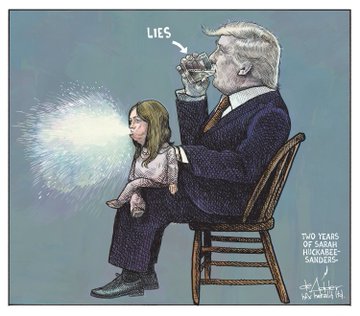
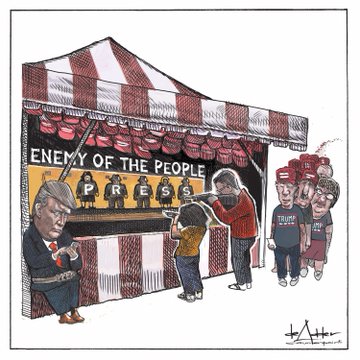
Everybody and his dog knows that I am no fan of Trump or the Irving Clan
but to be fair I must ask how on earth was the De Adder "cartoon"
remotely funny? I would not wish to be associated with the arsehole and
would have fired him too
Michael
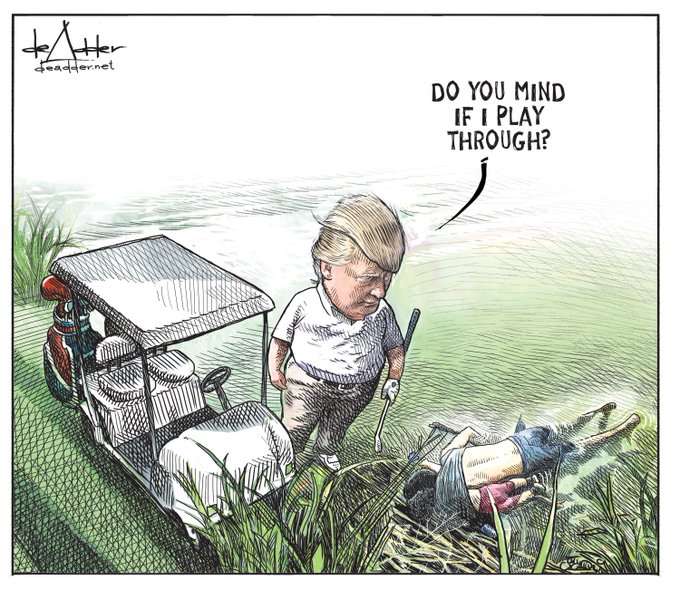
de Adder released this cartoon on June 26 of Donald Trump next to the
bodies of a father and daughter who died trying to cross the border into
Texas. (Michael de Adder)
Cartoonist Michael de Adder has been let go from Irving-owned
Brunswick News Inc. just days after his cartoon depicting U.S. President
Donald Trump playing golf next to the bodies of two migrants went
viral.
The cartoon, released on Wednesday, shows Trump looming
over Oscar Alberto Martínez Ramírez and his young daughter, Valeria,
who drowned while trying to cross into Brownsville, Texas.
The
original image of the Salvadoran father and daughter made headlines
early last week, bringing to light once again the issues around migrants
risking their lives to enter the U.S
"All they had to do was tell me why I was fired. They didn't tell me," de Adder said.
"No
matter how hard I pressed there were no answers given … I don't know if
it's about Trump, really. I think it's about Trump. It's the most
logical answer."
When he asked his editor whether it was a
cost-cutting measure, or his online social media or even "gross
incompetence," de Adder said, he was told no.
"I really wasn't interested in playing the role of disgruntled former employee."
Michael de Adder says he was never explicitly told why his contract with BNI was ending. (Mairin Prentiss/CBC)
BNI denies the claim that the reason for terminating its freelance contract with de Adder was the cartoon.
"This
is a false narrative which has emerged carelessly and recklessly on
social media. In fact, BNI was not even offered this cartoon," said the
company in a tweeted statement on Sunday.
"The decision to bring
back reader favourite Greg Perry was made long before this cartoon, and
negotiations had been ongoing for weeks."
But de Adder disputes BNI's reasoning and said he was told by the company that they would not run cartoons about Trump.
"It
got to the point where I didn't submit any Donald Trump cartoons for
fear that I might be fired," he said on Twitter, adding that in the past
two weeks he drew three viral Trump cartoons.
"And a day later I
was let go. And not only let go, the cartoons they already had in the
can were not used. Overnight it was like I never worked for the paper.
Make your own conclusions."
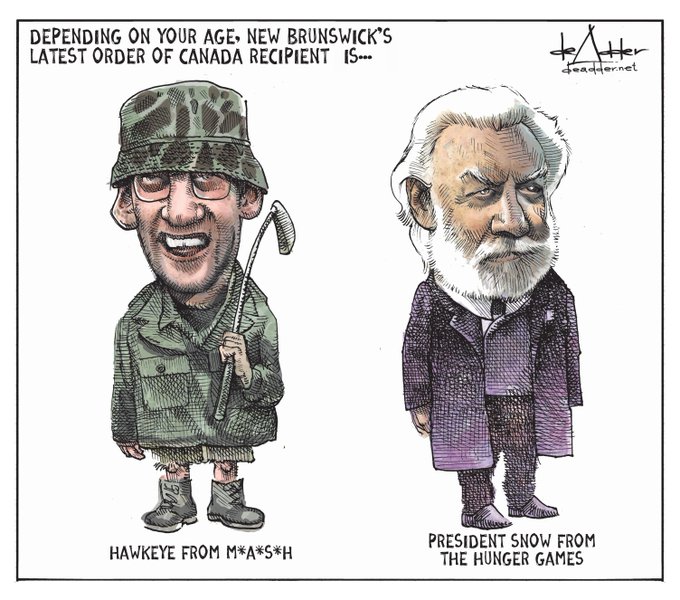
This was scheduled to appear today. Donald Sutherland receives the Order of Canada. He was born in New Brunswick. It was based upon a cartoon I did years ago for a book I did on the province. The fact that they didn't even run it is telling. All ties had to be cut ASAP.
On Twitter, de Adder also said that every Trump cartoon he submitted for the past year was axed.
This raised some red flags for Wes Tyrell, president of the Association of Canadian Cartoonists.
"This
is a smelly circumstance," Tyrell said. "Trump cartoons have been the
bread and butter for just about every publication out there since 2016,
2015. Why are they not running them?"
He said it's especially concerning to see editorial influence creeping up on cartoonists.
"To me, that's a form of censorship. And it's unacceptable."
Wes
Tyrell, president of the Association of Canadian Cartoonists, said the
timing of BNI letting go of Michael de Adder "was no coincidence." (CBC)
But de Adder said he doesn't believe it was entirely censorship.
"They wanted to manipulate the content," he said.
"The
Irvings don't want Justin Trudeau re-elected and they will not print a
cartoon that's slightly pro-Justin Trudeau. And they won't [print] a
cartoon that's slightly against Andrew Scheer."
He also said the
paper wouldn't run cartoons he drew of the province's premier,
Progressive Conservative leader Blaine Higgs, a former Irving Oil
executive.
'Disturbing' trend
Editorial influence over cartoonists is not just a trend in Canada.
Starting this month, the New York Times will stop running daily political cartoons in its international edition altogether.
Last year, staff cartoonist Rob Rogers was fired from his job at the Pittsburgh Post-Gazette for his depictions of Trump.
De Adder works in his home studio on Monday. (Mairin Prentiss/CBC)
"I
think it's really a terrible thing for a newspaper to start getting
involved in micromanaging the cartoonists," said Rogers, who noted the
trend was "disturbing."
"The president is dictating very negative
attacks on the media. He's calling us the enemy of the people. And I
believe that that is something that a newspaper publisher should be
fighting against."
Rogers
said in his case, the company was willing to sacrifice the following he
had built around his local cartoons "just to satisfy something that
they felt about the president. And I thought that was really tragic."
According to his website, de Adder freelances for the Chronicle Herald of Halifax, the Toronto Star and Ottawa Hill Times.
The hardest part in all of this,I have a mother with dimentia in NB who has a hard time remembering her family at times.But she knows her son draws cartoons. Part of her daily routine is to open the @TimesTranscript and see her son's cartoon.A cartoon that won't be there anymore.
In an emailed statement from the Ottawa Hill Times, editor Kate
Malloy said the paper will continue to work with de Adder "for many
years to come."
"He's one of the most talented editorial
cartoonists in the country. He pushes the envelope, but that's what a
great editorial cartoonist does," Malloy said.
Tyrell said who BNI chose as their new cartoonist is telling.
"No
disrespect to this other cartoonist at all, but this is an inoffensive,
non-provocative, run-of-the-mill individual, cartoon-wise. Mike de
Adder is an entirely different level," Tyrell said.
"He's undeniably the voice of New Brunswick."
But de Adder said he doesn't regret sharing the Trump cartoon.
"I regret that I won't have cartoons in newspapers in my hometown that friends and family can see."
I have a million texts, emails, dms, tweets, status updates, replies and phone messages. I just don't know where to start. I apologize to every reporter, news organization and television station that may have been under deadline and waiting for me to reply. No reception.
Emma
Davie is a reporter, web writer and videojournalist in Halifax. She
loves listening to, and telling stories from people in the Maritimes.
You can reach her at emma.davie@cbc.ca.
WIth files from Megan McCleister and Olivia Stefanovich
5157 Comments Commenting is now closed for this story.
Earl Higgins
The cartoon deserves an award not a firing.
David R. Amos
Reply to @Earl Higgins: I strongly disagree
If you were to imagine those were your loved ones in the water, I bet you would change your opinion.
Lori Patrick
The truth is often sad and tragic. This cartoonist captured what I was feeling.
Patrick Martin
Reply to @Lori Patrick:
Most media outlets in Canada are owned by Billionaires and US Hedge
Funds. Why do you think there is an agenda to cozy up to Trump, get
behind Harper and trash Trudeau and Singh?
It is pretty obvious why.
Patrick Martin
Reply to @Lori Patrick:
I meant Scheer, not Harper.
Dallas Wishnowski
Reply
to @Patrick Martin: Spot on pat! The billionaires really do hate
treadeau! He’s always cracking down on them, he truly is a man of the
people! Hahahahahahahahahahahahahahaha
David R. Amos
Reply to @Lori Patrick: "This cartoonist captured what I was feeling."
I see no humour in making a buck off of a tragedy
Tyler Earl
Reply to @Dallas Wishnowski:
treadeau? What's a treadeau?
Mike T
Reply
to @David R. Amos: He was there 17 years. He is a cartoonist--he
reflects what is going on in the world--in this case he was reflecting
Trump's prejudice which found expression in his immigration policy. Its
not an issue about "making a buck". Why is the right all of a sudden
concerned about "political correctness"?
Dallas Wishnowski
Reply
to @Tyler Earl: all you took from that was a typo.... Tyler the typo
police haha it’s a got a good ring eh smarty pants ?
David R. Amos
Reply
to @Mike T: Methinks everybody knows that I am NOT a right wingnut and
that I have run as Independent in 6 elections thus far because of my
contempt towards Harper and his Liberal,.NDP,.Bloc and Green cohorts. I
am also very outspoken against the Irving Clan (Check my comments in the
article today about NB Power) and their new buddy Mr Trump (Google
these words Trump NAFTA FATCA TPP Cohen David Amos) However as I said I
see no need for a cartoonist from my neck of the woods or the crybaby
Liberals everywhere to capitalize on the demise of a child and her
desperate father seeking a better life for his family.in the USA in
light of the fact Mr Prime Minister Trudeau The Younger would have
allowed them to walk illegally into Canada and he would have welcomed
them with opens arms and supported them on our taxpayer funds If the
Liberals care so much for the folks seeking a better life why not buy
them tickets in Mexico and fly them into Quebec rather than make fun of
the folks drowning in a Yankee river while Trump plays golf.
My point is not funny either N'esy Pas?
Mike T
Reply to @Patrick Martin: Same thing! LOLOLOL!!
Mike T
Reply
to @David R. Amos: How very nice, David. Clearly you hold right wing
views with regard to immigration. "Capitalizing" is not what the
cartoonist's motive was. You are taking an incident that happened in
Texas and using it to bash Trudeau on a hypothetical--who is
capitalizing here? Who is standing on their soap box now? :~) de Adder's
cartoon resonated deeply for a reason--these people were trying to
escape from El Salvador (one of the infamous blank hole country's Trump
listed). Perhaps you might have a little bit more sympathy for the
situation of you read about the US role in El Salvador, which in turn
motivated them to leave in search of a better life. At the very least,
you can (I would hope) appreciate the historical irony. "America's Role
in El Salvador's Deterioration" www.theatlantic.com/international/archive/2018/01/trump-and-el-salvador/550955/
David R. Amos
Reply
to @Mike T: Nope you are just part of a herd the crybaby noname
liberals bashing Trump for whatever excuse you can find which was fie by
me until lately. First it was the Huff Post and now CBC has chimed in
using this sad event. It has crossed the line of simple human decency in
my book. Methinks that is i all I will say on this topic so I can't
ever be ethically accused by a real person of what you just tried to
accuse me of N'esy Pas?
Mike T Reply
to @David R. Amos: Once again, David, thanks for making my point--you
are clearly a conservative trying to masquerade as an "independent".
Q.E.D.
David R. Amos Reply
to @Mike T: Many lawyers working for Harper and Trudeau knew that my
name had been on 6 ballots as an Independent when I sued the Queen in
2015. On the other hand your noname Liberal ID has only managed to
follow my comments into 3 threads and garner only 3 replies within one
Methinks your hero Mr Prime Minister Trudeau The Younger may remember me but definitely not you N'esy Pas?
Bruce Osborne
The
Irvings never liked anyone to criticize their empire. They own the
media in New Brunswick - radio, television and print. As they spread
their business tentacles further into the U. S. they don't want to
offend Americans and particularly the current very sensitive POTUS.
Shame on the Irvings.
David R. Amos
Reply
to @Bruce Osborne: Methinks everybody knows I am no fan of Trump or the
Irving Clan but because of this piece of work I have no respect for the
cartoonist Mikey de Adder or CBC for promoting it I suspect some would
agree that the Irvings were wise to be rid of Mikey if this comment is
even permitted to be posted N'esy Pas?
Mike T
Reply to @David R. Amos: If de Adder was so bad, why was he there 17 years?
Who's got the election message Canadians want to hear?
3097 Comments (Before I refreshed the page) Commenting is now closed for this story.
Mohamed Mohammed Anyone but Justin. He has got to go.
David R. Amos Reply
to @Mohamed Mohammed: Methinks everyone should vote for anyone except
the incumbent in their riding then we would have true change N'esy Pas?
Mo Bennett 1 outta 4 ain't bad. or was that 2 outta 3? call meatloaf.
David R. Amos
Reply to @mo bennett: YO MO Methinks yous should call your shrink before voting for Dizzy Lizzy and her crew N'esy Pas?
Mo Bennett ABRLNB !! anything but reformacons, liberals, ndippers, bloc.
David R. Amos Reply to @mo bennett: YO MO Methinks nobody cares N'esy Pas?
Mo Bennett hone their messaging? don't you mean bold faced inaccuracies?
David R. Amos Reply to @mo bennett: True
Mo Bennett hire a reformacon, it's fun to watch 'em wreck the place!
David R. Amos Reply to @mo bennett: YO MO why not give Dizzy Lizzy a few drinks and have a circus?
Mo Bennett vote green, sleep at night, save yer grand kids.
David R. Amos Reply to @mo bennett: Yea Right Tell us another one
John Smith No one cares anymore what Trudeau has to say and no one believes him anyway.
David R. Amos Reply to @John Smith: Methinks apathy rules the day and nobody cares what any of them have to say N'esy Pas?
Mike Crow They should ban attack ads.
Politicians should only say what their platforms is and that’s it.
Let us decide who is best.
David R. Amos Reply
to @Mike Crow: Methinks they should ban all ads because they irritate
most people. If folks truly wonder what the politicians are about they
can ask them rather than making the rest of us waste our precious time
being subject to their BS N'esy Pas?
Hermann Wendt Scheer
is the only one to get canada back on the right track. Trudeau has
failed at every turn and destroyed this country. He is incapable of
doing anything right we have the proof, nearly 4 years of total
failures. The other, other than the conservatives parties are no
better. Scheer will have a lot of repair work ahead of him as PM.
David R. Amos Reply to @Hermann Wendt: Methinks you jest too much N'esy Pas?
Rachael Saunders The
Trudeau Liberals do not understand that they cannot continue to tax
Canadians. The high cost of living has many Canadians just scraping by;
living paycheque to paycheque.
David R. Amos
Content disabled
Reply to @Rachael Saunders: Methinks you are running an ad within a comment section N'esy Pas?
BROCK Blakely Canada is setting records for capital investment moving out, those are facts and are not a good sign for the economy
David R. Amos Reply to @BROCK blakely: Methinks you should invest in where the money is going N'esy Pas?
Daryll Mcbain I am
voting Conservative. Taxes are up, we are alienated on the world stage
and Canada’s reputation has taken a huge hit with Trudeau at the helm.
David R. Amos Reply
to @Daryll Mcbain: Methinks whereas I finally have the right to do so
thanks to Mr Prime Minister Trudeau The Younger I should vote for me
N'esy Pas?
Mike Poska Let's take a poll on polls.
The only poll that counts is on election day when you head into your
local polling station and mark your X on the ballot. Get out and vote.
David R. Amos Reply to @Mike Poska: YUP
Rick Guthrie Let's see. A very unpopular PM and 3 way split on the Left. I'd say things are looking pretty good for Sheer.
David R. Amos Reply to @Rick Guthrie: NOPE
David R. Amos
Reply to @Rick Guthrie: Methinks everybody wants to forget Maxy Baby N'esy Pas?
Turner Jones Trudeau lost it when he chose Khadr over a widow and her two children.
David R. Amos Reply to @Turner Jones: Nobody cares about khadr
Who's got the election message Canadians want to hear?
CBC Poll reveals that health care, cost of living and climate change top voters' minds heading into election
Federal
party leaders - including, from left, the Greens' Elizabeth May,
Conservative Andrew Scheer, Liberal Justin Trudeau and New Democrat
Jagmeet Singh - face an electorate anxious about the cost of living and
concerned about the environment, according to a poll for CBC News. (Canadian Press/Associated Press photos)
As party leaders hone their platforms and messaging ahead of
this fall's election, the easy part is identifying the issues voters
care about. The challenge is convincing voters they are the best choice
for prime minister to deal with those same priorities.
Case in
point: while Justin Trudeau's Liberals are talking about the issues
Canadians say they care about most heading into the fall election, a
poll commissioned by CBC News suggests they aren't necessarily getting
credit for it.
The cost of living, climate change and health care
rank as the top-of-mind issues for Canadians surveyed, with concerns
about the affordability of home ownership and basic necessities like
groceries and retirement leading the list.
Those concerns help explain why the
Conservatives continue to focus their pre-campaign messaging on
pocketbook issues, attacking the Liberals' carbon-pricing system as a
tax on consumers while vowing to reduce emissions by imposing a cap on
the largest polluters to finance a green technology fund.
But the
poll also suggests Conservative Leader Andrew Scheer still has work to
do convincing voters he's in their corner. Just 41 per cent say they
believe he understands the average Canadian family.
The findings also point to an opening for the NDP and Green Party heading into the fall election campaign.
Although
two-thirds of the respondents believe New Democrats have lost their
way, the party remains the second choice among voters younger than 45,
and 46 per cent say they believe NDP Leader Jagmeet Singh understands
the average Canadian family.
Greens, on the other hand, are seen
as the most credible voices on climate change and a third of those
surveyed would consider voting Green to send a message to the
traditional parties.
NDP
Leader Jagmeet Singh, surrounded by fellow party-members, outlined a
platform that includes expanded health care during a speech at the
Ontario NDP Convention in Hamilton in June. Health care remains a
leading issue according to the poll. (Tara Walton/The Canadian Press)
The
online poll of 4,500 Canadians was conducted by Public Square Research
and Maru/Blue for CBC News between May 31 and June 10.
While polls
are considered snapshots in time, subject to change depending on new
developments, the themes and conclusions of this survey shed light on
how the political parties are faring in their voter outreach and
pre-campaign messaging.
"The numbers show the delicate balance the
parties need to strike, responding to voters' concern about climate
change and their ability to afford day-to-day costs," says CBC polls
analyst Éric Grenier.
"It's trickiest for the Liberals, who are
trying to appeal to both progressives, who care deeply about fighting
climate change, and the broader middle class. A lot of those voters live
in the suburbs, so they are worried about the costs of basic things
like commuting to work."
Financial anxiety and the middle class
For
example, the poll's finding that Canadians remain preoccupied with how
they will get by financially is consistent with a survey done by Finance
Canada after the 2018 budget.
It found middle-class Canadians
didn't feel their lives were getting better, despite the Liberals'
unrelenting messaging about "the middle class and those striving to join
it."
Prime
Minister Justin Trudeau and Finance Minister Bill Morneau have
positioned their tax and fiscal policies as supporting the middle class
"and those working to join it." But a poll for CBC News found anxiety
over the cost of living remains top of mind for many Canadians. (Sean Kilpatrick/Canadian Press)
It's
the sound bite Trudeau cabinet ministers offer up as they tout the
benefits of the government's "middle-class tax cut" and tax benefits
focused on families with children and low-income earners.
Still,
the Liberals remain undeterred. New French-language ads released just
this week resort to the same political messaging: "Justin Trudeau and
his team are focused on investing in the middle class."
While
health care is always a priority issue in election years, the poll done
for CBC finds that Canadians now rank climate change in the top three.
Nearly two-thirds of those surveyed say "our survival depends on
addressing climate change," or that climate change is "a top priority."
Pessimism on climate action
The
Liberals committed to reducing carbon emissions by 30 per cent below
2005 levels at the Paris climate conference four years ago. But many
leading climate scientists say they don't believe Canada can reach that
target, a sense of pessimism shared by most of those surveyed:
two-thirds said the government needs to do more to address climate
change.
"We know, just as smoking every pack of cigarettes causes
additional health damage, every additional gigatonne of carbon we
produce carries an additional cost," said Katharine Hayhoe, the director
of the Climate Science Centre at Texas Tech University, in an interview
with CBC Radio's The House airing this weekend.
"We
need the concrete details. We need people to take this seriously. They
[politicians] can disagree over what policy they propose or support. But
they have to be serious, meaningful policies with targets and goals to
cut our carbon emissions as soon as possible."
The poll also
offers some insight into the Conservatives' positioning on climate
change. Eight out of 10 respondents said they needed to know the party's
position on climate change, and just six per cent of respondents said
they don't believe in climate change.
This
month Conservative Leader Andrew Scheer delivered a vision for his
climate policy that includes a declaration that climate change is real -
an acknowledgement that may be important for the voters he needs to
attract in October. (Adrian Wyld/Canadian Press)
When party leader Andrew Scheer released his emissions-reduction plan last week,
he made a point of saying Conservatives believe climate change is real.
And the survey points to what the party must also know — that climate
change is a higher-priority issue in British Columbia and Quebec, where
the Conservatives must do better this fall than they did in 2015 in
order to win.
More than 40 per cent of respondents in those two
provinces list climate change as a top-of-mind issue, compared to less
than 30 per cent in the three Prairie provinces, where Conservative
support is traditionally strongest.
The poll also suggests
Canadians are less concerned about other issues championed by the
Conservatives in the recent past. Only 18 per cent list deficits as a
priority issue — suggesting Scheer's recent decision to scrap his
original promise to balance the books in two years might not be an issue
in the campaign — and just three per cent point to crime and public
safety as a priority.
Perhaps the biggest challenge facing all the
parties as they fine-tune their messaging for the fall election is the
one that they can do the least about.
The CBC survey suggests
Canadians' trust in government is low, with fully nine in 10 saying
politicians care more about staying in power than doing what's right.
CBC Politics' new weekly Canada Votes newsletter
Get
analysis from our Parliamentary bureau as we count down to the federal
election. Delivered to your inbox every Sunday evening – then daily
during the campaign. Sign up here. Commissioned
by CBC News, the Public Square Research and Maru/Blue survey was
conducted between May 31 and June 10, 2019, interviewing 4,500 eligible
voters. Respondents for this survey were selected from among
those who have registered to participate in the Maru Voice panel. The
data have been weighted to reflect the demographic composition of
Canada, according to Statistics Canada. Because the sample is based on
those who initially self-selected for participation in the Maru Voice
panel rather than a probability sample, no estimates of sampling error
can be calculated. However, a comparable probabilistic national sample
of 3,000 voters would have a margin of error of +/- 1.8 percentage
points, 19 times out of 20, while samples of 500 voters have a margin of
error of +/- 4.4 percentage points, 19 times out of 20.
The poll results referenced in this article came from the following questions, with answer options in brackets:
"Please
read the following statements about Andrew Scheer and the Conservative
party and indicate how strongly you agree or disagree with each. Andrew
Scheer understands what the average Canadian family is going through.
The Conservative party needs to tell us what their climate change
strategy is." (Agree strongly, agree somewhat, disagree somewhat,
disagree strongly)
"Please read the following statements
about Jagmeet Singh and the NDP and indicate how strongly you agree or
disagree with each. The NDP has lost its way. Jagmeet Singh understands
what the average Canadian family is going through." (Agree strongly,
agree somewhat, disagree somewhat, disagree strongly)
"Please
read the following statements about Elizabeth May and the Green
party and indicate how strongly you agree or disagree with each. I am
thinking of voting Greens to send a message to the traditional parties."
(Agree strongly, agree somewhat, disagree somewhat, disagree strongly)
"If
you had to say, how serious a problem is climate change?" (Our survival
depends on addressing it, it's a top priority, it's important, but not a
top priority, it's not a priority but we should do something to protect
the environment, I don't believe in climate change)
"Thinking
about the upcoming federal election in October specifically, which
issues are most concerning to you?" (Health care, climate change, cost
of living, jobs/the economy, housing affordability, home ownership,
government mismanagement, deficit spending, gun control, nobody to vote
for, immigration, terrorism, trade negotiations, rascism, the quality of
life in Indigenous communities, women's equality)
"What,
if anything, are you most worried about?" (My health/health of a family
member, cost of living, climate change, crime and public safety,
terrorism, my job/finding a job, immigration, international
relations/trade agreements, truth in the media, racism, social
inequality, none of these issues worry me)
"Please read
the following statements about issues in Canadian politics and indicate
how strongly you agree or disagree with each: Politicians care more
about staying in power than doing what's right." (Agree strongly, agree
somewhat, disagree somewhat, disagree strongly)
Ontario
Premier Doug Ford, a wealthy businessman who has used the term 'elite'
to disparage his political opponents, says elitism has nothing to do
with money. (Albert Leung/CBC)
This story is part of a series digging into the results of a CBC News-commissioned online poll of 4,500 Canadians ahead of the October federal election.
Between
bites of his free hamburger at last Saturday's Ford Fest celebration
north of Toronto — an annual barbecue hosted by the family of Ontario
Premier Doug Ford — 65-year-old Tony Laino provided a concise answer
when asked who he considers the "elites" of society.
"Those that think they're better than me," he said. "Because I don't espouse their beliefs."
That's one definition, anyway.
The
label "elites" seems to get flung around the political arena constantly
these days. It's become one of the dirty words of politics.
It's
also a term that resonates with many Canadians, particularly in an era
when political populism seems to be gaining ground. A new CBC poll
suggests nearly 80 per cent of Canadians either strongly or somewhat
agree with the statement: "My country is divided between ordinary people
and elites."
But what exactly does it mean? And why has it gained such traction as a political insult?
Tony
Laino, a retired information management consultant, says elites can be
defined as 'those that think they're better' than him. (Albert Leung/CBC)
"It's
become such an elastic term, it's become useless as a classification,"
said Sean Speer, a sessional instructor and senior fellow in public
policy at the University of Toronto's Munk School of Global Affairs and
Public Policy.
As history professor Beverly Gagenoted in a 2017 New York Times column,
the word is still seen in a positive light when used as an adjective —
an elite athlete, for example. But it takes on a nefarious meaning when
used as a noun and "has become one of the nastiest epithets in American
politics."
It's been used frequently by U.S. President Donald Trump,
but it's also been a rallying cry for many Canadian politicians,
including Ford and former prime minister Stephen Harper, who would often
take shots at the "liberal elite."
Historically,
the term "elite" seemed to have a connection to the rich. Politicians
of all stripes have often tried to show off their working-class bona
fides, regardless of their personal wealth.
In his initial foray
onto the political stage, former prime minister Brian Mulroney was
branded as the "Boy from Baie Comeau," Que., downplaying his role
as president of the Iron Ore Company of Canada, said Tim Powers,
vice-chairman of Summa Strategies, who served as the director of policy
and research for the Progressive Conservative Party of Canada.
Mulroney's former
Liberal rival, Jean Chrétien, who amassed great wealth in the private
sector and would also go on to become prime minister, was promoted as
the "little guy from Shawinigan."
"So it's always been there," Powers said. "I think the right really co-opted it with more vigour under Stephen Harper."
'We want to look average'
Powers
said by 2006, when the Conservatives under Harper were trying to unseat
Prime Minister Paul Martin, the party had done a lot of
research looking at how people identified themselves.
In an appeal to the middle class, he said, the Conservatives ran a series of what can be described as low-budget commercials.
"The
whole plot point of those commercials, as I recall hearing the
rationale behind the advertising, was, 'We want to look average. So, not
elite. We want to contrast ourselves to Paul Martin, the shipping
magnate."
The term, or concept anyway, would continue to be used
to score political points. Another of Harper's Liberal opponents,
Michael Ignatieff, was portrayed as an out-of-touch elitist in the 2011 federal election.
Current Prime Minister Justin Trudeau has had to deflect barbs from the Tories about being a "trust fund baby."
"It's been
pretty commonplace because most people would prefer to self-identify as
being with the 'us' as opposed to the 'them,' because the 'them' are
the elites and the people who get an advantage," Powers said.
He
suspects the increased potency of going against the so-called elite in
recent years comes from the reaction of people who have "drank the
populist elixir" for their concerns about globalism, economic
inequality, and being left out of jobs and opportunity.
"I think
it's become more and more politically valuable to talk about elitism,"
he said, "because it also now means you recognize there is an advantage
afforded to elites that wasn't there before."
The same CBC
poll suggests 52 per cent of Canadians either strongly or somewhat
agree with the statement: "The government doesn't do anything for me."
During
the 2011 federal election, the Conservatives tried to portray Liberal
Leader Michael Ignatieff as an out-of-touch elitist. (Adrian Wyld/The Canadian Press)
Speer, who was the research assistant on Harper's book Right Here, Right Now: Politics and Leadership in the Age of Disruption, suggested
one segment of the population feels particularly ignored by the
political system — people without a post-secondary education.
And populist politicians like Trump have been able to tap into their frustrations and fuel the divide, he said.
Nothing to do with money
But Speer believes the results of the CBC survey may reflect a confusion about what's happening in this country.
"I
think people would be shocked to discover where they fit in the broader
Canadian society," he said. "A significant number of them, based on
income status, would be quote, unquote elite."
However,
that's where the subjectivity of the term comes into play. Would
"elite" not apply to the same wealthy politicians like Ford and
Trump who use it to disparage their opponents?
Laino, the Ford Fest attendee and a retired information management consultant, says no. It doesn't have to do with money.
"Donald Trump is a super wealthy guy and he's not an elite by any means," he said. "It's attitude."
Ford made similar comments when asked to define the term while appearing on CBC's Metro Morning in March 2018.
WATCH| Doug Ford provides his definition of the "elite"
Newly elected Ontario Progressive Conservative leader Doug Ford speaks with Metro Morning guest host David Common. 9:07
"People
that look down on the common folk, the people that think they're
smarter than other people ... they just think they're better, they're
smarter, and they can tell the common folk how to live their lives," he
said. "And they drink their little bottle or glass of champagne with
their pinky up in the air. That's what an elite is."
Elitism has
nothing to do with money, Ford said. "Half of them don't have two
pennies to rub together. They think they're something that they aren't."
But
Amanda Galbraith, a principal with the public strategy and
communications firm Navigtor Ltd., said the word may actually be losing
some of its political punch.
"I do think it's kind of reached the
point now where it is sort of white noise, because who
defines elites? Everybody's using the term."


 Michael de Adder says he was never explicitly told why his contract with BNI was ending. (Mairin Prentiss/CBC)