Saturday, 7 December 2019

Cyber intelligence??? Too Too Funny Indeed

https://twitter.com/DavidRayAmos/with_replies


Replying to and  49 others
Cyber intelligence??? Too Too Funny Indeed


https://www.cbc.ca/news/politics/cse-recruitment-vacancies-1.5378493


As its powers grow, cyber intelligence agency looks to fill hundreds of job vacancies

'We have a lot of vacancies because we're growing massively,' says CSE's top recruiter


Catharine Tunney · CBC News · Posted: Nov 30, 2019 4:00 AM ET


An analyst looks at code in the malware lab of a cyber-security lab. The Communications Security Establishment says it's struggling to find qualified staff. (Jim Urquhart/Reuters)

Canada's foreign signals intelligence agency says it's struggling to find Canadians to fill vacancies as it grows its presence online.

The Communications Security Establishment (CSE) grew another head last year when it launched the Canadian Centre for Cyber Security.

The centre leads the government's response to cyber security events, defends Ottawa's cyber assets and provides advice to Canadian industries, businesses and citizens on how to protect themselves online. An average day can see the hub's team block more than 100 million malicious infiltration attempts.


Those responsibilities ramp up the pressure on CSE to hire the best hackers and codebreakers Canada's universities can supply. A number of internal CSE employees also shuffled over to the centre to get it up and running, creating vacant positions.
"We don't necessarily know all our needs right now. We have a lot of vacancies because we're growing massively," said Bruno Gervais, supervisor of the Communications Security Establishment's recruitment team. He made a presentation at a career fair in Ottawa Friday aimed at recruiting people in the intelligence and security fields.

"We don't have enough technical candidates for a number of positions we have. This is a bigger challenge."

Gervais said CSE needs to hire about 150 full-time employees next year and roughly 300 students to fill those gaps.


The secretive Communications Security Establishment (CSE) is headquartered at a complex in Ottawa. (Sean Kilpatrick/Canadian Press)

To work for the CSE, an applicant has to be a Canadian citizen and pass a top secret clearance process, and cannot have a criminal record. The stringent background check alone can take more than a year to complete.

The CSE's first pitch session Friday morning was packed, with roughly 150 people jammed into limited seating and dozens of others standing in the back to hear the recruiters' pitches.


The audience was split between students and grey-haired veterans. Some wore suits. Others sported hoodies and bedhead.

Low hiring ratio


Gervais said that for every 100 applications he gets, only one will make it through the process — two if he's lucky.

The CSE isn't alone in its struggle to hire new recruits.

Canada's spy agency, the Canadian Security Intelligence Service (CSIS), has flagged issues with recruitment and retention, while the Royal Canadian Mounted Police has also cited its need to hire more cyber experts.

Both agencies also had booths at this year's career fair, along with the Financial Transactions and Reports Analysis Centre of Canada (FINTRAC, which deals with financial intelligence) and Public Safety Canada.

"There's a lot of competition. All the Googles, Facebooks, Amazons and all these startups. The demands are really high. The universities are kind of adjusting right now," said Gervais.
"Most of the companies have the same problem right now, not just in the government. The fact that we're looking for Canadian citizens doesn't help because there's a lot of non-Canadians in all these programs in universities."

The CSE has tried to get creative with its recruitment strategies. In the fall it partnered with an Ottawa-based company that runs recreational "escape rooms"; those who escaped the demo room on time and cracked a bonus puzzle got a chance to meet with a CSE recruiter.

"We still have a problem letting people know who we are," said Gervais. "The biggest barrier for us is people don't know who we are."


231 Comments
Commenting is now closed for this story.


David Amos
Cyber intelligence??? Too Too Funny Indeed 


https://www.cbc.ca/news/politics/nato-summit-trump-article-5-mutual-defence-1.5378235


NATO marks 70 years with mutual suspicion and insults

Doubt in the era of Trump: will the U.S. step up when the chips are down?


Evan Dyer · CBC News · Posted: Dec 01, 2019 4:00 AM ET


U.S. President Donald Trump attends a meeting of the North Atlantic Council during a summit of heads of state and government at NATO headquarters in Brussels July 11, 2018. (Geert Vanden Wijngaert/The Associated Press)


After weeks of watching supposed allies trade allegations of betrayal and of insulting each others' troops, delegates to the NATO Summit in London this week might be wondering who their friends are these days.

But bitter as the recriminations have been, there's an even bigger cloud hanging over the summit: doubts about the fundamental principle of trust upon which NATO was built 70 years ago.

For decades, the 29 countries making up NATO have been reassured by the treaty's ironclad guarantee of mutual defence in Article Five of its founding charter: "an armed attack against one or more of them in Europe or North America shall be considered an attack against them all."


But in the era of U.S. President Donald Trump, governments now have doubts about the United States' commitment to Article Five. The mutual defence clause has only ever been invoked once — by Canada on behalf of the U.S. in the immediate aftermath of the September 11, 2001 terrorist attacks.

The 158 Canadian soldiers and seven Canadian civilians who lost their lives in Afghanistan died upholding Article Five. The NATO alliance only works when members trust that others will answer when the call comes.

Military analyst Dave Perry of the Canadian Global Affairs Institute said NATO allies still trust the U.S. military, American institutions and the individual Americans they work with in the alliance.

"The concern is really about a president who keeps demonstrating, over and over again, that he has a very different view of how America should be relating to its allies," he said.

"The American president has left the impression at times that he's got better relations with the Russian president than he does with some of the heads of NATO allies in Europe or even Canada."

A legacy of disloyalty


Ivo Daalder, president of the Chicago Council on Global Affairs, was the U.S. permanent representative on the NATO Council for four years under President Barack Obama.


He said President Trump has undermined the alliance by sowing doubts about America's intentions.

"He has said many times that NATO is obsolete. He refused for the first six months of his presidency to reaffirm Article Five, and has called into question whether the United States should continue to be a member of NATO if the allies are not willing to spend more on defence," he said.

"It's those kinds of questions that lead allies to say, 'If the chips are down, will the U.S. be there?' And there's less confidence about that today than there used to be."


Kurdish forces withdraw from an area near Turkish border with Syria, overseen by the Russian forces, near the town of Amuda, Sunday, Oct. 27, 2019. (Baderkhan Ahmad/The Associated Press)


Daalder said Trump has undermined that trust through both his words and his actions.

"President Trump has taken a number of steps, including abandoning his Kurdish allies in Syria, that would call into question his commitment to alliance relationships," he said.

Perry agrees that the betrayal of the Kurds sent a shiver through the Western alliance.

"It's not just that the United States bailed out on the Kurds, because I think we've seen a version of that movie before. It's the no-notice way of doing it, and the fact that the president would make these kinds of decisions not only capriciously, but also appearing to have totally ignored any advice that he did bother to solicit," he said.

"The president's whims are increasingly being translated into tangible outcomes. People have been speculating for several years that the president will send some tweets, but then the 'grown-ups' will prevail. I think the Syria example shows that the 'grown-ups-prevailing' narrative may be coming to an end."

Fighting with France


While some European leaders expressed their doubts in private, France's President Emmanuel Macron made his public in a recent interview with The Economist. In it, Macron said NATO was suffering "brain death" and openly questioned Article Five.

Daalder said the French leader's concerns about the United States' reliability as an ally may be affected by his own ambitions to lead Europe.

"My reading of President Macron's latest statements are back in this Gaullist perspective that France needs to lead Europe," he said. "I'm gratified that the reaction to that from allies within Europe has been to say, 'Don't call into question the fundamental nature of the alliance with the United States, and indeed with Canada,' while at the same time trying to say how can we do more ourselves within a European context."
 

Turkey's President Recep Tayyip Erdogan, right, shakes hands with French President Emmanuel Macron during the G-20 summit in Osaka, Japan June 28, 2019. (The Associated Press/Presidential Press Service)


On Thursday, Macron defended his harsh language and expanded on it.

"The questions I have asked are open questions that we haven't solved yet — peace in Europe, the Intermediate-Range Nuclear Forces Treaty, the relationship with Russia, the issue of Turkey," he said.

 "Who is the enemy?

"So I say, as long as these questions are not resolved, let's not negotiate about cost-sharing and burden-sharing, or this or that. Maybe we needed a wake-up call, as they say in English. I'm glad it was delivered, and I'm glad everyone now thinks we should rather think about our strategic aims."
But the U.S. does want to talk about cost-sharing; in fact, the Trump administration announced unilaterally this week that it intends to cut its contribution to NATO's total budget from 22 per cent to 16 per cent. Other members, including Canada, will have to pick up the slack.

Feuding with Germany


It's a feature of NATO that the closer its members are to Russia, the more likely they are to meet the desired threshold of spending at least 2 per cent of GDP on defence.

Bulgarian Prime Minister Boyko Borissov, while visiting President Trump in the Oval Office on Monday, made a point of noting that his country spends 3.1 per cent of its GDP on defence.

"You should tell that to Germany," Trump huffed.

Trump has singled Germany out for failing to spend enough on the alliance, although his administration also is pressuring Canada.
 

German Chancellor Angela Merkel, left, and U.S. President Donald Trump pose for a photograph prior to a bilateral meeting on the sideline of a summit of heads of state and government at NATO headquarters in Brussels July 11, 2018. (Markus Schreiber/Associated Press)


In the run-up to the NATO summit, the U.S. and Germany have been feuding over another topic familiar to Canadians: Huawei.

Like their Canadian counterparts, Germany's leaders are wrestling with whether to permit the Chinese company to bid on contracts to build its 5G networks. Berlin has been subjected to a pressure campaign by Washington to ban Huawei as a potential security risk.

On Sunday, German minister Peter Altmaier recalled during a TV debate that it was the Americans — not the Chinese — who were caught spying on Germans through the PRISM program exposed by Edward Snowden in 2013.

Pointing out that Germany had not boycotted the U.S. companies that facilitated that spying, Altmaier reminded Germans that "the U.S. also demands from its companies that they pass on information."

Back in 2013, when German Chancellor Angela Merkel personally reproached President Obama about the bugging of her phone, he apologized and promised to make changes to the program.

U.S. Ambassador Richard Grenell said Altmaier's remarks were "an insult to the thousands of American troops who help ensure Germany's security and the millions of Americans committed to a strong Western alliance."

Turkey: With friends like these….


Meanwhile, Turkey continues to behave more like an adversary than a member of the NATO alliance, doubling down on its arms purchases from NATO's main strategic rival Russia — and threatening other members with sending jihadists captured in Syria back to their European countries of origin if their governments don't stop complaining about Turkey's actions in Syria.

Turkey has depended on President Trump to shield it from U.S. retaliation over its attack on Kurdish enclaves in Northern Syria, which infuriated both Republicans and Democrats. At the same time, it has counted on Trump to block enforcement of a U.S. law that requires Washington to impose sanctions on Turkey for installing Russian-made S-400 air defence systems.
On Thursday, Turkish Foreign Minister Mevlut Cavusoglu castigated Macron for hosting a delegate from the Kurdish YPG last month.

"He is already the sponsor of the terrorist organization and constantly hosts them at the Elysée. If he says his ally is the terrorist organization ... there is really nothing more to say," said Cavusoglu.

"Right now, there is a void in Europe. [Macron is] trying to be its leader."

'You are brain dead'


Macron shot right back, arguing Turkey's attack on the Kurds was at cross-purposes with NATO's mission to defeat the Islamic State.

"One cannot say on one hand that we're allies, and consequently demand our solidarity, and on the other hand put one's allies in the face of a military offensive delivered as a fait accompli that endangers the action of the coalition against the Islamic State," he said.

And on Friday, Turkish President Recep Tayyip Erdogan upped the stakes again, accusing "some countries that are accustomed to not taking risks and always winning" of being unable to "tolerate Turkey's efforts to protect its own rights, laws, borders and sovereignty. Most particularly, the latest comments of French president are the examples of this sick and shallow understanding.
"[Macron] says NATO is experiencing a brain death. I'm addressing Mr. Macron from Turkey and I will say it at NATO: You should check whether you are brain dead first."

Pardoning war criminals


As if the rancour wasn't enough, Perry said that President Trump is sowing new doubts by pardoning convicted war criminals.

"For all its warts, the U.S. has long been an upholder of the laws of armed conflict. For him to be intervening in that process of maintaining order and discipline is extraordinarily troubling," he said, citing Trump's recent decision to intervene in a disciplinary case against a Navy SEAL accused of war crimes in Iraq.

"From allies' perspective, it's another piece falling on top of the Syria withdrawal. It's increasingly uncertain what the United States stands for. You're not as sure now what it means to contribute to an American military operation as you would have been even a year ago."


About the Author


Evan Dyer
Senior Reporter
Evan Dyer has been a journalist with CBC for 18 years, after an early career as a freelancer in Argentina. He works in the Parliamentary Bureau and can be reached at evan.dyer@cbc.ca.


4470 Comments
Commenting is now closed for this story.


Alex Matheson
Is it just me or has this world become a much uglier place since Trump became president. If he wins again in 2020 what will that mean for the rest of us? Nothing good I'm afraid.  


David Amos
Reply to @Alex Matheson: Methinks Trump is just the latest in along line of puppets working for the taxman. The Yankees lost their independence from British banksters on December 23, 1913 with the enactment of the Federal Reserve Act. 100 years later Obama and his cohorts renewed the malicious contract N'esy Pas? 


Garry Cyr
The US is a mess. Can't wait for Trump and his Republican hacks, especially McConnell and Nunes, to be tossed out.  


David Amos 
Reply to @Garry Cyr: Trust that I am no fan of Trump but I have questioned the existence of NATO since the Iron Curtain was no more. That said I must ask how many Canadians working for NATO were killed before Trump was elected? How many have died since? 


Grace Oliver
Didn't take long for Trump to destroy his country's reputation and damage the alliances of the West.
Putin must be delighted with his investment.


David Amos   
Reply to @Grace Oliver: Were any weapons of mass destruction found in Iraq yet?


Ottawa accepts Alberta's new $30-per-tonne carbon plan for large emitters in 2020

https://twitter.com/DavidRayAmos/with_replies


Replying to and  49 others
Methinks the Circus begins again with Kenney being the first clown to seize the spotlight N'esy Pas?


https://www.cbc.ca/news/canada/calgary/ottawa-accepts-alberta-tier-plan-carbon-pricing-1.5386955


Ottawa accepts Alberta's new $30-per-tonne carbon plan for large emitters in 2020

'Made-in-Alberta' plan will apply to industry; federal carbon tax — and rebates — will apply to consumers


Robson Fletcher · CBC News · Posted: Dec 06, 2019 10:48 AM MT


Prime Minister Justin Trudeau's federal government has accepted a carbon-pricing plan for large-emitting industries developed by the government of Alberta Premier Jason Kenney. (Justin Tang/The Canadian Press, Kyle Bakx/CBC, Amber Bracken/The Canadian Press)

The federal government will accept the Alberta government's latest plan to tax the greenhouse gas emissions of large industrial facilities at a rate of $30 per tonne in 2020.

Federal Environment Minister Jonathan Wilkinson said Friday his department agrees that Alberta's system will meet federal requirements for large emitters like oilsands operations, natural gas producers, chemical manufacturers and fertilizer plants.

All told, the province estimates these types of heavy-emitting facilities account for 55 to 60 per cent of Alberta's greenhouse gas emissions.


This system runs in parallel to the federal fuel charge — commonly known as the carbon tax — that applies to individual consumers and smaller-emitting companies.
Alberta already has a carbon-pricing system that charges large emitters at a rate of $30 per tonne. It was brought in by the previous NDP government. The new United Conservative Party government plans to modify that system, however, starting on Jan. 1.

While the carbon price will remain at $30 per tonne, that price only effectively applies to emissions above a target level.

Change in emissions targets


The new plan, known as the Technology Innovation and Emissions Reduction (TIER) regulation, will make it easier for some of the most carbon-intensive facilities to hit their emissions targets, thereby avoiding the tax and potentially earning credits for coming in below target.

That's because the current targets are set at an industry-wide level — meaning all oilsands facilities, for example, are held to the same emissions standard — while TIER will create individual targets for each facility based on its emissions levels from the recent past.

The province estimates that switching to the new system will save industry more than $330 million in avoided compliance costs in 2020.

The change in targets will apply to all industrial categories except electricity generation.
Alberta Environment Minister Jason Nixon said Friday he was pleased by Ottawa's decision to accept the "made-in-Alberta" carbon-pricing system.

"When we engaged with industry on TIER in summer 2019, we heard loud and clear that they want to be regulated by the province, not by Ottawa," Nixon said in a release.

The Canadian Association of Petroleum Producers (CAPP) issued a statement that also praised the "made-in-Alberta" plan.

"This program has the components to ensure both Alberta's large and small oil and natural gas operations remain competitive, while clearly satisfying the requirements set by the federal government," said Terry Abel, CAPP's executive vice-president of operations and climate.

Alberta will 'oppose' $40 price in 2021


Current federal rules will require the price on carbon to rise to $40 per tonne in 2021 and $50 per tonne in 2022.

Premier Jason Kenney said Friday his government would "oppose that measure" but won't necessarily flout it.
"We'll have to make a prudent judgment when we get closer to that date," Kenney told reporters. 

"Because one thing we don't want is the federal government bigfooting into Alberta and enforcing their own, separate regulatory regime."

The federal government plans to impose its carbon tax on the consumer-level sale of fossil fuels starting in 2020.

Carbon tax — and rebates — coming Jan. 1


Under its previous NDP goverment, Alberta had a consumer-level carbon tax that met federal requirements, but Kenney's UCP government killed that carbon tax as one of its first acts after being elected in April.

The federal "backstop" on carbon pricing, however, means Ottawa's carbon tax will apply to the purchase of fuels like gasoline, natural gas and propane in Alberta as of Jan 1.

Albertans will also start receiving carbon-tax rebates in the new year, which the federal government says will offset the increased cost for most households in the province.

Those rebates will be calculated as follows:
  • $444 for a single adult or the first adult in a couple.
  • $222 for the second adult in a couple. Single parents will receive this amount for their first child.
  • $111 for each child in the family (starting with the second child for single parents).
The rebate amounts are fixed. You get the same amount regardless of how much carbon tax you pay.
Economists say this helps alleviate the burden of the tax while also maintaining the incentive to consume less fossil fuel, since the less you burn, the less you pay.

That will also be applied at a rate of $30 per tonne in 2020, which works out to 6.63 cents per litre of gasoline.

About the Author


Robson Fletcher
Reporter / Editor
Robson Fletcher joined the CBC Calgary digital team in 2015 after spending the previous decade working as a reporter and editor at newspapers in Alberta, British Columbia and Manitoba.
With files from the The Canadian Press


CBC's Journalistic Standards and Practices


1657 Comments 


Malcolm Scott
"Alberta already has a carbon-pricing system that charges large emitters at a rate of $30 per tonne. It was brought in by the previous NDP government."

News Flash: Ottawa accepts NDP plan.....


David Amos
Reply to @Malcolm Scott: YUP Methinks the Circus begins again with Kenney being the first clown to seize the spotlight N'esy Pas? 


Christian Lopez
First, Kenney scrapped the NDP's carbon tax, and railed against the Fed consumer carbon tax; then he planned to implement a carbon tax of his own on energy producers in 2020. Now he's agreed to the Fed's consumer carbon tax which he vehemently opposed along with Scheer, Moe and Ford. Does any of this make sense? The Cons just don't seem to know what they're doing. In Scheer's first appearance in the new parliament, he was screaming that the Fed carbon tax must be scrapped, while at the same time his best buddy Kenney was accepting the Fed tax for AB. Was Scheer left out of the loop on this?


David Amos 
Reply to @Christian Lopez: Methinks Scheer should have known enough not to trust any of his old buddies by now N'esy Pas?


Adrian Williams
Taxing natural gas, the cleanest fuel of all and the reason we can live in these very cold climates is plain stupid


David Amos
Reply to @Adrian Williams: I concur


Tyler J
We should applying triple the carbon tax on imports.


David Amos
Reply to @Tyler J: YUP


David Sampson
Good, now Alberta can stop campaigning on behalf of Scheer, the election is over, Scheer lost. Time for Alberta to get it’s ducks in a row.


David Amos
Reply to @David Sampson: Dream on


Tara Sundberg
Most of the people complaining will be getting back more than they spend. It's astonishing how ill informed people insist on being.

Meanwhile those of us who care about the future are making small and big changes to ensure a safe environment for our children. You're welcome.


David Amos
Reply to @Tara Sundberg: Methinks you should back away from the red kool aid table for a while N'esy Pas?


Sydney Mines
Ottawa accepts Alberta's new $30-per-tonne carbon plan. 
Congrats to former Premier Notley.
Your thoughts Premier Kenny.


David Amos
Reply to @Sydney Mines: Good luck getting an answer


Glen Robert
While we are paying a carbon tax companies can import goods from heavy emitting countries and they are assessed no carbon tax


David Amos
Reply to @Glen robert: Oh So True


David Smythe
There you go Alberta. You now have a Jason Kenney Carbon tax + the wasted money fighting it in the courts.


David Amos
Reply to @David Smythe: Methinks Jason Kenney just made a major faux pas N'esy Pas?


Andrew Scheer doesn't seem to be quite done fighting the election yet

https://twitter.com/DavidRayAmos/with_replies


Replying to and  49 others
Methinks everybody knows that Harper 2.0 became irrelevant as soon as his old buddy MacKay spoke about the election result N'esy Pas?


https://www.cbc.ca/news/politics/andrew-scheer-justin-trudeau-2019-election-1.5387126


Andrew Scheer doesn't seem to be quite done fighting the election yet

Back in opposition and under pressure in his own party, Scheer suggests that Trudeau was the one who lost


Aaron Wherry · CBC News · Posted: Dec 06, 2019 5:04 PM ET


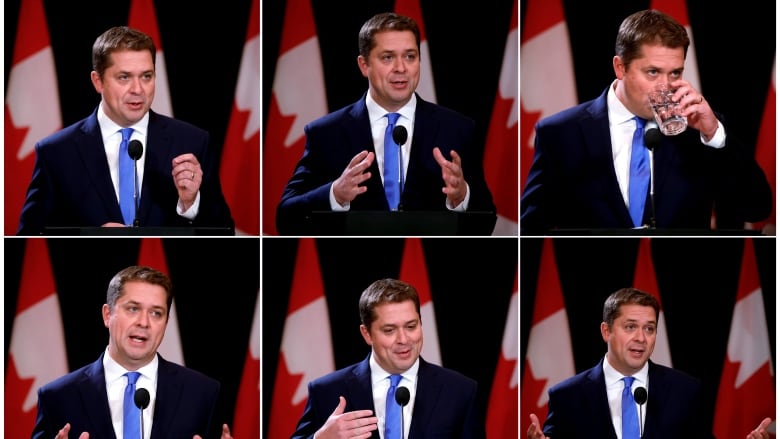
Conservative Leader Andrew Scheer speaks at a news conference the day after he lost the federal election to Justin Trudeau in Regina, October 22, 2019. (Todd Korol/Reuters)

Two men in need of redemption stood across from each other in the House of Commons on Friday.

The first man looked upon the other and declared himself disappointed to see that nothing had changed. The second man rose and made a point of showing that he would be taking a slightly altered approach, at least to this particular moment.

Between these two men — the leader of the Opposition and the prime minister — there's the question of what should change in federal politics in response to the results of the October election.


Through that election, Andrew Scheer argued, "the people sent a clear message to all of us."
"That the status quo had failed. That the approach of the previous four years just wasn't good enough," Scheer said. "Canadians want better."

Specifically, he said, Canadians rendered a verdict on the Liberal government of Justin Trudeau. The "talking heads and pundits" might be trying to dissemble the result, Scheer said, but the Liberals had lost seats and votes.

And while Trudeau hinted at changing his approach in the weeks following the election, Scheer said he sees the throne speech as too much of the same-old.


In his response to the throne speech Friday, Conservative Leader Andrew Scheer warns that politicians across the country should "not underestimate the deep alienation and anger" being felt by Canadians who live in Saskatchewan and Alberta.  0:43

"Yesterday, in the speech from the throne, [Trudeau] revealed that he hasn't learned a thing, that he hasn't changed at all," he said. "Even though the people of Canada sent a message that they demand better ... They demand a fundamentally new approach from a government that is prepared to rise to this moment in history."

Maybe Canadians did demand a new approach. But they were at least as loud in not demanding a Conservative government led by Andrew Scheer. Which is where the glaring irony in Scheer's analysis lies.


Justin Trudeau's party won 157 seats. Scheer insists that Trudeau must change his approach to government and his policies, markedly and substantively, as a result.

Scheer's party won 121 seats and Scheer is adamant that he doesn't need to change — except to the extent that his party needs to communicate better and hire better advisers.

Re-litigating October while looking ahead to April


Aside from some artful comments about the honour of occupying a seat in the House of Commons and a new focus on national unity, most of Scheer's remarks resembled a reprise of the fall campaign.

 Possibly because the campaign hasn't really ended for Scheer.

"Over the past several weeks, there's been a chorus of voices from elite corners of Canadian high society demanding that our party endorse the carbon tax," Scheer told the House on Friday. "Well, let me be clear, Mr. Speaker, we will always oppose a carbon tax because we know the real cost it imposes on the Canadian people."

Members of the Conservative Party will be asked in April whether they'd like to change leaders. Scheer apparently has decided that his best chance of surviving that vote is to put the onus on Trudeau and acknowledge his own need for change as little as possible — particularly when it comes to climate policy.

That sort of obstinacy on the major policy issue of the day could doom the Conservative leader in the next general election. That assumes, of course, that Scheer will still be the Conservative leader in May.

Has Trudeau changed his tune?


Rising to respond to Scheer, Justin Trudeau told the House that his office had written him a speech for this occasion — a "very excellent speech," Trudeau claimed — but he would not be reading it.

The speech had been written a day before, but Trudeau said it was important for MPs to listen to each other and he decided instead to actually listen to what Scheer had to say and respond to what he heard.

"I know that we need a new approach — we all need to take a new approach here — and I appreciate the opportunity to be able to make some remarks rather than simply reading a speech that reiterates everything that we want to do together," Trudeau said.
 

Prime Minister Justin Trudeau responds to a question during Question Period in the House of Commons Friday December 6, 2019 in Ottawa. (Adrian Wyld/THE CANADIAN PRESS)

The decision to eschew the prepared remarks was apparently taken about 20 minutes before Trudeau spoke.

There were no great surprises in what followed, but it was different from the usual Trudeau product — a little less lofty, slightly more direct. Without a script, Trudeau was nimble enough to note that Scheer had neglected to mention Indigenous reconciliation or any area of health policy in his remarks. He pointed to what he called the similarities between the Liberal and Conservative tax cut proposals. And he attempted to parry Scheer's criticism of the federal carbon price.

"If he is serious about reducing people's anxiety about the future, if he was serious about reassuring Canadians in their ability to tackle new challenges and support their families, it would be good if we were able to lay out the actual facts of what our plan for putting a price on pollution means for Canadians across the country," Trudeau said, pointing out that the average family is expected to receive a rebate that exceeds the added cost of the carbon levy.
The performance had something in common with Trudeau's showing at the National Press Theatre two days after the election. In both cases, there seemed to be just a bit less artifice on display.

Between that news conference in October and his appearance in the House on Friday, Trudeau was noticeably less prominent (with the notable exception of that cocktail reception at Buckingham Palace). And his two public forays to date have displayed a different tone.

If Trudeau's style and manner has been grating on some voters, this might be the appropriate response.

Such things may change. But Trudeau's wager might be that his party's election result had less to do with what it set out to do, and more to do with how it went about it — the brutal messes they made when they weren't being careful.

Scheer might complain that Trudeau should be changing a lot more than that. But Trudeau might believe that — at least as long as it's Andrew Scheer standing across from him — he doesn't need to reinvent himself so much as he needs to clean up his act.

About the Author


Aaron Wherry
Parliament Hill Bureau
Aaron Wherry has covered Parliament Hill since 2007 and has written for Maclean's, the National Post and the Globe and Mail. He is the author of Promise & Peril, a book about Justin Trudeau's years in power.


1572 Comments


Helen MacKinnon
Andrew seems to think that the louder he rants and the harder he pushes, the stronger he appears. He is wrong.


David Amos
Reply to @Helen MacKinnon: Methinks everybody knows that Harper 2.0 became irrelevant as soon as his old buddy MacKay spoke about the election result N'esy Pas?


Ferd Roseboom
Reply to @David Amos: He never was relevant. He's the Cons' Michael Ignatieff, someone who just hasn't figured out how to play the game yet, or, as Harper put it, "Just not ready."


Richard Sharp
Reply to @Helen MacKinnon:
Have to say I’ve been preaching that Harper’s (and now Scheer’s) inherent, incessant nastiness would be their undoing because Canadians get sick of that stuff. And we put up with Don Cherry for decades!


David Amos
Reply to @Richard Sharp: Methinks whereas the Bloc rules the roost you don't have much to gloat about today N'esy Pas?


Casey Jay
The extreme right in Canada think they can turn this country into a clone of the USA under Trump.

Good luck with that Andy. 


Franz Pökler
Reply to @Scott Bullerwell:
I am. I li vs e in Quebec. When was the last PM from Alberta? Remind me please... 


David Amos
Reply to @Franz Pökler: Methinks you will say close but no cigar but the lawyer I call Landslide Annie who is a former Deputy Prime Minister from Alberta has been advising Trudeau The Younger since the SNC/Wilson affair and just helped to pick his cabinet and his new Deputy Prime Minister N'esy Pas?


Bill Dixon
Reply to @David Amos: Fergawdsake, can the "N'esy Pas" would you? As I've pointed out before, it doesn't mean anything at all, and is highly annoying.


Alex Shetsen
Conservatives are all about two things: fighting to get into power when they're not in, and tossing over the nation when they are.

They are, plainly speaking, obscene.


David Amos
Reply to @Alex Shetsen: Methinks the same should be said of all political gangs N'esy Pas?


Helen MacKinnon
Why are all Conservative, Republican leaders so darned unlikeable? do they realize that?


Marguerite Deschamps
Reply to @Helen MacKinnon: No they don't.


David Amos
Reply to @Marguerite Deschamps: Methinks your heroes suffer from the same affliction N'esy Pas?


Jack Hill
How lucky are we?

We get to witness the last gasping breaths of a dinosaur stuck in the tar sands.


David Amos 
Reply to @Jack Hill: Methinks many would agree that Kenney and his cohorts ain't done yet N'esy Pas?


Bill Nest
The current Con party is a regional party, much like the Bloc.


Max Power
Reply to @Drew Dangerfield:
It was Peter McKay that sold out the Conservative party to the Reformers.


David Amos 
Reply to @Bill Nest: Please explain why they have so many seats in Parliament


David Amos  
Reply to @Max Power: Peter McKay sold out the Progressive Conservative Party and the provincial PC Premiers pretend they are Conservatives after Harper became the boss


Martin Clark
LOL Didn't anyone let Scheer know that AB has agreed to a carbon tax. Yup, Kenny and the UCP have reached an agreement with the Fed. Libs. Uh OH, Seems Scheer is still out of the loop. He doesn't know what Canadians want and he doesn't know even know what CONS want! He isn't listening to anyone and he isn't showing any desire to cooperate for the sake of Canada.


David Amos 
Reply to @Martin Clark: Methinks you can't tell Scheer anything he don't want to know N'esy Pas?
 
David Amos  
Reply to @Martin Clark: FYI

https://www.cbc.ca/news/canada/calgary/ottawa-accepts-alberta-tier-plan-carbon-pricing-1.5386955

David Amos
Reply to @Malcolm Scott: YUP Methinks the Circus begins again with Kenney being the first clown to seize the spotlight N'esy Pas?

Bill Dixon
Reply to @Martin Clark: Well, it isn't a real carbon tax.

It's based on emissions "intensity". Which means that companies can avoid paying the tax even when their total emissions are increasing, so long as their growth in production is greater than their growth in GHG emissions.

Alberta's oil sands industry has clearly demonstrated that since 2000, with increases in production of more than 400%, and increases in reported GHG emissions of more than 300% (noting of course that all independent assessments of emissions from oil sands and natural gas facilities have concluded that real emissions are much higher than industry estimates that are used as regulatory reporting values).

And yet, despite that reported total GHG emissions from oil sands development have increased by more than 300% since 2000, the Government of Alberta and oil sands companies, lobbyists, and public supporters (most are CPC ex-MPs or UPC/provincial Con MLAs or leaders) all constantly and consistently state publicly that emissions from oil sands have decreased.

Only in the Conservative echo chamber and oil company conference rooms does Alberta's carbon "tax" make any sense.
David Amos 
Reply to @Bill Dixon: Methinks a lot of Dominic Leblanc's cohorts who speak Chiac would agree with you N'esy Pas?


Dan Carpenter
Scheer said. "Canadians want better." Yes Andy, they wanted better and therefore did not elect you and your antiquated party.


David Amos 
Reply to @Dan Carpenter: Nor did we give Trudeau another majority mandate


Paul Bourgoin
Andrew Scheer, you should have given it your all during the election Campaign not after!
Too Little Too Late!


David Amos 
Reply to @Paul Bourgoin: YUP


Stan Smith
The conservatives would gain so much by being actually constructive right now. Not pretending. For real. They just don’t have it in them


David Amos  
Reply to @Stan Smith: Nor do any of the other political gangs overseeing us


Chris Maurier
Scheer is an unapologetic narcissist that blames Trudeau for his loss and has no interest in helping the general public or his own Party.


David Amos 
Reply to @ Chris Maurier: You seem bitter


Jean-Yves Duclos, the CBC, the RCMP and the evil old judge Michel ​Bastarache must know that I am paying attention

https://twitter.com/DavidRayAmos/with_replies


Replying to and  49 others
Methinks Jean-Yves Duclos, the CBC, the RCMP and the evil old judge Michel ​Bastarache must know that I am paying attention and writing 3 more lawsuits N'esy Pas? 


 davidraymondamos3.blogspot.com/2017/09/cbc-sa 


https://www.cbc.ca/news/politics/merlo-davidson-settlement-more-money-1.5386280


RCMP to get more money to settle sexual harassment lawsuit

Supplementary estimates include an extra $50 million to the settlement


Catharine Tunney · CBC News · Posted: Dec 05, 2019 6:30 PM ET


The settlement covers all women who were harassed while working for the RCMP during and after September 1974. (Valerie Zink/Reuters)

The federal government is promising to give the Royal Canadian Mounted Police more money to cover a historic class-action lawsuit after more women than originally expected came forward with stories of harassment and sexual abuse.

Today, Treasury Board President Jean-Yves Duclos tabled the supplementary estimates in the House of Commons, which includes a top-up of more than $50 million for the RCMP to cover the out-of-court settlement.

Known as the Merlo-Davidson settlement, after plaintiffs Janet Merlo and Linda Davidson, the lawsuit covers all women who were harassed while working for the RCMP during and after September 1974. Each victim is eligible for a payout of between $10,000 and $220,000.


When the settlement was announced back in 2016, the government set aside $100 million to cover the claims but said it was open to increasing the sum if necessary. The 2019-2020 supplementary estimates include a line giving the settlement another $50,135,621.
The RCMP originally expected about 1,000 people to submit claims. In the end, the assessor's office received more than three times that number. Facing more payouts, the RCMP flagged the need for more money in a memo to Public Safety Canada last year.

Successful claimants are awarded compensation on a sliding scale, ranging from level one claims — which cover sexualized comments —  to level six claims involving "forcing [the] complainant to engage in penetrative sex acts."

As of Dec. 1, independent assessor Michel ​Bastarache (a former Supreme Court justice) and his team have rendered decisions on 2,514 of the 3,131 claims.

Duclos will introduce a bill sometime this month seeking approval for an extra $4.9 billion in funding across government departments.

The RCMP has reached a second settlement — for about another $100 million — for women who worked for the force in non-policing roles, including municipal staff, contractors and volunteers.


CBC's Journalistic Standards and Practices


https://www.cbc.ca/news/politics/justin-trudeau-cabinet-alberta-saskatchewan-1.5366626


Trudeau's cabinet picks seem designed to project stability, seriousness

In 2015, 'change' was the driving narrative. The stakes for Trudeau are higher now - and time is short.


Chris Hall · CBC News · Posted: Nov 20, 2019 3:01 PM ET


Prime Minister Justin Trudeau is at Rideau Hall today watching new and returning members of the federal cabinet take their oaths of office. (Justin Tang/The Canadian Press)

Justin Trudeau's Liberals were shut out in Alberta and Saskatchewan last month, but the provinces got a shout-out in the cabinet choices the prime minister announced today.

Lacking an MP from the region, Trudeau tried for the next best thing. He named two key ministers with ties to the two provinces, and positioned a former cabinet minister as his eyes and ears in the Prairies.

To absolutely no one's surprise, Trudeau tapped Chrystia Freeland as his minister of intergovernmental affairs and deputy prime minister.


Chrystia Freeland is sworn in as the new Deputy Prime Minister as well as the new Minister of Intergovernmental Affairs, a key portfolio that will have to deal with some dissatisfied Premiers across the country. 0:43

The first of those roles is to work with the premiers — particularly prominent Trudeau antagonists Jason Kenney of Alberta and Scott Moe of Saskatchewan — to show that Trudeau not only understands the frustration of people in those provinces, but intends to respond.

Her second role is more symbolic: Freeland becomes the first deputy prime minister since Anne McLellan 15 years ago. (The parallels don't end there. McLellan represented an Alberta riding, Freeland comes from the province and has family there. Both are women. Both enjoy unfettered access to their boss.)

Second among equals


Making Freeland deputy PM signals that while Trudeau remains first among equals as prime minister, she's clearly second.

Her job is to use the diplomatic skills she honed in dealing with the Trump administration to find solutions to regional grievances, starting in the Prairies.

That doesn't mean capitulating to (for example) Moe's demand that the federal price on carbon be suspended, or agreeing to change the way equalization is calculated.

It does mean getting clear, measurable results, as McLellan did, for the oil and gas sector. It also means she takes on the task of addressing the most virulent outbreak of western alienation since the birth of the Reform Party in the early 1990s.


Former Alberta premier Alison Redford said Trudeau's cabinet must include people who are able to sustain a dialogue with the premiers.

"So I think a more robust intergovernmental affairs department under Freeland would be wonderful, with an understanding that things like energy, transportation and infrastructure all need to come together," she said.

A less confrontational approach to climate change?


Freeland will be the lead on the western alienation file, but she might be sharing the load with the new environment minister, Jonathan Wilkinson, who spent many years in Saskatchewan. His style and tone offers a direct contrast to the previous minister, Catherine McKenna — whose assertive approach to the climate change file may have played well with environmentalists but was received poorly by some provinces.

And former cabinet minister Jim Carr, recently diagnosed with cancer, will act as Trudeau's special representative for the Prairies. That role will keep him close to home in Winnipeg while giving him direct line to the prime minister on regional issues.

Four years ago, Trudeau faced a major challenge in naming his first cabinet. Most of his choices were new not only to government, but to politics as well. He said his inner circle would reflect gender parity "because it's 2015." Change was the driving narrative.

From 'change' to 'continuity'


Four years later, the change narrative has run its course. Experience is the mantra in 2019. The emphasis now is on promoting those with solid communication skills and a proven track record in government.

It all suggests Canadians might be seeing less of Trudeau over the next few years — and more of the team.

Trudeau kept nearly all of his re-elected ministers from the last government. Some — such as Bill Morneau in finance and Carolyn Bennett at Crown-Indigenous relations — continue in their old roles as a nod to stability and some of the ongoing challenges the government faces.

"What we want Canadians to see is that we are going to continue to work on their behalf to make sure that our economy is strong and that we continue to think about how we create opportunities for all Canadians," Morneau said on his way in to the swearing-in ceremony.

The others who remain in their portfolios — Marie-Claude Bibeau at agriculture, Marc Garneau at transport, Navdeep Bains at innovation, science and industry, Harjit Sajjan at defence and Lawrence MacAulay at veterans affairs — are there to signal continuity, to reinforce the idea that the government has unfinished business from the last Parliament.

But continuity was only one element informing Trudeau's choices. Other factors played a role.

The clock is running now


One of those factors almost certainly was time. Trudeau wants tangible results from his minority government — and if history is any guide, he can expect that government to last only two years.

"They key thing we know about cabinets in minority situations is that you need a cabinet with great political skills, that knows where the pitfalls are," said David Herle, who held a senior role in Paul Martin's minority government from 2004-2006.

"Most of these jobs can't help you win an election. But all of these jobs can cost you an election. If you're a minister who doesn't pay attention to detail or doesn't smell out a political problem or have the wherewithal to fight the department down from a bad idea … that can be much more demanding in a minority than a majority government."

Regional alienation has gotten 'worse', says Clark


The other factor may be national unity. Former B.C. premier Christy Clark pointed to the regional tensions in the Prairies and the re-emergence of the Bloc Québécois as a political force in Quebec as significant challenges Trudeau must somehow manage.

"I think that the most important thing this government has to do is fix the federation," said Clark.
Comparing the first four years of Trudeau's government to his father's final years in office, Clark said she thinks "it's worse this time."

"The alienation in the West is much deeper," she said. "The anger in Alberta and Saskatchewan is very, very profound."
Liberals strategists (who spoke on condition of anonymity) insisted that the goals of this government have to be more than mere survival.

They said there are measures in the Liberal election platform that could find national consensus. Provincial infrastructure priorities could dovetail with Ottawa's goal of promoting green tech and fighting climate change, they said, while moves to introduce a pharmacare system (to cover, at least initially, low-income families or those dealing with life-threatening or chronic diseases) should be broadly popular.

It's a substantial to-do list for what could prove to be a short period of time. It's why stability now matters more to the Trudeau government now than change, why cooperation needs to replace confrontation.

Because it's 2019.


About the Author


Chris Hall
National Affairs Editor
Chris Hall is the CBC's National Affairs Editor and host of The House on CBC Radio, based in the Parliamentary Bureau in Ottawa. He began his reporting career with the Ottawa Citizen, before moving to CBC Radio in 1992, where he worked as a national radio reporter in Toronto, Halifax and St. John's. He returned to Ottawa and the Hill in 1998.


CBC's Journalistic Standards and Practices


https://www.cbc.ca/news/canada/british-columbia/rcmp-sexual-harassment-lawsuit-100-million-settlement-1.5203683


New $100M settlement reached in RCMP sexual harassment case

2nd agreement covers women who worked in non-policing roles over past 45 years


Rhianna Schmunk · CBC News · Posted: Jul 08, 2019 7:51 AM PT


Lawyers Angela Bespflug, centre, Janelle O’Connor, left, and Patrick Higgerty speak to reporters during the announcement Monday of an RCMP settlement for former female employees who were discriminated against or harassed while on the job. (Ben Nelms/CBC)

hree years after settling a sexual harassment and discrimination lawsuit with female officers for $100 million, the RCMP has reached a second settlement — for about another $100 million — for women who worked for the force in non-policing roles.

The settlement was announced Monday morning by Klein Lawyers LLP, the same Vancouver law firm that handled the first settlement in 2016. The latest pact is subject to approval by a federal court.

Cheryl Tiller, who worked for the force as a stenographer in Yorkton, Sask., and is lead plaintiff, said she was sexually harassed at a retirement party for an RCMP corporal in 2007.


Tiller said a sergeant touched her in a sexual manner while other officers watched.


The Yorkton, Sask., municipal RCMP detachment is in the same building as Yorkton City Hall. The lead plaintiff on a recently settled lawsuit against the RCMP says she worked for the force in Yorkton as a stenographer when she was sexually harassed. (Google Streetview)

An emailed statement from the law firm said women who experienced gender or sexual-orientation-based harassment or discrimination while working as municipal staff, contractors and volunteers on or after Sept. 16, 1974, might be eligible for compensation.

Compensation for proven claims over the 45-year period would range from $10,000 to $222,000 each. There is no cap.

Statistically, the law firm estimates about 1,500 claims will be made to the settlement.
"This settlement is an acknowledgment of the pain experienced by women who were subjected to harassment and sexual assault while working or volunteering with the RCMP," Angela Bespflug, a Vancouver-based lawyer for the plaintiffs, said in a statement.

"No amount of money can compensate these women for the harms that they've endured, but the settlement gives a voice to their experiences."


'This settlement is an acknowledgment of the pain experienced by women who were subjected to harassment and sexual assault while working or volunteering with the RCMP,' says Bespflug, a Vancouver-based lawyer for the plaintiffs. (Ben Nelms/CBC)

Speaking to reporters on Monday, Bespflug said some of the stories she heard working on the case were "horrific."

"We want to thank the plaintiffs for their bravery in commencing this action and sharing their deeply personal stories," the lawyer said, adding her clients' "resilience was humbling."

Asked if there was any resistance to the settlement from the RCMP, Bespflug paused, and said: "It's always a lot of work to reach a settlement. This case was no different."
In a statement Monday, RCMP Commissioner Brenda Lucki said she was "pleased" a settlement was reached.

"While the women were not RCMP employees, they worked with us on our premises and had every right to feel safe and be treated with respect and dignity," Lucki wrote.

"Harassment and discrimination do not have a place in our organization. On behalf of the RCMP, I would like to thank the representative plaintiffs, Cheryl Tiller, Mary Ellen Copland and Dayna Roach for their courage in coming forward. I deeply regret that these women were subject to inappropriate behaviour in our workplace and apologize for the pain caused to them and their families."

More than 3,000 claims filed


In 2016, RCMP Commissioner Bob Paulson apologized to female Mounties who were harassed, belittled, demeaned or assaulted in the force as he announced a $100 million compensation package at a news conference in Ottawa.

"We hurt you. For that, I am truly sorry," Paulson said.

Janet Merlo and Linda Davidson led the class action lawsuits settled in 2016. At the RCMP apology, they said it was a small but "potent" minority of men who are perpetrators.


RCMP Commissioner Bob Paulson, left, wipes his eyes after hugging Janet Merlo, lead plaintiff in the class action for harassment against the RCMP, after the first $100-million settlement was announced in October 2016. (CBC)

More than 3,130 claims had been filed with the Merlo-Davidson settlement as of June 20, 2019.

"Merlo-Davidson helped pave the way for a different cultural environment within the RCMP that perhaps made this case a little more likely to settle," Bespflug said Monday.

The lawyer said the amount of each individual settlement will vary depending on the nature of the harassment endured and the impact it had on a woman's life, as decided by an assessor.

With files from Yvette Brend