Thank you for your message. Please note that due to the volume of
and address some of the common things we are hearing about. If you
Laurier–Sainte-Marie et ministre du Patrimoine canadien. Ce courriel
confirme la réception de votre correspondance. Veuillez prendre note
que votre demande sera traitée dans les meilleurs délais.
Parliament for Laurier–Sainte-Marie and Minister of Canadian Heritage.
This email confirms the receipt of your message. Please note that your
request will be processed as soon as possible.
Thank you very much for reaching out to the Office of the Hon. Bill
Blair, Member of Parliament for Scarborough Southwest.
further notice. We will continue to provide service during our regular
office hours, both over the phone and via email.
our role in serving the constituents of Scarborough Southwest. If you
your local of Member of Parliament for assistance. To find your local
your case is extremely urgent. We are experiencing an extremely high
volume of calls, and will better be able to serve you through email.
as possible.
MP Staff to the Hon. Bill Blair
ill.blair@parl.gc.ca
>
**
Merci beaucoup d'avoir pris contact avec le bureau de l'Honorable Bill
Blair, D?put? de Scarborough-Sud-Ouest.
Veuillez noter que par mesure de pr?caution en mati?re de sant? et de
s?curit?, notre bureau de circonscription ne tiendra pas de r?unions
en personne jusqu'? nouvel ordre. Nous continuerons ? fournir des
services pendant nos heures de bureau habituelles, tant par t?l?phone
que par courrier ?lectronique.
En raison du volume ?lev? de courriels que nous recevons, notre bureau
classe les demandes par ordre de priorit? en fonction de leur urgence
et de notre r?le dans le service aux ?lecteurs de Scarborough
Sud-Ouest. Si vous n'?tes pas un ?lecteur de Scarborough Sud-Ouest,
veuillez contacter votre d?put? local pour obtenir de l'aide. Pour
trouver votre d?put? local, visitez le
site:
https://www.noscommunes.ca/members/fr
En outre, nous vous demandons de ne t?l?phoner ? notre bureau que si
votre cas est extr?mement urgent. Nous recevons un volume d'appels
extr?mement ?lev? et nous serons mieux ? m?me de vous servir par
courrier ?lectronique.
Si vous avez des questions concernant COVID-19, veuillez consulter le
site :
http://www.canada.ca/le-coronavirus
Merci encore pour votre message, et nous vous r?pondrons d?s que possible.
Cordialement,
Personnel du D?put? de l'Honorable Bill Blair
Colline du Parlement : 613-995-0284
Bureau de Circonscription : 416-261-8613
bill.blair@parl.gc.cab
ill.blair@parl.gc.ca>
< mailto:
bill.blair@parl.gc.ca>
---------- Original message ----------
From: David Amos <
motomaniac333@gmail.com>
Date: Thu, 30 Jul 2020 05:16:53 -0300
Subject: YO Melanie Joly ans Pablo Rodriguez Methinks Steven Guilbeault, his buddy
Catherine Tait and all your former nasty minions in CBC must take courses on playing
dumb N'esy Pas?
To: "Melanie.Joly" <
Melanie.Joly@parl.gc.ca>,
Steven.Guilbeault@parl.gc.ca,
"pablo.rodriguez" <
pablo.rodriguez@parl.gc.ca>,
"darrow.macintyre" <
darrow.macintyre@cbc.ca>,
"barbara.massey" <
barbara.massey@rcmp-grc.gc.ca>,
"Brenda.Lucki" <
Brenda.Lucki@rcmp-grc.gc.ca>,
washington field <
washington.field@ic.fbi.gov>,
"Frank.McKenna" <
Frank.McKenna@td.com>,
prmibullrun@gmail.com, "Catherine.Tait" <
Catherine.Tait@cbc.ca>,
"Chuck.Thompson" <
Chuck.Thompson@cbc.ca>
Cc: David Amos <
david.raymond.amos333@gmail.com>,
RPineo@pattersonlaw.ca,
smcculloch@pattersonlaw.ca,
Norman Traversy <
traversy.n@gmail.com>,
CabalCookies <
cabalcookies@protonmail.com>,
El.Jones@msvu.ca,
tim@halifaxexaminer.ca, "steve.murphy" <
steve.murphy@ctv.ca>,
kevin.leahy@pps-spp.gc.ca,
Charles.Murray@gnb.ca,
JUSTWEB <
JUSTWEB@novascotia.ca>,
AgentMargaritaville@protonmail.com, "Bill.Blair" <
Bill.Blair@parl.gc.ca>,
"kevin.leahy" <
kevin.leahy@pps-spp.parl.gc.ca>,
lagenomai4@protonmail.com,
mlaritcey@bellaliant.com,
mla@esmithmccrossinmla.com,
toryrushtonmla@bellaliant.com,
kelly@kellyregan.ca,
mla_assistant@alanapaon.com,
stephenmcneil@ns.aliantzinc.ca,
PREMIER <
PREMIER@gov.ns.ca>,
info@hughmackay.ca,
pictoueastamanda@gmail.com,
markfurey.mla@eastlink.ca,
claudiachendermla@gmail.com,
FinanceMinister@novascotia.ca, "Bill.Morneau" <
Bill.Morneau@canada.ca>,
kevin.leahy@rcmp-grc.gc.ca,
pm <
pm@pm.gc.ca>,
istayhealthy8@gmail.com,
prmi@eastlink.ca,
"PETER.MACKAY" <
PETER.MACKAY@bakermckenzie.com>,
"Katie.Telford" <
Katie.Telford@pmo-cpm.gc.ca>
https://davidraymondamos3.blogspot.com/2020/07/rallies-continue-push-for-public.html
I waited all day to hear this nonsense
https://www.cbc.ca/player/play/1769780803841

----------Origiinal message ----------
From: David Amos <
david.raymond.amos333@gmail.com>
Date: Wed, 29 Jul 2020 09:09:14 -0300
Subject: RE The "Strike back: Demand an inquiry Event." What a
difference a day makes EH? Notice CBC ain't talking about this yet?
To: "darrow.macintyre" <darrow.macintyre@cbc.ca>, "barbara.massey"
< barbara.massey@rcmp-grc.gc.ca>, "Brenda.Lucki"
< Brenda.Lucki@rcmp-grc.gc.ca>, washington field
< washington.field@ic.fbi.gov>, "Frank.McKenna" <Frank.McKenna@td.com>
Cc: motomaniac333 <motomaniac333@gmail.com>, prmibullrun@gmail.com,
"Catherine.Tait" <Catherine.Tait@cbc.ca>, "Chuck.Thompson"
< Chuck.Thompson@cbc.ca>
----------Origiinal message ----------
From: "MinFinance / FinanceMin (FIN)" <fin.minfinance-financemin.fin@canada.ca>
Date: Wed, 29 Jul 2020 12:04:25 +0000
Subject: RE: YO Bill.Blair Now that a full Public Inquiry is in order
Methinks people such as Anne McLellan, Ralph Goodale Leanne Fitch,
Allan Carroll, Mark Furey and YOU should testify under oath N'esy Pas?
To: David Amos <david.raymond.amos333@gmail.com>
The Department of Finance acknowledges receipt of your electronic
correspondence. Please be assured that we appreciate receiving your
comments.
Due to the evolving COVID-19 situation, we apologize in advance for
any delay in responding to your enquiry. In the meantime, information
on Canada's COVID-19 Economic Response Plan is available on the
Government of Canada website at
www.canada.ca/coronavirus<http://www.canada.ca/coronavirus> or by
calling 1-800 O Canada (1-800-622-6232) or 1-833-784-4397.
Le ministère des Finances Canada accuse réception de votre courriel.
Nous vous assurons que vos commentaires sont les bienvenus.
En raison de la fluidité de la crise de la COVID-19, il est possible
que nous retardions à vous répondre et nous nous en excusons.
Entre-temps, les informations au sujet du Plan d'intervention
économique du Canada pour répondre à la COVID-19 sont disponibles dans
le site Web du gouvernement du Canada au
www.canada.ca/coronavirus<http://www.canada.ca/coronavirus> ou en
composant le
1-800 O Canada (1-800-622-6232) ou le 1-833-784-4397.
----------Origiinal message ----------
From: Premier <PREMIER@novascotia.ca>
Date: Wed, 29 Jul 2020 12:04:54 +0000
Subject: Automatic Reply
To: David Amos <david.raymond.amos333@gmail.com>
Thank you for your email to Premier McNeil. This is an automatic
confirmation your message has been received.
We recognize that Nova Scotians have concerns about novel coronavirus
(COVID-19). If you are looking for up-to-date information, we
encourage you to visit:
novascotia.ca/coronavirus<https://novascotia.ca/coronavirus/
> or
canada.ca/coronavirus<
https://canada.ca/coronavirus>. You can also
call the toll-free information line at 1-833-784-4397.
If you are experiencing symptoms, please use the COVID-19 online
self-assessment, which can be found here:
https://when-to-call-about-covid19.novascotia.ca/en
On April 18th and 19th, our province experienced an unimaginable
tragedy, in already difficult times.
To share your condolences, please visit StrongerTogetherNS on
Facebook, or by sending them to
condolences@novascotia.ca<
mailto:
condolences@novascotia.ca>.
To contribute to the Stronger Together Nova Scotia Fund, created in
partnership with the Canadian Red Cross, visit
redcross.ca and search
for the Stronger Together Nova Scotia Fund, or call 1-800-418-1111.
Kind Regards,
Premier’s Correspondence Team
----------Origiinal message ----------
From: Peter Mac Isaac <
prmibullrun@gmail.com>
Date: Tue, 28 Jul 2020 21:42:20 -0300
Subject: Re: RE The "Strike back: Demand an inquiry Event." Methinks
it interesting that Martha Paynter is supported by the Pierre Elliott
Trudeau Foundation N'esy Pas?
To: David Amos <
david.raymond.amos333@gmail.com>
A lot of info to chew on - every now and then we win one - Today we
won a partial victory when the provincial liberals threw the federal
liberals under the bus forcing their hand . Now the spin will be to
get a judge they can control.
> On Jul 28, 2020, at 6:48 PM, David Amos
<
david.raymond.amos333@gmail.com> wrote:
>
> BTW I inserted a lot more info in this blog
>
>
https://davidraymondamos3.blogspot.com/2020/07/independent-panel-slap-in-face-says.html
>
>
>
https://www.halifaxexaminer.ca/province-house/protesters-decry-shocking-and-paternalistic-decision-to-hold-review-not-inquiry-into-nova-scotia-mass-shooting/
>
>
> Protesters decry ‘shocking and paternalistic’ decision to hold review,
> not inquiry into Nova Scotia mass shooting
> July 27, 2020 By Yvette d'Entremont
>
> Gathered at Victoria Park in Halifax at noon Monday for a general
> strike intended to draw attention to demands for a public inquiry into
> the Nova Scotia mass killing.
>
> The event was slated to run from noon to 12:22, a 22-minute strike to
> pay homage to the 22 people whose lives were taken during the weekend
> of April 18-19.
>
> “This is something that all sectors of society have asked for,” Martha
> Paynter, founder and coordinator of Women’s Wellness Within, told
> reporters before the event started.
>
> Her organization works for reproductive justice, prison abolition and
> health equity. It was one of several feminist community activist and
> advocacy groups behind Monday’s ‘Strike back: Demand an inquiry’
> event."
>
>
>
>
https://marthapaynter.ca/
>
>
> ‘Strike back: Demand an inquiry’ event." is a registered nurse
> providing abortion and postpartum care. She is a Doctoral Candidate in
> Nursing at Dalhousie University. She is the founder and coordinator of
> Women’s Wellness Within, a non-profit organization supporting
> criminalized women and transgender/nonbinary individuals in the
> perinatal period in carceral institutions and the community. She works
> to advance reproductive justice through advocacy, collaboration and
> nursing scholarship.
>
> For her nursing advocacy and research, Martha has received numerous
> awards including the 2018 Rising Star Award from the Canadian
> Association of Perinatal and Women’s Health Nurses, the 2018 Health
> Advocacy Award from the Council of the College of Registered Nurses of
> Nova Scotia, the 2018 3M National Student Fellowship, and in 2017, the
> Senate of Canada Sesquicentennial Medal for volunteer service to the
> country.
>
> Martha’s doctoral research is supported by the Pierre Elliott Trudeau
> Foundation, CIHR Banting-Best Canadian Doctoral Scholarship, the
> Killam Predoctoral Scholarship, the Canadian Nurses Foundation,
> Dalhousie University and the IWK Health Centre"
>
>
>
> ---------- Original message ----------
> From: David Amos <
david.raymond.amos333@gmail.com>
> Date: Sun, 21 Jul 2019 11:29:02 -0400
> Subject: Attn El Jones I just called and left a message saying
Iiked your style
> To:
El.Jones@msvu.ca,
tim@halifaxexaminer.ca, "steve.murphy"
> <
steve.murphy@ctv.ca>
> Cc: "David.Raymond.Amos" <
David.Raymond.Amos@gmail.com>
>
>
https://www.halifaxexaminer.ca/featured/prisons-refugees-cats/#3.%20Fight%20me%20over%20cat%20names
>
> Prisons, Refugees, Cats
>
> August 5, 2018 By El Jones
>
> Martha Paynter was driving through New Brunswick this weekend and
> texted me that she saw a billboard for the Airbnb in the old
> Dorchester Jail.
>
> Among the attractions listed on the website are that it was the site
> of the last double hanging in New Brunswick (more on that in a
> moment), with a highlight being that guests can stay in the former
> cells.
>
>
tim@halifaxexaminer.ca
>
>
https://www.youtube.com/watch?v=ayro4wYzckg&t=64s
>
> El Jones - Judges
> 1,107 views
> el jones
> Published on May 25, 2016
>
>
https://www.youtube.com/watch?v=V7y0IkmSVTc
>
> Canada is So Polite - El Jones
> 2,895 views
> Janice Jo Lee
> Published on Jan 25, 2018
>
>
https://www.youtube.com/watch?v=YjxatZIus_o
Police Corruption? Nova Scotia Shooter - Behind The Scenes
10,476 views
•Streamed live 23 hours ago
37.9K subscribers
Nova Scotia Shooter Behind The Scenes with Paul Palango a former senior
editor at The Globe and Mail and author of three books on the RCMP, the
most recent being Dispersing the Fog, Inside the Secret World of Ottawa
and the RCMP. His work on the Nova Scotia massacre has been published in
MacLeans and the Halifax Examiner.
“An epic
failure”: The first duty of police is to preserve life; through the Nova Scotia
massacre, the RCMP saved no one
Photo: Joan Baxter
The RCMP has claimed it did its best
in trying to deal with the Nova Scotia mass killer on the weekend of April 18
and 19, but a reconstruction of events by the Halifax Examiner strongly
suggests that the police force made no attempt to save lives by confronting the
gunman or stopping his spree at any point.
“Public safety and preservation of
life are the primary duties of any peace officer,” said a former high ranking
RCMP executive officer who asked for anonymity out of fear of retaliation by
current and former law enforcement officials who are vigilant about any
criticism of policing by those in the field. “As far as I can tell, the RCMP
did nothing in Nova Scotia to save a life. They weren’t ready. It is
embarrassing to me. The entire thing was an epic failure.”
Based upon interviews with other
current and former police officers, witnesses, and law enforcement, and on
emergency services transcripts, it seems clear that there was a collapse of the
policing function on that weekend.
At no point in the two-day rampage
did the RCMP get in front of the killer, who the Examiner identifies as GW. It
also seems apparent that some Mounties, many of whom were called in from
distant locales, were stunningly unaware of the geography and landmarks in the
general area as the RCMP tried to keep up with GW.
Sources within the RCMP say a major
problem was that communications between various RCMP units was never
co-ordinated. “Everyone was on their own channels,” the source said. “Nothing
was synchronized. They could have gone to a single channel and brought in the
municipal cops as well, but for some reason they didn’t. It was like no one was
in charge.”
Nova Scotia RCMP’s chief
investigative officer, Chris Leather. Photo: Halifax Examiner.
RCMP Chief Supt. Chris Leather said
in the days after the incident, that the RCMP was responding to a “dynamic and
fluid” situation. “The fact that this individual had a uniform and a police car
at his disposal certainly speaks to it not being a random act,” he said.
RCMP Support Services Officer Darren
Campbell
In the days and weeks after the
shootings, RCMP spokespersons repeatedly portrayed the gunman as a clever,
psychotic criminal who had conceived what was essentially a brilliant plan to
dupe police and evade capture. This subtly changed in an interview with the CBC
earlier this month when Supt. Darren Campbell said: “There’s been no evidence
that he was pre-planning [the mass shooting].”
As chaotic as the situation might
have been for the RCMP, it is evident that the force failed to contain the
shooter on the evening of April 18 at the initial multiple crime scenes in the
Portapique Beach area of Central Nova Scotia. Thirteen people were murdered
that night in which might well be called the first massacre. As has already
been acknowledged, the RCMP did not set up roadblocks and perimeters around the
area, even though it knew within minutes of arriving at the scene that the
shooter was armed and likely on the loose in a replica Mountie police
vehicle.
On April 19, the second massacre
took place. Unlike the night before, the RCMP knew beforehand who the suspect
was, how he was dressed, and what kind of vehicle he was driving, a replica
RCMP vehicle. The RCMP had sightings of the killer that morning, but again
inexplicably did not seal off roads and highways and try to contain him after
numerous 911 calls about sightings. Nine more people, including RCMP constable
Heidi Stevenson, were murdered that day.
Preservation of human life is
generally accepted to be the ultimate duty of all law enforcement officers in
critical incident management. In basic training all Canadian police officers
are taught to understand that when confronted with a life-threatening
situation, the “priority of life” is demonstrated in this order: hostages,
innocent by-standers, police/first responders, and suspects.
The RCMP has said that officers who
responded to the original incident employed a tactic known as Immediate Action
Rapid Deployment (IARD). With such training, as well-described on-line, the first responding officers
are authorized to be proactive and disrupt a crime before criminals become
“active shooters.”
“We are taught to move past injured
victims and attack the situation,” said one current RCMP member. “If the
suspect is in a building, we use a T formation. If he’s outdoors, it’s a diamond. You typically need four officers, but, if need be,
you can do it with fewer. The point is to neutralize the suspect as quickly as
possible and prevent further injuries or deaths.”
In spite of what the RCMP has
publicly stated, law enforcement sources and others have told the Examiner that
the first RCMP responders did not actively intervene after arriving at the
scene. After discovering a considerable number of slain victims around a
property and on or near the road, the officers retreated to a point near the
top of Portapique Beach Road where they congregated to wait for reinforcements.
Several RCMP and law enforcement
sources say that a corporal from a nearby detachment who was the initial
supervisor on the scene froze in place to the distress of other Mounties. The
corporal later ran into nearby woods and turned off their flashlight and hid.
That officer continues to be off work on stress leave.
Some veteran Mounties say that there
were likely a number of factors which caused the first Mounties on the scene to
hesitate.
“It could have been inexperience.
Maybe there was no backup. And then there’s always that Canada Labour Code
thing,” said one long time Mountie.
He was referring to a $550,000 fine
imposed on the RCMP in January 2018 for failing to properly arm and train its
members after three Mounties were murdered and two injured in a shooting
rampage in Moncton on June 4, 2014. Since the Labor Code decision, all RCMP
members on patrol are trained in the use assault weapons. Every Mountie carries
a Colt C8 rifle with a 30-shot magazine in their patrol cars. The high-powered
gun is considered to be an upgrade to the American made AR-15.
“They were in a bad situation,” said
the Mountie. ”Their duty is to save lives, but whoever the supervisor was, he
or she might have been thinking that they could be criminally sanctioned and go
to jail if they send officers into a life threatening situation. At the very least,
it could be the end of their career. That’s how the Labour Code fine is
interpreted, even if the police are supposed to be exempt from it in the
performance of their duties.”
Others have suggested that the RCMP
called what has become to be known in policing circles as a FIDO — Fuck it, drive on. What that means is that
police deliberately avoid dangerous situations and delay or wait until
everything has calmed down before making a move.
Within an hour or so after the first
call came in, Staff-Sergeant Allan Carroll took over as the officer-in-charge
at a command centre set up in the RCMP detachment at Bible Hill. Sources say
that Carroll did not attend the scene and it is not known precisely what he did
or didn’t do.
It is noteworthy that his son,
Jordan, an RCMP constable, was the second officer to arrive at the scene in
Portapique. A knowledgeable source told the Examiner that Staff-Sgt. Carroll
retired from the force three weeks ago. A party was held on June
27.
As the Mounties maintained their
static position at Portapique Beach Road, tensions were rising. “It was a shit
show,” one Mountie said.
Some of the frustrated Mounties
wanted to follow their training, move forward and attack the situation. A RCMP
tactical officer from Cole Harbour who was called to the scene became
frustrated with the fact the Mounties were not attempting to move from their
fixed position, save lives and possibly confront the killer. When that Mountie
and another said they were going to do it on their own, an unknown supervisor
told them: “If you go down there this will be your last shift in the RCMP.” The
Mounties held their position.
The RCMP has refused to release its
own communications from that night or transcripts of them, but interviews with
and transcripts of communications from the nearby Truro Police Department and Emergency
Medical Services along with other already noted sources helps fill in some of
the gaps and paint a picture of the chaos inside the RCMP.
In the days after the shootings, the
RCMP gave three different versions of how long it took the force to respond to
the first 911 call which was at 10:01 p.m. First it said officers were on the
scene in 12 minutes. On April 21, the RCMP said the first call came in at 10:30
p.m. The next day this was corrected to the call coming in at 10:01 p.m with
the first Mounties arriving on the scene at 10:36 p.m.
A local man was driving out of
Portapique Beach Road when the killer in his replica cruiser approached him
from the other direction and shot at him in his vehicle, wounding him in the
arm.
According to search warrant documents obtained by the Examiner, that man
told investigators he drove up the road and met the cordon of Mounties waiting
there. Police sources tell us that the man told Mounties that a man he believed
was GW was in a marked police car had shot at him. This occurred sometime after
10:26 p.m. and before 10:35 p.m. when the vehicle was seen leaving the area
driving across a field to Brown Loop which is about 200 metres to the east of
where the police were positioned.
That man’s report is the first time,
as far as we know, that the RCMP were aware that GW was in a recognizable
police vehicle.
At or around 10:45 p.m., the killer
and his vehicle later are identified as passing by a residence on his way to
Debert where he arrived at 11:12 p.m. He parked his car behind a welding shop.
He stayed there for six hours.
Until midnight, the fires raged but
the RCMP held back the fire department. At least two people were hiding in the
woods. One was Clinton Ellison, who had found his brother, Corrie, dead on the
road and was stalked by the killer who was using a flashlight to try to find
Ellison. The other was GW’s girlfriend, who later said she escaped being
handcuffed in the back of another former police vehicle and ran into the woods
where she reportedly stayed until 6:30 a.m.
The RCMP put out its first alert to
the public on Twitter at 11:32 p.m. It read: “#RCMPNS remains on scene
in #Portapique. This is an active shooter situation. Residents in the area,
stay inside your homes & lock your doors. Call 911 if there is anyone on
your property. You may not see the police but we are there with you
#Portapique.”
The RCMP did not alert the two
municipal police forces on either side of Portapique, in Truro, 20 minutes
away, and Amherst, 45 minutes away. This is significant because in both police
forces most of the members have tactical training, a necessity in small
departments where any officer could find themselves in a difficult incident
without much or any notice. Both police forces had considerable numbers of
officers primed and ready to go.
On the Truro Police communications
log, at midnight the department received a call from someone at Colchester
Regional Hospital reporting that they have a gunshot victim from Portapique and
advised that the hospital is in lockdown.
Truro Police Sgt. Rick Hickox called
the RCMP six minutes later at 12:06 a.m. looking for an update.
The RCMP returned his call 49
minutes later at 12:55 a.m. to inform the Truro police of an active shooter in
Portapique, although GW was long gone from that area.
Three minutes later at 12:58 a.m.:
“RCMP dispatch calls advises shooter is associated to a former police car
possibly with a decal on it.”
Nine minutes later at 1:07 a.m. the
RCMP issued a BOLO (Be on the lookout) for GW as an active shooter and suspect.
The RCMP “ID’s some vehicles and girlfriend who is unaccounted for.”
At 1:07 a.m., therefore, the RCMP
clearly knew the identity of the suspect and that he had killed many people.
The RCMP was not sure about how many because the fires were still raging. Yet
the RCMP advised police departments outside the scene to look for this
incredibly dangerous person but did not themselves or ask anyone to put up
roadblocks and lock down the area. Most importantly, in its tweets the RCMP
fudged the markings on the car. The local man who was shot by GW told them it
was a police car. The RCMP described it as a former police car with a Canada
decal on it. Why the obfuscation?
Informed sources close to the
investigation say it was around this time that that an Amherst Police officer
was told that the RCMP did not need that force’s assistance because the
Mounties had deemed the situation to be a murder-suicide and that the shooter
was dead. Amherst Police Chief Dwayne Pike denied in an interview that such a
conversation took place. When told about the chief’s denial, the original
source persisted in his claim. “Municipal forces like Amherst depend upon the RCMP
for lab services,” the source said. “They don’t want to say anything to piss
off the Mounties because they will cut them off from the labs. That would cost
the locals a lot of money. The RCMP plays rough and the local forces know it,
so they keep their mouths shut.”
Chief Pike said recently in an email
response from the Examiner that his force was still putting together a timeline
of the force’s involvement that weekend.
Back at Portapique Beach, the RCMP
continued its investigations at the multiple crime sites. It obtained a search
warrant for the killer’s properties at 200 and 287 Portapique Beach Road and
136 Orchard Beach Drive. In the search warrants it cited human remains as one
of the things they were looking for.
The RCMP remained silent until 4:12
a.m., when it told Truro police about a Ford F150 truck associated to the
suspect. Two minutes later at 4:14 a.m. it updated Truro about another vehicle.
Ten minutes later at 4:24 a.m., the RCMP provides a list of vehicles the killer
may be driving and noted: “… he is still not in custody.” The RCMP didn’t
know where the killer was. They knew he had killed about a dozen people by that
time (some victims had not yet been located). But the force did not send out a
provincial alert or set up roadblocks around the greater area.
In its communications the RCMP
seemed to be suggesting that it was searching for GW, dead or alive, but it
still has not done anything proactive to preserve life by obstructing his
possible paths, if he were still alive.
In the overnight hours the RCMP says
it was busy clearing the various crime scenes in the Portapique Beach area. It
is not clear how many Mounties were at the scene or where they came from,
although some eventually were called in from New Brunswick. The RCMP has not been
clear about any of this, stating that at times there were 30 members there and
eventually “100 resources,” whatever that entails. Transfixed as it seemed to
be with the nightmarish crime scenes, the force seemed to have put the notion
that the killer was alive out of his collective thoughts. No one seems to know
what he was doing in Debert.
Some police sources have suggested
that GW was perhaps in touch with the RCMP during this period. It is known that
a RCMP crisis negotiator was on the scene in Portapique, but Supt. Campbell
denied to the CBC in an unpublished interview that the force had any contact
with the killer during the overnight period.
While the RCMP was putting out BOLOs
as perhaps a hedge, by its actions over the next few hours, the force seemed to
be convinced that shooter was no longer a threat. By 6:30 a.m. many of the
Mounties on the scene at Portapique, including the staff-sergeant from Bible
Hill, were allowed to go home after a long, gruelling night.
Informed sources say that a new incident
commander was scheduled to arrive at the scene at 10 a.m., possibly from “the
Valley.”
In the interim, the RCMP put out a tweet at 8:02 a.m. reiterating that a shooter was still
active in the Portapique area. This made the Truro police
anxious. Corporal Ed Cormier immediately called the RCMP at 8:03 a.m.
looking for an update. Four minutes later, at 8:07 a.m., the RCMP responded
with an updated BOLO, elaborating on their tweet: “[GW] arrestable for
homicide. Advises of a fully marked RCMP car Ford Taurus. Could be anywhere in
the province. Last seen loading firearms in vehicle. Vehicle photo will be sent
when available.”
This information reportedly came
from the killer’s girlfriend, who apparently came out of the woods at 6:30 a.m.
However, this BOLO provided not much more information than the one at 12:58
a.m., five and a half hours earlier. It added the firearms, but any reader
had to presume that GW had firearms in the earlier BOLO since he was described
as a “shooter.”
Still, while telling other police
agencies that GW “could be anywhere in the province,” so far as the public was
told, GW was still in Portapique.
And the RCMP did not engage the
local municipal police forces in Truro, Amherst, the New Glasgow area or even
Halifax, an hour away. There are more than 900 Mounties employed in Nova Scotia
in various capacities. Only a relative few of them were called in. The
Mounties, however, did enlist the help of RCMP members in New Brunswick from
Moncton and as far away as Fredericton, a three-hour drive at speed from
Portapique.
One of four H125 helicopters used by
the Nova Scotia Department of Natural Resources. Photo: Communications Nova
Scotia (CNW Group/Airbus)
Some expert police observers have
said in interviews that the attempts to locate the killer and pursue him would
have benefited from the use of a helicopter but the RCMP does not employ a
helicopter in Nova Scotia. No helicopter was employed during the overnight
hours, as well, to conduct a search.
“The RCMP has nine helicopters
across the country, but as far as I know has never had one in Nova Scotia,”
said a former executive level RCMP officer in an interview. “In renewing its
contracts with the RCMP, it appears that the government of Nova Scotia has
taken the position that a helicopter is an unneeded frill and dispensed with
the idea. That was a big mistake. The questionable leadership of the RCMP and
the questionable leadership of the government of Nova Scotia has failed to
appreciate the changing dynamics of policing. The force needed a helicopter
that weekend and didn’t have one.
Twenty-two people died. Some of those lives
could have been saved.”
Until 2001, the RCMP had an
agreement with the provincial Department of Natural Resources, which commands four helicopters. In return, informed sources say, the DNR
was allowed to use the RCMP’s forensic laboratories. The RCMP denied that use
in 2001, so the DNR stopped allowing the RCMP the use of the helicopters.
In the intervening 19 years,
whenever the RCMP required the use of a helicopter it either negotiated with
the armed forces or it paid private rental companies for one.
The relaxed attitude of the RCMP in
the early morning hours of Sunday was evidenced in a video shot by CBC at the
RCMP command centre at the firehall in Great Village. Emergency response team
members stand in a circle chatting away. A bored Mountie wielding a C8 rifle
paces back and forth. Another Mountie helps local fire-fighters roll up some
hose.
After this, things began to get even
hairier.
An RCMP map shows GW’s route from
123 Ventura Drive in Debert to 2328 Hunter Road, Wentworth. Insets of still
images taken from different videos show GW’s replica police car at 5:43am in
Debert and passing a driveway on Hunter Road in Wentworth at 6:29am.
At 5:45 a.m. surveillance cameras
record GW leaving the Debert Industrial Park as he began the 40-kilometre drive
to Hunter Road in Wentworth. He is believed to have arrived at the house of
Sean McLeod and Alanna Jenkins at around 6:30 a.m. McLeod and Jenkins were apparently
murdered in their beds. McLeod’s two dogs were also killed. GW killed neighbour
Tom Bagley who had come to investigate.
For some unknown reason, the killer
lingered at the McLeod property for three hours. At some point he set the house
on fire and left at 9:35 a.m. according to a security camera. It is not yet
known what he was doing while he lingered there.
Lillian Hyslop. Photo: Facebook.
At 9:43 a.m., the Truro police were
notified by the RCMP about “a dead woman in Wentworth on the road. Advises RCMP
car was seen in the area and there was a loud bang.” The killer had shot
retiree Lillian Hyslop who was out for her morning walk, unaware that he was in
the area because an alert has just been issued as she left the house.
The RCMP flooded the area and
thought it had the killer contained, even though callers to 911 had told them
that he had been seen heading eastbound on Highway 4 toward Truro. Thinking it
had the killer trapped, the RCMP again failed to mobilize in an attempt to
find, stop or capture him. As it had in Portapique, the RCMP did not call for
help from other forces, did not set up roadblocks, call for a helicopter or
track, contain or attack GW.
Instead of calling in local police
for help, the Mounties relied on their own, some from far away who were
entirely unfamiliar with the territory and couldn’t find roads. One couldn’t
find the RCMP building in Bible Hill just outside Truro. Another indicated to a
Truro police dispatcher that he didn’t realize that there was a hospital in Truro.
Further evidence of the
communications disconnect between Mounties and their commanders and between
Mounties and other police forces was how messages about what was going on in
Wentworth were disseminated.
At 9:46 a.m., a RCMP officer at the
Colchester Regional Hospital told Truro Constable Cormier that the force
believed it had the killer pinned down in Wentworth. Two minutes later Truro
Constable Thomas Whidden reported that that he had heard informally from the
RCMP that the killer was headed to Truro. The RCMP was not formally engaging
the Truro Police.
Then, at 10 a.m., RCMP Chief Supt.
Chris Leather, the number two Mountie in the province and the chief of criminal
operations, further added to the ball of confusion. He sent an e-mail to Truro
Police Chief Dave McNeil that the RCMP had the shooter pinned down in
Wentworth. But that wasn’t true. What Leather later told reporters is that he
had meant to Onslow, 30 kilometres to the south of Wentworth, an 8-minute or so
drive west of Truro.
By now the killer was heading back
to the Debert area where he had spent the overnight parked behind a garage in
the industrial park. Despite the fact that 13 people had been murdered, just
west of there in Portapique, there were still no roadblocks or impediments to his
travel.
At 9:48 a.m., GW visited the house
of a couple he knew who lived on the 2900 block of Highway 4, in Debert, just
north of the intersection with Highway 104. The couple hid under their
bed, a gun cocked and ready. The killer backed off and continued moving south.
GW left without harming them, and the couple called 911.
At 10:04 a.m. the RCMP sent out a tweet asking people to avoid the Hidden Hilltop
Campground in Glenholme, which is near the couple’s home. But GW wasn’t there.
He had moved on to Plains Road in Debert, where he killed Heather O’Brien and
Kristen Beaton, two Victorian Order of Nurses who were driving in separate
cars. The RCMP later said that the killer pulled them over and later still
corrected that statement, saying he hadn’t. The force has yet not explained
what really happened.
Near Onslow, the killer passed a
Mountie who was driving the other way. The unnamed Mountie thinking that he had
just seen the suspect is reported to have turned around to pursue him, but lost
sight of the killer. There was no RCMP back up in the area.
Although the killer had been
spotted, the RCMP did not issue a province wide alert or take any action
to impede or stop the killer with the ultimate intention of preserving
life.
The killer then headed to Truro
where he drove down Walker, Esplanade, and Willow streets between 10:16 and
10:19 a.m. and then headed south out of town toward Brookfield. The Truro
police were entirely unaware that he had done that until video surfaced later
that week.
Meanwhile, the RCMP finally had
negotiated the use of a helicopter from the Department of Natural Resources. A
source close to the DNR said that department was told that the helicopter would
be used to scout the Portapique Beach Road fire scenes to ensure that the fires
had not spread into the woods. The helicopter with a Mountie on board took off
for Portapique. The pilot was never instructed to hunt for the killer in his
readily identifiable mock RCMP cruiser — it was the only one on the road in the
area that featured a push bar or ram package over its front bumper.
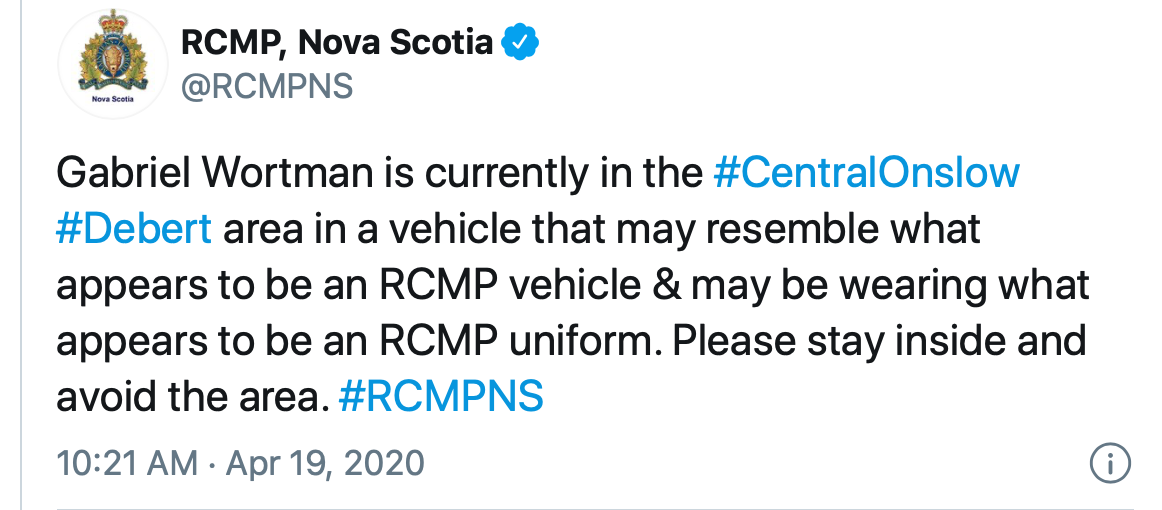
Back in the Truro area, more than 12
hours since the first alarm went in at Portapique Beach Road, the RCMP were
still playing catch-up. At 10:21 a.m., the force tweeted that GW was in the Central Onslow and Debert area
“in a vehicle that may resemble what appears to be an RCMP vehicle & may be
wearing what appears to be an RCMP uniform.” By then, he was long gone, but the
tweet or whatever else the RCMP was saying in its internal communications may
well have provoked one of the strangest known incidents that day.
The Onslow Belmont Fire Hall. Photo:
Jennifer Henderson
Around 10:30 a.m., two Mounties
emerged from a black Hyundai Elantra and started firing toward an emergency
services worker outside the Onslow Belmont Fire Brigade Fire Hall. The Mounties
shot up the fire hall and just missed hitting people inside while causing
considerable damage to equipment. One of the Mounties went into the fire hall
for a moment and then the two left in the Hyundai.
The killer was well on the other
side of Truro by then.
Five minutes earlier, at 10:25 a.m.,
in a well-known security video, the killer pulled into the lot of a business in
Millbrook, got out of the car and changed out of a RCMP jacket into a yellow
vest. He got back in the car and headed south toward Shubenacadie where two
RCMP constables, Chad Morrison and Heidi Stevenson were driving in separate
vehicles to meet up near the intersection of Highway 2 and 224.
Ten minutes after changing into the
vest, the killer pulled up beside Const. Morrison who was waiting by the side
of the road for Const. Stevenson. He fired into the car, striking Morrison in
one hand and the other arm.
Morrison apparently radioed for
help, but the media have not been privy to that communication.
A Nova Scotia EHS tape, widely
circulating on the Internet, indicates that at around the time shortly after
Morrison was shot and paramedics responded. In the conversation with a
dispatcher, a paramedic described a “member” (the common term for a Mountie)
who was shot in the foot. The paramedic says he can’t transport the patient to
hospital yet because he first had to recover a gun the officer had left in the
woods and lock his police car. The RCMP has not confirmed any of this.
At 10:48 a.m., the killer slammed
his vehicle into that of Const. Stevenson at the traffic circle connecting
highways 2 and 224. The RCMP says Stevenson “engaged” the killer, but witnesses
say he shot at her through the windshield and then dragged her out of her
damaged vehicle. He then executed her with multiple shots as she lay on the
pavement. He set his and Stevenson’s vehicles on fire. When a passerby, Joey
Webber, stopped to help, he was killed. The killer then dragged his guns and
paraphernalia to Webber’s Chevy Tracker and drove off.
After the shootings were reported,
the RCMP still did not try to get in front of the killer and stop him.
Gina Goulet
Joey Webber
Between 11:06 and 11:23 a.m. the
killer was less than a kilometre from the traffic circle where Stevenson was
killed, now at the home of Gina Goulet, a fellow denturist. He shot her and her
dog, changed clothes and stole her car, a Mazda 3.
The RCMP, meanwhile, was now looking
for GW in Joey Webber’s Chev Tracker, issuing a Tweet to that effect at 11:24 a.m.
Unfortunately, for the killer,
Goulet’s vehicles gas tank may have been empty. That seems a likely reason why
he pulled into the Irving Station at Endfield; or, perhaps, he felt the
gathering police presence around him. Instead of blocking off roads, the RCMP
was going to businesses such as Sobeys and asking them to close their doors.
It was around this time that Halifax
Police became engaged and began to set up a roadblock at exit 5A on Highway 102
heading into Halifax, one exit south of the airport. The Halifax Examiner
previously reported another curiosity about the lookout for the killer
in that Halifax Police Chief Dan Kinsella apparently ordered his officers to
attempt to capture the killer and not shoot him.
Whatever the case, suspect was in
his vehicle at the Irving station when a Mountie, reportedly a canine officer,
who was stopped to fill up his vehicle recognized him. A brief confrontation
ensued and the shooter was killed.
Meanwhile, the Department of Natural
Resources helicopter was done with its reconnaissance of the Portapique crime
scenes and was returning to Halifax. In the distance, the black smoke from the
two burning cars at the traffic circle. Sources say they pilot was never
engaged to try and hunt down the killer.
Obviously operating on a different
frequency than other Mounties, the pilot was informed that the suspect was down
at the Irving Station at Exit 7 on the 102.
As he landed in a field near the
station to let off the Mountie who was with him, the pilot received a
transmission from a gruff sounding RCMP Officer who identified himself as being
“the RCMP Command Post.”
What the Mountie had to tell him was
that the suspect had been brought down at the Irving Station in Enfield “at
Exit 11.”
Exit 11, as it turns out, is in
Stewiacke, approximately 43 kilometres to the north.
It was a fitting end to an epic
policing failure.
Paul Palango is a former senior editor
at the Globe and Mail and author of three books on the RCMP. He lives in
Chester Basin.
The Halifax Examiner is an
advertising-free, subscriber-supported news site. Your subscription makes this
work possible; please subscribe.
Some people have asked that we
additionally allow for one-time donations from readers, so we’ve created that
opportunity, via the PayPal button below. We also accept e-transfers, cheques,
and
donations with your credit card; please contact iris “at” halifaxexaminer
“dot” ca for details.
Thank you!
---------- Original message ----------
From: David Amos <
motomaniac333@gmail.com>
Date: Thu, 30 Jul 2020 06:26:35 -0300
Subject: YO Zane I wonder if your buddy Paul Palango knows if Kelly
Regan is the MLA for Timothy Bousquet or any of your cohorts
To:
info@kilnart.ca,
zane@halifaxexaminer.ca
Cc: David Amos <
david.raymond.amos333@gmail.com>
---------- Original message ----------
From: "
kelly@kellyregan.ca" <
kelly@kellyregan.ca>
Date: Thu, 30 Jul 2020 10:16:56 +0200
Subject: Auto Reply
To:
motomaniac333@gmail.com
[This is an auto reply]
Thank you for contacting the constituency office of the Hon. Kelly
Regan, MLA for Bedford. This office is here to assist residents of
the Bedford community. If you are looking to reach the Department of
Community Services, please call 1-877-424-1177.
In order to ensure a proper and timely response to your matter, please
include all necessary contact information in your correspondence,
including your name, address, phone number/e-mail, and the nature of
your matter.
This constituency office is a respectful workplace. Please be advised
that we are unable to respond to communications involving profanity,
personal attacks, racism, homophobia, or other forms of
discrimination.
Thank you and have a great day.
Traci Sullivan
Constituency Assistant
Office of the Honourable Kelly Regan | MLA, Bedford
902-407-3777 | 902-407-3779 |
www.kellyregan.ca | 1550 Bedford
Highway | Suite 555 | Bedford, NS B4A 1E6
---------- Original message ----------
From: Timothy Bousquet <
tim@halifaxexaminer.ca>
Date: Thu, 30 Jul 2020 05:41:36 -0300
Subject: Re: fea3
To: David Amos <
motomaniac333@gmail.com>
Hello, I’m taking a much-needed vacation and will not be responding to
email until August 4. If this is urgent Halifax Examiner business,
please email
zane@halifaxexaminer.ca.
Thanks,
Tim Bousquet
Editor
Halifax Examiner
On Jul 30, 2020, at 5:16 AM, David Amos <
motomaniac333@gmail.com> wrote:
>
https://davidraymondamos3.blogspot.com/2020/07/rallies-continue-push-for-public.html
>
>
> I waited all day to hear this nonsense
>
>
>
https://www.cbc.ca/player/play/1769780803841
>
>
> Sound Off: Deciphering the shift to a public inquiry of the Nova
> Scotia mass shooting
>
> 2 hours ago
> News
> 3:19
>
> Moving forward with a public inquiry may provide relief for some, but
> many questions remain. Jean Laroche and Michael Gorman decipher the
> politics of the decision.
>
>
https://twitter.com/zwoodford?lang=en
This Tweet is unavailable.
https://www.zanewoodford.ca/about
zdwoodford@gmail.com
902-830-8779
>
>
> **
> Merci beaucoup d'avoir pris contact avec le bureau de l'Honorable Bill
> Blair, D?put? de Scarborough-Sud-Ouest.
>
> Veuillez noter que par mesure de pr?caution en mati?re de sant? et de
> s?curit?, notre bureau de circonscription ne tiendra pas de r?unions
> en personne jusqu'? nouvel ordre. Nous continuerons ? fournir des
> services pendant nos heures de bureau habituelles, tant par t?l?phone
> que par courrier ?lectronique.
>
> En raison du volume ?lev? de courriels que nous recevons, notre bureau
> classe les demandes par ordre de priorit? en fonction de leur urgence
> et de notre r?le dans le service aux ?lecteurs de Scarborough
> Sud-Ouest. Si vous n'?tes pas un ?lecteur de Scarborough Sud-Ouest,
> veuillez contacter votre d?put? local pour obtenir de l'aide. Pour
> trouver votre d?put? local, visitez le
> site:
https://www.noscommunes.ca/members/fr
>
> En outre, nous vous demandons de ne t?l?phoner ? notre bureau que si
> votre cas est extr?mement urgent. Nous recevons un volume d'appels
> extr?mement ?lev? et nous serons mieux ? m?me de vous servir par
> courrier ?lectronique.
>
> Si vous avez des questions concernant COVID-19, veuillez consulter le
> site :
http://www.canada.ca/le-coronavirus
>
> Merci encore pour votre message, et nous vous r?pondrons d?s que possible.
>
> Cordialement,
>
> Personnel du D?put? de l'Honorable Bill Blair
> Colline du Parlement : 613-995-0284
> Bureau de Circonscription : 416-261-8613
>
bill.blair@parl.gc.cab
ill.blair@parl.gc.ca>
> < mailto:
bill.blair@parl.gc.ca>
>
>
> After backlash, governments agree to hold public inquiry into Nova
> Scotia shooting
> By Alexander Quon & Elizabeth McSheffrey Global News
> Posted July 28, 2020 10:42 am
>
> WATCH: The federal government is now proceeding with a public inquiry
> into the Nova Scotia massacre that left 22 innocent people dead in
> April. Elizabeth McSheffrey looks at why Ottawa is changing paths now,
> and what the inquiry has the power to do.
>
> The decision to hold a review into the mass killing in April that
> resulted in the deaths of 22 people in Nova Scotia took three months
> to arrange. In less than a week the decision has been undone after a
> massive wave of public backlash.
>
> Federal Public Safety Minister Bill Blair announced on Tuesday a
> public inquiry will be held into the mass shooting that began in
> Portapique, N.S. on April 18 and came to an end nearly 100 km away, 13
> hours later.
>
> “The Government of Canada is now proceeding with a full Public
> Inquiry, under the authority of the Inquiries Act,” said Blair in a
> statement.
>
>
> ---------- Original message ----------
> From: Allan Carroll <
allan.carroll@rcmp-grc.gc.ca>
> Date: Mon, 12 Aug 2013 18:14:09 -0400
> Subject: Re: Trust that Murray Segal's appointment to whitewash the
> Rehteah Parsons matter did not surprise me after the meail I sent this
> weekend (AOL)
> To: David Amos <
motomaniac333@gmail.com>
>
> I will be AOL commencing July 27, 2013 and returning on August 13,
> 2013. Cpl David Baldwin of Amherst Det will be assuming my duties
> during my absence. Should you require immediate assistance, please
> contact the main Amherst office number at 902-667-3859.
>
> For inquiries about the Crisis Negotiation Team, please contact
> Sgt.Royce MacRae at 902-720-5426 (w) or 902-471-8776 (c)
>
>
>
> ---------- Original message ----------
> From: "Fitch, Leanne" <
leanne.fitch@fredericton.ca>
> Date: Tue, 5 Apr 2016 14:05:24 +0000
> Subject: Automatic reply: Re Federal Court file no T-1557-15 Now this
> is interesting As soon as Brad Wall got reelected as Premier he began
> blocking my email Go Figure EH David Drummond???
> To: David Amos <
motomaniac333@gmail.com>
>
> Due to a very high volume of incoming email to this account there is
> an unusual backlog of pending responses. Your query may not be repleid
> to in a timely fashion. If you require a formal response please send
> your query in writing to my attention c/o Fredericton Police Force,
> 311 Queen St, Fredericton, NB E3B 1B1 or phone (506) 460-2300.
>
> This e-mail communication (including any or all attachments) is
> intended only for the use of the person or entity to which it is
> addressed and may contain confidential and/or privileged material. If
> you are not the intended recipient of this e-mail, any use, review,
> retransmission, distribution, dissemination, copying, printing, or
> other use of, or taking of any action in reliance upon this e-mail, is
> strictly prohibited. If you have received this e-mail in error, please
> contact the sender and delete the original and any copy of this e-mail
> and any printout thereof, immediately. Your co-operation is
> appreciated.
>
> Any correspondence with elected officials, employees, or other agents
> of the City of Fredericton may be subject to disclosure under the
> provisions of the Province of New Brunswick Right to Information and
> Protection of Privacy Act.
>
> Le présent courriel (y compris toute pièce jointe) s'adresse
> uniquement à son destinataire, qu'il soit une personne ou un
> organisme, et pourrait comporter des renseignements privilégiés ou
> confidentiels. Si vous n'êtes pas le destinataire du courriel, il est
> interdit d'utiliser, de revoir, de retransmettre, de distribuer, de
> disséminer, de copier ou d'imprimer ce courriel, d'agir en vous y
> fiant ou de vous en servir de toute autre façon. Si vous avez reçu le
> présent courriel par erreur, prière de communiquer avec l'expéditeur
> et d'éliminer l'original du courriel, ainsi que toute copie
> électronique ou imprimée de celui-ci, immédiatement. Nous sommes
> reconnaissants de votre collaboration.
>
> Toute correspondance entre ou avec les employés ou les élus de la
> Ville de Fredericton pourrait être divulguée conformément aux
> dispositions de la Loi sur le droit à l’information et la protection
> de la vie privée.
>
> GOV-OP-073
>
>
>
> ---------- Original message ----------
> From: "Hon.Ralph.Goodale (PS/SP)" <
Hon.ralph.goodale@canada.ca>
> Date: Mon, 29 Apr 2019 16:39:00 +0000
> Subject: Automatic reply: Methinks this afternoon Harjit Sajjan and
> his minions should go to Federal Court pull my file (T-1557-15) from
> the docket then read statement 83 real slow N'esy Pas?
> To: David Amos <
motomaniac333@gmail.com>
>
> Merci d'avoir ?crit ? l'honorable Ralph Goodale, ministre de la
> S?curit? publique et de la Protection civile.
> En raison d'une augmentation importante du volume de la correspondance
> adress?e au ministre, veuillez prendre note qu'il pourrait y avoir un
> retard dans le traitement de votre courriel. Soyez assur? que votre
> message sera examin? avec attention.
> Merci!
> L'Unit? de la correspondance minist?rielle
> S?curit? publique Canada
> *********
>
> Thank you for writing to the Honourable Ralph Goodale, Minister of
> Public Safety and Emergency Preparedness.
> Due to the significant increase in the volume of correspondence
> addressed to the Minister, please note there could be a delay in
> processing your email. Rest assured that your message will be
> carefully reviewed.
> Thank you!
> Ministerial Correspondence Unit
> Public Safety Canada
>
>
>
>
>
> ---------- Original message ----------
> From: "Fitch, Leanne" <
leanne.fitch@fredericton.ca>
> Date: Mon, 29 Apr 2019 16:38:59 +0000
> Subject: Automatic reply: Methinks this afternoon Harjit Sajjan and
> his minions should go to Federal Court pull my file (T-1557-15) from
> the docket then read statement 83 real slow N'esy Pas?
> To: David Amos <
motomaniac333@gmail.com>
>
>
> Due to a very high volume of incoming email to this account there is
> an unusual backlog of pending responses. Your message may not be
> responded to in a timely fashion. If you require a formal response
> please send your query in writing to my attention c/o Fredericton
> Police Force, 311 Queen St, Fredericton, NB E3B 1B1 or phone (506)
> 460-2300. If this is an emergency related to public safety please call
> 911.
>
> En raison du grand nombre de courriels que reçoit cette messagerie, il
> se peut qu’une réponse tarde un peu à venir. Si vous avez besoin d'une
> réponse officielle, veuillez envoyer votre demande par écrit à mon
> attention aux soins (a/s) de la Force policière de Fredericton 311,
> rue Queen, Fredericton, NB E3B 1B1, ou composer le 506 460-2300.
> S'il s'agit d'une urgence de sécurité publique, faites le 911.
>
>
> This e-mail communication (including any or all attachments) is
> intended only for the use of the person or entity to which it is
> addressed and may contain confidential and/or privileged material. If
> you are not the intended recipient of this e-mail, any use, review,
> retransmission, distribution, dissemination, copying, printing, or
> other use of, or taking of any action in reliance upon this e-mail, is
> strictly prohibited. If you have received this e-mail in error, please
> contact the sender and delete the original and any copy of this e-mail
> and any printout thereof, immediately. Your co-operation is
> appreciated.
>
> Any correspondence with elected officials, employees, or other agents
> of the City of Fredericton may be subject to disclosure under the
> provisions of the Province of New Brunswick Right to Information and
> Protection of Privacy Act.
>
> Le présent courriel (y compris toute pièce jointe) s'adresse
> uniquement à son destinataire, qu'il soit une personne ou un
> organisme, et pourrait comporter des renseignements privilégiés ou
> confidentiels. Si vous n'êtes pas le destinataire du courriel, il est
> interdit d'utiliser, de revoir, de retransmettre, de distribuer, de
> disséminer, de copier ou d'imprimer ce courriel, d'agir en vous y
> fiant ou de vous en servir de toute autre façon. Si vous avez reçu le
> présent courriel par erreur, prière de communiquer avec l'expéditeur
> et d'éliminer l'original du courriel, ainsi que toute copie
> électronique ou imprimée de celui-ci, immédiatement. Nous sommes
> reconnaissants de votre collaboration.
>
> Toute correspondance entre ou avec les employés ou les élus de la
> Ville de Fredericton pourrait être divulguée conformément aux
> dispositions de la Loi sur le droit à l’information et la protection
> de la vie privée.
>
> GOV-OP-073
>
>
>
>
https://davidraymondamos3.blogspot.com/2015/09/v-behaviorurldefaultvmlo.html
>
>
> Friday, 18 September 2015
> David Raymond Amos Versus The Crown T-1557-15
>
>
>
> Court File No. T-1557-15
>
> FEDERAL COURT
>
> BETWEEN:
> DAVID RAYMOND AMOS
>
> Plaintiff
> and
>
> HER MAJESTY THE QUEEN
>
> Defendant
>
> STATEMENT OF CLAIM
>
> The Parties
>
> 1. HER MAJESTY THE QUEEN (Crown) is Elizabeth II, the Queen of
> England, the Protector of the Faith of the Church of England, the
> longest reigning monarch of the United Kingdom and one of the
> wealthiest persons in the world. Canada pays homage to the Queen
> because she remained the Head of State and the Chief Executive Officer
> of Canada after the Canada Act 1982 (U.K.) 1982, c. 11 came into force
> on April 17, 1982. The standing of the Queen in Canada was explained
> within the 2002 Annual Report FORM 18-K filed by Canada with the
> United States Securities and Exchange Commission (SEC). It states as
> follows:
>
> “The executive power of the federal Government is vested in the
> Queen, represented by the Governor General, whose powers are exercised
> on the advice of the federal Cabinet, which is responsible to the
> House of Commons. The legislative branch at the federal level,
> Parliament, consists of the Crown, the Senate and the House of
> Commons.”
>
> “The executive power in each province is vested in the Lieutenant
> Governor, appointed by the Governor General on the advice of the
> federal Cabinet. The Lieutenant Governor’s powers are exercised on the
> advice of the provincial cabinet, which is responsible to the
> legislative assembly. Each provincial legislature is composed of a
> Lieutenant Governor and a legislative assembly made up of members
> elected for a period of five years.”
>
> 2. Her Majesty the Queen is the named defendant pursuant to
> sections 23(1) and 36 of the Crown Liability and Proceedings Act. Some
> of the state actors whose duties and actions are at issue in this
> action are the Prime Minister, Premiers, Governor General, Lieutenant
> Governors, members of the Canadian Forces (CF), and Royal Canadian
> Mounted Police (RCMP), federal and provincial Ministers of Public
> Safety, Ministers of Justice, Ministers of Finance, Speakers, Clerks,
> Sergeants-at-Arms and any other person acting as Aide-de-Camp
> providing security within and around the House of Commons, the
> legislative assemblies or acting as security for other federal,
> provincial and municipal properties.
>
> 3. Her Majesty the Queen’s servants the RCMP whose mandate is to
> serve and protect Canadian citizens and assist in the security of
> parliamentary properties and the protection of public officials should
> not deny a correspondence from a former Deputy Prime Minister who was
> appointed to be Canada’s first Minister of Public Safety in order to
> oversee the RCMP and their cohorts. The letter that helped to raise
> the ire of a fellow Canadian citizen who had never voted in his life
> to run for public office four times thus far is quoted as follows:
>
> “Mr. David R. Amos
> Jan 3rd, 2004
> 153Alvin Avenue
> Milton, MA U.S.A. 02186
>
> Dear Mr. Amos
>
> Thank you for your letter of November 19th, 2003, addressed to
> my predecessor, the Honourble Wayne Easter, regarding
> your safety.
> I apologize for the delay in responding.
>
> If you have any concerns about your personal safety, I can only
> suggest that you contact the police of local
> jurisdiction. In addition, any
> evidence of criminal activity should be brought to
> their attention since the
> police are in the best position to evaluate the
> information and take action
> as deemed appropriate.
>
> I trust that this information is satisfactory.
>
> Yours sincerely
>
> A. Anne McLellan”
>
> 4. DAVID RAYMOND AMOS (Plaintiff), a Canadian Citizen and the
> first Chief of the Amos Clan, was born in Sackville, New Brunswick
> (NB) on July 17th, 1952.
>
> 5. The Plaintiff claims standing in this action as a citizen
> whose human rights and democratic interests are to be protected by due
> performance of the obligations of Canada’s public officials who are
> either elected or appointed and all servants of the Crown whose
> mandate is to secure the public safety, protect public interests and
> to uphold and enforce the rule of law. The Crown affirms his right to
> seek relief for offences to his rights under section 24(1) of the
> Canadian Charter of Rights and Freedoms (Charter). Paragraphs 6 to 13
> explain the delay in bringing this action before Federal Court and
> paragraphs 25 to 88 explain this matter.
>
> 6. The Plaintiff states that pursuant to the democratic rights
> found in Section 3 of the Charter he was a candidate in the elections
> of the membership of the 38th and 39th Parliaments in the House of
> Commons and a candidate in the elections of the memberships of the
> legislative assemblies in Nova Scotia (NS) and NB in 2006.
>
> 7. The Plaintiff states that if he is successful in finding a
> Chartered Accountant to audit his records as per the rules of
> Elections Canada, he will attempt to become a candidate in the
> election of the membership of the 42nd Parliament.
>
> 8. The Plaintiff states that beginning in January of 2002, he
> made many members of the RCMP and many members of the corporate media
> including employees of a Crown Corporation, the Canadian Broadcasting
> Corporation (CBC) well aware of the reason why he planned to return to
> Canada and become a candidate in the next federal election. In May of
> 2004, all members seated in the 37th Parliament before the writ was
> dropped for the election of the 38th Parliament and several members of
> the legislative assemblies of NB and Newfoundland and Labrador (NL)
> knew the reason is the ongoing rampant public corruption. Evidence of
> the Plaintiff’s concerns can be found within his documents that the
> Office of the Governor General acknowledged were in its possession ten
> years ago before the Speech from the Throne in 2004. The Governor
> General’s letter is as follows:
>
>
> “September 11th, 2004
> Dear Mr. Amos,
>
> On behalf of Her Excellency the Right Honourable Adrienne
> Clarkson,
> I acknowledge receipt of two sets of documents and CD
> regarding corruption,
> one received from you directly, and the other forwarded to
> us by the Office of
> the Lieutenant Governor of New Brunswick.
>
> I regret to inform you that the Governor
> General cannot intervene in
> matters that are the responsibility of elected officials
> and courts of Justice of
> Canada. You already contacted the various provincial
> authorities regarding
> your concerns, and these were the appropriate steps to take.
>
> Yours sincerely.
> Renee
> Blanchet
> Office
> of the Secretary
> to the
> Governor General”
>
> 9. The Plaintiff states that the documents contain proof that the
> Crown by way of the RCMP and the Minister of Public Safety/Deputy
> Prime Minister knew that he was the whistleblower offering his
> assistance to Maher Arar and his lawyers in the USA. The Governor
> General acknowledged his concerns about the subject of this complaint
> and affirmed that the proper provincial authorities were contacted but
> ignored the Plaintiff’s faxes and email to the RCMP and the Solicitor
> General in November of 2003 and his tracked US Mail to the Solicitor
> General and the Commissioner of the RCMP by way of the Department of
> Foreign Affairs and International Trade (DFAIT) in December of 2003
> and the response he received from the Minister of Public Safety/Deputy
> Prime Minister in early 2004. One document was irrefutable proof that
> there was no need whatsoever to create a Commission of Inquiry into
> Maher Arar concerns at about the same point in time. That document is
> a letter from the US Department of Homeland Security (DHS) Office
> Inspector General (OIG complaint no. C04-01448) admitting contact with
> his office on November 21, 2003 within days of the Plaintiff talking
> to the office of Canada’s Solicitor General while he met with the US
> Attorney General and one day after the former Attorney General of New
> York (NY) and the former General Counsel of the SEC testified at a
> public hearing before the US Senate Banking Committee about
> investigations of the mutual fund industry.
>
> 10. The Plaintiff states that another document that the Plaintiff
> received during the election of the 39th Parliament further supported
> the fact he was a whistleblower about financial crimes. In December of
> 2006 a member of the RCMP was ethical enough to admit that he
> understood the Plaintiff’s concerns and forwarded his response to the
> acting Commissioner of the RCMP and others including a NB Cabinet
> Minister Michael B. Murphy QC. The Crown is well aware that any member
> sitting in the last days of the 37th Parliament through to the end of
> the 41st Parliament could have stood in the House of Commons and asked
> the Speaker if the Crown was aware of the Plaintiff’s actions. All
> parliamentarians should have wondered why his concerns and that of Mr.
> Arar’s were not heard by a committee within the House of Commons in
> early 2004. Instead, the Crown created an expensive Commission to
> delay the Arar matter while he sued the governments of Canada and the
> USA and his wife ran in the election of the 38th Parliament. In 2007,
> Arar received a $10-million settlement from the Crown and the Prime
> Minister gave him an official apology yet the US government has never
> admitted fault. A month after the writ was dropped for the election of
> the 42nd Parliament and CBC is reporting Syrian concerns constantly,
> Mr. Arar’s lawyer announced that the RCMP will attempt to extradite a
> Syrian intelligence officer because it had laid a charge in absentia
> and a Canada-wide warrant and Interpol notice were issued. The
> Plaintiff considers such news to be politicking practiced by the
> Minister of Public Safety. He noticed the usually outspoken Mr. Arar
> made no comment but his politically active wife had lots to say on
> CBC. Meanwhile, the RCMP continues to bar a fellow citizen from
> parliamentary properties because he exercised the same democratic
> rights after he had offered his support to Arar by way of his American
> lawyers. The aforementioned letter about financial crimes was from the
> Inspector General for Tax Administration in the US Department of the
> Treasury. Mr Arar’s lawyers, the RCMP, the Canadian Revenue Agency and
> the US Internal Revenue Service still refuse to even admit TIGTA
> complaint no. 071-0512-0055-C exists. However, the Commissioner of
> Federal Court, the Queen’s Privy Council Office and other agencies
> were made well aware of it before the Speech from the Throne in 2006.
>
> 11. The Plaintiff states that from June 24, 2004 until the day he
> signed this complaint he has diligently tried to resolve the breach of
> his rights under the Charter that are the subject of this complaint
> with any public official in Canada whom he believed had the mandate or
> the ability to request that the Crown investigate and correct the
> malicious actions and inactions of the RCMP, Sergeants-at-Arms and
> Aides-de-Camp in all jurisdictions. Until June 16, 2006 the Plaintiff
> did not have irrefutable proof to support this complaint. Time did not
> permit him to address it immediately in Federal Court in 2006 because
> his slate was full. For instance on June 16, 2006 while dealing with
> deeply troubling private family matters, he was running against the
> Attorney General for his seat in the NS provincial election while
> arguing members of the RCMP about strange calls he got from someone in
> Ottawa who claimed the Department of Public Safety as her client,
> dealing with many liberal party members who were about to witness in
> Moncton NB the first debate of all those who wished to become their
> new leader, assisting a farmer in his attempt to get some authority to
> properly investigate the demise of his cattle and discussing with
> members of the Saint John NB City Council the actions of a sergeant in
> the Saint John Police Force who was calling friends of the Plaintiff
> and claiming that he was drug dealing member of a bike gang that they
> should stay away from while he was preparing to intervene in pipeline
> matter that was about to heard by the National Energy Board in Saint
> John .
>
> 12. The Plaintiff states that in April of 2007 he wrote a complaint
> about this matter and returned to the Capital District of NB in order
> to file it and argue the Crown before the Federal Court if it did not
> wish to settle. A clerk of this court informed him that his complaint
> was not composed correctly, so he began to rewrite this complaint.
> However, as soon as it was known what the Plaintiff was about to file
> he was subject to further police harassment and his family began to
> suffer from constant slander, sexual harassment and death threats on
> the Internet and on the telephone that continues to this very day
> while the RCMP, the FBI and many other law enforcement authorities
> continue to ignored the obvious evidence of cybercrime practiced
> against many people including his minor children.
>
> 13. The Plaintiff states that the Crown’s only response has been
> further harassment by the RCMP including false arrest and imprisonment
> and theft of his property by the Fredericton Police Force supported by
> other law enforcement authorities in Canada and the USA. The Governor
> General has had the Plaintiff’s documents for over ten years to study.
> The Crown now has one of the complaints that the RCMP has been
> delaying since 2003. It is as follows:
>
> The Complaint
etc etc etc
https://stewartmckelvey.com/people/macdonald-the-honourable-j-michael/
The Honourable J. Michael MacDonald joined Stewart
McKelvey as Counsel in April of 2019 following a distinguished career on
the Bench. Mr. MacDonald was appointed a Justice of the Supreme Court
of Nova Scotia in 1995 and the Associate Chief Justice three years
later. He became the 22nd Chief Justice of Nova Scotia and
the Chief Justice of the Nova Scotia Court of Appeal in 2004. During his
time sitting on both courts, he wrote approximately 500 decisions. A
member of the Canadian Judicial Council for twenty years, he has chaired
several of its committees, most recently the Judicial Conduct
Committee.
As Chief Justice, in 2014, Michael led the creation
of the Nova Scotia Access to Justice Coordinating Committee, a group of
legal professionals working to make Nova Scotia a national leader in
access to justice. During his tenure as Chief Justice, he promoted
several judicial outreach initiatives to engage the Indigenous and
African Nova Scotia communities. His efforts to foster inclusion on the
Bench include creating a judicial mentorship initiative for African Nova
Scotian and Indigenous lawyers. He also volunteered with Phoenix Youth
to host justice day camps for young people from racialized communities.
Michael’s access to justice initiatives have been
recognized by Cape Breton University with an honourary doctorate of laws
degree. The Canadian Bar Association (Nova Scotia Branch) has renamed
its annual access to justice award the “J. Michael MacDonald Access to
Justice Award” to honour Michael’s work in this area.
He has presented at, and participated in, numerous
legal conferences in Canada, the United States, and Europe, and has
assisted the judiciaries in Kazakhstan and Ukraine. He is a regular
guest speaker at Dalhousie’s Schulich School of Law and a recipient of
the Queen’s Golden and Diamond Jubilee medals.
Michael focuses his practice on alternative dispute resolution.
Education & Career
Education
Dalhousie University, LLB, 1979
Mount Allison University, BA, 1976
Activities
Member, Canadian Bar Association
Member, African Nova Scotia Access to Justice Judicial Committee
Advisor, Access to Justice and Law Reform Institute of Nova Scotia
Board Member, Phoenix Youth
Creator and Chair, Nova Scotia Access to Justice Coordinating Committee, 2014 – 2018
Chair, Canadian Judicial Council, Judicial Conduct Committee, 2014 – 2018
Chair, Nova Scotia Judicial Council, 2004 – 2019
Chair, Executive Office of the Nova Scotia Judiciary, 2004 – 2019
Previous Member, Nova Scotia Barristers’ Society Council
Previous President, Cape Breton Barristers’ Society
Previous Board member, Enterprise Cape Breton Corporation
https://www.cbc.ca/news/canada/nova-scotia/liberal-mps-support-inquiry-letter-review-1.5665771
Inquiry into N.S. mass shooting to go ahead, public safety minister says
'Canadians deserve answers to how such a tragedy could occur,' Bill Blair says
Brooklyn Currie, Anjuli Patil · CBC News
· Posted: Jul 28, 2020 1:39 PM AT

Public Safety Minister Bill Blair on Tuesday announced a public inquiry
into the Nova Scotia mass shooting amid mounting pressure from fellow
MPs, families of victims, legal experts and the public who were upset
that a review panel had been announced last week instead. (Jon Collicott/CBC)
After days of criticism about the decision to launch a review
panel into the Nova Scotia mass shooting, the federal government has
announced that the tragedy will instead be the subject of a public
inquiry.
"Canadians deserve answers to how such a tragedy could
occur," Public Safety and Emergency Preparedness Minister Bill Blair
said in a statement on Tuesday, announcing the inquiry amid mounting
pressure from fellow MPs, families of victims, legal experts and the
public who were upset after a review panel was announced last week.
"This
situation requires that our governments work diligently with all those
affected by this tragedy to bring forward the critical answers, and to
ensure an event such as this will never happen again."
Twenty-two people died in the April 18-19 shootings, which began in the small community of Portapique, N.S.
A public inquiry will allow the power to summon witnesses and require them to:
- Give
evidence, orally or in writing, and on oath or, if they are persons
entitled to affirm in civil matters, on solemn affirmation.
- Produce
such documents and things as the commissioners deem requisite to the
full investigation of the matters into which they are appointed to
examine.
The same people who had been involved with the highly criticized review panel will take part in the public inquiry, Blair said.
J. Michael MacDonald, Anne McLellan and Leanne Fitch agreed to assist in the public inquiry and will serve as commissioners.
'I'm sorry,' premier tells families
In an interview with
CBC Nova Scotia News at Six
on Tuesday, Premier Stephen McNeil apologized to the families of
victims. He said his intent was not to cause families additional harm,
but to get them answers with the panel review.
WATCH | N.S. Premier Stephen McNeil apologizes to families of victims:
 In an
interview with CBC Nova Scotia anchor Tom Murphy, Premier Stephen McNeil
said families are getting what they wanted, but he maintained the
province needed federal support to move forward with a public inquiry. 14:45
In an
interview with CBC Nova Scotia anchor Tom Murphy, Premier Stephen McNeil
said families are getting what they wanted, but he maintained the
province needed federal support to move forward with a public inquiry. 14:45
"Clearly, they did not agree with that. They felt that the
inquiry was the only way that they would achieve the answers they were
looking for. We've delivered that today, and for them I would say I'm
sorry if the process created more anguish for you."
Relief and happiness
Robert
Pineo, the lawyer representing 21 of the 22 families in a class-action
lawsuit against the killer's estate, and whose firm is handling the
class-action suit against the province and the RCMP, said he's glad the
two levels of government had a change of heart.
"It is
unfortunate the families had to go through the turmoil of the last three
days worrying about this, but at the end of the day, the government did
the right thing," Pineo said.
He said he's only spoken with one
of the families since the news broke, but he said they're glad a public
inquiry is moving forward.

A demonstration in support of victims' families was held on
Monday in Bridgewater, N.S. The families have been demanding a public
inquiry into the shooting rampage that killed 22 people in April. (Brooklyn Currie)
"There's a lot of relief and a lot of happiness right now."
Families had organized a march for Wednesday and Pineo said they still plan to do that.
"The
family member that I spoke with said he would like to see the march go
on as ... a show of support to the families and to the processes
coming," Pineo said. "The families are going to be there tomorrow and so
will some of their supporters."
Earlier on Tuesday, Nova
Scotia Justice Minister Mark Furey said he would support a public
inquiry into the April mass shooting if the federal government agreed.
His comments came following days of criticism about the decision to instead appoint a review panel.
"If
the federal MPs agree that their government should conduct a joint
public inquiry rather than a review, they should take that up with the
federal minister and their federal colleagues," Furey said in a release
on Tuesday afternoon.
The joint review panel was announced last Thursday by the federal and Nova Scotia governments.
Unlike
a public inquiry, witnesses cannot be subpoenaed and will not testify
under oath. All documents and information collected as part of the
review will be kept confidential, and it's not clear whether any
hearings will be held in public.
On
Tuesday, several Nova Scotia Liberal members of Parliament called for a
full public inquiry into the killings, despite their names being
attached to a letter welcoming
the joint review when it was announced.
'Deeply upset' by decision
Kody
Blois, the MP for Kings-Hants, sent out a letter on the day of the
announcement on behalf of all the Liberal MPs in the province.
"The
Nova Scotia Federal Liberal Caucus welcomes the announcement of a
joint-review into the Nova Scotia mass shooting," the letter said.
But
in a statement on Facebook Tuesday morning, Sean Fraser, the MP for
Central Nova and the parliamentary secretary to the minister of finance,
said he was "deeply upset" by the decision to move forward with a
review instead of a public inquiry.
"If ever there was a moment to listen to Nova Scotians and reconsider the path being taken, it is now," Fraser said in his post.

Statement in Support of Public Inquiry into Mass Shootings
It is obvious that a comprehensive public inquiry into the mass
shootings that left our Province reeling this Spring is necessary to
provide any meaningful opportunity for the affected families to
experience healing, and for our communities to feel any meaningful sense
of justice. If there is not trust in the process, there will not be
trust in its outcome.
Upon learning the process would include a review, as opposed
to a comprehensive public inquiry, I was immediately disappointed.
Shortly after becoming aware of the details of the process, I saw my
name was included on a letter that welcomed the decision. I became aware
of the proposed letter shortly before its publication and I expressed
my disappointment with the decision and my preference for a public
process. I have come to understand that the letter was sent as a result
of a serious, albeit innocent, misunderstanding of my views. I should
have been more explicit and unequivocal in my opposition to being
included in that letter, and I remain responsible for that.
For the sake of expressing my own views with clarity, I am deeply upset
by the decision to move forward with something less than a
comprehensive public inquiry that provides answers to our province and
solace to the families who now live every day in our communities without
their loved ones.
There are some positive features of the
announced review that should be carried into a more fulsome inquiry. The
members of the panel selected for the review are of the highest quality
and their credentials are beyond reproach. I also find extraordinary
value in different aspects of the Terms of Reference given to the panel,
specifically including the requirement that the panel consider the
aspects of this particular massacre that relate to misogyny and
gender-based violence. However, the planned process lacks the essential
ingredient of public trust, which will ensure the process does not
succeed if no action is taken.
I have been dedicating myself
over the past few days to advocate for a reconsideration of the current
approach and will continue to do so until we have a process that
provides a level of comfort to those most affected by the tragedy. I
have spoken with many of my colleagues, including direct conversations
with the Prime Minister, to express my strong desire for a public
process that provides confidence to the families affected by this
tragedy that every question they have, no matter how difficult, will be
answered by the time the inquiry reaches its conclusion.
This
decision mattered greatly to me and to my constituents and it is
essential that the approach taken be revisited to provide whatever
powers to the Panel that are necessary in order to engender trust in the
process amongst both the families and the general public.
During
the course of our emergency response to the ongoing pandemic, I’ve
heard from many members of my community that were more impressed with
our willingness to listen and change course on policy decisions in
response to feedback from our communities than they were with any
particular policy we have advanced.
Nova Scotians are asking us
to listen once again. The families who lost loved ones are telling us
that the process, as it stands, will not provide the healing they so
desperately need, and our communities are telling us that the process
must take place in public to allow us the opportunity to better
understand the circumstances leading to the deadliest massacre in our
Province’s history.
If ever there was a moment to listen to Nova Scotians and reconsider the path being taken, it is now.
My hope is that we can find a path forward that will provide the
victims, their families, and the public with a process they can trust,
so that we can help facilitate the healing process our Province so
deeply needs and obviously deserves.
Sincerely,
Sean Fraser
Member of Parliament for Central Nova
Fraser said his name was included in the letter because of a "misunderstanding" of his views.
"I
should have been more explicit and unequivocal in my opposition to
being included in that letter, and I remain responsible for that," his
post said.
 Liberal
MP Sean Fraser discusses plans for a full public inquiry into the Nova
Scotia shooting after the government was criticized for its initial
decision to launch a review panel into the tragedy. 9:45
Liberal
MP Sean Fraser discusses plans for a full public inquiry into the Nova
Scotia shooting after the government was criticized for its initial
decision to launch a review panel into the tragedy. 9:45
Demands for 'greater response'
Darren Fisher, MP for Dartmouth-Cole Harbour, also said in a tweet Tuesday he's been "advocating" for a public inquiry.
"I
believe that the decision to move forward with a joint-review was made
with good intentions; however, the gravity of this tragedy demands a
greater response," the tweet said.
Halifax MP Andy Fillmore, who
is parliamentary secretary for infrastructure, tweeted Tuesday that a
public inquiry is "the best way forward" to get answers and closure for
the families of the victims.
My thoughts on the recent announcement of a joint-review into the April 2020 Nova Scotia mass shooting.
#Dartmouth #ColeHarbour
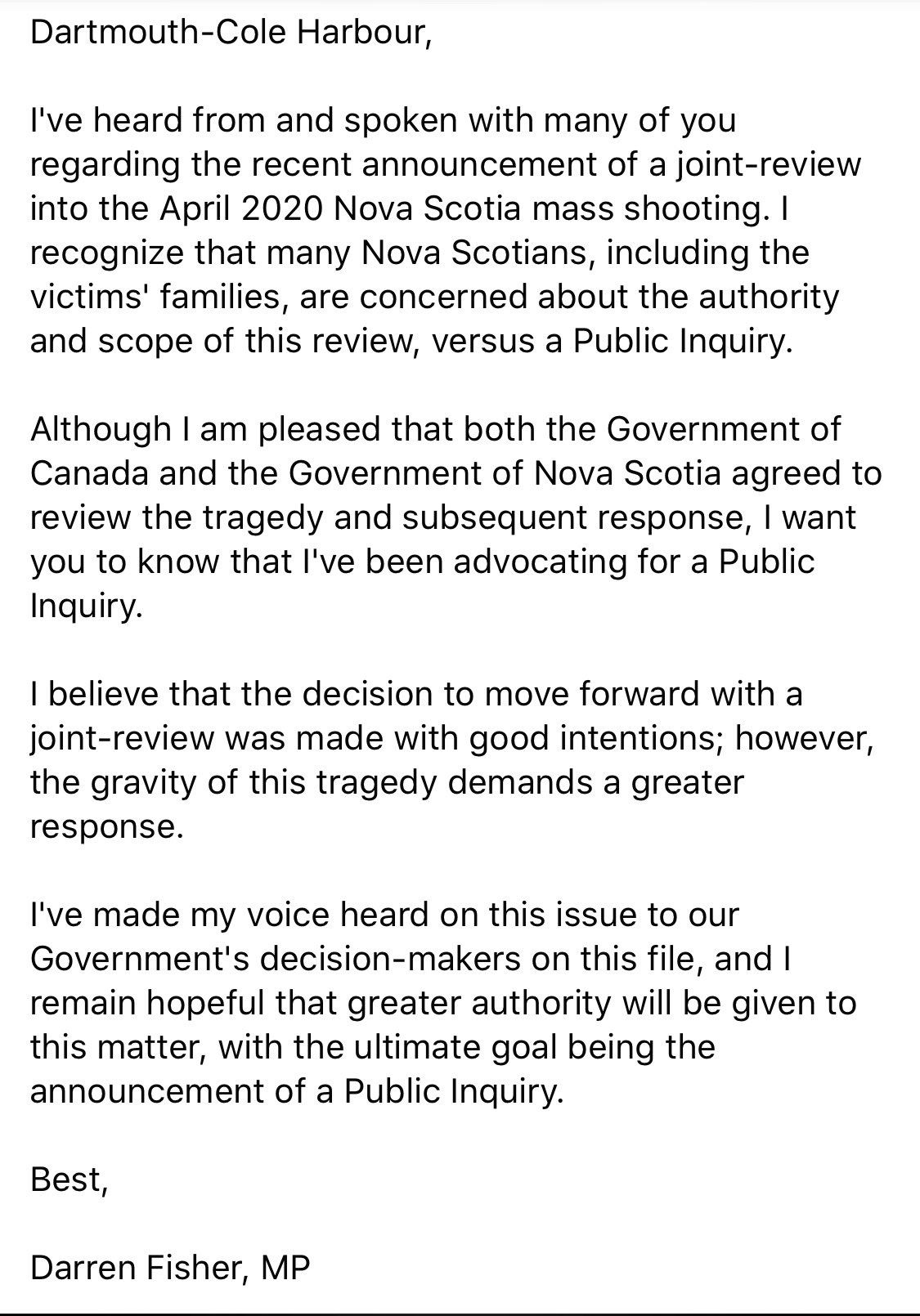
CBC News reached out to Fraser and Fisher, but neither was available for comment Tuesday.
Cape
Breton-Canso MP Mike Kelloway issued his own statement Tuesday
afternoon saying that since Thursday he's been hearing from
constituents expressing their disappointment in the government's plan.
"We know that the families of the victims are crying for a public inquiry and in my opinion that is what they deserve."
Kelloway
said it's the government's duty "to uphold the values" of Nova Scotians
and "honour the families of the victims by moving forward with a full
public inquiry and not a joint review."
Replying to @MichaelTGorman and @SeanFraserMP
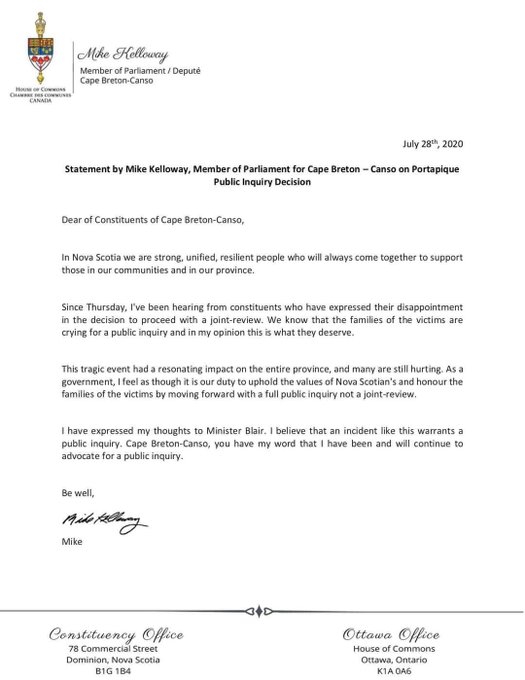
On Monday, the MP for Cumberland-Colchester, Lenore Zann, said she was upset
she was not consulted about the independent review. Many of the families of the victims live in her riding.
Relatives of victims have been
calling for a public inquiry into the massacre for months. On Monday,
two rallies in Halifax and Bridgewater did the same.
Karen
Casey, Nova Scotia's finance minister and the MLA for Colechester
North, a district that includes Portapique, said she knows her
constituents have questions, and she supports whatever process gets them
the information they deserve.
Casey said she wasn't concerned
about the path the two levels of government announced last week, but she
is concerned that people get what they need as she said the community
is still "very much in the grieving process."
Some want answers
more quickly, some want things done more publicly, but everyone has
questions, and Casey said she wants those questions answered in a way
that provides confidence to the public.
"Whatever the process
is, it will be traumatic for them and it will be difficult for them
... they need to be confident they're getting the answers they're
looking for."
'Flawed start'
Nova Scotia's lone
Conservative MP, Chris d'Entremont, says word of the inquiry "is
welcome" but also "raises a number of serious questions."
Some
of those questions, he said, include why a public inquiry wasn't called
on Friday, why families have to fight their government for transparency
and answers they deserve, and "how can Nova Scotians trust this process
after its flawed start?"
"Nova Scotians deserve a government
they can trust, who will stand up for their priorities," d'Entremont
said in a statement. "It's clear that the Trudeau Liberals have let them
down again. Conservatives will continue to fight for the answers you
deserve."
Earlier Tuesday, Nova Scotia Progressive Conservative
Leader Tim Houston had called for the premier to call a public inquiry
himself without waiting for the federal government.
Houston said a review panel instead of a public inquiry was "a slap in the face to the victims' families and all Nova Scotians."
With files from Michael Gorman and Tom Murphy
CBC's Journalistic Standards and Practices
 by @ydentremont
Tuesday’s announcement
that there will be a full public inquiry into April’s mass shooting had
nothing to do with politicians and everything to do with the victims’
families and Nova Scotians.
That was the message Nick Beaton delivered to reporters during a celebration event in downtown Halifax on Wednesday morning.
Initially planned as a protest march
from the Halifax Ferry Terminal to Province House, it shifted to a
victory celebration march after the news broke late yesterday that the
review was being dumped in favour of the inquiry the families had been
demanding all along.
“I want to start off by saying this
was not because of the government, right from Lenore Zann right to the
top of Bill Blair. This was because of the families, our determination,
our drive, and the Nova Scotians, the Bluenosers,” Beaton told
reporters.
Beaton’s pregnant wife Kristen Beaton
was killed on April 19 by the gunman the Halifax Examiner refers to as
GW. Beaton said while politicians are “pretty quick to pat themselves on
the back,” he wondered where they’ve been for the last three months.
He was alluding to the Nova Scotia Liberal MPs who yesterday publicly broke ranks
with their government to state they were disappointed in a review and
were advocating for an inquiry. This came after significant and
widespread public protest and condemnation since the review was announced last Thursday.
In a Tuesday afternoon statement,
Nova Scotia Justice Minister Mark Furey said the province would support a
joint public inquiry if the federal government came onboard and called
on the participation and testimony of key federal agencies.
By day’s end, federal Public Safety Minister Bill Blair announced there would be a public inquiry.
by @ydentremont
Tuesday’s announcement
that there will be a full public inquiry into April’s mass shooting had
nothing to do with politicians and everything to do with the victims’
families and Nova Scotians.
That was the message Nick Beaton delivered to reporters during a celebration event in downtown Halifax on Wednesday morning.
Initially planned as a protest march
from the Halifax Ferry Terminal to Province House, it shifted to a
victory celebration march after the news broke late yesterday that the
review was being dumped in favour of the inquiry the families had been
demanding all along.
“I want to start off by saying this
was not because of the government, right from Lenore Zann right to the
top of Bill Blair. This was because of the families, our determination,
our drive, and the Nova Scotians, the Bluenosers,” Beaton told
reporters.
Beaton’s pregnant wife Kristen Beaton
was killed on April 19 by the gunman the Halifax Examiner refers to as
GW. Beaton said while politicians are “pretty quick to pat themselves on
the back,” he wondered where they’ve been for the last three months.
He was alluding to the Nova Scotia Liberal MPs who yesterday publicly broke ranks
with their government to state they were disappointed in a review and
were advocating for an inquiry. This came after significant and
widespread public protest and condemnation since the review was announced last Thursday.
In a Tuesday afternoon statement,
Nova Scotia Justice Minister Mark Furey said the province would support a
joint public inquiry if the federal government came onboard and called
on the participation and testimony of key federal agencies.
By day’s end, federal Public Safety Minister Bill Blair announced there would be a public inquiry.

Nick Beaton speaks to reporters before the start of a victory march on Wednesday morning in Halifax.
— Photo: Yvette d’Entremont
“The ones saying that they wanted it,
they wanted it? They could’ve called for it, they could’ve stuck their
neck out and said they wanted it, but they didn’t until … it hit the
fan,” Beaton said, adding the victims’ families were grateful to Nova
Scotians and Canadians who stood behind them and rallied with them as
they fought for a public inquiry.
“It just proves that the little man
can have a voice if you band together and stay peaceful and respectful,
that you can make a change even in our government that together we can
conquer,” he said.
Several families who lost loved ones
during the mass shooting showed up on Wednesday morning to express their
gratitude to Nova Scotians and Canadians for their support.
Dan Jenkins lost his daughter Alanna
Jenkins and son-in-law Sean McLeod during the gunman’s rampage. He said
learning yesterday that there would be a public inquiry was the best
feeling he’s had in more than three months.
Clearly emotional, Jenkins told
reporters his family was grateful for the outpouring of support from
Nova Scotians who marched in protests, signed petitions and sent
letters. He said he doesn’t think the reversal of course would’ve
happened without the public outcry.
“It’s nice to be able to get out and thank them for a change and tell them how much we appreciate their support,” he said.

Charlene
Bagley participated Wednesday morning’s victory celebration in Halifax
to express
gratitude to Nova Scotians for supporting the victims’
families and their call for a public inquiry.
— Photo: Yvette
d’Entremont
Charlene Bagley lost her father Tom
Bagley during the tragedy. She showed up to celebrate the announcement
that a joint inquiry will in fact be the route taken by governments. She
said her primary motivation was to thank everyone in the province
across the country for their support.
In an interview, she described the last week as “a nightmare.”
“Yesterday when we heard the news,
that was probably the best I have felt in the last three months. It
still doesn’t change the outcome of what happened, but at least now the
families hopefully can get some of the answers that they need,” Bagley
said.
She described it as “not one bit of
an exaggeration” to say the families have been further traumatized since
last week’s announcement that the provincial and federal governments
would be pursuing a joint review instead of a joint public inquiry.
“When we heard that we may not get
the answers we need, it just kind of put our grief to the forefront
again and it’s really hard to move on if you don’t know the whole
story,” she said.
“I don’t think we would have gotten
it (public inquiry) if it wasn’t for the whole province behind us … I’m
hoping we’ll get the answers now, and I think it’s a long road ahead but
at least we’re on the right track.”
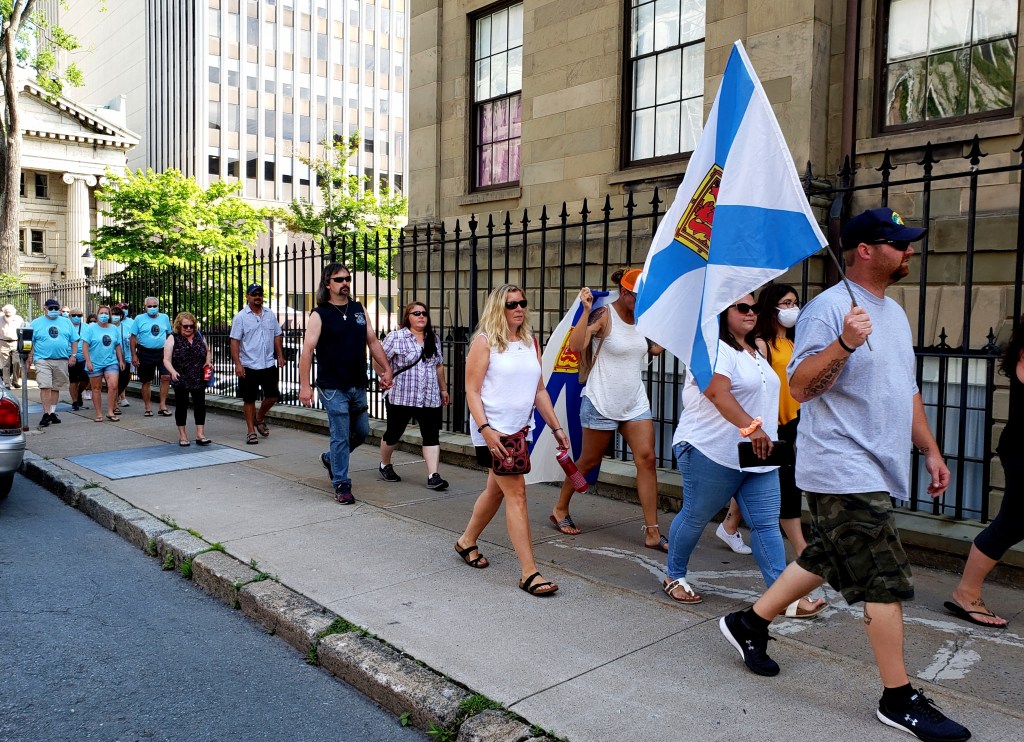
Family
members of the victims’ and their supporters marched from the ferry
terminal to Province House.
— Photo: Yvette d’Entremont
Nova Scotia NDP leader Gary Burrill
told reporters he commended the provincial government for reversing its
decision, calling it the “honourable thing” to do.
“There has been a broad based public outcry of a sort that we don’t usually see,” Burrill said.
“It would have been a deep error of
judgment on the government’s part to deny it, and in my judgment they
have done the honourable thing to recognize the mistake that they made
last week in announcing something other than a public inquiry and to
rectify the mistake as they did yesterday afternoon.”
Nova Scotia PC leader Tim Houston
described the journey to securing a public inquiry as “an odd route.” He
told reporters the goal now should be ensuring the inquiry has the
proper scope, gets the needed results, and that any recommendations that
come from it are followed through. He said he was surprised that no one
from the Liberal government had shown up to Wednesday morning’s event.
“I don’t know what to read into that,
but I think it was an opportunity for the government to really
sincerely show the families that they are behind this inquiry and that
they do support this inquiry and that they are apologetic for the
additional emotions of the past week,” Houston said.
“They decided to pass on that opportunity and I think that’s a missed opportunity for them.”
The Halifax Examiner is an advertising-free, subscriber-supported news site. Your subscription makes this work possible;
please subscribe.
Some people have asked that we additionally allow for one-time
donations from readers, so we’ve created that opportunity, via the
PayPal button below. We also accept e-transfers, cheques, and donations
with your credit card; please contact iris “at” halifaxexaminer “dot” ca
for details.
 Besides interrupting his well-earned vacation, @Tim_Bousquet
is spending lots of $$ on lawyer fees to help bring this very important
information out of the redacted darkness. Please help by subscribing or
donating.
Besides interrupting his well-earned vacation, @Tim_Bousquet
is spending lots of $$ on lawyer fees to help bring this very important
information out of the redacted darkness. Please help by subscribing or
donating.
>
**
Merci beaucoup d'avoir pris contact avec le bureau de l'Honorable Bill
Blair, D?put? de Scarborough-Sud-Ouest.
Veuillez noter que par mesure de pr?caution en mati?re de sant? et de
s?curit?, notre bureau de circonscription ne tiendra pas de r?unions
en personne jusqu'? nouvel ordre. Nous continuerons ? fournir des
services pendant nos heures de bureau habituelles, tant par t?l?phone
que par courrier ?lectronique.
En raison du volume ?lev? de courriels que nous recevons, notre bureau
classe les demandes par ordre de priorit? en fonction de leur urgence
et de notre r?le dans le service aux ?lecteurs de Scarborough
Sud-Ouest. Si vous n'?tes pas un ?lecteur de Scarborough Sud-Ouest,
veuillez contacter votre d?put? local pour obtenir de l'aide. Pour
trouver votre d?put? local, visitez le
site:
https://www.noscommunes.ca/members/fr
En outre, nous vous demandons de ne t?l?phoner ? notre bureau que si
votre cas est extr?mement urgent. Nous recevons un volume d'appels
extr?mement ?lev? et nous serons mieux ? m?me de vous servir par
courrier ?lectronique.
Si vous avez des questions concernant COVID-19, veuillez consulter le
site :
http://www.canada.ca/le-coronavirus
Merci encore pour votre message, et nous vous r?pondrons d?s que possible.
Cordialement,
Personnel du D?put? de l'Honorable Bill Blair
Colline du Parlement : 613-995-0284
Bureau de Circonscription : 416-261-8613
bill.blair@parl.gc.cab
ill.blair@parl.gc.ca>
< mailto:
bill.blair@parl.gc.ca>
---------- Original message ----------
From: Finance Minister <
FinanceMinister@novascotia.ca >
Date: Tue, 28 Jul 2020 21:48:16 +0000
Subject: Automatic reply: RE The "Strike back: Demand an inquiry
Event." Methinks it interesting that Martha Paynter is supported by
the Pierre Elliott Trudeau Foundation N'esy Pas?
To: David Amos <
david.raymond.amos333@gmail.com>
Your email has been received by the Office of the NS Minister of
Finance & Treasury Board.
Please be assured that your message will be reviewed and actioned accordingly.
If you are contacting the Honourable Karen Casey as your MLA, please
contact her constituency office at
KarenCasey@eastlink.ca or by phone
(902) 641-2200.
Thank you for your patience.
Office of the Minister
NS Department of Finance & Treasury Board
---------- Original message ----------
From: "MinFinance / FinanceMin (FIN)" <
fin.minfinance-financemin.fin@canada.ca>
Date: Tue, 28 Jul 2020 21:48:15 +0000
Subject: RE: RE The "Strike back: Demand an inquiry Event." Methinks
it interesting that Martha Paynter is supported by the Pierre Elliott
Trudeau Foundation N'esy Pas?
To: David Amos <
david.raymond.amos333@gmail.com>
The Department of Finance acknowledges receipt of your electronic
correspondence. Please be assured that we appreciate receiving your
comments.
Due to the evolving COVID-19 situation, we apologize in advance for
any delay in responding to your enquiry. In the meantime, information
on Canada's COVID-19 Economic Response Plan is available on the
Government of Canada website at
www.canada.ca/coronavirus<
http://www.canada.ca/coronavirus> or by
calling 1-800 O Canada (1-800-622-6232) or 1-833-784-4397.
Le ministère des Finances Canada accuse réception de votre courriel.
Nous vous assurons que vos commentaires sont les bienvenus.
En raison de la fluidité de la crise de la COVID-19, il est possible
que nous retardions à vous répondre et nous nous en excusons.
Entre-temps, les informations au sujet du Plan d'intervention
économique du Canada pour répondre à la COVID-19 sont disponibles dans
le site Web du gouvernement du Canada au
www.canada.ca/coronavirus<
http://www.canada.ca/coronavirus> ou en
composant le
1-800 O Canada (1-800-622-6232) ou le 1-833-784-4397.
---------- Original message ----------
From: "
kelly@kellyregan.ca" <
kelly@kellyregan.ca>
Date: Tue, 28 Jul 2020 23:48:04 +0200
Subject: Auto Reply
To:
david.raymond.amos333@gmail.com
[This is an auto reply]
Thank you for contacting the constituency office of the Hon. Kelly
Regan, MLA for Bedford. This office is here to assist residents of
the Bedford community. If you are looking to reach the Department of
Community Services, please call 1-877-424-1177.
In order to ensure a proper and timely response to your matter, please
include all necessary contact information in your correspondence,
including your name, address, phone number/e-mail, and the nature of
your matter.
This constituency office is a respectful workplace. Please be advised
that we are unable to respond to communications involving profanity,
personal attacks, racism, homophobia, or other forms of
discrimination.
Thank you and have a great day.
Traci Sullivan
Constituency Assistant
Office of the Honourable Kelly Regan | MLA, Bedford
902-407-3777 | 902-407-3779 |
www.kellyregan.ca | 1550 Bedford
Highway | Suite 555 | Bedford, NS B4A 1E6
---------- Original message ----------
From: Premier <
PREMIER@novascotia.ca>
Date: Tue, 28 Jul 2020 21:48:14 +0000
Subject: Automatic Reply
To: David Amos <
david.raymond.amos333@gmail.com>
Thank you for your email to Premier McNeil. This is an automatic
confirmation your message has been received.
We recognize that Nova Scotians have concerns about novel coronavirus
(COVID-19). If you are looking for up-to-date information, we
encourage you to visit:
novascotia.ca/coronavirus<
https://novascotia.ca/coronavirus/> or
canada.ca/coronavirus<
https://canada.ca/coronavirus>. You can also
call the toll-free information line at 1-833-784-4397.
If you are experiencing symptoms, please use the COVID-19 online
self-assessment, which can be found here:
https://when-to-call-about-covid19.novascotia.ca/en
On April 18th and 19th, our province experienced an unimaginable
tragedy, in already difficult times.
To share your condolences, please visit StrongerTogetherNS on
Facebook, or by sending them to
condolences@novascotia.ca<
mailto:
condolences@novascotia.ca>.
To contribute to the Stronger Together Nova Scotia Fund, created in
partnership with the Canadian Red Cross, visit
redcross.ca and search
for the Stronger Together Nova Scotia Fund, or call 1-800-418-1111.
Kind Regards,
Premier’s Correspondence Team
---------- Original message ----------
From: El Jones <
El.Jones@msvu.ca>
Date: Tue, 28 Jul 2020 22:13:35 +0000
Subject: Re: RE The "Strike back: Demand an inquiry Event." Methinks
it interesting that Martha Paynter is supported by the Pierre Elliott
Trudeau Foundation N'esy Pas?
To: David Amos <
david.raymond.amos333@gmail.com>
Trudeau fellowships are, I believe, awarded to the top candidates who
apply for PhD funding to SSHRC each year (which most institutions make
mandatory.) I say that just to say it is a research award more than a
political affiliation, although certainly raises questions whether
it’s ever appropriate to name research fellowships after political
figures. And they def try to network with the researchers etc.
Sent from my iPhone
---------- Original message ----------
From: David Amos <
david.raymond.amos333@gmail.com>
Date: Tue, 28 Jul 2020 18:48:00 -0300
Subject: RE The "Strike back: Demand an inquiry Event." Methinks it
interesting that Martha Paynter is supported by the Pierre Elliott
Trudeau Foundation N'esy Pas?
To: Norman Traversy <
traversy.n@gmail.com>, CabalCookies
<
cabalcookies@protonmail.com>,
El.Jones@msvu.ca,
tim@halifaxexaminer.ca, "steve.murphy" <
steve.murphy@ctv.ca>,
kevin.leahy@pps-spp.gc.ca,
Charles.Murray@gnb.ca, JUSTWEB
<
JUSTWEB@novascotia.ca>,
AgentMargaritaville@protonmail.com,
"Bill.Blair" <
Bill.Blair@parl.gc.ca>, "kevin.leahy"
<
kevin.leahy@pps-spp.parl.gc.ca>,
lagenomai4@protonmail.com,
mlaritcey@bellaliant.com,
mla@esmithmccrossinmla.com,
toryrushtonmla@bellaliant.com,
kelly@kellyregan.ca,
mla_assistant@alanapaon.com,
stephenmcneil@ns.aliantzinc.ca, PREMIER
<
PREMIER@gov.ns.ca>,
info@hughmackay.ca,
pictoueastamanda@gmail.com,
markfurey.mla@eastlink.ca,
claudiachendermla@gmail.com,
FinanceMinister@novascotia.ca, "Bill.Morneau" <
Bill.Morneau@canada.ca>
Cc: motomaniac333 <
motomaniac333@gmail.com>,
kevin.leahy@rcmp-grc.gc.ca, pm <
pm@pm.gc.ca>,
istayhealthy8@gmail.com,
prmi@eastlink.ca, "PETER.MACKAY" <
PETER.MACKAY@bakermckenzie.com>,
"Katie.Telford" <
Katie.Telford@pmo-cpm.gc.ca>
BTW I inserted a lot more info in this blog
https://davidraymondamos3.blogspot.com/2020/07/independent-panel-slap-in-face-says.html
https://www.halifaxexaminer.ca/province-house/protesters-decry-shocking-and-paternalistic-decision-to-hold-review-not-inquiry-into-nova-scotia-mass-shooting/
Protesters decry ‘shocking and paternalistic’ decision to hold review,
not inquiry into Nova Scotia mass shooting
July 27, 2020 By Yvette d'Entremont
Gathered at Victoria Park in Halifax at noon Monday for a general
strike intended to draw attention to demands for a public inquiry into
the Nova Scotia mass killing.
The event was slated to run from noon to 12:22, a 22-minute strike to
pay homage to the 22 people whose lives were taken during the weekend
of April 18-19.
“This is something that all sectors of society have asked for,” Martha
Paynter, founder and coordinator of Women’s Wellness Within, told
reporters before the event started.
Her organization works for reproductive justice, prison abolition and
health equity. It was one of several feminist community activist and
advocacy groups behind Monday’s ‘Strike back: Demand an inquiry’
event."
https://marthapaynter.ca/
‘Strike back: Demand an inquiry’ event." is a registered nurse
providing abortion and postpartum care. She is a Doctoral Candidate in
Nursing at Dalhousie University. She is the founder and coordinator of
Women’s Wellness Within, a non-profit organization supporting
criminalized women and transgender/nonbinary individuals in the
perinatal period in carceral institutions and the community. She works
to advance reproductive justice through advocacy, collaboration and
nursing scholarship.
For her nursing advocacy and research, Martha has received numerous
awards including the 2018 Rising Star Award from the Canadian
Association of Perinatal and Women’s Health Nurses, the 2018 Health
Advocacy Award from the Council of the College of Registered Nurses of
Nova Scotia, the 2018 3M National Student Fellowship, and in 2017, the
Senate of Canada Sesquicentennial Medal for volunteer service to the
country.
Martha’s doctoral research is supported by the Pierre Elliott Trudeau
Foundation, CIHR Banting-Best Canadian Doctoral Scholarship, the
Killam Predoctoral Scholarship, the Canadian Nurses Foundation,
Dalhousie University and the IWK Health Centre"
---------- Original message ----------
From: David Amos <
david.raymond.amos333@gmail.com>
Date: Sun, 21 Jul 2019 11:29:02 -0400
Subject: Attn El Jones I just called and left a message saying Iiked your style
To:
El.Jones@msvu.ca,
tim@halifaxexaminer.ca, "steve.murphy"
<
steve.murphy@ctv.ca>
Cc: "David.Raymond.Amos" <
David.Raymond.Amos@gmail.com>
https://www.halifaxexaminer.ca/featured/prisons-refugees-cats/#3.%20Fight%20me%20over%20cat%20names
Prisons, Refugees, Cats
August 5, 2018 By El Jones
Martha Paynter was driving through New Brunswick this weekend and
texted me that she saw a billboard for the Airbnb in the old
Dorchester Jail.
Among the attractions listed on the website are that it was the site
of the last double hanging in New Brunswick (more on that in a
moment), with a highlight being that guests can stay in the former
cells.
tim@halifaxexaminer.ca
https://www.youtube.com/watch?v=ayro4wYzckg&t=64s
El Jones - Judges
1,107 views
el jones
Published on May 25, 2016
https://www.youtube.com/watch?v=V7y0IkmSVTc
Canada is So Polite - El Jones
2,895 views
Janice Jo Lee
Published on Jan 25, 2018
https://www.msvu.ca/en/home/aboutus/news/ElJonesNamedNancysChair.aspx
El Jones appointed Nancy’s Chair in Women’s Studies at the Mount
El’s office is located in the McCain Centre (room 208B). She can be
reached at
El.Jones@msvu.ca or 902-457-6257.
---------- Original message ----------
From: Kevin Leahy <
kevin.leahy@rcmp-grc.gc.ca>
Date: Fri, 28 Jun 2019 12:38:43 -0400
Subject: Re: RE The call from the Boston cop Robert Ridge (857 259
9083) on behalf of the VERY corrupt Yankee DA Rachael Rollins
To: David Amos <
motomaniac333@gmail.com>
French will follow
Thank you for your email.
For inquiries regarding EMRO’s Office, please address your email to
acting EMRO Sebastien Brillon at
sebastien.brillon@rcmp-grc.gc.ca
For inquiries regarding CO NHQ Office, please address your email to
acting CO Farquharson, David at
David.Farquharson@rcmp-grc.gc.ca
All PPS related correspondence should be sent to my PPS account at
kevin.leahy@pps-spp@
parl.gc.ca
------------------------------
------------------------------
--------------------
Merci pour votre courriel.
Pour toute question concernant le Bureau de l'EMRO, veuillez adresser
vos courriels à l’Officier responsable des Relations
employeur-employés par intérim Sébastien Brillon à l'adresse suivante
sebastien.brillon@rcmp-grc.gc.ca
Pour toute question concernant le bureau du Commandant de la
Direction générale, veuillez adresser vos courriels au Commandant de
la Direction générale par intérim Farquharson, David à l'adresse
suivante
David.Farquharson@rcmp-grc.gc.ca
Toute correspondance relative au Service De Protection Parlementaire
doit être envoyée à mon compte de PPS à l'adresse suivante
kevin.leahy@pps-spp@
parl.gc.ca
Kevin Leahy
Chief Superintendent/Surintendant principal
Director, Parliamentary Protective Service
Directeur , Service de protection parlementaire
T 613-996-5048
Kevin.leahy@rcmp-grc.gc.ca
CONFIDENTIALITY NOTICE: This email and any attachments are
confidential and may contain protected information. It is intended
only for the individual or entity named in the message. If you are not
the intended recipient, or the agent responsible to deliver the
message that this email contains to the intended recipient, you should
not disseminate, distribute or copy this email, nor disclose or use in
any manner the information that it contains. Please notify the sender
immediately if you have received this email by mistake and delete it.
AVIS DE CONFIDENTIALITÉ: Le présent courriel et tout fichier qui y est
joint sont confidentiels et peuvent contenir des renseignements
protégés. Il est strictement réservé à l’usage du destinataire prévu.
Si vous n’êtes pas le destinataire prévu, ou le mandataire chargé de
lui transmettre le message que ce courriel contient, vous ne devez ni
le diffuser, le distribuer ou le copier, ni divulguer ou utiliser à
quelque fin que ce soit les renseignements qu’il contient. Veuillez
aviser immédiatement l’expéditeur si vous avez reçu ce courriel par
erreur et supprimez-le.
---------- Original message ----------
From: Premier of Ontario | Premier ministre de l’Ontario <
Premier@ontario.ca>
Date: Fri, 28 Jun 2019 16:38:41 +0000
Subject: Automatic reply: RE The call from the Boston cop Robert Ridge
(857 259 9083) on behalf of the VERY corrupt Yankee DA Rachael Rollins
To: David Amos <
motomaniac333@gmail.com>
Thank you for your email. Your thoughts, comments and input are greatly valued.
You can be assured that all emails and letters are carefully read,
reviewed and taken into consideration.
There may be occasions when, given the issues you have raised and the
need to address them effectively, we will forward a copy of your
correspondence to the appropriate government official. Accordingly, a
response may take several business days.
Thanks again for your email.
______
Merci pour votre courriel. Nous vous sommes très reconnaissants de
nous avoir fait part de vos idées, commentaires et observations.
Nous tenons à vous assurer que nous lisons attentivement et prenons en
considération tous les courriels et lettres que nous recevons.
Dans certains cas, nous transmettrons votre message au ministère
responsable afin que les questions soulevées puissent être traitées de
la manière la plus efficace possible. En conséquence, plusieurs jours
ouvrables pourraient s’écouler avant que nous puissions vous répondre.
Merci encore pour votre courriel.
---------- Original message ----------
From: David Amos <
motomaniac333@gmail.com>
Date: Thu, 18 May 2017 11:55:57 -0400
Subject: Re the CBA, the RCMP, Federal Court File # T-1557-15 and the
Hearing before the Federal Court of Appeal on May 24th 2017
To:
ray.adlington@mcinnescooper.com, mcu <
mcu@justice.gc.ca>,
"bob.paulson" <
bob.paulson@rcmp-grc.gc.ca>, "hon.ralph.goodale"
<
hon.ralph.goodale@canada.ca>, "Jody.Wilson-Raybould"
<
Jody.Wilson-Raybould@parl.gc.ca>, "bill.pentney"
<
bill.pentney@justice.gc.ca>, "jan.jensen" <
jan.jensen@justice.gc.ca>
Cc: David Amos <
david.raymond.amos@gmail.com>
, Mordaith
<
Mordaith@gmail.com>, "leanne.murray"
<
leanne.murray@mcinnescooper.com>, gopublic <
gopublic@cbc.ca>,
"Jacques.Poitras" <
Jacques.Poitras@cbc.ca>, "nick.moore"
<
nick.moore@bellmedia.ca>, "jeremy.keefe"
<
jeremy.keefe@globalnews.ca>, "steve.murphy" <
steve.murphy@ctv.ca>,
"Gilles.Blinn" <
Gilles.Blinn@rcmp-grc.gc.ca>, "Gilles.Moreau"
<
Gilles.Moreau@forces.gc.ca>, sallybrooks25 <
sallybrooks25@yahoo.ca>,
oldmaison <
oldmaison@yahoo.com>, andre <
andre@jafaust.com>, jbosnitch
<
jbosnitch@gmail.com>, "serge.rousselle" <
serge.rousselle@gnb.ca>,
premier <
premier@gnb.ca>, "brian.gallant" <
brian.gallant@gnb.ca>,
"Larry.Tremblay" <
Larry.Tremblay@rcmp-grc.gc.ca>, "luc.labonte"
<
luc.labonte@gnb.ca>
As I told the RCMP who called me last month the proper time and place
to discuss the CBA and your former partner Judge Richard Bell is the
Federal Court of Canada
Raymond G. Adlington Partner
McInnes Cooper
1300-1969 Upper Water St., Purdy's Wharf Tower II PO Box 730, Stn. Central
Halifax, Nova Scotia B3J 2V1
Phone: (902) 444-8470
Fax: (902) 425-6350
E:
ray.adlington@mcinnescooper.com
http://www.mcinnescooper.com/news/ray-adlington-named-to-cba-board-of-directors/
Ray Adlington named to CBA Board of Directors
May 2, 2017
Halifax partner Ray Adlington was recently named to the CBA Board of Directors.
In their announcement yesterday the CBA advised that the board would
come into effect September 1st, 2017.
After collecting extensive input over the past two years, we know
that CBA members believe it’s important for the organization to have a
Board of Directors that reflects the diversity of the legal
profession, including a mix of practice types, experience, skills,
geography and more.
Our new Board of Directors exemplifies this principle.
The board is composed from one member from each province as well as
the CBA President.
Congratulations Ray on this well deserved appointment.
> ---------- Original message ----------
> From: David Amos <
motomaniac333@gmail.com>
> Date: Wed, 26 Jun 2019 16:15:59 -0400
> Subject: Hey Ralph Goodale perhaps you and the RCMP should call the
> Yankees Governor Charlie Baker, his lawyer Bob Ross, Rachael Rollins
> and this cop Robert Ridge (857 259 9083) ASAP EH Mr Primme Minister
> Trudeau the Younger and Donald Trump Jr?
> To:
pm@pm.gc.ca,
Katie.Telford@pmo-cpm.gc.ca,
>
Ian.Shugart@pco-bcp.gc.ca,
djtjr@trumporg.com,
>
Donald.J.Trump@donaldtrump.com,
JUSTWEB@novascotia.ca,
>
Frank.McKenna@td.com,
barbara.massey@rcmp-grc.gc.ca,
>
Douglas.Johnson@rcmp-grc.gc.ca,
sandra.lofaro@rcmp-grc.gc.ca,
>
washington.field@ic.fbi.gov,
Brenda.Lucki@rcmp-grc.gc.ca,
>
gov.press@state.ma.us,
bob.ross@state.ma.us,
jfurey@nbpower.com,
>
jfetzer@d.umn.edu,
Newsroom@globeandmail.com,
sfine@globeandmail.com,
> .
Poitras@cbc.ca,
steve.murphy@ctv.ca,
David.Akin@globalnews.ca,
>
Dale.Morgan@rcmp-grc.gc.ca,
news@kingscorecord.com,
>
news@dailygleaner.com,
oldmaison@yahoo.com,
jbosnitch@gmail.com,
>
andre@jafaust.com>
> Cc:
david.raymond.amos333@gmail.com,
DJT@trumporg.com
>
wharrison@nbpower.com,
David.Lametti@parl.gc.ca,
mcu@justice.gc.ca,
>
Jody.Wilson-Raybould@parl.gc.ca,
hon.ralph.goodale@canada.ca
>
>>
>> ---------- Forwarded message ----------
>> From: "Murray, Charles (Ombud)" <
Charles.Murray@gnb.ca>
>> Date: Wed, 20 Mar 2019 18:16:15 +0000
>> Subject: You wished to speak with me
>> To: "
motomaniac333@gmail.com" <
motomaniac333@gmail.com>
>>
>> I have the advantage, sir, of having read many of your emails over the
>> years.
>>
>>
>> As such, I do not think a phone conversation between us, and
>> specifically one which you might mistakenly assume was in response to
>> your threat of legal action against me, is likely to prove a
>> productive use of either of our time.
>>
>>
>> If there is some specific matter about which you wish to communicate
>> with me, feel free to email me with the full details and it will be
>> given due consideration.
>>
>>
>> Sincerely,
>>
>>
>> Charles Murray
>>
>> Ombud NB
>>
>> Acting Integrity Commissioner
>>
>>
>>> From: Justice Website <
JUSTWEB@novascotia.ca>
>>> Date: Mon, 18 Sep 2017 14:21:11 +0000
>>> Subject: Emails to Department of Justice and Province of Nova Scotia
>>> To: "
motomaniac333@gmail.com" <
motomaniac333@gmail.com>
>>>
>>> Mr. Amos,
>>> We acknowledge receipt of your recent emails to the Deputy Minister of
>>> Justice and lawyers within the Legal Services Division of the
>>> Department of Justice respecting a possible claim against the Province
>>> of Nova Scotia. Service of any documents respecting a legal claim
>>> against the Province of Nova Scotia may be served on the Attorney
>>> General at 1690 Hollis Street, Halifax, NS. Please note that we will
>>> not be responding to further emails on this matter.
>>>
>>> Department of Justice
>>>
>>> On 8/3/17, David Amos <
motomaniac333@gmail.com> wrote:
>>>
>>>> If want something very serious to download and laugh at as well Please
>>>> Enjoy and share real wiretap tapes of the mob
>>>>
>>>>
http://thedavidamosrant.blogspot.ca/2013/10/re-glen-greenwald-and-braz
>>>> ilian.html
>>>>
>>>>>
http://www.cbc.ca/news/world/story/2013/06/09/nsa-leak-guardian.html
>>>>>
>>>>> As the CBC etc yap about Yankee wiretaps and whistleblowers I must
>>>>> ask them the obvious question AIN'T THEY FORGETTING SOMETHING????
>>>>>
>>>>>
http://www.youtube.com/watch?v=vugUalUO8YY
>>>>>
>>>>> What the hell does the media think my Yankee lawyer served upon the
>>>>> USDOJ right after I ran for and seat in the 39th Parliament baseball
>>>>> cards?
>>>>>
>>>>>
http://archive.org/details/ITriedToExplainItToAllMaritimersInEarly200
>>>>> 6
>>>>>
>>>>>
http://davidamos.blogspot.ca/2006/05/wiretap-tapes-impeach-bush.html
>>>>>
>>>>>
http://www.archive.org/details/PoliceSurveilanceWiretapTape139
>>>>>
>>>>>
http://archive.org/details/Part1WiretapTape143
>>>>>
>>>>> FEDERAL EXPRES February 7, 2006
>>>>> Senator Arlen Specter
>>>>> United States Senate
>>>>> Committee on the Judiciary
>>>>> 224 Dirksen Senate Office Building
>>>>> Washington, DC 20510
>>>>>
>>>>> Dear Mr. Specter:
>>>>>
>>>>> I have been asked to forward the enclosed tapes to you from a man
>>>>> named, David Amos, a Canadian citizen, in connection with the matters
>>>>> raised in the attached letter.
>>>>>
>>>>> Mr. Amos has represented to me that these are illegal FBI wire tap
>>>>> tapes.
>>>>>
>>>>> I believe Mr. Amos has been in contact with you about this previously.
>>>>>
>>>>> Very truly yours,
>>>>> Barry A. Bachrach
>>>>> Direct telephone: (508) 926-3403
>>>>> Direct facsimile: (508) 929-3003
>>>>> Email:
bbachrach@bowditch.com
>>>>>
>>>>
>>>
>>>> ---------- Forwarded message ----------
>>>> From: David Amos
motomaniac333@gmail.com
>>>> Date: Mon, 12 Jun 2017 09:32:09 -0400
>>>> Subject: Attn Integrity Commissioner Alexandre Deschênes, Q.C.,
>>>> To:
coi@gnb.ca
>>>> Cc:
david.raymond.amos@gmail.com
>>>>
>>>> Good Day Sir
>>>>
>>>> After I heard you speak on CBC I called your office again and managed
>>>> to speak to one of your staff for the first time
>>>>
>>>> Please find attached the documents I promised to send to the lady who
>>>> answered the phone this morning. Please notice that not after the Sgt
>>>> at Arms took the documents destined to your office his pal Tanker
>>>> Malley barred me in writing with an "English" only document.
>>>>
>>>> These are the hearings and the dockets in Federal Court that I
>>>> suggested that you study closely.
>>>>
>>>> This is the docket in Federal Court
>>>>
>>>>
http://cas-cdc-www02.cas-satj.gc.ca/IndexingQueries/infp_RE_info_e.php?court_no=T-1557-15&select_court=T
>>>>
>>>> These are digital recordings of the last three hearings
>>>>
>>>> Dec 14th
https://archive.org/details/BahHumbug
>>>>
>>>> January 11th, 2016
https://archive.org/details/Jan11th2015
>>>>
>>>> April 3rd, 2017
>>>>
>>>>
https://archive.org/details/April32017JusticeLeblancHearing
>>>>
>>>>
>>>> This is the docket in the Federal Court of Appeal
>>>>
>>>>
http://cas-cdc-www02.cas-satj.gc.ca/IndexingQueries/infp_RE_info_e.php?court_no=A-48-16&select_court=All
>>>>
>>>>
>>>> The only hearing thus far
>>>>
>>>> May 24th, 2017
>>>>
>>>>
https://archive.org/details/May24thHoedown
>>>>
>>>>
>>>> This Judge understnds the meaning of the word Integrity
>>>>
>>>> Date: 20151223
>>>>
>>>> Docket: T-1557-15
>>>>
>>>> Fredericton, New Brunswick, December 23, 2015
>>>>
>>>> PRESENT: The Honourable Mr. Justice Bell
>>>>
>>>> BETWEEN:
>>>>
>>>> DAVID RAYMOND AMOS
>>>>
>>>> Plaintiff
>>>>
>>>> and
>>>>
>>>> HER MAJESTY THE QUEEN
>>>>
>>>> Defendant
>>>>
>>>> ORDER
>>>>
>>>> (Delivered orally from the Bench in Fredericton, New Brunswick, on
>>>> December 14, 2015)
>>>>
>>>> The Plaintiff seeks an appeal de novo, by way of motion pursuant to
>>>> the Federal Courts Rules (SOR/98-106), from an Order made on November
>>>> 12, 2015, in which Prothonotary Morneau struck the Statement of Claim
>>>> in its entirety.
>>>>
>>>> At the outset of the hearing, the Plaintiff brought to my attention a
>>>> letter dated September 10, 2004, which he sent to me, in my then
>>>> capacity as Past President of the New Brunswick Branch of the Canadian
>>>> Bar Association, and the then President of the Branch, Kathleen Quigg,
>>>> (now a Justice of the New Brunswick Court of Appeal). In that letter
>>>> he stated:
>>>>
>>>> As for your past President, Mr. Bell, may I suggest that you check the
>>>> work of Frank McKenna before I sue your entire law firm including you.
>>>> You are your brother’s keeper.
>>>>
>>>> Frank McKenna is the former Premier of New Brunswick and a former
>>>> colleague of mine at the law firm of McInnes Cooper. In addition to
>>>> expressing an intention to sue me, the Plaintiff refers to a number of
>>>> people in his Motion Record who he appears to contend may be witnesses
>>>> or potential parties to be added. Those individuals who are known to
>>>> me personally, include, but are not limited to the former Prime
>>>> Minister of Canada, The Right Honourable Stephen Harper; former
>>>> Attorney General of Canada and now a Justice of the Manitoba Court of
>>>> Queen’s Bench, Vic Toews; former member of Parliament Rob Moore;
>>>> former Director of Policing Services, the late Grant Garneau; former
>>>> Chief of the Fredericton Police Force, Barry McKnight; former Staff
>>>> Sergeant Danny Copp; my former colleagues on the New Brunswick Court
>>>> of Appeal, Justices Bradley V. Green and Kathleen Quigg, and, retired
>>>> Assistant Commissioner Wayne Lang of the Royal Canadian Mounted
>>>> Police.
>>>>
>>>> In the circumstances, given the threat in 2004 to sue me in my
>>>> personal capacity and my past and present relationship with many
>>>> potential witnesses and/or potential parties to the litigation, I am
>>>> of the view there would be a reasonable apprehension of bias should I
>>>> hear this motion. See Justice de Grandpré’s dissenting judgment in
>>>> Committee for Justice and Liberty et al v National Energy Board et al,
>>>> [1978] 1 SCR 369 at p 394 for the applicable test regarding
>>>> allegations of bias. In the circumstances, although neither party has
>>>> requested I recuse myself, I consider it appropriate that I do so.
>>>>
>>>>
>>>> AS A RESULT OF MY RECUSAL, THIS COURT ORDERS that the Administrator of
>>>> the Court schedule another date for the hearing of the motion. There
>>>> is no order as to costs.
>>>>
>>>> “B. Richard Bell”
>>>> Judge
>>>>
>>>>
>>>> Below after the CBC article about your concerns (I made one comment
>>>> already) you will find the text of just two of many emails I had sent
>>>> to your office over the years since I first visited it in 2006.
>>>>
>>>> I noticed that on July 30, 2009, he was appointed to the the Court
>>>> Martial Appeal Court of Canada Perhaps you should scroll to the
>>>> bottom of this email ASAP and read the entire Paragraph 83 of my
>>>> lawsuit now before the Federal Court of Canada?
>>>>
>>>> "FYI This is the text of the lawsuit that should interest Trudeau the
>>>> most
>>>>
>>>>
>>>> ---------- Original message ----------
>>>> From:
justin.trudeau.a1@parl.gc.ca
>>>> Date: Thu, Oct 22, 2015 at 8:18 PM
>>>> Subject: Réponse automatique : RE My complaint against the CROWN in
>>>> Federal Court Attn David Hansen and Peter MacKay If you planning to
>>>> submit a motion for a publication ban on my complaint trust that you
>>>> dudes are way past too late
>>>> To:
david.raymond.amos@gmail.com
>>>>
>>>> Veuillez noter que j'ai changé de courriel. Vous pouvez me rejoindre à
>>>>
lalanthier@hotmail.com
>>>>
>>>> Pour rejoindre le bureau de M. Trudeau veuillez envoyer un courriel à
>>>>
tommy.desfosses@parl.gc.ca
>>>>
>>>> Please note that I changed email address, you can reach me at
>>>>
lalanthier@hotmail.com
>>>>
>>>> To reach the office of Mr. Trudeau please send an email to
>>>>
tommy.desfosses@parl.gc.ca
>>>>
>>>> Thank you,
>>>>
>>>> Merci ,
>>>>
>>>>
>>>>
http://davidraymondamos3.blogspot.ca/2015/09/v-behaviorurldefaultvmlo.html
>>>>
>>>>
>>>> 83. The Plaintiff states that now that Canada is involved in more war
>>>> in Iraq again it did not serve Canadian interests and reputation to
>>>> allow Barry Winters to publish the following words three times over
>>>> five years after he began his bragging:
>>>>
>>>> January 13, 2015
>>>> This Is Just AS Relevant Now As When I wrote It During The Debate
>>>>
>>>> December 8, 2014
>>>> Why Canada Stood Tall!
>>>>
>>>> Friday, October 3, 2014
>>>> Little David Amos’ “True History Of War” Canadian Airstrikes And
>>>> Stupid Justin Trudeau
>>>>
>>>> Canada’s and Canadians free ride is over. Canada can no longer hide
>>>> behind Amerka’s and NATO’s skirts.
>>>>
>>>> When I was still in Canadian Forces then Prime Minister Jean Chretien
>>>> actually committed the Canadian Army to deploy in the second campaign
>>>> in Iraq, the Coalition of the Willing. This was against or contrary to
>>>> the wisdom or advice of those of us Canadian officers that were
>>>> involved in the initial planning phases of that operation. There were
>>>> significant concern in our planning cell, and NDHQ about of the dearth
>>>> of concern for operational guidance, direction, and forces for
>>>> operations after the initial occupation of Iraq. At the “last minute”
>>>> Prime Minister Chretien and the Liberal government changed its mind.
>>>> The Canadian government told our amerkan cousins that we would not
>>>> deploy combat troops for the Iraq campaign, but would deploy a
>>>> Canadian Battle Group to Afghanistan, enabling our amerkan cousins to
>>>> redeploy troops from there to Iraq. The PMO’s thinking that it was
>>>> less costly to deploy Canadian Forces to Afghanistan than Iraq. But
>>>> alas no one seems to remind the Liberals of Prime Minister Chretien’s
>>>> then grossly incorrect assumption. Notwithstanding Jean Chretien’s
>>>> incompetence and stupidity, the Canadian Army was heroic,
>>>> professional, punched well above it’s weight, and the PPCLI Battle
>>>> Group, is credited with “saving Afghanistan” during the Panjway
>>>> campaign of 2006.
>>>>
>>>> What Justin Trudeau and the Liberals don’t tell you now, is that then
>>>> Liberal Prime Minister Jean Chretien committed, and deployed the
>>>> Canadian army to Canada’s longest “war” without the advice, consent,
>>>> support, or vote of the Canadian Parliament.
>>>>
>>>> What David Amos and the rest of the ignorant, uneducated, and babbling
>>>> chattering classes are too addled to understand is the deployment of
>>>> less than 75 special operations troops, and what is known by planners
>>>> as a “six pac cell” of fighter aircraft is NOT the same as a
>>>> deployment of a Battle Group, nor a “war” make.
>>>>
>>>> The Canadian Government or The Crown unlike our amerkan cousins have
>>>> the “constitutional authority” to commit the Canadian nation to war.
>>>> That has been recently clearly articulated to the Canadian public by
>>>> constitutional scholar Phillippe Legasse. What Parliament can do is
>>>> remove “confidence” in The Crown’s Government in a “vote of
>>>> non-confidence.” That could not happen to the Chretien Government
>>>> regarding deployment to Afghanistan, and it won’t happen in this
>>>> instance with the conservative majority in The Commons regarding a
>>>> limited Canadian deployment to the Middle East.
>>>>
>>>> President George Bush was quite correct after 911 and the terror
>>>> attacks in New York; that the Taliban “occupied” and “failed state”
>>>> Afghanistan was the source of logistical support, command and control,
>>>> and training for the Al Quaeda war of terror against the world. The
>>>> initial defeat, and removal from control of Afghanistan was vital and
>>>>
>>>> P.S. Whereas this CBC article is about your opinion of the actions of
>>>> the latest Minister Of Health trust that Mr Boudreau and the CBC have
>>>> had my files for many years and the last thing they are is ethical.
>>>> Ask his friends Mr Murphy and the RCMP if you don't believe me.
>>>>
>>>> Subject:
>>>> Date: Tue, 30 Jan 2007 12:02:35 -0400
>>>> From: "Murphy, Michael B. \(DH/MS\)"
MichaelB.Murphy@gnb.ca
>>>> To:
motomaniac_02186@yahoo.com
>>>>
>>>> January 30, 2007
>>>>
>>>> WITHOUT PREJUDICE
>>>>
>>>> Mr. David Amos
>>>>
>>>> Dear Mr. Amos:
>>>>
>>>> This will acknowledge receipt of a copy of your e-mail of December 29,
>>>> 2006 to Corporal Warren McBeath of the RCMP.
>>>>
>>>> Because of the nature of the allegations made in your message, I have
>>>> taken the measure of forwarding a copy to Assistant Commissioner Steve
>>>> Graham of the RCMP “J” Division in Fredericton.
>>>>
>>>> Sincerely,
>>>>
>>>> Honourable Michael B. Murphy
>>>> Minister of Health
>>>>
>>>> CM/cb
>>>>
>>>>
>>>> Warren McBeath
warren.mcbeath@rcmp-grc.gc.ca wrote:
>>>>
>>>> Date: Fri, 29 Dec 2006 17:34:53 -0500
>>>> From: "Warren McBeath"
warren.mcbeath@rcmp-grc.gc.ca
>>>> To:
kilgoursite@ca.inter.net,
MichaelB.Murphy@gnb.ca,
>>>>
nada.sarkis@gnb.ca,
wally.stiles@gnb.ca,
dwatch@web.net,
>>>>
motomaniac_02186@yahoo.com
>>>> CC:
ottawa@chuckstrahl.com,
riding@chuckstrahl.com,
John.Foran@gnb.ca,
>>>>
Oda.B@parl.gc.ca,"Bev BUSSON"
bev.busson@rcmp-grc.gc.ca,
>>>> "Paul Dube"
PAUL.DUBE@rcmp-grc.gc.ca
>>>> Subject: Re: Remember me Kilgour? Landslide Annie McLellan has
>>>> forgotten me but the crooks within the RCMP have not
>>>>
>>>> Dear Mr. Amos,
>>>>
>>>> Thank you for your follow up e-mail to me today. I was on days off
>>>> over the holidays and returned to work this evening. Rest assured I
>>>> was not ignoring or procrastinating to respond to your concerns.
>>>>
>>>> As your attachment sent today refers from Premier Graham, our position
>>>> is clear on your dead calf issue: Our forensic labs do not process
>>>> testing on animals in cases such as yours, they are referred to the
>>>> Atlantic Veterinary College in Charlottetown who can provide these
>>>> services. If you do not choose to utilize their expertise in this
>>>> instance, then that is your decision and nothing more can be done.
>>>>
>>>> As for your other concerns regarding the US Government, false
>>>> imprisonment and Federal Court Dates in the US, etc... it is clear
>>>> that Federal authorities are aware of your concerns both in Canada
>>>> the US. These issues do not fall into the purvue of Detachment
>>>> and policing in Petitcodiac, NB.
>>>>
>>>> It was indeed an interesting and informative conversation we had on
>>>> December 23rd, and I wish you well in all of your future endeavors.
>>>>
>>>> Sincerely,
>>>>
>>>> Warren McBeath, Cpl.
>>>> GRC Caledonia RCMP
>>>> Traffic Services NCO
>>>> Ph: (506) 387-2222
>>>> Fax: (506) 387-4622
>>>> E-mail
warren.mcbeath@rcmp-grc.gc.ca
>>>>
>>>>
>>>>
>>>> Alexandre Deschênes, Q.C.,
>>>> Office of the Integrity Commissioner
>>>> Edgecombe House, 736 King Street
>>>> Fredericton, N.B. CANADA E3B 5H1
>>>> tel.: 506-457-7890
>>>> fax: 506-444-5224
>>>>
e-mail:coi@gnb.ca
>>>>
>>>
>>> ---------- Forwarded message ----------
>>>
>>>
http://davidraymondamos3.blogspot.ca/2017/11/federal-court-of-appeal-finally-makes.html
>>>
>>>
>>> Sunday, 19 November 2017
>>> Federal Court of Appeal Finally Makes The BIG Decision And Publishes
>>> It Now The Crooks Cannot Take Back Ticket To Try Put My Matter Before
>>> The Supreme Court
>>>
>>>
https://decisions.fct-cf.gc.ca/fca-caf/decisions/en/item/236679/index.do
>>>
>>>
>>> Federal Court of Appeal Decisions
>>>
>>> Amos v. Canada
>>> Court (s) Database
>>>
>>> Federal Court of Appeal Decisions
>>> Date
>>>
>>> 2017-10-30
>>> Neutral citation
>>>
>>> 2017 FCA 213
>>> File numbers
>>>
>>> A-48-16
>>> Date: 20171030
>>>
>>> Docket: A-48-16
>>> Citation: 2017 FCA 213
>>> CORAM:
>>>
>>> WEBB J.A.
>>> NEAR J.A.
>>> GLEASON J.A.
>>>
>>>
>>> BETWEEN:
>>> DAVID RAYMOND AMOS
>>> Respondent on the cross-appeal
>>> (and formally Appellant)
>>> and
>>> HER MAJESTY THE QUEEN
>>> Appellant on the cross-appeal
>>> (and formerly Respondent)
>>> Heard at Fredericton, New Brunswick, on May 24, 2017.
>>> Judgment delivered at Ottawa, Ontario, on October 30, 2017.
>>> REASONS FOR JUDGMENT BY:
>>>
>>> THE COURT
>>>
>>>
>>>
>>> Date: 20171030
>>>
>>> Docket: A-48-16
>>> Citation: 2017 FCA 213
>>> CORAM:
>>>
>>> WEBB J.A.
>>> NEAR J.A.
>>> GLEASON J.A.
>>>
>>>
>>> BETWEEN:
>>> DAVID RAYMOND AMOS
>>> Respondent on the cross-appeal
>>> (and formally Appellant)
>>> and
>>> HER MAJESTY THE QUEEN
>>> Appellant on the cross-appeal
>>> (and formerly Respondent)
>>> REASONS FOR JUDGMENT BY THE COURT
>>>
>>> I. Introduction
>>>
>>> [1] On September 16, 2015, David Raymond Amos (Mr. Amos)
>>> filed a 53-page Statement of Claim (the Claim) in Federal Court
>>> against Her Majesty the Queen (the Crown). Mr. Amos claims $11 million
>>> in damages and a public apology from the Prime Minister and Provincial
>>> Premiers for being illegally barred from accessing parliamentary
>>> properties and seeks a declaration from the Minister of Public Safety
>>> that the Canadian Government will no longer allow the Royal Canadian
>>> Mounted Police (RCMP) and Canadian Forces to harass him and his clan
>>> (Claim at para. 96).
>>>
>>> [2] On November 12, 2015 (Docket T-1557-15), by way of a
>>> motion brought by the Crown, a prothonotary of the Federal Court (the
>>> Prothonotary) struck the Claim in its entirety, without leave to
>>> amend, on the basis that it was plain and obvious that the Claim
>>> disclosed no reasonable claim, the Claim was fundamentally vexatious,
>>> and the Claim could not be salvaged by way of further amendment (the
>>> Prothontary’s Order).
>>>
>>>
>>> [3] On January 25, 2016 (2016 FC 93), by way of Mr.
>>> Amos’ appeal from the Prothonotary’s Order, a judge of the Federal
>>> Court (the Judge), reviewing the matter de novo, struck all of Mr.
>>> Amos’ claims for relief with the exception of the claim for damages
>>> for being barred by the RCMP from the New Brunswick legislature in
>>> 2004 (the Federal Court Judgment).
>>>
>>>
>>> [4] Mr. Amos appealed and the Crown cross-appealed the
>>> Federal Court Judgment. Further to the issuance of a Notice of Status
>>> Review, Mr. Amos’ appeal was dismissed for delay on December 19, 2016.
>>> As such, the only matter before this Court is the Crown’s
>>> cross-appeal.
>>>
>>>
>>> II. Preliminary Matter
>>>
>>> [5] Mr. Amos, in his memorandum of fact and law in
>>> relation to the cross-appeal that was filed with this Court on March
>>> 6, 2017, indicated that several judges of this Court, including two of
>>> the judges of this panel, had a conflict of interest in this appeal.
>>> This was the first time that he identified the judges whom he believed
>>> had a conflict of interest in a document that was filed with this
>>> Court. In his notice of appeal he had alluded to a conflict with
>>> several judges but did not name those judges.
>>>
>>> [6] Mr. Amos was of the view that he did not have to
>>> identify the judges in any document filed with this Court because he
>>> had identified the judges in various documents that had been filed
>>> with the Federal Court. In his view the Federal Court and the Federal
>>> Court of Appeal are the same court and therefore any document filed in
>>> the Federal Court would be filed in this Court. This view is based on
>>> subsections 5(4) and 5.1(4) of the Federal Courts Act, R.S.C., 1985,
>>> c. F-7:
>>>
>>>
>>> 5(4) Every judge of the Federal Court is, by virtue of his or her
>>> office, a judge of the Federal Court of Appeal and has all the
>>> jurisdiction, power and authority of a judge of the Federal Court of
>>> Appeal.
>>> […]
>>>
>>> 5(4) Les juges de la Cour fédérale sont d’office juges de la Cour
>>> d’appel fédérale et ont la même compétence et les mêmes pouvoirs que
>>> les juges de la Cour d’appel fédérale.
>>> […]
>>> 5.1(4) Every judge of the Federal Court of Appeal is, by virtue of
>>> that office, a judge of the Federal Court and has all the
>>> jurisdiction, power and authority of a judge of the Federal Court.
>>>
>>> 5.1(4) Les juges de la Cour d’appel fédérale sont d’office juges de la
>>> Cour fédérale et ont la même compétence et les mêmes pouvoirs que les
>>> juges de la Cour fédérale.
>>>
>>>
>>> [7] However, these subsections only provide that the
>>> judges of the Federal Court are also judges of this Court (and vice
>>> versa). It does not mean that there is only one court. If the Federal
>>> Court and this Court were one Court, there would be no need for this
>>> section.
>>> [8] Sections 3 and 4 of the Federal Courts Act provide
>>> that:
>>> 3 The division of the Federal Court of Canada called the Federal Court
>>> — Appeal Division is continued under the name “Federal Court of
>>> Appeal” in English and “Cour d’appel fédérale” in French. It is
>>> continued as an additional court of law, equity and admiralty in and
>>> for Canada, for the better administration of the laws of Canada and as
>>> a superior court of record having civil and criminal jurisdiction.
>>>
>>> 3 La Section d’appel, aussi appelée la Cour d’appel ou la Cour d’appel
>>> fédérale, est maintenue et dénommée « Cour d’appel fédérale » en
>>> français et « Federal Court of Appeal » en anglais. Elle est maintenue
>>> à titre de tribunal additionnel de droit, d’equity et d’amirauté du
>>> Canada, propre à améliorer l’application du droit canadien, et
>>> continue d’être une cour supérieure d’archives ayant compétence en
>>> matière civile et pénale.
>>> 4 The division of the Federal Court of Canada called the Federal Court
>>> — Trial Division is continued under the name “Federal Court” in
>>> English and “Cour fédérale” in French. It is continued as an
>>> additional court of law, equity and admiralty in and for Canada, for
>>> the better administration of the laws of Canada and as a superior
>>> court of record having civil and criminal jurisdiction.
>>>
>>> 4 La section de la Cour fédérale du Canada, appelée la Section de
>>> première instance de la Cour fédérale, est maintenue et dénommée «
>>> Cour fédérale » en français et « Federal Court » en anglais. Elle est
>>> maintenue à titre de tribunal additionnel de droit, d’equity et
>>> d’amirauté du Canada, propre à améliorer l’application du droit
>>> canadien, et continue d’être une cour supérieure d’archives ayant
>>> compétence en matière civile et pénale.
>>>
>>>
>>> [9] Sections 3 and 4 of the Federal Courts Act create
>>> two separate courts – this Court (section 3) and the Federal Court
>>> (section 4). If, as Mr. Amos suggests, documents filed in the Federal
>>> Court were automatically also filed in this Court, then there would no
>>> need for the parties to prepare and file appeal books as required by
>>> Rules 343 to 345 of the Federal Courts Rules, SOR/98-106 in relation
>>> to any appeal from a decision of the Federal Court. The requirement to
>>> file an appeal book with this Court in relation to an appeal from a
>>> decision of the Federal Court makes it clear that the only documents
>>> that will be before this Court are the documents that are part of that
>>> appeal book.
>>>
>>>
>>> [10] Therefore, the memorandum of fact and law filed on
>>> March 6, 2017 is the first document, filed with this Court, in which
>>> Mr. Amos identified the particular judges that he submits have a
>>> conflict in any matter related to him.
>>>
>>>
>>> [11] On April 3, 2017, Mr. Amos attempted to bring a motion
>>> before the Federal Court seeking an order “affirming or denying the
>>> conflict of interest he has” with a number of judges of the Federal
>>> Court. A judge of the Federal Court issued a direction noting that if
>>> Mr. Amos was seeking this order in relation to judges of the Federal
>>> Court of Appeal, it was beyond the jurisdiction of the Federal Court.
>>> Mr. Amos raised the Federal Court motion at the hearing of this
>>> cross-appeal. The Federal Court motion is not a motion before this
>>> Court and, as such, the submissions filed before the Federal Court
>>> will not be entertained. As well, since this was a motion brought
>>> before the Federal Court (and not this Court), any documents filed in
>>> relation to that motion are not part of the record of this Court.
>>>
>>>
>>> [12] During the hearing of the appeal Mr. Amos alleged that
>>> the third member of this panel also had a conflict of interest and
>>> submitted some documents that, in his view, supported his claim of a
>>> conflict. Mr. Amos, following the hearing of his appeal, was also
>>> afforded the opportunity to provide a brief summary of the conflict
>>> that he was alleging and to file additional documents that, in his
>>> view, supported his allegations. Mr. Amos submitted several pages of
>>> documents in relation to the alleged conflicts. He organized the
>>> documents by submitting a copy of the biography of the particular
>>> judge and then, immediately following that biography, by including
>>> copies of the documents that, in his view, supported his claim that
>>> such judge had a conflict.
>>>
>>>
>>> [13] The nature of the alleged conflict of Justice Webb is
>>> that before he was appointed as a Judge of the Tax Court of Canada in
>>> 2006, he was a partner with the law firm Patterson Law, and before
>>> that with Patterson Palmer in Nova Scotia. Mr. Amos submitted that he
>>> had a number of disputes with Patterson Palmer and Patterson Law and
>>> therefore Justice Webb has a conflict simply because he was a partner
>>> of these firms. Mr. Amos is not alleging that Justice Webb was
>>> personally involved in or had any knowledge of any matter in which Mr.
>>> Amos was involved with Justice Webb’s former law firm – only that he
>>> was a member of such firm.
>>>
>>>
>>> [14] During his oral submissions at the hearing of his
>>> appeal Mr. Amos, in relation to the alleged conflict for Justice Webb,
>>> focused on dealings between himself and a particular lawyer at
>>> Patterson Law. However, none of the documents submitted by Mr. Amos at
>>> the hearing or subsequently related to any dealings with this
>>> particular lawyer nor is it clear when Mr. Amos was dealing with this
>>> lawyer. In particular, it is far from clear whether such dealings were
>>> after the time that Justice Webb was appointed as a Judge of the Tax
>>> Court of Canada over 10 years ago.
>>>
>>>
>>> [15] The documents that he submitted in relation to the
>>> alleged conflict for Justice Webb largely relate to dealings between
>>> Byron Prior and the St. John’s Newfoundland and Labrador office of
>>> Patterson Palmer, which is not in the same province where Justice Webb
>>> practiced law. The only document that indicates any dealing between
>>> Mr. Amos and Patterson Palmer is a copy of an affidavit of Stephen May
>>> who was a partner in the St. John’s NL office of Patterson Palmer. The
>>> affidavit is dated January 24, 2005 and refers to a number of e-mails
>>> that were sent by Mr. Amos to Stephen May. Mr. Amos also included a
>>> letter that is addressed to four individuals, one of whom is John
>>> Crosbie who was counsel to the St. John’s NL office of Patterson
>>> Palmer. The letter is dated September 2, 2004 and is addressed to
>>> “John Crosbie, c/o Greg G. Byrne, Suite 502, 570 Queen Street,
>>> Fredericton, NB E3B 5E3”. In this letter Mr. Amos alludes to a
>>> possible lawsuit against Patterson Palmer.
>>> [16] Mr. Amos’ position is that simply because Justice Webb
>>> was a lawyer with Patterson Palmer, he now has a conflict. In Wewaykum
>>> Indian Band v. Her Majesty the Queen, 2003 SCC 45, [2003] 2 S.C.R.
>>> 259, the Supreme Court of Canada noted that disqualification of a
>>> judge is to be determined based on whether there is a reasonable
>>> apprehension of bias:
>>> 60 In Canadian law, one standard has now emerged as the
>>> criterion for disqualification. The criterion, as expressed by de
>>> Grandpré J. in Committee for Justice and Liberty v. National Energy
>>> Board, …[[1978] 1 S.C.R. 369, 68 D.L.R. (3d) 716], at p. 394, is the
>>> reasonable apprehension of bias:
>>> … the apprehension of bias must be a reasonable one, held by
>>> reasonable and right minded persons, applying themselves to the
>>> question and obtaining thereon the required information. In the words
>>> of the Court of Appeal, that test is "what would an informed person,
>>> viewing the matter realistically and practically -- and having thought
>>> the matter through -- conclude. Would he think that it is more likely
>>> than not that [the decision-maker], whether consciously or
>>> unconsciously, would not decide fairly."
>>>
>>> [17] The issue to be determined is whether an informed
>>> person, viewing the matter realistically and practically, and having
>>> thought the matter through, would conclude that Mr. Amos’ allegations
>>> give rise to a reasonable apprehension of bias. As this Court has
>>> previously remarked, “there is a strong presumption that judges will
>>> administer justice impartially” and this presumption will not be
>>> rebutted in the absence of “convincing evidence” of bias (Collins v.
>>> Canada, 2011 FCA 140 at para. 7, [2011] 4 C.T.C. 157 [Collins]. See
>>> also R. v. S. (R.D.), [1997] 3 S.C.R. 484 at para. 32, 151 D.L.R.
>>> (4th) 193).
>>>
>>> [18] The Ontario Court of Appeal in Rando Drugs Ltd. v.
>>> Scott, 2007 ONCA 553, 86 O.R. (3d) 653 (leave to appeal to the Supreme
>>> Court of Canada refused, 32285 (August 1, 2007)), addressed the
>>> particular issue of whether a judge is disqualified from hearing a
>>> case simply because he had been a member of a law firm that was
>>> involved in the litigation that was now before that judge. The Ontario
>>> Court of Appeal determined that the judge was not disqualified if the
>>> judge had no involvement with the person or the matter when he was a
>>> lawyer. The Ontario Court of Appeal also explained that the rules for
>>> determining whether a judge is disqualified are different from the
>>> rules to determine whether a lawyer has a conflict:
>>> 27 Thus, disqualification is not the natural corollary to a
>>> finding that a trial judge has had some involvement in a case over
>>> which he or she is now presiding. Where the judge had no involvement,
>>> as here, it cannot be said that the judge is disqualified.
>>>
>>>
>>> 28 The point can rightly be made that had Mr. Patterson been
>>> asked to represent the appellant as counsel before his appointment to
>>> the bench, the conflict rules would likely have prevented him from
>>> taking the case because his firm had formerly represented one of the
>>> defendants in the case. Thus, it is argued how is it that as a trial
>>> judge Patterson J. can hear the case? This issue was considered by the
>>> Court of Appeal (Civil Division) in Locabail (U.K.) Ltd. v. Bayfield
>>> Properties Ltd., [2000] Q.B. 451. The court held, at para. 58, that
>>> there is no inflexible rule governing the disqualification of a judge
>>> and that, "[e]verything depends on the circumstances."
>>>
>>>
>>> 29 It seems to me that what appears at first sight to be an
>>> inconsistency in application of rules can be explained by the
>>> different contexts and in particular, the strong presumption of
>>> judicial impartiality that applies in the context of disqualification
>>> of a judge. There is no such presumption in cases of allegations of
>>> conflict of interest against a lawyer because of a firm's previous
>>> involvement in the case. To the contrary, as explained by Sopinka J.
>>> in MacDonald Estate v. Martin (1990), 77 D.L.R. (4th) 249 (S.C.C.),
>>> for sound policy reasons there is a presumption of a disqualifying
>>> interest that can rarely be overcome. In particular, a conclusory
>>> statement from the lawyer that he or she had no confidential
>>> information about the case will never be sufficient. The case is the
>>> opposite where the allegation of bias is made against a trial judge.
>>> His or her statement that he or she knew nothing about the case and
>>> had no involvement in it will ordinarily be accepted at face value
>>> unless there is good reason to doubt it: see Locabail, at para. 19.
>>>
>>>
>>> 30 That brings me then to consider the particular circumstances
>>> of this case and whether there are serious grounds to find a
>>> disqualifying conflict of interest in this case. In my view, there are
>>> two significant factors that justify the trial judge's decision not to
>>> recuse himself. The first is his statement, which all parties accept,
>>> that he knew nothing of the case when it was in his former firm and
>>> that he had nothing to do with it. The second is the long passage of
>>> time. As was said in Wewaykum, at para. 85:
>>> To us, one significant factor stands out, and must inform
>>> the perspective of the reasonable person assessing the impact of this
>>> involvement on Binnie J.'s impartiality in the appeals. That factor is
>>> the passage of time. Most arguments for disqualification rest on
>>> circumstances that are either contemporaneous to the decision-making,
>>> or that occurred within a short time prior to the decision-making.
>>> 31 There are other factors that inform the issue. The Wilson
>>> Walker firm no longer acted for any of the parties by the time of
>>> trial. More importantly, at the time of the motion, Patterson J. had
>>> been a judge for six years and thus had not had a relationship with
>>> his former firm for a considerable period of time.
>>>
>>>
>>> 32 In my view, a reasonable person, viewing the matter
>>> realistically would conclude that the trial judge could deal fairly
>>> and impartially with this case. I take this view principally because
>>> of the long passage of time and the trial judge's lack of involvement
>>> in or knowledge of the case when the Wilson Walker firm had carriage.
>>> In these circumstances it cannot be reasonably contended that the
>>> trial judge could not remain impartial in the case. The mere fact that
>>> his name appears on the letterhead of some correspondence from over a
>>> decade ago would not lead a reasonable person to believe that he would
>>> either consciously or unconsciously favour his former firm's former
>>> client. It is simply not realistic to think that a judge would throw
>>> off his mantle of impartiality, ignore his oath of office and favour a
>>> client - about whom he knew nothing - of a firm that he left six years
>>> earlier and that no longer acts for the client, in a case involving
>>> events from over a decade ago.
>>> (emphasis added)
>>>
>>> [19] Justice Webb had no involvement with any matter
>>> involving Mr. Amos while he was a member of Patterson Palmer or
>>> Patterson Law, nor does Mr. Amos suggest that he did. Mr. Amos made it
>>> clear during the hearing of this matter that the only reason for the
>>> alleged conflict for Justice Webb was that he was a member of
>>> Patterson Law and Patterson Palmer. This is simply not enough for
>>> Justice Webb to be disqualified. Any involvement of Mr. Amos with
>>> Patterson Law while Justice Webb was a member of that firm would have
>>> had to occur over 10 years ago and even longer for the time when he
>>> was a member of Patterson Palmer. In addition to the lack of any
>>> involvement on his part with any matter or dispute that Mr. Amos had
>>> with Patterson Law or Patterson Palmer (which in and of itself is
>>> sufficient to dispose of this matter), the length of time since
>>> Justice Webb was a member of Patterson Law or Patterson Palmer would
>>> also result in the same finding – that there is no conflict in Justice
>>> Webb hearing this appeal.
>>>
>>> [20] Similarly in R. v. Bagot, 2000 MBCA 30, 145 Man. R.
>>> (2d) 260, the Manitoba Court of Appeal found that there was no
>>> reasonable apprehension of bias when a judge, who had been a member of
>>> the law firm that had been retained by the accused, had no involvement
>>> with the accused while he was a lawyer with that firm.
>>>
>>> [21] In Del Zotto v. Minister of National Revenue, [2000] 4
>>> F.C. 321, 257 N.R. 96, this court did find that there would be a
>>> reasonable apprehension of bias where a judge, who while he was a
>>> lawyer, had recorded time on a matter involving the same person who
>>> was before that judge. However, this case can be distinguished as
>>> Justice Webb did not have any time recorded on any files involving Mr.
>>> Amos while he was a lawyer with Patterson Palmer or Patterson Law.
>>>
>>> [22] Mr. Amos also included with his submissions a CD. He
>>> stated in his affidavit dated June 26, 2017 that there is a “true copy
>>> of an American police surveillance wiretap entitled 139” on this CD.
>>> He has also indicated that he has “provided a true copy of the CD
>>> entitled 139 to many American and Canadian law enforcement authorities
>>> and not one of the police forces or officers of the court are willing
>>> to investigate it”. Since he has indicated that this is an “American
>>> police surveillance wiretap”, this is a matter for the American law
>>> enforcement authorities and cannot create, as Mr. Amos suggests, a
>>> conflict of interest for any judge to whom he provides a copy.
>>>
>>> [23] As a result, there is no conflict or reasonable
>>> apprehension of bias for Justice Webb and therefore, no reason for him
>>> to recuse himself.
>>>
>>> [24] Mr. Amos alleged that Justice Near’s past professional
>>> experience with the government created a “quasi-conflict” in deciding
>>> the cross-appeal. Mr. Amos provided no details and Justice Near
>>> confirmed that he had no prior knowledge of the matters alleged in the
>>> Claim. Justice Near sees no reason to recuse himself.
>>>
>>> [25] Insofar as it is possible to glean the basis for Mr.
>>> Amos’ allegations against Justice Gleason, it appears that he alleges
>>> that she is incapable of hearing this appeal because he says he wrote
>>> a letter to Brian Mulroney and Jean Chrétien in 2004. At that time,
>>> both Justice Gleason and Mr. Mulroney were partners in the law firm
>>> Ogilvy Renault, LLP. The letter in question, which is rude and angry,
>>> begins with “Hey you two Evil Old Smiling Bastards” and “Re: me suing
>>> you and your little dogs too”. There is no indication that the letter
>>> was ever responded to or that a law suit was ever commenced by Mr.
>>> Amos against Mr. Mulroney. In the circumstances, there is no reason
>>> for Justice Gleason to recuse herself as the letter in question does
>>> not give rise to a reasonable apprehension of bias.
>>>
>>>
>>> III. Issue
>>>
>>> [26] The issue on the cross-appeal is as follows: Did the
>>> Judge err in setting aside the Prothonotary’s Order striking the Claim
>>> in its entirety without leave to amend and in determining that Mr.
>>> Amos’ allegation that the RCMP barred him from the New Brunswick
>>> legislature in 2004 was capable of supporting a cause of action?
>>>
>>> IV. Analysis
>>>
>>> A. Standard of Review
>>>
>>> [27] Following the Judge’s decision to set aside the
>>> Prothonotary’s Order, this Court revisited the standard of review to
>>> be applied to discretionary decisions of prothonotaries and decisions
>>> made by judges on appeals of prothonotaries’ decisions in Hospira
>>> Healthcare Corp. v. Kennedy Institute of Rheumatology, 2016 FCA 215,
>>> 402 D.L.R. (4th) 497 [Hospira]. In Hospira, a five-member panel of
>>> this Court replaced the Aqua-Gem standard of review with that
>>> articulated in Housen v. Nikolaisen, 2002 SCC 33, [2002] 2 S.C.R. 235
>>> [Housen]. As a result, it is no longer appropriate for the Federal
>>> Court to conduct a de novo review of a discretionary order made by a
>>> prothonotary in regard to questions vital to the final issue of the
>>> case. Rather, a Federal Court judge can only intervene on appeal if
>>> the prothonotary made an error of law or a palpable and overriding
>>> error in determining a question of fact or question of mixed fact and
>>> law (Hospira at para. 79). Further, this Court can only interfere with
>>> a Federal Court judge’s review of a prothonotary’s discretionary order
>>> if the judge made an error of law or palpable and overriding error in
>>> determining a question of fact or question of mixed fact and law
>>> (Hospira at paras. 82-83).
>>>
>>> [28] In the case at bar, the Judge substituted his own
>>> assessment of Mr. Amos’ Claim for that of the Prothonotary. This Court
>>> must look to the Prothonotary’s Order to determine whether the Judge
>>> erred in law or made a palpable and overriding error in choosing to
>>> interfere.
>>>
>>>
>>> B. Did the Judge err in interfering with the
>>> Prothonotary’s Order?
>>>
>>> [29] The Prothontoary’s Order accepted the following
>>> paragraphs from the Crown’s submissions as the basis for striking the
>>> Claim in its entirety without leave to amend:
>>>
>>> 17. Within the 96 paragraph Statement of Claim, the Plaintiff
>>> addresses his complaint in paragraphs 14-24, inclusive. All but four
>>> of those paragraphs are dedicated to an incident that occurred in 2006
>>> in and around the legislature in New Brunswick. The jurisdiction of
>>> the Federal Court does not extend to Her Majesty the Queen in right of
>>> the Provinces. In any event, the Plaintiff hasn’t named the Province
>>> or provincial actors as parties to this action. The incident alleged
>>> does not give rise to a justiciable cause of action in this Court.
>>> (…)
>>>
>>>
>>> 21. The few paragraphs that directly address the Defendant
>>> provide no details as to the individuals involved or the location of
>>> the alleged incidents or other details sufficient to allow the
>>> Defendant to respond. As a result, it is difficult or impossible to
>>> determine the causes of action the Plaintiff is attempting to advance.
>>> A generous reading of the Statement of Claim allows the Defendant to
>>> only speculate as to the true and/or intended cause of action. At
>>> best, the Plaintiff’s action may possibly be summarized as: he
>>> suspects he is barred from the House of Commons.
>>> [footnotes omitted].
>>>
>>>
>>> [30] The Judge determined that he could not strike the Claim
>>> on the same jurisdictional basis as the Prothonotary. The Judge noted
>>> that the Federal Court has jurisdiction over claims based on the
>>> liability of Federal Crown servants like the RCMP and that the actors
>>> who barred Mr. Amos from the New Brunswick legislature in 2004
>>> included the RCMP (Federal Court Judgment at para. 23). In considering
>>> the viability of these allegations de novo, the Judge identified
>>> paragraph 14 of the Claim as containing “some precision” as it
>>> identifies the date of the event and a RCMP officer acting as
>>> Aide-de-Camp to the Lieutenant Governor (Federal Court Judgment at
>>> para. 27).
>>>
>>>
>>> [31] The Judge noted that the 2004 event could support a
>>> cause of action in the tort of misfeasance in public office and
>>> identified the elements of the tort as excerpted from Meigs v. Canada,
>>> 2013 FC 389, 431 F.T.R. 111:
>>>
>>>
>>> [13] As in both the cases of Odhavji Estate v Woodhouse, 2003 SCC
>>> 69 [Odhavji] and Lewis v Canada, 2012 FC 1514 [Lewis], I must
>>> determine whether the plaintiffs’ statement of claim pleads each
>>> element of the alleged tort of misfeasance in public office:
>>>
>>> a) The public officer must have engaged in deliberate and unlawful
>>> conduct in his or her capacity as public officer;
>>>
>>> b) The public officer must have been aware both that his or her
>>> conduct was unlawful and that it was likely to harm the plaintiff; and
>>>
>>> c) There must be an element of bad faith or dishonesty by the public
>>> officer and knowledge of harm alone is insufficient to conclude that a
>>> public officer acted in bad faith or dishonestly.
>>> Odhavji, above, at paras 23, 24 and 28
>>> (Federal Court Judgment at para. 28).
>>>
>>> [32] The Judge determined that Mr. Amos disclosed sufficient
>>> material facts to meet the elements of the tort of misfeasance in
>>> public office because the actors, who barred him from the New
>>> Brunswick legislature in 2004, including the RCMP, did so for
>>> “political reasons” (Federal Court Judgment at para. 29).
>>>
>>> [33] This Court’s discussion of the sufficiency of pleadings
>>> in Merchant Law Group v. Canada (Revenue Agency), 2010 FCA 184, 321
>>> D.L.R (4th) 301 is particularly apt:
>>>
>>> …When pleading bad faith or abuse of power, it is not enough to
>>> assert, baldly, conclusory phrases such as “deliberately or
>>> negligently,” “callous disregard,” or “by fraud and theft did steal”.
>>> “The bare assertion of a conclusion upon which the court is called
>>> upon to pronounce is not an allegation of material fact”. Making bald,
>>> conclusory allegations without any evidentiary foundation is an abuse
>>> of process…
>>>
>>> To this, I would add that the tort of misfeasance in public office
>>> requires a particular state of mind of a public officer in carrying
>>> out the impunged action, i.e., deliberate conduct which the public
>>> officer knows to be inconsistent with the obligations of his or her
>>> office. For this tort, particularization of the allegations is
>>> mandatory. Rule 181 specifically requires particularization of
>>> allegations of “breach of trust,” “wilful default,” “state of mind of
>>> a person,” “malice” or “fraudulent intention.”
>>> (at paras. 34-35, citations omitted).
>>>
>>> [34] Applying the Housen standard of review to the
>>> Prothonotary’s Order, we are of the view that the Judge interfered
>>> absent a legal or palpable and overriding error.
>>>
>>> [35] The Prothonotary determined that Mr. Amos’ Claim
>>> disclosed no reasonable claim and was fundamentally vexatious on the
>>> basis of jurisdictional concerns and the absence of material facts to
>>> ground a cause of action. Paragraph 14 of the Claim, which addresses
>>> the 2004 event, pleads no material facts as to how the RCMP officer
>>> engaged in deliberate and unlawful conduct, knew that his or her
>>> conduct was unlawful and likely to harm Mr. Amos, and acted in bad
>>> faith. While the Claim alleges elsewhere that Mr. Amos was barred from
>>> the New Brunswick legislature for political and/or malicious reasons,
>>> these allegations are not particularized and are directed against
>>> non-federal actors, such as the Sergeant-at-Arms of the Legislative
>>> Assembly of New Brunswick and the Fredericton Police Force. As such,
>>> the Judge erred in determining that Mr. Amos’ allegation that the RCMP
>>> barred him from the New Brunswick legislature in 2004 was capable of
>>> supporting a cause of action.
>>>
>>> [36] In our view, the Claim is made up entirely of bare
>>> allegations, devoid of any detail, such that it discloses no
>>> reasonable cause of action within the jurisdiction of the Federal
>>> Courts. Therefore, the Judge erred in interfering to set aside the
>>> Prothonotary’s Order striking the claim in its entirety. Further, we
>>> find that the Prothonotary made no error in denying leave to amend.
>>> The deficiencies in Mr. Amos’ pleadings are so extensive such that
>>> amendment could not cure them (see Collins at para. 26).
>>>
>>> V. Conclusion
>>> [37] For the foregoing reasons, we would allow the Crown’s
>>> cross-appeal, with costs, setting aside the Federal Court Judgment,
>>> dated January 25, 2016 and restoring the Prothonotary’s Order, dated
>>> November 12, 2015, which struck Mr. Amos’ Claim in its entirety
>>> without leave to amend.
>>> "Wyman W. Webb"
>>> J.A.
>>> "David G. Near"
>>> J.A.
>>> "Mary J.L. Gleason"
>>> J.A.
>>>
>>>
>>>
>>> FEDERAL COURT OF APPEAL
>>> NAMES OF COUNSEL AND SOLICITORS OF RECORD
>>>
>>> A CROSS-APPEAL FROM AN ORDER OF THE HONOURABLE JUSTICE SOUTHCOTT DATED
>>> JANUARY 25, 2016; DOCKET NUMBER T-1557-15.
>>> DOCKET:
>>>
>>> A-48-16
>>>
>>>
>>>
>>> STYLE OF CAUSE:
>>>
>>> DAVID RAYMOND AMOS v. HER MAJESTY THE QUEEN
>>>
>>>
>>>
>>> PLACE OF HEARING:
>>>
>>> Fredericton,
>>> New Brunswick
>>>
>>> DATE OF HEARING:
>>>
>>> May 24, 2017
>>>
>>> REASONS FOR JUDGMENT OF THE COURT BY:
>>>
>>> WEBB J.A.
>>> NEAR J.A.
>>> GLEASON J.A.
>>>
>>> DATED:
>>>
>>> October 30, 2017
>>>
>>> APPEARANCES:
>>> David Raymond Amos
>>>
>>>
>>> For The Appellant / respondent on cross-appeal
>>> (on his own behalf)
>>>
>>> Jan Jensen
>>>
>>>
>>> For The Respondent / appELLANT ON CROSS-APPEAL
>>>
>>> SOLICITORS OF RECORD:
>>> Nathalie G. Drouin
>>> Deputy Attorney General of Canada
>>>
>>> For The Respondent / APPELLANT ON CROSS-APPEAL
>>>
>>>
>
---------- Original message ----------
Date: Thu, 24 May 2007 19:01:11 -0700 (PDT)
From: "David Amos"
motomaniac_02186@yahoo.com
Subject: Now everybody and his dog knows TJ Burke and his cop buddies
allegations against me are false and you had the proof all along EH
Chucky?
To:
oldmaison@yahoo.com,
nbombud@gnb.ca,
dan.bussieres@gnb.ca,
jacques_poitras@cbc.ca,
news@dailygleaner.com,
kcarmichael@bloomberg.net,
advocacycollective@yahoo.com,
Easter.W@parl.gc.ca,
Comartin.J@parl.gc.ca,
cityadmin@fredericton.ca,
info@gg.ca,
bmosher@mosherchedore.ca,
rchedore@mosherchedore.ca,
police@fredericton.ca,
chebert@thestar.ca,
Stoffer.P@parl.gc.ca,
Stronach.B@parl.gc.ca,
Matthews.B@parl.gc.ca,
alltrue@nl.rogers.com,
Harper.S@parl.gc.ca,
Layton.J@parl.gc.ca,
Dryden.K@parl.gc.ca,
Duceppe.G@parl.gc.ca
CC:
dgleg@nb.aibn.com,
brad.woodside@fredericton.ca,
whalen@fredericton.ca,
david.kelly@fredericton.ca,
cathy.maclaggan@fredericton.ca,
stephen.kelly@fredericton.ca,
tom.jellinek@fredericton.ca,
scott.mcconaghy@fredericton.ca,
marilyn.kerton@fredericton.ca,
walter.brown@fredericton.ca,
norah.davidson@fredericton.ca,
mike.obrien@fredericton.ca,
bruce.grandy@fredericton.ca,
dan.keenan@fredericton.ca,
jeff.mockler@gnb.ca,
mrichard@lawsociety-barreau.nb.ca,
cynthia.merlini@dfait-maeci.gc.ca,
jlmockler@mpor.ca,
scotta@parl.gc.ca,
michael.bray@gnb.ca,
jack.e.mackay@gnb.ca
http://www.cbc.ca/canada/new-brunswick/story/2007/05/24/nb-burkethreat.html
http://www.canadaeast.com/ce2/docroot/article.php?articleID=149018
http://oldmaison.blogspot.com/2007/05/tj-burke-walking-around-with-rcmp.html
http://oldmaison.blogspot.com/2006/06/fapo-has-meeting-about-panhanding.html
http://oldmaison.blogspot.com/2007/05/hats-off-to-cbc-reporter-jacques.html
http://maritimes.indymedia.org/mail.php?id=9856
Methinks your liberal pals just made a major faux pas N'est Pas?
Scroll down Frenchie and go down?.
Threat against Burke taken seriously
By STEPHEN LLEWELLYN
dgleg@nb.aibn.com
Published Thursday May 24th, 2007
Appeared on page A1
An RCMP security detail has been guarding Justice Minister and
Attorney General T.J. Burke because of threats made against him
recently.
Burke, the Liberal MLA for Fredericton-Fort Nashwaaksis, wouldn't
explain the nature of the threats.
"I have had a particular individual or individuals who have made
specific overtures about causing harm towards me," he told reporters
Wednesday.
"The RCMP has provided security to me recently by accompanying me to a
couple of public functions where the individual is known to reside or
have family members in the area," said Burke. "It is nice to have some
added protection and that added comfort."
The RCMP provides protection to the premier and MLAs with its VIP security unit.
Burke didn't say when the threat was made but it's believed to have
been in recent weeks.
"When a threat is posed to you and it is a credible threat, you have
to be cautious about where you go and who you are around," he said.
"But again, I am more concerned about my family as opposed to my own
personal safety."
Burke said he doesn't feel any differently and he has not changed his
pattern of activity.
"It doesn't bother me one bit," he said. "It makes my wife feel awful nervous."
Burke served in an elite American military unit before becoming a
lawyer and going into politics in New Brunswick.
"(I) have taken my own precautions and what I have to do to ensure my
family's safety," he said. "I am a very cautious person in general due
to my background and training.
"I am comfortable with defending myself or my family if it ever had to happen."
Burke said it is not uncommon for politicians to have security concerns.
"We do live unfortunately in an age and in a society now where threats
have to be taken pretty seriously," he said.
Since the terrorism attacks in the United States on Sept. 11, 2001,
security in New Brunswick has been
beefed up.
Metal detectors were recently installed in the legislature and all
visitors are screened.
The position of attorney general is often referred to as the
province's "top cop."
Burke said sometimes people do not differentiate between his role as
the manager of the justice system and the individual who actually
prosecutes them.
"With the job sometimes comes threats," he said. "I have had numerous
threats since Day 1 in office."
Burke said he hopes his First Nations heritage has nothing to do with it.
"I think it is more of an issue where people get fixated on a matter
and they believe you are personally responsible for assigning them
their punishment or their sanction," he said.
Is the threat from someone who was recently incarcerated?
"I probably shouldn't answer that," he replied.
Reporters asked when the threat would be over.
"I don't think a threat ever passes once it has been made," said
Burke. "You have to consider the credibility of the source."
Bruce Fitch, former justice minister in the Conservative government,
said "every now and again there would be e-mails that were not
complimentary."
"I did have a meeting with the RCMP who are in charge of the security
of the MLAs and ministers," said Fitch.
"They look at each and every situation."
Fitch said he never had bodyguards assigned to him although former
premier Bernard Lord and former health minister Elvy Robichaud did
have extra security staff assigned on occasion.
He said if any MLA felt threatened, he or she would discuss it with the RCMP.
http://www.archive.org/details/SecTreasuryDeptEtc
Small World EH Chucky Leblanc?
"Lafleur, Lou"
lou.lafleur@fredericton.ca wrote:
From: "Lafleur, Lou"
lou.lafleur@fredericton.ca
To: "'
motomaniac_02186@yahoo.com'"
motomaniac_02186@yahoo.com,
"Lafleur, Lou"
lou.lafleur@fredericton.ca
Subject: Fredericton Police Force
Date: Mon, 11 Jun 2007 15:21:13 -0300
Dear Mr. Amos
My Name is Lou LaFleur and I am a Detective with the Fredericton
Police Major Crime Unit. I would like to talk to you regarding files
that I am investigating and that you are alleged to have involvement
in.
Please call me at your earliest convenience and leave a message and a
phone number on my secure and confidential line if I am not in my
office.
yours truly,
Cpl. Lou LaFleur
Fredericton Police Force
311 Queen St.
Fredericton, NB
506-460-2332
______________________________
__
This electronic mail, including any attachments, is confidential and
is for the sole use of the intended recipient and may be privileged.
Any unauthorized distribution, copying, disclosure or review is
prohibited. Neither communication over the Internet nor disclosure to
anyone other than the intended recipient constitutes waiver of
privilege. If you are not the intended recipient, please immediately
notify the sender and then delete this communication and any
attachments from your computer system and records without saving or
forwarding it. Thank you.
>
**
Merci beaucoup d'avoir pris contact avec le bureau de l'Honorable Bill
Blair, D?put? de Scarborough-Sud-Ouest.
Veuillez noter que par mesure de pr?caution en mati?re de sant? et de
s?curit?, notre bureau de circonscription ne tiendra pas de r?unions
en personne jusqu'? nouvel ordre. Nous continuerons ? fournir des
services pendant nos heures de bureau habituelles, tant par t?l?phone
que par courrier ?lectronique.
En raison du volume ?lev? de courriels que nous recevons, notre bureau
classe les demandes par ordre de priorit? en fonction de leur urgence
et de notre r?le dans le service aux ?lecteurs de Scarborough
Sud-Ouest. Si vous n'?tes pas un ?lecteur de Scarborough Sud-Ouest,
veuillez contacter votre d?put? local pour obtenir de l'aide. Pour
trouver votre d?put? local, visitez le
site:https://www.noscommunes.ca/members/fr
En outre, nous vous demandons de ne t?l?phoner ? notre bureau que si
votre cas est extr?mement urgent. Nous recevons un volume d'appels
extr?mement ?lev? et nous serons mieux ? m?me de vous servir par
courrier ?lectronique.
Si vous avez des questions concernant COVID-19, veuillez consulter le
site : http://www.canada.ca/le-coronavirus
Merci encore pour votre message, et nous vous r?pondrons d?s que possible.
Cordialement,
Personnel du D?put? de l'Honorable Bill Blair
Colline du Parlement : 613-995-0284
Bureau de Circonscription : 416-261-8613
bill.blair@parl.gc.cabill.blair@parl.gc.ca>
< mailto:bill.blair@parl.gc.ca>
After backlash, governments agree to hold public inquiry into Nova
Scotia shooting
By Alexander Quon & Elizabeth McSheffrey Global News
Posted July 28, 2020 10:42 am
WATCH: The federal government is now proceeding with a public inquiry
into the Nova Scotia massacre that left 22 innocent people dead in
April. Elizabeth McSheffrey looks at why Ottawa is changing paths now,
and what the inquiry has the power to do.
The decision to hold a review into the mass killing in April that
resulted in the deaths of 22 people in Nova Scotia took three months
to arrange. In less than a week the decision has been undone after a
massive wave of public backlash.
Federal Public Safety Minister Bill Blair announced on Tuesday a
public inquiry will be held into the mass shooting that began in
Portapique, N.S. on April 18 and came to an end nearly 100 km away, 13
hours later.
“The Government of Canada is now proceeding with a full Public
Inquiry, under the authority of the Inquiries Act,” said Blair in a
statement.
---------- Original message ----------
From: Allan Carroll <allan.carroll@rcmp-grc.gc.ca>
Date: Mon, 12 Aug 2013 18:14:09 -0400
Subject: Re: Trust that Murray Segal's appointment to whitewash the
Rehteah Parsons matter did not surprise me after the meail I sent this
weekend (AOL)
To: David Amos <motomaniac333@gmail.com>
I will be AOL commencing July 27, 2013 and returning on August 13,
2013. Cpl David Baldwin of Amherst Det will be assuming my duties
during my absence. Should you require immediate assistance, please
contact the main Amherst office number at 902-667-3859.
For inquiries about the Crisis Negotiation Team, please contact
Sgt.Royce MacRae at 902-720-5426 (w) or 902-471-8776 (c)
---------- Original message ----------
From: "Fitch, Leanne" <leanne.fitch@fredericton.ca>
Date: Tue, 5 Apr 2016 14:05:24 +0000
Subject: Automatic reply: Re Federal Court file no T-1557-15 Now this
is interesting As soon as Brad Wall got reelected as Premier he began
blocking my email Go Figure EH David Drummond???
To: David Amos <motomaniac333@gmail.com>
Due to a very high volume of incoming email to this account there is
an unusual backlog of pending responses. Your query may not be repleid
to in a timely fashion. If you require a formal response please send
your query in writing to my attention c/o Fredericton Police Force,
311 Queen St, Fredericton, NB E3B 1B1 or phone (506) 460-2300.
This e-mail communication (including any or all attachments) is
intended only for the use of the person or entity to which it is
addressed and may contain confidential and/or privileged material. If
you are not the intended recipient of this e-mail, any use, review,
retransmission, distribution, dissemination, copying, printing, or
other use of, or taking of any action in reliance upon this e-mail, is
strictly prohibited. If you have received this e-mail in error, please
contact the sender and delete the original and any copy of this e-mail
and any printout thereof, immediately. Your co-operation is
appreciated.
Any correspondence with elected officials, employees, or other agents
of the City of Fredericton may be subject to disclosure under the
provisions of the Province of New Brunswick Right to Information and
Protection of Privacy Act.
Le présent courriel (y compris toute pièce jointe) s'adresse
uniquement à son destinataire, qu'il soit une personne ou un
organisme, et pourrait comporter des renseignements privilégiés ou
confidentiels. Si vous n'êtes pas le destinataire du courriel, il est
interdit d'utiliser, de revoir, de retransmettre, de distribuer, de
disséminer, de copier ou d'imprimer ce courriel, d'agir en vous y
fiant ou de vous en servir de toute autre façon. Si vous avez reçu le
présent courriel par erreur, prière de communiquer avec l'expéditeur
et d'éliminer l'original du courriel, ainsi que toute copie
électronique ou imprimée de celui-ci, immédiatement. Nous sommes
reconnaissants de votre collaboration.
Toute correspondance entre ou avec les employés ou les élus de la
Ville de Fredericton pourrait être divulguée conformément aux
dispositions de la Loi sur le droit à l’information et la protection
de la vie privée.
GOV-OP-073
---------- Original message ----------
From: "Hon.Ralph.Goodale (PS/SP)" <Hon.ralph.goodale@canada.ca>
Date: Mon, 29 Apr 2019 16:39:00 +0000
Subject: Automatic reply: Methinks this afternoon Harjit Sajjan and
his minions should go to Federal Court pull my file (T-1557-15) from
the docket then read statement 83 real slow N'esy Pas?
To: David Amos <motomaniac333@gmail.com>
Merci d'avoir ?crit ? l'honorable Ralph Goodale, ministre de la
S?curit? publique et de la Protection civile.
En raison d'une augmentation importante du volume de la correspondance
adress?e au ministre, veuillez prendre note qu'il pourrait y avoir un
retard dans le traitement de votre courriel. Soyez assur? que votre
message sera examin? avec attention.
Merci!
L'Unit? de la correspondance minist?rielle
S?curit? publique Canada
*********
Thank you for writing to the Honourable Ralph Goodale, Minister of
Public Safety and Emergency Preparedness.
Due to the significant increase in the volume of correspondence
addressed to the Minister, please note there could be a delay in
processing your email. Rest assured that your message will be
carefully reviewed.
Thank you!
Ministerial Correspondence Unit
Public Safety Canada
---------- Original message ----------
From: "Fitch, Leanne" <leanne.fitch@fredericton.ca>
Date: Mon, 29 Apr 2019 16:38:59 +0000
Subject: Automatic reply: Methinks this afternoon Harjit Sajjan and
his minions should go to Federal Court pull my file (T-1557-15) from
the docket then read statement 83 real slow N'esy Pas?
To: David Amos <motomaniac333@gmail.com>
Due to a very high volume of incoming email to this account there is
an unusual backlog of pending responses. Your message may not be
responded to in a timely fashion. If you require a formal response
please send your query in writing to my attention c/o Fredericton
Police Force, 311 Queen St, Fredericton, NB E3B 1B1 or phone (506)
460-2300. If this is an emergency related to public safety please call
911.
En raison du grand nombre de courriels que reçoit cette messagerie, il
se peut qu’une réponse tarde un peu à venir. Si vous avez besoin d'une
réponse officielle, veuillez envoyer votre demande par écrit à mon
attention aux soins (a/s) de la Force policière de Fredericton 311,
rue Queen, Fredericton, NB E3B 1B1, ou composer le 506 460-2300.
S'il s'agit d'une urgence de sécurité publique, faites le 911.
This e-mail communication (including any or all attachments) is
intended only for the use of the person or entity to which it is
addressed and may contain confidential and/or privileged material. If
you are not the intended recipient of this e-mail, any use, review,
retransmission, distribution, dissemination, copying, printing, or
other use of, or taking of any action in reliance upon this e-mail, is
strictly prohibited. If you have received this e-mail in error, please
contact the sender and delete the original and any copy of this e-mail
and any printout thereof, immediately. Your co-operation is
appreciated.
Any correspondence with elected officials, employees, or other agents
of the City of Fredericton may be subject to disclosure under the
provisions of the Province of New Brunswick Right to Information and
Protection of Privacy Act.
Le présent courriel (y compris toute pièce jointe) s'adresse
uniquement à son destinataire, qu'il soit une personne ou un
organisme, et pourrait comporter des renseignements privilégiés ou
confidentiels. Si vous n'êtes pas le destinataire du courriel, il est
interdit d'utiliser, de revoir, de retransmettre, de distribuer, de
disséminer, de copier ou d'imprimer ce courriel, d'agir en vous y
fiant ou de vous en servir de toute autre façon. Si vous avez reçu le
présent courriel par erreur, prière de communiquer avec l'expéditeur
et d'éliminer l'original du courriel, ainsi que toute copie
électronique ou imprimée de celui-ci, immédiatement. Nous sommes
reconnaissants de votre collaboration.
Toute correspondance entre ou avec les employés ou les élus de la
Ville de Fredericton pourrait être divulguée conformément aux
dispositions de la Loi sur le droit à l’information et la protection
de la vie privée.
GOV-OP-073
https://davidraymondamos3.blogspot.com/2015/09/v-behaviorurldefaultvmlo.html
Friday, 18 September 2015
David Raymond Amos Versus The Crown T-1557-15
Court File No. T-1557-15
FEDERAL COURT
BETWEEN:
DAVID RAYMOND AMOS
Plaintiff
and
HER MAJESTY THE QUEEN
Defendant
STATEMENT OF CLAIM
The Parties
1. HER MAJESTY THE QUEEN (Crown) is Elizabeth II, the Queen of
England, the Protector of the Faith of the Church of England, the
longest reigning monarch of the United Kingdom and one of the
wealthiest persons in the world. Canada pays homage to the Queen
because she remained the Head of State and the Chief Executive Officer
of Canada after the Canada Act 1982 (U.K.) 1982, c. 11 came into force
on April 17, 1982. The standing of the Queen in Canada was explained
within the 2002 Annual Report FORM 18-K filed by Canada with the
United States Securities and Exchange Commission (SEC). It states as
follows:
“The executive power of the federal Government is vested in the
Queen, represented by the Governor General, whose powers are exercised
on the advice of the federal Cabinet, which is responsible to the
House of Commons. The legislative branch at the federal level,
Parliament, consists of the Crown, the Senate and the House of
Commons.”
“The executive power in each province is vested in the Lieutenant
Governor, appointed by the Governor General on the advice of the
federal Cabinet. The Lieutenant Governor’s powers are exercised on the
advice of the provincial cabinet, which is responsible to the
legislative assembly. Each provincial legislature is composed of a
Lieutenant Governor and a legislative assembly made up of members
elected for a period of five years.”
2. Her Majesty the Queen is the named defendant pursuant to
sections 23(1) and 36 of the Crown Liability and Proceedings Act. Some
of the state actors whose duties and actions are at issue in this
action are the Prime Minister, Premiers, Governor General, Lieutenant
Governors, members of the Canadian Forces (CF), and Royal Canadian
Mounted Police (RCMP), federal and provincial Ministers of Public
Safety, Ministers of Justice, Ministers of Finance, Speakers, Clerks,
Sergeants-at-Arms and any other person acting as Aide-de-Camp
providing security within and around the House of Commons, the
legislative assemblies or acting as security for other federal,
provincial and municipal properties.
3. Her Majesty the Queen’s servants the RCMP whose mandate is to
serve and protect Canadian citizens and assist in the security of
parliamentary properties and the protection of public officials should
not deny a correspondence from a former Deputy Prime Minister who was
appointed to be Canada’s first Minister of Public Safety in order to
oversee the RCMP and their cohorts. The letter that helped to raise
the ire of a fellow Canadian citizen who had never voted in his life
to run for public office four times thus far is quoted as follows:
“Mr. David R. Amos
Jan 3rd, 2004
153Alvin Avenue
Milton, MA U.S.A. 02186
Dear Mr. Amos
Thank you for your letter of November 19th, 2003, addressed to
my predecessor, the Honourble Wayne Easter, regarding
your safety.
I apologize for the delay in responding.
If you have any concerns about your personal safety, I can only
suggest that you contact the police of local
jurisdiction. In addition, any
evidence of criminal activity should be brought to
their attention since the
police are in the best position to evaluate the
information and take action
as deemed appropriate.
I trust that this information is satisfactory.
Yours sincerely
A. Anne McLellan”
4. DAVID RAYMOND AMOS (Plaintiff), a Canadian Citizen and the
first Chief of the Amos Clan, was born in Sackville, New Brunswick
(NB) on July 17th, 1952.
5. The Plaintiff claims standing in this action as a citizen
whose human rights and democratic interests are to be protected by due
performance of the obligations of Canada’s public officials who are
either elected or appointed and all servants of the Crown whose
mandate is to secure the public safety, protect public interests and
to uphold and enforce the rule of law. The Crown affirms his right to
seek relief for offences to his rights under section 24(1) of the
Canadian Charter of Rights and Freedoms (Charter). Paragraphs 6 to 13
explain the delay in bringing this action before Federal Court and
paragraphs 25 to 88 explain this matter.
6. The Plaintiff states that pursuant to the democratic rights
found in Section 3 of the Charter he was a candidate in the elections
of the membership of the 38th and 39th Parliaments in the House of
Commons and a candidate in the elections of the memberships of the
legislative assemblies in Nova Scotia (NS) and NB in 2006.
7. The Plaintiff states that if he is successful in finding a
Chartered Accountant to audit his records as per the rules of
Elections Canada, he will attempt to become a candidate in the
election of the membership of the 42nd Parliament.
8. The Plaintiff states that beginning in January of 2002, he
made many members of the RCMP and many members of the corporate media
including employees of a Crown Corporation, the Canadian Broadcasting
Corporation (CBC) well aware of the reason why he planned to return to
Canada and become a candidate in the next federal election. In May of
2004, all members seated in the 37th Parliament before the writ was
dropped for the election of the 38th Parliament and several members of
the legislative assemblies of NB and Newfoundland and Labrador (NL)
knew the reason is the ongoing rampant public corruption. Evidence of
the Plaintiff’s concerns can be found within his documents that the
Office of the Governor General acknowledged were in its possession ten
years ago before the Speech from the Throne in 2004. The Governor
General’s letter is as follows:
“September 11th, 2004
Dear Mr. Amos,
On behalf of Her Excellency the Right Honourable Adrienne
Clarkson,
I acknowledge receipt of two sets of documents and CD
regarding corruption,
one received from you directly, and the other forwarded to
us by the Office of
the Lieutenant Governor of New Brunswick.
I regret to inform you that the Governor
General cannot intervene in
matters that are the responsibility of elected officials
and courts of Justice of
Canada. You already contacted the various provincial
authorities regarding
your concerns, and these were the appropriate steps to take.
Yours sincerely.
Renee
Blanchet
Office
of the Secretary
to the
Governor General”
9. The Plaintiff states that the documents contain proof that the
Crown by way of the RCMP and the Minister of Public Safety/Deputy
Prime Minister knew that he was the whistleblower offering his
assistance to Maher Arar and his lawyers in the USA. The Governor
General acknowledged his concerns about the subject of this complaint
and affirmed that the proper provincial authorities were contacted but
ignored the Plaintiff’s faxes and email to the RCMP and the Solicitor
General in November of 2003 and his tracked US Mail to the Solicitor
General and the Commissioner of the RCMP by way of the Department of
Foreign Affairs and International Trade (DFAIT) in December of 2003
and the response he received from the Minister of Public Safety/Deputy
Prime Minister in early 2004. One document was irrefutable proof that
there was no need whatsoever to create a Commission of Inquiry into
Maher Arar concerns at about the same point in time. That document is
a letter from the US Department of Homeland Security (DHS) Office
Inspector General (OIG complaint no. C04-01448) admitting contact with
his office on November 21, 2003 within days of the Plaintiff talking
to the office of Canada’s Solicitor General while he met with the US
Attorney General and one day after the former Attorney General of New
York (NY) and the former General Counsel of the SEC testified at a
public hearing before the US Senate Banking Committee about
investigations of the mutual fund industry.
10. The Plaintiff states that another document that the Plaintiff
received during the election of the 39th Parliament further supported
the fact he was a whistleblower about financial crimes. In December of
2006 a member of the RCMP was ethical enough to admit that he
understood the Plaintiff’s concerns and forwarded his response to the
acting Commissioner of the RCMP and others including a NB Cabinet
Minister Michael B. Murphy QC. The Crown is well aware that any member
sitting in the last days of the 37th Parliament through to the end of
the 41st Parliament could have stood in the House of Commons and asked
the Speaker if the Crown was aware of the Plaintiff’s actions. All
parliamentarians should have wondered why his concerns and that of Mr.
Arar’s were not heard by a committee within the House of Commons in
early 2004. Instead, the Crown created an expensive Commission to
delay the Arar matter while he sued the governments of Canada and the
USA and his wife ran in the election of the 38th Parliament. In 2007,
Arar received a $10-million settlement from the Crown and the Prime
Minister gave him an official apology yet the US government has never
admitted fault. A month after the writ was dropped for the election of
the 42nd Parliament and CBC is reporting Syrian concerns constantly,
Mr. Arar’s lawyer announced that the RCMP will attempt to extradite a
Syrian intelligence officer because it had laid a charge in absentia
and a Canada-wide warrant and Interpol notice were issued. The
Plaintiff considers such news to be politicking practiced by the
Minister of Public Safety. He noticed the usually outspoken Mr. Arar
made no comment but his politically active wife had lots to say on
CBC. Meanwhile, the RCMP continues to bar a fellow citizen from
parliamentary properties because he exercised the same democratic
rights after he had offered his support to Arar by way of his American
lawyers. The aforementioned letter about financial crimes was from the
Inspector General for Tax Administration in the US Department of the
Treasury. Mr Arar’s lawyers, the RCMP, the Canadian Revenue Agency and
the US Internal Revenue Service still refuse to even admit TIGTA
complaint no. 071-0512-0055-C exists. However, the Commissioner of
Federal Court, the Queen’s Privy Council Office and other agencies
were made well aware of it before the Speech from the Throne in 2006.
11. The Plaintiff states that from June 24, 2004 until the day he
signed this complaint he has diligently tried to resolve the breach of
his rights under the Charter that are the subject of this complaint
with any public official in Canada whom he believed had the mandate or
the ability to request that the Crown investigate and correct the
malicious actions and inactions of the RCMP, Sergeants-at-Arms and
Aides-de-Camp in all jurisdictions. Until June 16, 2006 the Plaintiff
did not have irrefutable proof to support this complaint. Time did not
permit him to address it immediately in Federal Court in 2006 because
his slate was full. For instance on June 16, 2006 while dealing with
deeply troubling private family matters, he was running against the
Attorney General for his seat in the NS provincial election while
arguing members of the RCMP about strange calls he got from someone in
Ottawa who claimed the Department of Public Safety as her client,
dealing with many liberal party members who were about to witness in
Moncton NB the first debate of all those who wished to become their
new leader, assisting a farmer in his attempt to get some authority to
properly investigate the demise of his cattle and discussing with
members of the Saint John NB City Council the actions of a sergeant in
the Saint John Police Force who was calling friends of the Plaintiff
and claiming that he was drug dealing member of a bike gang that they
should stay away from while he was preparing to intervene in pipeline
matter that was about to heard by the National Energy Board in Saint
John .
12. The Plaintiff states that in April of 2007 he wrote a complaint
about this matter and returned to the Capital District of NB in order
to file it and argue the Crown before the Federal Court if it did not
wish to settle. A clerk of this court informed him that his complaint
was not composed correctly, so he began to rewrite this complaint.
However, as soon as it was known what the Plaintiff was about to file
he was subject to further police harassment and his family began to
suffer from constant slander, sexual harassment and death threats on
the Internet and on the telephone that continues to this very day
while the RCMP, the FBI and many other law enforcement authorities
continue to ignored the obvious evidence of cybercrime practiced
against many people including his minor children.
13. The Plaintiff states that the Crown’s only response has been
further harassment by the RCMP including false arrest and imprisonment
and theft of his property by the Fredericton Police Force supported by
other law enforcement authorities in Canada and the USA. The Governor
General has had the Plaintiff’s documents for over ten years to study.
The Crown now has one of the complaints that the RCMP has been
delaying since 2003. It is as follows:
The Complaint
14. The Plaintiff states that on June 24, 2004 during the election of
the membership of the 38th Parliament the Crown breached his right to
peaceful assembly and association under Section 2(c) and (d) of the
Charter. The Sergeant-at-Arms of the Legislative Assembly of NB (a
former member of the RCMP) supported by the Fredericton Police Force
(FPF), the Corps of Commissionaires (COC) and at least one RCMP
officer acting as Aide-de-Camp to the NB Lieutenant Governor barred
the Plaintiff under threat of arrest from the legislative properties
in NB.
15. The Plaintiff states that whereas the Crown refused to put
anything in writing to either confirm or deny that he was in fact
barred from the legislative properties in NB, he returned to the
public property whenever he deemed it necessary to do so as he ran for
public office three more times. For example, when the Plaintiff was a
candidate in the election of the 39th Parliament for the riding of
Fredericton, he was asked to come into the legislative building of NB
to record a live interview for an Atlantic Television (ATV) news cast
shortly before polling day. On that occasion, the Sergeant-at-Arms and
his Aides-de-Camp did not attempt to bar the Plaintiff from access to
legislative property quite possibly because they did not wish their
actions to be recorded by ATV. However, the Crown made matters worse
in short order. CBC barred the Plaintiff from an all-candidates’
debate on the University of New Brunswick (UNB) campus and on polling
day two District Returning Officers on the UNB campus after viewing
identification threatened to have the Plaintiff arrested stating that
they did not believe he was on the ballot.
16. The Plaintiff states that the NB Sergeant-at-Arms continued with
his threat of arrest after the election 39th Parliament. In response,
the Plaintiff challenged the Sergeant-at-Arms to either put his threat
in writing or arrest him so he could at least argue the Crown about
the offences against his rights under the Charter.
17. The Plaintiff states that on June 16th, 2006 he was on a sidewalk
on Queen Street in Fredericton NB waiting for a friend who was meeting
with the Premier of NB and others inside the legislative assembly
building. Within minutes of his arrival the Sergeant-at-Arms and two
members of the FPF marched out of the building and served a signed
document barring him from public places overseen by the Crown because
some unnamed parties found him in ”Contempt of the House”. The
Sergeant-at-Arms then ordered the Plaintiff off legislative property.
When the Plaintiff pointed out that he was not on legislative property
but on a sidewalk on Queen Street, the Sergeant-at-Arms claimed that
his jurisdiction extended to the middle of the street. The two members
of the FPF identified themselves and agreed that if the Plaintiff did
not cross the street they would arrest him.
18. The Plaintiff states that after he crossed Queen Street he took a
photograph of the Sergeant-at-Arms and the FPF marching back into the
building to prove date and time of their malice. He sent a photograph
of their barring notice to many people particularly liberal party
members gathering in Moncton, NB that day to hear a debate by those
who wished to replace the former Prime Minister as their party leader.
It was important to do so because a liberal mandate created the
Charter in 1982 compelling all New Brunswickers including the
Sergeant-at-Arms and the police to abide the law within Canada’s only
bilingual province. Any citizen or public official who understands the
Charter and received a copy of the barring notice should have noticed
the Crown had barred a citizen from the legislative properties in NB
in only one official language. No police officer or politician or
Language Commissioner at either a federal or provincial level ever
responded to any inquiry about that fact. The Sergeant-at-Arms of NB
did acknowledge the receipt of a copy of his barring notice years
later but he did so in French only.
19. The Plaintiff states that the NB Sergeant-at-Arms and his cohorts
in the FPF, RCMP and the COC are well aware that as soon as the
Plaintiff’s friend came out of legislative building on June 16, 2006,
he was given the barring notice to take back inside in order to
inquire about it and the reasons behind it. The COC are clearly named
at the bottom of the document yet the Commissionaires and all the
politicians he encountered that day claimed that they were not allowed
to discuss the barring notice and never would ever since. The
Plaintiff finds that the police, politicians and bureaucrats etc. are
maintaining their oath to the Crown rather than uphold the law and
Sections 2(c) (d), 16(2), 18(2) and 20(2) of the Charter and are
relying on the Crown’s legal counsel to stop him from seeking relief.
20. The Plaintiff states that the RCMP and the members of the FPF who
harassed the Plaintiff in September of 2006 while he was a candidate
in the NB provincial election would not explain why the NB
Sergeant-at-Arms and the COC had barred him with a document written in
English only or why it was not published in the Royal Gazette. Members
of the FPF who violated the Plaintiff’s privacy trying to read an
email that he was composing on a laptop within his car parked on
private property refused to explain why they thought they had the
right do so as they attempted to interrogate him without a warrant or
due process of law. Members of the FPF refused to take the same
documents the RCMP had so that their major crimes unit could finally
investigate after they demanded that the Plaintiff identify himself so
they could check for warrants for his arrest. The FPF would not
discuss what they would do if he returned to the UNB campus or if he
parked a vehicle and put money in a parking meter on the side of Queen
Street claimed by the Sergeant-at-Arms. In February of 2007 after a
Cabinet Minister of NB acknowledged his concerns with the RCMP, his
children took pictures of the Plaintiff standing on the legislative
property and the Sergeant-at-Arms and the FPF did nothing that day.
However, the police harassment got worse afterwards. The FPF tried to
call him a criminal while the Plaintiff waited for answers before he
argued the Crown in court about his property that the FPF had
illegally seized. The text of two emails that the Crown and the FPF
sent in 2007 are as follows:
“Date: Tue, 30 Jan 2007 12:02:35 -0400
From: "Murphy, Michael B. \(DH/MS\)" MichaelB.Murphy@gnb.ca
To: motomaniac_02186@yahoo.com
Subject:
January 30, 2007
WITHOUT PREJUDICE
Mr. David Amos
Dear Mr. Amos:
This will acknowledge receipt of a copy of
your e-mail of December
29, 2006 to Corporal Warren McBeath of the RCMP.
Because of the
nature of the allegations made in your message, I
have taken the
measure of forwarding a copy to Assistant
Commissioner Steve Graham
of the RCMP “J” Division in Fredericton .
Sincerely,
Honourable Michael B. Murphy
Minister of Health”
AND
“From: “Lafleur, Lou” lou.lafleur@fredericton.ca
To: motomaniac_02186@yahoo.com,
Subject: Fredericton Police Force
Date: Mon, 11 Jun 2007 15:21:13 -0300
Dear Mr. Amos
My Name is Lou LaFleur and I am a Detective with the
Fredericton Police Major Crime Unit. I would like to talk to you
regarding files that I am investigating and that you are alleged to
have involvement in.
Please call me at your earliest convenience and leave a
message and a phone number on my secure and confidential line if I am
not in my office.
yours truly,
Cpl. Lou LaFleur
Fredericton Police Force
311 Queen St.
Fredericton, NB
506-460-2332
21. The Plaintiff states that by September of 2007, he was told by
police officers and others that he was barred from the town of
Woodstock, the House of Commons, the National Capital District
including Rideau Hall and the University of Ottawa, the Capital
District of NB including the Lieutenant Governor’s residence and the
University of NB, all other legislative properties in Canada and that
a photograph of him was posted inside the NB legislative building, the
Fredericton airport and at least one mining property guarded by the
Corps of Commissionaires.
22. The Plaintiff states that on or about September 13, 2007 during a
conversation with the office of the Speaker of the House of Commons he
was referred to the Sergeant-at-Arms in order to find out if the
Plaintiff was truly barred from the House of Commons and if he had
been sent an answer to the documentation the Speaker and the
government of Iceland received in May of 2006. The Sergeant-at-Arms
was apparently well aware of his concerns because he said he knew the
Plaintiff from a past life and quickly hung up the telephone. The
Sergeant-at-Arms never did answer the Plaintiff and ignored all his
contacts ever since.
23. The Plaintiff states that the odd response from Sergeant-at-Arms
of the House of Commons caused him to research how they knew each
other. The public record states that in June of 2005 the RCMP officer
acting as Aide-de-Camp to the NB Lieutenant Governor retired and
joined the House of Commons as Director of Security Operations. On
September 1, 2006, he became the Sergeant-at-Arms of the House of
Commons. Therefore, because of all three of his positions from June of
2004 to December of 2014, the Sergeant-at-Arms of the House of Commons
must have agreed and seconded his fellow Sergeant-at-Arms in NB and
his threats to arrest Plaintiff if he reappeared on parliamentary
property.
24. The Plaintiff states that with regards to this complaint about
being illegally barred from parliamentary properties, the most recent
contact from the Crown was the three members of the RCMP who harassed
the Plaintiff at 1:30 AM on December 16, 2014 not long after he had
received an email from a former CSIS agent who is the current
Sergeant-at-Arms of the legislative assembly of Alberta.
The Facts of this Matter
25. The Plaintiff states that on June 24, 2004 within minutes of his
being barred, the Sergeant-at-Arms, two members of the FPF and one
Commissionaire witnessed him deliver a large number of documents to
the attention of two lawyers in the office of the opposition next
door. He suspects that the Sergeant-at-Arms read at least the cover
letter when his documents were in his care because to support his
right to bar a citizen in front two members of the FPF he falsely
accused the Plaintiff of attempting to serve documents while in the
legislative building.
26. The Plaintiff states that within the hour of being barred, the
Plaintiff visited the headquarters of the FPF and attempted to meet
with its Chief in order to discuss the false allegations and the
threat of arrest. Whereas a Corporal denied access to his Chief, the
Plaintiff contacted the City Solicitor of Fredericton because he knew
him personally in younger days. After waiting one week for someone to
get back to him, the Plaintiff visited the constituency office of the
Premier and the law office of a former Premier of NB and gave them
many documents with the same cover letter addressing his concern about
being barred from the legislative properties amongst other issues. One
month later the Attorney General of NB sent an answer similar to what
the Deputy Prime Minister sent eight months earlier telling him to
take up his concerns with the police and ignored the issue of a
citizen being barred and threatened by the police. A lawyer acting as
the NB Ombudsman did not wish deal with the government on his behalf
suggested that the Plaintiff take up his concerns with the New
Brunswick Police Commission (NBPC) and introduced them. The Plaintiff,
his wife and a lawyer met with the NBPC. The NBPC acknowledged the
complaint and asked the FPF to investigate their questionable actions.
In the eleven years since the NBPC never responded and the Plaintiff
knows why. The NBPC and Governor General have many of his documents
and one is a letter to the Commissioner of the RCMP. The Plaintiff is
well aware the Chair of the NBPC in 2004 was also the Chief Coroner
whom he testified before on July 15, 1982 and he clearly informed the
Crown he assisted in a successful civil lawsuit against the RCMP about
a wrongful death.
27. The Plaintiff states that the Sergeant-at-Arms, two
Commissionaires, a librarian, and two members of the FPF knew that the
Plaintiff was in legislative assembly on June 24, 2004 looking for the
“blogger” Charles Leblanc. While the Plaintiff was waiting for
Charles Leblanc to arrive that day he exercised his democratic right
to witness the proceedings of the Legislative Assembly from the
gallery.
28. The Plaintiff states that apparently a friend of the Crown put a
new spin on this matter the following day. The Crown’s corporate media
has never said anything about the Crown’s malicious actions barring
him it has had lots to say about the barring the blogger Charles
Leblanc two years later and it has made the arrests and prosecutions
of him well known. On June 25, 2004 Charles Leblanc a well-known
friend of the MLAs, the Sergeant-at-Arms, the Commissionaires, the
RCMP and the Fredericton Police Force falsely reported in the social
media that the Plaintiff had been “shown the door” claiming that he
had attempted to interrupt the proceedings in the Legislature by
speaking from the gallery. The Crown knows if that were true it would
have been recorded in the legislative records. The words of Charles
Leblanc an important witness to be called to testify as to what he
knows about this matter are as follows
“IS ELVY ROBICHAID SEEING THE LIGHT????
by Charles LeBlanc Friday, Jun. 25, 2004 at 10:56 AM
Fredericton updates from Charles
“There’s always undercovers cops around but only when the House is in
session. As God as my witness I hope nothing happens but it’s just a
matter of time till someone is push over the edge. I guess a guy name
David Amos was shown the door yesterday at the Legislature. This guy
is running as an Independent candidate in the riding of Fundy Royal. I
met the guy over the net and he has a beef with our political
bureaucrats. I admire people fighting for what they believe in but you
can’t get carried away. I guess in this case? He wanted to speak from
the Gallery and that’s a big faux pas!”
29. The Plaintiff states that he was not surprised that for the
benefit of his political opponents, servants of the Crown would
practice such malice against a citizen seeking public office. Three
weeks before the Plaintiff was barred in 2004 Elections Canada’s
lawyers waited until the very last minute to admit that section 3 of
the Charter existed and that it affirmed his right to run as an
Independent.
30. The Plaintiff states that he has studied the actions of
journalists, politicians and their lawyers for many years and has
argued many. He has no doubt that during the time of a federal
election the Crown would not have barred any member of a wealthy well
known political party from any parliamentary property in Canada
without dealing with a Charter argument in court and a host of
journalists almost immediately. With that in mind the Plaintiff
gathered the evidence to support this claim and waited until the CBC
reported that the Prime Minister had asked the Governor General to
drop a writ. Now history tells us all that the writ has been dropped
early in order for the Prime Minister to cause the most expensive and
one of the longest federal elections in the history of Canada on a
date mandated by a law that his wealthy political party created for
its benefit. Now that the stock markets are in a turmoil again the
Office of the Inspector General of the SEC is acknowledging the
Plaintiff’s emails but only after they were made aware that he
received an ethical answer from a global organization that oversees
auditors. Recent events have proven to the Plaintiff that it is
important that he file this action in Federal Court as soon as
possible in order see if the Harer government wishes to continue
barring him from parliamentary property before polling day.
31. The Plaintiff states that during the election of the 38th
Parliament not one of the employees of the CBC denied the fact that it
had acted in a deliberate partisan fashion and ignored the Crown
Corporation’s mandate. CBC reported that there were five candidates on
the ballot in Fundy but failed to name the Plaintiff in their website
or on the television and the radio. Nothing surprised the Plaintiff
about the actions of the CBC but they should not have laughed at him
when he pointed out other citizens should be afforded equal
opportunity to hear of him.
32. The Plaintiff states that many politicians knew that the CBC had
hard copy of two lawsuits of his since 2002 and their journalists had
been laughing at him for two years. It was a profound mistake for CBC
to ignore his candidacy now that he did as he promised in a statement
of one lawsuit and was running for public office in Canada. As CBC
continued serving the interests of the politicians who provided the
funding sourced from the Canadian taxpayer other citizens noticed that
the CBC was ignoring his candidacy. One journalist who had laughed at
him called back and tried to make a deal after the Plaintiff had
called the Ombudsman for CBC complaining of him and his associates
only to be laughed at some more and invited to sue CBC. CBC continued
to ignore the Plaintiff even though the popular former CBC reporter
Mike Duffy was now employed by their largest corporate competitor, CTV
and they claimed Fundy was a riding to watch and at least three
newspapers and even the CBC’s blogger friend Charles Leblanc had
chosen to put his strange spin the actions and words of the Plaintiff
while calling him a Hells Angel. However, the aforementioned CBC
journalist did not keep his job very long after his boss and three
directors of CBC received the very same documents and CD that the
Plaintiff’s political opponents had in their possession. (The former
CBC journalist did get a job with the government of NB and has
continued with his obvious malice ever since)
33. The Plaintiff states that the CBC would not have ignored its
mandate and the standing of a candidate if he or she were a member of
the Liberal Party or the newly merged Conservative parties or the Bloc
Quebecois Party or the Green Party or the New Democratic Party without
expecting to deal with legions of lawyers. CBC had no legal right
whatsoever to ignore the Plaintiff merely because he was an
Independent. In fact the mandate of CBC as a publicly owned
broadcaster dictates that he must not be ignored whether he be a
member of a powerful political party or not. With regards to this
complaint, on June 24, 2004 there were many journalists inside the
legislative properties of NB not just CBC. They published nothing
about the Plaintiff of his running for public office or his being
barred or even after their blogger friend, Charles Leblanc certainly
did.
34. The Plaintiff states that in June of 2006 Charles Leblanc was
also barred from the same legislative properties but not the Public
Documents Building on the UNB campus. More importantly the
Sergeant-at-Arms was clever enough not to sign or date the English
only document this time. Thus Charles Leblanc who usually demands
things in French from the government when he is in trouble was never
barred at all. The CBC immediately reported the barring of Charles
Leblanc falsely claiming that the Sergeant-at-Arms had signed the
Barring Notice. CBC wrote the Sergeant-at-Arms admitted that he had
barred about six others but did not disclose as to who they were. CBC
did not ask who who the other citizens were because they knew they
would have to name the Plaintiff as well. Many people have protested
the barring of Charles Leblanc and a petition to have it revoked was
placed in the public record of the legislative assembly to no avail.
In 2006 Charles Leblanc was arrested in Saint John and in 2011 in
Fredericton. In 2009 and 2012 the FPF arrested their blogging friend
Charles Leblanc on the legislative properties. The CBC reported each
time but failed to follow up and investigate and report why the Crown
refused to charge Charles Leblanc in both instances. The CBC knows
that as soon as the Plaintiff contacted the politicians and police to
remind them that he would appreciate being called to testify at
Charles Leblanc’s trial as a hostile but ethical witness about the
barring actions of the Crown it would never go forward with the
charges. Leblanc was arrested by the FPF two other times in recent
years and he is on trial right now. The CBC knows the Plaintiff has
talked to members of the RCMP, the FPF, the Saint John Police Force,
the Miramichi Police Force and the Edmundston Police Force who were
investigating Leblanc for various reasons since 2006. The police
usually denied knowing who the Plaintiff was as they refused to answer
his emails. The Plaintiff knows the reason why Charles Leblanc was
barred from legislative property. He agrees with the Crown doing so
but it failed to allow the nasty blogger the right to due process of
law just like it did with and several others. He has never understood
why the Crown has not charged Leblanc under sections 300 and 319 of
the Criminal Code in lieu of arresting him for protesting too loudly
or possible child porn or trespass or punching an equally nasty poetic
beggar.
35. The Plaintiff states that by the end of November of 2004 a lawyer
in the employ of the Attorney General of NB had answered him in
writing and the FPF, two lawyers, the Mayor and a city councilor of
Fredericton had some very serious email exchanges with the Plaintiff.
The only responses to the Plaintiff about the breach of his right to
peaceful assembly came from the (NBPC) on September 14, 2004
acknowledging his complaint (File no 2110-04-11) and two letters byway
of email from the FPF. On September 30, 2004 a Staff Sergeant of the
FPF wrote that he was in possession of the complaint and requested
evidence to support the Plaintiff’s statement that he had been barred
from the legislative properties for “political reasons not legal
reasons” The Plaintiff responded and suggested that the FPF listen to
the tape of the interview he had with the NBPC and study all the
evidence he gave to the NBPC in the presence of a lawyer as a witness.
The Staff Sergeant responded on October 29, 2004 stating that he had
detailed reports from fellow members of the FPF and he had interviewed
the Sergeant-at-Arms. He claimed that his fellow police officers acted
appropriately and he would inform the Chief of the FPF that he did not
have sufficient cause under the Police Act to investigate the
complaint the Plaintiff registered with the NBPC against the FPF. The
Plaintiff pointed out that the conflict of interest but grateful the
FPF acknowledged the incident. The Mayor of Fredericton found no
humour in that fact and sent the Plaintiff many emails within minutes
no doubt in an effort to overload his email account. In 2003 the
Plaintiff had demanded the Crown investigate the actions of RCMP now
the RCMP should do the same with the Crown because that para-military
police force has jurisdiction everywhere in Canada including all
public and private property controlled by the Crown even military
bases. The words of the Sergeant-at-Arms, Commissionaires and police
were witnessed by only the Plaintiff. A legal action about their
offences against his rights under the Charter would boil down to their
word against his. Evidence was required because he was outnumbered and
attacked by people the Crown employed to understand the law. It was
doubtful they would act ethically and until June 16, 2006 the Crown
refused to put anything in writing to prove this claim about the fact
that the Plaintiff is barred from parliamentary properties.
36. The Plaintiff states that the Crown is aware that far greater
offences have been practiced within the Capital District of NB by the
FPF and the RCMP against the Plaintiff. Many servants of the Crown
have challenged him to seek relief in a Canadian provincial court. The
Plaintiff will not oblige Crown attorneys of thier desires he will
file in a court of a country at a time he chooses. Time is on the
Plaintiff’s side even though he getting old and was finally allowed to
collect his Canada Pension. His children and grandchildren are still
very young. Whatever was done against the Plaintiff was done against
his Clan as well. All of the Plaintiff’s heirs are Canadian citizens
and two of them are American citizens as well. The Crown, INTERPOL and
the American law enforcement authorities cannot deny that there is no
statute of limitations on certain crimes. The problem the Plaintiff is
finding an ethical journalist to report about the legal actions that
he and the Crown have already been involved in since 1982.
37. The Plaintiff states that in October of 2004 if the Staff
Sergeant of the FPF had listened to the tape of his interview with the
NBPC and studied the documents they have in their possession he would
not have been so quick to dismiss the Plaintiff and his concerns in
such a fashion. Their many lawyers hardly ever allow corrupt police
officers to admit that the Plaintiff exists or put their malice
towards him in writing. The Plaintiff had explained to the NBPC what
transpired on June 24th, 2004. To explain briefly the police should
have known instantly the Sergeant-at-Arms actions were for political
reasons as soon as he turned in the guest pass and picked up his
documents as he stepped outside the building. While the Plaintiff was
inside the legislative building he spoke to only three employees two
Commissionaires and the librarian. He did not interfere with the
proceedings in the House as he watched the MLAs and their assistants
from the gallery, some of whom he knew personally. He did notice
political pundits in the building. One Cabinet Minister’s assistant
had been following him for a couple of days. His political foes wanted
him off the property immediately but they knew that he was not shy of
litigation if the Crown attempted to place a malicious charge against
him. Therefore they elected the Sergeant-at-Arms to try bully the
Plaintiff.
38. The Plaintiff states that he satisfied himself as to the reasons
behind the blatant malice once he asked Sergeant-at-Arms and the
police three questions as follows:
(1) The Plaintiff first asked was why he was being barred from the
legislative property. The Sergeant-at-Arms falsely claimed in front of
the police that the Plaintiff had tried to serve documents on somebody
inside the parliamentary building. The Commissionaires and police knew
that was untrue because they all witnessed the fact that the Plaintiff
had left all the documents in his possession with the Commissionaire
at the entrance before he was allowed into the building and they all
watched him pick up the same documents as he turned in a visitor’s
pass after he was asked to step outside of the building.
(2) The second question was to the police to see if they agreed to
the false claim of the Sergeant-at-Arms and if they would identify
themselves. After the Sergeant-at-Arms said something quickly in
French and both police officers stated that they agreed with him but
only one would state his name and rank.
(3) The Plaintiff then asked the Sergeant-at-Arms and the police
if they thought they had jurisdiction over him. They all said yes but
refused to take any documents from the Plaintiff just as the Deputy
Prime Minister suggested.
39. The Plaintiff states that three people who were mentioned during
the aforesaid meeting with the NBPC were Charles Leblanc, Byron Prior
and the most wanted American gangster Whitey Bulger. All three were
well aware of the Plaintiff and his actions. More importantly the NBPC
were made well aware of the RCMP’s knowledge of his possession of many
American police surveillance wiretap tapes. The NBPC were shown the
very same tapes that he had promised to give to the Suffolk County
District Attorney in the Dorchester District Court of Boston
Massachusetts before a hearing to discuss an illegal summons to answer
a malicious unsigned criminal complaint (Docket no. 0407CR004623).
When the Plaintiff did so he was falsely imprisoned under the charges
of “other”.
40. The Plaintiff states that an NBPC Commissioner did ask if they
should take the original wiretap tapes. The Plaintiff said no and that
the RCMP already had some but the NBPC could make copies of the ones
before them. The NBPC declined and said they did not have jurisdiction
over the RCMP and that they only wished to investigate why the FPF had
threatened to arrest him on June 24th, 2004.
41. The Plaintiff states that read a few legal actions involving the
NBPC. He truly believes that NBPC has a mandate to oversee the actions
of the RCMP in the employ of municipalities and the government of NB.
On April 12, 2013 an employee denied that the NBPC it has any concerns
with the RCMP, so he forwarded the NBPC a judgment with an important
statement. Whenever he called the NBPC afterwards she did not allow
him to speak to anyone and denied receiving any emails even though
several were published on the Internet. The judgment pertains to
Miramichi Agricultural Exhibition Association Ltd. v. Chatham (Town)
1995 CanLII 3862 (NB QB). The statement reads as follows:
“Section 20 of the Police Act authorizes the Police Commission to
assess the adequacy of each police force and the Royal Canadian
Mounted Police and determine whether each municipality and the
Province is discharging its responsibility for the maintenance of an
adequate level of policing.”
42. The Plaintiff states that in 2014 a confidential letter from the
lawyer who is now the chair of the NBPC was published by Charles
Leblanc. Within the aforesaid letter by a lawyer who was an officer in
the Canadian Forces when the Plaintiff was illegally barred in 2004
explained why he and some other unnamed lawyers claimed that the Chief
of the FPF and the NBPC did not have jurisdiction over the legislative
properties in order to investigate the wrongs of the members of FPF
under the Police Act. The lawyers claimed that whereas the police were
acting under the orders of the Sergeant-at-Arms the immunity afforded
them by parliamentary privilege would be undermined if the Chief of
the FPF and the NBPC upheld the law and the Charter.
43. The Plaintiff states that as soon as he read the aforesaid letter
he had a deeper understanding as to why the NBPC and the FPF had
ignored his concerns for ten years and have refused to answer hard
copy or an email or even come to the phone or return a call for ten
years. He did manage to talk the lawyer who wrote the letter. The
lawyer just like another lawyer who was the Chair of the NBPC since
2004 was offended that the Plaintiff would dare to call his law office
instead of the NBPC. They both knew the reason was because every time
he called the NBPC, the Commissioners and their executive directors
were never available. They definitely did not return calls or answer
emails from the Plaintiff. The assistant who had denied receiving any
emails during his last conversation with her in May of 2015 said that
NBPC was never going to talk to him again. It appears the NBPC believe
that parliamentary privileges extend to them as well. Whether or not
that is true the NBPC must agree that the RCMP have no civilian
oversight whatsoever and that it is the only police force that has
jurisdiction to investigate the actions of the Crown on parliamentary
properties, the Canadian Forces and their semi-retired cohorts within
the Corps of Commissionaires. It appears to the Plaintiff that the
NBPC will not investigate the RCMP and in return the RCMP will not
investigate them. However, they do report to the Crown and the Crown
answers to the citizens it purportedly serves and protects.
44. The Plaintiff states that claimed parliamentary privileges of
public officials are not above the rule of law just because some
unnamed lawyers deem it to be so. Some of the privileges
parliamentarians lay claim to cannot be found in the Constitution or
any other Act. They are implied by longstanding parliamentary
traditions and seldom challenged in a court of law.
45. The Plaintiff states that claimed parliamentary privileges must
not be exercised secretly by the Crown against a citizen of an open
and just democracy because he visited parliamentary properties while
exercising his rights under the Charter and attempting to unseat its
political friends. He vividly recalls the last encounter with the
Sergeant-at-Arms that caused the Crown to create a “Barring Notice”.
46. The Plaintiff states that on or about March 24th, 2006 he went to
the Office of the Conflict of Interest Commissioner of NB to give him
the same documents he had promised the Commissioner of Federal
Judicial Affairs, the Clerk of the Privy Council, Independent MP Andre
Arthur, Independent MLA Tanker O’Malley and many others. The
Commissionaire guarding door would not allow him in the building or
take the documents. The Sergeant-at-Arms must have been notified
because he was soon to appear and threatened to have the Plaintiff
arrested again. He asked why this time. The Sergeant-at-Arms said he
had already been warned to stay off legislative property. The
Plaintiff pointed out the fact that he was not on the legislative
property across the street but if the Crown wished to press false
charges against him the police should be called then he would look
forward to arguing the Sergeant-at-Arms in a court of law. The
Sergeant-at-Arms claimed that they were standing on parliamentary
property but did not call the police.
47. The Plaintiff states that he then informed the Sergeant-at-Arms
if he thought he had a legal right to bar a citizen from parliamentary
properties he should have the Crown put the reasons to do so in
writing just like the NBPC had demanded of him when he complained of
the Sergeant-at-Arms and the FPF about their malevolent actions
against him two years before. There was no response from the
Sergeant-at-Arms to that simple statement.
48. The Plaintiff states that he then asked the Sergeant-at-Arms in
front of witnesses if he still thought he had jurisdiction over him on
King Street and the response was yes. So the Plaintiff gave him the
documents and a CD destined for the Conflict of Interest Commissioner
and demanded an answer in writing. The Sergeant-at-Arms took the
documents but refused to sign a receipt for them. He tried to take
picture but the Sergeant-at-Arms crossed King Street and around the
corner too quickly. The Plaintiff received no answer from Conflict of
Interest Commissioner about his concerns. He called and emailed a copy
of the cover letter to the Commissioner’s office to see if it received
his documents and was ignored. The Commissionaire watching that day
knows who took the documents.
49. The Plaintiff states that whereas there was no federal oversight
of the securities exchange business and no civilian oversight of the
RCMP, he took his concerns to the highest officials of each province
who represented their governments and the Crown. By the end of July in
2005, he emailed and called the offices of the Premiers and Lieutenant
Governors eight provinces. The Premier of Alberta did speak to the
Plaintiff after he staged a parade on Wall Street in order to promote
his province and that conversation did not go well. In early August
2005 he met the Alberta Premier’s challenge and included all provinces
in their argument. The Premiers and Lieutenant Governors received by
way of their Attorney General hard copy of many documents and a CD
similar to those acknowledged by the Governor General and the
Lieutenant Governors of NB and NL in 2004. They were sent by
registered US mail (signature required). Since that time not one
Lieutenant Governor, Attorney General or Premier has responded to the
Plaintiff other than the occasional insulting email. Over the past ten
years the offices of the Attorney Generals for Nova Scotia, Manitoba,
Saskatchewan, Alberta, British Columbia and Newfoundland admitted on
the telephone that his documents are in their files. However, not one
would person was willing to explain why and who had determined his
communication and evidence did not deserve an answer. The offices of
the Attorney Generals for Canada, Ontario, Quebec and Prince Edward
Island denied having anything from the Plaintiff. Those offices could
not explain how registered mail sent signature required to their boss
could get lost. Ten years later several provinces are attempting to
join with the other provinces to oversee the securities exchange
business through one corporation. The Crown must admit that corruption
can be the only reason why all the Attorney Generals in Canada would
continue to ignore a Canadian whistleblower’s documents that employees
and Inspector Generals of the US Treasury Dept. and agents of the
Crown in the United Kingdom have acknowledged beginning in January of
2002. All of the Attorney Generals of Canada should have noticed that
the Plaintiff was capable of creating and arguing lawsuits against the
Attorney General of Massachusetts and embarrassing the US Attorney
when he attempted to make the complaints illegally evaporate “Ex
Parte”. This complaint proves this statement is true.
50. The Plaintiff states that he has had many conversations with many
Canadian law enforcement authorities etc. about his documentation etc.
and he was usually the one to make first contact. However, in 2008 he
was rather surprised when the office of the Auditor General of Canada
called him on their own accord not long after he had received a
response from the Commission of Public Sector Integrity to a complaint
he made in 2007. The person who called was very elusive about the
reason the Auditor General was contacting him but he gathered from the
brief conversation someone was talking to the Commission of Public
Sector Integrity. So he called the lawyer who just sent him the very
strange response to see if she had changed her mind. She recognized
the Plaintiff voice even though it had been six months since they had
talked and asked him to hold the line. Thus the Plaintiff surmised she
was expecting his call. Apparently she was because the Plaintiff was
surprised once again when a man who would not identify himself came on
the line claiming to be corporate security and threatened to have him
arrested if the Plaintiff ever called their Commission again. The
Plaintiff was not surprised to hear in late 2010 that the Auditor
General had been auditing the Commission of Public Sector Integrity.
The Plaintiff contacted the person in charge of the Freedom of
Information to see if the Auditor General had his complaint. He was
not surprised to see the Office of Auditor General claim that they did
not have his file. What surprised him was the fact that Auditor
General dared to deny it in writing.
51. The Plaintiff states that the Crown is well aware that the last
responses that he received from the Office of the Auditor General, the
Privy Council Office, the Commission of Public Complaints Against the
RCMP, the Commission of Public Sector Integrity and actions of the
RCMP against the Plaintiff in 2014 and 2015 have caused him quit
looking for ethical conduct to come from anyone employed in the public
service of Canada. In March of 2015 byway of an ethical lawyer in
British Columbia the Plaintiff, the Commissioner of the RCMP and his
legal department that whereas the RCMP has refused to investigate
itself then it should at least stop harassing his family and wait to
this lawsuit and his next one.
52. The Plaintiff states that from July of 1982 until July of 2008
the wrongful actions of the Crown and its cohorts against him were
usually covert and very difficult to prove because it typically
involved the word of the several police officers against his alone.
The Crown should have noticed that amongst the documents that the
Plaintiff provided it in 2004 there are two documents from the
Attorney General of NY. One document was labeled “Re corruption”
(reference no. 04/000233). The Plaintiff forwarded the Attorney
General of Canada amongst others emails containing his recent
communications in 2015 with the Attorney General of NY about that
file. The Crown should be aware that the Attorney General of NY in
2004 became the Governor of NY and that he was arrested by the FBI in
2008 while he was outside of his jurisdiction in the US Capital but
never prosecuted for any offence. The RCMP falsely arrested the
Plaintiff when he returned to the Capital District of NB shortly
afterwards. The RCMP practiced their wrongs on private property
without a warrant or due process of law and never placed any charges
against the Plaintiff as well. The downturn of the stock market in NY
within months of both arrests caused a major worldwide recession. On
October 8, 2008 the Plaintiff finally received an answer from the
Prime Minister of Iceland whose Canadian Ambassador received exactly
the same documents the Speaker in the House of Commons received in May
of 2006 that his Sergeant-At- Arms refused to answer. In December of
2008 Bernie Madoff was arrested by the FBI in NY and by March of 2008
the US Attorney in NY and the SEC in Washington admitted in writing
that the Plaintiff was involved in the Madoff matter and that his
documents had been filed under seal and against the Plaintiff’s
wishes. On September 8, 2015, the Office of the Inspector General of
the SEC sent the Plaintiff and email suggesting that the Plaintiff
file a new complaint within their website. The Plaintiff was quick to
inform the SEC and many law enforcement authorities in Canada of his
indignation as the news broke about the possible criminal actions of
KPMG, the very auditors he was complaining of with regards to his
family’s interests and the Madoff matter. The Plaintiff as usual has
been ignored as of this date. However the Plaintiff has noticed a
sudden upturn in visits to websites where his words and work are
published. It is no coincidence.
53. The Plaintiff states that the Crown cannot deny that the Arar
matter proved that the Canadian and American law enforcement
authorities have had an agreement to share their questionable
information and that Canadians do suffer from their unconfirmed
suspicions. The very same law enforcement authorities attacked a
whistleblower when he gave them irrefutable evidence to cause an
investigation of their wrongs. A recent judgment of the Supreme Court
of Canada (SCC), Wakeling v United States of America, 2014 SCC 72,
allows the RCMP to share their surveillance wiretap tapes of Canadian
citizens with Americans. However, the RCMP and the FBI etc. do not
wish to deal with American wiretap tapes of a mob that definitely
practices its crimes across many borders. The lawyer working for the
Plaintiff’s wife in a sincere effort to see justice served sent
several of the original wiretap tapes to a US Senator who was a chair
of the US Judiciary Committee after polling day for the election of
the 39th Parliament. The lawyer did so on or about day the Governor
General witnessed the first Conservative Cabinet Ministers of the
current Canadian government swear an oath to the Crown. The Plaintiff
sent proof of this statement to many members of the 39th Parliament
before a confidence vote on its first budget. An opposition member
acknowledged it but ignored it and only answered in a fashion that his
opinions about sending the Canadian Forces into combat agreed with the
Plaintiff’s.
54. The Plaintiff states that the Crown is well aware that until July
15th, 1982 the Plaintiff held a great respect for her servants in the
RCMP. The Crown cannot deny that he explained the reasons for his
change of mind with regards to the RCMP in his communications to the
Commissioner of the RCMP, the FBI, the US Treasury Department and the
Canadian Department of Foreign Affairs and International Trade (DFAIT)
amongst many others byway of fax and certified US Mail in November and
December of 2003. As the Plaintiff stated in paragraph 3 his ire was
raised when the Deputy Prime Minister chose to acknowledge his
concerns only after he received acknowledgment of a complaint on file
with the US Department of Homeland Security.
55. The Plaintiff states that he knew in September of 2004 that the
Crown and the Americans were never going to uphold the law in regards
to his concerns as he saw his tracked US Mail to DFAIT being forwarded
elsewhere and his tracked mail to the RCMP evaporated from the Canada
Post records. Furthermore his home phone line was cut right after
Byron Prior notified him he was being much harassed and his American
lawyer Barry Bachrach called to say that recent actions of the FBI and
others had frightened him and that for the benefit of his family he
was staying away from the Plaintiff and not going to court with on
October 1, 2004. The Plaintiff expecting foul play prepared his wife
to notify his Septs who held his Durable Power of Attorney and to
visit Josie Maguire, the same person in the Canadian Consulate in
Boston whom he sent his documents to on December 16, 2003. On October
1, 2004 a judge acted ethically and recused himself after witnessing
the Plaintiff sign an affidavit and file it in the docket of the court
along with hundreds of supporting documents proving the malicious
prosecution by a layman clerk with no mandate to create a criminal
prosecution. On September 3, 2003, the Plaintiff gave the police
surveillance wiretap tapes that he had shown to the NBPC to the
Suffolk County District Attorney before he stood before a sub
municipal court to demand that it prove jurisdiction to hear a
criminal prosecution involving a prison term and what right did a
clerk have to summon a Canadian citizen across an international border
to answer unknown criminal charges after the Boston Police would not
discuss anything with him and the District Attorney claimed in writing
that they were not involved in the matter. The court then changed its
plan and he was called before another judge who read the affidavit and
immediately sent the Plaintiff to jail held under the charges of
“other” in solitary confinement with no chance of bail. The actions of
the Plaintiff’s wife in Boston and his Septs in Canada caused a member
of the RCMP and Josie Maguire to meet with him inside the American
jail to advise him that they could not help him and because he must
obey the laws of other countries he visits and then gave him an
amazing document signed by a judge that had been faxed to them by the
very clerk who had him falsely imprisoned.
56. The Plaintiff states that in response he thanked the Crown’s
representatives in the USA for the proof of malice and showed them a
faxed copy of the letter from the Governor General dated September 11,
2004 that he had received just before his home phone line was cut. He
informed them that perhaps the Crown should expect a few lawsuits
against it in Canada and the USA then dismissed them.
57. The Plaintiff states that the Crown and the Americans have always
demanded that the Plaintiff keep his interactions in confidence with
the RCMP, the FBI, the US Treasury Dept. and other secretive law
enforcement authorities. The Plaintiff as a whistleblower about
financial crimes proved that he did keep his concerns with the federal
agents in Canada and the USA in confidence until Canada Day 2002 when
he began filing his exhibits supporting two lawsuits in an American
court. He continued to keep in confidence with the FBI the fact that
he was in possession of hundreds of police surveillance wiretap tapes
until April 1, 2003 when the US Secret Service and the Milton Police
Department appeared at his door in the middle of the night with false
allegations of a presidential threat and threatening extraordinary
rendition because the Plaintiff was a foreign national just like Maher
Arar. The Plaintiff called the RCMP headquarters the following day to
inquire if they were informed about the visit the night before by the
Secret Service. Some lady who claimed she was a lawyer said the RCMP
knew all about the Plaintiff. She hung the phone when she was asked if
the RCMP had listened to the police surveillance wiretap tapes he had
given to the FBI. The conversation with the RCMP lawyer caused the
Plaintiff to begin sharing a true copy of only one wiretap tape with
hundreds of members of the bar and other law enforcement authorities
in Canada and the USA. He has received an incredible number of
incompetent responses. He only sent a few of the responses with the
Crown thus far. There are many more.
58. The Plaintiff states that it is important to inform the Federal
Court what is on the CD that the Governor General’s office
acknowledged having two copies of in paragraph 8. It is a true copy of
an American police surveillance wiretap tape.
59. The Plaintiff states that in his opinion he sees no harm in it
being heard in public in Federal Court. He published copies of it in
two American Internet domains in 2008 after the RCMP falsely arrested
him and attempted to have him certified as mentally ill. The actions
of the RCMP caused the Crown to have the problem the American’s have
had since 2004 when they tried the same malicious trick rather than
uphold the law. The problem is that the Plaintiff’s health has no
bearing on irrefutable hard evidence. He should not be in possession
of police surveillance wiretap tapes that offend the civil rights of
many American citizens. With regards to this complaint about being
illegally barred from parliamentary properties, the plaintiff must
point out that the Commissioner of the RCMP and the Minister of Public
Safety knew of the American police surveillance wiretap tapes in 2003.
Furthermore in 2004 the RCMP and a catholic priest had several
original wiretap tapes and the FPF, the NBPC, many members of the bar
and public officials received a true copy of CDs the Governor General
acknowledged before the Plaintiff was falsely imprisoned in the USA.
The aforesaid problem is getting worse because every day more people
around the world are aware of the wiretap tapes and two of the tapes
have been downloaded a number of times by unknown parties. The
Plaintiff cannot take them back even if he wanted to. The public has
always taken far more interest about what is recorded on the wiretap
tapes than his whistleblowing efforts about financial crimes but that
could change anytime. Sooner or later someone will recognize who the
people recorded on the tapes are and it may generate many lawsuits in
the USA without involving the Plaintiff but has many more he has yet
to reveal. The Plaintiff still has a number of wiretap tapes in his
possession and several were stolen by the FPF along with his
motorcycle. Other tapes are scattered about in Canada and the USA with
people he trusts far more than any member of the RCMP or the FBI.
Others tapes are hidden. Many of the wiretap tapes were no longer in
the Plaintiff’s possession for over ten years. He made certain no one
gave him any idea as to where most of the wiretap tapes are hidden but
he secured the proof of the wiretap tapes he had given to the RCMP and
various law enforcement authorities placed in the public record of
American courts and that his former lawyer sent to a US Senator.
60. The Plaintiff states that before he left the USA, the Plaintiff
made the people he trusts far more than any other Yankee promise that
the tapes would surface if his American family were in jeopardy. It
was no longer safe for a family to live with its father in the USA or
Canada, too many corrupt law enforcement authorities and lawyers
working for mobsters knew he had the wiretap tapes. It was not his
fault that his family lost their interests because of the illegal
actions of family lawyers and their friends within the justice system.
The Plaintiff did the best he could in his Clan’s defence of their
homes and interests. He will die with a clear conscience about that
fact. However, he knew if his Clan suffered in any fashion because of
his actions trying to compel the RCMP and FBI to act ethically it
would be his fault because he knew the federal agents in Canada and
the USA were infinitely corrupt since 1982 when they began to call him
a drug dealer etc.
61. The Plaintiff states that he and his wife agree that they should
have moved to Canada as they planned when they wed in 1991 but it was
a common decision to stay put in the USA. Simply put, the wiretap
tapes that put his Clan in jeopardy also offered the only way that a
proud but bankrupt father could protect his Clan in his forced absence
from the people he loves far more than life itself. Eleven years later
quite a number of the Yankee mobsters and their lawyers are now dead
or imprisoned. More importantly, the Plaintiff’s children are now
adults and live separately. The Plaintiff sees no need to keep any of
the wiretap tapes in confidence anymore. After the election of the
42nd Parliament, he will begin publishing more wiretap tapes in the
public domain. He will copyright them and consider them a form of
entertainment about true history of the mob and offer them for sale.
Any settlement of any future lawsuit about his knowledge of financial
crimes and his Clan’s stolen assets will be for their benefit and that
of their children. Their lawyers will need their father’s records in
order to assist them to that end. The Crown must understand that this
complaint is one many actions that are part of his records. The
wiretap tapes insure that there will be no statute of limitations.
With regards to this complaint, the Plaintiff reminds the Crown of
paragraph 48 and the Sergeant-at-Arms took a CD and documents.
62. The Plaintiff states that the Clerk of Federal Court in the
Capital District of NB for reasons he will never understand mailed the
documents back to him instead of mailing them to the Commissioner of
Federal Judicial Affairs who was expecting them. So the Plaintiff
called that Commissioner’s office and then emailed a digital copy of
the cover letter and the clerk’s response and was ignored as well.
63. The Plaintiff states that with regards to this complaint the
Crown should obey Section 18(2) of the Charter and serve the document
in two official languages. The “Barring Notice” should state who, when
and why he was found to be in “Contempt of the House”. The Crown
should not try to intimidate a citizen with a threat of arrest for an
implied breach of a contract about trespass on public property not
agreed to by him. The Crown should have published a proper “Barring
Notice” in the Royal Gazette so that all Canadians could read it
before attempting to arrest and charge any citizen for exercising his
right to freedom of assembly in and around the most important public
properties of all Canada.
64. The Plaintiff states that in 2004 during his research of the
Crown barring citizens from parliamentary property, he found mention
of Louis Riel being barred from the House of Commons despite the fact
he had been democratically elected to the membership therein. However,
the Plaintiff could not find anything within the Charter or the
Constitution Act, 1967 or the Parliament of Canada Act, or the
Criminal Code about how the Crown could take such an action against a
citizen who had not been charged and found guilty with breaking an
applicable law first. He recorded his opinion of the Crown barring
citizens within the cover letters accompanying the documents sent to
the Governor General, the Prime Minister, a Canadian Senator, the Arar
Inquiry, the Chief Electoral Officer of Canada, the Premier, Attorney
General, Speaker of the House and Lieutenant Governor of NB, and the
Premier and Lieutenant Governor of Newfoundland and Labrador (NL) and
many others. All the public officials ignored the subject of barring.
65. The Plaintiff states that in the summer of 2004 Byron Prior a
Canadian citizen told the Plaintiff that he too was barred under
threat of arrest from the legislative building of NL. Many
parliamentarians knew that the Plaintiff supported Byron Prior’s
pursuit of justice but he did not share his support of two newly
merged federal Conservative parties. In return Byron Prior did not
support his candidacy in the election of the 38th Parliament. They
remained friends until April of 2005. They did not consider Byron
Prior’s barring a coincidence so they decided to include Byron Prior
in the Plaintiff’s matters in order to show their support of each
other’s concerns about justice for their families. The Plaintiff has
monitored Byron Prior’s actions ever since although they are no longer
friends. Byron Prior enjoyed receiving a copy of one response in
particular and he and his associates used copies of some the
Plaintiff’s documents within at least five legal actions.
66. The Plaintiff states that the response from the Lieutenant
Governor of NL is contrary to the opinions of the Deputy Prime
Minister of Canada and the Attorney General of NB. Clearly he believed
that the Attorney General of his province had the power to have crimes
investigated. The text of the letter Crown’s vice regal representative
in NL is as follows:
GOVERNMENT HOUSE
Newfoundland and Labrador
“September 10th, 2004
Dear Mr. Amos:
The Lieutenant Governor has asked me to acknowledge receipt of
your letter dated 2 September, addressed directly to him, the
Honourable Danny Williams, the Honourable John Crosbie and Mr. Brian
Furey. He has asked me to tell you that he has neither the authority
nor the responsibility over matters such as those raised in your
letter and the associated material.
Accordingly at his instructions, I have sent the material to the
Honourable Thomas Marshall, QC, the Attorney General and Minister of
Justice for Newfoundland and Labrador, with the request that he take
whatever further action he considers necessary and appropriate to deal
with it.
Sincerely yours,
Leona Harvey
Secretary to Lieutenant Governor”
67. The Plaintiff states that in 2004 the 37th Parliament and many
others in NB and NL were informed that he knew of Byron Prior and
Charles Leblanc and that he supported their pursuit of justice byway
of the social media. He called his fellow Maritimers after reading
their words about politicians and listened to the reasons why they
were collecting social assistance and could not afford computers. They
did not care about his concerns with politicians but he believed them
and offered his assistance by giving them computers. The Plaintiff
asked that they publish the truth about his actions and to serve
politicians copies of his documents. Leblanc publicly insulted the
Plaintiff after receiving his computer and stole documents he promised
to give to the Attorney General of NB and gave them to his activist
friends instead. Leblanc was asked why behaved in such a fashion and
he wrote back that he thought he was being funny and stated that he
was not a sheriff then sent an email asking if the Plaintiff was a
fair comparison to his dog. That email convinced the Plaintiff that
Leblanc was a Conservative insider because he had apparently read a
letter sent to the Attorney General. It did not take the Plaintiff
long to figure out who his activist friends were because Leblanc had
forwarded their email address along with pictures of his dog. Prior
was difficult to deal with but he was true to his word. It was he who
delivered the documents to the parties named in paragraph 53. In 2005
Prior was sued for libel within his website. The Plaintiff wrote his
defence and counterclaim and it remained on the Internet until 2010.
Prior’s one website had more visitors than all the blogs of Leblanc
until late 2006 when the New York Times reported that a judge found
Leblanc not guilty in a criminal trial and considered him to be a
legitimate journalist. As the readership of his blog soared, Leblanc
and all politicians became much better friends. In 2007 the Irving
media empire complained of the Plaintiff and Leblanc to Google and
Yahoo. In response the Plaintiff’s blog, two email accounts and all
his legal documents stored within Yahoo’s domain were deleted.
Leblanc’s blog was deleted then restored. The FPF arrested Leblanc
again in 2012. The Plaintiff reminded the Crown of a judgment of Byron
Prior finding Section 301 of the Criminal Code unconstitutional and
law professors came to Leblanc’s aid. The Plaintiff caused Leblanc’s
“other personality” blog to be deleted not the FPF.
68. The Plaintiff states that the Crown is well aware of three legal
actions against Byron Prior. One action is a civil lawsuit for libel
filed in Supreme Court of NL in January of 2005 against Byron Prior by
a MP and that a publication ban was placed on the matter immediately.
Two are criminal prosecutions of Byron Prior for libel. One
prosecution under section 301 of the Criminal Code was found to be
unconstitutional in 2008. The Plaintiff was falsely imprisoned by the
RCMP in a mental ward of a hospital after he spread the word that the
Crown had lost. The Plaintiff does not know the judgment in the second
trial under section 300. He does know that in 2009 Byron Prior filed
some of the Plaintiff’s documents in the docket before he was
imprisoned in a mental hospital until early 2010.
69. The Plaintiff states that it was not logical that Crown
considered Byron Prior’s actions on the legislative properties in NL
criminal. The Crown was arresting and prosecuting him in NL while the
RCMP were issuing him permits to do exactly the same thing in front of
the House of Commons for months at a time from the spring of 2006 to
at least the spring 2011. The Crown prosecutes and defends all
criminal actions at a provincial and federal level. If the Crown was
sincere in its prosecution of Byron Prior it should have arrested him
on the grounds of the House of Commons in the spring of 2006. Instead
the Crown had the RCMP and a lawyer whom the Plaintiff ran against in
the election of the 38th Parliament investigate Byron Prior’s concerns
at the request of his MP (Later appointed a Senator) and the Minister
of Justice (Who his left seat in the 41st Parliament midterm as
Minister of Public Safety and was appointed to be a judge).
70. The Plaintiff states that with regards to this complaint he knows
for certain that because of his association with Byron Prior in early
2004 the Crown has had a conflict of interest that affects the
interests of nearly all the federal and provincial political parties
of Canada. The Crown is well aware that a law firm of a former Premier
and a MP of NL represented Byron Prior in the past. The Prime Minister
and his current Attorney General are well aware the Plaintiff
published copies of letters from them to Byron Prior as they sat in
opposition of the 37th Parliament.
71. The Plaintiff states that in his opinion banning the publication
of legal documents after a public official sues a citizen for libel or
when the Crown decides to prosecute the same citizen twice for libel
does not serve the public interest and raises many questions about the
actions of the Crown. Whereas the Plaintiff truly believes such
actions only serve to protect the Crown and public officials from
being embarrassed by their words and deeds since 2002 he has published
on the Internet every document involving him that he has deemed
necessary to expose the public corruption just like Byron Prior did
beginning in 2002. That was how Byron Prior discovered the Plaintiff
and contacted him in early 2004 and the Plaintiff discovered and
contacted Charles Leblanc in Fredericton NB and later introduced them
to Werner Bock of NB and his concerns. The Plaintiff believes that is
why the Crown bars and imprisons its opponents who are adept with the
social media. Corporate media protects privacy and never mentions the
malice because like Louis Riel the Crown has deemed the poor souls to
be mentally ill.
72. The Plaintiff states that in early 2006 Saga Books of Calgary,
Alberta published a book about Byron Prior and the MP whom the
Plaintiff ran against in 2004 and hopefully again in 2014 had
researched Byron Prior’s matters. His report to the Minister of
Justice in late 2006 has not been made public. More importantly the
lawyer who has been the MP representing Fundy Royal for the past
eleven years and that the former Minister of Public Safety
acknowledged an email from the Plaintiff about Byron Prior that
contained the entire text of his website before the writ was dropped
for the election of the 38th Parliament. The aforesaid email exchange
has been published in the Internet for eleven years. Everything on the
Internet published by Byron Prior beginning in 2002 has been removed.
The last comments of Byron Prior that the Plaintiff could find
published on the Internet was within a few videos a “Freeman”
character named Max published within the YouTube domain. It was an
interview of Byron Prior as he was protesting on the grounds of the
House of Commons the day after the Prime Minister was found in
“Contempt of Parliament” and his most contemptuous minority mandate
became a matter of history. His majority mandate is history and the
Plaintiff seeks relief.
73. The Plaintiff states that he did see a comment posted in a public
Facebook of one of Byron Prior’s many associates in British Colombia
claiming that Byron Prior had been arrested in Ottawa in 2012 as had
several other of his associates across Canada for various reasons
during 2012. The whereabouts of Byron Prior are not known to the
Plaintiff but he does know that Charles Leblanc lives one block up the
same street as the Federal Court in Fredericton is located. Leblanc is
being prosecuted by the Crown and suing the FPF at the same time. It
is unlikely he would move far from the city soon. If the Crown wishes
to argue this complaint Byron Prior and Charles Leblanc should be
summoned to testify about what they know of this matter and of their
being illegally barred from parliament properties as well. Failing
that the Plaintiff has collected a large amount of documentation
including documents, videos and webpages etc. He can provide byway of
digital media much evidence for the Crown to review about the concerns
of Byron Prior and Charles Leblanc and their association with the
Plaintiff and many others.
74. The Plaintiff states that in June of 2009 while Byron Prior was
before the court a supporter of his, Robin Reid informed the Plaintiff
that she was barred from the legislative properties of Alberta and
while visiting a constituency office of a MP she had been arrested by
the RCMP and assaulted in a locked cell of a hospital in the St Albert
area of Alberta. Her arrest was after her visits to the constituency
offices of the Prime Minister and an Edmonton MLA. Ms. Reid forwarded
her emails to and from the Prime Minister’s office, the RCMP, a former
Premier and the office of the Sergeant-at-Arms and asked the Plaintiff
to support her. The Plaintiff introduced himself to all the
aforementioned parties in order to assist Robin Reid and they were
ignored for years. In 2012 the Plaintiff discovered he could no longer
assist Ms. Reid because she agreed with the actions of Neo Nazis who
supported Byron Prior and Werner Bock. The RCMP and many other law
enforcement authorities in Canada and the USA are well aware of the
reasons why the Plaintiff is not associated with such people in any
fashion other than to attack them with his written words. Neo Nazis
are not worthy of further mention in this complaint against the Crown
but their Zionist foe, Barry Winters is.
75. The Plaintiff states that the RCMP is well aware of the libel,
sexual harassment, and death threats practiced against his family that
have been published on the Internet since 2005 by fans (Trolls) who
supported Byron Prior. Four Trolls who live in Alberta are Barry
Winters, Dean Roger Ray, Eddy Achtem and Patrick Doran They have many
“Anonymous” cohorts throughout Canada, the USA and the United Kingdom.
The actions of these Trolls created an important example of
cyberbullying. Law enforcement officials have ignored these Trolls
because of the Plaintiff’s standing as a whistleblower exposing
corruption within the justice system. The Plaintiff is aware that
several people complained about their actions over the years. In fact
the mother of Dean Roger Ray recently her indignation in Barry
Winter’s blog. Complaints about Barry Winters can be seen on the
Internet by Glen Canning and Professor Kris Wells, two politically
well-connected people who complain of cyberbullying often. Proof the
Edmonton Police Force (EPS), RCMP, FBI and police in the UK have been
ignoring the Plaintiff’s complaints about these Trolls can also viewed
on the Internet. The Plaintiff fought fire with fire but did so in a
legal fashion and kept the police fully informed of his actions. The
Plaintiff was successful in causing numerous egregious videos and
several blogs to be taken down after doing his best to find out who
the “Anonymous” people were and reporting them. He saved all the blogs
and videos published about his family before the malice was removed
from public view. Three Trolls who continue to attack his family and
others are Dean Roger Ray, Barry Winters and one government employee.
A member of the legal dept. of Edmonton tried to claim that the
Plaintiff was Barry Winters then complained to the EPS about the
Plaintiff’s questions about her incompetence. Professor Kris Wells,
who was associated with the Police Commission of Edmonton and Glen
Canning, who lost his daughter to cyberbullying, said nothing. They
were content that the Plaintiff managed to convince Google’s lawyers
to remove one of Barry Winters’s blogs on October 23, 2014 and say
nothing about his blog within WordPress that the Troll uses to
continue his libel of them and their friends. Instead Glen Canning
slandered the Plaintiff within Twitter after Kris Wells sent the
Plaintiff an email stating his lawyer had advised him to ignore Barry
Winters and his blogs.
76. The Plaintiff states that since the fall of 2014 he has given up
on the notion that any police officer or Glen Canning and Professor
Kris Wells would ever act with any semblance of integrity. All their
actions appear to be for the purposes of self-promotion and personal
gain. Canning and Wells received the same emails that were sent to
politicians and law enforcement authorities and only Barry Winters
responded to all and disputed the Plaintiff’s words. The EPS in June
of 2015 informed the Plaintiff that they intend to prosecute Barry
Winters for sending “False Messages” instead of prosecuting for his
published malice under Sections 300 and 319 of the Criminal Code. That
fact must be true because since June the Plaintiff has not received
any emails from Barry Winters and within his blog he has slandered the
EPS and often mentions the topic of “False Messages”. In the meantime
Canning and Wells ignore the Plaintiff’s common concerns while
continuing to profess of their abundant knowledge of bullying to
university students and anyone else who will listen to them
particularly members of the corporate media. The Plaintiff saves every
word of Canning and Wells that they cause to be published on the topic
cyberbullying and plans to file them as his exhibits to support a
lawsuit to seek relief from the cyberbullying of his Clan. He
considers the blogs of Barry Winters and the videos of his associates
that remain published on the Internet to be important evidence of
cyberbullying that the Crown will be arguing within a provincial court
of his choice after the election of the 42nd Parliament. Therefore
other than remind the Crown and others that he is recording the work
of the Trolls, he has not reported their malice to Google and
WordPress anymore because the RCMP should have done so long ago.
77. The Plaintiff states that in June of 2015 when a member of the
EPS called him four times with an anonymous telephone number asking
him to stop emailing public officials about Barry Winters’s blog and
to file a formal complaint. The Plaintiff was offended by the
anonymous talk of “False Messages”. He refused and stated that if the
questionable public officials found his emails quoting the blog of
Barry Winters upsetting then the EPS and the RCMP should uphold the
law and do something about it in order to protect their reputations.
78. The Plaintiff states that until the EPS member clearly identified
himself with his badge number in the fourth phone call and sent a
follow up email to back up his words, the Plaintiff could not know for
certain that a Troll or the EPS had been calling him. The Plaintiff
has a record of two fraudulent calls to him during the same period of
time, one using an RCMP phone number and the other used the phone
number of Dana Durnford, a well-known Troll and friend of Byron Prior.
The Plaintiff returned the calls. Dana Durnford in a predictable
fashion denied knowing him and hung up but the Plaintiff did discuss
the malice of Trolls with an ethical member of the RCMP. The RCMP and
the FBI know that anyone can access several websites based in the USA
and engage their free services to harass people with. The RCMP know
that some programs allow cyberbullies to pretend to be anyone by
having their telephone numbers (including that of the RCMP or the EPS)
appear on their victims’ phone display. The Crown knows commercial
programs assist in political deceit. Recently, it sent a former
assistant of the MP the Plaintiff ran against Fundy-Royal in 2004 to
jail because of robo calls.
79. The Plaintiff states that he has clearly explained his intentions
to sue the EPS and the RCMP many times because they have been ignoring
his complaints for eight years. It was obvious to him what the EPS was
trying to do with him in June was trick. The RCMP has been trying to
pull the same trick on the Plaintiff since 2003. The Crown knows that
if the EPS managed to secure a complaint with the Plaintiff’s
signature then it would delay his lawsuit because the EPS could claim
that his complaint under investigation and that the EPS could say
nothing about it until the matter had concluded. The Plaintiff
informed the EPS that anyone could use an anonymous phone number and
claim to be anyone if it wished to talk then it should do so from an
identifiable telephone line or put it in writing just like he does. In
fact the Plaintiff’s family have been getting anonymous calls for many
years and the police claimed they could do nothing because the
malicious calls came through the Internet. The RCMP would have acted
ethically if the families of public officials were subject to the
harassment his Clan has suffered instead of assisting in the illegal
barring from the parliamentary properties of Canada.
80. The Plaintiff states that the subject of the Crown and Internet
harassment became incredibly worse in 2007 long before the demise of
two Canadian teenagers caused new cyber laws to be created and
promptly ignored. In 2008 while the Plaintiff’s family and friends
were being much harassed within many YouTube Channels by Trolls, the
RCMP in NB created a YouTube channel of its own to use as tool to
catch a local arsonist. As soon as the Plaintiff made a comment about
eleven incidents of arson on his friend’s farm in the same area the
Plaintiff and his friend were attacked by many Troll’s within the
Crown’s domain within YouTube and the RCMP only laughed at the obvious
malice that they were publishing for a year without attempting to
moderate the comments. In early 2009 the comments within the RCMP
YouTube channel change greatly with the arrest and imprisonment of
members of the Tingley family pertaining to charges of “Organized
Crime”. The libel continued until Werner Bock printed all the comments
within the RCMP YouTube channel and delivered hard copy of it in hand
to a local office of the RCMP. Once the Plaintiff had a conversation
with a member of the RCMP in Moncton NB who was investigating Bock’s
complaint, the RCMP took down their video with all the comments and
said nothing further about it. The Plaintiff did manage to save most
of the comments digitally before they were deleted by the Trolls and
the RCMP. Years later the Crown stayed the “Organized Crime” charges
against the Tingleys and a publication ban was placed on their
concerns about malicious prosecution. The matter was put before the
Supreme Court of Canada Rodney Tingley, et al. v. Her Majesty the
Queen SCC Docket no. 34107 and the Plaintiff had no idea of any
outcome. However in late 2014 he did speak with some of the Tingleys
and they admitted to knowing about him and his common concerns with
the RCMP. One Tingley stated that their lawyers have advised them not
to speak to him because of the publication ban. The same holds true
with his former friend Werner Bock and Hank Temper another German who
moved to NB to farm. They had trouble with the RCMP acting against
them. A search on the Internet with their names and the Plaintiff’s
easily proves his assistance but they will never acknowledge it as
they attack the Crown, Bock byway of social media and Tepper byway of
lawsuit.
81. The Plaintiff states that matters of harassment that the police
refuse to investigate would have entered the realm of ridiculous in
2012 if the reasons behind the suicides of teenagers did not become
well known by the corporate media. In the summer of 2012 a new member
of the FPS who as a former member of the EPS had inspired a lawsuit
for beating a client in Edmonton called the Plaintiff and accused him
of something he could not do even if he wanted to while he was arguing
many lawyers byway of emails about a matter concerning cyber stalking
that was before the SCC. The member of the FPF accused the Plaintiff
of calling the boss of Bullying Canada thirty times. At that time his
MagicJack account had been hacked and although he could receive
incoming calls, the Plaintiff could not call out to anyone. The
Plaintiff freely sent the FPF his telephone logs sourced from
MagicJack after his account restored without the Crown having to issue
a warrant to see his telephone records. He asked the FPF and the RCMP
where did the records of his phone calls to and from the FPF and the
RCMP go if his account had not been hacked. The police never
responded. Years later a Troll sent Dean Roger Ray a message through
YouTube providing info about the Plaintiff’s MagicJack account with
the correct password. Dean Roger Ray promptly posted two videos in
YouTube clearly displaying the blatant violation of privacy likely to
protect himself from the crime. The Plaintiff quickly pointed out the
videos to the RCMP and they refused to investigate as usual. At about
the same point in time the Plaintiff noticed that the CBC had
published a record of a access to information requests. On the list of
requests he saw his name along with several employees of CBC and the
boss of Bullying Canada. The Plaintiff called the CBC to make
inquiries about what he saw published on the Internet. CBC told him it
was none of his business and advised him if he thought his rights had
been offended to file a complaint. It appears the Plaintiff that
employees of CBC like other questionable Crown Corporations such as
the RCMP rely on their attorneys far too much to defend them from
litigation they invite from citizens they purportedly serve. The
employees of CBC named within the aforementioned and the CBC Legal
Dept. are very familiar with the Plaintiff and of the Crown barring
him from legislative properties while he running for public office.
82. The Plaintiff states that any politician or police officer should
have seen enough of Barry Winter’s WordPress blog by June 22, 2015
particularly after the very unnecessary demise of two men in Alberta
because of the incompetence of the EPS. Barry Winters was blogging
about the EPS using battering ram in order to execute a warrant for a
250 dollar bylaw offence at the same time Professor Kris Wells
revealed in a televised interview that the EPS member who was killed
was the one investigating the cyber harassment of him. It was obvious
why the police and politicians ignored all the death threats, sexual
harassment, cyberbullying and hate speech of a proud Zionist who
claimed to be a former CF officer who now working for the Department
of National Defence (DND). It is well known that no politician in
Canada is allowed to sit in Parliament as a member of the major
parties unless they support Israel. Since 2002 the Plaintiff made it
well known that he does not support Israeli actions and was against
the American plan to make war on Iraq. On Aril 1, 2003 within two
weeks of the beginning of the War on Iraq, the US Secret Service
threatened to practice extraordinary rendition because false
allegations of a Presidential threat were made against him by an
American court. However, the Americans and the Crown cannot deny that
what he said in two courts on April 1, 2003 because he published the
recordings of what was truly said as soon as he got the court tapes.
The RCMP knows those words can still be heard on the Internet today.
In 2009, the Plaintiff began to complain of Barry Winters about
something far more important to Canada as nation because of Winters’
bragging of being one of 24 CF officers who assisted the Americans in
the planning the War on Iraq in 2002. In the Plaintiff’s humble
opinion the mandate of the DND is Defence not Attack. He is not so
naive to think that such plans of war do not occur but if Barry
Winters was in fact one of the CF officers who did so then he broke
his oath to the Crown the instant he bragged of it in his blog. If
Winters was never an officer in the CF then he broke the law by
impersonating an officer. The Plaintiff downloaded the emails of the
Privy Council about Wikileaks. The bragging of Barry Winters should
have been investigated in 2009 before CBC reported that documents
released by WikiLeaks supported his information about Canadian
involvement in the War on Iraq.
83. The Plaintiff states that now that Canada is involved in more war
in Iraq again it did not serve Canadian interests and reputation to
allow Barry Winters to publish the following words three times over
five years after he began his bragging:
January 13, 2015
This Is Just AS Relevant Now As When I wrote It During The Debate
December 8, 2014
Why Canada Stood Tall!
Friday, October 3, 2014
Little David Amos’ “True History Of War” Canadian Airstrikes And
Stupid Justin Trudeau
Canada’s and Canadians free ride is over. Canada can no longer hide
behind Amerka’s and NATO’s skirts.
When I was still in Canadian Forces then Prime Minister Jean Chretien
actually committed the Canadian Army to deploy in the second campaign
in Iraq, the Coalition of the Willing. This was against or contrary to
the wisdom or advice of those of us Canadian officers that were
involved in the initial planning phases of that operation. There were
significant concern in our planning cell, and NDHQ about of the dearth
of concern for operational guidance, direction, and forces for
operations after the initial occupation of Iraq. At the “last minute”
Prime Minister Chretien and the Liberal government changed its mind.
The Canadian government told our amerkan cousins that we would not
deploy combat troops for the Iraq campaign, but would deploy a
Canadian Battle Group to Afghanistan, enabling our amerkan cousins to
redeploy troops from there to Iraq. The PMO’s thinking that it was
less costly to deploy Canadian Forces to Afghanistan than Iraq. But
alas no one seems to remind the Liberals of Prime Minister Chretien’s
then grossly incorrect assumption. Notwithstanding Jean Chretien’s
incompetence and stupidity, the Canadian Army was heroic,
professional, punched well above it’s weight, and the PPCLI Battle
Group, is credited with “saving Afghanistan” during the Panjway
campaign of 2006.
What Justin Trudeau and the Liberals don’t tell you now, is that then
Liberal Prime Minister Jean Chretien committed, and deployed the
Canadian army to Canada’s longest “war” without the advice, consent,
support, or vote of the Canadian Parliament.
What David Amos and the rest of the ignorant, uneducated, and babbling
chattering classes are too addled to understand is the deployment of
less than 75 special operations troops, and what is known by planners
as a “six pac cell” of fighter aircraft is NOT the same as a
deployment of a Battle Group, nor a “war” make.
The Canadian Government or The Crown unlike our amerkan cousins have
the “constitutional authority” to commit the Canadian nation to war.
That has been recently clearly articulated to the Canadian public by
constitutional scholar Phillippe Legasse. What Parliament can do is
remove “confidence” in The Crown’s Government in a “vote of
non-confidence.” That could not happen to the Chretien Government
regarding deployment to Afghanistan, and it won’t happen in this
instance with the conservative majority in The Commons regarding a
limited Canadian deployment to the Middle East.
President George Bush was quite correct after 911 and the terror
attacks in New York; that the Taliban “occupied” and “failed state”
Afghanistan was the source of logistical support, command and control,
and training for the Al Quaeda war of terror against the world. The
initial defeat, and removal from control of Afghanistan was vital and
essential for the security and tranquility of the developed world. An
ISIS “caliphate,” in the Middle East, no matter how small, is a clear
and present danger to the entire world. This “occupied state,”
or“failed state” will prosecute an unending Islamic inspired war of
terror against not only the “western world,” but Arab states
“moderate” or not, as well. The security, safety, and tranquility of
Canada and Canadians are just at risk now with the emergence of an
ISIS“caliphate” no matter how large or small, as it was with the
Taliban and Al Quaeda “marriage” in Afghanistan.
One of the everlasting “legacies” of the “Trudeau the Elder’s dynasty
was Canada and successive Liberal governments cowering behind the
amerkan’s nuclear and conventional military shield, at the same time
denigrating, insulting them, opposing them, and at the same time
self-aggrandizing ourselves as “peace keepers,” and progenitors of
“world peace.” Canada failed. The United States of Amerka, NATO, the
G7 and or G20 will no longer permit that sort of sanctimonious
behavior from Canada or its government any longer. And Prime Minister
Stephen Harper, Foreign Minister John Baird , and Cabinet are fully
cognizant of that reality. Even if some editorial boards, and pundits
are not.
Justin, Trudeau “the younger” is reprising the time “honoured” liberal
mantra, and tradition of expecting the amerkans or the rest of the
world to do “the heavy lifting.” Justin Trudeau and his “butt buddy”
David Amos are telling Canadians that we can guarantee our security
and safety by expecting other nations to fight for us. That Canada can
and should attempt to guarantee Canadians safety by providing
“humanitarian aid” somewhere, and call a sitting US president a “war
criminal.” This morning Australia announced they too, were sending
tactical aircraft to eliminate the menace of an ISIS “caliphate.”
In one sense Prime Minister Harper is every bit the scoundrel Trudeau
“the elder” and Jean ‘the crook” Chretien was. Just As Trudeau, and
successive Liberal governments delighted in diminishing,
marginalizing, under funding Canadian Forces, and sending Canadian
military men and women to die with inadequate kit and modern
equipment; so too is Prime Minister Stephen Harper. Canada’s F-18s are
antiquated, poorly equipped, and ought to have been replaced five
years ago. But alas, there won’t be single RCAF fighter jock that
won’t go, or won’t want to go, to make Canada safe or safer.
My Grandfather served this country. My father served this country. My
Uncle served this country. And I have served this country. Justin
Trudeau has not served Canada in any way. Thomas Mulcair has not
served this country in any way. Liberals and so called social
democrats haven’t served this country in any way. David Amos, and
other drooling fools have not served this great nation in any way. Yet
these fools are more than prepared to ensure their, our safety to
other nations, and then criticize them for doing so.
Canada must again, now, “do our bit” to guarantee our own security,
and tranquility, but also that of the world. Canada has never before
shirked its responsibility to its citizens and that of the world.
Prime Minister Harper will not permit this country to do so now
From: dnd_mdn@forces.gc.ca
Date: Fri, 27 May 2011 14:17:17 -0400
Subject: RE: Re Greg Weston, The CBC , Wikileaks, USSOCOM, Canada and
the War in Iraq (I just called SOCOM and let them know I was still
alive
To: david.raymond.amos@gmail.com
This is to confirm that the Minister of National Defence has received
your email and it will be reviewed in due course. Please do not reply
to this message: it is an automatic acknowledgement.
>>>>
---------- Original message ----------
From: David Amos
Date: Fri, 27 May 2011 13:55:30 -0300
Subject: Re Greg Weston, The CBC , Wikileaks, USSOCOM, Canada and the
War in Iraq (I just called SOCOM and let them know I was still alive
To: DECPR@forces.gc.ca, Public.Affairs@socom.mil,
Raymonde.Cleroux@mpcc-cppm.gc.ca, john.adams@cse-cst.gc.ca,
william.elliott@rcmp-grc.gc.ca, stoffp1 ,
dnd_mdn@forces.gc.ca, media@drdc-rddc.gc.ca, information@forces.gc.ca,
milner@unb.ca, charters@unb.ca, lwindsor@unb.ca,
sarah.weir@mpcc-cppm.gc.ca, birgir , smari
, greg.weston@cbc.ca, pm ,
susan@blueskystrategygroup.com, Don@blueskystrategygroup.com,
eugene@blueskystrategygroup.com, americas@aljazeera.net
Cc: "Edith. Cody-Rice" , "terry.seguin"
, acampbell , whistleblower
I talked to Don Newman earlier this week before the beancounters David
Dodge and Don Drummond now of Queen's gave their spin about Canada's
Health Care system yesterday and Sheila Fraser yapped on and on on
CAPAC during her last days in office as if she were oh so ethical.. To
be fair to him I just called Greg Weston (613-288-6938) I suggested
that he should at least Google SOUCOM and David Amos It would be wise
if he check ALL of CBC's sources before he publishes something else
about the DND EH Don Newman? Lets just say that the fact that your
old CBC buddy, Tony Burman is now in charge of Al Jazeera English
never impressed me. The fact that he set up a Canadian office is
interesting though
http://www.blueskystrategygroup.com/index.php/team/don-newman/
http://www.cbc.ca/news/arts/media/story/2010/05/04/al-jazeera-english-launch.html
Anyone can call me back and stress test my integrity after they read
this simple pdf file. BTW what you Blue Sky dudes pubished about
Potash Corp and BHP is truly funny. Perhaps Stevey Boy Harper or Brad
Wall will fill ya in if you are to shy to call mean old me.
http://www.scribd.com/doc/2718120/Integrity-Yea-Right
The Governor General, the PMO and the PCO offices know that I am not a
shy political animal
Veritas Vincit
David Raymond Amos
902 800 0369
Enjoy Mr Weston
http://www.cbc.ca/m/touch/news/story/2011/05/15/weston-iraq-invasion-wikileaks.html
"But Lang, defence minister McCallum's chief of staff, says military
brass were not entirely forthcoming on the issue. For instance, he
says, even McCallum initially didn't know those soldiers were helping
to plan the invasion of Iraq up to the highest levels of command,
including a Canadian general.
That general is Walt Natynczyk, now Canada's chief of defence staff,
who eight months after the invasion became deputy commander of 35,000
U.S. soldiers and other allied forces in Iraq. Lang says Natynczyk was
also part of the team of mainly senior U.S. military brass that helped
prepare for the invasion from a mobile command in Kuwait."
http://baconfat53.blogspot.com/2010/06/canada-and-united-states.html
"I remember years ago when the debate was on in Canada, about there
being weapons of mass destruction in Iraq. Our American 'friends"
demanded that Canada join into "the Coalition of the Willing. American
"veterans" and sportscasters loudly denounced Canada for NOT buying
into the US policy.
At the time I was serving as a planner at NDHQ and with 24 other of my
colleagues we went to Tampa SOUCOM HQ to be involved in the planning
in the planning stages of the op....and to report to NDHQ, that would
report to the PMO upon the merits of the proposed operation. There was
never at anytime an existing target list of verified sites where there
were deployed WMD.
Coalition assets were more than sufficient for the initial strike and
invasion phase but even at that point in the planning, we were
concerned about the number of "boots on the ground" for the occupation
(and end game) stage of an operation in Iraq. We were also concerned
about the American plans for occupation plans of Iraq because they at
that stage included no contingency for a handing over of civil
authority to a vetted Iraqi government and bureaucracy.
There was no detailed plan for Iraq being "liberated" and returned to
its people...nor a thought to an eventual exit plan. This was contrary
to the lessons of Vietnam but also to current military thought, that
folks like Colin Powell and "Stuffy" Leighton and others elucidated
upon. "What's the mission" how long is the mission, what conditions
are to met before US troop can redeploy? Prime Minister Jean Chretien
and the PMO were even at the very preliminary planning stages wary of
Canadian involvement in an Iraq operation....History would prove them
correct. The political pressure being applied on the PMO from the
George W Bush administration was onerous
American military assets were extremely overstretched, and Canadian
military assets even more so It was proposed by the PMO that Canadian
naval platforms would deploy to assist in naval quarantine operations
in the Gulf and that Canadian army assets would deploy in Afghanistan
thus permitting US army assets to redeploy for an Iraqi
operation....The PMO thought that "compromise would save Canadian
lives and liberal political capital.. and the priority of which
....not necessarily in that order. "
You can bet that I called these sneaky Yankees again today EH John
Adams? of the CSE within the DND?
http://www.socom.mil/SOCOMHome/Pages/ContactUSSOCOM.aspx
84. The Plaintiff states that the RCMP is well aware that he went to
western Canada in 2104 at the invitation of a fellow Maritimer in
order to assist in his attempt to investigate the murders of many
people in Northern BC. The Plaintiff has good reasons to doubt his
fellow Maritimer’s motives. The fact that he did not tell the
Plaintiff until he had arrived in BC that he had invited a Neo Nazi he
knew the Plaintiff strongly disliked to the same protest that he was
staging in front of the court house in Prince George on August 21,
2014. The Plaintiff was looking forward to meeting Lonnie Landrud so
he ignored the Neo Nazi. Several months after their one and only
meeting, Lonnie Landrud contacted the Plaintiff and asked him to
publish a statement of his on the Internet and to forward it to anyone
he wished. The Plaintiff obliged Landrud and did an investigation of
his own as well. He has informed the RCMP of his opinion of their
actions and has done nothing further except monitor the criminal
proceedings the Crown has placed against the Neo Nazi in BC and save
his videos and webpages and that of his associates. The words the
Plaintiff stated in public in Prince George BC on August 21, 2014 were
recorded by the Neo Nazi and published on the Internet and the RCMP
knows the Plaintiff stands by every word. For the public record the
Plaintiff truly believes what Lonnie Landrud told him despite the fact
that he does not trust his Neo Nazi associates. Therefore the
Plaintiff had no ethical dilemma whatsoever in publishing the
statement Lonnie Landrud mailed to him in a sincere effort to assist
Lonnie Landrud’s pursuit of justice. The Crown is well aware that
Plaintiff’s former lawyer, Barry Bachrach once had a leader of the
American Indian Movement for a client and that is why he ran against
the former Minister of Indian Affairs for his seat in the 39th
Parliament.
85. The Plaintiff states that while he was out west he visited
Edmonton AB several times and met many people. He visited the home of
Barry Winters and all his favourite haunts in the hope of meeting in
person the evil person who had been sexually harassing and threatening
to kill him and his children for many years. The Crown cannot deny
that Winters invited him many times. On June 13, 2015 Barry Winters
admitted the EPS warned him the Plaintiff was looking for him.
86. The Plaintiff states that on December 15th, 2014 the Crown in
Alberta contacted him byway of an email account he seldom uses since
his last communications with the Sergeant-at-Arms and Robin Reid. The
Sergeant-at-Arms wanted to know about a contact he had that day with
the constituency office of a recently appointed Cabinet Minister. All
the other statements in this complaint should prove that the Plaintiff
knew why a political lawyer from NB was ignoring a new constituent’s
contacts all summer after answering a message in Twitter promising to
meet with him. It was obvious to the Plaintiff that as soon as the
lawyer was a Cabinet Minister he was attempting to use his influence
to intimidate the Plaintiff byway of the Sergeant-at-Arms like his
political associates in NB did in 2004.
87. The Plaintiff states that before he had a chance to respond to
the email from the Sergeant-at-Arms of Alberta, three members of the
RCMP members in plain clothes were pounding on the basement entrance
of a condo at 1:30 AM. They did not identify themselves as being the
police as they attempted to harass the Plaintiff on private property
in the middle of the night without a warrant. The Plaintiff was twice
the age of the oldest one and considered them to be tough talking kids
who were trying to enter a home in the middle of the night so as he
closed the door he told them he was calling the cops. They hollered on
the other side of the door that they were the cops as the Plaintiff
called their headquarters and was immediately patched through to them.
The Plaintiff refused their request when RCMP tried to con him into
coming outside in freezing temperatures in the middle of the night so
they could supposedly speak with him instead of saying what they
needed to say over the telephone. If what the RCMP was saying was
remotely true then they should have identified themselves and asked
for him instead of someone else when he answered the door. The
Plaintiff’s response to the RCMP’s trickery was that it was best that
they communicate in writing and that he would be contacting their
lawyers in the morning. The Crown received its very justifiable
responses and the law was not upheld. The Plaintiff was ignored as the
RCMP continued to harass his family deep into the New Year as he
headed for the BC coast then back to the Maritimes to run for public
office again.
88. The Plaintiff states that in regards to this complaint the
actions and inactions of the Sergeant-at-Arms and the RCMP in Alberta
affirmed to the Plaintiff that he is still barred under threat of
arrest from all parliamentary properties in Canada because they did
not deny it. The RCMP does not have the integrity to talk to or email
him about anything because they know he tries to record everything
just like they do. Instead of acting ethically the standard operating
procedure of the RCMP since 2004 is to intimidate his friends and
family in a malicious effort to impeach his character and separate
them. That is the reason the Plaintiff stays away from most people
most of the time. The actions of the RCMP towards the Plaintiff and
many others and his experiences in the USA served to convince him that
the Crown acts just like corrupt Americans. In order to cover up
wrongs it would prefer to injure and imprison ethical citizens in
mental wards rather than uphold the law or argue them publicly in a
court of law. In 2002 the Plaintiff explained why he would seek public
office in Canada to American lawyers he was suing within statements of
a lawsuit about legal malpractice. Now he is doing the same to
Canadian lawyers in the employ of the government whose wages are once
again being paid by his fellow taxpayer. As the Plaintiff prepares to
deal with a predicable motion to dismiss and a motion for a
publication ban to delay and conceal this matter before polling day
perhaps the lawyers working for the Crown should study the Plaintiff’s
work found within documents in the Governor General’s office. Trust
that he will look forward to talking to the first lawyer to answer
this complaint because it has been years since he could get any lawyer
in Canada to discuss anything with him. There is no ethical dilemma to
be found in this statement, the Crown counsels should just do their
job according to the law of the land, seek the documents in the
possession of the lawyer who is the Governor General of Canada and let
the political cards fall where they may. In closing the Plaintiff must
remind the Crown that two members of the Canadian Forces acting as
security for the Highland Games held on the grounds of the Lieutenant
Governor’s residence in NB approached the Chief of the Amos Clan
claiming that an unnamed party found him “overbearing”. He gave them a
copy of the Governors General’s letter and freely left the
parliamentary property.
Jurisdiction and Venue
89. The Plaintiff states that Federal Court has jurisdiction in this
claim against the Crown pursuant to section 17 (1) of the Federal
Courts Act and he proposes that this action be tried at Fredericton,
New Brunswick.
90. The Plaintiff prays that the Federal Court does not strike this
complaint against the Crown. It is not without merit nor is it abusing
of the process of this Court. This claim is definitely not frivolous
or vexatious or immaterial or redundant.
91. The Plaintiff states he is not a lawyer or studied law at any law
school. This is a Pro Se complaint composed by him to the best of his
ability as a layman after studying Canadian laws on his own for ten
years. He is compelled to act Pro Se because not one lawyer of the
many whom he has approached in Canada and the USA over the course of
the past fifteen years would assist him in any complaint that would
impeach the character of an auditor or a fellow member of the bar or
embarrass a justice system in which they practice law for a fee.
However, many lawyers have been paid from the Plaintiff’s interests as
they worked diligently to cover up many wrongs practiced against his
family for many years. The Plaintiff considers two of the most
offensive to him are the lawyers who are the current Governor General
and Attorney General of Canada. The Plaintiff is acting upon a
suggestion of a former Governor General after diligently attempting to
settle this matter with all the Attorney Generals of Canada and the
RCMP for twelve years.
92. The Plaintiff states that must restate the simple truth of this
matter. It still is as he explained to the NBPC in 2004. The
Sergeant-at-Arms in NB illegally barred the Plaintiff for political
reasons. His actions as a whistleblower the RCMP and the liberal
federal government were the reasons. The Plaintiff met former Premiers
Bernard Lord and David Alward (Consular in Boston) On October 3, 2006,
Premier Lord studied the “Barring Notice” after being thanked for
putting the Crown’s malice in writing. Alward and a RCMP member heard
Lord claim he knew nothing about it and suggest that the Plaintiff sue
the Sergeant-at-Arms.
93. The Plaintiff states that on October 3, 2006 he quickly proved
what the political lawyer Bernard Lord had claimed in front of his
former Cabinet Minister was not true by presenting him with a document
signed by his former Attorney General. Bernard Lord quickly responded
that the Plaintiff should sue him too. The former Premier had nothing
further to say when he was shown a copy of the Plaintiff’s cover
letter that came with the documents and CD given to his constituency
office in Moncton NB in early July of 2004. The Plaintiff complained
of Premier Lord expelling him from the legislature building for
political reasons not legal within the first paragraph of the
aforesaid cover letter. The Attorney General had answered the
Plaintiff on the Crown’s behalf after admitting he had received the
documents given to Premier Lord and another former Premier Frank
McKenna the year before his was appointed to be the Canadian
Ambassador to the USA.
94. The Plaintiff states that on October 30, 2006, after he had read
the news and discussed Justice Dennis O’Connor’s report on the Arar
matter with many people that he knew Wayne Easter and Commissioner
Giuliano Zacardelli were profound liars he received a call from Sgt.
Vaillancourt of J Division of the RCMP. The Plaintiff refused to make
a deal with the RCMP and his reasons were published on the Internet
for years. Wayne Easter’s words quoted by CBC were the reason the RCMP
called. They are as follows:
“Wayne Easter, the former solicitor-general who presided during the
Arar ordeal, appeared to contradict earlier testimony from RCMP head
Giuliano Zacardelli today when he answered questions at a commons
committee. Responding to Justice Dennis O’Connor’s report on the Arar
case at the public safety and national security committee, Easter said
he was never told the RCMP had passed on false information to the
United States and was never told the RCMP tried to correct it, as
claimed by Zacardelli.
“I was not informed that the RCMP had provided inaccurate information
to the U.S.,” Easter told the MPs.”
95. The Plaintiff states that whereas the Prime Minister apologized
to Maher Arar on behalf of Canada and made $10-million settlement
after the government wasted several years and squandered an incredible
amount of taxpayer funds on legal fees generating Justice Dennis
O’Connor’s report, the Plaintiff deserves at least the same sort of
settlement in this matter.
96. The Plaintiff states that whereas he has been barred from access
to parliamentary properties for a period of eleven years and that the
aforesaid properties include ten provinces and the Nation’s Capital
District the apologies and amount he seeks in settlement is very
reasonable and certainly justified.
The plaintiff therefore asks this court for the following relief:
(a) A public apology by the Prime Minister and each Premier for the
illegal barring of a citizen from access to parliamentary properties.
(b) A declaration signed by the Minister of Public Safety and
witnessed by the Governor General stating that the Canadian government
will no longer allow the RCMP and the Canadian Forces to harass the
Plaintiff and his Clan.
(c) A settlement of eleven million dollars ($11,000,000.00) in the
form of relief and punitive damages for being barred from eleven
parliamentary properties for eleven years.
(d) Costs to the Plaintiff in bringing this matter before the court
Dated at Fredericton, NB the 15th day of September 2015
_________________________________
Plaintiff David Raymond Amos
P.O. Box 234
Apohaqui, NB, E5P 3G2
Telephone no.: (902) 800-0369
Fax no.: (506) 432-6089
Email : David.Raymond.Amos@gmail.com







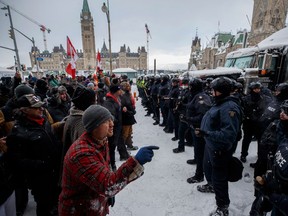


 A
memorial remembering Lillian Hyslop is seen along the road in
Wentworth, N.S. on Friday, April 24, 2020. 22 people are dead after a
man went on a murderous rampage in Portapique and several other Nova
Scotia communities. (Liam Hennessey/Canadian Press)
A
memorial remembering Lillian Hyslop is seen along the road in
Wentworth, N.S. on Friday, April 24, 2020. 22 people are dead after a
man went on a murderous rampage in Portapique and several other Nova
Scotia communities. (Liam Hennessey/Canadian Press)


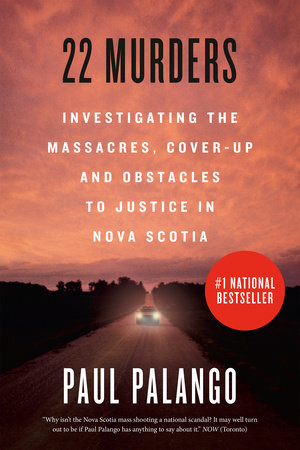




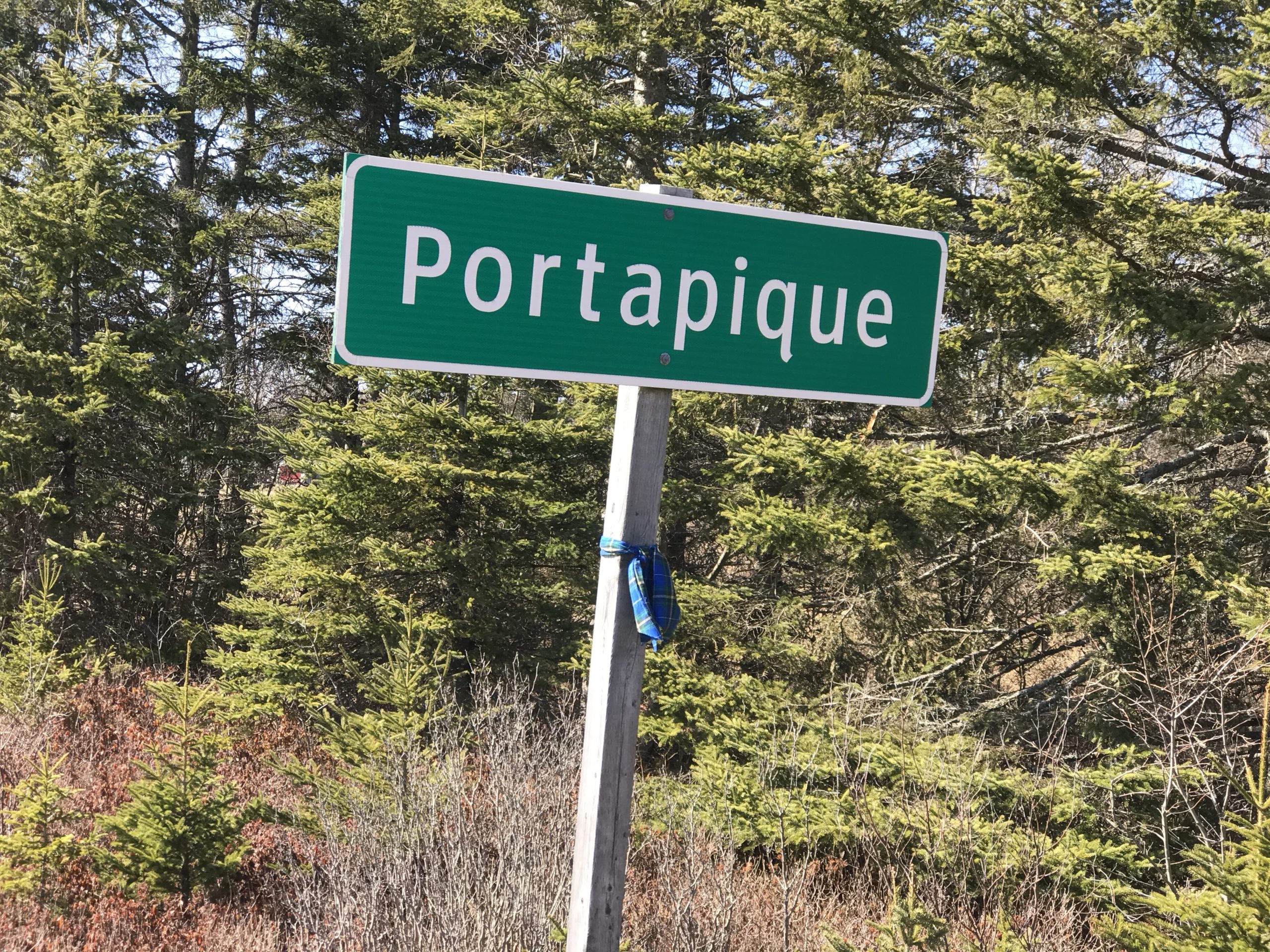


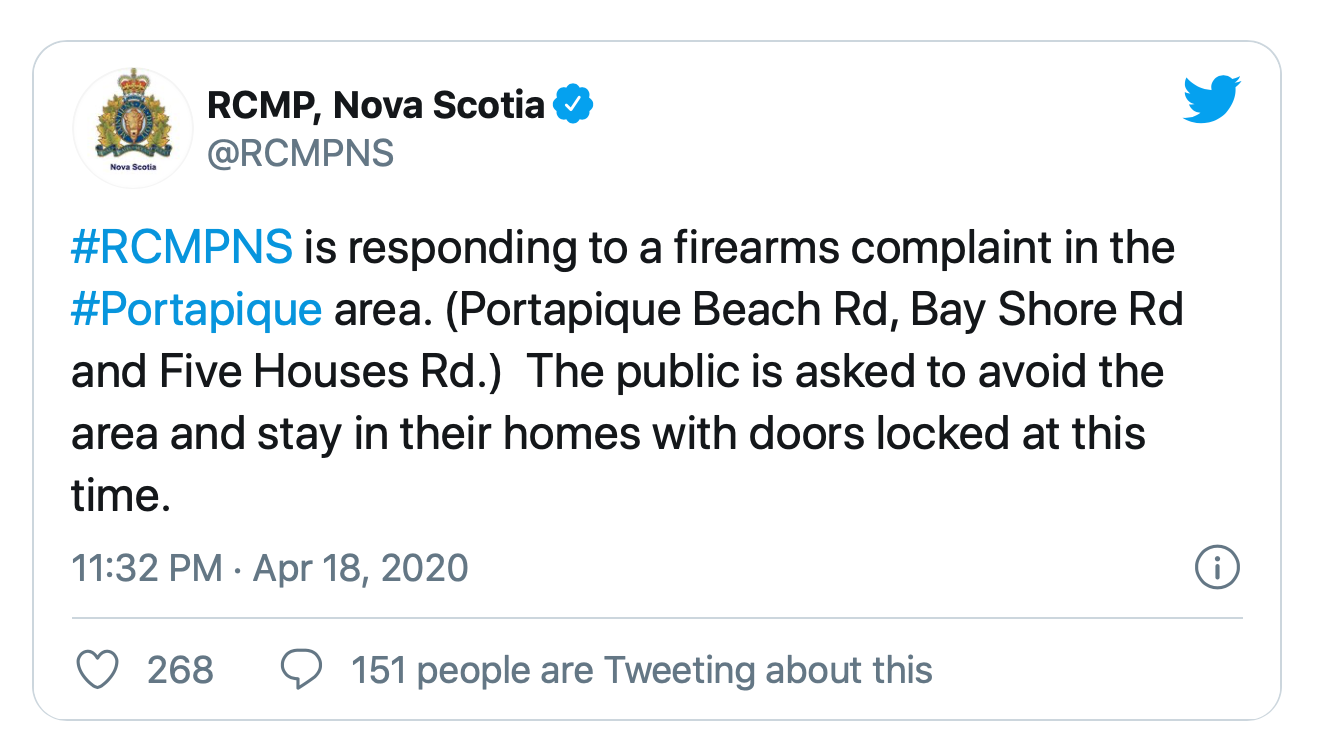

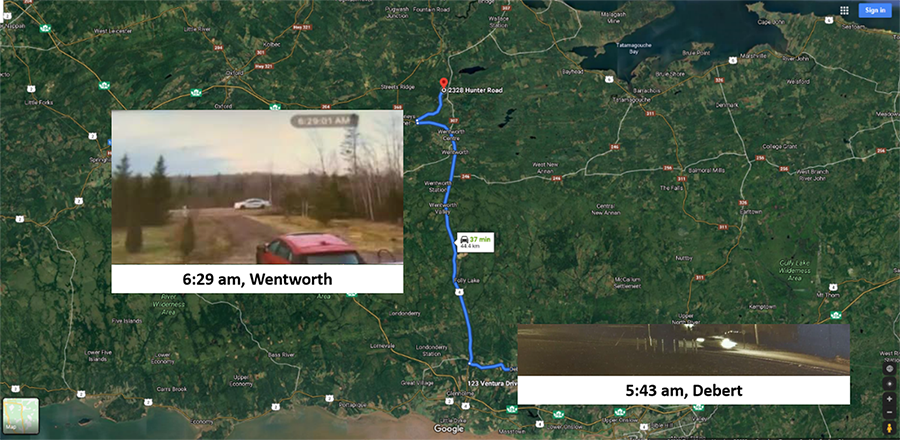





_corrected.jpg)
