Oil
prices finished Friday at their highest level in roughly seven months,
as President Donald Trump reportedly suggested that a U.S. military
strike on Iran is still being considered following a failed attempt this
week to reach a deal to end Tehran’s nuclear ambitions.
Trump
told reporters outside the White House Friday that he would “love not
to use” the U.S. military to attack Iran, but “sometimes you have to,” according to a report from CNBC. The report also said that a final decision on whether to attack Iran has not yet been made.
Full text of Stephen Harper's 1997 speech
Updated Wed. Dec. 14 2005 9:20 PM ET
Canadian Press
OTTAWA -- The text from a speech made by Stephen Harper, then
vice-president of the National Citizens Coalition, to a June 1997
Montreal meeting of the Council for National Policy, a right-wing U.S.
think tank, and taken from the council's website:
Ladies and gentlemen, let me begin by giving you a big welcome to
Canada. Let's start up with a compliment. You're here from the second
greatest nation on earth. But seriously, your country, and particularly
your conservative movement, is a light and an inspiration to people in
this country and across the world.
Now, having given you a compliment, let me also give you an insult. I
was asked to speak about Canadian politics. It may not be true, but
it's legendary that if you're like all Americans, you know almost
nothing except for your own country. Which makes you probably
knowledgeable about one more country than most Canadians.
But in any case, my speech will make that assumption. I'll talk
fairly basic stuff. If it seems pedestrian to some of you who do know a
lot about Canada, I apologize.
I'm going to look at three things. First of all, just some basic
facts about Canada that are relevant to my talk, facts about the country
and its political system, its civics. Second, I want to take a look at
the party system that's developed in Canada from a conventional
left/right, or liberal/conservative perspective. The third thing I'm
going to do is look at the political system again, because it can't be
looked at in this country simply from the conventional perspective.
First, facts about Canada. Canada is a Northern European welfare
state in the worst sense of the term, and very proud of it. Canadians
make no connection between the fact that they are a Northern European
welfare state and the fact that we have very low economic growth, a
standard of living substantially lower than yours, a massive brain drain
of young professionals to your country, and double the unemployment
rate of the United States.
In terms of the unemployed, of which we have over a
million-and-a-half, don't feel particularly bad for many of these
people. They don't feel bad about it themselves, as long as they're
receiving generous social assistance and unemployment insurance.
That is beginning to change. There have been some significant changes
in our fiscal policies and our social welfare policies in the last
three or four years. But nevertheless, they're still very generous
compared to your country.
Let me just make a comment on language, which is so important in this
country. I want to disabuse you of misimpressions you may have. If
you've read any of the official propagandas, you've come over the border
and entered a bilingual country. In this particular city, Montreal, you
may well get that impression. But this city is extremely atypical of
this country.
While it is a French-speaking city -- largely -- it has an enormous
English-speaking minority and a large number of what are called ethnics:
they who are largely immigrant communities, but who politically and
culturally tend to identify with the English community.
This is unusual, because the rest of the province of Quebec is, by
and large, almost entirely French-speaking. The English minority present
here in Montreal is quite exceptional.
Furthermore, the fact that this province is largely French-speaking,
except for Montreal, is quite exceptional with regard to the rest of the
country. Outside of Quebec, the total population of francophones,
depending on how you measure it, is only three to five per cent of the
population. The rest of Canada is English speaking.
Even more important, the French-speaking people outside of Quebec
live almost exclusively in the adjacent areas, in northern New Brunswick
and in Eastern Ontario.
The rest of Canada is almost entirely English speaking. Where I come
from, Western Canada, the population of francophones ranges around one
to two per cent in some cases. So it's basically an English-speaking
country, just as English-speaking as, I would guess, the northern part
of the United States.
But the important point is that Canada is not a bilingual country. It
is a country with two languages. And there is a big difference.
As you may know, historically and especially presently, there's been a
lot of political tension between these two major language groups, and
between Quebec and the rest of Canada.
Let me take a moment for a humorous story. Now, I tell this with some
trepidation, knowing that this is a largely Christian organization.
The National Citizens Coalition, by the way, is not. We're on the
sort of libertarian side of the conservative spectrum. So I tell this
joke with a little bit of trepidation. But nevertheless, this joke works
with Canadian audiences of any kind, anywhere in Canada, both official
languages, any kind of audience.
It's about a constitutional lawyer who dies and goes to heaven.
There, he meets God and gets his questions answered about life. One of
his questions is, "God, will this problem between Quebec and the rest of
Canada ever be resolved?'' And God thinks very deeply about this, as
God is wont to do. God replies, "Yes, but not in my lifetime.''
I'm glad to see you weren't offended by that. I've had the odd
religious person who's been offended. I always tell them, "Don't be
offended. The joke can't be taken seriously theologically. It is, after
all, about a lawyer who goes to heaven.''
In any case. My apologies to Eugene Meyer of the Federalist Society.
Second, the civics, Canada's civics.
On the surface, you can make a comparison between our political
system and yours. We have an executive, we have two legislative houses,
and we have a Supreme Court.
However, our executive is the Queen, who doesn't live here. Her
representative is the Governor General, who is an appointed buddy of the
Prime Minister.
Of our two legislative houses, the Senate, our upper house, is
appointed, also by the Prime Minister, where he puts buddies,
fundraisers and the like. So the Senate also is not very important in
our political system.
And we have a Supreme Court, like yours, which, since we put a
charter of rights in our constitution in 1982, is becoming increasingly
arbitrary and important. It is also appointed by the Prime Minister.
Unlike your Supreme Court, we have no ratification process.
So if you sort of remove three of the four elements, what you see is a
system of checks and balances which quickly becomes a system that's
described as unpaid checks and political imbalances.
What we have is the House of Commons. The House of Commons, the
bastion of the Prime Minister's power, the body that selects the Prime
Minister, is an elected body. I really emphasize this to you as an
American group: It's not like your House of Representatives. Don't make
that comparison.
What the House of Commons is really like is the United States
electoral college. Imagine if the electoral college which selects your
president once every four years were to continue sitting in Washington
for the next four years. And imagine its having the same vote on every
issue. That is how our political system operates.
In our election last Monday, the Liberal party won a majority of
seats. The four opposition parties divided up the rest, with some very,
very rough parity.
But the important thing to know is that this is how it will be until
the Prime Minister calls the next election. The same majority vote on
every issue. So if you ask me, "What's the vote going to be on gun
control?'' or on the budget, we know already.
If any member of these political parties votes differently from his
party on a particular issue, well, that will be national headline news.
It's really hard to believe. If any one member votes differently, it
will be national headline news. I voted differently at least once from
my party, and it was national headline news. It's a very different
system.
Our party system consists today of five parties. There was a remark
made yesterday at your youth conference about the fact that parties come
and go in Canada every year. This is rather deceptive. I've written
considerably on this subject.
We had a two-party system from the founding of our country, in 1867.
That two-party system began to break up in the period from 1911 to 1935.
Ever since then, five political elements have come and gone. We've
always had at least three parties. But even when parties come back,
they're not really new. They're just an older party re-appearing under a
different name and different circumstances.
Let me take a conventional look at these five parties. I'll describe
them in terms that fit your own party system, the left/right kind of
terms.
Let's take the New Democratic Party, the NDP, which won 21 seats. The
NDP could be described as basically a party of liberal Democrats, but
it's actually worse than that, I have to say. And forgive me jesting
again, but the NDP is kind of proof that the Devil lives and interferes
in the affairs of men.
This party believes not just in large government and in massive
redistributive programs, it's explicitly socialist. On social value
issues, it believes the opposite on just about everything that anybody
in this room believes. I think that's a pretty safe bet on all
social-value kinds of questions.
Some people point out that there is a small element of clergy in the
NDP. Yes, this is true. But these are clergy who, while very committed
to the church, believe that it made a historic error in adopting
Christian theology.
The NDP is also explicitly a branch of the Canadian Labour Congress,
which is by far our largest labour group, and explicitly radical.
There are some moderate and conservative labour organizations. They don't belong to that particular organization.
The second party, the Liberal party, is by far the largest party. It
won the election. It's also the only party that's competitive in all
parts of the country. The Liberal party is our dominant party today, and
has been for 100 years. It's governed almost all of the last hundred
years, probably about 75 per cent of the time.
It's not what you would call conservative Democrat; I think that's a
disappearing kind of breed. But it's certainly moderate Democrat, a type
of Clinton-pragmatic Democrat. It's moved in the last few years very
much to the right on fiscal and economic concerns, but still believes in
government intrusion in the economy where possible, and does, in its
majority, believe in fairly liberal social values.
In the last Parliament, it enacted comprehensive gun control, well
beyond, I think, anything you have. Now we'll have a national firearms
registration system, including all shotguns and rifles. Many other kinds
of weapons have been banned. It believes in gay rights, although it's
fairly cautious. It's put sexual orientation in the Human Rights Act and
will let the courts do the rest.
There is an important caveat to its liberal social values. For
historic reasons that I won't get into, the Liberal party gets the votes
of most Catholics in the country, including many practising Catholics.
It does have a significant Catholic, social-conservative element which
occasionally disagrees with these kinds of policy directions. Although I
caution you that even this Catholic social conservative element in the
Liberal party is often quite liberal on economic issues.
Then there is the Progressive Conservative party, the PC party, which
won only 20 seats. Now, the term Progressive Conservative will
immediately raise suspicions in all of your minds. It should. It's
obviously kind of an oxymoron. But actually, its origin is not
progressive in the modern sense. The origin of the term "progressive''
in the name stems from the Progressive Movement in the 1920s, which was
similar to that in your own country.
But the Progressive Conservative is very definitely liberal
Republican. These are people who are moderately conservative on economic
matters, and in the past have been moderately liberal, even sometimes
quite liberal on social policy matters.
In fact, before the Reform Party really became a force in the late
'80s, early '90s, the leadership of the Conservative party was running
the largest deficits in Canadian history. They were in favour of gay
rights officially, officially for abortion on demand. Officially -- what
else can I say about them? Officially for the entrenchment of our
universal, collectivized, health-care system and multicultural policies
in the constitution of the country.
At the leadership level anyway, this was a pretty liberal group. This
explains one of the reasons why the Reform party has become such a
power.
The Reform party is much closer to what you would call conservative Republican, which I'll get to in a minute.
The Bloc Quebecois, which I won't spend much time on, is a strictly
Quebec party, strictly among the French-speaking people of Quebec. It is
an ethnic separatist party that seeks to make Quebec an independent,
sovereign nation.
By and large, the Bloc Quebecois is centre-left in its approach.
However, it is primarily an ethnic coalition. It's always had diverse
elements. It does have an element that is more on the right of the
political spectrum, but that's definitely a minority element.
Let me say a little bit about the Reform party because I want you to be very clear on what the Reform party is and is not.
The Reform party, although described by many of its members, and most
of the media, as conservative, and conservative in the American sense,
actually describes itself as populist. And that's the term its leader,
Preston Manning, uses.
This term is not without significance. The Reform party does stand
for direct democracy, which of course many American conservatives do,
but also it sees itself as coming from a long tradition of populist
parties of Western Canada, not all of which have been conservative.
It also is populist in the very real sense, if I can make American
analogies to it -- populist in the sense that the term is sometimes used
with Ross Perot.
The Reform party is very much a leader-driven party. It's much more a
real party than Mr. Perot's party -- by the way, it existed before Mr.
Perot's party. But it's very much leader-driven, very much organized as a
personal political vehicle. Although it has much more of a real
organization than Mr. Perot does.
But the Reform party only exists federally. It doesn't exist at the
provincial level here in Canada. It really exists only because Mr.
Manning is pursuing the position of prime minister. It doesn't have a
broader political mandate than that yet. Most of its members feel it
should, and, in their minds, actually it does.
It also has some Buchananist tendencies. I know there are probably
many admirers of Mr. Buchanan here, but I mean that in the sense that
there are some anti-market elements in the Reform Party. So far, they
haven't been that important, because Mr. Manning is, himself, a fairly
orthodox economic conservative.
The predecessor of the Reform party, the Social Credit party, was
very much like this. Believing in funny money and control of banking,
and a whole bunch of fairly non-conservative economic things.
So there are some non-conservative tendencies in the Reform party,
but, that said, the party is clearly the most economically conservative
party in the country. It's the closest thing we have to a
neo-conservative party in that sense.
It's also the most conservative socially, but it's not a theocon
party, to use the term. The Reform party does favour the use of
referendums and free votes in Parliament on moral issues and social
issues.
The party is led by Preston Manning, who is a committed, evangelical
Christian. And the party in recent years has made some reference to
family values and to family priorities. It has some policies that are
definitely social-conservative, but it's not explicitly so.
Many members are not, the party officially is not, and, frankly, the
party has had a great deal of trouble when it's tried to tackle those
issues.
Last year, when we had the Liberal government putting the protection
of sexual orientation in our Human Rights Act, the Reform Party was
opposed to that, but made a terrible mess of the debate. In fact,
discredited itself on that issue, not just with the conventional liberal
media, but even with many social conservatives by the manner in which
it mishandled that.
So the social conservative element exists. Mr. Manning is a
Christian, as are most of the party's senior people. But it's not
officially part of the party. The party hasn't quite come to terms with
how that fits into it.
That's the conventional analysis of the party system.
Let me turn to the non-conventional analysis, because frankly, it's
impossible, with just left/right terminology to explain why we would
have five parties, or why we would have four parties on the conventional
spectrum. Why not just two?
The reason is regional division, which you'll see if you carefully
look at a map. Let me draw the United States comparison, a comparison
with your history.
The party system that is developing here in Canada is a party system
that replicates the antebellum period, the pre-Civil War period of the
United States.
That's not to say -- and I would never be quoted as saying -- we're
headed to a civil war. But we do have a major secession crisis,
obviously of a very different nature than the secession crisis you had
in the 1860s. But the dynamics, the political and partisan dynamics of
this, are remarkably similar.
The Bloc Quebecois is equivalent to your Southern secessionists,
Southern Democrats, states rights activists. The Bloc Quebecois, its 44
seats, come entirely from the province of Quebec. But even more
strikingly, they come from ridings, or election districts, almost
entirely populated by the descendants of the original European French
settlers.
The Liberal party has 26 seats in Quebec. Most of these come from
areas where there are heavy concentrations of English, aboriginal or
ethnic votes. So the Bloc Quebecois is very much an ethnic party, but
it's also a secession party.
In the referendum two years ago, the secessionists won 49 per cent of
the vote, 49.5 per cent. So this is a very real crisis. We're looking
at another referendum before the turn of the century.
The Progressive Conservative party is very much comparable to the
Whigs of the 1850s and 1860s. What is happening to them is very similar
to the Whigs. A moderate conservative party, increasingly under stress
because of the secession movement, on the one hand, and the reaction to
that movement from harder line English Canadians on the other hand.
You may recall that the Whigs, in their dying days, went through a
series of metamorphoses. They ended up as what was called the Unionist
movement that won some of the border states in your 1860 election.
If you look at the surviving PC support, it's very much concentrated
in Atlantic Canada, in the provinces to the east of Quebec. These are
very much equivalent to the United States border states. They're weak
economically. They have very grim prospects if Quebec separates. These
people want a solution at almost any cost. And some of the solutions
they propose would be exactly that.
They also have a small percentage of seats in Quebec. These are
French-speaking areas that are also more moderate and very concerned
about what would happen in a secession crisis.
The Liberal party is very much your northern Democrat, or mainstream
Democratic party, a party that is less concessionary to the
secessionists than the PCs, but still somewhat concessionary. And they
still occupy the mainstream of public opinion in Ontario, which is the
big and powerful province, politically and economically, alongside
Quebec.
The Reform party is very much a modern manifestation of the
Republican movement in Western Canada; the U.S. Republicans started in
the western United States. The Reform Party is very resistant to the
agenda and the demands of the secessionists, and on a very deep
philosophical level.
The goal of the secessionists is to transform our country into two
nations, either into two explicitly sovereign countries, or in the case
of weaker separatists, into some kind of federation of two equal
partners.
The Reform party opposes this on all kinds of grounds, but most
important, Reformers are highly resistant philosophically to the idea
that we will have an open, modern, multi-ethnic society on one side of
the line, and the other society will run on some set of
ethnic-special-status principles. This is completely unacceptable,
particularly to philosophical conservatives in the Reform party.
The Reform party's strength comes almost entirely from the West. It's
become the dominant political force in Western Canada. And it is
getting a substantial vote in Ontario. Twenty per cent of the vote in
the last two elections. But it has not yet broken through in terms of
the number of seats won in Ontario.
This is a very real political spectrum, lining up from the Bloc to
reform. You may notice I didn't mention the New Democratic Party. The
NDP obviously can't be compared to anything pre-Civil War. But the NDP
is not an important player on this issue. Its views are somewhere
between the liberals and conservatives. Its main concern, of course, is
simply the left-wing agenda to basically disintegrate our society in all
kinds of spectrums. So it really doesn't fit in.
But I don't use this comparison of the pre-Civil War lightly. Preston
Manning, the leader of the Reform party has spent a lot of time reading
about pre-Civil War politics. He compares the Reform party himself to
the Republican party of that period. He is very well-read on Abraham
Lincoln and a keen follower and admirer of Lincoln.
I know Mr. Manning very well. I would say that next to his own
father, who is a prominent Western Canadian politician, Abraham Lincoln
has probably had more effect on Mr. Manning's political philosophy than
any individual politician.
Obviously, the issue here is not slavery, but the appeasement of
ethnic nationalism. For years, we've had this Quebec separatist
movement. For years, we elected Quebec prime ministers to deal with
that, Quebec prime ministers who were committed federalists who would
lead us out of the wilderness. For years, we have given concessions of
various kinds of the province of Quebec, political and economic, to make
them happier.
This has not worked. The sovereignty movement has continued to rise
in prominence. And its demands have continued to increase. It began to
hit the wall when what are called the soft separatists and the
conventional political establishment got together to put in the
constitution something called "a distinct society clause.'' Nobody
really knows what it would mean, but it would give the Supreme Court,
where Quebec would have a tremendous role in appointment, the power to
interpret Quebec's special needs and powers, undefined elsewhere.
This has led to a firewall of resistance across the country. It
fuelled the growth of the Reform party. I should even say that the early
concessionary people, like Pierre Trudeau, have come out against this.
So there's even now an element of the Quebec federalists themselves who
will no longer accept this.
So you see the syndrome we're in. The separatists continue to make
demands. They're a powerful force. They continue to have the bulk of the
Canadian political establishment on their side. The two traditional
parties, the Liberals and PCs, are both led by Quebecers who favour
concessionary strategies. The Reform party is a bastion of resistance to
this tendency.
To give you an idea of how divided the country is, not just in Quebec
but how divided the country is outside Quebec on this, we had a
phenomenon five years ago. This is a real phenomenon; I don't know how
much you heard about it.
The establishment came down with a constitutional package which they
put to a national referendum. The package included distinct society
status for Quebec and some other changes, including some that would just
horrify you, putting universal Medicare in our constitution, and
feminist rights, and a whole bunch of other things.
What was significant about this was that this constitutional proposal
was supported by the entire Canadian political establishment. By all of
the major media. By the three largest traditional parties, the PC,
Liberal party and NDP. At the time, the Bloc and Reform were very small.
It was supported by big business, very vocally by all of the major
CEOs of the country. The leading labour unions all supported it.
Complete consensus. And most academics.
And it was defeated. It literally lost the national referendum
against a rag-tag opposition consisting of a few dissident conservatives
and a few dissident socialists.
This gives you some idea of the split that's taking place in the country.
Canada is, however, a troubled country politically, not socially.
This is a country that we like to say works in practice but not in
theory.
You can walk around this country without running across very many of these political controversies.
I'll end there and take any of your questions. But let me conclude by
saying, good luck in your own battles. Let me just remind you of
something that's been talked about here. As long as there are exams,
there will always be prayer in schools.
November 17, 2025
Resolutions passed on technology and innovation, regional collaboration on energy, and ecological connectivity and food security
Monday, November 17, 2025
CONTACT
NL: Ashley Jackson-Politi, AshleyPoliti@gov.nl.ca, 709- 685-3161
VT: Amanda Wheeler, Amanda.Wheeler@vermont.gov
ST. JOHN’S, NL – New England Governors, Eastern
Canadian Premiers, and their representatives met on November 16 and 17,
2025 in St. John’s, Newfoundland and Labrador at their 46th
annual conference to discuss shared energy and environmental priorities,
as well as opportunities to enhance regional collaboration in
technology and innovation.
Following the reconvening of the Northeast International Committee on
Energy and the Committee on Environment in 2024, both committees
provided updates on work completed throughout 2025 to advance regional
collaboration, planning on energy issues, ecological connectivity, and
food security. These two standing committees have long served to pursue
initiatives that the Governors and Premiers direct at the annual
conference.
Three resolutions were adopted at the conference, including two
directing the continuation of collaboration on energy, ecological
connectivity, and food security. In addition, a resolution was adopted
to initiate collaboration on technology and innovation. The resolutions
are available here: 46-1, 46-2, 46-3.
Premiers, Governors, and appointed representatives also discussed
other mutual priorities impacting citizens of their respective
jurisdictions, including the cost of living and affordability concerns
and the impact of trade relations on the economy on both sides of the
border.
“It was an honour to co-chair and host this year’s New England
Governors and Eastern Canadian Premiers conference in Newfoundland and
Labrador, where we welcomed our regional partners,” said Newfoundland and Labrador Premier Tony Wakeham.
“We focused our conversations on technology and innovation, energy, and
environment, and demonstrated the collective strength of our
jurisdictions and the value of working together.”
“From energy to innovative technology and environmental resilience,
there’s a lot of good happening across the region on both sides of the
border,” said Vermont Governor Phil Scott. “It’s
important we continue to find ways to solve some of the challenges
because the relationship between Canda and New England states is
important and something we all need to continue to repair and
strengthen.”
On November 16, delegates visited the Co. Innovation Centre for technology demonstrations from local innovators, including Avalon Holographics, College of the North Atlantic, Duxion Motors, Kraken Robotics, PolyUnity, and Virtual Marine.
Premiers, Governors, and other delegation heads also had a fireside
chat with attendees about the role of technology and innovation in
growing our economy.
“Technology and innovation are key drivers of economic development
and areas where Newfoundland and Labrador bring deep expertise and
demonstrated leadership to the table,” said Meagan Kay-Fowlow, President
of COIC. “I congratulate Premier Wakeham and his colleagues across
Eastern Canada and New England for their vision and collaboration. It
was a pleasure to host them this weekend.”
Delegates also participated in a tour of the Beaumont Hamel and Trail of the Caribou Exhibition at The Rooms.
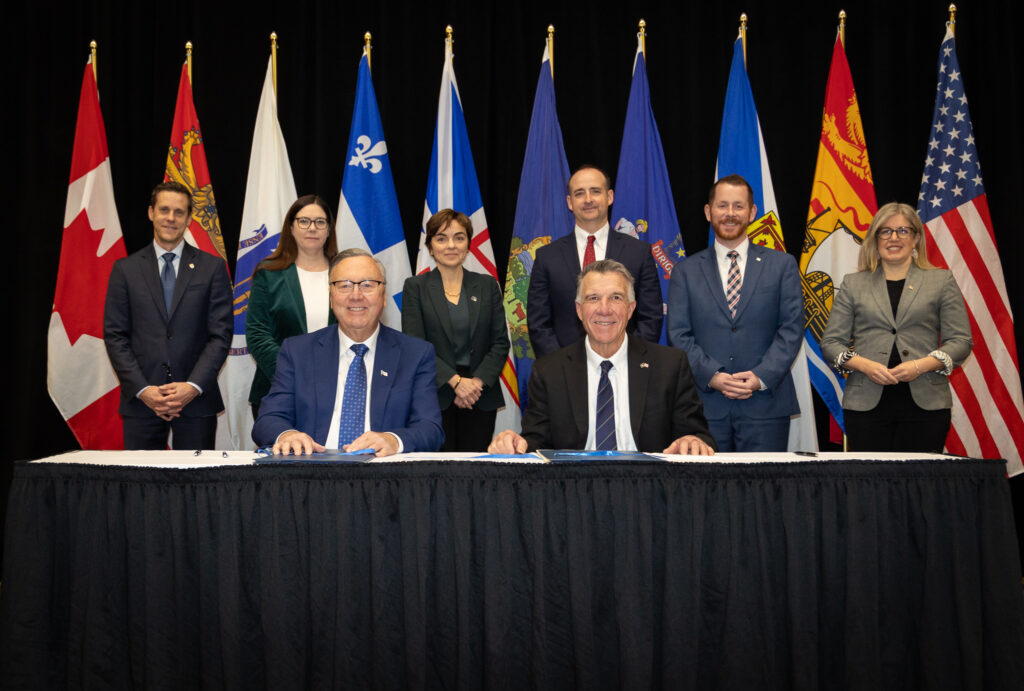
Premier Wakeham co-chaired the conference with Governor Phil Scott of
Vermont. Other Governors and Premiers and their representatives in
attendance were: New Brunswick Premier Susan Holt, Prince Edward Island
Premier Rob Lantz, Nova Scotia Minister of Growth and Development Colton
LeBlanc, Quebec Minister of Economy, Innovation and Energy Christine
Fréchette, Massachusetts Commissioner of the Department of Energy
Resources Elizabeth Mahony, and Maine Acting Commissioner of the
Department of Energy Resources Dan Burgess.
Quotes from Conference Participants:
New Brunswick Premier Susan Holt:
“This conference is a great reminder of
what we can achieve when we work together across borders. From
advancing clean energy to driving innovation and strengthening food
security, our shared challenges are also shared opportunities.
Collaboration like this helps us build a stronger, more sustainable
future for everyone in our region.”
Prince Edward Island Premier Rob Lantz:
“Prince Edward Island values the strong
partnerships we share with our New England and Eastern Canadian
neighbours. Through continued collaboration, we can strengthen our
economies and improve the quality of life on both sides of the border.”
Massachusetts Commissioner of the Department of Energy Resources Elizabeth Mahony:
“Massachusetts is proud to participate
in the Annual Conference of New England Governors and Eastern Canadian
Premiers,” said Massachusetts Energy Resources Commissioner Elizabeth
Mahony. “It was a privilege to welcome our regional partners to Boston
last year, and we extend our thanks to Newfoundland and Labrador for
hosting this year’s discussions. Our relationship with Canada has never
been more important — grounded in shared values, common interests, and
deep familial ties. Massachusetts remains committed to strengthening
this partnership to expand energy supply, meet rising demand, lower
costs, create jobs, and advance economic growth throughout the region.”
Nova Scotia Minister of Growth and Development Colton LeBlanc:
“Nova Scotia has a lot to offer the
Atlantic region and the Eastern United States, particularly when it
comes to meeting the massive energy needs of our region. We’re pleased
to collaborate on ideas and solutions that are in the best interest of
hardworking Nova Scotians, and can help us grow and prosper.”
Quebec Minister of Economy, Innovation and Energy Christine Fréchette:
“Québec is a leader in green energy and
its cutting-edge expertise is a key lever that is recognized around the
world. This annual conference is a unique opportunity to strengthen our
strategic ties with New England and Eastern Canada, particularly on
issued related to energy supply and defence. In the current geopolitical
climate, these issues are among our government’s top priorities. To
achieve our goals, we must focus on close and lasting collaboration with
our partners.”
Maine Acting Commissioner of the Department of Energy Resources Dan Burgess:
“Maine has long worked closely with our
neighboring Canadian provinces and fellow New England states on a range
of shared issues, and today these cross-border collaborations are more
important than ever. Maine and Canada share more than a border – our
economies are closely linked, our electricity grids are interconnected,
and we each rely on significant cross-border energy trading. Through
these convenings, we are advancing shared priorities and strengthening
the regional systems and relationships needed to deliver affordable,
reliable, and cleaner energy for Maine and the region.”
About the New England Governors and Eastern Canadian Premiers (NEG-ECP) Conference
Since 1973, the six New England states and the five Eastern Canadian
provinces have worked cooperatively to address their shared interests
across the border. Through the annual conferences of Governors and
Premiers and discussions of joint committees, the NEG-ECP encourages
cooperation by developing networks and relationships, taking collective
action, engaging in regional projects, undertaking research, and
increasing public awareness of shared interests.
The 11-member jurisdictions are Connecticut, Maine, Massachusetts,
New Hampshire, Rhode Island, Vermont, New Brunswick, Newfoundland and
Labrador, Nova Scotia, Prince Edward Island, and Québec.



 Prime
Minister Mark Carney speaks at the Canada-India Growth and Investment
Forum in Mumbai on Saturday. (Adrian Wyld/The Canadian Press)
Prime
Minister Mark Carney speaks at the Canada-India Growth and Investment
Forum in Mumbai on Saturday. (Adrian Wyld/The Canadian Press) U.S. and Israel launch attacks on Iran


 'This is about regime change': expert on U.S.-Israel strikes on Iran






 Carney talks U.S. relations, his government’s ambitions in exclusive interview | Power & Politics
 HMCS Corner Brook sits in drydock at CFB Esquimalt in Esquimalt B.C., in 2023. (Chad Hipolito/The Canadian Press)
 Minister
of Foreign Affairs Anita Anand and Minister of National Defence David
McGuinty, take part in a signing ceremony the with European Union
foreign policy chief during the Canada EU Summit in Brussels in 2025. (Sean Kilpatrick/The Canadian Press)
Minister
of Foreign Affairs Anita Anand and Minister of National Defence David
McGuinty, take part in a signing ceremony the with European Union
foreign policy chief during the Canada EU Summit in Brussels in 2025. (Sean Kilpatrick/The Canadian Press)


 N.L. defence sector poised to grow with Ottawa’s new strategy
 Victoria
Belbin, CEO of the Atlantic Canada Aerospace and Defence Association
(ACADA), says all four Atlantic provinces are poised to benefit from the
federal government's new defence industrial strategy. (Mike Simms/CBC)
Victoria
Belbin, CEO of the Atlantic Canada Aerospace and Defence Association
(ACADA), says all four Atlantic provinces are poised to benefit from the
federal government's new defence industrial strategy. (Mike Simms/CBC)





































876 Comments