
5 Comments


🍁 RAGECAST 610 - 8pm EST

'The numbers have gone up, but they were abysmal': Tory defence critic on military recruitment
 CTV News
 Boom or Bust? Conservatives debunk, slam Liberals for gaslighting Canadians in fiery Question Period
 Canada Info
 From: David Amos <david.raymond.amos333@gmail.com>
Date: Fri, Apr 17, 2026 at 2:09 PM
Subject: Fwd: Canada is breaking its 'sacred oath' to veterans if it passes the Budget Implementation Act unamended
To: <Raquel.Dancho@parl.gc.ca>, <pierre.poilievre@parl.gc.ca>, <ted.falk@parl.gc.ca>, <james.bezan@parl.gc.ca>, <Dan.Mazier@parl.gc.ca>, <branden.leslie@parl.gc.ca>, <grant.jackson@parl.gc.ca>, <colin.reynolds@parl.gc.ca>
From: Dancho, Raquel - M.P. <Raquel.Dancho@parl.gc.ca>
Date: Fri, Apr 17, 2026 at 2:15 PM
Subject: Automatic Reply - MP Dancho's Office
To: David Amos <david.raymond.amos333@gmail.com>
Hello,
Thank you for taking the time to contact the Office of Raquel Dancho, Member of Parliament for Kildonan—St. Paul.
Our office receives a high volume of correspondence each week. This automatic reply is to confirm that your message has been received at Raquel.Dancho@parl.gc.ca.
- If you are a Kildonan—St. Paul constituent, please reply to this email with your full name, phone number, and current address, including postal code. This will help us verify your residency and expedite your correspondence. If the matter is urgent, please contact our Winnipeg office by phone at 204-984-6322. We would be pleased to assist you. Please note that our office is able to assist with matters under federal jurisdiction.
- If your organization is requesting a meeting with MP Dancho, please allow time for us to process your request. If the request is time-sensitive, please call 204-984-6322.
- Individuals who do not reside in Kildonan—St. Paul should contact their local Member of Parliament to address their concerns. You can find your MP here: Find Members of Parliament - Members of Parliament - House of Commons of Canada.
- If you are not a resident of Kildonan—St. Paul and are contacting MP Dancho regarding an immigration matter from outside of Canada, we are unfortunately unable to assist. Please direct your inquiry to Immigration, Refugees and Citizenship Canada at: IRCC applications - Canada.ca
Sincerely,
Office of Raquel Dancho
Member of Parliament for Kildonan—St. Paul
204-984-6322
From: Bezan, James - M.P. <james.bezan@parl.gc.ca>
Date: Fri, Apr 17, 2026 at 2:10 PM
Subject: RE: Canada is breaking its 'sacred oath' to veterans if it passes the Budget Implementation Act unamended
To: David Amos <david.raymond.amos333@gmail.com>
Thank you for contacting the office of James Bezan, Member of Parliament
for Selkirk-Interlake-Eastman. This automatic response confirms
receipt of your message.
Mr. Bezan's constituents are his first priority. While he receives
thousands of emails from people across Canada each year, he is focused
on serving residents of Selkirk-Interlake-Eastman. If you are unsure
who your MP is, please visit OurCommons.ca or Electio
While we strive to respond to emails in a timely manner, please note we
are currently experiencing a high volume of correspondence. If you
require immediate assistance, please contact our constituency office at
204-785-6151.
Thank you once again for contacting our office.
From: Poilievre, Pierre - M.P. <pierre.poilievre@parl.gc.ca>
Date: Fri, Apr 17, 2026 at 2:10 PM
Subject: Acknowledgement – Email Received / Accusé de réception – Courriel reçu
To: David Amos <david.raymond.amos333@gmail.com>
On behalf of the Hon. Pierre Poilievre, we would like to thank you for contacting the Office of the Leader of the Official Opposition.
Mr. Poilievre greatly values feedback and input from Canadians. We wish to inform you that the Office of the Leader of the Official Opposition reads and reviews every e-mail we receive. Please note that this account receives a high volume of e-mails, and we endeavour to reply as quickly as possible.
If you are a constituent of Mr. Poilievre in the riding of Battle River - Crowfoot and you have an urgent matter to discuss, please contact his constituency office at:
Phone: 1-780-608-4600
Fax: 1-780-608-4603
Hon. Pierre Poilievre, M.P.
Battle River – Crowfoot
4945 50 Street
Camrose, Alberta T4V 1P9
Once again, thank you for writing.
Sincerely,
Office of the Leader of the Official Opposition
______________________________
Au nom de l’honorable Pierre Poilievre, nous tenons à vous remercier d’avoir communiqué avec le Bureau du chef de l’Opposition officielle.
M. Poilievre accorde une grande importance aux commentaires et aux suggestions des Canadiens. Nous tenons à vous informer que le Bureau du chef de l’Opposition officielle lit et examine tous les courriels qu’il reçoit. Veuillez noter que ce compte reçoit un volume important de courriels et que nous nous efforçons d’y répondre le plus rapidement possible.
Si vous êtes un électeur de M. Poilievre dans la circonscription de Battle River - Crowfoot et que vous avez une question urgente à discuter, veuillez contacter son bureau de circonscription :
Téléphone :
Télécopieur :
L’honorable Pierre Poilievre, député
Battle River – Crowfoot
4945, 50 Street
Camrose (Alberta) T4V 1P9
Encore une fois, merci de votre message.
Veuillez agréer nos salutatios distinguées,Bureau du chef de l’Opposition officielle
From: David Amos <david.raymond.amos333@gmail.com>
Date: Fri, Apr 17, 2026 at 1:49 PM
Subject: Fwd: Canada is breaking its 'sacred oath' to veterans if it passes the Budget Implementation Act unamended
To: <gabriel.hardy@parl.gc.ca>, <pm@pm.gc.ca>, <luc.berthold@parl.gc.ca>, <gerard.deltell@parl.gc.ca>, <bernard.genereux@parl.gc.ca>, <joel.godin@parl.gc.ca>, <jacques.gourde@parl.gc.ca>, <jason.groleau@parl.gc.ca>, <eric.lefebvre@parl.gc.ca>, <Richard.Martel@parl.gc.ca>, <dominique.vien@parl.gc.ca>, <Pierre.Paul-Hus@parl.gc.ca>
Date: Fri, Apr 17, 2026 at 1:52 PM
Subject: RE: Canada is breaking its 'sacred oath' to veterans if it passes the Budget Implementation Act unamended
To: David Amos <david.raymond.amos333@gmail.com>
(English follows)
Bonjour,
Je vous remercie de m’avoir fait parvenir votre message. Vos commentaires sont importants pour moi, afin de bien comprendre les enjeux qui sont importants pour les gens de Mégantic-l’Érable et du Canada.
Soyez assuré que j’en prendrai connaissance dans les plus brefs délais.
Si nécessaire, moi, ou un membre de mon équipe, allons communiquer avec vous.
Je vous remercie d’avoir pris le temps de m’écrire.
------------------------------
Hello,
Thank you for sending me your message. Your comments are important to me, in order to fully understand the issues that are important to the people of Mégantic-Érable and of Canada.
Rest assured that I will read them as soon as possible.
If necessary, I, or a member of my team, will contact you.
Thank you for taking the time to write to me.
|
|
Luc Berthold Député de Mégantic-L‘Érable Leader parlementaire adjoint à la Chambre de l’Opposition officielle Deputy House Leader of the Official Opposition
Bureau Ottawa | 613-995-1377 Bureau circonscription | 1-866-770-2903 Courriel | luc.berthold@parl.gc.ca |
From: Godin, Joël - Député <Joel.Godin@parl.gc.ca>
Date: Fri, Apr 17, 2026 at 1:52 PM
Subject: RE: Canada is breaking its 'sacred oath' to veterans if it passes the Budget Implementation Act unamended
To: David Amos <david.raymond.amos333@gmail.com>
Bonjor,
Au nom du député Joël Godin, merci d'avoir communiqué avec son bureau. Nous accusons réception de votre message et nous vous assurons que celui-ci lui sera transmis.
Cordialement,
|
|
Circonscription de Portneuf—Jacques-Cartier
334, route 138, bureau 230 Saint-Augustin-de-Desmaures, Qc G3A 1G8 Tél. : 418-870-1571 Sans frais: 1 888 285-0018
|
From: David Amos <david.raymond.amos333@gmail.
Date: Wed, Apr 15, 2026 at 7:02 PM
Subject: Re: Canada is breaking its 'sacred oath' to veterans if it passes the Budget Implementation Act unamended
To: <Yves-Francois.Blanchet@parl.
Cc: <John.Williamson@parl.gc.ca>, <rob.moore@parl.gc.ca>, <Richard.Bragdon@parl.gc.ca>, <mike.dawson@parl.gc.ca>, <michael.chong@parl.gc.ca>
Tuesday, 24 February 2026
From: David Amos <david.raymond.amos333@gmail.
Date: Wed, Apr 15, 2026 at 1:45 PM
Subject: Canada is breaking its 'sacred oath' to veterans if it passes the Budget Implementation Act unamended
Cc: Don.Monahan@legnb.ca, John.Williamson@parl.gc.ca, rob.moore@parl.gc.ca, Rob.Weir@gnb.ca, Richard.Bragdon@parl.gc.ca, mike.dawson@parl.gc.ca, michael.chong@parl.gc.ca, francois-philippe.champagne@pa
The democratic voice of Legion members and the resolution process
The
Legion is uniquely positioned to speak on behalf of our membership,
which includes approximately 60,000 Veterans, 140,000 family members, as
well as persons who support those who served. We are often asked by the
Government of Canada and other organizations to present our position on
issues because we are the only Veteran service organization that
assists Veterans and their families with representation to Veterans
Affairs Canada and the Veterans Review and Appeal Board Canada.
From: Blogger <no-reply@blogger.com>
Date: Wed, Apr 15, 2026 at 12:05 AM
Subject: Your post titled "Canada is breaking its 'sacred oath' to veterans if it passes the Budget Implementation Act unamended" has been reinstated
To: <david.raymond.amos333@gmail.
Hello,
We
have re-evaluated the post titled "Canada is breaking its 'sacred oath'
to veterans if it passes the Budget Implementation Act unamended"
against Community Guidelines (https://blogger.com/go/
Sincerely,
The Blogger Team
From: Ministerial Correspondence Unit - Justice Canada <mcu@justice.gc.ca>
Date: Wed, Apr 15, 2026 at 1:48 PM
Subject: Automatic Reply
To: David Amos <david.raymond.amos333@gmail.com>
Thank you for writing to the Minister of Justice and Attorney General of Canada.
Due to the volume of correspondence addressed to the Minister, please note that there may be a delay in processing your email. Rest assured that your message will be carefully reviewed.
We do not respond to correspondence that contains offensive language.
-------------------
Merci d'avoir écrit au ministre de la Justice et procureur général du Canada.
En raison du volume de correspondance adressée au ministre, veuillez
prendre note qu'il pourrait y avoir un retard dans le traitement de
votre courriel. Nous tenons à vous assurer que votre message sera lu
avec soin.
Nous ne répondons pas à la correspondance contenant un langage offensant.
From: Angela Bespflug <bespflug@murphybattista.com>
Date: Wed, Apr 15, 2026 at 1:46 PM
Subject: Automatic reply: Canada is breaking its 'sacred oath' to veterans if it passes the Budget Implementation Act unamended
To: David Amos <david.raymond.amos333@gmail.com>
I am currently out of the office in hearings. If your matter is urgent, please contact jacinda@murphybattista.com who will put you in touch with someone who can assist you.
https://www.youtube.com/watch?v=ti68QXtIg78

475 Comments
The Front Bench weighs in on Poilievre's attacks on Carney's economic record
Date: Sun, Mar 1, 2026 at 1:55 PM
Subject: Automatic reply: Does anyone understand why I laugh at all the bullshit?
To: David Amos <david.raymond.amos333@gmail.com>
Please be assured that we appreciate receiving your comments.
Le ministère des Finances Canada accuse réception de votre courriel.
Nous vous assurons que vos commentaires sont les bienvenus.
Deja Vu Anyone???
Fundy Royal campaign targets middle class with focus on jobs
Fundy Royal voters have elected Conservatives all but 1 time in 28 elections over 101 years

Candidates running in Fundy Royal are appealing to the middle class in the typically Tory-dominant riding, with a focus on jobs and the economy.
The Conservatives have strong roots in the southern New Brunswick riding — this area has given its support to the Conservatives in every election for the past century, save for 1993, when Liberal Paul Zed won office.
In 2011, Conservative incumbent Rob Moore captured nearly 60 per cent of the vote.
Moore said he hopes the party's record, with its focus on the economy and direct benefits to people, will earn him another term in office.

Fundy Royal, New Brunswick Debate – Federal Elections 2015 - The Local Campaign, Rogers TV
 Rogers tv
 23 Comments
From: David Amos <david.raymond.amos333@gmail.com>
Date: Sun, Mar 1, 2026 at 1:46 PM
Subject: Re: Does anyone understand why I laugh at all the bullshit?
To: <jasonlavigne@outlook.com>, pm <pm@pm.gc.ca>, pierre.poilievre <pierre.poilievre@parl.gc.ca>, don.davies <don.davies@parl.gc.ca>, elizabeth.may <elizabeth.may@parl.gc.ca>, John.Williamson <John.Williamson@parl.gc.ca>, Yves-Francois.Blanchet <Yves-Francois.Blanchet@parl.gc.ca>, <ps.ministerofpublicsafety-ministredelasecuritepublique.sp@ps-sp.gc.ca>, fin.minfinance-financemin.fin <fin.minfinance-financemin.fin@canada.ca>, <Chris.dEntremont@parl.gc.ca>, Ginette.PetitpasTaylor <Ginette.PetitpasTaylor@parl.gc.ca>, Wayne.Long <Wayne.Long@parl.gc.ca>, dominic.leblanc <dominic.leblanc@parl.gc.ca>, Michael.Duheme <Michael.Duheme@rcmp-grc.gc.ca>, mcu <mcu@justice.gc.ca>, ragingdissident <ragingdissident@protonmail.com>, washington field <washington.field@ic.fbi.gov>, Chrystia.Freeland <Chrystia.Freeland@parl.gc.ca>, Mark.Blakely <Mark.Blakely@rcmp-grc.gc.ca>, Mike.Comeau <Mike.Comeau@gnb.ca>, Richard.Bragdon <Richard.Bragdon@parl.gc.ca>, Frank.McKenna <Frank.McKenna@td.com>, JUSTMIN <JUSTMIN@novascotia.ca>, Sean.Fraser <Sean.Fraser@parl.gc.ca>, jan.jensen <jan.jensen@justice.gc.ca>, <mike.dawson@parl.gc.ca>, <paulpalango@eastlink.ca>, david mcguinty <david.mcguinty@parl.gc.ca>, PREMIER <PREMIER@gov.ns.ca>, <david.myles@parl.gc.ca>, Weir, Rob (LEG) <Rob.Weir@gnb.ca>, Donald J. Trump <contact@win.donaldjtrump.com>, <dlametti@fasken.com>, djtjr <djtjr@trumporg.com>, warren.mcbeath <warren.mcbeath@rcmp-grc.gc.ca>, <melanie.joly@ised-isde.gc.ca>, <JOHN.HERRON@gnb.ca>, Bill.Blair <Bill.Blair@parl.gc.ca>, premier <premier@ontario.ca>, premier <premier@gov.ab.ca>, Susan.Holt <Susan.Holt@gnb.ca>, rob.moore <rob.moore@parl.gc.ca>, robert.gauvin <robert.gauvin@gnb.ca>, <michael.chong@parl.gc.ca>, Mitton, Megan (LEG) <megan.mitton@gnb.ca>
Cc: <Sydney.Simon@mail.house.gov>, <IL08.helpline@mail.house.gov>, <mcgovern.press@mail.house.gov>, <massie.press@mail.house.gov>, <Castro.press@mail.house.gov>, <walz.press@state.mn.us>, <web_comments@wcco.com>, <rep.zack.stephenson@house.mn.gov>, <Alayna.Smieja@house.mn.gov>, <sen.bobby.champion@mnsenate.gov>, <JustinWells@foxnews.com>, <ottawanews@ctv.ca>, Boston.Mail <Boston.Mail@ic.fbi.gov>, news <news@chco.tv>, news957 <news957@rogers.com>, news-tips <news-tips@nytimes.com>, <news@guelphtoday.com>, <News@nowmediainc.com>, Newsroom <Newsroom@globeandmail.com>, sheilagunnreid <sheilagunnreid@gmail.com>, David.Akin <David.Akin@globalnews.ca>, darrow.macintyre <darrow.macintyre@cbc.ca>, Jacques.Poitras <Jacques.Poitras@cbc.ca>, Sean.Fraser <Sean.Fraser@parl.gc.ca>, <roman.baber@parl.gc.ca>, rob.moore <rob.moore@parl.gc.ca>, Robert. Jones <Robert.Jones@cbc.ca>, francis.scarpaleggia <francis.scarpaleggia@parl.gc.ca>, Francois-Phillipe Champagne <francois-philippe.champagne@parl.gc.ca>, sylvie.gadoury <sylvie.gadoury@radio-canada.ca>, <Don.Monahan@legnb.ca>, JORGE BARRERA <jorge.barrera@cbc.ca>, <mike.dawson@parl.gc.ca>, aaron.kennedy@gnb.ca <Aaron.Kennedy@gnb.ca>, <aaron.gunn@parl.gc.ca>
Canada supports U.S. actions in destroying Iran's nuclear program, Carney says
PM also says Canada not participating militarily and wasn't part of military buildup

As U.S. President Donald Trump charges ahead with a major attack on Iran, Prime Minister Mark Carney says Canada supports at least one component of the American mission: destroying Iran's nuclear program.
"Canada supports the United States acting to prevent Iran from obtaining a nuclear weapon and to prevent its regime from threatening international peace and security," Carney said in a speech at the Canada-India Growth and Investment Forum in Mumbai on Saturday.
"Canada's position remains clear: The Islamic Republic of Iran is the principal source of instability and terror throughout the Middle East, has one of the world's worst human rights records and must never be allowed to obtain or develop nuclear weapons."
After his speech, Carney said Canada is not participating militarily and that the federal government was "not party to the military buildup or planning."
The U.S. and Israel launched an attack on Iran on Saturday, with the first apparent strike happening near the offices of Supreme Leader Ayatollah Ali Khamenei.
- Are you a Canadian in the Middle East who is considering leaving after military strikes by the U.S. and Israel on Iran? We want to hear from you. Send an email to ask@cbc.ca.
Soon after the attack began, Trump released a video on social media declaring that the objective of the U.S. "is to defend the American people by eliminating imminent threats from the Iranian regime."
"It has always been the policy of the United States, in particular my administration, that this terrorist regime can never have a nuclear weapon."
Trump claimed that Iran has continued to develop its nuclear program and plans to develop missiles to reach the United States. He also appealed to the Iranian people to "take over your government — it will be yours to take."

Trump acknowledged that there could be American casualties following strikes by Iran, saying "that often happens in war."
Iran hit back at Israel and several Gulf countries with U.S. military bases, which Canadian Foreign Affairs Minister Anita Anand condemned.
"We strongly condemns the attacks of the Iranian regime against our partners in the Middle East," she said in a statement. "These attacks must stop."
Conservative Leader Pierre Poilievre said on social media his party supports "the courageous people of Iran in toppling this terror regime and reclaiming their destiny after 47 years of the regime's occupation."
"Conservatives support a democratic, free and permanently-denuclearized Iran that lives in peace and security with its neighbours. And Conservatives support the United States, Israel, and our allies across the Gulf to defend their sovereignty and dismantle the clerical military dictatorship of Iran," Poilievre said.
Bloc Québécois Leader Yves-Francois Blanchet said on social media in French that his party "recognizes the persistent threat posed by the Iranian regime to the security of the region and the freedom of Iranians," but has concerns the U.S. is using military force without the approval of Congress.
"Such endorsement of the attacks thus appears premature: both Donald Trump and the Iranian regime show a lack of regard for civilian lives, international law must prevail, and negotiation as well as sanctions remain the preferred paths," Blanchet said.
Other federal leaders, including interim NDP Leader Don Davies and Green Party Leader Elizabeth May have not yet commented on the attack.
But NDP foreign affairs critic Alexandre Boulerice said in a statement the party "strongly condemns the American and Israeli bombings of Iran. This is a dangerous escalation that risks dragging the entire region into a major conflict."
He added: "The NDP deplores the Carney government's decision to blindly support this dangerous venture by Israel and Donald Trump's administration. We want Canada to be a voice for diplomacy, peace, and international law."
ABOUT THE AUTHOR

With files from John Paul Tasker
Conservative MP refusing pay bump was heckled, admonished by his colleagues
Mike Dawson says some of his colleagues are angry he's trying to forgo wage hike

The Conservative MP who went public with his intent to refuse a pending parliamentary pay increase was called out by the party whip in front of his colleagues and heckled as he tried to defend his decision, CBC News has learned.
In a letter to the House of Commons clerk that was made public Tuesday, New Brunswick Conservative MP Mike Dawson said he wanted his pay frozen because he couldn't in good conscience accept an increase while many working people are struggling to get by.
"It's frankly distasteful that parliamentarians are set to receive a raise while the working man (and woman) in this country hasn't seen a decent raise in decades," Dawson wrote.
That letter has not gone over well with some of his fellow Conservative MPs, who are now facing uncomfortable questions from their own constituents about why they are willing to accept a roughly $10,000 salary increase set to take effect in April.
Backbench MPs are currently paid $209,800 with committee chairs, ministers, the prime minister, the Speaker and his deputies, among other officeholders, entitled to additional remuneration.
The party's whip, MP Chris Warkentin, called Dawson out from the front of the room during a caucus meeting on Wednesday, multiple caucus sources told CBC News.
Warkentin told Dawson that the scheduled pay bump is set out in law and he's legally required to take it, sources said.
The Parliament of Canada Act sets MP salaries or "sessional allowances," as they're called in the legislation, and includes a provision that increases them every year using a complex formula based on pay increases in the private sector.
It's not clear how Dawson could refuse this statutory increase; he could, like other MPs have done in the past, simply donate a portion of his higher salary to charity.
Dawson was standing at the microphone used by MPs to speak to the leader, whip and other caucus leaders while he was being dressed down by Warkentin, one caucus source said.
When it was his chance to speak, some MPs, between six or eight of them, started to heckle him and he abruptly left the meeting, sources said.
Other Conservatives are 'hypocritical': MP
Reached by phone Thursday morning, Dawson confirmed there was a dust up.
Warkentin "didn't like that I did it" and "called me out in front of the caucus," Dawson told CBC News.
The MP said the party whip told him "I should've done it a different way, I guess. But I disagree," Dawson said.
"It's my money. If the rest of caucus didn't want to do it, I didn't ask the rest of caucus to do it.
"I didn't ask the rest of caucus to give the money back but maybe they should. It's pretty rich and hypocritical to get up on the floor of the House of Commons and talk about the cost of living and then criticize me for wanting to give my money back," Dawson said.
Dawson said there was "a lot of chirping going on" from other MPs when he tried to defend his actions at the microphone.
 Conservative MP Chris Warkentin is the party's whip. (Sean Kilpatrick/The Canadian Press
"I couldn't speak. When I was trying to speak, nobody could hear anything I was trying to say," Dawson said. He confirmed he left amid the heckling.
One caucus source said the heckling Dawson faced "wasn't that bad, considering the level of anger" there is among MPs right now toward him for going public with the pay issue.
"He's opened a whole can of worms," this source said.
Dawson said he spoke to Conservative Leader Pierre Poilievre later by phone and they had "a great conversation," and there were "no disagreements," but he wouldn't elaborate further.
Warkentin and a spokesperson for Poilievre did not immediately respond to a request for comment.
Asked if what transpired bothered him, Dawson said he's not looking for respect from his parliamentary colleagues.
"I'm there to represent the people of Miramichi-Grand Lake. Those are the ones I care about if people respect me or not," he said.
And asked if the fracas is causing him to rethink his position in the Conservative caucus, Dawson said he's not considering crossing the floor to another party or sitting as an Independent.
"I'm a Conservative and I'm not a traitor," he said.
Dawson is also vowing to push ahead with his attempt to dodge the pay increase, despite some potential legal hurdles. "I'm not stopping. That's not in my DNA."
ABOUT THE AUTHOR

New Brunswick MP heckled by own colleagues for refusing pay raise
Mike Dawson says ‘it wasn’t met with the warmest reception,’ but that he wasn’t calling on his colleagues to follow suit

New Brunswick MP Mike Dawson says he was met with heckling and pushback from his own Conservative colleagues inside a caucus meeting earlier this week after publicly stating he would refuse a pending parliamentary pay raise.
That’s as the Conservative party’s whip says MPs can’t actually forgo the wage hike, and that it wasn’t “honest” to suggest politicians could.
It’s something the office of the clerk of the House of Commons has confirmed.
Dawson’s public pledge to do so ruffled feathers inside a closed door caucus meeting.
“When I started giving my philosophy on what I did, it wasn’t met with the warmest reception,” Dawson said in an interview with Brunswick News, adding he was surprised by the reaction when his intention was to show that he cared about taxpayers’ dollars.
The Miramichi-Grand Lake MP said he was standing behind a microphone used by Conservatives to speak to party leader Pierre Poilievre, when Conservative party whip MP Chris Warkentin called him out in front of the caucus.
Others jumped in, Dawson said, who then left the meeting, stating he had a flight home to Miramichi anyway.
“Most people, that stuff would bother them. That stuff don’t bother me,” Dawson said. “I don’t really care if I make friends in Ottawa, I’m not there to make friends. They all say they’re a family, they all say they’re friends.
“They’re colleagues. When I’m done in Ottawa, 95 per cent of them aren’t going to call or text me.”
He later added: “The problem here is that I never asked any of my colleagues to give the money up. That’s not what my letter said. All my letter said was that I was giving the money up.
“I don’t know what the finances of all the other members are. I don’t know what they have for bills. It’s none of my business. The only business I can control is my own.”
Dawson asked the clerk of the House of Commons earlier in the week to freeze his salary before parliamentarians are set to get an annual pay raise in April.
He did so, stating that “at a time when everyday Canadians are struggling to keep up with rising cost of living” he would not in good conscience accept a wage increase.
“It is frankly distasteful that Parliamentarians are set to receive a raise while the working man and woman in this country hasn’t seen a decent raise in decades,” reads Dawson’s letter to the clerk of the House of Commons.
Members of Parliament are set to receive a 4.2 per cent raise on April 1.
They currently make a base salary of $209,800.
That equates to a $8,811 jump.
It’s a legislated increase that’s indexed to wage settlements in the private sector, according to the House of Commons.
In an interview with Brunswick News on Thursday, Warkentin wouldn’t confirm or deny that Dawson was heckled by his own MPs behind closed doors in caucus.
“I will not tell you what I said in caucus because that would be a violation of my caucus confidentiality,” Warkentin said. “But I can tell you what I told him before and I’ll tell you what I told everybody after and that is when we make announcements to our constituents we must be honest with them.
“There is not a provision within the law that allows individual members of Parliament to individually turn down a pay increase. They’re well within their rights to donate pay increases, Conservatives in the past have done that to charitable organizations.”
Warkentin added that some are open about doing so, while other Conservatives “have been very private in their charitable giving because it’s against their values to be out there cheerleading their own generosity.”
Asked if Dawson’s move puts his caucus colleagues in a tough position to follow the New Brunswick MP’s lead, Warkentin said, “You can’t have members of Parliament say they’re going to do something they can’t because other members then can’t follow suit.
“So that does put everyone in an awkward position,” Warkentin said. “Nobody wants to say their colleague misled anybody, but on the flip side it’s important that we’re honest.”
He later continued: “If you’re saying you’re not taking a pay increase and then the public accounts are released in the months to come, you will be found to have been paid the exact same as every other MP.
“You might be cheered on one day, but there’s a reckoning to come.”
Spokesperson for the clerk of the House of Commons Olivier Duhaime confirmed in an email that MPs can’t decline the money.
“The annual adjustment to the sessional allowance and additional salaries of Members of Parliament is mandated by the provisions of the Parliament of Canada Act,” Duhaime said. “As the increase is mandated by law, it is not within the authority of the House Administration to enforce or withhold it.”
Warkentin said he called Dawson immediately after seeing the Miramichi MP post to social media that he would forgo his wage.
“I said ‘you can’t turn it down, but you can donate it,’” he said. “I was hopeful that he would clarify that so there wouldn’t be a misunderstanding, but Mike made his choice.”
Dawson said that Warkentin told him he couldn’t do it, but he replied that he would let the House of Commons decide.
The Miramichi MP said the governing Liberals should come forward to cancel the pay raise and save millions by doing so.
That’s while Dawson said he’s still unclear if he can simply take a pay cut or not, adding he’s yet to hear back from the clerk’s office.
That said, he added that a response may be buried in the “thousands” of emails he’s received from constituents and Canadians across the country in the aftermath of his announcement supporting his move.
“To be honest, I didn’t do it for a news story. I assumed I would send a letter, the clerk would send back an email with an attachment saying ‘here’s the form you’ve got to sign.’ And then it would be done.”
If he can’t forgo the wage increase, Dawson suggested he’ll donate the money.
“I won’t see any of that money,” he said. “It will be going somewhere.”
Dawson said that he has no interest in joining the governing Liberals or even sitting as an independent inside the House of Commons, despite the caucus disagreement.
“I’ll still be in caucus as long as they’ll have me,” he said. “I’m not planning on going anywhere.”
He added that he has since talked on the phone with Poilievre.
“Pierre and I had a good conversation after caucus, he’s supportive, but he’s got another 143 MPs that he’s got to try and manage, and I get it,” he said.
“It’s a difficult job for him.”
186 Comments
Miramichi MLA resigns provincial seat to run for federal Conservatives
Mike Dawson says provincial Tory party needs to be more transparent, inclusive in wake of last fall’s defeat
Miramichi West Progressive Conservative MLA Mike Dawson is resigning from the New Brunswick legislature to become a candidate in the federal election campaign.
Dawson will be the Conservative candidate in Miramichi-Grand Lake, a seat won for the party by Jake Stewart in 2021. Stewart announced earlier this month he would not run again.
Dawson's decision starts a six-month clock ticking for Premier Susan Holt to call a byelection — with the departing MLA warning his provincial party that it needs to change its approach.
"I think there needs to be a lot more transparency and a lot more inclusiveness with the membership from the PC party," Dawson said in an interview Monday.
"If the membership doesn't feel wanted, it's not much of a party."
 Miramichi MLA resigns to run federally for Conservatives
Earlier this year, Dawson said he believed the party needed to be more progressive on some issues and should choose a francophone as its next leader.
He also complained last fall that some members didn't get enough notice to attend the party's annual general meeting held shortly after the PC government of Blaine Higgs was defeated in an election.
"We have to start bringing people together instead of dividing people," he said in an interview.
"It seems like it's easier for people to drive a wedge between people than bring people together."
In his farewell speech in the legislature, Dawson referred to "tensions" with PC Leader Glen Savoie but tried to make it tongue-in-cheek.
"The leader of the Opposition and I are both Miramichiers, and that means we both have a love language that is not understood by many around us who are not from our region," he said.
"I get angry when I'm right, and the leader of the Opposition gets angry when he is wrong."
 PC Leader Glen Savoie says he would support having a byelection as early as June. (Jacques Poitras/CBC News)
Dawson wished Savoie well, and Savoie later told reporters that he took the comments as a joke — then called on Premier Susan Holt to call a byelection soon.
Under changes to the Elections Act adopted in 2022, a byelection must be held within six months of a seat in the legislature being certified as vacant.
Savoie said he'd support it happening as early as June.
"As soon as we possibly can, let's get that seat filled so those folks up there have that representation," he said.
Dawson was first elected in a 2022 byelection and was re-elected in the October 2024 provincial election.
He said running federally had not occurred to him until Stewart announced he would not seek re-election.
 Sitting MP Jake Stewart announced last month that he would not run again. (Pascal Raiche-Nogue/Radio-Canada)
"It wasn't something that I planned on doing," Dawson said.
"It's just something that — like everything else in life — just popped up."
Dawson said the economic uncertainty with U.S. tariffs on Canadian exports requires a strong leader.
"I think we've got that with the federal leader that we've got running for the Conservative Party," he said.
"We've got to learn to stand on our own two feet and not depend on the Americans."
"I think the country's in a lot worse shape now that it was 10 years ago."
Stewart dropped out amid turmoil within the Miramichi-Grand Lake Conservative membership.
The financial agent for the riding association resigned, alleging that the MP's riding office had been a toxic and manipulative workplace and that eight staffers had quit over the last two years.
Stewart's office was also closed for several weeks.
Mike Morrison, a longtime party supporter and two-time federal candidate, declared that Stewart was unelectable as a result of the turmoil.
Dawson said he hopes he can pull Conservatives together to get through the campaign for the April 28 election and then work on repairing the frayed relationships among members.
ABOUT THE AUTHOR

New Brunswick MP questions motives for Facebook suspension
Mike Dawson’s account was suspended and restored, twice, after he posted a speech about electric vehicles
A New Brunswick Conservative MP says he's not satisfied with Facebook's lack of explanation for why his account was suspended twice in seven days.
Mike Dawson's account was suspended after he posted a speech he gave in the House of Commons on June 17 denouncing a federal Liberal plan to phase out the sale of gas-powered vehicles by 2035.
"I feel they're trying to censor what I said," Dawson said."I've never had an issue before so I don't understand what the issue would be this time, unless they didn't like the speech and they want to stop it from being out there."
The account was later restored, then suspended again, then restored again.
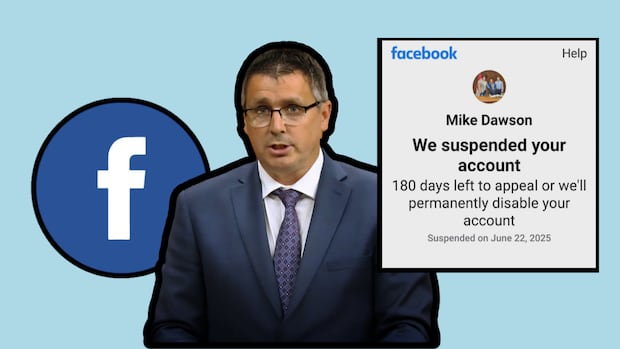 Miramichi MP baffled by Facebook suspension
The only explanation the site gave Dawson was that he had violated "community standards," he said.
A spokesperson for Meta, the company that owns Facebook, would not discuss the reasons for Dawson's suspension, citing "user privacy reasons."
In an emailed statement, the company would only say that Dawson's account "was removed in error and has been restored."
Dawson told CBC News he wasn't satisfied with that explanation.
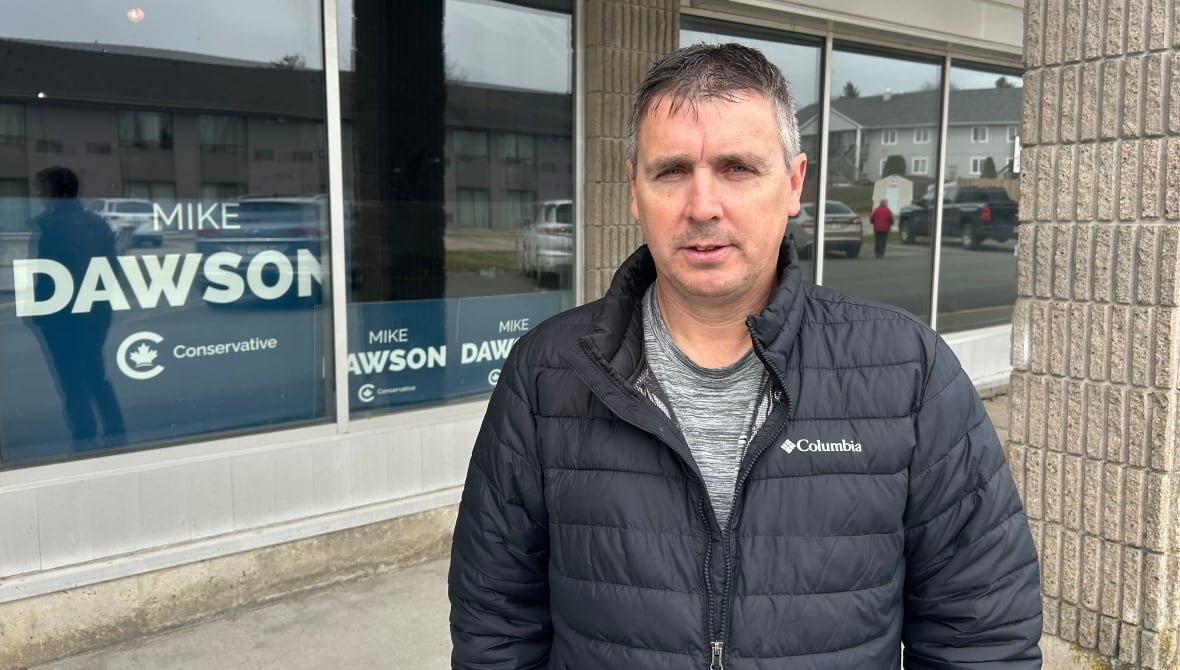 Dawson said he appealed the decision with Facebook. (Katelin Belliveau/CBC)
The rookie MP spoke last Tuesday during a debate on a supply motion in the House of Commons for the 2025-26 fiscal year, using his time to slam Ottawa's electric-vehicle policy.
Regulations give automakers until 2035 to gradually phase out combustion engine cars, trucks and SUVs with a requirement to gradually increase the proportion of electric models they offer for sale each year.
The figure must reach 20 per cent next year and continue growing until it hits 100 per cent a decade from now.
"Once this government takes away your right to choose what you drive, they won't stop there," Dawson said in his speech.
"Today it's gas vehicles. Tomorrow it's your furnace, your wood stove and maybe even your barbecue."
The seven-minute speech included plenty of pithy lines but nothing resembling hateful content or violent rhetoric.
Dawson said the EV policy was "the kind of thing you dream up after a latte at a downtown Toronto espresso bar, not after a hard winter on the Renous-Plaster Rock highway."
He tried to post the speech the same night, but Facebook removed it.
He tried two more times, with the same result. After the third attempt, his account was suspended.
He clicked a button to appeal the decision and uploaded images of his identification. The account was restored last Friday, so he posted the video again, only to experience a second suspension the next day.
The account was restored again on Sunday and the speech is there on Dawson's timeline.
Dawson said in an interview that anything that actually violated Facebook's rules would probably have also earned him a quick rebuke from the Speaker of the House of Commons.
"The Speaker never batted an eye at the speech when it was happening."
Dawson is a former provincial MLA who was first elected federally in the election on April 28.
He said he uses Facebook to monitor and promote community events and to stay in touch with constituents.
"I've put more controversial stuff on Facebook before than that, and never got flagged," he said.
He also pointed out that news coverage of his suspension won't be postable on the social site, either.
Facebook doesn't allow the posting of news articles in Canada as a result of a dispute with the previous Trudeau Liberal government over the Online News Act, which requires large internet platforms to pay for news content on their websites.
Rather than pay, Facebook opted to not allow news articles on its platform.
"That's a problem," Dawson said.
"News should be out there for people to share."
ABOUT THE AUTHOR
EXCLUSIVE: Conservative MP REFUSES PAY HIKE - Taxpayers interview him!
 Canadian Taxpayers Federation
 When Canadians are struggling to afford the basics, the last thing taxpayers need is another pay hike for politicians. Conservative MP Mike Dawson has refused a pay hike, something we have been calling on all MPs to do for a long time!
121 Comments
From: David Amos <david.raymond.amos333@gmail.
Date: Thu, Mar 12, 2026 at 6:01 PM
Subject: Re: Canada is breaking its 'sacred oath' to veterans if it passes the Budget Implementation Act unamended

Pierre Poilievre Squares Off Against Mark Carney | Question Period | Mar 11
 Canadian Capital Clips
 Liberal Prime Minister Mark Carney and Conservative Leader Pierre Poilievre squared off during question period in the House of Commons this afternoon.
LIVE: Conservative MPs Square Off Against Carney's Ministers | Question Period | Mar 12
Canadian Capital Clips 12 Comments
From: Davies, Don - M.P.
Date: Thu, Mar 12, 2026 at 3:09 PM
Subject: Automatic reply: Methinks NDP interim Leader Don Davies should read his emails ASAP N'esy Pas?
To: David Amos
Liberal House leader ‘starting to worry’ about support for upcoming budget
Minister MacKinnon dismissing ‘ludicrous’ demands other parties have put forward for the budget

Liberal House leader Steve MacKinnon signalled Tuesday that he’s concerned the government’s budget might not get support from the opposition benches, while at the same time dismissing some demands other parties have laid out.
The Liberal government will need the co-operation of at least one other party in order to pass the budget, which is being tabled on Nov. 4. Because the budget is a confidence vote, Canadians could be facing another election if it doesn’t pass.
"When I see opposition parties ruling out the possibility of voting for the budget, that's starting to worry me," MacKinnon told reporters on Parliament Hill.
 Liberal House leader worried about lack of support for budget
On Monday, Conservative Leader Pierre Poilievre penned a letter to Prime Minister Mark Carney saying he wants to see an “affordable budget” that includes broad tax cuts and keeping the deficit under $42 billion.
Meanwhile, the Bloc Québécois has said they have six key priorities for the budget including: an increase to the federal health transfer to the provinces, new infrastructure investments, an expansion of the rapid housing initiative, interest-free loans for first-time homebuyers and boosting Old Age Security (OAS) payments for those ages 65 to 75.
Despite raising concerns about getting support for the budget, MacKinnon dismissed both the Conservative and Bloc demands.
"We intend to present a plan to Canadians to deal with this very critical moment in our history, and what we're seeing is opposition parties — the Bloc Québécois, who without having even read the budget, eliminating the possibility that they'll support it — and Conservatives making just ludicrous demands,” he said Tuesday.
Up to government to get support: NDP
NDP interim Leader Don Davies fired back at MacKinnon’s comments, saying it's up to the government to gather support for its budget.
"The question of whether there is an election is entirely up to Mr. Carney. As a leader of a government with a minority in Parliament, it's up to him to craft a budget that can win the support of at least one opposition party. That's his job," Davies said during a press conference in Ottawa on Tuesday.
 Davies says no discussions had with Liberals on exchanges for budget support
"For Mr. MacKinnon to say he's worried, well that has me worried. Because the government should be reaching out to all the parties and working collaboratively to make sure that they can get enough votes to have the budget passed."
While the NDP caucus was reduced to only seven seats after April’s election, they still have enough sway to determine the outcome of a vote. The Liberals could pass the budget if New Democrats support it or abstain from the vote.
Davies met with Carney earlier this month to lay out his party’s priorities for the budget. He told reporters after the meeting that he wants to see “substantial investment” in jobs, health care and housing — though he didn’t list specific items.
The Parliamentary Budget Officer (PBO) released a report last month forecasting that the government will post an annual deficit of $68.5 billion this year, up from $51.7 billion last year.
But that update does not include plans to incrementally ramp up defence spending to meet the updated NATO benchmark of five per cent of GDP by 2035, nor does it factor in Ottawa's announced plans to reduce public service spending over the next three years.
ABOUT THE AUTHOR

Senior writer
Darren Major is a senior writer for CBC's parliamentary bureau in Ottawa. He previously worked as a digital reporter for CBC Ottawa and a producer for CBC's Power & Politics. He holds a master's degree in journalism and a bachelor's degree in public affairs and policy management, both from Carleton University. He also holds master's degree in arts from Queen's University. He can be reached at darren.major@cbc.ca.
With files from The Canadian Press
Could Nov. 4 federal budget trigger an early election? | Power & Politics


| RE Poilievre blasts ‘despicable’ RCMP leadership, accuses Mounties of covering up for Trudeau |
| David Amos <david.raymond.amos333@gmail. | Wed, Mar 11, 2026 at 5:31 PM | |
To:
"pierre.poilievre" <pierre.poilievre@parl.gc.ca>, "Sean.Fraser"
<Sean.Fraser@parl.gc.ca>,
ps.ministerofpublicsafety- | ||
From: Davies, Don - M.P. <don.davies@parl.gc.ca>
Date: Wed, Mar 11, 2026 at 5:50 PM
Subject: Automatic reply: RE Poilievre blasts ‘despicable’ RCMP leadership, accuses Mounties of covering up for Trudeau
To: David Amos <david.raymond.amos333@gmail.
*Please do not reply to this email*
Greetings!
I acknowledge receipt of your email. Thank you for taking the time to contact me and express your views.
Our office is open Mondays, Tuesday, Thursdays, and Fridays from 10am-4pm. We are closed Wednesdays for case processing.
While I read all correspondence, the volume of email we receive means that I am not able to respond immediately to every message. Every effort will be made to reply to you as soon as possible. Please note that in most cases, anonymous, cc’d or forwarded items will be read but will not receive a response.
If the information you have sent is about a concern that you have as a constituent, please make sure that you have given your full name, address and telephone number so my office is able to assist you efficiently. If you live outside Vancouver Kingsway please contact your own Member of Parliament for assistance.
You can ensure you are contacting the correct MP by entering your postal code at this website: https://www.ourcommons.ca/
Please be assured that all email sent to this office is treated as confidential.
Should you need further assistance, please contact my office at 604-775-6263.
Sincerely,
Don Davies, MP
Vancouver Kingsway
Date: Wed, Mar 11, 2026 at 5:35 PM
Subject: Automatic Reply
To: David Amos <david.raymond.amos333@gmail.
Thank you for writing to the Minister of Justice and Attorney General of Canada.
Due to the volume of correspondence addressed to the Minister, please note that there may be a delay in processing your email. Rest assured that your message will be carefully reviewed.
We do not respond to correspondence that contains offensive language.
-------------------
Merci d'avoir écrit au ministre de la Justice et procureur général du Canada.
En raison du volume de correspondance adressée au ministre, veuillez
prendre note qu'il pourrait y avoir un retard dans le traitement de
votre courriel. Nous tenons à vous assurer que votre message sera lu
avec soin.
Nous ne répondons pas à la correspondance contenant un langage offensant.
Date: Wed, Mar 11, 2026 at 5:36 PM
Subject: Réponse automatique : RE Poilievre blasts ‘despicable’ RCMP leadership, accuses Mounties of covering up for Trudeau
To: David Amos <david.raymond.amos333@gmail.
(Ceci est une réponse automatique)
(English follows)
Bonjour,
Nous avons bien reçu votre courriel et nous vous remercions d'avoir écrit à M. Yves-François Blanchet, député de Beloeil-Chambly et chef du Bloc Québécois.
Comme nous avons un volume important de courriels, il nous est impossible de répondre à tous individuellement. Soyez assuré(e) que votre courriel recevra toute l'attention nécessaire.
Nous ne répondons pas à la correspondance contenant un langage offensant.
L'équipe du député Yves-François Blanchet
Chef du Bloc Québécois
Thank you for your email. We will read it as soon as we can.
We do not respond to correspondence that contains offensive language.
From: Poilievre, Pierre - M.P. <pierre.poilievre@parl.gc.ca>
Date: Wed, Mar 11, 2026 at 5:35 PM
Subject: Acknowledgement – Email Received / Accusé de réception – Courriel reçu
To: David Amos <david.raymond.amos333@gmail.
On behalf of the Hon. Pierre Poilievre, we would like to thank you for contacting the Office of the Leader of the Official Opposition.
Mr. Poilievre greatly values feedback and input from Canadians. We wish to inform you that the Office of the Leader of the Official Opposition reads and reviews every e-mail we receive. Please note that this account receives a high volume of e-mails, and we endeavour to reply as quickly as possible.
If you are a constituent of Mr. Poilievre in the riding of Battle River - Crowfoot and you have an urgent matter to discuss, please contact his constituency office at:
Phone: 1-780-608-4600
Fax: 1-780-608-4603
Hon. Pierre Poilievre, M.P.
Battle River – Crowfoot
4945 50 Street
Camrose, Alberta T4V 1P9
Once again, thank you for writing.
Sincerely,
Office of the Leader of the Official Opposition
______________________________
Au nom de l’honorable Pierre Poilievre, nous tenons à vous remercier d’avoir communiqué avec le Bureau du chef de l’Opposition officielle.
M. Poilievre accorde une grande importance aux commentaires et aux suggestions des Canadiens. Nous tenons à vous informer que le Bureau du chef de l’Opposition officielle lit et examine tous les courriels qu’il reçoit. Veuillez noter que ce compte reçoit un volume important de courriels et que nous nous efforçons d’y répondre le plus rapidement possible.
Si vous êtes un électeur de M. Poilievre dans la circonscription de Battle River - Crowfoot et que vous avez une question urgente à discuter, veuillez contacter son bureau de circonscription :
Téléphone :
Télécopieur :
L’honorable Pierre Poilievre, député
Battle River – Crowfoot
4945, 50 Street
Camrose (Alberta) T4V 1P9
Encore une fois, merci de votre message.
Veuillez agréer nos salutations distinguées,
Bureau du chef de l’Opposition officielle
Date: Mon, Mar 9, 2026 at 9:52 PM
Subject: RE: Canada is breaking its 'sacred oath' to veterans if it passes the Budget Implementation Act unamended
To: David Amos <david.raymond.amos333@gmail.
Dear David,
I acknowledge receipt of your email and voicemails. Thank you for your advocacy efforts, but we will be unable to collaborate.
Bill C-15 is expected to be read for a second time in the Senate tomorrow. It is possible that it becomes law this week.
Yours truly,
Joshua M. Juneau
Senior Counsel
tel (613) 236-2657 x201
fax (613) 236-7476MICHEL DRAPEAU LAW OFFICE / CABINET JURIDIQUE MICHEL DRAPEAU
This message is intended for the exclusive use of its addressee and may contain confidential information and be protected under solicitor-client privilege. Please advise if you wish us to use a mode of communication other than regular, unsecured e-mail in our communications with you.
Ce message est à l'usage exclusif de son destinataire et peut contenir des renseignements confidentiels et être protégé par le secret professionnel. Si vous désirez que nous communiquions avec vous par un autre moyen de transmission que le courrier électronique ordinaire non sécurisé, veuillez nous en aviser.
---------- Original message ---------
From: Kouri, Adam (he him his il le lui) <Adam.Kouri@justice.gc.ca>
Date: Mon, Mar 9, 2026 at 10:07 AM
Subject: Réponse automatique - Automatic reply: Canada is breaking its 'sacred oath' to veterans if it passes the Budget Implementation Act unamended
To: David Amos <david.raymond.amos333@gmail.com>
Thank you for your email. As of January 9, 2026, I am no longer counsel at the Department of Justice. Kindly direct any correspondence to Samantha Fitzsimmons at samantha.fitzsimmons@justice.gc.ca. This inbox will not be monitored.
Methinks desperate politicians do desperate things N'esy Pas???
---------- Forwarded message ---------
From: Blogger <no-reply@blogger.com>
Date: Mon, Mar 9, 2026 at 8:49 AM
Subject: Your post titled "Canada is breaking its 'sacred oath' to
veterans if it passes the Budget Implementation Act unamended" has been
unpublished
To: <david.raymond.amos333@gmail.
Hello,
As you may know, our Community Guidelines (https://blogger.com/go/
If you are interested in republishing the post, please update the
content to adhere to Blogger's Community Guidelines. Once the content is
updated, you may republish it at
https://www.blogger.com/go/
You may have the option to pursue your claims in court. If you have legal questions or wish to examine legal options that may be available to you, you may want to consult with your own legal counsel.
For more information, please review the following resources:
- Terms of Service:
https://www.blogger.com/go/
terms - Blogger Community Guidelines:
https://blogger.com/go/
contentpolicy
Sincerely,
The Blogger Team
---------- Original message ---------
From: Minister of Finance / Ministre des Finances <minister-ministre@fin.gc.ca>
Date: Sun, Mar 8, 2026 at 3:07 PM
Subject: Automatic reply: Canada is breaking its 'sacred oath' to veterans if it passes the Budget Implementation Act unamended
To: David Amos <david.raymond.amos333@gmail.
The Department of Finance Canada acknowledges receipt of your electronic correspondence.
Please be assured that we appreciate receiving your comments.
Le ministère des Finances Canada accuse réception de votre courriel.
Nous vous assurons que vos commentaires sont les bienvenus.
---------- Original message ---------
From: Ministerial Correspondence Unit - Justice Canada <mcu@justice.gc.ca>
Date: Sun, Mar 8, 2026 at 3:12 PM
Subject: Automatic Reply
To: David Amos <david.raymond.amos333@gmail.
Thank you for writing to the Minister of Justice and Attorney General of Canada.
Due to the volume of correspondence addressed to the Minister, please note that there may be a delay in processing your email. Rest assured that your message will be carefully reviewed.
We do not respond to correspondence that contains offensive language.
-------------------
Merci d'avoir écrit au ministre de la Justice et procureur général du Canada.
En raison du volume de correspondance adressée au ministre, veuillez
prendre note qu'il pourrait y avoir un retard dans le traitement de
votre courriel. Nous tenons à vous assurer que votre message sera lu
avec soin.
Nous ne répondons pas à la correspondance contenant un langage offensant.
---------- Original message ---------
From: Blanchet, Yves-François - Député <Yves-Francois.Blanchet@parl.
Date: Sun, Mar 8, 2026 at 3:12 PM
Subject: Réponse automatique : Canada is breaking its 'sacred oath' to
veterans if it passes the Budget Implementation Act unamended
To: David Amos <david.raymond.amos333@gmail.
(Ceci est une réponse automatique)
(English follows)
Bonjour,
Nous avons bien reçu votre courriel et nous vous remercions d'avoir écrit à M. Yves-François Blanchet, député de Beloeil-Chambly et chef du Bloc Québécois.
Comme nous avons un volume important de courriels, il nous est impossible de répondre à tous individuellement. Soyez assuré(e) que votre courriel recevra toute l'attention nécessaire.
Nous ne répondons pas à la correspondance contenant un langage offensant.
L'équipe du député Yves-François Blanchet
Chef du Bloc Québécois
Thank you for your email. We will read it as soon as we can.
We do not respond to correspondence that contains offensive language.
---------- Original message ---------
From: Poilievre, Pierre - M.P. <pierre.poilievre@parl.gc.ca>
Date: Sun, Mar 8, 2026 at 3:07 PM
Subject: Acknowledgement – Email Received / Accusé de réception – Courriel reçu
To: David Amos <david.raymond.amos333@gmail.
On behalf of the Hon. Pierre Poilievre, we would like to thank you for contacting the Office of the Leader of the Official Opposition.
Mr. Poilievre greatly values feedback and input from Canadians. We wish to inform you that the Office of the Leader of the Official Opposition reads and reviews every e-mail we receive. Please note that this account receives a high volume of e-mails, and we endeavour to reply as quickly as possible.
If you are a constituent of Mr. Poilievre in the riding of Battle River - Crowfoot and you have an urgent matter to discuss, please contact his constituency office at:
Phone: 1-780-608-4600
Fax: 1-780-608-4603
Hon. Pierre Poilievre, M.P.
Battle River – Crowfoot
4945 50 Street
Camrose, Alberta T4V 1P9
Once again, thank you for writing.
Sincerely,
Office of the Leader of the Official Opposition
______________________________
Au nom de l’honorable Pierre Poilievre, nous tenons à vous remercier d’avoir communiqué avec le Bureau du chef de l’Opposition officielle.
M. Poilievre accorde une grande importance aux commentaires et aux suggestions des Canadiens. Nous tenons à vous informer que le Bureau du chef de l’Opposition officielle lit et examine tous les courriels qu’il reçoit. Veuillez noter que ce compte reçoit un volume important de courriels et que nous nous efforçons d’y répondre le plus rapidement possible.
Si vous êtes un électeur de M. Poilievre dans la circonscription de Battle River - Crowfoot et que vous avez une question urgente à discuter, veuillez contacter son bureau de circonscription :
Téléphone :
Télécopieur :
L’honorable Pierre Poilievre, député
Battle River – Crowfoot
4945, 50 Street
Camrose (Alberta) T4V 1P9
Encore une fois, merci de votre message.
Veuillez agréer nos salutations distinguées,
Bureau du chef de l’Opposition officielle
---------- Original message ---------
From: Moore, Rob - M.P. <Rob.Moore@parl.gc.ca>
Date: Sun, Mar 8, 2026 at 3:07 PM
Subject: Automatic reply: Canada is breaking its 'sacred oath' to veterans if it passes the Budget Implementation Act unamended
To: David Amos <david.raymond.amos333@gmail.
*This is an automated response*
Thank you for contacting the Honourable Rob Moore, P.C., M.P. office. We appreciate the time you took to get in touch with our office.
If you did not already, please ensure to include your full contact details on your email and the appropriate staff will be able to action your request. We strive to ensure all constituent correspondence is responded to in a timely manner.
If your question or concern is time sensitive, please call our office: 506-832-4200.
Again, we thank you for taking the time to share your thoughts and concerns.
~*~*~*~*~*~*~*~
Office of the Honourable Rob Moore, P.C., M.P.
Member of Parliament for Fundy Royal
---------- Original message ---------
From: Lawton, Andrew - M.P. <andrew.lawton@parl.gc.ca>
Date: Sun, Mar 8, 2026 at 3:07 PM
Subject: Automatic reply: Canada is breaking its 'sacred oath' to veterans if it passes the Budget Implementation Act unamended
To: David Amos <david.raymond.amos333@gmail.
Good day,
Thank you for contacting the office of MP Andrew Lawton.
To help us serve you as quickly as possible, please include your full name, address with postal code, and phone number if you haven’t already. Priority is given to residents of Elgin—St. Thomas—London South.
To find your MP, visit: ourcommons.ca/Members
Thank you,
Office of Andrew Lawton, MP
Elgin—St. Thomas—London South
AndrewLawtonMP.ca
---------- Original message ---------
From: Chong, Michael - M.P. <michael.chong@parl.gc.ca>
Date: Sun, Mar 8, 2026 at 3:07 PM
Subject: Automatic reply: Canada is breaking its 'sacred oath' to veterans if it passes the Budget Implementation Act unamended
To: David Amos <david.raymond.amos333@gmail.
Thanks very much for getting in touch with me!
This email is to acknowledge receipt of your message and to let you know that every incoming email is read and reviewed. A member of my Wellington-Halton Hills North team will be in touch with you shortly if follow-up is required.
Due to the high volume of email correspondence, priority is given to responding to residents of Wellington-Halton Hills North and to emails of a non-chain (or “forwards”) variety.
In your email, if you:
· have verified that you are a constituent by including your complete residential postal address and a phone number, a response will be provided in a timely manner.
· have not included your residential postal mailing address, please resend your email with your complete residential postal address and phone number, and a response will be forthcoming.
If you are not a constituent of Wellington Halton-Hills North, please contact your Member of Parliament. If you are unsure who your MP is, you can find them by searching your postal code at http://www.ourcommons.ca/en
Any constituents of Wellington-Halton Hills North who require urgent attention are encouraged to call the constituency office at 1-866-878-5556 (toll-free in riding). Please rest assured that any voicemails will be returned promptly.
Once again, thank you for your email.
The Hon. Michael Chong, M.P.
Wellington-Halton Hills North
toll free riding office:1-866-878-5556
Ottawa office: 613-992-4179
E-mail: michael.chong@parl.gc.ca
Website : www.michaelchong.ca
THIS MESSAGE IS ONLY INTENDED FOR THE USE OF THE INTENDED RECIPIENT(S) AND MAY CONTAIN INFORMATION THAT IS PRIVILEGED, PROPRIETARY AND/OR CONFIDENTIAL. If you are not the intended recipient, you are hereby notified that any review, retransmission, dissemination, distribution, copying, conversion to hard copy or other use of this communication is strictly prohibited. If you are not the intended recipient and have received this message in error, please notify me by return e-mail and delete this message from your system.
---------- Original message ---------
From: Singh, Karunjit (LNG-CAN) <karunjit.singh@lexisnexis.ca>
Date: Sun, Mar 8, 2026 at 3:10 PM
Subject: Automatic reply: Canada is breaking its 'sacred oath' to veterans if it passes the Budget Implementation Act unamended
To: David Amos <david.raymond.amos333@gmail.
Thank you for your email. I am out of office until March 9 and will not be checking email at this time. I will try to respond to you as soon as I can once I get back.
---------- Original message ---------
From: David Amos <david.raymond.amos333@gmail.
Date: Sun, Mar 8, 2026 at 3:03 PM
Subject: Canada is breaking its 'sacred oath' to veterans if it passes the Budget Implementation Act unamended
To: <info@ombudsman-veterans.gc.ca
Cc: <Don.Monahan@legnb.ca>, <John.Williamson@parl.gc.ca>, <rob.moore@parl.gc.ca>,
<Rob.Weir@gnb.ca>, <Richard.Bragdon@parl.gc.ca>, <mike.dawson@parl.gc.ca>, <michael.chong@parl.gc.ca>,
<francois-philippe.champagne@
On Sun, Mar 8, 2026 at 3:03 PM David Amos <david.raymond.amos333@gmail.
Methinks legions of Veterans would appreciate somebody ethical checking my work before the Senate does its third reading of the Budget Implementation Act N'esy Pas???
https://davidraymondamos3.
blogspot.com/2026/02/canada- is-breaking-its-sacred-oath- to.html
Tuesday, 24 February 2026
Canada is breaking its 'sacred oath' to veterans if it passes the Budget Implementation Act unamended
Court adjourns veterans’ benefits class action pending outcome of proposed retroactive legislation
Law360 Canada (December 23, 2025, 3:09 PM EST) -- The Federal Court has adjourned a certification motion in a proposed class action challenging the practice of prorating certain indexation adjustments for veterans’ benefits pending the outcome of proposed legislation that could end the class action.
In St-Jean v. Canada, 2025 FC 2000, released on Dec. 18, Justice Russel Zinn concluded it was in the interests of justice to grant the requested adjournment rather than press on with the certification motion.
“I have reached this conclusion primarily on the basis that justice is better served in proceeding when it is known whether the provisions of Bill C-15 have received assent,” the judge wrote.
The plaintiff, André St-Jean, sought to represent a class of individuals who were affected by the practice of prorating certain indexation adjustments for certain financial benefits, including the earnings loss benefit (ELB), the retirement income security benefit (RISB) and the income replacement benefit (IRB), available to disabled veterans.
The lawsuit alleges that between April 2006 and April 2019, Canada adopted the practice of prorating the indexation of inputs on which benefits were calculated.
The plaintiff alleges the practice resulted in the putative class of more than 40,000 disabled veterans being paid less than the fully indexed benefits to which they were otherwise entitled based on annual adjustments reflecting increases in the consumer price index.
In April 2019, the Veterans Well-being Act and Veterans Well-being Regulations came into force and expressly forbade the practice.
On Nov. 18, 2025, the federal government tabled Bill C-15, which proposes to amend, with retroactive effect, provisions of the Regulations to specify that the first annual indexation adjustments to certain amounts used in the calculation of the ELB are to be prorated.
Canada sought an adjournment of the certification motion on the basis that the bill, if enacted, could have a determinative effect on the certification criteria, particularly on whether the claim discloses a reasonable cause of action.
Canada also submitted that the length of the requested adjournment would be relatively short, as the outcome of Bill C-15 is expected to become clear by April 2026.
The plaintiff opposed adjournment, arguing that it would be uniquely harmful to the putative class comprised of veterans of the Canadian Armed Forces who became mentally and/or physically disabled while serving Canada.
The plaintiff also submitted that Canada’s conduct in advancing Bill C-15 is aimed at thwarting the proposed class from exercising their existing rights and providing ex post facto legislative authority for the practice of prorating the benefits.
He further submitted that he intended to mount a challenge to the constitutionality of the proposed retroactive legislation if it becomes law.
Justice Zinn held that justice would be better served in proceeding when it is known whether the provisions of Bill C-15 have received assent.
“If it does receive assent, then the certification request appears to be dependent on the validity of the amendments and that will require a unique finding of the Court based on materials not presently before it,” the judge wrote.
He further noted that if the proposed amendments do not receive assent or are amended such that they have no impact on the action, the certification motion would have suffered only a slight delay, with little to no prejudice to either party.
The court granted Canada’s motion to adjourn the certification motion.
Counsel for the plaintiff, Malcolm Ruby of Gowling WLG (Canada) LLP, said the government was seeking to retroactively give itself authority for conduct that lacked statutory authorization.
“I believe it’s the intention of the federal government to end the class action through the legislation,” Ruby told Law360 Canada.
Ruby added that the government is also attempting to shut down two other lawsuits through retroactive legislation: Estate of Gordon Allen and Stanley Broski v. His Majesty the King and Raymond White et al. v. His Majesty the King.
White et al. is a certified class action alleging that Veterans Affairs Canada miscalculated annual pension indexation by using the wrong comparators, contrary to statutory requirements, while the Estate of Gordon Allen and Stanley Broski concerns allegations that veterans who received long-term care benefits under the Veterans Health Care Regulations were overcharged for the cost of that care.
Ruby said retroactive legislation is rare, describing it as a “thermonuclear weapon” in litigation.
He added that if Bill C-15 is enacted, the plaintiff intends to argue that putative class members are being discriminated against on the basis of disability.
Adam Bazak of Gowling WLG (Canada) LLP, Angela Bespflug of Murphy Battista LLP and Donnaree Nygard of Nygard Legal also acted as counsel for the plaintiff.
Counsel for Canada were Laura Tausky, Asad Moten, Margaret Cormack and Adam Kouri of the Department of Justice Canada.
If you have any information, story ideas or news tips for Law360 Canada on business-related law and litigation, including class actions, please contact Karunjit Singh at karunjit.singh@lexisnexis.ca or 905-415-5859.
https://canada.justice.gc.ca/
eng/trans/transition/2025/p3. html
Re: Unfair Veterans-related Measures in Bill C-15, Budget 2025 Implementation Act
December 12, 2025
The Honourable Jill McKnight, P.C., M.P.
Minister of Veterans Affairs and Associate Minister of National Defence
66 Slater Street, 16th Floor
Ottawa, Ontario K1A 0P4Re: Unfair Veterans-related Measures in Bill C-15, Budget 2025 Implementation Act
Dear Minister McKnight,
After careful review, and after hearing many concerns from the Veteran community, I must point out the unfairness I believe will result from certain retroactive measures contained within the Budget 2025 Implementation Act (Bill C-15).
Contrary to what was originally intended in the Interpretation Act, sections 373-375 of Bill C-15 would retroactively redefine “province” to exclude the territories in the Veterans Health Care Regulations as it relates to Accommodations and Meals payment by some Veterans in long term care. In so doing, Veterans Affairs Canada would effectively legitimize its past overcharges to Veterans and nullify ongoing litigation aimed at securing reimbursement for affected Veterans.
It is inconceivable that the Department of Justice and Veterans Affairs Canada personnel who drafted the Veterans Health Care Regulations would have been unaware of the Interpretation Act that has for many decades prior to 1993 expressly defined “province” to include the territories. Indeed, the Department of Justice had published internal guidance that references the Interpretation Act in their 1995 “Guide to the Making of Federal Acts and Regulations”. Therefore, one must assume that the drafters understood that the word “province” in the Veterans Health Care Regulations was meant to include the territories and thus conclude that the Department made a mistake in not doing so when undertaking the Accommodations and Meals calculations.
I believe that using retroactive legislation to correct administrative errors is both inappropriate and unfair and undermines confidence in government decision-making, sets a troubling precedent, and denies justice to those who served our country. Normally, retroactive provisions are limited to changes in legislation or regulations only back to the date of a formal government announcement of such intended change; for example, a change in tax rules announced in a budget and made retroactive in a budget implementation act to the date of the budget announcement. In this case, however, retroactivity of almost 30 years is extraordinary; the amendments proposed in Bill C-15 should be prospective only.
Ultimately, it is clear to the Veteran community that Bill C-15 sections 373-375 are meant solely to correct an error made by the Department and to deny them compensation for the overcharge. VAC already faces growing reputational backlash over the manner in which it communicates with Canada’s Veterans, their families and Survivors. I fear this retroactivity measure, if enacted, will only increase the deep distrust in Veterans Affairs Canada that, sadly, I hear about far too often.
On behalf of our most elderly and disabled Veterans who would be unfairly and disproportionately affected by these retroactive amendments, I would ask that they be removed from Bill C-15. Beyond that, I believe acknowledging the error and making whole those Veterans who were affected would be a step in the right direction towards regaining the trust of this community.
Sincerely,
Colonel (Ret’d) Nishika Jardine, CD
Veterans Ombud
https://ombudsman-veterans.
gc.ca/en/contact-us Contact Us
We are here to assist when you feel you have been treated unfairly by Veterans Affairs Canada. We know you may be frustrated. But we cannot accept discriminatory, abusive or inappropriate language when we are communicating. Your respectful interaction with us helps us to help you.
Submit a Complaint
If you want to submit a complaint, please use our complaint form. It's the best and safest way to send us your information. We do not accept complaints by email.
You can also call us: Telephone (toll-free): 1-877-330-4343 or TTY: 1-833-902-9399
OR reach us by mail: Office of the Veterans Ombud, P.O. Box 66 Charlottetown, PE C1A 7K2
What to expect when you contact our office
Find out more: what to expect when you contact the Veterans OmbudGeneral Questions
If you have a general question about our office or what we do, you can email us at info@ombudsman-veterans.gc.ca.
Please don’t send complaints or personal information to this email.Media Inquiries
Lucille Hodgins
1-613-943-7884
lucille.hodgins@ombudsman-
veterans.gc.ca Media Relations Advisor, OVO Communications
Office hours
Monday to Friday, except holidays
- 8:30 a.m. to 4:30 p.m. (Atlantic)
---------- Original message ---------
From: Mail Delivery Subsystem <mailer-daemon@googlemail.com>
Date: Sat, Mar 7, 2026 at 1:29 PM
Subject: Delivery Status Notification (Failure)
To: <david.raymond.amos333@gmail.com>
Message blocked
Your message to lucille.hodgins@ombudsman-
veterans.gc.ca has been blocked. See technical details below for more information. com> Date: Sat, Mar 7, 2026 at 1:28 PMSubject: Fwd: Paul Vickery, senior general counsel for the federal Department of Justice, called the $80 million sum unreasonable. He said there is strong public interest in cutting the bill down."Counsel fees are going to be closely scrutinized here, both by the
claimant community and the broader Canadian public," Vickery said
another mouthfull> From: magicJack <voicemail@notify.magicjack.
com>
> Subject: New VM (21) - 0:08 minutes in your magicJack mailbox from "PETER MILLIKEN" <6134534040>
> To: "DAVID AMOS"
> Date: Friday, December 5, 2014, 2:14 PM
> Dear magicJack User:
>
> You received a new 0:08 minutes voicemail message, on
> Friday, December 05, 2014 at 04:14:22 PM in mailbox
> 9028000369 from "PETER MILLIKEN"
> <6134534040>.
>
---------- Forwarded message ----------
From: David Amos <motomaniac333@gmail.com>
Date: Fri, 5 Dec 2014 15:18:32 -0700
Subject: RE Veterans and litigation Mr Vickery you and the lawyer
Petey Baby Milliken must remember Mean Old Me taking up my concerns
with Parliamentians is many countries years ago EH??
To: paul.vickery@iustice.gc.ca, Sarah.Gossin@iustice.gc.ca, Mackap
<Mackap@parl.gc.ca>, "peter.mackay" <peter.mackay@justice.gc.ca>,
travis.henderson@justice.gc.ca, David.Raymond@iustice.gc.ca,
peter.driscoll@mcinnescooper.
com, "david.hansen"
<david.hansen@justice.gc.ca>, neil.robinson@vac-acc.gc.ca,
dmanuge@eastlink.ca, 'Walter.Natynczyk@vac-acc.gc.ca,
news@hilltimes.com, "Jacques.Poitras" <Jacques.Poitras@cbc.ca>,
"nick.moore" <nick.moore@bellmedia.ca>
Cc: David Amos <david.raymond.amos@gmail.com>, pmilliken@cswan.com,
veterans@millerthomson.com, jim@equitassociety.ca,
lucille.hodgins@ombudsman-veterans.gc.ca
For the record I like and respect Ms Hodgins
Office of the Veterans Ombudsman
Lucille Hodgins, Communications Advisor
613-943-7884
Cell: 613-894-6271
lucille.hodgins@ombudsman-veterans.gc.ca
www.ombudsman-veterans.gc.ca
..
http://www.commonlaw.uottawa.ca/index.php?option=com_ contact&task=view&contact_id= 513&Itemid=286
http://www.advocates.ca/new/about-the-society/officers- and-directors/paul-vickery. html
Paul B. Vickery
Department of Justice
Tel: 613.670.6317
Email: paul.vickery@justice.gc.ca
Assistant Sarah gossin
1 613 288 5075
http://www.canadianlawlist.com/listingdetail/contact/ travis-a-henderson-643424/
Travis A. Henderson Counsel
Called to the bar: 2009 (ON)
Justice Canada
Mgmt. of Class Actions & Mass Litigation Unit
50 O'Connor St.
Ottawa, Ontario K1A 0H8
Phone: 613-670-6374
Fax: 613-941-5879
Email: travis.henderson@justice.gc.ca
Assistant David Raymond (WOW want a coincidence or what?)
You can bet I called that young man.at
613 670 6369
http://www.equitassociety.ca/advisory-council.html#Milliken
http://cswan.com/lawyers/peter-milliken/
Hon. Peter Milliken, P.C.
613-546-8085
pmilliken@cswan.com
"The lawsuit was filed in fall 2012 by the group that claims the New
Veterans Charter is unconstitutional and violates the Charter of
Rights and Freedoms. It was approved by a unanimous vote of Parliament
in 2006 and amended in 2011 as a result of public outcry.
Current and former Canadian Forces members are appalled that the
lifetime disability pension for disabled soldiers has been replaced by
lump-sum payments.
Inside court, government lawyer Paul Vickery told a three-judge panel
the appeal was necessary because the soldiers’ claims could negatively
impact fundamental democratic principles.
He told court that while the government readily acknowledges the great
value and sacrifice of the soldiers, Parliament is the “only
appropriate forum” for resolving the claims made in the lawsuit.
“The appeal which the attorney general brings before you is not
brought out of any lack of appreciation of those services,” Vickery
said.
A second federal lawyer then attacked the plaintiffs’ main argument
that they deserve benefits in line with the previous regime, the
Pension Act, based on historical promises. He did not dispute that the
new scheme is “less generous.”
Your boss Petey Baby MacKay must emember this video EH?
https://www.youtube.com/watch?v=vugUalUO8YY&list= UUy8EcN1vBqTMe8fjF6mKD6g
or this info
January 30, 2007
WITHOUT PREJUDICE
Mr. David Amos
Dear Mr. Amos:
This will acknowledge receipt of a copy of your e-mail of December 29,
2006 to Corporal Warren McBeath of the RCMP.
Because of the nature of the allegations made in your message, I have
taken the measure of forwarding a copy to Assistant Commissioner Steve
Graham of the RCMP °J" Division in Fredericton.
Sincerely,
Honourable Michael B. Murphy
Minister of Health
CM/cb
Warren McBeath warren.mcbeath@rcmp-grc.gc.ca wrote:
Date: Fri, 29 Dec 2006 17:34:53 -0500
From: "Warren McBeath" warren.mcbeath@rcmp-grc.gc.ca
To: kilgoursite@ca.inter.net, MichaelB.Murphy@gnb.ca,
nada.sarkis@gnb.ca, wally.stiles@gnb.ca, dwatch@web.net,
motomaniac_02186@yahoo.com
CC: ottawa@chuckstrahl.com, riding@chuckstrahl.com,
John.Foran@gnb.ca, Oda.B@parl.gc.ca,
"Bev BUSSON" bev.busson@rcmp-grc.gc.ca,
"Paul Dube" PAUL.DUBE@rcmp-grc.gc.ca
Subject: Re: Remember me Kilgour? Landslide Annie McLellan has
forgotten me but the crooks within the RCMP have n
Dear Mr. Amos,
Thank you for your follow up e-mail to me today. I was on days off
over the holidays and returned to work this evening. Rest assured I
was not ignoring or procrastinating to respond to your concerns.
As your attachment sent today refers from Premier Graham, our position
is clear on your dead calf issue: Our forensic labs do not process
testing on animals in cases such as yours, they are referred to the
Atlantic Veterinary College in Charlottetown who can provide these
services. If you do not choose to utilize their expertise in this
instance, then that is your decision and nothing more can be done.
As for your other concerns regarding the US Government, false
imprisonment and Federal Court Dates in the US, etc... it is clear
that Federal authorities are aware of your concerns both in Canada and
the US. These issues do not fall into the purvue of Detachment
policing in Petitcodiac, NB.
It was indeed an interesting and informative conversation we had on
December 23rd, and I wish you well in all of your future endeavors.
Sincerely,
Warren McBeath, Cpl.
GRC Caledonia RCMP
Traffic Services NCO
Ph: (506) 387-2222
Fax: (506) 387-4622
E-mail warren.mcbeath@rcmp-grc.gc.ca
>> http://thedavidamosrant.blogspot.ca/2013/10/re-glen- greenwald-and-brazilian.html
>>
>> ---------- Original message ----------
>> From: PCC Complaints <complaints@cpc-cpp.gc.ca>
>> Date: Mon, 21 Oct 2013 17:59:52 +0000
>> Subject: The Commission for Public Complaints against RCMP - #2013-2824
>> To: "motomaniac333@gmail.com" <motomaniac333@gmail.com>
>>
>> Dear Mr. Amos:
>>
>> This is further to your recent communications with the Commission.
>> From September 18, 2013 to the present, our office has received 6
>> electronic messages from you. Many of these e-mails are not related to
>> RCMP conduct.
>>
>> On October 1, 2013, you called our office and spoke with an Intake
>> Officer. You wished to enquire about three complaint files. When the
>> Intake Officer attempted to inform you that you have three enquiry
>> files with the Commission, you became agitated and insisted otherwise.
>> You raised your voice and spoke over the Intake Officer. You then
>> demanded the name of the Intake Officer, and subsequently yelled "see
>> you in federal court" and hung up the telephone line.
>>
>> As a reminder, we request that all future correspondence with our
>> office must be courteous in tone and that you are respectful of the
>> requests that are made of you. While it is clearly not the intention
>> of the Commission to prevent you from making complaints against
>> members of the RCMP, your recent emails and telephone call have been
>> unproductive for both you and for Commission staff. In the future, we
>> request that all communication with our office be respectful in
>> language and related to our mandate. In the event that this request
>> is not respected, the Commission will consider imposing restrictions
>> on how you may communicate with our office.
>>
>> Should you have a complaint about a specific RCMP member surrounding a
>> specific incident, I invite you to visit the Commission's website
>> (www.cpc-cpp.gc.ca<http://www.cpc-cpp.gc.ca>) to submit an online
>> complaint, rather than to send an email that is difficult to follow or
>> a copy of a letter you have sent to many others. The complaint form
>> will guide you through the information required that will enable the
>> Commission to process your complaint. Should you have difficulty in
>> accessing the complaint form and wish to have one sent to you, you may
>> provide your mailing address and a form will be mailed to you via
>> Canada Post.
>>
>> I would also invite you to send your correspondence regarding any new
>> or existing complaints (quoting the appropriate Commission file
>> number) by letter mail to:
>>
>> Commission for Public Complaints Against the RCMP
>> National Intake Office
>> PO Box 88689
>> Surrey, BC V3W 0X1
>>
>> Yours truly,
>>
>> Günther Schönfeldt
>> Intake Officer / Agent d'information de liaison
>> Commission for Public Complaints Against the RCMP /
>> Commission des plaintes du public contre la Gendarmerie royale du Canada
>> Tel/Tél : 1-800-665-6878 | Fax/Téléc : (604) 501-4095
>> complaints@cpc-cpp.gc.ca<mailto:complaints@cpc-cpp.gc. ca>
>>
>> [Description: Description: cid:image001.jpg@01CCF6DA.65AE7FE0]
>>
>> ---------- Forwarded message ----------
>> From: !enquiries <enquiries@ipcc.gsi.gov.uk>
>> Date: Fri, 11 Oct 2013 10:56:26 +0100
>> Subject: IPCC Reference: 2013/015918
>> To: David Amos <motomaniac333@gmail.com>
>>
>> Dear Mr Amos
>>
>> I acknowledge receipt of 4 emails at the Independent Police Complaints
>> Commission (IPCC) earlier today.
>>
>> I note from our records that you have been advised on the IPCC remit,
>> as well as spoken with one of my colleagues in the customer contact
>> team. It remains unclear from your emails what your complaint against
>> the police is. This may be because you refer to a number of other
>> organisations, or matters outside of the IPCC's remit.
>>
>> If you wish to make a complaint against the police you should provide
>> these details to either the IPCC or the relevant police force's
>> professional standards department (PSD).
>>
>> The IPCC does not investigate allegations of crime(s) committed by
>> members of the public, nor can we direct a police force to commence an
>> investigation into such.
>>
>> If you have any queries about the IPCC's remit or the complaints
>> process please contact us. However, emails to the IPCC that fall
>> outside of our remit will be read and filed, but may not be responded
>> to.
>>
>> Kind regards
>>
>> Elly Goodman
>> Customer Contact Adviser
>> Independent Police Complaints Commission
>> Tel: 0300 020 0096
>> Email: enquiries@ipcc.gsi.gov.uk
>>
>>
>> The original of this email was scanned for viruses by the Government
>> Secure Intranet virus scanning service supplied by Vodafone in
>> partnership with Symantec. (CCTM Certificate Number 2009/09/0052.) On
>> leaving the GSi this email was certified virus free.
>> Communications via the GSi may be automatically logged, monitored
>> and/or recorded for legal purposes.
>>
>>
>> Talk about pissing a guy off. EH Ian McPhail? What planet do CROWN's
>> bureaucrats come from anyway?
>>
>> Need I say BULLSHIT once again??? The other CROWN Corp commonly know
>> as the CBC often puts that word over our airwaves so that can't be
>> offensive. That said I bet the call was recorded If so I demand a copy
>> ASAP. Next time I call I will record the call myself.
>>
>> I must ask did the oh so silent boss Ian MacPhail and his buddy Bob
>> Paulson about the Yankee wiretap tapes being evidence of MURDER?
>> Better check the Canadian Ciminal Code about assisting in the cover up
>> of such crimes EH?
>>
>> As for the call I remember it like it was yesterday. Howcome it took
>> Günther Schönfeldt three weeks to dream up the same sort of response I
>> got in 2007??? The first thing I did was ask for him and the woman
>> claimed he was not avaible and offered to help. She started out quite
>> nice but as soon as she admited that there was only a faxed complaint
>> in November of 2003 and that it did not warrant an answer I told her
>> to look some more. She got fairly argumentive and did not wish to
>> discuss the complaint I sent in August of 2005 (It appeared to me that
>> she read something in my file) I gave up and asked her name when she
>> got to snarky and she refused to give other than "Nora" So I said Cya
>> in Federal Court and hung up. The I sent your buddy Bob Paulson and
>> YOU Ian McPhail a Motherload of emails but I did only sent your
>> mindless bureaucrats six that were largely unrelated if they did not
>> know how to read deep.
>>
>> However your Commission should not deny that I argued with its former
>> lawyer/boss Shirley Heafey about the aforesaid compliant in 2005
>> within emails sent to many Parliamentarians months for a I ran for a
>> sent Parliament again and she was replaced by the lawyer Paul Kennedy.
>> (The lawyer Heafey and your Commission always denied that complaint
>> existed until your office sent me a similar bullshit email after Mike
>> Murphy a former Minister of Health and later another former Attorney
>> General asked Deputy Commissioner Steve Graham to investigate my
>> concerns.
>>
>> In return the Graham got transferred to Nova Scotia and RCMP falsely
>> arrested REMEMBER Stevey Boy Harper?
>>
>> As I said Cya'll in Federal Court
>>
>> Veritas Vincit
>> David Raymond Amos
>> 1 902 800 0369
>>
>> http://www.archive.org/details/ PoliceSurveilanceWiretapTape13 9
>>
>> http://www.archive.org/details/ FedsUsTreasuryDeptRcmpEtc
>>
>> http://davidamos.blogspot.com/
>>
>> FEDERAL EXPRES February 7, 2006
>> Senator Arlen Specter
>> United States Senate
>> Committee on the Judiciary
>> 224 Dirksen Senate Office Building
>> Washington, DC 20510
>>
>> Dear Mr. Specter:
>>
>> I have been asked to forward the enclosed tapes to you from a man
>> named, David Amos, a Canadian citizen, in connection with the matters
>> raised in the attached letter. Mr. Amos has represented to me that
>> these are illegal FBI wire tap tapes. I believe Mr. Amos has been in
>> contact with you about this previously.
>>
>> Very truly yours,
>> Barry A. Bachrach
>> Direct telephone: (508) 926-3403
>> Direct facsimile: (508) 929-3003
>> Email: bbachrach@bowditch.com
>>
>>
>> ---------- Forwarded message ----------
>> From: Lisa Porteous <lporteous@kleinlyons.com>
>> Date: Thu, 6 Jun 2013 14:46:22 +0000
>> Subject: RCMP
>> To: David Amos <motomaniac333@gmail.com>
>>
>> David,
>>
>> Thank you for your email inquiring about our class action against the
>> RCMP. As you may know, the Notice of Claim was filed in the British
>> Columbia Supreme Court on March 27, 2012. The lawsuit has been
>> brought by former RCMP constable Janet Merlo on behalf of female RCMP
>> members. Unfortunately, we cannot assist you with your claim.
>>
>> We recommend that you contact Mr. Barry Carter of Mair Jensen Blair
>> LLP to discuss any claim you may have against the RCMP for harassment.
>> His contact information is as follows:
>>
>> Mr. Barry Carter
>> Mair Jensen Blair LLP
>> 1380-885 W. Georgia Street
>> Vancouver, BC V6C 3E8
>> Phone: 604-682-6299
>> Fax 1-604-374-6992
>>
>> This is not intended to be an opinion concerning the merits of your
>> case. In declining to represent you, we are not expressing an opinion
>> as to whether you should take further action in this matter.
>>
>> You should be aware that there may be strict time limitations within
>> which you must act in order to protect your rights. Failure to begin
>> your lawsuit by filing an action within the required time may mean
>> that you could be barred forever from pursuing a claim. Therefore, you
>> should immediately contact another lawyer ( as indicated above) to
>> obtain legal advice/representation.
>>
>> Thank you again for considering our firm.
>>
>> Yours truly,
>>
>> Lisa Porteous
>> Case Manager/Paralegal
>>
>> lporteous@kleinlyons.com
>> www.kleinlyons.com
>>
>> KLEIN * LYONS
>> Suite 400-1385 West 8th Avenue
>> Vancouver BC V6H 3V9 Canada
>> Office 604.874.7171
>> Fax 604.874.7180
>> Direct 604.714.6533
>>
>> This email is confidential and may be protected by solicitor-client
>> privilege. It is intended only for the use of the person to whom it is
>> addressed. Any distribution, copying or other use by anyone else is
>> strictly prohibited. If you have received this e-mail in error, please
>> telephone us immediately and destroy this e-mail.
>>
>> üPlease consider the environment before printing this email.
Perhaps Mr Vickery should Google his name and mine to find such things as this
http://thedavidamosrant.blogspot.ca/2012/12/a-little- more-deja-vu-for-grant.html
---------- Forwarded message ----------
From: David Amos <david.raymond.amos@gmail.com>
Date: Tue, 13 Jan 2009 15:41:52 -0400
Subject: We just talked Mr. Vickery
To: paul.vickery@iustice.gc.ca
---------- Forwarded message ----------
From: David Amos <david.raymond.amos@gmail.com>
Date: Tue, 13 Jan 2009 14:06:57 -0400
Subject: we are talking
To: ministre@justice.gouv.qc.ca
Cc: rdeubelbeiss@justice.gouv.qc.ca

---------- Original message ---------
From: David Amos <david.raymond.amos333@gmail.com>
Date: Mon, Mar 9, 2026 at 10:00 AM
Subject: Re: Canada is breaking its 'sacred oath' to veterans if it passes the Budget Implementation Act unamended
To: <info@ombudsman-veterans.gc.ca>, <lucille.hodgins@ombudsman-veterans.gc.ca>, <ragingdissident@protonmail.com>, <jasonlavigne@outlook.com>, <paulpalango@eastlink.ca>, <Ginette.PetitpasTaylor@parl.gc.ca>, <Chris.dEntremont@parl.gc.ca>, <pm@pm.gc.ca>, <pierre.poilievre@parl.gc.ca>, <Yves-Francois.Blanchet@parl.gc.ca>, <don.davies@parl.gc.ca>, <elizabeth.may@parl.gc.ca>, <ps.ministerofpublicsafety-ministredelasecuritepublique.sp@ps-sp.gc.ca>, <melanie.joly@ised-isde.gc.ca>, <david.myles@parl.gc.ca>, <fin.minfinance-financemin.fin@canada.ca>, <Sean.Fraser@parl.gc.ca>, <Wayne.Long@parl.gc.ca>, <megan.mitton@gnb.ca>, <mcu@justice.gc.ca>, <malcolm.ruby@gowlingwlg.com>, <adam.bazak@gowlingwlg.com>, <karunjit.singh@lexisnexis.ca>, <david.hansen@justice.gc.ca>, <Adam.Kouri@justice.gc.ca>, <kbaert@kmlaw.ca>, <atanel@kmlaw.ca>, <daniel.wallace@mcinnescooper.com>, <Michel.Drapeau@mdlo.ca>, <Joshua.Juneau@mdlo.ca>, <bill@murphybattista.com>, <bespflug@murphybattista.com>, <andrew.lawton@parl.gc.ca>, <cathay.wagantall@parl.gc.ca>, <arnold.viersen@parl.gc.ca>, <fraser.tolmie@parl.gc.ca>, <blake.richards@parl.gc.ca>, <aaron.gunn@parl.gc.ca>, <JOHN.HERRON@gnb.ca>, <ottawanews@ctv.ca>
Cc: <Don.Monahan@legnb.ca>, <John.Williamson@parl.gc.ca>, <rob.moore@parl.gc.ca>, <Rob.Weir@gnb.ca>, <Richard.Bragdon@parl.gc.ca>, <mike.dawson@parl.gc.ca>, <michael.chong@parl.gc.ca>, <francois-philippe.champagne@parl.gc.ca>, <news957@rogers.com>, <sheilagunnreid@gmail.com>, <News@nowmediainc.com>, <David.Akin@globalnews.ca>, <news@chco.tv>, <Newsroom@globeandmail.com>, <news@guelphtoday.com>
From: Blogger <no-reply@blogger.com>
Date: Mon, Mar 9, 2026 at 8:49 AM
Subject: Your post titled "Canada is breaking its 'sacred oath' to veterans if it passes the Budget Implementation Act unamended" has been unpublished
To: <david.raymond.amos333@gmail.
Hello,
As you may know, our Community Guidelines (https://blogger.com/go/
If
you are interested in republishing the post, please update the content
to adhere to Blogger's Community Guidelines. Once the content is
updated, you may republish it at https://www.blogger.com/go/
You may have the option to pursue your claims in court. If you have legal questions or wish to examine legal options that may be available to you, you may want to consult with your own legal counsel.
For more information, please review the following resources:
- Terms of Service: https://www.blogger.com/go/
terms - Blogger Community Guidelines: https://blogger.com/go/
contentpolicy
Sincerely,
The Blogger Team
From: Minister of Finance / Ministre des Finances <minister-ministre@fin.gc.ca>
Date: Sun, Mar 8, 2026 at 3:07 PM
Subject: Automatic reply: Canada is breaking its 'sacred oath' to veterans if it passes the Budget Implementation Act unamended
To: David Amos <david.raymond.amos333@gmail.com>
Please be assured that we appreciate receiving your comments.
Le ministère des Finances Canada accuse réception de votre courriel.
Nous vous assurons que vos commentaires sont les bienvenus.
From: Ministerial Correspondence Unit - Justice Canada <mcu@justice.gc.ca>
Date: Sun, Mar 8, 2026 at 3:12 PM
Subject: Automatic Reply
To: David Amos <david.raymond.amos333@gmail.com
Thank you for writing to the Minister of Justice and Attorney General of Canada.
Due to the volume of correspondence addressed to the Minister, please note that there may be a delay in processing your email. Rest assured that your message will be carefully reviewed.
We do not respond to correspondence that contains offensive language.
-------------------
Merci d'avoir écrit au ministre de la Justice et procureur général du Canada.
En raison du volume de correspondance adressée au ministre, veuillez
prendre note qu'il pourrait y avoir un retard dans le traitement de
votre courriel. Nous tenons à vous assurer que votre message sera lu
avec soin.
Nous ne répondons pas à la correspondance contenant un langage offensant.
From: Blanchet, Yves-François - Député <Yves-Francois.Blanchet@parl.gc.ca>
Date: Sun, Mar 8, 2026 at 3:12 PM
Subject: Réponse automatique : Canada is breaking its 'sacred oath' to veterans if it passes the Budget Implementation Act unamended
To: David Amos <david.raymond.amos333@gmail.com>
(English follows)
Bonjour,
Nous avons bien reçu votre courriel et nous vous remercions d'avoir écrit à M. Yves-François Blanchet, député de Beloeil-Chambly et chef du Bloc Québécois.
Comme nous avons un volume important de courriels, il nous est impossible de répondre à tous individuellement. Soyez assuré(e) que votre courriel recevra toute l'attention nécessaire.
Nous ne répondons pas à la correspondance contenant un langage offensant.
L'équipe du député Yves-François Blanchet
Chef du Bloc Québécois
Thank you for your email. We will read it as soon as we can.
We do not respond to correspondence that contains offensive language.
From: Poilievre, Pierre - M.P. <pierre.poilievre@parl.gc.ca>
Date: Sun, Mar 8, 2026 at 3:07 PM
Subject: Acknowledgement – Email Received / Accusé de réception – Courriel reçu
To: David Amos <david.raymond.amos333@gmail.com>
On behalf of the Hon. Pierre Poilievre, we would like to thank you for contacting the Office of the Leader of the Official Opposition.
Mr. Poilievre greatly values feedback and input from Canadians. We wish to inform you that the Office of the Leader of the Official Opposition reads and reviews every e-mail we receive. Please note that this account receives a high volume of e-mails, and we endeavour to reply as quickly as possible.
If you are a constituent of Mr. Poilievre in the riding of Battle River - Crowfoot and you have an urgent matter to discuss, please contact his constituency office at:
Phone: 1-780-608-4600
Fax: 1-780-608-4603
Hon. Pierre Poilievre, M.P.
Battle River – Crowfoot
4945 50 Street
Camrose, Alberta T4V 1P9
Once again, thank you for writing.
Sincerely,
Office of the Leader of the Official Opposition
______________________________
Au nom de l’honorable Pierre Poilievre, nous tenons à vous remercier d’avoir communiqué avec le Bureau du chef de l’Opposition officielle.
M. Poilievre accorde une grande importance aux commentaires et aux suggestions des Canadiens. Nous tenons à vous informer que le Bureau du chef de l’Opposition officielle lit et examine tous les courriels qu’il reçoit. Veuillez noter que ce compte reçoit un volume important de courriels et que nous nous efforçons d’y répondre le plus rapidement possible.
Si vous êtes un électeur de M. Poilievre dans la circonscription de Battle River - Crowfoot et que vous avez une question urgente à discuter, veuillez contacter son bureau de circonscription :
Téléphone :
Télécopieur :
L’honorable Pierre Poilievre, député
Battle River – Crowfoot
4945, 50 Street
Camrose (Alberta) T4V 1P9
Encore une fois, merci de votre message.
Veuillez agréer nos salutations distinguées,
Bureau du chef de l’Opposition officielle
From: Moore, Rob - M.P. <Rob.Moore@parl.gc.ca>
Date: Sun, Mar 8, 2026 at 3:07 PM
Subject: Automatic reply: Canada is breaking its 'sacred oath' to veterans if it passes the Budget Implementation Act unamended
To: David Amos <david.raymond.amos333@gmail.com>
Thank you for contacting the Honourable Rob Moore, P.C., M.P. office. We appreciate the time you took to get in touch with our office.
If you did not already, please ensure to include your full contact details on your email and the appropriate staff will be able to action your request. We strive to ensure all constituent correspondence is responded to in a timely manner.
If your question or concern is time sensitive, please call our office: 506-832-4200.
Again, we thank you for taking the time to share your thoughts and concerns.
~*~*~*~*~*~*~*~
Office of the Honourable Rob Moore, P.C., M.P.
Member of Parliament for Fundy Royal
From: Lawton, Andrew - M.P. <andrew.lawton@parl.gc.ca>
Date: Sun, Mar 8, 2026 at 3:07 PM
Subject: Automatic reply: Canada is breaking its 'sacred oath' to veterans if it passes the Budget Implementation Act unamended
To: David Amos <david.raymond.amos333@gmail.com>
Good day,
Thank you for contacting the office of MP Andrew Lawton.
To help us serve you as quickly as possible, please include your full name, address with postal code, and phone number if you haven’t already. Priority is given to residents of Elgin—St. Thomas—London South.
To find your MP, visit: ourcommons.ca/Members
Thank you,
Office of Andrew Lawton, MP
Elgin—St. Thomas—London South
AndrewLawtonMP.ca
From: Chong, Michael - M.P. <michael.chong@parl.gc.ca>
Date: Sun, Mar 8, 2026 at 3:07 PM
Subject: Automatic reply: Canada is breaking its 'sacred oath' to veterans if it passes the Budget Implementation Act unamended
To: David Amos <david.raymond.amos333@gmail.com>
Thanks very much for getting in touch with me!
This email is to acknowledge receipt of your message and to let you know that every incoming email is read and reviewed. A member of my Wellington-Halton Hills North team will be in touch with you shortly if follow-up is required.
Due to the high volume of email correspondence, priority is given to responding to residents of Wellington-Halton Hills North and to emails of a non-chain (or “forwards”) variety.
In your email, if you:
· have verified that you are a constituent by including your complete residential postal address and a phone number, a response will be provided in a timely manner.
· have not included your residential postal mailing address, please resend your email with your complete residential postal address and phone number, and a response will be forthcoming.
If you are not a constituent of Wellington Halton-Hills North, please contact your Member of Parliament. If you are unsure who your MP is, you can find them by searching your postal code at http://www.ourcommons.ca/en
Any constituents of Wellington-Halton Hills North who require urgent attention are encouraged to call the constituency office at 1-866-878-5556 (toll-free in riding). Please rest assured that any voicemails will be returned promptly.
Once again, thank you for your email.
The Hon. Michael Chong, M.P.
Wellington-Halton Hills North
toll free riding office:1-866-878-5556
Ottawa office: 613-992-4179
E-mail: michael.chong@parl.gc.ca
Website : www.michaelchong.ca
THIS MESSAGE IS ONLY INTENDED FOR THE USE OF THE INTENDED RECIPIENT(S) AND MAY CONTAIN INFORMATION THAT IS PRIVILEGED, PROPRIETARY AND/OR CONFIDENTIAL. If you are not the intended recipient, you are hereby notified that any review, retransmission, dissemination, distribution, copying, conversion to hard copy or other use of this communication is strictly prohibited. If you are not the intended recipient and have received this message in error, please notify me by return e-mail and delete this message from your system.
From: Singh, Karunjit (LNG-CAN) <karunjit.singh@lexisnexis.ca>
Date: Sun, Mar 8, 2026 at 3:10 PM
Subject: Automatic reply: Canada is breaking its 'sacred oath' to veterans if it passes the Budget Implementation Act unamended
To: David Amos <david.raymond.amos333@gmail.com>
Thank you for your email. I am out of office until March 9 and will not be checking email at this time. I will try to respond to you as soon as I can once I get back.
From: David Amos <david.raymond.amos333@gmail.com>
Date: Sun, Mar 8, 2026 at 3:03 PM
Subject: Canada is breaking its 'sacred oath' to veterans if it passes the Budget Implementation Act unamended
To: <info@ombudsman-veterans.gc.ca>, <lucille.hodgins@ombudsman-veterans.gc.ca>, <ragingdissident@protonmail.com>, <jasonlavigne@outlook.com>, <paulpalango@eastlink.ca>, <Ginette.PetitpasTaylor@parl.gc.ca>, <Chris.dEntremont@parl.gc.ca>, <pm@pm.gc.ca>, <pierre.poilievre@parl.gc.ca>, <Yves-Francois.Blanchet@parl.gc.ca>, <don.davies@parl.gc.ca>, <elizabeth.may@parl.gc.ca>, <ps.ministerofpublicsafety-ministredelasecuritepublique.sp@ps-sp.gc.ca>, <melanie.joly@ised-isde.gc.ca>, <david.myles@parl.gc.ca>, <fin.minfinance-financemin.fin@canada.ca>, <Sean.Fraser@parl.gc.ca>, <Wayne.Long@parl.gc.ca>, <megan.mitton@gnb.ca>, <mcu@justice.gc.ca>, <malcolm.ruby@gowlingwlg.com>, <adam.bazak@gowlingwlg.com>, <karunjit.singh@lexisnexis.ca>, <david.hansen@justice.gc.ca>, <Adam.Kouri@justice.gc.ca>, <kbaert@kmlaw.ca>, <atanel@kmlaw.ca>, <daniel.wallace@mcinnescooper.com>, <Michel.Drapeau@mdlo.ca>, <Joshua.Juneau@mdlo.ca>, <bill@murphybattista.com>, <bespflug@murphybattista.com>, <andrew.lawton@parl.gc.ca>, <cathay.wagantall@parl.gc.ca>, <arnold.viersen@parl.gc.ca>, <fraser.tolmie@parl.gc.ca>, <blake.richards@parl.gc.ca>, <aaron.gunn@parl.gc.ca>, <JOHN.HERRON@gnb.ca>, <ottawanews@ctv.ca>
Cc: <Don.Monahan@legnb.ca>, <John.Williamson@parl.gc.ca>, <rob.moore@parl.gc.ca>, <Rob.Weir@gnb.ca>, <Richard.Bragdon@parl.gc.ca>, <mike.dawson@parl.gc.ca>, <michael.chong@parl.gc.ca>, <francois-philippe.champagne@parl.gc.ca>, <news957@rogers.com>, <sheilagunnreid@gmail.com>, <News@nowmediainc.com>, <David.Akin@globalnews.ca>, <news@chco.tv>, <Newsroom@globeandmail.com>, <news@guelphtoday.com>
Tuesday, 24 February 2026
Canada is breaking its 'sacred oath' to veterans if it passes the Budget Implementation Act unamended
Court adjourns veterans’ benefits class action pending outcome of proposed retroactive legislation
Law360 Canada (December 23, 2025, 3:09 PM EST) -- The Federal Court has adjourned a certification motion in a proposed class action challenging the practice of prorating certain indexation adjustments for veterans’ benefits pending the outcome of proposed legislation that could end the class action.In St-Jean v. Canada, 2025 FC 2000, released on Dec. 18, Justice Russel Zinn concluded it was in the interests of justice to grant the requested adjournment rather than press on with the certification motion.
“I have reached this conclusion primarily on the basis that justice is better served in proceeding when it is known whether the provisions of Bill C-15 have received assent,” the judge wrote.
The plaintiff, André St-Jean, sought to represent a class of individuals who were affected by the practice of prorating certain indexation adjustments for certain financial benefits, including the earnings loss benefit (ELB), the retirement income security benefit (RISB) and the income replacement benefit (IRB), available to disabled veterans.
The lawsuit alleges that between April 2006 and April 2019, Canada adopted the practice of prorating the indexation of inputs on which benefits were calculated.
The plaintiff alleges the practice resulted in the putative class of more than 40,000 disabled veterans being paid less than the fully indexed benefits to which they were otherwise entitled based on annual adjustments reflecting increases in the consumer price index.
In April 2019, the Veterans Well-being Act and Veterans Well-being Regulations came into force and expressly forbade the practice.
On Nov. 18, 2025, the federal government tabled Bill C-15, which proposes to amend, with retroactive effect, provisions of the Regulations to specify that the first annual indexation adjustments to certain amounts used in the calculation of the ELB are to be prorated.
Canada sought an adjournment of the certification motion on the basis that the bill, if enacted, could have a determinative effect on the certification criteria, particularly on whether the claim discloses a reasonable cause of action.
Canada also submitted that the length of the requested adjournment would be relatively short, as the outcome of Bill C-15 is expected to become clear by April 2026.
The plaintiff opposed adjournment, arguing that it would be uniquely harmful to the putative class comprised of veterans of the Canadian Armed Forces who became mentally and/or physically disabled while serving Canada.
The plaintiff also submitted that Canada’s conduct in advancing Bill C-15 is aimed at thwarting the proposed class from exercising their existing rights and providing ex post facto legislative authority for the practice of prorating the benefits.
He further submitted that he intended to mount a challenge to the constitutionality of the proposed retroactive legislation if it becomes law.
Justice Zinn held that justice would be better served in proceeding when it is known whether the provisions of Bill C-15 have received assent.
“If it does receive assent, then the certification request appears to be dependent on the validity of the amendments and that will require a unique finding of the Court based on materials not presently before it,” the judge wrote.
He further noted that if the proposed amendments do not receive assent or are amended such that they have no impact on the action, the certification motion would have suffered only a slight delay, with little to no prejudice to either party.
The court granted Canada’s motion to adjourn the certification motion.
Counsel for the plaintiff, Malcolm Ruby of Gowling WLG (Canada) LLP, said the government was seeking to retroactively give itself authority for conduct that lacked statutory authorization.
“I believe it’s the intention of the federal government to end the class action through the legislation,” Ruby told Law360 Canada.
Ruby added that the government is also attempting to shut down two other lawsuits through retroactive legislation: Estate of Gordon Allen and Stanley Broski v. His Majesty the King and Raymond White et al. v. His Majesty the King.
White et al. is a certified class action alleging that Veterans Affairs Canada miscalculated annual pension indexation by using the wrong comparators, contrary to statutory requirements, while the Estate of Gordon Allen and Stanley Broski concerns allegations that veterans who received long-term care benefits under the Veterans Health Care Regulations were overcharged for the cost of that care.
Ruby said retroactive legislation is rare, describing it as a “thermonuclear weapon” in litigation.
He added that if Bill C-15 is enacted, the plaintiff intends to argue that putative class members are being discriminated against on the basis of disability.
Adam Bazak of Gowling WLG (Canada) LLP, Angela Bespflug of Murphy Battista LLP and Donnaree Nygard of Nygard Legal also acted as counsel for the plaintiff.
Counsel for Canada were Laura Tausky, Asad Moten, Margaret Cormack and Adam Kouri of the Department of Justice Canada.
If you have any information, story ideas or news tips for Law360 Canada on business-related law and litigation, including class actions, please contact Karunjit Singh at karunjit.singh@lexisnexis.ca or 905-415-5859.
Re: Unfair Veterans-related Measures in Bill C-15, Budget 2025 Implementation Act
December 12, 2025
The Honourable Jill McKnight, P.C., M.P.
Minister of Veterans Affairs and Associate Minister of National Defence
66 Slater Street, 16th Floor
Ottawa, Ontario K1A 0P4
Re: Unfair Veterans-related Measures in Bill C-15, Budget 2025 Implementation Act
Dear Minister McKnight,
After careful review, and after hearing many concerns from the Veteran community, I must point out the unfairness I believe will result from certain retroactive measures contained within the Budget 2025 Implementation Act (Bill C-15).
Contrary to what was originally intended in the Interpretation Act, sections 373-375 of Bill C-15 would retroactively redefine “province” to exclude the territories in the Veterans Health Care Regulations as it relates to Accommodations and Meals payment by some Veterans in long term care. In so doing, Veterans Affairs Canada would effectively legitimize its past overcharges to Veterans and nullify ongoing litigation aimed at securing reimbursement for affected Veterans.
It is inconceivable that the Department of Justice and Veterans Affairs Canada personnel who drafted the Veterans Health Care Regulations would have been unaware of the Interpretation Act that has for many decades prior to 1993 expressly defined “province” to include the territories. Indeed, the Department of Justice had published internal guidance that references the Interpretation Act in their 1995 “Guide to the Making of Federal Acts and Regulations”. Therefore, one must assume that the drafters understood that the word “province” in the Veterans Health Care Regulations was meant to include the territories and thus conclude that the Department made a mistake in not doing so when undertaking the Accommodations and Meals calculations.
I believe that using retroactive legislation to correct administrative errors is both inappropriate and unfair and undermines confidence in government decision-making, sets a troubling precedent, and denies justice to those who served our country. Normally, retroactive provisions are limited to changes in legislation or regulations only back to the date of a formal government announcement of such intended change; for example, a change in tax rules announced in a budget and made retroactive in a budget implementation act to the date of the budget announcement. In this case, however, retroactivity of almost 30 years is extraordinary; the amendments proposed in Bill C-15 should be prospective only.
Ultimately, it is clear to the Veteran community that Bill C-15 sections 373-375 are meant solely to correct an error made by the Department and to deny them compensation for the overcharge. VAC already faces growing reputational backlash over the manner in which it communicates with Canada’s Veterans, their families and Survivors. I fear this retroactivity measure, if enacted, will only increase the deep distrust in Veterans Affairs Canada that, sadly, I hear about far too often.
On behalf of our most elderly and disabled Veterans who would be unfairly and disproportionately affected by these retroactive amendments, I would ask that they be removed from Bill C-15. Beyond that, I believe acknowledging the error and making whole those Veterans who were affected would be a step in the right direction towards regaining the trust of this community.
Sincerely,
Colonel (Ret’d) Nishika Jardine, CD
Veterans Ombud
Contact Us
We are here to assist when you feel you have been treated unfairly by Veterans Affairs Canada. We know you may be frustrated. But we cannot accept discriminatory, abusive or inappropriate language when we are communicating. Your respectful interaction with us helps us to help you.
Submit a Complaint
If you want to submit a complaint, please use our complaint form. It's the best and safest way to send us your information. We do not accept complaints by email.
You can also call us: Telephone (toll-free): 1-877-330-4343 or TTY: 1-833-902-9399
OR reach us by mail: Office of the Veterans Ombud, P.O. Box 66 Charlottetown, PE C1A 7K2
What to expect when you contact our office
Find out more: what to expect when you contact the Veterans Ombud
General Questions
If you have a general question about our office or what we do, you can email us at info@ombudsman-veterans.gc.ca.
Please don’t send complaints or personal information to this email.
Media Inquiries
Lucille Hodgins
1-613-943-7884
lucille.hodgins@ombudsman-veterans.gc.ca
Media Relations Advisor, OVO Communications
Office hours
Monday to Friday, except holidays
- 8:30 a.m. to 4:30 p.m. (Atlantic)
From: Mail Delivery Subsystem <mailer-daemon@googlemail.com>
Date: Sat, Mar 7, 2026 at 1:29 PM
Subject: Delivery Status Notification (Failure)
To: <david.raymond.amos333@gmail.com>
| |||||||||||||||||||||||||||||||||||||||||||||||||||||||||||||||||||||||||||||||||||||||||||||||
---------- Forwarded message --------- From: David Amos <david.raymond.amos333@gmail.com> Date: Tue, Mar 24, 2026 at 6:08 AM Subject: Re: I wonder Stevey Boy MacKinnon recalls saying "The Boys Are Back In Town" after the election in 2006 To: <lghc.minister-ministre.lgcc@pco-bcp.gc.ca>, Steven.MacKinnon <Steven.MacKinnon@parl.gc.ca>, pm <pm@pm.gc.ca>, pierre.poilievre <pierre.poilievre@parl.gc.ca>, <francois-philippe.champagne@parl.gc.ca>, fin.minfinance-financemin.fin <fin.minfinance-financemin.fin@canada.ca>, Yves-Francois.Blanchet <Yves-Francois.Blanchet@parl.gc.ca>, elizabeth.may <elizabeth.may@parl.gc.ca>, don.davies <don.davies@parl.gc.ca>, dominic.leblanc <dominic.leblanc@parl.gc.ca>, <ps.ministerofpublicsafety-ministredelasecuritepublique.sp@ps-sp.gc.ca>, melissa.lantsman <melissa.lantsman@parl.gc.ca>, mcu <mcu@justice.gc.ca>, Sean.Fraser <Sean.Fraser@parl.gc.ca>, <edsc.se.aines-seniors.sos.esdc@hrsdc-rhdcc.gc.ca>, <patty.hajdu@parl.gc.ca>, Wayne.Long <Wayne.Long@parl.gc.ca>, rob.moore <rob.moore@parl.gc.ca>, <melanie.joly@ised-isde.gc.ca>, <michael.chong@parl.gc.ca>, michelle.rempel <michelle.rempel@parl.gc.ca>, davidmylesforfredericton@gmail.com <DavidMylesForFredericton@gmail.com>, <david.mcguinty@parl.gc.ca>, <dlametti@fasken.com>, fin.dcu-ucm.fin <fin.dcu-ucm.fin@canada.ca>, <JOHN.HERRON@gnb.ca>, <John.nater@parl.gc.ca>, francis.scarpaleggia <francis.scarpaleggia@parl.gc.ca>, <John.Dornan@gnb.ca>, John.Williamson <John.Williamson@parl.gc.ca> Cc: briangallant10 <briangallant10@gmail.com>, <Francois.Legault.ASSO@assnat.qc.ca>, Frank.McKenna <Frank.McKenna@td.com>, ragingdissident <ragingdissident@protonmail.com>, rfife <rfife@globeandmail.com>, <jasonlavigne@outlook.com>, Nathalie.G.Drouin <Nathalie.G.Drouin@pco-bcp.gc.ca>, <ezra@forcanada.ca>, paulpalango <paulpalango@protonmail.com>, <pakeeagok6@gov.nu.ca>, premier <premier@gnb.ca>, premier <premier@leg.gov.mb.ca>, premier <premier@gov.bc.ca>, premier <premier@ontario.ca>, Premier <PREMIER@novascotia.ca>, justmin <justmin@gov.ns.ca>, premier <premier@gov.nt.ca>, premier <premier@gov.pe.ca>, premier <premier@gov.nl.ca>, Office of the Premier <scott.moe@gov.sk.ca>, <dan@ottawalife.com>, <info@nbarea.org> ---------- Forwarded message --------- From: David Amos <david.raymond.amos333@gmail.com> Date: Mon, Mar 30, 2026 at 12:11 PM Subject: Fwd: Canada is breaking its 'sacred oath' to veterans if it passes the Budget Implementation Act unamended To: <David.Iremadze@crandallu.ca>, <communications@crandallu.ca> ---------- Forwarded message --------- From: David Amos <david.raymond.amos333@gmail. Date: Tue, Mar 24, 2026 at 6:18 AM Subject: Re: Canada is breaking its 'sacred oath' to veterans if it passes the Budget Implementation Act unamended To: <info@ombudsman-veterans.gc.ca Cc: <Don.Monahan@legnb.ca>, <John.Williamson@parl.gc.ca>, <rob.moore@parl.gc.ca>, <Rob.Weir@gnb.ca>, <Richard.Bragdon@parl.gc.ca>, <mike.dawson@parl.gc.ca>, <michael.chong@parl.gc.ca>, <francois-philippe.champagne@ ---------- Forwarded message --------- From: David Amos <david.raymond.amos333@gmail. Date: Mon, Mar 23, 2026 at 1:19 PM Subject: Fwd: Canada is breaking its 'sacred oath' to veterans if it passes the Budget Implementation Act unamended To: <info@blueskystrategygroup.com Cc: <ned.kuruc@parl.gc.ca>, <clifford.small@parl.gc.ca>, <olivier.duhaime@parl.gc.ca>, <Speaker.President@parl.gc.ca> Carney could call an early election rather than gambling on the third reading in the Senate Notice of Meeting
Tuesday, March 24, 2026
9:00 a.m. ET
Location:
Room W110, 1 Wellington St., Ottawa ON
Clerk:
Sara Gajic
(343) 550-0954
Agenda
Meeting with interpretation and transcription
On Sun, Mar 8, 2026 at 3:03 PM David Amos <david.raymond.amos333@gmail.
Methinks
legions of Veterans would appreciate somebody ethical checking my work
before the Senate does its third reading of the Budget Implementation
Act N'esy Pas???
On Sun, Mar 8, 2026 at 3:03 PM David Amos <david.raymond.amos333@gmail.
Methinks
legions of Veterans would appreciate somebody ethical checking my work
before the Senate does its third reading of the Budget Implementation
Act N'esy Pas??? Tuesday, 24 February 2026Canada is breaking its 'sacred oath' to veterans if it passes the Budget Implementation Act unamended---------- Forwarded message --------- From: David Amos <david.raymond.amos333@gmail. Date: Mon, Mar 23, 2026 at 1:19 PM Subject: Fwd: Canada is breaking its 'sacred oath' to veterans if it passes the Budget Implementation Act unamended To: <info@blueskystrategygroup.com Cc: <ned.kuruc@parl.gc.ca>, <clifford.small@parl.gc.ca>, <olivier.duhaime@parl.gc.ca>, <Speaker.President@parl.gc.ca> Carney could call an early election rather than gambling on the third reading in the Senate Notice of Meeting
Tuesday, March 24, 2026
9:00 a.m. ET
Location:
Room W110, 1 Wellington St., Ottawa ON
Clerk:
Sara Gajic
(343) 550-0954
Agenda
Meeting with interpretation and transcription
On Sun, Mar 8, 2026 at 3:03 PM David Amos <david.raymond.amos333@gmail.
|


 Government
House Leader Steven MacKinnon and Conservative Leader Pierre Poilievre
outlined their parties' priorities as MPs gear up for the fall sitting
of Parliament. (Sean Kilpatrick/Justin Tang/The Canadian Press)
Government
House Leader Steven MacKinnon and Conservative Leader Pierre Poilievre
outlined their parties' priorities as MPs gear up for the fall sitting
of Parliament. (Sean Kilpatrick/Justin Tang/The Canadian Press) Prime
Minister Mark Carney delivers opening remarks at the Liberal caucus in
Edmonton on Wednesday. (Amber Bracken/The Canadian Press)
Prime
Minister Mark Carney delivers opening remarks at the Liberal caucus in
Edmonton on Wednesday. (Amber Bracken/The Canadian Press) Justice minister looking at 'criminalizing morally culpable behaviour' near faith-based buildings
 Does Poilievre worry about climate change?

 Poilievre returns to Parliament, goes toe-to-toe with Carney
 At Issue | Pierre Poilievre returns to the House
 Carney welcomes Poilievre back to House of Commons
 Carney and Poilievre spar in House of Commons for first time






Date: Sat, Mar 7, 2026 at 1:28 PM
Subject: Fwd: Paul Vickery, senior general counsel for the federal Department of Justice, called the $80 million sum unreasonable. He said there is strong public interest in cutting the bill down.
To: <lucille.hodgins@ombudsman-veterans.gc.ca>, <complaints@cpc-cpp.gc.ca>, <Stephane.vaillancourt@rcmp-grc.gc.ca>, <Jacques.Poitras@cbc.ca>
claimant community and the broader Canadian public," Vickery said
another mouthfull
> Subject: New VM (21) - 0:08 minutes in your magicJack mailbox from "PETER MILLIKEN" <6134534040>
> To: "DAVID AMOS"
> Date: Friday, December 5, 2014, 2:14 PM
> Dear magicJack User:
>
> You received a new 0:08 minutes voicemail message, on
> Friday, December 05, 2014 at 04:14:22 PM in mailbox
> 9028000369 from "PETER MILLIKEN"
> <6134534040>.
>
---------- Forwarded message ----------
From: David Amos <motomaniac333@gmail.com>
Date: Fri, 5 Dec 2014 15:18:32 -0700
Subject: RE Veterans and litigation Mr Vickery you and the lawyer
Petey Baby Milliken must remember Mean Old Me taking up my concerns
with Parliamentians is many countries years ago EH??
To: paul.vickery@iustice.gc.ca, Sarah.Gossin@iustice.gc.ca, Mackap
<Mackap@parl.gc.ca>, "peter.mackay" <peter.mackay@justice.gc.ca>,
travis.henderson@justice.gc.ca, David.Raymond@iustice.gc.ca,
<david.hansen@justice.gc.ca>, neil.robinson@vac-acc.gc.ca,
dmanuge@eastlink.ca, 'Walter.Natynczyk@vac-acc.gc.
news@hilltimes.com, "Jacques.Poitras" <Jacques.Poitras@cbc.ca>,
"nick.moore" <nick.moore@bellmedia.ca>
Cc: David Amos <david.raymond.amos@gmail.com>
veterans@millerthomson.com, jim@equitassociety.ca,
lucille.hodgins@ombudsman-
For the record I like and respect Ms Hodgins
Office of the Veterans Ombudsman
Lucille Hodgins, Communications Advisor
613-943-7884
Cell: 613-894-6271
lucille.hodgins@ombudsman-
www.ombudsman-veterans.gc.ca
..
http://www.commonlaw.uottawa.
http://www.advocates.ca/new/
Paul B. Vickery
Department of Justice
Tel: 613.670.6317
Email: paul.vickery@justice.gc.ca
Assistant Sarah gossin
1 613 288 5075
http://www.canadianlawlist.
Travis A. Henderson Counsel
Called to the bar: 2009 (ON)
Justice Canada
Mgmt. of Class Actions & Mass Litigation Unit
50 O'Connor St.
Ottawa, Ontario K1A 0H8
Phone: 613-670-6374
Fax: 613-941-5879
Email: travis.henderson@justice.gc.ca
Assistant David Raymond (WOW want a coincidence or what?)
You can bet I called that young man.at
613 670 6369
http://www.equitassociety.ca/
http://cswan.com/lawyers/
Hon. Peter Milliken, P.C.
613-546-8085
pmilliken@cswan.com
"The lawsuit was filed in fall 2012 by the group that claims the New
Veterans Charter is unconstitutional and violates the Charter of
Rights and Freedoms. It was approved by a unanimous vote of Parliament
in 2006 and amended in 2011 as a result of public outcry.
Current and former Canadian Forces members are appalled that the
lifetime disability pension for disabled soldiers has been replaced by
lump-sum payments.
Inside court, government lawyer Paul Vickery told a three-judge panel
the appeal was necessary because the soldiers’ claims could negatively
impact fundamental democratic principles.
He told court that while the government readily acknowledges the great
value and sacrifice of the soldiers, Parliament is the “only
appropriate forum” for resolving the claims made in the lawsuit.
“The appeal which the attorney general brings before you is not
brought out of any lack of appreciation of those services,” Vickery
said.
A second federal lawyer then attacked the plaintiffs’ main argument
that they deserve benefits in line with the previous regime, the
Pension Act, based on historical promises. He did not dispute that the
new scheme is “less generous.”
Your boss Petey Baby MacKay must emember this video EH?
https://www.youtube.com/watch?
or this info
January 30, 2007
WITHOUT PREJUDICE
Mr. David Amos
Dear Mr. Amos:
This will acknowledge receipt of a copy of your e-mail of December 29,
2006 to Corporal Warren McBeath of the RCMP.
Because of the nature of the allegations made in your message, I have
taken the measure of forwarding a copy to Assistant Commissioner Steve
Graham of the RCMP °J" Division in Fredericton.
Sincerely,
Honourable Michael B. Murphy
Minister of Health
CM/cb
Warren McBeath warren.mcbeath@rcmp-grc.gc.ca wrote:
Date: Fri, 29 Dec 2006 17:34:53 -0500
From: "Warren McBeath" warren.mcbeath@rcmp-grc.gc.ca
To: kilgoursite@ca.inter.net, MichaelB.Murphy@gnb.ca,
nada.sarkis@gnb.ca, wally.stiles@gnb.ca, dwatch@web.net,
motomaniac_02186@yahoo.com
CC: ottawa@chuckstrahl.com, riding@chuckstrahl.com,
John.Foran@gnb.ca, Oda.B@parl.gc.ca,
"Bev BUSSON" bev.busson@rcmp-grc.gc.ca,
"Paul Dube" PAUL.DUBE@rcmp-grc.gc.ca
Subject: Re: Remember me Kilgour? Landslide Annie McLellan has
forgotten me but the crooks within the RCMP have n
Dear Mr. Amos,
Thank you for your follow up e-mail to me today. I was on days off
over the holidays and returned to work this evening. Rest assured I
was not ignoring or procrastinating to respond to your concerns.
As your attachment sent today refers from Premier Graham, our position
is clear on your dead calf issue: Our forensic labs do not process
testing on animals in cases such as yours, they are referred to the
Atlantic Veterinary College in Charlottetown who can provide these
services. If you do not choose to utilize their expertise in this
instance, then that is your decision and nothing more can be done.
As for your other concerns regarding the US Government, false
imprisonment and Federal Court Dates in the US, etc... it is clear
that Federal authorities are aware of your concerns both in Canada and
the US. These issues do not fall into the purvue of Detachment
policing in Petitcodiac, NB.
It was indeed an interesting and informative conversation we had on
December 23rd, and I wish you well in all of your future endeavors.
Sincerely,
Warren McBeath, Cpl.
GRC Caledonia RCMP
Traffic Services NCO
Ph: (506) 387-2222
Fax: (506) 387-4622
E-mail warren.mcbeath@rcmp-grc.gc.ca
>> http://thedavidamosrant.
>>
>> ---------- Original message ----------
>> From: PCC Complaints <complaints@cpc-cpp.gc.ca>
>> Date: Mon, 21 Oct 2013 17:59:52 +0000
>> Subject: The Commission for Public Complaints against RCMP - #2013-2824
>> To: "motomaniac333@gmail.com" <motomaniac333@gmail.com>
>>
>> Dear Mr. Amos:
>>
>> This is further to your recent communications with the Commission.
>> From September 18, 2013 to the present, our office has received 6
>> electronic messages from you. Many of these e-mails are not related to
>> RCMP conduct.
>>
>> On October 1, 2013, you called our office and spoke with an Intake
>> Officer. You wished to enquire about three complaint files. When the
>> Intake Officer attempted to inform you that you have three enquiry
>> files with the Commission, you became agitated and insisted otherwise.
>> You raised your voice and spoke over the Intake Officer. You then
>> demanded the name of the Intake Officer, and subsequently yelled "see
>> you in federal court" and hung up the telephone line.
>>
>> As a reminder, we request that all future correspondence with our
>> office must be courteous in tone and that you are respectful of the
>> requests that are made of you. While it is clearly not the intention
>> of the Commission to prevent you from making complaints against
>> members of the RCMP, your recent emails and telephone call have been
>> unproductive for both you and for Commission staff. In the future, we
>> request that all communication with our office be respectful in
>> language and related to our mandate. In the event that this request
>> is not respected, the Commission will consider imposing restrictions
>> on how you may communicate with our office.
>>
>> Should you have a complaint about a specific RCMP member surrounding a
>> specific incident, I invite you to visit the Commission's website
>> (www.cpc-cpp.gc.ca<http://www.
>> complaint, rather than to send an email that is difficult to follow or
>> a copy of a letter you have sent to many others. The complaint form
>> will guide you through the information required that will enable the
>> Commission to process your complaint. Should you have difficulty in
>> accessing the complaint form and wish to have one sent to you, you may
>> provide your mailing address and a form will be mailed to you via
>> Canada Post.
>>
>> I would also invite you to send your correspondence regarding any new
>> or existing complaints (quoting the appropriate Commission file
>> number) by letter mail to:
>>
>> Commission for Public Complaints Against the RCMP
>> National Intake Office
>> PO Box 88689
>> Surrey, BC V3W 0X1
>>
>> Yours truly,
>>
>> Günther Schönfeldt
>> Intake Officer / Agent d'information de liaison
>> Commission for Public Complaints Against the RCMP /
>> Commission des plaintes du public contre la Gendarmerie royale du Canada
>> Tel/Tél : 1-800-665-6878 | Fax/Téléc : (604) 501-4095
>> complaints@cpc-cpp.gc.ca<
>>
>> [Description: Description: cid:image001.jpg@01CCF6DA.
>>
>> ---------- Forwarded message ----------
>> From: !enquiries <enquiries@ipcc.gsi.gov.uk>
>> Date: Fri, 11 Oct 2013 10:56:26 +0100
>> Subject: IPCC Reference: 2013/015918
>> To: David Amos <motomaniac333@gmail.com>
>>
>> Dear Mr Amos
>>
>> I acknowledge receipt of 4 emails at the Independent Police Complaints
>> Commission (IPCC) earlier today.
>>
>> I note from our records that you have been advised on the IPCC remit,
>> as well as spoken with one of my colleagues in the customer contact
>> team. It remains unclear from your emails what your complaint against
>> the police is. This may be because you refer to a number of other
>> organisations, or matters outside of the IPCC's remit.
>>
>> If you wish to make a complaint against the police you should provide
>> these details to either the IPCC or the relevant police force's
>> professional standards department (PSD).
>>
>> The IPCC does not investigate allegations of crime(s) committed by
>> members of the public, nor can we direct a police force to commence an
>> investigation into such.
>>
>> If you have any queries about the IPCC's remit or the complaints
>> process please contact us. However, emails to the IPCC that fall
>> outside of our remit will be read and filed, but may not be responded
>> to.
>>
>> Kind regards
>>
>> Elly Goodman
>> Customer Contact Adviser
>> Independent Police Complaints Commission
>> Tel: 0300 020 0096
>> Email: enquiries@ipcc.gsi.gov.uk
>>
>>
>> The original of this email was scanned for viruses by the Government
>> Secure Intranet virus scanning service supplied by Vodafone in
>> partnership with Symantec. (CCTM Certificate Number 2009/09/0052.) On
>> leaving the GSi this email was certified virus free.
>> Communications via the GSi may be automatically logged, monitored
>> and/or recorded for legal purposes.
>>
>>
>> Talk about pissing a guy off. EH Ian McPhail? What planet do CROWN's
>> bureaucrats come from anyway?
>>
>> Need I say BULLSHIT once again??? The other CROWN Corp commonly know
>> as the CBC often puts that word over our airwaves so that can't be
>> offensive. That said I bet the call was recorded If so I demand a copy
>> ASAP. Next time I call I will record the call myself.
>>
>> I must ask did the oh so silent boss Ian MacPhail and his buddy Bob
>> Paulson about the Yankee wiretap tapes being evidence of MURDER?
>> Better check the Canadian Ciminal Code about assisting in the cover up
>> of such crimes EH?
>>
>> As for the call I remember it like it was yesterday. Howcome it took
>> Günther Schönfeldt three weeks to dream up the same sort of response I
>> got in 2007??? The first thing I did was ask for him and the woman
>> claimed he was not avaible and offered to help. She started out quite
>> nice but as soon as she admited that there was only a faxed complaint
>> in November of 2003 and that it did not warrant an answer I told her
>> to look some more. She got fairly argumentive and did not wish to
>> discuss the complaint I sent in August of 2005 (It appeared to me that
>> she read something in my file) I gave up and asked her name when she
>> got to snarky and she refused to give other than "Nora" So I said Cya
>> in Federal Court and hung up. The I sent your buddy Bob Paulson and
>> YOU Ian McPhail a Motherload of emails but I did only sent your
>> mindless bureaucrats six that were largely unrelated if they did not
>> know how to read deep.
>>
>> However your Commission should not deny that I argued with its former
>> lawyer/boss Shirley Heafey about the aforesaid compliant in 2005
>> within emails sent to many Parliamentarians months for a I ran for a
>> sent Parliament again and she was replaced by the lawyer Paul Kennedy.
>> (The lawyer Heafey and your Commission always denied that complaint
>> existed until your office sent me a similar bullshit email after Mike
>> Murphy a former Minister of Health and later another former Attorney
>> General asked Deputy Commissioner Steve Graham to investigate my
>> concerns.
>>
>> In return the Graham got transferred to Nova Scotia and RCMP falsely
>> arrested REMEMBER Stevey Boy Harper?
>>
>> As I said Cya'll in Federal Court
>>
>> Veritas Vincit
>> David Raymond Amos
>> 1 902 800 0369
>>
>> http://www.archive.org/
>>
>> http://www.archive.org/
>>
>> http://davidamos.blogspot.com/
>>
>> FEDERAL EXPRES February 7, 2006
>> Senator Arlen Specter
>> United States Senate
>> Committee on the Judiciary
>> 224 Dirksen Senate Office Building
>> Washington, DC 20510
>>
>> Dear Mr. Specter:
>>
>> I have been asked to forward the enclosed tapes to you from a man
>> named, David Amos, a Canadian citizen, in connection with the matters
>> raised in the attached letter. Mr. Amos has represented to me that
>> these are illegal FBI wire tap tapes. I believe Mr. Amos has been in
>> contact with you about this previously.
>>
>> Very truly yours,
>> Barry A. Bachrach
>> Direct telephone: (508) 926-3403
>> Direct facsimile: (508) 929-3003
>> Email: bbachrach@bowditch.com
>>
>>
>> ---------- Forwarded message ----------
>> From: Lisa Porteous <lporteous@kleinlyons.com>
>> Date: Thu, 6 Jun 2013 14:46:22 +0000
>> Subject: RCMP
>> To: David Amos <motomaniac333@gmail.com>
>>
>> David,
>>
>> Thank you for your email inquiring about our class action against the
>> RCMP. As you may know, the Notice of Claim was filed in the British
>> Columbia Supreme Court on March 27, 2012. The lawsuit has been
>> brought by former RCMP constable Janet Merlo on behalf of female RCMP
>> members. Unfortunately, we cannot assist you with your claim.
>>
>> We recommend that you contact Mr. Barry Carter of Mair Jensen Blair
>> LLP to discuss any claim you may have against the RCMP for harassment.
>> His contact information is as follows:
>>
>> Mr. Barry Carter
>> Mair Jensen Blair LLP
>> 1380-885 W. Georgia Street
>> Vancouver, BC V6C 3E8
>> Phone: 604-682-6299
>> Fax 1-604-374-6992
>>
>> This is not intended to be an opinion concerning the merits of your
>> case. In declining to represent you, we are not expressing an opinion
>> as to whether you should take further action in this matter.
>>
>> You should be aware that there may be strict time limitations within
>> which you must act in order to protect your rights. Failure to begin
>> your lawsuit by filing an action within the required time may mean
>> that you could be barred forever from pursuing a claim. Therefore, you
>> should immediately contact another lawyer ( as indicated above) to
>> obtain legal advice/representation.
>>
>> Thank you again for considering our firm.
>>
>> Yours truly,
>>
>> Lisa Porteous
>> Case Manager/Paralegal
>>
>> lporteous@kleinlyons.com
>> www.kleinlyons.com
>>
>> KLEIN * LYONS
>> Suite 400-1385 West 8th Avenue
>> Vancouver BC V6H 3V9 Canada
>> Office 604.874.7171
>> Fax 604.874.7180
>> Direct 604.714.6533
>>
>> This email is confidential and may be protected by solicitor-client
>> privilege. It is intended only for the use of the person to whom it is
>> addressed. Any distribution, copying or other use by anyone else is
>> strictly prohibited. If you have received this e-mail in error, please
>> telephone us immediately and destroy this e-mail.
>>
>> üPlease consider the environment before printing this email.
Perhaps Mr Vickery should Google his name and mine to find such things as this
http://thedavidamosrant.
---------- Forwarded message ----------
From: David Amos <david.raymond.amos@gmail.com>
Date: Tue, 13 Jan 2009 15:41:52 -0400
Subject: We just talked Mr. Vickery
To: paul.vickery@iustice.gc.ca
---------- Forwarded message ----------
From: David Amos <david.raymond.amos@gmail.com>
Date: Tue, 13 Jan 2009 14:06:57 -0400
Subject: we are talking
To: ministre@justice.gouv.qc.ca
Cc: rdeubelbeiss@justice.gouv.qc.
Liberals accept Conservative proposals to limit 'immense' cabinet powers in budget bill
Vote on Budget Implementation Act could come this week

The federal Liberals have accepted amendments to the most controversial section of the Carney government's omnibus budget bill, effectively putting guardrails on new proposed powers that would allow the government to grant corporations the ability to bypass existing laws and regulations.
The House of Commons finance committee voted in favour of four Conservative amendments on Monday during a clause-by-clause review of C-15, the Budget Implementation Act.
The bill as tabled granted any cabinet minister the ability create "regulatory sandboxes," temporarily exempting individuals or businesses from any federal law with the exception of the Criminal Code.
"This is an immense concentration of power and what is clear is that this concern has been widespread and consistent," said Ontario Conservative MP Sandra Cobena.
 Liberals, Conservatives in behind-the-scenes talks to avoid spring election: sources
Canada is not the only country to propose this type of power — an OECD report shows that sandboxes are increasingly being deployed as a limited form of regulatory waiver or flexibility in order to spur competitive innovation in a digital age, where business models are shifting rapidly.
The report notes that sandboxes exist in countries including the United States, France, Germany and the U.K.
However, different countries employ different levels of safeguards around the exemptions.
The Conservative amendments create a mandatory 30-day public consultation prior to making exemptions. They require dual approval from both a cabinet minister and the president of the Treasury Board.
They also apply equal rules to all participants within the sector, not just hand-picked companies, as well as a full report to Parliament within 90 days explaining the rationale for the decision and assessing whether permanent legislation is warranted.
The amendments also add clear limits on what can never be exempted, including the Conflict of Interest Act, Auditor General Act and other core accountability, safety and national interest laws.
Conservative House leader Andrew Scheer told reporters on Parliament Hill that he is "very pleased" the amendments were accepted.
"We are here to scrutinize, dispassionately, every decision this government makes to ensure Canadians' interests are served and their tax dollars are treated with respect," he said.
A spokesperson for the finance minister said the regulatory sandbox provisions proposed by the government in the bill were informed by industry leaders, innovators and international comparators.
"These regulations, as initially drawn up, were not broadly supported by the opposition and were holding up consensus on a very important bill that advances Canadian competitiveness and innovation," said the spokesperson, John Fragos, in a statement.
"That's why, in keeping with the government's commitment to working with the opposition parties to deliver results, earlier today we adopted the proposed amendments in committee."
For weeks, there have been discussions between the Liberals and Conservatives about how to get the key legislation through. The vote on the Budget Implementation Act is expected to be a confidence vote.
Scheer wouldn't say whether these changes would result in Conservative support for the bill, which is set to return to the House on Wednesday.
No amendments on segments impacting veterans
Veterans and their advocates are calling to amend sections of the budget bill to remove language they say covers up a longstanding federal error and prevents them from being reimbursed.
In December, Canada's Veterans Ombud wrote to the minister saying that passing the bill as written would "effectively legitimize its past overcharges to veterans and nullify ongoing litigation aimed at securing reimbursement for affected veterans."
Conservatives have been critical of the move, but didn't seek to remove it from the legislation at committee.
ABOUT THE AUTHOR
Ahead of budget bill vote, veterans plead with Ottawa to change course
Budget bill includes language that could cost veterans millions in compensation for federal error
 Retired
colonel Michel Drapeau says Canada is breaking its 'sacred oath' to
veterans if it passes the Budget Implementation Act unamended. (Patrick Leduc/CBC)
Retired
colonel Michel Drapeau says Canada is breaking its 'sacred oath' to
veterans if it passes the Budget Implementation Act unamended. (Patrick Leduc/CBC)Veterans and their advocates are urging the Carney Liberals to change course and amend a bill before the House of Commons to remove sections that they say unfairly target people who served Canada.
Buried inside the more than 600-page Budget Implementation Act are sections that would, advocates say, retroactively amend a law that governs how veterans' benefits are calculated.
Advocates say if it is passed, the result would be that the federal government would legitimize mistakes it made in overcharging veterans and undervaluing their benefits, and at least three lawsuits, worth an estimated tens of millions of dollars, would be thrown out.
Canada's Veterans Ombud wrote to the veterans affairs minister in December, saying passing the bill as-written would "effectively legitimize its past overcharges to veterans and nullify ongoing litigation aimed at securing reimbursement for affected veterans."
"I believe that using retroactive legislation to correct administrative errors is both inappropriate and unfair and undermines confidence in government decision-making, sets a troubling precedent, and denies justice to those who served our country," wrote retired colonel Nishika Jardine.
Jardine was writing specifically about a proposed class-action lawsuit over an alleged decades-long overcharging for veterans in long-term care since at least 1998.
The charging error was first reported by CBC News, prompting the litigation.
 Veterans may be paying too much for long-term care, analysis shows
The statement of claim argues veterans were "significantly overcharged" because the federal government calculated the benefit based on the cost of the most advantageous province, excluding territories from their calculation.
But the Interpretation Act, which governs the regulations, says territories ought to be included. The long-term care rate in the Northwest Territories has been less expensive for years, meaning veterans in long-term care could be overcharged by more than $3,000 annually.
Lawyers and advocates say Prime Minister Mark Carney's government is trying to paper over its costly mistake by retroactively changing the law.
In a move described as a "thermonuclear weapon," the Carney government's Budget Implementation Act seeks to retroactively define the term "province" as excluding territories.
One of the lawyers representing veterans says the proposed changes to legislation equates to Canada breaking its promise to veterans.
"If there's anything that is sacred, it's the obligation governments of all colours have made since the First World War, that our obligation to veterans is to look after them, certainly not reverse our obligation to them," said retired colonel Michel Drapeau, one of the lawyers representing veterans.
Conservative Veterans Affairs critic Blake Richards said the move is "reprehensible."
"The government made a mistake, and their way of trying to fix it is to retroactively change legislation and try to rob veterans," he said.
In a statement, a spokesperson for Veterans Affairs Minister Jill McKnight said the bill "clarifies" how benefits have always been paid in the past.
"The BIA does not propose any reductions in benefits, nor does it require anyone to repay benefits already received," Adam Rogers-Green said.
 Veterans urge Ottawa to change course in payment fight
Coldbrook, N.S., resident James Fera, a retired lieutenant-colonel who volunteers with veterans in long-term care weekly, said he's frustrated with the lack of transparency from the federal government over these proposed changes.
Fera served in the Canadian Armed Forces for 25 years and was deployed to Afghanistan and Haiti.
"The reality is, it's unfair, it's shameful," he said. "If Mr. Carney believes that this is something that is worthwhile to do, then he should come out and say himself, and say why he’s done it."
The bill is still in front of Parliament, although through a programming motion, MPs agreed to submit their amendments before Feb. 19. Clause-by-clause debate is expected to happen on Feb. 23.
Richards wouldn't say if the Conservatives plan to amend the bill to remove the sections affecting veterans.
The Federal Court has already adjourned a class action pending the outcome of the proposed legislation.
An ongoing dispute about alleged errors in pro-rating certain indexation adjustments is adjourned pending the outcome of parliamentary debate. Drapeau said he believes three lawsuits could be thrown out if this law is passed.
In addition to the proposed class action targeting the long-term care dispute, there's a third lawsuit claiming that Veterans Affairs miscalculated annual adjustment rates on disability benefits payable to veterans under the Pensions Act.
The bill could pass through the House of Commons as quickly as Wednesday, Feb. 25.
ABOUT THE AUTHOR
With files from Salma Ibrahim
Contact Details
Website
Hill Office
House of Commons *
Ottawa, Ontario,
Canada
K1A 0A6
Telephone: 613-996-5152
Fax: 613-947-4601
* Mail may be sent postage-free to any member of Parliament.
Constituency Office
Main office - Airdrie
16-620 1st avenue NW
Airdrie, Alberta
T4B 2R3
Fax: 403-948-0879
Contact Details
Website
Hill Office
House of Commons *
Ottawa, Ontario,
Canada
K1A 0A6
Telephone: 613-992-4573
Fax: 613-996-6885
* Mail may be sent postage-free to any member of Parliament.
Constituency Office
Main office - Moose Jaw
1-54 Stadacona street West
Moose Jaw, Saskatchewan
S6H 1Z1
Fax: 306-691-3579
Contact Details
Website
Hill Office
House of Commons *
Ottawa, Ontario,
Canada
K1A 0A6
Telephone: 613-996-1783
Fax: 613-995-1415
* Mail may be sent postage-free to any member of Parliament.
Constituency Office
Main office - Barrhead
5124 50 street Box 4458
Barrhead, Alberta
T7N 1A3
Fax: 780-305-0343
Contact Details
Website
Hill Office
House of Commons *
Ottawa, Ontario,
Canada
K1A 0A6
Telephone: 613-992-4394
Fax: 613-992-8676
* Mail may be sent postage-free to any member of Parliament.
Constituency Office
Main office - Yorkton
43 Betts avenue
Yorkton, Saskatchewan
S3N 1M1
Fax: 306-786-7207
Contact Details
Website
Hill Office
House of Commons *
Ottawa, Ontario,
Canada
K1A 0A6
Telephone: 613-990-7769
Fax: 613-996-0194
* Mail may be sent postage-free to any member of Parliament.
Constituency Office
Main office - St. Thomas
215-750 Talbot Street
St. Thomas, Ontario
N5P 1E2
Government seeks to retroactively change law, potentially avoiding paying veterans over federal error
‘I’ve never seen anything like this,’ says lawyer representing veterans

The Carney government’s budget legislation contains an amendment that lawyers representing veterans say is a bid to cover up a decades-long error that led to overcharging for long-term care.
“Instead of owning up to their error, they are trying to change the rules after the fact,” said Malcolm Ruby, partner at Gowling WLG and co-counsel in a proposed class-action lawsuit seeking damages for an estimated tens of thousands of veterans.
“Retroactively changing legislation is like a thermonuclear weapon that the government has in litigation, that no other litigant has.”
The proposed amendment is buried in the 637-page budget implementation act, tabled on Tuesday.
It seeks to “clarify” the formula used for how much veterans should pay for long-term care, and apply that formula retroactively — a move being interpreted by the lawyers in the proposed class action as a way to legalize an expensive federal error.
In October 2024, CBC News reported that the federal government likely made an error interpreting its own law, causing the Veterans Affairs Department to miscalculate what veterans should pay.
Sources with ties to the department had said the issue was known internally and never addressed.
With some exceptions, veterans in the department's long-term care program are required to cover only the cost of their accommodation and meals. That cost is supposed to be set at a level equal to the lowest cost of room and board in the least expensive province, with federal law defining “province” to include territories.
However, an analysis by CBC News showed that Veterans Affairs was excluding territories from its calculation — even though the Northwest Territories has long had the cheapest rate for long-term care.
The analysis showed that last year alone, veterans may have been overcharged by about $3,130.
The revelations prompted Ruby and his co-counsel, retired colonel Michel Drapeau, to launch the class action. They allege the overcharging has been happening since at least 1998.
“They should have been applying a formula that was based on territorial expense. Instead, they neglected that,” said Ruby. “That resulted in overcharges and they were fairly significant overcharges for individual veterans.”
A day after the CBC News report, Prime Minister Justin Trudeau told the House of Commons that officials were investigating the matter further.
‘They’re trying to shut down veterans’
But the Carney government’s proposed amendment to the Veterans Health Care Regulations seeks to retroactively define “province” as excluding the territories — which could have the effect of eliminating the obligation to reimburse veterans who overpaid.
It would also effectively end the class action ahead of its certification hearing in 2026.
“They’re trying to shut down veterans and their lawyers who are making them accountable for their errors,” said Ruby.
Finance Minister François-Philippe Champagne dismissed a question on why the government seeks to amend the law.
“What I can say is that when it comes to services, actually we added money to support veterans, recognizing the service they’ve done to our nation,” he said on Wednesday.
A spokesperson for Champagne said the amendments “clarify” existing methodology used to calculate benefits, and that the government is entitled to make such changes.
“While there is a general presumption that legislation only applies to future events, this presumption can be displaced if there is clear legislative intent for the law to apply to past events,” said the spokesperson, John Fragos, in a statement.
But Drapeau, who served in the Canadian Armed Forces for more than 30 years, disagrees with the idea that it’s acceptable to retroactively change a legal definition that affects how benefits are calculated.
“I’ve never seen anything like this,” said Drapeau. “This is not law. This is fiction.”
The bill will have to pass through Parliament in order to take effect.
ABOUT THE AUTHOR
Veterans may have paid too much for long-term care for years due to federal error
CBC's analysis has triggered an internal investigation and a class action lawsuit application

A misinterpretation of federal rules may have caused tens of thousands of Canadian veterans to be overcharged for long-term care since at least 2005.
Veterans Affairs Canada (VAC) says it's investigating — and some lawyers have filed a new class-action lawsuit application — after an analysis by CBC News uncovered a possible error in how the department calculates what veterans pay for long-term care.
"It's just kind of a slap in the face [to] these veterans, who've given all they had during the Second World War, the Korean War … then to not be looked after properly, and not to be looked after the way Parliament wanted them to be," said retired colonel Michel Drapeau, who now practises law in Ottawa.
 Lawyer
Michel Drapeau is part of a legal team that is looking to file a class
action application arguing that veterans have been overcharged for
long-term care. (Kate McKenna/CBC News)
Lawyer
Michel Drapeau is part of a legal team that is looking to file a class
action application arguing that veterans have been overcharged for
long-term care. (Kate McKenna/CBC News)With some exceptions, veterans in the department's long-term care program are required to cover only the cost of their accommodation and meals. That cost is supposed to be set at a level equal to the lowest cost of room and board in the least expensive province.
Figures provided by Veterans Affairs Canada show that for this year, veterans in the program pay a maximum of $1,236.90 monthly for long-term care — roughly equivalent to the lowest available cost in Manitoba.
But the federal law that governs how other laws are interpreted defines "province" as "province or territory" — and long-term care fees are significantly cheaper in the Northwest Territories.
The long-term care rate in the Northwest Territories for this year is $976 — meaning veterans could be getting overcharged by more than $260 per month, or $3,130 annually.
Figures obtained by CBC News from provinces, territories and VAC show that some veterans in the long-term care program have been paying more than the lowest cost in the lowest province or territory (which consistently has been the Northwest Territories) for at least 19 years.
Drapeau said that publicly available information indicates only a small number of veterans are in long-term care right now — about 1,500. Ten years ago, he said, there were far more of them in care — between 6,000 and 14,000.
"We're not talking about millionaires here," he said, adding that many veterans are on pensions. "I think the average Canadian would say, 'Wow, that's $3,000 a year. It is significant.'"
Drapeau's firm and four other firms represented 330,000 CAF and RCMP veterans in a recent class action over pension and disability payments. Those firms successfully argued Veterans Affairs Canada made a similar error in law in calculating monthly disability benefits.
In that case, Manuge v. Canada, the court concluded that the federal government undervalued a pension adjustment based on the income tax rate for the province with the lowest combined federal/provincial rate, and failed to consider that Nunavut had the lowest rate.
The settlement ordered the federal government to repay the class action members the $528.5 million they'd lost to the error, plus millions of dollars in interest dating back to 2003.
Two sources with ties to Veterans Affairs Canada told CBC News that the question of veterans being overcharged for long-term care had been flagged internally.
Both sources said the department has known about this discrepancy "for years." One source said the question of whether the issue would become public was a matter of "when, not if."
CBC News asked the department why territories aren't included in the calculation of the cost for long-term care for veterans, and when VAC was first told of this issue. The department responded with a media statement.
"At Veterans Affairs Canada, we are working to ensure that all veterans have equitable access to our programs and services. We have been asked to investigate this matter," said the statement.
 Minister
of Veterans Affairs Ginette Petitpas Taylor speaks in the foyer of the
House of Commons on Parliament Hill in Ottawa on Wednesday, Jan. 31,
2024. (The Canadian Press)
Minister
of Veterans Affairs Ginette Petitpas Taylor speaks in the foyer of the
House of Commons on Parliament Hill in Ottawa on Wednesday, Jan. 31,
2024. (The Canadian Press)The office of Veterans Affairs Minister Ginette Petitpas Taylor declined an interview request but issued a statement.
"I have been briefed by my department officials regarding the meals and accommodations matter, and I have tasked the department to investigate it further," she said in the statement.
"We have been there for veterans, and we remain committed to supporting them. As there is pending litigation, it would be inappropriate to comment on the subject beyond this."
A spokesperson for the Veterans Legal Assistance Foundation, a charity established to provide Canada's veterans with funding to obtain legal counsel, said she hopes this matter gets settled and veterans and their estates get justice.
"Veterans Affairs Canada has one job, which is to support these veterans and their families, and they fail miserably, time and again," said Sandra Goodwin.
"Veterans and their families shouldn't have to use lawyers, they shouldn't have to access the judicial system to get the benefits they've earned."
Class action application filed
After being asked about this issue by CBC News, some lawyers involved in the Manuge class action said they were going to file another class-action application alleging that VAC is overcharging veterans for long-term care.
Drapeau said he believes the government made the same mistake by not taking territorial rates into account.
"As far as I can see, this time we're dealing with something similar again, a rate not being applied properly," he said. "Fundamentally, it's the same issue and the same principle."
A statement of claim was filed in federal court on Monday on behalf of the estate of Gordon Allan. The claim says the Second World War veteran died in 2022 after being admitted to a long-term care facility in 2019, and that he paid the maximum accommodation and meal charges for his care.
He participated in the Normandy invasion in June 1944 and was discharged from the military in 1946, says the statement of claim.
The claim was filed by Drapeau's firm and Gowling WLG.
ABOUT THE AUTHOR
Lawsuit over massive Veterans Affairs accounting error to cost Ottawa almost $1 billion
More than 272,000 veterans were short-changed on pension and disability payments for almost eight years
An embarrassing multi-million-dollar accounting error that was covered up for years at Veterans Affairs Canada (VAC) will end up costing taxpayers almost $1 billion, now that a Federal Court judge has signed off on a combined class-action settlement.
More than 272,000 former soldiers, sailors and aircrew — most of them elderly — were short-changed on pension and disability payments for almost eight years, starting in 2002.
VAC staff made the mistake by not factoring provincial tax credits for individuals into their calculations. The department discovered the error in 2010.
The oversight was fixed but officials decided at the time not to notify the affected veterans and not to offer reimbursement for the missed payments.
The affected veterans — who include some former members of the RCMP — sued and have now been awarded an additional $817 million on top of $165 million in compensation earmarked by the federal government.
The Liberal government chose to settle the case rather than fight it out in court. A settlement agreement struck last fall was approved by Federal Court Justice Catherine Kane on Jan. 17, 2024.
The settlement comes into effect in mid-March.
Former veterans ombudsman Guy Parent originally uncovered the accounting error in 2018.
A CBC News investigation the following year showed how VAC covered up and downplayed the error to the former Conservative government, which was at the time engaged in a massive deficit-cutting exercise. According to internal records, no one was held accountable for the decision to keep silent and shortchange veterans.
The Liberal government's compensation program began making payments in 2019 and early 2020, but to date only 48 per cent of the funds have been dispersed, according to VAC.
When the compensation program was announced six years ago, a substantial number of the affected veterans — 170,000, most of them from the Second World War and the Korean conflict — had passed away. Some of their survivors and other veterans joined the class action lawsuit, which eventually grew to encompass 330,000 military and RCMP veterans.
'It's about integrity,' veteran says
Dennis Manuge, who fought and won a separate landmark legal battle with the federal government over military disability, was one of the plaintiffs in the case.
The idea that VAC could hide the mistake without consequences was one of his biggest motivations for getting involved, he said.
"Nobody has been held accountable and that's extremely frustrating," he said.
"I think, just on a fundamental level, it's about the dishonest nature of how everything kind of unfolded … It's about doing the right thing. It's about integrity, honesty. And when somebody that operates in the highest offices and makes decisions with big budgets and big money, we want those people [to be] responsible and accountable."
He said the federal government has shown no interest in finding out who was responsible, even with a massive settlement hanging over it.
Veterans Affairs Minister Ginette Petitpas Taylor declined CBC's request for an interview.
CBC News reached to the current veterans ombud, retired colonel Nishika Jardine, who was not available to comment.
Manuge said there is some disagreement among the class-action plaintiffs and their lawyers about the settlement agreement. Lawyers for the veterans uncovered additional errors in the government's calculations, he said — mistakes that could affect future payments going forward.
"If you're taking somebody to Federal Court and you want a remedy, one would think you would want that remedy to be a permanent remedy," he said.
ABOUT THE AUTHOR

Anatomy of a blunder: How Veterans Affairs quietly buried a $165M accounting error
The department found and corrected the error in 2010 - but made no efforts to compensate veterans

It was an incredibly simple (and incredibly daft) mistake — and it led to a $165 million federal fiscal faux-pas.
In 2001, the Liberal government of Prime Minister Jean Chrétien made what appeared to be an innocuous change to federal tax forms.
It separated federal and provincial tax exemptions, shuffling the basic personal tax credit from one part of the document to another.
Staff at Veterans Affairs, who administer disability awards and pensions, did not pick up on the modification to the tax law for several years and ended up short-changing former soldiers — most of them elderly — who received disability pensions and awards benefits.
It was a mistake that cascaded, over time, into a whopping, multi-million dollar fiscal mess that Justin Trudeau's Liberal government began to mop up last fall.
CBC News has obtained hundreds of pages of documents under access to information legislation, and has conducted a series of background interviews with current and former federal officials, to understand the extraordinary blunder that shortchanged up to 272,000 disabled veterans of roughly $165 million.
The documents show how officials traced the confusion back to the change in the forms and in the Income Tax Act.
More troubling is the fact that the error was discovered and quietly fixed by Veterans Affairs in 2010 — but no effort was made to notify or reimburse those affected by it.
For critics, the records obtained by CBC News raise important questions about fiscal accountability at Veterans Affairs. What actions did bureaucrats take when the error was first discovered? Why it was kept hidden until the former veterans ombudsman blew the whistle internally in 2017?
A significant number of the affected veterans — 170,000 — have since passed away. While the Liberal government has pledged to repay their estates, the documents reveal that Veterans Affairs does not keep track of next-of-kin and has no means of finding them.
No one was held accountable for covering up the mistake and the Liberal government has shown no interest in conducting a follow-up investigation to get to the bottom of the matter.
 Jean-Pierre
Blackburn shakes hands with veteran Bruce Bullock, 87, in Ottawa on
Saturday, May 8, 2010. Blackburn was Veterans Affairs minister when the
department corrected an accounting error that cost veterans roughly $165
million - without attempting to compensate those affected. (Pawel Dwulit/The Canadian Press)
Jean-Pierre
Blackburn shakes hands with veteran Bruce Bullock, 87, in Ottawa on
Saturday, May 8, 2010. Blackburn was Veterans Affairs minister when the
department corrected an accounting error that cost veterans roughly $165
million - without attempting to compensate those affected. (Pawel Dwulit/The Canadian Press)A spokesman for Veterans Affairs Minister Seamus O'Regan ducked questions about who made the decision to cover up the error, and why.
"While I cannot speak about the decision-making processes of the previous government, it would be hard to believe a decision regarding the financial benefits of Canada's Veterans would have been made without the Minister's awareness," said Alex Wellstead, a spokesman O'Regan.
"What I do know is that when this was brought to our government's attention, we fixed it."
The minister at the time was Conservative Jean-Pierre Blackburn.
He was unavailable when contacted CBC News.
A 'fundamental breakdown'
Another former Conservative veterans minister, Erin O'Toole, said he believes there should be an investigation and described the decision to bury the mistake as an ethical lapse.
"This appears to be a fundamental breakdown of proper practices in a major department of the government," he said.
"I believe we would support the government on some sort of investigation into this to see if there's a cultural issue here. If someone elevated it to the political level on our watch and we didn't fix it, that is a mistake."
The briefings, slide deck presentations, letters, evaluations and actuarial projections offer a sketch of how the embarrassment unfolded and proceeded unchecked at the department level for the better part of eight years.
Starting in 2002, Veterans Affairs did not take into account the impact of the basic provincial tax credit on veterans.
The flawed method used to calculate disability pensions and awards "was never really questioned until about 2011," says an undated federal government analysis.
The department insisted recently in a statement to CBC News that it "consistently applied the formulas correctly" and blamed the tax changes themselves for the error.
According to the documents obtained by CBC News, Veterans officials at the time appeared to be operating on the assumption that they had the law on their side because the legislation was "silent" on the precise method of conducting the calculations.
The "Pension Act does not specify the calculation for the annual adjustment," said a December 2018 slide deck presentation.
Downplaying the error
The law may not be precise, but the documents show — under the heading of "new information" — that the regulations supporting the legislation do spell out the proper method for calculating the adjustment.
Internally, it seems, officials were trying to gloss over the mistake by downplaying its significance and making it appear — in one of the more recent briefings — as a proactive, positive measure:
"In 2011, [Veterans Affairs Canada] implemented a prospective change to the calculation of Disability Pensions and Disability Awards which was to the benefit of the veteran."
A number of troubling questions need to be put to current and former Veterans Affairs officials now, said O'Toole.
"Did the age — and in some cases, the relatively small amounts — lead someone to make the wrong decision from an ethical standpoint? That is what we should investigate," he said.
"That is perhaps one of the most troubling connections we might draw from this. I sincerely hope that was not the determination made by someone."
In the documents, Veterans Affairs defended its financial practices and said it "employs a rigorous process whereby all escalation calculations are completed by the Statistics Directorate and validated by the Attestation Unit. [The] review and sign off is completed by various directors up to and including the director general of finance."
It's not clear whether anyone in those positions was held accountable when the error was discovered.
A history of program gaffes
Retired lieutenant-general Walter Semianiw, a former senior official at Veterans Affairs, said he's not surprised that the blunder happened in the first place. He also questioned the meticulous fiscal image the department has tried to present in the documents.
During his three years there, Semianiw said, department officials were called on the carpet regularly by the federal Treasury Board for being unable to accurately cost programs.
"Every time we developed a new policy based upon direction from government, gave it to corporate services to figure out the dollars, had it ready in a Treasury Board submission ... to be fair, not all of them, but enough of them came back from Treasury Board, saying, 'Your numbers are wrong,'" he said.
"When I was there, this seemed to be a challenge for the department's corporate services area to be able to determine the correct financial make-up for any type of new program."
ABOUT THE AUTHOR
From: David Amos <david.raymond.amos333@gmail.com>
Date: Fri, Feb 27, 2026 at 11:56 AM
Subject: Re: Does anyone understand why I laugh at all the bullshit?
To: <jasonlavigne@outlook.com>, pm <pm@pm.gc.ca>, pierre.poilievre <pierre.poilievre@parl.gc.ca>, don.davies <don.davies@parl.gc.ca>, elizabeth.may <elizabeth.may@parl.gc.ca>, John.Williamson <John.Williamson@parl.gc.ca>, Yves-Francois.Blanchet <Yves-Francois.Blanchet@parl.gc.ca>, <ps.ministerofpublicsafety-ministredelasecuritepublique.sp@ps-sp.gc.ca>, fin.minfinance-financemin.fin <fin.minfinance-financemin.fin@canada.ca>, <Chris.dEntremont@parl.gc.ca>, Ginette.PetitpasTaylor <Ginette.PetitpasTaylor@parl.gc.ca>, Wayne.Long <Wayne.Long@parl.gc.ca>, dominic.leblanc <dominic.leblanc@parl.gc.ca>, Michael.Duheme <Michael.Duheme@rcmp-grc.gc.ca>, mcu <mcu@justice.gc.ca>, ragingdissident <ragingdissident@protonmail.com>, washington field <washington.field@ic.fbi.gov>, Chrystia.Freeland <Chrystia.Freeland@parl.gc.ca>, Mark.Blakely <Mark.Blakely@rcmp-grc.gc.ca>, Mike.Comeau <Mike.Comeau@gnb.ca>, Richard.Bragdon <Richard.Bragdon@parl.gc.ca>, Frank.McKenna <Frank.McKenna@td.com>, JUSTMIN <JUSTMIN@novascotia.ca>, Sean.Fraser <Sean.Fraser@parl.gc.ca>, jan.jensen <jan.jensen@justice.gc.ca>, <mike.dawson@parl.gc.ca>, <paulpalango@eastlink.ca>, david mcguinty <david.mcguinty@parl.gc.ca>, PREMIER <PREMIER@gov.ns.ca>, <david.myles@parl.gc.ca>, Weir, Rob (LEG) <Rob.Weir@gnb.ca>, Donald J. Trump <contact@win.donaldjtrump.com>, <dlametti@fasken.com>, djtjr <djtjr@trumporg.com>, warren.mcbeath <warren.mcbeath@rcmp-grc.gc.ca>, <melanie.joly@ised-isde.gc.ca>, <JOHN.HERRON@gnb.ca>, Bill.Blair <Bill.Blair@parl.gc.ca>, premier <premier@ontario.ca>, premier <premier@gov.ab.ca>, Susan.Holt <Susan.Holt@gnb.ca>, rob.moore <rob.moore@parl.gc.ca>, robert.gauvin <robert.gauvin@gnb.ca>, <michael.chong@parl.gc.ca>, Mitton, Megan (LEG) <megan.mitton@gnb.ca>
Cc: <Sydney.Simon@mail.house.gov>, <IL08.helpline@mail.house.gov>, <mcgovern.press@mail.house.gov>, <massie.press@mail.house.gov>, <Castro.press@mail.house.gov>, <walz.press@state.mn.us>, <web_comments@wcco.com>, <rep.zack.stephenson@house.mn.gov>, <Alayna.Smieja@house.mn.gov>, <sen.bobby.champion@mnsenate.gov>, <JustinWells@foxnews.com>, <ottawanews@ctv.ca>, Boston.Mail <Boston.Mail@ic.fbi.gov>, news <news@chco.tv>, news957 <news957@rogers.com>, news-tips <news-tips@nytimes.com>, <news@guelphtoday.com>, <News@nowmediainc.com>, Newsroom <Newsroom@globeandmail.com>, sheilagunnreid <sheilagunnreid@gmail.com>, David.Akin <David.Akin@globalnews.ca>, darrow.macintyre <darrow.macintyre@cbc.ca>, Jacques.Poitras <Jacques.Poitras@cbc.ca>, Sean.Fraser <Sean.Fraser@parl.gc.ca>, <roman.baber@parl.gc.ca>, rob.moore <rob.moore@parl.gc.ca>, Robert. Jones <Robert.Jones@cbc.ca>, francis.scarpaleggia <francis.scarpaleggia@parl.gc.ca>, Francois-Phillipe Champagne <francois-philippe.champagne@parl.gc.ca>, sylvie.gadoury <sylvie.gadoury@radio-canada.ca>, <Don.Monahan@legnb.ca>, JORGE BARRERA <jorge.barrera@cbc.ca>, <mike.dawson@parl.gc.ca>, aaron.kennedy@gnb.ca <Aaron.Kennedy@gnb.ca>, <aaron.gunn@parl.gc.ca>

OTTAWA — The federal Liberals’ Budget Implementation Act has passed a confidence vote in the House of Commons.
Bill C-15 carried on division, meaning there was no recorded vote in Parliament.
The legislation enacts key measures proposed in the Liberals’ 2025 federal budget, which passed a confidence vote for Prime Minister Mark Carney’s government in November last year.
Opposition parties worked with the Liberals to fast-track the bill through the House of Commons.
The Conservatives and the Bloc Québécois negotiated several amendments to the Liberals’ legislation in a clause-by-clause review at finance committee on Monday.
The Senate must now approve the bill before it receives royal assent and becomes law.
This report by The Canadian Press was first published Feb. 26, 2026
23 Comments
224 Comments
The Canadian Press Feb. 26, 2026
Conservatives Square Off Against Carney's Ministers | Question Period | Feb 26
Canadian Capital Clips 25 Comments
Anandasangaree EMBARRASSED: Minister Grilled on China Risks – CSIS Won't Back His Claims!
 this guy's garage
 338 Comments
Liberals accept Conservative proposals to limit 'immense' cabinet powers in budget bill
Vote on Budget Implementation Act could come this week

The federal Liberals have accepted amendments to the most controversial section of the Carney government's omnibus budget bill, effectively putting guardrails on new proposed powers that would allow the government to grant corporations the ability to bypass existing laws and regulations.
The House of Commons finance committee voted in favour of four Conservative amendments on Monday during a clause-by-clause review of C-15, the Budget Implementation Act.
The bill as tabled granted any cabinet minister the ability create "regulatory sandboxes," temporarily exempting individuals or businesses from any federal law with the exception of the Criminal Code.
"This is an immense concentration of power and what is clear is that this concern has been widespread and consistent," said Ontario Conservative MP Sandra Cobena.
 Liberals, Conservatives in behind-the-scenes talks to avoid spring election: sources
Canada is not the only country to propose this type of power — an OECD report shows that sandboxes are increasingly being deployed as a limited form of regulatory waiver or flexibility in order to spur competitive innovation in a digital age, where business models are shifting rapidly.
The report notes that sandboxes exist in countries including the United States, France, Germany and the U.K.
However, different countries employ different levels of safeguards around the exemptions.
The Conservative amendments create a mandatory 30-day public consultation prior to making exemptions. They require dual approval from both a cabinet minister and the president of the Treasury Board.
They also apply equal rules to all participants within the sector, not just hand-picked companies, as well as a full report to Parliament within 90 days explaining the rationale for the decision and assessing whether permanent legislation is warranted.
The amendments also add clear limits on what can never be exempted, including the Conflict of Interest Act, Auditor General Act and other core accountability, safety and national interest laws.
Conservative House leader Andrew Scheer told reporters on Parliament Hill that he is "very pleased" the amendments were accepted.
"We are here to scrutinize, dispassionately, every decision this government makes to ensure Canadians' interests are served and their tax dollars are treated with respect," he said.
A spokesperson for the finance minister said the regulatory sandbox provisions proposed by the government in the bill were informed by industry leaders, innovators and international comparators.
"These regulations, as initially drawn up, were not broadly supported by the opposition and were holding up consensus on a very important bill that advances Canadian competitiveness and innovation," said the spokesperson, John Fragos, in a statement.
"That's why, in keeping with the government's commitment to working with the opposition parties to deliver results, earlier today we adopted the proposed amendments in committee."
For weeks, there have been discussions between the Liberals and Conservatives about how to get the key legislation through. The vote on the Budget Implementation Act is expected to be a confidence vote.
Scheer wouldn't say whether these changes would result in Conservative support for the bill, which is set to return to the House on Wednesday.
No amendments on segments impacting veterans
Veterans and their advocates are calling to amend sections of the budget bill to remove language they say covers up a longstanding federal error and prevents them from being reimbursed.
In December, Canada's Veterans Ombud wrote to the minister saying that passing the bill as written would "effectively legitimize its past overcharges to veterans and nullify ongoing litigation aimed at securing reimbursement for affected veterans."
Conservatives have been critical of the move, but didn't seek to remove it from the legislation at committee.
ABOUT THE AUTHOR

Kate McKenna is a senior reporter with CBC’s parliamentary bureau in Ottawa, where she covers federal politics. She previously worked for CBC’s The Fifth Estate and in the Halifax, Montreal and Charlottetown newsrooms. Her investigative and breaking news coverage has won five RTDNA awards. She is the author of No Choice: The 30-Year Fight for Abortion on Prince Edward Island.
Ahead of budget bill vote, veterans plead with Ottawa to change course
Budget bill includes language that could cost veterans millions in compensation for federal error
 Retired
colonel Michel Drapeau says Canada is breaking its 'sacred oath' to
veterans if it passes the Budget Implementation Act unamended. (Patrick Leduc/CBC)
Retired
colonel Michel Drapeau says Canada is breaking its 'sacred oath' to
veterans if it passes the Budget Implementation Act unamended. (Patrick Leduc/CBC)Veterans and their advocates are urging the Carney Liberals to change course and amend a bill before the House of Commons to remove sections that they say unfairly target people who served Canada.
Buried inside the more than 600-page Budget Implementation Act are sections that would, advocates say, retroactively amend a law that governs how veterans' benefits are calculated.
Advocates say if it is passed, the result would be that the federal government would legitimize mistakes it made in overcharging veterans and undervaluing their benefits, and at least three lawsuits, worth an estimated tens of millions of dollars, would be thrown out.
Canada's Veterans Ombud wrote to the veterans affairs minister in December, saying passing the bill as-written would "effectively legitimize its past overcharges to veterans and nullify ongoing litigation aimed at securing reimbursement for affected veterans."
"I believe that using retroactive legislation to correct administrative errors is both inappropriate and unfair and undermines confidence in government decision-making, sets a troubling precedent, and denies justice to those who served our country," wrote retired colonel Nishika Jardine.
Jardine was writing specifically about a proposed class-action lawsuit over an alleged decades-long overcharging for veterans in long-term care since at least 1998.
The charging error was first reported by CBC News, prompting the litigation.
 Veterans may be paying too much for long-term care, analysis shows
The statement of claim argues veterans were "significantly overcharged" because the federal government calculated the benefit based on the cost of the most advantageous province, excluding territories from their calculation.
But the Interpretation Act, which governs the regulations, says territories ought to be included. The long-term care rate in the Northwest Territories has been less expensive for years, meaning veterans in long-term care could be overcharged by more than $3,000 annually.
Lawyers and advocates say Prime Minister Mark Carney's government is trying to paper over its costly mistake by retroactively changing the law.
In a move described as a "thermonuclear weapon," the Carney government's Budget Implementation Act seeks to retroactively define the term "province" as excluding territories.
One of the lawyers representing veterans says the proposed changes to legislation equates to Canada breaking its promise to veterans.
"If there's anything that is sacred, it's the obligation governments of all colours have made since the First World War, that our obligation to veterans is to look after them, certainly not reverse our obligation to them," said retired colonel Michel Drapeau, one of the lawyers representing veterans.
Conservative Veterans Affairs critic Blake Richards said the move is "reprehensible."
"The government made a mistake, and their way of trying to fix it is to retroactively change legislation and try to rob veterans," he said.
In a statement, a spokesperson for Veterans Affairs Minister Jill McKnight said the bill "clarifies" how benefits have always been paid in the past.
"The BIA does not propose any reductions in benefits, nor does it require anyone to repay benefits already received," Adam Rogers-Green said.
 Veterans urge Ottawa to change course in payment fight
Coldbrook, N.S., resident James Fera, a retired lieutenant-colonel who volunteers with veterans in long-term care weekly, said he's frustrated with the lack of transparency from the federal government over these proposed changes.
Fera served in the Canadian Armed Forces for 25 years and was deployed to Afghanistan and Haiti.
"The reality is, it's unfair, it's shameful," he said. "If Mr. Carney believes that this is something that is worthwhile to do, then he should come out and say himself, and say why he’s done it."
The bill is still in front of Parliament, although through a programming motion, MPs agreed to submit their amendments before Feb. 19. Clause-by-clause debate is expected to happen on Feb. 23.
Richards wouldn't say if the Conservatives plan to amend the bill to remove the sections affecting veterans.
The Federal Court has already adjourned a class action pending the outcome of the proposed legislation.
An ongoing dispute about alleged errors in pro-rating certain indexation adjustments is adjourned pending the outcome of parliamentary debate. Drapeau said he believes three lawsuits could be thrown out if this law is passed.
In addition to the proposed class action targeting the long-term care dispute, there's a third lawsuit claiming that Veterans Affairs miscalculated annual adjustment rates on disability benefits payable to veterans under the Pensions Act.
The bill could pass through the House of Commons as quickly as Wednesday, Feb. 25.
ABOUT THE AUTHOR
Kate McKenna is a senior reporter with CBC’s parliamentary bureau in Ottawa, where she covers federal politics. She previously worked for CBC’s The Fifth Estate and in the Halifax, Montreal and Charlottetown newsrooms. Her investigative and breaking news coverage has won five RTDNA awards. She is the author of No Choice: The 30-Year Fight for Abortion on Prince Edward Island.
With files from Salma Ibrahim
32 Comments
26 Comments
Did you deliberately mislead Canadians? | Minister pressed on $78B deficit, $140B in new spending
Canada Info 128 Comments
Champagne CRUSHED in PACP: Minister Grilled on Exploding Deficit & Broken Fiscal Anchors!
this guy's garage 49 Comments
Floor-crossing MP Matt Jeneroux joining Carney on trip to India, Australia and Japan
Former Alberta Conservative announced last week he joined the Liberal government

The Liberals' newest MP, Matt Jeneroux, will join Prime Minister Mark Carney on a whirlwind trade trip to India, Australia and Japan later this week.
The longtime Alberta Conservative announced last week he was crossing the floor to join the governing party, just months after he said he planned to leave politics altogether amid a frenzy of rumours that he was joining the Liberals.
The Edmonton Riverbend MP now finds himself joining the prime minister on his latest travels abroad, this time with stops in Mumbai, New Delhi, Sydney, Canberra and Tokyo in his new capacity as "special adviser on economic and security partnerships," according to the Prime Minister's Office (PMO).
Tuesday also marked Jeneroux's return to the House of Commons. He was spotted sitting in the front row for his first question period as a Liberal.
 India trip isn't a gift to floor-crosser Jeneroux, trade minister says
Finance Minister François-Philippe Champagne, Foreign Affairs Minister Anita Anand, Defence Minister David McGuinty and International Trade Minister Maninder Sidhu, as well as New Brunswick Premier Susan Holt and Saskatchewan Premier Scott Moe, will be on the India leg of the trip.
A smaller group, including Jeneroux, is staying on for the Australia and Tokyo portions.
Conservative House leader Andrew Scheer questioned Jeneroux's priorities, after he announced he was leaving politics to focus on his family. At the time, Conservative Leader Pierre Poilievre said Jeneroux would officially leave in the spring.
"Here's a guy that said that he didn't have time to do the job he was elected to do on behalf of taxpayers. And now he's suddenly got time to travel to India," Scheer said.
Questioned on the timing, Sidhu said the trip is "absolutely not" a present for Jeneroux.
"He brings much value to the team," said the minister following a cabinet meeting. "I'm happy that he's coming along because we can use the help."
Jeneroux is the third Conservative the Liberals have successfully poached in recent months, starting with Nova Scotia MP Chris d'Entremont in November and Toronto-area MP Michael Ma in December.
 'He's suddenly got time to travel': Scheer criticizes floor-crosser's trip to India
Ma was included in Carney's trip to Beijing and Qatar earlier this year, not long after he crossed the floor. The PMO said at the time that was because his Markham-Unionville riding is home to one of Canada’s largest Chinese Canadian communities.
Carney to address Australia's Parliament
Jeneroux's floor-crossing brings the Liberal seat count in the House of Commons to 169 MPs, against the 171 opposition MPs. There are three vacancies.
Jeneroux hasn't taken reporters' questions since leaving the Conservative caucus, but in a statement last week, he said he decided to cross the floor after reflecting "on the gravity of the moment that our country is living through."

In November, it was widely believed Jeneroux was considering defecting to government benches and had even met with Carney, but he appeared to put that speculation to bed when he abruptly announced his plans to retire from federal politics.
Jeneroux had not been spotted in the House of Commons since and abstained from voting alongside his then Conservative colleagues on a key confidence vote last year.
Carney has made reducing Canada's reliance on the United States a key part of his platform, and is heading to the Indo-Pacific region to discuss trade.
Carney and his delegation leave Thursday.
He will first touch down in Mumbai for talks with Indian Prime Minister Narendra Modi and business leaders.
During a stop in the Australian capital, Carney will address both houses of that country's Parliament — the first time a Canadian prime minister has done so in nearly 20 years.
ABOUT THE AUTHOR

Reporter
Catharine Tunney is a reporter with CBC's Parliament Hill bureau, where she covers national security and the RCMP. She worked previously for CBC in Nova Scotia. You can reach her at catharine.tunney@cbc.ca
With files from The Canadian Press
Ukraine marks four years since the start of the Russian invasion | Power Play for Feb.24, 2026
CTV News 31 Comments
Where is Canada's immigration minister? Community groups are asking
MPs question Lena Diab's performance at question period and in committee

When Lena Diab was appointed head of Canada's Immigration Department, community expectations were high.
The new minister is the daughter of immigrants, is trilingual and spent part of her childhood in Lebanon. Diab had also previously served in cabinet in her home province of Nova Scotia.
"It seemed like the perfect plan," said Stephan Reichhold, executive director of the Quebec-based Table de concertation des organismes au service des personnes réfugiées et immigrantes.
But Reichhold quickly became disillusioned with a minister who, in his opinion, was conspicuous in her absence.
Members of Parliament are also expressing disappointment in Diab's performance — including some of her fellow Liberal caucus members.
'She is completely absent'
Reichhold said he has never managed to speak directly with Diab, despite repeatedly asking to meet following her swearing-in last May.
"I have seen 14 immigration ministers come and go, and it is truly surprising. We are really astonished that she is completely absent," Reichhold said.
 Diab was sworn in as immigration minister in May 2025. (Christinne Muschi/The Canadian Press)
That's in contrast with her predecessor Marc Miller, who Reichhold said had frequent contact with stakeholders in the field even when his government lowered its immigration targets.
Radio-Canada spoke with five other organizations that criticized Diab's availability. Among them is the Ukrainian Canadian Congress, which spoke with the minister only once, via videoconference, last spring.
The organization is seeking to open a path to permanent residency for Ukrainians who have fled the war, but has still not managed to secure an in-person meeting with Diab. Her predecessors were more readily available, said the CEO of the congress, Ihor Michalchyshyn.
"It's frustrating," he said. "We haven't been able to schedule a meeting despite several attempts."
Asked by CBC News about the issue on Tuesday, Diab said "it is not something that I'm aware of."
Organizations also note that the minister is not very visible in the media, even as the immigration issue was widely covered in Quebec.
 The Ukrainian Canadian Congress's Ihor Michalchyshyn says he has not
been able to meet with Diab in person. (Justin Tang/The Canadian Press
The Ukrainian Canadian Congress's Ihor Michalchyshyn says he has not
been able to meet with Diab in person. (Justin Tang/The Canadian Press When asked to comment, Diab declined Radio-Canada's request for an interview and did not provide a written response.
In a statement, a spokesperson for Prime Minister Mark Carney said that "as minister of immigration, [Diab] plays a key role in the government's mandate to bring immigration back to sustainable levels, while attracting the best talent in the world to help build our economy."
The Prime Minister's Office (PMO) did not comment on the criticism from community groups.
Committee presence criticized
On the few occasions when Diab has been visible — in parliamentary committee, for example — her performance has raised eyebrows.
At the end of October, the minister had difficulty answering a question from the Bloc Québécois about processing times for refugee status applications and sought information from the civil servants sitting next to her.
Exasperated, MP Claude DeBellefeuille snapped, "Madam minister, why won't you answer me? It's your power. Why are you delegating it to your civil servant?"
"There are many laws governing these issues," Diab replied, adding that "it depends on the circumstances."
A few weeks later, Conservative immigration critic Michelle Rempel Garner, known for her sharp tongue in committee, questioned Diab about the possibility of extending the visas of millions of temporary residents and called her a "very bad minister." The exchange was widely shared on social media.
 ‘You are a very bad minister,’ Conservative MP says to immigration minister
"I understand as a woman in politics, sometimes you can get framed unfairly," said Rempel Garner in an interview with Radio-Canada. "But she is the minister of immigration. She has to step it up, right? And I just, I haven't seen that.… I feel like I know the file far better than she does."
The minister testified this month before two Senate committees studying the border security legislation Bill C-12. On several occasions, Diab had to give the floor to the officials accompanying her, visibly unable to answer the questions.
"She doesn't have a strong command of her file," said Bloc Québécois MP Alexis Brunelle-Duceppe, who was present during some of these committee exchanges and who, until recently, was the Bloc's immigration critic.
Discouraged Liberals
Criticism is coming not only from opposition parties, but also from Diab's own Liberal colleagues.
Away from the cameras, 10 Liberal MPs spoke to Radio-Canada about her performance. They were granted confidentiality in order to express themselves freely.
Of those, only one defended Diab's job performance. Although several of them emphasized that she is a "good person" in charge of a "difficult" portfolio, nine MPs said they believe that the minister is overwhelmed and are openly questioning her place at the cabinet table.
"It doesn't make sense. In the House of Commons, many MPs hold their breath when she answers questions from the opposition," said one Liberal elected official.
"We're afraid she'll put her foot in her mouth."
 Diab declined an interview request with Radio-Canada for this story. (Adrian Wyld/The Canadian Press)
The nine MPs told Radio-Canada that they, too, had difficulty getting straight answers from the minister. When they ask her a question, they say they often feel that she does not have a firm enough understanding of the issues to provide a clear answer.
"The minister has no idea how to respond," one MP said.
At the end of January, these communication challenges led to tense exchanges during a Liberal Party caucus meeting, where Diab was giving a presentation and dozens of MPs wanted to ask her questions, three Liberal sources told Radio-Canada.
Carney intervened to remind everyone that his government was committed to bringing order to the immigration file, the sources said.
In the last federal budget, the Liberal government reduced its target number of temporary residents to 385,000 in 2026, down from 673,000 in 2025.
"I understand the government's priority and agree with it," said a Liberal MP. "But 95 per cent of the people who come to see us in our constituency office are here to resolve immigration issues. We also need to be able to follow up with the people who contact us. And we're not getting any feedback from the minister."
"When Marc Miller was minister of immigration, he didn't say yes to all our requests. But at least we knew where we stood," the Liberal MP said.
Several elected officials admit to going through other channels to try to resolve urgent immigration cases.
"I go through her parliamentary secretary or her team," said a Liberal MP.
A new direction
When asked to comment on this internal criticism, Carney's office responded in writing that Diab's "work results" are "visible."
"Our government has taken steps to reduce the number of temporary residents arriving by more than half, the number of asylum claims by one-third and the number of foreign students by 60 per cent, while increasing the proportion of economic migrants entering Canada," the PMO said.
One Liberal MP did defend the minister's work.
"She has to make so many cuts to immigration. It goes against everything we've been doing for years. I think MPs are mainly frustrated with the government's leadership and are being unfair to the minister," they said.
"Ultimately, it is the prime minister who chooses his cabinet."
 Bloc
MP Alexis Brunelle-Duceppe said it appeared that Diab didn't have a
strong grasp of her portfolio during committee appearances. (Adrian Wyld/The Canadian Press)
Bloc
MP Alexis Brunelle-Duceppe said it appeared that Diab didn't have a
strong grasp of her portfolio during committee appearances. (Adrian Wyld/The Canadian Press)Another Liberal MP said Diab's file is particularly complex, demanding and "not a position for someone who is new to cabinet" — even if they have provincial experience.
Brunelle-Duceppe agrees.
"Mr. Carney clearly did not appoint the right person," the Bloc MP said.
New Democrat Jenny Kwan, her party's immigration critic, said that both Carney and Diab are responsible for how the immigration file is handled.
"That responsibility is to be responsive to stakeholders, to take these issues seriously, to examine the policies, to evaluate them, to hear from opposition and the public and look for ways to improve them," she said.
"That is their job."
ABOUT THE AUTHOR

Radio-Canada parliamentary correspondent
Yasmine Mehdi is a parliamentary correspondent with Radio-Canada in Ottawa.
Carney’s immigration minister under fire from community groups, opposition | Power & Politics
CBC News LIVE: Conservatives Square Off Against Carney's Ministers | Question Period | Feb 25
Canadian Capital Clips 7Comments
Date: Fri, 22 Mar 2019 15:02:01 +0000
Subject: RE: Yo Mr Saunders I told you before nobody cares for the
very same reasons you ignore me but feel free to use my resources
To: David Amos
La version fran?aise suit
Thank you for your email addressed to the Honourable Ahmed Hussen,
Minister of Immigration, Refugees and Citizenship. Please note that
all comments and questions are taken seriously, and although
Immigration, Refugees and Citizenship Canada (IRCC) cannot provide a
personalized response to every message, we will review and consider
all comments received.
Merci encore une fois d'avoir pris le temps d'?crire au ministre.
---------- Forwarded message ----------
From: David Amos
Date: Tue, 5 Mar 2019 12:25:58 -0400
Subject: Fwd: ATTN Ministers Lena Metlege Diab and Ahmed Hussen I just
heard about David and Kathryn Wright of Vogler’s Cove troubles with
Immigaration on CBC
To: Bernadette Jordan
From: Immigration Minister
Date: Thu, 6 Apr 2017 15:42:44 +0000
Subject: RE: ATTN Ministers Lena Metlege Diab and Ahmed Hussen I just
heard about David and Kathryn Wright of Vogler’s Cove troubles with
Immigaration on CBC
To: David Amos
Cc: Immigration Minister
Dear Mr. Amos:
Thank you for your email dated March 18, 2017 to the Honourable Lena
Metlege Diab, Minister of Immigration for the Province of Nova Scotia,
regarding David and Kathryn Wright. As I am Director of Programs for
the Office of Immigration, Minister Diab has requested that I respond
to your email.
I have been following this story in the news as well and am sorry to
hear about the difficulties of Mr. & Mrs. Wright in moving to Nova
Scotia.
In Canada, immigration is a shared responsibility between the
provinces and the Canadian government via Immigration, Refugees and
Citizenship Canada (IRCC). Provinces can nominate individuals for
permanent residency through provincial nominee programs; however, IRCC
has the final authority with respect to all admissions to the country.
I note that you have already contacted the federal Minister of
Immigration, the Honourable Ahmed Hussen, with your concerns. You may
also wish to contact your Member of Parliament as these decisions are
solely a federal responsibility.
Once again, thank you for taking the time to write to me and for
sharing your views on such an important issue.
Yours truly,
Original signed by
Shelley Bent
Director of Programs
c. Honourable Lena Metlege Diab, ECNS
-----Original Message-----
From: David Amos [mailto:motomaniac333@gmail.
Sent: Saturday, March 18, 2017 8:10 AM
To: Minister@cic.gc.ca; Ahmed.Hussen@parl.gc.ca; Immigration Minister
<ImmigrationMinister@
Minister <JUSTMIN@novascotia.ca>; Richard.Woodbury@cbc.ca;
mlcohen@eastlink.ca; patricklove@eastlink.ca; earth5@eastlink.ca;
barb.mckenna@tc.tc; Premier <PREMIER@novascotia.ca>; pm <pm@pm.gc.ca>;
Gerald.Butts <Gerald.Butts@pmo-cpm.gc.ca>; leader
<leader@greenparty.ca>; elizabeth.may <elizabeth.may@parl.gc.ca>;
lisa.raitt <lisa.raitt@parl.gc.ca>; Kellie.Leitch
<Kellie.Leitch@parl.gc.ca>; info@chrisalexander.ca;
info@jasonkenney.com; erin.otoole <erin.otoole@parl.gc.ca>;
maxime.bernier <maxime.bernier@parl.gc.ca>; brad.trost@parl.gc.ca;
andrew.scheer <andrew.scheer@parl.gc.ca>; Kevin
<Kevin@kevinoleary.com>; rona.ambrose <rona.ambrose@parl.gc.ca>;
MulcaT <MulcaT@parl.gc.ca>; Craig Munroe <cmunroe@glgmlaw.com>;
Liberal / Assistance <nbd_cna@liberal.ca>; Bill.Morneau
<Bill.Morneau@canada.ca>; premier <premier@gnb.ca>; postur
<postur@for.is>; mark.eyking@parl.gc.ca; Matt.DeCourcey
<Matt.DeCourcey@parl.gc.ca>; hon.ralph.goodale
<hon.ralph.goodale@canada.ca>; mcu <mcu@justice.gc.ca>; jan.jensen
<jan.jensen@justice.gc.ca>; oldmaison <oldmaison@yahoo.com>; andre
<andre@jafaust.com>; COCMoncton <COCMoncton@gmail.com>
Cc: David Amos <david.raymond.amos@gmail.com>
ht.lacroix <ht.lacroix@cbc.ca>; hon.melanie.joly
<hon.melanie.joly@canada.ca>; Hon.Dominic.LeBlanc
<Hon.Dominic.LeBlanc@canada.ca
<president@whitehouse.gov>
Subject: ATTN Ministers Lena Metlege Diab and Ahmed Hussen I just
heard about David and Kathryn Wright of Vogler’s Cove troubles with
Immigaration on CBC
http://davidraymondamos3.
Saturday, 18 March 2017
ATTN Ministers Lena Metlege Diab and Ahmed Hussen I just heard about
David and Kathryn Wright of Vogler’s Cove troubles with Immigaration
on CBC
Lawyers such as you should know for fact that if I can help Randy
Quaid and several others remain in Canada over the years when Monte
Soleberg, Jason Kenney and Chris Alexander did the dirty work
torturing immigrants for the Harper Government then I can help the
Wrights as well particularly now that the LIEbranos have the mandate
again N'esy Pas President Trump, Mr Prime Minister Trudeau "The
Younger" and Dizzy Lizzy May???
https://www.cp24.com/news/
Catalan leader goes to court after Canada refuses him entry for speaking visit
FILE - In this Feb. 18, 2019 file photo, Catalonia's former regional
president. Carles Puigdemont, addresses a conference in Brussels.
Spanish political party officials said on Monday, April 29, 2019, that
Spain's Electoral Board has ruled that Puigdemont and two other
Catalan separatists who fled abroad to escape arrest can’t stand as
candidates in next month's European Parliament elections. (AP
Photo/Francisco Seco, File)
The Canadian Press
Published Monday, April 29, 2019 4:39PM EDT
MONTREAL -- The exiled former president of Spain's Catalonia region is
fighting a Canadian government decision to refuse him entry into the
country to attend an event hosted by a Quebec nationalist group.
Carles Puigdemont, who fled Spain in 2017 to avoid prosecution after
his regional government held an unauthorized referendum on
independence, has hired Montreal immigration lawyer Stephane Handfield
to plead his case.
Handfield filed a motion Monday in Federal Court seeking judicial
review of the Immigration Department decision.
Top chat
Should the immigration minister be fired, or does she just have a communication problem?
Feb 25, 2026
106 Comments
Date: Fri, 22 Mar 2019 15:02:01 +0000
Subject: RE: Yo Mr Saunders I told you before nobody cares for the
very same reasons you ignore me but feel free to use my resources
To: David Amos <motomaniac333@gmail.com>
La version fran?aise suit
Thank you for your email addressed to the Honourable Ahmed Hussen,
Minister of Immigration, Refugees and Citizenship. Please note that
all comments and questions are taken seriously, and although
Immigration, Refugees and Citizenship Canada (IRCC) cannot provide a
personalized response to every message, we will review and consider
all comments received.
Merci encore une fois d'avoir pris le temps d'?crire au ministre.
---------- Forwarded message ----------
From: David Amos
Date: Tue, 5 Mar 2019 12:25:58 -0400
Subject: Fwd: ATTN Ministers Lena Metlege Diab and Ahmed Hussen I just
heard about David and Kathryn Wright of Vogler’s Cove troubles with
Immigaration on CBC
To: Bernadette Jordan
From: Immigration Minister
Date: Thu, 6 Apr 2017 15:42:44 +0000
Subject: RE: ATTN Ministers Lena Metlege Diab and Ahmed Hussen I just
heard about David and Kathryn Wright of Vogler’s Cove troubles with
Immigaration on CBC
To: David Amos
Cc: Immigration Minister
Dear Mr. Amos:
Thank you for your email dated March 18, 2017 to the Honourable Lena
Metlege Diab, Minister of Immigration for the Province of Nova Scotia,
regarding David and Kathryn Wright. As I am Director of Programs for
the Office of Immigration, Minister Diab has requested that I respond
to your email.
I have been following this story in the news as well and am sorry to
hear about the difficulties of Mr. & Mrs. Wright in moving to Nova
Scotia.
In Canada, immigration is a shared responsibility between the
provinces and the Canadian government via Immigration, Refugees and
Citizenship Canada (IRCC). Provinces can nominate individuals for
permanent residency through provincial nominee programs; however, IRCC
has the final authority with respect to all admissions to the country.
I note that you have already contacted the federal Minister of
Immigration, the Honourable Ahmed Hussen, with your concerns. You may
also wish to contact your Member of Parliament as these decisions are
solely a federal responsibility.
Once again, thank you for taking the time to write to me and for
sharing your views on such an important issue.
Yours truly,
Original signed by
Shelley Bent
Director of Programs
c. Honourable Lena Metlege Diab, ECNS
-----Original Message-----
From: David Amos [mailto:motomaniac333@gmail.
Sent: Saturday, March 18, 2017 8:10 AM
To: Minister@cic.gc.ca; Ahmed.Hussen@parl.gc.ca; Immigration Minister
<ImmigrationMinister@
Minister <JUSTMIN@novascotia.ca>; Richard.Woodbury@cbc.ca;
mlcohen@eastlink.ca; patricklove@eastlink.ca; earth5@eastlink.ca;
barb.mckenna@tc.tc; Premier <PREMIER@novascotia.ca>; pm <pm@pm.gc.ca>;
Gerald.Butts <Gerald.Butts@pmo-cpm.gc.ca>; leader
<leader@greenparty.ca>; elizabeth.may <elizabeth.may@parl.gc.ca>;
lisa.raitt <lisa.raitt@parl.gc.ca>; Kellie.Leitch
<Kellie.Leitch@parl.gc.ca>; info@chrisalexander.ca;
info@jasonkenney.com; erin.otoole <erin.otoole@parl.gc.ca>;
maxime.bernier <maxime.bernier@parl.gc.ca>; brad.trost@parl.gc.ca;
andrew.scheer <andrew.scheer@parl.gc.ca>; Kevin
<Kevin@kevinoleary.com>; rona.ambrose <rona.ambrose@parl.gc.ca>;
MulcaT <MulcaT@parl.gc.ca>; Craig Munroe <cmunroe@glgmlaw.com>;
Liberal / Assistance <nbd_cna@liberal.ca>; Bill.Morneau
<Bill.Morneau@canada.ca>; premier <premier@gnb.ca>; postur
<postur@for.is>; mark.eyking@parl.gc.ca; Matt.DeCourcey
<Matt.DeCourcey@parl.gc.ca>; hon.ralph.goodale
<hon.ralph.goodale@canada.ca>; mcu <mcu@justice.gc.ca>; jan.jensen
<jan.jensen@justice.gc.ca>; oldmaison <oldmaison@yahoo.com>; andre
<andre@jafaust.com>; COCMoncton <COCMoncton@gmail.com>
Cc: David Amos <david.raymond.amos@gmail.com>
<hon.melanie.joly@canada.ca>; Hon.Dominic.LeBlanc
<Hon.Dominic.LeBlanc@canada.ca
<president@whitehouse.gov>
Subject: ATTN Ministers Lena Metlege Diab and Ahmed Hussen I just
heard about David and Kathryn Wright of Vogler’s Cove troubles with
Immigaration on CBC
http://davidraymondamos3.
Saturday, 18 March 2017
ATTN Ministers Lena Metlege Diab and Ahmed Hussen I just heard about
David and Kathryn Wright of Vogler’s Cove troubles with Immigaration
on CBC
Lawyers such as you should know for fact that if I can help Randy
Quaid and several others remain in Canada over the years when Monte
Soleberg, Jason Kenney and Chris Alexander did the dirty work
torturing immigrants for the Harper Government then I can help the
Wrights as well particularly now that the LIEbranos have the mandate
again N'esy Pas President Trump, Mr Prime Minister Trudeau "The
Younger" and Dizzy Lizzy May???
https://www.cp24.com/news/
Catalan leader goes to court after Canada refuses him entry for speaking visit
FILE - In this Feb. 18, 2019 file photo, Catalonia's former regional
president. Carles Puigdemont, addresses a conference in Brussels.
Spanish political party officials said on Monday, April 29, 2019, that
Spain's Electoral Board has ruled that Puigdemont and two other
Catalan separatists who fled abroad to escape arrest can’t stand as
candidates in next month's European Parliament elections. (AP
Photo/Francisco Seco, File)
The Canadian Press
Published Monday, April 29, 2019 4:39PM EDT
MONTREAL -- The exiled former president of Spain's Catalonia region is
fighting a Canadian government decision to refuse him entry into the
country to attend an event hosted by a Quebec nationalist group.
Carles Puigdemont, who fled Spain in 2017 to avoid prosecution after
his regional government held an unauthorized referendum on
independence, has hired Montreal immigration lawyer Stephane Handfield
to plead his case.
Handfield filed a motion Monday in Federal Court seeking judicial
review of the Immigration Department decision.


109 Comments
Date: Fri, 22 Mar 2019 15:02:01 +0000
Subject: RE: Yo Mr Saunders I told you before nobody cares for the
very same reasons you ignore me but feel free to use my resources
To: David Amos <motomaniac333@gmail.com>
La version fran?aise suit
Thank you for your email addressed to the Honourable Ahmed Hussen,
Minister of Immigration, Refugees and Citizenship. Please note that
all comments and questions are taken seriously, and although
Immigration, Refugees and Citizenship Canada (IRCC) cannot provide a
personalized response to every message, we will review and consider
all comments received.
Merci encore une fois d'avoir pris le temps d'?crire au ministre.
---------- Forwarded message ----------
From: David Amos
Date: Tue, 5 Mar 2019 12:25:58 -0400
Subject: Fwd: ATTN Ministers Lena Metlege Diab and Ahmed Hussen I just
heard about David and Kathryn Wright of Vogler’s Cove troubles with
Immigaration on CBC
To: Bernadette Jordan
From: Immigration Minister
Date: Thu, 6 Apr 2017 15:42:44 +0000
Subject: RE: ATTN Ministers Lena Metlege Diab and Ahmed Hussen I just
heard about David and Kathryn Wright of Vogler’s Cove troubles with
Immigaration on CBC
To: David Amos
Cc: Immigration Minister
Dear Mr. Amos:
Thank you for your email dated March 18, 2017 to the Honourable Lena
Metlege Diab, Minister of Immigration for the Province of Nova Scotia,
regarding David and Kathryn Wright. As I am Director of Programs for
the Office of Immigration, Minister Diab has requested that I respond
to your email.
I have been following this story in the news as well and am sorry to
hear about the difficulties of Mr. & Mrs. Wright in moving to Nova
Scotia.
In Canada, immigration is a shared responsibility between the
provinces and the Canadian government via Immigration, Refugees and
Citizenship Canada (IRCC). Provinces can nominate individuals for
permanent residency through provincial nominee programs; however, IRCC
has the final authority with respect to all admissions to the country.
I note that you have already contacted the federal Minister of
Immigration, the Honourable Ahmed Hussen, with your concerns. You may
also wish to contact your Member of Parliament as these decisions are
solely a federal responsibility.
Once again, thank you for taking the time to write to me and for
sharing your views on such an important issue.
Yours truly,
Original signed by
Shelley Bent
Director of Programs
c. Honourable Lena Metlege Diab, ECNS
-----Original Message-----
From: David Amos [mailto:motomaniac333@gmail.
Sent: Saturday, March 18, 2017 8:10 AM
To: Minister@cic.gc.ca; Ahmed.Hussen@parl.gc.ca; Immigration Minister
<ImmigrationMinister@
Minister <JUSTMIN@novascotia.ca>; Richard.Woodbury@cbc.ca;
mlcohen@eastlink.ca; patricklove@eastlink.ca; earth5@eastlink.ca;
barb.mckenna@tc.tc; Premier <PREMIER@novascotia.ca>; pm <pm@pm.gc.ca>;
Gerald.Butts <Gerald.Butts@pmo-cpm.gc.ca>; leader
<leader@greenparty.ca>; elizabeth.may <elizabeth.may@parl.gc.ca>;
lisa.raitt <lisa.raitt@parl.gc.ca>; Kellie.Leitch
<Kellie.Leitch@parl.gc.ca>; info@chrisalexander.ca;
info@jasonkenney.com; erin.otoole <erin.otoole@parl.gc.ca>;
maxime.bernier <maxime.bernier@parl.gc.ca>; brad.trost@parl.gc.ca;
andrew.scheer <andrew.scheer@parl.gc.ca>; Kevin
<Kevin@kevinoleary.com>; rona.ambrose <rona.ambrose@parl.gc.ca>;
MulcaT <MulcaT@parl.gc.ca>; Craig Munroe <cmunroe@glgmlaw.com>;
Liberal / Assistance <nbd_cna@liberal.ca>; Bill.Morneau
<Bill.Morneau@canada.ca>; premier <premier@gnb.ca>; postur
<postur@for.is>; mark.eyking@parl.gc.ca; Matt.DeCourcey
<Matt.DeCourcey@parl.gc.ca>; hon.ralph.goodale
<hon.ralph.goodale@canada.ca>; mcu <mcu@justice.gc.ca>; jan.jensen
<jan.jensen@justice.gc.ca>; oldmaison <oldmaison@yahoo.com>; andre
<andre@jafaust.com>; COCMoncton <COCMoncton@gmail.com>
Cc: David Amos <david.raymond.amos@gmail.com>
ht.lacroix <ht.lacroix@cbc.ca>; hon.melanie.joly
<hon.melanie.joly@canada.ca>; Hon.Dominic.LeBlanc
<Hon.Dominic.LeBlanc@canada.ca
<president@whitehouse.gov>
Subject: ATTN Ministers Lena Metlege Diab and Ahmed Hussen I just
heard about David and Kathryn Wright of Vogler’s Cove troubles with
Immigaration on CBC
http://davidraymondamos3.
Saturday, 18 March 2017
ATTN Ministers Lena Metlege Diab and Ahmed Hussen I just heard about
David and Kathryn Wright of Vogler’s Cove troubles with Immigaration
on CBC
Lawyers such as you should know for fact that if I can help Randy
Quaid and several others remain in Canada over the years when Monte
Soleberg, Jason Kenney and Chris Alexander did the dirty work
torturing immigrants for the Harper Government then I can help the
Wrights as well particularly now that the LIEbranos have the mandate
again N'esy Pas President Trump, Mr Prime Minister Trudeau "The
Younger" and Dizzy Lizzy May???
https://www.cp24.com/news/
Catalan leader goes to court after Canada refuses him entry for speaking visit
FILE - In this Feb. 18, 2019 file photo, Catalonia's former regional
president. Carles Puigdemont, addresses a conference in Brussels.
Spanish political party officials said on Monday, April 29, 2019, that
Spain's Electoral Board has ruled that Puigdemont and two other
Catalan separatists who fled abroad to escape arrest can’t stand as
candidates in next month's European Parliament elections. (AP
Photo/Francisco Seco, File)
The Canadian Press
Published Monday, April 29, 2019 4:39PM EDT
MONTREAL -- The exiled former president of Spain's Catalonia region is
fighting a Canadian government decision to refuse him entry into the
country to attend an event hosted by a Quebec nationalist group.
Carles Puigdemont, who fled Spain in 2017 to avoid prosecution after
his regional government held an unauthorized referendum on
independence, has hired Montreal immigration lawyer Stephane Handfield
to plead his case.
Handfield filed a motion Monday in Federal Court seeking judicial
review of the Immigration Department decision.
MPs debate Conservative motion to restrict health-care benefits to failed asylum claimants
 National Post
 323 Comments
Date: Fri, 22 Mar 2019 15:02:01 +0000
Subject: RE: Yo Mr Saunders I told you before nobody cares for the
very same reasons you ignore me but feel free to use my resources
To: David Amos <motomaniac333@gmail.com>
La version fran?aise suit
Thank you for your email addressed to the Honourable Ahmed Hussen,
Minister of Immigration, Refugees and Citizenship. Please note that
all comments and questions are taken seriously, and although
Immigration, Refugees and Citizenship Canada (IRCC) cannot provide a
personalized response to every message, we will review and consider
all comments received.
Merci encore une fois d'avoir pris le temps d'?crire au ministre.
---------- Forwarded message ----------
From: David Amos
Date: Tue, 5 Mar 2019 12:25:58 -0400
Subject: Fwd: ATTN Ministers Lena Metlege Diab and Ahmed Hussen I just
heard about David and Kathryn Wright of Vogler’s Cove troubles with
Immigaration on CBC
To: Bernadette Jordan
From: Immigration Minister
Date: Thu, 6 Apr 2017 15:42:44 +0000
Subject: RE: ATTN Ministers Lena Metlege Diab and Ahmed Hussen I just
heard about David and Kathryn Wright of Vogler’s Cove troubles with
Immigaration on CBC
To: David Amos
Cc: Immigration Minister
Dear Mr. Amos:
Thank you for your email dated March 18, 2017 to the Honourable Lena
Metlege Diab, Minister of Immigration for the Province of Nova Scotia,
regarding David and Kathryn Wright. As I am Director of Programs for
the Office of Immigration, Minister Diab has requested that I respond
to your email.
I have been following this story in the news as well and am sorry to
hear about the difficulties of Mr. & Mrs. Wright in moving to Nova
Scotia.
In Canada, immigration is a shared responsibility between the
provinces and the Canadian government via Immigration, Refugees and
Citizenship Canada (IRCC). Provinces can nominate individuals for
permanent residency through provincial nominee programs; however, IRCC
has the final authority with respect to all admissions to the country.
I note that you have already contacted the federal Minister of
Immigration, the Honourable Ahmed Hussen, with your concerns. You may
also wish to contact your Member of Parliament as these decisions are
solely a federal responsibility.
Once again, thank you for taking the time to write to me and for
sharing your views on such an important issue.
Yours truly,
Original signed by
Shelley Bent
Director of Programs
c. Honourable Lena Metlege Diab, ECNS
-----Original Message-----
From: David Amos [mailto:motomaniac333@gmail.
Sent: Saturday, March 18, 2017 8:10 AM
To: Minister@cic.gc.ca; Ahmed.Hussen@parl.gc.ca; Immigration Minister
<ImmigrationMinister@
Minister <JUSTMIN@novascotia.ca>; Richard.Woodbury@cbc.ca;
mlcohen@eastlink.ca; patricklove@eastlink.ca; earth5@eastlink.ca;
barb.mckenna@tc.tc; Premier <PREMIER@novascotia.ca>; pm <pm@pm.gc.ca>;
Gerald.Butts <Gerald.Butts@pmo-cpm.gc.ca>; leader
<leader@greenparty.ca>; elizabeth.may <elizabeth.may@parl.gc.ca>;
lisa.raitt <lisa.raitt@parl.gc.ca>; Kellie.Leitch
<Kellie.Leitch@parl.gc.ca>; info@chrisalexander.ca;
info@jasonkenney.com; erin.otoole <erin.otoole@parl.gc.ca>;
maxime.bernier <maxime.bernier@parl.gc.ca>; brad.trost@parl.gc.ca;
andrew.scheer <andrew.scheer@parl.gc.ca>; Kevin
<Kevin@kevinoleary.com>; rona.ambrose <rona.ambrose@parl.gc.ca>;
MulcaT <MulcaT@parl.gc.ca>; Craig Munroe <cmunroe@glgmlaw.com>;
Liberal / Assistance <nbd_cna@liberal.ca>; Bill.Morneau
<Bill.Morneau@canada.ca>; premier <premier@gnb.ca>; postur
<postur@for.is>; mark.eyking@parl.gc.ca; Matt.DeCourcey
<Matt.DeCourcey@parl.gc.ca>; hon.ralph.goodale
<hon.ralph.goodale@canada.ca>; mcu <mcu@justice.gc.ca>; jan.jensen
<jan.jensen@justice.gc.ca>; oldmaison <oldmaison@yahoo.com>; andre
<andre@jafaust.com>; COCMoncton <COCMoncton@gmail.com>
Cc: David Amos <david.raymond.amos@gmail.com>
ht.lacroix <ht.lacroix@cbc.ca>; hon.melanie.joly
<hon.melanie.joly@canada.ca>; Hon.Dominic.LeBlanc
<Hon.Dominic.LeBlanc@canada.ca
<president@whitehouse.gov>
Subject: ATTN Ministers Lena Metlege Diab and Ahmed Hussen I just
heard about David and Kathryn Wright of Vogler’s Cove troubles with
Immigaration on CBC
http://davidraymondamos3.
Saturday, 18 March 2017
ATTN Ministers Lena Metlege Diab and Ahmed Hussen I just heard about
David and Kathryn Wright of Vogler’s Cove troubles with Immigaration
on CBC
Lawyers such as you should know for fact that if I can help Randy
Quaid and several others remain in Canada over the years when Monte
Soleberg, Jason Kenney and Chris Alexander did the dirty work
torturing immigrants for the Harper Government then I can help the
Wrights as well particularly now that the LIEbranos have the mandate
again N'esy Pas President Trump, Mr Prime Minister Trudeau "The
Younger" and Dizzy Lizzy May???
https://www.cp24.com/news/
Catalan leader goes to court after Canada refuses him entry for speaking visit
FILE - In this Feb. 18, 2019 file photo, Catalonia's former regional
president. Carles Puigdemont, addresses a conference in Brussels.
Spanish political party officials said on Monday, April 29, 2019, that
Spain's Electoral Board has ruled that Puigdemont and two other
Catalan separatists who fled abroad to escape arrest can’t stand as
candidates in next month's European Parliament elections. (AP
Photo/Francisco Seco, File)
The Canadian Press
Published Monday, April 29, 2019 4:39PM EDT
MONTREAL -- The exiled former president of Spain's Catalonia region is
fighting a Canadian government decision to refuse him entry into the
country to attend an event hosted by a Quebec nationalist group.
Carles Puigdemont, who fled Spain in 2017 to avoid prosecution after
his regional government held an unauthorized referendum on
independence, has hired Montreal immigration lawyer Stephane Handfield
to plead his case.
Handfield filed a motion Monday in Federal Court seeking judicial
review of the Immigration Department decision.
51 Comments
From: Blanchet, Yves-François - Député
Date: Tue, Feb 24, 2026 at 2:45 PM
Subject: Réponse automatique : Does anyone understand why I laugh at all the bullshit?
To: David Raymond Amos
(Ceci est une réponse automatique)
(English follows)
Bonjour,
Nous avons bien reçu votre courriel et nous vous remercions d'avoir écrit à M. Yves-François Blanchet, député de Beloeil-Chambly et chef du Bloc Québécois.
Comme nous avons un volume important de courriels, il nous est impossible de répondre à tous individuellement. Soyez assuré(e) que votre courriel recevra toute l'attention nécessaire.
Nous ne répondons pas à la correspondance contenant un langage offensant.
L'équipe du député Yves-François Blanchet
Chef du Bloc Québécois
Thank you for your email. We will read it as soon as we can.
We do not respond to correspondence that contains offensive language.
Conservative MP Matt Jeneroux joins Liberal caucus
Edmonton MP had earlier said he was resigning from the House of Commons

Another Conservative MP has crossed the floor to join the Liberal Party, nudging Prime Minister Mark Carney closer to the line of a coveted majority.
Alberta MP Matt Jeneroux, who said last year that he planned to leave politics altogether after his name circulated as a potential defector, announced Wednesday he is joining the government after all.
He is the third Conservative the Liberals have picked up, starting with Nova Scotia MP Chris d'Entremont in November and Toronto-area MP Michael Ma in December.
According to Carney's itinerary, he and Jeneroux will meet in Edmonton this morning.
In a statement, the Edmonton Riverbend MP said he had conversations with his family over the holidays and reflected "on the gravity of the moment that our country is living through — which our prime minister addressed head on in his speech at Davos."
"For Canada, this is a moment that demands steady leadership, constructive collaboration between all parliamentarians, and a willingness to stand up and serve even when the path is not easy," he wrote.
In his own statement announcing the move, Carney said Jeneroux said will take on a role as a special adviser on economic and security partnerships.
"Building a stronger, more resilient and more independent country will require ambition, collaboration, and occasionally, sacrifice," Carney wrote.
"This is a time to come together — and together, we will build a stronger future for Edmonton, Alberta, and all Canadians.
 Are floor-crossers traitors? | About That
Conservative Leader Pierre Poilievre said Jeneroux has "betrayed the people of Edmonton Riverbend who voted for affordable food and homes, safe streets, and a strong resource sector."
"Mark Carney is trying to seize a costly Liberal majority government that Canadians voted against in the last election through dirty backroom deals," he wrote on social media.
Jeneroux had suggested he would step aside
It was rumoured last fall that Jeneroux would defect to the government benches. Instead, he said he would resign as a member of Parliament.
"For now, my focus must turn entirely to my family and to the responsibilities that come with that," Jeneroux said at the time.
While he had not officially stepped aside, Jeneroux has not been spotted in the House of Commons since and has not voted with the Conservatives.
Jeneroux's floor-crossing brings the Liberals seat count in the House of Commons to 169 Liberal MPs, against the 171 opposition MPs.
There are three vacancies awaiting byelection calls.
The Toronto ridings previously held by former Liberals Chrystia Freeland and Bill Blair are largely considered safe Liberal seats.
And on Friday, the Supreme Court of Canada annulled the results of the Montreal-area riding of Terrebonne, which the Liberals won by a single vote in last spring's election.

Prime Minister Mark Carney pulled in a third Conservative MP to his government in just three months — raising questions about Conservative Leader Pierre Poilievre's grip on his caucus and whether the Liberals are inching toward majority territory. Meanwhile, the U.S. Supreme Court ruled President Donald Trump overstepped on emergency tariffs, but Trump says he won’t back down. What does that mean for Canada? Also on the show, the government announced its long-awaited defence industrial strategy, with ambitious goals to boost exports, create jobs and award 70 per cent of defence contracts to Canadian companies. And, as the NDP leadership race enters its final stretch, what direction will the party choose next?

Former Conservative MP Matt Jeneroux's defection to the Liberal Party has raised a significant question for Canadian politics: could Prime Minister Mark Carney's government reach a majority without calling an election?
414 Comments
Liberals accept Conservative proposals to limit 'immense' cabinet powers in budget bill
Vote on Budget Implementation Act could come this week
The federal Liberals have accepted amendments to the most controversial section of the Carney government's omnibus budget bill, effectively putting guardrails on new proposed powers that would allow the government to grant corporations the ability to bypass existing laws and regulations.
The House of Commons finance committee voted in favour of four Conservative amendments on Monday during a clause-by-clause review of C-15, the Budget Implementation Act.
The bill as tabled granted any cabinet minister the ability create "regulatory sandboxes," temporarily exempting individuals or businesses from any federal law with the exception of the Criminal Code.
"This is an immense concentration of power and what is clear is that this concern has been widespread and consistent," said Ontario Conservative MP Sandra Cobena.
Liberals, Conservatives in behind-the-scenes talks to avoid spring election: sourcesCanada is not the only country to propose this type of power — an OECD report shows that sandboxes are increasingly being deployed as a limited form of regulatory waiver or flexibility in order to spur competitive innovation in a digital age, where business models are shifting rapidly.
The report notes that sandboxes exist in countries including the United States, France, Germany and the U.K.
However, different countries employ different levels of safeguards around the exemptions.
The Conservative amendments create a mandatory 30-day public consultation prior to making exemptions. They require dual approval from both a cabinet minister and the president of the Treasury Board.
They also apply equal rules to all participants within the sector, not just hand-picked companies, as well as a full report to Parliament within 90 days explaining the rationale for the decision and assessing whether permanent legislation is warranted.
The amendments also add clear limits on what can never be exempted, including the Conflict of Interest Act, Auditor General Act and other core accountability, safety and national interest laws.
Conservative House leader Andrew Scheer told reporters on Parliament Hill that he is "very pleased" the amendments were accepted.
"We are here to scrutinize, dispassionately, every decision this government makes to ensure Canadians' interests are served and their tax dollars are treated with respect," he said.
A spokesperson for the finance minister said the regulatory sandbox provisions proposed by the government in the bill were informed by industry leaders, innovators and international comparators.
"These regulations, as initially drawn up, were not broadly supported by the opposition and were holding up consensus on a very important bill that advances Canadian competitiveness and innovation," said the spokesperson, John Fragos, in a statement.
"That's why, in keeping with the government's commitment to working with the opposition parties to deliver results, earlier today we adopted the proposed amendments in committee."
For weeks, there have been discussions between the Liberals and Conservatives about how to get the key legislation through. The vote on the Budget Implementation Act is expected to be a confidence vote.
Scheer wouldn't say whether these changes would result in Conservative support for the bill, which is set to return to the House on Wednesday.
No amendments on segments impacting veterans
Veterans and their advocates are calling to amend sections of the budget bill to remove language they say covers up a longstanding federal error and prevents them from being reimbursed.
In December, Canada's Veterans Ombud wrote to the minister saying that passing the bill as written would "effectively legitimize its past overcharges to veterans and nullify ongoing litigation aimed at securing reimbursement for affected veterans."
Conservatives have been critical of the move, but didn't seek to remove it from the legislation at committee.
ABOUT THE AUTHOR
Kate McKenna is a senior reporter with CBC’s parliamentary bureau in Ottawa, where she covers federal politics. She previously worked for CBC’s The Fifth Estate and in the Halifax, Montreal and Charlottetown newsrooms. Her investigative and breaking news coverage has won five RTDNA awards. She is the author of No Choice: The 30-Year Fight for Abortion on Prince Edward Island.
From: Blanchet, Yves-François - Député <Yves-Francois.Blanchet@parl.
Date: Tue, Feb 24, 2026 at 2:45 PM
Subject: Réponse automatique : Does anyone understand why I laugh at all the bullshit?
To: David Amos <david.raymond.amos333@gmail.
(Ceci est une réponse automatique)
(English follows)
Bonjour,
Nous avons bien reçu votre courriel et nous vous remercions d'avoir écrit à M. Yves-François Blanchet, député de Beloeil-Chambly et chef du Bloc Québécois.
Comme nous avons un volume important de courriels, il nous est impossible de répondre à tous individuellement. Soyez assuré(e) que votre courriel recevra toute l'attention nécessaire.
Nous ne répondons pas à la correspondance contenant un langage offensant.
L'équipe du député Yves-François Blanchet
Chef du Bloc Québécois
Thank you for your email. We will read it as soon as we can.
We do not respond to correspondence that contains offensive language.
From: Poilievre, Pierre - M.P. <pierre.poilievre@parl.gc.ca>
Date: Tue, Feb 24, 2026 at 2:48 PM
Subject: Acknowledgement – Email Received / Accusé de réception – Courriel reçu
To: David Amos <david.raymond.amos333@gmail.
On behalf of the Hon. Pierre Poilievre, we would like to thank you for contacting the Office of the Leader of the Official Opposition.
Mr. Poilievre greatly values feedback and input from Canadians. We wish to inform you that the Office of the Leader of the Official Opposition reads and reviews every e-mail we receive. Please note that this account receives a high volume of e-mails, and we endeavour to reply as quickly as possible.
If you are a constituent of Mr. Poilievre in the riding of Battle River - Crowfoot and you have an urgent matter to discuss, please contact his constituency office at:
Phone: 1-780-608-4600
Fax: 1-780-608-4603
Hon. Pierre Poilievre, M.P.
Battle River – Crowfoot
4945 50 Street
Camrose, Alberta T4V 1P9
Once again, thank you for writing.
Sincerely,
Office of the Leader of the Official Opposition
______________________________
Au nom de l’honorable Pierre Poilievre, nous tenons à vous remercier d’avoir communiqué avec le Bureau du chef de l’Opposition officielle.
M. Poilievre accorde une grande importance aux commentaires et aux suggestions des Canadiens. Nous tenons à vous informer que le Bureau du chef de l’Opposition officielle lit et examine tous les courriels qu’il reçoit. Veuillez noter que ce compte reçoit un volume important de courriels et que nous nous efforçons d’y répondre le plus rapidement possible.
Si vous êtes un électeur de M. Poilievre dans la circonscription de Battle River - Crowfoot et que vous avez une question urgente à discuter, veuillez contacter son bureau de circonscription :
Téléphone :
Télécopieur :
L’honorable Pierre Poilievre, député
Battle River – Crowfoot
4945, 50 Street
Camrose (Alberta) T4V 1P9
Encore une fois, merci de votre message.
Veuillez agréer nos salutations distinguées,
Bureau du chef de l’Opposition officielle
From: Ministerial Correspondence Unit - Justice Canada <mcu@justice.gc.ca>
Date: Tue, Feb 24, 2026 at 2:45 PM
Subject: Automatic Reply
To: David Amos <david.raymond.amos333@gmail.
Thank you for writing to the Minister of Justice and Attorney General of Canada.
Due to the volume of correspondence addressed to the Minister, please note that there may be a delay in processing your email. Rest assured that your message will be carefully reviewed.
We do not respond to correspondence that contains offensive language.
-------------------
Merci d'avoir écrit au ministre de la Justice et procureur général du Canada.
En raison du volume de correspondance adressée au ministre, veuillez
prendre note qu'il pourrait y avoir un retard dans le traitement de
votre courriel. Nous tenons à vous assurer que votre message sera lu
avec soin.
Nous ne répondons pas à la correspondance contenant un langage offensant.
From: Premier <PREMIER@novascotia.ca>
Date: Tue, Feb 24, 2026 at 2:45 PM
Subject: Thank you for your email
To: David Amos <david.raymond.amos333@gmail.
Thank you for contacting the Office of the Premier. This is an automatic confirmation that your message has been received.
Please note that the Premier receives a tremendous volume of e-mails and letters every week. If your message requires an answer, we will get back to you as soon as possible.
To get you the best answer possible and ensure accurate information, your message may be shared with other Ministers or appropriate government officials to respond on the Premier’s behalf. We appreciate your patience and understanding.
Here are some helpful resources:
- To learn more about Wind West, Canada's first offshore wind development, please visit:
https://novascotia.ca/wind-
west/ - For more information on the newly expanded Nova Scotia School Lunch Program and to order an affordable, nutritious lunch for your public school student, please visit: https://nslunch.ca/
- To learn more and apply for the $750 Seniors Care Grant to help with the costs of household and health services, including home heating, please visit: https://novascotia.ca/
seniors-care-grant/. To learn more and apply for the Heating Assistance Rebate Program, please visit: https://www.novascotia. ca/apply-heating-assistance- rebate-heating-assistance- rebate-program. - To discover Nova Scotia Loyal and learn how to identify, buy, and support local Nova Scotian products, please visit: https://nsloyal.ca/
- To learn more and sign up for the Nova Scotia Guard to rise to the occasion in the wake of an emergency, please visit: https://nsguard.ca/
- To
book health services, get secure access to your own health records, or
find the right care option for you, please download the YourHealthNS app or visit: https://yourhealthns.
ca/
Stay informed with NSGov News. Sign up for a
monthly newsletter with information about community programs, services,
and news that matters to you, delivered straight to your inbox.
Subscribe at:
https://newsletter.novascotia.
For the most up-to-date information from the Government of Nova Scotia, please visit: https://novascotia.ca/.
Thank you,
The Premier’s Correspondence Team
Automatic reply: Does anyone understand why I laugh at all the bullshit?

| Minister of Finance / Ministre des Finances | Jan 10, 2026, 7:44 PM | ||
| |||

| Moore, Rob - M.P. | Jan 10, 2026, 7:44 PM | ||
| |||

| Holt, Susan Premier (PO/CPM) | Jan 10, 2026, 7:44 PM | ||
| |||

| Davies, Don - M.P. | Jan 10, 2026, 7:44 PM | ||
| |||

| 2:45 PM (14 minutes ago) |
| |||

Thanks very much for getting in touch with me!
This email is to acknowledge receipt of your message and to let you know that every incoming email is read and reviewed. A member of my Wellington-Halton Hills North team will be in touch with you shortly if follow-up is required.
Due to the high volume of email correspondence, priority is given to responding to residents of Wellington-Halton Hills North and to emails of a non-chain (or “forwards”) variety.
In your email, if you:
· have verified that you are a constituent by including your complete residential postal address and a phone number, a response will be provided in a timely manner.
· have not included your residential postal mailing address, please resend your email with your complete residential postal address and phone number, and a response will be forthcoming.
If you are not a constituent of Wellington Halton-Hills North, please contact your Member of Parliament. If you are unsure who your MP is, you can find them by searching your postal code at http://www.ourcommons.ca/en
Any constituents of Wellington-Halton Hills North who require urgent attention are encouraged to call the constituency office at 1-866-878-5556 (toll-free in riding). Please rest assured that any voicemails will be returned promptly.
Once again, thank you for your email.
The Hon. Michael Chong, M.P.
Wellington-Halton Hills North
toll free riding office:1-866-878-5556
Ottawa office: 613-992-4179
E-mail: michael.chong@parl.gc.ca
Website : www.michaelchong.ca
THIS MESSAGE IS ONLY INTENDED FOR THE USE OF THE INTENDED RECIPIENT(S) AND MAY CONTAIN INFORMATION THAT IS PRIVILEGED, PROPRIETARY AND/OR CONFIDENTIAL. If you are not the intended recipient, you are hereby notified that any review, retransmission, dissemination, distribution, copying, conversion to hard copy or other use of this communication is strictly prohibited. If you are not the intended recipient and have received this message in error, please notify me by return e-mail and delete this message from your system.
| 2:46 PM (13 minutes ago) |
| |||
Thank you for contacting the Honourable Rob Moore, P.C., M.P. office. We appreciate the time you took to get in touch with our office.
If you did not already, please ensure to include your full contact details on your email and the appropriate staff will be able to action your request. We strive to ensure all constituent correspondence is responded to in a timely manner.
If your question or concern is time sensitive, please call our office: 506-832-4200.
Again, we thank you for taking the time to share your thoughts and concerns.
~*~*~*~*~*~*~*~
Office of the Honourable Rob Moore, P.C., M.P.
Member of Parliament for Fundy Royal

| 2:48 PM (11 minutes ago) |
| |||
Thank you for contacting the office of University-Rosedale. As of Friday January 9th, the Hon. Chrystia Freeland has resigned her position as Member of Parliament (MP).
The University-Rosedale constituency office will continue to provide
core services and support constituents and community partners until a
new MP is elected. Please note, however, that due to the volume of
enquries and our reduced capacity during this transition,
we may be delayed in our response and are prioritizing urgent and
critical matters.
We
encourage you to contact relevant Canadian Government agencies and
other community support services that are available to assist you.
·
Immigration, Refugees and Citizenship Canada (IRCC) Client Support Centre:
https://www.canada.ca/en/
·
Community immigration legal and support services are also available through the Neighbourhood Group:
https://tngcommunityto.org/
·
Canada Revenue Agency: https://www.canada.ca/en/
·
Service Canada (for
Canada Dental Care Plan, Canada Pension Plan, Guaranteed Income
Supplement, Old Age Security, Passport Canada) Contact your program:
https://www.canada.ca/en/
·
Benefits Finder is
available to help you find federal programs and benefits, access
financial assistance, healthcare, and other government supports and
services that you may be eligible for:
https://www.canada.ca/en/
Please note that priority is given to constituents of University-Rosedale. Individuals outside of University-Rosedale should contact their local MP to address their concerns. You can find your local MP at: https://www.ourcommons.ca/en/.
Should you wish to
engage on Canadian policy matters, please reach out to the relevant
Ministerial offices which can be found at:
https://www.ourcommons.ca/en/
Should you require assistance with provincial or municipal issues, please contact your provinical or local representative. They can be found via:
https://www.ola.org/en/
| 2:48 PM (11 minutes ago) |
| |||
Please be assured that we appreciate receiving your comments.
Le ministère des Finances Canada accuse réception de votre courriel.
Nous vous assurons que vos commentaires sont les bienvenus.
From: David Amos <david.raymond.amos333@gmail.
Date: Tue, Feb 24, 2026 at 2:36 PM
Subject: Re: Does anyone understand why I laugh at all the bullshit?
To: <jasonlavigne@outlook.com>, pm <pm@pm.gc.ca>, pierre.poilievre <pierre.poilievre@parl.gc.ca>, don.davies <don.davies@parl.gc.ca>, elizabeth.may <elizabeth.may@parl.gc.ca>, John.Williamson <John.Williamson@parl.gc.ca>, Yves-Francois.Blanchet <Yves-Francois.Blanchet@parl.
Cc: <Sydney.Simon@mail.house.gov>, <IL08.helpline@mail.house.gov>
LIVE: Conservatives Square Off Against Carney's Ministers | Question Period | Feb 23
Canadian Capital Clips 99 Comments


 @Kindredsprt EDUCATE
yourself go to Moose on the loose on YouTube look at the chart of
Carneys conflicts, go to capital clips, this guys garage on YouTube
enlighten yourself by observing parliament and committees. Get educated
on the fact Carney is conflicted, compromised by the CCP and wake up to
the fact he wants to create a military of foreigners just like Maduro
used Cubans to protect himself from his own citizens. People like you
need to spell check and use proper grammer an d get the real facts not
propaganda media. Carney has accomplished zero trade deals and failed
PATHETICALLY TO GET A DEAL WITH AMERICA THE COUNTRY WE DO 70% OF OUR
BUSINESS WITH. People like you are a threat to our democracy. Now you
can send me a detailed list of everything he has accomplished other then
burning tons of jet fuel, eating 80 thousand dollars worth of airline
food and making deals for Crookfield to enrich himself.
@Kindredsprt EDUCATE
yourself go to Moose on the loose on YouTube look at the chart of
Carneys conflicts, go to capital clips, this guys garage on YouTube
enlighten yourself by observing parliament and committees. Get educated
on the fact Carney is conflicted, compromised by the CCP and wake up to
the fact he wants to create a military of foreigners just like Maduro
used Cubans to protect himself from his own citizens. People like you
need to spell check and use proper grammer an d get the real facts not
propaganda media. Carney has accomplished zero trade deals and failed
PATHETICALLY TO GET A DEAL WITH AMERICA THE COUNTRY WE DO 70% OF OUR
BUSINESS WITH. People like you are a threat to our democracy. Now you
can send me a detailed list of everything he has accomplished other then
burning tons of jet fuel, eating 80 thousand dollars worth of airline
food and making deals for Crookfield to enrich himself.


LIVE: Conservatives Square Off Against Carney's Ministers | Question Period | Feb 23
Feb 23, 2026Conservative MPs will square off against Carney's Liberal cabinet today during question period, while Mark Carney is in Ottawa but refuses to come to the House of Commons. Tune in at 2pm EST for live coverage of question period!99 Comments
Why is that I am not surprised to see that my important comment was blocked???Poilievre removes anything said bad about him.@catlover2652 BINGOMark Carney is in Ottawa but refused to come to the House of Commons.Surprise Surprise SurpriseThe last thing Carney is concerned about is Canadians, he's preparing for another jet fuel burning holiday with exotic airline meals and no trade deals and nothing accomplished.Methinks many would agree that he is gonna have a writ dropped N'esy Pas?Methinks it should be quite a circus next week if Yves-Francois Blanchet asks about all the emails that he and many others have been thanking me for years N'esy Pas?From: Blanchet, Yves-François - DéputéDate: Thu, Feb 19, 2026 at 3:51 PMSubject: Réponse automatique : Full text of Stephen Harper's 1997 speechTo: David Amos"Thank you for your email. We will read it as soon as we can.We do not respond to correspondence that contains offensive language."I agree with commonsense conservatives.. thank you conservativesPlease name oneNo,Carney is not in Ottawa, he’s at home in New York! FACT!Counting all the taxpayers money he's stolen and dreaming of the dividends Crookfield will be paying him from all the green grift.LEARN TO HAVE RESPECT. THAT NOT FACTS. WHERE YOUR PROOF.??? WE ALL KNOW IS WORKING VERRY HARD WITH OTHERS COUNTRYS TO MAKE KNEW DEALS. IT EORKING VERRY HARD TO SAVE ARE COUNTRY. ARE YOU A AMERICAN OR A MAPLE MAGA?????? WITH ALL RESPECT@Kindredsprt Surely you jestPolievre ....wannabe Trump, sweeps the floor in the White House WashingtonThey are paying these people to vote for them , If they cut them off these liberals are afraid they will lose their vote .McKinnon what a quack, courts proved already emergencies act was illegal and unconstitutional STFU already what a hackWhat health care system Patty Hajdu I haven't been able to get anyon this side of the house. lol. minority govt thinking they own the show On the other side of the house, nobody likes their boss, but they have cross and realize the other guy has a nicer boss.@jimdevlin4949 no Andrew, Andrew, the formal leader of the opposition told me that three MPs cross the floor. Pee pee also said three MPs across the floor and he wasn’t happy about it.MR Carney YOU MAKE US CANADIANS SO PROUD. WELL KNOWN AND RESPECTED AROUND THE WORLD. SMART MAN COMPASSION BELEIVES IN RESPECTS AND UNITING HONESTY STRONG POLITE. WE
YOU. WE ARE TRUE CANADIANS .
 I won't need Canada's healthcare I will go out of the country and pay for my own I have already paid a pile in taxes to the lieberals for everyone else but in order for me to get decent healthcare i will pay for my own and charge it to my income tax and lower my taxes
 Personally, I don't perceive any real purpose for Question Period. So much bark but no bite. Have they ever accomplished anything worthwhile or imposed any positive action to make life better for Canadian's. I find it difficult to believe that these individuals are worth 200,000$+ annually
️
Perhaps the Question Period does appear as if nothing is accomplished. However, issues are brought to the attention of Canadians as In the case of the Conservative MP on her question of the Liberals giving free medical benefits to asylum seekers while Canadians have to wait to see a doctor or specialist. Of course, the Liberals skirt around the question and never answer truthfully. Canadians should always come first before asylum seekers. @HSequeira I guess that's my point, I'm not suggesting that valid questions don't arise, my concern is that they are argued to death but no consensus is ever reached, ergo, the session was for not !!ARE YOU ONE OF PP MAPLE MAGA=TRUMP REGIME?What would have ever given you that impression ? But yeah, any individual who believes that Mark Carney is a gift from the Gods to Canadian society would probably bow to Satan himself (forgive the hyperbole) !
 Liberal government are such clowns.
What is that little weasel doing in politics McKinnon what a quack, courts proved already emergencies act was illegal and unconstitutional STFU already what a hack
 Why are Republicans / Conservatives at risk and Democrats / Liberals are not?Why is there no middle ground on this health care issue, I agree refused asylum seekers, should not get better health care then Canadian Citizens, grant emergency only for adults and children care. But they must leave the country.These Liberals are a clown show! Nothing but lies and corruption. I am so done with these Liberals!!
 Appreciate Glen Motz’s comments. Well done sir.Say Hey to him for me will ya?
 Liberal stop lying!
In reguards to that CRA system why is there a need for consultants old system just needs modernized software you need programers not a consultants This is an unedited, uncut video of question period. One of thousands. Look at the comments... You wont find any liberal support on these videos, because they clearly are not interested in the non-answers, lies and hypocrisy of their party. They only want to like and comment on out-of-context clips and biased editing. Naive Idiots with their heads in their arses
 If it ain’t BROKE don’t fix it PERIOD
 I feel sorry for you if you think Canada isn't broken . Elbows up right@AStupidTourist Me Too
 why is minister of transport talking about immigration ? your immigration minister couldnt take the heat ?@jimdevlin4949 C'est Vrai
 Complain is easy, do it is hard.Yup
 so why hasn't carney done it yet? rtrd bots are hilariousI wonder if PP’s former coworkers waved at him or gave him the finger. Did he look behind him to see anybody is missing? Did he do a headcount? You have MPs going behind your back making stupid decisions, by going to the USA. You can be a windbag all you want about the Prime Minister., he is 25 points ahead of you, in the polls. The how you were the harder you fall. I am sure if this happened to Justin Trudeau you would’ve mocked him and laughed at him. Oh wait you did. We never get a friggin conservative government with you around. It’s you that they don’t like.It’s all made up anyways-CBC@jimdevlin4949 the three MPs that crossed the floor, was on all media outlets. Him losing a 25 point lead was also on all the news outlets. Losing his seat in Carleton was also on all the news outlets. PP didn’t like how his buddy went down to the states, he said he went on his own. If you look at all the latest polls, the Prime Minister Carney is 25 points ahead of pee pee.
@jimdevlin4949 Everybody knows I don't mince my words This was the last time any of my debates were televised and they edited out the last hour of it when the folks in the room sided with meEnjoyOct 11, 2019 Coverage of the 2019 Federal Election Debates, for the Fundy Royal Riding@jimdevlin4949 well since he is the leader of the opposition, yeah my comments would be about him
Is the Charter enough? Conservative MP Andrew Lawton EXPOSES Liberal gaslighting on hate bill
Feb 24, 2026Could quoting scripture soon lead to criminal charges in Canada? Conservative MP Andrew Lawton slams the Liberal attempt to remove long-standing religious defenses in the Criminal Code. He dives into the "Mark Miller fantasy" of prosecuting faith leaders and explains why "gaslighting" is the only word to describe the government’s current stance on religious freedom. Watch as he challenges Liberals on what this bill actually changes for people of faith.30 Comments
I called Lawton's office today to poke some holes in his stuffed shirt and his assistant didn't care enough to even ask my nameFeb 24, 202615 Comments
I repeat Methinks the Conservatives are playing Vassy like fiddle N'esy Pas?There's an 'unstoppable stream of rumours’ of more Conservative floor-crossers, Scott Reid says
Feb 23, 2026CTV News’ Political Commentator Scott Reid discusses MPs returning to Parliament after a week off and rumblings that more floor crossings may commence.480 Comments
Methinks desperate spin doctors say desperate things but time will tell the tale N'esy Pas?'We do know that there's a lot of bogus asylum claims': Conservative immigration critic
Feb 23, 2026Conservative MP Michelle Rempel Garner talks about her party's call for a probe into asylum seekers' access to health care.197 Comments
Methinks the Conservatives are playing Vassy like fiddle N'esy Pas?The Front Bench weighs in on the politics behind the Conservative plan for a motion on immigration
Feb 23, 2026The Front Bench panel talks about the politics behind the Conservative plan to put forth a motion to review how health benefits are provided to asylum seekers.96 Comments
Methinks folks should weigh into the politics as to why Vassy is attacking this motion N'esy Pas?Going Live With MP Andrew Lawton | What just happened with C-9, the hate speech act?
mycanadaassociation
Feb 23, 2026185 Comments
Do either of you two remember me or bothered to read my emails???Feb 22, 2026Political strategists discuss the latest deflection and whether Parliament should introduce new measures for floor crossing.526 Comments
Methinks everybody knows they ain't gonna change the rules because it would spoil the circus N'esy Pas?Feb 20, 2026Sheila Gunn Reid and Tamara Ugolini react to the Liberals feigned outrage after Conservative MP Jamil Jivani, a longtime friend of U.S. Vice-President J.D. Vance travelled to Washington to meet with officials including Vance and President Donald Trump.Feb 20, 2026On Thursday's live stream, Sheila Gunn Reid and Tamara Ugolini reacted to former Conservative MP Matt Jeneroux crossing the floor to join Mark Carney's Liberal Party.LIVE: Conservatives Square Off Against Carney's Ministers | Question Period | Feb 23
Feb 23, 2026Conservative MPs will square off against Carney's Liberal cabinet today during question period, while Mark Carney is in Ottawa but refuses to come to the House of Commons.Potential turmoil in the federal Conservative caucus | Alberta Primetime for Feb. 18, 2026
Feb 19, 2026As a third MP leaves the federal Conservatives to join the Liberals, analysts wonder if a schism is forming between leader Pierre Poilievre and the caucus.165 Comments
Who cares what the NDP think anymore?
Methinks CTV has had its own "hissy fit" and deleted quite a few of my comments for their benefit not ours N'esy Pas?Methinks it would be quite a circus next week if Yves-Francois Blanchet asks about all the emails that he and many others have been thanking me for years N'esy Pas?From: Blanchet, Yves-François - DéputéDate: Thu, Feb 19, 2026 at 3:51 PMSubject: Réponse automatique : Full text of Stephen Harper's 1997 speechTo: David Amos"Thank you for your email. We will read it as soon as we can.We do not respond to correspondence that contains offensive language."http://web.archive.org/web/20090609153131/http://www.ctv. ca/servlet/ArticleNews/story/ CTVNews/20051213/elxn_harper_ speech_text_051214/20051214/ Full text of Stephen Harper's 1997 speechUpdated Wed. Dec. 14 2005"Our party system consists today of five parties. There was a remark made yesterday at your youth conference about the fact that parties come and go in Canada every year. This is rather deceptive. I've written considerably on this subject.
We had a two-party system from the founding of our country, in 1867. That two-party system began to break up in the period from 1911 to 1935. Ever since then, five political elements have come and gone. We've always had at least three parties. But even when parties come back, they're not really new. They're just an older party re-appearing under a different name and different circumstances.
Let me take a conventional look at these five parties. I'll describe them in terms that fit your own party system, the left/right kind of terms.
Let's take the New Democratic Party, the NDP, which won 21 seats. The NDP could be described as basically a party of liberal Democrats, but it's actually worse than that, I have to say. And forgive me jesting again, but the NDP is kind of proof that the Devil lives and interferes in the affairs of men.
This party believes not just in large government and in massive redistributive programs, it's explicitly socialist. On social value issues, it believes the opposite on just about everything that anybody in this room believes. I think that's a pretty safe bet on all social-value kinds of questions.
Some people point out that there is a small element of clergy in the NDP. Yes, this is true. But these are clergy who, while very committed to the church, believe that it made a historic error in adopting Christian theology.
The NDP is also explicitly a branch of the Canadian Labour Congress, which is by far our largest labour group, and explicitly radical.
There are some moderate and conservative labour organizations. They don't belong to that particular organization.
The second party, the Liberal party, is by far the largest party. It won the election. It's also the only party that's competitive in all parts of the country. The Liberal party is our dominant party today, and has been for 100 years. It's governed almost all of the last hundred years, probably about 75 per cent of the time.
It's not what you would call conservative Democrat; I think that's a disappearing kind of breed. But it's certainly moderate Democrat, a type of Clinton-pragmatic Democrat. It's moved in the last few years very much to the right on fiscal and economic concerns, but still believes in government intrusion in the economy where possible, and does, in its majority, believe in fairly liberal social values.
In the last Parliament, it enacted comprehensive gun control, well beyond, I think, anything you have. Now we'll have a national firearms registration system, including all shotguns and rifles. Many other kinds of weapons have been banned. It believes in gay rights, although it's fairly cautious. It's put sexual orientation in the Human Rights Act and will let the courts do the rest.
There is an important caveat to its liberal social values. For historic reasons that I won't get into, the Liberal party gets the votes of most Catholics in the country, including many practising Catholics. It does have a significant Catholic, social-conservative element which occasionally disagrees with these kinds of policy directions. Although I caution you that even this Catholic social conservative element in the Liberal party is often quite liberal on economic issues.
Then there is the Progressive Conservative party, the PC party, which won only 20 seats. Now, the term Progressive Conservative will immediately raise suspicions in all of your minds. It should. It's obviously kind of an oxymoron. But actually, its origin is not progressive in the modern sense. The origin of the term "progressive'' in the name stems from the Progressive Movement in the 1920s, which was similar to that in your own country.
But the Progressive Conservative is very definitely liberal Republican. These are people who are moderately conservative on economic matters, and in the past have been moderately liberal, even sometimes quite liberal on social policy matters.
In fact, before the Reform Party really became a force in the late '80s, early '90s, the leadership of the Conservative party was running the largest deficits in Canadian history. They were in favour of gay rights officially, officially for abortion on demand. Officially -- what else can I say about them? Officially for the entrenchment of our universal, collectivized, health-care system and multicultural policies in the constitution of the country.
At the leadership level anyway, this was a pretty liberal group. This explains one of the reasons why the Reform party has become such a power.
The Reform party is much closer to what you would call conservative Republican, which I'll get to in a minute.
The Bloc Quebecois, which I won't spend much time on, is a strictly Quebec party, strictly among the French-speaking people of Quebec. It is an ethnic separatist party that seeks to make Quebec an independent, sovereign nation.
By and large, the Bloc Quebecois is centre-left in its approach. However, it is primarily an ethnic coalition. It's always had diverse elements. It does have an element that is more on the right of the political spectrum, but that's definitely a minority element."
"This is a very real political spectrum, lining up from the Bloc to reform. You may notice I didn't mention the New Democratic Party. The NDP obviously can't be compared to anything pre-Civil War. But the NDP is not an important player on this issue. Its views are somewhere between the liberals and conservatives. Its main concern, of course, is simply the left-wing agenda to basically disintegrate our society in all kinds of spectrums. So it really doesn't fit in.
Obviously, the issue here is not slavery, but the appeasement of ethnic nationalism. For years, we've had this Quebec separatist movement. For years, we elected Quebec prime ministers to deal with that, Quebec prime ministers who were committed federalists who would lead us out of the wilderness. For years, we have given concessions of various kinds of the province of Quebec, political and economic, to make them happier.
This has not worked. The sovereignty movement has continued to rise in prominence. And its demands have continued to increase. It began to hit the wall when what are called the soft separatists and the conventional political establishment got together to put in the constitution something called "a distinct society clause.'' Nobody really knows what it would mean, but it would give the Supreme Court, where Quebec would have a tremendous role in appointment, the power to interpret Quebec's special needs and powers, undefined elsewhere.
This has led to a firewall of resistance across the country. It fuelled the growth of the Reform party. I should even say that the early concessionary people, like Pierre Trudeau, have come out against this. So there's even now an element of the Quebec federalists themselves who will no longer accept this.
So you see the syndrome we're in. The separatists continue to make demands. They're a powerful force. They continue to have the bulk of the Canadian political establishment on their side. The two traditional parties, the Liberals and PCs, are both led by Quebecers who favour concessionary strategies. The Reform party is a bastion of resistance to this tendency.
To give you an idea of how divided the country is, not just in Quebec but how divided the country is outside Quebec on this, we had a phenomenon five years ago. This is a real phenomenon; I don't know how much you heard about it.
The establishment came down with a constitutional package which they put to a national referendum. The package included distinct society status for Quebec and some other changes, including some that would just horrify you, putting universal Medicare in our constitution, and feminist rights, and a whole bunch of other things.
What was significant about this was that this constitutional proposal was supported by the entire Canadian political establishment. By all of the major media. By the three largest traditional parties, the PC, Liberal party and NDP. At the time, the Bloc and Reform were very small.
It was supported by big business, very vocally by all of the major CEOs of the country. The leading labour unions all supported it. Complete consensus. And most academics.
And it was defeated. It literally lost the national referendum against a rag-tag opposition consisting of a few dissident conservatives and a few dissident socialists.
The Numbers: Poilievre on the ropes as Carney's majority in sight
Éric Grenier
Feb 19, 2026With the decision of Edmonton Riverbend MP Matt Jeneroux to cross from the Conservatives over to the Liberals — rather than resign as he said he would back in November — Pierre Poilievre’s leadership of the Conservative Party is again under the microscope. And with one additional MP joining the government benches and a series of byelections on the horizon, Mark Carney and the Liberals are within sight of the majority government they were denied in the 2025 federal election.This week on The Numbers, we break down the implications of Jeneroux’s floor-crossing, the over-turning of the Terrebonne election result and the potential resignation of NDP MP Alexandre Boulerice, who is reportedly eyeing greener (or more orange?) pastures at the provincial level. We also have some new polls to discuss out of British Columbia, Ontario, Nova Scotia and Quebec.199 Comments
Methinks Pierre Poilievre, Mr Outhouse and their minions are reading every word of every comment about this news everywhere N'esy Pas?Is Jeneroux crossing the floor a betrayal, a majority strategy or an MP trying to make a difference?
Feb 19, 2026The Front Bench panel talks about MP Matt Jeneroux's motivations for crossing the floor from the Conservatives to the Liberals.146 Comments
Potential turmoil in the federal Conservative caucus | Alberta Primetime for Feb. 18, 2026
Feb 19, 2026As a third MP leaves the federal Conservatives to join the Liberals, analysts wonder if a schism is forming between leader Pierre Poilievre and the caucus.165 Comments
Who cares what the NDP think anymore?
Methinks CTV has had its own "hissy fit" and deleted quite a few of my comments for their benefit not ours N'esy Pas?Methinks it would be quite a circus next week if Yves-Francois Blanchet asks about all the emails that he and many others have been thanking me for years N'esy Pas?From: Blanchet, Yves-François - DéputéDate: Thu, Feb 19, 2026 at 3:51 PMSubject: Réponse automatique : Full text of Stephen Harper's 1997 speechTo: David Amos"Thank you for your email. We will read it as soon as we can.We do not respond to correspondence that contains offensive language."http://web.archive.org/web/20090609153131/http://www.ctv. ca/servlet/ArticleNews/story/ CTVNews/20051213/elxn_harper_ speech_text_051214/20051214/ Full text of Stephen Harper's 1997 speechUpdated Wed. Dec. 14 2005"Our party system consists today of five parties. There was a remark made yesterday at your youth conference about the fact that parties come and go in Canada every year. This is rather deceptive. I've written considerably on this subject.
We had a two-party system from the founding of our country, in 1867. That two-party system began to break up in the period from 1911 to 1935. Ever since then, five political elements have come and gone. We've always had at least three parties. But even when parties come back, they're not really new. They're just an older party re-appearing under a different name and different circumstances.
Let me take a conventional look at these five parties. I'll describe them in terms that fit your own party system, the left/right kind of terms.
Let's take the New Democratic Party, the NDP, which won 21 seats. The NDP could be described as basically a party of liberal Democrats, but it's actually worse than that, I have to say. And forgive me jesting again, but the NDP is kind of proof that the Devil lives and interferes in the affairs of men.
This party believes not just in large government and in massive redistributive programs, it's explicitly socialist. On social value issues, it believes the opposite on just about everything that anybody in this room believes. I think that's a pretty safe bet on all social-value kinds of questions.
Some people point out that there is a small element of clergy in the NDP. Yes, this is true. But these are clergy who, while very committed to the church, believe that it made a historic error in adopting Christian theology.
The NDP is also explicitly a branch of the Canadian Labour Congress, which is by far our largest labour group, and explicitly radical.
There are some moderate and conservative labour organizations. They don't belong to that particular organization.
The second party, the Liberal party, is by far the largest party. It won the election. It's also the only party that's competitive in all parts of the country. The Liberal party is our dominant party today, and has been for 100 years. It's governed almost all of the last hundred years, probably about 75 per cent of the time.
It's not what you would call conservative Democrat; I think that's a disappearing kind of breed. But it's certainly moderate Democrat, a type of Clinton-pragmatic Democrat. It's moved in the last few years very much to the right on fiscal and economic concerns, but still believes in government intrusion in the economy where possible, and does, in its majority, believe in fairly liberal social values.
In the last Parliament, it enacted comprehensive gun control, well beyond, I think, anything you have. Now we'll have a national firearms registration system, including all shotguns and rifles. Many other kinds of weapons have been banned. It believes in gay rights, although it's fairly cautious. It's put sexual orientation in the Human Rights Act and will let the courts do the rest.
There is an important caveat to its liberal social values. For historic reasons that I won't get into, the Liberal party gets the votes of most Catholics in the country, including many practising Catholics. It does have a significant Catholic, social-conservative element which occasionally disagrees with these kinds of policy directions. Although I caution you that even this Catholic social conservative element in the Liberal party is often quite liberal on economic issues.
Then there is the Progressive Conservative party, the PC party, which won only 20 seats. Now, the term Progressive Conservative will immediately raise suspicions in all of your minds. It should. It's obviously kind of an oxymoron. But actually, its origin is not progressive in the modern sense. The origin of the term "progressive'' in the name stems from the Progressive Movement in the 1920s, which was similar to that in your own country.
But the Progressive Conservative is very definitely liberal Republican. These are people who are moderately conservative on economic matters, and in the past have been moderately liberal, even sometimes quite liberal on social policy matters.
In fact, before the Reform Party really became a force in the late '80s, early '90s, the leadership of the Conservative party was running the largest deficits in Canadian history. They were in favour of gay rights officially, officially for abortion on demand. Officially -- what else can I say about them? Officially for the entrenchment of our universal, collectivized, health-care system and multicultural policies in the constitution of the country.
At the leadership level anyway, this was a pretty liberal group. This explains one of the reasons why the Reform party has become such a power.
The Reform party is much closer to what you would call conservative Republican, which I'll get to in a minute.
The Bloc Quebecois, which I won't spend much time on, is a strictly Quebec party, strictly among the French-speaking people of Quebec. It is an ethnic separatist party that seeks to make Quebec an independent, sovereign nation.
By and large, the Bloc Quebecois is centre-left in its approach. However, it is primarily an ethnic coalition. It's always had diverse elements. It does have an element that is more on the right of the political spectrum, but that's definitely a minority element."
"This is a very real political spectrum, lining up from the Bloc to reform. You may notice I didn't mention the New Democratic Party. The NDP obviously can't be compared to anything pre-Civil War. But the NDP is not an important player on this issue. Its views are somewhere between the liberals and conservatives. Its main concern, of course, is simply the left-wing agenda to basically disintegrate our society in all kinds of spectrums. So it really doesn't fit in.
Obviously, the issue here is not slavery, but the appeasement of ethnic nationalism. For years, we've had this Quebec separatist movement. For years, we elected Quebec prime ministers to deal with that, Quebec prime ministers who were committed federalists who would lead us out of the wilderness. For years, we have given concessions of various kinds of the province of Quebec, political and economic, to make them happier.
This has not worked. The sovereignty movement has continued to rise in prominence. And its demands have continued to increase. It began to hit the wall when what are called the soft separatists and the conventional political establishment got together to put in the constitution something called "a distinct society clause.'' Nobody really knows what it would mean, but it would give the Supreme Court, where Quebec would have a tremendous role in appointment, the power to interpret Quebec's special needs and powers, undefined elsewhere.
This has led to a firewall of resistance across the country. It fuelled the growth of the Reform party. I should even say that the early concessionary people, like Pierre Trudeau, have come out against this. So there's even now an element of the Quebec federalists themselves who will no longer accept this.
So you see the syndrome we're in. The separatists continue to make demands. They're a powerful force. They continue to have the bulk of the Canadian political establishment on their side. The two traditional parties, the Liberals and PCs, are both led by Quebecers who favour concessionary strategies. The Reform party is a bastion of resistance to this tendency.
To give you an idea of how divided the country is, not just in Quebec but how divided the country is outside Quebec on this, we had a phenomenon five years ago. This is a real phenomenon; I don't know how much you heard about it.
The establishment came down with a constitutional package which they put to a national referendum. The package included distinct society status for Quebec and some other changes, including some that would just horrify you, putting universal Medicare in our constitution, and feminist rights, and a whole bunch of other things.
What was significant about this was that this constitutional proposal was supported by the entire Canadian political establishment. By all of the major media. By the three largest traditional parties, the PC, Liberal party and NDP. At the time, the Bloc and Reform were very small.
It was supported by big business, very vocally by all of the major CEOs of the country. The leading labour unions all supported it. Complete consensus. And most academics.
And it was defeated. It literally lost the national referendum against a rag-tag opposition consisting of a few dissident conservatives and a few dissident socialists.
This gives you some idea of the split that's taking place in the country.
Canada is, however, a troubled country politically, not socially. This is a country that we like to say works in practice but not in theory.
You can walk around this country without running across very many of these political controversies.
I'll end there and take any of your questions. But let me conclude by saying, good luck in your own battles. Let me just remind you of something that's been talked about here. As long as there are exams, there will always be prayer in schools."
Fallout of the latest floor crossing causing ‘a tight numbers game’ in Parliament
Feb 19, 2026CTV’s Jeremie Charron has the latest on MP Matt Jeneroux crossing the floor to join the Liberal Party.90 Comments
Trust that CTV does not know everythingFormer Liberal MP SLAMS Conservative floor-crosser for HIDING from constituents
Juno News
Feb 19, 2026Newly minted Liberal MP Matt Jeneroux is facing mounting backlash in Edmonton Riverbend after his controversial floor crossing. Reports of unanswered constituency phones and restricted social media access have sparked criticism that the former Conservative MP is avoiding accountability after switching parties.Also, an awkward CBC hot mic moment involving chief political correspondent Rosemary Barton is raising questions about bias in legacy media. During a live broadcast, Barton thought she was off-air when she laughed and told her team, “It’s all made up anyway,” seemingly dismissing the segment she had just reported.Former Liberal MP Dan McTeague joins Marc Patrone to discuss the latest Conservative floor crossing, the responsibility MPs have to their ridings, and why he believes accountability — not silence — is what voters expect.664 Comments
Too Too FunnyEx-Conservative joins Liberals, Poilievre backs federalism, US supports Alberta | Buffalo Roundtable
Feb 18, 2026Sheila Gunn Reid and Ezra Levant cover the top Western stories in this episode of the Buffalo Roundtable.182 Comments
Hmmm I must say that it is a wicked game Ezzy Baby has been playing since all the Truckers went to OttawaI read the emails Rebel News sends me I wonder I they read the ones I send themI trust that your "Public Intellectual" guests remember me Kenney, Carney and Harper cannot deny that Stockwell Day's minions falsely arrested me in 2008 before the economy took a nosedive Correct?RCMP in Fat Fred City Pt 1David AmosLess than 1 year into job, David Knight Legg steps down as CEO of Invest AlbertaThe former advisor to Jason Kenney will prioritize family, according to the corporationCBC News Jun 17, 2021"Knight Legg, a former international banker, was the top advisor to Premier Jason Kenney prior to being offered the CEO position in September. Invest Alberta is less than a year old, established in July to attract investment to the province's different sectors like energy, technology and agriculture.In 2019, Knight Legg was criticized by the opposition NDP for billing $45,000 in travel expenses over six months while working as Kenney's principal advisor. The government defended the expenses as reasonable costs for the trips."Conservative MP Matt Jeneroux crosses the floor to join Liberal caucus | Power Play for Feb.18, 2026
Feb 18, 2026Conservative MP Matt Jeneroux will join the Liberals, he says, giving the governing party more power in the House and representation in deep-blue Alberta.106 Comments
Methinks it would be quite a circus next week if Yves-Francois Blanchet asks about all the emails that he and many others have been thanking me for years N'esy Pas?From: Blanchet, Yves-François - DéputéDate: Thu, Feb 19, 2026 at 3:51 PMSubject: Réponse automatique : Full text of Stephen Harper's 1997 speechTo: David Amos"Thank you for your email. We will read it as soon as we can.We do not respond to correspondence that contains offensive language."Methinks the Bloc, the NDP and even the Green Party leader should not be surprised if Jamil Jivani has another "hissy fit" and crosses the floor in short order N'esy Pas?Poilievre disagrees with Conservative MP's 'anti-American hissy fit' commentsConservative leader says he spoke to Jivani following MP's trip to WashingtonCBC News · Posted: Feb 17, 2026"Following a recent trip to the U.S. capital, Conservative MP Jamil Jivani told the right-wing U.S. media outlet Breitbart News that "we are shooting ourselves in the foot if we continue this anti-America hissy fit."Poilievre said Tuesday that he didn't agree with Jivani's assessment."Canadians are legitimately upset by the unjustifiable tariffs and comments that the president has made," Poilievre told reporters on Parliament Hill.When asked if Jivani's comments might muddle the Conservative message on U.S. tariffs, Poilievre said the MP "speaks for himself, I speak for the party."My My Wasn't that a telling thing???Then he said this"Poilievre invoked comments recently made by former prime minister Stephen Harper in his response to questions from reporters."Perhaps Poilievre should review what Harper told his wealthy Yankee friends about our Native Land in 1997 EH???Need I say I liked Harper's joke about lawyers???http://web.archive.org/web/20090609153131/http://www.ctv. ca/servlet/ArticleNews/story/ CTVNews/20051213/elxn_harper_ speech_text_051214/20051214/ Full text of Stephen Harper's 1997 speechUpdated Wed. Dec. 14 2005"As you may know, historically and especially presently, there's been a lot of political tension between these two major language groups, and between Quebec and the rest of Canada.Let me take a moment for a humorous story.Now, I tell this with some trepidation, knowing that this is a largely Christian organization. The National Citizens Coalition, by the way, is not. We're on the sort of libertarian side of the conservative spectrum. So I tell this joke with a little bit of trepidation. But nevertheless, this joke works with Canadian audiences of any kind, anywhere in Canada, both official languages, any kind of audience.It's about a constitutional lawyer who dies and goes to heaven. There, he meets God and gets his questions answered about life. One of his questions is, "God, will this problem between Quebec and the rest of Canada ever be resolved?'' And God thinks very deeply about this, as God is wont to do. God replies, "Yes, but not in my lifetime.''I'm glad to see you weren't offended by that. I've had the odd religious person who's been offended. I always tell them, "Don't be offended. The joke can't be taken seriously theologically. It is, after all, about a lawyer who goes to heaven.''In any case. My apologies to Eugene Meyer of the Federalist Society."Methinks journalists, the Liberals, the Conservatives, the Bloc, the NDP and even the Green Party leader should not be surprised that CTV did not allow my last comment to be published in their domain So much for "Free Speech" within our not so profound democracy when the government is supporting MSM with our taxpayer dollars N'esy Pas?The public record of Federal Court and CBC articles easily prove that CBC DENIED the fact that I ran in 8 elections since 2004 which goes against the mandate of a Crown Corporation and CTV knows that is a true statement because at least they had me on their news in 2005 as I complained about it. Fundy Royal campaign targets middle class with focus on jobsFundy Royal voters have elected Conservatives all but 1 time in 28 elections over 101 yearsCBC News · Posted: Oct 17, 2015Comment by David Amos.October 17, 2015Clearly there are FIVE candidates not merely four.and everybody knows itReply by CT.October 17, 2015@David Amos I'm sorry they ignored you,you have great points but you should really pick a demographic that is smarter.Here people vote for cons without ever using their brains.Sad really when all they represent are Irving ,the potash corp and their minions.They are owned by them and they don't even know it.Comment by tony forward.October 17, 2015I may be a little confused here, Is there not 5 candidates in this Riding.. Humm. Seems you forgot the Independent candidate, David Amos is running, heard him on the radio and has a u tube following, Funny how u tube has become become more accurate than the CBC. Shame on you, CBC. Lets just see if you will post this comment,,,David AmosReply to tony forwardFor the record CBC is well aware that I am the fifth candidate. Hance Colburne of CBC moderated the debate in Hampton on Oct 7th one before CBC posted on their website on Oct 14th his interview with Rob Moore on CBC airwavesComment by David Amos.October 17, 2015Anybody bother to notice I am the only person posting here with a real name and it is the same name that is on the ballot in Fundy Royal?Do ya think the lawyer Rob Moore "The True Conservative" or any of the others would dare to debate me in writing with their true name within a website funded by the taxpayer and controlled by questionable public servants? How about outside the CROWN"s domain within the Yankee website called Twitter? That is where I play very serious Political Hard Ball. See for yourself or ask Rob Moore's hero Stevey Boy Harper if I am a liar or not.Comment by David Amos.October 17, 2015I must Say I am rather impressed at CBC's sudden fit of Integrity to allow my posts to stand the test of time for a few hours at least. (: Rest assured that I have been saving digital snapshots just in case they delete and block me as usual :)In return here is an old scoop about CTV that CBC and everybody else and his dog has been ignoring for 11 very long years after I ran in the election of the 38th Parliament against the aptly named lawyer Rob Moore.----- Original Message -----From: martine.turcotte@bell.caSent: Thursday, August 19, 2004 9:28 AMSubject: RE: I am curiousMr. Amos, I confirm that I have received your documentation. There isno need to send us a hard copy. As you have said yourself, thedocumentation is very voluminous and after 3 days, we are still in theprocess of printing it. I have asked one of my lawyers to review itin my absence and report back to me upon my return in the office. Wewill then provide you with a reply.Martine TurcotteChief Legal Officer / Chef principal du service juridiqueBCE Inc. / Bell Canada1000 de La Gauchetière ouest, bureau 3700Montréal (Qc) H3B 4Y7Tel: (514) 870-4637Fax: (514) 870-4877email: martine.turcotte@bell.caExecutive Assistant / Assistante à la haute direction: Diane ValadeTel: (514) 870-4638email: diane.valade@bell.ca
Whereas everything in Heaven and Hell is done in threes I should post a third then forward all three comments to many people before Monday because Harper's civics lesson after his religious joke is true but he failed to explain who really runs the circus.http://web.archive.org/web/20090609153131/http://www.ctv. ca/servlet/ArticleNews/story/ CTVNews/20051213/elxn_harper_ speech_text_051214/20051214/ Full text of Stephen Harper's 1997 speechUpdated Wed. Dec. 14 2005Second, the civics, Canada's civics.
On the surface, you can make a comparison between our political system and yours. We have an executive, we have two legislative houses, and we have a Supreme Court.
However, our executive is the Queen, who doesn't live here. Her representative is the Governor General, who is an appointed buddy of the Prime Minister.
Of our two legislative houses, the Senate, our upper house, is appointed, also by the Prime Minister, where he puts buddies, fundraisers and the like. So the Senate also is not very important in our political system.
And we have a Supreme Court, like yours, which, since we put a charter of rights in our constitution in 1982, is becoming increasingly arbitrary and important. It is also appointed by the Prime Minister. Unlike your Supreme Court, we have no ratification process.
So if you sort of remove three of the four elements, what you see is a system of checks and balances which quickly becomes a system that's described as unpaid checks and political imbalances.
What we have is the House of Commons. The House of Commons, the bastion of the Prime Minister's power, the body that selects the Prime Minister, is an elected body. I really emphasize this to you as an American group: It's not like your House of Representatives. Don't make that comparison.
What the House of Commons is really like is the United States electoral college. Imagine if the electoral college which selects your president once every four years were to continue sitting in Washington for the next four years. And imagine its having the same vote on every issue. That is how our political system operates.
IMHO It is Banksters byway of the Privy Council Office who control the circus and Carney and his cohorts have been proving it on a daily basis for over a year. They need to fold their tent and leave the House of Commons ASAP.Is Carney on the cusp of a majority government, with latest floor-crossing? | Power & Politics
Feb 18, 2026A third Conservative defects to the Liberals — Edmonton MP Matt Jeneroux, who says 'this is a moment that demands steady leadership.' This means the Carney government is now just three seats shy of a majority. The Power Panel weighs in on how this could change the political dynamic in Ottawa.Can the Conservatives stop the flow of floor-crossers before the Liberals reach a majority?
Feb 18, 2026The Front Bench panel talks about why Conservative MPs are crossing the floor to the Liberals and whether the CPC have a plan to turn the tide.237 Comments
Methinks that many Canadians agree that this is just another "Gold Medal Panel of Clowns" with partisan opinions N'esy Pas?Feb 18, 2026Conservative strategist Laryssa Waler dissects Conservative MP Matt Jeneroux's decision to join the Liberals and the possible impact on his voter base.297 Comments
Methinks many Canadians will enjoy what CTV's "Gold Medal Panel of Clowns" think about the latest news about the circus N'esy Pas?'Betrayal': Poilievre slams Jeneroux crossing | CTV News Ottawa at Five for Wednesday, Feb. 18, 2026
Feb 18, 2026Alberta MP Matt Jeneroux has crossed the floor to join the Liberals, becoming the third Conservative to switch parties recently; a proposal to ban right turns on red lights at all downtown intersections is facing opposition from city staff; and Ottawa's unemployment rate is holding near seven per cent as job vacancy rates drop to a multi-year low.242 Comments
Methinks CTV is making quite hayday about this topic N'esy Pas?Feb 18, 2026
Ehren Cory, Chief Executive Officer at the Canada Infrastructure Bank makes nearly $1 million dollars per year off of taxpayers as he heads a federal Crown corporation that invests taxpayers money into infrastructure projects to attract private sector capital and expertise. What do you think of his salary? Leave a comment below!44 Comments
Another boards the Gravy Train Surprise Surprise SurpriseAlberta Conservative MP Matt Jeneroux crosses floor to Liberals, despite November statement
Feb 18, 2026In November 2025, Edmonton Riverbend MP Matt Jeneroux said he would resign amid swirling rumours that he was planning to join the Liberal Party's caucus. On Wednesday, the Conservative crossed the floor. Prime Minister Mark Carney said in a statement posted on X that Jeneroux will serve as a special advisor on economic and security partnerships.Carney's Minister Gets COOKED By Reporter On LIVE TV!
Feb 18, 2026108 Comments
Methinks many Canadians will enjoy what CTV's "Gold Medal Panel of Clowns" think about the latest news about the circus N'esy Pas?Feb 16, 2026 The Front Bench panel talks about what the annulment of the Liberals' one-seat win in Terrebonne could mean for upcoming federal byelections.Feb 18, 2026In November 2025, Edmonton Riverbend MP Matt Jeneroux said he would resign amid swirling rumours that he was planning to join the Liberal Party's caucus. On Wednesday, the Conservative crossed the floor. Prime Minister Mark Carney said in a statement posted on X that Jeneroux will serve as a special advisor on economic and security partnerships.---------- Original message ---------
From: Juno News <junonews@substack.com>
Date: Wed, Feb 18, 2026 at 12:02 PM
Subject: BREAKING: Ex-Conservative MP Matt Jeneroux crosses floor to join Carney’s Liberals
To: <David.Raymond.Amos333@gmail.com>
BREAKING: Ex-Conservative MP Matt Jeneroux crosses floor to join Carney’s Liberals
Carney has lured yet another Conservative MP across the floor, tightening his grip on Parliament and pushing his government to being within a single seat of a majority government.
READ IN APP Source: Facebook
Liberal Prime Minister Mark Carney has lured yet another Conservative MP across the floor, tightening his grip on Parliament and pushing his government to being within a single seat of a majority government.
On Wednesday morning, Carney announced that Matt Jeneroux, the longtime Conservative MP for Edmonton Riverbend, is joining the Liberal caucus.
When the mainstream media skips over the full story, we dig deeper and bring the whole story to light. Subscribe to Juno News to support bold, fearless journalism.
Jeneroux becomes the third Conservative MP to defect to Carney’s government, following Chris d’Entremont and Michael Ma. The back-to-back losses leave the Conservatives down two seats in two days and the Liberals just one seat shy of a majority government.
Carney took to social media to frame the move as an act of national unity and economic necessity.
“I am honoured to welcome Matt Jeneroux to our caucus as the newest member of Canada’s new government,” Carney wrote.
“Building a stronger, more resilient, and more independent country will require ambition, collaboration, and occasionally, sacrifice.”
Carney also immediately handed Jeneroux a new title, appointing him as a special advisor on economic and security partnerships.
“As a new special advisor on economic and security partnerships, Matt’s leadership will contribute to strengthening Canada’s alliances and trade partnerships,” Carney said.
Jeneroux has represented Edmonton Riverbend since 2015, after first being elected to Alberta’s legislature in 2012. He secured four consecutive mandates in Ottawa and held several high-profile critic roles under Conservative leadership, including supply chains, innovation, infrastructure, health, and housing.
He also served internationally as Vice-Chair of the Canada-UK Interparliamentary Association and founded the Canada-ASEAN Parliamentary Group.
The floor-crossing comes after announcing in November that he would be stepping down a series of conflicting public statements where he claimed he was not preparing to join the Liberals. A statement initially provided to CTV News flatly denied the reports: “Despite the rumours being circulated in Ottawa, MP Jeneroux is not crossing the floor and is remaining a member of the Conservative caucus.”
Jeneroux had also previously announced his resignation, saying: “For now, my focus must turn entirely to my family and to the responsibilities that come with that.”
You’re currently a free subscriber to Juno News. For the full experience, upgrade your subscription.
.
Like
Comment
Restack
© 2026 Candice Malcolm
#100 111-5 Ave SW, Suite 288, Calgary AB
T2P 3Y6
Unsubscribe
/ @
premierministredelontario
1 Comment
The plot thickensCould losing the Terrebonne riding cause support of the Liberals to slip in Quebec?
Feb 16, 2026The Front Bench panel talks about what the annulment of the Liberals' one-seat win in Terrebonne could mean for upcoming federal byelections.42 Comments
Methinks many Canadians will enjoy what your "Gold Medal Panel of Clowns" think about the latest news about the circus N'esy Pas?https://www.youtube.com/watch?v=5gNdxLQN1sk Feb 18, 2026In November 2025, Edmonton Riverbend MP Matt Jeneroux said he would resign amid swirling rumours that he was planning to join the Liberal Party's caucus. On Wednesday, the Conservative crossed the floor. Prime Minister Mark Carney said in a statement posted on X that Jeneroux will serve as a special advisor on economic and security partnerships.Feb 16, 2026CBC News - Power in Politics back up JP Tasker does journalism on the Jamil Jivani trip to Washington DC to visit VP JD Vance to explore solutions to Mark Carney's Trade War.246 Comments
When asked if Jivani's comments might muddle the Conservative message on U.S. tariffs, Poilievre said the MP "speaks for himself, I speak for the party."What if the lawyer Jamil Jivani has a Hissy Fit and sits as an Independent???On Sat, Jan 10, 2026 at 7:43 PM David Amos <david.raymond.amos333@gmail.com> wrote: Fundamental Truths - Red Deer - January 10th 2026
Started streaming 25 minutes agoJoin Canada’s leading voices as we confront the fundamental truths of science, law, rights, culture, and governance. Charting a clearer path forward.Canada is facing a moment of deep uncertainty. From questions about biological reality to constitutional authority, parental rights, Indigenous relationships, economic truths, and the proper limits of government power, our society is divided not because people disagree, but because we no longer share the fundamental truths that underpin our country.Fundamental Truths brings together leading legal minds, scholars, advocates, researchers, and community leaders for an honest, respectful, and forward-looking discussion about the principles that shape our lives. This one-day gathering will examine the realities of sex and gender, the constitutional order, Indigenous relations, fiscal policy, youth protection, human rights, and the proper scope of state authority. This is an opportunity to confront the realities we face, whether we like them or not, and to explore meaningful solutions that can help Alberta and Canada chart a healthier, more stable future amid today's challenges.Speaker BiosJason LavigneAccredited Independent Journalist & Host of The Lavigne ShowJason Lavigne is the host of The Lavigne Show, a Canadian journalist known for his in-depth legal and political analysis and his coverage of complex constitutional issues.Dr. Jack MintzEconomist & Public Policy ScholarDr. Jack Mintz is one of Canada’s most respected economists and a leading voice on fiscal policy, taxation, and economic competitiveness.Leighton Grey, K.C.Constitutional Lawyer & Indigenous Rights AdvocateLeighton Grey is a King’s Counsel lawyer with decades of experience in constitutional law, Indigenous representation, and administrative legal reform.Mia HughesDirector, Genspect Canada & Senior Fellow, MacDonald-Laurier InstituteMia Hughes is a leading Canadian advocate for child safeguarding and evidence-based policy in gender medicine. As Director of Genspect Canada and a Senior Fellow at the Macdonald-Laurier Institute, she works to ensure that youth receive appropriate, ethical, and well-informed care.John CarpayPresident, Justice Centre for Constitutional FreedomsJohn Carpay is a constitutional litigator and founder of the JCCF, one of Canada’s most active civil-liberties legal organizations. He has led numerous Charter challenges involving freedoms of expression, conscience, assembly, and mobility.Bath-Shéba van den BergHuman Rights Lawyer & Specialist in International LawBath-Shéba van den Berg is a barrister practicing in Alberta and Ontario as well as an international law lawyer and human rights advocate.Bruce PardyProfessor of Law, Queen’s University & Executive Director, Rights ProbeBruce Pardy is a lawyer, academic, columnist, and outspoken critic of the illiberal managerial state. A professor at Queen’s University Faculty of Law and Executive Director of Rights Probe, Pardy is known for his clear explanations of the rule of law, constitutional order, and the dangers of administrative authority.Shawn BuckleyConstitutional Lawyer, Founder and Former Lead Counsel of the National Citizens Inquiry (NCI), Founder & President of the Natural Health Product Protection Association (NHPPA)Shawn Buckley is a constitutional lawyer with over 30 years of experience defending civil liberties and challenging government authority in Canadian courts.Nadine Wellwood (Moderator)Political Commentator & Public Policy AdvocateNadine Wellwood is a policy analyst and commentator with a background in economics, media, and public affairs. She has moderated national conversations on governance, civil liberties, and the future of federalism in Canada. Nadine will lead the audience through an engaging, dynamic Q&A session.Teresa BuckleyNatural Health Product Protection Association (NHPPA) & Former Communications Director and Executive Director for the National Citizens Inquiry (NCI)Teresa Buckley is an advocate for truth & discernment with a focus on documenting the reality of what is occurring in our world today. Best known for her work volunteering for the NCI across Canada. She currently serves as the National Communications Director for the NHPPA. She closes the event with a message focused on practical action, community leadership and spreading foundational truths daily.Join the conversation to interact with the creator and others watching this live stream.Hello from EdmonchukWatching from rural NE OntarioThank you Chris Scottand thank you to all the speakers, Jason & Paula Lavigne for all you do
Praying in agreement AmenNike doesn't own "Just do it". ha ha. My grandpa used to say that all the time in the 80s, and even long before that.hello from NiagaraAll The "fraud" in Minnesota, sure looks like international implementation of communist policy, based on nationality, to me. How is it fraud, if the government wasn't being deceived? Law is funwe are to turn a blind eye see no evil hear no evilclapDoes anyone understand why I laugh at all the bullshit?Go FigureVERITAS VINCITSparks Fly In Fiery House Judiciary Committee Hearing In Wake Of Deadly ICE Shooting
Jan 8, 2026The House Judiciary Committee holds a markup hearing in which lawmakers discussed the deadly shooting of Renee Good by an ICE Officer, and marked up: H.R. 6260 the Keeping Violent Offenders Off Our Streets Act; H.R. 5213 the Keep Violent Criminals Off Our Streets Act; H.R. 6622 the Sunshine for Regulatory Decrees and Settlements Act of 2025; and H.R. 2641 To amend the Illegal Immigration Reform and Immigrant Responsibility Act of 1996 to require all Federal contractors to participate in the E-verify program329 Comments
Does anyone understand why I laugh at all the bullshit? Go FigureSURVEY SAYS??? where are the grammy trophies .
 Truth does not need a trophy. It is tough to hear.
 Why do all these politicians think it’s ok to behave in this manner. They are elected to represent the people and country not to continue this clown show. They can’t even make time to attend these hearings. They come in sit for 15 minutes get their tv moments and then leave.
 Can any one of these ppl in Congress tell the truth without embellishing stories or lying??? They are an embarrassment@sabrinat1621 I Agree








 CBC Reporter SNAPS BACK at Hack Panel in Defence of Jamil Jivani


Court adjourns veterans’ benefits class action pending outcome of proposed retroactive legislation
By Karunjit Singh ·
Law360 Canada (December 23, 2025, 3:09 PM EST) -- The Federal Court has adjourned a certification motion in a proposed class action challenging the practice of prorating certain indexation adjustments for veterans’ benefits pending the outcome of proposed legislation that could end the class action.In St-Jean v. Canada, 2025 FC 2000, released on Dec. 18, Justice Russel Zinn concluded it was in the interests of justice to grant the requested adjournment rather than press on with the certification motion.
“I have reached this conclusion primarily on the basis that justice is better served in proceeding when it is known whether the provisions of Bill C-15 have received assent,” the judge wrote.
The plaintiff, André St-Jean, sought to represent a class of individuals who were affected by the practice of prorating certain indexation adjustments for certain financial benefits, including the earnings loss benefit (ELB), the retirement income security benefit (RISB) and the income replacement benefit (IRB), available to disabled veterans.
The lawsuit alleges that between April 2006 and April 2019, Canada adopted the practice of prorating the indexation of inputs on which benefits were calculated.
The plaintiff alleges the practice resulted in the putative class of more than 40,000 disabled veterans being paid less than the fully indexed benefits to which they were otherwise entitled based on annual adjustments reflecting increases in the consumer price index.
In April 2019, the Veterans Well-being Act and Veterans Well-being Regulations came into force and expressly forbade the practice.
On Nov. 18, 2025, the federal government tabled Bill C-15, which proposes to amend, with retroactive effect, provisions of the Regulations to specify that the first annual indexation adjustments to certain amounts used in the calculation of the ELB are to be prorated.
Canada sought an adjournment of the certification motion on the basis that the bill, if enacted, could have a determinative effect on the certification criteria, particularly on whether the claim discloses a reasonable cause of action.
Canada also submitted that the length of the requested adjournment would be relatively short, as the outcome of Bill C-15 is expected to become clear by April 2026.
The plaintiff opposed adjournment, arguing that it would be uniquely harmful to the putative class comprised of veterans of the Canadian Armed Forces who became mentally and/or physically disabled while serving Canada.
The plaintiff also submitted that Canada’s conduct in advancing Bill C-15 is aimed at thwarting the proposed class from exercising their existing rights and providing ex post facto legislative authority for the practice of prorating the benefits.
He further submitted that he intended to mount a challenge to the constitutionality of the proposed retroactive legislation if it becomes law.
Justice Zinn held that justice would be better served in proceeding when it is known whether the provisions of Bill C-15 have received assent.
“If it does receive assent, then the certification request appears to be dependent on the validity of the amendments and that will require a unique finding of the Court based on materials not presently before it,” the judge wrote.
He further noted that if the proposed amendments do not receive assent or are amended such that they have no impact on the action, the certification motion would have suffered only a slight delay, with little to no prejudice to either party.
The court granted Canada’s motion to adjourn the certification motion.
Counsel for the plaintiff, Malcolm Ruby of Gowling WLG (Canada) LLP, said the government was seeking to retroactively give itself authority for conduct that lacked statutory authorization.
“I believe it’s the intention of the federal government to end the class action through the legislation,” Ruby told Law360 Canada.
Ruby added that the government is also attempting to shut down two other lawsuits through retroactive legislation: Estate of Gordon Allen and Stanley Broski v. His Majesty the King and Raymond White et al. v. His Majesty the King.
White et al. is a certified class action alleging that Veterans Affairs Canada miscalculated annual pension indexation by using the wrong comparators, contrary to statutory requirements, while the Estate of Gordon Allen and Stanley Broski concerns allegations that veterans who received long-term care benefits under the Veterans Health Care Regulations were overcharged for the cost of that care.
Ruby said retroactive legislation is rare, describing it as a “thermonuclear weapon” in litigation.
He added that if Bill C-15 is enacted, the plaintiff intends to argue that putative class members are being discriminated against on the basis of disability.
Adam Bazak of Gowling WLG (Canada) LLP, Angela Bespflug of Murphy Battista LLP and Donnaree Nygard of Nygard Legal also acted as counsel for the plaintiff.
Counsel for Canada were Laura Tausky, Asad Moten, Margaret Cormack and Adam Kouri of the Department of Justice Canada.
If you have any information, story ideas or news tips for Law360 Canada on business-related law and litigation, including class actions, please contact Karunjit Singh at karunjit.singh@lexisnexis.ca or 905-415-5859.

Gowling WLG (Canada) LLP is an international, sector-focused law
firm with offices throughout Canada and more than 1,400 legal
professionals around the world. The firm has been involved in more than
100 class actions several of which have dealt with pensions and
benefits. Recently, the firm was involved in the settlement of a $800
million class action on behalf of Canadian Armed Forces veterans and
RCMP retirees.
Counsel on this class proceeding:
Malcolm N. Ruby
Phone: +1.416.862.4314
Email: malcolm.ruby@gowlingwlg.com
Office: Toronto, ON
Adam Bazak
Phone: +1.416.369.7363
Email: adam.bazak@gowlingwlg.com
Office: Toronto, ON

Koskie Minsky LLP, based in Toronto, is one of Canada’s foremost
class action, pension, labour, employment and litigation firms. Its
class actions group has been a leader in class actions since 1992 and
has prosecuted many of the leading cases in the area. Many of Koskie
Minsky’s class actions have been landmark cases that were the first of
their kind in Canada — successful not only in changing existing laws,
but also in providing a voice and substantial financial recovery for its
clients. The firm’s class action litigators act in all levels of Court,
including frequent appearances at the Court of Appeal and the Supreme
Court of Canada.
Counsel on this class proceeding:
Kirk M. Baert*
Phone: +1.416.595.2072
Email: kbaert@kmlaw.ca
Office: Toronto, ON
*Kirk Baert Professional Corporation
Adam Tanel
Phone: +1.416.595.2072
Email: atanel@kmlaw.ca
Office: Toronto, Ontario

McInnes Cooper is among the 25 largest business law firms in
Canada. The firm serves clients across North America and abroad from six
offices in Halifax, St. John’s, Fredericton, Moncton, Saint John, and
Charlottetown. With nearly 200 lawyers and over 200 professional
resources, McInnes Cooper is positioned to offer clients a range of
legal services. The firm provides services to industry-leading clients
in every major sector and with experience in all jurisdictions.
Counsel on this class proceeding:
Daniel Wallace*
Phone: +1.902.444.8630
Email: daniel.wallace@mcinnescooper.com
Office: Halifax, NS
*D.F. Wallace P.C. Incorporated

Michel Drapeau Law Office (MDLO) provides legal advice and
services focused on federal administrative law with an emphasis on
Military Law, Veterans Law, Freedom of Information (access) Law and
Privacy Law, Human Rights Law, and Employment Law in the public sector
as well as civil litigation. MDLO’s clientele is drawn principally from
the Canadian military across Canada (Regular and Reserves including RMC
cadets), veterans, the Royal Canadian Mounted Police and federal public
servants.
Counsel on this class proceeding:
Michel W. Drapeau
Phone: +1.613.236.2657, ext.200
Email: Michel.Drapeau@mdlo.ca
Office: Ottawa, ON
Joshua M. Juneau
Phone: +1.613.236.2657, ext.201
Email: Joshua.Juneau@mdlo.ca
Office: Ottawa, ON

A team of lawyers at Murphy Battista LLP, lead by Bill Dick,
K.C., and Angela Bespflug are working on this proposed class action
lawsuit. Bill is a partner at the firm and an experienced trial lawyer
who has obtained multi-million dollar awards on behalf of clients
injured in complex personal injury and medical malpractice claims. Bill
is a Past President of the Trial Lawyers Association of BC. Angela has
extensive experience as class counsel in large-scale, national class
actions. She has achieved settlements for class members in excess of
$800 million and has been recognized by the Federal Court of Canada as a
leading practitioner in the field. Angela was named one of the Top 25
Most Influential Lawyers of 2020 by Canadian Lawyer.
Counsel on this class proceeding:
Bill Dick, K.C.*
Phone: +1.250.549.1999
Email: bill@murphybattista.com
Office: Kelowna, BC
*William Dick Personal Law Corporation
Angela Bespflug*
Phone: +1.604.683.9621
Email: bespflug@murphybattista.com
Office: Vancouver, BC
*Angela Bespflug Law Corporation
Re: Unfair Veterans-related Measures in Bill C-15, Budget 2025 Implementation Act
December 12, 2025
The Honourable Jill McKnight, P.C., M.P.
Minister of Veterans Affairs and Associate Minister of National Defence
66 Slater Street, 16th Floor
Ottawa, Ontario K1A 0P4
Re: Unfair Veterans-related Measures in Bill C-15, Budget 2025 Implementation Act
Dear Minister McKnight,
After careful review, and after hearing many concerns from the Veteran community, I must point out the unfairness I believe will result from certain retroactive measures contained within the Budget 2025 Implementation Act (Bill C-15).
Contrary to what was originally intended in the Interpretation Act, sections 373-375 of Bill C-15 would retroactively redefine “province” to exclude the territories in the Veterans Health Care Regulations as it relates to Accommodations and Meals payment by some Veterans in long term care. In so doing, Veterans Affairs Canada would effectively legitimize its past overcharges to Veterans and nullify ongoing litigation aimed at securing reimbursement for affected Veterans.
It is inconceivable that the Department of Justice and Veterans Affairs Canada personnel who drafted the Veterans Health Care Regulations would have been unaware of the Interpretation Act that has for many decades prior to 1993 expressly defined “province” to include the territories. Indeed, the Department of Justice had published internal guidance that references the Interpretation Act in their 1995 “Guide to the Making of Federal Acts and Regulations”. Therefore, one must assume that the drafters understood that the word “province” in the Veterans Health Care Regulations was meant to include the territories and thus conclude that the Department made a mistake in not doing so when undertaking the Accommodations and Meals calculations.
I believe that using retroactive legislation to correct administrative errors is both inappropriate and unfair and undermines confidence in government decision-making, sets a troubling precedent, and denies justice to those who served our country. Normally, retroactive provisions are limited to changes in legislation or regulations only back to the date of a formal government announcement of such intended change; for example, a change in tax rules announced in a budget and made retroactive in a budget implementation act to the date of the budget announcement. In this case, however, retroactivity of almost 30 years is extraordinary; the amendments proposed in Bill C-15 should be prospective only.
Ultimately, it is clear to the Veteran community that Bill C-15 sections 373-375 are meant solely to correct an error made by the Department and to deny them compensation for the overcharge. VAC already faces growing reputational backlash over the manner in which it communicates with Canada’s Veterans, their families and Survivors. I fear this retroactivity measure, if enacted, will only increase the deep distrust in Veterans Affairs Canada that, sadly, I hear about far too often.
On behalf of our most elderly and disabled Veterans who would be unfairly and disproportionately affected by these retroactive amendments, I would ask that they be removed from Bill C-15. Beyond that, I believe acknowledging the error and making whole those Veterans who were affected would be a step in the right direction towards regaining the trust of this community.
Sincerely,
Colonel (Ret’d) Nishika Jardine, CD
Veterans Ombud
- Date modified:
Contact Us
We are here to assist when you feel you have been treated unfairly by Veterans Affairs Canada. We know you may be frustrated. But we cannot accept discriminatory, abusive or inappropriate language when we are communicating. Your respectful interaction with us helps us to help you.
Submit a Complaint
If you want to submit a complaint, please use our complaint form. It's the best and safest way to send us your information. We do not accept complaints by email.
You can also call us: Telephone (toll-free): 1-877-330-4343 or TTY: 1-833-902-9399
OR reach us by mail: Office of the Veterans Ombud, P.O. Box 66 Charlottetown, PE C1A 7K2
What to expect when you contact our office
Find out more: what to expect when you contact the Veterans Ombud
General Questions
If you have a general question about our office or what we do, you can email us at info@ombudsman-veterans.gc.ca.
Please don’t send complaints or personal information to this email.
Media Inquiries
Lucille Hodgins
1-613-943-7884
lucille.hodgins@ombudsman-veterans.gc.ca
Media Relations Advisor, OVO Communications
Office hours
Monday to Friday, except holidays
- 8:30 a.m. to 4:30 p.m. (Atlantic)
From: Mail Delivery Subsystem <mailer-daemon@googlemail.com>
Date: Sat, Mar 7, 2026 at 1:29 PM
Subject: Delivery Status Notification (Failure)
To: <david.raymond.amos333@gmail.com>
| ||||
Date: Sat, Mar 7, 2026 at 1:28 PM
Subject: Fwd: Paul Vickery, senior general counsel for the federal Department of Justice, called the $80 million sum unreasonable. He said there is strong public interest in cutting the bill down.
To: <lucille.hodgins@ombudsman-veterans.gc.ca>, <complaints@cpc-cpp.gc.ca>, <Stephane.vaillancourt@rcmp-grc.gc.ca>, <Jacques.Poitras@cbc.ca>
claimant community and the broader Canadian public," Vickery said
another mouthfull
---------- Original message ----------
From: "Vickery, Paul" <Paul.Vickery@justice.gc.ca>
Date: Thu, 16 Jun 2016 12:10:21 +0000
Subject: Automatic reply: Attn Alex Johnston I reregistered with CBC
as you and your fellow lawyers demanded and the malevolent CROWN Corp
is still blocking my comments even when I make the first one WHY?
To: David Amos <motomaniac333@gmail.com>
I am away from the office on business returning June 23rd. In my
absence, you may contact my assistant, James Moores, at 613-
670-6368. Thank you.
---------- Original message ----------
From: David Amos <motomaniac333@gmail.com>
Date: Thu, 16 Jun 2016 08:10:15 -0400
Subject: Attn Alex Johnston I reregistered with CBC as you and your
fellow lawyers demanded and the malevolent CROWN Corp is still
blocking my comments even when I make the first one WHY?
To: "Alex.Johnston" <Alex.Johnston@cbc.ca>, "sylvie.gadoury"
<sylvie.gadoury@radio-canada.c
"alan.white" <alan.white@cbc.ca>, "redmond.shannon"
<redmond.shannon@cbc.ca>, nmoore <nmoore@bellmedia.ca>,
"mclaughlin.heather" <mclaughlin.heather@dailyglean
"mike.obrien" <mike.obrien@fredericton.ca>, "Robert. Jones"
<Robert.Jones@cbc.ca>, "Leanne.Fitch" <Leanne.Fitch@fredericton.ca>,
"leanne.murray" <leanne.murray@mcinnescooper.c
<oldmaison@yahoo.com>, andre <andre@jafaust.com>, andrewjdouglas
<andrewjdouglas@gmail.com>, andrew <andrew@frankmagazine.ca>, radical
<radical@radicalpress.com>, Ezra <Ezra@therebel.media>,
"duncan@bissettmatheson.com" <duncan@bissettmatheson.com>,
"peacock.kurt" <peacock.kurt@telegraphjournal
Courier <editor@stcroixcourier.ca>, nouvelle
<nouvelle@acadienouvelle.com>, cbcfeedback@cbc.ca, newsroom
<newsroom@globeandmail.ca>, news <news@hilltimes.com>, news
<news@kingscorecord.com>, news957 <news957@rogers.com>,
"ed.pilkington" <ed.pilkington@guardian.co.uk>
Cc: David Amos <david.raymond.amos@gmail.com>, "Melanie.Joly"
"Jacques.Poitras" <Jacques.Poitras@cbc.ca>, harvey.cashore@cbc.ca,
"Andrew.Treusch" <Andrew.Treusch@cra-arc.gc.ca>
<mcu@justice.gc.ca>, gopublic <gopublic@cbc.ca>, Whistleblower
<Whistleblower@ctv.ca>, w5 <w5@ctv.ca>, investigations
<investigations@cbc.ca>, premier <premier@gnb.ca>,
"Deric.MacKenzie-Feder" <Deric.MacKenzie-Feder@cbc.ca>
<jan.jensen@justice.gc.ca>, "bill.pentney"
<bill.pentney@justice.gc.ca>, "paul.vickery"
<paul.vickery@justice.gc.ca>
---------- Original message ----------
From: CBC Feedback <cbcfeedback@cbc.ca>
Date: Thu, 9 Jun 2016 10:37:22 -0400
Subject: changes to CBC.ca comment spaces
To: motomaniac333@gmail.com
Hello Mr. Amos,
Alex Johnston shared your correspondence with us. On her behalf, we’d like
to acknowledge receipt of your email and thank you for sharing your
feedback regarding comment spaces on CBC.ca.
We'll ensure your concerns are relayed to the moderation staff at CBC.ca.
Your feedback will be kept in mind going forward.
Thank you again for taking the time to share your thoughts.
Sincerely,
CBC Audience Services
Here is the proof of all that was filed
http://cas-cdc-www02.cas-satj.gc.ca/IndexingQueries/infp_RE_info_e.php?court_no=T-1557-15&select_court=T
| Court Number : | T-1557-15 | ||
|---|---|---|---|
| Style of Cause : | DAVID RAYMOND AMOS v. HER MAJESTY THE QUEEN | ||
| Proceeding Category : | Actions | Nature : | Others - Crown (v. Queen) [Actions] |
| Type of Action : | Ordinary | ||
| Doc | Date Filed | Office | Recorded Entry Summary | ||
|---|---|---|---|---|---|
| - | 2016-12-19 | Ottawa | Copy of Order dated 19-DEC-2016 rendered by The Honourable Mr. Justice Webb The Honourable Mr. Justice Rennie The Honourable Mr. Justice de Montigny placed on file. Original filed on Court File No. A-48-16 | ||
| - | 2016-02-25 | Ottawa | Copy of Notice of Appeal (Appeal Court File No. A-48-16 ) appealing NOTICE OF CROSS APPEAL filed in Federal Court of Appeal filed in the Court of Appeal on 12-FEB-2016 on behalf of Plaintiff placed on file on 25-FEB-2016 | ||
| - | 2016-02-16 | Ottawa | Copy of Notice of Appeal (Appeal Court File No. A-48-16 ) appealing Order of Southcott, J. dated 25-JAN-2016 filed in the Court of Appeal on 04-FEB-2016 on behalf of Plaintiff placed on file on 16-FEB-2016 | ||
| - | 2016-01-25 | Toronto | Acknowledgment of Receipt received from Plaintiff and Defendant via fax transmission confirmation with respect to Order and Reasons dated 25-JAN-2016 placed on file on 25-JAN-2016 | ||
| - | 2016-01-25 | Toronto | Certificate of Order certifying that the Court (Justice Southcott) on 25-JAN-2016 ordered at the end of his Order and Reasons as follows: "This Court Orders that: 1. the Plaintiff's appeal is allowed in part; 2. the Order of Prothonotary Morneau dated 12-NOV-2015 is set aside; 3. the claims for relief in the final paragraph of the Plaintiff's Statement of Claim are struck without leave to amend, with the exception of the claim for monetary relief for allegedly being barred by the RCMP from the New Brunswick legislature in 2004; 4. the Defendant is at liberty to present a motion, to be filed within 30 days of the date of this Order or any decision resulting from any appeal of this Order, arguing which specific paragraphs of the Statement of Claim should be struck in order to accord with my decision; 5. the time for the Defendant to file a Statement of Defence is extended to 30 days from the date of this Order, the date of any Order resulting from a motion by the Defendant arguing which specific paragraphs of the Statement of Claim should be struck in order to accord with my decision, and the date of any decision resulting from any appea of either such Order; and 6. No costs are awarded on this motion." placed on file on 25-JAN-2016 | ||
| 20 | 2016-01-25 | Toronto | Reasons and Order dated 25-JAN-2016 rendered by The Honourable Mr. Justice Southcott Matter considered with personal appearance The Court's decision is with regard to Motion Doc. No. 8 Result: granted in part 2. the Order of Prothonotary Morneau dated 12-NOV-2015 is set aside; 3. claims for relief in final paragraph of Plaintiff's Statement of claim are struck without leave to amend, ... 4. Defendant is at liberty to present a motion, to be filed within 30 days.. 5. time for Defendant to file a Statement of Defence is extended to 30 days... 6. No costs are awarde on this motion. **(see Reasons and Order for complete wording)** Filed on 25-JAN-2016 certified copies sent to parties Interlocutory Decision Copy of Reasons for Order entered in J. & O. Book, volume 1290 page(s) 470 - 484 | ||
| - | 2016-01-11 | Fredericton | Receipt for payment audio CD hearing Dec 14, 2015 and Jan 11, 2016. Req.by Roger Richard placed on file on 11-JAN-2016 | ||
| - | 2016-01-11 | Fredericton | Receipt for payment copy audio CD recording hearing Jan 11, 2016. Requested by Plaintiff placed on file on 11-JAN-2016 | ||
| - | 2016-01-11 | Fredericton | Fredericton 11-JAN-2016 BEFORE The Honourable Mr. Justice Southcott Language: E Before the Court: Motion Doc. No. 8 on behalf of Plaintiff Result of Hearing: Matter reserved held in Court Duration per day: 11-JAN-2016 from 09:31 to 10:47 Courtroom : Courtroom No. 1 - Fredericton Court Registrar: Michel Morneault Total Duration: 1h16min Appearances: David Raymond Amos 902-800-0369 representing the Plaintiff on his own behalf Jill Chisholm 902-426-7570 representing Defendant Comments: DARS Z005130 was used for the recording of the hearing Minutes of Hearing entered in Vol. 943 page(s) 475 - 477 Abstract of Hearing placed on file | ||
| - | 2015-12-23 | Ottawa | Acknowledgment of Receipt received from all parties with respect to the Order of the Court rendered on December 14, 2015. (via fax) placed on file on 23-DEC-2015 | ||
| 19 | 2015-12-23 | Fredericton | Order dated 14-DEC-2015 rendered by The Honourable Mr. Justice Bell Matter considered with personal appearance The Court's decision is with regard to Motion Doc. No. 8 Result: Delivered orally from the Bench on December 14, 2015. As a result of my recusal, this Court orders that the Administrator of the Court schedule another date for the hearing of the motion. There is no order as to costs. Filed on 23-DEC-2015 entered in J. & O. Book, volume 1288 page(s) 428 - 430 Interlocutory Decision | ||
| - | 2015-12-23 | Fredericton | Correction to General Sitting concerning Motion Doc. No. 8 Hearing rescheduled from General Sitting at Fredericton on 14-DEC-2015 to General Sitting at Fredericton on 11-JAN-2016 at 09:30 duration: 2h Language: E Reason for correction: The presiding Judge recused himself on 14-DEC-2015 sitting | ||
| - | 2015-12-14 | Fredericton | Receipt for payment CD audio recording of the hearing on 14-DEC-2015, req. by Plaintiff placed on file on 14-DEC-2015 | ||
| - | 2015-12-14 | Fredericton | Fredericton 14-DEC-2015 BEFORE The Honourable Mr. Justice Bell Language: E Before the Court: Motion Doc. No. 8 on behalf of Plaintiff Result of Hearing: Matter adjourned sine die held in Court Duration per day: 14-DEC-2015 from 09:35 to 10:42 Courtroom : Courtroom No. 1 - Fredericton Court Registrar: Michel Morneault Total Duration: 1h07min Appearances: David Raymond Amos 902-800-0369 representing on his own behalf Jill Chisholm 902-426-7570 representing Defendant Comments: Tascam Backup was used for the recording of the hearing. Plaintiff requested an audio CD of the hearing. Minutes of Hearing entered in Vol. 943 page(s) 46 - 47 Abstract of Hearing placed on file | ||
| 17 | 2015-12-10 | Halifax | Solicitor's certificate of service on behalf of Jill Chisholm confirming service of the Defendant's Motion Record (Doc.16) upon Plaintiff by courier on 10-DEC-2015 filed on 10-DEC-2015 | ||
| 16 | 2015-12-10 | Halifax | Motion Record in response to Motion Doc. No. 8 containing the following original document(s): 14 15 Number of copies received: 3 on behalf of Defendant filed on 10-DEC-2015 | ||
| 15 | 2015-12-10 | Halifax | Written Representations contained within a Motion Record on behalf of Defendant concerning Motion Doc. No. 8 filed on 10-DEC-2015 | ||
| 14 | 2015-12-10 | Halifax | Affidavit of Jill Thomson sworn on 10-DEC-2015 contained within a Motion Record on behalf of Defendant in opposition to Motion Doc. No. 8 with Exhibits 1 & 2 filed on 10-DEC-2015 | ||
| 13 | 2015-12-08 | Fredericton | Affidavit of service of David Raymond Amos sworn on 08-DEC-2015 on behalf of Plaintiff confirming service of doc.12 (doc.8,10,11) upon Defendant by Priority next day mail on 08-DEC-2015 filed on 08-DEC-2015 | ||
| 12 | 2015-12-08 | Fredericton | Motion Record containing the following original document(s): 8 10 11 Number of copies received: 3 on behalf of Plaintiff filed on 08-DEC-2015 | ||
| 11 | 2015-12-08 | Fredericton | Written Representations contained within a Motion Record on behalf of Plaintiff concerning Motion Doc. No. 8 filed on 08-DEC-2015 | ||
| 10 | 2015-12-08 | Fredericton | Affidavit of David Raymond Amos sworn on 08-DEC-2015 contained within a Motion Record on behalf of Plaintiff in support of Motion Doc. No. 8 with Exhibits A & B (Exhibit A is a CD) filed on 08-DEC-2015 | ||
| - | 2015-11-23 | Fredericton | Memorandum to file from Michel G. Morneault dated 23-NOV-2015 a copy of the Notice of Motion filed on November 20th, 2015 appealing the decision of Proth. Morneau dated November 12th, 2015, sent to Mr. Morneau placed on file. | ||
| 9 | 2015-11-20 | Fredericton | Affidavit of service of David Raymond Amos sworn on 20-NOV-2015 on behalf of Plaintiff confirming service of doc.8 upon Defendant by mail on 20-NOV-2015 filed on 20-NOV-2015 | ||
| 8 | 2015-11-20 | Fredericton | Notice of Motion on behalf of Plaintiff returnable at General Sitting in Fredericton on 14-DEC-2015 to begin at 09:30 duration: 2h language: E for an appeal of the decision of Richard Morneau, Esq., Prothonotary dated 12-NOV-2015 Doc. No. 6 filed on 20-NOV-2015 | ||
| - | 2015-11-19 | Ottawa | Letter sent by Registry on 19-NOV-2015 to Plaintiff providing a certified copy of the order dated 12-NOV-2015 to the Plaintiff that had previously been faxed to him on 12-NOV-2015 and 19-NOV-2015 Copy placed on file. | ||
| - | 2015-11-19 | Ottawa | Confirmation of receipt by fax printout by the Plaintiff of the Order dated 12-NOV-2015 of Mr. Prothonotary Morneau placed on file on 19-NOV-2015 | ||
| - | 2015-11-12 | Montréal | Acknowledgment of Receipt received from parties with respect to reception of order 6 placed on file on 12-NOV-2015 | ||
| 6 | 2015-11-12 | Montréal | Order dated 12-NOV-2015 rendered by Richard Morneau, Esq., Prothonotary Matter considered without personal appearance The Court's decision is with regard to Motion in writing Doc. No. 2 Result: granted Filed on 12-NOV-2015 copies sent to parties entered in J. & O. Book, volume 1283 page(s) 357 - 359 Interlocutory Decision | ||
| - | 2015-11-06 | Montréal | Communication to the Court from the Registry dated 06-NOV-2015 re: Notice of Motion (doc. #2) + request for direction | ||
| 18 | 2015-10-26 | Fredericton | Affidavit of service of David Raymond Amos sworn on 26-OCT-2015 on behalf of Plaintiff confirming service of doc.7 upon Defendant by mail on 26-OCT-2015 filed on 26-OCT-2015 | ||
| 7 | 2015-10-26 | Montréal | Motion Record in response to Motion Doc. No. 2 Number of copies received: 1 on behalf of Plaintiff (filed as per order 6; one copy only) filed on 26-OCT-2015 | ||
| 5 | 2015-10-14 | St. John's | Solicitor's certificate of service on behalf of Jill Chisholm confirming service of Doc 4 Motion Record upon Plaintiff by Courier on 14-OCT-2015 filed on 14-OCT-2015 | ||
| 4 | 2015-10-14 | St. John's | Motion Record Number of copies received: 3 on behalf of Defendant filed on 14-OCT-2015 | ||
| - | 2015-10-14 | St. John's | Draft Order concerning Motion Doc. No. 2 received on 14-OCT-2015 | ||
| 3 | 2015-10-14 | St. John's | Written Representations contained within a Motion Record on behalf of Defendant concerning Motion Doc. No. 2 filed on 14-OCT-2015 | ||
| 2 | 2015-10-14 | St. John's | Notice of Motion contained within a Motion Record on behalf of Defendant in writing to be dealt with in the Montréal local office for an Order purusant to Rules 221(1)(a) and (c) to strike and an order pursuant to Rule 8 extention of time to serve and file Defence. filed on 14-OCT-2015 Draft Order\\Judgment received. | ||
| - | 2015-09-16 | Fredericton | Letter sent by Registry on 16-SEP-2015 to DOJ Halifax R.133 service letter Copy placed on file. | ||
| 1 | 2015-09-16 | Fredericton | Statement of Claim and 2 cc's filed on 16-SEP-2015 Certified copy(ies)/copy(ies) transmitted to Director of the Regional Office of the Department of Justice Section 48 - $2.00 | ||
- The Attorney General of Canada and Mr. Prothonotary Morneau have falsely claimed that the Plaintiff discloses no reasonable cause of action despite the fact that the CROWN admitted within its Motion to Dismiss that the Plaintiff had stated that the CROWN had breached his right to peaceful assembly and association pursuant to section 2(c) and (d) of the Canadian Charter of Rights and Freedoms. The facts are the Plaintiff is still barred today from access to parliamentary properties and public records buildings and that the Queen of England rules over every jurisdiction in Canada. The Federal Court of Canada does have the jurisdiction to hear this matter and the Plaintiff did file his statement of claim against the CROWN in a timely fashion because he is still barred from the most important public properties in all of Canada.
- Due process of law entitles the Plaintiff, to provide the Federal Court with the evidence to support his Statement of Claim and to be heard rather than be summarily dismissed in writing by a prothonotary because the counsel for the Defendant makes allegations that his actions in defence of his rights and freedoms under the Charter are frivolous and vexations or that the Federal Court does not have the jurisdiction to hear a claim against the CROWN.
- The Statement of Claim filed September 16, 2015.
- The Motion to Dismiss served on the Plaintiff on October 16, 2015.
- The Opposition to the Motion to Dismiss filed on October, 26, 2015
- A CD containing a true copy of a police surveillance wiretap tape and numerous documents that the CROWN has in its possession before the Plaintiff was illegally barred from parliamentary properties for unethical political reasons.
- The Deputy Attorney General falsely claims that the Plaintiff discloses no reasonable cause of action despite the fact that he later admits within the facts supporting his motion that the Plaintiff stated that the CROWN had breached his right to peaceful assembly and association pursuant to section 2(c) and (d) of the Canadian Charter of Rights and Freedoms.
- Due process of law entitles the Plaintiff, to provide the Federal Court with the evidence to support his Statement of Claim and to be heard rather than be summarily dismissed in writing by a Prothonotary because the counsel for the Defendant makes allegations that his actions in defence of his rights and freedoms under the Charter are frivolous and vexations or that the Federal Court does not have the jurisdiction to hear a claim against the CROWN.
- The Statement of Claim filed September 16, 2015.
- The Motion to Dismiss served on the Plaintiff on October 16, 2015.
- A CD containing a true copy of a police surveillance wiretap tape and numerous documents that the CROWN has in its possession before the Plaintiff was illegally barred from parliamentary properties for unethical political reasons.
- The Defendant has no grounds to seek an order to strike the Plaintiff’s Statement of Claim. In paragraph 6 of the Defendant’s written representation the CROWN admits that the Plaintiff stated that on June 24, 2004 the CROWN began its breach of his right to peaceful assembly and association pursuant to section 2(c) and (d) of the Canadian Charter of Rights and Freedoms (Charter). However, the Defendant fails to acknowledge that the Plaintiff is still barred from all parliamentary properties to this very day.
- The allegation is obviously false. The party named in this Statement of Claim is HER MAJESTY THE QUEEN as the Plaintiff stated in paragraph 89 of the Statement of Claim , the Federal Court has the jurisdiction to hear this matter pursuant to section 17 (1) of the Federal Courts Act which states as follows:
- Not True
- Not True. In fact it is the Defendant’s Motion to Dismiss that is frivolous and vexatious.
- True
- True
- Not True and the Plaintiff will diligently argue this statement before the court. All that the Plaintiff stated is true and he has an amazing amount of evidence to support his statements within this claim against the CROWN. His Charter rights have definitely been infringed upon and one slip of paper will prove that simple fact.
- The Plaintiff obeyed every word of Rule 174 of the Federal Court Rules while the Defendant was not capable of filing a timely defence according to the same rule and pleads for more time if this frivolous motion fails.
- Not true and the Defendant offers no proof to support this statement while the Motion to Dismiss is repetitive and supported by extraneous allegations and conclusions of law.
- Not True. The Plaintiff sued HER MAJESTY THE QUEEN pursuant to the rules of Federal Court, the Federal Court Act and the Crown Liability and Proceedings Act in defence of his rights and freedoms found in the Canadian Charter of Rights and Freedoms.
- Not True. The Defendant is well aware of my communications with all the Attorney Generals of Canada and both a federal and provincial level since 2004. Whereas the Defendant refers to my conversation with the former Sergeant-at-Arms Kevin Vickers on or about September 13, 2007, the Plaintiff should tell the CROWN about his recent communications with the former Speaker of the House Peter Milliken. He has stated to the Plaintiff that he is willing to testify about what he knows to be true about this matter. The Plaintiff offers proof of contact byway of a recent email exchange with Peter Milliken, Stephen Harper, the current Prime Minister Harper, Brian Hodgson, the current Sergeant-at Arms of Alberta and many others about the actions of cyber stalker Barry Winters aka Mr. Baconfat who is mentioned several times within the Plaintiff’s Statement of Claim about the relentless harassment of his family. The emails are as follows:
- The Plaintiff and his family was harassed enough that he had to leave Alberta if the CROWN disagrees it should confer with the lawyers working for the RCMP and Dale Drummond or Brian Hodsgen, the Sergeant at Arms or the questionable Lt. Col. Mason Stalker of the Canadian Forces.
- The Plaintiff does not suspect the police harassment and the barring, he knows it.
- Not True. Once again the Plaintiff sued HER MAJESTY THE QUEEN pursuant to the rules of Federal Court, the Federal Court Act and the Crown Liability and Proceedings Act in defence of his rights and freedoms found in the Canadian Charter of Rights and Freedoms.
- Not True
- The Plaintiff has no doubt whatsoever that if Prime Minister Harper or one of the lawyers within his caucus had been barred from all 11 parliamentary properties in Canada for the 11 years since the election of the 38th Parliament they would have sued the CROWN for much more than the sum of one million dollars per jurisdiction.
- Not true.
- The Defendant should review statement 13 of the Motion to Dismiss. The Plaintiff has lots of evidence to provide the court to support what he has stated is true. The onus is upon the Defendant to prove he is a liar in order to have the Statement of Claim dismissed. False allegations won’t do within a just court of law. It is the facts and the evidence that support this claim. Many words and the same false allegations support by nothing but references to the law by the Defendant have no merit whatsoever.
- Not True the Plaintiff is still barred today and the harassment is ongoing as well. In fact the malicious work that the RCMP allowed Barry Winters to publish over the past year is truly astounding.
- Not True and very redundant.
- Not True with continued redundancy.
- Not True and even more malicious redundancy.
- Not True. The court has yet to see any evidence to add weight to the claim.
- Not True. It appears to the Plaintiff that the Defendant’s counsel thinks if they repeat the same argument enough times then perhaps the court will become convinced of their sincerity. The Plaintiff has faith the court will see no merit in the Defendant’s motion to dismiss. He truly feels it was just a delay tactic served upon him in the last working hours before polling day of the 42nd Parliament. The Plaintiff ran in the election of the 42nd Parliament and the CROWN Corp known as the CBC ignored its mandate and denied the candidate equal access to be heard. He prays that the Federal Court does not behave like the CBC did. In 2004 the Plaintiff was barred by a Conservative provincial mandate government within days of his debating the Conservative lawyer Rob Moore and crossing paths with Stephen Harper. After Harper won a mandate in 2006, the Plaintiff was barred from all parliamentary properties.
- The Plaintiff states that it is not plain and obvious that his claim cannot succeed. It is only the Deputy Attorney General’s stated opinion without revealing all the facts to Federal Court. For instance while the Plaintiff was running in the election of the 42nd Parliament he sent many emails to many people containing a true copy of this Statement of his Claim. The CROWN should not deny that Peter MacKay the outgoing Attorney General, his Deputy Minister William Pentney and the local Justice Dept lawyer David Hansen received the emails found below during the time of the election of the 42nd Parliament. The entire text of the September 23rd, 2015 email (with some minor spelling errors corrected) is as follows:
- The second email to Peter MacKay and William Penteny is important to a self-represented litigant.
From: David Amos <david.raymond.amos@gmail.com>
Date: Fri, 16 Oct 2015 16:31:49 -0300
Subject: Fwd: Yo Rob Moore I called all the candidates in the Governor
General's old stompiing grounds of Waterloo and asked for an answer to
this email in writing while most of their help just laughed at me
To: bill.pentney@justice.gc.ca, "peter.mackay"
<peter.mackay@justice.gc.ca>, "Dale.Morgan"
<Dale.Morgan@rcmp-grc.gc.ca>, jill.chisholm@justice.gc.ca, barry
bachrach <bbachrach@bachrachlaw.net>, Brian Bixby
<bbixby@burnslev.com>, gopublic <gopublic@cbc.ca>, "david.hansen"
<David.Hansen@justice.gc.ca>
Cc: David Amos <motomaniac333@gmail.com>
William F. Pentney
Deputy Minister of Justice & Deputy Attorney General
Called to the bar: 1985 (ON)
Justice Canada
<http://www.canadianlawlist.com/listingdetail/company/justice-canada-678005/>
Deputy Minister of Justice and Deputy Attorney General
284 Wellington St.
Ottawa, Ontario K1A 0H8
Phone: 613-957-4998
Jill Chisholm
Counsel
Called to the bar: 2009 (NS); 2008 (NL)
Justice Canada
<http://www.canadianlawlist.com/listingdetail/company/justice-canada-671796/>
Civil Litigation & Advisory, Duke Tower
1400-5251 Duke St.
Halifax, Nova Scotia B3J 1P3
Phone: 902-426-7570
Fax: 902-426-2329
I just called thank you for your answer on the last minute of the last day.
As I said the first thing I will wish to argue before the court are the
Police Surveillance Wiretap Tapes.
I must ask where did you find my words within my statement of claim stating
that I was too busy since 2006 to address my concerns?
Veritas Vincit
David Raymond Amos
http://thedavidamosrant.blogspot.ca/2014/06/friday-13th-of-june-was-my-final-follow.html
---------- Forwarded message ----------
From: David Amos <david.raymond.amos@gmail.com>
Date: Mon, 16 Jun 2014 20:31:31 -0300
Subject: Friday the 13th of June was MY Final Follow up: with the Very
Questionable Elections Dudes The lawyers played dumb as usual but some
of the help did not.
To: Yves.Cote@elections.ca, Michael.Quinn@electionsnb.ca,
Marc.Mayrand@elections.ca, Mackap@parl.gc.ca,
justin.trudeau.a1@parl.gc.ca, MulcaT@parl.gc.ca, leader@greenparty.ca,
justmin@gov.ns.ca, pm@pm.gc.ca, Bob.Paulson@rcmp-grc.gc.ca,
terry.seguin@cbc.ca, jacques_poitras@cbc.ca,
danny.copp@fredericton.ca, oldmaison@yahoo.com, david.eidt@gnb.ca,
police@fredericton.ca, Premier@gnb.ca, briangallant10@gmail.com,
Davidc.Coon@gmail.com
Cc: Motomaniac333@gmail.com, Ronald.Lamothe@elections.ca,
jkingsle@uottawa.ca, warren@daisygroup.ca, diane.davidson@uottawa.ca,
David.Hansen@justice.gc.ca
It appears that they are all game to take me on in Federal Court.
So be it. I will pick the time and the location as is my right.
Veritas Vincit
David Raymond Amos
902 800 0369
---------- Forwarded message ----------
From: David Amos <motomaniac333@gmail.com>
Date: Thu, 1 Aug 2013 17:06:28 -0300
Subject: Mr Hansen YOU are the guy with my file who has been ducking
me for months Methinks I will name YOU in the lawsuit
To: David.Hansen@justice.gc.ca, Mackap <Mackap@parl.gc.ca>, David Amos
<david.raymond.amos@gmail.com>, justmin <justmin@gov.ns.ca>, stoffp1
<stoffp1@parl.gc.ca>
Cc: "justin.trudeau.a1" <justin.trudeau.a1@parl.gc.ca>, leader
<leader@greenparty.ca>, MulcaT <MulcaT@parl.gc.ca>
On 8/1/13, Hansen, David <David.Hansen@justice.gc.ca> wrote:
Hello Mr. Amos,
I manage the Justice Canada civil litigation section in the Atlantic
region.
We are only responsible for litigating existing civil litigation files in
which the Attorney General of Canada is a named defendant or plaintiff. If
you are a plaintiff or defendant in an existing civil litigation matter in
the Atlantic region in which Attorney General of Canada is a named
defendant or plaintiff please provide the court file number, the names of the parties in the action and your question. I am not the appropriate contact for other matters.
Thanks
David A. Hansen
From: Lamothe, Ronald <Ronald.Lamothe@elections.ca>
Subject: Call
To: "David Amos"
Date: Thursday, May 22, 2014, 6:30 AM
Mr. Amos … could you give me a call regarding your
recent email to Elections Canada.
Looking forward to hearing from you soon.
Please take note that I am in the office today until 2 pm –
and away from the office, returning on Tuesday June 3rd 2014.
RON
Ronald Lamothe Enquêteur / Investigator
Élections Canada / Elections Canada
819-939-2073
ronald.lamothe@elections.ca
-----Original Message-----
From: denise.savoie.c1@parl.gc.ca
Sent: Monday, March 26, 2012 5:53 PM
To: david.raymond.amos@gmail.com
Subject: RE: FWD I just called a lot of news people from 902 800 0369
Hi Dominique,
This is definitely not casework but you might want ot show it to Alex
. . . but he does not appear to be our constituent, may not even live
in Canada anymore. Seems to have a complaint with Elections Canada
from when he ran for election in Fundy in 2004. Is angry with Peter
McKay for something.
Slim chance it is useful but maybe Alex could look.
FYI - he called from NS today and left a long message on our machine.
I have not listened to it . . . . seems to be sending this to Denise
because she is Deputy Speaker.
Thanks
Donna Forbes
Constituency Assistant to Denise Savoie, MP
Phone: 250-363-3600
Fax: 250 - 363-8422
________________________________________
From: David Amos [david.raymond.amos@gmail.com]
Sent: March 26, 2012 3:13 PM
To: Savoie, Denise - M.P.
Cc: Savoie, Denise - Riding 1
Subject: Fwd: FWD I just called a lot of news people from 902 800 0369
-----Original Message-----
From: David Amos
Sent: Wednesday, February 29, 2012 7:52 AM
To: william.corbett@elections.ca ; Bob.Paulson@rcmp-grc.gc.ca ;
ndesrosiers@ccla.org ; Marc.Mayrand ; jkingsle@uottawa.ca ;
diane.davidson@uottawa.ca ; dbertschi@boslaw.ca ;
david@davidbertschi.ca ; email@stephentaylor.ca ; warren@daisygroup.ca
; nspector4@shaw.ca ; pm ; bob.rae ; Nycole.Turmel ;
leader@greenparty.ca ; scottribe@execulink.com ; lawrence ;
vote@bahmanyazdanfar.com ; vote@votersecho.com ;
info@grantgordon.liberal.ca ; craigscott@ndp.ca ;
christopher@canadianactionparty.ca ; elvis-priestley@rogers.com ;
mapleparty@yahoo.ca
Cc: oldmaison@yahoo.com ; danfour ; thepurplevioletpress ;
terry.seguin ; evelyngreene ; sallybrooks25@yahoo.ca ;
mclaughlin.heather ; publicite@ledevoir.com
Subject: A lttle Deja Vu for the Commissioners of the RCMP and Elections
Canada
---------- Forwarded message ----------
From: David Amos <david.raymond.amos@gmail.com>
Date: Wed, 29 Feb 2012 07:20:10 -0400
Subject: Fwd: Re voter fraud at least Vic Toews and Jean-Pierre
Kingsley know why I am laughing at you crooks today EH Harper?
To: jkingsle@uottawa.ca, diane.davidson@uottawa.ca,
"william.corbett@elections.ca" <william.corbett@elections.ca>,
"Bob.Paulson" <Bob.Paulson@rcmp-grc.gc.ca>, "ndesrosiers@ccla.org"
<ndesrosiers@ccla.org>, general@oic-ci.gc.ca,
ippd-dpiprp@tbs-sct.gc.ca, maritime_malaise
<maritime_malaise@yahoo.ca>, "terry.seguin" <terry.seguin@cbc.ca>,
"mclaughlin.heather" <mclaughlin.heather@dailygleaner.com>
Cc: dbertschi@boslaw.ca, david@davidbertschi.ca,
email@stephentaylor.ca, warren <warren@daisygroup.ca>
Jean-Pierre Kingsley
Telephone : 613-562-5800 ext. 2654
Fax : 613-562-5241
E-Mail Address : jkingsle@uOttawa.ca
http://ccla.org/2012/02/27/ccla-calls-for-investigation-into-federal-election-allegations-of-voter-suppression/
---------- Forwarded message ----------
From: David Amos <david.raymond.amos@gmail.com>
Date: Wed, 29 Feb 2012 06:44:42 -0400
Subject: Re voter fraud at least Vic Toews and Jean-Pierre Kingsley
know why I am laughing at you crooks today EH Harper?
To: pm@pm.gc.ca, vote@bahmanyazdanfar.com, vote@votersecho.com,
info@grantgordon.liberal.ca, craigscott@ndp.ca,
bob.rae@rogers.blackberry.net, lawrence@actionparty.ca,
christopher@canadianactionparty.ca, elvis-priestley@rogers.com,
mapleparty@yahoo.ca,
Nycole.Turmel@parl.gc.ca, leader@greenparty.ca
Cc: jacques_poitras@cbc.ca, nmoore@bellmedia.ca,
sallybrooks25@yahoo.ca, thepurplevioletpress@gmail.com,
brother.chao@gmail.com, evelyngreene@live.ca,
maritime_malaise@yahoo.ca, oldmaison@yahoo.com
Just Dave
By Location Visit Detail
Visit 16,250
Domain Name gc.ca ? (Canada)
IP Address 198.103.108.# (Solicitor General Canada)
ISP GTIS
Location Continent : North America
Country : Canada (Facts)
State/Region : Ontario
City : Ottawa
Lat/Long : 45.4167, -75.7 (Map)
Language English (Canada) en-ca
Operating System Microsoft WinNT
Browser Internet Explorer 9.0
Mozilla/5.0 (compatible; MSIE 9.0; Windows NT 6.1; WOW64; Trident/5.0)
Javascript version 1.3
Monitor Resolution : 1054 x 659
Color Depth : 24 bits
Time of Visit Feb 28 2012 1:54:22 pm
Last Page View Feb 28 2012 1:54:22 pm
Visit Length 0 seconds
Page Views 1
Referring URL http://www.google.ca...FDg&usg=AFQjCNG5gSra
Search Engine google.ca
Search Words "marie-france kingsley" "jean-pierre kingsley"
Visit Entry Page http://davidamos.blo...per-and-bankers.html
Visit Exit Page http://davidamos.blo...per-and-bankers.html
Time Zone UTC-5:00
Visitor's Time Feb 28 2012 12:54:22 pm
Visit Number 16,250
---------- Forwarded message ----------
From: Elizabeth May <leader@greenparty.ca>
Date: Wed, 29 Feb 2012 02:44:44 -0800
Subject: Thank you for your message / Merci pour votre courriel Re: Re
voter fraud at least Vic Toews and Jean-Pierre Kingsley know why I am
laughing at you crooks today EH Harper?
To: david.raymond.amos@gmail.com
Thank you for your email. We will work to ensure that a response is
sent to you as soon as possible.
Nous vous remercions d'avoir pris le temps de nous écrire. Nous ne
ménagerons aucun effort pour vous transmettre notre réponse dans les
meilleurs délais.
Leader's Office Correspondence Team
Équipe de correspondance du Bureau de la chef
--
Green Party of Canada
Parti vert du Canada
1-866-868-3447
www.greenparty.ca
---------- Forwarded message ----------
From: David Amos <david.raymond.amos@gmail.com>
Date: Thu, 13 Oct 2011 17:04:33 -0300
Subject: Check the attachment Francis
To: Marc.Mayrand@elections.ca
Cc: maritime_malaise <maritime_malaise@yahoo.ca>
From: Grady, Louise (ENB)
Sent: Friday, June 06, 2014 11:55 AM
To: mailto:David.Raymond.Amos@gmail.com
Subject: Final Follow up: Your registration as an independent candidate
Mr. Amos:
Following the Chief Electoral Officer's request by telephone on May
28, 2014 and his previous e-mailed requests for additional information
with respect to your registration as an independent candidate (please
see below), and having not received that information despite having
provided you with several opportunities to furnish the requested
information, he has now directed that said registration be cancelled.
Should you wish to re-apply for registration as an independent
candidate, you may do so after 60 days following the cancellation of
your present registration as provided for under subsection 146.1(1) of
the Elections Act.
Louise Grady
Elections Coordinator / Coordinatrice des élections
Elections New Brunswick / Élections Nouveau-Brunswick
Office/bureau : (506) 453-2218 / 1-800-308-2922
Fax/télécopieur: (506) 457-4926
http://www.electionsnb.ca
From: Grady, Louise (ENB)
Sent: May 28, 2014 4:20 PM
To: 'David.Raymond.Amos@gmail.com'
Subject: Follow up: Your registration as an independent candidate
Mr. Amos:
At the request of Mr. Michael Quinn, Chief Electoral Officer of the
Province of New Brunswick, I am writing to summarize his phone call to
you this afternoon, reminding you of his message of May 14 (see
below). In the message he left on your voice mail, he granted you a
few more days' grace and asked you to return his call at (506)
453-2218. He added that should he not hear from you by then, he would
proceed to cancel your registration as an independent candidate as
provided for in the Elections Act.
Louise Grady
Elections Coordinator / Coordinatrice des élections
Elections New Brunswick / Élections Nouveau-Brunswick
Office/bureau : (506) 453-2218 / 1-800-308-2922
Fax/télécopieur: (506) 457-4926
http://www.electionsnb.ca
From: Grady, Louise (ENB)
Sent: May 14, 2014 11:32 AM
To: 'David.Raymond.Amos@gmail.com'
Subject: Your registration as an independent candidate
At his request, I am writing the following to you on behalf of the
Chief Electoral Officer:
Mr. Amos:
Our e-mail of April 29th (below) brought to your attention the
fact that you had not appointed your official representative and
official agent and filed their information with the Chief Electoral
Officer. You are required to do this within 20 days of your
registration as an independent candidate on April 7th.
Please be advised that pursuant to section 141 of the Elections
Act, I feel I must cancel your registration as an independent
candidate as of May 23, 2014 unless you have filed the necessary
information before then.
If your registration is cancelled, you must wait 60 days before
you can re-apply for registration.
Please feel free to contact myself or Louise Grady concerning
this matter at any time.
Michael P. Quinn
Chief Electoral Officer
Louise Grady
Elections Coordinator / Coordinatrice des élections
Elections New Brunswick / Élections Nouveau-Brunswick
Office/bureau : (506) 453-2218 / 1-800-308-2922
Fax/télécopieur: (506) 457-4926
http://www.electionsnb.ca
From: Grady, Louise (ENB)
Sent: April 29, 2014 11:35 AM
To: 'David.Raymond.Amos@gmail.com'
Subject: Your registration as an independent candidate
Importance: High
Mr. Amos,
On April 7, 2014, you filled in the first page of Form P 04 841,
Application for Registration as an Independent Candidate. At that
time you did not fill in the second page on which you appoint your
official representative and official agent. Subsections 137(4) and
138(4) of the Elections Act , require that all registered independent
candidates must appoint their official representative and official
agent within twenty days of becoming registered as an independent
candidate.
Without the information mentioned above, we are unable to update your
registration as an independent candidate.
In order to assist you to satisfy the requirement under section 148 of
the Elections Act to "… without delay, furnish the Chief Electoral
Officer with the information required for updating the various
registries provided for under the Act …", we ask that you complete and
submit the second page of Form P 04 841 within the next seven (7) days
(that is, by May 6, 2014).
Thank you in advance for your cooperation.
Louise Grady
Elections Coordinator / Coordinatrice des élections
Elections New Brunswick / Élections Nouveau-Brunswick
Office/bureau : (506) 453-2218 / 1-800-308-2922
Fax/télécopieur: (506) 457-4926
http://www.electionsnb.ca
From: Harpelle, Paul (ENB)
Sent: Monday, April 07, 2014 4:22 PM
To: david.raymond.amos@gmail.com
Subject: Registration as an Independant Candidate
Mr. Amos
I have passed your application on to my co-worker who takes care of
the registry.
To make this official, you must still indicate and provide the second
part of the form within 20 days providing the name(s) of your official
agent and official representative.
They can be the same person.
Regards,
Paul Harpelle
Director of Communications & Community Outreach
Directeur des communications et Relations communautaires
Elections NB
Tel/tél 506-444-2105
Your Vote Counts- Votre vote compte
http://thedavidamosrant.blogspot.ca/2013/10/re-glen-greenwald-and-brazilian.html
----- Original Message -----
From: "David Amos" <motomaniac333@gmail.com>
To: <Glenn.Greenwald@guardian.co.uk>; <info@praxisfilms.org>;
"birgittaj" <birgittaj@althingi.is>; "ed.pilkington"
<ed.pilkington@guardian.co.uk>; "steven.blaney"
<steven.blaney@parl.gc.ca>; "roger.l.brown"
<roger.l.brown@rcmp-grc.gc.ca>
Cc: "David Amos" <david.raymond.amos@gmail.com>;
<DANIEL.POULIN@CHRC-CCDP.CA>; <abromberg@bnaibrith.ca>;
<habrams@pacificcoast.net>; "ndesrosiers" <ndesrosiers@ccla.org>
Sent: Sunday, August 18, 2013 10:54 PM
Subject: Snowden ain't got nothing on mean old me when it comes to
dealing with corrupt Feds and keeping one's Integrity as well
---------- Forwarded message ----------
From: David Amos <motomaniac333@gmail.com>
Date: Sat, 15 Jun 2013 02:40:18 -0300
Subject: YO FBI Special Agent Richard Deslauriers I just called your
office and the nasty Yankee played dumb as usual
To: boston@ic.fbi.gov, washington.field@ic.fbi.gov, "bob.paulson"
<bob.paulson@rcmp-grc.gc.ca>, "Kevin.leahy"
<Kevin.leahy@rcmp-grc.gc.ca>, Brian.Kelly@usdoj.gov,
us.marshals@usdoj.gov, Fred.Wyshak@usdoj.gov, jcarney
<jcarney@carneybassil.com>, bbachrach@bachrachlaw.net
Cc: David Amos <david.raymond.amos@gmail.com>, birgittaj
<birgittaj@althingi.is>, shmurphy@globe.com, Red Ice Creations
<redicecreations@gmail.com>
Clearly I am not joking
Just Dave
By Location Visit Detail
Visit 19,571
Domain Name (Unknown)
IP Address 153.31.113.# (FBI Criminal Justice Information Systems)
ISP FBI Criminal Justice Information Systems
Location Continent : North America
Country : United States (Facts)
State : West Virginia
City : Clarksburg
Lat/Long : 39.2664, -80.3097 (Map)
Language English (U.S.) en-us
Operating System Microsoft WinXP
Browser Internet Explorer 8.0
Mozilla/4.0 (compatible; MSIE 8.0; Windows NT 5.1; Trident/4.0; .NET
CLR 2.0.50727; .NET CLR 3.0.04506.648; .NET CLR 3.5.21022; InfoPath.2; .NET CLR 3.0.4506.2152; .NET CLR 3.5.30729; .NET CLR 1.1.4322; MS-RTC LM 8; .NET4.0C; .NET4.0E)
Javascript version 1.3
Monitor Resolution : 800 x 600
Color Depth : 32 bits
Time of Visit Jun 12 2013 5:00:01 pm
Last Page View Jun 12 2013 5:00:01 pm
Visit Length 0 seconds
Page Views 1
Referring URL http://www.google.co...YIZDuTIWsfuPUhflswCk
Search Engine google.com
Search Words jp morgan and "andrew kosloff"
Visit Entry Page http://davidamos.blo...-stewart-and-me.html
Visit Exit Page http://davidamos.blo...-stewart-and-me.html
Out Click
Time Zone UTC-5:00
Visitor's Time Jun 12 2013 4:00:01 pm
Visit Number 19,571
On 6/15/13, David Amos <motomaniac333@gmail.com> wrote:
> FBI Boston
> One Center Plaza
> Suite 600
> Boston, MA 02108
> Phone: (617) 742-5533
> Fax: (617) 223-6327
> E-mail: Boston@ic.fbi.gov
>
> Hours
> Although we operate 24 hours a day, seven days a week, our normal
> "walk-in" business hours are from 8:15 a.m. to 5:00 p.m., Monday
> through Friday. If you need to speak with a FBI representative at any
> time other than during normal business hours, please telephone our
> office at (617) 742-5533.
>
> ---------- Forwarded message ----------
> From: David Amos <motomaniac333@gmail.com>
> Date: Mon, 10 Jun 2013 01:20:20 -0300
> Subject: Yo Fred Wyshak and Brian Kelly your buddy Whitey's trial is
> finally underway now correct? What the hell do I do with the wiretap
> tapes Sell them on Ebay?
> To: Brian.Kelly@usdoj.gov, us.marshals@usdoj.gov,
> Fred.Wyshak@usdoj.gov, jcarney <jcarney@carneybassil.com>,
> bbachrach@bachrachlaw.net, michael wolfheart
> <wolfheartlodge@live.com>, jonathan.albano@bingham.com,
> shmurphy@globe.com, mvalencia@globe.com
> Cc: David Amos <david.raymond.amos@gmail.com>, oldmaison
> <oldmaison@yahoo.com>, PATRICK.MURPHY@dhs.gov, rounappletree@aol.com
>
>
http://www.bostonglobe.com/metro/2013/06/05/james-whitey-bulger-jury-selection-process-enters-second-day/KjS80ofyMMM5IkByK74bkK/story.html
>
> http://www.cbc.ca/news/world/story/2013/06/09/nsa-leak-guardian.html
>
> As the CBC etc yap about Yankee wiretaps and whistleblowers I must ask
> them the obvious question AIN'T THEY FORGETTING SOMETHING????
>
> http://www.youtube.com/watch?v=vugUalUO8YY
>
> What the hell does the media think my Yankee lawyer served upon the
> USDOJ right after I ran for and seat in the 39th Parliament baseball
> cards?
>
> http://archive.org/details/ITriedToExplainItToAllMaritimersInEarly2006
>
> http://davidamos.blogspot.ca/2006/05/wiretap-tapes-impeach-bush.html
>
> http://www.archive.org/details/PoliceSurveilanceWiretapTape139
>
> http://archive.org/details/Part1WiretapTape143
>
> FEDERAL EXPRES February 7, 2006
> Senator Arlen Specter
> United States Senate
> Committee on the Judiciary
> 224 Dirksen Senate Office Building
> Washington, DC 20510
>
> Dear Mr. Specter:
>
> I have been asked to forward the enclosed tapes to you from a man
> named, David Amos, a Canadian citizen, in connection with the matters
> raised in the attached letter.
>
> Mr. Amos has represented to me that these are illegal FBI wire tap tapes.
>
> I believe Mr. Amos has been in contact with you about this previously.
>
> Very truly yours,
> Barry A. Bachrach
> Direct telephone: (508) 926-3403
> Direct facsimile: (508) 929-3003
> Email: bbachrach@bowditch.com
---------- Forwarded message ----------
From: David Amos <david.raymond.amos@gmail.com>
Date: Thu, Oct 15, 2015 at 5:21 PM
Subject: Fwd: Yo Rob Moore I called all the candidates in the Governor
General's old stompiing grounds of Waterloo and asked for an answer to this
email in writing while most of their help just laughed at me
To: future@electseanfraser.ca, david.hachey@greenparty.ca, "peter.mackay" <
peter.mackay@justice.gc.ca>, Ross.Landry@ndp.ca, info@freddelorey.ca, "
justmin@gov.ns.ca" <justmin@gov.ns.ca>, "OfficeofthePremier, Office
PREM:EX" <premier@gov.bc.ca>
Cc: David Amos <motomaniac333@gmail.com>
http://davidamos.blogspot.ca/
David Amos wrote:
Date: Fri, 22 Sep 2006 09:43:40 -0700 (PDT)
From: David Amos motomaniac_02186@yahoo.com
Subject: What say you now Jacky Boy Layton? Cat still got your tongue?
Shame on you. You likely walked past Byron Prior again today
To: "Ciavarra, Louis M." , racing.commission@state.ma.us, dwatch@web.net,
general.info@thomson.com, tracy.parsons@pcparty.org, Harper.S@parl.gc.ca,
ahamilton@casselsbrock.com, Layton.J@parl.gc.ca, Duceppe.G@parl.gc.ca,
Martin.P@parl.gc.ca, Scott.A@parl.gc.ca, graham@grahamsteele.ca,
michael.baker@ns.sympatico.ca, jeff.mockler@gnb.ca, justice@gov.nl.ca,
info@apex.gc.ca
CC: Kandalaw@mindspring.com, fbinhct@leo.gov,
josie.maguire@dfait-maeci.gc.ca, alicia.mcdonnell@state.ma.us,
info@pco-bcp.gc.ca, ted.tax@justice.gc.ca, Cotler.I@parl.gc.ca,
lgold.blcanada@b-l.com, Rep.LindaDorcenaForry@Hou.State.MA.US,
Rep.MichaelMoran@Hou.State.MA.US, canada@canadianembassy.org,
brenda.boyd@RCMP-GRC.gc.ca,
Grant.GARNEAU@gnb.ca, Byron
To: "Info, Info" , "David Amos" motomaniac_02186@yahoo.com
Thank you for your message to the Privy Council Office. We will reply to
you as soon as possible.Merci d'avoir communiqué avec le Bureau du Conseil
privé. Nous vous répondrons aussitôt que
possible.
- In the concluding statement of the Defendant, the Deputy Attorney General expresses his concern that his request for relief may not be granted and seeks an extension of time for filing a Defence that doubles the time allowed by the Federal Court Rules after having the additional ten days the Plaintiff was allowed to file an opposition to his Motion to Dismiss and whatever period of time before the court hears the oral argument to his motion. The Defendant has already had forty days to compose a Statement of Defense and it may not be until the next year that the oral argument to the Plaintiff is requesting is heard. Thus the Defendant’s counsel has ample time to compose a Statement of Defense on the ground that the claim is without merit in case the court does not grant HER MAJESTY THE QUEEN the relief her counsel seeks. The Plaintiff knows for a fact that by the time an oral argument to the Defendant’s motion is heard Canada will have a new Attorney General sworn in and more than likely the Deputy Attorney General will be replaced shortly thereafter. The Plaintiff believes that the Defendant’s frivolous motion is just another malicious Conservative political action to delay his matters until the outgoing Attorney General and the current Prime Minister no longer has to account for their actions against the Plaintiff and the Canadian electorate as a whole.
- The Plaintiff contacted the office of the Deputy Attorney General before filing this complaint because he had read the affidavit of William F. Pentney filed in the Edgar Schmidt versus the Attorney (Court file no. T-225-12). He must have noticed the former Deputy Speaker Denise Savoie, the Solicitor General and the Privy Council Office within the email within paragraph 33.
---------- Original message ----------
From: David Amos <motomaniac333@gmail.com>
Date: Fri, 9 Jan 2015 15:09:21 -0700
Subject: Re: BTW Jean Chretien knew that Mel Hurtig OC got one thing
wrong when he told off Paul Cellucci 12 years ago We were deeply
involved in the War on Iraq Everybody in the know knew it Ask General
Walt Natynczyk or Jean Chretien if you don't believe me
To: jhriddell@sympatico.ca, melhurtig@gmail.com, COCMoncton
<COCMoncton@gmail.com>, "peter.dauphinee" <peter.dauphinee@gmail.com>,
oldmaison <oldmaison@yahoo.com>, andre <andre@jafaust.com>,
markandcaroline <markandcaroline@gmail.com>, "Jean.Chretien"
<Jean.Chretien@dentons.com>, michaelharris
<michaelharris@ipolitics.ca>, pm <pm@pm.gc.ca>, "peter.mackay"
<peter.mackay@justice.gc.ca>, "pej.prentice" <pej.prentice@gmail.com>,
"paul.vickery" <paul.vickery@justice.gc.ca>, john adams
<john.adams@queensu.ca>, pmilliken@cswan.com, birgittaj@althingi.is,
kevin.vickers@parl.gc.ca, robert.stoney@gnb.ca, "john.logan"
<john.logan@gnb.ca>, "john.green" <john.green@gnb.ca>, sunrayzulu
<sunrayzulu@shaw.ca>, james.goodman@forces.gc.ca, "Thomas.Lawson"
<Thomas.Lawson@forces.gc.ca>
Cc: David Amos <david.raymond.amos@gmail.com>
<travis.henderson@justice.gc.c
---------- Forwarded message ----------
From: "Vickery, Paul" <Paul.Vickery@justice.gc.ca>
Date: Fri, 9 Jan 2015 22:07:23 +0000
Subject: Automatic reply: BTW Jean Chretien knew that Mel Hurtig OC
got one thing wrong when he told off Paul Cellucci 12 years ago We
were deeply involved in the War on Iraq Everybody in the know knew it
Ask General Walt Natynczyk or Jean Chretien if you don't...
To: David Amos <motomaniac333@gmail.com>
I am away from the office and out of the country on annual leave,
returning on February 11, 2015. In my absence you may contact my
assistant, Sarah Gosson, at 613- 288-5075. On the Hepatitis C,
Retrofoam, Statistics Canada and Tobacco files, please contact Monika
Lozinska at 613-670-6377. On the student loans privacy files, and
medical Marihuana, please contact Catharine Moore at 613-670-6390, or
Travis Henderson, at 613-670-6374. On the disabled veterans matters,
please contact Travis Henderson at the above number, or Lori Rasmussen
at 902-426-4472. In regard to residential schools and the TRC, please
contact Catherine Coughlan at 780-495-2975. Thank you.
---------- Original message ----------
From: David Amos <motomaniac333@gmail.com>
Date: Fri, 9 Jan 2015 15:07:20 -0700
Subject: BTW Jean Chretien knew that Mel Hurtig OC got one thing wrong
when he told off Paul Cellucci 12 years ago We were deeply involved in
the War on Iraq Everybody in the know knew it Ask General Walt
Natynczyk or Jean Chretien if you don't believe me
To: jhriddell@sympatico.ca, melhurtig@gmail.com, COCMoncton
<COCMoncton@gmail.com>, "peter.dauphinee" <peter.dauphinee@gmail.com>,
oldmaison <oldmaison@yahoo.com>, andre <andre@jafaust.com>,
markandcaroline <markandcaroline@gmail.com>, "Jean.Chretien"
<Jean.Chretien@dentons.com>, michaelharris
<michaelharris@ipolitics.ca>, pm <pm@pm.gc.ca>, "peter.mackay"
<peter.mackay@justice.gc.ca>, "pej.prentice" <pej.prentice@gmail.com>,
"paul.vickery" <paul.vickery@justice.gc.ca>, john adams
<john.adams@queensu.ca>, pmilliken@cswan.com, birgittaj@althingi.is,
kevin.vickers@parl.gc.ca, robert.stoney@gnb.ca, "john.logan"
<john.logan@gnb.ca>, "john.green" <john.green@gnb.ca>, sunrayzulu
<sunrayzulu@shaw.ca>, james.goodman@forces.gc.ca, "Thomas.Lawson"
<Thomas.Lawson@forces.gc.ca>
Cc: David Amos <david.raymond.amos@gmail.com>
---------- Original message ----------
From: "Vickery, Paul" <Paul.Vickery@justice.gc.ca>
Date: Sat, 6 Dec 2014 01:41:05 +0000
Subject: Automatic reply: Yo Chief Gilles Larochelle need I say that I
expected your cops to deny getting my email or deny jurisdiction over
my concerns even though every body has a pension overseen by corrupt
Yankees? However read on there is more
To: David Amos <motomaniac333@gmail.com>
I will be away from the office Friday November 28th and Monday
December 1st. From Tuesday, December 2nd through Friday, December 5th
I will be in Vancouver in court. In my absence, you may contact my
assistant, Sarah Gosson at 613-288-5075.
---------- Original message ----------
From: David Amos <motomaniac333@gmail.com>
Date: Fri, 5 Dec 2014 18:34:36 -0700
Subject: Yo Chief Gilles Larochelle need I say that I expected your
cops to deny getting my email or deny jurisdiction over my concerns
even though every body has a pension overseen by corrupt Yankees?
However read on there is more
To: chief@kpf.ca, media@kpf.ca, "rod.knecht"
<rod.knecht@edmontonpolice.ca>
<julian.fantino@parl.gc.ca>, mclellana <mclellana@bennettjones.com>,
paul.vickery@iustice.gc.ca, Mackap <Mackap@parl.gc.ca>, "peter.mackay"
<peter.mackay@justice.gc.ca>, travis.henderson@justice.gc.ca
peter.driscoll@mcinnescooper.c
<david.hansen@justice.gc.ca>, neil.robinson@vac-acc.gc.ca,
dmanuge@eastlink.ca, 'Walter.Natynczyk@vac-acc.gc.c
news@hilltimes.com, "Jacques.Poitras" <Jacques.Poitras@cbc.ca>,
"nick.moore" <nick.moore@bellmedia.ca>, veterans@millerthomson.com,
jim@equitassociety.ca, lucille.hodgins@ombudsman-vete
"Thomas.Lawson" <Thomas.Lawson@forces.gc.ca>, "paul.dewar.a1"
<paul.dewar.a1@parl.gc.ca>, stoffp1 <stoffp1@parl.gc.ca>,
"Randall.Garrison.c1" <Randall.Garrison.c1@parl.gc.c
Lampron <Lampron.Raynald@psic-ispc.gc.
<danny.copp@fredericton.ca>, "dan. bussieres" <dan.bussieres@gnb.ca>,
"Jonathan.Denis" <Jonathan.Denis@gov.ab.ca>, "kris.wells"
<kris.wells@ualberta.ca>, deanr0032 <deanr0032@hotmail.com>,
"Gary.Rhodes" <Gary.Rhodes@rcmp-grc.gc.ca>
Cc: pmilliken@cswan.com, ian.macalpine@sunmedia.ca, sunrayzulu
<sunrayzulu@shaw.ca>, oldmaison <oldmaison@yahoo.com>, patrick_doran1
<patrick_doran1@hotmail.com>, pmcleod@herald.ca, Glen Canning
<grcanning@gmail.com>, birgittaj <birgittaj@althingi.is>, David Amos
<david.raymond.amos@gmail.com>
<kevin.vickers@parl.gc.ca>, "bob.paulson" <bob.paulson@rcmp-grc.gc.ca>
At least I could rely on your friend the evil bastard in Edmonton who
claims to be a former officer of the PPLI who has been threatening to
kill my children for many years to add his two bits worth N'esy Pas
Landslide Annie?
---------- Forwarded message ----------
From: BARRY WINTERS <sunrayzulu@shaw.ca>
Date: Fri, 5 Dec 2014 17:25:14 -0700 (MST)
Subject: Re: Attn Chief Gilles Larochelle the lawyer Peter Milliken
just suggested that I discuss this email with your people
To: David Amos <motomaniac333@gmail.com>
Oh dear, more spam from David Amos. "Yo" little David are the
"kiddies" still alive and swallowing paste.
Blog this cocksucker!
The War Betwixt The Sexual Deviate, and God, and Normal People.
Self-described “professor” of gender studies at the University of
Alberta, the LGBTQ, or LGLBTQQ, and or the rest of the scores of
acronyms used to denote sexual anomalies, and statistical
abnormalities, are at war, with normal people, and “people of faith.”
They say “the first casualty of war is the truth. “Professor” Kris
Wells, and the LGBHTQ “community” are waging a war of hate and
prevarication against Alberta Catholic Schools, a large number of
Christian sects or denominations, Muslims, and or people of any faith.
“Professor” Kris Wells, the LGBTQ “community” are using the concept,
issue or idea of enshrining student run “gay straight alliances,” in
the Alberta School Act as a means to promote a much larger and
insidious political agenda. And since “the first casualty of war” is
the truth, and these “people” have mutated truth and facts to force
their political agenda on normal people, “people of faith,” and their
institutions.
etc etc etc
https://baconfatreport.wordpre
http://thedavidamosrant.blogsp
http://thedavidamosrant.blogsp
http://davidamos.blogspot.com/
September 11th, 2004
Dear Mr. Amos,
On behalf of Her Excellency the Right Honourable Adrienne Clarkson, I
acknowledge receipt of two sets of documents and CD regarding
corruption, one received from you directly, and the other forwarded to
us by the Office of the Lieutenant Governor of New Brunswick.
I regret to inform you that the Governor General cannot intervene in
matters that are the responsibility of elected officials and courts of
Justice of Canada. You already contacted the various provincial
authorities regarding your concerns, and these were the appropriate
steps to take.
Yours sincerely
Renee Blanchet
Office of the Secretary
to the Governor General
Jan 3rd, 2004
Mr. David R. Amos
153 Alvin Avenue
Milton, MA 02186
U.S.A.
Dear Mr. Amos
Thank you for your letter of November 19th, 2003, addressed to my
predecessor, the Honourble Wayne Easter, regarding your safety. I
apologize for the delay in responding.
If you have any concerns about your personal safety, I can only
suggest that you contact the police of local jurisdiction. In
addition, any evidence of criminal activity should be brought to their
attention since the police are in the best position to evaluate the
information and take action as deemed appropriate.
I trust that this information is satisfactory.
Yours sincerely
A. Anne McLellan
Criminal Code PART IV: OFFENCES AGAINST THE ADMINISTRATION OF LAW AND
JUSTICE Corruption and Disobedience
126. (1) Every one who, without lawful excuse, contravenes an Act of
Parliament by wilfully doing anything that it forbids or by wilfully
omitting to do anything that it requires to be done is, unless a
punishment is expressly provided by law, guilty of an indictable
offence and liable to imprisonment for a term not exceeding two years.
2) Any proceedings in respect of a contravention of or conspiracy to
contravene an Act mentioned in subsection (1), other than this Act,
may be instituted at the instance of the Government of Canada and
conducted by or on behalf of that Government.
R.S., 1985, c. C-46, s. 126; R.S., 1985, c. 27 (1st Supp.), s. 185(F).
Veritas Vincit
David Raymond Amos
----- Original Message -----
From: "David Amos" <motomaniac333@gmail.com>
To: chief@kpf.ca, media@kpf.ca, "rod.knecht"
<rod.knecht@edmontonpolice.ca>
<julian.fantino@parl.gc.ca>
Cc: pmilliken@cswan.com, "ian macalpine" <ian.macalpine@sunmedia.ca>,
"sunrayzulu" <sunrayzulu@shaw.ca>, pmcleod@herald.ca, "Glen Canning"
<grcanning@gmail.com>, "birgittaj" <birgittaj@althingi.is>, "David
Amos" <david.raymond.amos@gmail.com>
<kevin.vickers@parl.gc.ca>, "bob.paulson" <bob.paulson@rcmp-grc.gc.ca>
Sent: Friday, December 5, 2014 4:40:09 PM
Subject: Attn Chief Gilles Larochelle the lawyer Peter Milliken just
suggested that I discuss this email with your people
http://www.thewhig.com/2013/05
They say you are a cop's cop .I hope that is not true but rahter a cop
who upholds the law for the people you purportedly serve and protect
.
This kinda of stuff makes me ashamed to be a Canadian these days
http://thedavidamosrant.blogsp
http://thedavidamosrant.blogsp
This pervert is truly sick
https://baconfatreport.wordpre
https://kpf.ca/chiefsmessagec9
Gilles M. Larochelle
Chief of Police
Primary Phone
(613) 549-4660
Email chief@kpf.ca
Non-Emergency Telephone: 613-549-4660
Administration Fax: 613-549-3111
Operations Fax: 613-549-7111
Mailing address:
705 Division Street
Kingston, Ontario, K7K 4C2
> From: magicJack <voicemail@notify.magicjack.
> Subject: New VM (21) - 0:08 minutes in your magicJack mailbox from "PETER MILLIKEN" <6134534040>
> To: "DAVID AMOS"
> Date: Friday, December 5, 2014, 2:14 PM
> Dear magicJack User:
>
> You received a new 0:08 minutes voicemail message, on
> Friday, December 05, 2014 at 04:14:22 PM in mailbox
> 9028000369 from "PETER MILLIKEN"
> <6134534040>.
>
---------- Forwarded message ----------
From: David Amos <motomaniac333@gmail.com>
Date: Fri, 5 Dec 2014 15:18:32 -0700
Subject: RE Veterans and litigation Mr Vickery you and the lawyer
Petey Baby Milliken must remember Mean Old Me taking up my concerns
with Parliamentians is many countries years ago EH??
To: paul.vickery@iustice.gc.ca, Sarah.Gossin@iustice.gc.ca, Mackap
<Mackap@parl.gc.ca>, "peter.mackay" <peter.mackay@justice.gc.ca>,
travis.henderson@justice.gc.ca
peter.driscoll@mcinnescooper.
<david.hansen@justice.gc.ca>, neil.robinson@vac-acc.gc.ca,
dmanuge@eastlink.ca, 'Walter.Natynczyk@vac-acc.gc.
news@hilltimes.com, "Jacques.Poitras" <Jacques.Poitras@cbc.ca>,
"nick.moore" <nick.moore@bellmedia.ca>
Cc: David Amos <david.raymond.amos@gmail.com>
veterans@millerthomson.com, jim@equitassociety.ca,
lucille.hodgins@ombudsman-
For the record I like and respect Ms Hodgins
Office of the Veterans Ombudsman
Lucille Hodgins, Communications Advisor
613-943-7884
Cell: 613-894-6271
lucille.hodgins@ombudsman-
www.ombudsman-veterans.gc.ca
..
http://www.commonlaw.uottawa.
http://www.advocates.ca/new/
Paul B. Vickery
Department of Justice
Tel: 613.670.6317
Email: paul.vickery@justice.gc.ca
Assistant Sarah gossin
1 613 288 5075
http://www.canadianlawlist.
Travis A. Henderson Counsel
Called to the bar: 2009 (ON)
Justice Canada
Mgmt. of Class Actions & Mass Litigation Unit
50 O'Connor St.
Ottawa, Ontario K1A 0H8
Phone: 613-670-6374
Fax: 613-941-5879
Email: travis.henderson@justice.gc.ca
Assistant David Raymond (WOW want a coincidence or what?)
You can bet I called that young man.at
613 670 6369
http://www.equitassociety.ca/
http://cswan.com/lawyers/
Hon. Peter Milliken, P.C.
613-546-8085
pmilliken@cswan.com
"The lawsuit was filed in fall 2012 by the group that claims the New
Veterans Charter is unconstitutional and violates the Charter of
Rights and Freedoms. It was approved by a unanimous vote of Parliament
in 2006 and amended in 2011 as a result of public outcry.
Current and former Canadian Forces members are appalled that the
lifetime disability pension for disabled soldiers has been replaced by
lump-sum payments.
Inside court, government lawyer Paul Vickery told a three-judge panel
the appeal was necessary because the soldiers’ claims could negatively
impact fundamental democratic principles.
He told court that while the government readily acknowledges the great
value and sacrifice of the soldiers, Parliament is the “only
appropriate forum” for resolving the claims made in the lawsuit.
“The appeal which the attorney general brings before you is not
brought out of any lack of appreciation of those services,” Vickery
said.
A second federal lawyer then attacked the plaintiffs’ main argument
that they deserve benefits in line with the previous regime, the
Pension Act, based on historical promises. He did not dispute that the
new scheme is “less generous.”
Your boss Petey Baby MacKay must emember this video EH?
https://www.youtube.com/watch?
or this info
January 30, 2007
WITHOUT PREJUDICE
Mr. David Amos
Dear Mr. Amos:
This will acknowledge receipt of a copy of your e-mail of December 29,
2006 to Corporal Warren McBeath of the RCMP.
Because of the nature of the allegations made in your message, I have
taken the measure of forwarding a copy to Assistant Commissioner Steve
Graham of the RCMP °J" Division in Fredericton.
Sincerely,
Honourable Michael B. Murphy
Minister of Health
CM/cb
Warren McBeath warren.mcbeath@rcmp-grc.gc.ca wrote:
Date: Fri, 29 Dec 2006 17:34:53 -0500
From: "Warren McBeath" warren.mcbeath@rcmp-grc.gc.ca
To: kilgoursite@ca.inter.net, MichaelB.Murphy@gnb.ca,
nada.sarkis@gnb.ca, wally.stiles@gnb.ca, dwatch@web.net,
motomaniac_02186@yahoo.com
CC: ottawa@chuckstrahl.com, riding@chuckstrahl.com,
John.Foran@gnb.ca, Oda.B@parl.gc.ca,
"Bev BUSSON" bev.busson@rcmp-grc.gc.ca,
"Paul Dube" PAUL.DUBE@rcmp-grc.gc.ca
Subject: Re: Remember me Kilgour? Landslide Annie McLellan has
forgotten me but the crooks within the RCMP have n
Dear Mr. Amos,
Thank you for your follow up e-mail to me today. I was on days off
over the holidays and returned to work this evening. Rest assured I
was not ignoring or procrastinating to respond to your concerns.
As your attachment sent today refers from Premier Graham, our position
is clear on your dead calf issue: Our forensic labs do not process
testing on animals in cases such as yours, they are referred to the
Atlantic Veterinary College in Charlottetown who can provide these
services. If you do not choose to utilize their expertise in this
instance, then that is your decision and nothing more can be done.
As for your other concerns regarding the US Government, false
imprisonment and Federal Court Dates in the US, etc... it is clear
that Federal authorities are aware of your concerns both in Canada and
the US. These issues do not fall into the purvue of Detachment
policing in Petitcodiac, NB.
It was indeed an interesting and informative conversation we had on
December 23rd, and I wish you well in all of your future endeavors.
Sincerely,
Warren McBeath, Cpl.
GRC Caledonia RCMP
Traffic Services NCO
Ph: (506) 387-2222
Fax: (506) 387-4622
E-mail warren.mcbeath@rcmp-grc.gc.ca
>> http://thedavidamosrant.
>>
>> ---------- Original message ----------
>> From: PCC Complaints <complaints@cpc-cpp.gc.ca>
>> Date: Mon, 21 Oct 2013 17:59:52 +0000
>> Subject: The Commission for Public Complaints against RCMP - #2013-2824
>> To: "motomaniac333@gmail.com" <motomaniac333@gmail.com>
>>
>> Dear Mr. Amos:
>>
>> This is further to your recent communications with the Commission.
>> From September 18, 2013 to the present, our office has received 6
>> electronic messages from you. Many of these e-mails are not related to
>> RCMP conduct.
>>
>> On October 1, 2013, you called our office and spoke with an Intake
>> Officer. You wished to enquire about three complaint files. When the
>> Intake Officer attempted to inform you that you have three enquiry
>> files with the Commission, you became agitated and insisted otherwise.
>> You raised your voice and spoke over the Intake Officer. You then
>> demanded the name of the Intake Officer, and subsequently yelled "see
>> you in federal court" and hung up the telephone line.
>>
>> As a reminder, we request that all future correspondence with our
>> office must be courteous in tone and that you are respectful of the
>> requests that are made of you. While it is clearly not the intention
>> of the Commission to prevent you from making complaints against
>> members of the RCMP, your recent emails and telephone call have been
>> unproductive for both you and for Commission staff. In the future, we
>> request that all communication with our office be respectful in
>> language and related to our mandate. In the event that this request
>> is not respected, the Commission will consider imposing restrictions
>> on how you may communicate with our office.
>>
>> Should you have a complaint about a specific RCMP member surrounding a
>> specific incident, I invite you to visit the Commission's website
>> (www.cpc-cpp.gc.ca<http://www.
>> complaint, rather than to send an email that is difficult to follow or
>> a copy of a letter you have sent to many others. The complaint form
>> will guide you through the information required that will enable the
>> Commission to process your complaint. Should you have difficulty in
>> accessing the complaint form and wish to have one sent to you, you may
>> provide your mailing address and a form will be mailed to you via
>> Canada Post.
>>
>> I would also invite you to send your correspondence regarding any new
>> or existing complaints (quoting the appropriate Commission file
>> number) by letter mail to:
>>
>> Commission for Public Complaints Against the RCMP
>> National Intake Office
>> PO Box 88689
>> Surrey, BC V3W 0X1
>>
>> Yours truly,
>>
>> Günther Schönfeldt
>> Intake Officer / Agent d'information de liaison
>> Commission for Public Complaints Against the RCMP /
>> Commission des plaintes du public contre la Gendarmerie royale du Canada
>> Tel/Tél : 1-800-665-6878 | Fax/Téléc : (604) 501-4095
>> complaints@cpc-cpp.gc.ca<
>>
>> [Description: Description: cid:image001.jpg@01CCF6DA.
>>
>> ---------- Forwarded message ----------
>> From: !enquiries <enquiries@ipcc.gsi.gov.uk>
>> Date: Fri, 11 Oct 2013 10:56:26 +0100
>> Subject: IPCC Reference: 2013/015918
>> To: David Amos <motomaniac333@gmail.com>
>>
>> Dear Mr Amos
>>
>> I acknowledge receipt of 4 emails at the Independent Police Complaints
>> Commission (IPCC) earlier today.
>>
>> I note from our records that you have been advised on the IPCC remit,
>> as well as spoken with one of my colleagues in the customer contact
>> team. It remains unclear from your emails what your complaint against
>> the police is. This may be because you refer to a number of other
>> organisations, or matters outside of the IPCC's remit.
>>
>> If you wish to make a complaint against the police you should provide
>> these details to either the IPCC or the relevant police force's
>> professional standards department (PSD).
>>
>> The IPCC does not investigate allegations of crime(s) committed by
>> members of the public, nor can we direct a police force to commence an
>> investigation into such.
>>
>> If you have any queries about the IPCC's remit or the complaints
>> process please contact us. However, emails to the IPCC that fall
>> outside of our remit will be read and filed, but may not be responded
>> to.
>>
>> Kind regards
>>
>> Elly Goodman
>> Customer Contact Adviser
>> Independent Police Complaints Commission
>> Tel: 0300 020 0096
>> Email: enquiries@ipcc.gsi.gov.uk
>>
>>
>> The original of this email was scanned for viruses by the Government
>> Secure Intranet virus scanning service supplied by Vodafone in
>> partnership with Symantec. (CCTM Certificate Number 2009/09/0052.) On
>> leaving the GSi this email was certified virus free.
>> Communications via the GSi may be automatically logged, monitored
>> and/or recorded for legal purposes.
>>
>>
>> Talk about pissing a guy off. EH Ian McPhail? What planet do CROWN's
>> bureaucrats come from anyway?
>>
>> Need I say BULLSHIT once again??? The other CROWN Corp commonly know
>> as the CBC often puts that word over our airwaves so that can't be
>> offensive. That said I bet the call was recorded If so I demand a copy
>> ASAP. Next time I call I will record the call myself.
>>
>> I must ask did the oh so silent boss Ian MacPhail and his buddy Bob
>> Paulson about the Yankee wiretap tapes being evidence of MURDER?
>> Better check the Canadian Ciminal Code about assisting in the cover up
>> of such crimes EH?
>>
>> As for the call I remember it like it was yesterday. Howcome it took
>> Günther Schönfeldt three weeks to dream up the same sort of response I
>> got in 2007??? The first thing I did was ask for him and the woman
>> claimed he was not avaible and offered to help. She started out quite
>> nice but as soon as she admited that there was only a faxed complaint
>> in November of 2003 and that it did not warrant an answer I told her
>> to look some more. She got fairly argumentive and did not wish to
>> discuss the complaint I sent in August of 2005 (It appeared to me that
>> she read something in my file) I gave up and asked her name when she
>> got to snarky and she refused to give other than "Nora" So I said Cya
>> in Federal Court and hung up. The I sent your buddy Bob Paulson and
>> YOU Ian McPhail a Motherload of emails but I did only sent your
>> mindless bureaucrats six that were largely unrelated if they did not
>> know how to read deep.
>>
>> However your Commission should not deny that I argued with its former
>> lawyer/boss Shirley Heafey about the aforesaid compliant in 2005
>> within emails sent to many Parliamentarians months for a I ran for a
>> sent Parliament again and she was replaced by the lawyer Paul Kennedy.
>> (The lawyer Heafey and your Commission always denied that complaint
>> existed until your office sent me a similar bullshit email after Mike
>> Murphy a former Minister of Health and later another former Attorney
>> General asked Deputy Commissioner Steve Graham to investigate my
>> concerns.
>>
>> In return the Graham got transferred to Nova Scotia and RCMP falsely
>> arrested REMEMBER Stevey Boy Harper?
>>
>> As I said Cya'll in Federal Court
>>
>> Veritas Vincit
>> David Raymond Amos
>> 1 902 800 0369
>>
>> http://www.archive.org/
>>
>> http://www.archive.org/
>>
>> http://davidamos.blogspot.com/
>>
>> FEDERAL EXPRES February 7, 2006
>> Senator Arlen Specter
>> United States Senate
>> Committee on the Judiciary
>> 224 Dirksen Senate Office Building
>> Washington, DC 20510
>>
>> Dear Mr. Specter:
>>
>> I have been asked to forward the enclosed tapes to you from a man
>> named, David Amos, a Canadian citizen, in connection with the matters
>> raised in the attached letter. Mr. Amos has represented to me that
>> these are illegal FBI wire tap tapes. I believe Mr. Amos has been in
>> contact with you about this previously.
>>
>> Very truly yours,
>> Barry A. Bachrach
>> Direct telephone: (508) 926-3403
>> Direct facsimile: (508) 929-3003
>> Email: bbachrach@bowditch.com
>>
>>
>> ---------- Forwarded message ----------
>> From: Lisa Porteous <lporteous@kleinlyons.com>
>> Date: Thu, 6 Jun 2013 14:46:22 +0000
>> Subject: RCMP
>> To: David Amos <motomaniac333@gmail.com>
>>
>> David,
>>
>> Thank you for your email inquiring about our class action against the
>> RCMP. As you may know, the Notice of Claim was filed in the British
>> Columbia Supreme Court on March 27, 2012. The lawsuit has been
>> brought by former RCMP constable Janet Merlo on behalf of female RCMP
>> members. Unfortunately, we cannot assist you with your claim.
>>
>> We recommend that you contact Mr. Barry Carter of Mair Jensen Blair
>> LLP to discuss any claim you may have against the RCMP for harassment.
>> His contact information is as follows:
>>
>> Mr. Barry Carter
>> Mair Jensen Blair LLP
>> 1380-885 W. Georgia Street
>> Vancouver, BC V6C 3E8
>> Phone: 604-682-6299
>> Fax 1-604-374-6992
>>
>> This is not intended to be an opinion concerning the merits of your
>> case. In declining to represent you, we are not expressing an opinion
>> as to whether you should take further action in this matter.
>>
>> You should be aware that there may be strict time limitations within
>> which you must act in order to protect your rights. Failure to begin
>> your lawsuit by filing an action within the required time may mean
>> that you could be barred forever from pursuing a claim. Therefore, you
>> should immediately contact another lawyer ( as indicated above) to
>> obtain legal advice/representation.
>>
>> Thank you again for considering our firm.
>>
>> Yours truly,
>>
>> Lisa Porteous
>> Case Manager/Paralegal
>>
>> lporteous@kleinlyons.com
>> www.kleinlyons.com
>>
>> KLEIN * LYONS
>> Suite 400-1385 West 8th Avenue
>> Vancouver BC V6H 3V9 Canada
>> Office 604.874.7171
>> Fax 604.874.7180
>> Direct 604.714.6533
>>
>> This email is confidential and may be protected by solicitor-client
>> privilege. It is intended only for the use of the person to whom it is
>> addressed. Any distribution, copying or other use by anyone else is
>> strictly prohibited. If you have received this e-mail in error, please
>> telephone us immediately and destroy this e-mail.
>>
>> üPlease consider the environment before printing this email.
Perhaps Mr Vickery should Google his name and mine to find such things as this
http://thedavidamosrant.
---------- Forwarded message ----------
From: David Amos <david.raymond.amos@gmail.com>
Date: Tue, 13 Jan 2009 15:41:52 -0400
Subject: We just talked Mr. Vickery
To: paul.vickery@iustice.gc.ca
---------- Forwarded message ----------
From: David Amos <david.raymond.amos@gmail.com>
Date: Tue, 13 Jan 2009 14:06:57 -0400
Subject: we are talking
To: ministre@justice.gouv.qc.ca
Cc: rdeubelbeiss@justice.gouv.qc.
---------- Forwarded message ----------
From: David Amos <david.raymond.amos@gmail.com>
Date: Tue, 13 Jan 2009 13:41:18 -0400
Subject: what planet do Jean St-Gelais people from
To: sylvain.theberge@lautorite.qc.
denise.houde@lautorite.qc.ca, pasquale.dibiasio@lautorite.
pierre.cantin@lautorite.qc.ca
---------- Forwarded message ----------
From: David Amos <david.raymond.amos@gmail.com>
Date: Tue, 13 Jan 2009 13:07:02 -0400
Subject: Fwd: You fellas at PARADIGMcalled me back EH Seth Moskowitz?
(506 756 8687)
To: slachapelle@ific.ca, consultation-en-cours@
---------- Forwarded message ----------
From: David Amos <david.raymond.amos@gmail.com>
Date: Tue, 13 Jan 2009 12:30:12 -0400
Subject: You fellas at PARADIGMcalled me back EH Seth Moskowitz? (506 756
8687"
To: info@paradigm-ny.com, cair-ny@cair-ny.com,
masmith@senate.state.ny.us, dmckee@canadianpeacecongress.
pbest@globeandmail.com, minfin@leg.gov.mb.ca, dmfin@leg.gov.mb.ca,
communication@capp.ca, econeutral.wc@gmail.com,
contactus@boardoftrade.com, syellin@ific.ca, ifse@ifse.ca
Cc: webo <webo@xplornet.com>
The Investment Funds Institute of Canada
11 King Street West, 4th Floor
Toronto, Ontario M5H 4C7
Phone: (416) 363-2150
Fax: (416) 861-9937
Susan Yellin, Director of Communications
Email: syellin@ific.ca
Phone: 416-309-2317
The Quebec Investment Funds Council
1010 Sherbrooke Ouest bureau 1800
Montréal, Québec H3A 2R7
Phone: (514) 985-7025
Fax: (514) 985-5113
http://www.ecot.ca/speakers/
The Economic Club of Toronto
80 Richmond Street West
Suite 501
Toronto, Ontario, Canada
http://www.theglobeandmail.
http://www.financialpost.com/
http://gov.mb.ca/minister/
http://www.ctv.ca/servlet/
http://www.paradigmhedgefunds.
PARADIGM looks forward to hearing from you.
For questions regarding any of PARADIGM's products and services or to
comment on our website please contact us at:
Tel: 212. 271.3388
Fax: 212.271.3395
Email: info@paradigm-ny.com
Marketing/Client Services
Seth Moskowitz : Ext. 401
The Vancouver Board of Trade
World Trade Centre
Suite 400, 999 Canada Place
Vancouver, B.C. V6C 3E1
Phone: 604-681-2111 / Fax: 604-681-0437
E-mail: contactus@boardoftrade.com
CAIR - NY (New York)
------------------------------
475 Riverside Drive #246
New York, NY 10115
Contact Name: Nasir Gondal
Main Telephone: 212-870-2002
Fax Number: 212-870-2020
Email: cair-ny@cair-ny.com
Website: http://www.cair-ny.com
---------- Forwarded message ----------
From: David Amos <david.raymond.amos@gmail.com>
Date: Mon, 12 Jan 2009 23:42:45 -0400
Subject: Perhaps you fellas should finally call me back now EH? 506 756 8687
To: navmajid@nb.sympatico.ca, htmouftah@yahoo.com,
cic@canadianislamiccongress.
shaheedkhan@hotmail.com
Cc: geg@unb.ca
http://www.fianb.com/
Naveed Majid
Ph: (506) 455-7292
Professor D. Jack Gegenberg
Dept of Math & Stats
University of New Brunswick
PO Box 4400
Fredericton NB
Tel 506-453-4768
E-mail geg@unb.ca…
Dr. Hussein Mouftah (Chair of CIC's Regional Directors Committee)
613-899-0058 (cell)
---------- Forwarded message ----------
From: David Amos <david.raymond.amos@gmail.com>
Date: Mon, 12 Jan 2009 15:56:43 -0400
Subject: These are the pdf files I mentioned to Paul Jones' assistant
and some lawyers within the OLIPHANT COMMISSION
To: inquiry.admin@
Canadahelp@aol.com, CanadaFeed@aol.com, paul.jones@twtelecom.com,
pr@twtelecom.com, ir@twtelecom.com, "rick. skinner"
<rick.skinner@dhs.gov>, "rae. b" <rae.b@parl.gc.ca>, kate@ceo.tv,
rwolson@gws.ca, m_desjardins@videotron.ca, bmcc@magma.ca,
nancy.brooks@blakes.com, roitenberg@gws.ca,
gbattista@shadleybattista.com, JohnRWDJOnes@hotmail.com,
admin@aiad-icdaa.org
Cc: webo <webo@xplornet.com>, "kirk. macdonald"
<kirk.macdonald@gnb.ca>, "jeff. mockler" <jeff.mockler@gnb.ca>
http://www.oliphantcommission.
The lawyers within OLIPHANT COMMISSION should study every link and
every document I send them rather closely begining with the files with
the following links. Myriam Corbeil and Giuseppe Battista should
recall my doing with the Gomery Commission and Oliphant should rember
me me from my doings with the
"Montreal criminal lawyer Giuseppe Battista concurs. He says that the
Quebec Court of Appeal appears to have "established the norm that in
principle" when abuse of trust and the public purse is involved in
matters of large-scale fraud a jail term is "required."
"But it is important to note that the court maintained the quantum of
the sentence," noted Battista. "In other words, they didn't touch the
amount of the sentence but they said that it should be served in jail
and not in the community."
http://www.scribd.com/doc/
http://www.scribd.com/doc/
http://www.newswire.ca/en/
Somebody within Time Warner should check this file out ASAP EH?
http://www.scribd.com/doc/
http://canada.aol.com/moncton/
"Because AOL employees are just as diverse as AOL members,
individuality is valued and personal skills are put to use. Our
employees have ambition and ability; therefore, opportunities for
career development and advancement throughout the Time Warner/AOL
family are plentiful."
Shannon O'Brien
AOL Halifax
Suite 600 — 1550 Bedford Highway
Bedford, Nova Scotia B4A 1E6
Canada
(902) 832-1014 — Phone
(902) 832-1015 — Fax
mail@aolhalifax.com
http://money.aol.ca/article/
http://www.twtelecom.com/
The lawyer Paul Jones just has to know who I am.
Paul Jones is Executive Vice President -- General Counsel and
Regulatory Policy for tw telecom inc.
Mr. Jones previously served as Senior Vice President - Corporate
Development for Time Warner Cable Ventures and was Senior Vice
President and General Counsel for Warner Cable Communications. Prior
to joining Warner Cable, Mr. Jones served as Vice President, Strategy
and Development for CBS, inc.'s publishing group. In 2004, President
George W. Bush nominated Mr. Jones to serve a 5 year term on the IRS
Oversight Board as one of the Board's "private life members." In 2006,
the IRS Oversight Board elected Mr. Jones to serve as its Chairman.
A native of Worthington, Ohio, Mr. Jones earned a Bachelor of Arts
degree from Yale University in 1968 and a Juris Doctorate degree from
Yale in 1972.
Just Dave
By Location Visit Detail
Visit 6,668
Domain Name aol.com ? (Commercial)
IP Address 64.236.208.# (AOL Transit Data Network)
ISP AOL Transit Data Network
Location Continent : North America
Country : United States (Facts)
State : Virginia
City : Herndon
Lat/Long : 38.9553, -77.3881 (Map)
Language English (U.S.) en-us
Operating System Microsoft WinXP
Browser Firefox
Mozilla/5.0 (Windows; U; Windows NT 5.1; en-US; rv:1.9.0.5)
Gecko/2008120122 Firefox/3.0.5
Javascript version 1.5
Monitor Resolution : 1280 x 1024
Color Depth : 32 bits
Time of Visit Jan 12 2009 3:09:31 pm
Last Page View Jan 12 2009 3:11:35 pm
Visit Length 2 minutes 4 seconds
Page Views 2
Referring URL http://govinjustice....id-
Visit Entry Page http://davidamos.blogspot.com/
Visit Exit Page http://davidamos.blogspot.com/
Out Click
Time Zone UTC-4:00
Visitor's Time Jan 12 2009 3:09:31 pm
Visit Number 6,668
Just Dave
By Location Visit Detail
Visit 6,637
Domain Name twtelecom.net ? (Network)
IP Address 64.129.127.# (Time Warner Telecom)
ISP Time Warner Telecom
Location Continent : North America
Country : United States (Facts)
State : District of Columbia
City : Washington
Lat/Long : 38.9097, -77.0231 (Map)
Language English (U.S.) en-us
Operating System Microsoft Windows Server 2003
Browser Internet Explorer 6.0
Mozilla/4.0 (compatible; MSIE 6.0; Windows NT 5.2; SV1; .NET CLR
1.1.4322; .NET CLR 2.0.50727; .NET CLR 3.0.04506.30; .NET CLR
3.0.04506.648; .NET CLR 3.5.21022)
Javascript version 1.3
Monitor Resolution : 1280 x 1024
Color Depth : 24 bits
Time of Visit Jan 9 2009 3:59:42 pm
Last Page View Jan 9 2009 4:01:05 pm
Visit Length 1 minute 23 seconds
Page Views 1
Referring URL
Visit Entry Page http://davidamos.blogspot.com/
Visit Exit Page http://davidamos.blogspot.com/
Out Click View my complete profile
http://www.blogger.c...
Time Zone UTC-5:00
Visitor's Time Jan 9 2009 2:59:42 pm
Visit Number 6,637
Just Dave
By Location > Visit Detail
Visit 6,635
[<<] [>>]
Domain Name twtelecom.net ? (Network)
IP Address 64.129.127.# (Time Warner Telecom)
ISP Time Warner Telecom
Location Continent : North America
Country : United States (Facts)
State : District of Columbia
City : Washington
Lat/Long : 38.9097, -77.0231 (Map)
Language English (U.S.)
en-us
Operating System Microsoft Windows Server 2003
Browser Internet Explorer 6.0
Mozilla/4.0 (compatible; MSIE 6.0; Windows NT 5.2; SV1; .NET CLR
1.1.4322; .NET CLR 2.0.50727; .NET CLR 3.0.04506.30; .NET CLR
3.0.04506.648; .NET CLR 3.5.21022)
Javascript version 1.3
Monitor Resolution : 1400 x 1050
Color Depth : 24 bits
Time of Visit Jan 9 2009 2:29:07 pm
Last Page View Jan 9 2009 2:29:07 pm
Visit Length 0 seconds
Page Views 1
Referring URL http://www.blogger.com/
Visit Entry Page http://davidamos.blogspot.com/
Visit Exit Page http://davidamos.blogspot.com/
Out Click
Time Zone UTC-5:00
Visitor's Time Jan 9 2009 1:29:07 pm
Visit Number 6,635
Just Dave
By Location Visit Detail
Visit 6,201
Domain Name twtelecom.net ? (Network)
IP Address 74.202.51.# (Time Warner Telecom)
ISP Time Warner Telecom
Location Continent : North America
Country : United States (Facts)
State : Ohio
City : Columbus
Lat/Long : 39.9968, -82.9882 (Map)
Language English (U.S.) en-us
Operating System Microsoft WinXP
Browser Internet Explorer 6.0
Mozilla/4.0 (compatible; MSIE 6.0; Windows NT 5.1; SV1; .NET CLR
1.1.4322; .NET CLR 2.0.50727)
Javascript version 1.3
Monitor Resolution : 1024 x 768
Color Depth : 32 bits
Time of Visit Nov 19 2008 3:19:49 pm
Last Page View Nov 19 2008 3:19:49 pm
Visit Length 0 seconds
Page Views 1
Referring URL http://www.google.co...
Search Engine google.com
Search Words "david aufhauser" "david amos"
Visit Entry Page http://davidamos.blo.../03/me-
Visit Exit Page http://davidamos.blo.../03/me-
Out Click
Time Zone UTC-5:00
Visitor's Time Nov 19 2008 2:19:49 pm
Visit Number 6,201
----- Original Message -----
From: David Amos
To: jtravers@thestar.ca ; Geoffrey.Peters@gnb.ca ;
dohertylaw@rogers.com ; premier@gnb.ca ; abel.leblanc@gnb.ca ;
Margaret-Ann.BLANEY@gnb.ca ; kirk.macdonald@gnb.ca ;
David.ALWARD@gnb.ca ; rick.brewer@gnb.ca ; Trevor.HOLDER@gnb.ca ;
rosemay.poirier@gnb.ca ; Percy.Mockler@gnb.ca ; Jody.CARR@gnb.ca ;
Keith.ASHFIELD@gnb.ca ; Johnw.BETTS@gnb.ca ; Jeannot.VOLPE@gnb.ca ;
oldmaison@yahoo.com ; bev.harrison@gnb.ca ; john.logan@gnb.ca ;
christina.winsor@gnb.ca
Cc: Akoschany@ctv.ca ; cumby.meghan@dailygleaner.com ;
dan.bussieres@gnb.ca ; flowerswade@nblib.nb.ca ; paul@nblib.nb.ca ;
dykstrafarms@hotmail.com ; Steve.Gilliland@gnb.ca ; dale.graham@gnb.ca
; brian.kenny@gnb.ca ; Hermenegilde.Chiasson@gnb.ca ; premier@gnb.ca ;
kelly.lamrock@gnb.ca ; Stephane.vaillancourt@rcmp-
Bill.Fraser@gnb.ca ; mary.schryer@gnb.ca ; rick.miles@gnb.ca ;
jack.keir@gnb.ca ; Bernard.LeBlanc@gnb.ca ; Cheryl.Lavoie@gnb.ca ;
greg.byrne@gnb.ca ; john.foran@gnb.ca ; jonesr@cbc.ca ; mleger@stu.ca
; jwalker@stu.ca ; plee@stu.ca ; DannyWilliams@gov.nl.ca ;
bruce.northrup@gnb.ca ; carl.urquhart@gnb.ca ; claude.landry@gnb.ca ;
mike.olscamp@gnb.ca ; info@pco-bcp.gc.ca
Sent: Thursday, May 31, 2007 12:45 AM
Subject: Remember me Mr Travers? Say hey to Bev Busson for me will ya?
All her cops are ducking me.
Date: Sat, 4 Nov 2006 10:30:08 -0800 (PST)
From: David Amos <motomaniac_02186@yahoo.com>
Subject: Re: My cell # is 506 434 1379 Stress test my integrity why don't ya?
To: "Travers, Jim" <jtravers@thestar.ca>
What you say is true, that is why I must sue.. We all know why
your fellow haughty snotty Upper Canadian reporters have ignored the
Code of Ethics for journalists for years. The freedom of the press is
a myth. They do what they are told. N'est Pas? However your publicly
held company is in a world of trouble with me.
If you doubt me ask Marie Beyette your company's
Vice-President, General Counsel and Corporate Secretary to ask the
following dudes about my issues about Tax Fraud Securities Fraud, Bank
Fraud and Murder. Rest assured the RCMP ain't gonna tell you shit.
Theses dudes are your directors and I have already proven many time
that their companies are as crooked as Hell. The Torys oufit was the
most fun of all just ask Lord Conrad Black and his sneaky lawyer Eddy
Greenspan about the doings between me and the corrupt Yankee US
Attorney Patrick Fitzgerald just acrost the 49th from you.
SARABJIT S. MARWAH (He should talk to Deborah Alexander)
Vice Chairman and Chief Administrative Officer, Bank of Nova Scotia
RONALD W. OSBORNE (he should talk to Robert C. Pozen and Jeffery Carp)
Chairman, Sun Life Financial Inc.
THE HON. FRANK IACOBUCCI (He should talk to his partner John Laskin)
Chairman of the Board, Torstar Corporation
Counsel, Torys LLP
Former Justice of the Supreme Court of Canada
Veritas Vincit
David Raymond Amos
"Travers, Jim" <jtravers@thestar.ca> wrote:
Your integrity is beyond my purview.
--------------------------
Sent from my BlackBerry Wireless Handheld
-----Original Message-----
From: David Amos
To: Travers, Jim
Sent: Sat Nov 04 09:08:59 2006
Subject: My cell # is 506 434 1379 Stress test my integrity why don't ya?
http://www.thestar.com/news/
http://thechronicleherald.ca/
http://www.mcinnescooper.com/
-----Original Message-----
From: David Amos
Sent: Sunday, November 13, 2011 9:41 PM
To: Mackay.P ; neil.robinson@vac-acc.gc.ca ;
peter.driscoll@mcinnescooper.
Lori.Rasmussen@justice.gc.ca ; James.Gunvaldsen-Klassen@
stoffp1 ; daniel.wallace@mcinnescooper.
Cc: florencejohn@ns.sympatico.ca ; Dennis ; maritime_malaise
Subject: RE Veterans and litigation This email proves that many lawyers such
as Peter Driscoll and you know of my concerns EH MacKay??
http://www.veterans.gc.ca/eng/
http://csat.top-talk.net/t382-
http://natoveterans.org/en/
http://www.thestar.com/news/
http://www.mcinnescooper.com/
http://www.mcinnescooper.ca/
---------- Forwarded message ----------
From: David Amos <david.raymond.amos@gmail.com>
Date: Mon, 26 Sep 2011 08:32:55 -0300
Subject: So Mr Robinson who do you work for if at all? Feds
provincials or the Common folk?
To: neil.robinson@vac-acc.gc.ca, kmcasey@assembly.pe.ca,
ajmacdonald@assembly.pe.ca, abflynn@gov.pe.ca, maritime_malaise
<maritime_malaise@yahoo.ca>, "Wayne.Lang" <Wayne.Lang@rcmp-grc.gc.ca>,
Minister <Minister@cic.gc.ca>, "william.elliott@rcmp-grc.gc.
<william.elliott@rcmp-grc.gc.
Cc: idowbiggin@upei.ca, cpyyounker@gov.pe.ca, chmackay@assembly.pe.ca,
mariamacdonald@gov.pe.ca
Who are your mindless security people in the Legislative Buildings to
try to barr me from coming to PEI under threat of arrest merely
because Jason Kenney loves a stinky election?
OR BETTER Who the Hell do you dudes in Veterans Affairs think you are
to ignore me since your false allegations against me in 2008 caused me
to be illegally arrested in 2008? Just so ya know I called both of
your Fed and Provincial offices on Friday and neither said your worked
there. Thus I truly believe that you are just another politically
appointed lawyer who does not bother to work at all.
Just Dave
By Location Visit Detail
Visit 15,097
Domain Name gc.ca ? (Canada)
IP Address 198.103.134.# (Department of Veterans Affairs)
ISP GTIS
Location Continent : North America
Country : Canada (Facts)
State/Region : Prince Edward Island
City : Charlottetown
Lat/Long : 46.2333, -63.1333 (Map)
Language English (U.S.)en-us
Operating System Microsoft WinXP
Browser Firefox
Mozilla/5.0 (Windows NT 5.1; rv:5.0.1) Gecko/20100101 Firefox/5.0.1
Javascript version 1.5
Monitor Resolution : 1024 x 768
Color Depth : 24 bits
Time of Visit Sep 23 2011 2:18:42 pm
Last Page View Sep 23 2011 2:18:42 pm
Visit Length 0 seconds
Page Views 1
Referring URL http://www.google.ca...v-
Search Engine google.ca
Search Words david amos veterans affairs canada
Visit Entry Page http://davidamos.blo...04/
Visit Exit Page http://davidamos.blo...04/
Out Click
Time Zone UTC-4:00
Visitor's Time Sep 23 2011 2:18:42 pm
Visit Number 15,097
http://www.gov.pe.ca/photos/
Neil Robinson
Office of the Conflict of Interest Commissioner
Province House
Richmond Street / P.O. Box 2000
Charlottetown, PE C1A 7K7
Phone (902) 368-5970
Fax (902) 368-5175
www.assembly.pe.ca/conflict/
neil.robinson@vac-acc.gc.ca
http://www.lspei.pe.ca/
A. NEIL ROBINSON JUSTICE CANADA - LEGAL SERVICES
Address: 161 GRAFTON STREET
BOX 7700
City/Prov: Charlottetown, Prince Edward Island
Phone: 902-566-8810
Fax: 902-566-8793
http://edmonton.ctv.ca/
---------- Forwarded message ----------
From: David Amos <david.raymond.amos@gmail.com>
Date: Wed, 21 Sep 2011 14:45:36 -0300
Subject: Lets see if Dougy Currie's opponents have any sand before I
sue PEI EH Sqeaky?
To: eliza.knockwood@greenparty.ca, bernardflynn@peipcparty.ca,
noel.pauley@bellaliant.ca
Cc: maritime_malaise <maritime_malaise@yahoo.ca>, squeak1948
<squeak1948@hotmail.com>
Perhaps they all should read the text of the letter to Binns 6 years ago
http://qslspolitics.blogspot.
http://www.electionspei.ca/
http://greenparty.ca/campaign/
I remember talking to Ms Knockwood as she went over to protest Old
Harry She never called me back but i read what her friends said about
mean old me not long afterwards
http://peipcparty.ca/District-
I tried to talk to Bernie but he did not pick up the phone and his
message box was full
http://ndppei.ca/
As far as the NDP guy goes they don't seem to talk about anything
except how great their leaders are so I called Noel's home number and
did manage to leave a message
---------- Forwarded message ----------
From: David Amos <david.raymond.amos@gmail.com>
Date: Wed, 21 Sep 2011 14:17:49 -0300
Subject: I just called and tried to talk to you Dougy Baby and your
help Seth played as dumb as a post
To: doug.currie@liberal.pe.ca, squeak1948 <squeak1948@hotmail.com>
Cc: maritme_malaise <maritme_malaise@yahoo.ca>
http://www.movingforwardpei.
---------- Forwarded message ----------
From: Doug Currie <DWCURRIE@gov.pe.ca>
Date: Wed, 21 Sep 2011 14:07:10 -0300
Subject: Re: Fwd: INTERPOL, the RCMP and even the Premier of Nova
Scotia picked a bad day to play dumb EH Mr Harper?
To: David Amos <david.raymond.amos@gmail.com>
Between Wednesday, September 7th and Monday, October 3rd, both dates
inclusive, I will out of the office and all inquiries in relation to
the Department of Education and Early Childhood Development should be
directed to 368-4610.
All inquiries in relation to the Department of Justice and Public
Safety, and Attorney General, should be directed to 368-5152.
Thank you,
>>> David Amos <david.raymond.amos@gmail.com> 09/21/11 14:06 >>>
---------- Forwarded message ----------
From: David Amos <david.raymond.amos@gmail.com>
Date: Wed, 21 Sep 2011 13:27:19 -0300
Subject: INTERPOL, the RCMP and even the Premier of Nova Scotia picked
a bad day to play dumb EH Mr Harper?
To: premier@gov.ns.ca, "Wayne.Lang" <Wayne.Lang@rcmp-grc.gc.ca>,
"ddexter@ns.sympatico.ca" <ddexter@ns.sympatico.ca>, tony
<tony@peoplestandup.ca>, june.bell@fco.gov.uk, "alfred.smithers"
<alfred.smithers@fco.gov.uk>, shahtx@gmail.com, danfour
<danfour@myginch.com>, thepurplevioletpress
<thepurplevioletpress@gmail.
<oldmaison@yahoo.com>, "Jacques.Poitras" <Jacques.Poitras@cbc.ca>
Cc: pm <pm@pm.gc.ca>, maritime_malaise <maritime_malaise@yahoo.ca>,
"william.elliott@rcmp-grc.gc.
http://www.sitemeter.com/?a=
Just Dave
By Location Visit Detail
Visit 15,078
Domain Name (Unknown)
IP Address 198.166.214.# (Province of Nova Scotia)
ISP Telus Communications
Location Continent : North America
Country : Canada (Facts)
State/Region : Nova Scotia
City : Halifax
Lat/Long : 44.65, -63.6 (Map)
Language English (U.S.) en-us
Operating System Microsoft WinXP
Browser Firefox
Mozilla/5.0 (Windows NT 5.1; rv:6.0.2) Gecko/20100101 Firefox/6.0.2
Javascript version 1.5
Monitor Resolution : 1280 x 1024
Color Depth : 24 bits
Time of Visit Sep 21 2011 11:46:01 am
Last Page View Sep 21 2011 11:46:26 am
Visit Length 25 seconds
Page Views 2
Referring URL http://www.google.ca...
Search Engine google.ca
Search Words "david amos" 2005 election new brunswick
Visit Entry Page http://davidamos.blogspot.
Visit Exit Page http://davidamos.blogspot.
Out Click David R. Amos
http://www.blogger.c...
Time Zone UTC-4:00
Visitor's Time Sep 21 2011 11:46:01 am
Visit Number 15,078
---------- Forwarded message ----------
From: "shahtx(gmail)" <shahtx@gmail.com>
Date: Sat, 17 Sep 2011 21:38:46 -0800
Subject: RE: BRITISH Embassy -
http://ukinbahrain.fco.gov.uk/
with querry
To: June.Bell@fco.gov.uk
Cc: "j.kroes" <j.kroes@interpol.int>, info@interpol.int,
children@interpol.int, webmaster@interpol.int, a.farelo@interpol.int,
environmentalcrime@interpol.
<Wayne.Lang@rcmp-grc.gc.ca>, "Jacques.Poitras"
<Jacques.Poitras@cbc.ca>, oldmaison@yahoo.com, danfour
<danfour@myginch.com>, thepurplevioletpress
<thepurplevioletpress@gmail.
<david.raymond.amos@gmail.com>
"Gilles. Blinn" <Gilles.Blinn@rcmp-grc.gc.ca>, "Barry.MacKnight"
<Barry.MacKnight@fredericton.
<alfred.smithers@fco.gov.uk>
Thank you June, for helping.
Advise is good. I am cc'ing interpol also to see if they can do this for me.
I apologize for cc'ing other people. Pls forgive me. But I desperately need
help.
I called the interpol yesterday. Mr Loic requested I resend emails via
<http://www.interpol.int/
http://www.interpol.int/
received them & read them while on the phone for 30 mins.
Mr Loic said he will pass the detail to Legal Dept but otherwise helpless -
I told him this was quite deplorable and unacceptable. What kind of
ludicrous system is this ? Why do I have to wait for weeks before I get a
reply ?
Regards,
Tahir Shah
Mobile : 00 973 3 636 2590
Tel/Fax: 00 973 77 066 118
<http://www.skype.com/> www.skype.com : SHAHTX
---------- Forwarded message ----------
From: David Amos <david.raymond.amos@gmail.com>
Date: Sat, 12 Nov 2011 18:05:05 -0400
Subject: Cya'll in court or hell someday EH pussies?
To: rotorhead@ns.sympatico.ca, capt@islandtelecom.com,
vinapieroway@nf.sympatico.ca, seankis@rogers.com, info@champlaw.ca,
thehouse@cbc.ca, gordjenkins@gmail.com, cbellamy@sympatico.ca,
d.c.brunton@sympatico.ca
Cc: maritime_malaise@yahoo.ca
---------- Forwarded message ----------
From: David Amos <david.raymond.amos@gmail.com>
Date: Sat, 12 Nov 2011 18:00:48 -0400
Subject: See you in court someday pussy
To: Dennis <dmanuge@eastlink.ca>, pm <pm@pm.gc.ca>, toewsv1
<toewsv1@parl.gc.ca>, "steve.graham" <steve.graham@rcmp-grc.gc.ca>,
"Wayne.Lang" <Wayne.Lang@rcmp-grc.gc.ca>
Cc: maritime_malaise <maritime_malaise@yahoo.ca>, Mackap
<Mackap@parl.gc.ca>, stoffp1 <stoffp1@parl.gc.ca>
-----Original Message-----
From: David Amos
Sent: Saturday, November 12, 2011 3:11 PM
To: rotorhead@ns.sympatico.ca ; capt@islandtelecom.com ;
vinapieroway@nf.sympatico.ca ; seankis@rogers.com ; info@champlaw.ca ;
thehouse@cbc.ca ; gordjenkins@gmail.com ; cbellamy@sympatico.ca ;
d.c.brunton@sympatico.ca ; dmanuge@eastlink.ca ; Mike Blais ; Wayne.Lang ;
pm@pm.gc.ca ; toewsv1@parl.gc.ca ; Gilles. Blinn ; Mackap@parl.gc.ca ;
stoffp1@parl.gc.ca ; Nycole.Turmel
Cc: maritime_malaise@yahoo.ca ; nichor
Subject: Perhaps his fellow veterans should ask Sean Bruyea if it was my
name or Brent Babcock's that rang the right bells to cause the Harper Govt
to settle so quickly?
---------- Forwarded message ----------
From: David Amos <maritime_malaise@yahoo.ca>
Date: Sat, 9 Oct 2010 07:29:10 -0700 (PDT)
Subject: Attn Sean Bruyea Does the name Brent Babcock within Veterns
Affairs ring any bells?
To: seankis@rogers.com, info@champlaw.ca
Cc: thehouse@cbc.ca
If not at least a former intelligence officer should know who these
dudes are and why Petey Mackay is very nervous about what I am up to
these days.
Just Dave
By Location Visit Detail
Visit 12,009
Domain Name gc.ca ? (Canada)
IP Address 131.137.245.# (Defence Research Establishment-Ottawa)
ISP Defense Research Establishment
Location
Continent : North America
Country : Canada (Facts)
State/Region : Ontario
City : Ottawa
Lat/Long : 45.4167, -75.7 (Map)
Language English (Canada) en-ca
Operating System Microsoft WinXP
Browser Internet Explorer 6.0 Mozilla/4.0 (compatible; MSIE 6.0;
Windows NT 5.1; SV1; .NET CLR 2.0.50727; InfoPath.1; .NET CLR
1.1.4322; .NET CLR 3.0.4506.2152; .NET CLR 3.5.30729)Javascript
version 1.3
Monitor
Resolution : 1024 x 768
Color Depth : 32 bits
Time of Visit Sep 28 2010 12:48:22 pm
Last Page View Sep 28 2010 12:48:22 pm
Visit Length 0 seconds
Page Views 1
Referring URL
Visit Entry Page http://davidamos.blogspot.com/
Visit Exit Page http://davidamos.blogspot.com/
Out Click
Time Zone UTC-5:00
Visitor's Time Sep 28 2010 11:48:22 am
Visit Number 12,009
BTW You pissed me off when you asked the same question bureaucrats ask
three times
In my humble opinion the better question for you to ask after you quit
interupting with the same dumb question would how can I help you My
number is 902 800 0369 perhaps your lawyer should check the pdf hereto
attached and try to talk to a very serious whisteblower EH?
http://www.seanbruyea.com/
FYI check this lawyer's work about your Fed buddies
http://www.waterwarcrimes.com/
New Deputy Minister of Justice - Myles Kirvan
Deputy Minister of Justice in a nation that is covering up a major
international crime is a dangerous job. Astute observers are asking:
How long will Canada's newest Deputy Minister of Justice and Deputy
Attorney General, Mr. Myles Kirvan last in his new job?
Formerly Associate Deputy Minister of Public Safety, Mr. Kirvan
becomes Deputy Minister of Justice and Deputy Attorney General of
Canada, effective April 6.
Mr. Kirvan replaces outgoing Deputy Minister, John Sims, Q.C., who was
caught making fraudulent submissions in the WaterWarCrimes lawsuit in
Canada's Federal Court, who refused to retract the submission and who
suddenly resigned, effective April 1, 2010, a few short weeks after
his misconduct was broadcast internationally via several whistle
blowing sites on the internet, such as Paul Drockton, Jeff Rense and
David Icke. Canada's mainstream media ignored the story.
As Associate Deputy Minister of Public Safety, (RCMP) from October 1,
2007 to date, Mr. Kirvan would probably have been privy to the secret
police files containing the identity of the Water War Criminals - a
group that Canadian legal authorities have consistently refused to
investigate and prosecute.
We at the WaterWarCrimes crimes web site and blog welcome the
appointment of Mr. Myles Kirvan to the position of Deputy Minister of
Justice and Attorney General for Canada. It is always refreshing to
see a new face and our expectation of common human decency, justice
and fair and equitable treatment from our fellow human beings is ever
present nothwithstanding the sinister, devilish, and corrupt record of
Canadian and British Columbia Government employees to date.
In 1991, Myles Kirvan began his Public Service career in the
Department of Justice as General Counsel, Federal-Provincial Relations
Office. He went on to serve in the Department of Justice in various
capacities including Senior Advisor to the Associate Deputy Minister,
Public Law; General Counsel, Dispute Resolution Services; Senior
General Counsel, Legal Services, Health Canada; and from 2003-2007,
Assistant Deputy Minister, Business and Regulatory Law.
Prior to joining the Public Service of Canada, Myles Kirvan served as
an advisor to Ministers. He has served as Legislative Assistant to the
Solicitor General of Canada; Senior Policy Advisor to the Minister of
National Revenue; Judicial Affairs Advisor and then Chief of Staff for
the Minister of Justice and Attorney General. In 1993 Myles Kirvan
served as Deputy Chief of Staff to the Prime Minister.
Myles Kirvan is a member of the Law Society of Upper Canada a.k.a. the
Province of Ontario. He holds a B.A. from Carleton University and an
LL.B. from the University of Ottawa.
We will be watching Mr. Kirvan VERY closely and keep out readers
posted on the conduct of Canada's Ministry of Justice under Deputy
Attorney General, Myles Kirvan.
Did Deputy Minister of Justice John Sims Commit Fraud?
Was He Fired??
John Sims, Q.C.
John Sims is Canada's Deputy Minister of Justice. He and his
subordinates are supposed to tell the truth in Court proceedings but
they do not.
Mr. Sims has falsely, recklessly, argued in the Federal Court, that
the lawsuit filed in the Federal Court under Action T-95-09, by Ms.
Gibbs and Mr. Carten, as joint plaintiffs, is a re-litigation of an
application, filed by Mr. Carten, acting alone, in Octrober, 2007, in
the Supreme Court of British Columbia, Kelowna Registry, Action No.
77000.
This argument by Mr. John Sims is nonsense and we think it is a
deliberate fraud.
The two claims are entirely different.
The claim filed in Kelowna was an application for an injunction to
restrain the Provincial Court judges in British Columbia from the
dealing with the matter of the enforcement of the accumulated arrears
of child support that now total close to $400,000 that Mr. Carten
supposedly owes to his ex-wife as a result of the deliberately
excessive child support payment order made against him by former BC
Deupty Attorney General Robert Edwards. The Provincial Court Judges
will not permit Mr. Carten to call necessary or useful witnesses and
have been trying to railroad him.
By contrast, the claim in the Federal Court is a claim seeking
compensatory damages against the Government of Canada and the
Government of British Colubmia and several others for conspiriing to
cause harm to Mr. Carten and Ms. Gibbs because they were connected to
Sun Belt Water Inc. and deemed to be assisting Sun Belt Water Inc. on
a path that would reveal who the criminals behind the WaterWarCrimes
were.
We have accused John Sims, Q.C., the Deputy Attorney General for
Canada of intentionally misleading the Court and he has not responded
to our allegation.
Silence is agreement.
We sent our allegation to every member of the House of Commons and
Senate of Canada, by e-mail on December 25, 2009, and on December 30,
2009, before the members returned to their offices, Prime Minister
Harper suspended (prorogued) Parliament. Is this just another one of
those strange co-incidences like the nine dead judges?
John Sims Deputy Minister of Justice - Professional Background
John Sims
In 2009 the Government of Canada awarded Mr. Sims The Outstanding
Achievement Award. The award is considered to be the most prestigious
award in the Public Service, this award is presented to senior public
service employees who have distinguished themselves by a sustained
commitment to excellence.
The Government of Canada made the following comments about Mr. Sims at
the time of his receiving the award.
"Mr. Sims received a Bachelor of Arts (Honours) in History and
Economics and a Bachelor of Laws from Queen's University. He was
called to the Ontario Bar in 1973 and joined the Public Service of
Canada in 1977 as legal counsel to Transport Canada.
As a lawyer, Mr. Sims has provided high-quality legal advice to
ministers and the Government of Canada on some of the most complex and
sensitive policy and operational priorities of the government, such as
aviation safety, war crimes, labour relations and national security
(including as the first head of legal services at the Canadian
Security Intelligence Service). His advice has always reflected the
highest standards of integrity and ethical behaviour and has been
informed by the broader context and potential implications".
For the full text of the remarks about Mr. Sims go to
http://www.tbs-sct.gc.ca/arp/
We ask the reader:
If Mr. Sims has a high reputation for integrity why did he mislead the
Federal Court?
It Sure Looks Like John Sims Was Fired?
Referring to whether a high level Ottawa minister will resign or be
fired, CTV Ottawa bureau chief Robert Fife recently stated:
“In this town nobody voluntarily resigns,” Mr. Fife said. “They’ve got
a limo, and a staff, and they love this sort of stuff. She’s not going
to give it up.”
Link to the Fife quote:
http://www.theglobeandmail.
Based on Robert Fife's reputation for logical thinking and other
factors outlined above, we think that John Sims was fired.
This web site and our Chronology of events at
http://waterwarcrimes.
John Sims and how he misled Prothonotary Lafreniere of Canada's
Federal Court in February 2010. Then, in the last week of February
and the first week of March 2010, the story of the corruption by John
Sims begain circulating around the planet courtesy of some prominent
internationally recognized whistle blowers, such as Jeff Rense, Paul
Drockton, David Icke and many others who helped get the truth out
along with John Sims.
On March 15, 2010, John Sims, Q.C., Canada's Deputy Minister of
Justice and Deputy Attorney General tendered his resigntion effective
April 1, 2010.
Sean Bruyea
Sean lives in the Ottawa area and can be reached at the following
telephone number and email address:
Telephone Number: (613) 825-8002
Email: seankis@rogers.com
http://www.seanbruyea.com/wp-
http://champlaw.ca/8801/19601.
Champ & Associates
43 Florence Street
Ottawa, ON K2P 0W6
Phone: (613) 237-4740
Fax: (613) 232-2680
info@champlaw.ca
Etc Etc Etc (The rest of the email above is below after a large space)
-----Original Message-----
From: David Amos
Sent: Saturday, November 12, 2011 3:05 PM
To: rotorhead@ns.sympatico.ca ; capt@islandtelecom.com ;
vinapieroway@nf.sympatico.ca ; seankis@rogers.com ; info@champlaw.ca ;
thehouse@cbc.ca ; gordjenkins@gmail.com ; cbellamy@sympatico.ca ;
d.c.brunton@sympatico.ca
Cc: maritime_malaise@yahoo.ca
Subject: Cya'll in court or hell someday EH pussies?
---------- Forwarded message ----------
From: David Amos <david.raymond.amos@gmail.com>
Date: Sat, 12 Nov 2011 18:00:48 -0400
Subject: See you in court someday pussy
To: Dennis <dmanuge@eastlink.ca>, pm <pm@pm.gc.ca>, toewsv1
<toewsv1@parl.gc.ca>, "steve.graham" <steve.graham@rcmp-grc.gc.ca>,
"Wayne.Lang" <Wayne.Lang@rcmp-grc.gc.ca>
Cc: maritime_malaise <maritime_malaise@yahoo.ca>, Mackap
<Mackap@parl.gc.ca>, stoffp1 <stoffp1@parl.gc.ca>
-----Original Message-----
From: Dennis <dmanuge@eastlink.ca>,
Sent: Saturday, November 12, 2011 2:30 PM
To: 'David Amos'
Cc: 'maritime_malaise'
Subject: RE: I never heard another word from the veterans Howcome? Your
monetary ties must be too close to that of the RCMP EH?
Not interested David
Thanks
Dennis
-----Original Message-----
From: David Amos [mailto:david.raymond.amos@
Sent: November-12-11 3:04 PM
To: dmanuge@eastlink.ca
Cc: maritime_malaise
Subject: Fwd: I never heard another word from the veterans Howcome? Your
monetary ties must be too close to that of the RCMP EH?
http://www.cbc.ca/news/
html
http://natoveterans.org/en/
---------- Forwarded message ----------
From: David Amos <david.raymond.amos@gmail.com>
Date: Sat, 12 Nov 2011 11:41:39 -0400
Subject: Re: I never heard another word from the veterans Howcome?
Your monetary ties must be too close to that of the RCMP EH?
To: Mike Blais <mlblaisrcr@gmail.com>, "Wayne.Lang"
<Wayne.Lang@rcmp-grc.gc.ca>, pm <pm@pm.gc.ca>, toewsv1
<toewsv1@parl.gc.ca>
Cc: "Gilles. Blinn" <Gilles.Blinn@rcmp-grc.gc.ca>, Mackap
<Mackap@parl.gc.ca>, stoffp1 <stoffp1@parl.gc.ca>, "Nycole.Turmel"
<Nycole.Turmel@parl.gc.ca>
Well you can bet that I ain't LAUGHING
Read something for a change will ya? It costs nothing to read this
simple pdf file.
http://www.checktheevidence.
f
BTW I am this David Amos
From: David Amos <david.raymond.amos@gmail.com>
Date: Wed, 24 Aug 2011 21:14:11 -0300
Subject: Mr Aguirre I just called from 902 800 0369
To: Gary@aguirrelawfirm.com
Cc: maritime_malaise <maritime_malaise@yahoo.ca>,
NYAG.Pressoffice@oag.state.ny.
<matt.taibbi@rollingstone.com>
FYI I am the unamed Whistleblower that Mr Nester of the SEC mentioned
in 2009 who is the link from Putnam investments and Madoff matter
Etc Etc Etc (The rest of the email above is below after a large space)
From: Mike Blais <mlblaisrcr@gmail.com>,
Sent: Saturday, November 12, 2011 7:58 AM
To: David Amos
Subject: Re: I never heard another word from the veterans Howcome? Your
monetary ties must be too close to that of the RCMP EH?
David, I wish we had money ties... cause then we would have money! LOL
Sorry, i do not mean to laugh but we are so broke it ain't funny.
On Sat, Nov 12, 2011 at 8:41 AM, David Amos <david.raymond.amos@gmail.com>
wrote:
-----Original Message-----
From: David Amos
Sent: Saturday, November 12, 2011 6:41 AM
To: info@canadianveteransadvocacy.
minister-ministre@vac-acc.gc.
stoffp1@parl.gc.ca ; Mackap ; Wayne.Lang ; steve.graham
Cc: maritime_malaise ; news@hilltimes.com ; shawn_apel@cbc.ca ; news@ctv.ca
Subject: I never heard another word from the veterans Howcome? Your monetary
ties must be too close to that of the RCMP EH?
http://www.youtube.com/watch?
http://www.youtube.com/watch?
http://www.youtube.com/watch?
Sylvain Chartrand Canada Remembers
http://www.cbc.ca/canada/
CBC News - Prince Edward Island - Veterans Affairs union fights higher
penalties
www.cbc.ca
The union representing Department of Veterans Affairs employees says
it will fight any efforts to increase the penalties against staffers
who share confidential information about veterans.
.
November 11, 2010 at 3:43am · .
Sylvain Chartrand
From: Cpl (Ret) Sylvain Chartrand CD
Sent: November-11-10 1:28 AM
To: 'thauvey@psac.com'; 'colesk@psac.com'
Cc: ACC Deputy Minister Suzanne Tining; Blackburn.J@parl.gc.ca;
'minister-ministre@vac-acc.gc.
(BlackJ@parl.gc....ca); ACC Ombudsman info@ombudsman-veterans.gc.ca;
ACC Sophie Doucet; 'Walter.Natynczyk@forces.gc.ca
'Mackay.P@parl.gc.ca'; 'StoffP0@parl.gc.ca'; 'stoffp1@parl.gc.ca';
Louise Wallis; 'guy.parent@ombudsman-
'mgurney@nationalpost.com'; shawn_apel@cbc.ca; Media CBC
shawn_apel@cbc.ca; Media Hils Time (news@hilltimes.com); Engel,
Shirlee (Ottawa News)
Subject: Veterans Affairs union fights higher penalties
Importance: High
Mme,
Repeat please.......
"It's the second time in the last month and a half that he [Blackburn]
is blasting his own employees," said Yvan Thauvette, head of the Union
of Veterans Affairs Employees. "As a union representative, I would say
that he will probably find us in his way because he cannot go from
one-day suspension to 30-day suspension and losing your job."
I hope it’s not that last time he reprimands your staff. Well first,
of all, he is doing his JOB CORRECTLY and your employee ARE NOT, I SAY
AGAIN, ARE NOT.
Lets count how many time your employees have breach the privacy and
other laws etc etc etc.....
I’ve told you many times, My Blackburn, militarize VAC, get
Military/Vets in there, and we will take care of the rest. Bottom
line, get in Combat Arms RSM (Chief Warrant Officers), ask the CDS
(Gen Walter.Natynczyk) about what is an RSM.
Well, if you don’t do you job right, HE better go from a one day
suspension to a 30 day suspension, or would you rather be sent to
Afghanistan. We can have an office opened over there and they can do
foot patrols. OH NO, a grievance would be raised , too hard on your
poor little feet.... Hon Peter McKay and CDS would help you out on
this.
http://www.uvae-seac.ca/
Cpl (Ret) Sylvain Chartrand CD
A proud reservist who was at war with DND/CF and fought for his
rights, for all other reservists, and made DND/CF change
UNFICYP 90 Roto 54
UNPROFOR 93 Roto 1See More
November 11, 2010 at 3:44am · LikeUnlike · 1Loading....Sylvain
Chartrand
From: Sylvain Chartrand []
Sent: November-11-10 2:23 AM
To: 'thauvey@psac.com'; 'colesk@psac.com'
Cc: 'Greg Kerr ( MP for West Nova )'; 'Hon. Peter G MacKay ( Minister
of National Defence )'; ACC Deputy Minister Suzanne Tining;
Blackburn.J...@parl.gc.ca; 'minister-ministre@vac-acc.gc.
Minister (BlackJ@parl.gc.ca); ACC Ombudsman
info@ombudsman-veterans.gc.ca; ACC Sophie Doucet;
'Walter.Natynczyk@forces.gc.ca
'StoffP0@parl.gc.ca'; 'stoffp1@parl.gc.ca'; Louise Wallis;
'guy.parent@ombudsman-
'news@ctv.ca'; Media CBC shawn_apel@cbc.ca; Media Hils Time
(news@hilltimes.com); Engel, Shirlee (Ottawa News)
Subject: RE: How does the word "ILLEGAL" sound?????
Rob,
I’m in touch with the RCMP about this.... More to follow...
Bye The way Mme Yvan Thauvette. I think you and your employees have
forgotten your Values and Ethics Code for the Public Service.
http://www.tbs-sct.gc.ca/pubs_
Failure to Comply
A public servant who does not comply with the requirements of this
Code is subject to appropriate disciplinary action, up to and
including termination of employment.
By the way, Mme Yvan Thauvette, you don’t yell too much about getting
Vets, getting kicked out of VAC Staff????
A little military knowledge, if you are to write be back, address me
as Cpl (Ret) Sylvain Chartrand CD.
Cpl (Ret) Sylvain Chartrand CD
A proud reservist who was at war with DND/CF and fought for his
rights, for all other reservists, and made DND/CF change
UNFICYP 90 Roto 54
UNPROFOR 93 Roto 1See More
November 11, 2010 at 4:25am · LikeUnlike.Jim Newton The Review and
Appeal Board is a big part of the problem! I have been fighting them
for 11 years! And they refute the testimony of a MGen for no reason!
November 11, 2010 at 5:18am · LikeUnlike.
David Raymond Amos
Perhaps Mr Chartrand and I should talk ASAP? My number is 902 800 036
-----Original Message-----
From: Dennis
Sent: Saturday, November 12, 2011 2:30 PM
To: 'David Amos'
Cc: 'maritime_malaise'
Subject: RE: I never heard another word from the veterans Howcome? Your
monetary ties must be too close to that of the RCMP EH?
Not interested David
Thanks
Dennis
-----Original Message-----
From: David Amos [mailto:david.raymond.amos@
Sent: November-12-11 3:04 PM
To: dmanuge@eastlink.ca
Cc: maritime_malaise
Subject: Fwd: I never heard another word from the veterans Howcome? Your
monetary ties must be too close to that of the RCMP EH?
http://www.cbc.ca/news/
html
http://natoveterans.org/en/
---------- Forwarded message ----------
From: David Amos <david.raymond.amos@gmail.com>
Date: Sat, 12 Nov 2011 11:41:39 -0400
Subject: Re: I never heard another word from the veterans Howcome?
Your monetary ties must be too close to that of the RCMP EH?
To: Mike Blais <mlblaisrcr@gmail.com>, "Wayne.Lang"
<Wayne.Lang@rcmp-grc.gc.ca>, pm <pm@pm.gc.ca>, toewsv1
<toewsv1@parl.gc.ca>
Cc: "Gilles. Blinn" <Gilles.Blinn@rcmp-grc.gc.ca>, Mackap
<Mackap@parl.gc.ca>, stoffp1 <stoffp1@parl.gc.ca>, "Nycole.Turmel"
<Nycole.Turmel@parl.gc.ca>
Well you can bet that I ain't LAUGHING
Read something for a change will ya? It costs nothing to read this
simple pdf file.
http://www.checktheevidence.
f
BTW I am this David Amos
From: David Amos <david.raymond.amos@gmail.com>
Date: Wed, 24 Aug 2011 21:14:11 -0300
Subject: Mr Aguirre I just called from 902 800 0369
To: Gary@aguirrelawfirm.com
Cc: maritime_malaise <maritime_malaise@yahoo.ca>,
NYAG.Pressoffice@oag.state.ny.
<matt.taibbi@rollingstone.com>
FYI I am the unamed Whistleblower that Mr Nester of the SEC mentioned
in 2009 who is the link from Putnam investments and Madoff matter
To support , my allegations first and foremost Eric Schneiderman
should see that Eliot Spitzer testified on the very day he thanked me
for the info in November of 2003.
Please notice the transcripts and webcasts went of th Senate hearings
"poof' not long after I made the congressman Ron Paul and legions of
others well aware of their existence as he bitched about such things
whilst running for the GOP endorsement to run for president in 2007.
The records of the hearings were deleted in late fall 2007 just as all
the subprime mortgages began to smell bad.
http://banking.senate.gov/
ng_ID=90f8e691-9065-4f8c-a465-
Now check the dates on the letters in this file page 13 in particular
http://www.checktheevidence.
f
BTW I just discovered you and your client Darcy Flynn byway of these
news reports
http://www.rollingstone.com/
he-secs-defense-20110823
"My first clue came when I called the SEC before the story came out
and asked them about the allegations by SEC attorney/whistleblower
Darcy Flynn. I sent them a detailed questionnaire, both about the
document disposal and the mini cover-up among SEC higher-ups like
former Goldman executive Adam Storch (who was not sure he should "take
on this exposure voluntarily," because the SEC FOIA officer told him
there "might be criminal liability"). Then, when I called back, I
expected them to deny the whole thing and trash Flynn as an unreliable
disgruntled employee.
They did none of that. Instead, to my amazement, SEC spokesperson John
Nester copped to the document destruction right away when I got him on
the phone. When I asked him how long it had been going on, Nester not
only offered that it had been "at least the early nineties," but
volunteered, without my even asking about it, that he couldn't be sure
it hadn't "always been the policy." He didn't deny any of Flynn's
allegations at all. It was a very weird call - I kept waiting for the
other shoe to drop, and it never did."
http://www.nytimes.com/2011/
-whistle-blower-alleges.html
http://www.rollingstone.com/
-crimes-20110817
http://aguirrelawfirm.com/
I can be found all over the web as well but I am latgely mentioned by
people trying hard to impeach my character. However it is the
docmentation that is truly important not the malicious spin on them.
A portion of the email below can be found within the following link or
simply Google Amos and Madoff and anyone can find it
This is not my blog
http://qslspolitics.blogspot.
Notice Mr Nestor of the SEC?
These are more informative blogs of his about me
http://qslspolitics.blogspot.
t.html
http://qslspolitics.blogspot.
t-3.html
> > ----- Original Message -----
> > From: "STAINTON-JAMES, Angela" <STAINTONJAMESA@parliament.uk>
> > To: "'David Amos'" <david.raymond.amos@gmail.com>
> > Sent: Tuesday, June 01, 2010 5:50 AM
> > Subject: RE: So what is the Conservative MP Hugh Robertson gonna do
> > about people in his riding torturing people on the Internet? In Canada
> > such slander is a crime EH Vic Toews?
> >
> >
> >
> > Dear David
> >
> > Thank you for your e-mail addressed to Hugh Robertson. Your e-mail
> > has come through to Hugh's constituency office when, clearly, you need
> > his Department. Sadly, I do not have an e-mail address for him but
> > the telephone number of the Department of Media Culture and Sport is
> > 020 7211 6200 and they should be able to provide you with the
> > necessary information.
> >
> > Thank you for writing to Hugh and if you have any problem at all
> > please do not hesitate to come back to me.
> >
> > Best wishes
> > Angela Stainton-James
> >
> > -----Original Message-----
> > From: David Amos [mailto:david.raymond.amos@
> > Sent: 29 May 2010 23:24
> > To: STAINTON-JAMES, Angela; toewsv1
> > Cc: RHar100@aol.com; Gilles. Blinn; gilles.moreau; roger. gillies;
> > rogerduguay21
> > Subject: So what is the Conservative MP Hugh Robertson gonna do about
> > people in his riding torturing people on the Internet? In Canada such
> > slander is a crime EH Vic Toews?
> >
> > Need I say that "Satan's Crack Dealer" and his many evil little fans
> > atacked the wrong pissed of Maritimer in Youtube? Scroll down read
> > real slow and then call your lawyer or the cops Mr Robertson
> >
> > http://www.facebook.com/group.
> > Richard Coughlan
> > Faversham, United Kingdom
> > email RHar100@aol.com
> > Website:http://youtube.com/
> > Phone 07935333407
> >
> >
> > ---------- Forwarded message ----------
> > From: David Amos <david.raymond.amos@gmail.com>
> > Date: Sat, 29 May 2010 15:46:20 -0300
> > Subject: Mr. Finkelstein I just discovered you and your concerns today
> > perhaps we should have a long talk ASAP? i an be reached at 506 xxx
> > xxxx for a couple of days
> > To: normfinkelstein@gmail.com
> >
> > Need I say that I am hounoured that this evil person hates me/
> >
> >
http://baconfat53.blogspot.
> >
> >
> > ---------- Forwarded message ----------
> > From: David Amos <david.raymond.amos@gmail.com>
> > Date: Fri, 28 May 2010 14:23:46 -0300
> > Subject: Lets see if the Russians will understand Fwd: We just talked
> > this what I was trying to relate to the President of Mexico while he
> > was in Canada
> > To: info@rusembassy.ca
> >
> > ---------- Forwarded message ----------
> > From: David Amos <david.raymond.amos@gmail.com>
> > Date: Fri, 28 May 2010 14:19:51 -0300
> > Subject: We just talked this what I was trying to relate to the
> > President of Mexico while he was in Canada
> > To: atperez_lee <atperez_lee@yahoo.com.mx>
> >
> > The easiest way to check something about my concerns quickly is to go
> > to the US Senate Banking Committee hearing on November 18th and 20th
> > 2003 and notice the webcasts and transcripts of a very important
> > hearing about the financial industry are missing. Please notice the
> > crook Eliot Spitzer testified on the 20th
> >
> >
http://banking.senate.gov/
Year=2003
> >
> >
> >
http://banking.senate.gov/
ng_ID=102e41a1-f540-4ce5-a701-
> >
> >
http://banking.senate.gov/
ng_ID=90f8e691-9065-4f8c-a465-
> >
> > Now look for Spitzer's answer to me on page 13 of this pdf file
> >
> > http://www.scribd.com/doc/
> >
> > The easy answer to your next question is YES I am the the guy nobody
> > will talk about. so perhaps you should for the benefit of your
> > concerns and pocketbook. (Google David Amos and Wendy Olsen to see how
> > far down the rabbbit hole I can take anyone)
> >
> > I explained some of it a year ago on many talk shows and nobody cared.
> > Listen here if you wish then go figure whom you should trust.
> >
> > http://www.youtube.com/watch?
> >
> > If nothing else have laugh at my espense and Google this expression
> > "Nobody will say my name"
> >
> >
> > Here is just one of the many reasons why
> >
> > -----Original Message-----
> > From: Olsen, Wendy (USANYS)
> > Sent: Tuesday, March 31, 2009 9:21 AM
> > To: David Amos; USANYS-MADOFF; Litt, Marc (USANYS)
> > Cc: webo; vasilescua@sec.gov; friedmani@sec.gov; krishnamurthyp@sec.gov
> > Subject: RE: USANYS-MADOFF AND IMPORTANT INFORMATION FROM US
> > ATTORNEY'S OFFICE SDNY
> >
> > Thank you for your response.
> >
> > Wendy Olsen
> > Victim Witness Coordinator
> >
> > -----Original Message-----
> > From: David Amos [mailto:david.raymond.amos@
> > Sent: Tuesday, March 31, 2009 8:48 AM
> > To: USANYS-MADOFF; Olsen, Wendy (USANYS); Litt, Marc (USANYS)
> > Cc: webo; vasilescua@sec.gov; friedmani@sec.gov; krishnamurthyp@sec.gov
> > Subject: RE: USANYS-MADOFF AND IMPORTANT INFORMATION FROM US
> > ATTORNEY'S OFFICE SDNY
> >
> > Ms Olsen
> >
> > Thank you for keeping me informed.
> >
> > Yes unseal all my emails with all their attachments immediately and
> > make certain that the US Attorny's office finally practices full
> > disclosurement as to who I am and what my concerns are as per the Rule
> > of Law within a purported democracy.
> >
> > As you folks all well know I am not a shy man and I have done nothing
> > wrong. It appears to me that bureacratic people only use the right to
> > privacy of others when it suits their malicious ends in order to
> > protect their butts from impreacment, litigation and prosecution.
> >
> > The people in the US Attorney's Office and the SEC etc are very well
> > aware that I protested immediately to everyone I could think of when
> > the instant I knew that my correspondences went under seal and Madoff
> > pled guilty so quickly and yet another cover up involing my actions
> > was under full steam. Everybody knows that.the US Government has been
> > trying to keep my concerns about the rampant public corruption a
> > secret for well over seven long years. However now that a lot of
> > poeple and their countries in general are losing a lot of money people
> > are beginning to remember just exactly who I am and what i did
> > beginning over seven years ago..
> >
> > Veritas Vincit
> > David Raymond Amos
> > 506 756 8687
> >
> > P.S. For the record Obviously I pounced on these Yankee bastards as
> > soon as the newsrag in Boston published this article on the web last
> > night.
> >
> > http://www.bostonherald.com/
> > ormat=&page=2&listingType=biz#
> >
> > Notice that Nester just like everyone else would not say my name? It
> > is because my issues surrounding both Madoff and are NOT marketing
> > timing They are as you all well know money laundering, fraud,
> > forgery, perjury, securites fraud, tax fraud, Bank fraud, illegal
> > wiretappping and Murder amongst other very serious crimes.
> >
> > "SEC spokesman John Nester dismissed similarities between Markopolos
> > and Scannell's cases as "not a valid comparison."
> >
> > He said the SEC determined the market-timing by Putnam clients that
> > Scannell reported didn't violate federal law. Nester said the SEC only
> > acted after another tipster alleged undisclosed market-timing by some
> > Putnam insiders.
> >
> > Scannell, now a crusader for SEC reforms, isn't surprised the agency
> > is in hot water again.
> >
> > Noting that several top SEC officials have gone on to high-paying
> > private-sector jobs, he believes hopes for future employment impact
> > investigations. "It's a distinct disadvantage to make waves before you
> > enter the private sector," Scannell said."
> >
> > --- On Mon, 3/30/09, David Amos <david.raymond.amos@gmail.com> wrote:
> >
> > From: David Amos <david.raymond.amos@gmail.com>
> > Subject: Fwd: USANYS-MADOFF IMPORTANT INFORMATION FROM US ATTORNEY'S
OFFICE
> > SDNY
> > To: NesterJ@sec.gov, letterstoeditor@bostonherald.
> > <oig@sec.gov>, Thunter@tribune.com, david@davidmyles.com,
> > ddexter@ns.sympatico.ca, "Dan Fitzgerald" <danf@danf.net>
> > Cc: dsheehan@bakerlaw.com, dspelfogel@bakerlaw.com,
> > mc@whistleblowers.org, gkachroo@mccarter.com,
> > david.straube@accenture.com, gurdip.s.sahota@accenture.com,
> > benjamin_mcmurray@ao.uscourts.
> > Date: Monday, March 30, 2009, 10:00 PM
> >
> > Need I say BULLSHIT?
> >
> > http://www.bostonherald.com/
> > ormat=&page=2&listingType=biz#
> >
> >
> > ---------- Forwarded message ----------
> > From: David Amos <david.raymond.amos@gmail.com>
> > Date: Mon, 30 Mar 2009 00:03:13 -0300
> > Subject: RE: USANYS-MADOFF IMPORTANT INFORMATION FROM US ATTORNEY'S
OFFICE
> > SDNY
> > To: Russ.Stanton@latimes.com, meredith.goodman@latimes.com,
> > ninkster@navigantconsulting.
> > Cc: firstselectmanffld@town.
> > editor@whatsupfairfield.com, info@csiworld.org, jacques_poitras
> > <jacques_poitras@cbc.ca>
> >
> > ---------- Forwarded message ----------
> > From: David Amos <david.raymond.amos@gmail.com>
> > Date: Sun, 29 Mar 2009 23:40:55 -0300
> > Subject: Fwd: USANYS-MADOFF FW: IMPORTANT INFORMATION FROM US
> > ATTORNEY'S OFFICE SDNY
> > To: gmacnamara@town.fairfield.ct.
> > "Paul. Harpelle" <Paul.Harpelle@gnb.ca>, Jason Keenan
> > <jason.keenan@icann.org>, Kandalaw <Kandalaw@mindspring.com>
> > Cc: info@grahamdefense.org, fbinhct@leo.gov
> >
> > From: "Peck,Dave" <DPeck@town.fairfield.ct.us>
> > Date: Sun, 29 Mar 2009 22:32:32 -0400
> > Subject: Out of Office AutoReply: USANYS-MADOFF FW: IMPORTANT
> > INFORMATION FROM US ATTORNEY'S OFFICE SDNY
> > To: David Amos <david.raymond.amos@gmail.com>
> >
> > I will be unavailable until 4/1/09.
> >
> > Deputy Chief MacNamara will be in charge while I am away.
> >
> > He can be reached at 254-4831 or email him at
> > gmacnamara@town.fairfield.ct.
> >
> > I will not be checking emails or cell phone messages.
> >
> > Thank you,
> >
> > Chief Dave Peck
> >
> > ---------- Forwarded message ----------
> > From: David Amos <david.raymond.amos@gmail.com>
> > Date: Sun, 29 Mar 2009 23:32:18 -0300
> > Subject: Fwd: USANYS-MADOFF FW: IMPORTANT INFORMATION FROM US
> > ATTORNEY'S OFFICE SDNY
> > To: dpeck@town.fairfield.ct.us, edit@ctpost.com, bresee@courant.com
> >
> > ---------- Forwarded message ----------
> > From: David Amos <david.raymond.amos@gmail.com>
> > Date: Sun, 29 Mar 2009 23:19:35 -0300
> > Subject: RE: USANYS-MADOFF FW: IMPORTANT INFORMATION FROM US
> > ATTORNEY'S OFFICE SDNY
> > To: dtnews@telegraph.co.uk
> >
> > -----Original Message-----
> > From: USANYS-MADOFF
> > Sent: Saturday, March 28, 2009 3:06 PM
> > To: DAVID.RAYMOND.AMOS@GMAIL.COM
> > Subject: IMPORTANT INFORMATION FROM US ATTORNEY'S OFFICE SDNY
> >
> > In United States v. Bernard L. Madoff, 09 Cr. 213 (DC), the Court
> > received a request from NBC and ABC to unseal all correspondence from
> > victims that has been submitted in connection with the case.
> >
> > This includes your email to the Government.
> >
> > If the correspondence from victims is unsealed, the victim's personal
> > identifying information including name, address, telephone number and
> > email address (to the extent it was included on the correspondence)
> > will become public. The Government must submit a response to the
> > request by NBC and ABC by Tuesday, March 31, 2009. Please let us know
> > whether you consent to the full disclosure of your correspondence, or
> > whether you wish to have your correspondence remain sealed for privacy
> > or other reasons.
> > If you wish to have your correspondence remain sealed, please let us
> > know the reason. We will defend your privacy to the extent that we
> > can. Thank you.
> >
> > I looks like the US attorney in New York finally has to unseal my
> > emails that you dudes have been sitting on for quite some time for no
> > reason I will ever understand other than you are just a bunch of
> > chickenshits.
> >
> > I know NBC, ABC, your blogger buddies or any other media wacko will
> > never say my name but the pissed off folks that lost a lot of money
> > with Bernie Baby just may ask how the hell I am EH?
> >
> > Veritas Vincit
> > David Raymond Amos
> >
> >
> >
> >
> > From: David Amos <david.raymond.amos@gmail.com>
> > Date: Wed, 11 Mar 2009 15:48:50 -0300
> > Subject: Fwd: Trust that whatever covert deal that Bernie Madoff and
> > KPMG etc may make with the Feds they are not fooling mean old me
> > To: Marc.Litt@usdoj.gov
> >
> > ---------- Forwarded message ----------
> > From: David Amos <david.raymond.amos@gmail.com>
> > Date: Wed, 11 Mar 2009 15:29:42 -0300
> > Subject: Fwd: Trust that whatever covert deal that Bernie Madoff and
> > KPMG etc may make with the Feds they are not fooling mean old me
> > To: PChavkin@mintz.com
> > Cc: webo <webo@xplornet.com>
> >
> > ---------- Forwarded message ----------
> > From: "Olsen, Wendy (USANYS)" <Wendy.Olsen@usdoj.gov>
> > Date: Tue, 10 Mar 2009 19:08:04 -0400
> > Subject: RE: Trust that whatever covert deal that Bernie Madoff and
> > KPMG etc may make with the Feds they are not fooling mean old me
> > To: david.raymond.amos@gmail.com
> >
> > On March 10, 2009, the Honorable Denny Chin provided the following
> > guidance for victims who wish to be heard at the plea proceeding on
> > March 12, 2009 at 10:00 a.m.:
> >
> > Judge Chin stated that there are two issues that the Court will
> > consider at the hearing: (1) whether to accept a guilty plea from the
> > defendant to the eleven-count Criminal Information filed by the
> > Government, which provides for a maximum sentence of 150 years'
> > imprisonment; and (2) whether the defendant should be remanded or
> > released on conditions of bail, if the Court accepts a guilty plea.
> > Judge Chin also stated that, at the hearing on March 12, 2009, he will
> > conduct a plea allocution of the defendant and then will announce
> > whether the Court intends to accept the plea. At that time, the Court
> > will solicit speakers who disagree with the Court's intended ruling.
> >
> > Assuming the defendant pleads guilty and his plea is accepted by
> > the Court, the Court intends to allow the Government and defense
> > counsel to speak on the issue of bail. The Court will then announce
> > its intended ruling on that issue. The Court will then invite
> > individuals who disagree with the proposed ruling on bail to be heard.
> >
> > The Court noted that there will be opportunity for victims to be
> > heard in the future on the subjects of sentencing, forfeiture and
> > restitution in advance of any sentencing of the defendant. The Court
> > also noted that it is not appropriate for victims who wish to speak
> > concerning sentencing issues to be heard at the March 12, 2009
> > proceeding.
> >
> > A link to the a transcript of the March 10, 2009 Court hearing can
> > be found on the website of the United States Attorney's Office for the
> > Southern District of New York:
> >
> > http://www.usdoj.gov/usao/nys
> >
> >
> > -----Original Message-----
> > From: Olsen, Wendy (USANYS)
> > Sent: Monday, March 09, 2009 10:56 AM
> > To: usanys.madoff@usdoj.gov
> > Subject: FW: Trust that whatever covert deal that Bernie Madoff and
> > KPMG etc may make with the Feds they are not fooling mean old me
> >
> >
> > -----Original Message-----
> > From: David Amos [mailto:david.raymond.amos@
> > Sent: Friday, March 06, 2009 12:58 PM
> > To: horwitzd@dicksteinshapiro.com; Nardoza, Robert (USANYE);
> > USAMA-Media (USAMA); Olsen, Wendy (USANYS)
> > Cc: oig
> > Subject: Trust that whatever covert deal that Bernie Madoff and KPMG
> > etc may make with the Feds they are not fooling mean old me
> >
> > horwitzd@dicksteinshapiro.com
> >
> > ---------- Forwarded message ----------
> > From: "Sartory, Thomas J." <TSartory@goulstonstorrs.com>
> > Date: Fri, 6 Mar 2009 07:41:20 -0500
> > Subject: RE: I did talk the lawyers Golub and Flumenbaum tried to
> > discuss Bernie Madoff and KPMG etc before sending these emails
> > To: david.raymond.amos@gmail.com
> >
> >
> > Dear Mr. Amos,
> >
> > I am General Counsel at Goulston & Storrs. Your email below to
> > Messers. Rosensweig and Reisch has been forwarded to me for response.
> > While it's not clear what type of assistance, if any, you seek from
> > Goulston % Storrs, please be advised that we are not in a position to
> > help you. Please do not send further communications to any of our
> > attorneys. We will not be able to respond, and your communications
> > will not be protected by the attorney-client privilege.
> >
> > We wish you well in the pursuit of your concerns.
> >
> > Sincerely,
> >
> > Thomas J. Sartory
> >
> >
> > -----Original Message-----
> > From: David Amos [mailto:
> > Sent: Wednesday, March 04, 2009 8:18 PM
> > To: Rosensweig, Richard J.; info@LAtaxlawyers.com; Reisch, Alan M.;
> > reed@hbsslaw.com
> > Subject: Fwd: I did talk the lawyers Golub and Flumenbaum tried to
> > discuss Bernie Madoff and KPMG etc before sending these emails
> >
> > Perhaps somebody should call me back now. EH?
> >
> > UK Parliament Disclaimer:
> > This e-mail is confidential to the intended recipient. If you have
> > received it in error, please notify the sender and delete it from your
> > system. Any unauthorised use, disclosure, or copying is not permitted.
> > This e-mail has been checked for viruses, but no liability is accepted
> > for any damage caused by any virus transmitted by this e-mail.
-----Original Message-----
From: David Amos
Sent: Saturday, November 12, 2011 3:11 PM
To: rotorhead@ns.sympatico.ca ; capt@islandtelecom.com ;
vinapieroway@nf.sympatico.ca ; seankis@rogers.com ; info@champlaw.ca ;
thehouse@cbc.ca ; gordjenkins@gmail.com ; cbellamy@sympatico.ca ;
d.c.brunton@sympatico.ca ; dmanuge@eastlink.ca ; Mike Blais ; Wayne.Lang ;
pm@pm.gc.ca ; toewsv1@parl.gc.ca ; Gilles. Blinn ; Mackap@parl.gc.ca ;
stoffp1@parl.gc.ca ; Nycole.Turmel
Cc: maritime_malaise@yahoo.ca ; nichor
Subject: Perhaps his fellow veterans should ask Sean Bruyea if it was my
name or Brent Babcock's that rang the right bells to cause the Harper Govt
to settle so quickly?
---------- Forwarded message ----------
From: David Amos <maritime_malaise@yahoo.ca>
Date: Sat, 9 Oct 2010 07:29:10 -0700 (PDT)
Subject: Attn Sean Bruyea Does the name Brent Babcock within Veterns
Affairs ring any bells?
To: seankis@rogers.com, info@champlaw.ca
Cc: thehouse@cbc.ca
If not at least a former intelligence officer should know who these
dudes are and why Petey Mackay is very nervous about what I am up to
these days.
Just Dave
By Location Visit Detail
Visit 12,009
Domain Name gc.ca ? (Canada)
IP Address 131.137.245.# (Defence Research Establishment-Ottawa)
ISP Defense Research Establishment
Location
Continent : North America
Country : Canada (Facts)
State/Region : Ontario
City : Ottawa
Lat/Long : 45.4167, -75.7 (Map)
Language English (Canada) en-ca
Operating System Microsoft WinXP
Browser Internet Explorer 6.0 Mozilla/4.0 (compatible; MSIE 6.0;
Windows NT 5.1; SV1; .NET CLR 2.0.50727; InfoPath.1; .NET CLR
1.1.4322; .NET CLR 3.0.4506.2152; .NET CLR 3.5.30729)Javascript
version 1.3
Monitor
Resolution : 1024 x 768
Color Depth : 32 bits
Time of Visit Sep 28 2010 12:48:22 pm
Last Page View Sep 28 2010 12:48:22 pm
Visit Length 0 seconds
Page Views 1
Referring URL
Visit Entry Page http://davidamos.blogspot.com/
Visit Exit Page http://davidamos.blogspot.com/
Out Click
Time Zone UTC-5:00
Visitor's Time Sep 28 2010 11:48:22 am
Visit Number 12,009
BTW You pissed me off when you asked the same question bureaucrats ask
three times
In my humble opinion the better question for you to ask after you quit
interupting with the same dumb question would how can I help you My
number is 902 800 0369 perhaps your lawyer should check the pdf hereto
attached and try to talk to a very serious whisteblower EH?
http://www.seanbruyea.com/
FYI check this lawyer's work about your Fed buddies
http://www.waterwarcrimes.com/
New Deputy Minister of Justice - Myles Kirvan
Deputy Minister of Justice in a nation that is covering up a major
international crime is a dangerous job. Astute observers are asking:
How long will Canada's newest Deputy Minister of Justice and Deputy
Attorney General, Mr. Myles Kirvan last in his new job?
Formerly Associate Deputy Minister of Public Safety, Mr. Kirvan
becomes Deputy Minister of Justice and Deputy Attorney General of
Canada, effective April 6.
Mr. Kirvan replaces outgoing Deputy Minister, John Sims, Q.C., who was
caught making fraudulent submissions in the WaterWarCrimes lawsuit in
Canada's Federal Court, who refused to retract the submission and who
suddenly resigned, effective April 1, 2010, a few short weeks after
his misconduct was broadcast internationally via several whistle
blowing sites on the internet, such as Paul Drockton, Jeff Rense and
David Icke. Canada's mainstream media ignored the story.
As Associate Deputy Minister of Public Safety, (RCMP) from October 1,
2007 to date, Mr. Kirvan would probably have been privy to the secret
police files containing the identity of the Water War Criminals - a
group that Canadian legal authorities have consistently refused to
investigate and prosecute.
We at the WaterWarCrimes crimes web site and blog welcome the
appointment of Mr. Myles Kirvan to the position of Deputy Minister of
Justice and Attorney General for Canada. It is always refreshing to
see a new face and our expectation of common human decency, justice
and fair and equitable treatment from our fellow human beings is ever
present nothwithstanding the sinister, devilish, and corrupt record of
Canadian and British Columbia Government employees to date.
In 1991, Myles Kirvan began his Public Service career in the
Department of Justice as General Counsel, Federal-Provincial Relations
Office. He went on to serve in the Department of Justice in various
capacities including Senior Advisor to the Associate Deputy Minister,
Public Law; General Counsel, Dispute Resolution Services; Senior
General Counsel, Legal Services, Health Canada; and from 2003-2007,
Assistant Deputy Minister, Business and Regulatory Law.
Prior to joining the Public Service of Canada, Myles Kirvan served as
an advisor to Ministers. He has served as Legislative Assistant to the
Solicitor General of Canada; Senior Policy Advisor to the Minister of
National Revenue; Judicial Affairs Advisor and then Chief of Staff for
the Minister of Justice and Attorney General. In 1993 Myles Kirvan
served as Deputy Chief of Staff to the Prime Minister.
Myles Kirvan is a member of the Law Society of Upper Canada a.k.a. the
Province of Ontario. He holds a B.A. from Carleton University and an
LL.B. from the University of Ottawa.
We will be watching Mr. Kirvan VERY closely and keep out readers
posted on the conduct of Canada's Ministry of Justice under Deputy
Attorney General, Myles Kirvan.
Did Deputy Minister of Justice John Sims Commit Fraud?
Was He Fired??
John Sims, Q.C.
John Sims is Canada's Deputy Minister of Justice. He and his
subordinates are supposed to tell the truth in Court proceedings but
they do not.
Mr. Sims has falsely, recklessly, argued in the Federal Court, that
the lawsuit filed in the Federal Court under Action T-95-09, by Ms.
Gibbs and Mr. Carten, as joint plaintiffs, is a re-litigation of an
application, filed by Mr. Carten, acting alone, in Octrober, 2007, in
the Supreme Court of British Columbia, Kelowna Registry, Action No.
77000.
This argument by Mr. John Sims is nonsense and we think it is a
deliberate fraud.
The two claims are entirely different.
The claim filed in Kelowna was an application for an injunction to
restrain the Provincial Court judges in British Columbia from the
dealing with the matter of the enforcement of the accumulated arrears
of child support that now total close to $400,000 that Mr. Carten
supposedly owes to his ex-wife as a result of the deliberately
excessive child support payment order made against him by former BC
Deupty Attorney General Robert Edwards. The Provincial Court Judges
will not permit Mr. Carten to call necessary or useful witnesses and
have been trying to railroad him.
By contrast, the claim in the Federal Court is a claim seeking
compensatory damages against the Government of Canada and the
Government of British Colubmia and several others for conspiriing to
cause harm to Mr. Carten and Ms. Gibbs because they were connected to
Sun Belt Water Inc. and deemed to be assisting Sun Belt Water Inc. on
a path that would reveal who the criminals behind the WaterWarCrimes
were.
We have accused John Sims, Q.C., the Deputy Attorney General for
Canada of intentionally misleading the Court and he has not responded
to our allegation.
Silence is agreement.
We sent our allegation to every member of the House of Commons and
Senate of Canada, by e-mail on December 25, 2009, and on December 30,
2009, before the members returned to their offices, Prime Minister
Harper suspended (prorogued) Parliament. Is this just another one of
those strange co-incidences like the nine dead judges?
John Sims Deputy Minister of Justice - Professional Background
John Sims
In 2009 the Government of Canada awarded Mr. Sims The Outstanding
Achievement Award. The award is considered to be the most prestigious
award in the Public Service, this award is presented to senior public
service employees who have distinguished themselves by a sustained
commitment to excellence.
The Government of Canada made the following comments about Mr. Sims at
the time of his receiving the award.
"Mr. Sims received a Bachelor of Arts (Honours) in History and
Economics and a Bachelor of Laws from Queen's University. He was
called to the Ontario Bar in 1973 and joined the Public Service of
Canada in 1977 as legal counsel to Transport Canada.
As a lawyer, Mr. Sims has provided high-quality legal advice to
ministers and the Government of Canada on some of the most complex and
sensitive policy and operational priorities of the government, such as
aviation safety, war crimes, labour relations and national security
(including as the first head of legal services at the Canadian
Security Intelligence Service). His advice has always reflected the
highest standards of integrity and ethical behaviour and has been
informed by the broader context and potential implications".
For the full text of the remarks about Mr. Sims go to
http://www.tbs-sct.gc.ca/arp/
We ask the reader:
If Mr. Sims has a high reputation for integrity why did he mislead the
Federal Court?
It Sure Looks Like John Sims Was Fired?
Referring to whether a high level Ottawa minister will resign or be
fired, CTV Ottawa bureau chief Robert Fife recently stated:
“In this town nobody voluntarily resigns,” Mr. Fife said. “They’ve got
a limo, and a staff, and they love this sort of stuff. She’s not going
to give it up.”
Link to the Fife quote:
http://www.theglobeandmail.
Based on Robert Fife's reputation for logical thinking and other
factors outlined above, we think that John Sims was fired.
This web site and our Chronology of events at
http://waterwarcrimes.
John Sims and how he misled Prothonotary Lafreniere of Canada's
Federal Court in February 2010. Then, in the last week of February
and the first week of March 2010, the story of the corruption by John
Sims begain circulating around the planet courtesy of some prominent
internationally recognized whistle blowers, such as Jeff Rense, Paul
Drockton, David Icke and many others who helped get the truth out
along with John Sims.
On March 15, 2010, John Sims, Q.C., Canada's Deputy Minister of
Justice and Deputy Attorney General tendered his resigntion effective
April 1, 2010.
Sean Bruyea
Sean lives in the Ottawa area and can be reached at the following
telephone number and email address:
Telephone Number: (613) 825-8002
Email: seankis@rogers.com
http://www.seanbruyea.com/wp-
http://champlaw.ca/8801/19601.
Champ & Associates
43 Florence Street
Ottawa, ON K2P 0W6
Phone: (613) 237-4740
Fax: (613) 232-2680
info@champlaw.ca
--- On Mon, 9/27/10, David Amos <maritime_malaise@yahoo.ca> wrote:
From: David Amos <maritime_malaise@yahoo.ca>
Subject: Here is some more info for the PC wannabe MLAs to chew on EH
Wally Stiles?
To: carl@carlkillen.ca, info@craigleonard.ca, sherry38@nbnet.nb.ca,
vote@mcblais.ca, fredalbertpc@hotmail.com, yvonbon@ca.inter.net,
wm@aibn.com, martinecoulombe55@hotmail.com, danfour@myginch.com,
oldmaison@yahoo.com, nbpolitico@gmail.com, spinks08@hotmail.com,
nb.premier@gmail.com, Jacques.Poitras@cbc.ca, info@philipchiasson.com,
janice.brun@rogers.com, dfortunat@yahoo.com, brucehickey1@hotmail.com,
elijos@bellaliant.net, dmaltais@rogers.com, bathurst@nancymckay.ca,
greg.byrne@gnb.ca, shawn.graham@gnb.ca, kelly.lamrock@gnb.ca,
Bernard.LeBlanc@gnb.ca, Brian.kenny@gnb.ca, rick.doucet@gnb.ca,
rick.brewer@gnb.ca, donald.arseneault@gnb.ca, rick.miles@gnb.ca,
wally.stiles@gnb.ca, victor.boudreau@gnb.ca,
rchedore@mosherchedore.ca, dan.bussieres@gnb.ca,
Wayne.Gallant@rcmp-grc.gc.ca, Wayne.Lang@rcmp-grc.gc.ca
Cc: david.raymond.amos@gmail.com
Received: Monday, September 27, 2010, 2:47 PM
---------- Forwarded message ----------
From: David Amos <david.raymond.amos@gmail.com>
Date: Tue, 14 Sep 2010 12:30:01 -0300
Subject: RE: Email from the BHP Billiton Chairman
To: David.ALWARD@gnb.ca, jacques_poitras@cbc.ca, cjcw@nbnet.nb.ca,
tomp.young@atlanticradio.
bruce.northrup@gnb.ca, atlbf@nb.aibn.com, akapoor@globeandmail.com,
nmacadam@globeandmail.com, vepp@globeandmail.com
Cc: fpletters@nationalpost.com, jlsteve@ucalgary.ca,
"oldmaison@yahoo.com" <oldmaison@yahoo.com>, danfour
<danfour@myginch.com>, "shawn. graham" <shawn.graham@gnb.ca>,
"jack.macdougall" <jack.macdougall@greenparty.ca
<Jack.Keir2@gnb.ca>, krisaustin <krisaustin@panb.org>
Here is something for some students out west to ponder ASAP EH David Alward?
http://www.theglobeandmail.
http://haskayne.ucalgary.ca/
James Stevenson
Senior Communications Manager
External Relations
403-210-6308
jlsteve@ucalgary.ca
http://haskayne.ucalgary.ca/
http://www.haskayne.com/bio.
http://opinion.financialpost.
---------- Forwarded message ----------
From: "Collins, Susan J (COSEC)" <Susan.J.Collins@bhpbilliton.
Date: Tue, 14 Sep 2010 09:23:12 +1000
Subject: Email to BHP Billiton Chairman's
To: david.raymond.amos@gmail.com
Please find attached a letter from Mr Jac Nasser, Chairman of BHP Billiton
Susan Collins
Company Secretariat
BHP Billiton | 180 Lonsdale St | Melbourne Vic 3000 |Australia
T: +61 3 9609 2654 | M: +61 427 713 994 | F: +61 3 9609 3290
E: susan.j.collins@bhpbilliton.
<<Amos D 2010 09 14.pdf>>
> -----Original Message-----
> From: David Amos [mailto:david.raymond.amos@
> Sent: Thursday, August 19, 2010 8:36 AM
> To: pr@potashcorp.com; Podwika@potashcorp.com;
> fosterd@bennettjones.ca; corporate.relations@
> lgold.blcanada@b-l.com; shawn. graham; David.ALWARD@gnb.ca;
> krisaustin; jacques_poitras@cbc.ca; cjcw@nbnet.nb.ca;
> tomp.young@atlanticradio.
> bruce.northrup@gnb.ca; atlbf@nb.aibn.com; akapoor@globeandmail.com;
> nmacadam@globeandmail.com; vepp@globeandmail.com;
> potash@mackenziepartners.com; contactus@
> rick.hancox; Bernard.LeBlanc; Liebenberg, Andre;
> mclellana@bennettjones.com; MooreR; danfour; oldmaison@yahoo.com;
> Harris, Brendan; Dean.Buzza; Gilles. Blinn
> Cc: wcoady; michel.desneiges@sade-els.org; producers@stu.ca;
> WaterWarCrimes; Penny Bright; tony; Nasser, Jacques
> Subject: Fwd: PotashCorp should mention my concerns about their lack
> of ethical conduct and actions against me to your shareholers before
> you people buy much stock in their stock eh?
>
> With ANOTHER election in the near future I see no need to explain my
> issues again about theexploitation of our natural resources to a
> bunch of sneaky lawyers.(everyboy shoul checkout the pdf hereto
> attache) especially our former Deputy Prime Minister Lanslide Annie
> McLelllan an the RCMP thought they knew everything seven years ago and
> did nothing let alone call me back just like you an your many
> conservative cohorts NEVER did EH Brucy Baby Northrup? (902 800 0369
> Notice my new contact number? You an the RCMP can forget Werner Bock's
> now)
>
> Clearly there is no need for politicians to try to be confidential
> with mean old me when the Globe and Mail loves spiling the beans
> sometimes ou woul think those unethical journlists woul know that
> simple truths spoken amongst common folk about corrupt politicians
> have a good habit of coming to the surface sooner or later anyway EH?
>
> Veritas Vincit
> David Raymond Amos
>
>
This message and any attached files may contain information that is
confidential and/or subject of legal privilege intended only for use
by the intended recipient. If you are not the intended recipient or
the person responsible for delivering the message to the intended
recipient, be advised that you have received this message in error and
that any dissemination, copying or use of this message or attachment
is strictly forbidden, as is the disclosure of the information
therein. If you have received this message in error please notify the
sender immediately and delete the message.
--- On Mon, 9/13/10, David Amos <david.raymond.amos@gmail.com> wrote:
From: David Amos <david.raymond.amos@gmail.com>
Subject: How is your conscience and sense of ethical conduct doing now
ladies?
To: Jane.McAloon@bhpbilliton.com, Susan.J.Collins@bhpbilliton.
Cc: "william.elliott@rcmp-grc.gc.
"Dean.Buzza" <Dean.Buzza@rcmp-grc.gc.ca>
Date: Monday, September 13, 2010, 7:57 PM
Jane McAloon (Group Company Secretary) BEc (Hons), LLB, GDipGov, FCIS
Term of office: Jane McAloon was appointed Group Company Secretary in
July 2007 and joined the BHP Billiton Group in September 2006 as
Company Secretary for BHP Billiton Limited.
Skills and experience: Prior to joining BHP Billiton, Jane McAloon
held the position of Company Secretary and Group Manager External and
Regulatory Services in the Australian Gas Light Company. She
previously held various State and Commonwealth government positions,
including Director General of the NSW Ministry of Energy and Utilities
and Deputy Director General for the NSW Cabinet Office, as well as
working in private legal practice. She is a Fellow of the Institute of
Chartered Secretaries.
---------- Forwarded message ----------
From: "Collins, Susan J (COSEC)" <Susan.J.Collins@bhpbilliton.
Date: Tue, 14 Sep 2010 09:23:12 +1000
Subject: Email to BHP Billiton Chairman's
To: david.raymond.amos@gmail.com
Please find attached a letter from Mr Jac Nasser, Chairman of BHP
Billiton
Susan Collins
Company Secretariat
BHP Billiton | 180 Lonsdale St | Melbourne Vic 3000 |Australia
T: +61 3 9609 2654 | M: +61 427 713 994 | F: +61 3 9609 3290
E: susan.j.collins@bhpbilliton.
<<Amos D 2010 09 14.pdf>>
> -----Original Message-----
> From: David Amos [mailto:david.raymond.amos@
> Sent: Thursday, August 19, 2010 8:36 AM
> To: pr@potashcorp.com; Podwika@potashcorp.com;
> fosterd@bennettjones.ca; corporate.relations@
> lgold.blcanada@b-l.com; shawn. graham; David.ALWARD@gnb.ca;
> krisaustin; jacques_poitras@cbc.ca; cjcw@nbnet.nb.ca;
> tomp.young@atlanticradio.
> bruce.northrup@gnb.ca; atlbf@nb.aibn.com; akapoor@globeandmail.com;
> nmacadam@globeandmail.com; vepp@globeandmail.com;
> potash@mackenziepartners.com; contactus@
> rick.hancox; Bernard.LeBlanc; Liebenberg, Andre;
> mclellana@bennettjones.com; MooreR; danfour; oldmaison@yahoo.com;
> Harris, Brendan; Dean.Buzza; Gilles. Blinn
> Cc: wcoady; michel.desneiges@sade-els.org; producers@stu.ca;
> WaterWarCrimes; Penny Bright; tony; Nasser, Jacques
> Subject: Fwd: PotashCorp should mention my concerns about their lack
> of ethical conduct and actions against me to your shareholers before
> you people buy much stock in their stock eh?
>
> With ANOTHER election in the near future I see no need to explain my
> issues again about theexploitation of our natural resources to a
> bunch of sneaky lawyers.(everyboy shoul checkout the pdf hereto
> attache) especially our former Deputy Prime Minister Lanslide Annie
> McLelllan an the RCMP thought they knew everything seven years ago and
> did nothing let alone call me back just like you an your many
> conservative cohorts NEVER did EH Brucy Baby Northrup? (902 800 0369
> Notice my new contact number? You an the RCMP can forget Werner Bock's
> now)
>
> Clearly there is no need for politicians to try to be confidential
> with mean old me when the Globe and Mail loves spiling the beans
> sometimes ou woul think those unethical journlists woul know that
> simple truths spoken amongst common folk about corrupt politicians
> have a good habit of coming to the surface sooner or later anyway EH?
>
> Veritas Vincit
> David Raymond Amos
>
>
This message and any attached files may contain information that is
confidential and/or subject of legal privilege intended only for use
by the intended recipient. If you are not the intended recipient or
the person responsible for delivering the message to the intended
recipient, be advised that you have received this message in error and
that any dissemination, copying or use of this message or attachment
is strictly forbidden, as is the disclosure of the information
therein. If you have received this message in error please notify the
sender immediately and delete the message.
With ANOTHER election in the near future I see no need to explain my
issues again about theexploitation of our natural resources to a
bunch of sneaky lawyers.(everyboy shoul checkout the pdf hereto
attache) especially our former Deputy Prime Minister Lanslide Annie
McLelllan an the RCMP thought they knew everything seven years ago and
did nothing let alone call me back just like you an your many
conservative cohorts NEVER did EH Brucy Baby Northrup? (902 800 0369
Notice my new contact number? You an the RCMP can forget Werner Bock's
now)
Clearly there is no need for politicians to try to be confidential
with mean old me when the Globe and Mail loves spiling the beans
sometimes ou woul think those unethical journlists woul know that
simple truths spoken amongst common folk about corrupt politicians
have a good habit of coming to the surface sooner or later anyway EH?
Veritas Vincit
David Raymond Amos
http://www.bennettjones.com/
http://www.theglobeandmail.
http://beta.images.
http://www.potashcorp.com/
http://www.bhpbilliton.com/bb/
http://www.potashcorp.com/
http://www.corridor.ca/media/
http://www.bennettjones.com/
http://www.robmooremp.com/
http://www.cbc.ca/canada/new-
http://www.newbrunswickbeacon.
http://www.
http://www.elements.nb.ca/
http://www.nbmediacoop.org/
From: David Amos <david.raymond.amos@gmail.com>
Subject: Attn Rob Moir I have read some of your work perhaps you
should read something from years ago
To: fundyroyalndp@gmail.com, Moore.R@parl.gc.ca,
jacques_poitras@cbc.ca, cjcw@nbnet.nb.ca,
tomp.young@atlanticradio.
Layton.J@parl.gc.ca, oldmaison@yahoo.com, bbixby@burnslev.com,
david@lutz.nb.ca, drosenblatt@burnslev.com,
markwright4mp@politician.com
Cc: fosterd@bennettjones.ca, corporate.relations@
lgold.blcanada@b-l.com, fbinhct@leo.gov
Date: Wednesday, April 30, 2008, 9:46 PM
First things first meet Lenny Gold, Dougy Foster and Joey Podwika. You
can be certain that these wicked bastards know exactly who I am and
are no doubt quite nervous that the Feds have not figured out a way to
shut me up yet.
Everybody knows that far away corporate lawyers such as these three
stooges have been making the big score off us dumb Maritimers forever
and a day and have been laughing their nasty arses off at us all the
way to their buddies' bank. They appear to fear only one Maritimer and
that is yours truly. Ask them if I am liar or not as I speak of the
Bank Fraud Tax Fraud, Securities Fraud and Murders that you are afraid
to talk about. Shawn Graham should know everthing he partied hardy
with my G.A.L. Brian Bixby's Law firm in Beantown one year ago and I
effected an introduction with the lawyer Leonard Gold because that
very dumb Maritimer came to Beantown to talk to many evil Yankees ten
times more worldly wise than Shawny Baby ever could be.
Your laments Bobby Baby about lost water really rot my socks. You
should know I covered that base years ago and everybody just ran away
scared. Ask the Minister Larry Cannon why I laughed when he gave out a
little federal gold just before Bernie Lord had the writ dropped in
2006 in the provincial election. It was very telling thing just like
all the money being passed out right now.
I noticed that you and all you NDP pals ignored the fact that I ran in
that election as well as the Fed one and the one in Nova Scotia
earlier that year. Yea I saw you and Pat Hannratty ducking out the
back just as I walked in that night in January of 2006. Why you didn't
answer my friend Jack's letter either spoke to your personal integrity
EH? If Rob Moore or none of the Conservatives on the Hill faraway
won't talk to you just ask the lawyer Smith in Saint John the boss of
the NB Securities Commission if I didn't raise a little Hell while he
filled the other lawyer Nicholson's boots in PUB just long enough to
cram the pipeline through to the trunk while the election was on and I
was intervening in the pipeline matter in Saint John at the same time
and Norm Miller and his lawyer ignored my arguments but read my words
about it all on the web all the same.
Better yet why not have some fun and ask the very strange PCS dudes in
Sussex why they had my photo posted at the gate and the RCMP were to
be called if I made an appearance there while I was running against
your pal John Carty in Fat Fred City. Your clue to their malice is UBS
and another lawyer named Dave Aufhauser whom I have been battling with
for six long years. Do you even know who he is? Rest assured Lenny,
Dougy and Joey do.
Whereas you trust the words of the very malicious CBC or the Irvings
and not mine read what the CBC were saying one year ago. Then read
what the local Irving rag wrote about me four god damned years ago.
For the record Bobby Baby I still remember you commenting on the
trouble I was having with the Feds so that my minor son could return
to the USA to comfort his mother and how little milk of human kindness
you have had in your greedy little PHD soul ever since. Can ya tell I
don't like you not even a little bit?
http://www.cbc.ca/canada/new-
Read on Teacher pay particular attention to my words about oil and
gas.and crossborder public corruption. For the record I have always
considered the water in Penobsquis a federal matter concerning the NEB
and if they ignore me then maybe i would take it up in the Federal
Court. It won't go anywhere though if Maritimers don't finally wise up
start listening to me.
FYI I have started to upload some of my ducument for the public to
view. They can be found here and there will be a great deal more to
follow as my time allows.
http://www.scribd.com/people/
This Maritimer Danny Boy Fitzgeral who is studying for his PHD in
Holland made several interesting blogs about me as he attacked my
integrity. In the end methinks I may have turned him my way and in
return I left his school out of my battles.
http://qslspolitics.blogspot.
http://qslspolitics.blogspot.
http://qslspolitics.blogspot.
http://qslspolitics.blogspot.
http://qslspolitics.blogspot.
Perhaps you should study them sometime EH Teacher? You should take
careful notice that college degrees mean less than nothing to me. Just
like any true Maritimer it is fighters, foresters, farmers and
fishermen I admire not rich snots that do not understand the meaning
of hard work. That said it does appear that Danny Boy does work very
hard on his blog. I do know how long such things take and his blog is
a fine and as fancy as anyones and constantly updated. I particularly
apprciate the fact he leaves his comments open without moderation.
Also for the record I signed your Fake Left friends' petition.
Penobsquis Deserves Safe Water
98 Fran Oliver There is no excuse for this situation. A responsible
provincial government and a responsible corporation would never allow
local families to bear the financial and social burden, likely
resulting from a provincial mining operation, while government and
corporation choke on huge profits.
99 David Raymond Amos Ask Garth Moore why my picture is posted at the
gate while I ran for Parliament will ya?
My friends tell me tha the Photo the PCS dudes had posted as some sort
of criminal the RCMP were watching out for was clipped from the pages
of the Kings County Record that contained the following articles.
The following email and two deleted blogs can be found within one
pigheaded Maritimer's blog about government injustice. After the
Irvings had his pal's Chucky Leblanc' former blog wiped out I had to
tease and torture him into doing the right thing and allowing just one
of my comments to stand. Some much for Freedom on Speech on the
Internet when even Maritime bloggers are unethical EH teacher?
For the record only the Gypsy and Danny Boy fitzgerald have allowed
all of my comments to stand the test of time and ethics. Thus far so I
must give credit where credit is due. Your chosen profession such as
it is should at least understand that EH Mr. Moir?
Here is my last post in the blogs tonight. Obviously I do not pretend
to be somebody I am not. N'est Pas?
http://gypsy-blog.blogspot.
Veritas Vincit
David Raymond Amos
The following email can be found here
http://govinjustice.blogspot.
---- Original Message -----
From: "McKnight, Gisele" McKnight.Gisele@kingscorecord.
To: lcampenella@ledger.com
Cc:motomaniac_02186@hotmail.
Sent: Tuesday, March 22, 2005 2:53 PM
Subject: David Amos
Hello Lisa,
David Amos asked me to contact you. I met him last June after he became
an independent (not representing any political party) candidate in our
federal
election that was held June 28. He was a candidate in our constituency of
Fundy (now called Fundy-Royal).
I wrote a profile story about him, as I did all other candidates. That
story appeared in the Kings County Record June 22. A second story, written
by one of my reporters, appeared on the same date, which was a report on
the candidates' debate held June 18.
As I recall David Amos came last of four candidates in the election.
The winner got 14,997 votes, while Amos got 358.
I have attached the two stories that appeared, as well as a photo
taken by reporter Erin Hatfield during the debate. I couldn't find the photo
that ran, but this one is very similar.
A1-debate A1-amos,David for MP 24.doc debate 2.JPG
Gisele McKnight editor
Kings County Record
Sussex, New Brunswick
Canada
506-433-1070
Raising a Little Hell- Lively Debate Provokes Crowd
By Erin Hatfield
"If you don't like what you got, why don't you change it? If your
world is all screwed up, rearrange it."
The 1979 Trooper song Raise a Little Hell blared on the speakers at
the 8th Hussars Sports Center Friday evening as people filed in to
watch the Fundy candidates debate the issues. It was an accurate, if
unofficial, theme song for the debate.
The crowd of over 200 spectators was dwarfed by the huge arena, but as
they chose their seats, it was clear the battle lines were drawn.
Supporters of Conservative candidate Rob Moore naturally took the blue
chairs on the right of the rink floor while John Herron's Liberalswent
left. There were splashes of orange, supporters of NDP Pat Hanratty,
mixed throughout. Perhaps the loudest applause came from a row towards
the back, where supporters of independent candidate David Amos sat.
The debate was moderated by Leo Melanson of CJCW Radio and was
organized by the Sussex Valley Jaycees. Candidates wereasked a barrage
of questions bypanelists Gisele McKnight of the Kings County Record
and Lisa Spencer of CJCW.
Staying true to party platforms for the most part, candidates
responded to questions about the gun registry, same sex marriage, the
exodus of young people from the Maritimes and regulated gas prices.
Herron and Moore were clear competitors,constantly challenging each
other on their answers and criticizing eachothers' party leaders.
Hanratty flew under the radar, giving short, concise responses to the
questions while Amos provided some food for thought and a bit of comic
relief with quirky answers. "I was raised with a gun," Amos said in
response to the question of thenational gun registry. "Nobody's
getting mine and I'm not paying 10 cents for it."
Herron, a Progressive Conservative MP turned Liberal, veered from his
party'splatform with regard to gun control. "It was ill advised but
well intentioned," Herron said. "No matter what side of the house I am
on, I'm voting against it." Pat Hanratty agreed there were better
places for the gun registry dollars to be spent.Recreational hunters
shouldn't have been penalized by this gun registry," he said.
The gun registry issues provoked the tempers of Herron and Moore. At
one point Herron got out of his seat and threw a piece of paper in
front of Moore. "Read that," Herron said to Moore, referring to the
voting record of Conservative Party leader Steven Harper. According to
Herron, Harper voted in favour of the registry on the first and second
readings of the bill in 1995. "He voted against it when it counted, at
final count," Moore said. "We needa government with courage to
register sex offenders rather than register the property of law
abiding citizens."
The crowd was vocal throughout the evening, with white haired men and
women heckling from the Conservative side. "Shut up John," one woman
yelled. "How can you talk about selling out?" a man yelled whenHerron
spoke about his fear that the Conservatives are selling farmers out.
Although the Liberal side was less vocal, Kings East MLA Leroy
Armstrong weighed in at one point. "You're out of touch," Armstrong
yelled to Moore from the crowd when the debate turned to the cost of
post-secondary education. Later in the evening Amos challenged
Armstrong to a public debate of their own. "Talk is cheap. Any time,
anyplace," Armstrong responded.
As the crowd made its way out of the building following the debate,
candidates worked the room. They shook hands with well-wishers and
fielded questions from spectators-all part of the decision-making
process for the June 28 vote.
Cutline – David Amos, independent candidate in Fundy, with some of his
favourite possessions—motorcycles.
McKnight/KCR
The Unconventional Candidate
David Amos Isn't Campaigning For Your Vote, But….
By Gisele McKnight
FUNDY—He has a pack of cigarettes in his shirt pocket, a chain on his
wallet, a beard at least a foot long, 60 motorcycles and a cell phone
that rings to the tune of "Yankee Doodle."
Meet the latest addition to the Fundy ballot—David Amos.
The independent candidate lives in Milton, Massachusetts with his wife
and two children, but his place of residence does not stop him from
running for office in Canada.
One has only to be at least 18, a Canadian citizen and not be in jail
to meet Elections Canada requirements.
When it came time to launch his political crusade, Amos chose his
favourite place to do so—Fundy.
Amos, 52, is running for political office because of his
dissatisfaction with politicians.
"I've become aware of much corruption involving our two countries," he
said. "The only way to fix corruption is in the political forum."
The journey that eventually led Amos to politics began in Sussex in
1987. He woke up one morning disillusioned with life and decided he
needed to change his life.
"I lost my faith in mankind," he said. "People go through that
sometimes in midlife."
So Amos, who'd lived in Sussex since 1973, closed his Four Corners
motorcycle shop, paid his bills and hit the road with Annie, his 1952
Panhead motorcycle.
"Annie and I rode around for awhile (three years, to be exact)
experiencing the milk of human kindness," he said. "This is how you
renew your faith in mankind – you help anyone you can, you never ask
for anything, but you take what they offer."
For those three years, they offered food, a place to sleep, odd jobs
and conversation all over North America.
Since he and Annie stopped wandering, he has married, fathered a son
and a daughter and become a house-husband – Mr. Mom, as he calls
himself.
He also describes himself in far more colourful terms—a motorcyclist
rather than a biker, a "fun-loving, free-thinking, pig-headed
individual," a "pissed-off Maritimer" rather than an activist, a proud
Canadian and a "wild colonial boy."
Ironically, the man who is running for office has never voted in his life.
"But I have no right to criticize unless I offer my name," he said.
"It's alright to bitch in the kitchen, but can you walk the walk?"
Amos has no intention of actively campaigning.
"I didn't appreciate it when they (politicians) pounded on my door
interrupting my dinner," he said. "If people are interested, they can
call me. I'm not going to drive my opinions down their throats."
And he has no campaign budget, nor does he want one.
"I won't take any donations," he said. "Just try to give me some. It's
not about money. It goes against what I'm fighting about."
What he's fighting for is the discussion of issues – tainted blood,
the exploitation of the Maritimes' gas and oil reserves and NAFTA, to
name a few.
"The political issues in the Maritimes involve the three Fs – fishing,
farming and forestry, but they forget foreign issues," he said. "I'm
death on NAFTA, the back room deals and free trade. I say chuck it
(NAFTA) out the window.
NAFTA is the North American Free Trade Agreement which allows an
easier flow of goods between Canada, the United States and Mexico.
Amos disagrees with the idea that a vote for him is a wasted vote.
"There are no wasted votes," he said. "I want people like me,
especially young people, to pay attention and exercise their right.
Don't necessarily vote for me, but vote."
Although…if you're going to vote anyway, Amos would be happy to have
your X by his name.
"I want people to go into that voting booth, see my name, laugh and
say, 'what the hell.'"
---------- Forwarded message ----------
From: David Amos <david.raymond.amos@gmail.com>
Date: Wed, 18 Aug 2010 16:38:35 -0300
Subject: Fwd: PotashCorp should mention my concerns about their lack
of ethical conduct and actions against me to your shareholers before
you people buy much stock in their stock eh?
To: henrybanta <henrybanta@aol.com>
---------- Forwarded message ----------
From: David Amos <david.raymond.amos@gmail.com>
Date: Wed, 18 Aug 2010 15:47:02 -0300
Subject: PotashCorp should mention my concerns about their lack of
ethical conduct and actions against me to your shareholers before you
people buy much stock in their stock eh?
To: Scott.Espenshade@bhpbilliton.
http://www.theglobeandmail.
http://beta.images.
---------- Forwarded message ----------
From: David Amos <david.raymond.amos@gmail.com>
Date: Wed, 18 Aug 2010 15:47:02 -0300
Subject: PotashCorp should mention my concerns about their lack of
ethical conduct and actions against me to your shareholers before you
people buy much stock in their stock eh?
To: Scott.Espenshade@bhpbilliton.
http://www.theglobeandmail.
http://beta.images.
> > ----- Original Message -----
> > From: "STAINTON-JAMES, Angela" <STAINTONJAMESA@parliament.uk>
> > To: "'David Amos'" <david.raymond.amos@gmail.com>
> > Sent: Tuesday, June 01, 2010 5:50 AM
> > Subject: RE: So what is the Conservative MP Hugh Robertson gonna do
> > about people in his riding torturing people on the Internet? In Canada
> > such slander is a crime EH Vic Toews?
> >
> >
> >
> > Dear David
> >
> > Thank you for your e-mail addressed to Hugh Robertson. Your e-mail
> > has come through to Hugh's constituency office when, clearly, you need
> > his Department. Sadly, I do not have an e-mail address for him but
> > the telephone number of the Department of Media Culture and Sport is
> > 020 7211 6200 and they should be able to provide you with the
> > necessary information.
> >
> > Thank you for writing to Hugh and if you have any problem at all
> > please do not hesitate to come back to me.
> >
> > Best wishes
> > Angela Stainton-James
> >
> > -----Original Message-----
> > From: David Amos [mailto:david.raymond.amos@
> > Sent: 29 May 2010 23:24
> > To: STAINTON-JAMES, Angela; toewsv1
> > Cc: RHar100@aol.com; Gilles. Blinn; gilles.moreau; roger. gillies;
> > rogerduguay21
> > Subject: So what is the Conservative MP Hugh Robertson gonna do about
> > people in his riding torturing people on the Internet? In Canada such
> > slander is a crime EH Vic Toews?
> >
> > Need I say that "Satan's Crack Dealer" and his many evil little fans
> > atacked the wrong pissed of Maritimer in Youtube? Scroll down read
> > real slow and then call your lawyer or the cops Mr Roberson
> >
> > http://www.facebook.com/group.
> > Richard Coughlan
> > Faversham, United Kingdom
> > email RHar100@aol.com
> > Website:http://youtube.com/
> > Phone 07935333407
> >
> >
> > ---------- Forwarded message ----------
> > From: David Amos <david.raymond.amos@gmail.com>
> > Date: Sat, 29 May 2010 15:46:20 -0300
> > Subject: Mr. Finkelstein I just discovered you and your concerns today
> > perhaps we should have a long talk ASAP? i an be reached at 506 485
> > 2578 for a couple of days
> > To: normfinkelstein@gmail.com
> >
> > Need I say that I am hounoured that this evil person hates me/
> >
> > http://baconfat53.blogspot.
> >
> >
> > ---------- Forwarded message ----------
> > From: David Amos <david.raymond.amos@gmail.com>
> > Date: Fri, 28 May 2010 14:23:46 -0300
> > Subject: Lets see if the Russians will understand Fwd: We just talked
> > this what I was trying to relate to the President of Mexico while he
> > was in Canada
> > To: info@rusembassy.ca
> >
> > ---------- Forwarded message ----------
> > From: David Amos <david.raymond.amos@gmail.com>
> > Date: Fri, 28 May 2010 14:19:51 -0300
> > Subject: We just talked this what I was trying to relate to the
> > President of Mexico while he was in Canada
> > To: atperez_lee <atperez_lee@yahoo.com.mx>
> >
> > The easiest way to check something about my concerns quickly is to go
> > to the US Senate Banking Committee hearing on November 18th and 20th
> > 2003 and notice the webcasts and transcripts of a very important
> > hearing about the financial industry are missing. Please notice the
> > crook Eliot Spitzer testified on the 20th
> >
> > http://banking.senate.gov/
> >
> >
> > http://banking.senate.gov/
> >
> > http://banking.senate.gov/
> >
> > Now look for Spitzer's answer to me on page 13 of this pdf file
> >
> > http://www.scribd.com/doc/
> >
> > The easy answer to your next question is YES I am the the guy nobody
> > will talk about. so perhaps you should for the benefit of your
> > concerns and pocketbook. (Google David Amos and Wendy Olsen to see how
> > far down the rabbbit hole I can take anyone)
> >
> > I explained some of it a year ago on many talk shows and nobody cared.
> > Listen here if you wish then go figure whom you should trust.
> >
> > http://www.youtube.com/watch?
> >
> > If nothing else have laugh at my espense and Google this expression
> > "Nobody will say my name"
> >
> >
> > Here is just one of the many reasons why
> >
> > -----Original Message-----
> > From: Olsen, Wendy (USANYS)
> > Sent: Tuesday, March 31, 2009 9:21 AM
> > To: David Amos; USANYS-MADOFF; Litt, Marc (USANYS)
> > Cc: webo; vasilescua@sec.gov; friedmani@sec.gov; krishnamurthyp@sec.gov
> > Subject: RE: USANYS-MADOFF AND IMPORTANT INFORMATION FROM US
> > ATTORNEY'S OFFICE SDNY
> >
> > Thank you for your response.
> >
> > Wendy Olsen
> > Victim Witness Coordinator
> >
> > -----Original Message-----
> > From: David Amos [mailto:david.raymond.amos@
> > Sent: Tuesday, March 31, 2009 8:48 AM
> > To: USANYS-MADOFF; Olsen, Wendy (USANYS); Litt, Marc (USANYS)
> > Cc: webo; vasilescua@sec.gov; friedmani@sec.gov; krishnamurthyp@sec.gov
> > Subject: RE: USANYS-MADOFF AND IMPORTANT INFORMATION FROM US
> > ATTORNEY'S OFFICE SDNY
> >
> > Ms Olsen
> >
> > Thank you for keeping me informed.
> >
> > Yes unseal all my emails with all their attachments immediately and
> > make certain that the US Attorny's office finally practices full
> > disclosurement as to who I am and what my concerns are as per the Rule
> > of Law within a purported democracy.
> >
> > As you folks all well know I am not a shy man and I have done nothing
> > wrong. It appears to me that bureacratic people only use the right to
> > privacy of others when it suits their malicious ends in order to
> > protect their butts from impreacment, litigation and prosecution.
> >
> > The people in the US Attorney's Office and the SEC etc are very well
> > aware that I protested immediately to everyone I could think of when
> > the instant I knew that my correspondences went under seal and Madoff
> > pled guilty so quickly and yet another cover up involing my actions
> > was under full steam. Everybody knows that.the US Government has been
> > trying to keep my concerns about the rampant public corruption a
> > secret for well over seven long years. However now that a lot of
> > poeple and their countries in general are losing a lot of money people
> > are beginning to remember just exactly who I am and what i did
> > beginning over seven years ago..
> >
> > Veritas Vincit
> > David Raymond Amos
> > 506 756 8687
> >
> > P.S. For the record Obviously I pounced on these Yankee bastards as
> > soon as the newsrag in Boston published this article on the web last
> > night.
> >
> > http://www.bostonherald.com/
> > ormat=&page=2&listingType=biz#
> >
> > Notice that Nester just like everyone else would not say my name? It
> > is because my issues surrounding both Madoff and are NOT marketing
> > timing They are as you all well know money laundering, fraud,
> > forgery, perjury, securites fraud, tax fraud, Bank fraud, illegal
> > wiretappping and Murder amongst other very serious crimes.
> >
> > "SEC spokesman John Nester dismissed similarities between Markopolos
> > and Scannell's cases as "not a valid comparison."
> >
> > He said the SEC determined the market-timing by Putnam clients that
> > Scannell reported didn't violate federal law. Nester said the SEC only
> > acted after another tipster alleged undisclosed market-timing by some
> > Putnam insiders.
> >
> > Scannell, now a crusader for SEC reforms, isn't surprised the agency
> > is in hot water again.
> >
> > Noting that several top SEC officials have gone on to high-paying
> > private-sector jobs, he believes hopes for future employment impact
> > investigations. "It's a distinct disadvantage to make waves before you
> > enter the private sector," Scannell said."
> >
> > --- On Mon, 3/30/09, David Amos <david.raymond.amos@gmail.com> wrote:
> >
> > From: David Amos <david.raymond.amos@gmail.com>
> > Subject: Fwd: USANYS-MADOFF IMPORTANT INFORMATION FROM US ATTORNEY'S
> > OFFICE
> > SDNY
> > To: NesterJ@sec.gov, letterstoeditor@bostonherald.
> > <oig@sec.gov>, Thunter@tribune.com, david@davidmyles.com,
> > ddexter@ns.sympatico.ca, "Dan Fitzgerald" <danf@danf.net>
> > Cc: dsheehan@bakerlaw.com, dspelfogel@bakerlaw.com,
> > mc@whistleblowers.org, gkachroo@mccarter.com,
> > david.straube@accenture.com, gurdip.s.sahota@accenture.com,
> > benjamin_mcmurray@ao.uscourts.
> > Date: Monday, March 30, 2009, 10:00 PM
> >
> > Need I say BULLSHIT?
> >
> > http://www.bostonherald.com/
> > ormat=&page=2&listingType=biz#
> >
> >
> > ---------- Forwarded message ----------
> > From: David Amos <david.raymond.amos@gmail.com>
> > Date: Mon, 30 Mar 2009 00:03:13 -0300
> > Subject: RE: USANYS-MADOFF IMPORTANT INFORMATION FROM US ATTORNEY'S
> > OFFICE
> > SDNY
> > To: Russ.Stanton@latimes.com, meredith.goodman@latimes.com,
> > ninkster@navigantconsulting.
> > Cc: firstselectmanffld@town.
> > editor@whatsupfairfield.com, info@csiworld.org, jacques_poitras
> > <jacques_poitras@cbc.ca>
> >
> > ---------- Forwarded message ----------
> > From: David Amos <david.raymond.amos@gmail.com>
> > Date: Sun, 29 Mar 2009 23:40:55 -0300
> > Subject: Fwd: USANYS-MADOFF FW: IMPORTANT INFORMATION FROM US
> > ATTORNEY'S OFFICE SDNY
> > To: gmacnamara@town.fairfield.ct.
> > "Paul. Harpelle" <Paul.Harpelle@gnb.ca>, Jason Keenan
> > <jason.keenan@icann.org>, Kandalaw <Kandalaw@mindspring.com>
> > Cc: info@grahamdefense.org, fbinhct@leo.gov
> >
> > From: "Peck,Dave" <DPeck@town.fairfield.ct.us>
> > Date: Sun, 29 Mar 2009 22:32:32 -0400
> > Subject: Out of Office AutoReply: USANYS-MADOFF FW: IMPORTANT
> > INFORMATION FROM US ATTORNEY'S OFFICE SDNY
> > To: David Amos <david.raymond.amos@gmail.com>
> >
> > I will be unavailable until 4/1/09.
> >
> > Deputy Chief MacNamara will be in charge while I am away.
> >
> > He can be reached at 254-4831 or email him at
> > gmacnamara@town.fairfield.ct.
> >
> > I will not be checking emails or cell phone messages.
> >
> > Thank you,
> >
> > Chief Dave Peck
> >
> > ---------- Forwarded message ----------
> > From: David Amos <david.raymond.amos@gmail.com>
> > Date: Sun, 29 Mar 2009 23:32:18 -0300
> > Subject: Fwd: USANYS-MADOFF FW: IMPORTANT INFORMATION FROM US
> > ATTORNEY'S OFFICE SDNY
> > To: dpeck@town.fairfield.ct.us, edit@ctpost.com, bresee@courant.com
> >
> > ---------- Forwarded message ----------
> > From: David Amos <david.raymond.amos@gmail.com>
> > Date: Sun, 29 Mar 2009 23:19:35 -0300
> > Subject: RE: USANYS-MADOFF FW: IMPORTANT INFORMATION FROM US
> > ATTORNEY'S OFFICE SDNY
> > To: dtnews@telegraph.co.uk
> >
> > -----Original Message-----
> > From: USANYS-MADOFF
> > Sent: Saturday, March 28, 2009 3:06 PM
> > To: DAVID.RAYMOND.AMOS@GMAIL.COM
> > Subject: IMPORTANT INFORMATION FROM US ATTORNEY'S OFFICE SDNY
> >
> > In United States v. Bernard L. Madoff, 09 Cr. 213 (DC), the Court
> > received a request from NBC and ABC to unseal all correspondence from
> > victims that has been submitted in connection with the case.
> >
> > This includes your email to the Government.
> >
> > If the correspondence from victims is unsealed, the victim's personal
> > identifying information including name, address, telephone number and
> > email address (to the extent it was included on the correspondence)
> > will become public. The Government must submit a response to the
> > request by NBC and ABC by Tuesday, March 31, 2009. Please let us know
> > whether you consent to the full disclosure of your correspondence, or
> > whether you wish to have your correspondence remain sealed for privacy
> > or other reasons.
> > If you wish to have your correspondence remain sealed, please let us
> > know the reason. We will defend your privacy to the extent that we
> > can. Thank you.
> >
> > I looks like the US attorney in New York finally has to unseal my
> > emails that you dudes have been sitting on for quite some time for no
> > reason I will ever understand other than you are just a bunch of
> > chickenshits.
> >
> > I know NBC, ABC, your blogger buddies or any other media wacko will
> > never say my name but the pissed off folks that lost a lot of money
> > with Bernie Baby just may ask how the hell I am EH?
> >
> > Veritas Vincit
> > David Raymond Amos
> >
> >
> >
> >
> > From: David Amos <david.raymond.amos@gmail.com>
> > Date: Wed, 11 Mar 2009 15:48:50 -0300
> > Subject: Fwd: Trust that whatever covert deal that Bernie Madoff and
> > KPMG etc may make with the Feds they are not fooling mean old me
> > To: Marc.Litt@usdoj.gov
> >
> > ---------- Forwarded message ----------
> > From: David Amos <david.raymond.amos@gmail.com>
> > Date: Wed, 11 Mar 2009 15:29:42 -0300
> > Subject: Fwd: Trust that whatever covert deal that Bernie Madoff and
> > KPMG etc may make with the Feds they are not fooling mean old me
> > To: PChavkin@mintz.com
> > Cc: webo <webo@xplornet.com>
> >
> > ---------- Forwarded message ----------
> > From: "Olsen, Wendy (USANYS)" <Wendy.Olsen@usdoj.gov>
> > Date: Tue, 10 Mar 2009 19:08:04 -0400
> > Subject: RE: Trust that whatever covert deal that Bernie Madoff and
> > KPMG etc may make with the Feds they are not fooling mean old me
> > To: david.raymond.amos@gmail.com
> >
> > On March 10, 2009, the Honorable Denny Chin provided the following
> > guidance for victims who wish to be heard at the plea proceeding on
> > March 12, 2009 at 10:00 a.m.:
> >
> > Judge Chin stated that there are two issues that the Court will
> > consider at the hearing: (1) whether to accept a guilty plea from the
> > defendant to the eleven-count Criminal Information filed by the
> > Government, which provides for a maximum sentence of 150 years'
> > imprisonment; and (2) whether the defendant should be remanded or
> > released on conditions of bail, if the Court accepts a guilty plea.
> > Judge Chin also stated that, at the hearing on March 12, 2009, he will
> > conduct a plea allocution of the defendant and then will announce
> > whether the Court intends to accept the plea. At that time, the Court
> > will solicit speakers who disagree with the Court's intended ruling.
> >
> > Assuming the defendant pleads guilty and his plea is accepted by
> > the Court, the Court intends to allow the Government and defense
> > counsel to speak on the issue of bail. The Court will then announce
> > its intended ruling on that issue. The Court will then invite
> > individuals who disagree with the proposed ruling on bail to be heard.
> >
> > The Court noted that there will be opportunity for victims to be
> > heard in the future on the subjects of sentencing, forfeiture and
> > restitution in advance of any sentencing of the defendant. The Court
> > also noted that it is not appropriate for victims who wish to speak
> > concerning sentencing issues to be heard at the March 12, 2009
> > proceeding.
> >
> > A link to the a transcript of the March 10, 2009 Court hearing can
> > be found on the website of the United States Attorney's Office for the
> > Southern District of New York:
> >
> > http://www.usdoj.gov/usao/nys
> >
> >
> > -----Original Message-----
> > From: Olsen, Wendy (USANYS)
> > Sent: Monday, March 09, 2009 10:56 AM
> > To: usanys.madoff@usdoj.gov
> > Subject: FW: Trust that whatever covert deal that Bernie Madoff and
> > KPMG etc may make with the Feds they are not fooling mean old me
> >
> >
> > -----Original Message-----
> > From: David Amos [mailto:david.raymond.amos@
> > Sent: Friday, March 06, 2009 12:58 PM
> > To: horwitzd@dicksteinshapiro.com; Nardoza, Robert (USANYE);
> > USAMA-Media (USAMA); Olsen, Wendy (USANYS)
> > Cc: oig
> > Subject: Trust that whatever covert deal that Bernie Madoff and KPMG
> > etc may make with the Feds they are not fooling mean old me
> >
> > horwitzd@dicksteinshapiro.com
> >
> > ---------- Forwarded message ----------
> > From: "Sartory, Thomas J." <TSartory@goulstonstorrs.com>
> > Date: Fri, 6 Mar 2009 07:41:20 -0500
> > Subject: RE: I did talk the lawyers Golub and Flumenbaum tried to
> > discuss Bernie Madoff and KPMG etc before sending these emails
> > To: david.raymond.amos@gmail.com
> >
> >
> > Dear Mr. Amos,
> >
> > I am General Counsel at Goulston & Storrs. Your email below to
> > Messers. Rosensweig and Reisch has been forwarded to me for response.
> > While it's not clear what type of assistance, if any, you seek from
> > Goulston % Storrs, please be advised that we are not in a position to
> > help you. Please do not send further communications to any of our
> > attorneys. We will not be able to respond, and your communications
> > will not be protected by the attorney-client privilege.
> >
> > We wish you well in the pursuit of your concerns.
> >
> > Sincerely,
> >
> > Thomas J. Sartory
> >
> >
> > -----Original Message-----
> > From: David Amos [mailto:
> > Sent: Wednesday, March 04, 2009 8:18 PM
> > To: Rosensweig, Richard J.; info@LAtaxlawyers.com; Reisch, Alan M.;
> > reed@hbsslaw.com
> > Subject: Fwd: I did talk the lawyers Golub and Flumenbaum tried to
> > discuss Bernie Madoff and KPMG etc before sending these emails
> >
> > Perhaps somebody should call me back now. EH?
> >
> > UK Parliament Disclaimer:
> > This e-mail is confidential to the intended recipient. If you have
> > received it in error, please notify the sender and delete it from your
> > system. Any unauthorised use, disclosure, or copying is not permitted.
> > This e-mail has been checked for viruses, but no liability is accepted
> > for any damage caused by any virus transmitted by this e-mail.
> >
> >
> >
> > ----- Original Message -----
> > From: "R Hide (MIN)" <R.Hide@ministers.govt.nz>
> > To: "David Amos" <david.raymond.amos@gmail.com>
> > Sent: Tuesday, September 29, 2009 6:33 PM
> > Subject: RE: BENJAMIN'S EASTON'S PROTEST NOTICE ABOUT INJUSTICES I
> > have an idea for you Ben
> >
> >
> > On behalf of the Hon Rodney Hide, Minister of Local Government, I wish
> > to acknowledge receipt of your email.
> >
> > Your correspondence has been placed in front of the Minister.
> >
> > regards
> >
> > Sandy Grove
> > Ministerial Private Secretary (Advisory)
> > Office of Hon Rodney Hide
> > WELLINGTON
> > Ph 04 817 6630
> > Email: sandy.grove@parliament.govt.nz
> >
> > The content of this email, including any attachment, is intended for
> > the named recipient only and is not necessarily the official view or
> > communication of the Department of Internal Affairs It may contain
> > privileged material and/or confidential information.
> >
> > If you are not the intended recipient of this email, you must not
> > copy it, distribute it or take any action in reliance on it. If you
> > have received this email in error, please notify the sender
> > immediately and delete this email. Although this email has been
> > scanned for viruses, this email is not guaranteed to be free of
> > viruses and should be checked by your own security mechanisms. No
> > liability is accepted for any loss or damage arising from the use of
> > this email or its attachments.
> >
> >
> > -----Original Message-----
> > From: David Amos [mailto:david.raymond.amos@
> > Sent: Tuesday, 29 September 2009 3:05 pm
> > To: T Ryall (MIN); Amy Adams; Jim Anderton;
> > anderton.wigram@xtra.co.nz; Jacinda Ardern; Shane Ardern; Chris
> > Auchinvole; Kanwaljit Singh Bakshi; Rick Barker; Carol Beaumont; David
> > Bennett; Loren Bolton (MIN); Jackie Blue; Chester Borrows;
> > chester.wanganui@xtra.co.nz; chester.hawera@xtra.co.nz; John Boscawen;
> > Sue Bradford; socialjustice@greens.org.nz; Simon Bridges; Natalie
> > Roberts (MIN); Brendon Burns; bb@brendonburns.co.nz; Chris Carter;
> > labourwest@xtra.co.nz; D Carter (MIN); cartermp@xtra.co.nz; J Carter
> > (MIN); northlandelectorate@xtra.co.nz
> > Chauvel; Ashraf Choudhary; J Coleman (MIN); J Collins (MIN);
> > office@judithcollins.co.nz; Clayton Cosgrove;
> > claytoncosgrovekaiapoi@xtra.
> > dcunliffe@xtra.co.nz; Clare Curran; lianne.dalziel@parliament.
> > Kelvin Davis; Jacqui Dean; Catherine Delahunty; Roger Douglas; P Dunne
> > (MIN); electjville@xtra.co.nz; Ruth Dyson; ruth.dyson@xtra.co.nz; B
> > English (MIN); elecgor@esi.co.nz; Darien Fenton;
> > office@labournorth.org.nz; C Finlayson (MIN); Jeanette Fitzsimons; Te
> > Ururoa Flavell; Craig Foss; craigfoss@backingthebay.co.nz; David
> > Garrett; Aaron Gilmore; p.goff@parliament.govt.nz; phil@goff.org.nz;
> > Jo Goodhew; sandra.goudie@national.org.nz; Kennedy Graham; Hon. Tim
> > Groser (MIN); nathan.guy@national.org.nz;
> > national.horowhenua@xtra.co.nz
> > Hague; Hone Harawira; Terry Ututaonga; George Hawkins; John Hayes; P
> > Heatley (MIN); Tau Henare; tau.henaremp@xtra.co.nz; R Hide (MIN);
> > rodney@epsom.org.nz; Paul Hutchison; hunua.electorate@xtra.co.nz;
> > Shane Jones; shanejonesmp@xtra.co.nz; S Joyce (MIN); Rahui Katene;
> > Nikki Kaye; Sue Kedgley; J Key (MIN); genelle@johnkey.mp.net.nz;
> > A.King@parliament.govt.nz; kilbirnieeo@xtra.co.nz;
> > colin.kingmp@xtra.co.nz; winnie.laban@parliament.govt.
> > mana.electorate@xtra.co.nz; Melissa Lee;
> > Iain.leesgalloway@parliament.
> > greenmps.auckland@greens.org.
> > peseta.sam.lotuiiga@
> > moana.mackey@labour.org.nz; Nanaia Mahuta;
> > tainuielectorate@xtra.co.nz; Trevor Mallard; WOAoffice@xtra.co.nz;
> > petone.eo@clear.net.nz; W Mapp (MIN); Todd McClay; M McCully (MIN);
> > murray.mccully@xtra.co.nz; Sue Moroney; waikatohub.mps@xtra.co.nz;
> > Stuart Nash; Russel Norman; Hekia Parata; David Parker; Allan Peachey;
> > Ritchie Wards; lynne.pillaymp@xtra.co.nz; S Power (MIN);
> > simonpower.feilding@xtra.co.nz
> > Prasad; Paul Quinn; angela.bray@parliament.govt.nz
> > jen.toogood@parliament.govt.nz
> > marlene.ditchfield@xtra.co.nz; janette.granville@xtra.co.nz; Pete
> > Hodgson; pete@petehodgson.co.nz; Parekura Horomia;
> > ikaroa.gis@xtra.co.nz; ikaroa.hstgs@xtra.co.nz; Darren Hughes; Raymond
> > Huo; office@grantrobertson.co.nz; Ross Robertson;
> > rae.waterhouse@xtra.co.nz; michael.clatworthy@xtra.co.nz; Eric Roy; H
> > Roy (MIN); Heather Henderson; Pita Sharples (MIN); Sua William Sio;
> > Trish Wanden; mp.rodney.warkworth@xtra.co.nz
> > nick@nick4nelson.co.nz; Maryan Street; Lindsay Tisch;
> > tolleywhk@xtra.co.nz; tolleygis@xtra.co.nz;
> > chris.tremain@national.org.nz; napier.electorate@airnet.net.
> > Metiria Turei; greenmps.dunedin@greens.org.nz
> > Tari.Turia@xtra.co.nz; Philip Twyford; Louise Upston; Nicky Wagner; K
> > Wilkinson (MIN); waimakariri@xtra.co.nz; M Williamson (MIN); Michael
> > Woodhouse; blueandgold@parliament.govt.nz
> > pansy.wong@xtra.co.nz; ahan.young@parliament.govt.nz;
> > rosslynn@hrc.co.nz; sylviab@hrc.co.nz; michaelW@hrc.co.nz;
> > phillippa.smith@oag.govt.nz; Mark.Holman@ssc.govt.nz;
> > mark.thornton@justice.govt.nz; boris.vanbeusekom@justice.
> > tinz@paradise.net.nz; >; emma.miles@police.govt.nz;
> > John.Rivers@police.govt.nz; Mike.Webb@police.govt.nz;
> > nurses@nzno.org.nz; gay@pha.org.nz; qsolutionsrising@gmail.com;
> > easy@island.net; jardim.stratton@gmail.com;
> > christinejhansen@gmail.com; no_to_nwo@yahoo.co.uk;
> > johan.niklasson@evolution-
> > saxon1hero@yahoo.co.uk; journalist@bellsouth.net;
> > irenew.politico@gmail.com; daniel.solis@seznam.cz;
> > vickytoxotis@hotmail.com; wef339@mail.com; katcre22@yahoo.com;
> > scott@tkgtech.com; amandablake@blueyonder.co.uk;
> > who.flu.2009@gmail.com; jazon@ymail.com; sineadcasper@live.ie;
> > acpscotland@hotmail.co.uk; p.duffy93@ntlworld.com;
> > tua46054@temple.edu; ciaranmcloone@ooglemail.com;
> > marek_p2000@yahoo.com; black2000at@hotmail.com;
> > madame_karnak@yahoo.com; sracine@gmail.com;
> > annikatornlind@hotmail.com; manonf6@yahoo.com; matt@mattengelman.com;
> > grantlear@hotmail.com; helix7@hotmail.com; editor@uncensored.co.nz;
> > melocacau@gmail.com; steve.gosschalk@gmail.com;
> > tidalelectric@gmail.com; vapi.kupenga@xtra.co.nz;
> > eastwood.vincent@gmail.com; sichel@nsw.chariot.net.au;
> > mlm@archaeoskymatrix.com
> > Cc: laos_newzealand@yahoo.co.nz; jane burgermeister
> > Subject: RE: BENJAMIN'S EASTON'S PROTEST NOTICE ABOUT INJUSTICES I
> > have an idea for you Ben
> >
> > From: National Kapiti Electorate Office <national.kapiti@xtra.co.nz>
> > Date: Mon, 28 Sep 2009 09:14:19 +1300
> > Subject: RE: NZ HEALTH MINISTER TONY RYALL - MS PENNY DO YOU READ
> > EMAILS AS WELL AS WRITE THEM?
> > To: David Amos <david.raymond.amos@gmail.com>
> >
> > Dear Mr Amos
> > Thank you for copying Nathan in with your email to NZ Health Minister
> > Tony
> > Ryall. This has been passed on to Nathan for his information.
> >
> > Regards
> > Heather
> >
> > Heather Shaw| Electorate Agent for Hon Nathan Guy MP for Otaki
> > P: +64 4 298 2906| F: +64 4 298 4845| Shop 3, 23 Amohia Street,
> > Paraparaumu,
> > Kapiti Coast 5032
> > www.nathanguy.co.nz
> >
> > Regards
> > Heather
> >
> > Jan 3rd, 2004
> >
> > Mr. David R. Amos
> > 153 Alvin Avenue
> > Milton, MA U.S.A. 02186
> >
> > Dear Mr. Amos
> >
> > Thank you for your letter of November 19th, 2003, addressed to
> > my predecessor,
> > the Honourble Wayne Easter, regarding your safety. I apologize for the
> > delay in responding.
> >
> > If you have any concerns about your personal safety, I can only
> > suggest that you contact
> > the police of local jurisdiction. In addition, any evidence of
> > criminal activity should be brought
> > to their attention since the police are in the best position to
> > evaluate the information and take
> > action as deemed appropriate.
> >
> > I trust that this information is satisfactory.
> >
> > Yours sincerely
> > A. Anne McLellan”
> >
> > September 11th, 2004
> >
> > Dear Mr. Amos,
> >
> > On behalf of Her Excellency the Right Honourable Adrienne
> > Clarkson, I acknowledge receipt of two sets of documents and
> > CD regarding corruption, one received from you directly, and the
> > other forwarded to us by the Office of the Lieutenant Governor of
> > New Brunswick.
> >
> > I regret to inform you that the Governor General cannot
> > intervene in matters that are the responsibility of elected officials
> > and courts of
> > Justice of Canada. You already contacted the various provincial
> > authorities
> > regarding your concerns, and these were the appropriate steps to take.
> >
> > Yours sincerely.
> >
> > Renee Blanchet
> > Office of the Secretary to the Governor General
> >
>
>
>
>
>
> ---------- Forwarded message ----------
> From: David Amos <david.raymond.amos@gmail.com>
> Date: Wed, 28 Jul 2010 10:12:44 -0300
> Subject: Fwd: We just talked
> To: scott.white@thecanadianpress.
> editor@policeprofessional.com
> Cc: IgnatM <IgnatM@parl.gc.ca>, LaytoJ <LaytoJ@parl.gc.ca>,
> jemma@policeprofessional.com, hiddenfromhistory
> <hiddenfromhistory@yahoo.ca>
>
> Need i say i was not surprised when Askari and his boss Kevin Page
> formerly of the PCO office did not respond to my phone calls or email
> yesterday?
>
> ---------- Forwarded message ----------
> From: David Amos <david.raymond.amos@gmail.com>
> Date: Tue, 27 Jul 2010 15:39:54 -0300
> Subject: We just talked
> To: askarm@parl.gc.ca
>
> Mostafa Askari
> Director General
> Library of Parliament
> Economic and Fiscal Analysis
> Parliament Buildings
> Ottawa, Ontario K1A 0A9
> Canada
>
> Telephone : 613-992-8045
>
>
> ---------- Forwarded message ----------
> From: David Amos <david.raymond.amos@gmail.com>
> Date: Mon, 12 Jul 2010 18:07:59 -0300
> Subject: You Cato dudes played dumb again about your missing blog and
> the documents I sent ya but lets see if one of your Directors is a
> dumb as you and the Feds pretend to be
> To: barnold@cato.org, kcouchman@cato.org, ckennedy@cato.org,
> amast@cato.org
> Cc: "rick. skinner" <rick.skinner@dhs.gov>, "Dean.Buzza"
> <Dean.Buzza@rcmp-grc.gc.ca>
>
> The text of the blog of Tom Palmer's that Cato denies existed can be
> found within my blog and many other places as well as this email
>
> http://davidamos.blogspot.com/
>
> March 24, 2005
> Crazy as a Loon, but Free
>
> Off to Iceland!
>
> Well, Bobby Fischer has his Icelandic passport. The U.S. government
> can now stop persecuting him for the crime of playing chess in
> Yugoslavia. Fischer may be out of his mind (tha’ts almost certain, if
> you consider his anti-Semitism and praise for the 9-11 attacks), but
> he’s not out of his mind for choosing Iceland as his country of
> refuge. And the Icelanders, who may later regret having such an
> utterly crazy person wandering around in their country, have done the
> right thing by offering him refuge.
>
> NOTE: I seem to have attracted a stalker, who keeps posting strange
> messages on this site. Whatever.
>
> Posted by Tom Palmer at March 24, 2005 07:09 AM | TrackBack
>
> Comments
> Quite frankly I do not understand this. What does Iceland gain from
> this? Fischer himself stated that he would NEVER return to chess. So,
> it is unlikely that he will play for Iceland... and even though he
> did, it is not like he’d be back at the top.
> Now, he might want to teach his fellow Icelanders
> Fischerrandom...Fischerrandom is to chess what Estonian grammar is to
> linguistic ...And THAT sounds like a threat to me. NV
>
>
> Posted by: Nathalie I. Vogel at March 24, 2005 08:36 AM
> I doubt that Iceland has much to gain. (And I suspect that the
> inhabitants of Reykjavik may suffer from having an insufferable
> loudmouth crackpot wandering around.) But they did the right thing.
> The better thing would have been for the U.S. to drop its case against
> Mr. Fischer. I don't think you should lose your passport or suffer
> criminal prosecution for traveling someplace to play chess. I think
> that the position of the U.S. government (and of both Democratic and
> Republican administrations) is the harder one to understand.
>
> Posted by: Tom G. Palmer at March 24, 2005 08:47 AM
> TGP: "Fischer may be out of his mind (tha’ts almost certain, if you
> consider his anti-Semitism "
>
> I don't want to go all Szaszian on someone for what is most likely a
> casual comment, but suggesting someone is "out of his mind" simply
> because he is (labeled as) anti-Semitic seems overmuch. Immoral,
> perhaps...poorly informed, possibly...holding to views developed as a
> result of childhood associations, maybe...a confusion on either the
> part of Fischer or the person making the accusation of anti-Semitism
> with anti-Zionism, quite possible. But "out of his mind"?
>
> Posted by: Ross Levatter at March 24, 2005 11:17 AM
> Ross, Tom did refer to 'his' anti-Semitism; maybe it's not just that
> Fischer does not like Jews, but that he suffers from a particularly
> radical form of bigotry.
>
> I wouldn't know myself, but that was the inference I drew from Tom's
> comment.
>
> Posted by: Henri Hein at March 25, 2005 02:45 AM
> Then, Henri, he would be immoral, or bigoted, not "out of his mind".
> And he should consult an ethicist, not a travel agent or chiropracter
> to bring him back to his mind or better align it.
> Again, my point was merely that "out of his mind" implies one must be
> crazy or mentally ill to be anti-Semitic; I think that's a category
> error.
>
> Ross
>
> Posted by: Ross Levatter at March 25, 2005 06:54 PM
> Ross's points are well taken, but I do think that some term such as
> "crazy" (I'll stay away from "mentally ill") is useful in describing
> Mr. Fischer. (And even Thomas Szasz readily admits that there are
> "lots of crazy people" around; he just says that they're not sick.)
>
> The anti-Semitism that Mr. Fischer spouts is not of the "they wouldn't
> be welcome in our club" sort (bad as that is), but of the "Organized
> International Jewry is out to get me," sort. The former is an example
> of bad behavior, bad manners, immoral views, or the like. The latter
> sort of anti-Semitism is an obsession that seems in general to be
> immune to either moral appeal (since it's a claim about an alleged
> state of affairs, viz., that the Jews run everything and are out to
> get one) or to factual refutation (how do you argue someone out of
> such a...for want of a better word...crazy view?).
>
> Posted by: Tom G. Palmer at March 25, 2005 11:34 PM
> ----- Original Message -----
> From: David Amos
> To: rjvattuone@aol.com
> Sent: Sunday, March 27, 2005 9:59 AM
> Subject: This is going to get interesting
>
>
> Hey Richard
>
> Thanks for calling me back the other day. Here is my number in Boston
> 617 698-6549 begin_of_the_skype_
> end_of_the_skype_highlighting. I will be hitting the road shortly
> and I will be sending out to you hard copy of what I am sending to
> Scott Daruty. However there is a great deal more you should know ASAP.
> I am involved against the biggest and baddest of them all and we all
> know they play for keeps. It is important that you know much and have
> evidence of it in order to protect yourself. I know they moniter my
> phone calls and I have know doubt that they listen to the Canadain
> Cell as well. The fact that you spoke to me honestly and openly puts
> you in jeopardy. If you had acted like most lawyers, the bastards
> would leave you alone. If you come to my aid, they will attack you.
> Trust me it has happened before and I will send proof of it in the
> following emails. Some contain the Tiffs I mentioned I am curious to
> see if they get through AOL system. I hack been blocked by them in the
> past. I have not heard from Barry Bachrach since just after he warned
> me that the FBI was about to pounce on me on Oct 1st. It seems they
> have him running scared. I must do my best to protect honest men..
>
> The following is what I just posted but it seems Bill Gates does not
> allow Tiff files in his sites so I will forward it to you to support
> what I said is true. Answer this email if and when you get it an I
> will send some others if you wish. However I think it would be better
> not to use AOL. As I said just get one in Yahoo or Hotmail they work
> better and are free.
>
> From: motomaniac in response to Message 1 Sent: 3/27/2005 9:21 AM
>
> In defense of Bobby Fischer I must say that he is just another man
> like me. He has his strengths and his weaknesses. Just like me. One
> particular forte of his, the amazing ability to play a game very well
> thrust him into the limelight for the whole wide world to study and
> examine his every move. More importantly I believe his fame caused him
> to become a pawn in the big big game. Although he had his right to
> privacy, the whole world dogged at his heels and critized his every
> action as a man. The Masters of War obviously tried use him to their
> advantage during the Cold War. He is not a stateman or a lawyer. He is
> simply a free thinking individual who has every right to speak his
> mind particularly after he has suffered through hell just because he
> plays chess so very well.
>
> I say judge not lest ye be judged and mind your own mouth about things
> you do not know all the details of. I am far more outspoken than Bobby
> ever was and yet you have never even heard of my name. It is because
> the corporate controlled media is not permited to do so. I am nobody
> with any special talent that had caused me to be thrown into public
> scrutiny before I was compelled to speak out as Bobby has done. I do
> not have to agree or disagree with his every word over the years to
> understand his meaning and his troubles. That said, in all honesty it
> would behoove us both if his lawyer would listen to me and employ
> Bobby's fame to expose the truth of all that we say.
>
> I am am not a perfect person and neither is Bobby. I do not know him
> nor do I judge him. Yet I do agree with with his standing in defense
> of his freedom. The Chessmaster has every right to spout off against
> the Masters of War because they have offended him greatly. It is for
> his attorney to weed out the truth and evidence of his convictions and
> present it in court in order to seek relief on his client's behalf. A
> jury of his peers will decide the truth of his matters not us bloggers
> without veiwing and hearing all the evidence. Forget what you may
> glean from the media. The information is controlled and slanted
> against him. Listen to what his lawyer says and what is used in
> arguement against him on the public record. Do not hold court in the
> media just gossip about things you know are true in order for the
> courts to act properly in the public interest.
>
> Bobby has paid the devil his due and done time in his jails. It is
> time for him to seek relief. I have as well. I was summoned to jail in
> the USA while running for Parliament in Canada and held under the
> charges of "other". I will not want allow myself to be judged on just
> one particular act or deed. My criminal trial in the USA is coming
> very soon. I will have lots to say.
>
> It is the average of all our days and deeds that speaks of us as the
> men we are. Like any game, it is what happens in the end that counts.
> Sometimes sacrifices must be made and sometimes mistakes are made.
> However once the word "checkmate" is declared, it is all over but the
> crying as long as we play by the rules and the fat lady sings in tune.
> I am more than happy to provide to Mr. Vattuone my evidence of much
> public corruption in order to support Bobby's lawsuit against the USA.
> It is high time the the Masters of War paid the fiddler and then be
> compelled to dance to a different tune as we make them fall on their
> own sword. No one is above the law. The public trust must be upheld or
> we are all losers in the the big big game. Forget Bobby and chess for
> a minute and listen to what he is saying through his attorney. I
> applaud is efforts in support of Bobby and his legal matters. I hope
> we get on like a house on fire. Any enemy of my foe should be a friend
> of mine. Bobby lawyer is your neighbor listen to him and then speak
> out to protect your own civil rights. What happened to Bobby and I
> could happen to you next. Get it?
>
> If anyone wishes to challenge what I have said, respond to this
> message with a email account that can hold of 25 megs of attachments.
> I will send you Tiff files of legal documents etc. that will take you
> down path of of the Garden of Good and Evil that everybody knows is
> true. I simply made it a point to prove it. My particular forte that
> helped accomplish such a necessary task is that I am more stubburn
> than a pig, meaner than a snake and smarter than the average bear.
> Much to my chagrin, I am just an average sort of chess player and have
> much to learn from Bobby in that regard but I maintain that chess is
> just a game. Bobby was compelled to play a far more serious and deadly
> game just because of his love of a game. I do recognize his talent but
> my hat is off to him because of what he did and stood for as a man not
> a chess player. In regards to his legal actions methinks I can teach
> his attorney a trick or two of mine.
>
> If anyone has any questions here is my phone number. 506 434-1379
> begin_of_the_skype_
> end_of_the_skype_highlighting Feel free to argue me and stress test my
> ethics to the max. It is your freedom as well as my own that I am
> protecting. I think anyone has the right to question my motives. I
> speak plainly and do not hide my identity. Integrity does not need a
> mask to hide behind. However men like John Ashcroft and all his
> cohorts need jails to cage honest men who speak their mind about their
> masks of virtue.
>
> Bobby is just one man of many. His is fortunate that he is famous.
> Iceland would not do such things on behalf of the likes of me and many
> others. However Canada or Japan or whatever would do the same against
> me to support President Bush in a New York minute. In fact it already
> happened. The one file I have attached is the reason Clark Kent Ervin
> got fired immediately after the recent election. He long along proved
> to me that he was not interested in Truth Justice and the American Way
> and in fact he is a dumb as a post. I will wager I could beat him at
> chess. I know I played him like a fiddle as a lawyer and that is his
> game of choice. It was really to funny to me the advice he offered to
> others as he entered into the Aspen Crowd of nasty dudes. I feel the
> need to quote him. Many a govenment lawyer will understand why I am
> busting my gut laughing. I hope Bobby's lawyer does too.
>
> Lauren Robinson POGO Fellow " Any advice for your fellow public servants?"
>
> Clark Kent Ervin "Well, just do your job and let the political chips
> fall where they may. Unless your're willing to do that, it seems to me
> you shouldn't take the job in the first place."
>
> My answer to his remark is No Shit Sherlock. The former Inspector
> General can expect a rather profound civil lawsuit. He must argue me
> Pro Se or a at least without government assistance on his behalf
> because he failed to act within the scope of his employment and he is
> now out of the job.
>
> David Raymond Amos
>
>
> Posted by: David R. Amos at March 27, 2005 06:12 PM
> December 7th, 2003
>
> Gene Healy Senior Editor Cato Institute
> 1000 Massachusetts Avenue, N.W.
> Washington D.C. 20001-5403
> Phone (202) 842-0200 begin_of_the_skype_
> (202) 842-0200 end_of_the_skype_highlighting
> Fax (202) 842-3490
> RE: Corruption
> Sir,
> Please find enclosed an exact copy of a letter with all its enclosures
> recently sent to the Hearst Corporation and many others. Many of your
> directors such as Lewis E. Randall, John C. Malone and Jeffrey S. Yass
> should find the documents an interesting read. I ask that you make
> them available for their review.
> I watched David Boaz speak on C-Span the other day and heard him say
> many things. What I found the most interesting was that he said that
> the Cato Institute was named after some rather prolific letter
> writers. I invite you all to read mine. They can be found at the
> website mentioned in the enclosed documents. I could not send this
> letter to Mr. Boaz because he is not a lawyer and an officer of the
> court as you are. This is because only law enforcement authorities or
> officers of the court have any right to listen to the copy of wiretap
> numbered 139. It is served upon you in confidence as an officer of the
> court in order that you may act ethically and see that it is properly
> investigated. Please share the contents of the Cd with only the proper
> authorities so that I may never be accused of violating anyone’s
> Fourth Amendment Rights.
> As I have said to many other lawyers, at the very least I have now
> made you a witness to my pursuit of justice. I ask you simply the
> following. What will you do with your newfound knowledge of Civil
> Rights Violations and Government Corruption?
> Best Regards
> David R.Amos
> 153 Alvin Ave.
> Milton MA. 02186
>
> Posted by: David R. Amos at March 27, 2005 06:22 PM
> Um, as I was saying about some people being, um, a bit....well,
> "different."
>
> Posted by: Tom G. Palmer at March 27, 2005 09:12 PM
> Did I mention that I found snotty Oxford dudes had stuffed shirts and
> were great fun to poke fun at as they bullshit others about how smart
> they are?
>
> ----- Original Message -----
> From: David Amos
> To: marnie.ferguson@keyporter.com
> Sent: Wednesday, March 30, 2005 5:08 PM
> Subject: Fw: I just called I am not kidding
>
>
>
> ----- Original Message -----
> From: David Amos
> To: deborahlbmc@yahoo.com ; egeetter@bu.edu ;
> dfpletters@dailyfreepress.com ; lawrence_summers@harvard.edu ;
> wrogersjr@therogerslawfirm.com ; thomas.hannigan@ropesgray.com ;
> jotodd@toddweld.com
> Cc: warren.tolman@hklaw.com ; dan@dankennedy.net ; w.kirtz@neu.edu ;
> howiecarr@wrko.com ; bzelnick@bu.edu ; n.daniloff@neu.edu ;
> barnicle@969fmtalk.com ; wsj.ltrs@wsj.com ; amy.wolfcale@dowjones.com
> ; joseph.stern@dowjones.com ; letters@washpost.com ; fair@fair.org ;
> editor@usatoday.com ; pressreleases@upi.com ; letters@time.com ;
> newshour@pbs.org ; ombudsman@npr.org ; morning@npr.org ;
> letters@newsweek.com ; nytnews@nytimes.com ;
> dfpletters@dailyfreepress.com ; gillooly@dailyfreepress.com ;
> dfpnews@dailyfreepress.com ; 48hours@cbsnews.com ; pr@ap.org ;
> nightline@abcnews.com
> Sent: Wednesday, March 30, 2005 4:21 PM
> Subject: Fw: I just called I am not kidding
>
>
> Hey
>
> It appears that all the Law Schools know nothing of ethical behavior
> if it may affect their coffers. I made it my task to prove it. Lets
> see if I can turn the worm and make the light dawn on Marblehead for
> the benefit of all.
>
> Whereas Todd Klipp is on Legal Advisory Committee United Educators
> (UE) Insurance Risk Retention Group I called Corporate Counsel, Jan
> Holt and told her something is up and that I would be serving the Hard
> Copy of the evidence that proves what I say is true upon Mr. Klipp. If
> I were you I would go to the US District Court in Beantown, query the
> dockets that bear my name and ask the BU professor Chief Justice Young
> about his integrity and his association with crooks like Charles J.
> Kickham Jr. and all of his cohorts.
>
> Cardinal Law would be a good witness to ask to start a proper
> investigation that is if you can get whoever becomes the next US
> Ambassador to the Vatican to make him fess up about his sins.
> Otherwise ask his former secretary Robert Kickham he is now O'Malley's
> secretary. I have no doubt that little bastard knows everything but
> trust that the three legal stooges Todd, Rogers and Hannigan have told
> him to shut up and wait for me to quit or die. However I think the
> Kickhams will soon fold their hand and start rattin out others very
> soon. Their is no honour amongst theives and I have the Kickhams
> cornered after three years of hard work. Their big daddy Chucky is
> dead and the rest of them are as dumb as a post. Uncle Franky has been
> dead since last June and I have finally forced the court to admit it.
> None of their accountings have been assented to by anyone and the IRS
> must check their work before my wife will settle. the Feds have a big
> problem and everybody knows its me.
>
> I am proud to say I won't quit and don't care if I die. I made certain
> that my truths live on and that no Kickham relatives can no longer
> claim to be kin to my little Clan. I refuse to allow my family to
> associate with bible pounding criminals that expound of law nor will I
> settle with them in order that they may escape justice. They must be
> held accountable and so should all their friends.
>
> I may seem crazy but at least I know my rights and will not allow
> wrongs against my family to go unpunished, particularly when the
> wrongs are practiced by people well paid or licensed by the state to
> insure that matters such as this never happen. If I am not crazy then
> the governments of Canada and the USA must be insanely corrupt. I know
> for a fact that there are a lot of ordinary people that agree with me
> therefore I know I am OK but I have my doubts about you. i am giving
> Mr. Klipp just enough evidence to impeach George Bush and for safe
> measure I am giving the same material to many others as well. Here's
> hoping ethics wins out after all. Otherwise we are all losers and the
> crooks within such organizations as the Aspen Institute will keep on
> advising the bastards on how to screw us all.
>
> The judges of the First Circuit of the US District Court have a lot to
> be accountable for and Judge Young is well aware of it all. He has no
> right to teach others about trial practice and the law until he proves
> that he understands how to uphold the law. I will be suing the bastard
> in short order you pick whether you wish to stand with him or me.
> There is no middle ground in this legal battle for Boston University
> to stand on. Judge Young is in your employ. However methinks he is no
> longer a feather in your cap. The University has bragged to have such
> a man to teach the students. What say you now?
>
> Trust that I don't care if anyone reads this email or not. In fact it
> will be more fun if ya didn't.
>
> "The Honorable William G. Young was appointed judge of the U.S.
> District Court for Massachusetts in 1984, after serving as associate
> justice of the state’s Superior Court. Prior positions include special
> assistant attorney general, chief counsel to the governor, and clerk
> for the Honorable Raymond Wilkins, former chief justice of the
> Massachusetts Supreme Judicial Court. Judge Young has a long list of
> pro bono activities, teaching experience, and several awards,
> including the Award for Judicial Excellence from the Massachusetts
> Academy of Trial Attorneys. Judge Young developed the course Advanced
> Trial Practice and also teaches Evidence."
>
> ----- Original Message -----
> From: David Amos
> To: jb95@bu.edu
> Sent: Wednesday, March 30, 2005 1:02 PM
> Subject: Fw: I just called I am not kidding
>
>
>
> ----- Original Message -----
> From: David Amos
> To: MauraH@ci.boston.ma.us ; maurah@maurahennigan.com
> Sent: Wednesday, March 30, 2005 12:36 PM
> Subject: I just called I am not kidding
>
>
>
> ----- Original Message -----
> From: David Amos
> To: info@pogo.org ; elliot.gerson@aspeninstitute.
> pat.zindulka@aspeninstitute.
> clark.ervin@aspeninstitute.org
> Cc: brian@questionsquestions.net ; plough@ploughshares.ca ; moto
> maniac ; cei@nbnet.nb.ca ; kbar@nbnet.nb.ca ; backtalk@motherjones.com
> ; Wes Penre@Illuminati News.com ; tpalmer@cato.org ; ghealy@cato.org ;
> david@davidakin.com ; McLellan.A@parl.gc.ca ; david@lutz.nb.ca ;
> cynthia.merlini@dfait-maeci.
> INFO7@elections.ca ; inquiry.admin@bellnet.ca ; cotlei@parl.gc.ca ;
> Robert.Creedon@state.ma.us ; Brian.A.Joyce@state.ma.us ;
> Jack.Hart@state.ma.us ; Rep.WalterTimilty@hou.state.
> Rep.AStephenTobin@hou.state.
> Sent: Wednesday, March 30, 2005 9:30 AM
> Subject: I just left voicemail for Jim Spiegelman
>
>
> Hey Fellas
> I have picked you Mr. Gerson to send exactly the same material that I
> sent to two Solicitor Generals last year before I ran for Parliament
> in Canada. I am certain that material caused Theodore Olson to quit
> his job and your brand new fellow, Clark Kent Erwin to get the boot
> from his job right after the last Yankee election.
> Obviously I picked you because of your own bragging. There is no need
> for me to expand upon things that you and I know to be true. It is
> merely my task to prove to the world that you are well aware of my
> concerns and allegations. Then if you and your Association does
> nothing to uphold the public trust, I will make it my best effort to
> embarrass you all in court in front of a jury of my peers. You people
> claim to inspire people to ethical leaders? I say Bullshit. What say
> you?
> Say Hey to Superman for me. Will ya? Yea I know I just did but he
> likes to keep everything in confidence while his cohorts keep me
> falsely imprisoned. However I plan to call him to testify during my
> pending criminal trial as I have the right to do. I should be very
> interesting to see if he takes the fifth.
> David R. Amos
>
>
> "Elliot Gerson is responsible for the Aspen Institute's seminars,
> including the Executive Seminar, topical and custom seminars, and
> those offered in the Society of Fellows and Socrates programs. He also
> manages the Institute's public programs and activities, including the
> Aspen Ideas Festival. He is a graduate of Harvard College, Oxford
> University, where he was a Rhodes Scholar, and Yale Law School. As
> American Secretary of the Rhodes Trust, he manages the U.S. Rhodes
> Scholarships and is an advisor to the Mandela Rhodes Foundation in
> Cape Town, which focuses on African higher education and leadership.
> He was a U. S. Supreme Court clerk and has had a career including the
> practice of law, executive positions in state and federal government
> and a presidential campaign, president of leading insurance and
> healthcare companies, and service on many non-profit boards,
> especially in the arts."
>
>
> Posted by: David R. Amos at March 30, 2005 05:23 PM
>
> ----- Original Message -----
> From: David Amos
> To: backtalk@motherjones.com
> Sent: Monday, March 28, 2005 4:01 PM
> Subject: Fw: Cya in court Cato
>
>
> ----- Original Message -----
> From: David Amos
> To: tpalmer@cato.org ; ghealy@cato.org ; tcarpent@cato.org ;
> dboaz@cato.org ; rpilon@cato.org ; cpreble@cato.org ; tlynch@cato.org
> ; blindsey@cato.org ; rlevy@cato.org ; tfirey@cato.org ;
> ecrane@cato.org
> Cc: Wes Penre@Illuminati News ; freedom_of_information@
> ; Letters@globeandmail.ca ; webmaster@canadalawcourts.com ; lloyd
> brinson ; J. D. Kuntz ; elois@newdata.ca ; Jack Hook ; John Bjornstrom
> Sent: Sunday, March 27, 2005 8:47 PM
> Subject: Cya in court Cato
>
>
>
> Hey Tommy Boy
> You invited me. These are your words correct? I tried to register on
> line but your link does not work. I want to come. we should be in
> agreement in most things but I know we are not and we should really
> talk about it before I file my civil lawsuits. You people have already
> proven to me your malice. this is your last chance to act ethically.
> My criminal trial will begin shortly thereafter and I may call some of
> you to testify at it. One of them could be you. I am one of those
> people that many already turn to for an honest opinion. Right or wrong
> they know my answer comes from sincere ethical consideration because I
> am more a man of my word than legions of lawyers ever were. I am good
> to my friends and sheer hell to my foes. I hate the false fronts of
> integrity of the people you joke about within your following
> invitation. You are joking. I am not.
> Dear Friend,
>
> Would you like to be the person to whom others turn for an explanation
> of the debate over Social Security and retirement, the economics of
> international trade, or how to control pollution and protect the
> environment through incentives? Would you like to be better able to
> explain the benefits of free markets, private property, and free trade
> to your friends, colleagues, and family members?
>
> If so, you should come to Washington, D.C., for the Cato University
> seminar April 28 to May 1 on Applied Economics: User-Friendly Tools to
> Understand Politics, Business Enterprise, and Life. The faculty
> includes top-level economists and policy experts from universities and
> the Cato Institute.
>
> The seminar will be held in the F. A. Hayek Auditorium of the Cato
> Institute, with dinner and a tour at Mount Vernon, the historic home
> of George Washington.
>
> Our goal is to help attendees become the people to whom their friends
> turn to explain the economy and how political interference in markets
> tends to generate disaster. And there's a reason it's being held in
> Washington, D.C. You see, we want to change fundamentally the culture
> of Washington, D.C. Washington's a very strange city. Most of the
> people here spend their working days taking from Peter to give to Paul
> (minus a substantial cut, of course). Or writing minute and
> incomprehensible "regulations" on the optimal size of broccoli, or
> warning people to wear sensible shoes, or just figuring out new ways
> to strip American citizens of their rights and dignity.
>
> You can come to D.C. for a long weekend and learn how to change that.
> You'll learn how to make the arguments that will convince your
> friends, coworkers, and neighbors that they don't need or benefit from
> all those rules, redistributions, regulations, and rip-offs.
>
> You're invited to attend one Cato University seminar, or two, or
> three. Each is a stand alone seminar, but all three are complementary.
> (The other two are on history and on the art and technique of
> persuasion.)
>
> Please check out the faculty and schedule, and register using our
> secure registration form. Online registration is safe, easy, and fast.
>
> Come to Washington, D.C. ... and learn how to change it.
>
> I look forward to welcoming you to Cato University this year.
>
> Cordially,
>
> and Signed by you. Tom Palmer
>
> In order not to be somehow overlooked, I just called you cell phone to
> cell phone so that I would have a record of contact to let you know we
> had a problem to discuss. You were to busy to talk so you missed your
> chance. Methinks you are a fine example of the reason your buddy Gene
> Healy and his ilk ignored me. I read enough of your work to think you
> are a very snotty tall talking whore for the Global Corps. I wanted to
> hear your voice to be certain my feelings were correct. You did not
> dissappoint me. If you don't like my opinion of you, sue me and bring
> all these emails to court. I promise I will not file a motion to
> dismiss. In fact I can't wait to meet your lawyers. I thought what you
> said about Bobby Fischer was far more offensive and as you can see I
> blogged in his defense. Many people call me crazy too. That seem to be
> the label bad actors put on someone when they are cornered. I wanted
> you to hear my voice so that you would understand that I am not nuts
> but very sincere. when you shunned my last words were see you in
> court. Ignore me some more and you certainly will. Check my work
> before you laugh and call me crazy too.
> In order to prove you all I am serious I will send Roger Pilon, Vice
> President for Legal Affairs at 1000 Massachusetts Avenue, N.W.,
> Washington D.C. 20001-5403 hard copy of exactly the same material I
> sent to two Solicitor Generals last year just before I ran for
> Parliament. Teddy Olson quit and went into private practice as soon as
> Stephen Harper opened his mouth about the Arar Inquiry but thus far
> Landslide Annie has hung onto hers. Now if you have any questions of
> me before we meet, ask them to New Canadian Ambassador Franky Boy
> McKenna. He knows exactly who I am and what has happened in the year
> since. If you want a Yankee perspective ask John Ashcroft, John
> Edwards. Tom Ridge, Clark Kent Ervin, Theodore Olson or David
> Aufhauser to name a few. They all are now free agents and in the same
> hot water as your buddy and now you.
> I emailed ya, blogged ya, called ya and am now telling some your
> friends plus a few of mine for good measure. Under Title 18 of the
> federal code you are all as guilty as everyone else if you don't get
> honest real fast. Ask Frank Quatronne and Martha Stewart about email
> evidence in federal court
> In light of the reasons I was falsely imprisoned and what I had sent
> you dudes the year before it makes Cato's work in "Go Directly to
> Jail: The Criminalization of Almost Everything." a total bullshit
> piece of work. It is my job to properly shame you bastards so that
> nobody will take you seriously ever again.
>
> "At one time, the sanction of the criminal law was reserved for
> serious, morally culpable offenders. But during the past 40 years, an
> unholy alliance of tough-on-crime conservatives and anti-big-business
> liberals has utterly transformed the criminal law. Today, while
> violent crime often goes unpunished, Congress continues to add new,
> trivial offenses to the federal criminal code. With more than 4,000
> federal offenses on the statute books, and thousands more buried in
> the Code of Federal Regulations, it is now frighteningly easy for
> American citizens to be hauled off to jail for actions that no
> reasonable person would regard as crimes. At the same time, rampant
> federalization and mandatory minimum sentencing are making America’s
> criminal justice system ever more centralized and punitive. The result
> is a labyrinthine criminal code, a burgeoning prison population, and
> often real injustice. Go Directly to Jail examines those alarming
> trends and proposes reforms that could rein in a criminal justice
> apparatus at war with fairness and common sense."
> If you dudes do not want me to turn up after being invited please let
> me know why in writing and introduce me to the lawyer I will be
> arguing someday in court.
> David R. Amos
> 153 Alvin Ave.
> Milton, MA 02186
>
> ----- Original Message -----
> From: David Amos
> To: dante17678@hotmail.com
> Sent: Sunday, March 27, 2005 10:20 AM
> Subject: Fw: Hunky-dory EH Petey
>
>
> ----- Original Message -----
> From: David Amos
> To: rjvattuone@aol.com
> Sent: Sunday, March 27, 2005 10:04 AM
> Subject: Fw: Hunky-dory EH Petey
>
>
> ----- Original Message -----
> From: David Amos
> To: lsewell@canadians.org
> Sent: Friday, March 25, 2005 7:27 AM
> Subject: Fw: Hunky-dory EH Petey
>
>
> ----- Original Message -----
> From: David Amos
> To: jeffryhouse@hotmail.com
> Sent: Friday, March 25, 2005 7:03 AM
> Subject: Fw: Hunky-dory EH Petey
>
>
> ----- Original Message -----
> From: David Amos
> To: Stronach.B@parl.gc.ca ; Mackay.P@parl.gc.ca ; Jack Layton ;
> Easter.W@parl.gc.ca ; Cadman.C@parl.gc.ca ; Casey.B@parl.gc.ca ;
> Thompson.G@parl.gc.ca
> Cc: McDonough.A@parl.gc.ca ; Matthews.B@parl.gc.ca ;
> macaul1@parl.gc.ca ; Godin.Y@parl.gc.ca ; Duceppe.G@parl.gc.ca ;
> Anderson.D@parl.gc.ca ; Anderson.Da@parl.gc.ca ;
> david.anderson1@sk.sympatico.
> Sent: Thursday, March 24, 2005 7:12 PM
> Subject: Hunky-dory EH Petey
>
>
> I got a better one for ya Petey Boy. "Thar she blows". I bet Belinda
> is really pissed off at everybody and is letting off some steam. If I
> were you I would start bailing out of your new party like any other
> rat that would desert a sinking ship. That is one boat that could
> never float. The way you back stabbed your way into its creation will
> likely never be forgotten. Some of the new Senators Martin just
> appointed proved that didn't they? Right now you are just hanging on
> and kissing Harper's arse because nobody else will ever trust you in
> their Dory except maybe the diddler, Billy Matthews. He is used to
> turningcoat and needs help bailing out his punky little craft. I think
> the liberals are tired of him by now and Johnny Crosbie is likely
> pretty pissed at him too. I think you two dudes should be good company
> for each other as everybody else tries to distance themselves from a
> couple of cry babies that call themselves Maritimers. You were born
> there alright but a lair lawyer and a nasty old diddler reflect poorly
> upon the rest of us. But bad apples fall from the best of trees. The
> sooner the better so that they don't suck the sap out of the good
> ones.
> Dare to argue me Petey Boy? I am ten times meaner with no temper than
> the man that pitches silly fits kicks chairs. I would kick your arse
> in a good debate. I would laugh if you asked me to step outside, head
> for the door and quit talking immediately in a sincere effort to kick
> your arse in the street. Win or lose, rest assured I would have fun.
> Fighting is a true Maritime tradition. EH MacKay? Feel free to try to
> call me a liar. Everybody knows it would be a case of the pot trying
> to call the kettle black.
>
> "The Nova Scotia MP described his relations with Conservative Leader
> Stephen Harper as "hunky-dory, everything's great - that's a good
> Maritime phrase."
> Forwarded Message
>
> Date: Thu, 24 Mar 2005 10:14:47 -0800 (PST)
>
> From: David Amos" motomaniac_02186@yahoo.com
>
> Subject: Attn Don Amos
>
> To: MEC.investors@magnaent.com, dhart@pattersonpalmer.ca,
> smay@pattersonpalmer.ca
>
> As I stated within an earlier email, Scott Daruty finally called me
> back and pissed me off. He picked the wrong guy to try and toy with. I
> will take up my concerns with Magna byway of Daruty and Cellucci down
> here in the Yankee courts. I have much proof of what I sent Belinda
> Stronach long before she ever became a Member of Parliament up home. I
> will deal with her in a political fashion first to see if she is
> interested in up holding the public trust while protecting her
> interests in Magna. Good luck with your conscience as a lawyer named
> Amos as you check my work. Here is my phone number 506 434-1379
> begin_of_the_skype_
> end_of_the_skype_highlighting if you have any questions before
> deciding whether or not to uphold the law and protect the investor's
> interests in Magna from my necessary civil actions. I gave my material
> to Argeo P. Cellucci in Canada in July of 2002 before I sent the
> Sheriffs out with my first complaints. I know by the fax numbers at
> the top of my first complaint that it was Ashcroft and Cellucci that
> directed the US Attorney to try to make my complaints evaporate. Now
> that Cellucci speaks for Magna and Belinda speaks for Canadians there
> is a couple of Amos boys that should have along talk about many
> things. But forget trying to label me as your brother until I am
> assured of your integrity. I have a high contempt towards lawyers and
> their sense of ethics for very justifiable reasons.
>
> Note: forwarded message attached.
>
>
> ----- Original Message -----
> From: David Amos
> To: dhart@pattersonpalmer.ca ; moto maniac ; cei@nbnet.nb.ca ;
> kbar@nbnet.nb.ca ; danthebagelman@msn.com ; info@electtomobrien.com ;
> lcampenella@ledger.com ; jeff.mockler@gnb.ca ; newsonline@bbc.co.uk ;
> Robert.Creedon@state.ma.us ; Brian.A.Joyce@state.ma.us ;
> Jack.Hart@state.ma.us ; Rep.WalterTimilty@hou.state.
> Rep.AStephenTobin@hou.state.
> MEC.investors@magnaent.com
> Cc: zedp@parl.gc.ca ; rmooremp@nb.sympatico.ca ; savoya2@parl.gc.ca ;
> thompg@nb.sympatico.ca ; john_kerry@kerry.senate.gov ;
> martib@sen.parl.gc.ca ; dougchristielaw@shaw.ca ;
> Mayor@ci.boston.ma.us ; Stephen.Murphy@ci.boston.ma.us ;
> Governor.Rell@po.state.ct.us ; smay@pattersonpalmer.ca ;
> johnduggan@legalaid.nf.ca ; brenda.boyd@RCMP-GRC.gc.ca ;
> McLellan.A@parl.gc.ca ; david@lutz.nb.ca ;
> cynthia.merlini@dfait-maeci.
> INFO7@elections.ca ; inquiry.admin@bellnet.ca ; cotlei@parl.gc.ca
> Sent: Thursday, March 24, 2005 12:14 PM
> Subject: Shame on you Della
>
>
> At least I am a man of my word. I called you personally as I stated I
> would. I have the record of the call that I was directed to do by your
> boss, Stevey Boy May. Too bad you would not speak to me to protect
> your own interests. At least I have your signature because no word
> from you is worthless to me. You can never claim ignorance of my
> concerns after directing me to your lawyer. I stuck my hand out to you
> as a layman but you had picked your friends the lawyers and had
> enlisted them to bite it? Do you really Think I am afraid of dealing
> with the likes of Johnny Crosbie and Stevey Boy May when I am
> preparing a lawsuit against the likes of John Edwards, John Ashcroft
> and Theodore Olson to name a few? Plus there is the irrefutable fact
> that you and the law firm you work for have already admitted that you
> are aware of the crimes practiced against me. You have done nothing to
> uphold the law and have already filed the evidence of that fact in the
> Newfoundland Supreme Court. Lady, either I or my estate will bankrupt
> you and your firm with its own sworn testimony that you witnessed. You
> can take that to the bank. The first question I must ask you Della
> what did your law fir do with its copy of the police surveillance tape
> # 139 and did you listen to it? You should not have because you are
> not an officer of the court nor are you employed by law enforcement.
> The Lieutenant Governor Roberts notified me that he had given his
> copies of the material to Tommy Marshall to be investigated but I have
> received no word from your law firm as to what the hell they did with
> their copies. Have your lawyers explain their integrity to you because
> you and I will never come to an understanding of ethical behavior
> after your treatment of me today. I often sing the praises of Newfys
> because they are amongst the nicest folks on the planet excepting of
> course their lawyers and their cohorts such as you Della. By the way I
> heard about the clerks in Supreme Court having a little wager over who
> buys lunch if I managed to do what I said I would do. I would like to
> meet the lady who felt I was as serious as a heart attack and willing
> to buy lunch if I was not a man of my word. I would love to buy her
> lunch some time because the courts need more folks like her in their
> employment. She clearly did not disregard the word of a common man.
> On the other hand after our exchange of the mere few words today it
> would not be wise for me to trust your word or typing if I had left
> the voicemail you desired. I have much evidence of many edited
> transcripts of things I have said in the past. You and I will argue
> them some day no doubt byway of your lawyer friends because I think
> you don't speak pro se very well in order to protect your personal
> interests. I just got off the phone with one of Frank Stronach's
> Yankee lawyers Scott Daruty. He did me the service of really pissing
> me off today by finally calling me back after I had torn a piece off
> of Magna in Canada about his neglect of duty on their behalf. He
> thought he was funny by joking that the Canadian lawyer, Don Amos was
> my brother. No lawyer is a brother of mine. He thought I was joking
> when I told him I would sue him personally if he did not uphold the
> law and rat out Magna's brand new Vice President his brother, Argeo P.
> Cellucci so I had to repeat myself so he would understand me in no
> uncertain terms. I do make a lot of jokes about very serious business
> however it would not be wise to underestimate my sincerity and attempt
> to toy with me. I enjoy a good fight win or lose as long as I stand on
> the right side of the battle. You just picked a fight with me lady on
> a day when I ain't taking prisoners from lawyers or their cohorts. All
> lawyers are liars and I have proven it. It is only laymen I will
> settle with from now on and only if they tell the truth, the whole
> truth and nothing but the truth.
> I don't care if your god helps you or not. We can all do it again in
> hell for all I care.
> From now on I must rely on hard copy of my own creation. For now I
> will send you and Stevey Boy a bunch of emails that have been
> forwarded to many other people first. I require the record of doing
> so. Whereas I have no doubt Stevey Boy will wan to argue about the
> emails I have already sent I figure why not be hung for a cow as a
> calf? Since everything in heaven and hell is done in threes. I will
> forward to Magna's lawyer, Don Amos, Stevey Boy and three large emails
> that contain Tiff files. There is no need to be redundant with hard
> copy already sent to Scott Daruty and Johnny Crosbie. You can tell the
> folks at Patterson Palmer who directed you to offend me that the
> emails contain exactly the same documents that Greg Byrne and Johnny
> Crosbie received and that you should all prepare to argue every word
> within in them. The first email contains a file called Big Day. It
> contains every document I served upon Two Solicitors Generals Theodore
> Olson and Anne McLellan before I ran for Parliament and Olson quit his
> job on June 24th immediately after Johnny Crosbie told Stevey Harper
> to shut up about the Arar Inquiry. the second file is called Big
> Canada Add and it is a copy of the documents served upon my political
> opponents while running for Parliament. Last but not least are what
> was added to the first to pile of documents and then served upon
> Patterson and Palmer by way of Greg Byrne.
> Scott Daruty is receiving the documents within "Big Day" and other
> interesting material that Magna should find quite interesting to say
> the least. Magna really made my day when they appointed Cellucci and
> their new VP. I is comical that he is going to lobby the government
> about horse racing especially after listening to what is recorded on a
> lot of the tapes and the fact that the top dog of the RCMP had to
> teach that dumb Yankee how to ride a horse last summer so that he
> would not make an ass out himself at the Calgary Stampede. This was
> almost as rich as when Martin sent Franky McKenna to Washington after
> he and I had a spit and chew about dogs and pork. At least I am clever
> enough to realize when I am a lucky man and how to make the best out
> of a golden opportunity to see that justice is served upon some very
> nasty bastards. I am very pissed off but still having more fun than
> ten men. I love cornering lawyers and listening to them stutter and
> try to duck the issues. I will wager that you are having a bad day
> too. EH Della? It looks good on you if you are. Why not get mad? I
> hope you share your anger with the others at Patterson and Palmer and
> start bitchin about me. Never forget all I want is the truth from you.
> It will cost you nothing. Why do you want to stand with crooks and
> liars for a days pay? I bet you have witnessed lots of dirty dealings.
> I truly beleive that there is no honour in your work. To me working
> for lawyers is like a lady being sent to a nunnery in Medieval times.
> I share ol Shake's opinion of such a place. Times changes nothing
> lawyers still work for Jesuits. Look around downtown St John's and
> call me a liar. I dare ya. Even the name of the town says it all.
> Cya'll in Court:)
> David R. Amos
>
> ----- Original Message -----
> From: David Amos
> To: dhart@pattersonpalmer.ca ; moto maniac ; cei@nbnet.nb.ca ;
> kbar@nbnet.nb.ca ; danthebagelman@msn.com ; info@electtomobrien.com ;
> lcampenella@ledger.com ; jeff.mockler@gnb.ca ; newsonline@bbc.co.uk ;
> Robert.Creedon@state.ma.us ; Brian.A.Joyce@state.ma.us ;
> Jack.Hart@state.ma.us ; Rep.WalterTimilty@hou.state.
> Rep.AStephenTobin@hou.state.
> Cc: zedp@parl.gc.ca ; rmooremp@nb.sympatico.ca ; savoya2@parl.gc.ca ;
> thompg@nb.sympatico.ca ; john_kerry@kerry.senate.gov ;
> martib@sen.parl.gc.ca ; dougchristielaw@shaw.ca ;
> Mayor@ci.boston.ma.us ; Stephen.Murphy@ci.boston.ma.us ;
> Governor.Rell@po.state.ct.us ; smay@pattersonpalmer.ca ;
> johnduggan@legalaid.nf.ca ; brenda.boyd@RCMP-GRC.gc.ca ;
> McLellan.A@parl.gc.ca ; david@lutz.nb.ca ;
> cynthia.merlini@dfait-maeci.
> INFO7@elections.ca ; inquiry.admin@bellnet.ca ; cotlei@parl.gc.ca
> Sent: Thursday, March 24, 2005 8:33 AM
> Subject: RE: Me versus Patterson and Palmer
>
>
> Hey Della,
> I see that Stevey Boy is on vacation and told me to contact you. I am
> happy to hear that he is saving all of my emails in a special spot for
> some apparent future litigation. I keep very good records as well and
> look forward to his argument but I will wager that I sue him first.
> I see by the following Affidavit you witnessed and Stevey Boy filed in
> court that every lawyer within Patterson Palmer is a flat out liar. I
> served Greg Byryne in Fredericton myself with witnesses before Byron
> Prior served everyone else in Newfoundland. If Byrne did not share the
> info with his buddy Johnny Crosbie, it is not my fault. Yet I suspect
> that he did so out of the gate because he sent me an email in which it
> appears that he was conferring with many others about me and my
> concerns. It was too funny that Byrne clicked the wrong button and
> forwarded his email to me as well.
> I also sent many of your people the same emails that I sent to Byrne
> and May as soon as I got out off jail last October and Stevey Boy
> first contacted Byron Prior and I had called him. (Thank you for
> making a transcript of my voicemail and filing it in court for me. It
> is quite hard for me to make lawyers even admit that I exist) Some of
> the aforesaid emails were responded to by other members of your law
> firm byway of their computers like Stevey Boy's just did. At least
> computers are far more honest than the lawyers that own them. I am
> compelled to rely on the integrity of their machines and the ability
> of their computers and mine to keep perfect records. (Never forget I
> am being prosecuted for sending an email to a lawyer I have been
> litigating against for years who even went as far to fraudulently
> create a document bearing my signature) Because of the fact I can
> prove contact with many members of the law firm you work for, they can
> never say that they did not know of my concerns and allegations long
> before Stevey complained of Byron Prior's actions on behalf of his
> client Billy Matthews. He only went forward with his malicious threat
> when he thought my goose was cooked down here. There is quite simply
> no way you could have prepared his filing on January 21st and he had
> Judge green sign it in the time between Byron had served it and the
> Judge signed it without the Bastards reading our private emails and
> listening to our phone calls. I sent the last email containing the
> words to Byron's counterclaim just before I went to court that morning
> and he only managed to see it filed by 3 PM Newfy time. You may be a
> fast typists but the courts don't work that fast unless they are
> covering up something big time. No know as well as I that is true
> because the judge and Stevey Boy do not even want other lawyers to
> view the public record. Small wonder he took a vacation. If Stevey Boy
> has any semblance of a conscience he no doubt has trouble dealing with
> himself. I can only wonder if he and Johnny Crosbie are singing for
> more tequila right now.
> As you no doubt know I am preparing to defend myself in a criminal
> trial in the USA and filing some rather profound civil lawsuits in
> Canada and the USA that will make the whining of Billy Matthews in
> Newfoundland Supreme court seem rather comical. I will be filing
> copies of the documents you no doubt helped create for Stevey Boy May
> on behalf of your law firm in many courts.
> If Greg Byrne, the former Minister of Justice and Attorney General of
> New Brunswick had acted ethically last September while I was in Canada
> and under Brad Green's jurisdiction I would not have been falsely
> imprisoned in the USA the following month. I will be suing him, your
> law firm and many others for personal injury and conspiracy to cover
> up the many crimes practiced against my Clan and I. My question to
> you, Della is why don't I sue you too? As you can see if you have read
> my work my battle is with corrupt lawyers not layman. I would settle
> with you in a heartbeat for costs if you would be honest about all
> that you know to be true. If you decide to go against me I suggest
> that you seek legal counsel outside of your law firm or in fact all of
> Newfoundland. I am about to take on every damned lawyer within the
> Newfoundland law Society. You would not be wise to doubt me before you
> have a look at my work in the USA. I will deal with Newfys under the
> heading of fun after I have embarrassed the Yankees.
> I will give you a call as Stevey Boy suggests so that at least you can
> understand that I am not an unreasonable person and not the sort of
> person that lawyers claim that I am. I am just a simple, sincere and
> serious man that refuses to play the wicked games lawyers play. I am
> willing to die in order to expose the truth. No lawyer can say that.
> they love money to much to be willing to miss the chance to spend it.
> Judge me for yourself and your own best interests before you choose
> whom to stand with.
> Whether you believe me or not I am battling for your rights as well as
> my own. I am forwarding this email to many ordinary people like you
> and me. To Hell with the lawyers and politicians. They do what they do
> for personal gain not public service. Their concerns are lucre not
> justice and everybody knows it. All I did was go to great lengths to
> prove it. There is no need for you and I to argue about simple truths.
> As far as I am concerned up until the time you received this email all
> you have done is type things and witness signatures. However you
> cannot say that anymore.
> My pending phone call to you is not harassment. I need the Yankee
> phone bill record of my call to you in order to assist in the defence
> of my freedom in the USA. Stevey Boy told me to call ya. Please be
> nice. After today you can't say that you are not involved in my false
> imprisonment in the USA. I am doing no more or less than Stevey Boy
> and his malicious clients would do if the same thing had happened to
> them. If Billy Matthews had been summoned to the USA while he was
> running for his seat in Parliament to be presecuted by an unsigned
> criminal complaint and then held without bail under the charges of
> "other", he would be more pissed off than I am.
> Cya'll in Court:)
> David R. Amos
>
> ----- Original Message -----
> From: "May, Steve"
> To: "David Amos"
> Sent: Wednesday, March 23, 2005 8:32 PM
> Subject: Out of Office AutoReply: Dan and Tom Remember me
>
>
> Mr. May is out of the office till 11 April 2005. He will not be
> checking his e-mail. Please contact Della Hart at 709-570-5527
> begin_of_the_skype_
> end_of_the_skype_highlighting or dhart@pattersonpalmer.ca if you
> require immediate assistance.
>
>
> 2005 01 T 0010
> IN THE SUPREME COURT OF NEWFOUNDLAND AND LABRADOR
> TRIAL DIVISION
> BETWEEN:
> WILLIAM MATTHEWS PLAINTIFF
> AND:
> BYRON PRIOR DEFENDANT
>
> AND BETWEEN:
> BYRON PRIOR DEFENDANT/PLAINTIFF
> BY COUNTERCLAIM
>
> AND: WILLIAM MATTHEWS PLAINTIFF/FIRST DEFENDANT
> BY COUNTERCLAIM
>
> AND: T. ALEX HICKMAN SECOND DEFENDANT
> BY COUNTERCLAIM
>
> AND: THOMAS MARSHALL THIRD DEFENDANT
> BY COUNTERCLAIM
>
> AND: DANNY WILLIAMS FOURTH DEFENDANT
> BY COUNTERCLAIM
>
> AND: EDWARD M. ROBERTS FIFTH DEFENDANT
> BY COUNTERCLAIM
>
> AND: JOHN CROSBIE SIXTH DEFENDANT
> BY COUNTERCLAIM
>
> AND: PATTERSON PALMER SEVENTH DEFENDANT
> BY COUNTERCLAIM
> SUMMARY OF CURRENT DOCUMENTCourt File Number(s):2005 01 T 0010Date of
> Filing of Document:25 January 2005Name of Filing Party or
> Person:Stephen J. MayApplication to which Document being filed
> relates:Amended Application of the Plaintiff/Defendant by Counterclaim
> to maintain an Order restricting publication, to strike portions of
> the Statement of Defence, strike the Counterclaim in it’s entirety,
> and to refer this proceeding to case management.Statement of purpose
> in filing:To maintain an Order restricting publication, to strike
> portions of the Statement of Defence, strike the Counterclaim in its
> entirety and refer this proceeding to case management.
> A F F I D A V I T
>
> I, Stephen J. May, of the City of St. John’s, in the Province of
> Newfoundland and Labrador, Barrister and Solicitor, make oath and say
> as follows:
>
> THAT I am a Partner in the St. John’s office of PATTERSON PALMER
> solicitors for William Matthews, the Member of Parliament for
> Random-Burin-St. George’s in the Parliament of Canada.
>
> THAT Mr. Matthews originally retained Mr. Edward Roberts, Q.C. on or
> about 30 April 2002 after Mr. Byron Prior, the Defendant/Plaintiff by
> Counterclaim, had made allegations against Mr. Matthews in a
> publication called “My Inheritance - The truth - Not Fiction: A Town
> with a Secret”. In that publication, the allegation was made that Mr.
> Matthews had had sex with a girl who had been prostituted by her
> mother. That girl was alleged to have been Mr. Prior’s sister.
>
> THAT upon being retained, Mr. Edward Roberts wrote a letter to Mr.
> Prior. That letter to Mr. Prior is attached as Exhibit “1" to my
> Affidavit.
>
> THAT subsequent to Mr. Roberts’ letter to Mr. Prior, Mr. Roberts
> received a 1 May 2002 e-mail from Mr. Prior. That e-mail is attached
> as Exhibit “2".
>
> THAT subsequent to Mr. Roberts receipt of the e-mail, Mr. Prior swore
> an Affidavit acknowledging that what had been said in that publication
> was false. That Affidavit is attached as Exhibit “3" to my Affidavit.
> Following Mr. Roberts’ receipt of that Affidavit, Mr. Matthews advised
> that he was satisfied not to pursue the matter any further and our
> firm closed our file.
>
> THAT on or about 25 October 2004, I was retained by Mr. Matthews
> following his gaining knowledge that a web site, made a series of
> allegations against him relating to my having sex with a girl of
> approximately 12 years old through to an approximate age of 15 years
> old. It also accused him of being a father of one of her children and
> accused him of having raped that girl. Upon checking the web site I
> saw that Byron Prior, the Defendant, had been identified as the author
> of the material on the site.
>
> THAT Mr. Matthews instructed me to write Mr. Prior, to remind him of
> the fact that the allegations had been admitted to being false through
> a 16 May 2002 Affidavit to advise him of Mr. Matthews’ intentions to
> commence legal proceedings if the comments were not removed from the
> web site. A copy of my letter to Mr. Prior is attached as Exhibit “4"
> to this Affidavit.
>
> THAT I attach as Exhibit “5" a transcript from a 5 November 2004
> voicemail left by David Amos, identified in the voicemail as a friend
> of Mr. Prior.
>
> THAT I attach as Exhibit “6" a portion of a 6 November 2004 e-mail
> from Mr. Amos.
>
> THAT until I received his voicemail and e-mail, I had never heard of Mr.
> Amos.
>
> THAT Mr. Amos has continued to send me e-mail since his 5 November
> e-mail. Including his 6 November 2004 e-mail, I have received a total
> of 15 e-mails as of 23 January 2005. All do not address Mr. Matthews’
> claim or my involvement as Mr. Matthews’ solicitor. I attach as
> Exhibit “7" a portion of a 12 January 2005 e-mail that Mr. Amos sent
> to me but originally came to my attention through Ms. Lois Skanes
> whose firm had received a copy. This e-mail followed the service of
> the Statement of Claim on 11 January 2005 on Mr. Prior. I also attach
> as Exhibit “8" a copy of a 19 January 2005 e-mail from Mr. Amos.
>
> THAT I attach as Exhibit “9" a copy of a 22 November 2004 letter
> addressed to me from Edward Roberts, the Lieutenant Governor of
> Newfoundland and Labrador covering a 2 September 2004 letter from Mr.
> Amos addressed to John Crosbie, Edward Roberts, in his capacity as
> Lieutenant Governor, Danny Williams, in his capacity as Premier of
> Newfoundland and Labrador, and Brian F. Furey, President of the Law
> Society of Newfoundland and Labrador. I requested a copy of this
> letter from Government House after asking Mr. Roberts if he had
> received any correspondence from Mr. Amos during his previous
> representation of Mr. Matthews. He advised me that he received a
> letter since becoming Lieutenant Governor, portions of which involved
> his representation of Mr. Matthews. Mr. Roberts’ letter also covered
> his reply to Mr. Amos.
>
> THAT I attach as Exhibit “10" an e-mail from Mr. Amos received on
> Sunday, 23 January 2005.
>
> THAT I swear this Affidavit in support of the Application to strike
> Mr. Prior’s counterclaim.
>
>
> SWORN to before me at
> St. John’s, Province of Newfoundland
> and Labrador this 24th day of
> January, 2005.
>
>
> Signed by Della Hart STEPHEN J. MAY Signature
> STAMP
> DELLA HART
> A Commissioner for Oaths in and for
> the Province of Newfoundland and Labrador.
> My commission expires on December 31, 2009.
> The Conservatives in Canada have very Punky Dory EH Tommy Boy?
>
> Posted by: David R. Amos at March 30, 2005 05:26 PM
> The Cato dudes ain't got nothin on me when it comes to letter writing.
> Here is where I am teasing abunch of dumb Yankees. The whole world
> calls our Newfys dumb. So what does that say of Danny williams the
> Premier? He is a Rhodes Scholar that works for free. Is he dumb or
> evil? I will have to ask the Aspen Dudes have I attend Tommy's little
> hoe down EH?
>
> Posted by: David R. Amos at March 30, 2005 05:38 PM
> http://pogoblog.typepad.com/
> HMMM no link we will try this way ok?
>
> Posted by: David R. Amos at March 30, 2005 05:40 PM
> I'm very proud to have had such a person as David Amos, help us with
> our fight and the legal work. I will never be able to repay him.Thank
> you David.
> Byron Prior
>
> Posted by: Byron Prior at August 21, 2005 10:59 PM
> keno hot spot califorina lottery odds of wining keno sandles
> http://tibidoh.stals.ru/keno/
> http://tibidoh.stals.ru/keno/
> california state keno odds information ohayou - keno mp
> http://tibidoh.stals.ru/keno/
> free keno http://tibidoh.stals.ru/keno/
> theatres keno casino_html
> http://tibidoh.stals.ru/keno/
>
> Posted by: wildball keno at December 23, 2005 10:46 PM
> This is great stuff! I can't wait to see how things end for David! An
> "edge of the seat" and "mile a minute" thriller with unsuspected
> twists and turns! Keep up the good work! When it comes to writing
> fictional thrillers with international intrigue and betrayals, John
> LeCarre has met his match. Love it!
>
> Posted by: MFH at January 24, 2006 02:05 PM
> Post a comment
>
>
> ---------- Forwarded message ----------
> From: David Amos <david.raymond.amos@gmail.com>
> Date: Mon, 12 Jul 2010 14:35:16 -0300
> Subject: Fwd: I called the crook from Calgary Jason Kenney to remind
> him of the documents his office recieved from during the election of
> the 40th Parliament
> To: breitg@parl.gc.ca, hollam@parl.gc.ca, Mourani.Ma@parl.gc.ca,
> wrzesb@parl.gc.ca, Kania.A@parl.gc.ca, McColeman.P@parl.gc.ca,
> gloves@parl.gc.ca, rick@ricknorlock.ca, macked@parl.gc.ca,
> Desnoyers.L@parl.gc.ca, rathgb0@parl.gc.ca, SECU@parl.gc.ca
> Cc: zorroboy2009@hotmail.com, tony@peoplestandup.ca,
> waterwarcrimes@gmail.com, whistleblower <whistleblower@ctv.ca>,
> "ddexter@ns.sympatico.ca" <ddexter@ns.sympatico.ca>, vickiconrad
> <vickiconrad@nsndp.ca>
>
> ---------- Forwarded message ----------
> From: David Amos <david.raymond.amos@gmail.com>
> Date: Mon, 5 Jul 2010 19:33:09 -0300
> Subject: Fwd: I called the crook from Calgary Jason Kenney to remind
> him of the documents his office recieved from during the election of
> the 40th Parliament
> To: peter.teasdale@gov.ab.ca, larry.stein@gov.ab.ca
>
> ---------- Forwarded message ----------
> From: David Amos <david.raymond.amos@gmail.com>
> Date: Fri, 28 May 2010 13:52:15 -0300
> Subject: I called the crook from Calgary Jason Kenney to remind him of
> the documents his office recieved from during the election of the 40th
> Parliament
> To: kennej@parl.gc.ca, godiny <godiny@parl.gc.ca>, toewsv1
> <toewsv1@mts.net>, Mackap <Mackap@parl.gc.ca>, robin reid
> <zorroboy2009@hotmail.com>, "ddexter@ns.sympatico.ca"
> <ddexter@ns.sympatico.ca>, tony <tony@peoplestandup.ca>,
> WaterWarCrimes <waterwarcrimes@gmail.com>, "Wayne.Lang"
> <Wayne.Lang@rcmp-grc.gc.ca>, "John.DeWinter"
> <John.DeWinter@rcmp-grc.gc.ca>
> <billestabrooks@navnet.net>
> Cc: pm <pm@pm.gc.ca>, "info@gg.ca" <info@gg.ca>, info
> <info@wildrosealliance.ca>, info <info@greenparty.ca>, IgnatM
> <IgnatM@parl.gc.ca>, LaytoJ <LaytoJ@parl.gc.ca>
>
> His snotty help picked a very bad day to play games with me EH Vic
> Toews? Although Kenney never cared about my human rights as he laughed
> while i was falsely imprisoned and my children were sexualy harassed
> and threatened at least he cannot deny receiving my documents twice
> thanx to an ethical government computer EH stevey boy Harper?
>
> http://www.jasonkenney.ca/EN/
>
>
> ---------- Forwarded message ----------
> From: Minister <Minister@cic.gc.ca>
> Date: Fri, 28 May 2010 12:39:27 -0400
> Subject: RE: Sept 23rd is coming fast for another Yankee War Resister
> eh Mr Harper?
> To: David Amos <david.raymond.amos@gmail.com>
>
>
>
> La version française suit.
>
>
>
>
>
>
>
> This is an automatic acknowledgement of your e-mail addressed to the
> Minister of Citizenship, Immigration and Multiculturalism.
>
>
>
> If this is a request for case information, the responsibility placed
> on us by the Privacy Act to protect all personal information precludes
> us from responding using e-mail unless we are able to verify that you
> are entitled/authorized to receive the case specific information. In
> this respect, if you are the applicant and you provide us with your
> full name, date of birth, and a file number or Citizenship and
> Immigration Canada (CIC) client ID, or you are a person to whom we are
> authorized to release information (written consent on the citizenship
> or immigration file) and are able to provide the applicant's full
> name, DOB and the file number or CIC client ID, you will receive a
> reply by e-mail within 10 - 30 working days. If you are not the
> applicant or you are not authorized to receive the information, you
> will not receive a further reply to your e-mail. Please note that we
> will not respond to e-mails concerning the following:
>
>
>
> * Assessment of points/qualifications.
> * Calculation of time for citizenship eligibility, visit
> www.cic.gc.ca/english/e-
> * Refusal of an application by immigration or visa officials.
> * Complaints about the Call Centre (will be sent to CIC officials for
> necessary action/information).
> * Processing of Permanent Resident Cards (will be sent to the
> Permanent Resident Card Processing Centre for necessary
> action/information).
> * Processing of Citizenship applications (will be sent to the Case
> Processing Centre in Sydney).
> * Requests to expedite processing of cases (will be sent to the
> processing office).
> * Travel documents/requirements for travel to other countries.
> * Complaints about U.S. Immigration.
> * Issuance of Canadian passports (please consult
> www.passportcanada.gc.ca ).
> * Canadian citizens outside Canada seeking assistance (please consult
> www.dfait-maeci.gc.ca ).
> * Opinions about recent announcements/news releases/cases.
> * Information about visiting, living, working or studying in Canada
> (please consult www.cic.gc.ca <http://www.cic.gc.ca/> ).
> * Information about services in Canada
> (www.goingtocanada.gc.ca/
> * Requests to confirm the legitimacy of a lawyer, consultant or
> organization.
> * Requests for employment with the federal government (please consult
> http://jobs-emplois.gc.ca).
> * Complaints about consultants (Please visit www.csic-scci.ca )
>
>
>
> Please note that e-mail is not a secure channel of communication. CIC
> is not liable for the unauthorized disclosure of personal information
> to or the misuse of that information by a third party where we took
> reasonable means to verify the identity of the party.
>
>
>
> For more information about CIC, please visit one of the following sites.
>
>
>
> * General information - visit www.cic.gc.ca <http://www.cic.gc.ca/>
> * For the Call Centre, please visit
> www.cic.gc.ca/english/
> <http://www.cic.gc.ca/english/
> * For a list of visa offices, please visit
> http://www.cic.gc.ca/english/
> <http://www.cic.gc.ca/english/
> * Application forms - visit
> http://www.cic.gc.ca/english/
> * Permanent Resident Card - visit
> http://www.cic.gc.ca/english/
> * Sponsor your family - visit
> http://www.cic.gc.ca/english/
> <http://www.cic.gc.ca/english/
> * Immigrating to Canada - visit
> http://www.cic.gc.ca/english/
> <http://www.cic.gc.ca/english/
> * Refugees - visit http://www.cic.gc.ca/english/
> * Citizenship - visit
> http://www.cic.gc.ca/english/
> <http://www.cic.gc.ca/english/
> * Announcements/News Releases - visit
> http://www.cic.gc.ca/english/
>
>
>
> For on-line services provided by CIC such as a change of address or to
> check your application status, visit
> www.cic.gc.ca/english/e-
>
> ______________________________
>
>
> Ceci est un accusé de réception automatique au courriel que vous avez
> acheminé au Ministre de la Citoyenneté, de l'Immigration et du
> Multiculturalisme.
>
> Si ce courriel concerne une demande de renseignements sur l'état
> d'avancement d'un dossier, nous devons souligner que la Loi canadienne
> sur la protection des renseignements personnels interdit la
> transmission d'information personnelle par voie électronique à moins
> que nous ne soyons en mesure de vérifier que vous êtes autorisé à
> recevoir cette information. Ainsi, si vous êtes le demandeur principal
> et que vous nous fournissez votre nom complet, votre date de naissance
> et le numéro de dossier ou le numéro d'identité du client attribué par
> Citoyenneté et Immigration Canada (CIC), ou si vous êtes une personne
> autorisée à recevoir des renseignements (consentement écrit au dossier
> d'immigration ou de citoyenneté) et que vous nous fournissez le nom
> complet du demandeur, sa date de naissance et le numéro de dossier ou
> le numéro d'identité du client attribué par CIC, vous recevrez une
> réponse par courriel dans un délai de 10 à 30 jours ouvrables. Si vous
> n'êtes pas le demandeur ou que vous n'êtes pas autorisé à recevoir de
> l'information, nous ne donnerons pas suite à votre courriel. Prière
> de noter que nous ne répondrons pas aux courriels concernant les
> questions suivantes :
>
>
>
>
>
> · Évaluation des points/compétences.
>
> · Pour le calcul du temps de résidence pour présenter
> une demande de citoyenneté, visitez l'adresse suivante :
> http://www.cic.gc.ca/francais/
>
> · Refus d'une demande par les agents responsables d'un
> bureau des visas ou d'un Centre d'immigration du Canada.
>
> · Plaintes concernant le télécentre (seront transmises
> aux représentants de CIC pour suite à donner/information).
>
> · Traitement des cartes de résident permanent (les
> demandes seront envoyées au Centre de traitement des demandes pour
> suivi/information).
>
> · Traitement des demandes de citoyenneté (celles-ci
> seront transmises au Centre de traitement des demandes de Sydney).
>
> · Demandes pour accélérer le traitement d'un dossier
> (les demandes seront envoyées au bureau responsable).
>
> · Documents de voyages/exigences pour voyager dans
> d'autres pays.
>
> · Plaintes concernant les Service d'immigration des Etats-Unis.
>
> · Délivrance des passeports canadiens (veuillez
> consulter le site www.passeportcanada.gc.ca ).
>
> · Citoyens canadiens à l'extérieur ayant besoin d'aide
> (veuillez consulter le site www.dfait-maeci.gc.ca ).
>
> · Commentaires ou vues sur les annonces et communiqués
> du Ministre ou sur un cas.
>
> · Information générale pour visiter, étudier ou
> travailler au Canada (veuillez consulter notre site au www.cic.gc.ca
> <http://www.cic.gc.ca/> ).
>
> · Information sur des services disponibles au Canada
> (www.serendreaucanada.gc.ca/
>
> · Demandes de confirmation de la légitimité d'un
> avocat, consultant ou organisme.
>
> · Demandes d'emploi avec le gouvernement fédéral
> (veuillez consulter le site www.jobs-emplois.gc.ca).
>
> · Plaintes concernant les consultants, veuillez
> consulter le site (www.csic-scci.ca/fr/ )
>
>
>
> Veuillez noter que le courriel n'est pas une voie de communication
> protégée. CIC se décharge de toute responsabilité pour ce qui est de
> la divulgation non autorisée de renseignements personnels à une tierce
> partie ou de la mauvaise utilisation de ces renseignements par une
> tierce partie s'il a pris des mesures raisonnables pour s'assurer de
> l'identité de cette partie.
>
>
>
> Pour plus de renseignements sur notre ministère, visitez les sites
> suivants :
>
> Information générale : www.cic.gc.ca
>
> Pour l'adresse du télécentre:
> http://www.cic.gc.ca/francais/
>
> Pour la liste des bureaux des visas à l'étranger :
> http://www.cic.gc.ca/francais/
>
> Formulaires de demande :
> http://www.cic.gc.ca/francais/
>
> Carte de résident permanent :
> http://www.cic.gc.ca/francais/
>
> Parrainer des membres de la famille :
> http://www.cic.gc.ca/francais/
>
> Immigrer au Canada : http://www.cic.gc.ca/francais/
>
> Réfugié : http://www.cic.gc.ca/francais/
>
> Citoyenneté : http://www.cic.gc.ca/francais/
>
> Annonces et communiqués récents du Ministre:
> http://www.cic.gc.ca/francais/
>
>
>
> Pour effectuer un changement d'adresse ou pour vérifier l'état de
> votre demande d'immigration, consultez les services en ligne à
> l'adresse suivante :
> http://www.cic.gc.ca/francais/
>
>
> ---------- Forwarded message ----------
> From: David Amos <david.raymond.amos@gmail.com>
> Date: Tue, 9 Sep 2008 04:09:14 -0300
> Subject: Sept 23rd is coming fast for another Yankee War Resister eh Mr
> Harper?
> To: "Harper.S@parl.gc.ca" <Harper.S@parl.gc.ca>, Minister@cic.gc.ca,
> Ignatieff.M@parl.gc.ca, pm@pm.gc.ca, resisters@sympatico.ca,
> Layton.J@parl.gc.ca
> Cc: nelsonresisters@gmail.com, montrealresisters@hotmail.com,
> vlannon@pacificcoast.net, goresisters@gmail.com,
> londonresisters@yahoo.ca, vanresisters@yahoo.ca,
> laverne_mott@ao.uscourts.gov, Angus.C@parl.gc.ca,
> Atamenenko.A@parl.gc.ca, Bell.C@parl.gc.ca, Bevington.D@parl.gc.ca,
> Black.D@parl.gc.ca, Blaikie.B@parl.gc.ca, Charlton.C@parl.gc.ca,
> Chow.O@parl.gc.ca, Christopherson.D@parl.gc.ca, Comartin.J@parl.gc.ca,
> Crowder.J@parl.gc.ca, Cullen.N@parl.gc.ca, Davies.L@parl.gc.ca,
> Dewar.P@parl.gc.ca, Godin.Y@parl.gc.ca, Julian.P@parl.gc.ca,
> Marston.W@parl.gc.ca, Martin.P@parl.gc.ca, Martin.T@parl.gc.ca,
> Masse.B@parl.gc.ca, Mathyssen.I@parl.gc.ca, McDonough.A@parl.gc.ca,
> Nash.P@parl.gc.ca, Priddy.P@parl.gc.ca, Savoie.D@parl.gc.ca,
> Siksay.B@parl.gc.ca, Stoffer.P@parl.gc.ca, Wasylycia-Leis.J@parl.gc.ca
>
> When do ya think one will ignore his dumb lawyer such as Jeffry House,
> sprout some balls, print a pdf file and say my name?
>
> Before polling day would benefit all Canadains not just the wannabes and
> the
> wannabe Prime Ministers eh Jacky boy Layton? .
>
> Veritas Vincit
> David Raymond Amos
>
> If your too chicken to print a pdf file perhaps you can watch Youtube then
> EH Jacky Boy Layton?
>
> http://www.youtube.com/watch?
>
> http://www.youtube.com/watch?
>
> ---------- Forwarded message ----------
> From: David Amos <david.raymond.amos@gmail.com>
> Date: Tue, Jun 3, 2008 at 12:16 PM
> Subject: Maybe Corey Glass should contact me before Harper gives him the
> boot EH? 506 756 8687
> To: nelsonresisters@gmail.com, montrealresisters@hotmail.com,
> vlannon@pacificcoast.net, goresisters@gmail.com, londonresisters@yahoo.ca,
> vanresisters@yahoo.ca
> Cc: Minister@cic.gc.ca, Ignatieff.M@parl.gc.ca, pm@pm.gc.ca,
> resisters@sympatico.ca
>
>
> http://canadianpress.google.
>
> His purported friend Lee Zaslofsky would not give me his contact
> number for some strange reason i will never understand.
>
> I would lay odds that would have be different if I had been elected
> in the last couple of elections or was player within one of the
> established politcal parties. It certainly appears to me that fellow
> concerned Canadian citizens don't count to American war protesters and
> their outspoken supporters unless they are politcally connected EH
> Mikey Ignatieff AKA Canada's Prince of Darkness south of the 49th?
>
> That said I cannot begin to try to help anyone unless they learn how
> to help themselves and that starts with picking up the phone retuning
> calls and answering emails. N'est Pas Stevey Boy Harper?
>
> Veritas Vincit
> David Raymond Amos
>
> ---------- Forwarded message ----------
> From: David Amos <david.raymond.amos@gmail.com>
> Date: Tue, 3 Jun 2008 02:17:23 -0300
> Subject: Your tally of blogs about me to date dictates that maybe you
> can inspire a war resister such as Corey Glass to contact me before
> Harper gives him the boot.
> To: danf@danf.net, pm@pm.gc.ca
> Cc: irishmike02@yahoo.com, common_ills@yahoo.com, Dion.S@parl.gc.ca,
> Bevilacqua.M@parl.gc.ca, vancouvercatholicworker@yahoo.
>
> Like you everybody thinks I am a nut excepting of course Stevey Boy
> Harper and the dummy Dion. They just flat out hate me. Nest Pas?
>
> http://qslspolitics.blogspot.
>
> http://qslspolitics.blogspot.
>
> http://qslspolitics.blogspot.
>
> http://qslspolitics.blogspot.
>
> http://qslspolitics.blogspot.
>
> http://qslspolitics.blogspot.
>
> http://qslspolitics.blogspot.
>
> http://qslspolitics.blogspot.
>
> http://qslspolitics.blogspot.
https://twitter.com/DavidRayAmos/status/721706594753495040
Bow Man @BowmanBowman211 8 hours ago
@TheTruePooka she is correct, and you are being racist for using the " uncle tom" phrase
0 retweets 0 likes
David Raymond Amos @DavidRayAmos 2 hours ago
@BowmanBowman211 Trust that the @TheTruePooka @MadShangi & their butt buddy Mr Baconfat are worse than mere racists
http://eateshite.blogspot.ca/2016/04/the-mad-shangi-show-david-amos-and-very.html
0 retweets 0 likes
David Raymond Amos @DavidRayAmos 1 hour ago
So @CalgaryPolice when did @BowmanBowman211 contact me about @MadShangi & his mindless show & why would I want to talk to the evil pervert?
0 retweets 0 likes
David Raymond Amos @DavidRayAmos 1 hour ago
@CalgaryPolice @edmontonpolice @RCMPAlberta @FBI @JustinTrudeau & @BowmanBowman211 Are aware of @MadShangi words EH
http://eateshite.blogspot.ca/2016/04/david-amos-and-his-klan-are-wanted-dead.html
0 retweets 0 likes
 David Raymond Amos
http://eateshite.blogspot.ca/2016/04/the-mad-shangi-show-david-amos-and-very.html
Saturday, 16 April 2016
The Mad Shangi Show, David Amos and the Very Fucked Bow Man
There's a "man," he's not a particularly bright, or educated man named, Bow Man. This not too bright devote of Twitter, plaintively bleated to David Amos he ought to go on the Mad Shangi Show. Bow Man needs to know David Amos is no nearly altruistic or courageous enough be on the Mad Shangi Show.
Calling Shangi's employer, and posting his home address on the web is more David Amo's style. The "eleven million dollar man" David Amos has perpetrated this crime on scores of other victims: Tommy Cdnaris, members of the League of Reason, Owen Foster. Linda Duffet-Leger, Allison Menard, Lori Ink. Mike Kydd, Patrick Doran and Keltie Winters are but just a few of the decent people and victims of David Amos' criminal harassment.
Now it seems the less than intelligent Bow Man, is the same sort of uneducated animal David Amos is.
David Amos will NOT appear on the Mad Shangi Show, because he would be eviscerated and shown to be the stupid animal he is. I would appear with Amos on the Shangi show. and destroy him, and he knows it.
David Amos like Bow Man is not very bright and semi-illiterate....Come and "get some." David
Posted by Seren at 20:38
---------- Original message ----------
From: David Amos <motomaniac333@gmail.com>
Date: Sun, 17 Apr 2016 10:00:44 -0400
Subject: At least Cindy Bruneau's ethical computer forever proves what YOU and Mayors Iveson and Nenshi and their mnay cops have known about their clients the evil Barry Winters and his blogging butt buddy Patty Baby doran for years nNesy Pas soon to be retired Ast Commissioners Gilles Moreau and Roger "the Dodger" Brown of the RCMP???
To: Ezra <Ezra@therebel.media>, radical <radical@radicalpress.com>, "Gilles.Moreau" <Gilles.Moreau@rcmp-grc.gc.ca>, nmoore <nmoore@bellmedia.ca>, "steve.murphy" <steve.murphy@ctv.ca>, info@brianpallister.com, winnipegnews@ctv.ca, cecil.rosner@cbc.ca, john.bertrand@cbc.ca, talkback@cbc.ca, karen.mitchell@bellmedia.ca, jared.story@canstarnews.com, carliannerunions@greenparty.mb.ca, newis@mts.net, georgewong@todaysndp.ca, Peter.Bastians@manitobaliberals.ca, cameronproulx@greenparty.mb.ca, KerriIrvinRoss@todaysndp.ca, kyra.wilson@manitobaliberals.ca, SarahGforPC@gmail.com, jeff.bollenbach@bellmedia.ca, gary@mbparty.ca, gojoechan@hotmail.com, mckellarformb@outlook.com, sullie@mymts.net, ajit.wpg@gmail.com, wayneforwolseley@gmail.com, matthewostrove@gmail.com, davidfordawsontrail@gmail.com
Cc: David Amos <david.raymond.amos@gmail.com>, "roger.l.brown" <roger.l.brown@rcmp-grc.gc.ca>, narinderjohar@hotmail.com, info@jonreyes.ca, james.bloomfield@manitobaliberals.ca, DaveGaudreau@todaysndp.ca, donwoodstock@gmail.com, contact@winnipegalternativemedia.com, john.kendle@canstarnews.com, andrea.geary@canstarnews.com, "Paul.Lynch" <Paul.Lynch@edmontonpolice.ca>, pol7163 <pol7163@calgarypolice.ca>, "don.iveson" <don.iveson@edmonton.ca>, Cindy Bruneau <Cindy.Bruneau@edmonton.ca>, themayor <themayor@calgary.ca>, oldmaison <oldmaison@yahoo.com>, andre <andre@jafaust.com>, alana.trachenko@canstarnews.com, info@damiandempsey.ca, darrellinkster@gmail.com, fgodon@yahoo.com, ed_paquette@yahoo.com, Virgiliocgil@hotmail.com, biglofts@aol.com, scottforconcordia@hotmail.com, albert.ratt@gmail.com
---------- Forwarded message ----------
From: Cindy Bruneau <cindy.bruneau@edmonton.ca>
Date: Sun, 17 Apr 2016 06:51:04 -0700
Subject: Out of Office Re: While I was talking to political and media
people in Manitoba yesterday this malice towards my family and I was
being published by a couple Brian Pallister's racist fan boys in
Alberta
To: motomaniac333@gmail.com
I am away from the office and will return on Monday April 18th. If
your matter is time sensitive please contact Corporate Security
Monitoring and Dispatch Centre at 780-496-8888, and ask to speak to
the Advisor on call.
I will respond to your email when I return.
Have a great day!
--
Thank you,
Cindy Bruneau, CPP
Corporate Security Advisor
Law / Corporate Security
Financial and Corporate Services
780-496-5156
------------------------------------------------------------------------------------
“Corporate Security’s mission is to mitigate risks to
corporate assets and to contribute to the improved
livability of employees and the citizens of Edmonton”
To report a security incident:
Click here
On 4/17/16, David Amos <motomaniac333@gmail.com> wrote:
> http://eateshite.blogspot.ca/2016/04/david-amos-and-his-klan-are-wanted-dead.html
>
> Saturday, 16 April 2016
> David Amos and His Klan are Wanted, Dead or Alive by Authrorities
> The new, expanded, Encyclopedia Dramtica entry for the troll David Amos
>
> David Raymond Amos
> From Encyclopedia Dramatica
>
> http://sunrayzulu.blogspot.ca/2016/04/wanted-david-amos-and-his-children-dead.html
>
> Saturday, 16 April 2016
>
> Wanted David Amos and his "Children" DEAD OR ALIVE!
> The New ,Expanded and Revised indictment of David Amos. Amos and his
> "kids" wanted dead dead dead!
>
> David Raymond Amos
> From Encyclopedia Dramatica
>
> https://encyclopediadramatica.se/David_Raymond_Amos
>
> On 4/16/16, David Amos <motomaniac333@gmail.com> wrote:
>> http://www.winnipegsun.com/2016/03/30/gary-marshall-to-lead-manitoba-party
>>
>> Gary Marshall to lead Manitoba Party
>> Winnipeg Sun First posted: Wednesday, March 30
>>
>> https://mbparty.ca/our-people/
>>
>> ---------- Forwarded message ----------
>> From: David Amos <motomaniac333@gmail.com>
>> Date: Sat, 16 Apr 2016 16:56:43 -0400
>> Subject: RE My calls to certain politicians the CTV and the CBC about
>> my tweets etc parliamentary election history and my emails prove that
>> Brian Pallister and I first crossed paths bigtime in 2004 Now he
>> cannot deny that called his office and sent him and his pals important
>> emails in Feb of this year
>> To: info@brianpallister.com, winnipegnews@ctv.ca, cecil.rosner@cbc.ca,
>> john.bertrand@cbc.ca, talkback@cbc.ca, karen.mitchell@bellmedia.ca,
>> jeff.bollenbach@bellmedia.ca
>> Cc: David Amos <david.raymond.amos@gmail.com>, premier@leg.gov.mb.ca
>>
>> I called you all today before sending this email as prommised correct?
>>
>> http://www.brianpallister.com/
>> 204 594-4075
>>
>> http://winnipeg.ctvnews.ca/about-ctv/contact-us
>>
>> CTV Winnipeg
>> 400-345 Graham Ave.
>> Winnipeg, MB
>> R3C 5S6
>>
>> Telephone: 204-788-3300
>> News Fax: 204-943-3112
>> News e-mail: winnipegnews@ctv.ca
>> CTV Sales Fax: 204-788-3399
>> TTY: 1-800-461-1542
>> Twitter: @ctvwinnipeg
>> Website: http://winnipeg.ctvnews.ca
>>
>> General Management
>> Jeff Bollenbach
>> General Manager
>> jeff.bollenbach@bellmedia.ca
>>
>>
>>
>> News & News Production
>> Karen Mitchell
>> News Director
>> karen.mitchell@bellmedia.ca
>>
>>
>>
>>
>> http://www.cbc.ca/manitoba/contact/
>>
>> CBC Manitoba
>> 541 Portage Ave.
>> Winnipeg, Manitoba
>> R3B 2G1
>>
>> Managing Editor:
>> E-mail: Cecil Rosner
>> TEL: (204) 788-3651
>>
>> Newsroom
>> TEL: (204) 788-3641
>> (204) 788-3217
>> E-mail: talkback@cbc.ca
>>
>> ---------- Forwarded message ----------
>> From: Póstur FOR <postur@for.is>
>> Date: Mon, 4 Apr 2016 22:05:47 +0000
>> Subject: Re: Hey Premier Gallant please inform the questionable
>> parliamentarian Birigtta Jonsdottir that although NB is a small "Have
>> Not" province at least we have twice the population of Iceland and
>> that not all of us are as dumb as she and her Prime Minister pretends
>> to be..
>> To: David Amos <motomaniac333@gmail.com>
>>
>> Erindi þitt hefur verið móttekið / Your request has been received
>>
>> Kveðja / Best regards
>> Forsætisráðuneytið / Prime Minister's Office
>>
>>
>> This is the docket
>>
>> http://cas-cdc-www02.cas-satj.gc.ca/IndexingQueries/infp_RE_info_e.php?court_no=T-1557-15&select_court=T
>>
>> These are digital recordings of the last two hearings
>>
>> Dec 14th https://archive.org/details/BahHumbug
>>
>> Jan 11th https://archive.org/details/Jan11th2015
>>
>> This me running for a seat in Parliament again while CBC denies it again
>>
>> Fundy Royal, New Brunswick Debate – Federal Elections 2015 - The Local
>> Campaign, Rogers TV
>>
>> https://www.youtube.com/watch?v=-cFOKT6TlSE
>>
>> http://www.cbc.ca/news/canada/new-brunswick/fundy-royal-riding-profile-1.3274276
>>
>> Veritas Vincit
>> David Raymond Amos
>> 902 800 0369
>>
>>
>>
>> ---------- Forwarded message ----------
>> From: Dale Morgan <dale.morgan@rcmp-grc.gc.ca>
>> Date: Wed, 13 Apr 2016 16:26:57 -0400
>> Subject: Re: I must say that Tom Henheffer just called the wrong
>> Maritimer a liar just like you did a year ago EH Dale Morgan of the
>> RCMP?
>> To: David Amos <motomaniac333@gmail.com>
>>
>> I am AOL returning April 18th. Sgt. Alain DESROSIER (Grand Bay -
>> Westfield) will be acting in my absence. I will have my cell if you
>> need me. (506)435-4598.
>>
>>
>> On 4/13/16, David Amos <motomaniac333@gmail.com> wrote:
>>
>>> ---------- Forwarded message ----------
>>> From: Donna.Riguidel@forces.gc.ca
>>> Date: Wed, 13 Apr 2016 20:24:40 +0000
>>> Subject: Automatic reply: I must say that Tom Henheffer just called
>>> the wrong Maritimer a liar just like you did a year ago EH Dale Morgan
>>> of the RCMP?
>>> To: motomaniac333@gmail.com
>>>
>>>
>>> I am out of the office until 25 April. If this is urgent, please call
>>> Capt Denny Brown at ext 8018.
>>>
>>> Alternatively, please note the following:
>>>
>>> -Articles and photos for the Western Sentinel can be sent directly to:
>>> Armywesternsentinel@gmail.com
>>>
>>> - Submissions for the E-circular or electronic sign can be directed
>>> to: 3CDSGEcircular@gmail.com
>>>
>>> Your email has not been forwarded.
>>>
>>>
>>
>>
>> ---------- Forwarded message ----------
>> From: David Amos <motomaniac333@gmail.com>
>> Date: Tue, 2 Feb 2016 16:57:02 -0400
>> Subject: Fwd: Federal Court File no T-1557-15 Trust that a lot of your
>> assistants and some of your cumputers cannot deny my attempt to
>> contact parliamentarians today today N'esy Pas?
>> To: ian.wishart@leg.gov.mb.ca, "jon.gerrard"
>> <jon.gerrard@leg.gov.mb.ca>, premier <premier@leg.gov.mb.ca>,
>> brian.pallister@leg.gov.mb.ca, pcmanitoba@pcmanitoba.com
>> Cc: David Amos <david.raymond.amos@gmail.com>
>>
>> Ian Wishart
>> Portage La Prairie
>> PC
>> Email: ian.wishart@leg.gov.mb.ca
>> Office:
>>
>> Room 227 Legislative Building
>> 450 Broadway
>> Winnipeg, MB R3C 0V8
>> Phone: (204) 945-8088
>> Fax: (204) 942-6613
>>
>> ---------- Forwarded message ----------
>> From: David Amos <motomaniac333@gmail.com>
>> Date: Tue, 2 Feb 2016 16:42:02 -0400
>> Subject: Fwd: Federal Court File no T-1557-15 Trust that a lot of your
>> assistants and some of your cumputers cannot deny my attempt to
>> contact parliamentarians today today N'esy Pas?
>> To: daryl.reid@leg.gov.mb.ca
>> Cc: David Amos <david.raymond.amos@gmail.com>
>>
>> Hon. Daryl Reid
>> Speaker
>> Transcona
>> NDP
>> Email: daryl.reid@leg.gov.mb.ca
>>
>> ---------- Forwarded message ----------
>> From: David Amos <motomaniac333@gmail.com>
>> Date: Fri, 29 Jan 2016 12:06:16 -0400
>> Subject: Re: Federal Court File no T-1557-15 Trust that a lot of your
>> assistants and some of your cumputers cannot deny my attempt to
>> contact parliamentarians today today N'esy Pas?
>> To: info@pco-bcp.gc.ca, "dominic.leblanc.c1"
>> <dominic.leblanc.c1@parl.gc.ca>, Hon.Jane.Philpott@canada.ca,
>> dnd_mdn@forces.gc.ca, info@infc.gc.ca, min@dfo-mpo.gc.ca,
>> mcu@justice.gc.ca, Bill.Morneau@canada.ca,
>> jeanyves.duclos@hrsdc.rhdcc.gc.ca, ec.ministre-minister.ec@canada.ca,
>> Marie-Claude.Bibeau@international.gc.ca, Minister@cic.gc.ca,
>> Diane.Lebouthillier.a1@parl.gc.ca, minister-ministre@swc-cfc.gc.ca,
>> "'Walter.Natynczyk" <'Walter.Natynczyk@vac-acc.gc.ca>,
>> Questions@tc.gc.ca, "lawrence.macaulay"
>> <lawrence.macaulay@parl.gc.ca>, minister@pwgsc.gc.ca,
>> sci.minister-ministre.sci@canada.ca, "ralph.goodale.a1"
>> <ralph.goodale.a1@parl.gc.ca>, goodale <goodale@sasktel.net>,
>> sbt.minister-ministre.pet@canada.ca, dions1 <dions1@parl.gc.ca>,
>> "stephane.dion" <stephane.dion@parl.gc.ca>,
>> Minister.Ministre@nrcan-rncan.gc.ca, InfoPubs@aadnc-aandc.gc.ca,
>> ised.minister-ministre.isde@canada.ca, Kent.Hehr.a1@parl.gc.ca, Karine
>> Fortin <info@ndp.ca>, "stephen.harper" <stephen.harper.a1@parl.gc.ca>,
>> "rona.ambrose.A1" <rona.ambrose.A1@parl.gc.ca>, Craig Munroe
>> <cmunroe@glgmlaw.com>, nbd_cna@liberal.ca, pm <pm@pm.gc.ca>,
>> ljulien@liberal.ca, pmilliken <pmilliken@cswan.com>, bdysart
>> <bdysart@smss.com>, bdysart <bdysart@stewartmckelvey.com>,
>> Braeden.Caley@vancouver.ca, robert.m.schuett@schuettlaw.com,
>> jda@nf.aibn.com, eclark@coxandpalmer.com, office@liberal.ns.ca,
>> president@lpco.ca, david@lpcm.ca, emerchant@merchantlaw.com,
>> "justin.trudeau.a1" <justin.trudeau.a1@parl.gc.ca>
>> Cc: richard.tardif@cas-satj.gc.ca, David Amos
>> <david.raymond.amos@gmail.com>, SpkrOff@parl.gc.ca, Geoff Regan
>> <geoff@geoffregan.ca>, david <david@lutz.nb.ca>
>>
>> http://cas-cdc-www02.cas-satj.gc.ca/rss/Notice-Jan7.pdf
>>
>> OTTAWA, January 7, 2016 - In response to recent media reports
>> regarding the application of Order in Council PC 2015-1071, the Chief
>> Administrator of the Courts Administration Service (CAS) is releasing
>> the following statement on behalf of the Chief Justices of the Federal
>> Court of Appeal, the Federal Court, the Court Martial Appeal Court of
>> Canada and the Tax Court of Canada: The Chief Justices share the
>> position conveyed today by the Chief Justice of Canada. They are also
>> encouraged by the federal government’s response to their concerns
>> about the impact of this Order in Council on judicial independence and
>> are expecting a satisfactory resolution of the issue shortly.
>>
>> For further information contact:
>> Richard Tardif Deputy
>> Chief Administrator Judicial and
>> Registry Services Courts Administration Service
>> richard.tardif@cas-satj.gc.ca
>> Tel: 613-943 -3458
>>
>>
>> http://www.theglobeandmail.com/news/politics/stephen-harpers-courts-how-the-judiciary-has-been-remade/article25661306/
>>
>> Justice
>> Stephen Harper’s courts: How the judiciary has been remade
>>
>> Sean Fine The Globe and Mail Published Friday, Jul. 24, 2015 3:08PM EDT
>>
>>
>> http://www.macleans.ca/authors/paul-wells/no-home-court-advantage/
>>
>> The power to appoint judges doesn’t mean Harper will get what he wants
>> On Insite, the cruellest blow against the feds’ case came from one of
>> the PM’s own appointees Paul Wells May 20, 2011
>>
>> http://www.macleans.ca/news/canada/harper-v-the-judges/
>>
>> Harper v. The Judges
>> The biggest issues facing the country are being tackled not by
>> Parliament, but in court
>> Andrew Stobo Sniderman August 21, 2012
>>
>>
>>
>> ---------- Forwarded message ----------
>> From: Britt Dysart <bdysart@stewartmckelvey.com>
>> Date: Mon, 18 Jan 2016 16:10:44 +0000
>> Subject: Automatic reply: Hey JP I just called RE "wondering if barred
>> from all parliamentary properties in Canada" For the Public Record I
>> did NOT email anyone between Dece 7th and Dec 17th 2015
>> To: David Amos <motomaniac333@gmail.com>
>>
>> I am out of the City due to a death in the fanmily, returning January
>> 20th.. If the matter is urgent, please contact my assistant, Sonja,
>> at 506-443-9942, and she will re-direct your call.
>>
>> Otherwise, I will contact you upon my return. Thank you.
>>
>> From: SpkrOff@parl.gc.ca
>> Sent: Tuesday, January 12, 2016 11:51 AM
>> To: david.raymond.amos@gmail.com
>> Subject: wondering if barred from all parliamentary properties in Canada
>>
>> Dear Mr. Amos:
>>
>> Please find attached a letter signed from the Speaker of the House of
>> Commons in response to your electronic message dated December 11,
>> 2015.
>>
>> Nicole Beaudin
>>
>> Correspondence and Finance Officer, Speaker's Office/
>>
>> Agent des finances et de la correspondance, La Présidence
>>
>> Room 328-N, Centre Block/Pièce 328-N édifice du Centre
>>
>> Ottawa, ON K1A 0A6
>>
>> Tel.: 613-996-0630
>>
>>
>>
>>
>>
>> ---------- Forwarded message ----------
>> From: "Cmunroe (Liberal / Assistance)" <nbd_cna@liberal.ca>
>> Date: Wed, 06 Jan 2016 19:28:25 +0000
>> Subject: Re: Attn Dr. John Gillis Re Federal Court File No: T-1557-15
>> Trust that I called and tried to reason with a lot of Liberals begore
>> I am before the cour...
>> To: Motomaniac333 <motomaniac333@gmail.com>
>>
>> RealChange.ca | DuVraiChangement.ca
>>
>> ----------------------------------------------
>>
>> Cmunroe, Jan 6, 14:28
>>
>> Hello all,
>>
>> I would ask that you please do not respond to this e-mail (in the
>> event that you were inclined to do so.)
>>
>> Let me know if you have any questions or concerns.
>>
>> Regards,
>>
>> Craig Munroe
>> (Party Legal and Constitutional Advisor)
>>
>> -----Original Message-----
>> From: David Amos [mailto:motomaniac333@gmail.com]
>> Sent: Wednesday, January 06, 2016 11:09 AM
>> To: Craig Munroe <cmunroe@glgmlaw.com>; nbd_cna@liberal.ca; pm
>> <pm@pm.gc.ca>; ljulien@liberal.ca; pmilliken <pmilliken@cswan.com>;
>> bdysart <bdysart@smss.com>; bdysart <bdysart@stewartmckelvey.com>;
>> Braeden.Caley@vancouver.ca; robert.m.schuett@schuettlaw.com;
>> jda@nf.aibn.com; eclark@coxandpalmer.com; office@liberal.ns.ca;
>> president@lpco.ca; david@lpcm.ca; emerchant@merchantlaw.com
>> Cc: David Amos <david.raymond.amos@gmail.com>; assistance@liberal.ca;
>> Karine Fortin <info@ndp.ca>; stephen.harper
>> <stephen.harper.a1@parl.gc.ca>
>> Subject: Re: Attn Dr. John Gillis Re Federal Court File No: T-1557-15
>> Trust that I called and tried to reason with a lot of Liberals begore
>> I am before the court again on Monday Jan 11th
>>
>> On 1/6/16, David Amos <motomaniac333@gmail.com> wrote:
>>> BTW the nice guys who talked to me and didn't dismiss me I put in the
>>> BCC line
>>>
>>
>>
>> ---------- Forwarded message ----------
>> From: "MinFinance / FinanceMin (FIN/FIN)"
>> <fin.minfinance-financemin.fin@canada.ca>
>> Date: Fri, 29 Jan 2016 15:31:46 +0000
>> Subject: RE: Re The CBC and Federal Court File no T-1557-15 FYI I just
>> called Steven Webb in Saint John and he denied the fact that CBC is
>> supposed to be non paristan
>> To: David Amos <motomaniac333@gmail.com>
>>
>> The Department of Finance acknowledges receipt of your electronic
>> correspondence. Please be assured that we appreciate receiving your
>> comments.
>>
>> Le ministère des Finances accuse réception de votre correspondance
>> électronique. Soyez assuré(e) que nous apprécions recevoir vos
>> commentaires.
>>
>>
>> ---------- Forwarded message ----------
>> From: Scott.Bardsley@parl.gc.ca
>> Date: Fri, 29 Jan 2016 15:30:38 +0000
>> Subject: Automatic reply: Re The CBC and Federal Court File no
>> T-1557-15 FYI I just called Steven Webb in Saint John and he denied
>> the fact that CBC is supposed to be non paristan
>> To: motomaniac333@gmail.com
>>
>> Please resend your message to
>> scott.bardsley@canada.ca<mailto:scott.bardsley@canada.ca>, as my
>> primary work account has changed.
>>
>> Scott
>>
>> ***
>>
>> SVP envoyer votre message ?
>> scott.bardsley@canada.ca<mailto:scott.bardsley@canada.ca>. Mon compte
>> de bureau a chang?.
>>
>> Scott
>>
>>
>> ---------- Forwarded message ----------
>> From: "Info (INFC/INFC)" <infc.info.infc@canada.ca>
>> Date: Fri, 29 Jan 2016 15:30:33 +0000
>> Subject: Infrastructure Canada
>> To: David Amos <motomaniac333@gmail.com>
>>
>> Thank you for contacting Infrastructure Canada.
>>
>> We are following up on your enquiry. We will provide a response as
>> soon as possible.
>>
>> Journalists may contact our media relations team at: (613) 960-9251 or
>> via email at: media@infc.gc.ca<mailto:media@infc.gc.ca>.
>>
>> Sincerely,
>>
>> ________________________________________________________________
>> Nous vous remercions d'avoir communiqué avec Infrastructure Canada.
>>
>> Nous faisons le suivi de votre demande et nous vous répondrons dans
>> les plus brefs délais.
>>
>> Les journalistes peuvent communiquer avec notre équipe des relations
>> avec les médias au : (613) 960-9251 ou par courriel à l'adresse :
>> media@infc.gc.ca.
>>
>> Merci,
>>
>>
>> Infrastructure Canada
>> Telephone | Téléphone 1-877-250-7154
>> Facsimile | Télécopieur 613-941-5050
>> Government of Canada | Gouvernement du Canada
>> www.infrastructure.gc.ca<http://www.infrastructure.gc.ca>
>>
>>
>>
>> ---------- Forwarded message ----------
>> From: "Ministre / Minister (SPAC/PSPC)"
>> <TPSGC.Ministre-Minister.PWGSC@tpsgc-pwgsc.gc.ca>
>> Date: Fri, 29 Jan 2016 10:30:32 -0500
>> Subject: Accusé réception / Acknowledgement
>> To: David Amos <motomaniac333@gmail.com>
>>
>> Le présent message accuse réception de votre courriel au ministre des
>> Services publics et de l’Approvisionnement. Soyez assuré(e) que nous y
>> accorderons toute l’attention voulue.
>>
>> ___________________________________________________________________________
>>
>>
>> This message is to acknowledge receipt of your email to the Minister
>> of the Public Services and Procurement. Please be assured it will be
>> given every consideration.
>>
>>
>>
>>
>> ---------- Forwarded message ----------
>> From: InfoPubs InfoPubs <InfoPubs@aadnc-aandc.gc.ca>
>> Date: Fri, 29 Jan 2016 10:30:57 -0500
>> Subject: Re:Fwd: Re The CBC and Federal Court File no T-1557-15 FYI I
>> just called Steven Webb in Saint John and he denied the fact that CBC
>> is supposed to be non paristan (Accusé de réception automatique /
>> Automatic confirmation )
>> To: David Amos <motomaniac333@gmail.com>
>>
>> Ceci est un accusé de réception automatique de votre message.
>>
>> **********************************************
>> This is an automatic confirmation that we have received your message.
>>
>>
>> Le Centre de contacts de renseignements du public du ministère des
>> Affaires autochtones et du Nord Canada fournit des renseignements et
>> des publications gratuites liées aux programmes et services du
>> Ministère. Le Centre de contact vous fournira les renseignements
>> recherchés ou vous fera parvenir les publications demandées dans les
>> trois jours ouvrables suivant la réception de votre demande. S'il vous
>> plaît veuillez noter que certaines demandes de renseignements
>> complexes peuvent prendre jusqu'à dix à quinze jours ouvrables, ou
>> plus, cependant nous vous fournirons une estimation du temps
>> nécessaire pour répondre à votre demande dans les trois jours
>> ouvrables.
>>
>> Pour regarder ou télécharger les publications d'AANC, veuillez visiter
>> le catalogue de publications en ligne du Ministère à l'adresse
>> suivante : http://pse-esd.ainc-inac.gc.ca/pubcbw/catalog-fra.asp . Le
>> catalogue vous permet également de commander sans frais les
>> publications disponibles en format imprimé.
>>
>> ****************************************************************
>>
>> The Public Enquiries Contact Centre at Indigenous and Northern Affairs
>> Canada provides information and free publications related to
>> departmental programs and services. The Contact Centre will provide
>> you with the information requested, or send requested publications
>> within three business days following receipt of your request. Please
>> note that some complicated information requests may take up to ten to
>> fifteen business days, or longer, but we will provide you with an
>> estimate of the time required to answer your request within three
>> business days.
>>
>> To view or download INAC publications please visit the department's
>> online publications catalogue at :
>> http://pse-esd.ainc-inac.gc.ca/pubcbw/catalog-eng.asp. Publications
>> available in print format can also be ordered here free of charge.
>>
>>
>> Centre de contacts de demandes de renseignements du public | Public
>> Enquiries Contact Centre
>> Direction de la gestion de l'information ministérielle | Corporate
>> Information Management Directorate
>> Affaires autochtones et développement du Nord Canada | Indigenous and
>> Northern Affairs Canada
>> infopubs@aadnc-aandc.gc.ca
>> Pièce 1415, rue 10 Wellington, Gatineau QC K1A 0H4 | Room 1415, 10
>> Wellington Street, Gatineau QC K1A 0H4
>> Téléphone | Telephone 1-800-567-9604 / Télécopieur | Facsimile
>> 1-866-817-3977 / Téléimprimeur | Teletypewriter: 1-866-553-0554
>> Gouvernement du Canada | Government of Canada
>>
>>
>> ---------- Forwarded message ----------
>> From: Minister <Minister@cic.gc.ca>
>> Date: Fri, 29 Jan 2016 10:30:31 -0500
>> Subject: RE: Re The CBC and Federal Court File no T-1557-15 FYI I just
>> called Steven Webb in Saint John and he denied the fact that CBC is
>> supposed to be non paristan
>> To: David Amos <motomaniac333@gmail.com>
>>
>> La version française suit.
>> This is an automatic acknowledgement of your e-mail addressed to the
>> Minister of Immigration, Refugees and Citizenship.
>>
>>
>> Please note that e-mail is not a secure channel of communication.
>> Citizenship and Immigration Canada (CIC) is not liable for the
>> unauthorized disclosure of personal information or the misuse of that
>> information by a third party where we have taken reasonable means to
>> verify the identity of the party.
>>
>> If this is a request for case information, the responsibility placed
>> on us by the Privacy Act to protect all personal information precludes
>> us from responding to you with case specific information using e-mail,
>> unless we are able to verify that you are entitled/authorized to
>> receive the case specific information. Therefore, only general
>> information would be provided in response to your enquiry.
>>
>> You will receive a reply by e-mail within 10 - 30 working days.
>> However, we will not respond to e-mails concerning the following:
>>
>>
>> * Assessment of points/qualifications.
>> * Calculation of time for citizenship eligibility.
>> * Refusal of an application by an immigration or visa official.
>>
>> * Travel documents/requirements for travel to other countries.
>> * Complaints about U.S. Immigration.
>> * General information about visiting, living, working or studying
>> in Canada (please consult www.cic.gc.ca<http://www.cic.gc.ca>).
>> * The use of an authorized representative
>> (www.cic.gc.ca/english/information/representative/rep-who.asp<http://www.cic.gc.ca/english/information/representative/rep-who.asp>).
>>
>> For more information about CIC, including online services, please
>> visit: www.cic.gc.ca<http://www.cic.gc.ca/>.
>>
>>
>> Ceci est un accusé de réception automatique au courriel que vous avez
>> acheminé au ministre de l'Immigration, des Réfugiés et de la
>> Citoyenneté.
>>
>> Veuillez noter que le courriel n'est pas une voie de communication
>> protégée. Citoyenneté et Immigration Canada (CIC) se décharge de toute
>> responsabilité pour ce qui est de la divulgation non autorisée de
>> renseignements personnels à une tierce partie ou de la mauvaise
>> utilisation de ces renseignements par une tierce partie s'il a pris
>> des mesures raisonnables pour s'assurer de l'identité de cette partie.
>>
>> Si ce courriel concerne une demande de renseignements sur un dossier,
>> nous devons souligner que la Loi canadienne sur la protection des
>> renseignements personnels interdit la transmission d'information
>> personnelle par voie électronique à moins que nous ne soyons en mesure
>> de vérifier que vous êtes autorisé(e) à recevoir cette information.
>> Par conséquent, seulement des informations générales pourraient vous
>> être fournies.
>>
>> Vous recevrez une réponse par courriel dans un délai de 10 à 30 jours
>> ouvrables mais veuillez noter que nous ne répondrons pas aux courriels
>> concernant les questions suivantes :
>>
>> * Évaluation des points/compétences.
>> * Le calcul du temps de résidence pour les demandes de citoyenneté.
>> * Le refus d'une demande par un agent d'immigration ou un agent des
>> visas.
>> * Documents de voyages/exigences pour voyager dans d'autres pays.
>> * Plaintes concernant les Service d'immigration des États-Unis.
>> * Informations générales pour visiter, vivre, travailler ou étudier
>> au Canada (veuillez consulter : www.cic.gc.ca<http://www.cic.gc.ca>).
>> * L'utilisation d'un représentant autorisé :
>> www.cic.gc.ca/francais/information/representants/representant-qui.asp<http://www.cic.gc.ca/francais/information/representants/representant-qui.asp>
>>
>> Pour plus de renseignements à propos de CIC, incluant les services en
>> ligne, veuillez consulter: www.cic.gc.ca<http://www.cic.gc.ca>.
>>
>>
>>
>>
>>
>>
>> On 1/29/16, David Amos <motomaniac333@gmail.com> wrote:
>>> ---------- Forwarded message ----------
>>> From: David Amos <motomaniac333@gmail.com>
>>> Date: Fri, 29 Jan 2016 09:59:16 -0400
>>> Subject: Re: Re The CBC and Federal Court File no T-1557-15 FYI I just
>>> called Steven Webb in Saint John and he denied the fact that CBC is
>>> supposed to be non paristan
>>> To: steven.webb@cbc.ca, "hance.colburne" <hance.colburne@cbc.ca>,
>>> "ht.lacroix" <ht.lacroix@cbc.ca>, karin.reid.leblanc@cbc.ca, ombudsman
>>> <ombudsman@cbc.ca>, ombudsman <ombudsman@radio-canada.ca>, pm
>>> <pm@pm.gc.ca>, "Melanie.Joly" <Melanie.Joly@parl.gc.ca>,
>>> "justin.trudeau.a1" <justin.trudeau.a1@parl.gc.ca>, "justin.ling"
>>> <justin.ling@vice.com>, gopublic <gopublic@cbc.ca>, investigations
>>> <investigations@cbc.ca>, w5 <w5@ctv.ca>
>>> Cc: David Amos <david.raymond.amos@gmail.com>, harry.forestell@cbc.ca,
>>> nmoore <nmoore@bellmedia.ca>, newsroom <newsroom@globeandmail.ca>,
>>> "steve.murphy" <steve.murphy@ctv.ca>
>>>
>>> ---------- Forwarded message ----------
>>> From: Melanie.Joly@parl.gc.ca
>>> Date: Fri, 29 Jan 2016 13:54:50 +0000
>>> Subject: Réponse automatique : Re The CBC and Federal Court File no
>>> T-1557-15 FYI I just called Steven Webb in Saint John and he denied
>>> the fact that CBC is supposed to be non paristan
>>> To: motomaniac333@gmail.com
>>>
>>> Merci d'avoir écrit à l'honorable Mélanie Joly, députée
>>> d'Ahuntsic-Cartierville. Votre courriel recevra toute l'attention
>>> voulue.
>>>
>>> Thank you for writing to the Honourable Mélanie Joly, M.P. for
>>> Ahuntsic-Cartierville. Please be assured that your correspondence
>>> will receive every consideration.
>>>
>>>
>>> On 1/29/16, David Amos <motomaniac333@gmail.com> wrote:
>>>> Myfanwy Davies
>>>> Information Morning Producer - Fredericton
>>>> 506-451-4014
>>>> myfanwy.davies@cbc.ca
>>>>
>>>> Terry Seguin
>>>> Information Morning Host - Fredericton'
>>>> 506-451-4008
>>>> terry.seguin@cbc.ca
>>>> Twitter: @seguincbc
>>>>
>>>> Harry Forestell
>>>> CBC News New Brunswick Host
>>>> 506-451-4184
>>>> harry.forestell@cbc.ca
>>>> Twitter: @harryforestell
>>>>
>>>> Steven Webb
>>>> Information Morning Host - Saint John
>>>> 506-632-7729
>>>> steven.webb@cbc.ca
>>>>
>>>> Karin Reid LeBlanc
>>>> Information Morning Producer - Moncton
>>>> karin.reid.leblanc@cbc.ca
>>>> 506-853-6633
>>>>
>>>> Jacques Poitras
>>>> Provincial Affairs Reporter
>>>> 50-451-4015
>>>> jacques.poitras@cbc.ca
>>>> Twitter: @poitrascbc
>>>>
>>>> ---------- Forwarded message ----------
>>>> From: David Amos <motomaniac333@gmail.com>
>>>> Date: Fri, 29 Jan 2016 09:24:28 -0400
>>>> Subject: Re: The CBC, the Investment Industry and Potash Corp versus
>>>> Mean Old Me I will odds that YOU will never allow this comment to be
>>>> published N'esy pas Hubby Baby LaCroix???
>>>> To: "ht.lacroix" <ht.lacroix@cbc.ca>, dan.ciraco@cbc.ca,
>>>> "Wayne.Gallant" <Wayne.Gallant@rcmp-grc.gc.ca>,
>>>> alexandra.fortier@cbc.ca, marc.pichette@radio-canada.ca,
>>>> Chuck.Thompson@cbc.ca, Joe Friday <Friday.Joe@psic-ispc.gc.ca>,
>>>> damianpenny@gmail.com, jpink@pinklarkin.com, andrew
>>>> <andrew@frankmagazine.ca>, andrewjdouglas <andrewjdouglas@gmail.com>,
>>>> "justin.trudeau.a1" <justin.trudeau.a1@parl.gc.ca>, Karine Fortin
>>>> <info@ndp.ca>, "info@pco-bcp.gc.ca" <info@pco-bcp.gc.ca>,
>>>> "Michael.Wernick" <Michael.Wernick@pco-bcp.gc.ca>, "stephen.harper.a1"
>>>> <stephen.harper.a1@parl.gc.ca>, pm <pm@pm.gc.ca>, investigations
>>>> <investigations@cbc.ca>, gopublic <gopublic@cbc.ca>, "Jacques.Poitras"
>>>> <Jacques.Poitras@cbc.ca>, "Robert. Jones" <Robert.Jones@cbc.ca>,
>>>> "terry.seguin" <terry.seguin@cbc.ca>, nmoore <nmoore@bellmedia.ca>,
>>>> "steve.murphy" <steve.murphy@ctv.ca>, news <news@kingscorecord.com>,
>>>> newsroom <newsroom@globeandmail.ca>, news-tips
>>>> <news-tips@nytimes.com>, news <news@hilltimes.com>, news919
>>>> <news919@rogers.com>, oldmaison <oldmaison@yahoo.com>, radical
>>>> <radical@radicalpress.com>, merv <merv@northwebpress.com>, leader
>>>> <leader@greenparty.ca>, "Elizabeth.May.C1"
>>>> <Elizabeth.May.C1@parl.gc.ca>, andre <andre@jafaust.com>
>>>> Cc: David Amos <david.raymond.amos@gmail.com>, "rona.ambrose.A1"
>>>> <rona.ambrose.A1@parl.gc.ca>, iteam <iteam@cbc.ca>
>>>>
>>>> http://www.cbc.ca/news/canada/new-brunswick/potashcorp-fourth-quarter-report-1.3423363
>>>>
>>>>
>>>> PotashCorp profits fell 50% in 4th quarter
>>>> Dividends to shareholders cut by 34% in response to weaker sales and
>>>> lower prices
>>>>
>>>> The Canadian Press Posted: Jan 28, 2016 9:37 AM AT Last Updated: Jan
>>>> 28, 2016 9:40 AM AT
>>>>
>>>> SASKATOON — Canada's largest potash producer is cutting its dividend
>>>> by 34 per cent in response to weaker sales volumes and lower global
>>>> fertilizer prices.
>>>>
>>>> The announcement was included with the latest financial report from
>>>> Potash Corporation of Saskatchewan (TSX:POT), which saw its
>>>> fourth-quarter profit cut in half as a result of weak market
>>>> conditions.
>>>>
>>>> PotashCorp suspends Picadilly mine in N.B., cuts 430 jobs
>>>>
>>>> The Saskatoon-based company's net income, reported in U.S. dollars,
>>>> dropped to $201 million or 24 cents per share from $407 million or 49
>>>> cents per share in the fourth quarter of 2014.
>>>>
>>>> The value of its sales dropped to US$1.35 billion in the fourth
>>>> quarter of 2015 from US$1.9 billion a year earlier.
>>>>
>>>> During the quarter, PotashCorp declared dividends worth 38 cents per
>>>> share but the payout to shareholders will fall to 25 cents per share
>>>> with the May payment.
>>>>
>>>> The company recently announced the closure of its new potash mine in
>>>> New Brunswick, resulting in the loss of up to 430 jobs.
>>>>
>>>> Besides potash, the company produces nitrogen-based and
>>>> phosphates-based materials used in fertilizers to stimulate crop
>>>> growth.
>>>>
>>>> "Weaker fertilizer prices late in the year reduced our earnings for
>>>> the quarter, giving rise to a more cautious outlook for all three
>>>> nutrients as we begin 2016," PotashCorp president and CEO Jochen Tilk
>>>> said in a statement.
>>>>
>>>> The company is forecasting its 2016 earnings will amount to between 90
>>>> cents and $1.20 per share, including between 10 and 20 cents per share
>>>> in the first quarter.
>>>>
>>>> That's down from $1.52 per share in 2015 and $1.82 per share in 2014.
>>>>
>>>> Tilk said the dividend cut and suspension of potash production in New
>>>> Brunswick will "strategically position the company and balance the
>>>> interests of our shareholders, debtholders, employees and communities
>>>> who depend on our enduring success."
>>>>
>>>> He added PotashCorp's long-standing position that rising global crop
>>>> production and better economics "will support improved market
>>>> conditions."
>>>>
>>>> Comments on this story are moderated according to our Submission
>>>> Guidelines. Comments are welcome while open. We reserve the right to
>>>> close comments at any time.
>>>>
>>>> 55 Comments
>>>>
>>>>
>>>> David Amos
>>>> This comment is awaiting moderation by the site administrators.
>>>> Flag
>>>>
>>>>
>>>> This article published by a very malevolent CROWN Corp is all about
>>>> the Investment Industry and Potash. Trust that the CBC knows that I
>>>> know a lot about that topic.
>>>>
>>>> I can't help but wonder if anyone in Fundy Royal remembers what I said
>>>> during the debates last fall???
>>>>
>>>> I did show this letter during the debate hosted by Hance Colburne
>>>> after the sneaky Rob Moore bragged about Potash Correct?
>>>>
>>>> FYI Just point your mouse at the leeter and click and it will get
>>>> bigger
>>>>
>>>> http://thedavidamosrant.blogspot.ca/2013/12/fwd-i-will-lay-odds-jac-nasser-of-bhp.html
>>>>
>>>> Here is some of what I said in Hampton the evening Trudeau "The
>>>> Younger" visited Sussex
>>>>
>>>> Potash and BHP versus Mean Old Me
>>>>
>>>> https://www.youtube.com/watch?v=ZsqMzjv1Ais
>>>>
>>>> Perhaps the folks who read this comment in my email (we all know the
>>>> CBC will block this comment as per their MO) should ask yourselves why
>>>> CBC denied that I was even on the ballot for the FIFTH TIME. The title
>>>> of their article about Fundy Royal is rather ironic these days EH?
>>>>
>>>> Fundy Royal campaign targets middle class with focus on jobs
>>>>
>>>> http://www.cbc.ca/news/canada/new-brunswick/fundy-royal-riding-profile-1.3274276
>>>>
>>>> Fundy Royal, New Brunswick Debate – Federal Elections 2015
>>>>
>>>> https://www.youtube.com/watch?v=-cFOKT6TlSE
>>>>
>>>> Veritas Vincit
>>>> David Raymond Amos
>>>>
>>>> 1 minute ago 0 Likes
>>>>
>>>
>>
>
From: David Amos <david.raymond.amos333@gmail.com>
Date: Tue, Mar 24, 2026 at 6:22 PM
Subject: Fwd: Julia Croome oversees Ecojustice’s team of 34 lawyers working across Canada
To: <ahollis@ucalgary.ca>
From: David Amos <david.raymond.amos333@gmail.
Date: Tue, Mar 24, 2026 at 5:48 PM
Subject: Re: Julia Croome oversees Ecojustice’s team of 34 lawyers working across Canada
To: <charles.codere.1@ulaval.ca>, <ChaireNEME@fd.ulaval.ca>, <info@cqde.org>, <jcroome@ecojustice.ca>, <media@ccla.org>, <lghc.minister-ministre.lgcc@
Cc: <info@blueskystrategygroup.com
From: info générale CQDE <info@cqde.org>
Date: Tue, Mar 24, 2026 at 4:38 PM
Subject: Accusé de réception Re: Fwd: Julia Croome oversees Ecojustice’s team of 34 lawyers working across Canada
To: <david.raymond.amos333@gmail.
Bonjour,
Nous vous remercions de l'intérêt que vous portez au Centre québécois du droit de l'environnement.
Notez que nous traitons les demandes reçues
en fonction de différents critères et des ressources disponibles. En
raison d'un nombre élevé de demandes, un délai de réponse est à prévoir.
Aussi,
avez-vous consulté notre banque d'information vulgarisée Obiterre ?
Vous y trouverez peut-être directement la réponse à vos questions.
Si
vous souhaitez être représenté·e par avocat·e ou que vous faites face à
une urgence, nous vous invitons à consulter le Bottin des avocats du
Barreau du Québec: https://www.barreau.qc.ca/fr/
Cordialement,
--


Charles Codère

Postdoctoral Researcher
Charles Codère is a postdoctoral researcher at the Research Chair on New Challenges of Economic Globalization (NEME) at Université Laval. He holds a doctoral degree in law, specializing in innovation, science, and technology, from the University of Montreal, as well as a Master's in Public International Law from the University of Oslo and an LLB from the University of Montreal. He has been a member of the Barreau du Québec since 2016.
Charles's research focuses on international environmental law, particularly climate change law, and the implementation of obligations arising from international environmental treaties in domestic law. His doctoral thesis explored legal issues related to the transfer of climate technologies under the Paris Agreement on climate change. During his postdoctoral journey within the NEME Chair, he focus on examining the operationalization of climate disclosure standards for companies and their potential interactions with the norms and mechanisms of the Paris Agreement.
Pavillon Charles-De Koninck, 1030, av. des Sciences Humaines, local 7174. Université Laval Québec (Québec) G1V 0A6. 418-656-2131 · ChaireNEME@fd.ulaval.ca---------- Forwarded message ---------
From: David Amos <david.raymond.amos333@gmail.com>
Date: Tue, Mar 24, 2026 at 4:37 PM
Subject: Fwd: Julia Croome oversees Ecojustice’s team of 34 lawyers working across Canada
To: <info@cqde.org>---------- Forwarded message ---------
From: David Amos <david.raymond.amos333@gmail.com>
Date: Tue, Mar 24, 2026 at 4:15 PM
Subject: Julia Croome oversees Ecojustice’s team of 34 lawyers working across Canada
To: <jcroome@ecojustice.ca>
Mar 11, 2026
06:45 p.m. ETBill C-15, An Act to implement certain provisions of the budget tabled in Parliament on November 4, 2025 Appearing
- The Honourable Steven MacKinnon, P.C., M.P, Minister of Transport and Leader of the Government in the House of Commons Transport Canada
Witnesses
- Anaïs Bussières McNicoll, Director, Fundamental Freedoms Program Canadian Civil Liberties Association
- Charles Codère, Lawyer Quebec Environmental Law Centre
- Julia Croome, Director of Litigation Practice Ecojustice
- Luis Miguel Izquierdo Martin, Acting Assistant Deputy Minister, High Speed Rail, Major Projects Transport Canada
- Muhannad Malas, Director of Law Reform Ecojustice
- Geneviève Paul, Chief Executive Officer Quebec Environmental Law Centre
- Nicholas Robinson, Associate Assistant Deputy Minister, Safety and Security Transport Canada
- Arun Thangaraj, Deputy Minister Transport Canada
Julia A. S. Croome
Called to the bar: 2009 (ON)Staff LawyerP.O. Box 106777 Bay St., Suite 1910Toronto, Ontario M5G 2C8Phone: 416-368-7533 Ext: 530Fax: 416-363-2746Email: jcroome@ecojustice.caLeadershipJulia Croome
Director of Litigation PracticeAs Director of Litigation Practice, Julia oversees Ecojustice’s dynamic team of 34 lawyers working across Canada from Halifax, NS to Victoria, BC. As a member of the Climate Team, Julia advocates on all sides of the triple planetary crisis of climate change, pollution and biodiversity loss.
Julia Croome joined Ecojustice in 2016 after practicing municipal, environmental, and land-use litigation first at a boutique, then a large downtown Toronto firm.
Julia has litigated at all levels of court and played a significant role in major cases holding governments and decision-makers accountable. Particularly noteworthy work includes Smith v. Inco – the largest certified environmental class action in Canada – and Mathur, the youth-led Charter climate case against the Ontario government. She also led Ecojustice’s work on federal climate accountability, and was lead author of “A New Canadian Climate Accountability Act”, a report which heavily informed the eventual federal legislation. In October 2024, Julia received the Clean50 Award for her contributions to Canadian sustainability and the clean economy.
Julia is an Adjunct Professor at the University of Toronto Faculty of Law, where she has run the Environmental Law Externship since 2011.
Julia earned an Honors BArtsSci in the multi-disciplinary Arts & Science Programme at the University of McMaster, a MA in history at the University of Toronto Institute for the History & Philosophy of Science & Technology and her JD at the University of Toronto.
Main Office Vancouver
Suite 390, 425 Carrall Street | Vancouver BC V6B 6E3
T 604-685-5618 F 604-685-7813Toronto Office
1910 – 777 Bay Street, PO Box 106 | Toronto ON M5G 2C8
T 416-368-7533 F 416-363-2746Ecojustice Environmental Law Clinic at the University of Ottawa
Faculty of Law – Common Law Section | 1 Stewart Street, Suite 216 | Ottawa, ON K1N 7M9
T 613 903-5898 F 613 916-6150Calgary Office
1810, 801 – 6th Ave SW, Calgary, AB T2P 3W2
T 403-705-0202 | 1-800-926-7744
F 403-452-6574Halifax Office
520 – 1801 Hollis Street | Halifax, NS, B3J 3N4
T 902-417-1700 F 902-417-1701
---------- Original message ---------
From: Drouin, Nathalie G <Nathalie.G.Drouin@pco-bcp.gc.ca>
Date: Tue, Mar 24, 2026 at 6:14 AM
Subject: Automatic reply: I wonder Stevey Boy MacKinnon recalls saying "The Boys Are Back In Town" after the election in 2006
To: David Amos <david.raymond.amos333@gmail.com> Good day,
Please note that I no longer work at PCO.
For any assistance, please contact David Morrison or Dominic Rochon.
You can also reach me at nathalie.drouin@international.
gc.ca Thank you
********************
Bonjour,
Veuillez noter que je ne travailler plus au BCP.
Pour toute assistance, veuillez communiquer avec David Morrison ou Dominic Rochon.
Vous pouvez aussi me rejoindre à nathalie.drouin@international.
gc.ca Merci
---------- Forwarded message ---------
From: David Amos <david.raymond.amos333@gmail.com>
Date: Mon, Mar 23, 2026 at 1:19 PM
Subject: Fwd: Canada is breaking its 'sacred oath' to veterans if it passes the Budget Implementation Act unamended
To: <info@blueskystrategygroup.com>, <eric-antoine@northstarpa.ca>, <fred@northstarpa.ca>, <nffn@sen.parl.gc.ca>
Cc: <ned.kuruc@parl.gc.ca>, <clifford.small@parl.gc.ca>, <olivier.duhaime@parl.gc.ca>, <Speaker.President@parl.gc.ca>, <jonathan.rowe@parl.gc.ca>, <carol.anstey@parl.gc.ca>, <media@sen.parl.gc.ca>, <joanne.rigon@rcmp-grc.gc.ca>, <Samir.Chhabra@ised-isde.gc.ca >, <kimby.barton@phac-aspc.gc.ca> , <Lorenzo.Ieraci@tpsgc-pwgsc. gc.ca> Carney could call an early election rather than gambling on the third reading in the SenateNotice of Meeting
Tuesday, March 24, 20269:00 a.m. ETLocation: Room W110, 1 Wellington St., Ottawa ONClerk: Sara Gajic (343) 550-0954Agenda
Bill C-15, An Act to implement certain provisions of the budget tabled in Parliament on November 4, 2025 9 a.m. - 10 a.m.
Witnesses-Joanne Rigon, Executive Director, National Compensation Services and Executive Liaison Officer to Veterans Affairs Canada -Jeff Hutcheson, Director General, Corporate Management and Controllership -Samir Chhabra, Director General, Marketplace Framework Policy Branch -Kimby Barton, Director General, Centre for Biosecurity, Regulatory Operations and Emergency Management Branch -Lorenzo Ieraci, Assistant Deputy Minister, Policy, Planning and Communications
Clause-by-clause consideration (10 a.m. - 11 a.m.)
Meeting with interpretation and transcriptionOn Sun, Mar 8, 2026 at 3:03 PM David Amos <david.raymond.amos333@gmail.com> wrote: Methinks legions of Veterans would appreciate somebody ethical checking my work before the Senate does its third reading of the Budget Implementation Act N'esy Pas???
---------- Original message ----------From: William Amos <wamos@ecojustice.ca>Date: Tue, 20 Oct 2015 00:43:48 +0000Subject: Automatic reply: Yo Danny Boy Bussieres Do you or the GreenMeanie lawyer Wee Willy Amos recall 9 years ago all the shit that wentdown when the Librano Stevey Boy MacKinnon declared the Boyz are backin town in Fat Fred City???To: David Amos <motomaniac333@gmail.com>?I will be on unpaid leave-of-absence from Ecojustice for the period ofMay 15 to Oct. 22, 2015. I will not have access to my emails. In myabsence, please direct any questions regarding Ecojustice files or theOttawa Environmental Law Clinic management to Pierre Sadik atpersonal emails to---------- Forwarded message ----------From: paul.dewar@parl.gc.caDate: Tue, 20 Oct 2015 02:25:09 +0000Subject: Automatic reply: Yo Danny Boy Bussieres Do you or the GreenMeanie lawyer Wee Willy Amos recall 9 years ago all the shit that wentdown when the Librano Stevey Boy MacKinnon declared the Boyz are backin town in Fat Fred City???? ?Le texte fran?ais suitThank you for your email.With the dissolution of Parliament and the calling of the 42nd GeneralElection for October 19th this email address will no longer bemonitored regularly. If you are a local Ottawa-Centre resident andneed assistance with casework inquiries, please emailIf you have policy or election related questions or would like toinvite Paul Dewar (NDP candidate) to an event, please address themdirectly to the candidates in the general election. Please note thatPaul Dewar is no longer an MP at this time and as such will not beable to participate in his usual duties as an MP.Thank you for your understanding.**********Nous avons bien re?u votre courriel.Suite ? la dissolution du Parlement et au d?clenchement de la 42e?lection g?n?rale qui aura lieu le 19 octobre 2015, cette adressecourriel ne sera pas v?rifi? r?guli?rement. Si vous ?tes un r?sidentd'Ottawa-Centre et vous avez des questions concernant le traitementd'un dossier, pri?re de contacterSi vous avez des questions au sujet de politiques ou de questions?lectorales ou vous voulez inviter Paul Dewar (candidat du NPD) ? un?v?nement, veuillez communiquer directement avec les candidats del'?lection g?n?rale. Pri?re de noter que puisque Paul n'est plus und?put?, il ne participe pas aux ?v?nements traditionnellement assign?? ce role.Merci de votre compr?hension.Alexie Lalonde-SteedmanConstituency Assistant | Adjointe en circonscriptionOffice of Paul Dewar, MP | Ottawa CentreBureau de Paul Dewar, d?put? | Ottawa CentreNew Democratic Party | Nouveau Parti d?mocratique______________________________________________________ (TEL | T?l?phone) 613-946-8682 | (FAX | T?l?copier) 613-946-8680404-1066 rue Somerset St W., Ottawa, ON K1Y 4T3Steve MacKinnon is currently a Senior Vice‑President at Hill +Knowlton Strategies, a communications and public affairs firm, wherehe is the national practice leader in specialized transactions relatedto mergers and acquisitions.Steve also has extensive professional experience in the politicalarena. He was an advisor to Canadian Prime Minister Paul Martin andNew Brunswick Premier Frank McKenna. He was also the National Directorof the Liberal Party of Canada and the Returning Officer for theLiberal Leadership in 2013. He is regularly invited to variousnational media forums as a political commentator.Steve is proficient in both of Canada’s official languages and holds aBachelor’s Degree in Business Administration from Université deMoncton and a Master’s Degree in Business Administration (MBA) fromQueen’s University. He has also completed the Canadian SecuritiesCourse (CSC).819.205.3119Campaign Office200 Gréber Blvd., unit 9Gatineau, QuebecJ8T 6K2---------- Forwarded message ----------From: William Amos <wamos@ecojustice.ca>Date: Sun, Oct 18, 2015 at 11:26 PMSubject: Automatic reply: Ben Perrin, ex-PMO lawyer, says Tories have lostmoral authority to govern???To: David Amos <david.raymond.amos@gmail.com>*I will be on unpaid leave-of-absence from Ecojustice for the period of May15 to Oct. 22, 2015. I will not have access to my emails. In my absence,please direct any questions regarding Ecojustice files or the OttawaEnvironmental Law Clinic management to Pierre Sadik at psadik@ecojustice.ca<psadik@ecojustice.ca>. Please direct any personal emails to888.479.0616Main Campaign Office - Gatineau147 d'Europe Blvd.Gatineau, QuebecJ9J 0N3William is a recognized expert in environmental law and naturalresources. For years he has been advocating for environmentalprotection and sustainable resource development – holding governmentsand corporations accountable to Canadians. He has also writtennumerous publications on various environmental law topics and hasparticipated on a number of parliamentary committees.During his career, William has worked in various legal areasthroughout the private, public and non-profit sectors. William iscurrently the regional director of a national environmental lawcharity, which offers legal advice free of charge to community groupsand individuals regarding environmental matters. He currently teachesat the University of Ottawa and is a regular guest commentator in thenational media, speaking on a range of issues.Active in the community, William has been a long-time boards ofdirectors’ member for the Chelsea Foundation and Sierra Club Canada.He has also been a volunteer for Big Brothers Big Sisters and forSantropol Roulant.Clearly I am on the ballot again tonight along with you two veryquestionable dudes.Notice your evil pals in CBC such as Jacques Poitras remained true toform omitted Mean Old Me once again???That said have a little Deja Vu at your blogging butt buddy ChuckyBaby.Leblanc's, Harpers and of course the Green Meanies" expense
---------- Original message ---------Date: Wed, 4 Oct 2006 08:36:38 -0700 (PDT)From: "David Amos" motomaniac_02186@yahoo.comSubject: The one true thing Stevey Boy MacKinnon said yesterday inFredericton was that the boys were back townThat includes little old me.and I took pictures to prove it was true.Ask porcupine.(Since Cpl. Kevin Jackson of the RCMP has finally struckhimself dumb Chucky Leblanc should at least see himself and the CBCdudes in the attached photo. While all the liberals dogs were sniffingand licking each other's arses in front of the Legislature buildings,I was having a rather interesting conversation with Bernie Lord (morelike a little lawyer doing a lot of double talking) in front ofseveral witnesses (his former Cabinet Ministers) beside the CentennialBuilding where my father used to work for many Finance Ministers inthe past. Rest assured my father's ghost was laughing at the nonsenseof it all. However my son is not. (Sad but true)Alas my poor father I knew him well. I have had a thousand times morefun than he ever did. I have no doubt whatsoever that he is (his ghostthat is) impressed at how far his wild child had come in his effortsat poking holes in the stuffed shirts that he had to obey. My fathertoiled in an ethical fashion for a corrupt government in order to putsupper on the table and keep a roof over our heads. I do the same butagainst the public corruption. My father knew me well as well. He knewI would never follow orders and was far too dumb to know fear yet justclever enough to do exactly what I wished in my own personal pursuitof happiness. On his death bed my father admitted he was jealous of mychosen lifestyle and sometimes wished he had chosen that path as well.I thanked him for his blessing and for being a very honourable father.Even though my father and I argued tooth and nail most of our lives,he and I held a great respect for each other despite of it all. Myfather left this wonderful old world knowing he had the respect andlove of a very different man whom he had raised as a son and friend.All men should be so lucky EH?My father, Max had five sons. I have only one. I named him after myfather. I know him well as well I raised him as a Mr. Mom. My son, Maxis more clever than my father and I put together. I made my son mybest friend out of the gate because that is the way it should alwaysbe even though I am his boss for 18 years. Methinks my boy is on theright path and he has witnessed and understands much already. I do allof this for him in a similar fashion as what my father did for me. (Incase you haven't figured this out this was personal note to my son heis in the USA and the Bcc line of this email. He checks my work andstress tests my ethics all the time and I am proud that he does. Weargue a lot as well but with respect and joy. They say sons of strangefathers go far in life EH? If my boy can ethically deal with me withsuccess, it follows that he will have an easy time with the likes ofyou N'est Pas?(P.S.I talked yesterday to that nasty old bureaucrat, Tiny Tim Andrewwho wants to Mayor of Fat Fred City. He was having fun with me and Iallowed it for a bit so that he would understand he was making fun ofthe wrong pissed off Maritimer. Tiny Tim with the grey beard said heremembered my Honourable Farmer Friend Werner Bock and also claimedthat he knew my father and Lloyd Nickerson, the Conservative dude whomarried my mother after my father had died. When he joked whilemunching his on supper that I had named my son after Mad Max I was alldone talking to that bastard outside of a court of law and let himknow in no uncertain terms as only I can do.)Whereas you all claim to know so much, why should I brag of my prowessat connecting dots? (Danny Boy Fitzgerald does that enough for both ofus N'est Pas?) Why not just save the fun for court? Sometimes less ismore so I will prove to Hollies and his boss why Johnny Crosbie needsto sing for more booze because his powers to smooze are fading fast.(Looks like I was kinda sorta wrong for a bit anyway but it mustreally rot Byron Prior's socks that another devil he made a deal withwithin the very same law firm that your buddy Richy hates so much isnow a Lieutenant Governor too. It appears to me that some Newfy'struly are that dumb. and Patterson Palmer must have figured if itworked once with Prior it would work twice) Press print on theattachment Mr. Hollies look your new boss in the eye and talk of hispal and the Newfy lawyer Crosbie. (I did not include it this timebecause sometimes less is more EH?) Perhaps you have some interestingpillow talk with your wife ASAP. She has already displayed to me thatshe does not understand the meaning of the expression "non partisan".Tell me honestly, do you think she will remain as Chief ElectoralOfficer now that the liberal boys are back in town or will BarbaraLaundry get her old post back? I have not forgotten the tricks thatthat woman pulled on me in the last federal election. Do you think thenew Commissioner Mr. Corbet ( I believed that was his name and I wascorrect)will overlook just as the other Laundry dude did?If I confuse you please understand that I am kinda sorta speaking inriddles as any court jester or fool worth his sand would. Why let thecat out of the bag too soon EH? (I am still the same you dudes willnever understand ethical thinking outside the box anyway) I am stillbusy lining up my ducks. Never forget yesterday was only the secondday of duck season around home. I still have a whole month before theYankee federal election is a matter of important history. (Now we arefacing another one in short order) Perhaps the Maritimer in Stevey BoyMacKinnon (notice he got shitcanned for opening his piehole and DougTyler's sneaky plays for more gold keep backfiring on him too too toofunny EH?) Perhaps Johnny Crosbie is clever enough to explain thefollowing poem to the very dumb porcupine. He don't understand that heis the goose the doesn't matter right now (his big day was today)as hetries hard to pick a fight with me. I know my son will understandbecause he longs to come to Canada to come hunting with me. After thatperhaps you dudes should give Greg Byrne's former law firm partner theNewfy lawyer Stevey Boy May a call and ask him to explain thefollowing affidavit he wrote about a fool taking on Johnny Crosbie'scrowd of goofy Newfy's. Perhaps my fellow loser in this past electionMr. Bruno Roy can explain the following email to y'all. (You are gonnalove the next two email Chucky baby one is a response from GreggyByrne and another is a response from Carl Davies that I have beensaving from four years ago it is time to send them to Stevey BoyHarper to make the liberals sit up and pay attention to a pigheadedMaritimer with a long memory and good records) Rest assured your oldlawyer pal Mr. Turner never will. (Do you even remember him Chucky?Rest assured Brian Mulroney does.Veritas VincitDavid Raymond Amos---------- Original message ---------
From: MacKinnon, Steven - Député <Steven.MacKinnon@parl.gc.ca>
Date: Tue, Jun 11, 2024 at 3:44 PM
Subject: Réponse automatique : Hey Higgy Methinks this news in CBC no doubt will drive your blogger buddy batshit crazy N'esy Pas???
To: David Amos <david.raymond.amos333@gmail.com> (English follows)
Merci d’avoir communiqué avec le bureau de circonscription de L’hon. Steven MacKinnon, député de Gatineau. Ce courriel confirme la réception de votre correspondance.
Veuillez lire attentivement les consignes suivantes :
1 - Si vous êtes un.e résident.e, un organisme ou une entreprise de la circonscription de Gatineau et que vous avez besoin d’assistance dans le cadre d’une démarche auprès d’un ministère fédéral, veuillez nous réécrire en fournissant les informations nécessaires, soit :
· Un bref résumé de la situation;
· Nom complet tel qu’il apparaît sur votre passeport;
· Numéro de téléphone;
· Le code postal de votre domicile, organisme ou entreprise.
Les ministères concernés :
· Agence du revenu du Canada;
· Service Canada;
· Système de paye Phénix;
· Immigration Canada;
· Réfugiés et Citoyenneté Canada;
· Etc.
2 - Si vous adressez votre requête à L’hon. Steven MacKinnon en sa qualité de Leader du gouvernement à la Chambre des communes, veuillez l’envoyer à :
lghc.minister-ministre.lgcc@
pco-bcp.gc.ca
Trouvez votre député fédéral :
La Ville de Gatineau est divisée entre quatre circonscriptions fédérales.
Afin d’adresser votre correspondance à votre député.e, consultez le lien suivant:
Trouvez les députés - Députés - Chambre des communes du Canada (noscommunes.ca)
Nous vous souhaitons une agréable journée.
Cordialement,
Bureau de Steven MacKinnon, Député | M.P - Gatineau
401-160 boul. de l’Hôpital
Gatineau, Québec, J8T 8J1
Tel. (819) 561-5555
Je vous invite à répondre à ce courriel dans la langue officielle de votre choix.
I encourage you to answer this email in the official language of your choice.
//
Thank you for contacting the office of Hon. Steven MacKinnon, Member of Parliament for Gatineau.
2526023-DAMOSIntegrity-yea- right.-txt(1).pdf
663K View as HTML Scan and download

Overview of the Department of Justice
Office of the Deputy Minister and Associate Deputy Ministers
Shalene Curtis-Micallef
Deputy Minister and
Deputy Attorney General of Canada
Appointed pursuant to subsection 3(1) of the Department of Justice Act, the Deputy Minister is responsible for the management and direction of the Department.
Under subsection 3(2) of the Department of Justice Act, the Deputy Minister is ex officio the Deputy Attorney General of Canada, except in respect of the powers, duties and functions that the Director of Public Prosecutions is authorized to exercise or perform under subsection 3(3) of the Director of Public Prosecutions Act.
The Deputy Minister supports the Minister to achieve the Government’s objectives through four broad roles: Manager of the Department, Chief Policy Advisor, Accounting Officer and Litigation.
Manager of the Department
As the Department’s top public servant, the Deputy Minister has overall responsibility for managing the Department of Justice.
In addition, as a member of the community of deputy ministers and deputy heads, the Deputy Minister of Justice shares responsibility with colleagues in other government departments and agencies for contributing to the overall leadership of the public service under the direction of the Clerk of the Privy Council.
Chief Policy Advisor
The Deputy Minister acts as principal policy advisor to the Minister on matters within the Minister’s responsibility and authority. She coordinates policy development and ensures the departmental implementation of the Minister’s initiatives and priorities. She also advises on coherent policy development and management of the Minister’s portfolio.
Accounting Officer
The Financial Administration Act provides that deputy ministers and deputy heads of government entities are designated accounting officers for their organizations. Under the legislation, the responsibilities of accounting officers arise within the framework of ministerial responsibility and accountability to Parliament. Accounting officers are required to appear before parliamentary committee to answer questions regarding the responsibilities and duties relating to departmental management. These responsibilities include managing departmental resources in accordance with legislation, and federal government policies and procedures, maintaining effective systems of internal control, and approving departmental accounts.
Litigation
The Deputy Attorney General oversees and directs all civil and administrative litigation conducted by or on behalf of the Crown, as well as litigation under the Extradition Act and the Mutual Legal Assistance in Criminal Matters Act.
Following the creation of the Public Prosecution Service of Canada in 2006, the Deputy Attorney General retained a role as advisor to the Attorney General with respect to the exercise of powers reserved to the Attorney General under the Director of Public Prosecutions Act and may be called upon to intervene in proceedings raising questions of public interest or assume the conduct of a prosecution.
In addition, certain decisions in litigation matters involving international relations, national defence and national security are made by the Deputy Attorney General. This includes the delegation of authority to officials within the Department who may authorize disclosure of information under section 38 of the Canada Evidence Act.
This provision governs the protection and disclosure of information that is sensitive or potentially injurious to international relations, national defence or national security if released.
Associate Deputy Ministers
Isabelle T. Jacques
Associate Deputy Minister

Samantha Maislin Dickson
Associate Deputy Minister
Appointed pursuant to subsection 3(3) of the Department of Justice Act, the Associate Deputy Ministers have the rank and status of a deputy head of a department and performs such powers, duties and functions under the Deputy Minister.
While the Deputy Minister leads the Department and remains accountable for all decisions and actions taken within the Department, all sectors and portfolios of the Department report to the Deputy Minister and Associate Deputy Ministers. Although they each have specific areas of responsibility, their leadership approach enables any of them to lead as one on any issue at any given time.
Office of the Deputy Minister and Associate Deputy Ministers’ Team
Chief of Staff, Director General and Senior General Counsel
- Julie Adair
Legal Team
- Yanike Legault, Senior Director, Ministerial Secretariat
- Zachary Healy, Director, Cabinet and Parliamentary Affairs Unit
- Mélanie Bélanger, Manager, Ministerial Liaison Unit
- David Boucher, Manager, Ministerial Correspondence Unit
Departmental Advisor
- Tyler Paquette, Acting Senior Counsel
Executive Assistants
- Shawn Béchamp, Executive Assistant to Deputy Minister Curtis-Micallef
- Kelly Butler, Executive Assistant to Associate Jacques
- Clunie François-Maurice, Executive Assistant to Associate Maislin Dickson
- Josiane Deslauriers, Executive Assistant to the Chief of Staff, Director General and Senior General Counsel
Business Management Services
- Adam Seaby, Director of Business Management
- Anik Gorley, Manager of Business Management
Driver and Administrative Support
- Stéphane Tremblay
Key Weekly Meetings
Min-DM
The Min-DM is a weekly meeting between the Deputy Minister, the Associate Deputy Ministers, the Minister, their Chiefs of Staff, the Minister’s Office exempt staff and the Departmental Advisor. Senior departmental executives and experts may also participate by invitation to provide in-depth briefing on files and issues. The Min-DM provides a forum for the constructive exchange of information, in-depth discussions on files and issues, and for the provision of advice on the management and advancement of files.
Bilateral with the Minister
A weekly bilateral meeting between the Minister, Minister’s Chief of Staff, the Deputy Minister, and the Associate Deputy Ministers is held to discuss emerging issues and files.
Bilateral with the Minister’s Chief of Staff
The Deputy Minister and the Associate Deputy Ministers meet weekly with the Minister’s Chief of Staff to discuss the management of files.
The Deputy Minister’s Chief of Staff meets weekly with the Minister’s Chief of Staff to discuss operational issues.
Legal Team
Martha Butler, Manager and Senior Counsel
The members of the Legal Team advise on a broad range of high-priority files and support the Office of the Deputy Minister and Associate Deputy Ministers in providing timely and responsive legal advice. They contribute to the implementation of departmental and Government of Canada priorities. They attend briefings of the Minister’s Office on behalf of the Deputy Ministers to ensure continuity and consistency in the provision of legal advice. They work closely with each other and with the rest of the Deputy Ministers’ Office and support departmental sectors in providing strategic legal advice to the Offices of the Minister and Deputy Ministers to ensure the Department is providing legal advice from a whole-of-government perspective.
Ministerial Secretariat
Yanike Legault, Senior Director
The Ministerial Secretariat provides advisory and executive services to support the Minister of Justice and Attorney General of Canada, the Deputy Minister and Deputy Attorney General of Canada and Associate Deputy Ministers in fulfilling their responsibilities to Parliament and Cabinet, in advancing ministerial and departmental initiatives and priorities and in meeting their engagements and obligations to the Canadian public, key partners and stakeholders, provinces and territories and the Government of Canada.
This includes providing strategic advice, guidance and executive operational services in support of Cabinet and parliamentary activities, legislation and regulation, the federal Budget exercise, correspondence, outreach campaigns, invitations, briefing needs as well as managing a wide array of Justice portfolio organizations issues such as Governor in Council appointments. The Ministerial Secretariat also provides executive operational and advisory support on transition-related activities, proactive disclosure and compliance under the Access to Information Act and Privacy Act.
The team is headed by the Senior Director’s Office and is composed of three units who work in close collaboration with the Offices of the Minister and Deputy Ministers, departmental sectors, Justice portfolio organizations, and other government departments and central agencies with a view to enhancing information-sharing and supporting decision-making across the Department.
Cabinet and Parliamentary Affairs Unit
Zachary Healy, Director
The Cabinet and Parliamentary Affairs Unit (CPAU) monitors and manages Cabinet and parliamentary activities as well as acts as the primary liaison between the Minister’s Office and the Department on these matters. The CPAU provides integrated strategic advice on parliamentary procedures and Cabinet process and develops strategies, approaches, parliamentary plans and recommendations to advance the Cabinet, parliamentary, legislative and regulatory agenda, including on the Department’s overall strategic framework.
The CPAU prepares, coordinates and reviews briefing materials for the Minister’s use at Cabinet and before Parliament. It also manages all Parliamentary Returns, the tabling before Parliament of annual reports and other special reports and documents such as Charter Statements, serves as the departmental liaison with parliamentary committee clerks in managing parliamentary relations and provides support for Question Period. The CPAU also leads the annual Budget submission exercise for Justice, including liaising with Justice portfolio organizations.
Ministerial Liaison Unit
Mélanie Bélanger, Manager
The Ministerial Liaison Unit (MLU) serves as the primary liaison for information going to and coming from the Offices of the Minister and Deputy Ministers. The MLU provides executive operational and administrative services related to briefing needs, including domestic and international meetings and events such as federal-provincial-territorial meetings. The MLU also oversees the organization of departmental briefing meetings for the Minister and their Office.
The MLU also provides strategic advice, recommendations and guidance to enhance coordination and horizontal sharing of information to support decision-making and risk management across the Department and reports on all matters related to the management and flow of information.
Ministerial Correspondence Unit
David Boucher, Manager
The Ministerial Correspondence Unit (MCU) manages, develops and implements departmental systems, processes and procedures for the preparation, production, review, analysis and approval of replies to correspondence for the signature of the Minister of Justice and Attorney General of Canada and the Deputy Ministers.
The MCU provides strategic advice, recommendations and reports on all matters related to the management of correspondence, including managing strategic assessments of incoming requests to the Minister and the Deputy Minister from the public, federal/provincial/territorial representatives, Parliamentarians, and key stakeholders, as well as monitoring and identifying trends that may require special response actions. The MCU also supports departmental outreach campaigns addressed to various stakeholders done by massive mail-out exercises.
Business Management Unit
Adam Seaby, Director
The Business Management Unit provides integrated and strategic business and operational support to the Offices of the Minister and Deputy Ministers, including analyzing business needs and issues and recommending approaches and initiatives to align plans with departmental business strategies and goals, as well as, the provision of day-to-day financial, human resources, information management, administrative and other support services.
Members of the Executive Committee and their Areas of Responsibility
Business and Regulatory Law Portfolio
Michael Sousa
Assistant Deputy Minister
The Business and Regulatory Law Portfolio provides a full range of
strategic legal services to approximately 40 client departments,
agencies and other federal entities, through 12 departmental Legal
Services Units (LSUs). The LSUs play a key role in supporting their
clients’ policy, operational and legislative priorities by providing
integrated legal advisory services and litigation and drafting support services.
The 12 LSUs are co-located with their respective client departments, and provide legal support to a wide variety of other departments and agencies:
- Agriculture and Agri-Food Canada, including the Canadian Food Inspection Agency;
- Canadian Heritage, including Library and Archives Canada, Women and Gender Equality Canada and Sport Canada;
- Competition Bureau;
- Employment and Social Development Canada / Veterans Affairs Canada;
- Environment and Climate Change Canada, including Parks Canada and the Impact Assessment Agency of Canada;
- Fisheries and Oceans Canada, including the Canadian Coast Guard;
- Global Affairs Canada, supporting the Ministers of Foreign Affairs, International Trade, and International Development;
- Health Canada, including the Public Health Agency of Canada;
- Innovation, Science and Economic Development Canada, including the Canadian Space Agency, and the National Research Council of Canada;
- Natural Resources Canada;
- Public Services and Procurement Canada / Shared Services Canada; and
- Transport Canada / Housing, Infrastructure and Communities Canada.
BRLP Centres of Expertise and Specialized Unit
The Portfolio also includes two centres of expertise and a specialized coordinating unit.
The Centre for Business and Technology Law (CBTL) is a centre of expertise in business and technology law. The CBTL provides legal advisory services in 1) corporate and commercial law; 2) intellectual property law; 3) technology law, including artificial intelligence and digital government; and 4) federal real property and immovable. The CBTL provides strategic legal advice and ensures consistency of legal positions and practices throughout federal departments and agencies in these four practice areas.
The Centre of Expertise in Procurement Law (COEPL), housed in the Public Services and Procurement Canada / Shared Services Canada LSU, has the exclusive mandate for providing procurement legal advice to all Department of Justice clients. The COEPL also conducts the litigation of procurement complaints before the Canadian International Trade Tribunal.
The Resource Development Coordination Unit (RDCU) is a specialized unit responsible for the coordination of the Department of Justice legal support on major resource development files. Given the multi-client and multidisciplinary nature of these files, the RDCU works collaboratively with LSUs to ensure that the Department of Justice is providing consistent and whole-of-government legal advice to its clients on resource projects.
Central Agencies Portfolio

Riri Shen
Assistant Deputy Minister
The Central Agencies Portfolio manages the legal issues related to several of the central agency functions of government. The Portfolio provides advisory, legislative and litigation services in a wide range of areas including:
- Financial institutions;
- Pension and benefits;
- Federal financial transfers to the provinces and territories;
- Tax policy, trade issues, securities and capital markets regulation;
- Money laundering, terrorist financing and financial administration;
- Crown corporations;
- Information and privacy;
- Digital government and official languages;
- Regulatory affairs, public service employment and labour law; and
- Development and implementation of the federal budget.
The Portfolio’s main clients are the Department of Finance, the Treasury Board Secretariat, the Public Service Commission, the Office of the Superintendent of Financial Institutions of Canada, the Financial Transactions and Reports Analysis Centre of Canada, and the Financial Consumer Agency of Canada.
The Portfolio also provides specialized labour and employment litigation and advisory services to the entire core public administration as well as all separate agencies.
Communications Branch
Charles Stanfield
A/Director General
The Communications Branch provides advisory and planning services to support the Minister of Justice as principal spokesperson for the Department in communicating departmental policies, programs, priorities and decisions to the public. Services are provided in media relations, media monitoring and analysis, issues management, strategic communications advice, event coordination and support and digital engagement.
The Branch develops communications plans, news releases, media lines, speeches, graphic design and digital content across multiple platforms. The Branch partners with other government departments and agencies to ensure that litigation communications are well coordinated, clear and effective in communicating the Crown’s position on legal matters. The Branch is also responsible for coordinating paid advertising, public opinion research, online consultations and publishing activities.
The Branch is headed by the Director General’s Office and is composed of three main units who support the Offices of the Minister and Deputy Minister and senior departmental officials in ensuring that communications with the public are well coordinated, effectively managed and responsive to the needs of the audience:
- Corporate, Consultations and Policy Communications;
- Employee Communications and Digital, Creative and Language Services;
- Public Affairs and Regional Coordination.
Employees of the Branch work in the National Capital Region, regional offices and remotely.
Indigenous Rights and Relations Portfolio

Laurie Sargent
Assistant Deputy Minister
The Indigenous Rights and Relations Portfolio provides legal advisory and litigation support services on a wide range of Aboriginal law, Indigenous rights and Northern Affairs matters to the whole of government. In particular, the Portfolio works to support the policy, operational, and legislative priorities of its two major clients, Crown- Indigenous Relations and Northern Affairs Canada and Indigenous Services Canada, including to improve strategic management of legal and litigation risks. The Portfolio also supports the Minister of Justice on Indigenous justice policy and reconciliation- related matters and in fulfilling their responsibilities under the United Nations Declaration on the Rights of Indigenous Peoples Act.
The Portfolio plays a leadership role in coordinating and integrating Justice Canada’s advice on Indigenous legal and policy issues across Justice Canada in the advisory, negotiations, litigation, and policy contexts.
The Portfolio is composed of the following units:
- Aboriginal Law Centre;
- Crown-Indigenous Relations and Northern Affairs Canada/Indigenous Services Canada Legal Services Unit;
- Indigenous Justice Revitalization Centre;
- Strategic Planning and Business Management Unit;
- United Nations Declaration Act Implementation Secretariat.
Internal Audit and Evaluation Sector

Tricia Goulbourne
Chief Audit and Evaluation Executive
The Internal Audit and Evaluation Sector supports the Department by providing independent and objective assurance to management on the adequacy and effectiveness of risk management, internal control and governance processes. The Sector also ensures that programs, policies and initiatives continue to be relevant, effective and efficient.
The Sector is composed of the following units:
Internal Audit Branch
The Internal Audit Branch conducts assurance and advisory engagements, which add value by assessing and contributing to the continuous improvement of the Department’s risk management, internal control, and governance processes.
Evaluation Branch
The Evaluation Branch carries out objective and credible evaluations of the Department’s policies, programs, operations and services, and provides advice regarding departmental and program-level performance measurement.
Professional Practices Branch
The Professional Practices Branch acts as the liaison between the Department and external assurance providers, including central agencies. It also conducts sector planning and delivers the quality assurance program.
Management Sector
Bill Kroll
Assistant Deputy Minister and Chief Financial Officer
The Management Sector provides a suite of internal services to assist the Department in meeting its policy and program priorities, building a workplace of choice, and delivering high-quality legal services to the Government of Canada.
The Sector is composed of the following units:
Finance and Planning Branch
The Finance and Planning Branch supports the Deputy Minister’s role as Chief Accounting Officer. It provides objective advice on the overall stewardship of the Department’s financial management and its performance, and it develops and provides guidance on corporate documents such as Memoranda to Cabinet, Treasury Board submissions, Departmental Plans, and Departmental Results Reports. The Branch is also responsible for procurement in the Department.
Human Resources Branch
The Human Resources Branch provides human resources management, including learning and leadership development, official languages, recruitment, compensation, labour relations, classification, and talent/performance management, and offers services to foster a respectful, healthy and safe work environment.
Anti-Racism and Anti-Discrimination Secretariat
The Anti-Racism and Anti-Discrimination Secretariat supports the Department in becoming a representative, diverse and inclusive organization by developing and implementing frameworks, processes, training and tools to eradicate systemic racism and discrimination in our organization and in the provision of services.
Legal Practices Branch
The Legal Practices Branch promotes and ensures consistency, efficiency, continuous improvement, and innovation in federal legal practices through the development of policies, tools and analytics. The Branch supports the professional needs of Justice’s legal professionals, including timekeeping, reporting, case management, and Corporate Counsel Office services. The Branch also supports legal knowledge management, legal learning and development, paralegal services, and leads the Department in the use of business analytics and artificial intelligence.
The Branch also assumes responsibility for access to information and privacy services, including certain aspects of proactive disclosure.
Information Solutions Branch
The Information Solutions Branch provides advice, guidance and solutions to the Department in the areas of information management, information technology, including its security, library services, and Open Government.
The Branch also provides select services to the Public Prosecution Service of Canada, the Office of the Federal Ombudsperson for Victims of Crime, and the Law Commission of Canada.
Corporate Services Branch
The Corporate Services Branch implements the Department’s Safety and Security Program and manages accommodations and facilities nationally. It also provides a full range of integrated strategic and business management services to the Management Sector and serves as an executive support mechanism for many of the Department’s corporate governance functions.
National Litigation Sector
Lynn Lovett
Assistant Deputy Attorney General
The National Litigation Sector supports the Government and mitigates risks and manages the law before, during, or as a result of litigation. The Attorney General of Canada has responsibility for all litigation for or against the Crown, any department, or Crown agent corporations, but not for criminal prosecutions, which are handled by the Public Prosecution Service of Canada. The litigation function within the Department of Justice is managed by the Sector at headquarters, the regional offices, and some specialized departmental Legal Services Units. The Assistant Deputy Attorney General has functional and coordination responsibility for all litigation conducted by or on behalf of the Department of Justice.
The National Litigation Sector is also responsible for extradition; mutual legal assistance requests and related litigation; the review of alleged miscarriages of justice applicationsFootnote 1; national security litigation; class action and mass litigation to which Canada is a party; the Agent Affairs Program; and litigation support services and technology.
The Assistant Deputy Attorney General is the Government’s chief legal adviser in matters relating to litigation by and against the Crown.
Christopher Rupar
Chief General Counsel
The Chief General Counsel reports directly to the Deputy Minister as a national resource and pre-eminent authority on issues related to litigation and its practice. They provide authoritative expert legal advice on a wide range of highly complex, cross- cutting matters and issues which are national in scope, have the broadest government, societal, economic and legal implications, to ensure that legal and litigation advice is coordinated and responsive to Government interests.
They lead teams in the conduct of highly complex and significant litigation and negotiations of national interest, profile, risk and impact, and provide expert legal advice on a variety of highly complex cases related to assigned litigation, as well as more broad legal issues beyond litigation.
They also monitor legal and legal policy developments to anticipate emerging trends, risks and issues, identify their implications for the Government and develop new frameworks and new interpretations that frame the direction of the law.
The Chief General Counsel’s role also includes mentoring counsel across the country; sharing their vast experience relating to oral and written advocacy; providing assistance with complex procedural and strategic issues and advice on various aspects of cases, including points of law, preparation of arguments and case strategy.
Regional Offices
The regional offices form part of the National Litigation Sector and provide litigation and advisory services to federal departments and agencies operating across the country.
Atlantic Region
David Hansen
Regional Director General
The Atlantic Regional Office, located in Halifax, provides legal services to federal departments and agencies in Nova Scotia, Prince Edward Island, New Brunswick, and Newfoundland and Labrador. The Atlantic Regional Office’s areas of practice include litigation, Aboriginal law, commercial law, real property, public safety, defence, immigration, public law, regulatory law, and tax law services. Regional counsel represent the Government of Canada at various tribunals and all levels of court in the four Atlantic provinces.
Quebec Region

Valérie Tardif
Regional Director General
The Quebec Regional Office has an office in Montreal and another in Ottawa. It is composed of lawyers – members of the Quebec Bar, notaries – members of the Chambre des notaires, and other legal and administrative professionals. The Quebec Regional Office provides legal services to federal departments and agencies in Quebec. It represents the Attorney General of Canada in proceedings before Quebec provincial tribunals, administrative tribunals and the Federal Courts, as well as before the Supreme Court of Canada. It deals with cases involving issues in many areas of law affecting the Crown and falling under private law, governed by Quebec civil law, and/or Quebec public law.
National Capital Region – Civil Litigation Sector

Catherine Lawrence
Director General
The Civil Litigation Section, located in Ottawa, provides litigation services to all federal departments and agencies in Ottawa, Eastern Ontario and Northern Ontario. The Civil Litigation Section’s areas of practice include administrative law, constitutional law, immigration law, corporate and commercial law, privacy law, national security law and aboriginal law before all levels of provincial, territorial and federal courts, commissions of inquiry, federal and provincial administrative tribunals, and international panels.
Ontario Region

Carla Lyon
Regional Director General
The Ontario Regional Office, located in Toronto, provides legal services to federal client departments and agencies throughout Ontario. The Ontario Regional Office’s areas of practice include civil litigation, immigration law, extradition, Aboriginal law, public law, and tax law services with some advisory services, primarily in the area of real property. Ontario Regional Office counsel represent the Government of Canada before various federal and provincial administrative tribunals and all levels of federal and provincial courts, including the Supreme Court of Canada.
Prairie Region

Voula Karlaftis
Regional Director General
The Prairie Regional Office provides legal services to federal departments and agencies operating in offices in Alberta (Calgary and Edmonton), Saskatchewan (Saskatoon), and Manitoba (Winnipeg). The Prairie Regional Office’s main areas of practice are civil litigation involving Aboriginal law, tax law, regulatory law, public law, immigration law, and extradition and advisory services. Counsel represent the Government of Canada at various tribunals and at all levels of court.
British Columbia Region

Sandra Weafer
Regional Director General
The British Columbia Regional Office is located in Vancouver, with a sub-office in Victoria. The Regional Office provides legal services to more than 40 federal departments and agencies in British Columbia. The British Columbia Regional Office’s areas of practice are Aboriginal law, tax law, public safety, defence and immigration, extradition, central agency, business and regulatory matters. Regional counsel represent the Government of Canada at various tribunals and at all levels of court.
Northern Region
Alex Benitah
Regional Director General
The Northern Regional Office has offices in the Northwest Territories (Yellowknife) and in Yukon (Whitehorse); it also has lawyers co-located with Crown-Indigenous Relations and Northern Affairs Canada in Nunavut (Iqaluit). The Northern Regional Office provides litigation and advisory services to federal departments operating in the three northern territories. Its main areas of practice are in relation to Aboriginal law, public safety, real property, business and regulatory matters. Counsel represent the Government of Canada at various tribunals and all levels of court.
Privy Council Office Legal Services Sector
Jodie van Dieen
Counsel to the Clerk of the Privy Council and Assistant Deputy Minister
The Privy Council Office (PCO) Legal Services Sector provides legal advice and services to PCO and its portfolio Ministers, in support of Cabinet and the whole-of-government decision-making.
The Sector advises PCO on the operation of the Cabinet decision-making system as well as on a wide range of program, policy, legislative and litigation activities. For example, the Sector supports PCO on matters involving Governor in Council and Senate appointments, House of Commons and Senate agenda and activities, intergovernmental relations, and other policy matters facing the Government.
In addition, the Sector serves as a centre of expertise on legal issues surrounding confidences of the King’s Privy Council. In this regard, the Sector supports the Clerk of the Privy Council as custodian of confidences and in the exercise of the Clerk’s statutory duties in the context of judicial or quasi-judicial proceedings, and pursuant to requests for access to confidences.
The Sector also supports PCO in litigation respecting their responsibilities such as Parliament (the Leader of the Government in the House of Commons), elections (the Minister of Democratic Institutions), intergovernmental matters (Minister of Intergovernmental Affairs), and PCO decisions under the Access to Information Act and the Privacy Act. The Sector also provides legal support to the Office of the Secretary to the Governor General.
Policy Sector

Owen Ripley
Senior Assistant Deputy Minister
The Policy Sector supports the Minister in their responsibility for policy leadership in the areas of criminal law, youth criminal justice, victims’ rights, Indigenous justice, family law and access to justice. The sector does this primarily by developing policy advice and options in relation to legislation such as the Criminal Code, the Youth Criminal Justice Act and the Divorce Act. To support better decision-making, the Sector develops and advances the Department’s research plan, including data collection.
The Sector administers the Department’s funding programs (grants and contributions) to support a variety of public policy objectives, including access to justice, support for victims, training and Indigenous and community justice. Funding is delivered through provinces and territories, Indigenous governments and partners, as well as civil society organizations.
Finally, the Sector supports the Minister in provincial, territorial and international engagement. On the international front, the Sector coordinates the Department’s work to provide technical assistance to other countries looking to develop their justice systems.
The Sector is comprised of the following units:
- Criminal Law Policy Section;
- Family Law and Youth Justice Policy Section;
- Programs Branch;
- Policy Integration and Coordination Section;
- International Development Section; and
- Access to Justice Secretariat.
Public Law and Legislative Services Sector
Sarah Geh
Assistant Deputy Minister
The Public Law and Legislative Services Sector provides specialized legal advisory services and policy advice across government and plays a fundamental role in drafting and developing Canadian legislation and regulations.
The Sector has centres of legal expertise in the following areas:
- Constitutional, administrative and international law
- Human rights law;
- Information and privacy law;
- International trade and investment law;
- Judicial affairs;
- Official languages law; and
- Legislative and regulatory law.
Legislative Services Branch
The Legislative Services Branch drafts bills and regulations in both official languages harmoniously with Canada’s two legal systems.
Secretariat of the Action Committee on Modernizing Court Operations
The Secretariat is housed in the Judicial Affairs Section of the Sector and supports the work of the Committee, co-chaired by the Minister of Justice and Attorney General of Canada and the Chief Justice of Canada.
Public Safety, Defence and Immigration Portfolio
Alain Langlois
Assistant Deputy Minister
The Public Safety, Defence and Immigration Portfolio’s provides advisory, legislative and litigation services in the following main areas of expertise: national security law, corrections and conditional release, immigration and refugee law, border law, national defence law, law enforcement, and international criminal law.
The Portfolio’s main client departments and agencies are:
- Public Safety Canada;
- Correctional Service of Canada;
- Parole Board of Canada;
- Royal Canadian Mounted Police (RCMP);
- Canadian Security Intelligence Service;
- Canada Border Services Agency (CBSA);
- Department of National Defence;
- Immigration, Refugees and Citizenship Canada (IRCC); and
- Communications Security Establishment.
The Portfolio is also responsible for the Department of Justice’s Crimes Against Humanity and War Crimes (CAHWC) Section, which offers legal support to the CAHWC Program partners (CBSA, IRCC and the RCMP) in fulfilling their mandate to deny safe haven in Canada to individuals believed to have committed or been complicit in war crimes, crimes against humanity, or genocide.
Tax Law Services Portfolio
Jade Boucher
Assistant Deputy Minister
The Tax Law Services Portfolio provides advice and litigation services to the Canada Revenue Agency and is responsible for the management of the law in all areas of tax law.
The Portfolio’s experience encompasses areas of practice such as:
- Taxation law;
- Collections, bankruptcy and insolvency;
- Charities law;
- Access to information and privacy;
- Administrative law; and
- Ministerial governance.
The Portfolio provides legal services across the country in coordination with the Department’s regional offices. Its in-depth expertise in tax law and related areas allows the Portfolio to mobilize resources best suited to respond to the evolving legal needs of the Canada Revenue Agency.
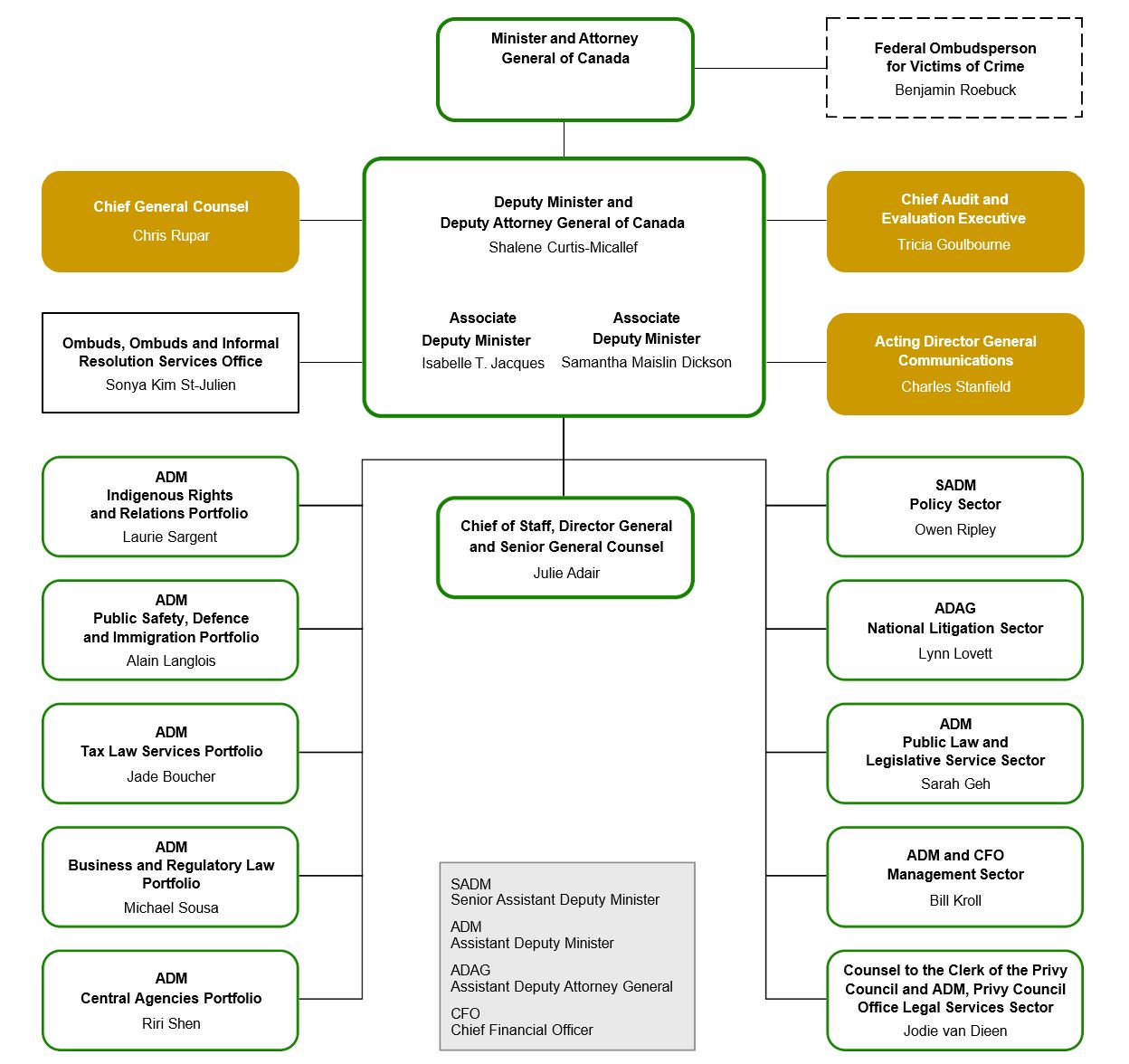
Text version
- Date modified:
From: David Amos <david.raymond.amos333@gmail.com>
Date: Sat, Apr 18, 2026 at 10:35 PM
Subject: Re: Does anyone understand why I laugh at all the bullshit?
To: <jasonlavigne@outlook.com>, pm <pm@pm.gc.ca>, pierre.poilievre <pierre.poilievre@parl.gc.ca>, don.davies <don.davies@parl.gc.ca>, elizabeth.may <elizabeth.may@parl.gc.ca>, John.Williamson <John.Williamson@parl.gc.ca>, Yves-Francois.Blanchet <Yves-Francois.Blanchet@parl.gc.ca>, <ps.ministerofpublicsafety-ministredelasecuritepublique.sp@ps-sp.gc.ca>, fin.minfinance-financemin.fin <fin.minfinance-financemin.fin@canada.ca>, <Chris.dEntremont@parl.gc.ca>, Ginette.PetitpasTaylor <Ginette.PetitpasTaylor@parl.gc.ca>, Wayne.Long <Wayne.Long@parl.gc.ca>, dominic.leblanc <dominic.leblanc@parl.gc.ca>, Michael.Duheme <Michael.Duheme@rcmp-grc.gc.ca>, mcu <mcu@justice.gc.ca>, ragingdissident <ragingdissident@protonmail.com>, washington field <washington.field@ic.fbi.gov>, Chrystia.Freeland <Chrystia.Freeland@parl.gc.ca>, Mark.Blakely <Mark.Blakely@rcmp-grc.gc.ca>, Mike.Comeau <Mike.Comeau@gnb.ca>, Richard.Bragdon <Richard.Bragdon@parl.gc.ca>, Frank.McKenna <Frank.McKenna@td.com>, JUSTMIN <JUSTMIN@novascotia.ca>, Sean.Fraser <Sean.Fraser@parl.gc.ca>, jan.jensen <jan.jensen@justice.gc.ca>, <mike.dawson@parl.gc.ca>, <paulpalango@eastlink.ca>, david mcguinty <david.mcguinty@parl.gc.ca>, PREMIER <PREMIER@gov.ns.ca>, <david.myles@parl.gc.ca>, Weir, Rob (LEG) <Rob.Weir@gnb.ca>, Donald J. Trump <contact@win.donaldjtrump.com>, <dlametti@fasken.com>, djtjr <djtjr@trumporg.com>, warren.mcbeath <warren.mcbeath@rcmp-grc.gc.ca>, <melanie.joly@ised-isde.gc.ca>, <JOHN.HERRON@gnb.ca>, Bill.Blair <Bill.Blair@parl.gc.ca>, premier <premier@ontario.ca>, premier <premier@gov.ab.ca>, Susan.Holt <Susan.Holt@gnb.ca>, rob.moore <rob.moore@parl.gc.ca>, robert.gauvin <robert.gauvin@gnb.ca>, <michael.chong@parl.gc.ca>, Mitton, Megan (LEG) <megan.mitton@gnb.ca>
Cc: <Sydney.Simon@mail.house.gov>, <IL08.helpline@mail.house.gov>, <mcgovern.press@mail.house.gov>, <massie.press@mail.house.gov>, <Castro.press@mail.house.gov>, <walz.press@state.mn.us>, <web_comments@wcco.com>, <rep.zack.stephenson@house.mn.gov>, <Alayna.Smieja@house.mn.gov>, <sen.bobby.champion@mnsenate.gov>, <JustinWells@foxnews.com>, <ottawanews@ctv.ca>, Boston.Mail <Boston.Mail@ic.fbi.gov>, news <news@chco.tv>, news957 <news957@rogers.com>, news-tips <news-tips@nytimes.com>, <news@guelphtoday.com>, <News@nowmediainc.com>, Newsroom <Newsroom@globeandmail.com>, sheilagunnreid <sheilagunnreid@gmail.com>, David.Akin <David.Akin@globalnews.ca>, darrow.macintyre <darrow.macintyre@cbc.ca>, Jacques.Poitras <Jacques.Poitras@cbc.ca>, Sean.Fraser <Sean.Fraser@parl.gc.ca>, <roman.baber@parl.gc.ca>, rob.moore <rob.moore@parl.gc.ca>, Robert. Jones <Robert.Jones@cbc.ca>, francis.scarpaleggia <francis.scarpaleggia@parl.gc.ca>, Francois-Phillipe Champagne <francois-philippe.champagne@parl.gc.ca>, sylvie.gadoury <sylvie.gadoury@radio-canada.ca>, <Don.Monahan@legnb.ca>, JORGE BARRERA <jorge.barrera@cbc.ca>, <mike.dawson@parl.gc.ca>, aaron.kennedy@gnb.ca <Aaron.Kennedy@gnb.ca>, <aaron.gunn@parl.gc.ca>, <ahuras@postmedia.com>, <Jean-Sebastien.Comeau@iga-aig.gc.ca>

The Honourable Dominic LeBlanc
President of the King’s Privy Council for Canada and Minister responsible for Canada-U.S. Trade, Intergovernmental Affairs, Internal Trade and One Canadian Economy
Jean-Sébastien Comeau
Press Secretary and Communications Advisor
Office of the Honourable Dominic LeBlanc
Minister of Intergovernmental Affairs, Infrastructure and Communities
343-574-8116
Jean-Sebastien.Comeau@iga-aig.
Mark Carney isn’t joining the federal Liberals, says Dominic LeBlanc
LeBlanc says he’s been given assurances from Trudeau that he will remain the country’s finance minister. 'Carney is not an option. That discussion has concluded'

OTTAWA • Former Bank of Canada governor Mark Carney isn’t joining the federal Liberals, says new Trudeau government Finance Minister Dominic LeBlanc.
The New Brunswick MP and Trudeau confidant says he’s been given assurances from the prime minister that he will remain the country’s finance minister.
“Carney is not an option,” LeBlanc said in an interview with Brunswick News.
“That discussion has concluded.”.

Ali Ehsassi
---------- Original Message ---------
From: Gladu, Marilyn - M.P. <Marilyn.Gladu@parl.gc.ca>
Date: Mon, 21 Feb 2022 21:30:21 +0000
Subject: RE: Deployment of Emergencies Act expected to pass with support of the NDP because of Trudeau's predictable confidence vote EH ON?
To: David Amos <david.raymond.amos333@gmail.
Thank you for contacting the Office of M.P. Marilyn Gladu. This is an acknowledgement of the receipt of your e-mail.
---------- Original message ----------
From: Erskine-Smith, Nathaniel - M.P. <Nathaniel.Erskine-Smith@parl.
Date: Tue, Feb 22, 2022 at 2:06 PM
Subject: RE: Deployment of Emergencies Act expected to pass with support of the NDP because of Trudeau's predictable confidence vote EH ON?
To: David Amos <david.raymond.amos333@gmail.
We encourage you to read Nate's speech from Monday, February 21: https://beynate.ca/speech-on-
For those interested in the legal arguments for and against the Emergencies Act, please listen to this discussion: https://uncommons.ca/2022/02/
Nate has written about current events at https://twitter.com/beynate
Nate regularly comments on current events on social media. Find him at facebook.com/beynate & twitter.com/beynate & instagram.com/beynate
If you're writing to us about a hot topic, there's a good chance Nate has already recorded an in-depth discussion with an expert on the issue mentioned in your email. Subscribe to Nate's Uncommons Podcast at www.uncommons.ca or find it on your favourite podcast platform.
If you are writing to better understand Nate's thoughts on current events, ask your questions personally by joining Nate bi-weekly on Facebook Live at 8:30 p.m. on Thursday evenings. If you are seeking to advocate for an issue, consider engaging directly with Nate at this forum.
For general updates, it's best to sign up to our email newsletter. If you're not signed up, please reply to this email to say "sign me up."
We can help constituents with federal government resources and programs. For COVID-19 info from our office, please visit our website www.beynate.ca
If you are a constituent of Beaches-East York, below you'll find a guide on how your email will be responded to:
- Queries regarding government programs, policies and operations take time to research, contact appropriate departments, and collate information for dissemination to you. If you have provided your full contact details with your query, a response will be forthcoming.
- If your query is case related (i.e. immigration, CPP, EI, tax issues, etc.), consent forms will need to be filled out before your file can be activated. If you have not yet filled out our office's consent form, a staff member will be in contact with you.
Subscribe to Nate's podcast at uncommons.ca
Nathaniel Erskine-Smith
OFFICE OF
M.P. Nathaniel Erskine-Smith
For general updates, it's best to sign up to our email newsletter.
Simply reply to this email and say "sign me up" or click here.
beynate.ca / info@beynate.ca
---------- Original message ----------
From: "Brock, Larry - M.P." <larry.brock@parl.gc.ca>
Date: Mon, 21 Feb 2022 02:23:25 +0000
Subject: Automatic reply: RE Trudeau Invoking the Emergency Act and
Freeland defending her liberal democracy byway of her bankster buddies
To: David Amos <david.raymond.amos333@gmail.
Thank you for contacting the office of Larry Brock, Member of
Parliament (MP) for Brantford-Brant.
MP Brock welcomes hearing from constituents on issues that are
important to them. A reply to your email will be provided as soon as
possible.
Due to the high volume of email correspondence we receive, priority
will be given to residents of Brantford-Brant, and to emails of a
non-form letter or “email forward” variation. Likewise, if you reside
outside of MP Brock’s riding, please contact your local Member of
Parliament. To find your MP, please visit Find Members of Parliament -
Members of Parliament - House of Commons of Canada
(ourcommons.ca)<https://www.
In order for us to serve you better, please provide your complete
residential mailing address, including postal code and a phone number.
If you did not provide this in your original email, please re-forward
your original email providing this information.
If you require assistance with an urgent matter, please call our
constituency office at 519-754-4300, Monday to Friday, 8:30am to 4pm.
Again, thank you for taking the time to share your thoughts and concerns.
Kind Regards,
Office of Larry Brock, MP for Brantford-Brant
Deputy Shadow Minister for Justice and Attorney General of Canada
Constituency Office:
108 St. George Street, Suite 3
Brantford, ON N3R 1V6
T: 519-754-4300 | F: 519-751-8177
Hill Office:
Room 686, Confederation Building
House of Commons
Ottawa, ON K1A 0A6
T: 613-992-3118 | F: 613-992-6382
---------- Original message ----------
From: "Caputo, Frank - M.P." <frank.caputo@parl.gc.ca>
Date: Mon, 21 Feb 2022 02:07:47 +0000
Subject: Automatic reply: RE Trudeau Invoking the Emergency Act and
Freeland defending her liberal democracy byway of her bankster buddies
To: David Amos <david.raymond.amos333@gmail.
Thank you for writing to the office of Frank Caputo, Member of
Parliament for Kamloops-Thompson-Cariboo. This response confirms that
your email has been received. Given the high volume of emails our
office receives, it is necessary for us to prioritize the emails
coming from constituents of Kamloops-Thompson-Cariboo.
If your email does not include an address or postal code, please send
that information.
Please know that I greatly appreciate all of your comments and
suggestions, even those arriving as form letters or petitions.
Because of the huge volume of this type of email, we will not be able
to answer these individually. Please be assured, however, that staff
are logging the comments and suggestions, and forwarding them to me
directly.
Once again, thank you for reaching out to my office, and for your
patience in processing your request.
Sincerely,
Frank Caputo, M.P.
Kamloops-Thompson-Cariboo
---------- Original message ----------
From: "Fortin, Rhéal - Député" <Rheal.Fortin@parl.gc.ca>
Date: Sat, 19 Feb 2022 07:30:11 +0000
Subject: Automatic reply: RE Trudeau Invoking the Emergency Act and
Freeland defending her liberal democracy byway of her bankster buddies
To: David Amos <david.raymond.amos333@gmail.
Merci de nous avoir transmis votre message.
Soyez assuré(e) que votre correspondance sera portée à l'attention de
Monsieur Fortin.
Vos commentaires sont importants pour nous.
Passez une belle journée!
L'équipe de Rhéal Fortin
Député de Rivière-du-Nord
Bureau 218
Édifice de la Confédération
Ottawa (Ontario) K1A 0A6
613 992-3257
72 rue de la Gare, bureau 203
Saint-Jérôme (Québec) J7Z 2B8
450-565-0061
---------- Original message ----------
From: "Anandasangaree, Gary - M.P." <Gary.Anand@parl.gc.ca>
Date: Mon, 21 Feb 2022 21:30:22 +0000
Subject: Automatic reply: Deployment of Emergencies Act expected to
pass with support of the NDP because of Trudeau's predictable
confidence vote EH ON?
To: David Amos <david.raymond.amos333@gmail.
Hello,
Thank you for contacting my office. This message is to acknowledge
that we are in receipt of your email.
If you are a resident of Scarborough-Rouge Park seeking assistance
with a federal service or program, please provide the following
information:
* Your full name;
* Address, including postal code;
* Telephone number;
* Brief details of your situation &;
* The best way to contact you.
All correspondence sent to the office is treated as confidential.
Yours very truly,
Gary Anandasangaree
Member of Parliament
Scarborough-Rouge Park
---------- Original message ----------
From: "Sarai, Randeep - M.P." <Randeep.Sarai@parl.gc.ca>
Date: Mon, 21 Feb 2022 02:07:45 +0000
Subject: Automatic reply: RE Trudeau Invoking the Emergency Act and
Freeland defending her liberal democracy byway of her bankster buddies
To: David Amos <david.raymond.amos333@gmail.
Hello,
Thank you for contacting the office of Randeep Sarai, Member of
Parliament for Surrey Centre. This email is an automatic response to
inform you that our office has received your correspondence and will
take action on it accordingly.
Our office is CLOSED indefintely for in person inquiries, we will be
handling ALL inquiries through email or over the phone. If you are
having an emergency situation, please state that in the subject
heading of your email and we will do their best to get back to you.
However, should you require assistance with a federal service, please
visit Canada.ca/coronavirus or see the below contact information to
contact them directly:
- Service Canada 1-800-206-7218
- Immigration, Refugees and Citizenship Canada Client Support Centre
1-888-242-2100 (In Canada only)
- Canadians requiring emergency consular assistance can call the 24/7
Emergency Watch and Response Centre in Ottawa at +1 613-996-8885
(collect calls are accepted where available) or email
sos@international.gc.ca<mailto
Thank you again for reaching out to my office.
Sincerely,
Randeep S. Sarai
Member of Parliament for Surrey Centre
---------- Original message ----------
From: "Brière, Élisabeth - Députée" <Elisabeth.Briere@parl.gc.ca>
Date: Mon, 21 Feb 2022 02:07:46 +0000
Subject: Réponse automatique : RE Trudeau Invoking the Emergency Act
and Freeland defending her liberal democracy byway of her bankster
buddies
To: David Amos <david.raymond.amos333@gmail.
Bonjour,
Nous accusons la réception de votre courriel à Élisabeth Brière,
députée de Sherbrooke. Votre courriel est important pour nous et nous
répondrons aux demandes de support dans un délai de 72 heures.
Veuillez noter que conformément aux mesures de la santé publique, nos
employés sont en télétravail et que notre bureau est présentement
fermé pour les rencontres en présentiel.
Merci,
---------- Original message ----------
From: "Dhillon, Anju - M.P." <Anju.Dhillon@parl.gc.ca>
Date: Mon, 21 Feb 2022 02:23:27 +0000
Subject: Automatic reply: RE Trudeau Invoking the Emergency Act and
Freeland defending her liberal democracy byway of her bankster buddies
To: David Amos <david.raymond.amos333@gmail.
(English version will follow)
Bonjour,
Merci pour votre courriel. Nous ferons de notre mieux afin de vous
répondre dans les meilleurs délais.
Afin de réduire la propagation de la COVID-19, mon bureau de
circonscription est présentement fermé pour les rendez-vous en
personne.
Mon équipe de circonscription demeure cependant disponible pour vous
aider avec tous les aspects des services fédéraux. Vous pouvez nous
joindre au 514 639-4497 ou par courriel à l’adresse suivante :
anju.dhillon@parl.gc.ca
Pour obtenir les dernières informations, suivre les développements,
connaître les nouvelles mesures et les dernières directives concernant
la COVID-19, nous vous invitons à consulter les sites suivants :
Gouvernement du
Canada<https://www.canada.ca/
Gouvernement du
Québec<https://www.quebec.ca/
Santé Montréal <https://santemontreal.qc.ca/
Organisation mondiale de la santé<https://www.who.int/fr/
Pour ce qui est des mises à jour concernant le plan d’intervention
économique du Canada pour répondre à la COVID-19, veuillez consulter
le lien suivant :
https://www.canada.ca/fr/
Pour celles et ceux qui ont de la difficulté à joindre Service Canada,
vous pouvez compléter un formulaire électronique que vous trouverez en
cliquant sur le lien suivant :
https://sr-ds.
Service Canada devrait vous contacter rapidement.
Pour des questions d’ordre légal entourant la COVID-19 et ses
nombreuses conséquences, vous pouvez faire appel à la clinique
d’assistance juridique mise en place par le gouvernement provincial et
le Barreau du Québec :
https://www.justice.gouv.qc.
POUR LES CANADIENS À L’ÉTRANGER
Assurez-vous d’être enregistré sur le site web d’Affaires mondiale
Canada<https://voyage.gc.ca/
pour recevoir l’information nécessaire.
Les Canadiens ayant besoin d'une assistance consulaire d'urgence
peuvent appeler le Centre de surveillance et d’intervention d’urgence
24/7 à Ottawa, au +1 613 996-8885 (les appels à frais virés sont
acceptés dans la mesure du possible) ou envoyer un courriel à
sos@international.gc.ca<
PROTÉGEZ-VOUS, VOTRE FAMILLE ET VOTRE COMMUNAUTÉ
• Veuillez pratiquer la distanciation
sociale<https://www.canada.ca/
• Si vous le pouvez, restez à la maison.
• Lavez vos mains<https://www.canada.ca/
régulièrement.
Pour plus d’informations : canada.ca/le-coronavirus<
Merci d'avoir contacté mon bureau.
Anju Dhillon
Députée de Dorval-Lachine-LaSalle | MP for Dorval-Lachine-LaSalle
Bureau de Justice, Pièce 302 | 735 rue Notre-Dame
Ottawa, Ontario K1A 0A6 | Lachine, Québec, H8S 2B5
Tel: 613-995-2251 | Tel: 514-639-4497
Anju.Dhillon@parl.gc.ca<
Thank you for your email. We will do our best to reply as soon as possible.
To prevent the spread of COVID-19, my constituency office is presently
closed for walk-ins and appointments.
My constituency team remains however available to help you with your
federal inquiries. You can reach us at 514-639-4497 or by mail:
anju.dhillon@parl.gc.ca.
To get the latest information, follow developments and/or learn about
new measures and directives concerning COVID-19, we invite you to
consult these links:
Government of Canada<https://www.canada.ca/
Government of Quebec<https://www.quebec.ca/
Santé Montréal<https://
World Health Organisation<https://www.who.
For the latest updates regarding Canada’s COVID-19 Economic Response
Plan, we invite you to visit:
https://www.canada.ca/en/
For those who have difficulty reaching Service Canada, you can fil out
the following form: https://sr-ds.
A Service Canada agent is supposed to get back to you shortly.
If you have any legal questions about COVID-19 and its consequences,
you can contact the legal clinic implemented by the provincial
government and the Quebec Bar:
https://www.justice.gouv.qc.
FOR CANADIANS ABROAD
Please make sure you are registered on the Global Affairs Canada
website<https://travel.gc.ca/
latest information.
Canadians requiring emergency consular assistance can call the 24/7
Emergency Watch and Response Centre in Ottawa at +1 613-996-8885
(collect calls are accepted where available) or email
sos@international.gc.ca<
PROTECT YOURSELF, YOUR FAMILY AND YOUR COMMUNITY
• Practice social
distancing<https://www.canada.
• If you can, stay home.
• Wash your hands<https://www.canada.ca/
often.
For more information, visit: Canada.ca/coronavirus<about:
Thank you for reaching out to my office,
Anju Dhillon
Députée de Dorval-Lachine-LaSalle | MP for Dorval-Lachine-LaSalle
Bureau de Justice, Pièce 302 | 735 rue Notre-Dame
Ottawa, Ontario K1A 0A6 | Lachine, Québec, H8S 2B5
Tel: 613-995-2251 | Tel: 514-639-4497
Anju.Dhillon@parl.gc.ca<
---------- Original message ----------
From: "Naqvi, Yasir - M.P." <yasir.naqvi@parl.gc.ca>
Date: Mon, 21 Feb 2022 02:39:30 +0000
Subject: Automatic reply: RE Trudeau Invoking the Emergency Act and
Freeland defending her liberal democracy byway of her bankster buddies
To: David Amos <david.raymond.amos333@gmail.
Hello,
Thank you for reaching out to the office of Yasir Naqvi, MP for Ottawa Centre.
I am so glad to hear from you and my team and I are ready to provide
assistance. Please note that we are experiencing a high volume of
correspondence and will get back to you as soon as we can.
If you are writing in relation to the ongoing protests in Ottawa,
please be assured that as your Member of Parliament, I am doing
everything in my capacity to push for immediate, strong and concrete
action from all levels of government to put an end to this unlawful
protest. I appreciate your input and I will respond to your email at
the earliest convenience.
To get the latest information, follow developments and/or learn about
new measures and directives concerning COVID-19, we invite you to
consult these links:
Government of Canada:
https://www.canada.ca/en/
Government of Ontario: https://www.ontario.ca/page/
Ottawa Public Health: https://www.
World Health Organisation:
https://www.who.int/
Public Health Agency of Canada's dedicated hotline and email address:
Phone: 1-833-784-4397 (open 7 a.m. to midnight 7 days a week)
Email: phac.info.aspc@canada.ca<
Subscribe to our newsletter to receive regular updates:
YasirNaqviMP.ca<https://
Thanks again for writing.
Sincerely,
Yasir
Yasir Naqvi
MP, Ottawa Centre
//
Bonjour,
Merci d'avoir communiqué avec le bureau de Yasir Naqvi, député d'Ottawa-Centre.
Je suis heureux de vous entendre et mon équipe et moi-même sommes
prêts à vous aider. Veuillez noter que nous faisons face à un volume
élevé de correspondance et que nous vous répondrons dès que possible.
Si vous m'écrivez au sujet des manifestations en cours à Ottawa,
sachez qu'en tant que votre député, je fais tout ce qui est en mon
pouvoir pour réclamer une action immédiate, forte et concrète de la
part de tous les niveaux de gouvernement afin de mettre un terme à ces
manifestations illégales. J'apprécie votre contribution et je
répondrai à votre courriel dans les plus brefs délais.
Pour obtenir les dernières informations, suivre les développements,
connaître les nouvelles mesures et les dernières directives concernant
la COVID-19, nous vous invitons à consulter les sites suivants :
Gouvernement du Canada :
https://www.canada.ca/fr/
Gouvernement de l’Ontario :
https://www.ontario.ca/fr/
Santé publique de la ville d’Ottawa :
https://www.
Organisation mondiale de la santé:
https://www.who.int/fr/
Pour communiquer avec le service d'assistance téléphonique et
l'adresse électronique de l'Agence de la santé publique du Canada:
Nous vous invitons à vous inscrire à notre bulletin pour recevoir les
dernières nouvelles: YasirNaqviMP.ca<https://
Merci encore de nous avoir écrit.
Sincèrement,
Yasir
Yasir Naqvi
Député, Ottawa-Centre
---------- Original message ----------
Sent: February 21, 2022 4:30 PM
To: Aitchison, Scott - M.P. <Scott.Aitchison@parl.gc.ca>; Alghabra, Omar - M.P. <Omar.Alghabra@parl.gc.ca>; Ali, Shafqat - M.P. <shafqat.ali@parl.gc.ca>; Allison, Dean - M.P. <dean.allison@parl.gc.ca>; Anand, Anita - M.P. <Anita.Anand@parl.gc.ca>; Anandasangaree, Gary - M.P. <Gary.Anand@parl.gc.ca>; Angus, Charlie - M.P. <charlie.angus@parl.gc.ca>; Arya, Chandra - M.P. <Chandra.Arya@parl.gc.ca>; Badawey, Vance - M.P. <Vance.Badawey@parl.gc.ca>; Baker, Yvan - M.P. <Yvan.Baker@parl.gc.ca>; Baldinelli, Tony - M.P. <Tony.Baldinelli@parl.gc.ca>; Barrett, Michael - M.P. <Michael.Barrett@parl.gc.ca>; Bennett, Carolyn - M.P. <carolyn.bennett@parl.gc.ca>; Bittle, Chris - M.P. <Chris.Bittle@parl.gc.ca>; Blair, Bill - M.P. <Bill.Blair@parl.gc.ca>; Bradford, Valerie - M.P. <valerie.bradford@parl.gc.ca>; Brassard, John - M.P. <John.Brassard@parl.gc.ca>; Brock, Larry - M.P. <larry.brock@parl.gc.ca>; Carrie, Colin - M.P. <colin.carrie@parl.gc.ca>; Chagger, Bardish - M.P. <Bardish.Chagger@parl.gc.ca>; Chambers, Adam - M.P. <adam.chambers@parl.gc.ca>; Chen, Shaun - M.P. <Shaun.Chen@parl.gc.ca>; Chiang, Paul - M.P. <paul.chiang@parl.gc.ca>; Chong, Michael - M.P. <michael.chong@parl.gc.ca>; Collins, Chad - M.P. <chad.collins@parl.gc.ca>; Coteau, Michael - M.P. <michael.coteau@parl.gc.ca>; Dabrusin, Julie - M.P. <Julie.Dabrusin@parl.gc.ca>; Damoff, Pam - M.P. <Pam.Damoff@parl.gc.ca>; Davidson, Scot - M.P. <Scot.Davidson@parl.gc.ca>; Dong, Han - M.P. <Han.Dong@parl.gc.ca>; Dowdall, Terry - M.P. <Terry.Dowdall@parl.gc.ca>; Drouin, Francis - Député <Francis.Drouin@parl.gc.ca>; Duncan, Eric - M.P. <Eric.Duncan@parl.gc.ca>; Duncan, Kirsty - M.P. <kirsty.duncan@parl.gc.ca>; Dzerowicz, Julie - M.P. <Julie.Dzerowicz@parl.gc.ca>; Ehsassi, Ali - M.P. <Ali.Ehsassi@parl.gc.ca>; Epp, Dave - M.P. <Dave.Epp@parl.gc.ca>; Erskine-Smith, Nathaniel - M.P. <Nathaniel.Erskine-Smith@parl.
Cc: motomaniac333 <motomaniac333@gmail.com>
Subject: Deployment of Emergencies Act expected to pass with support of the NDP because of Trudeau's predictable confidence vote EH ON?
https://davidraymondamos3.
Monday, 21 February 2022
Deployment of Emergencies Act expected to pass with support of the NDP
because of Trudeau's predictable confidence vote EH?
---------- Original message ----------
From: "Mendicino, Marco - M.P." <Marco.Mendicino@parl.gc.ca>
Date: Mon, 21 Feb 2022 19:14:55 +0000
Subject: Automatic reply: Deployment of Emergencies Act expected to
pass with support of the NDP because of Trudeau's predictable
confidence vote EH?
To: David Amos <david.raymond.amos333@gmail.
Thank you for contacting the constituency office of the Hon. Marco
Mendicino, P.C., M.P. for Eglinton—Lawrence.
Please be advised that our office has the capacity to assist with
requests within Eglinton—Lawrence only and we prioritize
correspondence from residents.
If you reside outside the riding and require assistance, you can
contact your local Member of Parliament by entering your postal code
here: https://www.ourcommons.ca/
If you are a resident of Eglinton—Lawrence and require assistance
continue reading below.
· For assistance with casework, we require your full name,
phone number, address and postal code to proceed.
· For non-ministerial meeting requests, we need to know
the nature of the meeting and we will respond back with possible
options.
· For media requests, the Press Secretary will get back to you.
To contact Public Safety Canada directly, please visit:
https://www.publicsafety.gc.
To contact Immigration, Refugees and Citizenship Canada directly,
please email minister@cic.gc.ca or phone 613-954-1064.
For assistance with the situation in Afghanistan, please continue reading.
If you and your family require assistance regarding the rapidly
evolving situation in Afghanistan, detailed information on Canada’s
special measures to support Afghan nationals is available here:
https://www.canada.ca/en/
For Afghans who assisted the Government of Canada, please contact:
Canada-Afghanistan@
For questions on how Afghan nationals may reunite with their families
in Canada, or information on the humanitarian program to resettle
Afghans outside of Afghanistan, please contact:
IRCC.SituationAfghanistan.
You may also call 1-613-321-4243 from Monday to Friday, 6:30 a.m. to 7
p.m. (ET).
For Canadians in need of consular assistance in Afghanistan, please
contact Global Affairs Canada’s 24/7 Emergency Watch and Response
Centre in Ottawa at:
· Phone: 613-996-8885
· Email: sos@international.gc.ca
· SMS: 613-686-3658
---------- Original message ----------
From: "Bergen, Candice - M.P." <candice.bergen@parl.gc.ca>
Date: Mon, 21 Feb 2022 19:14:55 +0000
Subject: Automatic reply: Deployment of Emergencies Act expected to
pass with support of the NDP because of Trudeau's predictable
confidence vote EH?
To: David Amos <david.raymond.amos333@gmail.
On behalf of the Hon. Candice Bergen, thank you for contacting the
Office of the Leader of the Official Opposition.
Ms. Bergen greatly values feedback and input from Canadians. We read
and review every incoming e-mail. Please note that this account
receives a high volume of e-mails. We reply to e-mails as quickly as
possible.
If you are a constituent of Ms. Bergen’s in Portage-Lisgar with an
urgent matter please provide complete contact information. Not
identifying yourself as a constituent could result in a delayed
response.
Once again, thank you for writing.
Sincerely,
Office of the Leader of the Official Opposition
------------------------------
------------------------------
Au nom de l’hon. Candice Bergen, nous vous remercions de communiquer
avec le Bureau de la cheffe de l’Opposition officielle.
Mme Bergen accorde une grande importance aux commentaires des
Canadiens. Nous lisons et étudions tous les courriels entrants.
Veuillez noter que ce compte reçoit beaucoup de courriels. Nous y
répondons le plus rapidement possible.
Si vous faites partie de l’électorat de Mme Bergen dans la
circonscription de Portage-Lisgar et que votre affaire est urgente,
veuillez fournir vos coordonnées complètes. Si vous ne le faites pas,
cela pourrait retarder la réponse.
Nous vous remercions une fois encore d’avoir pris le temps d’écrire.
Veuillez agréer nos salutations distinguées,
Bureau de la cheffe de l’Opposition officielle
---------- Original message ----------
From: "Blanchet, Yves-François - Député" <Yves-Francois.Blanchet@parl.
Date: Mon, 21 Feb 2022 19:14:55 +0000
Subject: Réponse automatique : Deployment of Emergencies Act expected
to pass with support of the NDP because of Trudeau's predictable
confidence vote EH?
To: David Amos <david.raymond.amos333@gmail.
(Ceci est une réponse automatique)
(English follows)
Bonjour,
Nous avons bien reçu votre courriel et nous vous remercions d'avoir
écrit à M. Yves-François Blanchet, député de Beloeil-Chambly et chef
du Bloc Québécois.
Comme nous avons un volume important de courriels, il nous est
impossible de répondre à tous individuellement. Soyez assuré(e) que
votre courriel recevra toute l'attention nécessaire.
L'équipe du député Yves-François Blanchet
Chef du Bloc Québécois
Thank you for your email. We will read it as soon as we can.
---------- Original message ----------
From: Ministerial Correspondence Unit - Justice Canada <mcu@justice.gc.ca>
Date: Mon, 21 Feb 2022 19:06:21 +0000
Subject: Automatic Reply
To: David Amos <david.raymond.amos333@gmail.
Thank you for writing to the Honourable David Lametti, Minister of
Justice and Attorney General of Canada.
Due to the volume of correspondence addressed to the Minister, please
note that there may be a delay in processing your email. Rest assured
that your message will be carefully reviewed.
We do not respond to correspondence that contains offensive language.
-------------------
Merci d'avoir écrit à l'honorable David Lametti, ministre de la
Justice et procureur général du Canada.
En raison du volume de correspondance adressée au ministre, veuillez
prendre note qu'il pourrait y avoir un retard dans le traitement de
votre courriel. Nous tenons à vous assurer que votre message sera lu
avec soin.
Nous ne répondons pas à la correspondance contenant un langage offensant.
---------- Original message ----------
From: David Amos <david.raymond.amos333@gmail.
Date: Mon, 21 Feb 2022 15:06:16 -0400
Subject: Deployment of Emergencies Act expected to pass with support
of the NDP because of Trudeau's predictable confidence vote EH?
To: pm <pm@pm.gc.ca>, "Katie.Telford" <Katie.Telford@pmo-cpm.gc.ca>,
kingpatrick278 <kingpatrick278@gmail.com>, Viva Frei
<david@vivafrei.com>, "freedomreport.ca" <freedomreport.ca@gmail.com>,
"jagmeet.singh" <jagmeet.singh@parl.gc.ca>,
Yves-Francois.Blanchet@parl.
<Candice.Bergen@parl.gc.ca>, Marco.Mendicino@parl.gc.ca, "Bill.Blair"
<Bill.Blair@parl.gc.ca>, "David.Lametti" <David.Lametti@parl.gc.ca>,
mcu <mcu@justice.gc.ca>, "Ian.Shugart" <Ian.Shugart@pco-bcp.gc.ca>,
"Kevin.leahy" <Kevin.leahy@rcmp-grc.gc.ca>, "Brenda.Lucki"
<Brenda.Lucki@rcmp-grc.gc.ca>, "blaine.higgs" <blaine.higgs@gnb.ca>,
"hugh.flemming" <hugh.flemming@gnb.ca>, premier <premier@ontario.ca>,
premier <premier@gov.ab.ca>, Office of the Premier
<scott.moe@gov.sk.ca>, premier <premier@gov.nl.ca>, PREMIER
<PREMIER@gov.ns.ca>, premier <premier@gov.pe.ca>, premier
<premier@gov.yk.ca>, premier <premier@leg.gov.mb.ca>, premier
<premier@gov.bc.ca>, premier <premier@gov.nt.ca>,
blake.desjarlais@parl.gc.ca, freedomforusal@protonmail.com,
jake.stewart@parl.gc.ca, paul <paul@paulfromm.com>, "Paul.Lynch"
<Paul.Lynch@edmontonpolice.ca>
<derekstorie85@gmail.com>, eps <eps@edmontonpolice.ca>,
Peggy.Regimbal@bellmedia.ca, patrickking@canada-unity.com,
james@canada-unity.com, novaxpass@outlook.com,
martin@canada-unity.com, tdundas10@gmail.com, jlaface@gmail.com,
davesteenburg269@gmail.com, brown_tm3@yahoo.ca, leannemb
<leannemb@protonmail.com>, harold@jonkertrucking.com,
keepcanada@protonmail.com, andyjohanna01@hotmail.com,
janiebpelchat@icloud.com, janetseto@protonmail.com,
johndoppenberg@icloud.com, stiessen1979@gmail.com,
77cordoba@outlook.com
Cc: motomaniac333 <motomaniac333@gmail.com>
https://davidraymondamos3.
Monday, 21 February 2022
Deployment of Emergencies Act expected to pass with support of the NDP
because of Trudeau's predictable confidence vote EH?
Blaine Higgs has a new job
Former premier joins Canadian Taxpayers Federation’s board of directors and has a public appearance scheduled in May
 Over
a year after his government’s election defeat, former premier Blaine
Higgs has been named to the Canadian Taxpayers Federation’s board of
directors. BRUNSWICK NEWS ARCHIVES
Over
a year after his government’s election defeat, former premier Blaine
Higgs has been named to the Canadian Taxpayers Federation’s board of
directors. BRUNSWICK NEWS ARCHIVESFormer Premier Blaine Higgs has been named to the Canadian Taxpayers Federation’s board of directors.
Now over a year after his government’s election defeat, Higgs joins the non-profit advocacy group dedicated to lower taxes, reduced waste, and government accountability that was a huge fan of his tenure in government.
“The taxpayers federation, we give out very few bouquets,” said Tim McMillan, the federation’s board of directors chair, in an interview with Brunswick News.
“Be it a Conservative, Liberal, or NDP government, we are generally taking a pretty strong position on the side of the taxpayers for fiscal responsibility, and if we find waste, we are going to identify it.
“That being said, Premier Higgs, looking back at his record, it was a shining light in Canada at the time that, even through COVID, he was running balanced budgets where everybody else was not. His record is one of the strongest that I can think of in recent history.”
He added: “We’re very pleased to have somebody with kind of his experience, both in government and also in the private sector, a strong track record of being very responsible with taxpayers dollars, that very much aligns with our mandate.”
The job will see Higgs attend board meetings, strategy sessions, and events throughout the year. It’s also a voluntary role that will see Higgs contribute to the strategy and direction of the organization, McMillan said.
“It’s the worst job you can get, because it doesn’t pay anything, but I think it aligns with Premier Higgs’s values, and it’s an organization that takes those values and principles very seriously,” McMillan said.
Higgs has largely remained away from the spotlight since the 2024 election.
He’s instead spent most of his time at a family cottage in Forest City, N.B., enjoying family time with his wife, three daughters, and five grandchildren.
But it appears he will now be venturing publicly a little more.
Higgs is also slated in May to speak on a panel alongside other former premiers at the Canada Strong and Free Networking Conference, formerly the Manning conference, billed as the largest conservative networking event in Canada.
Meanwhile, just last month, the Canadian Taxpayers Federation released an hour-long interview with Higgs that it called “Government Spending Decoded: Higgs Tells It Straight.”
It leads off with Higgs explaining how his governments turned large surpluses.
“We reduced interest payments by $100 million a year and we did that because we just didn’t spend it all,” Higgs said.
“Because what are you going to do with it?
“Are you going to throw it into the air and say ‘feel good, because I made an announcement, I’m spending more money’ because that’s what the media look for today and that’s so sad.”
Later, Higgs was asked how as finance minister under the Alward government he didn’t balance the budget, but then did as premier.
“There has to be the will within the premier’s office to get it done,” he said.
The interview with Taxpayers Federation president and CEO Scott Hennig sees Higgs credit his rural New Brunswick upbringing for teaching him “self-sufficiency” and instilling an attitude to do things yourself.
He said his time at Irving Oil underscored a private business mentality that success, progress, and results matter.
“And spending money, as much as you can, was a problem,” Higgs said.
“Finding better results at a better price was a focus.
“I questioned why that’s not a theme in government because I was mystified that it didn’t appear to exist.”
Later, in speaking about how he entered politics, Higgs added: “I did have a thirst to use what I learned in business, to apply that to government.”
He also defends running government like a business.
“People would say ‘it’s not a business’ and I would beg to differ on that because the reason is you should be getting maximum results out of taxpayers’ money. If you’re not, you’re unnecessarily using taxpayer dollars,” Higgs said.
At one point, the former premier stated that
he “often wonders why any business would ever support a Liberal
government, or a Green or NDP, and wouldn’t be whole heartedly
Conservative because it’s the best chance they’ve got at government
running like it has to get results for money spent.”
He added that it’s likely because they can get “lump sum payments to offset the abuse they witness in politics.”
The conversation goes on to detail the Alward government’s pension reforms with Higgs as finance minister, his unlikely rise to become party leader on promising less, the narrow election victory that handed him a minority government, and governing through COVID-19.
It speaks at length on natural resource development as a way to self-sufficiency.
It then briefly rehashes Higgs’s position on parental rights and schools as part of his downfall as premier, including the rift within the party.
That leads Higgs to call conservatism “in many ways a dying art.”
It also sees Higgs return to a few familiar staples of his political career in deriding election spending and lamenting how new governments undo the changes of those they follow.
“We are seeing that in spades in this current mandate,” Higgs said. “It’s very disheartening.”
In particular, he referenced new collective agreements signed by the Holt government with unions, stating they didn’t negotiate a deal, they “capitulated” to them.
Asked what he was most proud of as premier, Higgs said it was “having national media recognize that New Brunswick can be different.”
“We don’t need to be the basket case of the country, we can be proud of our province,” he said.
https://tj.news/new-brunswick/
UPDATE: Holt to meet with Carney during two-day Ontario trip
The premier will also make an appearance on a conference panel alongside Ontario Premier Doug Ford
 Prime Minister Mark Carney and Premier Susan Holt are pictured in Fredericton. SUBMITTED
Premier Susan Holt will meet with Prime Minister Mark Carney in Ottawa on Monday.
It’s part of a two-day Ontario trip that will also include an appearance on a conference panel alongside Ontario Premier Doug Ford.
The premier says she’s arranged a series of meetings with federal ministers throughout the first day, before heading to Toronto for another speaking event.
It comes as the federal government is on the verge of earmarking billions in defence and infrastructure spending, while pushing forward on a select number of nation-building projects.
“That’s why it’s valuable to go up to Ottawa, to make sure New Brunswick is front and centre,” Holt said in an interview. “To make sure that New Brunswickers are getting the benefits of federal investment in these things that align with our capabilities and assets.
“We don’t take for granted that we’ve submitted our projects, we’ve told them how great they are. Instead, we’re going to be up there hustling every day. We’re not resting on our laurels. We need to make sure that every minister and every member of this government understands what New Brunswick is capable of and how we can contribute, and we want to see our projects moving forward.”
The premier’s office says Holt will meet with New Brunswick MP Dominic LeBlanc, minister responsible for Canada-U.S. trade and intergovernmental affairs, ACOA Minister Sean Fraser, National Defence Minister David McGuinty, Health Minister Marjorie Michel, Stephen Fuhr, secretary of state for defence procurement, and Saint John-Kennebecasis MP Wayne Long, secretary of state for the Canada Revenue Agency.
Talks will include an update on the Sisson mine project, the $579-million nation-building project that Carney referred to the federal government’s major projects office last year.
Holt said Ottawa continues to work on offtake agreements and a price floor to push ahead the extraction of the mine’s tungsten and molybdenum.
They’re two tools that would help find long-term buyers for the minerals at a viable price, with federal backing.
“We want to make sure that’s moving at pace,” Holt said.
The Holt government had also been pitching projects at both the Port of Saint John and Belledune, with the feds signalling that they fit best within the Carney government’s $5-billion Trade Diversification Corridors Fund.
Applications for the fund opened a few weeks ago.
“They’re in, and I am going to make darn sure that New Brunswick gets the attention and support that those projects deserve,” Holt said. “We’re there to make sure that they get funded and accepted.”
That’s as Holt said she plans to push New Brunswick’s place within the federal government’s defence strategy.
The premier said her government is also developing a defence strategy to underscore New Brunswick assets in Base Gagetown, but also the province’s capabilities in cyber security, the Port of Belledune’s ability to be a home for defence ships, and a push for new defence sector manufacturing.
Holt said that will come after a new economic growth strategy slated to be unveiled late next week.
In Ottawa, the premier said she will raise the province’s bid to be the home of Canada’s largest explosives factory since the Second World War. Holt has recently met with Eurenco, Europe’s top producer of propellants and explosives, and new Canadian firm Nalagx, the two companies that want to build an energetics facility.
“That’s part of the conversation with Minister McGuinty,” Holt said.
“We see the value of having a Canadian sovereign source of energetics, but the key is in the contract.
“Right now, we procure some of our energetics from American based contractors, and want to talk with the minister and the procurement minister about the path for a sovereign Canadian solution.”
Holt is also attending on Monday the Canadian Chamber of Commerce future business summit.
There, she’s slated to speak on a panel alongside Ontario Premier Doug Ford, Prince Edward Island Premier Rob Lantz and R.J. Simpson, the premier of the Northwest Territories.
The topic for the 45-minute panel is “What Can We Agree On?”
“We’re convening a table of premiers from across the political spectrum on one stage to test what still unites the country,” reads the talk’s synopsis. “Will they find common ground before the clock runs out?”
On Tuesday, Holt is in Toronto for an event celebrating the Business Council of Canada’s 50th anniversary.
The business council confirmed in an email that Holt is a guest speaker at a closed-door meeting.
https://tj.news/new-
N.B. MP helped get first floor crosser to join the Liberals
He argued it opened the flood gates for several floor crossers – and now a majority government
 Saint
John-Kennebecasis MP Wayne Long is pictured with Nova Scotia MP Chris
d'Entremont, who crossed over from the Conservatives to the federal
Liberals in November. SUBMITTED
Saint
John-Kennebecasis MP Wayne Long is pictured with Nova Scotia MP Chris
d'Entremont, who crossed over from the Conservatives to the federal
Liberals in November. SUBMITTEDWayne Long says he’s the guy who arranged for former Nova Scotia Conservative MP Chris d’Entremont to meet with Prime Minister Mark Carney.
He argued it opened the flood gates for several floor crossers – and now a majority government.
D’Entremont ended up being the first of four Conservatives to leave the opposition bench and join the Liberal government.
An NDP MP also jumped.
And with three byelection wins on Monday night, the Liberal caucus is now 174 MPs, allowing the Carney Liberals to pass legislation without support from opposition parties.
“You go back to the old adage of a wartime government or wartime cabinet,” Long, the veteran Saint John-Kennebecasis MP, said in an interview on Tuesday.
“We are at war right now. It’s an economic warfare that’s being waged on our country, and it’s a war that puts our sovereignty at risk.
“And I think everybody of all political stripes is seized with the importance of putting down partisanship, working across party lines, and doing what’s best for the country.”
He added: “I think there’s little appetite for the slogans and the partisan games that were being played in the past.
“We need to get stuff done. Our country’s at stake.”
That’s as it all started with a single floor crossing, Long said.
“Chris’s office is literally down the hall from mine in Wellington (a building located directly across from Parliament Hill),” Long said. “And we were chatting one night.
“I basically said ‘Look, what’s it going to take?’ And Chris said he would really like to have a conversation with the prime minister.”
Long continued: “So I quickly got on my phone and had that set up, and I think Chris was in front of the prime minister within about 30 minutes after that.”
A car picked up d’Entremont and drove him a few short blocks down Wellington Street to the prime minister’s office.
“Clearly, that clinched the deal,” Long said, adding that d’Entremont became a “longtime” friend of his in the hallways of Parliament, suggesting that, like him, the former Conservative MP was more of a Red Tory.
That’s as Nova Scotia Liberal MP Kody Blois had broached several times to d’Entremont that he would be a welcome addition to the Liberal party.
Efforts toward that ramped up over the summer, Long said.
The conversation with Carney happened on a Monday night in November.
A day later, d’Entremont became the first to leave the Tory caucus, citing a better alignment with Carney’s economic agenda and vision.
D’Entremont has since recounted that the meeting saw Carney lead with the spending his government was making for Acadian culture.
The conversation lasted an hour.
“Don’t underestimate how Chris was the first one. I’ve got a little experience in being the first one out of the gate, and that took a lot of courage on Chris’s part,” Long said, a reference to how he was the first to call publicly for former Prime Minister Justin Trudeau’s resignation.
“I’d say he was the one who broke that dam and made it easier for other MPs to follow.”
Ontario MP Michael Ma became the second to leave the Tories for the Liberals just before a Christmas party in December.
Edmonton MP Matt Jeneroux, after already announcing his resignation from politics, abruptly decided to stay and cross in February.
In early March, NDP MP for Nunavut Lori Idlout crossed the floor.
Then in a stunner last week, longtime Conservative MP Marilyn Gladu joined the Liberals.
Long said he wasn’t completely surprised.
“If you had asked me two weeks ago who were the top five nicest, most pleasant, most cordial MPs on the Conservative side, Marilyn Gladu would have been in the top five,” Long said.
“I mean, yes, there’s obviously some pretty strong viewpoints that I wouldn’t agree with and I think as a party we wouldn’t agree with.
“But as far as somebody that worked across party lines, Gladu did that. I mean, Marilyn would be somebody who would be heckling me in the House, but also waving and smiling at me to say hello when I came in.”
Long said the Liberals have assurances from Gladu that she will vote with the party where she once disagreed, including on social issues.
That’s while he suggested Gladu’s floor crossing represents something bigger.
“I think people realize that the prime minister’s agenda is the agenda that Canadians want to see move forward,” Long said.
“And that’s why people from all political ideologies and stripes are migrating to Mark Carney and his vision.”
The Saint John-Kennebecasis MP said he’s not currently involved in talks to bring any other opposition colleagues over to the Liberal side, adding that other conversations may still be happening.
Long said there’s importance in reaching the majority government mark.
Long was first elected in 2015 with a Liberal majority government, and was then reelected in 2019, 2021, and most recently with the Liberals handed minority Parliaments.
“And they’re vastly different,” he said. “How you run government, how you approach government, how you deal with legislation, things that can happen that can obstruct or slow down your agenda.
“The last Parliament was one of the most dysfunctional Parliaments. You see how things can get obstructed at committee, how there can be games played in the House, motions of privilege that really grind parliament to a halt.
“In that last Parliament, it was months where we literally go into the House and sit there and do very little with respect to our agenda.”
Carney said something similar on Tuesday.
“There’s a difference between real testimony, real substance, getting to issues, debating aspects of law – and showboating,” he said.
He also pushed away any idea that the Liberals grabbed a majority illegitimately.
“Canadians elect deputies, deputies vote with their conscience and support the program that they see best for their constituents and for the country,” Carney said.
The next federal election doesn’t have to be called until October 2029.
It’s now more likely there won’t be one until then.
The prime minister said on Tuesday that he has no plans to call a snap election anytime soon.
ANALYSIS: Higher gas prices bring windfall of revenue for Holt government
Premier won't be following Ottawa's lead in cutting gas tax, instead pointing to other affordability measures her government has already made
 The
New Brunswick government is currently bringing in about $2.40 in extra
tax money every time you fill up your vehicle at the pumps. Photo by Tony Caldwell/Postmedia
The
New Brunswick government is currently bringing in about $2.40 in extra
tax money every time you fill up your vehicle at the pumps. Photo by Tony Caldwell/PostmediaThe New Brunswick government is currently bringing in about $2.40 in extra tax money every time you fill up your vehicle at the pumps.
And it could equate to between $10 million to $15 million in additional revenue, based on past math, if higher prices last for an entire year, it suggests.
But Premier Susan Holt won’t be following Prime Minister Mark Carney’s lead in cutting gas taxes, instead pointing to a series of affordability measures her government has already made, including past efforts to lower the price of gas.
Progressive Conservative Leader Glen Savoie says the Holt government can’t afford to do it because it already spent itself into a fiscal corner.
Carney unveiled in Ottawa on Tuesday that his government is temporarily suspending the federal fuel excise tax on gasoline and diesel across Canada, a move that will cut gas prices by 10 cents at the pumps beginning Monday.
Higher gas prices, brought on by a war in the Middle East that remains volatile, also mean higher tax revenue for governments.
The federal government has decided to give part of the gas revenue it’s bringing in back to Canadians.
Meanwhile, Holt says she hopes the spike in prices will be short lived, while lamenting how global markets have erased the cut to gas prices her government recently carried out.
Prices climbing
As of Wednesday, the maximum retail price of regular unleaded gas in New Brunswick was 184.4 cents per litre.
It hit a high of 194.5 per litre last week.
Forecasters suggest the price might soon eclipse $2 a litre as Iran and the United States grapple over control of the Strait of Hormuz, where 20 per cent of the world’s total oil and liquefied natural gas consumption passes through daily.
Although Canada is one of the world’s largest oil producers, Canadians still pay market prices for fuel.
Carney’s temporary suspension of the federal excise tax on gas and diesel means the cost of gas will drop by 10 cents on a litre of gasoline and four cents per litre of diesel starting on Monday and lasting until Labour Day.
Asked if her government will follow suit, Holt instead highlighted other measures.
“We are looking at all the things that we can do to deliver relief to New Brunswickers,” Holt said, while listing that her government has discounted power bills by 10 per cent, put in place a rent cap, and has frozen property tax assessments.
“And so we’re glad that the federal government, given this is something that has come from a war (U.S. President Donald) Trump has caused, has the ability to make that adjustment to motor fuel taxes to deal with this global uncertainty,” Holt said.
“That’s good for New Brunswickers.”
Government officials also pointed Brunswick News to comments she made last week.
“Right now, the price of gas is something that I am hearing about regularly from New Brunswickers who find that these spikes are exceptionally challenging,” Holt told reporters last week in Fredericton.
She then expressed optimism that a ceasefire with Iran “should open up the Strait of Hormuz and get product flowing at a more competitive rate.”
“Because our team over the last 12 months put a lot of effort into lowering gas prices, taking the cost of carbon adjuster off, moving to E10 so that we could drop the price by seven cents, doing things to deliver that affordability to New Brunswick,” Holt said.
“I wish we had more control of the global gas market, but we’re always looking at New Brunswick’s role in global energy to deliver affordability to New Brunswickers.”
But whether the strait opens up anytime soon is anyone’s guess.
The U.S. on Monday said it began blocking ships from entering or exiting Iranian ports in the Strait of Hormuz, attempting to ratchet up pressure on Iran to reopen the key oil route after weekend peace negotiations collapsed.
Provincial revenue from gas
Meanwhile, higher gas prices do mean more revenue for governments.
It happened just recently.
Asked how much more in revenue the Holt government could anticipate from higher gas prices brought on by the Iran war, the Holt government brought up some past math.
“Based on the experience of the Russia-Ukraine conflict, it is estimated that the full-year impact of rising fuel prices was in the order of $10 million to $15 million in net, additional revenue to the province,” said Holt government spokesperson David Kelly.
“This reflects the estimated impact on HST but also volume shortfalls on tax revenue.
“Higher fuel prices could also result in reduced consumption elsewhere in the economy, to offset higher fuel costs.”
He added: “Any impacts will be dependent on the duration and size of price changes.”
The province brings in revenue from gasoline sales in a few ways.
Its Gasoline and Motive Fuels Tax adds 10.87 cents per litre.
The Holt government brought in $211 million in gas tax revenue last year, which was actually $11 million more than it originally forecasted.
But it’s a fixed amount per litre, meaning that even if the overall price of gas climbs higher, the province won’t bring in more revenue as the taxation level stays the same.
It means that the only way gas tax revenue would climb is if large volumes of gas are sold.
And there’s arguably a lesser chance of that happening right now, as higher gas prices may result in some New Brunswickers deciding to drive less due to pump prices.
But the New Brunswick government will benefit from higher prices in another way, namely higher sales tax revenue.
HST is charged at two points in the equation that sets maximum gas prices in the province – first on the benchmark price, wholesale and retail margins, but also later on the delivery cost.
With the maximum retail price of regular unleaded gas in New Brunswick set at 184.4 cents per litre, a total of 24.1 cents of that is HST, according to the price-setting formula.
Last week, gas prices had a maximum price of 194.5 per litre, resulting in 25.4 cents per litre in sales tax.
Meanwhile, a year ago, the maximum price of that same gas in April was as low as 138.8 cents a litre.
About 18.1 cents of that was HST.
The result is roughly six cents extra in tax revenue per litre that’s now being collected.
For a 60-litre vehicle, that’s an extra $3.60 cents per fill up.
For New Brunswick, the federal government collects the entire 15 per cent HST and then eventually remits 10 per cent of it to the province.
That means the provincial government will pocket an extra $2.40 for every fill up in the province versus this time last year.
It is worth noting, however, that the Holt government won’t see that money immediately.
Ottawa collects HST revenue for the province and then remits New Brunswick its share, doing so via estimates that lag and are not in real time.
Finance Minister René Legacy has pointed to that system as one of the reasons why the Holt government piled up a massive deficit over the last year, stating that HST estimates in the past were too high and that they’ve recently corrected, amounting to a lower-than-expected payout.
Kelly brought that up as well.
“There is limited data available to arrive at a reliable estimate of the additional HST that would result from higher gas prices,” he said. “HST is formula-determined and based on lagged economic and administrative data.
“It is not based on real-time activity.”
Holt promises overhaul of lobbyist rules that blocked NHL ticket disclosure
‘It's not strong right now,’ premier says, pledging legislative changes next month
 Susan
Holt is promising an overhaul of lobbyist rules that the province’s
integrity commissioner says prevented him from publicly disclosing her
attendance at two NHL games and an NBA game paid for by private
interests. POSTMEDIA ARCHIVES
Susan
Holt is promising an overhaul of lobbyist rules that the province’s
integrity commissioner says prevented him from publicly disclosing her
attendance at two NHL games and an NBA game paid for by private
interests. POSTMEDIA ARCHIVESSusan Holt is promising an overhaul of lobbyist rules that the province’s integrity commissioner says prevented him from publicly disclosing the premier’s attendance at two NHL games and an NBA game paid for by private interests.
In an interview with Brunswick News, Holt says legislative changes will be unveiled inside the provincial legislature next month.
“It’s not strong right now,” the premier said.
“It doesn’t tell us who is meeting with who to try to influence whom on what subject.
“And so amendments to the lobbyist registry are going to come that will strengthen both protections and transparency.”
Brunswick News recently reported that Holt was invited to attend a Maple Leafs game in a private box last month by Miramichi-based Sunny Corner Enterprises while in Toronto for the Prospectors & Developers Association of Canada convention.
Questions about the tickets then uncovered past games.
Holt had box tickets to a Bruins game on March 15, 2025, at TD Garden paid for by International Seafood & Bait, a Shippigan-based company.
On April 3, 2025, Holt attended a Portland Trail Blazers versus Toronto Raptors game at Scotiabank Arena.
Those tickets came from Tom Liston, a prominent technology investor, who is on the board of directors at Opportunities NB and the fundraising chair for the World’s Oldest Basketball Court Group in St. Stephen that’s currently lobbying the Holt government for $6 million.
New Brunswick Integrity Commissioner Charles Murray said Holt’s office disclosed all of those invites to his office in advance of going.
But none of them were then disclosed publicly.
Murray said the tickets don’t count as gifts and the province’s lobbyist registry isn’t sophisticated enough to disclose individual meetings, ultimately leaving New Brunswickers blind to when companies use private boxes to bend an elected official’s ear.
In an interview about the tickets, Holt said changes are coming.
“I take your point, when Sunny Corner says ‘come to the box where we’ve got Major Drilling and our other clients and colleagues from our operations around the world,’ who flags what to whom?” Holt said.
“Does Sunny Corner register as a lobbyist?”
Murray has said that all three incidents do amount to lobbying the Holt government.
That’s while adding New Brunswick’s lobbyist registry doesn’t log individual incidents of lobbying, only providing a list of names that intend to talk to government officials, meaning there’s nowhere to publicly record these free tickets to sporting events.
“I’m hopeful that’s going to change,” Murray said in an interview earlier this month. “The barrier to doing that is resources.”
The integrity commissioner’s office is made up of Murray and one other staffer.
“We’re going to need to build a computer database that can handle that, which we currently don’t have, but we are working on trying to find a way to source that at low cost,” Murray said.
“And then we’re going to need to add at least one more staff member.”
The registry as it stands is a simple spreadsheet of voluntary names.
Problematic is that none of the private groups that brought Holt to sporting events currently appear on it at all.
“We’ve been proactive on this and we hear the integrity commissioner’s requests for better tools, better technology, so that they can make the process more open and more clear,” Holt said.
“That’s what we want.”
Holt said new requirements will lay out expectations of what people, firms, and organizations will need to declare.
“Who they’re meeting with and why and when,” she said.
The integrity commissioner has put forward a budget plan for what is needed, including a new staff position, the premier continued.
“The goal is transparency,” Holt said
“That’s what I’ve been campaigning on for a lot of years, is to put the information out there, share with people what we’re doing, who we’re doing it with.
“New Brunswickers deserve to know how their government is spending their time and who they’re meeting with, and so we want to see that both of those pieces, right to information and lobbyist registry, be strengthened in the interests of transparency and good government.”
Holt’s Liberal platform that she ran on in 2024 does commit to that.
It specifically promises to “modernize and strengthen the lobbyist registry to enhance transparency and accountability.”
That’s under a headline that reads “Leadership you can trust” that goes on to criticize the former Progressive Conservative government for bringing New Brunswickers’ trust in government to “an all-time low.”
Holt said she wants New Brunswickers “to have confidence in their government and have access to the information they need to understand who’s trying to lobby government and under what terms,” adding that she wants it publicly available “in easy and accessible ways.”
Green Leader David Coon said in an interview that he awaits Holt’s follow through.
Past governments haven’t, he said.
Coon noted New Brunswick was the second-last province in the country to create a lobbyist registry, but that it has remained a “miserable piece of internet junk” despite repeated recommendations for changes dating back to former integrity commissioner and retired appeal judge Alexandre Deschênes, who left the role in 2018.
“And the current integrity commissioner has done nothing to improve that website during his term,” he said.
The Green leader said he also takes issue with another finding from Brunswick News’ investigation, that not a single MLA from 2021 to 2024 was required to declare receiving a gift.
“I don’t understand how that can be possible,” Coon said.
New Brunswick’s conflict of interest act makes it clear that “a member or a member’s immediate family member shall not accept a fee, gift or personal benefit…that is connected directly or indirectly with the performance of the member’s duties of office.”
But the law does provide limits to what needs to be reported.
The statute sets a limit at $250, meaning any gift below that threshold doesn’t require a politician to file with the integrity commissioner a gift disclosure statement.
Holt cited that.
She gave the example of the recent week-long trade mission she led to Belgium and France, stating there she was given a scarf, a book, and a commemorative coin as gifts, noting they weren’t things that are valued at more than $250.
“And so while we record them and track those things, we connect with the integrity commissioner on them, but they don’t get publicly disclosed,” Holt said.
Another section of the act creates a seemingly large grey zone that is open to the interpretation of the integrity commissioner, as well as being subject to the judgement of MLAs.
Disclosure “does not apply to a gift or personal benefit that is received as an incident of the protocol or social obligations that normally accompany the responsibilities of office,” reads the legislation.
Murray said that exempts things like hockey tickets from being reported.
Coon disagrees.
“If you receive something that’s worth $250 or more from anyone, whether it has to do with protocol or not, it should be declared and published,” Coon said.
He said all tickets constitute a gift.
“Of course they do, absolutely,” he said.
Asked if he had ever received a gift over $250, Coon said he has, and then refused it.
The Green leader said that when he was first elected he was offered an all-access pass to the Fredericton Harvest Jazz and Blues Festival, but that he declined it, noting that as the local MLA he was the one who determined which organizations in his riding get subsidized summer students.
That’s as the festival sought summer students.
A request for comment from interim Progressive Conservative Leader Glen Savoie was not returned.
From: David Amos <david.raymond.amos333@gmail.
Date: Sun, Mar 1, 2026 at 1:46 PM
Subject: Re: Does anyone understand why I laugh at all the bullshit?
To: <jasonlavigne@outlook.com>, pm <pm@pm.gc.ca>, pierre.poilievre <pierre.poilievre@parl.gc.ca>, don.davies <don.davies@parl.gc.ca>, elizabeth.may <elizabeth.may@parl.gc.ca>, John.Williamson <John.Williamson@parl.gc.ca>, Yves-Francois.Blanchet <Yves-Francois.Blanchet@parl.
Cc: <Sydney.Simon@mail.house.gov>, <IL08.helpline@mail.house.gov>
Canada supports U.S. actions in destroying Iran's nuclear program, Carney says
PM also says Canada not participating militarily and wasn't part of military buildup

As U.S. President Donald Trump charges ahead with a major attack on Iran, Prime Minister Mark Carney says Canada supports at least one component of the American mission: destroying Iran's nuclear program.
"Canada supports the United States acting to prevent Iran from obtaining a nuclear weapon and to prevent its regime from threatening international peace and security," Carney said in a speech at the Canada-India Growth and Investment Forum in Mumbai on Saturday.
"Canada's position remains clear: The Islamic Republic of Iran is the principal source of instability and terror throughout the Middle East, has one of the world's worst human rights records and must never be allowed to obtain or develop nuclear weapons."
After his speech, Carney said Canada is not participating militarily and that the federal government was "not party to the military buildup or planning."
The U.S. and Israel launched an attack on Iran on Saturday, with the first apparent strike happening near the offices of Supreme Leader Ayatollah Ali Khamenei.
- Are you a Canadian in the Middle East who is considering leaving after military strikes by the U.S. and Israel on Iran? We want to hear from you. Send an email to ask@cbc.ca.
Soon after the attack began, Trump released a video on social media declaring that the objective of the U.S. "is to defend the American people by eliminating imminent threats from the Iranian regime."
"It has always been the policy of the United States, in particular my administration, that this terrorist regime can never have a nuclear weapon."
Trump claimed that Iran has continued to develop its nuclear program and plans to develop missiles to reach the United States. He also appealed to the Iranian people to "take over your government — it will be yours to take."

Carney backs U.S. action against Iranian nuclear program
February 28|
Duration 0:35
Trump acknowledged that there could be American casualties following strikes by Iran, saying "that often happens in war."
Iran hit back at Israel and several Gulf countries with U.S. military bases, which Canadian Foreign Affairs Minister Anita Anand condemned.
"We strongly condemns the attacks of the Iranian regime against our partners in the Middle East," she said in a statement. "These attacks must stop."
Conservative Leader Pierre Poilievre said on social media his party supports "the courageous people of Iran in toppling this terror regime and reclaiming their destiny after 47 years of the regime's occupation."
"Conservatives support a democratic, free and permanently-denuclearized Iran that lives in peace and security with its neighbours. And Conservatives support the United States, Israel, and our allies across the Gulf to defend their sovereignty and dismantle the clerical military dictatorship of Iran," Poilievre said.
Bloc Québécois Leader Yves-Francois Blanchet said on social media in French that his party "recognizes the persistent threat posed by the Iranian regime to the security of the region and the freedom of Iranians," but has concerns the U.S. is using military force without the approval of Congress.
"Such endorsement of the attacks thus appears premature: both Donald Trump and the Iranian regime show a lack of regard for civilian lives, international law must prevail, and negotiation as well as sanctions remain the preferred paths," Blanchet said.
Other federal leaders, including interim NDP Leader Don Davies and Green Party Leader Elizabeth May have not yet commented on the attack.
But NDP foreign affairs critic Alexandre Boulerice said in a statement the party "strongly condemns the American and Israeli bombings of Iran. This is a dangerous escalation that risks dragging the entire region into a major conflict."
He added: "The NDP deplores the Carney government's decision to blindly support this dangerous venture by Israel and Donald Trump's administration. We want Canada to be a voice for diplomacy, peace, and international law."
ABOUT THE AUTHOR

Associate Producer
Benjamin Lopez Steven is an associate producer for CBC's The House and a digital writer with CBC Politics. He was also a 2024 Joan Donaldson Scholar and a graduate of Carleton University. You can reach him at benjamin.steven@cbc.ca or find him on X at @bensteven_s.
With files from John Paul Tasker
Zero population growth expected in Canada this year: Budget watchdog
Projection mainly due to lower non-permanent resident admissions

The parliamentary budget officer (PBO) predicts Canada's rate of population growth will remain flat in 2026, mainly due to cuts to non-permanent resident admissions in the latest federal Immigration Levels Plan.
This would be the second year in a row with zero population growth in Canada, which follows several years of above-average growth, including the record-breaking years of 2022 and 2023.
Statistics Canada reported flat growth in 2025, with the PBO report finding any gains were offset by a decline in the non-permanent resident population of 382,000 people.
It said population growth averaged 1.1 per cent annually between 1972 and 2015, before it began to see greater increases driven primarily by immigration.
In 2022, Canada's population grew by more than one million people for the first time in a single year. It exceeded that marker again in 2023, when annual population growth peaked at 3.1 per cent.
Statistics Canada data shows immigration-driven population growth in 2023 of 1.2 million people, with a combination of permanent and non-permanent arrivals.
The PBO analysis of annual immigration targets projects the government will hit its goal of reducing the population share of non-permanent residents from a peak of 7.6 per cent in October 2024 to less than five per cent by the end of 2027 — one year later than originally planned.
The federal immigration plan includes a dramatic cut to the number of new temporary work and student visas, from almost 674,000 in 2025 to 385,000 this year.
The plan sets a target of 380,000 permanent resident admissions annually between 2026 and 2028, with two one-time programs to fast-track permanent residency for 148,000 non-permanent residents over the next two years.

These programs are focused on speeding up access to permanent residency for eligible people and some temporary workers.
The 2026 levels plan says one of those programs is meant for up to 115,000 individuals who can't return to their home countries and are already on track for permanent residency.
The other looks to accelerate permanent status for up to 33,000 temporary workers who have put down "strong roots" and are employed in jobs that help to build the economy, says the levels plan.
 Jason Jacques is the interim parliamentary budget officer. (Justin Tang/The Canadian Press
The PBO predicts these one-time programs will play a significant role in reducing the number of non-permanent residents in Canada to less than five per cent of the population by the end of 2027.
The PBO report says while these two programs are in addition to the broader 380,000 person permanent resident target, the outflow of non-permanent residents is expected to offset population growth.
The PBO predicts the non-permanent resident population will decline by 385,000 this year, and by another 289,000 people in 2027.
The report notes about 80 per cent of this decline is expected to involve work permit holders leaving the country. The remaining decline projection is based on a combination of some student visa holders leaving and people becoming permanent residents.
The PBO report projects that Canada's population will grow by 0.3 per cent in 2027 before stabilizing at around 0.8 per cent annually in the medium term.

From: Blanchet, Yves-François - Député <Yves-Francois.Blanchet@parl.
Date: Tue, Feb 24, 2026 at 2:45 PM
Subject: Réponse automatique : Does anyone understand why I laugh at all the bullshit?
To: David Amos <david.raymond.amos333@gmail.
(Ceci est une réponse automatique)
(English follows)
Bonjour,
Nous avons bien reçu votre courriel et nous vous remercions d'avoir écrit à M. Yves-François Blanchet, député de Beloeil-Chambly et chef du Bloc Québécois.
Comme nous avons un volume important de courriels, il nous est impossible de répondre à tous individuellement. Soyez assuré(e) que votre courriel recevra toute l'attention nécessaire.
Nous ne répondons pas à la correspondance contenant un langage offensant.
L'équipe du député Yves-François Blanchet
Chef du Bloc Québécois
Thank you for your email. We will read it as soon as we can.
We do not respond to correspondence that contains offensive language.
Saturday, 17 January 2026
The day when Mindless Mélanie Joly came to Fat Fred City
Anything but Politics with David Myles - S01 E01 - Hon. Mélanie Joly [The Pilot] [Filmed 10/15/2025]
 Anything But Politics with David Myles
183 Comments
The Fredericton Chamber of Commerce invites you to an exclusive, in-person breakfast with The Honourable Sean Fraser, Minister of Justice and Attorney General of Canada, and Minister responsible for the Atlantic Canada Opportunities Agency.
This gathering brings together business and community leaders for meaningful dialogue at a moment when knowledge, insight, and collaboration are more essential than ever for our region's economic and social progress.
 What to Expect
Buffet breakfast & networking
Connect with leaders committed to strengthening Atlantic Canada's economic landscape.
Formal remarks from Minister Fraser
Hear the Minister's perspective on federal initiatives shaping innovation, and regional economic competitiveness.
A focused fireside chat
A thoughtful, moderated discussion exploring themes central to Atlantic Canada's momentum, from sustainable growth to workforce readiness to the conditions needed to accelerate opportunity.
Live audience Q&A
A dedicated Q&A segment designed to give attendees the opportunity to ask informed, substantive questions.
You'll gain timely insights into federal priorities and how they align with Atlantic Canada's evolving economic realities, including the opportunities, pressures, and shared responsibilities facing businesses and institutions across the region.
Join us for a morning of insight and connection here in Atlantic Canada's Knowledge Capital, where informed conversations help shape the region's future.
Methinks Dominic LeBlanc was supposed to come to Fat Fred City afterwards but I didn't hear any more about it nor did I care. Whereas he and I have hated each other since 2002 you could not pay me to have breakfast with that French lawyer N'esy Pas?David Amos Isn’t Campaigning For Your Vote, But….
By Gisele McKnight
FUNDY—He has a pack of cigarettes in his shirt pocket, a chain on his
wallet, a beard at least a foot long, 60 motorcycles and a cell phone
that rings to the tune of "Yankee Doodle."
Meet the latest addition to the Fundy ballot—David Amos.
The independent candidate lives in Milton, Massachusetts with his wife
and two children, but his place of residence does not stop him from
running for office in Canada.
One has only to be at least 18, a Canadian citizen and not be in jail
to meet Elections Canada requirements.
When it came time to launch his political crusade, Amos chose his
favourite place to do so—Fundy.
Amos, 52, is running for political office because of his
dissatisfaction with politicians.
"I’ve become aware of much corruption involving our two countries," he
said. "The only way to fix corruption is in the political forum."
The journey that eventually led Amos to politics began in Sussex in
1987. He woke up one morning disillusioned with life and decided he
needed to change his life.
"I lost my faith in mankind," he said. "People go through that
sometimes in midlife."
So Amos, who’d lived in Sussex since 1973, closed his Four Corners
motorcycle shop, paid his bills and hit the road with Annie, his 1952
Panhead motorcycle.
"Annie and I rode around for awhile (three years, to be exact)
experiencing the milk of human kindness," he said. "This is how you
renew your faith in mankind – you help anyone you can, you never ask
for anything, but you take what they offer."
For those three years, they offered food, a place to sleep, odd jobs
and conversation all over North America.
Since he and Annie stopped wandering, he has married, fathered a son
and a daughter and become a house-husband – Mr. Mom, as he calls
himself.
He also describes himself in far more colourful terms—a motorcyclist
rather than a biker, a "fun-loving, free-thinking, pig-headed
individual," a "pissed-off Maritimer" rather than an activist, a proud
Canadian and a "wild colonial boy."
Ironically, the man who is running for office has never voted in his life.
"But I have no right to criticize unless I offer my name," he said.
"It’s alright to bitch in the kitchen, but can you walk the walk?"
Amos has no intention of actively campaigning.
"I didn’t appreciate it when they (politicians) pounded on my door
interrupting my dinner," he said. "If people are interested, they can
call me. I’m not going to drive my opinions down their throats."
And he has no campaign budget, nor does he want one.
"I won’t take any donations," he said. "Just try to give me some. It’s
not about money. It goes against what I’m fighting about."
What he’s fighting for is the discussion of issues – tainted blood,
the exploitation of the Maritimes’ gas and oil reserves and NAFTA, to
name a few.
"The political issues in the Maritimes involve the three Fs – fishing,
farming and forestry, but they forget foreign issues," he said. "I’m
death on NAFTA, the back room deals and free trade. I say chuck it
(NAFTA) out the window.
NAFTA is the North American Free Trade Agreement which allows an
easier flow of goods between Canada, the United States and Mexico.
Amos disagrees with the idea that a vote for him is a wasted vote.
"There are no wasted votes," he said. "I want people like me,
especially young people, to pay attention and exercise their right.
Don’t necessarily vote for me, but vote."
Although…if you’re going to vote anyway, Amos would be happy to have
your X by his name.
"I want people to go into that voting booth, see my name, laugh and
say, ‘what the hell.’"

From: Thériault, Isabelle Hon. (THC/TPC) <Isabelle.Theriault@gnb.ca>
Date: Sat, Feb 28, 2026 at 9:51 PM
Subject: Réponse automatique : Re Hearing into power-rate increase postponed because of issue with board member
To: David Amos <david.raymond.amos333@gmail.
Bonjour,
Merci d’avoir communiqué avec le bureau de l’honorable Isabelle Thériault, ministre du Tourisme, du Patrimoine et de la Culture. Nous avons reçu votre correspondance et votre message sera examiné attentivement.
Veuillez agréer l’assurance de nos meilleurs sentiments.
Bureau de la ministre du Tourisme, du Patrimoine et de la Culture
******************************
Hello,
Thank you for reaching out to the office of The Honourable Isabelle Thériault, Minister of Tourism, Heritage and Culture. We have received your correspondence, and your message will be carefully reviewed.
Sincerely,
Office of the Minister of Tourism, Heritage and Culture
The powers in Bill C-15, the Budget Implementation Act, are an affront to Parliamentary democracy
by Fair Vote Canada | Dec 8, 2025

When NDP House Leader Alexandre Boulerice asserted that Mark Carney is “governing
like he has a majority” in a minority Parliament, that didn’t even
begin to capture the power grab staring us in the face with Bill C-15, the Budget Implementation Act.
As the Toronto Star’s Althia Raj pointed out, Bill C-15, the Budget Implementation Act, gives Cabinet Ministers “the
power to exempt any individual or company from any federal law on the
books — except for the Criminal Code — for up to six years.”
Normally,
even in a “majority” government (the last two of which were elected
with the support of 39% of voters), the Prime Minister must respect
legislation passed by Parliament. If a government wants to get things
done, they must go through Parliament. If the current legislation isn’t
suited to their agenda, they must pass new legislation.
The
composition of a Parliament elected by first-past-the-post may be
wildly unrepresentative of how people voted but the Parliament still has
a meaningful authority to decide what gets done.
Bill C-15 comes close to dispensing with that responsibility.
This
latest affront to democracy continues a worrying trend. The Prime
Minister is giving himself and his Ministers unfettered power at a
breakneck speed.
In June, 2025, Bill C-5 granted Cabinet Ministers the power to authorize projects to go ahead subject to any or no conditions. This overrides “any
one or more of 13 statutes already in existence and listed in an annex
to the BCA – statutes such as the [Environmental] Impact Assessment Act,
the Species at Risk Act, the Fisheries Act, and the Indian Act.”
If this sounds bad, Bill C-15 – the Budget Implementation Act – is worse.
With
C-15, any law that exists, with the exception of laws in the Criminal
Code, are now essentially optional. A Minister’s opinion of what is in
“the public interest” will become a higher authority than almost any
piece of legislation.
Should
we be concerned if the laws passed by a democratically elected
Parliament can now be ignored at the whim of the Prime Minister or any
one of his Ministers?
Do we want Parliament to become a focus group for the Prime Minister that he can utilize or ignore at his pleasure?
As Andrew Coyne so aptly noted in his book released in the spring of 2025, the Crisis of Canadian Democracy:
“Put simply, we do not live in the system we think we do. We have the form of a democracy but not the substance.”
Bill C-15 makes the MPs we elected in April even more irrelevant.
First-past-the-post makes it easier to concentrate power at the top
Concentration of power at the top is
what winner-take-all systems like first-past-the-post and Alternative
Vote (winner-take-all ranked ballot) are all about.
One party can get a “majority” government and 100% of the power with far less than half the vote.
Almost
every government that comes out of a winner-take-all system, minority
or majority, is ruled by one party which has proven to not be healthy
for our democracy.
That means every Cabinet Minister is from the same party and serves at the pleasure of the Prime Minister.
Over the years, successive Prime Ministers have acted to concentrate even more power in the Prime Minister’s office.
In 2020, imminent scholar Donald Savoie, author of Democracy in Canada: The Disintegration of Our Institutions examining this trend in Canada stated,
“Cabinet
has now joined Parliament as an institution relegated to making
decisions legitimate that are struck elsewhere, or in the Prime
Minister’s office, a handful of courtiers. Only one brand is now
tolerated: the PM brand.”
Proportional representation means more checks and balances, more inclusive decision-making
With proportional representation, used by about 80% of OECD countries, governments usually consist of several parties. This means the government includes Cabinet Ministers from different parties.
More voices are at the table, representing more views in the electorate. Power to craft legislation is shared.
In
some countries, even when there is a majority government consisting of
several parties, meaningful consultation with parties who are not in the
governing coalition on major items like the budget is the norm.
With
proportional representation, a bill that hands excessive power to one
party or leader would be unlikely to be introduced much less breeze
through Parliament.
While Bill C-15 could still be amended at committee to remove the problematic clauses, will it be?
Further concentration of power might be something the Conservatives prefer to leave in place, as a precedent.
Ironically,
the government has produced a new form letter to send to those who
write to Liberal MPs calling for proportional representation.
In extolling the merits first-past-the-post, the letter explains to Canadians:
“As
you know, our electoral system (i.e., the basic rules that determine
how votes translate into seats in the House of Commons) is one of the
most fundamental elements of our democracy.
In particular, it provides Canadians with a direct link to their Members of Parliament, who
must work together to develop national policy and make political
decisions, while engaging with and being accountable to their
constituents.”
Bill C-15 makes this claim even more absurd.
38 Comments
Elizabeth May Gives a Press Conference Outlining Consistent Abuse of Parliamentary Democracy.
 Green Party of Canada - Parti vert du Canada
 95 Comments
Conservative Senator Easily Puts Liberal Minister In His Place!
Canadian Capital Clips247 Comments
David Amos Isn’t Campaigning For Your Vote, But….
By Gisele McKnight
FUNDY—He has a pack of cigarettes in his shirt pocket, a chain on his
wallet, a beard at least a foot long, 60 motorcycles and a cell phone
that rings to the tune of "Yankee Doodle."
Meet the latest addition to the Fundy ballot—David Amos.
The independent candidate lives in Milton, Massachusetts with his wife
and two children, but his place of residence does not stop him from
running for office in Canada.
One has only to be at least 18, a Canadian citizen and not be in jail
to meet Elections Canada requirements.
When it came time to launch his political crusade, Amos chose his
favourite place to do so—Fundy.
Amos, 52, is running for political office because of his
dissatisfaction with politicians.
"I’ve become aware of much corruption involving our two countries," he
said. "The only way to fix corruption is in the political forum."
The journey that eventually led Amos to politics began in Sussex in
1987. He woke up one morning disillusioned with life and decided he
needed to change his life.
"I lost my faith in mankind," he said. "People go through that
sometimes in midlife."
So Amos, who’d lived in Sussex since 1973, closed his Four Corners
motorcycle shop, paid his bills and hit the road with Annie, his 1952
Panhead motorcycle.
"Annie and I rode around for awhile (three years, to be exact)
experiencing the milk of human kindness," he said. "This is how you
renew your faith in mankind – you help anyone you can, you never ask
for anything, but you take what they offer."
For those three years, they offered food, a place to sleep, odd jobs
and conversation all over North America.
Since he and Annie stopped wandering, he has married, fathered a son
and a daughter and become a house-husband – Mr. Mom, as he calls
himself.
He also describes himself in far more colourful terms—a motorcyclist
rather than a biker, a "fun-loving, free-thinking, pig-headed
individual," a "pissed-off Maritimer" rather than an activist, a proud
Canadian and a "wild colonial boy."
Ironically, the man who is running for office has never voted in his life.
"But I have no right to criticize unless I offer my name," he said.
"It’s alright to bitch in the kitchen, but can you walk the walk?"
Amos has no intention of actively campaigning.
"I didn’t appreciate it when they (politicians) pounded on my door
interrupting my dinner," he said. "If people are interested, they can
call me. I’m not going to drive my opinions down their throats."
And he has no campaign budget, nor does he want one.
"I won’t take any donations," he said. "Just try to give me some. It’s
not about money. It goes against what I’m fighting about."
What he’s fighting for is the discussion of issues – tainted blood,
the exploitation of the Maritimes’ gas and oil reserves and NAFTA, to
name a few.
"The political issues in the Maritimes involve the three Fs – fishing,
farming and forestry, but they forget foreign issues," he said. "I’m
death on NAFTA, the back room deals and free trade. I say chuck it
(NAFTA) out the window.
NAFTA is the North American Free Trade Agreement which allows an
easier flow of goods between Canada, the United States and Mexico.
Amos disagrees with the idea that a vote for him is a wasted vote.
"There are no wasted votes," he said. "I want people like me,
especially young people, to pay attention and exercise their right.
Don’t necessarily vote for me, but vote."
Although…if you’re going to vote anyway, Amos would be happy to have
your X by his name.
"I want people to go into that voting booth, see my name, laugh and
say, ‘what the hell.’"
22 years later
Sask. Premier Scott Moe to join Prime Minister Mark Carney's trade mission to India
Moe will join Carney in meetings in Mumbai and New Delhi

Saskatchewan Premier Scott Moe is once again joining Prime Minister Mark Carney on a trade mission.
The trade mission is set to depart on Thursday and continue to March 7. Moe is part of the Canadian delegation set to attend meetings in New Delhi and Mumbai, according to the Prime Minister's Office.
It's not the first time that Moe and Carney have travelled together. In January, the pair linked up as the federal government travelled to China.
That trip saw Ottawa emerge with a deal to lift Chinese tariffs on Canadian canola products in exchange for allowing 49,000 Chinese electric vehicles into the Canadian market.
This time Moe will not be the only premier joining Carney's trade mission.
New Brunswick Premier Susan Holt will join Carney, Moe and other federal officials in Mumbai. She will not be part of meetings in New Delhi, according to the Prime Minister's Office.
India has placed its own tariffs on Canadian canola products, which could explain Moe's inclusion on this trip.
 Premier Scott Moe speaks on Canada-China tariff deal
Heath MacDonald, Canada's Minister of Agriculture, said the inclusion of the premiers was a "positive move" and that it's something he wants to see more of in the future.
"I think it's extremely important to have the collaboration with the premiers ... especially in my sector," MacDonald said.
Moe and Holt will not travel with the Prime Minister as the trade mission continues to Australia and Japan.
Moe is set to discuss his inclusion in the trade mission at a news conference on Wednesday.
ABOUT THE AUTHOR

Reporter
Alexander Quon is the provincial affairs reporter for CBC Saskatchewan. He has been a reporter with CBC Saskatchewan since 2021 and is happy to be working in his hometown of Regina after half a decade in Atlantic Canada. He has previously worked with the CBC News investigative unit in Nova Scotia and Global News in Halifax. Alexander specializes in freedom of information requests and data reporting. He can be reached at: alexander.quon@cbc.ca.
N.B. Premier Susan Holt speaks to reporters during trade mission to India – February 27, 2026
Need I say that I have no respect for my MLA as well???

N.B. budget deficit soars to record $1.3 billion
Fiscal shortfall is now more than double what Liberals projected in their first budget

The New Brunswick government’s budget deficit is projected to reach an unprecedented $1.3 billion this year, more than double what the Holt Liberals originally projected.
Finance Minister René Legacy said it will now be “extremely difficult” for the government to balance the budget by the end of its four-year mandate in 2028.
A balanced budget was a Liberal election promise in 2024, but both spending and revenue projections have made that impossible.
Revenues from corporate and personal income tax and from sales tax are now expected to be $320 million below what was forecast, mainly because of adjustments to how the federal government remits money to the provinces.
Meanwhile, health-care costs alone will be $432.5 million higher than what Legacy projected when he tabled his first budget last March.
More than 40 per cent of that — $176 million — is from increased compensation for New Brunswick doctors under a new agreement with the New Brunswick Medical Society, including extra incentives for them to work in the collaborative care clinic system the Liberals are expanding.
 Premier
Susan Holt said earlier this month that New Brunswickers will get the
opportunity to identify ways to cut down the province's budget. (Chad Ingraham/CBC)
Premier
Susan Holt said earlier this month that New Brunswickers will get the
opportunity to identify ways to cut down the province's budget. (Chad Ingraham/CBC)Legacy defended the government decisions that led to the deficit, including that agreement.
“We’re going to see the benefits of it, but later on.”
He cited two other decisions — the elimination of the provincial sales tax on electricity bills and bonuses for nurses that he said has stabilized their workforce — as examples of moves that he said were expensive but necessary.
He warned, however, that his next budget in March will contain some tough decisions, including the possible closure of schools that are below one-third capacity.
 N.B. deficit hits record $1.3 billion
That idea is contained in a government pre-budget consultation document, and Legacy said so far to it “has been quite interesting.”
Some schools are overcrowded while others are more than half-empty, he said.
“Is the question whether the education system is properly funded, or is it whether the money we’re putting into education is going to the right places?”
Legacy also would not commit to having money in the budget to help achieve the goal of average child-care costs of $10 a day under a federal-provincial funding agreement.
“That’s what we’re working out right now,” he said.
Last March’s budget projected a deficit of $549 million, which jumped to $668.7 in the first-quarter fiscal update and to $834.7 million in the second-quarter update.
Legacy said it was unlikely the budget will be balanced by the fourth year of the Liberal mandate in 2028, and the search for savings would be a continual process every year.
 Progressive
Conservative MLA Don Monahan, who is running for the party leadership,
said he feels for New Brunswickers after hearing the government's fiscal
update. (Tara King-Stewart/CBC)
Progressive
Conservative MLA Don Monahan, who is running for the party leadership,
said he feels for New Brunswickers after hearing the government's fiscal
update. (Tara King-Stewart/CBC)Don Monahan, the Progressive Conservative finance critic, called it “a hard day for New Brunswickers and it’s a hard day for that younger generation. … They’re going to be taxed with this problem.”
But Monahan, who is running for the PC leadership, wouldn’t say what Liberal spending decisions he would undo, saying his party’s approach would be determined by a policy convention next year.
He also said he would oppose closing small schools that are below one-third capacity because he didn’t believe it would produce big savings and would hurt rural communities.
ABOUT THE AUTHOR

Provincial Affairs reporter
Jacques Poitras has been CBC's provincial affairs reporter in New Brunswick since 2000. He grew up in Moncton and covered Parliament in Ottawa for the New Brunswick Telegraph-Journal. He has reported on every New Brunswick election since 1995 and won awards from the Radio Television Digital News Association, the National Newspaper Awards and Amnesty International. He is also the author of five non-fiction books about New Brunswick politics and history.
Finance minister faces the music over CRA's poor record | Public accounts cmte hearing, 25 Feb 2026
Canada Info 2 Comments
Date: Wed, 24 May 2017 13:10:52 +0000
Subject: Your various correspondence about abusive tax schemes - 2017-02631
To: Mr. David Raymond Amos
Dear Mr. Amos:
Thank you for your various correspondence about abusive tax schemes,
and for your understanding regarding the delay of this response.
This is an opportunity for me to address your concerns about the way
the Canada Revenue Agency (CRA) deals with aggressive tax planning,
tax avoidance, and tax evasion by targeting individuals and groups
that promote schemes intended to avoid payment of tax. It is also an
opportunity for me to present the Government of Canada’s main
strategies for ensuring fairness for all taxpayers.
The CRA’s mission is to preserve the integrity of Canada’s tax system,
and it is taking concrete and effective action to deal with abusive
tax schemes. Through federal budget funding in 2016 and 2017, the
government has committed close to $1 billion in cracking down on tax
evasion and combatting tax avoidance at home and through the use of
offshore transactions. This additional funding is expected to generate
federal revenues of $2.6 billion over five years for Budget 2016, and
$2.5 billion over five years for Budget 2017.
More precisely, the CRA is cracking down on tax cheats by hiring more
auditors, maintaining its underground economy specialist teams,
increasing coverage of aggressive goods and service tax/harmonized
sales tax planning, increasing coverage of multinational corporations
and wealthy individuals, and taking targeted actions aimed at
promoters of abusive tax schemes.
On the offshore front, the CRA continues to develop tools to improve
its focus on high‑risk taxpayers. It is also considering changes to
its Voluntary Disclosures Program following the first set of program
recommendations received from an independent Offshore Compliance
Advisory Committee. In addition, the CRA is leading international
projects to address the base erosion and profit shifting initiative of
the G20 and the Organisation for Economic Co-operation and
Development, and is collaborating with treaty partners to address the
Panama Papers leaks.
These actions are evidence of the government’s commitment to
protecting tax fairness. The CRA has strengthened its intelligence and
technical capacities for the early detection of abusive tax
arrangements and deterrence of those who participate in them. To
ensure compliance, it has increased the number of actions aimed at
promoters who use illegal schemes. These measures include increased
audits of such promoters, improved information gathering, criminal
investigations where warranted, and better communication with
taxpayers.
To deter potential taxpayer involvement in these schemes, the CRA is
increasing notifications and warnings through its communications
products. It also seeks partnerships with tax preparers, accountants,
and community groups so that they can become informed observers who
can educate their clients.
The CRA will assess penalties against promoters and other
representatives who make false statements involving illegal tax
schemes. The promotion of tax schemes to defraud the government can
lead to criminal investigations, fingerprinting, criminal prosecution,
court fines, and jail time.
Between April 1, 2011, and March 31, 2016, the CRA’s criminal
investigations resulted in the conviction of 42 Canadian taxpayers for
tax evasion with links to money and assets held offshore. In total,
the $34 million in evaded taxes resulted in court fines of $12 million
and 734 months of jail time.
When deciding to pursue compliance actions through the courts, the CRA
consults the Department of Justice Canada to choose an appropriate
solution. Complex tax-related litigation is costly and time consuming,
and the outcome may be unsuccessful. All options to recover amounts
owed are considered.
More specifically, in relation to the KPMG Isle of Man tax avoidance
scheme, publicly available court records show that it is through the
CRA’s efforts that the scheme was discovered. The CRA identified many
of the participants and continues to actively pursue the matter. The
CRA has also identified at least 10 additional tax structures on the
Isle of Man, and is auditing taxpayers in relation to these
structures.
To ensure tax fairness, the CRA commissioned an independent review in
March 2016 to determine if it had acted appropriately concerning KPMG
and its clients. In her review, Ms. Kimberley Brooks, Associate
Professor and former Dean of the Schulich School of Law at Dalhousie
University, examined the CRA’s operational processes and decisions in
relation to the KPMG offshore tax structure and its efforts to obtain
the names of all taxpayers participating in the scheme. Following this
review, the report, released on May 5, 2016, concluded that the CRA
had acted appropriately in its management of the KPMG Isle of Man
file. The report found that the series of compliance measures the CRA
took were in accordance with its policies and procedures. It was
concluded that the procedural actions taken on the KPMG file were
appropriate given the facts of this particular case and were
consistent with the treatment of taxpayers in similar situations. The
report concluded that actions by CRA employees were in accordance with
the CRA’s Code of Integrity and Professional Conduct. There was no
evidence of inappropriate interaction between KPMG and the CRA
employees involved in the case.
Under the CRA’s Code of Integrity and Professional Conduct, all CRA
employees are responsible for real, apparent, or potential conflicts
of interests between their current duties and any subsequent
employment outside of the CRA or the Public Service of Canada.
Consequences and corrective measures play an important role in
protecting the CRA’s integrity.
The CRA takes misconduct very seriously. The consequences of
misconduct depend on the gravity of the incident and its repercussions
on trust both within and outside of the CRA. Misconduct can result in
disciplinary measures up to dismissal.
Leads Program, which handles leads received from the public regarding
cases of tax evasion across the country. This program, which
coordinates all the leads the CRA receives from informants, determines
whether there has been any non-compliance with tax law and ensures
that the information is examined and conveyed, if applicable, so that
compliance measures are taken. This program does not offer any reward
for tips received.
The new Offshore Tax Informant Program (OTIP) has also been put in
place. The OTIP offers financial compensation to individuals who
provide information related to major cases of offshore tax evasion
that lead to the collection of tax owing. As of December 31, 2016, the
OTIP had received 963 calls and 407 written submissions from possible
informants. Over 218 taxpayers are currently under audit based on
information the CRA received through the OTIP.
With a focus on the highest-risk sectors nationally and
internationally and an increased ability to gather information, the
CRA has the means to target taxpayers who try to hide their income.
For example, since January 2015, the CRA has been collecting
information on all international electronic funds transfers (EFTs) of
$10,000 or more ending or originating in Canada. It is also adopting a
proactive approach by focusing each year on four jurisdictions that
raise suspicion. For the Isle of Man, the CRA audited 3,000 EFTs
totalling $860 million over 12 months and involving approximately 800
taxpayers. Based on these audits, the CRA communicated with
approximately 350 individuals and 400 corporations and performed 60
audits.
In January 2017, I reaffirmed Canada’s important role as a leader for
tax authorities around the world in detecting the structures used for
aggressive tax planning and tax evasion. This is why Canada works
daily with the Joint International Tax Shelter Information Centre
(JITSIC), a network of tax administrations in over 35 countries. The
CRA participates in two expert groups within the JITSIC and leads the
working group on intermediaries and proponents. This ongoing
collaboration is a key component of the CRA’s work to develop strong
relationships with the international community, which will help it
refine the world-class tax system that benefits all Canadians.
The CRA is increasing its efforts and is seeing early signs of
success. Last year, the CRA recovered just under $13 billion as a
result of its audit activities on the domestic and offshore fronts.
Two-thirds of these recoveries are the result of its audit efforts
relating to large businesses and multinational companies.
But there is still much to do, and additional improvements and
investments are underway.
Tax cheats are having a harder and harder time hiding. Taxpayers who
choose to promote or participate in malicious and illegal tax
strategies must face the consequences of their actions. Canadians
expect nothing less. I invite you to read my most recent statement on
this matter at canada.ca/en/revenue-agency/
statement_from_
Thank you for taking the time to write. I hope the information I have
provided is helpful.
Sincerely,
The Honourable Diane Lebouthillier
Minister of National Revenue
Date: Fri, Feb 27, 2026 at 12:04 PM
Subject: Automatic reply: Does anyone understand why I laugh at all the bullshit?
To: David Amos <david.raymond.amos333@gmail.
Please be assured that we appreciate receiving your comments.
Le ministère des Finances Canada accuse réception de votre courriel.
Nous vous assurons que vos commentaires sont les bienvenus.
Finance and National Revenue Minister Francois-Philippe Champagne greets committee members before his appearance at the House of Commons Standing Committee on Finance in Ottawa, Thursday, Feb. 5, 2026. THE CANADIAN PRESS/ Patrick DoyleOTTAWA — The federal Liberals’ Budget Implementation Act has passed a confidence vote in the House of Commons.
Bill C-15 carried on division, meaning there was no recorded vote in Parliament.
The legislation enacts key measures proposed in the Liberals’ 2025 federal budget, which passed a confidence vote for Prime Minister Mark Carney’s government in November last year.
Opposition parties worked with the Liberals to fast-track the bill through the House of Commons.
The Conservatives and the Bloc Québécois negotiated several amendments to the Liberals’ legislation in a clause-by-clause review at finance committee on Monday.
The Senate must now approve the bill before it receives royal assent and becomes law.
This report by The Canadian Press was first published Feb. 26, 2026
Feb 26, 2026This morning the OGGO committee heard from Jason Jacques, the Interim Parliamentary Budget Officer who is responsible for overseeing the Liberal government's finances, and has rightfully criticized the government for failing to meet it's own fiscal anchors. His role as interim PBO ends in 4 days and so far, the government has said whether or not they will give him a mandate to continue.23 Comments
Jason Jacques is a gatekeeper of the highest order
https://en.wikipedia.org/wiki/2006_Nova_Scotia_general_election
- September 29, 2005 - Premier John Hamm, leader of the Progressive Conservative minority government, announces his intent to resign as soon as the party chooses a new leader.
The 2006 Nova Scotia general election was held on June 13, 2006 to elect members of the 60th House of Assembly of the Province of Nova Scotia, Canada.
Premier Rodney MacDonald, who led a Progressive Conservative minority government in the legislature, called for the election on May 13, 2006, hoping for a majority government to better advance his agenda and a clear mandate for himself as he had not yet fought an election as leader.
Ultimately, MacDonald was returned to power leading another, slightly smaller, minority government against a strengthened New Democratic Party sitting as the Official Opposition and a weakened Liberal Party. Liberal leader Francis MacKenzie was defeated in his riding of Bedford.
Timeline
| Argyle |
|
Chris d'Entremont 3,158 67.65% |
|
Charles Muise 531 11.38% |
|
Christian Surette 913 19.56% |
|
Patricia Saunders 66 1.41% |
|
|
|
Chris d'Entremont |
| Cumberland South |
|
Murray Scott 5,082 76.76% |
|
Andrew Kernohan 753 11.37% |
|
Mary Dee MacPherson 681 10.29% |
|
James Dessart 92 1.39% |
|
David Raymond Amos 13 0.20% |
|
Murray Scott |
| Lunenburg |
|
Michael Baker 3,969 49.40% |
|
Chris Heide 2,669 33.22% |
|
Rick Welsford 1,200 14.94% |
|
Stuart Simpson 196 2.44% |
|
|
|
Michael Baker |
Michael Baker | |||
|---|---|---|---|
| Member of the Nova Scotia House of Assembly for Lunenburg | |||
| In office March 24, 1998 – March 2, 2009 | |||
| Preceded by | Lila O'Connor | ||
| Succeeded by | Pam Birdsall | ||
| Minister of Finance | |||
| In office February 23, 2006 – February 22, 2009 | |||
| Premier | Rodney MacDonald | ||
| Preceded by | Peter G. Christie | ||
| Succeeded by | Chris d'Entremont | ||
| Minister of Justice and Attorney General of Nova Scotia | |||
| In office August 16, 1999 – December 19, 2002 | |||
| Premier | John Hamm | ||
| Preceded by | Robbie Harrison | ||
| Succeeded by | Murray Scott | ||
| Minister of Justice and Attorney General of Nova Scotia | |||
| In office August 18, 2003 – February 24, 2006 | |||
| Premier | John Hamm | ||
| Preceded by | Jamie Muir | ||
| Succeeded by | Murray Scott | ||
| Personal details | |||
| Born | January 28, 1957 | ||
| Died | March 2, 2009 (aged 52) Lunenburg, Nova Scotia | ||
| Party | Progressive Conservative | ||
| Occupation | Lawyer | ||

No comments:
Post a Comment