Is Carney 'All Hat And No Cattle'?
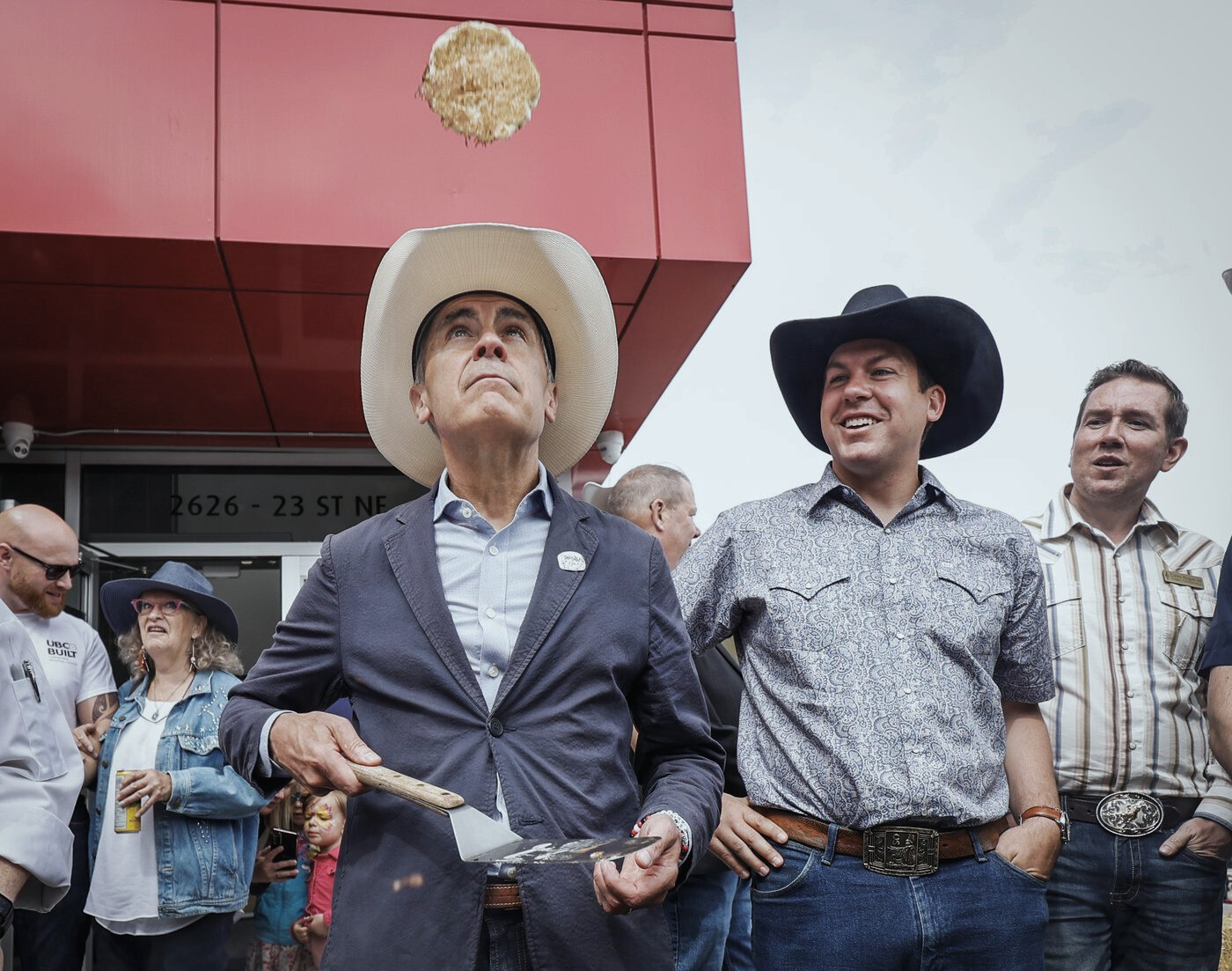
Mark Carney promised to lead Canada with bold vision and economic strength. But his latest stall tactics on removing red tape for Canadian oil and gas, his floundering in tariff negotiations despite lofty "elbows up" promises, and his refusal to address shocking interference allegations tied to his public safety minister so far show that he’s all hat and no cattle.
Today, Prime Minister Mark Carney held consultations and conversations with Indigenous groups on Bill C-5, which claims to fast-track “nation-building” energy projects. Yet he announced no major approvals on the horizon, and impressed no urgency or authority upon those in attendance who would seek to claim veto over vital projects.
Canada doesn’t need more endless talk or one bill to pick more losers than winners. We need action to remove anti-resource laws and regulatory roadblocks that choke our energy sector. Projects like pipelines and LNG facilities are critical for jobs, economic growth, and energy security, but they’re stalled by bureaucratic overreach and outdated policies. Hard-working Canadians deserve affordable energy. Our economy needs rescuing from tariff threat and a decade of Liberal sabotage. And Indigenous communities deserve real economic partnerships, not more delays and cowardly half-measures that often only placate anti-resource interests and insiders, not the real needs of the community.
Streamlined approvals with clear economic benefits will unlock prosperity for all Canadians. Carney’s stall tactics only hold back progress. It’s time to cut the red tape and get out of the way so that real Canadian leaders, and our great Canadian workers, can rebuild Canada after all that's been broken.
Carney campaigned as the economic genius who could handle U.S. President Donald Trump’s tariff threats. Yet, with Trump’s August 1 deadline for a 35% tariff on Canadian goods approaching, Carney’s negotiations are going nowhere. His vague promises do nothing to protect Canadian jobs, industries, or families facing higher costs. Canadians deserve a leader who delivers results, not one who breaks campaign promises with empty rhetoric.
Meanwhile, he's been shielding corruption and dodging accountability. Carney, now revealed to have 16 pages of conflicts that were kept from voters during the election, continues to protect Public Safety Minister Gary Anandasangaree, who faces serious allegations of lobbying for those with listed terrorist ties. Instead of demanding transparency, Carney is shielding his minister from scrutiny, doubling down on the Liberal tradition of dodging accountability. Canadians deserve a government that upholds integrity, not one that buries troubling connections to protect political allies. Is Carney just like Justin, who broke immigration and invited rampant foreign interference into government? Because this response is right out of his predecessor's playbook.
Mark Carney’s leadership has been all talk and no action. Canada needs a government that unleashes our energy potential, lives up to its lofty campaign promises, and roots out corruption; not another Justin Trudeau.
We're not falling for it. And neither are you. Demand action. Demand results.
-Peter Coleman, President, National Citizens Coalition
Who We Are
Founded in 1967 with the express goal to stand up for Canadian taxpayers and to champion small-c conservative values, The National Citizens Coalition is made up of a dedicated group of professionals working together to ensure the continued success of Canada's pioneering non-profit taxpayer advocacy group.
Peter Coleman
President and CEO

Peter was Treasurer of the National Citizens Coalition from 1990 to 2003. He joined the NCC full-time in March 2003 as Chief Operating Officer and was promoted to President and CEO in May 2006.
Contact Peter at: petercoleman@nationalcitizens.ca
Tel: (416) 869-3838 ext 101
Alexander Brown
Director of Communications & Campaigns

Alexander Brown is a writer, communications professional, and campaign coordinator for the NCC.
Contact Alexander at: alexbrown@nationalcitizens.ca
Miriam Alford
Vice President Finance and Administration

As the Vice President of Finance and Administration, Miriam manages the Toronto office and has been with the NCC since 1984.
If you have any questions or concerns regarding administrative items (membership, direct mail, online donations) or operations, please direct your queries to Miriam.
Contact Miriam at: miriamalford@nationalcitizens.ca
Digital strategy, contributing writers, and stakeholder relations
The NCC is proud to work with some of Canada's best and brightest political consultants, writers, and freelancers in crafting advocacy efforts that make a difference for common-sense, conservative Canadians.
Contact Us
National Citizens Coalition
55 Queen Street East, Suite 202
Toronto, Ontario
M5C 1R6
Tel: (416) 869-3838
Coalition nationale des citoyens | ||||||
 | ||||||
| Abbreviation | NCC | |||||
|---|---|---|---|---|---|---|
| Formation | 1967
| |||||
| Founder | Colin M. Brown | |||||
| Type | Lobby group | |||||
| Headquarters | Toronto | |||||
| Location |
| |||||
President and CEO | Peter Coleman | |||||
| Website | www | |||||
The National Citizens Coalition (NCC) is a Canadian conservative lobby group that was incorporated in 1975 by Colin M. Brown, a successful insurance agent who strongly opposed public health insurance—Medicare. In response to what he perceived to be excessive government spending in Canada, Brown had begun an advertisement campaign in 1967.[1] Its slogan is "More freedom through less government", and campaigns against public sector unions and in favour of smaller government and lower taxes.[2]: 197–206
From 1998 to 2002, the president of the group was Stephen Harper, who served as the 22nd prime minister of Canada from 2006 to 2015.
Mandate
The NCC has supported privatization, tax cuts and government spending cuts; it also opposes electoral laws that limit third-party spending.[citation needed] It has been heavily involved in advertising, political campaigns and legal challenges in support of its goals of "more freedom through less government."[3] The Tyee on March 23, 2011, described the NCC as an "Alberta-based think tank that crusades for smaller government and less taxes".[4]
Overview
 | This section needs additional citations for verification. (March 2014) |
In the 1970s, the three federal political parties—the Liberals under Prime Minister Pierre Trudeau, the Conservatives under Robert Stanfield and the NDP under David Lewis—gave no voice to corporate Canada or the business elite in policy making in the Canadian parliament.[2] Stanfield was supportive of state intervention, as a Red Tory. Lewis thought that big business received too many tax breaks and subsidies as "corporate welfare bums."[2] In the 1970s, labour was increasing its power, public safety nets were being introduced, and participatory government was growing. To reverse this trend, from 1974 to 1976, CEOs took major initiatives.[2]: 164 The Business Council on National Issues (BCNI), the Fraser Institute—a conservative[5]: 244 and libertarian[6]: 216, F13 public policy think tank established in 1974, and the National Citizens' Coalition—incorporated in 1975—were formed to change the political culture to support the business elite. The two latter organizations focussed on changing public opinion.[2]: 165
Incorporated in Ontario in 1975, the NCC was founded by insurance agent Colin M. Brown, who had begun an advertising campaign in 1967 against what he perceived as excessive government spending.[7]
In 1987, David Somerville became the NCC's leader.
In 1993, the NCC successfully supported Stephen Harper's bid to become a Reform Party Member of Parliament for Calgary West.
In the 1990s, the NCC founded and funded Ontarians for Responsible Government, a lobby group that played a large role in electing the Progressive Conservative Harris government in Ontario of 1995–2003.
It has also legally challenged electoral financing laws limiting third-party advertising spending during election campaigns, but unsuccessfully, in Harper v. Canada (Attorney General).
In 1997, Harper resigned as Member of Parliament and joined the NCC and became the NCC's vice-president. From 1998 to 2002, Stephen Harper served as NCC president with Gerry Nicholls as vice-president. In 2002, Harper resigned as NCC's president to seek the leadership of the Canadian Alliance. Harper served as 22nd Prime Minister of Canada from 2006 to 2015.
At a June 1997 meeting of the American political organization, the Council for National Policy (CNP), held in Montreal, Quebec, Harper said that the American "conservative movement" was a light and an inspiration to [Canada] and across the world."[8][9] Harper compared Canada with the United States in the 1990s, saying that the "standard of living" was "substantially lower" in Canada while the unemployment rate was almost double that of the United States and that there was a "massive brain drain of young professionals".[9] The Council for National Policy is a "little-known group that has served for decades as a hub for a nationwide network of conservative activists and the donors who support them".[10] It was established during the Reagan administration in 1981 by right-wing conservative Christians.[10][11][12] Its members are a "few hundred of the most powerful conservatives in the country," who meet "behind closed doors at undisclosed locations for a confidential conference, according to the New York Times.[13] In his speech. Harper summarized his perspective on the federal parties in 1997 with a focus on the Reform party, its leader Preston Manning, its strengths, weaknesses and future as a Christian conservative movement.[8]
In 2003 Peter Coleman became NCC's full-time as Chief Operating Officer and in 2006 NCC's President and CEO.
The NCC holds no annual general membership meetings and provides no financial statements to its members. The organization's constitution distinguishes between 'voting' and 'public' members. Public members pay dues but do not have formal mechanisms for influencing the organization's policies or priorities. Public members are not entitled to be notified of or to attend any meetings, and they are not entitled to vote at any such meetings.
It is headquartered in Toronto and reports an annual budget of $2.8 million. The organization has fought to keep information about itself confidential, and opposed amendments to the Canada Elections Act that would have required third-party organizations like the NCC to publish the names of all contributors donating more than $250.
Campaigns against Medicare
Brown was vehemently opposed to public health insurance,[9] although the NCC is now reluctant to take such a stand on this issue, as it would be unpopular with the electorate. The NCC would go on in subsequent years to campaign against "socialized medicine" and other government programs.[9]
Anti-labour campaigns
The NCC campaigned against the general strike organized by the Canadian Labour Congress against wage and price controls imposed by the Liberal government of Pierre Trudeau in 1975.
Anti-union activity
In 1995 the NCC launched the "Canadians against forced unions" with spokesman Rob Anders saying, "The time has come to free Alberta's workers."[2]: 203 The project was dedicated to the introduction of anti-union "right-to-work" legislation.[2]: 203
The NCC provided CA$1 million in financial support in a series of cases filed by Francis Lavigne,[2]: 165 a former Ontario community college teacher who alleged that Ontario Public Service Employees Union fees were being used to support causes he opposed, which he claimed infringed his rights under the freedom of expression section of the Canadian Charter of Rights and Freedoms. In a leading Supreme Court of Canada 1991 decision Lavigne v Ontario Public Service Employees Union, Lavigne lost.[14]: 67–102 [15]
Anti-immigration
During the refugee crisis, the Vietnamese boat people in 1979 and 1980, the NCC staged a campaign against admitting the refugees of the Viet Nam war into Canada. They placed newspaper advertisements "questioning whether the government has been forthcoming about the number of Vietnamese refugees they will allow into Canada." David Somerville appeared on the CBC Sunday Morning show to present the NCC's case.[16]
Campaigns
The NCC has campaigned against:
- the Canada Health Act,
- the Canadian Wheat Board,
- the general strike organized by the Canadian Labour Congress against wage and price controls imposed by the Liberal government of Pierre Trudeau in 1975
- the admittance of Vietnamese boat people (post-Vietnam War refugees) to Canada in 1979–1980
- closed-shop unions
- the so-called "gold-plated" pension plan for Members of Parliament
- real or perceived government waste in general
- the mandatory long-form census
- Quebec's Charter of the French Language (Bill 101)[17]
References
- Thompson, Elizabeth. "MPs call on Stephen Harper to clarify stand on Bill 101".
External links
Canada through Stephen Harper’s Eyes
What might he do with a majority? Well, he once called his country a “welfare state in the worst sense.” Here’s that speech.
Today, on the eve of another federal election, the NCC’s web site
says: “Is Canada today perfect? Far from it. Have we conservatives been
able to accomplish everything we want? Not by a long shot. But we now
have the people, the tools and the political will to help bring
Canadians the government they deserve at a price they can afford.“
Next
week Stephen Harper will begin his fourth try at winning a majority
government for the Conservative Party he welded together from its
predecessors, the Reform Party and the Progressive Conservatives.We
thought it might be a good time to run in its entirety the speech Harper
gave to a June 1997 Montreal meeting of the right-wing U.S. Council for
National Policy, in which he spoke frankly about the aspirations and
criticisms he holds for Canada.]
Ladies and gentlemen, let me begin by giving you a big welcome to Canada. Let’s start up with a compliment. You’re here from the second greatest nation on earth. But seriously, your country, and particularly your conservative movement, is a light and an inspiration to people in this country and across the world.
Council for National Policy
US nonprofit conservative organization From Wikipedia, the free encyclopedia
- Joe Aguillard
- Gary Aldrich
- John K. Andrews Jr.
- Larry P. Arnn
- Cleta Mitchell
- Lowell C. Smith
- 2020 presidential election and the "Pence Card" scheme
- Ginni Thomas' efforts to overturn the 2020 presidential election
- Nelson, Anne (2019). Shadow Network: Media, Money, and the Secret Hub of the Radical Right. New York: Bloomsbury Publishing. ISBN 978-1-63557-319-0. OCLC 1126560275.
- Katie Thornton (November 22, 2022). "The Divided Dial: Episode 2 - From Pulpit to Politics - On the Media". WNYC Studios (Podcast). Retrieved November 26, 2022.
- O'Harrow, Robert Jr. (October 14, 2020). "Videos show closed-door sessions of leading conservative activists: 'Be not afraid of the accusations that you're a voter suppressor'". The Washington Post. Archived from the original on October 30, 2020. Retrieved July 23, 2025.
- Kirkpatrick, David D. (February 24, 2007). "Christian Right Labors to Find '08 Candidate". The New York Times. Archived from the original on December 11, 2008. Retrieved July 23, 2025.
- Nelson, Anne (2019). "Shadow Network". Bloomsbury Publishing. Retrieved 2019-11-09.
- Wilson, Jason (30 September 2021). "Top Republicans rub shoulders with extremists in secretive rightwing group, leak reveals". The Guardian.
- Kirkpatrick, David K. (August 28, 2004). "Club of the Most Powerful Gathers in Strictest Privacy". The New York Times. Archived from the original on July 25, 2012. Retrieved July 23, 2025.
- Blumenthal, Max (September 1, 2008). "Secretive Right-Wing Group Vetted Palin". Campaign '08. TheNation.com. Archived from the original on September 5, 2008. Retrieved July 23, 2025.
- "A History of Accomplishment". The Conservative Caucus. Retrieved 5 January 2019.
- Ambinder, Marc J. (May 2, 2002). "Vast, Right-Wing Cabal?". ABC News. Archived from the original on June 9, 2002. Retrieved July 23, 2025.
- Kirkpatrick, David D. (August 28, 2004). "The 2004 Campaign: The Conservatives; Club of the Most Powerful Gathers in Strictest Privacy". The New York Times.
- "The War for Thee University, page 191". Texas Monthly. November 1991. Retrieved February 16, 2011.
- "About Steve Baldwin". Archived from the original on 2016-03-06.
- Nelson, Anne (February 22, 2021). "How the CNP, a Republican Powerhouse, Helped Spawn Trumpism, Disrupted the Transfer of Power, and Stoked the Assault on the Capitol". The Washington Spectator. Archived from the original on June 10, 2022. Retrieved 30 July 2022.
- Gibbs, Nancy; Duffy, Michael (October 4, 2007). "Still Looking for Mr. Right". Time. Archived from the original on October 10, 2007.
- Adam Clymer, "Conservatives Gather in Umbrella Council for a National Policy", The New York Times, May 20, 1981
- Beirich, Heidi; Potok, Mark (May 17, 2016). "The Council for National Policy: Behind the Curtain". Southern Poverty Law Center. Archived from the original on June 18, 2016. Retrieved July 23, 2025.
- Leonard, Kimberly; Relman, Eliza; Beckler, Hannah (September 24, 2021). "One of the most secretive and powerful groups in GOP politics just had its cellphone numbers leaked. Here's what its members said about Trump 2024 when we started calling". Business Insider. Archived from the original on September 30, 2021. Retrieved July 23, 2025.
- Martin, Jonathan (September 30, 2007). "Social conservatives may back 3rd party over Rudy". POLITICO.com. Archived from the original on October 12, 2007. Retrieved July 23, 2025.
- Scherer, Michael (September 30, 2007). "Religious right may blackball Giuliani". Salon. Archived from the original on October 6, 2007. Retrieved July 23, 2025.
- "Committee for the Free World". RightWeb. Political Research Associates. 1989. Archived from the original on January 13, 2009. Retrieved July 23, 2025.
- "Board of Trustees". Archived from the original on March 16, 2010.
- "Midge Decter". National Endowment for the Humanities.
- Decter, Midge (2001). An old wife's tale : my seven decades in love and war. New York: Regan Books. ISBN 978-0-06-039428-8. OCLC 46421841.
- Judith Miller, Arms control chief asserts Reagan is uncertain how to use power, The New York Times, January 23, 1982
- "National Citizens Coalition (NCC) – Harper's presidency was a critical period]". The Harper Index. May 11, 2007. Archived from the original on March 3, 2016.
- Gonzalez, Nathan C. (September 28, 2007). "VP Cheney makes quick trip to Utah to address secretive conservative policy group". Salt Lake Tribune. Archived from the original on October 15, 2007. Retrieved July 23, 2025.
- Gibbs, Nancy (2007-10-05). "Still Looking For Mr. Right". Time. Archived from the original on February 3, 2008.
- Donald Trump (August 2020), Speech by Donald Trump, Arlington
- "Home - Americans United". www.au.org.
- "Council for National Policy". www.nndb.com.
- "Behind closed doors: who is the council for national policy and what are they up to? And why don't they want you to know? - Free Online Library". www.thefreelibrary.com.
- "Council for National Policy (CNP) - I - J - K - Member Biographies". www.seekgod.ca.
- "Council for National Policy Executives & Members". www.seekgod.ca. Archived from the original on 2007-06-20. Retrieved 2007-10-08.
- "Tony Perkins, President". Family Research Council. 2003-08-21. Retrieved 2020-01-19.
- Official website
- "Council for National Policy". Internal Revenue Service filings. ProPublica Nonprofit Explorer.
The Council for National Policy (CNP) is an umbrella organization and networking group that advocates for conservative and Republican Party initiatives in the United States. It was launched in 1981 during the Reagan administration by Tim LaHaye and the Christian right, to "bring more focus and force to conservative advocacy".[1][2][3] The membership list for September 2020 was later leaked, showing that members included prominent Republicans and conservatives. Members are instructed not to reveal their membership or even name the group.[4]
The CNP has been described by The New York Times as "a little-known club of a few hundred of the most powerful conservatives in the country", who meet three times yearly behind closed doors at undisclosed locations for a confidential conference.[5] Max Blumenthal has called it a secretive organization that "networks wealthy right-wing donors together with top conservative operatives to plan long-term movement strategy".[6]
Meetings and membership
About the CNP, Marc Ambinder of ABC News said: "The group wants to be the conservative version of the Council on Foreign Relations." The CNP was founded in 1981. Among its founding members were: Tim LaHaye, then the head of the Moral Majority, Nelson Bunker Hunt, T. Cullen Davis, William Cies, Howard Phillips,[7] and Paul Weyrich.[8]
Members of the CNP have included General John Singlaub, shipping magnate J. Peter Grace, Edwin Feulner of The Heritage Foundation, Rev. Pat Robertson of the Christian Broadcasting Network, Jerry Falwell, U.S. Senator Trent Lott, Southern Baptist Convention activists and retired Texas Court of Appeals Judge Paul Pressler, lawyer and paleoconservative activist Michael Peroutka,[9] Reverend Paige Patterson,[10] Senator Don Nickles, former United States Attorneys General Edwin Meese and John Ashcroft, gun-rights activist Larry Pratt, Colonel Oliver North, Steve Bannon, Kellyanne Conway, philanthropist Elsa Prince (mother of Blackwater founder and former CEO Erik Prince and Trump Administration Secretary of Education Betsy Devos), Leonard Leo, Virginia Thomas (wife of Supreme Court Justice Clarence Thomas).[1] Former California State Assemblyman Steve Baldwin was CNP's executive director from 2000 to 2008.[11] Conservative attorney Cleta Mitchell sits on the board of governors for the organization.[12]
Membership is by invitation only. The organization's membership list is considered "strictly confidential". Guests may attend "only with the unanimous approval of the executive committee." Members are instructed not to refer to the organization by name to protect against leaks.[5] The New York Times political writer David D. Kirkpatrick suggested that the organization's secrecy since its founding was intended to insulate it "from what its members considered the liberal bias of the news media."[2] CNP's meetings are closed to the general public to allow for a free-flowing exchange of ideas. The group meets three times per year.[13] This policy is said to be similar to the long-held policy of the Council on Foreign Relations, to which the CNP has at times been compared. CNP's 501(c)(3) tax-exempt status was revoked by the IRS in 1992 on grounds that it was not an organization run for the public benefit. The group successfully challenged this ruling in federal court.[citation needed]
While those involved in the organization are almost entirely from the United States, their organizations and influence cover the globe, both religiously and politically. Members include corporate executives,[14] legislators,[14] former high ranking government officers,[14] leaders of 'think tanks'[14] dedicated to molding society and those whom many view as "Christian leadership".[14]
In May 2016, the Southern Poverty Law Center released a leaked copy of the membership directory for 2014.[15]
A membership list for September 2020, leaked a year later, included Jerome Corsi, Michael Farris, Brigitte Gabriel, Frank Gaffney, Charlie Kirk, Tony Perkins, and Mathew Staver.[4][16]
Conferences and political plans
Leading members of the CNP voted in a meeting at the Grand America Hotel in Salt Lake City, on September 29, 2007, to consider launching a third party candidate if the 2008 Republican nominee were pro-choice. (The candidacy of former New York City Mayor Rudy Giuliani, who held liberal opinions on social issues such as abortion, gay rights and gun ownership, had disturbed the Christian right.) The CNP's statement read, "If the Republican Party nominates a pro-abortion candidate, we will consider running a third-party candidate." Attending the meeting were notable social conservatives, including James Dobson, Richard Viguerie, Tony Perkins and Morton Blackwell.[17][18]
CNP has membership links to the Committee for the Free World, whose many other members included, among others, some members of the Unification Church of the United States, some Republican Party leaders, and counter-revolutionaries in Latin America, particularly during the 1980s.[19] Midge Decter served as Executive Director of its committee.[20][21][22] Other members included Jeane Kirkpatrick, Leszek Kołakowski, Irving Kristol, Melvin J. Lasky, Seymour M. Lipset, Donald Rumsfeld, Tom Stoppard and George Will. Eugene V. Rostow, then serving as Director of the Arms Control and Disarmament Agency under President Ronald Reagan, was a speaker at a CFW event on Poland.[23]
In his June 1997 speech at a CNP meeting in Montreal, Quebec, then president of the National Citizens' Coalition, Stephen Harper—who later served as the prime minister of Canada from 2006 to 2015—said that the American "conservative movement, is a light and an inspiration to people [of Canada] and across the world."[24]
In 1999, a speech given to the CNP by Republican candidate George W. Bush is credited with helping him gain the support of conservatives in his successful bid for the United States Presidency in 2000. The content of the speech has never been released by the CNP or by Bush.[8]
In February 2007, the organization planned to be involved in the 2008 presidential election campaign and actively sought candidate that would represent their views. U.S. Vice President Dick Cheney[25] and former Massachusetts governor Mitt Romney[26] spoke at a four-day conference that the council held in Salt Lake City, Utah, during the last week of September 2007. The Council for National Policy scheduled a conference in late October 2007; other than Giuliani, most Republican presidential candidates pledged to appear.[17]
On August 21, 2020, President Trump attended a CNP meeting where he gave a speech.[27]
In an October 14, 2020, Washington Post article, which described the CNP as a "little-known group that has served for decades as a hub for a nationwide network of conservative activists and the donors who support them", one of the attendees of the August 2020 meeting in Arlington, warned of plans by Democrats to "steal this election". He said that, "if they get away with that, what happens? Democracy is finished because they usher in totalitarianism."[1]
Leadership
CNP was founded in 1981 by Southern Baptist pastor Tim LaHaye, author of The Battle for the Mind (1980) and the Left Behind series of books. Other early participants have included W. Cleon Skousen, a theologian within the Church of Jesus Christ of Latter-day Saints and founder of the Freemen Institute; Paul Weyrich; Phyllis Schlafly; Robert Grant; Howard Phillips, a former Republican affiliated with the Constitution Party; Richard Viguerie, the direct-mail specialist; and Morton Blackwell, a Louisiana and Virginia activist who is considered a specialist on the rules of the Republican Party.[28][29][30]
The council's first executive director was Woody Jenkins; later, Morton Blackwell and Bob Reccord served in this role. Organization presidents have included Nelson Bunker Hunt of Dallas, Amway co-founder Richard DeVos of Michigan, Pat Robertson of Virginia Beach, retired Judge Paul Pressler of Houston, former Reagan Cabinet secretaries Edwin Meese and Donald Hodel, former Reagan advisor and President of the Intercollegiate Studies Institute Kenneth Cribb, Family Research Council president Tony Perkins, and current President (as of 2014) Stuart Epperson, founder of the Salem Media Group.[30][31][32][33]


No comments:
Post a Comment