From: Minister of Finance / Ministre des Finances <minister-ministre@fin.gc.ca>
Date: Tue, Apr 14, 2026 at 9:27 PM
Subject: Automatic reply: : Foreign direct investment, chart 1 from StatCan
To: David Amos <david.raymond.amos333@gmail.com>
Please be assured that we appreciate receiving your comments.
Le ministère des Finances Canada accuse réception de votre courriel.
Nous vous assurons que vos commentaires sont les bienvenus.
From: Infostats / infostats (STATCAN) <infostats@statcan.gc.ca>
Date: Tue, Apr 14, 2026 at 9:26 PM
Subject: Automatic reply: : Foreign direct investment, chart 1 from StatCan
To: David Amos <david.raymond.amos333@gmail.com>
infostats@statcan.gc.ca
www.statcan.gc.ca
Statistics Canada | Statistique Canada
Government of Canada | Gouvernement du Canada
From: Ministerial Correspondence Unit - Justice Canada <mcu@justice.gc.ca>
Date: Tue, Apr 14, 2026 at 9:25 PM
Subject: Automatic Reply
To: David Amos <david.raymond.amos333@gmail.com>
Thank you for writing to the Minister of Justice and Attorney General of Canada.
Due to the volume of correspondence addressed to the Minister, please note that there may be a delay in processing your email. Rest assured that your message will be carefully reviewed.
We do not respond to correspondence that contains offensive language.
-------------------
Merci d'avoir écrit au ministre de la Justice et procureur général du Canada.
En raison du volume de correspondance adressée au ministre, veuillez
prendre note qu'il pourrait y avoir un retard dans le traitement de
votre courriel. Nous tenons à vous assurer que votre message sera lu
avec soin.
Nous ne répondons pas à la correspondance contenant un langage offensant.
From: David Amos <david.raymond.amos333@gmail.com>
Date: Tue, Apr 14, 2026 at 9:19 PM
Subject: Fwd: : Foreign direct investment, chart 1 from StatCan
To: <mark.carney@parl.gc.ca>, <francois-philippe.champagne@parl.gc.ca>, <PABMINMAILG@cra-arc.gc.ca>, <lfcote@spiegelryan.com>, <fin.minfinance-financemin.fin@canada.ca>, <Sean.Fraser@parl.gc.ca>, <justmin@gov.ns.ca>, <pm@pm.gc.ca>, <infostats@statcan.gc.ca>, <Michael.Chong@parl.gc.ca>, <Bob.Zimmer@parl.gc.ca>, <John.Barlow@parl.gc.ca>, <pierre.poilievre@parl.gc.ca>, <Michael.Cooper@parl.gc.ca>, <Chris.dEntremont@parl.gc.ca>, <James.Bezan@parl.gc.ca>, <John.Williamson@parl.gc.ca>, <Ginette.PetitpasTaylor@parl.gc.ca>, <Anita.Anand@parl.gc.ca>, <andrew.scheer@parl.gc.ca>, <Greta.Bossenmaier@hq.nato.int>, <MOC@hq.nato.int>, <mcu@justice.gc.ca>, <richard.williams@gnb.ca>, <rob.moore@parl.gc.ca>
From: Minister of Finance / Ministre des Finances <minister-ministre@fin.gc.ca>
Date: Tue, Apr 14, 2026 at 1:42 PM
Subject: Automatic reply: Statistics Canada - Case # 1202981 - GDP by Industry Pie Chart
To: David Amos <david.raymond.amos333@gmail.
Please be assured that we appreciate receiving your comments.
Le ministère des Finances Canada accuse réception de votre courriel.
Nous vous assurons que vos commentaires sont les bienvenus.
From: Justice Minister <JUSTMIN@novascotia.ca>
Date: Tue, Apr 14, 2026 at 1:45 PM
Subject: Automatic reply: Statistics Canada - Case # 1202981 - GDP by Industry Pie Chart
To: David Amos <david.raymond.amos333@gmail.
From: David Amos <david.raymond.amos333@gmail.
Date: Tue, Mar 31, 2026 at 11:09 AM
Subject: Re: Anyone recall why Erin O'Toole fired his most popular critic Pierre Poilievre two very long years ago?
To: <heath.krevesky@tritonlogging.
Cc: <james.mockler@gnb.ca>, <cheryl.scholten@gnb.ca>, <Kevin.leahy@rcmp-grc.gc.ca>, barbara.massey <barbara.massey@rcmp-grc.gc.ca
https://davidraymondamos3.blogspot.com/2023/03/high- profile-lawyer-gets-1-month. html
>
> ---------- Forwarded message ----------
> From: David Amos <david.raymond.amos333@gmail.com>
> Date: Thu, 11 Mar 2021 16:48:08 -0400
> Subject: Fwd: Attn LGen Wayne Eyre I just called and tried to explain
> this email and Federal Court File No T-1557-15 in particular
> To: James.Bezan@parl.gc.ca, randall.garrison@parl.gc.ca,
> "Leona.Alleslev" <Leona.Alleslev@parl.gc.ca>, John.Barlow@parl.gc.ca,
> Luc.Berthold@parl.gc.ca, "bob.atwin" <bob.atwin@nb.aibn.com>,
> "Bob.Zimmer" <Bob.Zimmer@parl.gc.ca>, "bob.rae" <bob.rae@canada.ca>,
> Bob.Benzen@parl.gc.ca, Steven.Blaney@parl.gc.ca,
> John.Brassard@parl.gc.ca, Michael.Chong@parl.gc.ca,
> Michael.Cooper@parl.gc.ca, James.Cumming@parl.gc.ca,
> Gerard.Deltell@parl.gc.ca, Eric.Duncan@parl.gc.ca,
> Chris.dEntremont@parl.gc.ca, Dave.Epp@parl.gc.ca,
> Rosemarie.Falk@parl.gc.ca, Ed.Fast@parl.gc.ca,
> Kerry-Lynne.Findlay@parl.gc.ca, Cheryl.Gallant@parl.gc.ca
> Cc: motomaniac333 <motomaniac333@gmail.com>, "pierre.poilievre"
> <pierre.poilievre@parl.gc.ca>, Candice.Bergen@parl.gc.ca
>
> https://www.youtube.com/watch?v=kLiVYvRCavs
>
> Here's why Erin O'Toole fired Pierre Poilievre
> 119,253 views
> Feb 11, 2021
> Rebel News
> 1.45M subscribers
> Why would Erin O'Toole, the leader of the Conservative Party of
> Canada, fire his most popular MP, Pierre Poilievre?
> READ MORE ► https://rebelne.ws/2LEk3G2
>
>
> ---------- Original message ----------
> From: Art.McDonald@forces.gc.ca
> Date: Thu, 11 Mar 2021 17:08:24 +0000
> Subject: Automatic reply: YO JONATHAN.VANCE You have been ducKing e
> since 2015 when I was running iN the election of the 42nd Parliament
> and suing the Queen in Federal Court Methinks it is YOU who should
> finally call me back N'esy Pas?
> To: david.raymond.amos333@gmail.com
>
> The Acting Chief of the Defence Staff is LGen Wayne Eyre, he may be
> reached at wayne.eyre@forces.gc.ca.
>
> Le Chef d'état-major de la Défense par intérim est le LGen Wayne Eyre.
> Il peut être rejoint au wayne.eyre@forces.gc.ca.
>
> Art McD
> He/Him // Il/Lui
> Admiral/amiral Art McDonald
>
> Chief of the Defence Staff (CDS)
> Canadian Armed Forces
> art.mcdonald@forces.gc.ca<mailto:art.mcdonald@forces.gc. ca> / Tel:
> 613-992-5054
>
> Chef d’état-major de la Defense (CÉMD)
> Forces armées canadiennes
> art.mcdonald@forces.gc.ca<mailto:art.mcdonald@forces.gc. ca> / Tél:
> 613-992-5054
>
>
From: David Amos <david.raymond.amos333@gmail.
Date: Tue, Apr 14, 2026 at 7:51 PM
Subject: Re: : Foreign direct investment, chart 1 from StatCan
To: Erik Andersen <twolabradors@shaw.ca>
Cc: Mark Carney <mark.carney@parl.gc.ca>, Francois-Phillipe Champagne <francois-philippe.champagne@
From: "Min.Mail / Courrier.Min (CRA/ARC)" <PABMINMAILG@cra-arc.gc.ca>
Date: Wed, 24 May 2017 13:10:52 +0000
Subject: Your various correspondence about abusive tax schemes - 2017-02631
To: "motomaniac333@gmail.com" <motomaniac333@gmail.com>
Mr. David Raymond Amos
motomaniac333@gmail.com
Dear Mr. Amos:
Thank you for your various correspondence about abusive tax schemes,
and for your understanding regarding the delay of this response.
This is an opportunity for me to address your concerns about the way
the Canada Revenue Agency (CRA) deals with aggressive tax planning,
tax avoidance, and tax evasion by targeting individuals and groups
that promote schemes intended to avoid payment of tax. It is also an
opportunity for me to present the Government of Canada’s main
strategies for ensuring fairness for all taxpayers.
The CRA’s mission is to preserve the integrity of Canada’s tax system,
and it is taking concrete and effective action to deal with abusive
tax schemes. Through federal budget funding in 2016 and 2017, the
government has committed close to $1 billion in cracking down on tax
evasion and combatting tax avoidance at home and through the use of
offshore transactions. This additional funding is expected to generate
federal revenues of $2.6 billion over five years for Budget 2016, and
$2.5 billion over five years for Budget 2017.
More precisely, the CRA is cracking down on tax cheats by hiring more
auditors, maintaining its underground economy specialist teams,
increasing coverage of aggressive goods and service tax/harmonized
sales tax planning, increasing coverage of multinational corporations
and wealthy individuals, and taking targeted actions aimed at
promoters of abusive tax schemes.
On the offshore front, the CRA continues to develop tools to improve
its focus on high‑risk taxpayers. It is also considering changes to
its Voluntary Disclosures Program following the first set of program
recommendations received from an independent Offshore Compliance
Advisory Committee. In addition, the CRA is leading international
projects to address the base erosion and profit shifting initiative of
the G20 and the Organisation for Economic Co-operation and
Development, and is collaborating with treaty partners to address the
Panama Papers leaks.
These actions are evidence of the government’s commitment to
protecting tax fairness. The CRA has strengthened its intelligence and
technical capacities for the early detection of abusive tax
arrangements and deterrence of those who participate in them. To
ensure compliance, it has increased the number of actions aimed at
promoters who use illegal schemes. These measures include increased
audits of such promoters, improved information gathering, criminal
investigations where warranted, and better communication with
taxpayers.
To deter potential taxpayer involvement in these schemes, the CRA is
increasing notifications and warnings through its communications
products. It also seeks partnerships with tax preparers, accountants,
and community groups so that they can become informed observers who
can educate their clients.
The CRA will assess penalties against promoters and other
representatives who make false statements involving illegal tax
schemes. The promotion of tax schemes to defraud the government can
lead to criminal investigations, fingerprinting, criminal prosecution,
court fines, and jail time.
Between April 1, 2011, and March 31, 2016, the CRA’s criminal
investigations resulted in the conviction of 42 Canadian taxpayers for
tax evasion with links to money and assets held offshore. In total,
the $34 million in evaded taxes resulted in court fines of $12 million
and 734 months of jail time.
When deciding to pursue compliance actions through the courts, the CRA
consults the Department of Justice Canada to choose an appropriate
solution. Complex tax-related litigation is costly and time consuming,
and the outcome may be unsuccessful. All options to recover amounts
owed are considered.
More specifically, in relation to the KPMG Isle of Man tax avoidance
scheme, publicly available court records show that it is through the
CRA’s efforts that the scheme was discovered. The CRA identified many
of the participants and continues to actively pursue the matter. The
CRA has also identified at least 10 additional tax structures on the
Isle of Man, and is auditing taxpayers in relation to these
structures.
To ensure tax fairness, the CRA commissioned an independent review in
March 2016 to determine if it had acted appropriately concerning KPMG
and its clients. In her review, Ms. Kimberley Brooks, Associate
Professor and former Dean of the Schulich School of Law at Dalhousie
University, examined the CRA’s operational processes and decisions in
relation to the KPMG offshore tax structure and its efforts to obtain
the names of all taxpayers participating in the scheme. Following this
review, the report, released on May 5, 2016, concluded that the CRA
had acted appropriately in its management of the KPMG Isle of Man
file. The report found that the series of compliance measures the CRA
took were in accordance with its policies and procedures. It was
concluded that the procedural actions taken on the KPMG file were
appropriate given the facts of this particular case and were
consistent with the treatment of taxpayers in similar situations. The
report concluded that actions by CRA employees were in accordance with
the CRA’s Code of Integrity and Professional Conduct. There was no
evidence of inappropriate interaction between KPMG and the CRA
employees involved in the case.
Under the CRA’s Code of Integrity and Professional Conduct, all CRA
employees are responsible for real, apparent, or potential conflicts
of interests between their current duties and any subsequent
employment outside of the CRA or the Public Service of Canada.
Consequences and corrective measures play an important role in
protecting the CRA’s integrity.
The CRA takes misconduct very seriously. The consequences of
misconduct depend on the gravity of the incident and its repercussions
on trust both within and outside of the CRA. Misconduct can result in
disciplinary measures up to dismissal.
All forms of tax evasion are illegal. The CRA manages the Informant
Leads Program, which handles leads received from the public regarding
cases of tax evasion across the country. This program, which
coordinates all the leads the CRA receives from informants, determines
whether there has been any non-compliance with tax law and ensures
that the information is examined and conveyed, if applicable, so that
compliance measures are taken. This program does not offer any reward
for tips received.
The new Offshore Tax Informant Program (OTIP) has also been put in
place. The OTIP offers financial compensation to individuals who
provide information related to major cases of offshore tax evasion
that lead to the collection of tax owing. As of December 31, 2016, the
OTIP had received 963 calls and 407 written submissions from possible
informants. Over 218 taxpayers are currently under audit based on
information the CRA received through the OTIP.
With a focus on the highest-risk sectors nationally and
internationally and an increased ability to gather information, the
CRA has the means to target taxpayers who try to hide their income.
For example, since January 2015, the CRA has been collecting
information on all international electronic funds transfers (EFTs) of
$10,000 or more ending or originating in Canada. It is also adopting a
proactive approach by focusing each year on four jurisdictions that
raise suspicion. For the Isle of Man, the CRA audited 3,000 EFTs
totalling $860 million over 12 months and involving approximately 800
taxpayers. Based on these audits, the CRA communicated with
approximately 350 individuals and 400 corporations and performed 60
audits.
In January 2017, I reaffirmed Canada’s important role as a leader for
tax authorities around the world in detecting the structures used for
aggressive tax planning and tax evasion. This is why Canada works
daily with the Joint International Tax Shelter Information Centre
(JITSIC), a network of tax administrations in over 35 countries. The
CRA participates in two expert groups within the JITSIC and leads the
working group on intermediaries and proponents. This ongoing
collaboration is a key component of the CRA’s work to develop strong
relationships with the international community, which will help it
refine the world-class tax system that benefits all Canadians.
The CRA is increasing its efforts and is seeing early signs of
success. Last year, the CRA recovered just under $13 billion as a
result of its audit activities on the domestic and offshore fronts.
Two-thirds of these recoveries are the result of its audit efforts
relating to large businesses and multinational companies.
But there is still much to do, and additional improvements and
investments are underway.
Tax cheats are having a harder and harder time hiding. Taxpayers who
choose to promote or participate in malicious and illegal tax
strategies must face the consequences of their actions. Canadians
expect nothing less. I invite you to read my most recent statement on
this matter at canada.ca/en/revenue-agency/
statement_from_
Thank you for taking the time to write. I hope the information I have
provided is helpful.
Sincerely,
The Honourable Diane Lebouthillier
Minister of National Revenue
From: David Amos <david.raymond.amos333@gmail.
Date: Tue, Apr 14, 2026 at 1:40 PM
Subject: Fwd: Statistics Canada - Case # 1202981 - GDP by Industry Pie Chart
To: <lfcote@spiegelryan.com>, <fin.minfinance-financemin.
Cc: <twolabradors@shaw.ca>, <infostats@statcan.gc.ca>

Conservative MPs ‘being held back like children at a daycare’ amid floor crossings, Mulcair says
 CTV News
 CTV News’ Political Commentator Tom Mulcair says Poilievre is a ‘control freak’ with his party during ‘unprecedented’ wave of floor crossings.
696 Comments

A group of Conservative parliamentarians recently formed what they call a "civil liberties" working group to advocate for the unvaccinated.
While promoting the group's work during an appearance on CTV, Conservative MP Marilyn Gladu suggested that polio — a disease largely eradicated in Canada through vaccinations — posed more of a threat than COVID-19.
"In terms of the risk, people that got polio, many of them died and many of them were crippled, and that is not the same frequency of risk that we see with COVID-19," she said in an interview on the network's Question Period program.
"I'm just receiving the information from medical experts that talk about the relative risk. I'm not a doctor myself."
Between 1949 and 1954, 11,000 people in Canada incurred some degree of paralysis and 500 people died due to polio. More than 29,000 Canadians have died so far of COVID-19 since the onset of this health crisis in early 2020.
Gladu also said "multiple sources of data" must be reviewed to determine if vaccine mandates actually work to curb the spread of the virus. She said asking people to disclose their vaccination status is a slippery slope that could lead to "discrimination" against people with other health conditions.
"People are being forced to disclose and the question is, what is next?" she said.
In an interview with CBC's Power & Politics, Gladu said vaccine mandates "infringe on people's rights" and that politicians "need to hear from all sides," including those who choose to go unvaccinated.
WATCH: Conservative MPs forming 'mini-caucus' to talk about vaccine-related issues

Conservative MPs forming ‘mini-caucus’ to talk about vaccine-related issues
Asked about Gladu's comparison of COVID-19 to polio, O'Toole said Conservatives "take a professional approach to discussions on the safety of vaccines."
"That was not the case yesterday with Ms. Gladu. There is a big difference between the work you do as an MP for your constituents and questions involving reasonable accommodations and the matter of efficacy of vaccines. Vaccines are safe and effective," O'Toole said. "There is a big difference between the work done by MPs for constituents and creating confusion."
Gladu's comments not 'helpful,' says O'Toole
With more than five million eligible Canadians still choosing to avoid vaccination, O'Toole said, politicians should be focused on helping the hesitant find answers to legitimate questions.
"Ms. Gladu's interview yesterday added more questions and I don't think that's helpful," he said.
Gladu isn't the first Conservative MP to speak out about vaccine
policy. Newly elected MP Leslyn Lewis, who placed a close third in the
2020 Conservative leadership race, has emerged as a vocal critic of
plans to roll out COVID-19 shots to kids, saying Canadian children are
being "used as shields for adults."
Most health experts say vaccine coverage in this younger cohort will help Canada finally achieve some form of herd immunity against the virus.
Tory MP Dean Allison, who represents the Ontario riding of Niagara West, has invited speakers challenging the widespread use of COVID-19 vaccines onto a show he broadcasts online. Those guests — some of them doctors — have suggested vaccines aren't necessary for those previously infected by the virus, a position that is not widely held by public health experts.
"It's a great example of why members of Parliament, of all stripes, should let the professionals, the public health officials, the physicians, answer questions about efficacy of vaccines or provincial programs on vaccines," O'Toole said when asked about the actions of these MPs.
O'Toole dodged questions about whether these MPs should be booted from caucus for questioning the advice f public health officials, saying caucus membership isn't a decision for the leader alone.
Prime Minister Justin Trudeau pounced on the Conservatives' disunity on vaccines ahead of a Liberal caucus meeting today. He said Conservative squabbling over vaccines threatens the country's pandemic recovery.

On Mon, Apr 13, 2026 at 12:03 PM Erik Andersen <twolabradors@shaw.ca> wrote:How nice to hear from you Graham.I have been giving thought to the Stats. Can chart "Canada's foreign direct investment position. Paul Hellyer must have been aware of this when he wrote "Funny Money".Thanks for the series highlighted below. Best wishes ErikFrom: "Graham Juneau, StatCan" <graham.juneau@statcan.gc.ca>
To: "Erik Andersen" <twolabradors@shaw.ca>
Cc: "Infostats / infostats (STATCAN)" <infostats@statcan.gc.ca>
Sent: Monday, April 13, 2026 7:43:06 AM
Subject: RE: Statistics Canada - Case # 1202981 - GDP by Industry Pie ChartHi Erik,
I looked back through our correspondence, and it seems like what I sent you was a download of the national GDP by Industry data from table 36-10-0710-01 (see the attached email) which you could use to calculate the percentage share of each industry.
For the standard tables on our website, table 36-10-0400-01 has data on the percentage share of GDP by industry for the provinces:
Gross domestic product (GDP) at basic prices, by industry, provinces and territories, percentage share – Table: 36-10-0400-01
Since I am now in a different position, I have cc’d my colleagues at Infostats (infostats@statcan.gc.ca) – they will be able to assist you with any follow-up questions you have on the GDP by industry data.
Best regards,
Graham Juneau
Agent de communications - Québec
Division de la mobilisation et des services de données
Statistique Canada / (514) 397-2787
statcan.censusoutreach.quebec-
rayonnementdurec.quebec. statcan@statcan.gc.ca
From: Erik Andersen <twolabradors@shaw.ca>
Sent: April 11, 2026 12:17 AM
To: Juneau, Graham (StatCan) <graham.juneau@statcan.gc.ca>
Subject: Re: Statistics Canada - Case # 1202981 - GDP by Industry Pie Chart
Hi Graham. I am rummaging around to find it. If you remember , you gave me the conversion of the GDP data into % share of total, by year and industry designation. Thanks for the provincial data link. Best regards Erik
On 2025-12-11 11:09 a.m., Juneau, Graham (StatCan) wrote:
Hello Erik,
I am unable to load or save the image in your friend’s email below. Would you be able to provide me with a copy of the image, or a link to where your friend found it?
Unfortunately, after having gone through the data visualisation products associated with the GDP data, we don’t have any pie charts showing the percentage distribution of the GDP by industry. It wouldn’t be too hard for you to create one using the data in table 36-10-0710-01, you would just need to use the Concordance - Gross Domestic Product by Industry to group industries by sector.
We do have a data visualisation for GDP by Industry at the provincial level showing change over time, which you might find interesting: Gross domestic product (GDP) by industry, provinces and territories: Interactive tool
Let me know if you can provide a copy of the image or any more information on where it is from. If you have any questions, please feel free to contact me.
Season’s greetings,
Graham Juneau
Analyste-conseil | Consulting Analyst
Service de renseignements statistiques | Statistical Information Service
Statistique Canada | Statistics Canada
Complexe Guy-Favreau Tour Est | Guy-Favreau Complex East Tower / Floor | Étage 4
Téléphone | Telephone (438) 337-5341
Gouvernement du Canada | Government of Canada
From: Erik Andersen <twolabradors@shaw.ca>
Sent: December 11, 2025 1:29 PM
To: Juneau, Graham (StatCan) <graham.juneau@statcan.gc.ca>
Subject: Fwd: whatdouthink
Hello Graham. A friend shared this pie chart from 2002. I think the relative size of each category is of interest to the few who have been following my discussions about the GDP. I suspect you understand my interest in the GDP numbers, but for the record, I think a broad understanding of these statistics, by the public, would result in better economic navigation, in the public interest, not now provided by current politicians. Statistics Canada is doing a great job of giving the population great economic navigation tools to use, if they only had a little help getting up the learning curve..
Is there now a current version of this pie chart ? I imagine you now recognize that I am beginning to use "DEPENDENT" in place of "SERVICES" and "INDEPENDENT" in place of "GOODS".
Best Christmas wishes. Erik
From: "D
To: "Erik Andersen" <twolabradors@shaw.ca>
Sent: Wednesday, December 10, 2025 10:20:22 PM
Subject: Re: whatdouthink
FORM 18-K
For Foreign Governments and Political Subdivisions Thereof
SECURITIES AND EXCHANGE COMMISSION
Washington, D.C. 20549
ANNUAL REPORT
of
CANADA
(Name of Registrant)
Date of end of last fiscal year: March 31, 2002
SECURITIES REGISTERED*
(As of the close of the fiscal year)
Time of Issue
Amounts as to
which registration
Is effective
Name of
exchange on
which registered
N/A
N/A
N/A
Name and address of person authorized to receive notices
and communications from the Securities and Exchange Commission:
HIS EXCELLENCY MICHAEL KERGIN
Canadian Ambassador to the United States of America
Canadian Embassy
501 Pennsylvania Avenue, N.W.
Washington, D.C. 20001
Copies to:
BILL MITCHELL
Director
Financial Markets Division
Department of Finance, Canada
20th Floor, East Tower
L’Esplanade Laurier
140 O’Connor Street
Ottawa, Ontario K1A 0G5
DAVID MURCHISON
Consul
Consulate General of Canada
1251 Avenue of the Americas
New York, N.Y. 10020
ROBERT W. MULLEN, JR.
Milbank, Tweed, Hadley & McCloy LLP
1 Chase Manhattan Plaza
New York, N.Y. 10005
DISTRIBUTION OF REAL GROSS DOMESTIC PRODUCT AT BASIC PRICES(1)
Percentage Distribution in 2001(2)
On Wed, Dec 10, 2025 at 6:40 PM Erik Andersen <twolabradors@shaw.ca> wrote:
FYI
From: "Erik Andersen" <twolabradors@shaw.ca>
To:
Sent: Tuesday, December 9, 2025 7:33:08 PM
Subject: Re: whatdouthink
Maybe it is time to understand what people will be faced with. The BoC deliberately took their interest rate to near zero as a way of solving the lending banks problem in 2008. It is important to realize that banks are fractional reserve businesses so if the open market bid prices on assets go down, because of fraud , the banks then become unqualified to be part of the international banking system, bankruptcy. In 2008 the Canadian gov, set up an account at the CMHC where banks could exchange their under par value loans for full value cash . The low bank rate was held low for 6-7 years. That turned private investors into speculators and asset prices to balloon. When that happens asset affordability collapses, real estate.
In economics the determination of the prices of all assets is determined by the net earning of any asset, ships, airplanes, trucks , office towers and real estate.. When there are inadequate or no earnings, the asset becomes a "stranded" asset/investment.
So it is easy to now see that real estate is more and more likely to become a stranded asset as they become un-affordable .for a growing proportion of the population. A desperate need for more income by governments compounds the problem and is behind property tax loan deferment and other programs like reverse mortgaging..
I have no idea what is in store for Canadians but I can't imagine it will be pleasant.
Hope this helps. Regards Erik
From: "
To: "Erik Andersen" <twolabradors@shaw.ca>
Sent: Tuesday, December 9, 2025 6:36:41 PM
Subject: whatdouthink
Before I send this to others and scare them, do you think this man's assessment of Canada is sufficiently accurate to share?
Sent with Proton Mail secure email.
---------- Forwarded message ---------
From: Erik Andersen <twolabradors@shaw.ca>
Date: Sat, Apr 11, 2026 at 5:48 PM
Subject: Re: [Shared Post] All Wars Are Bankers’ Wars: Iran and the Bankers' Endgame
To: David Amos <david.raymond.amos333@gmail.com> Paul would have been lucky to have your common sense. Regards, ErikFrom: "David Amos" <david.raymond.amos333@gmail.com>
To: "Erik Andersen" <twolabradors@shaw.ca>
Sent: Saturday, April 11, 2026 11:32:19 AM
Subject: Re: [Shared Post] All Wars Are Bankers’ Wars: Iran and the Bankers' EndgameI tried to run under Paul Hellyer's banner in 2004 but the CAP HAD BEEN TAKEN OVER BY CROOKED CONNNIE FOGALOn Fri, Apr 10, 2026 at 10:59 PM Erik Andersen <twolabradors@shaw.ca> wrote:FYIFrom: "Chansonette" <chansonette@protonmail.com>
T
Sent: Friday, April 10, 2026 10:26:54 AM
Subject: [Shared Post] All Wars Are Bankers’ Wars: Iran and the Bankers' EndgameA great companion read to this article is the book titled "Funny Money" by Paul Hellyer.When I look at 25 years of GDP data, provided by Stats. Can. and subdivided into 20+ component parts, the record while transiting the two large disruptive events in the period ( the financial fraud known as "mortgage backed securities" and C-19) the Canadian financial industry transited with no changes to their % share of total GDP. That is something that can only be done if legislative laws of protective fencing, providing the legal shelter ErikAll Wars Are Bankers’ Wars: Iran and the Bankers’ Endgame
r April 10, 2026


In one of the scariest moments in modern history, we're doing our best at ScheerPost to pierce the fog of lies that conceal it but we need some help to pay our writers and staff. Please consider a tax-deductible donation.
Ellen Brown ScheerPost
“The powers of financial capitalism had another far reaching aim, nothing less than to create a world system of financial control in private hands able to dominate the political system of each country and the economy of the world as a whole.” —Prof. Caroll Quigley, GeorgetownUniversity, Tragedy and Hope (1966) In February 2026, the United States and Israel launched surprise airstrikes on Iran. The officially proffered reasons — preventing Iran’s acquisition of a nuclear weapon and forestalling its aggression — have not held up under scrutiny. As James Corbett documented in recent Corbett Report episodes, the nuclear pretext appears to be recycled propaganda, and the scale and timing of the strikes raise deeper questions about motive.
The thesis that “All Wars Are Bankers’ Wars” was popularized by Michael Rivero in a 2013 documentary by that name. His accompanying article begins with a quote from Aristotle (384-322 BCE):
The most hated sort [of moneymaking], and with the greatest reason, is usury, which makes a gain out of money itself, and not from the natural use of it. For money was intended to be used in exchange, but not to increase at interest.
Rivero then traces how private banking interests have financed and profited from conflicts on both sides for centuries — from the founding of the Bank of England in 1694 to fund William III’s wars to modern regime-change wars.
Full-Spectrum Financial Dominance
Other commentators point to the report of the Project for the New American Century (PNAC) titled “Rebuilding America’s Defenses” (September 2000), which called for “full-spectrum” U.S. military forces to achieve global preeminence. It postulated the need for a “catastrophic and catalyzing event — like a new Pearl Harbor” to accelerate the military transformation the authors envisioned.
This was followed by a 2007 Democracy Now interview in which Gen. Wesley Clark revealed that weeks after 9/11, he had been shown a classified Pentagon memo outlining plans to “take out seven countries in five years”: Iraq, Syria, Lebanon, Libya, Somalia, Sudan, and finishing off with Iran. The first six have since been destabilized or regime-changed. Iran, considered the ultimate prize for Middle East dominance and oil control, remains the last one standing.
Why those seven, and why was Iran the ultimate prize? Greg Palast’s 2013 article titled “Larry Summers and the Secret ‘End-Game’ Memo” supplied the missing financial logic. In 1999, the world was opened to unregulated derivatives trading, so that sovereign bonds, oil flows, shipping routes, and war-risk policies could all be collateralized, rehypothecated (pledged multiple times over), and gambled upon. The lynchpin was the 1997 WTO Financial Services Agreement (the Fifth Protocol to GATS), which became operational in 1999.
None of the seven targeted countries joined the WTO, and they were also not members of the Bank for International Settlements (BIS). That left them outside the long regulatory arm of the central bankers’ central bank in Switzerland. Other countries that were later identified as “rogue states” were also not members of the BIS, including North Korea, Cuba, and Afghanistan.
As for Iran, it is not only the largest and strongest of the Islamic countries but operates the world’s only fully interest-free (riba-free) banking regime. This stands in direct contrast to the conventional Western model, which relies on interest as its primary revenue mechanism. “Money making money out of itself” underpins the global derivatives complex, which is built on rehypothecated, collateralized debt-at-interest.
The last piece in the financial control grid was detailed in David Rogers Webb’s 2024 book The Great Taking. The Everything Bubble, including what some commentators estimate to be more than a quadrillion dollars in derivative bets, is just waiting for a pin. When it bursts, it will trigger large institutional bankruptcies; and under the legal machinery Webb documents, the derivative players will take all.
The 2026 Hormuz insurance crisis triggered by Lloyd’s of London could be that pin. More on all that below.
The City of London and Lloyd’s Weaponize Chaos
For more than three centuries, the City of London – the “Square Mile” that is London’s financial center — has financed both sides of wars and sold insurance against the destruction that would follow. Lloyd’s of London is the insurance pillar of the City’s financial control grid. It is not actually an insurance company but is a corporate body that “operates as a partially-mutualized marketplace within which multiple financial backers, grouped in syndicates, come together to pool and spread risk.”
Lloyd’s has built its reputation on always performing, but it performs at a cost. In 1898, it formalized long-standing practice by introducing the “Free of Capture and Seizure” clause, stripping war risks from standard policies so it could charge extortionate premiums when conflict erupted. It exercised that clause in both world wars and is exercising it in 2026.
After the strikes on Iran, Lloyd’s Joint War Committee expanded its “high-risk” zone in the Middle East. Several of its underwriters issued 72-hour cancellation notices effective March 5, and war-risk premiums for Hormuz transits jumped from 0.25% to 1–5% of hull value. Lloyd’s has stressed that coverage remains available — at the right price. But for a $100 million oil tanker, that means an extra $1–5 million per voyage, a premium the owners are understandably reluctant to pay.
The Private Credit Spark
Meanwhile, other dark clouds are hovering over the market. Financial analyst Stephanie Pomboy warns that the $1.5-3 trillion private credit market is in lockdown, forcing fire sales of liquid assets; and the much larger $5 trillion BBB-rated corporate bond market is teetering. Downgrades will force mass selling, and pensions face a $4 trillion shortfall.
The Hormuz crisis supplies the perfect accelerant to this collateral crisis: higher oil prices create inflation, which raises bond yields (interest), collapsing the value of collateral and triggering margin calls across the derivatives game board. Margin calls then force private credit funds into fire sales.
This is one reason some commentators point to the City of London as the real architect of the Middle East chaos. The old war-insurance machine and the new derivatives machine operate together. One creates the chaos premium; the other harvests it through rehypothecation and legal seizure.
Palast and the End Game Memo: Making the World Safe for Derivatives
Guaranteeing against shipping loss is one type of insurance, but a much bigger insurance trap is the derivatives market. Sold as a form of insurance against market risk, derivatives are a speculative betting game that extracts rents from all major economic flows.
In his 2013 article, Greg Palast presented evidence of a secret 1997 memo to Deputy Treasury Secretary Larry Summers from Timothy Geithner (then U.S. Ambassador to the WTO acting for Summers) describing the “End-Game” of the WTO Financial Services negotiations. Geithner wrote to Summers, “As we enter the end-game… I believe it would be a good idea for you to touch base with the CEOs ….” The memo then listed the private phone numbers of Goldman Sachs, Merrill Lynch, Bank of America, Citibank, and Chase Manhattan, numbers which Palast confirmed were real.
What was the end-game? Palast wrote:
US Treasury Secretary Robert Rubin was pushing hard to de-regulate banks. That required, first, repeal of the Glass-Steagall Act to dismantle the barrier between commercial banks and investment banks. It was like replacing bank vaults with roulette wheels.
Second, the banks wanted the right to play a new high-risk game: “derivatives trading.” … Deputy Treasury Secretary Summers (soon to replace Rubin as Secretary) body-blocked any attempt to control derivatives.
But what was the use of turning U.S. banks into derivatives casinos if money would flee to nations with safer banking laws?
The answer conceived by the Big Bank Five: eliminate controls on banks in every nation on the planet – in one single move.… The bankers’ and Summers’ game was to use the Financial Services Agreement, an abstruse and benign addendum to the international trade agreements policed by the World Trade Organization.
… The new rules of the game would force every nation to open their markets to Citibank, JP Morgan and their derivatives “products.”
And all 156 nations in the WTO would have to smash down their own Glass-Steagall divisions between commercial savings banks and the investment banks that gamble with derivatives.
The WTO Financial Services Agreement became the battering ram for opening global markets to this derivative play. Every member nation was forced to open its banking system or face sanctions. In 1999, the portion of Glass-Steagall separating investment banking from depository banking in the U.S. was repealed, leaving depositors’ money vulnerable to speculative risk. Derivatives then exploded. Sovereign bonds, oil contracts, shipping insurance policies, and war-risk premiums were all sliced into credit-default swaps, hedges, and other derivative products.
Derivatives trading has since become one of the most concentrated and profitable businesses on the planet, and it is almost entirely controlled by a handful of megabanks. According to data from the Bank for International Settlements and the Office of the Comptroller of the Currency, the top five U.S. banks alone hold roughly 90% of all U.S. bank derivatives, with JPMorgan, Citigroup, Goldman Sachs, Bank of America, and Morgan Stanley dominating the global over-the-counter market. These institutions capture the lion’s share of derivative profits, especially during periods of volatility when the “chaos premium” spikes.
“The Great Taking” — the Legal Trap Granting Derivatives Super-Priority in Bankruptcy
In The Great Taking, David Rogers Webb lays bare the final piece in this financial control grid: virtually every security today is dematerialized (digitized) and pooled in central depositories. Quiet changes to the Uniform Commercial Code and equivalent E.U. rules have turned ordinary investors into mere “entitlement holders” holding only a legal claim against their brokerages.
As for bank depositors, they have for centuries been categorized as mere “creditors” of their banks. Once the money is deposited, legal title passes to the bank. The depositor holds only a contractual claim (a demand liability) that ranks as an unsecured creditor position in the event of insolvency.
In any insolvency, stocks, bonds, and deposits are legally collateral for the derivatives complex — collateral that has been rehypothecated multiple times over. And when the derivative collateral fails, the rehypothecated house of cards that has been built on it collapses. Margin calls cascade, super-priority is triggered, and the Great Taking begins. (For more on this quite complicated subject, see Webb’s book and my earlier article here.)
Iran’s Interest-Free Islamic Banking: The Structural Obstacle
So what did it matter if Iran and a handful of other countries declined to join in this lucrative bankers’ game? The risk was that when depositors and shareholders realized that they did not actually own their funds, they would move their assets to those safe zones. The holdout countries were also safe from the sort of sanctions imposed by Western governments (and enforced by Western banks and clearing houses) on Russian central bank assets after Russia’s invasion of Ukraine in 2022.
Leading this band of holdouts was Iran, which since its 1983 Law for Usury-Free Banking Operations has run the world’s only fully interest-free (riba-free) banking regime. Its banks use Sharia-compliant contracts — profit-sharing (musharakah), cost-plus financing (murabaha), and leasing (ijara) — instead of charging or paying interest. This banking model stands in direct contrast to the conventional Western model, which relies on interest as its primary revenue stream and underpins the global derivatives complex with collateralized, rehypothecated debt.
Iran’s system was designed to eliminate usury and align finance with real economic activity and risk-sharing rather than speculative debt. It has long been viewed as structurally incompatible with the interest-based, collateral-heavy architecture of City of London and Wall Street finance — an architecture that requires perpetual debt servicing and easily rehypothecated assets to feed the derivatives machine.
By rejecting interest at the national level, Iran has thus insulated itself and its financial partners from the control grid that has made the global “Great Taking” possible.
The Insurance Chaos Has Softened but the “Black Swan” Still Hovers
The Strait of Hormuz is not fully closed, but traffic remains severely reduced under Iran’s selective, permission-based transit regime. Only vessels from “friendly” or non-hostile nations are being cleared after prior coordination with Iranian authorities. Significant backlogs persist, with more than 1,000 vessels reported waiting or diverted and over 34,000 shipping routes rerouted in the first four weeks of disruption.
President Trump’s $20 billion reinsurance facility announced on March 6 is now operational and has been doubled to $40 billion. Additional major U.S. insurers have joined, while Lloyd’s of London has engaged in related discussions. The facility remains centered on American carriers with U.S. government backing. But analysts doubt it will restart widespread commercial traffic without broader liability protection and safer conditions.
In short, the “insurance chaos” trigger has eased but has not vanished. Premiums remain elevated, uncertainty lingers, and the collateral and derivatives pressures Webb described are still in play.
Conclusions and Resolutions
The 2007-08 Global Financial Crisis (GFC) is now widely regarded as having been triggered by the unchecked explosion of unregulated derivatives — especially credit default swaps and collateralized debt obligations — which turned subprime mortgages into a systemic time bomb. The damage was not confined to the United States: developing countries suffered heavily as well.
Today the risk of a crash is even greater than during the GFC. The global OTC derivatives market has officially ballooned to a notional value of $846 trillion, more than seven times the size of the entire world economy.
Long-range political solutions are possible. Congress could restore Glass-Steagall and impose a financial transaction tax. State governments could withdraw their approval of relevant portions of the UCC and form public banks that can protect against local bank bankruptcies. (See my earlier articles here and here.)
But the immediate need in the current context is to settle the conflict with Iran, and settle it fast, before another black-swan shock ignites the derivatives daisy chain and activates the final Great Taking on a global scale.
Ellen Brown is an American author, attorney, and activist known for her work on financial reform and public banking. She is the founder of the Public Banking Institute and the author of books like Web of Debt and The Public Bank Solution, advocating for publicly owned banking systems.
38 CommentsMost VotedDavid Raymond Amosright nowAwaiting for approvalThis lady and I should talk
https://www.blbglaw.com/cases-
investigations/mfs-mutual- fund-litigation
MFS Mutual Fund Fraud Litigation
Court: United States District Court for the District of Maryland Case Number: 04-md-15863 Class Period: 12/15/1998 – 12/08/2003 Following a hearing on May 3, 2004 in the massive mutual fund litigation, the United States District Court for the District of Maryland appointed BLB&G client the City of Chicago Deferred Compensation Plan as Lead Plaintiff in the securities fraud class action against Massachusetts Financial Services Company (“MFS”), the investment advisor to the MFS Funds, and others.
On March 1, 2006, the Court sustained the Consolidated Amended Class Action Complaint, allowing the case to move forward against certain defendants.Sunday, 6 July 2025
Where did all the hearings go???
--------- Forwarded message ---------
From: Minister of Finance / Ministre des Finances <minister-ministre@fin.gc.ca>
Date: Tue, Dec 16, 2025 at 6:44 PM
Subject: Automatic reply: YO Christopher Perry here is some of what you did not wish to know
To: David Amos <david.raymond.amos333@gmail.com>
The Department of Finance Canada acknowledges receipt of your electronic correspondence.
Please be assured that we appreciate receiving your comments.
Le ministère des Finances Canada accuse réception de votre courriel.
Nous vous assurons que vos commentaires sont les bienvenus.
---------- Original message ---------
From: David Amos <david.raymond.amos333@gmail.com>
Date: Tue, Dec 16, 2025 at 6:43 PM
Subject: YO Christopher Perry here is some of what you did not wish to know
To: <cdp7@ntrs.com>, Ted McEnroe <Ted.McEnroe@tbf.org>
Cc: fin.minfinance-financemin.fin <fin.minfinance-financemin.fin@canada.ca> Christopher PerryNorthern Trust
One International Place
Suite 1600
Boston MA 02110
617-235-1835Sunday, 6 July 2025
Where did all the hearings go???
MFS Investment Mangement
Since 1924, MFS Investment Management 1 has guided investors in the United States through every market condition on record. Today, our exclusive lineup of Sun Life MFS funds brings Canadian investors the power of their deep-rooted expertise and three driving pillars of investment success.
Media Relations Contacts
For press inquires, please contact:
Dan Flaherty (Americas), 617-954-4256, DFlaherty@mfs.com
Cherida Naughton (Europe and Asia), 44-207-429-7426, CNaughton@mfs.com
Kasia Gilewska (Europe), 44-207-429-7356, KGilewska@mfs.comFinancial Information
MFS is a majority-owned subsidiary of Sun Life Financial (SLF), based in Toronto.
Further information can be found under Investor Relations at www.sunlife.com.Investment Strategists, Portfolio Managers and Analysts
Robert Almeida, Global Investment Strategist
Erik Weisman, Chief Economist
Benoit Anne, Investment Solutions Group
Others generally available to comment on investment topics and retirement trends.


Michael W. Roberge, CFA, is chair of MFS Investment Management® (MFS®). He helps set the strategic direction of the firm. He is the chair of the Chairman's Committee, chair of the MFS Board of Directors, and a trustee on the MFS mutual funds board. Michael became chair in 2025 after leading the firm as CEO from 2017 to 2024. In addition, he held the role of chief investment officer from 2010 through 2018. He also previously held the roles of president of MFS from 2010 through 2017 and co-CEO from 2015 through 2016. In 2006, he was appointed chief investment officer -- US Investments and co-director of Global Research. Before that, he was senior vice president and associate director of Fixed Income Research and served as portfolio manager for several MFS fixed income funds. He joined the firm in 1996 as a credit analyst in the municipal fixed income group. Before joining MFS, he was a municipal credit analyst and portfolio manager for the Colonial Group from 1995 to 1996 and a credit analyst with Moody's Investors Service from 1991 to 1994. Michael earned a Bachelor of Science degree from Bemidji State (Minn.) University in 1990 and a Master of Business Administration degree from Hofstra University in 1992. He is a Chartered Financial Analyst and a member of the CFA Society Boston. He is also the vice chair of the board of Horizons for Homeless Children, a Boston-based nonprofit organization dedicated to combatting the negative impact of homelessness on children and families.  Heidi W. Hardin is executive vice president and general counsel at MFS Investment Management® (MFS®). She leads the Legal, Compliance and Enterprise Risk Management departments and is a member of the firm's Enterprise Leadership Team and the Chairman's Committee. Heidi joined MFS in 2017 from Harris Associates, where she had been the general counsel since 2015. She spent the prior 16 years at Janus Capital Group Inc., holding multiple senior legal roles, with her last role being senior vice president and general counsel of Janus Capital Management LLC, the firm's global asset management business. Earlier in her career she was a vice president, senior legal counsel and chief compliance officer for Liberty Funds Group and a litigation associate at Beeler Schad & Diamond P.C. She began her career in the financial services industry in 1993. Heidi earned a Bachelor of Arts degree from DePauw University and a Juris Doctor degree from Chicago- Kent College of Law. She is a member of the board of directors of ICI Mutual Insurance Company and the Advisory Board of The Boston Ballet.Email Leadership@mfs.comAddress BOSTONPhone 1-800-637-8255602 322 8045Angela FaderSr Assist Analyst at MFS Investment ManagementGreater Phoenix Areahttps://www.blbglaw.com/
cases-investigations/mfs- mutual-fund-litigation MFS Mutual Fund Fraud Litigation
Court: United States District Court for the District of Maryland Case Number: 04-md-15863 Class Period: 12/15/1998 - 12/08/2003 Following a hearing on May 3, 2004 in the massive mutual fund litigation, the United States District Court for the District of Maryland appointed BLB&G client the City of Chicago Deferred Compensation Plan as Lead Plaintiff in the securities fraud class action against Massachusetts Financial Services Company ("MFS"), the investment advisor to the MFS Funds, and others.
On March 1, 2006, the Court sustained the Consolidated Amended Class Action Complaint, allowing the case to move forward against certain defendants.
SUMMARY OF ALLEGATIONS:
The Complaint in this litigation alleges that MFS and certain of its senior executives were aware of, engaged in and facilitated "timing" trades in the MFS Funds: a money-making act involving short-term trading in and out of a mutual fund. The technique is designed to exploit inefficiencies in the way mutual fund companies price their shares by allowing certain customers to trade shares at distorted prices that no longer reflect the true value of the fund. As a result, those few customers permitted to engage in market timing typically reap huge profits, the cost of which are borne primarily by the long-term investors in the relevant fund.
The public filings issued by the Defendants stated that, "MFS funds do not permit market-timing or other excessive trading practices that may disrupt portfolio management strategies and may harm fund performance." In reality, however, the Defendants knew, or recklessly disregarded, the fact that trades were being timed and that these timed trades negatively and materially impacted the MFS Funds, thereby causing significant losses to investors in the MFS Funds.
On February 5, 2004, MFS agreed to entry of a cease and desist order by the Securities and Exchange Commission ("SEC") against MFS and John W. Ballen ("Ballen"), MFS's current chief executive officer, and Kevin R. Parke ("Parke"), MFS's current president and chief investment officer ("Cease and Desist Order"). Specifically, the SEC found that MFS, Ballen and Parke allowed widespread market timing trading in certain MFS Funds from at least late 1999 through October 2003, in contravention of the Funds' public disclosures. In particular, MFS explicitly informed certain select brokers in a written memo that "unrestricted" trading would be permitted in certain MFS funds (known internally at MFS as "Unrestricted Funds"), including the Massachusetts Investors Growth Stock Fund, "even if a pattern of excessive trading has been detected." Not only did MFS selectively enforce its market-timing policies, but executives at MFS facilitated the frequent trading in and out of certain MFS Funds by steering select investors to these "Unrestricted Funds." As the Cease and Desist Order confirms, as much as $2 billion in timing money flowed into MFS Funds during the Class Period.
Internal MFS documents and policies acknowledged that market timing was detrimental to long-term shareholders. In fact, as early as June 2000, an internal presentation entitled "Market Timing Wheel of Terror," warned that "[l]ong term investors are being penalized" by market timing activity. Nevertheless, the market timing activity persisted in the MFS "Unrestricted Funds." Moreover, MFS's select enforcement of its trading policies also included late trading, which alone caused well over $100 million in investor losses. And, as further alleged in the complaint, various brokers and financial institutions also participated in the market timing schemes, to the detriment of ordinary investors.
MFS's policy of allowing market-timing and steering select investors to the "Unrestricted Funds" was adopted as a means to increase profits by luring market timing assets so as to increase funds under management, and, therefore, increase fees paid to MFS for investment advisory services. These additional assets under management also resulted in an increased bonus pool from which MFS employees, including Ballen and Parke, were paid excessive compensation. During this period, none of the above detailed material information was disclosed to the members of the Class. In addition to the profits from their market timing, MFS also profited by charging ordinary investors hundreds of millions of dollars in management fees while breaching their fiduciary duties to those very same investors.
On May 20, 2010, the Court preliminarily approved proposed settlements, totaling $75,042,250, that would resolve this litigation. On October 25, 2010, the Court entered Judgments granting final approval to the settlements and entered separate Orders granting Plaintiffs' Counsel's application for an award of attorneys' fees and expenses and approving the Plan of Allocation of the settlement proceeds.
The claims administration process has concluded and the net settlement fund has been fully disbursed. This matter is considered closed.
IN THE UNITED STATES DISTRICT COURT
FOR THE DISTRICT OF MARYLAND
IN RE MUTUAL FUNDS INVESTMENT
LITIGATION
This Document Relates To:
In re MFS
04-md-15863-04
MDL 1586
Case No. 04-MD-15863
(Judge J. Frederick Motz)
BRUCE RIGGS, et al., Individually and
On Behalf of All Others Similarly Situated,
Plaintiff,
v.
MASSACHUSETTS FINANCIAL
SERVICES COMPANY, et al.
Defendants.
Case No. 04-cv-01162-JFM
CONSOLIDATED AMENDED CLASS ACTION COMPLAINT95
Dated: September 29, 2004 BERNSTEIN LITOWITZ BERGER
& GROSSMANN LLP
/s/
ALAN SCHULMAN
ROBERT S. GANS
TIMOTHY A. DeLANGE
JERALD D. BIEN-WILLNER
12544 High Bluff Drive, Suite 150
San Diego, CA 92130
Tel: (858) 793-0070
Fax: (858) 793-0323
-and-
J. ERIK SANDSTEDT
JOSEPH A. FONTI
1285 Avenue of the Americas
New York, New York 10019
Tel: (212) 554-1400
Fax: (212) 554-1444
Lead Counsel
Dated: September 29, 2004 TYDINGS & ROSENBERG LLP
/s/
WILLIAM C. SAMMONS, Fed Bar No. 02366
JOHN B. ISBISTER, Fed Bar No. 00639
100 East Pratt Street, 26th Floor
Baltimore, MD 21202
Tel: (410) 752-9700
Fax: (410) 727-5460
Liaison Counsel---------- Original message ---------
From: Minister of Finance / Ministre des Finances <minister-ministre@fin.gc.ca>
Date: Mon, Jul 7, 2025 at 1:56 PM
Subject: Automatic reply: 617 954 4225 RE Robert Pozen Former executive chairman of MFS Investment Management
To: David Amos <david.raymond.amos333@gmail.com>
The Department of Finance acknowledges receipt of your electronic correspondence. Please be assured that we appreciate receiving your comments.Le ministère des Finances Canada accuse réception de votre courriel. Nous vous assurons que vos commentaires sont les bienvenus.---------- Original message ---------
From: Fraser, Sean - M.P. <Sean.Fraser@parl.gc.ca>
Date: Mon, Jul 7, 2025 at 1:57 PM
Subject: Automatic reply: 617 954 4225 RE Robert Pozen Former executive chairman of MFS Investment Management
To: David Amos <david.raymond.amos333@gmail.com> Thank you for your contacting the constituency office of Sean Fraser, Member of Parliament for Central Nova.
This is an automated reply.
Please note that all correspondence is read, however due to the high volume of emails we receive on a daily basis there may be a delay in getting back to you. Priority will be given to residents of Central Nova.
To ensure we get back to you in a timely manner, please include your full name, home address including postal code and phone number when reaching out.
Thank you.
-------------
Merci d'avoir contacté le bureau de circonscription de Sean Fraser, député de Central Nova. Il s'agit d'une réponse automatisée.
Veuillez noter que toute la correspondance est lue, mais qu'en raison du volume élevé de courriels que nous recevons quotidiennement, il se peut que nous ne puissions pas vous répondre dans les meilleurs délais.
Pour que nous puissions vous répondre dans les meilleurs délais, veuillez indiquer votre nom complet, votre adresse personnelle, y compris le code postal, et votre numéro de téléphone lorsque vous nous contactez.
Nous vous remercions.
Facebook : facebook.com/SeanFraserMP
Twitter : @SeanFraserMP
Instagram : SeanFraserMP
Sans frais : 1-844-641-5886
---------- Original message ---------
From: David Amos <david.raymond.amos333@gmail.com>
Date: Mon, Jul 7, 2025 at 1:53 PM
Subject: Fwd: 617 954 4225 RE Robert Pozen Former executive chairman of MFS Investment Management
To: <bobpozen@mit.edu>, fin.minfinance-financemin.fin <fin.minfinance-financemin.fin@canada.ca>, ministryofjustice <ministryofjustice@gov.ab.ca>, justmin <justmin@gov.ns.ca>, Mike.Comeau <Mike.Comeau@gnb.ca>, <CrownAdminOttawa@ontario.ca>, mcu <mcu@justice.gc.ca>, Sean.Fraser <Sean.Fraser@parl.gc.ca>, pm <pm@pm.gc.ca> ---------- Forwarded message ---------
From: David Amos <david.raymond.amos333@gmail.com>
Date: Mon, Jul 7, 2025 at 1:49 PM
Subject: 617 954 4225 RE Robert Pozen Former executive chairman of MFS Investment Management
To: <Leadership@mfs.com>, <kimc714@mit.edu>Review of Current Investigations and Regulatory Actions Regarding the Mutual Fund Industry
Date: Tuesday, November 18, 2003 Time: 10:00 AM
Topic
The Committee will meet in OPEN SESSION to conduct the first in a series of hearings on the “Review of Current Investigations and Regulatory Actions Regarding the Mutual Fund Industry.”Witnesses
Witness Panel 1
- Mr. William H. Donaldson
ChairmanSecurities and Exchange CommissionWitness Panel 2
- Mr. Matthew P. Fink
PresidentInvestment Company Institute- Mr. Marc Lackritz
PresidentSecurities Industry AssociationReview of Current Investigations and Regulatory Actions Regarding the Mutual Fund Industry
Date: Thursday, November 20, 2003 Time: 02:00 PM
Topic
The Committee will meet in OPEN SESSION to conduct the second in a series of hearings on the “Review of Current Investigations and Regulatory Actions Regarding the Mutual Fund Industry.”Witnesses
Witness Panel 1
- Mr. Stephen M. Cutler
Director - Division of EnforcementSecurities and Exchange Commission- Mr. Robert Glauber
Chairman and CEONational Association of Securities Dealers- Eliot Spitzer
Attorney GeneralState of New YorkReview of Current Investigations and Regulatory Actions Regarding the Mutual Fund Industry: Understanding the Fund Industry from the Investor’s Perspective
Date: Wednesday, February 25, 2004 Time: 10:00 AM
Topic
The Committee will meet in OPEN SESSION to conduct a hearing on “A Review of Current Investigations and Regulatory Actions Regarding the Mutual Fund Industry: Understanding the Fund Industry from the Investor’s Perspective.”Witnesses
Witness Panel 1
- Mr. Tim Berry
TreasurerState of Indiana- Honorable Gary Gensler
ChairmanU.S. Commodity Futures Trading Commission- Mr. James K. Glassman
Resident FellowAmerican Enterprise Institute- Mr. Don Phillips
Managing DirectorMorningstar, Inc- Mr. Jim Riepe
Vice Chairman of the Board of DirectorsT. Rowe Price Group, Inc.Review of Current Investigations and Regulatory Actions Regarding the Mutual Fund Industry: Fund Operations and Governance.
Date: Thursday, February 26, 2004 Time: 02:00 PM
Topic
The Committee will meet in OPEN SESSION to conduct a hearing on “Review of Current Investigations and Regulatory Actions Regarding the Mutual Fund Industry: Fund Operations and Governance.” Rescheduled from February 3rd.Witnesses
Witness Panel 1
- Mr. Jack Bogle
FounderThe Vanguard Group- Ms. Mellody Hobson
PresidentAriel Capital Management- Mr. David Pottruck
President, Chief Executive Officer and a member of the Board of DirectorsCharles Schwab- Mr. David Ruder
Former ChairmenU.S. Securities and Exchange CommissionReview of Current Investigations and Regulatory Actions Regarding the Mutual Fund Industry: The Regulatory Landscape
Date: Wednesday, March 10, 2004 Time: 10:00 AM
Topic
The Committee will meet in OPEN SESSION to conduct the sixth in a series of hearings on "A Review of Current Investigations and Regulatory Actions Regarding the Mutual Fund Industry: The Regulatory Landscape."Witnesses
Witness Panel 1
- Ms. Lori Richards
Director, Office of Compliance, Inspections, and ExaminationsSecurities and Exchange Commission- Mr. Paul Roye
Director, Division of Investment ManagementSecurities and Exchange Commission- Ms. Mary Schapiro
Vice Chairman of NASD and President of NASD Regulatory Policy & OversightNational Association of Securities Dealers- Honorable David M. Walker
Comptroller General of the United StatesReview of Current Investigations and Regulatory Actions Regarding the Mutual Fund Industry: Fund Operations and Governance
Date: Tuesday, March 23, 2004 Time: 10:00 AM
Topic
The Committee will meet in OPEN SESSION to conduct the sixth in a series of hearings on "A Review of Current Investigations and Regulatory Actions Regarding the Mutual Fund Industry: Fund Operations and Governance."Witnesses
Witness Panel 1
- Professor Mercer Bullard
Associate Professor of LawUniversity of Mississippi School of Law- Mr. William D Lutz
Professor of EnglishRutgers University- Mr. Robert Pozen
Non-Executive ChairmanMassachusetts Financial Services Co.- Ms. Barbara Roper
Director of Investor ProtectionConsumer Federation of AmericaReview of Current Investigations and Regulatory Actions Regarding the Mutual Fund Industry: Fund Costs and Distribution Practices
Date: Wednesday, March 31, 2004 Time: 02:30 PM
Topic
The Committee will meet in OPEN SESSION to conduct the nineth in a series of hearings reviewing the current investigations and regulatory actions in the mutual fund industry.Witnesses
Witness Panel 1
- Honorable Daniel K. Akaka (D-HI)
United States Senator- Honorable Susan Collins (R-ME)
United States Senator- Honorable Peter Fitzgerald (R-IL)
United States Senator- Honorable Carl Levin (D-MI)
United States SenatorWitness Panel 2
- Mr. Paul G. Haaga, Jr.
Executive Vice President and Director of Capitol Research and Management Company, and Chairman of the Investment Company Institute- Mr. Chet Helck
President and Chief Operating OfficerRaymond James Financial- Mr. Thomas Putnam
Founder and CEOFenimore Asset Management- Mr. Edward Siedle
Founder and PresidentThe Benchmark Companies- Mr. Mark Treanor
General Counsel and Head of Legal DepartmentWachovia CorporationReview of Current Investigations and Regulatory Actions Regarding the Mutual Fund Industry: The SEC's Perspective
Date: Thursday, April 8, 2004 Time: 10:00 AM
Topic
The Committee will meet in OPEN SESSION to conduct the tenth in a series of hearings regarding a "Review of Current Investigations and Regulatory Actions Regarding the Mutual Fund Industry". This hearing will focus on the views of the Securities and Exchange Commission.Witnesses
Witness Panel 1
- Mr. William H. Donaldson
ChairmanSecurities and Exchange Commission
Saved from 6 Jul 2025 17:01:34 UTC All snapshots from host www.govinfo.gov U.S . GOVERNMENT PRINTING OFFICE
WASHINGTON :
For sale by the Superintendent of Documents, U.S. Government Printing Office
Internet: bookstore.gpo.gov Phone: toll free (866) 512–1800; DC area (202) 512–1800
Fax: (202) 512–2250 Mail: Stop SSOP, Washington, DC 20402–0001
97–186 PDF 2004
S. HRG . 108–711
REVIEW OF CURRENT INVESTIGATIONS
AND REGULATORY ACTIONS REGARDING
THE MUTUAL FUND INDUSTRY
HEARINGS
BEFORE THE
COMMITTEE ON
BANKING, HOUSING, AND URBAN AFFAIRS
UNITED STATES SENATE
ONE HUNDRED EIGHTH CONGRESS
FIRST AND SECOND SESSION
ON
INVESTIGATIONS AND REGULATORY ACTIONS REGARDING THE
MUTUAL FUND INDUSTRY AND INVESTORS’ PROTECTION
NOVEMBER 18, 20, 2003, FEBRUARY 25, 26, MARCH 2, 10, 23, 31, AND
APRIL 8, 2004
Printed for the use of the Committee on Banking, Housing, and Urban Affairs(1)
REVIEW OF CURRENT INVESTIGATIONS
AND REGULATORY ACTIONS REGARDING
THE MUTUAL FUND INDUSTRY
TUESDAY, NOVEMBER 18, 2003
U.S. SENATE,
COMMITTEE ON BANKING, HOUSING, AND URBAN AFFAIRS,
Washington, DC.
The Committee met at 10 a.m. in room SD–538 of the Dirksen
Senate Office Building, Senator Richard C. Shelby (Chairman of
the Committee) presiding.
OPENING STATEMENT OF CHAIRMAN RICHARD C. SHELBY
Chairman SHELBY. The hearing shall come to order.
This hearing is part of the Committee’s ongoing oversight of the
mutual fund industry. Today, the Committee will review current
investigations and enforcement proceedings and examine regu-
latory actions taken to date in order to fully inform and guide the
Banking Committee’s consideration of possible legislative reform.
On September 30, 2003, this Committee first examined the scope
of problems confronting the mutual fund industry. At that time,
Chairman Donaldson testified about the SEC’s ongoing enforce-
ment actions and described the SEC’s regulatory blueprint for
adopting new regulations aimed at improving the transparency of
fund operations and stopping abusive trading practices. Since
Chairman Donaldson’s testimony, we have learned that improper
fund trading practices are a widespread problem that fund insiders,
brokers, and privileged clients have profited from at the expense of
average investors.
In early September, New York Attorney General Spitzer uncov-
ered arrangements through which brokers facilitated improper
trades for their clients in certain prominent mutual funds in ex-
change for large, fee generating investments. Since this initial set-
tlement, we have learned the extent to which both intermediaries,
such as brokers, and fund executives have engaged in illicit trading
activities. We have read about the backhanded ways by which the
brokers colluded with their customers to disguise improper trade
orders to make them appear legitimate, thus evading detection by
mutual fund policing systems.
Even in situations where mutual funds attempted to halt im-
proper trading activity, certain brokers created fictitious names
and account numbers to fool fund compliance officers and to con-
tinue trading. Recent investigations have also revealed that mutual
fund executives and portfolio managers have actively engaged in2
improper trading activity. And these allegations are particularly
troubling because fund executives and portfolio managers have
represented themselves as protecting client assets, but they failed
by either knowingly permitting improper trading by brokers or
actively engaging in illegal trading activities themselves.
Such practices may not only violate prospectus disclosures, but
also violate the fiduciary duties that funds owe to their share-
holders—the duties to treat all shareholders equitably and to pro-
tect shareholder interests. Further, regulators have indicated that
they may soon file charges against funds that have selectively
disclosed portfolio information to certain privileged investors and
fund executives that may have engaged in illegal insider trading by
acting on the basis of nonpublic information.
As this Committee made clear during Chairman William H.
Donaldson’s September 30 appearance here, a regulatory response
to improper trading activities is just one of the many actions that
the SEC must take to address the many troubling issues that have
come to light in the mutual fund industry. This Committee remains
concerned with the transparency of fund operations and ensuring
that investors can learn how their fund is being managed. It has
become very, very apparent that many of the questionable fund
practices that are now being examined are not just the result of a
few bad actors, but are longstanding industry practices that have
largely gone unregulated and not well disclosed to, or understood
by, most investors.
Therefore, this Committee must take a comprehensive look, I be-
lieve, at the industry to determine if the industry’s operations and
practices are consistent with investors’ interests and the greater
interests of the market. It may be that we must consider possible
realignment of interests to ensure that mutual funds are operating
as efficiently and fairly as the market and investors demand. We
will examine fund disclosure practices regarding fees, trading costs,
sales commissions, and portfolio holdings. So, we will continue to
question the conflicts of interest surrounding the relationship be-
tween the investment adviser and the fund and how potential
changes to fund governance and disclosure practices may minimize
these conflicts.
We will also focus on fund sales practices to ensure that brokers
sell suitable investments to their clients, provide adequate disclo-
sure of any sales incentives, and give clients any breakpoint dis-
counts to which they are entitled.
Chairman Donaldson has told this Committee that the SEC has
the necessary statutory authority to reform the mutual fund indus-
try and is in the process of conducting a comprehensive rulemak-
ing. As we have learned in other contexts, however, additional reg-
ulation is not the only answer. Late trading is clearly illegal and
market timing is actively deterred and policed. Despite prohibitions
and warnings, these activities continued unabated because of the
inadequate compliance and enforcement regimes at the SEC, the
mutual funds and the brokers. Whether due to a lack of resources
or other pressing priorities, mutual fund abuses simply did not re-
ceive adequate attention from the SEC. Although recent enforce-
ment actions indicate that priorities have changed, we need tounderstand how the SEC will revise compliance programs to detect
and halt future fund abuses.
Vigorous enforcement remains the key to restoring integrity to
the fund industry, and Attorney General Spitzer’s timely actions
once again demonstrate, I believe, the significant role that States
play in prosecuting fraud and abuse in the securities markets. Re-
gardless of the number of rules or amount of resources, it would
be impractical to expect the SEC to detect every single fraud and
manipulation in the fund industry. Therefore, the mutual funds
and the brokerage houses themselves must proactively adopt new
compliance measures to detect fraud and abuse. For many years,
participants in the mutual fund industry maintain industry ‘‘best
practices.’’ These practices, however, have clearly proven to be in-
adequate as brokers and funds have disregarded conflicts of inter-
est and colluded at the expense of investors without detection.
Although funds and brokers owe different types of duties to their
investors, both groups have an obligation to refrain from knowingly
ignoring their clients’ interests and profiting at their expense.
With over 95 million investors and $7 trillion—yes, $7 trillion—
in assets, mutual funds have always been perceived as the safe
investment option for average investors. America has become a Na-
tion of investors, but there is no doubt that recent revelations
about mutual funds have caused very many to question the per-
ceived fairness of the industry. Many are surprised to learn that
the mutual fund industry is plagued by the same conflict that was
at the root of the Enron scandal and the global settlement—one set
of profitable rules for insiders and another costly set for average
investors.
Beyond the legal concepts of fiduciary duties and transparency,
there is a more fundamental principle that should underlie the
operation of the mutual fund industry and our securities markets
in general.
This principle is that securities firms and mutual funds should
not neglect investors’ interests and knowingly profit at their ex-
pense. Until firms can demonstrate an ability to abide by this
ideal, investors will not trust the markets, nor should they. In our
own way, Congress, the SEC and regulators, and industry partici-
pants must collectively work to reform the mutual fund industry in
order to restore investor confidence. I believe, we must reassure in-
vestors that mutual funds are a vehicle in which they can safely
invest their money and not fall victim to financial schemes. The
mutual fund industry is simply too important to too many Ameri-
cans to do otherwise.
Examining the mutual fund industry is a priority for this Com-
mittee, and I look forward to working with my fellow Committee
Members, especially Senators Enzi, Dodd, and Corzine, all of whom
have already expressed significant interest in this issue.
Our first witness today is Chairman Bill Donaldson, and on the
second panel we will hear from Matthew Fink, President of the In-
vestment Company Institute, and Marc Lackritz, President of the
Securities Industry Association.
Now, I will call on my Members.
Senator Sarbanes.Statement of Robert C. Pozen
Chairman
MFS Investment Management
and
Visiting Professor
Harvard Law School
“REVIEW OF CURRENT INVESTIGATIONS AND REGULATORY ACTIONS
REGARDING THE MUTUAL FUND INDUSTRY:
FUND OPERATIONS AND GOVERNANCE”
COMMITTEE ON BANKING, HOUSING AND URBAN AFFAIRS
UNITED STATES SENATE
March 23, 2004Thank you Chairman Shelby, Ranking Member Sarbanes and other members of the
Committee for this opportunity to present my views on appropriate reforms for the mutual fund
industry.
My name is Robert C. Pozen and I am from Boston, Massachusetts. I am currently
Chairman of MFS Investment Management, which manages approximately $140 billion for
approximately 370 accounts including over 100 mutual funds serving approximately six million
investors. I am also a visiting professor at Harvard Law School and author of the textbook The
Mutual Fund Business (2 ed. Houghton Mifflin 2001).
I commend the Committee for engaging in a deliberative and broad-ranging review of the
operations and regulation of the mutual fund industry. While I welcome questions about any
aspect of the fund industry, I will limit my testimony today to three areas where I believe that MFS is helping to set important new standards for the fund industry:1) maximized shareholder valuethrough fund brokerage;2) individualized reporting of shareholder expenses; and3) structural enhancements for fund governance. We are making changes in these three areas to benefit MFS shareholders and, if followed by the rest of the industry, to benefit all fund shareholders.
I. Reducing Reliance on Soft Dollars
The current system of paying for goods and services with “soft dollars”, taken out of
brokerage commissions, is detrimental to mutual fund shareholders. The use of “soft dollar”
payments makes it virtually impossible for a fund manager to ascertain the true costs of executing trades because execution costs are bundled together with the costs of other goods and services such as research reports and Bloomberg terminals. If these costs were unbundled, then fund managers could pay cash out of their own pockets for independent research or market data, and could negotiate for lower execution prices for fund shareholders.
Currently, if a trader from a mutual fund executes fund trades through a full-service
broker on Wall Street, the trader pays five cents a share for execution plus a broad range of
goods or services from the executing broker or third parties: e.g., securities research, market data and brokerage allocations to promote fund sales. These goods and services are paid in “soft dollars”: that is, they are bundled into the five cents per share charge in a non- transparent
1 of 6manner. If MFS does not accept these ancillary goods or services through “soft dollars”, it will still
be required to pay five cents per share by the full-service broker.
In other words, it is almost impossible to obtain a price discount from a full-service
Wall Street firm for executing a large fund trade. However, that firm is willing to provide an in-kind
discount in the form of soft dollars that can be used to purchase various goods or services. This is
more than a technical pricing oddity. The key point is this: a price discount on the trade (for
example, from five cents to three cents per share) would go directly to the mutual fund and its
shareholders. In-kind services like market data services go directly to the fund management
company and only indirectly to the mutual fund and its shareholders.
MFS has already eliminated the use of “soft dollars” to promote sales of mutual fund
shares. Since January 1, 2004, MFS has been paying cash out of its own pocket to broker-
dealers to promote fund sales. While the SEC has proposed a rule to this effect, MFS has
switched from soft dollars to cash to promote fund sales regardless of whether and when the SEC
adopts its rule.
More dramatically, earlier this month MFS decided to stop using soft dollars to pay for
third-party research1 and market data. Again MFS will pay cash out of its own pocket for these
items. MFS estimates that this decision will cost the management company $10 to $15 million per
year. Yet MFS has agreed not to raise its advisory fees for its funds over the next five years.
Why is MFS willing to take the lead on getting off the addiction to soft dollars and moving to the healthy environment of price discounts?The simple answer is: MFS puts the fund shareholder first. We recognize the need to employ a full-service broker to execute a large block trade (e.g., 500,000 shares in Genzyme); we need their skills and capital to actively work the trade and take up a portion of the trade themselves if necessary. But we want to pay a price in the range of three cents per share for an agency-only trade, though we are willing to pay more for a trade requiring capital to be put at risk by the broker-dealer.
1 We are not stopping the use of “soft dollars” for proprietary research and other services. Only recently has the SEC issued a concept release on accounting for all the elements of a bundled commission. SEC Release IC-26313 (Dec. 19, 2003).
2 of 6The broader answer is that MFS wants to lead the industry to lower and more transparent execution costs. To accomplish this objective, MFS will need support from other asset managers as well as the SEC. Section 28(e) of the Securities Exchange Act provides a safe harbor for asset managers using “soft dollars” for research and brokerage services. Initially, the SEC interpreted this safe harbor narrowly--allowing payment in “soft dollars” only if a good or service or product were not readily available for cash. Several years later, however, the SEC broadened the safe harbor to include any “legitimate” purpose for soft dollars (SEC Exchange Act Release 23170, April 23, 1986). The SEC should move back to its initial narrow interpretation of 28(e) to reduce the reliance on the use of “soft dollars”.
II. Individualized Expense Reporting
MFS will issue an individualized quarterly statement, rather than a general listing of fund expenses in basis points, which will show each fund shareholder a reasonable estimate of his or her actual fund expenses in dollar terms.The MFS design for this individualized quarterly statement is cost effective as a result of one key assumption: that shareholders hold their funds for the whole prior quarter. This assumption is reasonable because over 90% of MFS shareholders fall into this category.
At present, the prospectus of every mutual fund contains an expense table listing the
various categories of fund expenses in basis points. The table might say, for instance:
Advisory Fee 53 bp
Transfer Agency Fee 10 bp
Other Fees 2 bp
12 b-1 Fee 25 bp
Total Expenses 90 bp
In addition, the prospectus of every fund includes a hypothetical example of a $10,000 investment in the fund to show the dollar amount of actual fund expenses paid by such a fund shareholder during the relevant period. The hypothetical example for the mutual fund with the expenses described above, for instance, would show $90 in total fund expenses over the last year.
Nevertheless, some critics have argued that mutual fund investors need customized
expense statements. By that, these critics mean the actual expenses paid by a shareholder in
3 of 6several funds based on his or her precise holding period as well as the fund dividends during that
period. For example, we would have to compute the exact expenses of a shareholder who held
Fund A from January 15 until March 31 without reinvesting fund dividends; another shareholder
who held Fund B for the whole year and reinvested all fund dividends; and yet another
shareholder who held Fund C from February 1 until June 15 as well as from August 22 until
December 11 (during both periods, assuming no record date for fund dividends occurred).
This type of customized expense statement would, in my opinion, involve enormous
computer programming costs. The program would have to track the holdings of every fund
shareholder on a daily basis, take into account whether a fund dividend was reinvested or paid
out to the shareholder, and apply monthly basis point charges to fund balances reflecting monthly
appreciation or depreciation of fund assets. Of course, these large computer costs would
ultimately be passed on to fund shareholders.
At MFS, we will provide every fund shareholder with an estimate of his or her actual
expenses on their quarterly statements.2 We can do this at an affordable cost by making one
reasonable assumption—that the fund holdings of the shareholder at the end of the quarter were
the same throughout the quarter. Although this is a simplifying assumption, it produces a good
estimate of actual fund expenses since most shareholders do not switch funds during a quarter.
Indeed, this assumption will often lead to a slightly higher estimate of individualized expenses
than the actual amount because some shareholders will buy the fund during the quarter and other
shareholders will reinvest fund dividends during the quarter.
In addition, MFS will send its shareholders in every fund’s semi-annual report the
total amount of brokerage commissions paid by the fund during the relevant period as well as the
fund’s average commission rate per share (for example, 4.83 cents per share on average). But
this information on brokerage commissions should be separated from the fund expense table
because all the other items in the table are ordinary expenses expressed in basis points. By
contrast, brokerage commissions are a capital expense added to the tax basis of the securities
held by the fund, and brokerage commissions are expressed in cents per share.
2 These individualized expenses will not include brokerage costs because they are capitalized in the cost of the portfolio
security.
4 of 6II. Enhanced Governance Structure
The mutual fund industry has a unique governance structure: the fund is a separate entity from its external manager. The independent directors of the fund must annually approve the
terms and conditions of the fund’s contract with its external manager. Of course, the independent directors usually reappoint the management company. In an industrial company, how often do the directors throw out the whole management team? But the independent directors of most mutual funds, in my experience, do represent fund shareholders by negotiating for contract terms and monitoring potential conflicts of interest.
At MFS, we believe we have the most advanced form of corporate governance in the
industry. To begin with, over 75% of the board is comprised of independent directors, who elect their own independent chairman. The chairman leads the executive sessions of independent directors, which occur before or after every board meeting. The independent chairman also helps set the board’s agenda for each meeting. A lead independent director could definitely take charge of the executive sessions and a lead director could also help set the board’s agenda. Thus, it
does not matter which title is employed; the key is to insure that a senior independent director
plays these two functions.
In many boards, the independent directors have their own independent counsel, as
the MFS boards do. But the independent directors of the MFS funds are going one step further by
appointing their own compliance officer. This officer will monitor all compliance activities by MFS
as well as supervise the fund’s own activities, and will report regularly to the Compliance
Committee of the Board (which itself is composed solely of independent directors).
On the management company side, MFS is the only company I know of that has a
non-executive chairman reporting to the independent directors of the MFS funds. This is a new
position designed to assure that the management company is fully accountable to the funds’
independent directors.
Finally, MFS as a management company has established the new position of Executive Vice President for Regulatory Affairs, and filled the position with a distinguished industry veteran. In addition, MFS has hired a distinguished law firm partner as its new general
5 of 6counsel. Both will serve on the executive committee of MFS. The new Executive Vice President will be in charge of several regulatory functions—compliance, internal audit and fund treasury.
This high profile position within MFS is more than symbolic; it represents the great significance
given by MFS to these regulatory functions. While these functions are performed in most fund
management companies, it is rare to see the person in charge of these functions having the title of executive vice president and serving on the executive committee of the firm.
Conclusions
In summary, MFS is trying to establish standards of best practices in three important
areas to fund shareholders:1) reduced reliance on “soft dollars”,2) individualized expense reporting, and3) enhanced governance structure. Other management firms are trying to take the lead in setting industry standards in other areas. At the same time, the SEC is in the process of
proposing and adopting a myriad of rules on disclosure requirements and substantive prohibitions or the fund industry—which overlap to a degree with the efforts of the fund management firms.
Because the SEC and the management firms are making such serious efforts to develop
higher behavioral norms for the mutual fund industry, it might be useful for Congress to monitor these efforts before finalizing a bill on mutual fund reforms. These are complex issues that may be better suited to an evolutionary process, led by an expert public agency with the flexibility to address the changing legal and factual environment.
Thank you again for this opportunity to testify on mutual fund reform. I would be pleased
to answer any questions the Chairman or Committee Members might have.6 of 6Robert C. Pozen
- Former president of Fidelity Investments and executive chairman of MFS Investment Management
- Expert who has made hundreds of appearances to companies, television audiences and leaders around the world
- Writer for the New York Times, the Wall Street Journal, the Financial Times, the Harvard Business Review, and more around the globe
Support Staff
Kimberly Crumpton
Get in Touch
- Building E62-483
- bobpozen@mit.edu
- (617) 715-4813
- (617) 258-6855
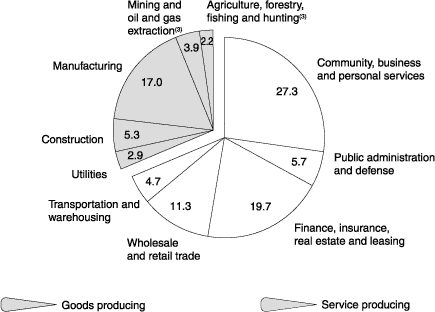


Dear Prime Minister;As can be seen in the Stats. Can. chart below, there has been a growing separation between inbound and out bound direct investment money, decidedly in favor of outgoing money. In the mid 1900s Brooksley Born characterized this kind on condition as "tape-worm" economics, where the parasites consume the host until both die.Another way of describing the condition below is a growing economic liquidity squeeze that is causing Canadians economic and financial hardships. These totals mask who are responsible the growing sound of this money vacuum, but I am sure you have sources for this information. Growing economic concentration of ownership, something like Rogers buying Shaw, would be part of the story.From my past I can give you a possible example. At the turn of the century I was a business partner with an American Engineer. We wanted to sell a Canadian cement producer, diatoms. They told me to my face, if we got a buy contract the product would come directly from the USA into Canada but our invoices would go to a Tax haven in the Caribean..Good hunting. Erik
To: "Erik Andersen" <twolabradors@shaw.ca>
Sent: Monday, April 13, 2026 3:17:21 PM
Subject: Foreign direct investment, chart 1 from StatCanCanada's foreign direct investment position (StatCan)

No comments:
Post a Comment