'It's a paperweight now': Why the Mounties' ban of popular rifle led to so much pushback
Rules determining which guns are allowed unpopular with both manufacturers and gun control groups
When it comes to Canada's often tense debate around gun laws, most Canadians likely will not have heard of an RCMP database called the Firearms Reference Table, or FRT.
But to people like Melody Philistin, unexpected updates to this database have a personal impact.
"Yeah. It really sucks," she said.
Philistin is a competitive shooter who recently represented Canada at an international event in the Czech Republic.
After one of her firearms was banned last year, she trained for the competition using the Sterling Arms R9 MK1, a semi-automatic nine-millimetre rifle.
"We were using those religiously to practice," she said.
Earlier this month, Philistin learned that the rifle had been classified in the FRT as prohibited. Prohibited firearms cannot be legally used, sold, imported, or transferred to another individual.
"It's just a paperweight now. It just sits there," she said.
"There's nothing we can do. What sucks is that [the R9 MK1] was kind of the last hope for [pistol-calibre carbine shooting] in Canada."
The decision blindsided J.R. Cox, the head of the Calgary-based firearms company Sterling Arms International, forcing his company into what he described as "crisis mode." He had to lay off five of his seven employees and had already shipped R9 MK1 units to dealers when the prohibition hit.
So what is the FRT, and why are both gun manufacturers and gun control advocates pushing for the rules to change?
What the FRT is used for
The FRT is a database used by the RCMP to help classify firearms. That classification determines whether a gun is non-restricted, restricted or prohibited.
Technically, the FRT isn't a legal instrument, but instead just an internal RCMP tool based on definitions set out in the Criminal Code and Firearms Act. But in practice?
"It's both the law and not the law," said A.J. Somerset, the author of Arms: The Culture and Credo of the Gun.
 A.
J. Somerset has written extensively on Canada’s gun culture. He says
there’s long been frustration in the gun community that the RCMP is
using an overly broad definition of the term 'variant' as a part of its
Firearms Reference Table. (Dale Molnar/CBC)
A.
J. Somerset has written extensively on Canada’s gun culture. He says
there’s long been frustration in the gun community that the RCMP is
using an overly broad definition of the term 'variant' as a part of its
Firearms Reference Table. (Dale Molnar/CBC)
"Strictly speaking, it's an opinion of the RCMP. And if they say that a certain rifle is a variant of the AR-15 in the FRT, that still has to be proven in court.
"However, it's de facto law. Because anybody who wants to possess such a firearm or manufacture it or import it is facing criminal charges if they do. And obviously it's very expensive and risky to do that and then defend yourself in court."
What happened with the R9?
Sterling Arms International designed the R9 MK1 with an aim of meeting the standards for a non-restricted firearm. Cox said he submitted technical paperwork to the RCMP in July 2024.
The RCMP said it inspected the firearm in June 2025. Cox said it was determined that it was a variant of a previously banned gun, the Armalite AR-180B.
Cox has since been contesting the classification, arguing that the R9 MK1 is a semi-automatic sporting rifle chambered only in a pistol-calibre cartridge. It can't be converted to fully automatic fire, Cox said.
"My firearm has nothing in common with the firearm that they say it's a variant of," he said, arguing the only interchangeable part in the rifles is the trigger.
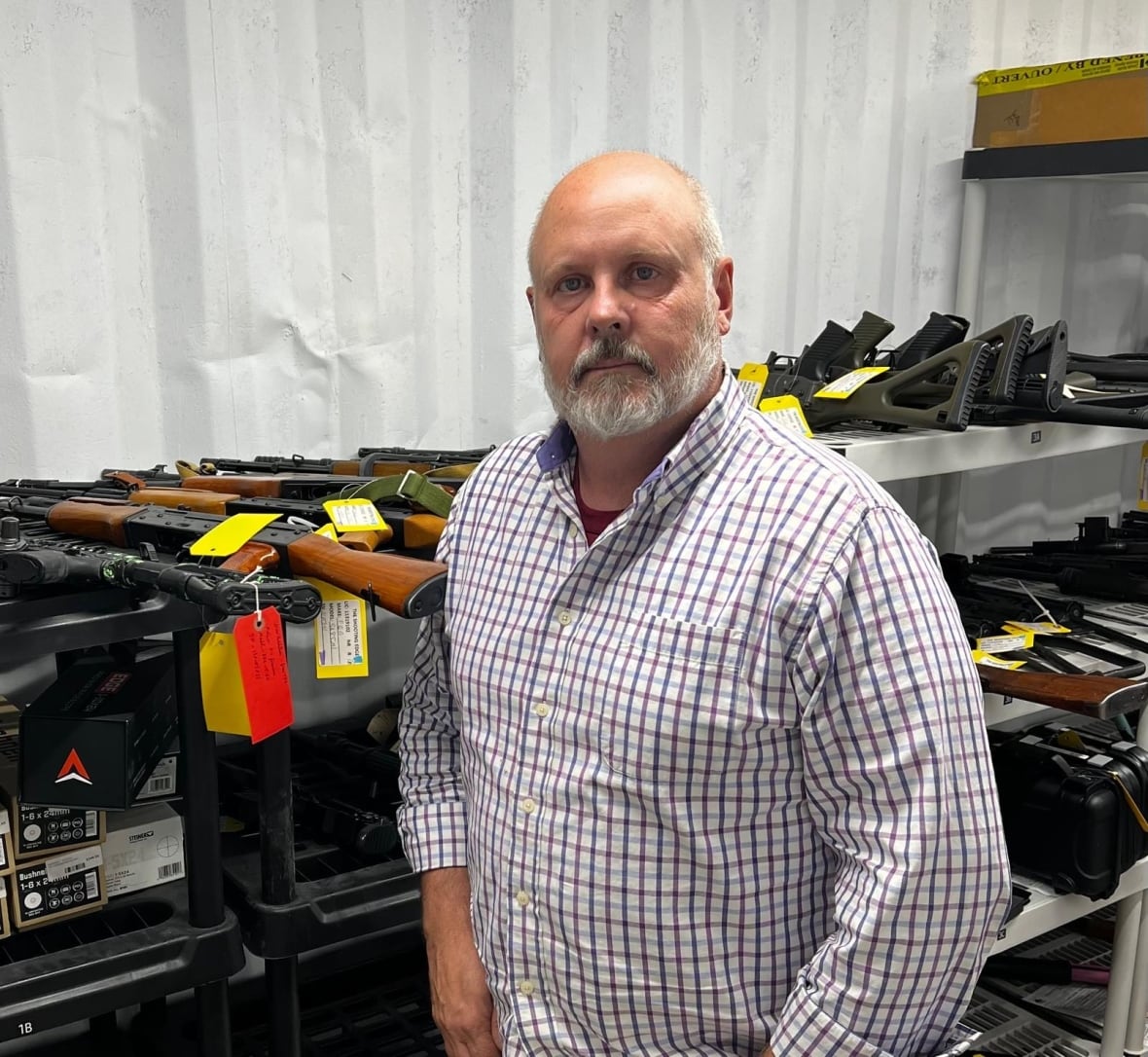 J.R.
Cox said he was caught off-guard when the Calgary-based Sterling Arms
International R9 MK1, a semi-automatic nine-millimetre rifle, was
classified as a prohibited firearm by the RCMP earlier this month. (Submitted by JR Cox)
J.R.
Cox said he was caught off-guard when the Calgary-based Sterling Arms
International R9 MK1, a semi-automatic nine-millimetre rifle, was
classified as a prohibited firearm by the RCMP earlier this month. (Submitted by JR Cox)
In the meantime, his business remains in dire straits.
"Dealers aren't happy, we're not happy too, but now we've got dozens and dozens of firearms that are kind of in limbo," Cox said.
"Dealers have them, they've paid for them. Obviously, they don't want them, and I'm not in a position to take them all back."
While Cox said the RCMP has now indicated it may re-examine the classification if he provides additional technical details, there's no formal appeal process.
"I'm at the mercy of the RCMP," he said. "So the fact that they've said, well, hey, we're willing to take a look at this again. Is that lipstick on a pig or is there going to be an honest reassessment?"
Calls for reform from both sides
Wes Winkel, president of the Canadian Sporting Arms and Ammunition Association, said this isn't the first time something like this has happened.
"Sometimes they add a whole bunch [to the FRT], and then sometimes it's just one gun at a time," he said.
For gun owners who aren't closely keeping track of updates, this can be a problem.
"So, they bought a firearm that they think they can take out turkey hunting or whatever, and then all of a sudden they're caught in the field with it, and it's listed on the FRT as prohibited," he said. "There's a lot of ramifications for carrying a prohibited firearm in Canada."
 Wes
Winkel, president of the Canadian Sporting Arms and Ammunition
Association, says the process has led to much uncertainty for those in
the industry. (Albert Leung/CBC News)
Wes
Winkel, president of the Canadian Sporting Arms and Ammunition
Association, says the process has led to much uncertainty for those in
the industry. (Albert Leung/CBC News)
Gun control advocates also want change. Groups like PolySeSouvient argue the problem is that firearms like the R9 can reach the market before the RCMP finishes assessing them.
"The problem of manufacturers introducing new models to the market based on their own interpretations is at the root of this kind of problematic situation, where the RCMP has to play catch-up after the models start being sold to Canadians," reads a release attributed to PolySeSouvient, sent to CBC News.
The group said there were many examples of industry misclassifications, including labelling prohibited guns as legal.
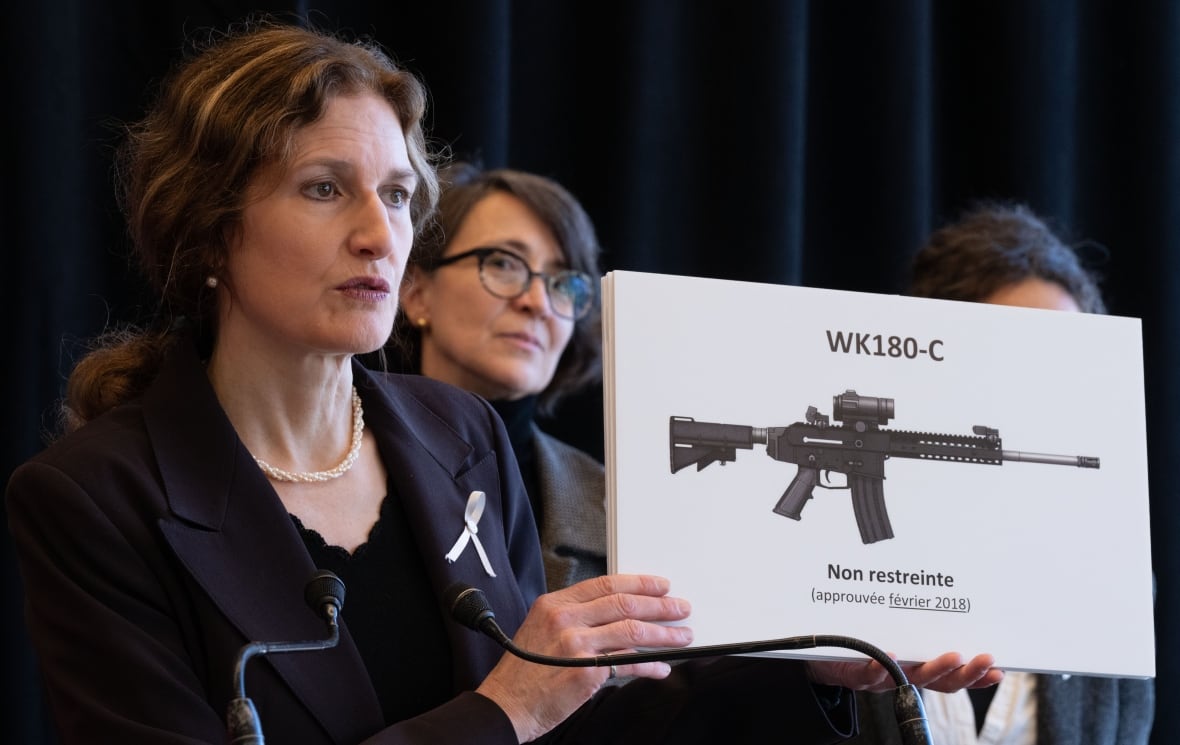 Heidi
Rathjen, coordinator of PolySeSouvient, holds a sign showing a gun in a
file photo from a press conference about stricter gun control in
Montreal in November 2024. (Christinne Muschi/The Canadian Press)
Heidi
Rathjen, coordinator of PolySeSouvient, holds a sign showing a gun in a
file photo from a press conference about stricter gun control in
Montreal in November 2024. (Christinne Muschi/The Canadian Press)
"Which is a huge public safety concern in addition to the inconvenience this causes those who purchased them," the group said. "The Liberals have repeatedly promised to change the process so that the RCMP vets and classifies new models before they hit the Canadian market.
"The previous Liberal government tabled regulations to that effect, but these are faulty and need to be fixed as they essentially change nothing. During the last election, Mark Carney has promised this would be done."
Canadian Doctors for Protection from Guns, another gun control group, agrees.
"CDPG has called on the RCMP to review guns before coming to market to ensure they meet the definition of banned firearm," said Christopher Holcroft, a spokesperson with the group, in an email to CBC News.
For firearms owners, the process remains an "incredibly contentious subject," according to Cox, especially given that some may not closely follow the latest updates.
"It's the whole, 'Ignorance is no excuse for the law' aspect," Cox said. "It's like, well, how am I supposed to know? So the FRT has just created a monster of liability for firearms owners."
What does the government say?
The federal government says it is committed to ensuring that all makes and models of firearms are assessed prior to entering the market.
A spokesperson with Public Safety Canada said that the government "has received and published comments on the proposed regulations and is assessing ways to further strengthen the firearms safety regime and the classification process."
During the federal election campaign, Prime Minister Mark Carney said classification of new firearm models should be left "to the RCMP, to the experts, not to the gun industry."
"No new guns should come into this country before they have been examined and classified by those experts," Carney said April 10.
Conservative Leader Pierre Poilievre has said he would get rid of the previous government's "assault-style" firearm buyback program, branding it as a "gun grab."
Poilievre is currently running in the riding of Battle River-Crowfoot to regain a seat in the House of Commons. During a town hall held in Stettler, Alta., last week, Poilievre took aim again at the federal plan.
"The RCMP doesn't want to do it. I don't know how they're going to do this. I actually don't think they're going to be able to do it," he said in clips of the event posted online by local news outlet Hometown Media.
 Late additions to gun buyback program will balloon costs, critics say
As the process unfolds, the FRT is likely to continue to be a "burning issue" amongst gun owners and gun control advocates, according to Somerset.
"I don't think that anybody's particularly happy," he said.
The RCMP didn't immediately respond to follow-up questions from CBC News about the FRT and the Sterling Arms R9 MK1.
ABOUT THE AUTHOR

Alberta firearms maker 'riled up' as Mounties ban popular rifle from Canadian market
RCMP says technical inspection determined Sterling Arms R9 MK1 is variant of prohibited firearm
A Calgary-based firearms company says one of its rifles being classified as prohibited by the RCMP has thrown his business into "crisis mode."
"Right now, I'm all riled up, because I get very frustrated. I've been in the industry now for like 28 years," said J.R. Cox, head of Sterling Arms International. "It's these rulings that, to me, completely devalue and delegitimize the RCMP technical identification team."
Cox said he learned over the weekend from a client that the Sterling Arms R9 MK1, a semi-automatic nine-millimetre rifle, had been classified in the RCMP's Firearms Reference Table (FRT) as prohibited. The FRT is a database used by RCMP to determine a firearm's legal status.
"This caught us completely off-guard, because we were quite confident. We submitted a sample for them to look at, like the paperwork, back in July of last year, to get a [FRT] number for it," Cox said in an interview. "We built this thing, specifically, to be non-restricted."
RCMP says it conducted technical inspection
In a statement to CBC News, RCMP said it had conducted a technical inspection of the newly-manufactured Sterling Arms R9 MK1 firearm before publishing its findings in the FRT.
"Prior to that inspection, the Sterling Arms R9 MK1 firearm was unknown to the Firearms Reference Table. However, upon receiving the firearm in June 2025, a technical inspection was completed and a determination of the classification of the firearm was made according to the relevant sections of the Criminal Code and the regulations," the statement reads.
"As a result of this technical inspection, it was determined that the Sterling Arms R9 MK1 is a variant of a prohibited firearm."
 RCMP
said it had conducted a technical inspection of the Sterling Arms R9
MK1 firearm before publishing its findings in the Firearms Reference
Table. (RCMP)
RCMP
said it had conducted a technical inspection of the Sterling Arms R9
MK1 firearm before publishing its findings in the Firearms Reference
Table. (RCMP)
RCMP said prohibited firearms cannot be legally used, sold, imported, or transferred to another individual. They can only be transported if it's specifically allowed in an amnesty order.
"Affected firearms may not be used for hunting or sport shooting, either at a range or elsewhere, unless allowed through an amnesty," the statement reads.
'We finally thought we had a winner'
Cox said he recognized that for those not familiar with firearms, the black, boxy semi-automatic pistol carbine may look intimidating.
But he said the firearm is designed to use pistol ammunition, and is popular in sporting competitions where shooters need to use a rifle-style firearm that's accurate, but not too powerful.
"This is hugely detrimental, because we've been hit with so many prohibitions on firearms that we manufacture over the last five years," said Cox, who was also the owner of the Calgary-based The Shooting Edge, which closed its doors last year.
"We finally thought we had a winner that we could sell, that we wouldn't have any issues with."
The Canadian Shooting Sports Association said the classification means owners of the R9 MK1 can no longer use the firearm at the range or in the field. Canada's National Firearms Association said the Sterling Arms R9 MK1 was "the last remaining pistol-calibre carbine still eligible for competitive use in Canada."
"To most Canadians, that name may mean nothing. But to those who compete in PCC — those who spend thousands of dollars, countless hours, and travel to represent Canada and participate in organized sport shooting — it means everything," the association wrote in a post on X.
Dispute over R9 as variant
According to Cox, the R9 was labelled by the RCMP as a variant of a firearm that was prohibited years earlier. He disputes that classification, saying the "absolute only interchangeable part" in the rifles is the trigger.
"They're going to slap another sticker on it and call it arbitrarily a variant of some other firearm. And that's the frustrating part," Cox said.
The group PolySeSouvient, a longtime proponent of stricter gun laws, wrote in an email that the problem of manufacturers introducing new models to the market based on their own interpretations is "at the root of this kind of problematic situation," where the RCMP has to play catch-up after models start being sold to Canadians.
"There are many examples of industry misclassifications, including labelling prohibited guns as legal (restricted or non-restricted), which is a huge public safety concern in addition to the inconvenience this causes those who purchased them," the statement reads.
"The Liberals have repeatedly promised to change the process so that the RCMP vets and classifies new models before they hit the Canadian market."
A.J. Somerset is the author of Arms: The Culture and Credo of the Gun. He has written extensively about Canada's gun culture.
A.
J. Somerset, who has written extensively about Canada's gun culture,
said gun owners feel the RCMP has overstepped its bounds and made
arbitrary decisions when it comes to the Firearms Reference Table. (Dale Molnar/CBC)
"You have the firearm, the Sterling R9, which has been designed to be legal in Canada … there's no way to second-guess the RCMP on this, unless you have one and you can take it apart and examine it. But, we'll take the manufacturer's word for it," Somerset said.
"It's designed to be legal, but then the RCMP decides, no, this is actually a variant … as such, it's a variant of a prohibited firearm, so it's prohibited under whatever rule prohibits that firearm."
He said the situation around the gun is emblematic with an ongoing problem that gun owners have had with how the RCMP makes decisions when it comes to the FRT.
"This has been a real bone of contention for Canadian gun owners, because what the FRT essentially does in practice is it allows the RCMP, administratively, to declare things to be prohibited," he said. "And if you disagree with them, then it's really, really hard to do anything about that."
"One route is to go and get yourself charged, which is not a very bright thing to do, because then you have to fight in court at great expense and risk. And, you know, in theory, you can challenge them. But in practice, I'm not sure how well that actually works."
Uncertainty for business owners
Wes Winkel, president of the Canadian Sporting Arms and Ammunition Association, said the way the process has been playing out has created uncertainty and disruption for the industry and legal firearm owners.
"For the average general public, they just see another firearm being prohibited," Winkel said. "But for those of us that are in the business, it means a significant loss of jobs for manufacturers, distributors and retailers, as well as our customers lose their valuable assets."
Wes
Winkel, president of the Canadian Sporting Arms and Ammunition
Association, says the process has led to much uncertainty for those in
the industry. (Albert Leung/CBC News)
On online Canadian gun forums like Canadian Gun Nutz and on the canadaguns subreddit, the move also drew strong reactions.
"Unless you're on top of what they're doing, you could be using a newly-prohibited rifle without knowing it," one poster wrote.
"Good luck winning that argument in court," another responded.
Somerset said the debate around what is and isn't a variant has been going on for some time, and is likely to continue.
He added that the R9 is fairly new on the market, so the stir this latest move is causing is likely disproportionately large.
"People [get] really concerned that, you know, no matter what we do to comply with the rules, they're just after us," he said. "And it's that sense of persecution that really, I think, is driving a lot of that response."
ABOUT THE AUTHOR

No comments:
Post a Comment