https://davidraymondamos3.blogspot.com/2026/05/rep-thomas-massie-battling-treachery-of.html
Wednesday, 13 May 2026
Rep. Thomas Massie: Battling the Treachery of Trump’s Republican Party
We Just Learned He SABOTAGED the Peace Deal…
 Valhalla VFT
 266 Comments
 Surprise Surprise Surprise
https://www.youtube.com/watch?v=Fnvnlti4flw

1,824 Comments
- Charlie Angus – former MP and member of Canada's New Democratic Party[44]
MeidasTouch (pronounced "Midas touch")[3] is an American progressive[4][5][6][7] media company. The network describes itself as doing "pro-democracy" journalism.[8][6]
Previously, the MeidasTouch name was used by its founders for a liberal American political action committee formed in March 2020 with the purpose of stopping the reelection of Donald Trump in the 2020 United States presidential election.[9][10][11][12] The SuperPAC aligned with the Democratic Party in the 2020 United States presidential election, the 2020–21 United States Senate election in Georgia, and the 2020–21 United States Senate special election in Georgia.[13][14][15]
The PAC changed its name to Democracy Defense Action in 2023.[8] The MeidasTouch name continues to be used by the MeidasTouch Network, the news organization.[2]
History
The committee was founded in March 2020 by Ben, Brett and Jordan Meiselas, three brothers from Long Island, while in quarantine due to the COVID-19 pandemic.[16][17] The group name and slogan come from their mother and father, combining their surname and their mother's maiden name, Golden,[17] alluding to the mythological Greek king Midas known for his ability to turn everything he touched into gold.
On July 21, 2023, MeidasTouch filed paperwork to rename itself to Democracy Defense Action,[18] and later that year, news reporting indicated the MeidasTouch name was being used for a news network called MeidasTouch Network.[19][20][2]
Political Action Committee
2020 U.S. presidential election
On April 22, 2020, the committee released their first video, titled "Are You Better Off?", an allusion to Ronald Reagan's famous line in the 1980 general election presidential debate,[21] which criticized Trump's handling of the COVID-19 pandemic in the United States;[22] The committee shared the video in a Twitter reply to George Conway, which was then retweeted by him.[17]
On June 6, 2020, another video was released, called "Bye Ivanka"; it took parts out of her commencement speech and focused on her relation with China and criticized Trump's handling of the COVID-19 pandemic.[23] Her Wichita State University Tech speech was canceled due to student and teacher pressure.[24][25]
On June 17, 2020, another video was released, "Gop Cowards", which accused Republican senators of being cowards. Near the end of the video, followers are urged to vote 11 Republican legislators out.[26]
On June 23, the committee released a video called "Trump Kills US".[27] The video focuses on Trump's comment at his Tulsa rally which urged doctors to "slow the testing down".[28] MeidasTouch called it "Mass murder on a national scale".[29]
On July 8, a new video was released called "Creepy Trump". It compiled Kellyanne Conway's comments on Joe Biden and put it together with Trump statements.[30] The ad uses clips of Conway's comments and remarks Trump has presented about women, and was played on Fox News, CNN and MSNBC.[31]
On July 14, another video was released called "#ByeDonJr". It takes Donald Trump Jr.'s comments on Fox News about Biden and applies them against Trump. The video also further criticizes the older Trump's handling of the pandemic.[32][33]
The group continued its activities after the November 3 elections. On November 27, it claimed credit for making #DiaperDon the top Twitter trending topic in the US, via a tweet that mocked (as summarized by The Independent) a "press briefing ... which saw [Donald Trump] furiously assail a reporter from behind a surprisingly small desk", and provoked Trump into calling for the immediate abolishing of Section 230 "for purposes of National Security".[34]
2020–2021 Georgia Senate elections
The SuperPAC targeted Republican candidates in the 2020–21 United States Senate election in Georgia and the 2020–21 United States Senate special election in Georgia with several televised attack ads, billboards, direct mailings and door-to-door canvassing efforts.[13][14][15]
Most notably, MeidasTouch aired an advertisement called "The Grinches of Georgia." CNN said of the ads, "Humor is the chosen route for Democrat-backed Meidas Touch. Their television ads show Perdue and Loeffler with green faces and Grinch-like features. A nursery rhyme narration includes the verse, "Their stockings were stuffed from the stocks that were sold, when they heard Covid was coming, before we were told."[35] The Hill credits MeidasTouch as framing the Republican candidates Kelly Loeffler and David Perdue as "Looting Loeffler" and "Chicken Perdue," respectively. "The ad takes aim at the senators—dubbed 'Looting Loeffler and Chicken Perdue'—and highlights the controversies surrounding their stock purchases," The Hill said.[14] The "Grinches" ad campaign also included matching billboards and mailers.[36]
News network and podcast
On July 22, 2024, shortly after JD Vance was named Donald Trump's running mate, MeidasTouch editor-in-chief Ron Filipkowski posted a clip from a 2021 Fox News interview in which Vance stated, "we are effectively run in this country via the Democrats, via our corporate oligarchs, by a bunch of childless cat ladies who are miserable at their own lives and the choices that they've made and so they want to make the rest of the country miserable too." The resurfaced remarks from Vance sparked viral outrage against the candidate across social media, with many celebrities weighing in, including Jennifer Aniston and Taylor Swift.[37][38][39] Swift, referencing Vance's comments, signed off her post endorsing Kamala Harris as a "childless cat lady."[40]
In 2024, Adam Mockler joined MeidasTouch as a contributor, anchoring coverage and commentary.[41] By 2026, he was being invited to sit on panels for television network programs,[42][43] and at one, he confronted Scott Jennings on air with the result that Jennings lost his composure rather than answering the question directed toward him.
Following the 2024 presidential election, prominent Democratic politicians such as Joe Biden, Hakeem Jeffries, Elizabeth Warren, and Adam Schiff have made appearances on the podcast.[6] As of March 2025, the network had 12 full-time employees and 30 regular contributors.[6]
MeidasTouch has also weighed in on Canadian politics, with New Democratic Party MP Charlie Angus appearing as a guest commentator.[44] In September 2025, Angus launched MeidasTouch's Canadian channel, MeidasCanada, on Labour Day.[45]
In July 2025, MeidasTouch unearthed a video clip of a 2010 deposition by convicted sex offender Jeffrey Epstein, in which he was asked if he had socialized with underage girls in the presence of Donald Trump.[46][47]
In October 2025, MeidasTouch broke the news that Donald Trump planned to fire munitions over the Interstate 5 in California, causing the interstate's closure, during the No Kings Protests.[48][49] The Trump administration initially denied the reporting.[50] The San Francisco Chronicle later reported on munitions striking two California Highway Patrol vehicles on October 18, 2025.[51] An investigation by the U.S. Marines Corps described the incident as the result of a "one in a million" malfunction. The report determined that the explosion was "highly improbable; beyond reasonable expectations and should not have happened, but it did."[52]
In March 2026, Forbes described MeidasTouch as using "a 'trial lawyer approach,' combining legal analysis (by attorney Ben Meiselas), media commentary and brotherly banter to explain complex political issues—setting it apart from, for instance, CNN or other cable news opinion-based roundtables."[53]
Founders
The Meiselas brothers grew up on Long Island.[54] Their father, Kenny Meiselas, is an entertainment lawyer who has represented Lady Gaga, The Weeknd, Nicki Minaj and Sean "Diddy" Combs.[55][54]
Brett Meiselas (born 1989 or 1990)[54] is an Emmy-winning video editor who worked for The Ellen DeGeneres Show.[56] Jordan Meiselas (born 1992 or 1993)[54] is a marketing supervisor living in Brooklyn, New York.[56]
Ben Meiselas (born May 19, 1985)[57][54] is a former attorney.[54] His bar mitzvah party was held at Justin's, a now-defunct restaurant owned by Sean Combs.[55] Ben studied law in Georgetown,[54] and worked as an intern for Steve Israel, Hillary Clinton and Sean Combs.[58][54]
Ben represented former NFL player Colin Kaepernick[58] and the attendees of the Fyre Festival, together with his boss Mark Geragos.[59] In December 2022, he partnered with Geragos to form Engine Vision Media and acquire Los Angeles magazine from Hour Media.[60] In 2023, Ben quit his job as an attorney to devote his efforts to MeidasTouch.[54]
Ben married his longtime partner Xochitl Marin in May 2024.[61] They have a daughter.[54] Ben appeared in the Fyre Festival documentaries Fyre and Fyre Fraud, both released in 2019.[59]
Reception
Political action committee
MeidasTouch was described in October 2020 as "a viral video powerhouse" by The Hollywood Reporter. The magazine noted it "caught the attention of politically inclined Hollywood A-listers like Judd Apatow, Mark Ruffalo and Ken Jeong." [56] In October 2020, Variety described MeidasTouch's videos as "razor-sharp."[62]
In April 2021, Seth Hettena of Rolling Stone magazine criticized MediasTouch's $1 million advertising strategy as "nonsensical and a more effective tool for fundraising than for helping Democrats win elections" and raised concerns that donors were being misled by "grandiose self-promotion".[5]
In February 2022, singer-songwriter India Arie shared a compilation of podcaster Joe Rogan saying the racial slur "nigger" on The Joe Rogan Experience on Instagram.[63] Rogan apologized, calling his past language "regretful and shameful" while also saying that the clips were "taken out of context" and he only quoted the slur to discuss its use by others.[64][65][66] The footage in question was first published by the political action committee PatriotTakes,[67] an affiliate of MeidasTouch.[68] This resulted in allegations of a defamation attempt by MeidasTouch, which the founders denied in an interview with Barstool Sports founder Dave Portnoy, instead attributing the source of the footage to Alex Jones, who was a recurring guest on Rogan's show.[69] Rogan described the video compilation as a "political hit job".[70][71]
News website and podcast
MeidasTouch has been characterized as progressive,[6][46][7] liberal[2] and left-wing.[72][47]
In June 2024, MeidasTouch was described in the Columbia Journalism Review as being made for social media, unlike a lot of more traditional left-leaning media outlets, and does a better job than most of exploiting the perception that the mainstream media was too sympathetic to Trump.[8]
In February 2025, Podscribe listed The MeidasTouch Podcast as the top podcast in its rankings of monthly downloads and plays for the period of January 1–February 12, beating out The Joe Rogan Experience.[41] Downloads and plays increased by 141% for the period of February 12–March 12, making The MeidasTouch Podcast the top podcast in that ranking, and the MeidasTouch Network the #2 podcast publisher by downloads and plays behind only Spotify.[73] While the number of listeners per episode and YouTube subscribers remains significantly lower than Joe Rogan due to MeidasTouch releasing so many 10–20-minute episodes, its growth since the reelection of Donald Trump has mirrored other progressive podcasts and online shows like Pod Save America and The Young Turks.[41]
In March 2025, Media Matters identified MeidasTouch as the 4th most-popular progressive online show across the most popular streaming and social media platforms, with 6.4 million total viewers.[74] That month, John Ross and Nathan J. Robinson, writing in Current Affairs, unfavorably compared the podcast to The Joe Rogan Experience and said, "Even though it is targeted at viewers who think Trump is dumb, the content is remarkably shallow, by which we mean that it doesn't dive seriously into topics like health care, criminal punishment, foreign policy, and inequality. It's the National Enquirer for Trump-haters." They also criticized MeidasTouch's lack of coverage of left-wing concerns such as environmental issues, the Gaza war and Trump's efforts to crack down on pro-Palestinian protests, as well as MeidasTouch's close ties to the Democratic Party.[75]
The MeidasTouch Podcast was awarded Podcast of the Year at the 29th Annual Webby Awards in April 2025. Journalist Molly Jong-Fast presented The MeidasTouch Podcast hosts with the award.[76][77] That month, Virginia Heffernan of The New Republic attributed the news group's success to embracing the kind of masculinity that stands up to bullies and speaks truth to power.[78]
Der Spiegel highlighted MeidasTouch's international coverage in its May 2025 issue, particularly as it relates to Donald Trump's threats against Greenland and Canada.[79]
In July 2025, The MeidasTouch Podcast overtook The Joe Rogan Experience for the first time on YouTube's weekly podcast ranking.[80]
In March 2026, Forbes noted that the show "has often supplanted Joe Rogan's long-running podcast for the top spot in Podtrac ratings."[53]
The MeidasTouch Podcast was awarded Best News Podcast at the 2026 IHeartRadio Podcast Awards, beating nominees including The Daily, The Megyn Kelly Show, Pivot, and Up First from NPR.[81] The show also won The Advertiser's Choice award at the 2026 Indie Podcast and Creator Awards held at the 2026 South By Southwest (SXSW) Conference by Oxford Road.[82]
Notable contributors
Current

US News LIVE | Trump Stunned by Bongino Expose, Hidden Truth Revealed | Trump 'Kill Plot' News
 Times Now
Wednesday, 13 May 2026
Rep. Thomas Massie: Battling the Treachery of Trump’s Republican Party
From: David Amos <david.raymond.amos333@gmail.com>
Date: Tue, May 19, 2026 at 11:51 PM
Subject: Fwd: Automatic reply: RE Thomas Massie LOSES. America is COOKED: LIVE 5:15 PM PST
To: <ValhallaFirearmsTraining@gmail.com>
From: Minister of Finance / Ministre des Finances <minister-ministre@fin.gc.ca>
Date: Tue, May 19, 2026 at 11:36 PM
Subject: Automatic reply: RE Thomas Massie LOSES. America is COOKED: LIVE 5:15 PM PST
To: David Amos <david.raymond.amos333@gmail.
The Department of Finance Canada acknowledges receipt of your electronic correspondence.
Please be assured that we appreciate receiving your comments.
Le ministère des Finances Canada accuse réception de votre courriel.
Nous vous assurons que vos commentaires sont les bienvenus.
Live chat


Trump-backed challenger defeats Republican rebel Massie in primary

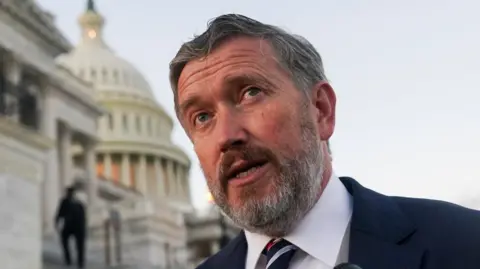 Reuters
Congressman Thomas Massie, one of the most vocal Republican critics of Donald Trump, has lost his fight for re-election to a challenger endorsed by the president.
Ed Gallrein, a former Navy Seal, will now compete in November's midterm election after his victory in the Kentucky primary on Tuesday.
The contest, the most expensive primary in the history of the House of Representatives, had been widely seen as a key test of President Trump's decade-long grip on the Republican Party.
Trump repeatedly called for voters to back Gallrein over the incumbent Massie, who he described as a "major sleazebag" and "the worst Republican congressman in history".
Massie, who has been in office since 2012, publicly broke with Trump by voting against his "big, beautiful" tax and spending bill last year over concerns about the national debt. He has also voted to curtail Trump's attacks on suspected drug boats in the Caribbean and his ongoing war in Iran.
Massie also joined with Democrats - and a handful of Republicans - to force Trump's Department of Justice to release all of its files on Jeffrey Epstein.
He lost by 55 percent to 45 percent in the vote on Tuesday, marking a major victory for Trump who has successfully ousted a number of dissenting Republicans by endorsing a more loyal challenger.
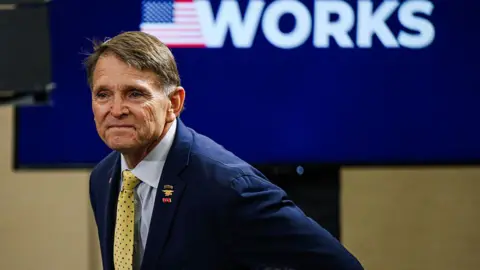 Getty Images
At his victory party, Gallrein told supporters he had come "a long way" from his childhood at his family's dairy farm to become the nominee.
"The winner of the race tonight is not so much Ed Gallrein," he said. "It's the Republicans of Kentucky district four and their families who I will be a champion for in Washington."
He went on to thank Trump for his support and his "counsel" during the race.
Many of the president's biggest donors backed Gallrein, and more than $32m (£23m) was spent on campaign advertising in the Kentucky district.
In his concession speech, Massie said voters had indicated they wanted someone who would "go along to get along", but added: "There is a yearning in this country for somebody who will vote for principles over party."
He criticised the administration's foreign aid spending, the plans to build a White House ballroom, the large donations to his opponent and a decision by Secretary of Defence Pete Hegseth to campaign in Kentucky for Gallrein on Monday.
"They panicked and sent the Secretary of War here, and you stopped the war for a day," he said, as his supporters cheered his name and chanted "America first".
On Monday, Trump criticised Massie in a series of social media posts, calling him "an obstructionist and a fool".
Massie then touted his record of voting with Trump "90% of the time," but added that the president and his allies "want 100% compliance".
"It's only the 10% of the time they're mad about - when I won't vote for a war, when I won't vote for warrantless spying and when I won't vote to bankrupt the country," he said.
In a separate development in Kentucky on Tuesday, Congressman Andy Barr won the Republican nomination to replace retiring Senator Mitch McConnell who has been in the Senate for more than 40 years.
Trump had endorsed Barr, and his victory did not come as a surprise after Trump intervened to offer an ambassadorship to his main Republican challenger.
Trump has been aggressively wielding his influence with recent Republican endorsements, including by helping to tank the campaign of an incumbent senator who had voted to convict him during his 2021 impeachment trial.
In Texas, he has also given his endorsement to Ken Paxton rather than longtime Republican Senator John Cornyn.
"John Cornyn is a good man, and I worked well with him, but he was not supportive of me when times were tough," Trump said of his decision to back Paxton on Tuesday.
From: Minister of Finance / Ministre des Finances <minister-ministre@fin.gc.ca>
Date: Wed, May 13, 2026 at 4:50 PM
Subject: Automatic reply: Rep. Thomas Massie: Battling the Treachery of Trump’s Republican Party
To: David Amos <david.raymond.amos333@gmail.com>
Please be assured that we appreciate receiving your comments.
Le ministère des Finances Canada accuse réception de votre courriel.
Nous vous assurons que vos commentaires sont les bienvenus.
Donald Trump LIVE | Cabinet Stunned as Trump Moves to Elevate Elon Musk | Trump | Elon Musk
Times Now From: David Amos <david.raymond.amos333@gmail.com>
Date: Wed, May 13, 2026 at 4:46 PM
Subject: Rep. Thomas Massie: Battling the Treachery of Trump’s Republican Party
To: <press@thomasmassie.com>
Cc: <minister-ministre@fin.gc.ca>, <Roger.Sobotkiewicz@gov.sk.ca>, <Fred.Pretorius@yukon.ca>, <David.Harrison@novascotia.ca>, <INQUIRIES@osc.gov.on.ca>, <pm@pm.gc.ca>, <Michael.Duheme@rcmp-grc.gc.ca>, <twolabradors@shaw.ca>, <John.Williamson@parl.gc.ca>
Washington, D.C. Office
Rep. Thomas Massie: Battling the Treachery of Trump’s Republican Party, AIPAC, and the Epstein Class
 Tucker Carlson
Call my office anytime: (859) 363-5836
Please direct press inquiries to press@thomasmassie.com .
Media Page : https://www.thomasmassie.com/media
To contribute by mail, please send a personal check made payable to “Thomas Massie for Congress” to:
Thomas Massie for Congress
PO Box 72821
Newport, KY 41072
From: David Amos <david.raymond.amos333@gmail.
Date: Mon, Jul 7, 2025 at 1:49 PM
Subject: 617 954 4225 RE Robert Pozen Former executive chairman of MFS Investment Management
To: <Leadership@mfs.com>, <kimc714@mit.edu>
Review of Current Investigations and Regulatory Actions Regarding the Mutual Fund Industry
Date: Tuesday, November 18, 2003 Time: 10:00 AM
Topic
Witnesses
Witness Panel 1
-
Mr.
William H.
Donaldson
ChairmanSecurities and Exchange Commission
Witness Panel 2
-
Mr.
Matthew P.
Fink
PresidentInvestment Company Institute
-
Mr.
Marc
Lackritz
PresidentSecurities Industry Association
Review of Current Investigations and Regulatory Actions Regarding the Mutual Fund Industry
Date: Thursday, November 20, 2003 Time: 02:00 PM
Topic
Witnesses
Witness Panel 1
-
Mr.
Stephen M.
Cutler
Director - Division of EnforcementSecurities and Exchange Commission
-
Mr.
Robert
Glauber
Chairman and CEONational Association of Securities Dealers
-
Eliot
Spitzer
Attorney GeneralState of New York
Review of Current Investigations and Regulatory Actions Regarding the Mutual Fund Industry: Understanding the Fund Industry from the Investor’s Perspective
Date: Wednesday, February 25, 2004 Time: 10:00 AM
Topic
Witnesses
Witness Panel 1
-
Mr.
Tim
Berry
TreasurerState of Indiana
-
Honorable
Gary
Gensler
ChairmanU.S. Commodity Futures Trading Commission
-
Mr.
James K.
Glassman
Resident FellowAmerican Enterprise Institute
-
Mr.
Don
Phillips
Managing DirectorMorningstar, Inc
-
Mr.
Jim
Riepe
Vice Chairman of the Board of DirectorsT. Rowe Price Group, Inc.
Review of Current Investigations and Regulatory Actions Regarding the Mutual Fund Industry: Fund Operations and Governance.
Date: Thursday, February 26, 2004 Time: 02:00 PM
Topic
Witnesses
Witness Panel 1
-
Mr.
Jack
Bogle
FounderThe Vanguard Group
-
Ms.
Mellody
Hobson
PresidentAriel Capital Management
-
Mr.
David
Pottruck
President, Chief Executive Officer and a member of the Board of DirectorsCharles Schwab
-
Mr.
David
Ruder
Former ChairmenU.S. Securities and Exchange Commission
Review of Current Investigations and Regulatory Actions Regarding the Mutual Fund Industry: The Regulatory Landscape
Date: Wednesday, March 10, 2004 Time: 10:00 AM
Topic
Witnesses
Witness Panel 1
-
Ms.
Lori
Richards
Director, Office of Compliance, Inspections, and ExaminationsSecurities and Exchange Commission
-
Mr.
Paul
Roye
Director, Division of Investment ManagementSecurities and Exchange Commission
-
Ms.
Mary
Schapiro
Vice Chairman of NASD and President of NASD Regulatory Policy & OversightNational Association of Securities Dealers
-
Honorable
David M.
Walker
Comptroller General of the United States
Review of Current Investigations and Regulatory Actions Regarding the Mutual Fund Industry: Fund Operations and Governance
Date: Tuesday, March 23, 2004 Time: 10:00 AM
Topic
Witnesses
Witness Panel 1
-
Professor
Mercer
Bullard
Associate Professor of LawUniversity of Mississippi School of Law
-
Mr.
William D
Lutz
Professor of EnglishRutgers University
-
Mr.
Robert
Pozen
Non-Executive ChairmanMassachusetts Financial Services Co.
-
Ms.
Barbara
Roper
Director of Investor ProtectionConsumer Federation of America
Review of Current Investigations and Regulatory Actions Regarding the Mutual Fund Industry: Fund Costs and Distribution Practices
Date: Wednesday, March 31, 2004 Time: 02:30 PM
Topic
Witnesses
Witness Panel 1
-
Honorable
Daniel K.
Akaka (D-HI)
United States Senator
-
Honorable
Susan
Collins (R-ME)
United States Senator
-
Honorable
Peter
Fitzgerald (R-IL)
United States Senator
-
Honorable
Carl
Levin (D-MI)
United States Senator
Witness Panel 2
-
Mr.
Paul G.
Haaga, Jr.
Executive Vice President and Director of Capitol Research and Management Company, and Chairman of the Investment Company Institute
-
Mr.
Chet
Helck
President and Chief Operating OfficerRaymond James Financial
-
Mr.
Thomas
Putnam
Founder and CEOFenimore Asset Management
-
Mr.
Edward
Siedle
Founder and PresidentThe Benchmark Companies
-
Mr.
Mark
Treanor
General Counsel and Head of Legal DepartmentWachovia Corporation
Review of Current Investigations and Regulatory Actions Regarding the Mutual Fund Industry: The SEC's Perspective
Date: Thursday, April 8, 2004 Time: 10:00 AM
Topic
Witnesses
Witness Panel 1
-
Mr.
William H.
Donaldson
ChairmanSecurities and Exchange Commission
archive.today webpage capture | Saved from | |
| 6 Jul 2025 17:01:34 UTC | ||
| All snapshots | from host www.govinfo.gov | |
WASHINGTON :
For sale by the Superintendent of Documents, U.S. Government Printing Office
Internet: bookstore.gpo.gov Phone: toll free (866) 512–1800; DC area (202) 512–1800
Fax: (202) 512–2250 Mail: Stop SSOP, Washington, DC 20402–0001
97–186 PDF 2004
S. HRG . 108–711
REVIEW OF CURRENT INVESTIGATIONS
AND REGULATORY ACTIONS REGARDING
THE MUTUAL FUND INDUSTRY
HEARINGS
BEFORE THE
COMMITTEE ON
BANKING, HOUSING, AND URBAN AFFAIRS
UNITED STATES SENATE
ONE HUNDRED EIGHTH CONGRESS
FIRST AND SECOND SESSION
ON
INVESTIGATIONS AND REGULATORY ACTIONS REGARDING THE
MUTUAL FUND INDUSTRY AND INVESTORS’ PROTECTION
NOVEMBER 18, 20, 2003, FEBRUARY 25, 26, MARCH 2, 10, 23, 31, AND
APRIL 8, 2004
Printed for the use of the Committee on Banking, Housing, and Urban Affairs
REVIEW OF CURRENT INVESTIGATIONS
AND REGULATORY ACTIONS REGARDING
THE MUTUAL FUND INDUSTRY
TUESDAY, NOVEMBER 18, 2003
U.S. SENATE,
COMMITTEE ON BANKING, HOUSING, AND URBAN AFFAIRS,
Washington, DC.
The Committee met at 10 a.m. in room SD–538 of the Dirksen
Senate Office Building, Senator Richard C. Shelby (Chairman of
the Committee) presiding.
OPENING STATEMENT OF CHAIRMAN RICHARD C. SHELBY
Chairman SHELBY. The hearing shall come to order.
This hearing is part of the Committee’s ongoing oversight of the
mutual fund industry. Today, the Committee will review current
investigations and enforcement proceedings and examine regu-
latory actions taken to date in order to fully inform and guide the
Banking Committee’s consideration of possible legislative reform.
On September 30, 2003, this Committee first examined the scope
of problems confronting the mutual fund industry. At that time,
Chairman Donaldson testified about the SEC’s ongoing enforce-
ment actions and described the SEC’s regulatory blueprint for
adopting new regulations aimed at improving the transparency of
fund operations and stopping abusive trading practices. Since
Chairman Donaldson’s testimony, we have learned that improper
fund trading practices are a widespread problem that fund insiders,
brokers, and privileged clients have profited from at the expense of
average investors.
In early September, New York Attorney General Spitzer uncov-
ered arrangements through which brokers facilitated improper
trades for their clients in certain prominent mutual funds in ex-
change for large, fee generating investments. Since this initial set-
tlement, we have learned the extent to which both intermediaries,
such as brokers, and fund executives have engaged in illicit trading
activities. We have read about the backhanded ways by which the
brokers colluded with their customers to disguise improper trade
orders to make them appear legitimate, thus evading detection by
mutual fund policing systems.
Even in situations where mutual funds attempted to halt im-
proper trading activity, certain brokers created fictitious names
and account numbers to fool fund compliance officers and to con-
tinue trading. Recent investigations have also revealed that mutual
fund executives and portfolio managers have actively engaged in
improper trading activity. And these allegations are particularly
troubling because fund executives and portfolio managers have
represented themselves as protecting client assets, but they failed
by either knowingly permitting improper trading by brokers or
actively engaging in illegal trading activities themselves.
Such practices may not only violate prospectus disclosures, but
also violate the fiduciary duties that funds owe to their share-
holders—the duties to treat all shareholders equitably and to pro-
tect shareholder interests. Further, regulators have indicated that
they may soon file charges against funds that have selectively
disclosed portfolio information to certain privileged investors and
fund executives that may have engaged in illegal insider trading by
acting on the basis of nonpublic information.
As this Committee made clear during Chairman William H.
Donaldson’s September 30 appearance here, a regulatory response
to improper trading activities is just one of the many actions that
the SEC must take to address the many troubling issues that have
come to light in the mutual fund industry. This Committee remains
concerned with the transparency of fund operations and ensuring
that investors can learn how their fund is being managed. It has
become very, very apparent that many of the questionable fund
practices that are now being examined are not just the result of a
few bad actors, but are longstanding industry practices that have
largely gone unregulated and not well disclosed to, or understood
by, most investors.
Therefore, this Committee must take a comprehensive look, I be-
lieve, at the industry to determine if the industry’s operations and
practices are consistent with investors’ interests and the greater
interests of the market. It may be that we must consider possible
realignment of interests to ensure that mutual funds are operating
as efficiently and fairly as the market and investors demand. We
will examine fund disclosure practices regarding fees, trading costs,
sales commissions, and portfolio holdings. So, we will continue to
question the conflicts of interest surrounding the relationship be-
tween the investment adviser and the fund and how potential
changes to fund governance and disclosure practices may minimize
these conflicts.
We will also focus on fund sales practices to ensure that brokers
sell suitable investments to their clients, provide adequate disclo-
sure of any sales incentives, and give clients any breakpoint dis-
counts to which they are entitled.
Chairman Donaldson has told this Committee that the SEC has
the necessary statutory authority to reform the mutual fund indus-
try and is in the process of conducting a comprehensive rulemak-
ing. As we have learned in other contexts, however, additional reg-
ulation is not the only answer. Late trading is clearly illegal and
market timing is actively deterred and policed. Despite prohibitions
and warnings, these activities continued unabated because of the
inadequate compliance and enforcement regimes at the SEC, the
mutual funds and the brokers. Whether due to a lack of resources
or other pressing priorities, mutual fund abuses simply did not re-
ceive adequate attention from the SEC. Although recent enforce-
ment actions indicate that priorities have changed, we need to
and halt future fund abuses.
Vigorous enforcement remains the key to restoring integrity to
the fund industry, and Attorney General Spitzer’s timely actions
once again demonstrate, I believe, the significant role that States
play in prosecuting fraud and abuse in the securities markets. Re-
gardless of the number of rules or amount of resources, it would
be impractical to expect the SEC to detect every single fraud and
manipulation in the fund industry. Therefore, the mutual funds
and the brokerage houses themselves must proactively adopt new
compliance measures to detect fraud and abuse. For many years,
participants in the mutual fund industry maintain industry ‘‘best
practices.’’ These practices, however, have clearly proven to be in-
adequate as brokers and funds have disregarded conflicts of inter-
est and colluded at the expense of investors without detection.
Although funds and brokers owe different types of duties to their
investors, both groups have an obligation to refrain from knowingly
ignoring their clients’ interests and profiting at their expense.
With over 95 million investors and $7 trillion—yes, $7 trillion—
in assets, mutual funds have always been perceived as the safe
investment option for average investors. America has become a Na-
tion of investors, but there is no doubt that recent revelations
about mutual funds have caused very many to question the per-
ceived fairness of the industry. Many are surprised to learn that
the mutual fund industry is plagued by the same conflict that was
at the root of the Enron scandal and the global settlement—one set
of profitable rules for insiders and another costly set for average
investors.
Beyond the legal concepts of fiduciary duties and transparency,
there is a more fundamental principle that should underlie the
operation of the mutual fund industry and our securities markets
in general.
This principle is that securities firms and mutual funds should
not neglect investors’ interests and knowingly profit at their ex-
pense. Until firms can demonstrate an ability to abide by this
ideal, investors will not trust the markets, nor should they. In our
own way, Congress, the SEC and regulators, and industry partici-
pants must collectively work to reform the mutual fund industry in
order to restore investor confidence. I believe, we must reassure in-
vestors that mutual funds are a vehicle in which they can safely
invest their money and not fall victim to financial schemes. The
mutual fund industry is simply too important to too many Ameri-
cans to do otherwise.
Examining the mutual fund industry is a priority for this Com-
mittee, and I look forward to working with my fellow Committee
Members, especially Senators Enzi, Dodd, and Corzine, all of whom
have already expressed significant interest in this issue.
Our first witness today is Chairman Bill Donaldson, and on the
second panel we will hear from Matthew Fink, President of the In-
vestment Company Institute, and Marc Lackritz, President of the
Securities Industry Association.
Now, I will call on my Members.
Senator Sarbanes.
Chairman
MFS Investment Management
and
Visiting Professor
Harvard Law School
“REVIEW OF CURRENT INVESTIGATIONS AND REGULATORY ACTIONS
REGARDING THE MUTUAL FUND INDUSTRY:
FUND OPERATIONS AND GOVERNANCE”
COMMITTEE ON BANKING, HOUSING AND URBAN AFFAIRS
UNITED STATES SENATE
Committee for this opportunity to present my views on appropriate reforms for the mutual fund
industry.
My name is Robert C. Pozen and I am from Boston, Massachusetts. I am currently
Chairman of MFS Investment Management, which manages approximately $140 billion for
approximately 370 accounts including over 100 mutual funds serving approximately six million
investors. I am also a visiting professor at Harvard Law School and author of the textbook The
Mutual Fund Business (2 ed. Houghton Mifflin 2001).
I commend the Committee for engaging in a deliberative and broad-ranging review of the
operations and regulation of the mutual fund industry. While I welcome questions about any
aspect of the fund industry, I will limit my testimony today to three areas where I believe that MFS is helping to set important new standards for the fund industry:
The current system of paying for goods and services with “soft dollars”, taken out of
brokerage commissions, is detrimental to mutual fund shareholders. The use of “soft dollar”
payments makes it virtually impossible for a fund manager to ascertain the true costs of executing trades because execution costs are bundled together with the costs of other goods and services such as research reports and Bloomberg terminals. If these costs were unbundled, then fund managers could pay cash out of their own pockets for independent research or market data, and could negotiate for lower execution prices for fund shareholders.
broker on Wall Street, the trader pays five cents a share for execution plus a broad range of
goods or services from the executing broker or third parties: e.g., securities research, market data and brokerage allocations to promote fund sales. These goods and services are paid in “soft dollars”: that is, they are bundled into the five cents per share charge in a non- transparent
1 of 6
be required to pay five cents per share by the full-service broker.
In other words, it is almost impossible to obtain a price discount from a full-service
Wall Street firm for executing a large fund trade. However, that firm is willing to provide an in-kind
discount in the form of soft dollars that can be used to purchase various goods or services. This is
more than a technical pricing oddity. The key point is this: a price discount on the trade (for
example, from five cents to three cents per share) would go directly to the mutual fund and its
shareholders. In-kind services like market data services go directly to the fund management
company and only indirectly to the mutual fund and its shareholders.
MFS has already eliminated the use of “soft dollars” to promote sales of mutual fund
shares. Since January 1, 2004, MFS has been paying cash out of its own pocket to broker-
dealers to promote fund sales. While the SEC has proposed a rule to this effect, MFS has
switched from soft dollars to cash to promote fund sales regardless of whether and when the SEC
adopts its rule.
More dramatically, earlier this month MFS decided to stop using soft dollars to pay for
third-party research1 and market data. Again MFS will pay cash out of its own pocket for these
items. MFS estimates that this decision will cost the management company $10 to $15 million per
year. Yet MFS has agreed not to raise its advisory fees for its funds over the next five years.
Why is MFS willing to take the lead on getting off the addiction to soft dollars and moving to the healthy environment of price discounts?
1 We are not stopping the use of “soft dollars” for proprietary research and other services. Only recently has the SEC issued a concept release on accounting for all the elements of a bundled commission. SEC Release IC-26313 (Dec. 19, 2003).
2 of 6
MFS will issue an individualized quarterly statement, rather than a general listing of fund expenses in basis points, which will show each fund shareholder a reasonable estimate of his or her actual fund expenses in dollar terms.
various categories of fund expenses in basis points. The table might say, for instance:
Advisory Fee 53 bp
Transfer Agency Fee 10 bp
Other Fees 2 bp
12 b-1 Fee 25 bp
Total Expenses 90 bp
Nevertheless, some critics have argued that mutual fund investors need customized
expense statements. By that, these critics mean the actual expenses paid by a shareholder in
period. For example, we would have to compute the exact expenses of a shareholder who held
Fund A from January 15 until March 31 without reinvesting fund dividends; another shareholder
who held Fund B for the whole year and reinvested all fund dividends; and yet another
shareholder who held Fund C from February 1 until June 15 as well as from August 22 until
December 11 (during both periods, assuming no record date for fund dividends occurred).
This type of customized expense statement would, in my opinion, involve enormous
computer programming costs. The program would have to track the holdings of every fund
shareholder on a daily basis, take into account whether a fund dividend was reinvested or paid
out to the shareholder, and apply monthly basis point charges to fund balances reflecting monthly
appreciation or depreciation of fund assets. Of course, these large computer costs would
ultimately be passed on to fund shareholders.
At MFS, we will provide every fund shareholder with an estimate of his or her actual
expenses on their quarterly statements.2 We can do this at an affordable cost by making one
reasonable assumption—that the fund holdings of the shareholder at the end of the quarter were
the same throughout the quarter. Although this is a simplifying assumption, it produces a good
estimate of actual fund expenses since most shareholders do not switch funds during a quarter.
Indeed, this assumption will often lead to a slightly higher estimate of individualized expenses
than the actual amount because some shareholders will buy the fund during the quarter and other
shareholders will reinvest fund dividends during the quarter.
In addition, MFS will send its shareholders in every fund’s semi-annual report the
total amount of brokerage commissions paid by the fund during the relevant period as well as the
fund’s average commission rate per share (for example, 4.83 cents per share on average). But
this information on brokerage commissions should be separated from the fund expense table
because all the other items in the table are ordinary expenses expressed in basis points. By
contrast, brokerage commissions are a capital expense added to the tax basis of the securities
held by the fund, and brokerage commissions are expressed in cents per share.
2 These individualized expenses will not include brokerage costs because they are capitalized in the cost of the portfolio
security.
4 of 6
The mutual fund industry has a unique governance structure: the fund is a separate entity from its external manager. The independent directors of the fund must annually approve the
terms and conditions of the fund’s contract with its external manager. Of course, the independent directors usually reappoint the management company. In an industrial company, how often do the directors throw out the whole management team? But the independent directors of most mutual funds, in my experience, do represent fund shareholders by negotiating for contract terms and monitoring potential conflicts of interest.
industry. To begin with, over 75% of the board is comprised of independent directors, who elect their own independent chairman. The chairman leads the executive sessions of independent directors, which occur before or after every board meeting. The independent chairman also helps set the board’s agenda for each meeting. A lead independent director could definitely take charge of the executive sessions and a lead director could also help set the board’s agenda. Thus, it
does not matter which title is employed; the key is to insure that a senior independent director
plays these two functions.
In many boards, the independent directors have their own independent counsel, as
the MFS boards do. But the independent directors of the MFS funds are going one step further by
appointing their own compliance officer. This officer will monitor all compliance activities by MFS
as well as supervise the fund’s own activities, and will report regularly to the Compliance
Committee of the Board (which itself is composed solely of independent directors).
On the management company side, MFS is the only company I know of that has a
non-executive chairman reporting to the independent directors of the MFS funds. This is a new
position designed to assure that the management company is fully accountable to the funds’
independent directors.
Finally, MFS as a management company has established the new position of Executive Vice President for Regulatory Affairs, and filled the position with a distinguished industry veteran. In addition, MFS has hired a distinguished law firm partner as its new general
5 of 6
This high profile position within MFS is more than symbolic; it represents the great significance
given by MFS to these regulatory functions. While these functions are performed in most fund
management companies, it is rare to see the person in charge of these functions having the title of executive vice president and serving on the executive committee of the firm.
Conclusions
In summary, MFS is trying to establish standards of best practices in three important
areas to fund shareholders:
proposing and adopting a myriad of rules on disclosure requirements and substantive prohibitions or the fund industry—which overlap to a degree with the efforts of the fund management firms.
Because the SEC and the management firms are making such serious efforts to develop
higher behavioral norms for the mutual fund industry, it might be useful for Congress to monitor these efforts before finalizing a bill on mutual fund reforms. These are complex issues that may be better suited to an evolutionary process, led by an expert public agency with the flexibility to address the changing legal and factual environment.
to answer any questions the Chairman or Committee Members might have.
Robert C. Pozen
- Former president of Fidelity Investments and executive chairman of MFS Investment Management
- Expert who has made hundreds of appearances to companies, television audiences and leaders around the world
- Writer for the New York Times, the Wall Street Journal, the Financial Times, the Harvard Business Review, and more around the globe
Support Staff
Kimberly Crumpton
Get in Touch
- Building E62-483
- bobpozen@mit.edu
- (617) 715-4813
- (617) 258-6855
From: OSC General Inquiries <INQUIRIES@osc.gov.on.ca>
Date: Wed, May 13, 2026 at 4:50 PM
Subject: Automatic reply: Rep. Thomas Massie: Battling the Treachery of Trump’s Republican Party
To: David Amos <david.raymond.amos333@gmail.com>
This message is intended only for the use of the addressee and may contain information that is privileged and confidential. If you are not the intended recipient or have received this communication in error, you are hereby notified that any unauthorized use or disclosure is strictly prohibited. Please notify the sender immediately and delete the original without making a copy or disclosing its contents.
Le présent message s'adresse exclusivement à son destinataire et peut contenir des renseignements privilégiés et confidentiels. Si vous n'êtes pas le destinataire de ce document ou si vous l'avez reçu par erreur, vous êtes par la présente avisé qu'il est strictement interdit de le divulguer ou de l'utiliser sans autorisation. Veuillez en avertir l'expéditeur immédiatement et détruire le message original sans le copier ou en révéler le contenu. .
Ontario Securities Commission
No comments:
Post a Comment