Date: Sat, Apr 19, 2025 at 5:53 PM
Subject: INSIDE SCOOP: What on earth happened at the leaders' debates?
To: David Amos <David.Raymond.Amos333@gmail.com>
|
|||||||||||||||||||||||
|
|||||||||||||||||||||||
|


|
This email was sent to David.Raymond.Amos333@gmail. To stop receiving emails, click here. |

Ezra Levant reacts to Debate Commission leader slamming Rebel News

119 Comments


From: Ezra Levant, Rebel News <info@rebelnews.com>
Date: Mon, Apr 21, 2025 at 1:23 PM
Subject: Mark Carney stole my property so I just sued him. Read the lawsuit here.
To: David Amos <David.Raymond.Amos333@gmail.com>
|
|||||||||||||||||||||||
|
|||||||||||||||||||||||
|

|
This email was sent to David.Raymond.Amos333@gmail. To stop receiving emails, click here. |


Saturday, April 19
Yesterday started in Montreal, and 12 hours later I was sitting by a fire on Salt Spring Island. Today I’ll be meeting up with Elizabeth May and attending an all-candidates meeting in her riding of Saanich and Gulf Islands, and in the evening I’ll catch up with Jagmeet Singh while he campaigns with incumbent MP Laurel Collins in Victoria.
On Thursday night there was a national leader’s debate, and as you may have heard, there were some issues. I was there, and I’ve got my own strongly held feelings. As you may have heard, I gave Ezra Levant a real piece of my mind. And I stand by those comments.
But if there’s one thing that’s stuck with me as the aftermath unfolded, it is the importance of holding the line for facts, in the face of those who would manufacture their own.
So here’s what I know. A group of some dozen journalists from what they describe as the Independent Press Gallery were accredited to cover the French and English debates in Montreal. This included a group of five from Rebel News, Ezra Levant’s outfit, and former Rebel employees and folks in their orbit from like-minded websites.
There was a rule that each outlet could designate only one journalist to ask questions in the post-debate Q&A, but Ezra threatened to sue and the debate commission folded. Rebel ended up getting four questions after the French debate — along with others from fellow travellers like Keean Bexte, a former Rebel employee who Ricochet exposed as one of the operators of a white supremacist web store back in 2019 — and used them to make long-winded statements largely focused on attacking Liberal leader Mark Carney.
Then, on Thursday, before the English debate even started, according to reporting by the CBC’s David Cochrane, Ezra and some of his associates used their media status to enter a secure area and crashed the CBC’s live broadcast, forcing them to go off air. This caused a security lockdown of the entire site, and led to Ezra being taken aside for questioning. He was then allowed to return to the media room.
Prior to the debate starting, there was also an exchange between Hill Times journalist Stuart Benson and Keean Bexte, which ended up expanding to include Ezra. Bexte and Ezra were doing what they do best: needling someone in the hope of provoking a reaction.

Shortly before the debate ended, word spread in the media room that the Q&A session was to be cancelled. The debate commission blamed the cancellation on an inability to guarantee everyone’s safety, and journalist Mercedes Stephenson reported that sources told her it was a result of the Rebel team’s antics.
After the debate ended, I sarcastically applauded Ezra and blamed him for preventing journalists from doing their jobs, depriving the public of answers to the important questions we would have asked. He came over to harangue me, mocking me for a physical tremor I’ve had for years and trying to get a rise out of me. Bexte would later mock me for being “obese” on social media. A classy group, all around.
I don’t want to waste any more time on people whose goal is confrontation and chaos, but I do think there’s one more point that should be highlighted.
Both Rebel and another group owned by Ezra, called “ForCanada,” are registered with Elections Canada as third-party advertisers, which means they’re spending money to try and influence how people vote. During the debates, an ad truck operated by “For Canada” circled the venue with ads attacking Mark Carney. The two groups share an owner in Ezra and have the same auditor and financial agent.
The question of who is and is not a journalist is fraught, and I’m no more eager to see the government determine that than Ezra. But when it comes to election campaigns I hope we can all agree that people who are registered with Elections Canada as participants in the campaign cannot simultaneously be journalists reporting on it. Especially when their third-party is circling the venue with attack ads against one of the candidates.
And while Ezra bleats about how the legacy media are in the bag for Carney, it’s hard to avoid the word projection. After all, Ezra has known Conservative leader Pierre Poilievre for decades, serving as his mentor and collaborator on various campaigns.
Then, on the most important night of Poilievre’s life, Ezra showed up like a wrecking ball.
In any case, one thing is for sure, the three-ring circus for which I had a front-row seat on Thursday is incredibly good at raising money. If diligent, thorough, fact-based outlets can’t figure out how to appeal to better to donors, we may be left with little else than Rebel and friends.
Right now, Ricochet has a team of all-star, award-winning journalists travelling across Canada to bring you stories that go beyond the headlines. Journalists like Stephen Maher, Brandi Morin, Adrian Harewood, Karyn Pugliese, Jon Thompson and myself — as well as up-and-coming journalists like Sophia de Guzman Rivadeiro and Konnor Killorn helping with TikTok and socials.
Over the course of this campaign we will have spent tens of thousands of dollars to do real journalism. That expenditure has been made possible by the generous support of the Covering Canada: Election 2025 Fund, but we’ll be dipping into our reserves to spend thousands more.
You can help support and encourage our reporting, during this campaign and beyond, by becoming a monthly donor to Ricochet. After all, nothing would make Ezra angrier than to know his circus drove donors to support our journalism.
The Independent Press Gallery condemns the unjustified suppression of press freedom during the English-language Leaders Debate
On behalf of the Independent Press Gallery (IPG) and our
accredited members, we express our grave concern over the abrupt and
unexplained cancellation of Thursday night’s post-debate press scrum
following the English-language leaders’ debate.
The Leaders’ Debates Commission — a publicly funded body with a mandate to serve the public interest and uphold journalistic independence — failed on both fronts. All IPG journalists present, were accredited through your own established process.
Despite this, some of our members were harassed, singled out, and verbally abused by other accredited journalists, simply for exercising their right to ask questions. The Commission chose to cancel the scrum rather than confront this unprofessional conduct — effectively punishing all media and Canadian voters to appease a few.
It is also unacceptable that Commissioner Michel Cormier appeared on a CBC broadcast before the scrum’s cancellation, fielding questions that disparaged independent journalists, and remarking there is only “so much we can do to control free speech.” It is not the Commissioner’s role to control speech — it is to protect the diversity of it.
Your mandate clearly states a commitment to the “principles of independence, impartiality, transparency, credibility and democratic citizenship.”
Suppressing the post-debate scrum and excluding non-legacy journalists contradicts these principles and infringes upon Section 2(b) of the Canadian Charter of Rights and Freedoms, which protects freedom of the press and the right to gather news without undue interference.
We therefore formally request:
- A full explanation for the cancellation of the press scrum;
- An apology to independent journalists who were mistreated;
- A public reaffirmation of the Commission’s commitment to equal access and press freedom;
- A review of the conduct of accredited journalists who undermined the spirit of fair and open media access.
The Canadian public deserves transparency — not censorship. We, the undersigned await your response.
Respectfully,
Sheila Gunn Reid, President, Independent Press Gallery of Canada
Candice Malcolm, Publisher, Juno News
William McBeath, Executive Director, True North Wire
Cosmin Dzsurdzsa, Managing Editor, True North Wire
Ezra Levant, Publisher, Rebel News
Derek Fildebrandt, Publisher, Western Standard
Keean Bexte, Publisher, The Counter Signal
Canadian Alliance Federal Leadership Debate – Vancouver, February 2002
Candidates
vie to become leader of the Canadian Alliance by presenting their
stances on various topics, beginning with issues related to same-sex
relationships. Other issues discussed include media convergence in
Canada, appealing to voters in Quebec, and the Canadian Alliance vision
for Canada. The contenders are Grant Hill, Stockwell Day, Stephen
Harper, and Diane Ablonczy.
https://www.theglobeandmail.com/opinion/ezra-plays-the-fool/article753779/
Ezra plays the fool
The saga surrounding Calgary Southwest is making a lot of people look bad.
New Canadian Alliance Leader Stephen Harper's failure to persuade Ezra Levant to give up the party's nomination in the riding, to make way for Mr. Harper, suggests he has no control over his foot soldiers. It's a rookie mistake he could ill afford, given his predecessor's notorious failings in this area.
Prime Minister Jean Chrétien looks small and mean-spirited in taking advantage of the squabble to quickly call a by-election in this and six other ridings. Mr. Chrétien's backroom minions must be congratulating each other for squeezing Mr. Harper into a tight corner and maybe keeping him out of the House of Commons for a few extra months. But the manoeuvre runs counter to our sense of fair play, and makes Mr. Chrétien look like a smug oligarch unwilling to give voice to his political foes.
But the man who far and away looks the most foolish is Mr. Levant, who seems bent on destroying his fledgling political career before it's off the ground.
Mr. Levant, who just turned 30, could have had a long, successful career within the Alliance. He had worked directly for the party's two previous leaders, Preston Manning and Stockwell Day, which gave him valuable exposure to the political game and solid connections in the party hierarchy. While he hadn't been a supporter of Mr. Harper's leadership bid (he was, after all, best man at the wedding of Mr. Day's son Logan), he could have quickly ingratiated himself to his new leader by handing over the Calgary Southwest nomination.
But that isn't Mr. Levant's way. As he demonstrated in his brief stint as Mr. Day's combative communications chief, and again in his aggressive campaign to secure the Calgary Southwest nomination, Mr. Levant is a pit bull in a china shop. His lack of subtlety and foresight has damaged both himself and the party he claims to serve.
Mr. Levant could have struck a deal to hand over Calgary Southwest in exchange for a prominent backroom advisory job and a promise of a nomination in a relatively secure riding next time around. His ascension to the Commons would have been delayed only a couple of years, at which point he might have taken a front-bench role.
Instead, his public insubordination should relegate him to the backest of backbenches if he wins the by-election, and that's far from a lock. The largely middle-class, suburban voters of Calgary Southwest already had doubts about Mr. Levant's big-spending, sledgehammer campaign tactics. Now, his peevish behaviour might just persuade them to elect prominent Tory candidate Jim Prentice.
The loss of the key seat, in the Alliance's heartland, would be a harsh blow to the party, one not easily forgotten. Should that occur, Mr. Levant might find he has spent all his political currency in one selfish spree.
Sign up for the Opinion Newsletter.
Keep your opinions sharp and informed with a helpful summary of The Globe’s most provocative columns, covering politics, world affairs, business, arts, health and the way we live
Jim Prentice: A career that changed Conservative politics
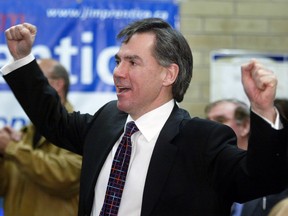
Former Alberta premier Jim Prentice was remembered Friday as a pivotal figure in both provincial and federal politics, a leader who stuck to his principles even in defeat.
Prentice, who was killed Thursday night in a British Columbia plane crash, served in the key federal cabinet posts of Indian and Northern Affairs, Industry and Environment before his tumultuous tenure as premier.
The loss capped a dramatic period in Alberta politics that saw an unprecedented mass floor-crossing of Opposition MLAs to the PC government, a tough budget and an election called a year ahead of the date set out in provincial legislation.
But Robin Campbell, who served as Prentice’s finance minister, noted that the Tory loss stemmed from government efforts to squarely face the economic and fiscal consequences of slumping oil prices that continue to bedevil Alberta.
“I think people will look back and realize he was honest and what he was doing was the right thing for the province,” Campbell said Friday.
“It wasn’t the right thing for Jim Prentice. As a matter of fact, the right thing for Jim Prentice would have been to not be so honest. But he was. That’s who he was. And he thought it was important for Albertans to hear the truth.”
Prentice, who is survived by his wife Karen and three daughters, Christina, Cassia and Kate, was born in Ontario and came to Grand Cache, Alta., at the age of 13, with the family later moving to Crowsnest Pass.
His father had played briefly in the NHL and Prentice was a self-described “rink rat” as a kid before a knee injury ended his dreams of a pro hockey career.

As he often recounted on the campaign trail, Prentice spent his summers working in the coal mines, while studying commerce at the University of Alberta and law at Dalhousie University in Halifax.
Long interested in politics, Prentice got his first real taste of political life when he volunteered on Joe Clark’s upstart federal PC leadership campaign in 1976.
That started what would be decades of immersion in conservative circles, including an unsuccessful run for the provincial Tories in 1986.
“He was passionate about politics,” said former PC cabinet minister Rick Orman, a longtime friend of Prentice.
While family considerations kept Prentice off the ballot through the 1990s, he chaired Orman’s unsuccessful bid for the provincial Tory leadership in 1991 and became treasurer of the federal PC party from 1991 to 1995.
As a lawyer, Prentice became active in property rights cases and First Nations land claims, eventually serving as head of the Indian Claims Commission of Canada.
Longtime Tory cabinet minister Dave Hancock, who had been friends with Prentice since they were both students at the U of A, said that work on indigenous issues is a key — if little-known — aspect of Prentice’s legacy.
“He set the table for the resolution of a number of outstanding land claims . . . a lot of that is down to his work building the relationships with aboriginal leaders and the ability to understand the issues,” said Hancock.
Prentice’s next attempt at elected politics came as the fracture between Canada’s conservative forces was at its deepest in the early 2000s.
Amid talk of trying to “unite the right,” he opted to seek the federal nomination in Calgary Southwest in 2002 to capture Preston Manning’s old seat. He won the PC nomination but stepped aside when newly crowned Canadian Alliance leader Stephen Harper decided to run in the riding.

The following year, he entered the federal PC leadership race to replace Clark, finishing second as a relative unknown, talking up cross-party co-operation.
Jason Kenney, who was then a Canadian Alliance MP, said that as a voice on the Tory side favouring unity, Prentice played a crucial role in the ultimate merger of the Alliance and the PCs.
“What Jim did was make it much more acceptable in PC circles,” said Kenney, who later served in cabinet with Prentice.
After the parties were united, Prentice launched a short-lived campaign to lead the new Conservative party. He stepped aside the day Harper announced his own leadership bid, citing the lack of ability to raise funds.
In 2004, Prentice ran for public office under the Conservative banner in Calgary North-Centre, winning by more than 17,000 votes. In opposition, the rookie MP made headlines for supporting same-sex marriage legislation when most of his Tory colleagues did not.
Prentice said later the pressure on him over the vote was incredible and the fallout was intense, including one angry Calgarian pulling over in a pickup truck and threatening to clean his clock.
“(But) I believe in the rights of individuals, including the rights of communities of faith,” said Prentice. “There’s a duty to balance and protect the rights of everyone.”

After the 2006 election, he was appointed to Harper’s cabinet and would serve in some of the most high-profile and contentious portfolios. He also served as the chair of the critical cabinet operations committee that handles day-to-day government business.
Among Prentice’s major accomplishments in cabinet was a historic apology for the Indian residential schools. As environment minister, he represented Canada as it signed the Copenhagen accord to curtail greenhouse gas emissions, he began the phase-out of coal-fired power, and he negotiated tougher auto emission standards with the United States.
Former premier Alison Redford, who as a young lawyer articled under Prentice, said he was a “very effective” environment minister.
“He raised issues around environment and climate change in arenas that really weren’t very open to embracing those ideas,” she said. “He very often ran into opposition in terms of how forward-thinking he was.”
Kenney noted that Prentice was also an early voice raising the need for greater market access for Alberta oilsands crude, long before the issue came to dominate Alberta’s political relations with the rest of the country.
In 2010, after more than six years as an MP, Prentice surprised many when he declared his “tour of duty” in the House of Commons was over. He took an executive role with the Canadian Imperial Bank of Commerce and later a number of corporate directorships with blue-chip firms such as Canadian Pacific and BCE.
While he was often mentioned as a potential successor to Harper as Conservative leader, it was provincial politics that ultimately pulled him back.
The PC dynasty that had governed Alberta for more than four decades was in rough shape following years of infighting and the resignation of Redford in the midst of controversy.
Prentice entered the race as the overwhelming favourite, with the support of almost the entire Tory caucus, as he promised to renew the ethical tone of government.
https://www.youtube.com/watch?v=f2VZBh5ZPUU
PC leadership profile: Jim Prentice
 Calgary Herald
1 Comment
“I will need to work hard to restore the trust and confidence that Albertans expect in their government,” he said when he launched his campaign.

Prentice swept to victory with 77 per cent of the vote in the leadership campaign to become Alberta’s 16th premier.
Exerting a steady hand as premier, Prentice was at first enormously popular, but trouble quickly arose during his tenure as the high oil prices that had buoyed the provincial economy — and government coffers — began to slide.
Just before Christmas of 2014, almost the entire Wildrose Opposition caucus crossed the floor to join the PC government. While the move at first appeared to be a political master stroke, the mass defection caused fury among Wildrose supporters and raised dissatisfaction among many PCs.
In early 2015, Prentice’s government released a deficit budget that put an end to Alberta’s flat tax on income and reintroduced health-care premiums, while also cutting health and education spending.
Saying he needed a mandate for the budget, Prentice called an election despite provincial legislation that set the date of the vote in 2016.
Hammered on both sides by the Wildrose and the NDP under new leader Rachel Notley, the Tories went down to defeat, with Prentice resigning both his party leadership and the Calgary-Foothills seat he had just won on election night.

Prentice mostly laid low in the election aftermath but apologized to PC members at a party dinner in Calgary less than two weeks after the vote.
“The obligation of leadership rests squarely on my shoulders,” an emotional Prentice told the crowd of more than 1,000 people.
“I will carry those decisions and the electoral consequences of it for the rest of my life.”
In the year after the election, Prentice was named a visiting scholar at the Washington D.C.-based Canada Institute of the Wilson Centre for four months and took a new position with private equity firm Warburg Pincus. He also wrote a book on energy and environment issues in Canada that will be released next year.
Many of his friends and colleagues who spoke Friday stressed Prentice’s devotion to his family was the most important thing to him, noting that his defeat had allowed him to spend more time with his wife, daughters and grandchildren.
Hancock said there will be time in the future to weigh the ins and outs of Prentice’s time as premier.
“Today is the time to recognize that here was a person of intellect, of character and of ability who stepped forward to provide service . . . and he did it at great sacrifice to family,” he said.
“And then to have a life cut short, so you don’t have that time to make up some of the stuff you lost in the process, that’s what we need to be thinking about today.”
— With files from The Canadian Press
Stephen Harper's long political path from plucky upstart to the nation's helm
Tracing the former prime minister's circuitous route to power through CBC Calgary's video archives
From Stephen Harper's plucky candidacy with the upstart Reform Party, to becoming leader of the Canadian Alliance, to the creation of the modern Conservative Party of Canada, to being elected prime minister, Harper's path to power was long and winding — all of it captured in CBC Calgary's video archives.
In Stephen Harper's earliest appearance in CBC Calgary's video archives, he's attacking Joe Clark.
It was September 1988 and, as a young member of the upstart Reform Party, Harper took dead aim at the former Progressive Conservative prime minister and then MP, accusing him of being more talk than action on issues Western Canadians care about — particularly agriculture, Senate reform and federal procurement policies.
"He's going to have to tell people what he's done on those issues and what he will do," Harper says.
"And, if he doesn't address them, he's going to be in trouble."
 Harper '88 Joe Clark critique
At the time, Harper and the Reform movement may have seemed like a minor threat to the governing PC party, which enjoyed a massive majority in Parliament.
The Tories suffered a small setback in the election later that year, losing seats to both the Liberals and NDP, but still earned a comfortable majority government, while the Reform Party won barely two per cent of the popular vote.
But with a worsening economy and Prime Minister Brian Mulroney's introduction of the wildly unpopular GST, things had changed by the early 1990s.
Staring down sinking poll numbers, the Tories launched a pre-emptive strike on their Reform opponents in May 1992.
Harper seemed to relish the retaliation.
 Harper '92 Tory attack on Reform
"It's no secret that we wouldn't be attacked unless we were considered pretty important," Harper told reporters, in response to PC radio ads targeting Reform policies.
Sensing opportunity and seeing their party membership numbers swell, Harper and other Reform candidates began planning strategy for the looming election call.
On policy, Harper stressed a handful of issues that would become his refrain, including reducing government spending and getting tough on crime.
 Harper '93 Reform candidates
The strategy worked.
In the 1993 federal election, the Reform Party broke through, winning 52 seats and falling just short of forming the Official Opposition to the Bloc Quebecois.
The Liberals, meanwhile, swept to power under Jean Chretien, while the PCs were nearly wiped out, being reduced to a mere two seats.
Not one to sit quietly in caucus, Harper soon made headlines by taking on Reform Leader Preston Manning and the party brass.
He questioned the annual allowance of roughly $31,000 the party paid Manning, on top of his MP salary, for things like transportation, clothing and other expenses, without requiring receipts.
 Harper '94 Manning critique
"I think it's not consistent with what we're advocating publicly," Harper said in April 1994. "I really would strongly urge the party … to make all of these allowances accountable."
By 1995, polls were showing declining support for the Reform Party and increasing support for the Progressive Conservatives, but both parties were being consistently walloped by public support for the federal Liberals under Chretien.
Alberta Premier Ralph Klein said at the time that Reform had created a "very strange political situation" that split the Conservative vote and paved the way for Chretien to continue effectively unchallenged.
Klein suggested it might be time for the right-of-centre parties to join forces.
 Harper '95 Reform merger
Harper, for his part, agreed, but stopped short of calling for an immediate merger.
"If you have three or four opposition parties in the next campaign, the only beneficiary is the Liberals," he said in July 1995.
But the merger talk produced little action and Harper started looking at other career options.
After revealing in late 1996 that he wouldn't run in the next federal election, he announced his resignation as an MP in January 1997 to take a position as vice-president with the National Citizens Coalition, a conservative advocacy group.
"Frankly I'm looking to being in a position where I can speak much more independently than I'm able to do as a Member of Parliament," Harper told reporters at the time.
 Harper '97 quits politics
Five months later, the Chretien Liberals cruised to another majority government, but the Reform Party managed to pick up 10 more seats and edge ahead of the Bloc Quebecois to form the Official Opposition.
But, despite running a full slate of candidates for the first the time, no Reform MPs were elected east of Manitoba, diminishing the party's hopes of developing a national presence.
The sense that Reform's growth had stalled eventually led to the creation of a new party, the Canadian Alliance, in March 2000, and a new leader in Stockwell Day.
A snap election later that year caught the Alliance off guard, and again the Chretien Liberals cruised to another majority government, increasing both their number of seats and share of the popular vote.
Infighting within the Alliance led Day to call a leadership convention, and that paved the way for Harper's return to federal politics.
 Harper '01 runs for Alliance leadership
Harper was first out of the gate in December 2001 to file papers as an Alliance leadership candidate, calling on the party to stop "navel gazing" over the idea of a merger with the PCs, which had so far led nowhere.
"We've got to end this interminable mating dance," he said. "It's not leading us anywhere and it's demoralizing people. We've got to get on to offering a conservative alternative to voters, and I'll let [PC Leader] Joe [Clark] offer a second Liberal party."
Harper went on to defeat Day on the first ballot of the leadership convention in April and then set his sights on a return to Parliament.
A logical place for him to run was Calgary Southwest, a staunchly conservative riding that had been recently vacated by Preston Manning and was due for a byelection.
But there already was an Alliance candidate in that riding — Ezra Levant.
Despite pressure from the party, Levant refused to give up his spot, at least at first.
 Harper '02 vs Ezra Levant
As the byelection campaign got underway, Harper described one of his biggest challenges as his status as the overwhelming favourite.
 Harper '02 byelection campaign
"What we're fighting, to a large degree, is apathy or people not knowing about the race or even, occasionally, people thinking I'm already the Member of Parliament," he said.
Only 23 per cent of Calgary Southwest voters ultimately turned out to the polls in May, but they elected Harper in a landslide, with 72 per cent of the vote.
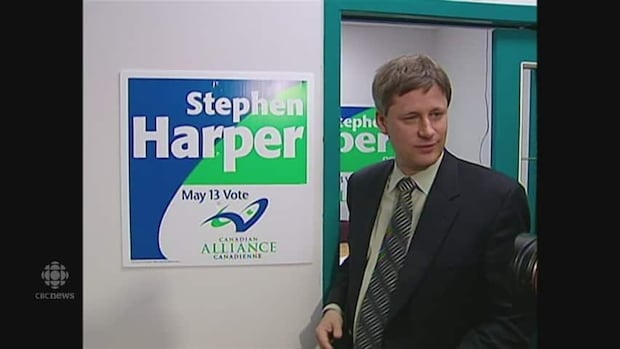 Harper '02 byelection win
"I think we've really established ourselves as the major opposition party in Western Canada and the major right-of-centre opposition party in Ontario," Harper said.
Taking his seat in Parliament as leader of the Official Opposition, Harper used the opportunity to exchange jabs with Chretien over internal strife within the governing party over who would succeed him as leader.
Three months later, in August 2002, Chretien announced that he would retire in 2004.
In Calgary, some voters greeted the news by literally jumping for joy.
 Harper '02 Chretien quits
Harper, too, must have been thrilled by the development.
While the Liberals were fighting over succession, the Canadian Alliance and Progressive Conservatives finally found common ground and agreed to merge into the present-day Conservative Party of Canada.
As the Liberals reeled from a damning auditor-general report into the sponsorship scandal, Harper was elected leader of the new Conservative party in March 2004, giving him his best shot yet at government in the federal election that June.
Not everyone in the small-c conservative movement was smiling, however.
Clark refused to endorse Harper or the new Conservative party, even going as far as saying Chretien's replacement, Paul Martin, was a "marginally more acceptable" option for voters.
Despite the Liberals' challenges, though, Martin managed to eke out a minority government.
Harper, nonetheless, was buoyed by the Conservatives' 99 seats in Parliament.
"Tonight our new party has, in a very short period of time, made historic strides across this country," he said.
 Harper '04 Election Loss
But as the Martin government flailed, Harper smelled blood.
Less than a year after the election, he was laying the groundwork for a non-confidence vote to bring down the shaky Liberal minority.
"I will be asking our caucus to put this government out of its misery at the earliest possible opportunity," Harper said in April 2005.
It didn't take long.
By November the government fell, setting the stage for a Christmas campaign.
 Harper '05 government falls
Once the writ was dropped, the Conservatives hammered the Liberals over the sponsorship scandal while setting out key planks of their platform.
Harper criss-crossed the country promising to trim the GST, create a $1,200-per-child rebate for parents, toughen up the criminal justice system and boost military spending.
The message resonated with voters, who moved toward the Conservatives, not in overwhelming numbers, but enough to give the party a foothold on government that it would translate into nearly a decade of rule.
Under Harper, the party won 36.3 per cent of the popular vote in 2006 and earned its first minority government.
 Harper '06 election win
Harper and the Conservatives went on to earn a second, larger minority in 2008.
They finally won their coveted majority government in 2011.
In 2015, they were defeated by Justin Trudeau's Liberal Party, and Harper resigned as party leader.
On Aug. 26, 2016, Harper announced his resignation as a Member of Parliament.
 A look back at Stephen Harper's political legacy
ABOUT THE AUTHOR

Calgary Southwest
Calgary Southwest was a federal electoral district in Alberta, Canada, that was represented in the House of Commons of Canada from 1988 to 2015. The district was in the southwest part of the city of Calgary, south of Glenmore Trail and west of the Canadian Pacific Kansas City Railway line.
Former Prime Minister Stephen Harper represented the riding during his leadership.
History
The electoral district was created in 1987 from parts of the Bow River, Calgary West, Calgary East, Calgary South, and a small piece of Calgary Centre ridings.
The riding was abolished during the Canadian federal electoral redistribution, 2012, 80% into Calgary Heritage and 20% into Calgary Midnapore.
Historical boundaries
-
 1987 representation order
 -
 1996 representation order
 -
 2003 representation order
.svg)


Members of Parliament
This riding has elected the following members of the House of Commons of Canada:
Members of Parliament
All three of the riding's MPs were prominent: Bobbie Sparrow served in the cabinet led by Kim Campbell, while Preston Manning was the leader of the Reform Party of Canada from 1987 and Leader of the Opposition from 1997 to 2000. Its final MP in the Southwest configuration was Prime Minister Stephen Harper, an economist and a lecturer outside politics.[3] He was elected to Calgary Southwest, shortly after becoming leader of the Canadian Alliance and thus leader of the Opposition, in a 2002 by-election occasioned by Manning's retirement. From 2003, Harper was the leader of the re-formed Conservative Party of Canada, and from 2006, prime minister; he ceased to be both after the 2015 Canadian federal election.
Election results
Note: Change is compared to redistributed 2000 results. Conservative vote is compared to the combined Alliance and Progressive Conservative vote.
Note: Alliance vote is compared to the Reform vote in 1997.
 Alberta electoral district Alberta electoral district | ||||||||
|---|---|---|---|---|---|---|---|---|
Calgary Southwest in relation to the other Calgary ridings | ||||||||
| Defunct federal electoral district | ||||||||
| Legislature | House of Commons | |||||||
| District created | 1987 | |||||||
| District abolished | 2013 | |||||||
| First contested | 1988 | |||||||
| Last contested | 2011 | |||||||
| Demographics | ||||||||
| Population (2011)[1] | 136,011 | |||||||
| Electors (2011) | 93,707 | |||||||
| Area (km²)[2] | 76.70 | |||||||
| Census division(s) | Division No. 6 | |||||||
| Census subdivision(s) | Calgary | |||||||
| Parliament | Years | Member | Party | |||||
| Calgary Southwest Riding created from Bow River, Calgary Centre, Calgary East, Calgary West and Calgary South |
||||||||
| 34th | 1988–1993 | Bobbie Sparrow | Progressive Conservative | |||||
| 35th | 1993–1997 | Preston Manning | Reform | |||||
| 36th | 1997–2000 | |||||||
| 2000–2000 | Alliance | |||||||
| 37th | 2000–2002 | |||||||
| 2002–2003 | Stephen Harper | |||||||
| 2003–2004 | Conservative | |||||||
| 38th | 2004–2006 | |||||||
| 39th | 2006–2008 | |||||||
| 40th | 2008–2011 | |||||||
| 41st | 2011–2015 | |||||||
| Riding dissolved into Calgary Heritage and Calgary Midnapore | ||||||||
| 2011 Canadian federal election | ||||||||
| Party | Candidate | Votes | % | ±% | Expenditures | |||
|
|
Conservative | Stephen Harper | 42,998 | 75.12 | +2.16 | $62,436 | ||
|
|
New Democratic | Holly Heffernan | 6,823 | 11.92 | +4.16 | $1,113 | ||
|
|
Liberal | Marlene Lamontagne | 4,121 | 7.20 | −2.11 | $14,171 | ||
|
|
Green | Kelly Christie | 2,991 | 5.23 | −3.75 | $4,879 | ||
|
|
Independent | Larry R. Heather | 303 | 0.53 | +0.04 | $495 | ||
| Total valid votes | 57,236 | 99.69 | ||||||
| Total rejected ballots | 177 | 0.31 | −0.00 | |||||
| Turnout | 57,413 | 60.42 | +2.02 | |||||
| Eligible voters | 95,026 | |||||||
|
|
Conservative hold | Swing | -1.00 | |||||
| Note: Larry R. Heather's vote as an independent candidate is compared to his vote as a CHP candidate in 2008. | ||||||||
| 2008 Canadian federal election | ||||||||
| Party | Candidate | Votes | % | ±% | Expenditures | |||
|
|
Conservative | Stephen Harper | 38,545 | 72.96 | +0.60 | $61,102 | ||
|
|
Liberal | Marlene Lamontagne | 4,918 | 9.31 | −2.10 | $14,071 | ||
|
|
Green | Kelly Christie | 4,743 | 8.98 | +1.30 | $1,250 | ||
|
|
New Democratic | Holly Heffernan | 4,102 | 7.76 | −0.30 | $1,719 | ||
|
|
Libertarian | Dennis Young | 265 | 0.48 | $398 | |||
|
|
Christian Heritage | Larry R. Heather | 256 | 0.48 | −0.01 | $1,746 | ||
| Total valid votes/expense limit | 52,832 | 99.69 | – | $92,156 | ||||
| Total rejected ballots | 164 | 0.31 | +0.10 | |||||
| Turnout | 52,996 | 58.39 | -8.18 | |||||
| Eligible voters | 52,996 | |||||||
|
|
Conservative hold | Swing | +1.35 | |||||
| 2006 Canadian federal election | ||||||||
| Party | Candidate | Votes | % | ±% | Expenditures | |||
|
|
Conservative | Stephen Harper | 41,549 | 72.36 | +4.01 | $67,115 | ||
|
|
Liberal | Michael Swanson | 6,553 | 11.41 | -6.99 | $15,691 | ||
|
|
New Democratic | Holly Heffernan | 4,628 | 8.06 | +2.48 | $5,177 | ||
|
|
Green | Kim Warnke | 4,407 | 7.68 | +1.46 | $1,800 | ||
|
|
Christian Heritage | Larry Heather | 279 | 0.49 | +0.04 | $1,370 | ||
| Total valid votes | 57,416 | 99.79 | – | |||||
| Total rejected ballots | 120 | 0.21 | -0.08 | – | ||||
| Turnout | 57,536 | 66.57 | +2.08 | – | ||||
| Eligible voters | 86,426 | |||||||
|
|
Conservative hold | Swing | +5.50 | |||||
| 2004 Canadian federal election | ||||||||
| Party | Candidate | Votes | % | ±% | Expenditures | |||
|
|
Conservative | Stephen Harper | 35,297 | 68.36 | -12.84 | $62,955 | ||
|
|
Liberal | Avalon Roberts | 9,501 | 18.40 | +3.49 | $55,529 | ||
|
|
Green | Darcy Kraus | 3,210 | 6.22 | $521 | |||
|
|
New Democratic | Daria Fox | 2,884 | 5.59 | +1.70 | $3,648 | ||
|
|
Marijuana | Mark de Pelham | 516 | 1.00 | – | |||
|
|
Christian Heritage | Larry Heather | 229 | 0.44 | $1,630 | |||
| Total valid votes | 51,637 | 99.71 | – | |||||
| Total rejected ballots | 149 | 0.29 | – | – | ||||
| Turnout | 51,786 | 64.49 | – | |||||
| Eligible voters | 80,296 | |||||||
|
|
Conservative notional hold | Swing | -8.16 | |||||
| 2000 federal election redistributed results[4] | ||||||||
| Party | Vote | % | ||||||
| Canadian Alliance | 31,756 | 64.96 | ||||||
| Progressive Conservative | 7,936 | 16.23 | ||||||
| Liberal | 7,290 | 14.91 | ||||||
| New Democratic | 1,901 | 3.89 | ||||||
| Canadian federal by-election, May 13, 2002 Resignation of Preston Manning | ||||||||
| Party | Candidate | Votes | % | ±% | Expenditures | |||
|
|
Alliance | Stephen Harper | 13,200 | 71.66 | +6.84 | $58,959.16 | ||
|
|
New Democratic | Bill Phipps | 3,813 | 20.70 | +16.73 | $34,789.77 | ||
|
|
Green | James S. Kohut | 660 | 3.58 | $2,750.80 | |||
|
|
Independent | Gordon Barrett | 428 | 2.32 | $3,329.34 | |||
|
|
Christian Heritage | Ron Gray | 320 | 1.74 | $27,772.78 | |||
| Total valid votes | 18,421 | 99.47 | ||||||
| Total rejected ballots | 98 | 0.53 | +0.23 | |||||
| Turnout | 18,519 | 23.05 | -39.89 | |||||
| Electors on the lists | 80,360 | |||||||
|
|
Alliance hold | Swing | -4.94 | |||||
| 2000 Canadian federal election | ||||||||
| Party | Candidate | Votes | % | ±% | Expenditures | |||
|
|
Alliance | Preston Manning | 34,529 | 64.81 | +6.81 | $69,676 | ||
|
|
Progressive Conservative | Paul Monaghan | 8,679 | 16.29 | -1.61 | $8,592 | ||
|
|
Liberal | Barry J. Rust | 7,954 | 14.93 | -5.24 | $13,233 | ||
|
|
New Democratic | Jennifer Stewart | 2,113 | 3.97 | +1.22 | $720 | ||
| Total valid votes | 53,275 | 99.70 | – | |||||
| Total rejected ballots | 158 | 0.30 | +0.07 | – | ||||
| Turnout | 53,433 | 62.93 | -3.84 | – | ||||
| Eligible voters | 84,905 | |||||||
|
|
Alliance notional hold | Swing | +4.22 | |||||
| 1997 Canadian federal election | ||||||||
| Party | Candidate | Votes | % | ±% | Expenditures | |||
|
|
Reform | Preston Manning | 27,912 | 57.99 | -3.23 | $62,515 | ||
|
|
Liberal | Paul Drager | 9,706 | 20.17 | +3.86 | $61,666 | ||
|
|
Progressive Conservative | Jan Brown | 8,617 | 17.90 | -0.69 | $34,551 | ||
|
|
New Democratic | Mara Vogel | 1,322 | 2.75 | +1.13 | $1,064 | ||
|
|
Green | Sol Candel | 310 | 0.64 | +0.20 | |||
|
|
Natural Law | Richard Shelford | 175 | 0.36 | -0.00 | |||
|
|
Christian Heritage | Larry Heather | 89 | 0.18 | – | $176 | ||
| Total valid votes | 48,131 | 99.78 | – | |||||
| Total rejected ballots | 107 | 0.22 | – | – | ||||
| Turnout | 48,238 | 66.78 | – | |||||
| Eligible voters | 72,239 | |||||||
|
|
Reform hold | Swing | -3.54 | |||||
| 1993 Canadian federal election | ||||||||
| Party | Candidate | Votes | % | ±% | Expenditures | |||
|
|
Reform | Preston Manning | 41,630 | 61.22 | +47.80 | $59,445 | ||
|
|
Progressive Conservative | Bobbie Sparrow | 12,642 | 18.59 | -46.57 | $61,978 | ||
|
|
Liberal | Bill Richards | 11,087 | 16.30 | +4.77 | $60,511 | ||
|
|
New Democratic | Catherine Rose | 1,099 | 1.62 | -6.49 | $4,791 | ||
|
|
National | Lea Russell | 910 | 1.34 | $2,580 | |||
|
|
Green | Sol Candel | 301 | 0.44 | $6,216 | |||
|
|
Natural Law | Ida Bugmann | 249 | 0.37 | $0 | |||
|
|
Independent | Miel S.R. Gabriel | 57 | 0.08 | $218 | |||
|
|
Communist | Darrell Rankin | 28 | 0.04 | $1,422 | |||
| Total valid votes | 68,003 | 100.00 |
| |||||
| Rejected ballots | 137 |
|
| |||||
| Turnout | 68,140 | 70.81 |
| |||||
| Electors on lists | 96,213 |
|
| |||||
|
|
Reform gain from Progressive Conservative | Swing | +47.19 | |||||
| Source:Thirty-fifth General Election, 1993: Official Voting Results, Published by the Chief Electoral Officer of Canada. Financial figures taken from official contributions and expenses provided by Elections Canada. | ||||||||
| 1988 Canadian federal election | ||||||||
| Party | Candidate | Votes | % | |||||
|
|
Progressive Conservative | Bobbie Sparrow | 40,397 | 65.16 | ||||
|
|
Reform | Janet Jessop | 8,316 | 13.41 | ||||
|
|
Liberal | Percy Baker | 7,147 | 11.53 | ||||
|
|
New Democratic | Vera Vogel | 5,024 | 8.10 | ||||
|
|
Independent | Larry R. Heather | 669 | 1.08 | ||||
|
|
Rhinoceros | Johnny Barretto | 372 | 0.60 | ||||
|
|
Confederation of Regions | Bill Sinclair | 68 | 0.11 | ||||
| Total valid votes | 61,993 | 100.00 | ||||||

Confederation of Regions Party of Canada
Confederation of Regions Party of Canada | |
|---|---|
| Former federal party | |
| Founder | Elmer Knutson |
| Founded | 1984 |
| Dissolved | 1988 (Federal, some provincial branches continued) |
| Split from | Social Credit Party |
| Merged into | Reform Party of Canada (de facto) |
| Ideology | Conservatism Regionalism Anti-bilingualism |
| Political position | Right-wing |
| Colours | Green, Yellow |
The Confederation of Regions Party (CoR) was a right-wing federal political party in Canada founded in 1984 by Elmer Knutson. It was founded as a successor to the Western Canada Federation (West-Fed), a non-partisan organization, to fight the Liberal Party of Canada. The CoR aimed to fill the void on the right of the political spectrum left by the decline of the Social Credit Party of Canada and the growing unpopularity among westerners of the Progressive Conservative Party of Canada under the leadership of Brian Mulroney.
The party also attracted significant support as a protest vote against official bilingualism among some voters who were not necessarily ideologically opposed to mainstream Canadian political parties on other issues. The party proposed dividing Canada into four 'regions', western Canada, Atlantic Canada, Ontario and Quebec, each with an equal number of seats in the House of Commons of Canada.[1]
In the 1984 federal election, it nominated 55 candidates, who won 65,655 votes in total, or 0.52% of the popular vote across the country. The party took 2.2% of the vote in Alberta and peaked with 6.7% in Manitoba.
In the 1988 federal election, its 51 candidates won 41,342 votes, 0.31% of the popular vote. One of its candidates was Paul Fromm, leader of the far-right groups Citizens for Foreign Aid Reform and Canadian Association for Free Expression. (See also: Confederation of Regions Party candidates, 1988 Canadian federal election).
The party's greatest success came in New Brunswick, where its provincial wing, the New Brunswick Confederation of Regions Party, held the status of official opposition from 1991 to 1995. After the demise of CoR, many former supporters joined the Reform Party of Canada.
New Brunswick Confederation of Regions Party
The New Brunswick Confederation of Regions Party was a political party in the Province of New Brunswick, Canada. It was the only branch of the Confederation of Regions Party of Canada to win any seats in their respective legislature. Having won the second most seats in the 1991 provincial election, the party was the official opposition in the Legislative Assembly between 1991 and 1995, before losing all its seats in the following election.
New Brunswick Confederation of Regions Party | |
|---|---|
| Former provincial party | |
| Founder | Arch Pafford |
| Founded | 1989 |
| Dissolved | March 31, 2002 |
| Ideology | Conservatism Regionalism Anti-bilingualism |
| Political position | Right-wing |
| Colours | Green, Yellow |
| Most MLAs (1991) | 8 / 58 |
History
Uprising
In the late 1980s, support for the Progressive Conservative Party of Premier Richard Hatfield had collapsed because of corruption scandals in the government. As well, many English-speaking New Brunswickers were unhappy with the government's promotion of official bilingualism (the use of English and French in public services).
The federal Confederation of Regions Party (CoR) promised to repeal the 1969 Official Languages Act, which made the English and French languages equal for all official purposes in all public services. CoR proposed providing government services in French only in areas with a predominantly francophone population. The French-speaking Acadian population believed this to be an anti-francophone policy, and so the CoR had no support in areas of majority francophone population.
In the 1988 federal election, the CoR Party had considerable success in New Brunswick, where it nominated candidates in seven of the ten electoral ridings and captured 4.3% of the vote within the province.
Formation
The CoR Party's New Brunswick provincial wing was founded in 1989.[1] Miramichi businessman Arch Pafford was elected its first leader, and former Hatfield cabinet minister Ed Allen became the party's most notable candidate. Blaine Higgs, who would decades later become leader of the Progressive Conservative Party and Premier, also ran for the CoR leadership, placing second behind Pafford.[2]
1991 provincial election
.gif)
The party's greatest success came in the 1991 provincial election. Going into the election, the Liberals held all the seats in the legislature, but many conservatives, especially in the Fredericton area and rural southern New Brunswick, were still upset with the Progressive Conservatives over the issue of bilingualism. CoR was able to capitalize on the situation, winning 21.04% of the vote (87,256 votes) and eight seats despite only running candidates in 48 of the 58 ridings.Despite their success, the CoR Party's leader, Arch Pafford, did not win his seat, placing third behind the Liberal and Progressive Conservative in Miramichi-Newcastle. [3] Danny Cameron, who won his seat in York South, was chosen as the party's interim leader following the election.[1]
The party ran full slates in Northumberland, Westmorland and Victoria counties, which have mixed English-speaking and Acadian populations, and a full slate in the Acadian-but-bilingual Restigouche county. The party also nominated one candidate in Kent County and two in Gloucester County. No candidates for the CoR ran in the very unilingual French Madawaska County. The Progressive Conservatives, which ran a full slate of 58 candidates, received only 20.7% of the vote and three seats.
The results allowed the CoR Party to form the official opposition, and their success prompted pro-bilingual politicians in the governing Liberal Party to enshrine section 16.1 in the Charter of Rights in 1993. The section guarantees equality between English-speaking and French-speaking residents of New Brunswick.
Internal divisions
Internal differences resulted in political infighting within the CoR. A rivalry formed between Cameron, who was seen as a moderate within the party, and fellow CoR MLA Brent Taylor, who was seen as more radical. A year after Cameron's election as interim leader, the party's board of directors sought to remove him. A structural problem arose, as the party policy was that an elected member is responsible to the electorate first, the party second, and the leader last, yet under its constitution the board of directors (and not the elected caucus) could call a leadership convention, which inevitably gave the party control over the elected members.Martin, Geoffrey (1995). "The Rise and Fall of the New Brunswick CoR Party, 1988-1995". Canadian Parliamentary Review. 18 (3): 19–22. Retrieved 4 October 2024. The party council then held a leadership race at the 1992 convention in Campbellton, where Taylor narrowly defeated Cameron and became leader. However, Cameron and his supporters argued that the race was illegal. Cameron's supporters later gained control over the party's presidency, allowing Cameron to fire a large portion of the party executive and council. Taylor and fellow CoR MLA Bev Brine were kicked out of the caucus in 1994 due to their ongoing opposition to Cameron. During this period, party membership dropped from 20,000 to 5,000.[citation needed]
Cameron eventually chose to resign the leadership to try to settle the internal divisions affecting the party. The entire party membership was allowed to vote in the race that followed. Pro-Taylor Gary Ewart was chosen over pro-Cameron Greg Hargrove, but neither Ewart nor caucus leader Ab Rector were able to resolve their differences with Cameron's supporters. Ewart resigned 23 days later, leaving the party in limbo.[citation needed]
1995 provincial election
The executive elected Greg Hargrove leader in time for the 1995 election, but the damage had been done. None of the party Members of the Legislative Assembly were re-elected in 1995, and the party received just 27,684 votes (7.1% of the popular vote), placing them behind the New Democrats.[4]
1999 provincial election
By 1999, Conservative voters were being wooed back by the charismatic leadership of Bernard Lord, who looked poised to return the party to power after ten years in the wilderness. The Confederation of Region Party, now led by Jim Webb, slipped further in the 1999 provincial election to just 2,807 votes (0.7% of the total).[5] Following the election, Colby Fraser, who had run federally for the party in 1988, replaced Webb as leader.
Dissolution
In 2001, Fraser contacted the remaining members, who voted to dissolve the party.[citation needed] The dissolution formally occurred March 31, 2002.
Leaders
- Arch Pafford (1989–1991)
- Danny Cameron (1991–1992) (interim leader)
- Brent Taylor (1992) - Taylor's election was later deemed illegal
- Danny Cameron (1992–1995)
- Ab Rector (1995) (interim leader)
- Gary Ewart (1995)
- Ab Rector (1995) (interim leader)
- Greg Hargrove (1995–1999)
- Jim Webb (1999)
- Colby Fraser (1999–2002)
Members of the New Brunswick Legislative Assembly
- Edwin G. Allen, Fredericton North (1991-1995)
- Beverly Brine, Albert (1991-1994)
- Danny Cameron, York South (1991-1995) (leader)
- Greg Hargrove, York North (1991-1995)
- Ab Rector, Oromocto (1991-1995)
- Brent Taylor, Southwest Miramichi (1991-1994)
- Gordon Willden, Riverview (1991-1995)
- Max White, Sunbury (1991-1995)
Election results
The CoR Party contested three general elections, with diminishing success. Despite being shut out of the legislature in 1995, they placed second in a number of ridings while by 1999 they placed fourth in every riding they ran a candidate.
| Election | Seats Won | Second Place | Third Place | Fourth Place | Not on ballot |
|---|---|---|---|---|---|
| 1991 | 8 | 18 | 17 | 5 | 10 |
| 1995 | - | 2 | 17 | 17 | 19 |
| 1999 | - | - | - | 18 | 37 |
See also
Further reading
- Martin, Geoffrey (1995). "The Rise and Fall of the New Brunswick CoR Party, 1988-1995". Canadian Parliamentary Review. 18 (3): 19–22. Retrieved 4 October 2024.
- Poitras, Jacques. "The Right Fight: Bernard Lord and the Conservative Dilemma" (2004) ISBN 978-0-86492-376-9 Goose Lane Editions.
References
- "Thirty-Fourth General Election, June 7, 1999" (PDF). Elections NB. 1999-11-01. Retrieved 2021-06-14.

No comments:
Post a Comment