
Neil Macdonald: The 'monarchs of money' and the war on savers
Power Shift: First in a series on the rise of the central bankers and the global imposition of cheap credit
 The Monarchs of Money
Quietly, without much public fuss or discussion, a new ruling class has risen in the richer nations.
These men and women are unelected and tend to shun the publicity hogged by the politicians with whom they co-exist.
They are the world's central bankers. Every six weeks or so, they gather in Basel, Switzerland, for secret discussions and, to an extent at least, they act in concert.
The decisions that emerge from those meetings affect the entire world. And yet the broad public has a dim understanding, if any, of the job they do.
In fact, these individuals now wield at least as much influence over the lives of ordinary citizens as prime ministers and presidents.
The tool they have used to change the world so profoundly is one they alone possess: creating money out of thin air.
There is an economic term for this: quantitative easing. More colloquially, it's called printing money.
Since the great economic meltdown in 2008, these central bankers have probably saved the world's economy from collapse, and dragged it into the unknown at the same time.
The amounts they have created are so vast as to be almost incomprehensible — trillions of dollars in pounds and euros, among other currencies.
At the end of 2012, the balance sheets of the world's largest central banks, those of the G20 nations and the eurozone, including Sweden and Switzerland, totalled $17.4 trillion US, according to Bank of Canada calculations from publicly available data.
What's their legacy?
When the record of the 2008 global financial catastrophe is fully written — that story remains a work in progress — the world's central bankers will emerge either as heroes, or as the people who administered a cure that turned out to be as bad as the disease.
Three of them in particular will go down in history: Ben Bernanke of the U.S. Federal Reserve, Mario Draghi of the European Central Bank, and Canada's own Mark Carney, soon to be the governor of the Bank of England.
That is nearly a quarter of global GDP, and slightly more than double the $8.5 trillion these same institutions were holding at the end of 2007, before the financial crisis hit.
Stock markets have risen on this tide of cheap money. So has real estate. So, arguably, has everything else.
But there are two big concerns with what this new central banker elite has done.
One is that no one really understands the consequences of pumping such vast amounts of money into the world economy. It's already distorted the prices of certain assets, and some fear hyperinflation or market crashes are inevitable (the subject of tomorrow's column).
The other is that it's caused a massive shift in wealth, from savers to borrowers, and is taking money out of the pockets of almost everyone approaching or at retirement age.
A war on savings
Probably the most painful of the consequences of quantitative easing has been borne by the elderly.
Most of that generation grew up believing that if you save and exercise prudence that you will earn at least a modest return on your hard-earned money to keep you comfortable in your old age, perhaps along with a pension.
But the money-printing orgy of the last five years looks to have shot that notion to smithereens.
Very deliberately, the central bankers have punished savers, pushing interest rates so low that any truly safe investment — and older people are always advised to play it safe — yields a negative return when inflation is factored in.

The policy has savaged pension and savings returns worldwide, but particularly in Britain, a nation of savers and pensioners.
There is more money in British pension funds than in the rest of Europe combined, and now that money is just sitting, "dead," as some call it, not working for its owners.
Ask Judy White, a retiree in her late 60s who lives in Teddington, south of London, with her husband, Alan.
This year, the Bank of England shattered her retirement. Her pension benefit was effectively slashed by half.
"I don't understand what quantitative easing is, except that it's printing money," she says. "But I do understand that I now have 50 per cent less.
"What they have done is take money from people who have been really careful all their lives."
On the backs of the virtuous
Actually, by the Bank of England's own reckoning, the £375 billion of quantitative easing it has carried out since 2008 has cost British savers and pensioners about £70 billion, roughly $100 billion. (At the same time, the richest 10 per cent of British households saw the value of their assets increase over the same period, the bank reported.)
That cost to the elderly is largely because pension payouts in the U.K. are pegged to the yields on government bonds, and quantitative easing has forced those yields down to almost nothing.
Speaking for the Bank of England, Paul Fisher acknowledges that the bank has created a paradox: It does want people to save and be prudent — just not right now.
"We try," he says, "to get people to do things now to get out of this mess, which in the long run we prefer not to do."
In other words, might we please have some more of the wild consumer spending and borrowing that helped get us all into this situation, at least for a while?

The plain fact, though, is that central bank- and government-imposed solutions to disasters caused by irresponsible, greedy, foolish behaviour are almost always carried out on the backs of the virtuous.
So it was with the bank rescues in 2008, and so it is with quantitative easing.
As Ros Altmann, a longtime pension manager and director of the London School of Economics, puts it, quantitative easing has amounted to a "monumental social experiment" — a large-scale transfer of wealth from older people to younger people.
"Anybody who was a saver and has got some accumulated savings will have had a reduction in their income," she says.
While "anyone who had a big debt, particularly mortgage debts, would have had improvement in their income because their interest payments have gone down."
As stupid as it might sound, older people everywhere would probably be better off if they'd abandoned prudence and borrowed more.
That is obviously not what the central bankers or our political leaders want. But that's the situation they've created.
What's the alternative?
This transfer from savers to borrowers has also been taking place here in the U.S. and in Canada, to varying degrees.
Some U.S. pension funds are in danger of default, at least partially because of these artificially low interest rates, and Canadian pension funds that are heavily invested in safer debt have been injured, too.
In an interview in his Ottawa office, Bank of Canada governor Mark Carney defends quantitative easing elsewhere, and his own low-interest rate policy, though he does acknowledge that it has been hard on pensioners and savers.
Like all central bankers, he argues the (impossible to prove) negative: There have been consequences, yes, but if we hadn't done this, things would be far, far worse.
As for carrying out these solutions on the backs of the virtuous: "I don't see a world where the virtuous are rewarded if we suffered a second Depression," he says. "These are the stakes."
Carney would prefer not to talk about the enormous power central bankers have gained since 2008, saying only: "We have a tremendous responsibility … because of a series of mistakes that were made in the private sector and the public sector."
 See
the surge in central bank holdings, the printing of new money,
beginning in the spring of 2008 with the bank bailouts and the
acquistion of long-term securities to keep interest rates down. (International Monetary Fund)
See
the surge in central bank holdings, the printing of new money,
beginning in the spring of 2008 with the bank bailouts and the
acquistion of long-term securities to keep interest rates down. (International Monetary Fund)
As Canada has performed better than most Western nations, Carney has not ordered any new money printing.
But he has kept interest rates down, and that has fed the real estate booms over the last few years in Vancouver, Toronto, Calgary and elsewhere.
He scoffs at the suggestion that "the party" will end at some point. "I am not sure we are having a party right now," he says. "It doesn't feel like a party."
And, in fact, he has repeatedly expressed concern at the huge debt levels Canadians are accruing, at least partly because of his low-rate policies.
But surely he understands the anger of an older person watching their savings being eroded, I ask him.
Carney smiles grimly. That question is clearly a sore point. He gets a lot of mail on the topic.
Canadians, he says, must understand that the alternative is massive unemployment and thousands of businesses going under, and "my experience with Canadians is that they tend to think about their neighbours and their children and more broadly … they care a little bit more than just about themselves."
Asked whether central bankers are not in fact enabling irresponsible behaviour by speculators enamoured of cheap money, not to mention politicians who can't curb their borrowing and spending, Carney merely remarks that voters in a democracy get the governments they choose.
ABOUT THE AUTHOR

Mark Carney holds rally in Fredericton – April 21, 2025
Transcript
look I uh I'm going to finish up but I was uh just given the day I was reminded of this difference in approach everyone

0 Comments

Fundy Royal, New Brunswick Debate – Federal Elections 2015 - The Local Campaign, Rogers TV
 Rogers tv
 Poilievre pledges to protect seniors' benefits during Toronto appearance


FORM 18-K
SECURITIES AND EXCHANGE COMMISSION
ANNUAL REPORT
Date of end of last fiscal year: March 31, 2002
THE CANADIAN ECONOMY*
General
The following chart shows the distribution of real gross domestic product (“GDP”) at basic prices (1997 constant dollars) in 2001, which is indicative of the structure of the economy.
DISTRIBUTION OF REAL GROSS DOMESTIC PRODUCT AT BASIC PRICES(1)
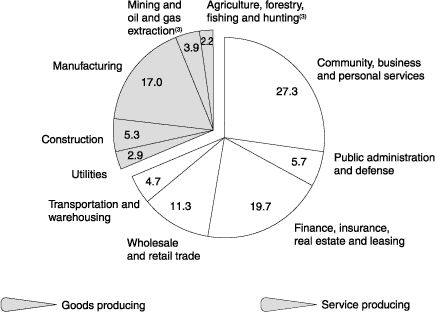
(1) GDP is a measure of production originating within the geographic boundaries of Canada, regardless of whether factors of production are Canadian or non-resident owned, whereas gross national product (“GNP”) measures the value of Canada’s total production of goods and services — that is, the earnings of all Canadian owned factors of production. Quantitatively, GDP is obtained from GNP by adding investment income paid to non-residents and deducting investment income received from non-residents. GDP at basic prices represents the value added by each of the factors of production and is equivalent to GDP at market prices less indirect taxes (net), plus other production taxes (net). Moreover, these differences in GDP measures explain any perceived discrepancies in GDP growth rates in this document.
(2) May not add to 100.0% due to rounding.
(3) The agriculture, forestry, fishing, hunting, mining and oil and gas extraction sectors include a service component.
The volume of industry and sector output in the following discussion provides “constant dollar” measures of the contribution of each industry to GDP at basic prices. The share of service-producing industries in real GDP was 68.7% in 2001 while the remaining 31.3% was attributed to goods-producing industries.
CANADA SAVINGS BONDS
Series S78 issued on November 1, 2002 has a guaranteed minimum interest rate of 2.00% for the year beginning November 1, 2002. Rates for the remaining years to maturity will be announced at a future date.
CANADA PREMIUM BONDS
Series P27 issued on November 1, 2002 has a guaranteed interest rate of 2.50% for the year beginning November 1, 2002, 3.00% for the year beginning November 1, 2003, 4.00% for the year beginning April 1, 2004, 4.85% for the year beginning November 1, 2005 and 6.00% for the year beginning November 1, 2006. Rates for the remaining years to maturity will be announced at a future date.
TREASURY BILLS
From October 1, 2002 through November 30, 2002 treasury bills outstanding increased by $4,400 million to $106,600 million.
CANADA BILLS
From October 1, 2002 through November 30, 2002 Canada Bills outstanding decreased by U.S.$155,039,000 to U.S.$1,701,386,000.
CROSS CURRENCY SWAPS
From October 1, 2002 through November 30, 2002, domestic liabilities of $237,390,000 were swapped into liabilities of U.S.$150,000,000.
CONSENT
I hereby consent to the use of my name in the Canada description attached as Exhibit D to the Form 18-K of Canada. I acknowledge that such description may from time to time be incorporated by reference into one or more Registration Statements, and in the related prospectuses, of Canada and/or one or more Crown Corporations of Canada. I consent to the use of my name in any such Registration Statements and related prospectuses in connection with the information so incorporated.
| /s/ Kevin G. Lynch | ||
| Kevin G. Lynch | ||
| Deputy Minister of Finance |
End of the Canada Savings Bonds Program
In the latest federal budget released on 22 March 2017, the Government of Canada announced it will discontinue the sale of Canada Savings Bonds (CSB) and Canada Premium Bonds (CPB) as of November 2017.
A formal communication was sent out to all Payroll Savings Plan owners and contributors from the Canada Savings Bonds Program, on behalf of the Government of Canada.
Your CSB contributions will continue to be deducted from your monthly pension until October 2017.
The funds (principal and interest) in your Payroll Savings Plan are safe, guaranteed and will be honoured. Bond series in your plan will continue to earn interest until redemption or maturity, whichever comes first. Go to CSB Online Services to validate your mailing address or sign up for direct deposit to ensure you receive your payment.
To find out what this announcement means to bond owners, you are encouraged to refer to the "Questions and Answers" by visiting the Canada Savings Bonds Program's website.
Canada Savings Bonds sales to continue, despite KPMG recommendation to stop
Program costs $58M to run and is no longer a 'net source of funds' for Ottawa
Ottawa has no plans to stop offering Canada Savings Bonds, despite the recommendations of a government-commissioned report from an arm of consultancy KPMG that recommends cancelling the program.
In a report, the consultancy says "there is currently no valid economic rationale for the retail debt program," better known to Canadians as Canada Savings Bonds and Canada Premium Bonds, which allow citizens to loan money to the government with interest for small time periods.
"For a time they were a great opportunity for people to save money using a simple to understand product that paid reasonable interest," is how Dan Bortolotti, an investment adviser with PWL Capital in Toronto described them. "But that time has possibly passed."
The program was formed in 1946, born out of a precursor designed to raise funds for the war effort, but has shrunk dramatically. The total value of all funds in the program was as high as $55 billion in 1987, but that has declined to about $7.7 billion in 2013. That's less than one per cent of all the insured retail savings instruments in Canada that year.
Far from being a source of funds, the program now costs Ottawa more money to run than it takes in. All in all, it costs Ottawa $58 million a year to run, not including the cost of interest payments, KPMG said.
"It is no longer a net source of funds for the government, since it has been necessary since 1987 to borrow on the wholesale market to fund the net yearly redemptions," KPMG said.
Despite the recommendations of the report, the Department of Finance said Thursday it has no plans to close the program.
"While noting KPMG's recommendations, the government recognizes that approximately 2.5 million Canadians continue to hold over $6 billion of government of Canada retail debt products, and over a million Canadians today still purchase Canada Savings Bonds and Canada Premium Bonds, demonstrating Canadians' continuing interest in the program," Stephanie Rubec, a spokeswoman for the Finance Department, said in a statement.
Low risk, low return
It's no coincidence that the program peaked during a time when interest rates were in double digits in the 1980s, when the prospect of safely loaning money to the government while getting a guaranteed return of more than 10 per cent for 10 or more years was attractive.
In 1981, for example, one could buy a Canada Savings Bond and earn 19.5 per cent interest, guaranteed.
Today, however, in the face of low interest rates that have dragged down both the cost of borrowing and the return on savings, the appeal has diminished. The one-year return on the batch of Canada Savings Bonds offered in April is a comparatively meagre one per cent — which means an investment of $1,000 on April 1 of this year would net someone a profit of $10 in a year's time.
That's below the current inflation rate, and less than what's offered at most high-interest savings accounts at banks, which are just as safe in terms of investments because they are 100 per cent backed by the Canada Deposit Insurance Corporation for up to $100,000.
Some versions of the bonds didn't even lock in the same returns over time. A Canada Savings Bond Series 547, issued in 1992, saw its annual return drop from six per cent when it was first offered, all the way down to 0.50 per cent in 2013 when it matured.
Bortolotti says low interest rates hastened their irrelevance, but Canada Savings Bonds won't return to prominence even if and when rates come back, because investors have so many other options now that didn't exist 20 or more years ago to achieve the same low-risk return.
Payroll deductions
Ottawa says the vast majority — 88 per cent — of Canada Savings Bonds sales now come through payroll deductions, where employees automatically save money by putting money into them through their place of work.
Unfortunately from the government's perspective, that's also one of the most expensive ways of managing the program, as it incurs costs for things like call centres and other administrative overhead. The KPMG report says as many as 220 people are employed to run that program. By that math, it takes one employee to run every $35 million worth of savings bond debt under management. In other countries with similar programs, that ratio is closer to $100 million to $300 million per employee, KPMG notes.
If the government doesn't want to cancel the program, at the very least it could eliminate the payroll sales channel to make the program more efficient and start a "no-frills version" that would eliminate the ability of Canadians to buy bonds through deductions from their paycheque, KPMG suggests.
That would allow the government to continue to provide Canadians with access to government bonds while reducing costs related to the program.
"The only channels maintained would be cash sales channels," the report said. Among other things, this would allow "a gradual downsizing of the call centres as the payroll sales channel gradually winds down."
Replacement needed?
Bortolotti says that if Ottawa opts to halt the payroll deduction option, he hopes employers will replace that with something comparable, because for many people they serve as a forced savings program that is "simple and automatic and without distractions."
Rubec said the government is assessing potential efficiencies to reduce program costs, but that it planned to maintain its existing distribution channels.
This isn't the first time Ottawa ignored a recommendation to wind down the system. In 2004, the then-Liberal government was advised by consultants to do so and save $650 million over the next nine years but shelved the plan. The subsequent Tory government has done the same ever since.
Rest in peace, CSB: A eulogy for the Canada Savings Bond
'A relic of a bygone era' has lost its shine and was axed in this week's budget
The Canada Savings Bond, a ubiquitous savings vehicle that grew from humble postwar origins into a household name by the 1980s, died this week after a lengthy decline.
She was 71 years old.
The official cause of death was no longer being "a cost effective source of funds."
The news — announced in Wednesday's federal budget — though somewhat grim, came as something of a relief to market watchers who spent decades watching CSB's rise and fall.
 By
the 1960s, Canada Savings Bonds had really come into their own and were
one of the most popular investment vehicles in the country. (Government of Canada)
By
the 1960s, Canada Savings Bonds had really come into their own and were
one of the most popular investment vehicles in the country. (Government of Canada)
Born in 1946 out of a previous program aimed at raising funds to support Canada's war effort, the upstart CSB took Canada by storm and soon became one of the most popular savings vehicles for an entire generation of baby boomers, who grew up watching her memorable — and often spectacular — performances.
After her grand debut, CSB quickly found fame as a payroll deduction, with more than 16,000 employers providing an easy and secure way for their employees to participate in the program.
She was popular from the start, but the heights she reached in mid-life were truly meteoric.
"I have a very clear memory of selling Canada Savings Bonds in 1981 with a 19.5 per cent interest rate," said David Baskin of Baskin Wealth Management in Toronto, a money manager who knew CSB well.
"Can you imagine that? It's almost impossible to believe."
 From 1981: CSBs pay out 19%
Against the backdrop of sudden runaway inflation in the 1980s, CSB was a star among investment vehicles. Even removing the wild inflationary days of the early 1980s from the equation, CSB offered risk-free returns in the high single digits for decades.
She cranked out small, steady returns of between two and four per cent a year for her first decade or so. By the time she reached adolescence, CSB was firmly in her heyday.
But she had even greater ambitions. For an entire generation of Canadians, their first exposure to the world of investing was a CSB that paid high single digits, and sometimes far more.

A poster for the bonds during happier times, in 1947, when they were barely a year old. (Government of Canada)"
Back in those days," Baskin recalled, "nobody had mutual funds," and investing "was unknown to the great part of the public."
CSB changed all that. Simply by loaning money to the government, she enabled everyday Canadians to save for their financial futures — for the first time ever, really.
"They were a staple of a lot of people's financial planning for decades," Baskin said.
From precocious ingenue to fast-rising young adult, CSB continued to gain popularity through the 1970s, and by 1976, held almost half of all the government's total marketable outstanding debt.
She peaked with a box office draw of $55 billion in 1987. With a yield of nine per cent, it's not hard to see why everyone wanted a piece of her.
Despite a flashy ad campaign singing her praises, a swift and sudden decline soon followed. Before Ottawa pulled the plug on Wednesday, there was only about $5.5 billion worth of CSBs left.
In the end, it wasn't just one ailment that felled CSB. In the face of online brokerages, she simply couldn't compete with shiny new starlets such as high-interest savings accounts and exchange-traded funds investors can buy and sell on their smartphone.
And she'd lost a lot of her former glory.
"The interest rate that the government is paying is now so tiny that nobody sees the point anymore," Baskin said of CSB's most-recent offering, which paid out a meagre 0.7 per cent return for 2016.
CSB's condition had worsened so significantly in recent years that she cost more to operate than she was worth. Consultancy KPMG reported recently that it costs Ottawa $58 million to offer CSBs every year — a figure that doesn't include interest payments.
With recent performances like that, it's not hard to see why Baskin and others are somewhat relieved to see her laid to rest. But not to worry — all outstanding CSBs will still be honoured in full, so those still hiding in safety deposit boxes are worth holding on to.
"They're a relic of a bygone era," Baskin said. And just as many fallen stars eventually end in a supernova "these things have a natural life cycle."
In lieu of deposits, put your money, literally, anywhere else.
ABOUT THE AUTHOR

The Dow is up 300 points as most of Wednesday’s big rally evaporates into the close: Live updates
 Traders work on the floor at the New York Stock Exchange on April 23, 2025.
Stocks surged on Wednesday on hopes that U.S.-China trade tensions could soon ease, while President Donald Trump signaled he doesn’t plan to remove Federal Reserve Chairman Jerome Powell from his post as central bank leader.
The Dow Jones Industrial Average
popped 397 points, or 1%. The S&P 500 climbed 1.5%, and the Nasdaq Compositerallied 2.4%.
However, the major averages faded from their session highs. Early Wednesday morning, the blue-chip Dow had added as much 1,100 points.
Trump said Tuesday he’s willing to take a less confrontational approach to trade talks with China, noting that the current 145% tariff on Chinese imports is “very high, and it won’t be that high. ... No, it won’t be anywhere near that high. It’ll come down substantially. But it won’t be zero.”
Treasury Secretary Scott Bessent also said Wednesday that both countries have the chance to make “a big deal” on trade. “If they want to rebalance, let’s do it together,” Bessent said.
“That’s what the market has been begging for — even just a hint of cooling down in the back and forth between the U.S. and China when it comes to trade,” said Keith Buchanan, portfolio manager at Globalt Investments. “The market is relieved, of course — the worst talk is hopefully behind us — but we’re still not at the end game.”
The Wall Street Journal also reported Wednesday, citing a White House official, that the administration was considering reducing China tariffs to between 50% and 65%. A White House official later told CNBC that such a move would have to be bilateral, however, with China lowering trade barriers as well.
Stocks with higher exposure to China that have sold off in recent weeks rallied. This included “Magnificent Seven” titans Apple
and Nvidia, which were up 3% and 4%, respectively.
Shares of Tesla
popped 5% also due to easing tariff pressures and after CEO Elon Musk said during the company’s Tuesday earnings call that his time spent running Trump’s Department of Government Efficiency will drop “significantly” starting next month.
Investors also breathed a sigh of relief as Trump also said that he has “no intention” of firing Powell, whose term as Fed chair will end in May 2026. The comment is a reversal of sorts for the president, who fired off barbs against Powell as recently as Monday, calling the central bank leader a “major loser” and demanding that interest rates come down. Just last week, Trump said in a Truth Social post that Powell’s “termination cannot come fast enough.”
Stocks are coming off of a winning session, with the 30-stock Dow
surging more than 1,000 points to end a four-day losing streak. Both the S&P 500 and the Nasdaq Composite jumped more than 2%.Gold’s rally may have reached ‘inflection point,’ BTIG says
Tuesday’s heavy trading in a popular gold fund may be a signal that the yellow metal’s rally needs a breather, according to BTIG.
On Tuesday, the trading volume of SPDR Gold Shares (GLD)
was 35.2 million shares, the highest since March 8, 2022, according to FactSet. On a notional value basis, the day appears to have been the highest since 2013, based on the closing price of the fund.
Shares of the fund dropped 1.4% on the day, reversing some of the recent rally for gold.
“The chart below speaks for itself, but we think today likely marks a multi-week, if not multi-month inflection for gold (GLD) followed by a period of consolidation,” BTIG chief market technical Jonathan Krinsky said in a note to clients.
“Parabolic moves rarely correct by moving sideways, so the downside risk is high here, in our view,” he continued.
GLD was down more than 2% on Wednesday.
— Jesse Pound
Citadel’s Ken Griffin warns Trump about tarnishing the ‘brand’ of U.S. Treasurys

- President Donald Trump’s global trade fight risks spoiling the reputation of the U.S. and its government bond market, according to Ken Griffin, founder and CEO of Citadel.
- Treasury yields have risen and the dollar has weakened against its global counterparts this month in a sign that investors may be moving away from the U.S. as the safest place to invest.
 Citadel
CEO Ken Griffin speaks during the Semafor World Economy Summit 2025 at
Conrad Washington on April 23, 2025 in Washington, DC.
Citadel
CEO Ken Griffin speaks during the Semafor World Economy Summit 2025 at
Conrad Washington on April 23, 2025 in Washington, DC. Ken Griffin, founder and CEO of Citadel, said President Donald Trump’s global trade fight risks spoiling the reputation of the country and its government bond market.
“The United States was more than just a nation … it’s a universal brand. Whether it’s our culture, our financial strength, our military strength, America rose beyond just being a country,” Griffin said at Semafor’s World Economy Summit in Washington, D.C., on Wednesday. “It was like an aspiration for most of the world, and we’re eroding that brand right now.”
Trump’s rollout of the highest tariffs on imports in generations shocked the world earlier this month, triggering extreme volatility on Wall Street. Days later, the president announced a sudden 90-day pause on much of the increase, except for China, as the White House sought to make deals with countries.
In reaction to the political tensions, Treasury yields rose and the dollar weakened against its global counterparts in a sign that investors are moving away from the U.S. as the safest place to invest.
“In the financial markets, no brand compared to the brand of the U.S. Treasury market, the strength of the U.S. dollar. The strength, the credit worthiness of U.S. Treasurys, no brand came close. We put that brand at risk,” Griffin said.
Griffin, whose hedge fund had more than $65 billion in assets under management at the beginning of 2025, voted for Trump and was a megadonor to Republican politicians. However, he has been highly critical of Trump’s trade policy, calling the president’s rhetoric “bombastic.”
“The President and the Secretary of Treasury and the Secretary of Commerce need to be very thoughtful when you have a brand, you need to behave in a way that respects that brand, that strengthens that brand because when you tarnish that brand, it can be a lifetime to repair the damage that has been done,” Griffin said.
Get Your Ticket to Pro LIVE
Join us at the New York Stock Exchange!
Uncertain markets? Gain an edge with CNBC Pro LIVE, an exclusive, inaugural event at the historic New York Stock Exchange.
In today’s dynamic financial landscape, access to expert insights is paramount. As a CNBC Pro subscriber, we invite you to join us for our first exclusive, in-person CNBC Pro LIVE event at the iconic NYSE on Thursday, June 12.
Stock markets tumble as investors pull back from American assets
The S&P 500 sank 2.4%, Dow Jones Industrial Average dropped 2.5%, Nasdaq fell 2.6%
Wall Street weakened Monday as investors worldwide became more skeptical about American investments, something many economists suggest is due to U.S. President Donald Trump's trade war and his ongoing criticism of the Federal Reserve.
The S&P 500 sank 2.4 per cent in another wipeout. That yanked the index 16 per cent below its record set two months ago.
The Dow Jones Industrial Average dropped 971 points, or 2.5 per cent, while losses for Tesla and Nvidia helped drag the Nasdaq composite down 2.6 per cent.
In Canada, the main S&P/TSX composite index fell 0.76 per cent today.
Perhaps more worryingly, U.S. government bonds and the value of the U.S. dollar also sank as prices retreated across U.S. markets. It's an unusual move because the value of U.S. Treasurys and the dollar have historically strengthened during episodes of nervousness. This time around, though, experts say it is policies directly from Washington that are causing the fear and potentially weakening their reputations as some of the world's safest investments.
Trump kept up his tough talk on global trade Monday as economists and investors continue to say his stiff proposed tariffs could cause a recession if they're not rolled back. U.S. talks last week with Japan failed to reach a quick deal that could lower tariffs and protect the economy, and they're seen as a "test case," according to Thierry Wizman, a strategist at Macquarie.
"The golden rule of negotiating and success: He who has the gold makes the rules," Trump wrote in all capital letters on his Truth Social Network. He also said that "the businessmen who criticize tariffs are bad at business, but really bad at politics," likewise in all caps.
 Billionaire Trump ally warns tariffs could trigger ‘economic nuclear winter’
Trump has recently focused more on China, the world's second-largest economy, which has also been keeping up its rhetoric. China on Monday warned other countries against making trade deals with the United States "at the expense of China's interest" as Japan, South Korea and others try to negotiate agreements.
"If this happens, China will never accept it and will resolutely take countermeasures in a reciprocal manner," China's Commerce Ministry said in a statement.
Also hanging over the market are worries about Trump's anger at Federal Reserve Chair Jerome Powell. Trump last week criticized Powell again for not cutting interest rates sooner to give the economy more juice.
The Fed has been resistant to lowering rates too quickly because it does not want to allow inflation to re-accelerate after slowing nearly all the way down to its two per cent goal from more than nine per cent three years ago.
Trump also referenced Powell in a social media post on Monday afternoon when he posted about a slowdown coming for the U.S. economy "unless Mr. Too Late, a major loser, lowers interest rates, NOW."
A move by Trump to fire Powell would likely send a bolt of fear through financial markets. While Wall Street loves lower rates, largely because they boost stock prices, the bigger worry would be that a less independent Fed wouldn't be as effective at keeping inflation under control. Experts worry that such a move could further weaken, if not kill, the United States' reputation as the world's safest place to keep cash.
All the uncertainty striking pillars at the centre of financial markets means some investors say they're having to rethink the fundamentals of how to invest.
"We can no longer extrapolate from past trends or rely on long-term assumptions to anchor portfolios," strategists at BlackRock Investment Institute said in a report. "The distinction between tactical and strategic asset allocation is blurred. Instead, we need to constantly reassess the long-term trajectory and be dynamic with asset allocation as we learn more about the future state of the global system."
That in turn could push investors outside the United States to keep more of their money in their home markets, according to the strategists led by Jean Boivin.
Big tech leads the drop
On Wall Street, Big Tech stocks helped lead indexes lower ahead of their latest earnings reports due later this week.
Tesla sank 5.7 per cent. The electric vehicle's stock has more than halved from its record set in December on criticism that its stock price had gone too high and that its brand has become too entwined with Elon Musk, who's leading the U.S. government's efforts to cut spending.
Chipmaker Nvidia fell 4.5 per cent for a third straight drop after disclosing that U.S. export limits on chips to China could hurt its first-quarter results by $5.5 billion. They led another wipeout on Wall Street, and 92 per cent of the stocks within the S&P 500 fell.
Among the few gainers were Discover Financial Services and Capital One Financial, which climbed after the U.S. government approved their proposed merger. Discover rose 3.6 per cent, while Capital One added 1.5 per cent.

Gold also climbed to burnish its reputation as a safe-haven investment, unlike some others.
In the bond market, shorter-term U.S. Treasury yields fell as investors expect the Fed to cut its main overnight interest rate later this year to support the economy.
But longer-term yields rose with doubts about the United States' standing in the global economy. The yield on the 10-year Treasury climbed to 4.40 per cent, up from 4.34 per cent at the end of last week and from just about four per cent earlier this month. That's a substantial move for the bond market.
The U.S. dollar's value, meanwhile, fell against the euro, Japanese yen, the Swiss franc and other currencies. The Canadian dollar traded for 72.36 cents U.S. as well, up from 72.17 cents U.S. on Thursday.
Canadian dollar strengthens, benchmark yield climbs

The Canadian dollar strengthened against the greenback on Monday, and the yield on benchmark government debt climbed.
The loonie was trading 0.4% higher at C$1.3794 to the greenback, or 72.5 U.S. cents, after trading in a range of 1.3782 to 1.3851.
Canadian government 10-year bond yields rose 5.1 basis points to 3.188%. The yield on similar U.S. government benchmark debt rose to 4.3872%.
U.S. May crude futures fell $1.62 to $63.06 a barrel on Monday.
S&P/TSX composite down almost 200 points Monday, U.S. stock markets tumble

TORONTO — Canada's main stock index was down almost 200 points Monday in a broad-based decline after the long weekend, while U.S. stock markets also fell amid ongoing tariff concerns and U.S. President Donald Trump's latest criticism of the head of the Federal Reserve.
"We actually saw a pretty nice jump on some things last Thursday, and now we're seeing the hangover today," said Michael Currie, senior investment adviser at TD Wealth.
The S&P/TSX composite index closed down 183.95 points at 24,008.86.
In New York, the Dow Jones industrial average was down 971.82 points at 38,170.41. The S&P 500 index was down 124.50 points at 5,158.20, while the Nasdaq composite was down 415.55 points at 15,870.90.
Markets have had a rough couple of weeks as Trump announced aggressive tariffs on countries around the world, strengthening concerns that the duties will lead to inflation and slowing economic growth. Some of those tariffs have been put on pause, but the country's trade war with China has quickly accelerated, with China on Monday warning other countries against making trade deals with the U.S.
Trump has also been critical of U.S. Federal Reserve chairman Jerome Powell, including comments last week about the central bank not cutting interest rates sooner to help the economy.
The Fed has been cautious in lowering its key rate as the fight against inflation winds down.
Trump went after Powell again on Monday, calling him "a major loser" and "Mr. Too Late," advocating again for lower rates.
Trump’s issues with Powell aren’t new, noted Currie, but his latest rant is adding to the ongoing uncertainty over Trump’s trade policy.
Talks with Japan last week over tariffs failed to reach a deal, but if the two countries are able to find an agreement it would provide some hope to tariff-sensitive investors, he said.
"It's almost like ... if they work out a deal, then a whole bunch of other countries will follow after it," he said.
The Canadian dollar traded for 72.36 cents US compared with 72.17 cents US on Thursday. The gains had more to do with the weakening U.S. dollar than anything else, said Currie, noting the loonie has been gaining over the past month.
Gold continued to rise Monday, helping the TSX even as most other materials stocks were down in Canada, said Currie.
"That's another indicator the market is saying, sell the economically sensitive (stocks)," he said. "So there's still a lot of nervousness in the market."
The June crude oil contract was down US$1.60 at US$62.41 per barrel and the May natural gas contract was down 23 cents US US$3.02 per mmBTU.
The June gold contract was up US$96.90 at US$3,425.30 an ounce and the May copper contract was down less a penny at US$4.73 a pound.
— With files from The Associated Press
This report by The Canadian Press was first published April 21, 2025.
Companies in this story: (TSX:GSPTSE, TSX:CADUSD)
Rosa Saba, The Canadian Press
Wall Street and the dollar tumble as investors retreat further from the United States
 1 / 6
1 / 6 NEW YORK (AP) — Wall Street weakened Monday as investors worldwide get more skeptical about U.S. investments because of President Donald Trump’s trade war and his criticism of the Federal Reserve, which are shaking the traditional order.
The S&P 500 sank 2.4% in another wipeout. That yanked the index that’s at the center of many 401(k) accounts 16% below its record set two months ago.
The Dow Jones Industrial Average dropped 971 points, or 2.5%, while losses for Tesla and Nvidia helped drag the Nasdaq composite down 2.6%.
Perhaps more worryingly, U.S. government bonds and the value of the U.S. dollar also sank as prices retreated across U.S. markets. It’s an unusual move because Treasurys and the dollar have historically strengthened during episodes of nervousness. This time around, though, it’s policies directly from Washington that are causing the fear and potentially weakening their reputations as some of the world’s safest investments.
Trump continued his tough talk on global trade as economists and investors continue to say his stiff proposed tariffs could cause a recession if they’re not rolled back. U.S. talks last week with Japan failed to reach a quick deal that could lower tariffs and protect the economy, and they’re seen as a “test case,” according to Thierry Wizman, a strategist at Macquarie.
“The golden rule of negotiating and success: He who has the gold makes the rules,” Trump said in all capitalized letters on his Truth Social Network. He also said that “the businessmen who criticize tariffs are bad at business, but really bad at politics,” likewise in all caps.
Trump has recently focused more on China, the world’s second-largest economy, which has also been keeping up its rhetoric. China on Monday warned other countries against making trade deals with the United States “at the expense of China’s interest” as Japan, South Korea and others try to negotiate agreements.
“If this happens, China will never accept it and will resolutely take countermeasures in a reciprocal manner,” China’s Commerce Ministry said in a statement.
Also hanging over the market are worries about Trump’s anger at Federal Reserve Chair Jerome Powell. Trump last week criticized Powell again for not cutting interest rates sooner to give the economy more juice.
The Fed has been resistant to lowering rates too quickly because it does not want to allow inflation to reaccelerate after slowing nearly all the way down to its 2% goal from more than 9% three years ago.
Trump talked Monday about a slowdown for the U.S. economy that could be coming unless “Mr. Too Late, a major loser, lowers interest rates, NOW.”
A move by Trump to fire Powell would likely send a bolt of fear through financial markets. While Wall Street loves lower rates, largely because they boost stock prices, the bigger worry would be that a less independent Fed would be less effective at keeping inflation under control. Such a move could further weaken, if not kill, the United States’ reputation as the world’s safest place to keep cash.
All the uncertainty striking pillars at the center of financial markets means some investors say they’re having to rethink the fundamentals of how to invest.
“We can no longer extrapolate from past trends or rely on long-term assumptions to anchor portfolios,” strategists at BlackRock Investment Institute said in a report. “The distinction between tactical and strategic asset allocation is blurred. Instead, we need to constantly reassess the long-term trajectory and be dynamic with asset allocation as we learn more about the future state of the global system.”
That in turn could push investors outside the United States to keep more of their money in their home markets, according to the strategists led by Jean Boivin.
On Wall Street, Big Tech stocks helped lead indexes lower ahead of their latest earnings reports due later this week.
Tesla sank 5.7%. The electric vehicle maker’s stock has more than halved from its record set in December on criticism that the stock price had gone too high and that CEO Elon Musk’s role in leading the U.S. government’s efforts to cut spending is damaging the brand.
Nvidia fell 4.5% for a third straight drop after disclosing that U.S. export limits on chips to China could hurt its first-quarter results by $5.5 billion.
They led another wipeout on Wall Street, and 92% of the stocks within the S&P 500 fell.
Among the few gainers were Discover Financial Services and Capital One Financial, which climbed after the U.S. government approved their proposed merger. Discover rose 3.6%, while Capital One added 1.5%.
All told, the S&P 500 fell 124.50 points to 5,158.20. The Dow Jones Industrial Average dropped 971.82 to 38,170.41, and the Nasdaq composite tumbled 415.55 to 15,870.90.
Gold also climbed to burnish its reputation as a safe-haven investment, unlike some others.
In the bond market, shorter-term Treasury yields fell as investors expect the Fed to cut its main overnight interest rate later this year to support the economy.
But longer-term yields rose with doubts about the United States’ standing in the global economy. The yield on the 10-year Treasury climbed to 4.40%, up from 4.34% at the end of last week and from just about 4% earlier this month. That’s a substantial move for the bond market.
The U.S. dollar’s value, meanwhile, fell against the euro, Japanese yen, the Swiss franc and other currencies.
___
AP Business Writer Elaine Kurtenbach contributed.
Stan Choe, The Associated Press

Liberal Leader Mark Carney meets with supporters in Charlottetown, P.E.I. – April 20, 2025

Carney promises to cut Confederation Bridge and ferry tolls by half
During P.E.I. visit, Liberal leader says reducing transportation costs will boost interprovincial trade
Liberal Leader Mark Carney has pledged to cut Confederation Bridge tolls by more than half and reduce the cost of Northumberland Ferries fares by at least 50 per cent.
Carney made the announcement during a campaign stop Monday in Charlottetown, speaking at a news conference at the University of Prince Edward Island's medical school.
"I just want to underscore what we're doing — reducing the toll on the Confederation Bridge to $20, cutting the cost on the ferries, and maintaining the ferries, to be absolutely clear," Carney said at the event.
The P.E.I. government has argued for some time that charging Island citizens and businesses to cross to the mainland by bridge or car-passenger ferry is unfair, especially since the Confederation Bridge that joins P.E.I. and New Brunswick is considered a continuation of the Trans-Canada Highway.
 The
Confederation Bridge links southeastern New Brunswick and southwestern
Prince Edward Island. The round-trip toll for a standard two-axle
vehicle to cross it is $50.25. (CBC/Radio-Canada)
The
Confederation Bridge links southeastern New Brunswick and southwestern
Prince Edward Island. The round-trip toll for a standard two-axle
vehicle to cross it is $50.25. (CBC/Radio-Canada)
The seasonal car-passenger ferries operated by Northumberland Ferries connect eastern P.E.I. with the northern part of mainland Nova Scotia.
At the moment, the round-trip toll for a standard two-axle vehicle to cross the Confederation Bridge is $50.25. For the ferry service, the round-trip fare is $86 for passenger vehicles up to six metres long and two metres high.
Conservative Leader Pierre Poilievre, who visited P.E.I. earlier this month, has committed to eliminating tolls on the bridge entirely. In addition, Poilievre pledged to conduct a review of the federal government's support for Northumberland Ferries.
Ferry service faced challenges last year
The Northumberland Strait ferry service has been struggling since MV Holiday Island was scrapped after a fire in the summer of 2022, leaving only MV Confederation on the run.
That ship and MV Saaremaa, leased from the Quebec ferry service for parts of three seasons, then faced their own share of problems.
The Confederation was out of service for four weeks last year after it ran into the wharf at Wood Islands, P.E.I., and the Saaremaa was knocked out of commission by engine troubles.
 Ferry service between P.E.I. and Nova Scotia runs on a seasonal basis, from early May to late December. (Patrick Morrell/CBC)
Earlier this year, CBC News reported that then transport minister Anita Anand would order an audit of Northumberland Ferries Limited due to what Anand called "unacceptable" frequent service interruptions during the 2024 sailing season.
When a reporter asked Carney whether he would commit to annual Transport Canada inspections of the vessels that are operated by Northumberland Ferries but owned by Transport Canada, the Liberal leader said the idea seemed "sensible."
"I will commit to looking into that and providing a direct answer on it. I think certainly the safety of passengers is paramount. … We want to make sure that maintenance is done properly," he said.
Reductions would also apply to commercial transport: Carney
Carney's plan extends beyond P.E.I., according to a news release issued after Monday's event.
He also promised to reduce costs by at least half on other routes, including those operated by Marine Atlantic and the Coopérative de Transport Maritime et Aérien ferry in co-operation with the Quebec government.
"We will also reduce fares for those using these routes to transport goods. Significantly reducing the costs associated with the Confederation Bridge and these ferry services will make it easier to trade between provinces, unite Canada and build one Canadian economy," the release said.
 At
the news conference on Monday, Carney also talked about a national
health-care strategy that includes investing $4 billion in community
health infrastructure and adding thousands of new doctors across Canada. (CBC)
At
the news conference on Monday, Carney also talked about a national
health-care strategy that includes investing $4 billion in community
health infrastructure and adding thousands of new doctors across Canada. (CBC)
There has been considerable talk in recent months about strengthening internal trade and removing interprovincial trade barriers, particularly in light of the U.S.-led trade war with Canada and other countries.
This has fuelled discussions about reducing reliance on American trade. Many politicians and business leaders have called for stronger internal trade and the elimination of interprovincial trade barriers — including removing tolls on the Confederation Bridge and Northumberland Ferries.
Carney spoke last month of his plan to achieve "free trade by Canada Day" between provinces and territories.
Carney outlines national health-care strategy
Carney also used Monday's visit to highlight a broader plan to protect and modernize Canada's public health-care system.
This includes components such as investing $4 billion to construct and renovate community health-care infrastructure, supporting women's health, improving mental health and substance abuse services, and addressing Canada's shortage of health-care professionals by adding thousands of new doctors.
"We'll help tackle this shortage by working with the provinces and territories to create more spaces in medical schools like this one," he said, referring to UPEI's medical school.
The plan also includes expanding residency positions, recruiting qualified doctors through a new global recruitment strategy, and streamlining credential recognition for internationally trained doctors and nurses.
With files from Laura Meader
Mark Carney makes campaign stop in Upper Onslow, N.S. – April 21, 2025
Carney promises support for N.S. industries amid tensions with U.S.
Liberal leader speaks at campaign event in Upper Onslow, N.S., while small protest proceeds nearby
Liberal Leader Mark Carney promised Monday that Nova Scotia industries will be sustained amid the ongoing political tensions with the United States.
Carney told those attending a campaign event in Upper Onslow, Colchester County, that a Liberal government will support industries in Nova Scotia and from coast to coast as they deal with U.S. President Donald Trump's tariffs and his threats to Canada's sovereignty.
"We're building this big country because we are in control of our future," said Carney, who also made a campaign stop in Charlottetown on Monday. "It doesn't matter what Trump tweets, we can build millions of houses with Canadian technology, Canadian workers and Nova Scotia lumber."
The Liberal leader also made reference to the Canadian ships and icebreakers being built in Halifax to secure the Canadian Arctic and protect the country "from threats that also come south of the border as well as across the ocean."
Carney's message, with a week remaining before the April 28 election, struck a chord with people in Upper Onslow.
"In a very turbulent time where tariffs and goodness knows what are causing so much harm and also psychological distress, we need a calm leadership and a calm government," Anthony Kawalski said.
Affordability and freedom of expression were two issues important to Rod Norrie, who also attended the afternoon event.
"Making life more viable and easy for people in this country," Norrie said. "We are so lucky to be able to say our views out loud and it's just a great country."
A small group of people protesting against Carney also gathered close to the meet-and-greet. While they created little to no disruption to the event, the opposing views highlighted among some people the need for a more unified Canada.
"I would just like to bring some unity to the country and fight against the tariffs and I hope we can build this country stronger than we have been," said Jim Baker.
Joanne Wells echoed his sentiments.
With the continued threats to Canadian sovereignty from the U.S. president, she said there is one thing that really matters to her during this election.
"Democracy," Wells said. "You see the fascism, right-wing, loud, ignorance. It's like respect is gone."
With files from Hannah Veinot
Mark Carney holds rally in Fredericton – April 21, 2025
Defence spending is on the ballot this election. So is military 'culture', say some N.B. voters
Recent changes to dress code part of simmering dissatisfaction with direction of military
Canada's military has featured prominently in the discourse this federal election, with questions about its preparedness amid moves by U.S. President Donald Trump to upend the conventional global order.
But while federal party leaders make promises about boosting defence spending, some in New Brunswick's military community say more money isn't the only change they want to see after this election.
"I think if [military members] are feeling burnt out and not appreciated, and there's not the equipment to do the things that they need to do, they're going to feel low," said Jennafer Lapierre, the wife of a 25-year member of the Canadian Forces.
"So definitely money is part of it, but you know, there's the whole culture of the military right now is a little bit, like, lacking morale overall."
 Concerns about military 'culture' could sway some voters in N.B. riding
In their campaigns ahead of the April 28 federal election, the Conservatives, Liberals and New Democrats have each pledged to increase spending.
Liberal Leader Mark Carney said he'd bring defence spending up to two per cent of Canada's GDP — in line with the NATO benchmark — by 2030.
Conservative Leader Pierre Poilievre promised to "work toward" that target, as did the NDP.
Voted different ways in past
Lapierre said she's voted Conservative in some elections, including in 2008, when she felt former prime minister Stephen Harper was better for the military at a time when her husband was being deployed to Afghanistan.
She said she's also voted Liberal — notably in 2015, in response to cuts Harper went on to make to Veterans Affairs.
This time around, Lapierre said she's pleased with the parties' promises about defence spending, and has been undecided about how she'll vote.
But she's leaning toward the message from Poilievre that speaks to a less tangible gripe about the direction the military has taken in recent years.
"I liked when Poilievre said that he wanted to bring back, like, warrior culture, because I feel like that's lacking right now, and I think a lot of people will embrace that," Lapierre said.
 Conservative
Leader Pierre Poilievre has said the military will be guided by a
"warrior culture" if he's elected to be the next prime minister. (Frank Gunn/Canadian Press)
Conservative
Leader Pierre Poilievre has said the military will be guided by a
"warrior culture" if he's elected to be the next prime minister. (Frank Gunn/Canadian Press)
Speaking to the Toronto Sun last December, Poilievre claimed an "insane, woke DEI obsession" by the Liberals and NDP was to blame for the Forces' recruitment challenges, and said that as prime minister, he'd "bring back a warrior culture" focused on fighting for Canada.
Poilievre repeated that message at an event in Ottawa in February, when he said, "Our military will be guided by a warrior culture not a woke culture."
CBC News asked the Conservative Party if Poilievre could elaborate on how he would change military culture, but there was no response.
South of the border, U.S. Defence Secretary Pete Hegseth told senators during his confirmation hearing in January that Trump picked him "to bring the warrior culture" back to his department.
Hegseth has gone on to defend executive orders by Trump seeking to ban diversity, equity and inclusion initiatives from the military, and banning transgender people from serving.
Hair regulations under fire
Lapierre admits it's unclear what Poilievre means with his warrior-culture promise.
But his message partly resonates with specific concerns she has about military's direction, particularly with its allowing long hair, beards and face tattoos on soldiers.
"It's definitely making some of the the older vets and some of the people that have been in a long time … want to exit because it's no longer the military that they chose to serve in. It's very different now."
 Jennafer
Lapierre, the spouse of a military member, says she's leaning toward
Conservative Party Leader Pierre Poilievre and a message that speaks to
bringing in a 'warrior culture' to the military. (Chad Ingraham/CBC)
Jennafer
Lapierre, the spouse of a military member, says she's leaning toward
Conservative Party Leader Pierre Poilievre and a message that speaks to
bringing in a 'warrior culture' to the military. (Chad Ingraham/CBC)
Faced with challenges in recruiting members, the Canadian Forces have taken steps to become more inclusive, by dropping some acceptance requirements and removing restrictions on tattoos, and hair and nail length for men and women.
Those grooming standards, which were dramatically loosened in 2022, were opposed by active service members and veterans alike. In response, the military updated the rules last year to limit beard length and require longer hair be worn neatly.
The military has also dropped aptitude tests from its recruitment process and is now considering applicants with medical conditions that now would disqualify them entirely.
Lapierre said she recognizes the military's personnel challenges, but thinks they'd be better solved by efforts to provide more affordable housing and better medical care for service members and their families.
By tackling recruitment through loosening certain standards, she said, the military risks demoralizing members who joined for the clean-cut, uniform image long attached to it.
"While it's going to maybe draw some people in because they'll be like 'It's more relaxed and I like it', other people are like, 'No, I wanted the discipline, I wanted the structure'."
CBC News asked the Department of Defence for an interview with Col. Paul Williams, commander for 5th Canadian Division Support Base Gagetown.
Capt. Mike MacNeill, public affairs officer for the base, said Williams cannot make comments about issues during the election.
CBC News also approached active members on the street for interviews about the issues they're concerned about in this election. All of them declined, saying they were not allowed to comment.
Better training should be focus, says veteran
Like Lapierre, Scott Kelly has voted both Liberal and Conservative over his life, which involved 24 years in the military before he retired in 2012.
This election, he's voting Conservative, driven largely by pocketbook issues.
 Veteran
Scott Kellys is concerned about problems with morale and discipline
within the Canadian Armed Forces and thinks Poilievre would be best
suited for addressing them. (Aidan Cox/CBC)
Veteran
Scott Kellys is concerned about problems with morale and discipline
within the Canadian Armed Forces and thinks Poilievre would be best
suited for addressing them. (Aidan Cox/CBC)
But when it comes to the military, Kelly said, he and other veterans are concerned standards have become lax.
"When you do that, you're going to have a trickle-[down] effect that the quality of the veteran is going to diminish because they don't have the same standards as it did when I was in."
Kelly said he thinks the Conservative Party is best attuned to the changes he wants to see happen in the military, both on culture and spending.
He thinks additional spending should go toward improving the military's training capacity and providing more opportunities for members to upgrade their skills. That, in turn, could bolster recruitment and morale.
"So we don't need that one [new] boat. We need maybe 50 smaller things, and put money back into the training, so that we get the proper people working in the proper jobs."
Culture likely won't be deciding issue, researcher says
The federal riding of Fredericton-Oromocto includes 5th Canadian Division Support Base Gagetown, which directly employs 6,000 service members and 1,000 civilians.
In the last election, in 2021, Liberal candidate Jenica Atwin won with 37 per cent of votes, narrowly beating the 35.9 per cent of votes won by Conservative candidate Andrea Johnson. Polling station data show voters in Fredericton voted more Liberal, while those in Oromocto voted more Conservative.
Concerns about recent changes to the military will likely play a role in voting intentions for active members and veterans this time, said Charlotte Duval-Lantoine, a defence researcher specializing in social issues in the military.
 The
Liberals won the riding of Fredericton by a margin of one per cent over
the Conservatives in 2021. Data from polling stations, represented by
dots, show the Conservatives received more votes in Oromocto, home to
5th Canadian Division Support Base Gagetown. (election-atlas.ca)
The
Liberals won the riding of Fredericton by a margin of one per cent over
the Conservatives in 2021. Data from polling stations, represented by
dots, show the Conservatives received more votes in Oromocto, home to
5th Canadian Division Support Base Gagetown. (election-atlas.ca)
But to what degree is difficult to know, she said.
"Every time we see changes like this in the military culture, we always see a pushback," said Duval-Lantoine, of the Canadian Global Affairs Institute.
"And here, given the political context, which brings a wide-ranging pushback against diversity, equity and inclusion reforms, and knowing that the military tends to skew more conservative than the Canadian population on average, we will see also a pushback against those issues."
 Dissatisfaction
changing standards within the military could potentially sway some
voters in this election, but likely won't be the top issue, says
Charlotte Duval-Lantoine, a defence researcher specializing in social
issues in the military. (Submitted by Charlotte Duval-Lantoine)
Dissatisfaction
changing standards within the military could potentially sway some
voters in this election, but likely won't be the top issue, says
Charlotte Duval-Lantoine, a defence researcher specializing in social
issues in the military. (Submitted by Charlotte Duval-Lantoine)
Duval-Lantoine also noted that while Poilievre has attempted to connect the Liberals and NDP to recent policy changes by the military, it's not a completely accurate or fair portrayal.
Though the changes in dress standards were made during the Liberals' time in office, they were implemented by retired Gen. Wayne Eyre, she said.
Duval-Lantoine said military members — like the general public — are also affected by the increased cost of living, the housing shortage and poor access to primary health care.
If greater defence spending stands to improve those problems, she said, it will likely be a more important issue for military members when they vote.
"I do think that the heart of the issues that they're having are similar to what Canadians care about," she said. "That is affordability, housing, access to health care and and those questions are deeply tied to defence spending."
ABOUT THE AUTHOR

20 Very Long Years Ago In Fat Fred City
How the parties are doing in the polls; Are Liberals getting a Trump bump? \ CTV's Question Period
 CTV News
No comments:
Post a Comment