None of 40 Sisson Mine conditions met so far, province says
Opponents say decade-old environmental approval is outdated and should start over

The New Brunswick government is acknowledging that none of the 40 conditions imposed on the Sisson Mine project have been met almost a decade after they were attached to the province’s environmental impact assessment approval.
That is giving environmentalists another argument in their case against the massive resource project that would be built northwest of Fredericton.
“The EIA process is a living process, so I’d say the 40 are not complied [with] yet, and we know that 28 of those conditions need to be fulfilled before construction starts,” Environment Minister Gilles LePage told reporters recently at the legislature.
Critics say the conditions were too weak when they were issued in 2015, and now many are a decade out of date.
“We don’t have a lot of faith that this project is going forward with high environmental standards,” said Allyson Heustis, the executive director of the Nashwaak Watershed Association.
“It’s been about 15 years since they’ve been starting this proposed mine, so we’ve officially come out in opposition of the mine as it was proposed.”

Among the 40 conditions are a water quality monitoring plan, air quality approval, modelling for potential tailings pond failures, an emergency response plan and a start of construction within five years.
The province extended that deadline twice already, in 2020 and 2022.
LePage extended it again earlier this month for another five years, until 2030.
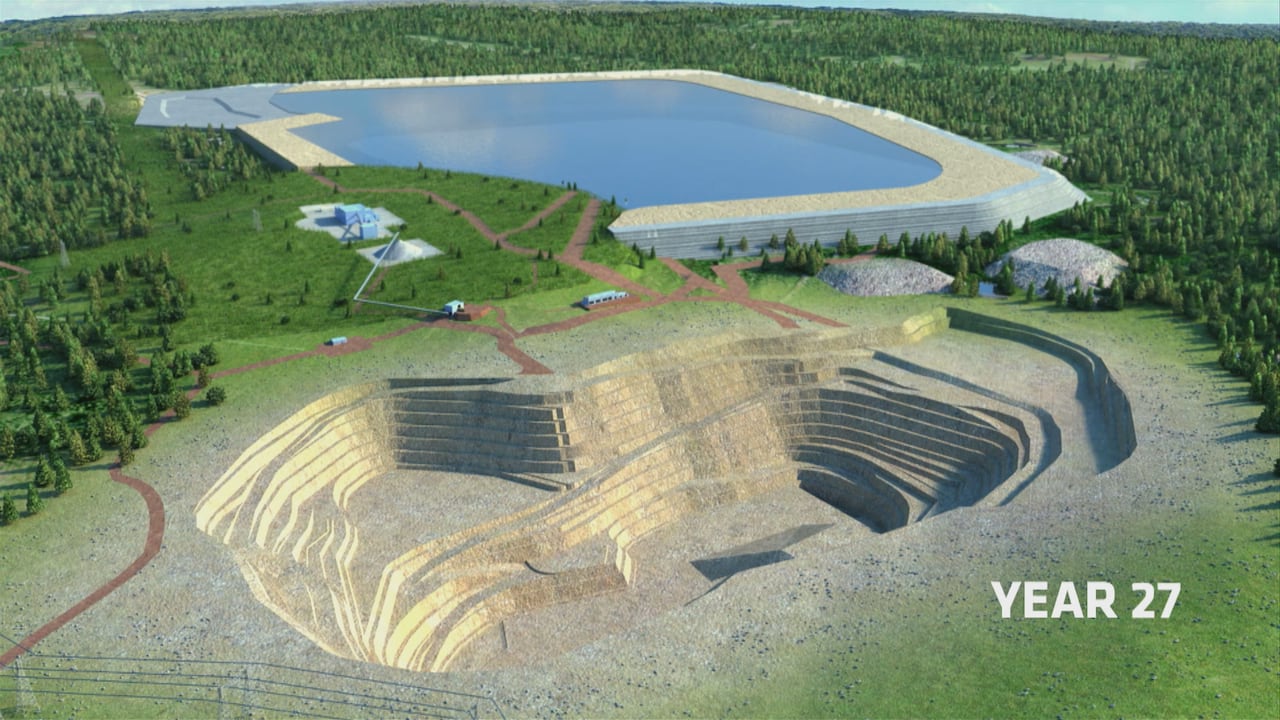
The mine would extract tungsten and molybdenum, two critical minerals used in energy applications like batteries, and also for military purposes.
 Sisson Mine hasn’t met any N.B. environmental conditions
The province estimated a decade ago it would generate $280 million in royalties for the government over the 27 years of operation.
The federal government referred the mine to its Major Projects Office two weeks ago as part of an effort to weaken China’s domination of the global critical minerals market.
Major project designation would allow for the fast-tracking of federal regulatory approvals, though even projects that are not designated can benefit from other forms of government support.
The Susan Holt government is pushing for offtake agreements and a price floor — two measures that would guarantee sales of the mine’s minerals at a viable price.
One reason the mine hasn’t advanced in the decade since its approval has been the low price of the minerals on the world market, which has made investors reluctant to back the project.
Environmentalist Lawrence Wuest, a resident of Stanley, said moving ahead on some of the conditions — like financial guarantees on potential cleanup costs — “would be a feather in their cap to get private investment in the mine.
“Why they haven’t done that — that’s a curious thing,” he said.

The mine proponent Northcliff Resources said a decade ago the mine would operate for 27 years.
Wuest said the fluctuation in mineral prices could force it to close sooner than that, creating a greater risk of leakage from the tailings pond into the Nashwaak River watershed.
It could also leave the province absorbing those cleanup costs.
“They want this mine there even if it’s economically unfeasible,” Wuest said.
“They want it there as a kind of billboard to the rest of the world and the rest of Canada that New Brunswick is a place where mining can take place.”
LePage told reporters that the 40 conditions will be tied to today’s environmental regulations, not the ones that were in effect a decade ago.
“They’re still valid, but we have to make sure that they are up to date,” he said.
“The standard of the response from the proponent has to be up to date with today’s regulations — municipal, provincial and federal.”
Heustis said that among the changes since 2015 are new wetland mapping and further identification of species at risk in the watershed.
But the critics also say the fundamental design of the project approved in 2015, including the tailings pond, is itself out of date and should require Northcliff to go back to the drawing board for a new EIA.
“There’s been changes in best practices and best available technologies for this kind of an open pit mining operation with a low grade of ore,” Green Leader David Coon said.
Wuest called LePage’s commitment “a hollow promise” and said changes to best practices for tailings ponds and dams make the original approval irrelevant.
“There should be a reset of that EIA,” he said.
The 40 conditions are also key to First Nations acceptance of the project.
Wolastoqey chiefs and the province signed an accommodation agreement for the mine in 2017, which Indigenous Affairs Minister Keith Chiasson said remains in effect.
A spokesperson said none of the six chiefs would provide an interview for now.
After the federal announcement earlier this month, they issued a statement saying they will “insist” that “the conditions upon which the mine was established will be maintained.”
At the time of the 2015 EIA conditions, the province was not enforcing water classification regulations under the Clean Water Act.
Those regulations, if applied to the Nashwaak, would have prohibited new sources of pollution in the watershed, Wuest said.
He is pessimistic the province will restart the EIA process but says not doing so may add to the uncertainty for investors.
“I would like to think that this thing is so bad that it could never generate enough investment to go ahead, but given the craziness that’s going on in the world, all bets are off,” Wuest said.
Northcliff says it will make “a final investment decision … around 2027” with construction to follow if it’s approved.
CEO Andrew Ing has not responded to multiple interview requests from CBC News.
ABOUT THE AUTHOR

Northern Sask. riding could be island of Liberal red in sea of Tory blue, projection modelling suggests
Conservative-leaning communities moved into southern ridings by redistricting

Saskatchewan's northern riding of Desnethé-Missinippi-Churchill River could flip to Liberal red from its current Conservative blue in the next federal election, projection modelling suggests.
The riding comprises nearly the entire northern half of the province, but with a fraction of the population (about 37,845 people, according to Elections Canada).
When the federal government began the process to redefine electoral boundaries in 2022 — a non-partisan review required every 10 years — some communities that voted heavily Conservative in the previous election were moved to other federal ridings.
The 338Canada project, an election projection model based on opinion polls, electoral history and demographic data, suggests the Liberals could win 56 per cent of the vote, plus/-minus 14 per cent, in Desnethé-Missinippi-Churchill River, with the Conservatives garnering 26 per cent of the vote, plus/minus 12 per cent.
In the 2021 election, the Meadow Lake region had the most valid votes at the polls (about 2,450) and the vast majority were garnered by now-former MP Gary Vidal (about 65.8 per cent), the Conservative incumbent at the time.
According to Elections Canada, if the new boundaries had been in place during the 2021 election, the Liberals would have won the seat.
Éric Grenier, a polls analyst and the creator of thewrit.ca, says Conservatives won the seat comfortably in 2021 with support from Meadow Lake. He says the Conservatives would have finished third behind the Liberals if the redrawn boundaries had been in place.
"If the Liberals form the government and they have a seat from Saskatchewan, that means at least they'll have one voice from Saskatchewan in the caucus," Grenier said.
"One of the issues that the Liberals have had over the last few elections is they've had very few MPs from Western Canada outside of British Columbia and Winnipeg," he said.
The other top voting areas in the riding — including La Ronge, Spiritwood, Christopher Lake, Creighton and Debden — also voted Conservative. In fact, the top eight regions that put forward the most valid votes (not including mail-in ballots) opted for the Tories.
The issue for the Conservatives is that all of those communities, with the exception of La Ronge and Creighton, are no longer within the northern electoral boundary.
"You have basically taken a bunch of conservative voters and moved them into ridings that kind of border Prince Albert or that are further south of that riding," said Daniel Westlake, an assistant professor of political science at the University of Saskatchewan.
He says Saskatchewan's rural population is strongly conservative — until you get farther north: "I would suggest this is a northern Prairie riding that just is more open to progressives than most other rural Prairie ridings and probably will continue to be like that."
Over the past nearly three decades, the region has ping-ponged among the three major parties: the Conservative Party of Canada, the Liberal Party of Canada and the New Democratic Party.
As of Monday morning, three candidates in the riding have been confirmed by Elections Canada:
- Jim Lemaigre, Conservative Party of Canada.
- Buckley Belanger, Liberal Party of Canada.
- Doug Racine, federal New Democratic Party.
The Green Party has listed Jacqueline Hanson as their candidate for the riding. The People's Party of Canada does not have a candidate for the region listed on their website.
Cost of living front of mind
In the province's north, the cost of living is higher.
At Northern Store, a local grocery store in Stony Rapids, the cost of a 10-kilogram bag of flour is more than $40, while a three-litre bottle of olive oil runs for more than $70.

Residents who spoke with CBC said the cost of living was among their top election priorities.
"As you'll see, we have probably some of the most expensive milk and eggs in the whole country," Brandon Calvert said. "They complain about the egg prices in the States, but our eggs are always probably three, four times more than theirs are right now."
He suggested the government could subsidize freight costs to help reduce prices at the till.

Shaun Suski, a staunch Conservative supporter living in Creighton, about 430 kilometres northeast of Saskatoon, says his monthly electrical bill is more than $1,000 during the winter months.
"Cost of living up here has gone up quite a bit, fuel is high, all that and carbon tax — it's hurting us for sure," he said. "Anything that we could get rid of taxes and help us save a little more and put more in our pocket is great for us."
He's hesitant to trust polling suggesting Saskatchewan's northern riding could fall to the Liberals.
And while the Liberal government recently pulled back the consumer carbon tax, Suski feels more comfortable voting for the party that has argued in favour of removing the tax long before the election was called.
"I find [the Liberals] are just saying it now because it is election time," he said. "Before, when it was always brought up, they always fought it."
Suksi says crime is also an issue in the region, leading him to lean toward Conservative Leader Pierre Poilievre and his tough-on-crime mentality.
Voter keeps an eye on rabbits
Vince Ahenakew, a long-time Liberal supporter living in Île-à-la-Crosse, is backing a red-led north and, in doing so, he's keeping a watchful eye of the rabbits.
"Kâ mihcåtitwâw wâposhwak êkota anima Lî liberal ta otahowêwak," [If there's a lot of rabbits during election season, the Liberals are going to win] he said, explaining he heard the Northern Michif phrase from elders.
"And usually, they're right," he laughed.
Ahenakew says he supports the Liberals because he believes their administration has best supported the country's Indigenous population.
Île-à-la-Crosse, a community of about 1,425 located about 376 kilometres northwest of Saskatoon, voted Liberal in 2021. Of the top 10 communities with the most total valid votes cast, it was the only one to vote Liberal.
Ahenakew says there are social and health issues in the north — including mental health and drug use — he believes could be partially resolved by better connecting with Indigenous culture. As well, he added, people in the north don't have the same easy access to medical and dental services as those in the south.
Since the northern population has to pay more in travel to access those services, he says, they should not be taxed the same. Road infrastructure, education and employment are also top issues for him.
And while he's a Liberal supporter, he wished luck to candidates in every party.
"They all want what is best for Canada," Ahenakew said.
Clarifications
- An earlier version of this story used the term "polling" in the headline. While 338Canada Project includes opinion polls, no polling was conducted at the riding level.Apr 07, 2025 12:27 PM ADT
ABOUT THE AUTHOR

With files from Alexandre Silberman
‘The chaos was real’: MP Gary Vidal on Freeland’s resignation
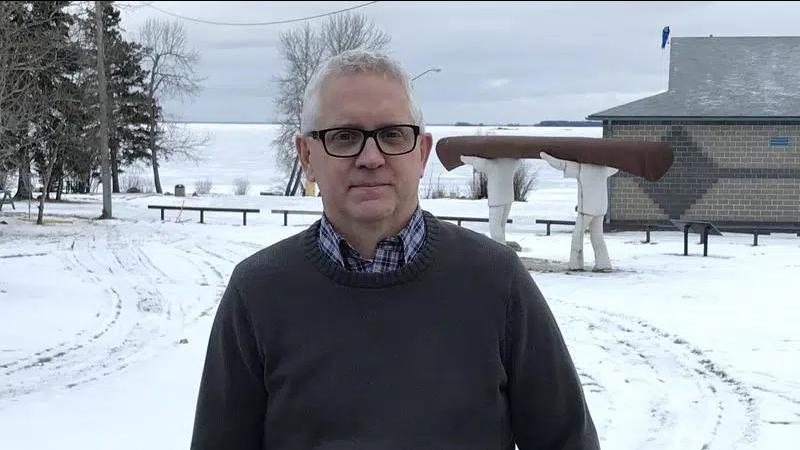 (Derek Cornet/larongeNOW Staff)
A quiet has settled over Parliament Hill after yesterday’s historic and weird day in Canadian politics brought the government to a standstill.
“Yesterday was very chaotic, it was a very interesting day around here,” said Gary Vidal, Conservative MP for the Desnethé—Missinippi—Churchill River riding.
Monday had been shaping up to be a busy day with the anticipated roll out of the Fall Economic Statement later that afternoon. Vidal said members of Parliament from all over the country were in various stages of making their way to Ottawa for the tabling. Vidal was en-route when the news broke that Deputy Prime Minister and Finance Minister Chrystia Freeland resigned.
“We all just kind of walked into the middle of it so to speak,” he said. “It was probably one of the weirdest days of my almost six days of being here.”

No comments:
Post a Comment