
 Written by Jeff Rose-Martland, SRL and NSRLP Advisory Panel member; originally published on Slaw, Canada’s online legal magazine.
If you’ve been adrift on the internet desperately trying not to drown in the flood of legal information, great news! You’ve found a raft!
No, that’s not really funny. When you’re representing yourself, trying to get to the information you want does often feel like drowning. There’s so much info, mostly not what you need, so you wind up flailing about desperate to stay afloat while the currents try to pull you under. Or you get caught in whirlpools of misinformation. Or weighted down by too much case law.
Few make an intentional choice to dive in and go DIY-lawyering. Most self-reps wind up here because they can’t afford a lawyer or can’t get a lawyer, and their legal issue won’t just go away. Sometimes it’s about fighting for your rights; sometimes it’s about defending yourself against someone else. Regardless, you should know that you’re not alone. Canadian news has been reporting on the increasing numbers of self-reps for decades now: we have a crisis throughout our justice system. Lawyers’ fees are out of reach of a majority of people, and legal aid income thresholds are very low – many cannot qualify because they earn too much. Even if you are financially eligible, legal aid may not be able or allowed to be involved in the type of matter you have. And as for pro bono work… well, anything you’ve heard about pro bono lawyers is almost certainly wrong. Individual lawyers can rarely afford to do cases for free and, when they do, it tends to be cases headed to the Supreme Court of Canada. The image of a stalwart lawyer taking a case for free simply because they believe in the rightness of the client is, sad to say, mainly fiction. So more and more people are washed away in the flood, just like you.
And there’s sharks and rocks in the water…
COVID drove a rapid increase in the amount of legal information available online, and even forced courtrooms into video hearings. Unfortunately, that same rise also increased the number of hazards for self-reps. There are now predators – people who claim to be able to tell you what to do for a much lower fee than a lawyer. Some have track-records in court as self-reps themselves, and some just speak in legalese. Social media is littered with them; they will take your money and, worse, may sink your case as well as your bank balance.
Even if they don’t want money, they can still harm you through the spread of misinformation. Take Romana Didulo, self-proclaimed “Queen of Canada.” She has issued “royal decrees”saying taxes are optional, debts are forgiven, and utilities are free. Those believing her have wound up with serious financial and legal problems. Similarly, people subscribing to the sovereign citizenship movement – also known as Organized Pseudolegal Commercial Arguments – wind up in a lot of trouble when they decide they know ways to nullify the legal system. And artificial intelligence (AI) is changing the world in innumerable ways, including the legal sphere – AI tools seem to offer help preparing documents and finding cases, but the technology isn’t there yet. Chatbots can produce realistic-looking documents with fake cases, and judges aren’t keen on that.
Even well-intentioned people can give you legal advice that’s bad, misleading, or just plain wrong. Which is why, on your legal quest, you will hear this sentence a whole lot: “I cannot provide you with legal advice.” Unless you retain a legal representative, anyone involved in the legal system will tell you this. If they give you advice, they become liable for the results: you could sue, they could get fired, or face discipline from their regulatory body. So everyone from a registry clerk to duty counsel will say, “I cannot give you legal advice.” It quickly gets tired.
But this sentence is also a very useful reminder to you. A legal representative you’ve hired can give you legal advice; advice from anyone else is of questionable value, ranging from personal opinion to bad direction to outright grift. An idea might be thrown at you, but you need to be very careful. Is it a life-preserver or is it bait? As your own representative, you need to know before you snatch it. You need to verify everything, which means knowing what sources to trust. So where do you start?
Public Legal Education and Information (PLEI) organizations, established nationwide by governments, law societies, and courts. You can search online for your province + “public legal information.” Here are a few pages with links to some: Justice Canada; the Supreme Court of Canada, and the Canadian Bar Association. PLEIs provide general information regarding the courts and legal system. These organizations can’t give you legal advice, but many offer referrals to lawyers who offer free consultations, or low-cost services for smaller matters.
Legal aid. Search legal aid office + your region. If you call, ask to speak with duty counsel. Even if they cannot represent you, they can provide information, answer general questions, or maybe refer you to others.
Lawyers. Many lawyers offer free initial consultations. Similar to legal aid, they’ll listen, help you understand your legal situation, and tell you what they would charge. If that’s not workable, they might be able to refer you to other individuals or services. If you’ve been through this process already, it still may be worth it to contact someone new. You can also inquire about “limited scope retainers” – unbundled services where you pay a lower fee for a specific service, such as drafting a motion.
Contact the court. Since COVID, most courts have an online presence. Some have pages just for self-represented litigants. Many courts also have duty counsel. This is a lawyer who you can speak with and get answers to general questions, especially about things like court procedure. You can get information on forms and procedures from the court registry as well. Pro Tip: start by telling the clerk you know what you want to do but not how to do it. That makes it clear that you don’t want legal advice. If they aren’t sure how to proceed, they will usually check with duty counsel. It’s also worth noting that some courts have been adapting their rules, procedures, and particularly forms, with the aim of assisting self-reps.
Law libraries. If you are looking for specific information on legal precedents, or information for lawyers, you can search out your local law society library. Some are open to the public (you may need to book an appointment), and their staff are very knowledgeable. They should be, as they help law students as well as lawyers. Staff can probably guide you toward the information you want.
The National Self-Represented Litigants Project. The NSRLP began as a research study into the increasing number of unlawyered people standing before judges, and evolved into an information and advocacy organization. The NSRLP has a number of resources: guides for self-represented litigants, blog posts, directories, and much more. If you visit, take a few minutes to fill out their SRL survey. The data collected is used to track the issues driving people to self-represent and to understand their experiences in the legal system, and that information is in turn used to advocate for systemic change.
The Canadian Legal Information Institute (CanLII) is a non-profit managed by the Federation of Law Societies of Canada. You will use it a lot, so bookmark CanLII now. It provides databases of legal precedents, searchable by region and court type. It also offers case commentary and articles. CanLII Connects has articles and discussion papers. The further you get into your matter, the more you will be using CanLII.
There are many groups spread across the country dedicated to helping SRLs or advocating for access to justice (A2J). These differ in area of focus and types of assistance, but even the ones that are far away may have information that is useful to you. They are friendly, and willing to provide answers or send you to someone who can. Add “canada law” and “access to justice” or “A2J” to your web searches.
And there’s much more. Lawyers, legal aid, and courts have taken to social media, posting video guides and explainers on YouTube, TikTok, and embedded on their websites. Some large law firms have online resources, intended for lawyers but available to everyone, or even written specifically for the public. Some law schools offer free online courses. You can also buy used law books online from a variety of vendors. Even if the book is not the current edition, it can give you the education you need. Pro Tip: check the reading lists for law schools.
If you are wondering about the legitimacy of advice or an individual, fact checking is easy. Search their name in CanLII – people who are legal professionals should appear in case law. Or check their online presence. Legal professionals are typically too busy to be constantly posting content. If the results scream influencer, perhaps this isn’t the right person for you. If their advice seems too good to be true, again, you can check on CanLII and online. This isn’t foolproof, but if it’s connected with scams or pseudo-law or cults, it will likely return a whole bunch of results saying so. Or you can take that advice or “fact” and contact any of the public sources or law societies and ask for help verifying it.
You may be surrounded by water, but you don’t have to swallow anything.
4 thoughts on “This Way for the Legal Wading Pool”
https://parlvu.parl.gc.ca/Harmony/en/PowerBrowser/PowerBrowserV2?fk=11916523
About the NSRLP

The National Self-Represented Litigants Project (NSRLP) builds on the National Self-Represented Litigants (SRL’s) Research Study conducted by Dr. Julie Macfarlane from 2011-2013. The Project takes its mandate from the Final Recommendations of the Research Report: 10 Actions Steps for the SRL Phenomenon.
Since 2013, the NSRLP has continued to generate energy and motivation towards serious contemplation of system change, reflecting the findings of the Research Study. The core of our work is to advocate for better and deeper understanding of the needs, motivations and challenges of self-represented litigants. This means that we are committed to:
- Collaboration to enhance the responsiveness of the Canadian justice system to self-represented litigants (SRLs) and their direct participation in the change process, and continuing dialogue among all stakeholders who include SRLs, lawyers, judges and court services staff.
- The development of practical, focused, and accessible resources to assist self-represented litigants and to enhance understanding and co-operation among SRLs, lawyers, judges and court services staff, and to information and resource-sharing among all interested and affected parties.
- Research on emerging areas of special interest to those affected by the SRL phenomenon, including jurisprudence, court and legal information services, and changes in legal practice to meet SRL needs (unbundling, coaching). The NSRLP also publishes ongoing data on the demographics and narratives of self-represented litigants who complete our Intake Form.
NSRLP is proud to be a grantee in the Law Foundation of Ontario’s Catalyst program. Other NSRLP funding comes from an assortment of grants and private donations from across Canada.
We are very excited about continuing our work with and for SRLs. We invite you to:
Written by NSRLP Advisory Board Member Jeff Rose-Martland; originally published on Slaw, Canada’s online legal magazine.
[Jeff Rose-Martland is a writer and SRL from St. John’s, Newfoundland, and member of NSRLP’s Advisory Board.]
Envision a self-represented litigant. Did you get a picture of someone in court, poorly dressed, who doesn’t know what they are doing? I see that, and I am an SRL. The more-accurate mental image of a person at their dining table struggling with legal documents until the wee hours rarely comes to mind. Possibly because it’s draining to even consider, let alone do. In point of fact, a courtroom may not even be involved; there are a variety of circumstances that will turn one into self-rep.
If asked when I became an SRL, I respond with my most recent matters. But recent discussions have caused me to realize that I’ve actually been doing this for most of my adult life. Because we focus on the Self-Rep-In-The-Courtroom, we forget all the other circumstances where DIY-lawyering happens. All those boards, tribunals, appeals boards, and the lesser, limited jurisdiction, courts, where supposedly lawyers aren’t used: small claims, traffic, bylaw/ticket offences, etc. I certainly forgot all of that. When I stopped to consider those situations, I discovered I’ve actually been a self-represented litigant for about 30 years.
My first go was in criminal court. It wasn’t anything serious: I was facing Possession of Alcohol by a Minor. I’d been 18 rather than the required 19. I didn’t even speak to a lawyer, let alone retain one. I didn’t see the point: I’d been carrying a half-case of beer. No point in dragging that experience out. I plead guilty, accepted my fine, and got on with life. It was an eye-blink of time, decades ago, and so trivial that I didn’t even think about it making me an SRL.
Sometimes government can make you represent yourself. That happened when I appealed a student loan decision back-when; I was told I wasn’t permitted to have a lawyer when I appeared at the tribunal. Which implies a less formal, more easygoing affair. Except that the tribunal consisted of a panel of a dozen or so government lawyers. This unfairness was further magnified by the board demanding to know the legal grounds for my appeal, legislation and precedent. What??? My half-complete electronics program hardly prepared me for that. For that matter, I’m pretty sure I couldn’t have even tracked down the legislation, as the government of the time tended to refuse to hand out information to private individuals. Obviously, the board ruled there were no grounds for any appeal and I was contemptuously dismissed. Arrogant glares chased me from the room.
Traffic Court is intended to be mostly lawyerless. After all, the fines and charges are generally small. I’d successfully challenged several traffic and parking tickets, getting them dropped through a pre-trial conversation with Crown counsel. But one time, the Crown wouldn’t speak with me, and I found myself suddenly in front of the Court, with no preparation. But I was certain of my case, that logically I had the right to block my own driveway, especially as I had been loading my vehicle. The judge dismissed my opening statement for being an argument and not in compliance with The Rules. The Crown called its witness, the traffic enforcement officer, who confirmed the ticket. I attempted to question him, and the Crown immediately objected, “Your honour, clearly the Defendant has no familiarity with Court procedure or etiquette, and the Crown requests that the Defendant be barred from further wasting the Courts time.” Objection sustained, case immediately decided against me. Yes, the Crown was correct, I didn’t know what to do in a courtroom. Still, I felt hard done by. I hadn’t had any opportunity to present my side, and I’d been treated pretty offensively. Once again, I felt the sting of my lack of a law degree, and the contempt of those who do.
I need to point out that both of these circumstances were decades ago, and, compared to then, the legal profession has improved its attitude as regards we-without-lawyers. What still triggers my outrage, however, is that I feel I lost, not on facts or law, but simply because I didn’t have a lawyer, when I’d understood that I couldn’t have one and didn’t need one.
Not all my experiences have been so humiliating, nor did I always lose.
There’s the Employment Insurance Appeal Board. As with the student loan appeal, I’d been told I couldn’t have a lawyer. The board was two lawyers and a civil servant. I successfully appealed an EI decision, even though I openly admitted that I had no grounds under the Act. Logic on my part, and compassion on theirs, carried me through. Looking back as an SRL, it wasn’t just my success that was important. I was treated like an equal, like I mattered, and that made a huge difference.
It’s interesting to note that even when lawyers are barred from a process, they can still be snuck in. A couple decades ago, I filed a complaint with the Labour Board over being terminated when I tried to return from sick leave. After preliminaries, a settlement conference was arranged with a Labour Board mediator. Both sides were told, in no uncertain terms, that this was for the parties only, and counsel was not permitted.
Imagine then my surprise when my former employer turned up with a lawyer, complete with business card listing the correct post-nominals. I informed the chair that I’d never met this guy during my employment and that he was a lawyer. He declared he’d never passed the bar; he was a labour relations consultant on contract. He may have a law degree and training, but he wasn’t a lawyer. He also wasn’t counsel because, under terms of his contract, he was an employee, a HR manager. The Chair wasn’t impressed, but couldn’t eject him. The conference continued and I had to cope with this guy; my former bosses didn’t say a word. That’s completely contrary to the Labour Board process, which is intended to get employer and employee to work things out informally. Naturally, we failed to reach agreement.
I moved for arbitration. I tried to get a lawyer, but no one was interested in taking my case on a cost-recovery basis. Having read the documents I’d already filed, two lawyers told me I seemed quite capable of representing myself and encouraged me to do so. I had become more confident, and legislation was now available online, so I took up my own cause.
I arrived a bit early for the hearing. So had the arbitrator, a retired judge. He was quite friendly and he took the time to explain that the process was less formal than court, and that he’d make sure both sides were heard. We chatted a bit more about nothing much until the other party arrived: my boss, my manager, and their lawyer.
The lawyer was dragging a wheeled case with an encyclopedia’s worth of dead trees piled on top. It took him four arm-loads to get it all on the table. I looked at the arbitrator, who was frowning and glaring at the lawyer. As the stack of paper grew thumpingly on the table, the arbitrator spoke, “You should know better! This isn’t court and I’m not required, nor inclined, to read all that.” The lawyer shrugged and defiantly responded, “I guess we’ll see.”The lawyer then moved for dismissal of the case and started reaching for documents. The arbitrator said he was deferring judgement on the motion. The lawyer objected. The judge reminded him that this wasn’t court, and he’d consider it later. The lawyer started to complain more and the judge suggested the lawyer hold his tongue, with a look that strongly hinted that he could lose the case right then. I was trying hard not to giggle. It felt good to know there are people who could put lawyers in their place.
The arbitrator let me have plenty of leeway with my questions, and asked me questions to flesh out my position. He was patient and generous… with me. Every time the other party got to speak, the lawyer re-stated his call for dismissal. After a while, even his clients were getting annoyed with this. The arbitrator repeatedly said the hearing would proceed, regardless, and he would decide that part after the fact.
For specific legislative issues, and because my employer had lots of experience pulling shell games to dismiss with impunity, the call for dismissal did succeed and I lost the case. But I didn’t feel bad about it then, and still don’t. That’s down to the way I was treated by the arbitrator: I was heard, I got to state my position, I was permitted to question my former employer at length. Not being a lawyer wasn’t held against me. Even though the arbitrator decided against me, I still respect the way he treated me: with respect.
That was also the situation in Family Court.
As with other jurisdictions, increasing numbers of people are appearing unrepresented in Newfoundland & Labrador Family Court. The system was forced to adapt. Provincial Rules have been updated, forms made clear and accessible, and even the culture has shifted towards a service model. Judges are active in proceedings, explaining procedures and tests, and asking probing questions, so they can get the information needed to make decisions. Myself and the other party were both self-representing, and were equally treated with respect. That system has adjusted to fit us; something many other systems are trying to avoid.
Until very recently, I wouldn’t even have said what I was doing was DIY lawyering. Not until my recent, ongoing, legal problems. I didn’t have a term to describe what I was doing until I came across the National Self-Represented Litigants Project. My involvement with the NSRLP since 2016, and more generally with access to justice issues, has made me realize how wide-ranging self-reps are. SRLs don’t come from hearings or decisions or even initial filings. You become a self-rep when you wind up defending you rights, especially the right to be heard.
I never set out to be my own lawyer. There was never a point where I decided to explore the legal world for my own edification, to have a go at have-a-go-lawyering, to try hammering down the doors of justice armed only with attitude and a foam bat. Every time I have been my own counsel, I was compelled by circumstance. Sometimes I was a Respondent-Defendant. Other times, I was just trying to get fair treatment. In all these cases, getting a lawyer wasn’t possible. Self-representation was the only viable option, poor though it is.
Looking back now, I’ve been at this for a very long time – three decades. There’s probably many, many people out there who have likewise been unwitting self-reps. If you’ve ever used any of the quasi-judicial systems of boards and appeals; appeared before Traffic, Small Claims, Tax or other lower courts; participated in a settlement conferences or arbitration – even where lawyers are not permitted – then you, too, have been a Self-Rep – check your closet for the t-shirt.
This week’s guest blogger is Chris Budgell, who has had considerable experience as an SRL before numerous justice agencies. Chris was once described by the late journalist Christie Blatchford as, “a self-appointed citizen watchdog of the judicial council”.
On May 21st a Federal Court justice delivered a decision in the case Smith v. Canada (Attorney General), 2020 FC 629. There was considerable media commentary, including this article by the Globe and Mail’s Sean Fine. (I also recommend this article on slaw.ca.) But so far none of this commentary does justice to the significance of this case.
The decision states that the Canadian Judicial Council (CJC) acted abusively in triggering its disciplinary processes against Justice Patrick Smith of Ontario’s Superior Court of Justice without having received a complaint, and despite the lengths to which Justice Smith had gone to secure approval – from the court’s chief justice and the federal Minister of Justice – to take on a temporary assignment acting in a limited role as Dean of the Laskin Law School at Lakehead University.
The real significance of this won’t be apparent to most Canadians, including I suspect most SRLs, because there has been little public awareness of what the CJC is.
What is the CJC?
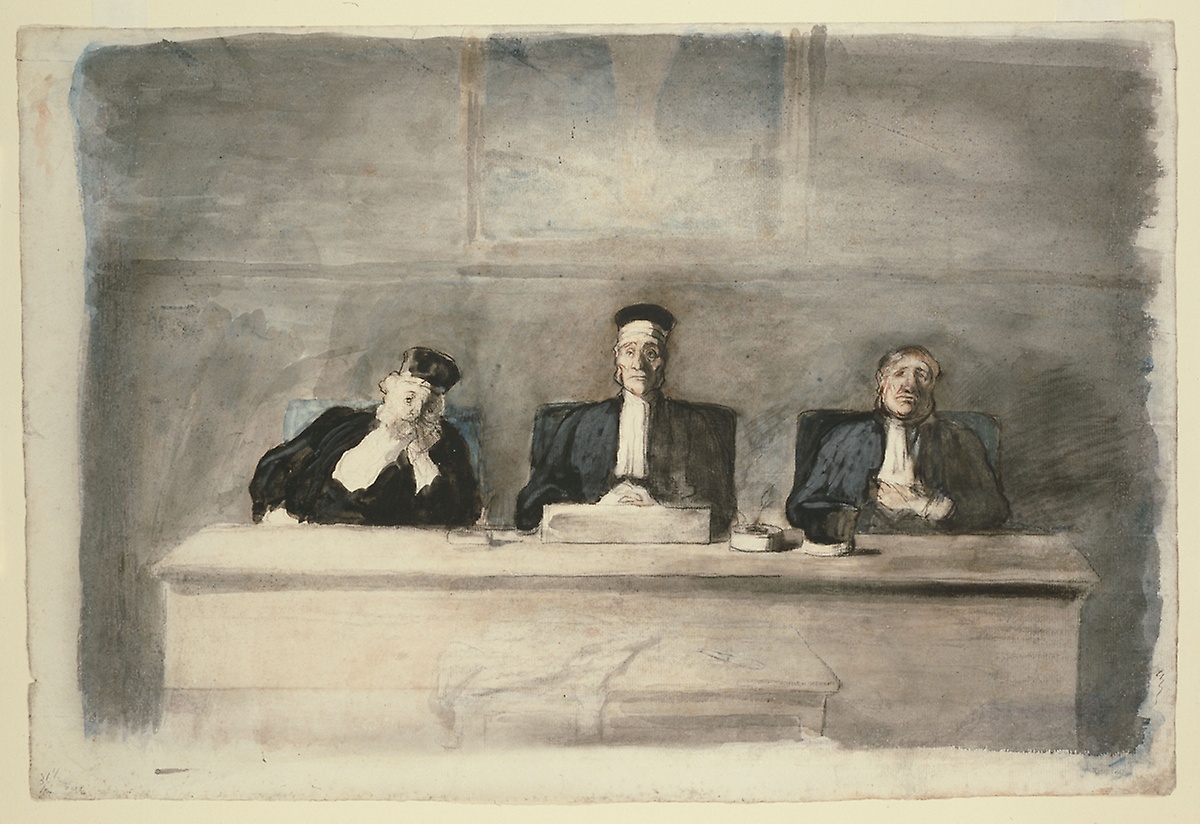
“The Three Judges”, by Daumier
The Canadian Judicial Council is a unique entity, created by Parliament in 1971 with an extensive addition to the Judges Act. The Judges Act governs the courts whose judges are appointed by the federal government (in practice, the Prime Minister has the final say). Those are the two “superior” courts in each province and territory (one “trial level” court and one appeal court) and five courts (including the Supreme Court of Canada) that have national jurisdiction, and usually sit in Ottawa. Scroll down here to see all these courts listed. This is the list of the membership of the Canadian Judicial Council.
Prior to the 1971 legislation, there was evidently little interest in what should be done if it became apparent that a judge was, or might have become, unfit for office. But then the superior court judges across Canada began to develop such an interest, a development largely driven by Wilbur Roy Jackett. The book Chief Justice W.R. Jacket: By the Law of the Land, by Richard Pound, includes a chapter on the creation of the Canadian Judicial Council. It’s a very interesting story. Jackett later became the first Chief Justice of the Federal Court – the Court that issued this recent judgment condemning the conduct of the CJC. It’s interesting to ask what W.R. Jackett would have made of the current situation.
The CJC wasn’t granted the power to remove judges in the 1971 legislation. Parliament absolved itself of most of the responsibility for dealing with judicial conduct issues, but ultimately retained the authority and responsibility for removing a judge. After even the most lengthy and drawn out processes at the CJC, all the Council can do is forward its final recommendation to the government (that is, the Justice Minister). The Judges Act does not prevent the government from putting before Parliament a motion to remove a judge even without hearing from the CJC. Nor does it prevent any citizen from submitting a complaint to the Justice Minister or any member of Parliament. But if you do so, they’ll simply direct you to the CJC.
A dismal record
So since 1971 the CJC has been receiving public complaints about individual judges. Those who are familiar with the record know that it is not an encouraging one. Since the beginning of this century there have been some spectacular demonstrations of just how dysfunctional the CJC’s processes are – two good examples are the case of Associate Chief Justice Lori Douglas, who eventually give up the fight and agreed to retire, and the debacle of the Justice Robin Camp inquiry, which eventually led to his resignation, after a protracted battle.
Going back to the recent Smith case, Federal Court Justice Zinn’s 184-paragraph decision may signal the end of the CJC as the entity with the exclusive mandate to receive and dispose of complaints about the conduct of federally appointed judges. Parliament has the option to create an entity fully independent from both the judiciary and the executive branch to receive complaints and decide how to respond to them (including, of course, steps that would likely involve members of the judiciary). In my opinion, this is the right solution. It always has been.
Fundamental problems with the CJC have always been evident. Judges judging judges doesn’t work. And the Smith judgement itself is another instance of a judge judging judges (for a rather amusing take on that see Ezra Levant’s rant, not someone I usually quote with approval, here). However it is worth noting that the Federal Court did not accept the CJC’s argument that its members – federally appointed chief and associate chief justices – are acting “judicially” in conducting disciplinary processes at the CJC and hence beyond criticism.
The CJC has always been an opaque entity. There has been talk about being transparent and engaging the public, but little evidence of this in practice. The CJC’s website has gone through more than one redesign since I first engaged the Council in 2010, and each new iteration seems to provide less information, and in a manner that makes it increasingly hard to find what one is looking for.
Public voices?
In 2015, following years of discussion about giving the public a voice in the disciplinary process, the Council, on its own, decided that one “layperson” would be added to the membership of what they call their “Review Panels”, one of the steps in the process of deciding whether or not the Council will recommend to parliament that a judge should be removed. That caught my attention. I had more than enough experience to understand that the Council wasn’t the least bit interested in giving the public a voice in its processes.
Omar Ha-Redeye’s article on slaw.ca includes this link to another review panel decision. As with the first such panel decision, this one identifies, on the final page, all the members of the panel, including the person intended to be a voice for the public – who is a former federal public servant (as described by this Lawyer’s Daily’s article). It’s hard to believe that the CJC is interested in truly outside voices, or any dissenting opinions, and there has never been a dissent in any of these Review Panel decisions. So why bother with a multi-member panel at all?
In this news release the chair of the CJC has said that the CJC understands that “vital legislative changes” it has urged on the government “are imminent”. What changes? Does anyone other than Justice Minister Lametti, or whoever he’s designated to negotiate with the CJC, know? Do any of the Opposition members know? Any Senators? Certainly we the public have had no warning of what these changes might be. I doubt that anything is in fact imminent. I certainly hope not. Let’s see some transparency first – from the government and from the judiciary. My own MP as well as other MPs and Senators have heard from me about these issues. They are all easily reached by email. I urge everyone to do the same.
25 thoughts on “Questioning the Role of the Canadian Judicial Council: Is Access to Justice Being Served?”
-
sandra olson says:
my experience with the CJC has proven how insular, and self serving they are. It was a waste of my precious time. I imagine everyone else who wrote to this organization went through the same, As to legal organizations generally, I cannot say any of them are different. insular and self serving is really it. We allowed this organization to run the organization of our courts, This should never have happened.
-
Kat says:
Procedural fairness is the key.
I went to trial against 2 lawyers, their pal the OCL and the same judge that heard my motion the week before and adjourned it to himself. They couldn’t beat me in trial, I was just too professional and child-focused. I nailed the cross-examination and the women in the room were like wow Matlock on the break. I had no clue what was coming.
The judge made an order after trial that was open to interpretation and then 2 months later he emailed his reasons for judgement holding me in contempt for something that I didn’t do, by calling it a material change. Meanwhile, I did nothing and had the evidence, yet I was never provided my right to be heard.
It didn’t matter. Rules don’t matter and our children suffer while they all get paid. It’s a business, stay strong.
I figured out how to do my own appeal too, it’s hard with highly complex thinking involved. I’m going with procedural fairness I guess, but this really sucks so bad.
How can someone prepare, or defend a case that’s issues changed after the trial was over? Apparently I have the right to be heard, uh helloooo Canadian Judicial Council? They are great at leaving evidence though.
The CJC opened and closed my file 3x and based on my data, they have hundreds of complaints each month and it’s on a 3 month loop. No one is reading our complaints, I’ve tested it just to make sure that my evidence of them breaking their mandate is collected. “Always collect an audit trail” my dad says. He’s right. Good luck and stay well my fellow abused self-reps.
-
Angela Davis says:
Thank you for your hard work and sharing. The only travesty is if we behave angrily and unreasonably. More people know so carry on. It will work.
-
Trevor says:
The cjc has stated to me that judges have the right to accept or reject any evidence up to and including their own transcripts. They can even call evidence themselves to refute the transcript of trial. Of course with this power the cjc and judges can refute anything as no evidence is better than their opinion. Of course see our charter of rights, fundamental justice and arbitrary justice. Broken.
-
-
Some years ago I too was an avid SRL, ultimately filing a Summary Judgment at my local BC Ministry of Justice, indicating a local Judge had explicitly erred in her assessment of the rules of law by dismissing my claims (did not like this SRL’s poking at their privilege.) Understandably, judges can not be sued! BUT then WHO is responsible? In a Supreme Court setting – with only the Supreme Court Judge and his fellow Defense Counsel , sitting lower, at my eye level, I spent an hour plus being told I was wasting the Court’s Time.
– Having purchased the transcript of the session, it reads like a PLAY!
In any seriously considered DEMOCRACY….(where?) … the above scenario would be considered a most outrageous and blatant example of COLLUSION!
Where I consider the USA to be a primarily > POLICE run STATE, I suggest our Canada is primarily a quietly, but solidly run LEGAL SYSTEM run ‘quasi Democracy’.
After my informative/telling court session, my view is: At the base of all societies runs its legal system in which most are hands on police based …..And IF/WHEN it is corrupt? > every other Department within that structure will be so as well!
Since Legal Systems purvey naturally throughout al our systems (SURVIVAL OF THE FITTEST) > other then Religious stipulations, most our present day systems are run as such.
However, I have been suffering “the slings and arrows of outrageous fortune” Online these daze :(> …
There is a whole new ‘BIG BROTHER’ a foot, and it is the Wild-West of catch-as-catch-can ONLINE!
BUYER BE WARE!
Ultimately life continues to be about : Survival of the Fittest!
-
-
Allen says:
We should not be seeking to get on Judicial Council. That is pointless. It would be one against a gang so we would be out numbered and serve no purpose. We should demand to be told when any judge before whom we appear and any lawyer against whom we appeared is seeking to become judge or in the case of judges if they seek any other or higher office so we can make submissions about the crooked ones and stop them from getting appointed. Currently the law society alone has a say in appointment of judges. Go figure
-
Judge’s get really mad at us for proving our case in court so I am offended when told the problem is our inability to do that. Many lawyers do horribly-but usually the court props up their cases for them. No one is listening to us let alone hearing us. Until we become a properly functional organisational force the CJC will not regard us as parties with rights. There is a way they have to (MUST) hear a complaint.
You are right rules do not matter nor does the law. Many decisions make no sense. A panel of three (not one, not two) “judges’ said since the Labour Board (OLRB) decision is reasonable it does not breach my employment contract.. How ridiculous! The decisions is contingent upon the contract not the other way around. The decision breached 10 clauses of my contract and counting. One clause stops them from getting off the ground but they just trampled that and got going anyways. When I convinced the court they had the wrong timeline (scared the bejesus out of all of them and stunned them) they just supplanted other September incidents in their October 6 to Novemeber 2, 2016 “critical” and “crucial” timeline (they even said OLRB gave no date but they made them 24 to 26). So by magic the 3 judges decided to make up a new timeline so that July, August and September are months that fall between October and November. They even ruled (literally) that I should suffer harshest punishment-termination for not joining in the theft from my employer or allow others to take it as they liked though I am responsible for the funds. The decision is an embarrassment (to them)-not one paragraph is a fact. At appropriate time It will be public .
-
I’m sorry to hear this and I would also love to know how to get our stories to the public. Did you have any luck? We should be pushing towards a new type of discrimination (the legally unrepresented)
-
-
Cjc claim that judges have the right to weigh evidence up to and including official transcript of trial. There is no better evidence than the transcript of trial. It is a judges duty to accept the transcript of trial as highest form of evidence otherwise our system of appeal is broken as well as charter of rights and fundamental justice as justice is completely arbitrary. Completely broken.
-
Chris Budgell says:
Five days after this post was published here, the Globe & Mail published an opinion piece written by Patrick Smith’s counsel. The link is here – https://www.theglobeandmail.com/opinion/article-judges-need-access-to-justice-too-or-we-risk-public-confidence-in/. Had they already read what was posted here? I think that is likely.
.
It would appear that those lawyers have some information the public does not have. But they don’t suggest any solution to the problem presented by the CJC. All they suggest is that “parliament should decline” to implement the changes to the Judges Act that the CJC is apparently seeking.
.
I note in the next paragraph this statement: “. . . the pattern of the council’s conduct . . . raises the question of whether its abusive decision making . . . was . . . the product of a problematic culture at the council.”. That’s what is called a rhetorical question.
.
The culture at the CJC cannot be fixed. The solution of course won’t include defunding the CJC. Our parliamentarians won’t entertain that idea. But the funding of the new agency that I’m proposing ought to be substantially, if not entirely, balanced by reducing the funds that the CJC receives. -
Ari says:
Trevor agree with your comment. However, what happens if one does not receive a “recorded verbatim” transcript? in other words a “word for word transcript”. Let’s be honest here, the judiciary are part of the transcript production process. Some judiciary cannot refrain from “editing” the court transcript before the court transcript is released to the public. How can “integrity of the record” be achieved when this occurs? Editing of a court transcript by a member of the judiciary is “unconscionable” and totally preempts one’s ability to bring forward a proper appeal of a legal matter. Judiciary need to be removed from the “transcript production process”. Independence of the judiciary does not result when court transcripts are edited. The editing implies that the judiciary have taken a side in the legal matter.
-
We’ve had three people here already comment about transcripts.
.
Besides being a witness in a labour arbitration regarding my own employment dismissal grievance, where, in keeping with the convention, no recording was made, I’ve been an SRL in two hearings before Provincial Court judges, several before B.C. Supreme Court judges and two before B.C. Court of Appeal judges, and to this day I still don’t know what the rules say, what one should expect, about recordings and transcripts. This is an important topic and I think it could be fully explained without resorting to any legalese. There should be, I suggest, a basic set of rules / protocols that apply to all adjudicative forums.
.
My own experience includes getting a transcript on only one occasion – when I was appealing in the B.C. Supreme Court a decision of a Provincial Court judge. I recall paying a private firm to make the transcription from the audio recording held by the court. I don’t recall if a copy of the audio recording was released to me, or if the court itself sent the recording to the firm. Given what I had heard from other SRL’s about transcripts I wondered about that firm.
.
Have I missed it? Is there a comprehensive explanation somewhere?
-
-
Chris, when the legal system has taken advantage of a self-represented litigant, one lives and learns.
Unfortunately by not focusing on the accuracy of your transcripts, you may have missed something significant.
As a self-represented litigant, it is next to impossible to get a copy of the audio recording to compare to the issued transcript.l.
I can only speak for Ontario but The Court Reporting industry is not a regulated industry here and there should be a significant movement afoot to have court reporters regulated as court reporters fulfill a very significant function and like with any other profession, professional ethics and professional integrity are important components of the court reporters functions.
The court reporter in attendance at your court hearing may not be the court reporter that transcribes your transcript. One should compare their notes of the court appearance to the words within the certified transcript and where differences are noted, one should follow up.
Judiciary need to be called out on this. If you or I did this, we would be guilty of a crime. Why is this ok for a member of the judiciary to do.
this? It blows me away that in family law setting , where the best interest of a child is at stake, that In a family law setting, where the best inter judiciary could actually do this, but they do.This is the biggest concern that I have with the CJC. As you say, how can judges judge other judges? Would the CJC actually come down hard on a “recorded verbatim” issue within a court transcript or would they instead target the blame on the court reporter instead of targeting the blame on the member of the judiciary.
To those that don’t realize this, this is a huge “public interest” issue.
-
I admit that I didn’t do the full research on this issue that was warranted at the time.
.
My understanding was and remains that the person sitting in front of the bench simply ensures that everything is recorded on an electronic medium. That would have been an analogue recording on tape until they switched to digital recording – on what physical medium I’m not sure. But my recollection was that on the one occasion that I got a transcript, the audio recording was provided to the outside firm – the entity I paid – on a CD. Maybe they even gave me that CD to deliver to the firm. I don’t recall now.
.
What happens after that? Someone employed by the firm creates a transcript. Is it then sent back to the court so the judge can review it? That would suggest that the judge might be able to request deletions or other changes. I didn’t make notes when I was going through this process. Maybe my understanding is not correct. Years ago I heard from other people that transcripts were being altered. I kind of doubted that at the time. If so I would guess the judiciary has since put a stop to it.
.
I don’t know anything about these technologies like Zoom. Would that not make it possible for any participant to record everything said by everyone?
.
I don’t want to spend too much time talking about this issue here, as I think there’s a lot more to be said and understood about the CJC, which cannot simply drift along in its current state for much longer. Everyone should be aware of the Michel Girouard case and what will happen if he reaches the ten year mark since his appointment, still suspended with pay. Then he’ll be able to retire with a pension for life. That will be on September 30. -
Richard Chmura says:
Very well articulated, Ari. Justice must not only be done but also appear to be done. Further given the current technology, justice must be recorded properly in public courts so as to sound and read to be done…by any fifth-grader. Judges ought to be free to review the record, but never secretly to alter, only to annotate and append their interpretations publicly. Anything less might seem like turning off a body-cam when something nefarious is going down.
-
-
The Supreme Court of Canada has handed down a decision that has assisted me now in acquiring a deeper understanding of the powerful forces that are fighting access to justice. I would encourage everyone who reads this to do some research. I’ve just found the website of the International Chamber of Commerce, based in Paris – iccwbo.org/about-us. The entry on Wikipedia may also be useful. The SCC judgment – http://www.canlii.org/en/ca/scc/doc/2020/2020scc16/2020scc16.html – is one the media seems to be saying has given a little bit of justice to Uber drivers in Canada, but their fight is far from over.
.
Few of us are going to try to read and understand all of that, but I suggest taking note of the fact that one of the eighteen parties listed as interveners is Arbitration Place. These arbitrators – http://www.arbitrationplace.com/arbitrators – include the former Chief Justice of Canada and three other former SCC judges. Why are these people intervening in this case? I’ve just found this factum – http://www.scc-csc.ca/WebDocuments-DocumentsWeb/38534/FM070_Intervener_Arbitration-Place.pdf – that may offer an answer. -
I want to note something only indirectly connected to the Canadian Judicial Council issues. I’ve spoken before, including on the NSRLP, about the issue of judges engaging with select (i.e. privileged) communities, most notably giving speeches at functions the public never hears about.
.
I commented about that here last November 14 in this discussion: https://representingyourselfcanada.com/using-twitter-to-open-the-a2j-discussion/.
.
Another opportunity presented itself a couple of days ago with this post on slaw.ca: http://www.slaw.ca/2020/07/26/balancing-transparency-and-independence-in-the-judiciary/. I think my comment was as clear and succinct a statement as one could make about this issue. I was a bit surprised when it elicited a reply from the author of the post, more surprised by his claim that I confirmed his position, and surprised again to note that he then immediately closed down the ability to submit any more comments. The site’s administrator told me that indeed these authors / contributors have the ability to do that, but I’d never noticed that happening before. I suspect that the fear was not just that I’d have something more to say, but that someone else in the slaw.ca community might express agreement with me. -
As this blog post was about the CJC I want to note first that the CJC is in the news again with a remarkable story unfolding about the University of Toronto’s law school and a certain “sitting judge”. Also, next week Justice Michel Girouard, effectively suspended for the last seven or eight years with full pay, will qualify to retire with a pension for life (reported by one CBC article to be $155K p/a). I recommend monitoring the media to see how these stories play out.
.
But I have something else to suggest. With my impaired hearing I don’t try to listen to any audio, including podcasts. I’d like to encourage anyone who reads this to listen to the podcast found here – https://www.lawsociety.bc.ca/our-initiatives/rule-of-law-and-lawyer-independence/rule-of-law-matters-podcast/ . I’ve just now found this and I’m going to read the transcript also linked to there.
.
On many occasions I have concluded that certain actions appeared to be responses to emails that I’ve sent. On finding that podcast I checked my emails and found one entitled, “The problem with the claims of judicial independence and the rule of law”, that I sent to Jon Festinger on August 24. That’s the only email I’ve ever sent to him. So I think there is a reasonable likelihood that this podcast is a response to my email. I note that both he and Craig Ferris have something to say about engaging the public in a dialogue. So I’m looking for how they’ve enabled the public to contribute to this dialogue.-
I just want to add to that prior post, that on the LSBC website there is now an Episode 2 added to the Rule of Law podcasts – https://www.lawsociety.bc.ca/our-initiatives/rule-of-law-and-lawyer-independence/rule-of-law-matters-podcast/ .
.
I still see a link there to the transcript for Episode 1 but not one for Episode 2. However, I’ve found it here – https://www.lawsociety.bc.ca/our-initiatives/rule-of-law-and-lawyer-independence/rule-of-law-matters-podcast/what-is-the-rule-of-law-vs-rule-by-law/ .
.
I want to encourage as many people as possible to read and listen to both of those podcasts. They reinforce my view that the Canadian legal establishment has a very serious problem with the notion of the rule of law and that the attention that has been increasingly given to it reflects a growing desperation and a concerted attempt to use it as a marketing tool. Coincidently I have just rediscovered a copy of a very insightful chapter included in a book published in 2018 – https://www.academia.edu/34848921/The_Rule_of_Law_as_a_Marketing_Tool_The_International_Criminal_Court_and_the_Brand_of_Global_Justice?email_work_card=view-paper . I cannot recommend it too highly. The author is focusing primarily on the International Criminal Court, but I think her criticism has far wider application.
-
-
Any complaint process that involves judges examining other judges would clearly be a questionable one.
It’s highly suspicious that the entire complaint process is automated and that the CJC simply close files without logic, law, or reasoning.
Who holds the CJC accountable? Who holds anyone accountable for that matter?
Canada’s judges don’t even have formal interviews, they’re just lawyers with 10+ years of experience.
The justice system is broken because no one is accountable. If the system has no proper complaint processes, then we are forced to take the law into our own, more capable hands.
-
An update on the CJC’s situation. September 30, the date on which Michel Girouard became eligible to retire with a pension, passed without any comment from the Canadian media. My guess is that they will comment on this case next when the SCC decides on his lawyers’ application for leave. Leave denied will be the signal for David Lametti to ask parliament to vote on a motion to have him removed from the bench. Maybe some MPs or senators would like to take the opportunity to say something about the process – eight years with Justice Girouard on full salary while enjoying effectively a vacation – that has set a record for CJC proceedings. But it’s unlikely that they’ll be presented with the opportunity because he will almost certainly invoke his right to retire first.
.
Meanwhile the CJC is faced with another challenge that has unprecedented features in the complaint(s) about a judge – identified as Justice David E. Spiro of the Tax Court of Canada – who allegedly persuaded the Dean of Law at the U. of T. to “rescind” an offer of employment made to Valentina Azarova. There has been plenty of commentary, including on Twitter and by voices outside of Canada. But of the Canadian mainstream media only the Globe and Mail and the Toronto Star have reported on the story so far. -
The Canadian Judicial Council is corrupt. I have waited over 6 months and have heard not a peep, except the empty promise to investigate Justice Ward Branch within 3 to 6 months. No forward movement to date. Look at my complaint if you want, as it will shock you. Thanks, (PS: I posted on your comment because it seems this thread for new comments is not active).
-
Should you eventually receive a reply to your complaint I hope you’ll share it with the public. You might never receive a reply. A review of the Judges Act – https://laws-lois.justice.gc.ca/eng/acts/j-1/ – and the Complaints Procedures – https://cjc-ccm.ca/sites/default/files/documents/2019/CJC-CCM-Procedures-2015_0.pdf – reveals that the CJC is not obliged to do anything with a complaint, except when an Attorney General asks for an inquiry. In the Act (Part II) notice the preference for “may” over “shall” or “must”. Look at the contrast between sections 63(1) and 63(2). (1) uses “shall”. (2) uses “may”, and may means “may, or may not”. So they are not legally obliged to do anything with a complaint except those coming from “the Minister or the attorney general of a province”. This is an example of how our governments construct statutes for which they make claims that don’t stand up when one simply reads the words. And all MPs and senators share in the blame. It demonstrates the chronic incompetence and disregard for the public interest of our elected and appointed legislators.
.
In the Procedures (written by the CJC itself) look carefully at sections 4 and 5. What is the Executive Director obliged to do if he or she determines that a matter does not warrant consideration? Nothing whatsoever. Not even reply to the complainant. The last correspondence on official letterhead I received was this stupid reply – http://www.uncharted.ca/images/users/ssigurdur/201503_pub_reply_cjc_jcc_vice_chair.pdf – from Council member Robert Pidgeon. “Sorry for the delays.” I wrote to him because Norman Sabourin was ignoring me. And he continued to do so.
-
-
It is a year since this post was published. There has been a very recent development that I have reason to believe was prompted by an email I addressed to one of the CJC’s members and cc’d to the former member most recently identified as the “interim” or “acting” Executive Director.
.
That response was announced in this Department of Justice news release – https://www.newswire.ca/news-releases/government-of-canada-introduces-legislation-to-foster-greater-confidence-in-the-judicial-system-876746703.html – to which the CJC itself responded here – https://cjc-ccm.ca/en/news/canadian-judicial-council-responds-proposed-government-reforms-judicial-discipline-process.
.
I then sent an email, sharing my previous email, to Senator Gold and the other senate leaders and the Speaker. I would urge anyone reading this who has some interest and especially anyone who has some experience in deciphering statutory language to review the language presented in Bill S-5, found here – https://parl.ca/DocumentViewer/en/43-2/bill/S-5/first-reading. I haven’t thoroughly reviewed it myself yet, but I see problems, including what I take to be evidence that this was prepared in haste. I don’t think they began drafting it after I sent my email. Rather I think what they did was use something that had been sitting on the drafting board for a very long time. Perhaps it is also not a coincidence that petition e-3014 – https://petitions.ourcommons.ca/en/Petition/Details?Petition=e-3014 – will likely be presented to the House of Commons before the summer recess scheduled to begin in about three weeks.


PTSD Buddies group launched to let sufferers share stories
 PTSD Buddies
A new group that aims to help people with post-traumatic stress disorder (PTSD) held its first meeting in St. John's on Sunday.
The group is called PTSD Buddies and is intended to get people together who have the condition, to help them share experiences and lean on each other for support.
Jamie MacWhirter, one of the founders of the group, said as someone who has PTSD he believes he can help others who are also struggling with it.
I've learned so much from other, not just veterans, but from anyone suffering with PTSD," he said.
"So I thought if I could just get these people together we would all learn from each other and move forward with our lives."
MacWhirter said his experience serving as a refuel driver in Afghanistan caused him to suffer from frequent anxiety attacks once he returned to Canada, so he felt it would be good for him and anyone else with PTSD to get together and share their stories.
"Since my tour I decided to write a book about my tour, and since the release I've had so many people contact me to talk about PTSD," he said.
"When you have PTSD and you meet someone going through the same thing, you kind of connect with them."
A system that is overstressed and broken
Another person at the meeting over the weekend was Jeff Rose-Martland, who is president of a group that advocates for veterans.

He thinks groups like PTSD Buddies can play an important role in helping those who are struggling after a traumatic experience.
He thinks that currently, there is a lack of support from the traditional healthcare system.
"I don't think anybody with a mental health issue in Newfoundland is being taken care of adequately at all," he said.
"The system is majorly overstressed, under-sourced and it's broken."
Rose-Martland said the rise of mental health problems are reaching a crisis level.
"In our current society, we work with our brains, we work with our minds — and that's why mental illness is on the rise, because we are breaking the muscle that is our brain," he said.
"If we don't start to fix that, we're going to end up with an economic crisis on top of a health crisis."
With files from Mark Quinn
Printable Handouts
Navigable Slide Index
- Introduction
- Jeff Rose-Martland
- Operation
- Contact centers
- Simple contact centre organization
- Types of contact centers
- Outbound contact centers
- Inbound contact centers
- Inbound - emergency and government services
- Inbound - employee care
- Inbound - customer care
- The popcorn maker example
- The results of a call to the customer care service
- New ways to contact organizations
- Function
- The importance of agents
- Why have agents?
- Users demand human interaction
- What do agents do?
- The essence of the agent's job is communication
- The importance of communication skills
- Customers' expectation from the agent
- How do organizations regard agents?
- Different roles of agents
- What are agents?
- The importance of agents in contact centers (1)
- The importance of agents in contact centers (2)
- Reality
- The attitude towards agents
- Users' attitude towards agents
- Agents are forced to endure the abuse
- Agents' interaction with the users
- The agent is stuck in the middle
- Dehumanization
- Reasons behind the dehumanization
- Agents aren't valued by the organization
- Reasons for the lack of value towards agents
- Evaluation methods
- The agent is becoming a machine
- Quality evaluation
- Quality evaluation - example "empathy"
- Quality evaluation effect on agents
- Dehumanization - summary
- Frustration
- The misconceptions about the agents' job
- The basis of this misunderstanding
- The disadvantages in the agents' work
- The work of agents
- Communication is disregarded by the management
- Agents cope with angry users constantly
- The chat agents
- Lack of guidance in dealing with the abuse
- The aspects that are missing in this job
- The difficulties in being an agent
- The end result
- Hope
- Human agents are to stay
- Emergency services in an agent-less world (1)
- Emergency services in an agent-less world (2)
- Contact centers are a new industry
- Making contact center a happy workplace
- The contact centre survival plan
- References


I hope this gets some more comments.
.
Over many, many years, I’ve sought legal advice from every “legitimate” source one could possibly name. No one would even give me the time of day. Most of that was *after* I had prevailed as an SRL in my first appearance before a superior court judge facing counsel for three politically prominent organizations. I found key information on my own. Though I use CanLII in only the most rudimentary manner it has been a fabulous resource. I know that if I were a more sophisticated user it could do far more for me. Who is available to provide some guidance about that? Again, I have found no one. One example of how friendly I have found the legal profession to be is that the last time one of my comments was posted on slaw.ca was in 2023, to the column ‘The Legal Ethics of Delay’. written by Noel Semple – https://www.slaw.ca/2023/10/20/the-legal-ethics-of-delay/. Since then I have noticed that apart from articles contributed by the NSRLP the subject of access to justice no longer gets any attention on slaw.ca. Attention to it has very markedly diminished not only there but across all media, whether legal focused or general.
I think that information online is only of value if you have a qualified legal coach to help you interpret and apply it. They are growing in numbers and very affordable as you only pay for small spots of coaching time so that the work you are doing is being done correctly, it’s unclear why more airtime isn’t being given to self reps about this. I’m providing this not as a legal coach myself – I don’t take clients as retired- but I volunteer countless hours over the last 6 years with the Legal Coaches Association amd training legal professionals to provide guidance needed to self reps. I wish more people out there knew of these services!
Chris, there are essentially two aspects of litigation – procedural and what I call substantive. There are many experienced litigation lawyers who offer legal coaching on court process, and can often do so on a limited scope consultation, so long as they don’t need to dig in to the substance ofa legal dispute.
Nonetheless, legal information on basic court procedure should be provided by court clerks, who have a responsibility – pursuant to the Canadian Judicial Council’s Statement of Principles on Self-Represented Litigants – to properly orient self-represented litigants (SRLs) seeking procedural direction on their file.
In my experience, a common issue experienced by SRLs is an inability to find affordable counsel willing to assist them with formulating their legal arguments in line with similar fact case law precedent and the evidence they have at hand. Unfortunately, many litigation lawyers are loathe to wade into the substance of a litigation dispute without a large upfront retainer to review a client’s documents. This is particularly the case with SRLs who have complicated fact situations involving multiple legal issues with sophisticated grounds at play.
Before seeking out legal counsel to assist with tightening their legal position on a limited scope consultation, the SRL should take some time to create a concise and focused written summary of their legal dispute. In this respect, it is important to develop the skill of distilling one’s dispute down to only the most pertinent facts – a brief synopisis, as opposed to a a meandering novel filled with too much granular detail.
If you have a case with “litigation mileage” on it, consider that even the most experienced lawyer needs to get acclimated to the basic facts of a dispute – to get that 10,000 foot view before digging into the details. Many SRLs get too caught up with the details, and as a consequence, often find it difficult to articulate the basic “seed” of their dispute.
If the SRL spends some time to create a concise written overview of the dispute – say, no more than a page – it may help immensely to obtain a productive 1-2 paid working consultation with a lawyer who may get enough of an overview, sufficient to enable the lawyer to assist the SRL in articulating their legal position – because, at the end of the day,, many hotly contested legal disputes come down to each party’s ability to effectively articulate their legal position in line with case law precedent.
It can make all the difference for the SRL to learn to summarize their position effectively so that they may more easily obtain the limited scope assistance they require in order to get a more objective insight into the strengths and weaknesses of their case.
The writer needed to speak to SRLS about our encounters with these, recommended sources from whence he thinks we should seek help. My experience has been, too many of these recommended sources proved more un-reliable than the ones we all know we should avoid. Case in point, Alberta Court of Kings Bench (then QB) had a program to help SRLS. Law firms claimed to support it, but their actions spoke otherwise. They were more trying to make us their clients. Most appalling to me was that after we signed disclaimers and wavers of all sorts to protect them, they had the nerve to call their firms to “verify that we have never sued any of their clients in the past (or present)”. Either way they only told us we” need to get a lawyer”. They treated us like fools, needless to say how badly they looked to us for being SRLS. On the other hand, the Law Information Centre that had no lawyer was way more helpful and helped greatly with understanding court procedures. They would review our document for conformity with rules requirement (not content). As regards Canlii, our regard for it is “ Can Lie” for it is full of lies especially regarding SRL cases. It is more a tool for defaming SRLS. I often wonder if anyone reads the cases before publishing them for it takes nothing to see how pointless some decisions are. I must say I am offended by the reference to the OPCA term that a certain former judge conflate with SRL. I could go n and on.