Creditors circle as cull controversy shines light on B.C. ostrich farmers' unpaid bills
Garnishing orders sought to intercept government cash in case food agency proceeds with slaughter

After chasing debts through the courts, creditors of a high-profile ostrich farm in southeastern B.C. are hoping the Canada Food Inspection Agency (CFIA) will help them recoup hundreds of thousands of dollars in the event of a cull.
CFIA wants to destroy more than 300 birds belonging to Universal Ostrich Farms Inc., located in Edgewood, B.C., nearly nearly 100 kilometres east of Kelowna, because of the threat of avian flu, which was detected in some of the animals last December.
As the farm has sought public support and donations for a federal court battle to keep the flock alive, creditors claim the business owners have ignored B.C. Supreme Court orders to repay debts worth more than $250,000.
"It's a very unique situation here at the moment," said Steven Cope, a lawyer for a pair of Fort St. John businessmen who obtained a $140,000 judgment against Universal Ostrich last May.
"The only [asset that can be levied or taxed] that they have are two-legged animals that are under quarantine facing a death penalty. It's a very rare situation."
'All funds raised are directed transparently'
A CFIA order to destroy Universal Ostrich Farms' birds is currently on hold as the Supreme Court of Canada considers the farm's application to appeal the agency's directive — first issued in December 2024.
Cope's clients are among three creditors who have sued Universal in the past two years — shining a light on a troubled financial history the farm's owners insist is separate from the legal battle over the flock's fate.

"[The civil matters] are unrelated to the CFIA's actions or to the core issue at hand — the preservation of these healthy ostriches and their importance to science, food security, and humanity," farm owners Karen Espersen and Dave Bilinski said in an email to CBC News.
"Legal and financial matters with private individuals are before the courts and we will continue to follow due process."
Universal's website features four "donate" buttons, which lead to a page claiming that nearly 2,000 people have donated more than $131,000 toward a goal of $200,000 to "help cover legal and operational expenses."
Espersen and Bilinski say the money will be used for its intended purposes.
"We can assure supporters and the public that all funds raised are directed transparently toward legal costs and the ongoing care of the ostriches during this prolonged quarantine," the farm's statement says.
"Our priority remains ensuring these animals are fed, housed, protected, and represented in court."
Ostrich oil in lieu of compensation
Cope's clients — Rudi George and Roman Stadler, who are together one of the creditors — sued Universal Ostrich Farms last February in relation to a deal that saw the businessmen supply the farm with $126,399 worth of ostriches. They claim to have received only $5,000 in return.
According to B.C. Supreme Court documents, another creditor, David Goranson, sued Universal in August 2023 over repayment of a $60,000 loan issued the previous year to "fund the operation and expansion" of the business.

Court documents include emails from 2023 between Goranson and Universal in which Bilinski and Espersen claim to "have some really good things going on for the business that will make 2023 a game changer for the farm."
"As you know Covid-19 hit us very hard but we have survived and the future looks very bright for the ostrich industry," the farm's owners wrote.
In a response to Goranson's lawsuit, Universal Ostrich Farms admitted to falling behind on interest payments, but say they were not in breach of the loan.
"To compensate for any feelings of damage or temporary loss David Goranson asked for and received ostrich oil products for free from Universal Ostrich Farms Inc. many times," the reply says.
Goranson obtained a judgment for more than $80,000 against Universal Ostrich in May 2024.
"It is unclear to Mr. Goranson why this obligation has not been met," Goranson's lawyer said in a statement to CBC News.
"And it is frustrating to him that the judgment is not being paid."
Goranson has also served the CFIA with a garnishing order.
The B.C. Supreme Court file contains a letter from the agency dated last January, disputing the order on the grounds that, basically, no decision has been made on compensation.
'Severe economic harm'
The farm's finances have arisen in the CFIA court battle as background to the case and as part of arguments over the "irreparable harm" Espersen and Bilinski have argued they would suffer if the cull goes ahead.
In court documents, Bilinski claims the business was engaged in the sale of ostriches for "breeding purposes, some meat processing, ostrich oil skin care products and agritourism" until March 2020.

But by the end of that year, Bilinski said the farm's operations "became entirely dedicated to scientific research" in collaboration with a Japanese scientist known as Dr. Ostrich, who studies antibodies in ostrich egg yolks said to block infectious diseases.
In arguments at the Federal Court of Appeal, the CFIA claimed the farm owners "submitted no evidence establishing that it has ever been engaged in a profitable antibody production business and that its evidence of irreparable harm relates to speculative future profits."
Regardless, the appeal court judge accepted that "the destruction of the appellant's flock would seriously disrupt its business operations [and] cause it severe economic loss."
According to court filings, in the event of a cull, the Health of Animals Act would limit compensation to $3,000 per bird — but the scheme is tied to compliance with CFIA directives that encourage "timely cooperation with the Agency's disease control measures."
Cope says his clients garnished the company's bank accounts, which came up empty, and they tried to garnish the CFIA. He said the agency's lawyer has been very helpful, but no decision has been made on compensation, so no debt is due yet to the ostrich owners.
At the moment, Cope says the only assets the principals of Universal Ostrich Farms appear to have are their birds — which leaves their creditors in an unusual position.
"Really, the only thing we could do is get a writ of seizure and sale on the ostriches, but they're under quarantine, so that's a very bad path," he says.
"So we are waiting to see which way the CFIA is going to move and the courts are going to move."
'They're not being raised to be pets'
Ariton Talica is the third creditor to sue Universal Ostrich Farms in B.C. Supreme Court. He said he plans to serve a garnishing order on the CFIA this week in relation to a $30,677 judgment he obtained against Universal Ostrich Farms in October 2023.
According to court documents, Talica agreed to buy six ostriches for $45,000 in 2017 but ran into problems trying to house them, which led to a situation where Universal kept his birds on a consignment basis.
In a response, the farm owners said they paid "room and board for Ariton's ostriches." They also claimed they "felt we had a deal coming up and could pay him out. The deal is still coming together but unfortunately is still taking time."
Talica, who works as a tile fitter, said he's not a rich man. He said he was sold on a scheme that would have seen Universal Ostrich Farms buy the chicks that his birds — breeding hens — produced.
And he wasn't under the impression they were being raised for research.
"I think people have pity for the birds ... but let's be realistic. If the government aren't going to kill their birds, the next day, me and the other guys they owe money to are going to be there and take most of their birds," Talica told CBC News.
"So they're going to be slaughtered anyway. So either way, the birds are being raised to be slaughtered, they're not being raised to be pets."
ABOUT THE AUTHOR

https://www.youtube.com/watch?v=XEPY9VJUfHk
Rebel News exposes gov't-sanctioned kill pen for ostriches | THE EZRA LEVANT SHOW

From: Vlad Tepes <donotreply@wordpress.com>
Date: Mon, Oct 6, 2025 at 8:42 PM
Subject: Ezra Levant goes to the Ostrich farm
To: <david.raymond.amos333@gmail.com>
|


 |




CFIA confirms death of ostrich with 'pre-existing condition' at B.C. farm
CFIA says the bird's health declined over 2 days before dying Saturday
The Canadian Food Inspection Agency says an ostrich that was part of a B.C. flock that was recently issued a last-minute stay of a cull order by the Supreme Court of Canada has died.
The agency says the bird at Universal Ostrich Farms in Edgewood, B.C., had a previous injury and a pre-existing condition that impacted its left leg and mobility, and was being treated by the owners for some time.
It says the bird's health "significantly declined" over a two-day period before dying Saturday.
Farm spokesperson Katie Pasitney posted a video to Facebook also confirming the news of the death before she accused the CFIA of animal cruelty, saying they had been "dumping the electrolytes out."
The CFIA did not immediately respond to requests to address those claims, but said in a release that it had been "administering medication and electrolyte fluids consistent with the therapy regime provided by the owners."
The cull was ordered after an outbreak of avian flu at the farm, but the farm's owners challenged the move saying the birds that survived are healthy and scientifically valuable.
It was given a temporary reprieve after the Supreme Court of Canada issued a last-minute stay of the cull last month.
The CFIA has said it will comply with the stay and file a response with the High Court, while it maintains control of the ostrich enclosure at the farm outside the small southeastern B.C. community.
Owner of BC ostrich farm blames CFIA after bird dies 'probably in extreme pain'
The Canadian Food Inspection Agency (CFIA) has confirmed that one of the birds at Universal Ostrich Farms in Edgewood has died.
According to the agency, the ostrich had a “chronic pre-existing condition” that affected its mobility.
“Unfortunately, the health of the bird significantly declined in the last 48 hours, and it died on October 4, 2025,” it explained in a statement.
But the farm’s owner, Katie Pasitney, blamed the CFIA in a video released over the weekend.
She said the animal, named Spirit, died “probably in extreme pain” while suffering from dehydration.
“The death of that bird, our family, is on you,” she said, accusing the CFIA of failing to give it electrolytes.
The CFIA, however, said it had been “administering medication and electrolyte fluids consistent with the therapy regime provided by the owners to one compromised bird.”
The birds are in the custody of the CFIA, which has been keen to cull the flock following an outbreak of avian flu at the farm.
A last-minute Supreme Court of Canada order stayed the cull last month, however, prompting the CFIA to hold off on killing the birds while it appeals.
The CFIA has said it has to kill the birds the prevent the spread of the flu, but the owners have argued the surviving members of the flock are healthy, and could even be of interest to scientists.
Newsroom
Email: News@KamloopsBCNow.com
Poilievre chooses words carefully when asked about ostrich cull, May calls for re-testing
CFIA has taken control of farm while waiting for court decision

As the Supreme Court of Canada considers whether to hear the case of a B.C. farm that's fighting to save its ostriches from a Canadian Food Inspection Agency cull, politicians in Ottawa appear to be choosing their words on the matter very carefully.
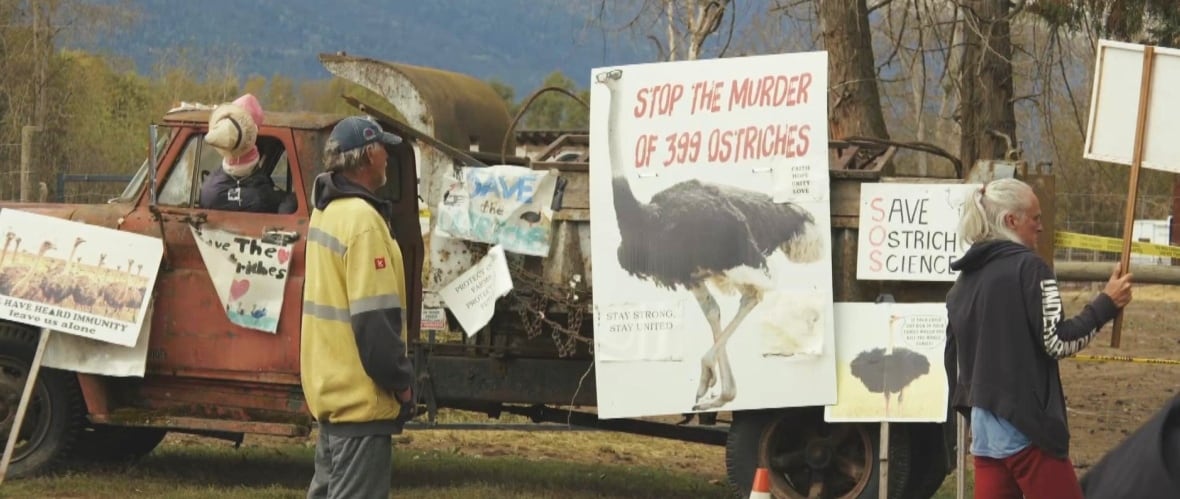
Pierre Poilievre was asked twice this past week whether he supports the people gathered at Universal Ostrich Farms to protest the planned cull. The typically outspoken Conservative leader has avoided commenting directly on the protesters' claims.
On Thursday, Poilievre — without saying the word "ostrich" — pointed the finger at the Liberal government.
"They have mismanaged this from the very beginning, and now they have left Canadians confused, farmers baffled by the total incompetence by the Canadian Food Inspection Agency," he said.
Health Minister Marjorie Michel, who oversees the CFIA, said she's concerned about the situation at the farm.
"I'm not going to comment on the topic because it's in front of the court," she said Thursday in Ottawa.
"Our politicians have been silent," the farm's spokesperson, Katie Pasitney, told a Thursday press conference. "It would be nice to see the real topics that are affecting real Canadians … be on the agenda and the discussion of leaders like Pierre Poilievre," she said.
A fine line for Conservative leader: prof
For many of the farm's supporters, the issue has clear parallels to the COVID-19 mandates that motivated the 2022 "Freedom Convoy" demonstrations, and prominent "Freedom Convoy" organizer Tamara Lich has visited the farm a number of times.
Pasitney said the protesters have received some support in recent weeks from the area's Conservative MP Scott Anderson, and from the local provincial MLA, but the farm is frustrated that it's not getting much attention from Ottawa — and particularly from Poilievre.
Lori Turnbull, a professor of political science at Dalhousie University, said the Tory leader seems reluctant to take a strong stand on what could be a wedge issue among his own supporters.
"This is the type of issue that could easily divide the Conservative coalition," she said.
Turnbull said Poilievre was successful in getting the support of those who agreed with the convoy without fully endorsing it.
"He puts himself up as kind of adjacent to it enough that those people might come to support him," she said.
Poilievre is also focused on attacking the Liberals on issues of affordability and crime, she said, and the party likely wants him to stay on message.
Gerry Ritz, a former Conservative federal agriculture minister, agreed that Poilievre has "bigger fish to fry."
"Where's the minister? You know, where's [Agriculture Minister] Heath MacDonald? He should be out in front of this saying, 'Yes, there's a rationale for doing this,'" Ritz said.
Calls for re-testing
Green Party leader Elizabeth May was also asked about the ostrich farm this week and said she had written to the Minister of Health in January asking for the ostriches to be re-tested.
"Most of my constituents who write me want that ostrich cull not to happen," she said.

But May also said the politics surrounding the farm, which has received support from Trump administration member Robert F. Kennedy, Jr. and U.S. billionaire John Castimidis, had made her "sympathize with the ostriches less."
"But that doesn't matter," she added. "What matters is that we get our facts first, and we don't have all our facts because the CFIA has refused to re-test."
The CFIA has been consistent in its message that once avian flu is detected among domestic birds, the entire flock must be wiped out to prevent the disease from spreading and to remain compliant with international trade agreements aimed at preventing the spread of the disease in commercial poultry.
The CFIA tested two birds for avian flu in December 2024 after receiving a tip of dead ostriches on the farm, which eventually saw 69 of the birds die by mid-January. Both of the tested ostriches were found to have avian flu, and the cull order was issued shortly before January.
Two subsequent court rulings have found the CFIA's application of the policy to the ostrich farm has been consistent, and that whether or not the disease is still present among the ostriches on the farm is immaterial because what's at play is whether it was reasonably believed to be present in December 2024, when the cull order was first issued, not whether it is still present months later due to legal delays.
Typically, the CFIA says, a cull is carried out within 72 hours of avian flu being detected, while the ostrich farm has managed to extend things more than ten months through legal delays and political lobbying.
The CFIA has taken control of the farm while waiting to hear whether the Supreme Court of Canada will hear the latest legal challenge filed by Universal Ostrich.
ABOUT THE AUTHOR

With files from Brenna Owen and CBC News
MLA Brodie visits B.C. ostrich farm, calls cull 'government overreach'

MLA Dallas Brodie has arrived at an Edgewood farm where more than 300 ostriches are under the threat of a cull she says appears to be imminent.
Universal Ostrich Farm has been a landing spot in recent weeks for politicians, like Brodie, from the Vancouver-Quilchena riding, who are concerned about government overreach. The ostriches have been at risk of being destroyed ever since the Canadian Food Inspection Agency (CFIA) declared an outbreak of avian influenza among the flock in December 2024. A cull order was issued, which the farm has fought tirelessly through the courts.
The latest court development saw the Supreme Court of Canada grant the farm an interim stay of the cull order on Sept. 24. Court documents show the CFIA had until Oct. 3 to respond to the application, and the ostriches were to remain in the agency's custody with no interference from Universal Ostrich.
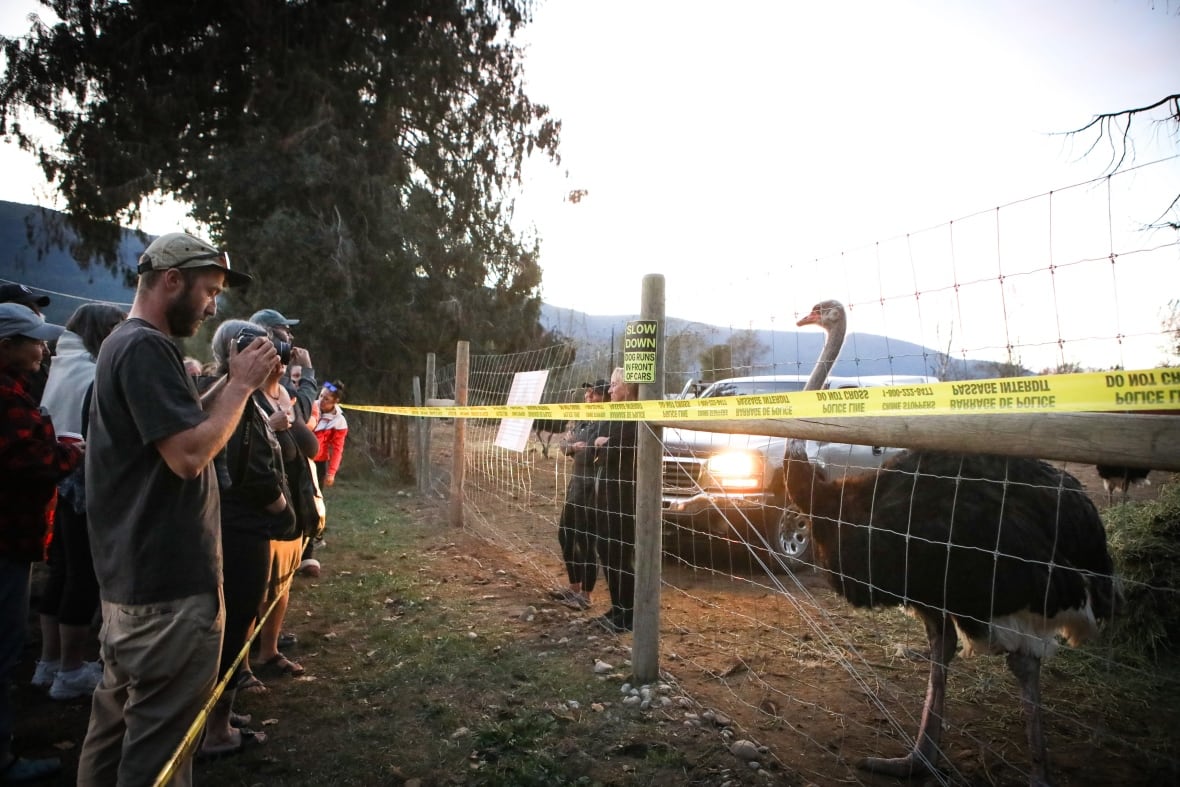
Brodie, the interim leader of the fledgling OneBC party — a role she assumed after being ousted by the B.C. Conservative caucus in March over residential school comments — spoke to The Morning Star Friday morning, Oct. 3, 20 minutes after arriving at the farm, where she saw well over 100 cars parked, tents set up to form a camp of supporters, people milling about, and a thoroughly isolated flock of ostriches.
Beyond that, she described a police presence that was strikingly large.
"What struck me initially — this is the first time I've been here — the police presence is unbelievable," Brodie said. "You'd think there were weapons of war or something here ... there are cops everywhere."
A large blue fence and police tape have been put up to keep people away from the ostriches. A few of the birds can still be seen running around. A police officer, said Brodie, is guarding the top of the road where people drive in, and clusters of officers can be seen throughout the property.
Brodie said she was told by a person who has been filming at the farm for days that hunters have been hired "to set up and shoot" the birds. Asked if she thinks the cull could be taking place soon, she said she wasn't sure when it would be happening, "but it looks like it could be imminent."
The CFIA will have to wait at least until the Supreme Court of Canada decides whether to hear the case before carrying out the cull.
The CFIA has stood firm on its stamping-out policy, which it maintains is an internationally recognized leading method of dealing with avian flu outbreaks. It is common practice at infected poultry farms, though this is the first case of it being used on an ostrich flock by the CFIA.
Late last month, the agency answered a question that's long been sought by Universal Ostrich Farm and other defenders of the ostriches: why hasn't additional testing taken place following the initial detection of avian flu nine months ago, after the farm has said the birds have been healthy for months?
"There is no post-detection testing of exposed birds to exclude individual birds to exclude them from depopulation," the CFIA said, meaning there is no method of testing that could spare the birds from the cull.
Brodie isn't buying the CFIA's explanation, saying testing can and should be done to determine if the ostriches need to be culled.
"You test something because you're curious to find out whether there is a problem here, and the group here is demanding testing. They want to know the truth about the state of the health of these birds," she said.
Walking around the farm, Brodie said she saw signs of what felt to her to be a "massive government overreach."
"We're concerned because it seems to be targeting a small farming operation, and it seems like it's overkill for the situation that's here," she said.
She said she was told Prime Minister Mark Carney has been getting regular updates on the situation at the farm, and wonders why he won't step in.
"Someone could say, 'Why don't you just test the birds, Mr. Carney, and find out if there's a problem here?'" she said. "If there's no problem here, then leave the ostrich farm alone and let it be."
An ironic wrinkle to the situation relates to how the ostriches are used. The farm doesn't use the ostriches for meat; rather, its owners claim they are using them for scientific research to fight future outbreaks of diseases, such as avian flu, the disease that's prompted the cull order.
Brodie thinks the cull is illogical and hopes political leaders will take note.
"I would like to see Premier David Eby and Prime Minister Mark Carney and other leaders show some reasonableness here," she said. "If there were a serious outbreak here, I'm sure even (farm spokesperson) Katie Pasitney would say, okay, we will euthanize these birds. She'd probably participate in it."
Protesters at the farm were peaceful on Friday morning, according to Brodie.
Things haven't always been orderly at the farm — a suspicious fire was ignited in a wall of hay bales early morning, Sept. 24. The bales had been set up by the CFIA and RCMP, ostensibly to corral the ostriches.
The flock of ostriches was at one point 400 strong. The CFIA previously reported that 69 of the ostriches had died, and puts the current ostrich count at the farm between 300 and 330.
Ostrich with 'pre-existing condition' dies at B.C. farm, CFIA confirms

Oct 04, 2025
The ostrich was part of the 300-plus flock at Universal Ostrich Farm that is under the threat of the cull order, but which recently was given reprieve through a last-minute stay of the order by the Supreme Court of Canada.
The CFIA said the compromised ostrich had a pre-existing condition and a previous injury that affected its left leg and mobility. The agency said the bird was being treated by its owners for some time.
The ostrich's health significantly declined in the last 48 hours and it died on Saturday, Oct. 4, the agency said.
Farm spokesperson Katie Pasitney shared a video on social media Saturday afternoon, confirming the ostrich's death and accusing the CFIA of animal cruelty in its death. The CFIA could not be immediately reached to respond to the accusation.
However, the agency issued a press release Saturday saying it had been "administering medication and electrolyte fluids consistent with the therapy regime provided by the owners" with regards to the compromised bird.
The CFIA ordered the cull after an outbreak of avian influenza was discovered at the farm in December 2024. The farm's owners have fought the order ever since, challenging it in the courts and saying the ostriches that survived the outbreak are healthy and being used for scientific research.
The Supreme Court of Canada granted an 11th-hour stay of the cull on Sept. 24. Court documents showed the CFIA had until Oct. 3 to respond to the application, and the ostriches were to remain in the agency's custody with no interference from Universal Ostrich.
The CFIA said it will respect all orders and decisions of the courts throughout the process, including holding off on the cull until a further decision is made on the stay motion.
The agency noted the Supreme Court did not order the CFIA to stop any other operations or preparations at the farm.
It added CFIA inspectors, RCMP and third-party contractors are not required to wear personal protective equipment (PPE) while on the ostrich farm property unless they are entering designated “hot” zones related to the quarantine.
"Any individuals entering the designated zones have worn PPE or have been thoroughly disinfected upon exit. All equipment is also disinfected when leaving designated zones," the CFIA said.
Brendan Shykora
I started my career with the Morning Star as a carrier at
the age of eight. I went on to earn a Bachelor of Arts degree from UBC
Okanagan, majoring in English. In 2019, I graduated from the Master of
Journalism program at Carleton University. During my time in the
capital, I wrote feature articles about star amateur athletes for the
Ottawa Sportspage, and interned at the Ottawa Citizen. Whenever I have
spare time, I enjoy reading and playing golf.
I always enjoy engaging with people in the community I serve. Email me at brendan.shykora@vernonmorningstar.com with questions, comments and story tips.
- Phone
- 250-550-7921 ext 221
- brendan.shykora@vernonmorningstar.com


30 Comments


About
Kinetica Online is produced and supported by Kinexus Bioinformatics Corporation. Kinexus is a systems proteomics/bioinformatics company that conducts in-house signal transduction research and has also been a provider of innovative proteomics solutions to over 1650 academic and industrial laboratories in the last 14 years. The research carried out by Kinexus aims to identify disease biomarkers and therapeutic drug targets, and characterize drug candidates. The future application of this knowledge should facilitate disease diagnosis and personalized therapies to improve human healthcare and welfare. The content in Kinetica Online reflects the efforts by many talented individuals at Kinexus, the University of British Columbia and various collaborators. Profiles of two of the principals responsible for Kinetica Online are shown below.

Kinetica Online’s senior editor and principal contributor is Dr. Steven Pelech. He is the Founder, President and Chief Scientific Officer of Kinexus Bioinformatics Corporation, and concurrently a full professor in the Department of Medicine at the University of British Columbia (UBC), where he has been on faculty since 1988. Dr. Pelech was the principal founder of Kinetek Pharmaceuticals, Inc. and served as its President and C.E.O. for six years, and was one of the founding scientists of the Biomedical Research Center in Vancouver. Prior to his academic and industrial experience, he spent five years in post-doctoral training with Sir Philip Cohen at the University of Dundee in Scotland and Nobel laureate Dr. Edwin Krebs at the University of Washington in Seattle. Dr. Pelech received his B.Sc. (1979; Honours) and Ph.D. (1982) degrees in Biochemistry from UBC. Dr. Pelech has authored over 220 scientific publications in peer-reviewed journals and book chapters about signal transduction, and he is one of the discoverers of the MAP kinase family of cell signalling proteins. He has served on grant review panels for the US National Institutes of Health, the Canadian Institutes for Health Research, the National Research Council of Canada, the Michael Smith Health Research Foundation, Genome Alberta, the Canadian Heart and Stroke Foundation, the Canadian National Cancer Institute, and the American Heart Association, as well as an external reviewer for 22 other agencies including the U.S. National Science Foundation and the Israel Science Foundation. He has also been an external reviewer for 30 scientific journals.
Since the seizure of their flock, the farmers of Universal Ostrich Farms have been arrested and barred from caring for the birds or verifying their well-being.
On Friday's Rebel Roundtable livestream, Sheila Gunn Reid and Drea Humphrey, joined by independent journalists Chris Dacey and Jonathan Villeneuve, reacted to May's statement and the uncommon bit of 'moral clarity' shining through her staunch anti-Americanism.

From: Rebel News <info@rebelnews.com>
Date: Fri, Oct 3, 2025 at 9:20 AM
Subject: REBEL BUZZ | TD Bank’s connection to disgraced financier Jeffrey Epstein has resurfaced
To: David Amos <David.Raymond.Amos333@gmail.com>
|
|||||||||||||||||||||||||||||||||||||||
|
|||||||||||||||||||||||||||||||||||||||
|
|||||||||||||||||||||||||||||||||||||||
|
|||||||||||||||||||||||||||||||||||||||
|
|||||||||||||||||||||||||||||||||||||||
|
|||||||||||||||||||||||||||||||||||||||
|
|||||||||||||||||||||||||||||||||||||||
|
|||||||||||||||||||||||||||||||||||||||
|
|||||||||||||||||||||||||||||||||||||||
|
|||||||||||||||||||||||||||||||||||||||
|


 Live Music
 Cocktails
 Hors D'oeuvres
 Meet &
Greet
Meet &
Greet Photos with our Journalists
 General Admission includes a drink ticket, hors
d’oeuvres, entertainment, cake, photo booth & free parking.
General Admission includes a drink ticket, hors
d’oeuvres, entertainment, cake, photo booth & free parking. VIP Tickets include everything above — plus a
private dinner with Rebel journalists before the party.
VIP Tickets include everything above — plus a
private dinner with Rebel journalists before the party.


|
This email was sent to David.Raymond.Amos333@gmail. To stop receiving emails, click here. |

The RCMP are present to prevent citizens from interfering with the Canadian Food Inspection Agency's bird cull.
Ezra Levant reports on the CFIA's seizure of an ostrich farm, protected by RCMP, as they prepare to cull nearly 400 healthy ostriches.
Sheila Gunn Reid and Drea Humphrey are joined by independent journalists Right Blend and Chris Dacey to discuss the top stories of the day in this edition of the Rebel Roundtable livestream.
90 Comments
.

Alexa Lavoie and Tamara Ugolini react to Pierre Poilievre's response to the Canadian Food Inspection Agency's cull order on a presumably healthy flock of nearly 400 ostriches in B.C.
467 Comments
‘Something is rotten in Ottawa’: fight to save B.C. ostriches ramps up with Trump ally weighing in
 An ostrich at the Universal Ostrich Farms in Edgewood, B.C., on Saturday, May 17, 2025. THE CANADIAN PRESS/Aaron Hemens
Posted October 2, 2025 6:29 pm.
The fight to save hundreds of B.C. ostriches from a mass cull is somehow getting even more dramatic, with a member of U.S President Donald Trump’s inner circle now calling out the Canadian government.
John Catsimatidis is a New York businessman, billionaire, radio host, and Trump confidant.
He has been helping pay Universal Ostrich Farms’ legal bills — nearly $50,000 Canadian so far.
“Something is rotten in Ottawa,” Catsimatidis said during an emergency press conference held over Zoom on Thursday.
Universal Ostrich Farms, located in Edgewood, B.C., has been locked in a months-long battle with the Canadian Food Inspection Agency (CFIA), which insists more than 300 ostriches must be culled after an avian flu outbreak last December.
But the farm — and its list of high-profile supporters — argue the birds are healthy and should be tested, not slaughtered.
Catsimatidis says if Canada won’t test the flock, then the United States should be allowed to.
“All I’m asking is for the Supreme Court of Canada to [come to] the common sense solution: allow the Food and Drug Administration to test the animals.”
He even suggested moving the birds to Dr. Mehmet Oz’s ranch in Florida.
“If Canada doesn’t want the animals, allow Dr. Oz to take them to the United States. What is wrong with that?”
Catimatidis also says that he sent Prime Minister Mark Carney a letter “asking him in the nicest way” to consider his proposal.
“I told President Trump about it. I don’t know if they discussed it,” he said, referring to a potential conversation between Carney and Trump.
What happens next
The CFIA has held its ground, saying its policies require a full flock cull after avian flu is detected.
Officials say inspectors are feeding and watering the birds, and note the animals are not showing signs of stress.
The case is now in the hands of the Supreme Court of Canada, which has temporarily paused the cull while it decides whether to hear the farm’s appeal.
A decision is expected soon.
— With files from The Canadian Press.
Former public safety minister Stockwell Day and lawyer Keith Wilson discuss Pierre Poilievre's response to the ongoing ostrich saga in B.C.

Ostrich farmers awaiting Supreme Court decision get little attention from Ottawa
Published:
Karen Espersen, right, the co-owner of Universal Ostrich Farms, speaks with supporters with her daughter, Katie Pasitney, at the farm in Edgewood, B.C., on Monday, Sept. 22, 2025, as the Canadian Food Agency took custody of 400 of the farm’s ostriches. THE CANADIAN PRESS/Aaron Hemens
As the Supreme Court of Canada considers whether to hear the case of a B.C. farm that’s fighting to save its ostriches from a Canadian Food Inspection Agency cull, politicians in Ottawa appear to be choosing their words on the matter very carefully.
Pierre Poilievre was asked twice this past week whether he supports the people gathered at Universal Ostrich Farms to protest the planned cull. The typically outspoken Conservative leader has avoided commenting directly on the protesters’ claims.
On Thursday, Poilievre — without saying the word “ostrich” — pointed the finger at the Liberal government.
“They have mismanaged this from the very beginning, and now they have left Canadians confused, farmers baffled by the total incompetence by the Canadian Food Inspection Agency,” he said.
Health Minister Marjorie Michel, who oversees the CFIA, said she’s concerned about the situation at the farm.
“I’m not going to comment on the topic because it’s in front of the court,” she said Thursday in Ottawa.
“Our politicians have been silent,” the farm’s spokesperson, Katie Pasitney, told a Thursday press conference.
She said the protesters have received some support in recent weeks from the area’s Conservative MP Scott Anderson, and from the local provincial MLA, but the farm is frustrated that it’s not getting much attention from Ottawa — and particularly from Poilievre.
Lori Turnbull, a professor of political science at Dalhousie University, said the Tory leader seems reluctant to take a strong stand on what could be a wedge issue among his own supporters.
“This is the type of issue that could easily divide the Conservative coalition,” she said.
The saga dates back to December, when the Canadian Food Inspection Agency received an anonymous tip about the deaths of some birds at the farm near Edgewood, B.C., a tiny unincorporated community about two hours southeast of Vernon by highway.
The CFIA reported finding 69 dead ostriches at the farm. Two of them subsequently tested positive for avian flu.
The highly infectious virus has been detected on 534 properties across Canada in recent years, resulting in more than 14 million birds being culled. Worldwide, outbreaks at poultry operations have been blamed for driving up egg prices.
The CFIA said the culls are required under the World Organisation for Animal Health’s “stamping out” policy, which Canada and many of its trading partners have adopted.
The policy requires the “depopulation of animals that are infected, suspected to be infected or exposed” to the virus, according to the CFIA. That’s typically done within 48 to 72 hours.
The farm’s co-owner Karen Espersen and her daughter Pasitney have launched a court challenge of the cull that’s drawn media and political attention from all over the world — including the Trump administration — and has brought dozens of supporters to the farm.

The case has taken more than 200 days to get to the top court. The farmers say the remaining ostriches show no signs of avian flu and should not be killed.
The CFIA says ostriches that appear healthy can still spread the disease, including new mutations of the virus.
The Supreme Court has issued a temporary stay of the cull order and has ordered the CFIA to take custody of the birds until it decides whether to hear the case.
The agency was escorted onto the property by RCMP on Sept. 22 and took control of the ostrich enclosure.
The CFIA said that’s a first.
“Typically, animal owners co-operate with the agency’s disease control efforts, and such measures have not previously been necessary,” a spokesperson said in a media statement.
The RCMP say they are investigating a number of incidents in the area surrounding the operation, including suspicious fires, an alleged assault of an elderly neighbour who said she was doused with gasoline, and threats of violence made toward businesses associated with the CFIA’s work at the farm. One business reported to police that its employees were threatened with being followed home and fired upon.
U.S. billionaire John Catsimatidis, an ally of President Donald Trump, has helped fund the farm’s legal battle. He said during a press conference with Pasitney on Thursday that he personally told Trump about the issue.
Trump and Prime Minister Mark Carney are set to meet in Washington next week.
U.S. Health Secretary Robert F. Kennedy Jr. has written to the Canadian government to ask it to stop the cull. Dr. Mehmet Oz, the administrator of the Centers for Medicare & Medicaid Services — an agency of the U.S. Department of Health — has offered to bring the flock to his personal ranch.
“It would be nice to see the real topics that are affecting real Canadians … be on the agenda and the discussion of leaders like Pierre Poilievre,” Pasitney said Thursday, adding she wants to see reform of the CFIA’s stamping out policy.
For many of the farm’s supporters, the issue has clear parallels to the COVID-19 mandates that motivated the 2022 “Freedom Convoy” demonstrations.
“I see it as blatant government overreach from the CFIA,” said Jeffery Gaudry, who was at the farm last week when the agency arrived.
“That’s exactly what I seen happening in 2022 — different elements, one was a virus that was affecting people, one that’s a virus that’s affecting birds.”
He’s not alone. Prominent “Freedom Convoy” organizer Tamara Lich has visited the farm a number of times.
Turnbull said Poilievre was successful in getting the support of those who agreed with the convoy.
“He doesn’t go full on and endorse it, but he puts himself up as kind of adjacent to it enough that those people might come to support him,” she said.
Poilievre is also focused on attacking the Liberals on issues of affordability and crime, she said, and the party likely wants him to stay on message.
Gerry Ritz, a former Conservative federal agriculture minister, agreed that Poilievre has “bigger fish to fry.”
“Where’s the minister? You know, where’s (Agriculture Minister) Heath MacDonald? He should be out in front of this saying, yes, there’s a rationale for doing this,” Ritz said.
“They can’t point to anything in the Health of Animals Act that allows the thuggery that they’ve devolved to in this instance.”
Ritz, who used to raise ostriches on his Saskatchewan farm, also said he’s not convinced the flock actually had avian flu. “I’m not even sure that avian influenza is a factor with them. Nobody’s proven that,” he said.
Pasitney has said the same — but the farm itself has not argued in court that there was no avian flu.
In fact, according to the CFIA, the farm said in court that “individuals associated with the infected premises have reported that they had their own blood tested and H5N1 antibodies were detected.”
“While no serious illnesses were reported to public health authorities, this apparent evidence of ostrich to human transmission is a concern and highlights the risk of delays in completing the disposal of an infected flock,” the CFIA stated.
The Supreme Court is set to decide whether it will hear the case soon.
RELATED STORIES:
- Law professor would be ‘surprised’ if High Court takes up B.C. ostrich farm case
- RCMP investigate alleged assault of woman who lives beside B.C. ostrich farm
- Stay of ostrich cull in southeast B.C. an ongoing potential health risk, CFIA says
This report by Sarah Ritchie, The Canadian Press, was first published Oct. 2, 2025.
— With files from Brenna Owen in Edgewood, B.C.

Deja Vu Anyone???
From: Premier of Ontario | Premier ministre de l’Ontario <Premier@ontario.ca>
Date: Mon, Sep 4, 2023 at 10:04 PM
Subject: Automatic reply: LIVE - Stronger Together w/ Leighton Grey & Kenneth Drysdale
To: David Amos <david.raymond.amos333@gmail.com>
Thank you for your email. Your thoughts, comments and input are greatly valued.
You can be assured that all emails and letters are carefully read, reviewed and taken into consideration.
There may be occasions when, given the issues you have raised and the need to address them effectively, we will forward a copy of your correspondence to the appropriate government official. Accordingly, a response may take several business days.
Thanks again for your email.
______
Merci pour votre courriel. Nous vous sommes très reconnaissants de nous avoir fait part de vos idées, commentaires et observations.
Nous tenons à vous assurer que nous lisons attentivement et prenons en considération tous les courriels et lettres que nous recevons.
Dans certains cas, nous transmettrons votre message au ministère responsable afin que les questions soulevées puissent être traitées de la manière la plus efficace possible. En conséquence, plusieurs jours ouvrables pourraient s’écouler avant que nous puissions vous répondre.
Merci encore pour votre courriel.
From: LeBlanc, Dominic - député <dominic.leblanc@parl.gc.ca>
Date: Fri, Oct 3, 2025 at 3:56 PM
Subject: Automatic reply: LIVE - Stronger Together w/ Leighton Grey & Kenneth Drysdale
To: David Amos <david.raymond.amos333@gmail.com>
(Le français suit)
IMPORTANT - PLEASE READ
Hello,
We acknowledge receipt and thank you for your email addressed to the Honourable Dominic LeBlanc, P.C., K.C., M.P. for Beauséjour.
Please note that we are receiving a high volume of correspondence. This may mean a delay in our response to you.
Constituents of Beauséjour
For emails related to specific issues from our constituents in Beauséjour, we will make sure to review your message and an employee from our constituency office will reach out to you if necessary. If you have any questions or require clarification, you can always contact our office at the following number: (506) 533-5700.
Intergovernmental Affairs, Internal Trade and One Canadian Economy
If you are writing with
respect to Minister LeBlanc’s Intergovernmental Affairs, Internal Trade
and One Canadian Economy files, please direct your correspondence to the
Ministerial Department at
iga.minister-ministre.aig@pco-
Canada-US Trade
If you are writing with
respect to Minister LeBlanc’s Canada-US Trade file, please direct your
correspondence to the Ministerial Department at
dominic.leblanc@international.
Media Inquiries
For all media inquiries, please contact Gabriel Brunet at
Gabriel.Brunet@iga-aig.gc.ca
Thank you and have a good day.
Office of the Hon. Dominic LeBlanc, P.C., K.C.
Member of Parliament for Beauséjour
------------------------------
IMPORTANT - VEUILLEZ LIRE
Bonjour,
Nous accusons réception de votre courriel adressé à L’honorable Dominic
LeBlanc, cp, cr, député de Beauséjour, et nous vous en remercions.
Veuillez noter que nous recevons un volume élevé de correspondances. Veuillez prévoir un délai dans nos réponses.
Commettants de Beauséjour
En ce qui concerne les courriels relatifs à des enjeux particuliers de nos commettants de Beauséjour, nous allons nous assurer de bien réviser votre message et un employé de notre bureau de circonscription communiquera avec vous si nécessaire. Si vous avez des questions ou désirez des clarifications, vous pouvez toujours communiquer avec notre bureau au numéro suivant : (506) 533-5700.
Affaires intergouvernementales, Commerce intérieur et l’Unité de l’économie canadienne
Si vous
écrivez au sujet des fonctions du ministre LeBlanc en matière des
Affaires intergouvernementales, du Commerce intérieur et de l’Unité de
l’économie canadienne, veuillez adresser votre correspondance
au département ministériel à l'adresse suivante:
iga.minister-ministre.aig@pco-
Commerce Canada–États-Unis
Si vous
écrivez au sujet des fonctions du ministre LeBlanc en matière du
Commerce Canada–États-Unis, veuillez adresser votre correspondance au
département ministériel à l'adresse suivante:
dominic.leblanc@international.
Demandes des médias
Pour toutes demandes des médias, veuillez contacter Gabriel Brunet à
Gabriel.Brunet@iga-aig.gc.ca
Merci et bonne journée.
Bureau de L’hon. Dominic LeBlanc, c.p., c.r.
Député de Beauséjour
From: Moore, Rob - M.P. <Rob.Moore@parl.gc.ca>
Date: Fri, Oct 3, 2025 at 3:56 PM
Subject: Automatic reply: LIVE - Stronger Together w/ Leighton Grey & Kenneth Drysdale
To: David Amos <david.raymond.amos333@gmail.com>
Thank you for contacting the Honourable Rob Moore, P.C., M.P. office. We appreciate the time you took to get in touch with our office.
If you did not already, please ensure to include your full contact details on your email and the appropriate staff will be able to action your request. We strive to ensure all constituent correspondence is responded to in a timely manner.
If your question or concern is time sensitive, please call our office: 506-832-4200.
Again, we thank you for taking the time to share your thoughts and concerns.
~*~*~*~*~*~*~*~
Office of the Honourable Rob Moore, P.C., M.P.
Member of Parliament for Fundy Royal
Date: Fri, Oct 3, 2025 at 3:56 PM
Subject: Acknowledgement – Email Received / Accusé de réception – Courriel reçu
To: David Amos <david.raymond.amos333@gmail.com>
On behalf of the Hon. Pierre Poilievre, we would like to thank you for contacting the Office of the Leader of the Official Opposition.
Mr. Poilievre greatly values feedback and input from Canadians. We wish to inform you that the Office of the Leader of the Official Opposition reads and reviews every e-mail we receive. Please note that this account receives a high volume of e-mails, and we endeavour to reply as quickly as possible.
If you are a constituent of Mr. Poilievre in the riding of Battle River - Crowfoot and you have an urgent matter to discuss, please contact his constituency office at:
Phone: 1-780-608-4600
Fax: 1-780-608-4603
Hon. Pierre Poilievre, M.P.
Battle River – Crowfoot
4945 50 Street
Camrose, Alberta T4V 1P9
Once again, thank you for writing.
Sincerely,
Office of the Leader of the Official Opposition
_____________________________
Au nom de l’honorable Pierre Poilievre, nous tenons à vous remercier d’avoir communiqué avec le Bureau du chef de l’Opposition officielle.
M. Poilievre accorde une grande importance aux commentaires et aux suggestions des Canadiens. Nous tenons à vous informer que le Bureau du chef de l’Opposition officielle lit et examine tous les courriels qu’il reçoit. Veuillez noter que ce compte reçoit un volume important de courriels et que nous nous efforçons d’y répondre le plus rapidement possible.
Si vous êtes un électeur de M. Poilievre dans la circonscription de Battle River - Crowfoot et que vous avez une question urgente à discuter, veuillez contacter son bureau de circonscription :
Téléphone :
Télécopieur :
L’honorable Pierre Poilievre, député
Battle River – Crowfoot
4945, 50 Street
Camrose (Alberta) T4V 1P9
Encore une fois, merci de votre message.
Veuillez agréer nos salutations distinguées,
Bureau du chef de l’Opposition officielle
From: Blanchet, Yves-François - Député <Yves-Francois.Blanchet@parl.gc.ca>
Date: Fri, Oct 3, 2025 at 3:56 PM
Subject: Réponse automatique : LIVE - Stronger Together w/ Leighton Grey & Kenneth Drysdale
To: David Amos <david.raymond.amos333@gmail.com>
(Ceci est une réponse automatique)
(English follows)
Bonjour,
Nous avons bien reçu votre courriel et nous vous remercions d'avoir écrit à M. Yves-François Blanchet, député de Beloeil-Chambly et chef du Bloc Québécois.
Comme nous avons un volume important de courriels, il nous est impossible de répondre à tous individuellement. Soyez assuré(e) que votre courriel recevra toute l'attention nécessaire.
Nous ne répondons pas à la correspondance contenant un langage offensant.
L'équipe du député Yves-François Blanchet
Chef du Bloc Québécois
Thank you for your email. We will read it as soon as we can.
We do not respond to correspondence that contains offensive language.
From: David Myles <davidmylesforfredericton@gmail.com>
Date: Fri, Oct 3, 2025 at 3:53 PM
Subject: David Myles MP Re: LIVE - Stronger Together w/ Leighton Grey & Kenneth Drysdale
To: <david.raymond.amos333@gmail.com>
From: Office of the Premier <scott.moe@gov.sk.ca>
Date: Fri, Oct 3, 2025 at 3:56 PM
Subject: Thank you for your email
To: David Amos <david.raymond.amos333@gmail.com>
This is to acknowledge that your email has been received by the Office of the Premier.
We appreciate the time you have taken to write.
NOTICE: This e-mail was intended for a specific person. If it has reached you by mistake, please delete it and advise me by return e-mail. Any privilege associated with this information is not waived. Thank you for your cooperation and assistance.
Avis: Ce message est confidentiel, peut être protégé par le secret professionnel et est à l'usage exclusif de son destinataire. Il est strictement interdit à toute autre personne de le diffuser, le distribuer ou le reproduire. Si le destinataire ne peut être joint ou vous est inconnu, veuillez informer l'expéditeur par courrier électronique immédiatement et effacer ce message et en détruire toute copie. Merci de votre cooperation.
From: Ministerial Correspondence Unit - Justice Canada <mcu@justice.gc.ca>
Date: Fri, Oct 3, 2025 at 3:56 PM
Subject: Automatic Reply
To: David Amos <david.raymond.amos333@gmail.com>
Thank you for writing to the Minister of Justice and Attorney General of Canada.
Due to the volume of correspondence addressed to the Minister, please note that there may be a delay in processing your email. Rest assured that your message will be carefully reviewed.
We do not respond to correspondence that contains offensive language.
-------------------
Merci d'avoir écrit au ministre de la Justice et procureur général du Canada.
En raison du volume de correspondance adressée au ministre, veuillez
prendre note qu'il pourrait y avoir un retard dans le traitement de
votre courriel. Nous tenons à vous assurer que votre message sera lu
avec soin.
Nous ne répondons pas à la correspondance contenant un langage offensant.
From: Fraser, Sean - M.P. <Sean.Fraser@parl.gc.ca>
Date: Fri, Oct 3, 2025 at 3:56 PM
Subject: Automatic reply: LIVE - Stronger Together w/ Leighton Grey & Kenneth Drysdale
To: David Amos <david.raymond.amos333@gmail.com>
Thank you for your contacting the constituency office of Sean Fraser, Member of Parliament for Central Nova.
This is an automated reply.
Please note that all correspondence is read, however due to the high volume of emails we receive on a daily basis there may be a delay in getting back to you. Priority will be given to residents of Central Nova.
To ensure we get back to you in a timely manner, please include your full name, home address including postal code and phone number when reaching out.
Thank you.
-------------
Merci d'avoir contacté le bureau de circonscription de Sean Fraser, député de Central Nova. Il s'agit d'une réponse automatisée.
Veuillez noter que toute la correspondance est lue, mais qu'en raison du volume élevé de courriels que nous recevons quotidiennement, il se peut que nous ne puissions pas vous répondre dans les meilleurs délais.
Pour que nous puissions vous répondre dans les meilleurs délais, veuillez indiquer votre nom complet, votre adresse personnelle, y compris le code postal, et votre numéro de téléphone lorsque vous nous contactez.
Nous vous remercions.
Facebook : facebook.com/SeanFraserMP
Twitter : @SeanFraserMP
Instagram : SeanFraserMP
Sans frais : 1-844-641-5886
From: David Amos <david.raymond.amos333@gmail.com>
Date: Fri, Oct 3, 2025 at 3:53 PM
Subject: Re: LIVE - Stronger Together w/ Leighton Grey & Kenneth Drysdale
To: Jason Lavigne <jason@yellowhead.vote>, <lgrey@gwsllp.ca>, <contact@fedsforfreedom.ca>, <Blaine.Higgs@gnb.ca>, premier <premier@ontario.ca>, Bill.Blair <Bill.Blair@parl.gc.ca>, premier <premier@gov.ab.ca>, <derekstorie85@gmail.com>, cps <cps@calgarypolice.ca>, <ministryofjustice@gov.ab.ca>, Kaycee.Madu <Kaycee.Madu@gov.ab.ca>, hugh.flemming <hugh.flemming@gnb.ca>, Bill.Hogan <Bill.Hogan@gnb.ca>, pm <pm@pm.gc.ca>, jcarpay <jcarpay@jccf.ca>, robert.mckee <robert.mckee@gnb.ca>, Anita.Anand <Anita.Anand@parl.gc.ca>, oldmaison <oldmaison@yahoo.com>, Office of the Premier <scott.moe@gov.sk.ca>, <michael.chong@parl.gc.ca>, pierre.poilievre <pierre.poilievre@parl.gc.ca>, mcu <mcu@justice.gc.ca>, Sean.Fraser <Sean.Fraser@parl.gc.ca>, elizabeth.may <elizabeth.may@parl.gc.ca>, don.davies <don.davies@parl.gc.ca>, davidmylesforfredericton@gmail.com <DavidMylesForFredericton@gmail.com>, <mike.dawson@parl.gc.ca>, <david.mcguinty@parl.gc.ca>, <ps.ministerofpublicsafety-ministredelasecuritepublique.sp@ps-sp.gc.ca>, dominic.leblanc <dominic.leblanc@parl.gc.ca>, prontoman1 <prontoman1@protonmail.com>, rob.moore <rob.moore@parl.gc.ca>, John.Williamson <John.Williamson@parl.gc.ca>, Richard.Bragdon <Richard.Bragdon@parl.gc.ca>, <Francois.Legault.ASSO@assnat.qc.ca>, Yves-Francois.Blanchet <Yves-Francois.Blanchet@parl.gc.ca>, francis.scarpaleggia <francis.scarpaleggia@parl.gc.ca>, <francois-philippe.champagne@parl.gc.ca>, Chrystia.Freeland <Chrystia.Freeland@parl.gc.ca>, Frank.McKenna <Frank.McKenna@td.com>, news <news@chco.tv>, Newsroom <Newsroom@globeandmail.com>, news-tips <news-tips@nytimes.com>, Nathalie.G.Drouin <Nathalie.G.Drouin@pco-bcp.gc.ca>, <News@nowmediainc.com>, news957 <news957@rogers.com>, <daceymedia@gmail.com>
Cc: <info@donaldbest.ca>, motomaniac333 <motomaniac333@gmail.com>, ian <ian@mccuaiglaw.ca>, <mjackson@fieldlaw.com>, freedomreport.ca <freedomreport.ca@gmail.com>, <chris.scott@whistlestoptruckstop.ca>, sheilagunnreid <sheilagunnreid@gmail.com>, stefanos.karatopis <stefanos.karatopis@gmail.com>, ragingdissident <ragingdissident@protonmail.com>
From: <postmaster@abgov.onmicrosoft.
Date: Mon, Sep 4, 2023 at 10:04 PM
Subject: Undeliverable: Re: LIVE - Stronger Together w/ Leighton Grey & Kenneth Drysdale
To: <david.raymond.amos333@gmail.
Delivery has failed to these recipients or groups:
Your message is too large to send. To send it, make the message smaller, for example, by removing attachments.The maximum message size that's allowed is 1 KB. This message is 93 KB.
https://rumble.com/v3eriyb-stronger-together-w-leighton- grey-and-kenneth-drysdale.html
---------- Forwarded message ----------
From: David Amos <david.raymond.amos333@gmail.com>
Date: Sun, 22 May 2022 15:06:40 -0300
Subject: Hey Leighton Grey QC if that were remotely true then how to
you explain the FEDS FOR FREEDOM CEASE & DESIST BULLSHIT BEARING YOUR
SIGNATURE???
To: Blaine.Higgs@gnb.ca, premier <premier@ontario.ca>, "Brenda.Lucki"
<Brenda.Lucki@rcmp-grc.gc.ca>, "Bill.Blair" <Bill.Blair@parl.gc.ca>,
premier <premier@gov.ab.ca>, derekstorie85@gmail.com, cps
<cps@calgarypolice.ca>, ministryofjustice@gov.ab.ca, "Kaycee.Madu"
<Kaycee.Madu@gov.ab.ca>, "hugh.flemming" <hugh.flemming@gnb.ca>,
"Bill.Hogan" <Bill.Hogan@gnb.ca>, pm <pm@pm.gc.ca>, "Katie.Telford"
<Katie.Telford@pmo-cpm.gc.ca>, "Ian.Shugart"
<Ian.Shugart@pco-bcp.gc.ca>, jcarpay <jcarpay@jccf.ca>,
"jagmeet.singh" <jagmeet.singh@parl.gc.ca>, "robert.mckee"
<robert.mckee@gnb.ca>, "andrea.anderson-mason"
<andrea.anderson-mason@gnb.ca>, "Anita.Anand"
<Anita.Anand@parl.gc.ca>, oldmaison <oldmaison@yahoo.com>, Office of
the Premier <scott.moe@gov.sk.ca>
Cc: motomaniac333 <motomaniac333@gmail.com>, lgrey@gwsllp.ca,
contact@fedsforfreedom.ca, ian <ian@mccuaiglaw.ca>,
mjackson@fieldlaw.com, "freedomreport.ca"
<freedomreport.ca@gmail.com>, chris.scott@whistlestoptruckstop.ca,
sheilagunnreid <sheilagunnreid@gmail.com>, "stefanos.karatopis"
<stefanos.karatopis@gmail.com>
Better yet do you even recall talking to me last year as you denied
reading my emails???
---------- Original message ----------
From: Leighton Grey <LGrey@gwsllp.ca>
Date: Sun, 22 May 2022 17:53:32 +0000
Subject: Re: Methinks YOU and many FEDS FOR FREEDOM cannot deny that I
crossed paths with their lawyer Leighton Grey QC just over a year ago
N'esy Pas Higgy??
To: David Amos <david.raymond.amos333@gmail.com>
Mr. Amos:
I have no connection whatsoever to Mark Jackson. Nor do I presently
represent FFF.
Regards,
“Lex deficere non potest Justitia exhibenda”
Leighton B. U. Grey, Q.C.
Senior Counsel
GWSLLP
---------- Forwarded message ----------
From: "Higgs, Premier Blaine (PO/CPM)" <Blaine.Higgs@gnb.ca>
Date: Sun, 22 May 2022 17:50:29 +0000
Subject: RE: Methinks YOU and many FEDS FOR FREEDOM cannot deny that I
crossed paths with their lawyer Leighton Grey QC just over a year ago
N'esy Pas Higgy??
To: David Amos <david.raymond.amos333@gmail.com>
Hello,
Thank you for taking the time to write.
Due to the volume of incoming messages, this is an automated response
to let you know that your email has been received and will be reviewed
at the earliest opportunity.
If your inquiry more appropriately falls within the mandate of a
Ministry or other area of government, staff will refer your email for
review and consideration.
Merci d'avoir pris le temps de nous écrire.
En raison du volume des messages reçus, cette réponse automatique vous
informe que votre courriel a été reçu et sera examiné dans les
meilleurs délais.
Si votre demande relève plutôt du mandat d'un ministère ou d'un autre
secteur du gouvernement, le personnel vous renverra votre courriel
pour examen et considération.
If this is a Media Request, please contact the Premier’s office at
(506) 453-2144 or by email
media-medias@gnb.ca<mailto:media-medias@gnb.ca>
S’il s’agit d’une demande des médias, veuillez communiquer avec le
Cabinet du premier ministre au 506-453-2144.
Office of the Premier/Cabinet du premier ministre
P.O Box/C. P. 6000 Fredericton New-Brunswick/Nouveau-Brunswick E3B 5H1 Canada
Tel./Tel. : (506) 453-2144
Email/Courriel: premier@gnb.ca <mailto:premier@gnb.ca%20> /
premierministre@gnb.ca<mailto:premierministre@gnb.ca>
---------- Forwarded message ----------
From: Premier of Ontario | Premier ministre de l’Ontario <Premier@ontario.ca>
Date: Sun, 22 May 2022 17:51:01 +0000
Subject: Automatic reply: Methinks YOU and many FEDS FOR FREEDOM
cannot deny that I crossed paths with their lawyer Leighton Grey QC
just over a year ago N'esy Pas Higgy??
To: David Amos <david.raymond.amos333@gmail.com>
Thank you for reaching out to Ontario Premier Doug Ford.
As you may know, Writs of Election were issued on May 4, 2022, which
signals that the campaign period has begun. This means the Ontario
government has entered caretaker mode until the completion of the next
general election on June 2, 2022.
In certain instances, your inquiry will be forwarded to the
appropriate government official for review but please note that
responses may be deferred.
Rest assured that all correspondence is carefully read and given
proper consideration.
Thank you again for writing.
______
Merci d’avoir contacté le premier ministre de l’Ontario, Doug Ford.
Comme vous le savez sans doute, un décret de convocation des électeurs
et électrices à une élection provinciale a été émis le 4 mai 2022,
marquant le début de la campagne électorale. Par conséquent, le
gouvernement de l’Ontario est entré dans une période de transition
jusqu’à la tenue des prochaines élections générales, le 2 juin 2022.
Votre demande sera transmise à un représentant du gouvernement aux
fins d’examen. Toutefois, veuillez noter que dans certains cas, il
pourrait y avoir un délai avant qu’une réponse ne vous soit acheminée.
Soyez assurés que toutes les correspondances que nous recevons sont
lues et traitées attentivement. Nous vous remercions de nous avoir
écrit.
---------- Forwarded message ----------
From: Office of the Premier <scott.moe@gov.sk.ca>
Date: Sun, 22 May 2022 17:49:00 +0000
Subject: Thank you for your email
To: David Amos <david.raymond.amos333@gmail.com>
This is to acknowledge that your email has been received by the Office
of the Premier.
We appreciate the time you have taken to write.
NOTICE: This e-mail was intended for a specific person. If it has
reached you by mistake, please delete it and advise me by return
e-mail. Any privilege associated with this information is not waived.
Thank you for your cooperation and assistance.
Avis: Ce message est confidentiel, peut être protégé par le secret
professionnel et est à l'usage exclusif de son destinataire. Il est
strictement interdit à toute autre personne de le diffuser, le
distribuer ou le reproduire. Si le destinataire ne peut être joint ou
vous est inconnu, veuillez informer l'expéditeur par courrier
électronique immédiatement et effacer ce message et en détruire toute
copie. Merci de votre cooperation.
---------- Forwarded message ----------
From: David Amos <david.raymond.amos333@gmail.com>
Date: Sun, 22 May 2022 14:51:15 -0300
Subject: Re: We Need Serious Leadership | Nous avons besoin de
leadership sérieux Cry me a river
To: messages@jeancharest.ca
Cc: motomaniac333 <motomaniac333@gmail.com>
On 5/22/22, Jean Charest <messages@jeancharest.ca> wrote:
> « Le français suivra »
>
> David,
>
> Everywhere I go in Canada, I’ve been hearing something from Conservatives
> that really worries me.
>
> “I don’t feel at home in this Party anymore. I don’t know if I belong.”
>
> They hear wild speculation about Bitcoin and they ask — when did
> Conservatives start telling Canadians to take big financial risks?
>
> They hear talk of the superiority of the Anglo-Saxon language, and they
> think — do I even want to be associated with this Party anymore?
>
> And then they see the people they relied on to be a calm and trusted voice
> in our Party — like Ed Fast — cancelled by our own. And they wonder if they
> should even bother anymore.
>
> I’m going to tell you what I’ve been telling them.
>
> Not only do you belong in our Party. Our Party NEEDS you. Now more than
> ever.
>
> I believe we are a strong Party when we offer Canadians serious solutions.
> Exploiting anger is not a solution.
>
> I am going to get our Party back on the right track. But I can’t do it
> without you.
>
> I need you to do one thing, right now, to save our Party.
>
> Send this email to two people. One friend and one family member.
>
> Ask them to sign up.
>
> That’s it, just two people.
>
> The first two people who come to mind.
>
> Forward this email and ask them to sign up at jeancharest.ca
> (https://d2y0PW04.na1.hubspotlinks.com/Ctc/GG+113/ d2y0PW04/ VXclyp7VQrqjW4GNTKj1bGGLGW28qd JZ4Knr7mN2L_pzS3l0g5V1- WJV7CgCRvW2BpSV22HqgCyW96h_ CQ43CCnDW6CB40W7zL4fpW8QCRjs4G RkNTW1JYP3Z8cb8c5W7mwGs63NGtb3 W1lC5wk3_GwLPW8BMsnL8xqWG7W8_ WXBz5BjrlmW3LrbTN42qr0cW8gCY88 4bJRDPW6K8L- 52pr5MrW5Fjdmn3R2ntQW5YXdfY8nx xl0N4xpsGmY88CVMbC0pBTkrznW7JQ -Dg1Vdvp0W2JgWz63- jDY8VKfClS6rn4jWW950ZjZ8x41MsW 8g6W8H7V4YcjW7WccR- 45Q2YPW8pL4Kk7vdL2kW4dDXBb8HHS 6LW1cnXdn511_ 5bM321tLnHySB3fr61
> ) before June 3rd so that they and you can have your voices heard.
>
> The Party and the Country need you.
>
> Sincerely,
>
> Jean Charest
>
> Candidate for the Conservative Party of Canada Leadership
>
> P.S. The CPC cannot go backwards. We must move forward and bring big ideas
> and policies back to our conservative movement. My campaign is proposing
> serious leadership on issues that matter to Canadians. Sign up
> (https://d2y0PW04.na1.hubspotlinks.com/Ctc/GG+113/ d2y0PW04/ VXclyp7VQrqjW4GNTKj1bGGLGW28qd JZ4Knr7mN2L_pzS3l0g5V1- WJV7CgCRvW2BpSV22HqgCyW96h_ CQ43CCnDW6CB40W7zL4fpW8QCRjs4G RkNTW1JYP3Z8cb8c5W7mwGs63NGtb3 W1lC5wk3_GwLPW8BMsnL8xqWG7W8_ WXBz5BjrlmW3LrbTN42qr0cW8gCY88 4bJRDPW6K8L- 52pr5MrW5Fjdmn3R2ntQW5YXdfY8nx xl0N4xpsGmY88CVMbC0pBTkrznW7JQ -Dg1Vdvp0W2JgWz63- jDY8VKfClS6rn4jWW950ZjZ8x41MsW 8g6W8H7V4YcjW7WccR- 45Q2YPW8pL4Kk7vdL2kW4dDXBb8HHS 6LW1cnXdn511_ 5bM321tLnHySB3fr61
> ) to support our campaign today if you want a credible leader who can beat
> Justin Trudeau.
>
> David,
>
> Partout où je vais au Canada, j'entends quelque chose des conservateurs qui
> m'inquiète vraiment.
>
> « Je ne me sens plus chez moi dans ce Parti. Je ne sais pas si j'y
> appartiens. »
>
> Ils entendent de folles spéculations sur le Bitcoin et pose la question :
> quand les conservateurs ont-ils commencé à dire aux Canadiens de prendre de
> tels risques financiers ?
>
> Ils entendent parler de la supériorité de la langue anglo-saxonne, et ils
> pensent - est-ce que je veux encore être associé à ce Parti ?
>
> Et puis ils voient les gens sur lesquels ils comptaient pour être une voix
> calme et de confiance dans notre Parti — comme Ed Fast — muselé par les
> nôtres. Et ils se demandent s'ils ne devraient même plus s'en soucier.
>
> Je vais vous dire ce que je leur ai dit.
>
> Non seulement vous appartenez à notre Parti. Notre parti A BESOIN de vous.
> Maintenant plus que jamais.
>
> Je crois que nous sommes un parti fort lorsque nous offrons aux Canadiens
> des solutions sérieuses. Exploiter la colère n'est pas une solution.
>
> Je vais remettre notre Parti sur la bonne voie. Mais je ne peux pas le faire
> sans vous.
>
> J'ai besoin que vous fassiez une chose, maintenant, pour sauver notre
> Parti.
>
> Envoyez ce courriel à 2 personnes. Un ami et un membre de la famille.
>
> Demandez-leur de s'inscrire.
>
> C'est tout, juste deux personnes.
>
> Les deux premières personnes qui vous viennent à l'esprit.
>
> Transférez ce courriel et demandez-leur de s'inscrire sur jeancharest.ca
> (https://d2y0PW04.na1.hubspotlinks.com/Ctc/GG+113/ d2y0PW04/ VXclyp7VQrqjW4GNTKj1bGGLGW28qd JZ4Knr7mN2L_pzS3l0g5V1- WJV7CgTM3W5Jn8Bt5qX7xmW2TMYV72 wHQCWW8cM31P8LlYsfW1J_ vHm3lWp6vW6zf1Xw54HQs6W3sBGBw2 j154bW4NpMmR1nHs1QW3hkvVj347- d_ W6pm1D268xQtFW4YqXz11MclPxW2nJ 8Ch6-Rkc- W27nxw65vw8NmMhDXTh5Rf7XW5QJ30 240YQdmW15vTy13KmzjvW81pTtF5xK Cz3W4BsNwf3F8STlVrz_ k056mcRHW26wgZC6_ W7xDW2PhX823kkprzW3SysCf66mgVt W8ql-rt5lWttSN5m5pQbvy- hWW99VwkW65wyD4W2jLbs29fMyZbW8 ffDxl6VkX-Q350_1
> ) avant le 3 juin afin qu'eux et vous puissiez faire entendre votre voix.
>
> Le Parti et le pays ont besoin de vous.
>
> Sincèrement,
>
> Jean Charest
>
> Candidat à la direction du Parti conservateur du Canada
>
> PS Le PCC ne peut pas revenir en arrière. Nous devons aller de l'avant et
> ramener de grandes idées et politiques à notre mouvement conservateur. Ma
> campagne propose un leadership sérieux sur des questions qui comptent pour
> les Canadiens. Inscrivez-vous
> (https://d2y0PW04.na1.hubspotlinks.com/Ctc/GG+113/ d2y0PW04/ VXclyp7VQrqjW4GNTKj1bGGLGW28qd JZ4Knr7mN2L_pzS3l0g5V1- WJV7CgTM3W5Jn8Bt5qX7xmW2TMYV72 wHQCWW8cM31P8LlYsfW1J_ vHm3lWp6vW6zf1Xw54HQs6W3sBGBw2 j154bW4NpMmR1nHs1QW3hkvVj347- d_ W6pm1D268xQtFW4YqXz11MclPxW2nJ 8Ch6-Rkc- W27nxw65vw8NmMhDXTh5Rf7XW5QJ30 240YQdmW15vTy13KmzjvW81pTtF5xK Cz3W4BsNwf3F8STlVrz_ k056mcRHW26wgZC6_ W7xDW2PhX823kkprzW3SysCf66mgVt W8ql-rt5lWttSN5m5pQbvy- hWW99VwkW65wyD4W2jLbs29fMyZbW8 ffDxl6VkX-Q350_1
> ) pour soutenir notre campagne aujourd'hui si vous voulez un leader crédible
> qui peut battre Justin Trudeau.
>
> Follow the team that's Built to Win.
>
> Suivez le mouvement Bâti pour gagner.
>
> (https://d2y0PW04.na1.hubspotlinks.com/Ctc/GG+113/ d2y0PW04/ VXclyp7VQrqjW4GNTKj1bGGLGW28qd JZ4Knr7mN2L_pzf3l0fwV1- WJV7CgKm0W9l2rhK3BnL4rW7GKJlc6 qC3y8W56cdbY43CbmtW2P258R5bg- 7jW4ZbRHs5f0BB6N7Cr1gzc6Sp5W7n 0V6_1NPqWMW1Pn7Yp4_cWXtW7- r7Hr6Wl85TW4PdTs_3YDgrZVr_ j8V8rk- FnW86LGkN5m8C9pW82F9Yn5p1LN6W8 14DQn43d-vMW56JlKq2W8-_ RW4hJWM_ 5F8rtjW6STJPP3DvrljVXhp2x8L5Sr 1W1WPT166C_vx- W5NkhTF48S0B3W5T8P-58X-W_ CW9hJ-yY5Dpb3F3lss1
> )
>
> (https://d2y0PW04.na1.hubspotlinks.com/Ctc/GG+113/ d2y0PW04/ VXclyp7VQrqjW4GNTKj1bGGLGW28qd JZ4Knr7mN2L_pzf3l0fwV1- WJV7CgRJ7W66QwTr6Q4WDxW4qgXDz1 -8pwpW2rlJpK9j- DtdW1VZztj5RWxspW1Sg3_ c4Cv7lKVd90p49jWQRdW1mTGCc7SqK 2JW1M9XhC5QShJLW5JmRB23YXgbrW6 ZZLh_ 3W3sSsW7dtvVV307Ns1N3vXH5lKr1B 5W7- RpmV1WVJPBW90rRF08rwcN8W7GKf2y 1Y2tcDW6RwmVq7gfCL0W4mFx6c3f_ 5MzW589Y- g628DvqN49fn9SJFLwqW3ykG9s31ll mNW3nkJG08zhfWQW5r- RVl1N7pkY32Gw1
> )
>
> (https://d2y0PW04.na1.hubspotlinks.com/Ctc/GG+113/ d2y0PW04/ VXclyp7VQrqjW4GNTKj1bGGLGW28qd JZ4Knr7mN2L_pzf3l0fwV1- WJV7CgM9LW2snpxy3ZdlvwW3X8VqK6 MkB0BW4pb_ Sg6Drq7rW12BrL15s8VdYW3h- 5XH4Bs_ 1JW1D0S6k82q48zW3K6psK27d- sYW3gq- Qh3fMbSqW3Hk33H1f3gz5N55r25JVG fk4W42THyY1w8_ qCW7n0TCt7ZQhP1W4b- s647XW7wkW6QwD0q5ksrk7N6NcSKWT yfZXW3kfzZM30xTjtW7s7CBJ1KMJdw W28q7_ L215ylNN4L5hcb517HlW8Qxbnd2gkh HVW6qQyJG3FgCnhW6B0XKG1gp6Zx33 VJ1
> )
>
> (https://d2y0PW04.na1.hubspotlinks.com/Ctc/GG+113/ d2y0PW04/ VXclyp7VQrqjW4GNTKj1bGGLGW28qd JZ4Knr7mN2L_pzf3l0fwV1- WJV7CgF3YW9cd3hT7475wMW8llkbH2 YRVdgW1VFsls3SDrLhW8_- GQM7jYsLGW9g5XDY36VKzGW7gMKPg8 TxdTtW3g37424FGf7DW56NclC5RNj5 pW8XgqwG2mNqZqW675J251q_ gY8W1ygvjL8XwYmJW11JGFm77PRVZW 1gjJXJ6TqgZdN2zPbSLybjCmW3pl51 368zmV1N6y_2V73mnjDM6ML2Ctv6J- W71R4_ q4lBws5W2WfBsC1MDd2kVtWw144YKh _ mW4FZyx15HBhMqN32q6Rp23bxr3gWR 1
> )
>
> Copyright © 2022 Jean Charest Campaign, All rights reserved.
>
> Droits d’auteur © 2022 Jean Charest Campaign. Tous les droits sont
> réservés.
>
> Jean Charest Campaign, 500-30 Wellington Street West, Commerce Court South,
> Toronto, Ontario, M5L 1E2, Canada
>
> Unsubscribe
> (https://hs-21574884.s.hubspotemail.net/hs/manage- preferences/unsubscribe-all? languagePreference=en&d= Vnk5VT8x_ B18W17YKDM3SZ3pCW3zkxTZ41QPXcW 3_XYHc1V1bxVW3_ R5921JxwY5MWLSh_ DQvqKVQtGlF7wQpJPN8pLl4NDy5PyW 8ZnCs- 8yBbjsW7rGYm35byBTkV1yf0N30hjN JW4BLwsw8yp3W7N6BTgqyQFgw71h3& v=3&_hsenc=p2ANqtz-- kfyvnYqbvEuDbPaiRd2WY5bTJFZq4X OMjOBd- Vun5rQfWGvNhp2uQDKIrKnpeeG2pNQ R4OXYpQT2jrc4rE8yeNcutKQNxCeBz PRJcGPvBlcX0A6M&_hsmi= 213890861
> )
>
> Manage preferences
> (https://hs-21574884.s.hubspotemail.net/hs/manage- preferences/unsubscribe? languagePreference=en&d= Vnk5VT8x_ B18W17YKDM3SZ3pCW3zkxTZ41QPXcW 3_XYHc1V1bxVW3_ R5921JxwY5MWLSh_ DQvqKVQtGlF7wQpJPN8pLl4NDy5PyW 8ZnCs- 8yBbjsW7rGYm35byBTkV1yf0N30hjN JW4BLwsw8yp3W7N6BTgqyQFgw71h3& v=3&_hsenc=p2ANqtz-- kfyvnYqbvEuDbPaiRd2WY5bTJFZq4X OMjOBd- Vun5rQfWGvNhp2uQDKIrKnpeeG2pNQ R4OXYpQT2jrc4rE8yeNcutKQNxCeBz PRJcGPvBlcX0A6M&_hsmi= 213890861
> )
---------- Original message ----------
From: David Amos <david.raymond.amos333@gmail.com>
Date: Sun, 22 May 2022 14:48:54 -0300
Subject: Methinks YOU and many FEDS FOR FREEDOM cannot deny that I
crossed paths with their lawyer Leighton Grey QC just over a year ago
N'esy Pas Higgy??
To: Blaine.Higgs@gnb.ca, premier <premier@ontario.ca>, "Brenda.Lucki"
<Brenda.Lucki@rcmp-grc.gc.ca>, "Bill.Blair" <Bill.Blair@parl.gc.ca>,
premier <premier@gov.ab.ca>, derekstorie85@gmail.com, cps
<cps@calgarypolice.ca>, ministryofjustice@gov.ab.ca, "Kaycee.Madu"
<Kaycee.Madu@gov.ab.ca>, "hugh.flemming" <hugh.flemming@gnb.ca>,
"Bill.Hogan" <Bill.Hogan@gnb.ca>, pm <pm@pm.gc.ca>, "Katie.Telford"
<Katie.Telford@pmo-cpm.gc.ca>, "Ian.Shugart"
<Ian.Shugart@pco-bcp.gc.ca>, jcarpay <jcarpay@jccf.ca>,
"jagmeet.singh" <jagmeet.singh@parl.gc.ca>, "robert.mckee"
<robert.mckee@gnb.ca>, "andrea.anderson-mason"
<andrea.anderson-mason@gnb.ca>, "Anita.Anand"
<Anita.Anand@parl.gc.ca>, oldmaison <oldmaison@yahoo.com>, Office of
the Premier <scott.moe@gov.sk.ca>
Cc: motomaniac333 <motomaniac333@gmail.com>, lgrey@gwsllp.ca,
contact@fedsforfreedom.ca, ian <ian@mccuaiglaw.ca>,
mjackson@fieldlaw.com, "freedomreport.ca"
<freedomreport.ca@gmail.com>, chris.scott@whistlestoptruckstop.ca,
sheilagunnreid <sheilagunnreid@gmail.com>, "stefanos.karatopis"
<stefanos.karatopis@gmail.com>
Hence anyone should undestand why I am laughing at them today EH?
https://www.fedsforfreedom.ca/category/press-releases/
CEASE & DESIST SERVED TO CORE FEDERAL DEPARTMENTS
Wednesday, January 26, 2022
FEDS FOR FREEDOM
FOR IMMEDIATE PRESS RELEASE
This notice is to inform the press and the public at large, that today
the President, Secretary and Chief Human Resources Officer of the
Treasury Board (the official employer of federal public servants) have
been served with a Cease and Desist letter regarding the federal
vaccination mandate for public servants.
Today, January 26th 2022, the lawyers for Feds For Freedom, a
not-for-profit advocacy organization for public servants, served The
Honorable Mona Fortier, Peter Wallace, Christine Donughue along with
all Departmental Ministers of the Core Public Service Administration
under the Treasury Board Secretariat. These documents put the
individuals served on notice that the federal vaccine mandates are
unjustifiable, unconstitutional and criminal in nature. Feds For
Freedom maintains that bodily autonomy and informed consent, free of
coercion, intimidation or bullying are fundamental rights that are
inviolable. The consequences laid out by legal counsel include, but
are not limited to:
Numerous charter rights challenges;
Legal action against the Government of Canada; and
Applications seeking injunctive relief and punitive damages.
As federal public servants, we have had our livelihoods stripped from
us; we have endured unprecedented amounts stress and hardships. We
have been harassed, ridiculed, mocked and had hatred and violence
incited against us. This type of abusive behavior cannot and will not
be tolerated; we expect and request an expeditious response.
contact@fedsforfreedom.ca
---------- Original message ----------
From: "Higgs, Premier Blaine (PO/CPM)" <Blaine.Higgs@gnb.ca>
Date: Tue, 18 May 2021 17:29:19 +0000
Subject: RE: Methinks Jason Kenney and everybody else in Alberta knows
I crossed paths with the law firm of J. Mark Jackson QC before either
of you wee elected to be Premiers N'esy Pas Higgy??
To: David Amos <david.raymond.amos333@gmail.com>
Hello,
Thank you for taking the time to write.
Due to the volume of incoming messages, this is an automated response
to let you know that your email has been received and will be reviewed
at the earliest opportunity.
If your inquiry more appropriately falls within the mandate of a
Ministry or other area of government, staff will refer your email for
review and consideration.
Merci d'avoir pris le temps de nous écrire.
En raison du volume des messages reçus, cette réponse automatique vous
informe que votre courriel a été reçu et sera examiné dans les
meilleurs délais.
Si votre demande relève plutôt du mandat d'un ministère ou d'un autre
secteur du gouvernement, le personnel vous renverra votre courriel
pour examen et considération.
If this is a Media Request, please contact the Premier’s office at
(506) 453-2144 or by email
media-medias@gnb.ca<mailto:media-medias@gnb.ca>
S’il s’agit d’une demande des médias, veuillez communiquer avec le
Cabinet du premier ministre au 506-453-2144.
General Information
For general information and answers to common questions on novel
coronavirus please visit:
GNB/COVID-19<https://na01.safelinks.protection.outlook. com/?url=https%3A%2F%2Fwww2. gnb.ca%2Fcontent%2Fgnb%2Fen% 2Fcorporate%2Fpromo%2Fcovid- 19.html&data=04%7C01%7CBlaine. Higgs%40gnb.ca% 7C0136b42c4b0a43c7736e08d8c6c6 3f14% 7Ce08b7eefb5014a679ed007e38bfc cee7%7C0%7C0% 7C637477902044012255% 7CUnknown% 7CTWFpbGZsb3d8eyJWIjoiMC4wLjAw MDAiLCJQIjoiV2luMzIiLCJBTiI6Ik 1haWwiLCJXVCI6Mn0%3D%7C1000& sdata=%2FGtlmCM6V3808% 2BQgSt6Z3wjqnOXYsAu747t% 2FfiaDJl0%3D&reserved=0>
or Canada.ca/coronavirus<https://na01.safelinks.protection. outlook.com/?url=https%3A%2F% 2Fwww.canada.ca%2Fen%2Fpublic- health%2Fservices%2Fdiseases% 2F2019-novel-coronavirus- infection.html&data=04%7C01% 7CBlaine.Higgs%40gnb.ca% 7C0136b42c4b0a43c7736e08d8c6c6 3f14% 7Ce08b7eefb5014a679ed007e38bfc cee7%7C0%7C0% 7C637477902044022246% 7CUnknown% 7CTWFpbGZsb3d8eyJWIjoiMC4wLjAw MDAiLCJQIjoiV2luMzIiLCJBTiI6Ik 1haWwiLCJXVCI6Mn0%3D%7C1000& sdata= HgRaSAAAHGAGc1FpMHeBhbY2ITqbgn jB%2BRwSDLc4pBc%3D&reserved=0>
information line 1-833-784-4397.
Safety Issues
For safety issues regarding place of employment/employer please call
WorkSafe NB 1-800-999-9775.
Compassionate requests
Please call the Canadian Red Cross 1-800-863-6582.
Non-health questions
Please call 1-844-462-8387. The email address is
helpaide@gnb.ca<mailto:helpaide@gnb.ca>.
For questions related to travel restrictions during COVID-19
Please call 1-833-948-2800.
MENTAL HEALTH
CHIMO Helpline 1-800-667-5005
Hope for Wellness Helpline 1-855-242-3310
Canadian Border Services Agency
CBSA has instituted a COVID-19 hotline regarding border crossing
concerns/questions at
1-800-461-9999.
Employment Insurance Hotline
Please call 1-833-381-2725.
Renseignements généraux
Pour obtenir des renseignements généraux et des réponses aux questions
les plus fréquentes sur la COVID-19, veuillez consulter le site
GNB/COVID-19<https://na01.safelinks.protection.outlook. com/?url=https%3A%2F%2Fwww2. gnb.ca%2Fcontent%2Fgnb%2Ffr% 2Fcorporate%2Fpromo%2Fcovid- 19.html&data=04%7C01%7CBlaine. Higgs%40gnb.ca% 7C0136b42c4b0a43c7736e08d8c6c6 3f14% 7Ce08b7eefb5014a679ed007e38bfc cee7%7C0%7C0% 7C637477902044022246% 7CUnknown% 7CTWFpbGZsb3d8eyJWIjoiMC4wLjAw MDAiLCJQIjoiV2luMzIiLCJBTiI6Ik 1haWwiLCJXVCI6Mn0%3D%7C1000& sdata= 26VhE3DgZhYd1yDaBFGgqHI6ivyF9o %2F6%2ByymkoP9ubo%3D&reserved= 0>
ou Canada.ca/coronavirus<https://na01.safelinks.protection. outlook.com/?url=https%3A%2F% 2Fwww.canada.ca%2Ffr%2Fsante- publique%2Fservices% 2Fmaladies%2F2019-nouveau- coronavirus.html&data=04%7C01% 7CBlaine.Higgs%40gnb.ca% 7C0136b42c4b0a43c7736e08d8c6c6 3f14% 7Ce08b7eefb5014a679ed007e38bfc cee7%7C0%7C0% 7C637477902044032242% 7CUnknown% 7CTWFpbGZsb3d8eyJWIjoiMC4wLjAw MDAiLCJQIjoiV2luMzIiLCJBTiI6Ik 1haWwiLCJXVCI6Mn0%3D%7C1000& sdata= 77IrMQEwU2uBR9l3gMEYpY9xtWjSSf XBGgIMU9PsPig%3D&reserved=0>
ou composer le 1-833-784-4397.
questions de sécurité
Pour les questions de sécurité concernant les lieux de travail ou les
employeurs, communiquez avec Travail sécuritaire NB au 1-800-999-9775.
DEMANDES POUR RAISONS DE COMPASSION
Veuillez téléphoner à la Croix-Rouge canadienne au 1-800-863-6582.
Questions non liées à la santé
Veuillez composer le 1-844-462-8387 ou envoyer un courriel à l’adresse
helpaide@gnb.ca<mailto:helpaide@gnb.ca>.
Questions liées aux restrictions de voyage pendant la pandémie de COVID-19 :
Composez le 1-833-948-2800.
SANTÉ MENTALE
Ligne d'aide CHIMO : 1-800-667-5005
Ligne d’écoute d’espoir : 1-855-242-3310
Agence des services frontaliers du Canada
L’Agence a mis en place une ligne d’information sur la COVID-19 pour
les questions concernant la traversée de la frontière, le
1-800-461-9999.
LIGNE D’INFORMATION SUR l'assurance-emploi
Composez le 1-833-381-2725.
Office of the Premier/Cabinet du premier ministre
P.O Box/C. P. 6000 Fredericton New-Brunswick/Nouveau-Brunswick E3B 5H1 Canada
Tel./Tel. : (506) 453-2144
Email/Courriel:
premier@gnb.ca/premier.ministre@gnb.ca<mailto:premier @gnb.ca/premier.ministre@gnb. ca>
---------- Original message ----------
From: David Amos <david.raymond.amos333@gmail.com>
Date: Tue, 18 May 2021 14:27:40 -0300
Subject: Methinks Jason Kenney and everybody else in Alberta knows I
crossed paths with the law firm of J. Mark Jackson QC before either of
you wee elected to be Premiers N'esy Pas Higgy??
To: mjackson@fieldlaw.com, jnosyk@fieldlaw.com, lgrey@gwsllp.ca,
info@fairviewbaptistchurch.ca, ian@mccuaiglaw.ca,
freedomreport.ca@gmail.com, derekstorie85@gmail.com, themayor
<themayor@calgary.ca>, cps <cps@calgarypolice.ca>, ministryofjustice
<ministryofjustice@gov.ab.ca>, premier <premier@gov.ab.ca>,
"Kaycee.Madu" <Kaycee.Madu@gov.ab.ca>, sheilagunnreid
<sheilagunnreid@gmail.com>, "Brenda.Lucki"
<Brenda.Lucki@rcmp-grc.gc.ca>, "Bill.Blair" <Bill.Blair@parl.gc.ca>,
"barbara.massey" <barbara.massey@rcmp-grc.gc.ca>, pm <pm@pm.gc.ca>,
"Katie.Telford" <Katie.Telford@pmo-cpm.gc.ca>, "Ian.Shugart"
<Ian.Shugart@pco-bcp.gc.ca>, jcarpay <jcarpay@jccf.ca>,
"jagmeet.singh" <jagmeet.singh@parl.gc.ca>, hugh.flemming@gnb.ca,
"robert.mckee" <robert.mckee@gnb.ca>, "andrea.anderson-mason"
<andrea.anderson-mason@gnb.ca>, "Anita.Anand" <Anita.Anand@parl.gc.ca>
Cc: motomaniac333 <motomaniac333@gmail.com>, premier
<premier@ontario.ca>, Office of the Premier <scott.moe@gov.sk.ca>,
"blaine.higgs" <blaine.higgs@gnb.ca>
---------- Forwarded message ----------
From: David Amos <david.raymond.amos333@gmail.com>
Date: Mon, 17 May 2021 12:48:15 -0300
Subject: Fwd: YO Mayor Nenshi Methinks Tyson Fedor and his CTV cohorts
have informed us that you want Kevin Johnston locked up just as he
wishes the same for you Nesy Pas?
To: derekstorie85@gmail.com, themayor <themayor@calgary.ca>, cps
<cps@calgarypolice.ca>, ministryofjustice
<ministryofjustice@gov.ab.ca>, premier <premier@gov.ab.ca>,
"Kaycee.Madu" <Kaycee.Madu@gov.ab.ca>
Cc: motomaniac333 <motomaniac333@gmail.com>
---------- Forwarded message ----------
From: Freedom Report <freedomreport.ca@gmail.com>
Date: Wed, 12 May 2021 15:08:06 -0600
Subject: Re: YO Mayor Nenshi Methinks Tyson Fedor and his CTV cohorts
have informed us that you want Kevin Johnston locked up just as he
wishes the same for you Nesy Pas?
To: David Amos <david.raymond.amos333@gmail.com>
Is that the law firm for naheed nenshi?
GO FIGURE Why Chris Scott should have printed this document
https://www.scribd.com/doc/2718120/Integrity-Yea-Right
---------- Forwarded message ----------
From: David Amos <david.raymond.amos333@gmail.com>
Date: Sat, 8 May 2021 22:50:57 -0300
Subject: Hey Chris I sure hope that you printed the document I
suggested and said Hey to the RCMP for me
To: chris.scott@whistlestoptruckstop.ca, sheilagunnreid
<sheilagunnreid@gmail.com>, ministryofjustice@gov.ab.ca, premier
<premier@ontario.ca>, "Brenda.Lucki" <Brenda.Lucki@rcmp-grc.gc.ca>,
"Bill.Blair" <Bill.Blair@parl.gc.ca>, "barbara.massey"
<barbara.massey@rcmp-grc.gc.ca>, premier <premier@gov.ab.ca>,
"blaine.higgs" <blaine.higgs@gnb.ca>, "hugh.flemming"
<hugh.flemming@gnb.ca>
Cc: motomaniac333 <motomaniac333@gmail.com>
https://www.cbc.ca/news/canada/edmonton/whistle-stop- campout-protest-1.6019583
Cafe owner arrested, dozens ticketed leaving anti-restriction protest in Alberta
Anti-restriction protest at Whistle Stop Cafe goes ahead despite injunction
The Canadian Press · Posted: May 08, 2021 3:38 PM MT
https://calgary.ctvnews.ca/calgary-mayoral-candidate- pastor-both-released-after- alleged-covid-19-violations-1. 5432410
Calgary mayoral candidate, pastor both released after alleged COVID-19
violations
Bill Graveland
Published Tuesday, May 18, 2021 6:11AM MDT
https://calgaryherald.com/news/crime/mayoral-candidate- pastor-granted-release- pending-contempt-hearing-for- breaching-public-health-orders
Mayoral candidate, pastor granted release pending contempt hearing for
breaching public health orders
Calgary Herald
Publishing date: May 17, 2021
Kevin J. Johnston outside of GraceLife Church on Sunday March 14,
2021. Photo by Larry Wong/Postmedia
Mayoral candidate Kevin J. Johnston was granted his release Monday
after being arrested Saturday for breaching a court order that
required him to comply with COVID-19 public health restrictions.
But Johnston complained the condition of his release — that he comply
with masking requirements, along with other orders issued by chief
medical officer of health Dr. Deena Hinshaw — might be difficult for
him to follow, pending a June 16 contempt of court hearing.
“I’m already feeling the anxiety,” Johnston told a virtual court
hearing, as he sat, masked, in the prisoner’s box in a Calgary Court
of Queen’s Bench courtroom where the judge and lawyers appeared on
video link.
“I simply cannot wear a mask for that period of time,” he said. “I’m
already feeling the anxiety of this right now and I’m sweating. I’m
bothered by having to have this on; I could not possibly wear a mask
for that entire amount of time.”
But Justice Adam Germain told Johnston that he wouldn’t have to wear a
mask 24 hours a day; he only had to comply with restrictions regarding
masking, social distancing and limited attendance at gatherings.
“There’s nothing in these health orders that requires you to wear a
mask in your own abode,” the judge said. “(Your lawyer Ian) McCuaig
will get the health orders and brief you on them.”
McCuaig, who appeared via WebEx from his Toronto office, said Johnston
might raise issues of free speech as a political candidate as a
defence to his alleged breach of the court order restricting his
activities.
Before Johnston’s court appearance, Fairview Baptist Church pastor Tim
Stephens appeared for his release hearing.
Albert Health Services lawyer Kyle Fowler agreed to his release on
condition he comply with a May 6 order prohibiting non-compliance with
public heath guidelines.
Lawyer Leighton Grey said Stephens, who was arrested Sunday for
holding a service without complying with the restrictions, may argue
an amendment to the initial court order of Justice John Rooke meant
that pronouncement no longer applied to the pastor.
He too will face a contempt hearing on June 16.
https://www.fieldlaw.com/People/J-Mark-Jackson
J. Mark Jackson QC, Partner
2500 - 10175 101 ST NW
Edmonton, AB T5J 0H3
T780-423-9589
F780-428-9329
mjackson@fieldlaw.com
Jaclyn Nosyk
Legal Assistant
T780-423-7667
jnosyk@fieldlaw.com
https://www.mccuaiglaw.ca/
McCuaig Law
647 528 7247
ian@mccuaiglaw.ca
http://www.fairviewbaptistchurch.ca/ contact/
Fairview Baptist Church
230 – 78 Ave SE
Calgary, AB T2H 1C4
(403) 252-1704
info@fairviewbaptistchurch.ca
https://gwsllp.ca/contact-grey-wowk-spencer/
Leighton Grey
PHONE: (780) 594-0299
EMAIL: lgrey@gwsllp.ca
---------- Original message ----------
From: David Amos <motomaniac333@gmail.com>
Date: Mon, 30 Jul 2018 19:42:09 -0400
Subject: Attn James Casey QC Re Me versus you and your clients in the
Jedi Academy
To: jcasey@fieldlaw.com, paul.froese@ata.ab.ca,
greg.jeffery@ata.ab.ca, kent.kinsman@ata.ab.ca, themayor
<themayor@calgary.ca>, "don.iveson" <don.iveson@edmonton.ca>, cps
<cps@calgarypolice.ca>, eps <eps@edmontonpolice.ca>, Newsroom
<Newsroom@globeandmail.com>, news <news@kingscorecord.com>, sfine
<sfine@globeandmail.com>, investigations <investigations@cbc.ca>,
gopublic <gopublic@cbc.ca>, "Sophia.Harris" <Sophia.Harris@cbc.ca>,
"steve.murphy" <steve.murphy@ctv.ca>, premier <premier@gov.ab.ca>,
"Kathleen.Ganley" <Kathleen.Ganley@assembly.ab.ca>, ministryofjustice
<ministryofjustice@gov.ab.ca>, "philip.bryden"
<philip.bryden@gov.ab.ca>, "bill.pentney"
<bill.pentney@justice.gc.ca>, "linda.duncan.a1"
<linda.duncan.a1@parl.gc.ca>, "Amarjeet.Sohi"
<Amarjeet.Sohi@edmonton.ca>, "jason.kenney"
<jason.kenney@assembly.ab.ca>
Cc: David Amos <david.raymond.amos@gmail.com>, "Paul.Collister"
<Paul.Collister@rcmp-grc.gc.ca>, "Paul.Lynch"
<Paul.Lynch@edmontonpolice.ca>
https://www.fieldlaw.com/People/James-Casey
James Casey QC
2500 - 10175 101 ST NW
Edmonton, AB T5J 0H3
T780-423-7615
F780-428-9329
jcasey@fieldlaw.com
---------- Forwarded message ----------
From: Paul Froese <Paul.Froese@ata.ab.ca>
Date: Mon, 30 Jul 2018 22:16:44 +0000
Subject: Re: Attn Paul Froese all you had to do was be honest with me
But we are way past that now
To: David Amos <motomaniac333@gmail.com>
Please direct your statement of claim to Mr. James Casey QC care of
Field Law Edmonton. Chief solicitor for the Alberta Teachers’
Association. 2500-10175 101 street Edmonton Alberta Canada T5J-OH3.
Thanks
Transmitted from Jedi Academy Headquarters. May the Force be with you.
On 7/30/18, David Amos <motomaniac333@gmail.com> wrote:
> https://www.teachers.ab.ca/About%20the%20ATA/Who%20We% 20Are/Pages/Provincial% 20Executive%20Council.aspx
>
> Paul Froese
> Phone (cell): 780-951-2461
> paul.froese@ata.ab.ca
>
> ---------- Forwarded message ----------
> From: David Amos <motomaniac333@gmail.com>
> Date: Fri, 27 Jul 2018 13:49:13 -0400
> Subject: Attn Commissioner of Revenue Bob Hamilton I just called Best
> you start lining up your lawyers ASAP EH?
> To: bob.hamilton@canada.ca, "Diane.Lebouthillier"
> <Diane.Lebouthillier@cra-arc.gc.ca>, George J Russell TIGTA
> <j.Russell.George@tigta.treas.gov>, mdcohen212 <mdcohen212@gmail.com>,
> "Jean-Yves.Duclos" <Jean-Yves.Duclos@parl.gc.ca>
> Cc: David Amos <david.raymond.amos@gmail.com>, "Nathalie.Drouin"
> <Nathalie.Drouin@justice.gc.ca>, kevin.leahy@rcmp-grc.gc.ca
>
> Bob Hamilton
> Commissioner of Revenue and Chief Executive Officer of the CRA
> Telephone Number 613-957-3688
> Email bob.hamilton@canada.ca
>
> Perhaps I will run into somebody ethical some day but I bet the
> Yankees know that they won't work for any government. N'esy Pas
> George J Russell and Mikey Cohen?
>
> ---------- Forwarded message ----------
> From: "Ministre / Minister (SPAC/PSPC)"
> <TPSGC.Ministre-Minister.PWGSC@tpsgc-pwgsc.gc.ca>
> Date: Tue, 24 Jul 2018 10:56:46 -0400
> Subject: Accusé réception / Acknowledgement
> To: David Amos <motomaniac333@gmail.com>
>
> Le présent message accuse réception de votre courriel au ministre des
> Services publics et de l'Approvisionnement. Soyez assuré(e) que nous y
> accorderons toute l'attention voulue.
>
> Merci de votre intérêt.
> _________________________________
>
> This message is to acknowledge receipt of your email to the Minister
> of the Public Services and Procurement. Please be assured it will be
> given every consideration.
>
> Thank you for your interest.
>
> ---------- Forwarded message ----------
> From: "Min.Mail / Courrier.Min (CRA/ARC)" <PABMINMAILG@cra-arc.gc.ca>
> Date: Wed, 24 May 2017 13:10:52 +0000
> Subject: Your various correspondence about abusive tax schemes - 2017-02631
> To: "motomaniac333@gmail.com" <motomaniac333@gmail.com>
>
> Mr. David Raymond Amos
> motomaniac333@gmail.com
>
>
> Dear Mr. Amos:
>
> Thank you for your various correspondence about abusive tax schemes,
> and for your understanding regarding the delay of this response.
>
> This is an opportunity for me to address your concerns about the way
> the Canada Revenue Agency (CRA) deals with aggressive tax planning,
> tax avoidance, and tax evasion by targeting individuals and groups
> that promote schemes intended to avoid payment of tax. It is also an
> opportunity for me to present the Government of Canada’s main
> strategies for ensuring fairness for all taxpayers.
>
> The CRA’s mission is to preserve the integrity of Canada’s tax system,
> and it is taking concrete and effective action to deal with abusive
> tax schemes. Through federal budget funding in 2016 and 2017, the
> government has committed close to $1 billion in cracking down on tax
> evasion and combatting tax avoidance at home and through the use of
> offshore transactions. This additional funding is expected to generate
> federal revenues of $2.6 billion over five years for Budget 2016, and
> $2.5 billion over five years for Budget 2017.
>
> More precisely, the CRA is cracking down on tax cheats by hiring more
> auditors, maintaining its underground economy specialist teams,
> increasing coverage of aggressive goods and service tax/harmonized
> sales tax planning, increasing coverage of multinational corporations
> and wealthy individuals, and taking targeted actions aimed at
> promoters of abusive tax schemes.
>
> On the offshore front, the CRA continues to develop tools to improve
> its focus on high‑risk taxpayers. It is also considering changes to
> its Voluntary Disclosures Program following the first set of program
> recommendations received from an independent Offshore Compliance
> Advisory Committee. In addition, the CRA is leading international
> projects to address the base erosion and profit shifting initiative of
> the G20 and the Organisation for Economic Co-operation and
> Development, and is collaborating with treaty partners to address the
> Panama Papers leaks.
>
> These actions are evidence of the government’s commitment to
> protecting tax fairness. The CRA has strengthened its intelligence and
> technical capacities for the early detection of abusive tax
> arrangements and deterrence of those who participate in them. To
> ensure compliance, it has increased the number of actions aimed at
> promoters who use illegal schemes. These measures include increased
> audits of such promoters, improved information gathering, criminal
> investigations where warranted, and better communication with
> taxpayers.
>
> To deter potential taxpayer involvement in these schemes, the CRA is
> increasing notifications and warnings through its communications
> products. It also seeks partnerships with tax preparers, accountants,
> and community groups so that they can become informed observers who
> can educate their clients.
>
> The CRA will assess penalties against promoters and other
> representatives who make false statements involving illegal tax
> schemes. The promotion of tax schemes to defraud the government can
> lead to criminal investigations, fingerprinting, criminal prosecution,
> court fines, and jail time.
>
> Between April 1, 2011, and March 31, 2016, the CRA’s criminal
> investigations resulted in the conviction of 42 Canadian taxpayers for
> tax evasion with links to money and assets held offshore. In total,
> the $34 million in evaded taxes resulted in court fines of $12 million
> and 734 months of jail time.
>
> When deciding to pursue compliance actions through the courts, the CRA
> consults the Department of Justice Canada to choose an appropriate
> solution. Complex tax-related litigation is costly and time consuming,
> and the outcome may be unsuccessful. All options to recover amounts
> owed are considered.
>
> More specifically, in relation to the KPMG Isle of Man tax avoidance
> scheme, publicly available court records show that it is through the
> CRA’s efforts that the scheme was discovered. The CRA identified many
> of the participants and continues to actively pursue the matter. The
> CRA has also identified at least 10 additional tax structures on the
> Isle of Man, and is auditing taxpayers in relation to these
> structures.
>
> To ensure tax fairness, the CRA commissioned an independent review in
> March 2016 to determine if it had acted appropriately concerning KPMG
> and its clients. In her review, Ms. Kimberley Brooks, Associate
> Professor and former Dean of the Schulich School of Law at Dalhousie
> University, examined the CRA’s operational processes and decisions in
> relation to the KPMG offshore tax structure and its efforts to obtain
> the names of all taxpayers participating in the scheme. Following this
> review, the report, released on May 5, 2016, concluded that the CRA
> had acted appropriately in its management of the KPMG Isle of Man
> file. The report found that the series of compliance measures the CRA
> took were in accordance with its policies and procedures. It was
> concluded that the procedural actions taken on the KPMG file were
> appropriate given the facts of this particular case and were
> consistent with the treatment of taxpayers in similar situations. The
> report concluded that actions by CRA employees were in accordance with
> the CRA’s Code of Integrity and Professional Conduct. There was no
> evidence of inappropriate interaction between KPMG and the CRA
> employees involved in the case.
>
> Under the CRA’s Code of Integrity and Professional Conduct, all CRA
> employees are responsible for real, apparent, or potential conflicts
> of interests between their current duties and any subsequent
> employment outside of the CRA or the Public Service of Canada.
> Consequences and corrective measures play an important role in
> protecting the CRA’s integrity.
>
> The CRA takes misconduct very seriously. The consequences of
> misconduct depend on the gravity of the incident and its repercussions
> on trust both within and outside of the CRA. Misconduct can result in
> disciplinary measures up to dismissal.
>
> All forms of tax evasion are illegal. The CRA manages the Informant
> Leads Program, which handles leads received from the public regarding
> cases of tax evasion across the country. This program, which
> coordinates all the leads the CRA receives from informants, determines
> whether there has been any non-compliance with tax law and ensures
> that the information is examined and conveyed, if applicable, so that
> compliance measures are taken. This program does not offer any reward
> for tips received.
>
> The new Offshore Tax Informant Program (OTIP) has also been put in
> place. The OTIP offers financial compensation to individuals who
> provide information related to major cases of offshore tax evasion
> that lead to the collection of tax owing. As of December 31, 2016, the
> OTIP had received 963 calls and 407 written submissions from possible
> informants. Over 218 taxpayers are currently under audit based on
> information the CRA received through the OTIP.
>
> With a focus on the highest-risk sectors nationally and
> internationally and an increased ability to gather information, the
> CRA has the means to target taxpayers who try to hide their income.
> For example, since January 2015, the CRA has been collecting
> information on all international electronic funds transfers (EFTs) of
> $10,000 or more ending or originating in Canada. It is also adopting a
> proactive approach by focusing each year on four jurisdictions that
> raise suspicion. For the Isle of Man, the CRA audited 3,000 EFTs
> totalling $860 million over 12 months and involving approximately 800
> taxpayers. Based on these audits, the CRA communicated with
> approximately 350 individuals and 400 corporations and performed 60
> audits.
>
> In January 2017, I reaffirmed Canada’s important role as a leader for
> tax authorities around the world in detecting the structures used for
> aggressive tax planning and tax evasion. This is why Canada works
> daily with the Joint International Tax Shelter Information Centre
> (JITSIC), a network of tax administrations in over 35 countries. The
> CRA participates in two expert groups within the JITSIC and leads the
> working group on intermediaries and proponents. This ongoing
> collaboration is a key component of the CRA’s work to develop strong
> relationships with the international community, which will help it
> refine the world-class tax system that benefits all Canadians.
>
> The CRA is increasing its efforts and is seeing early signs of
> success. Last year, the CRA recovered just under $13 billion as a
> result of its audit activities on the domestic and offshore fronts.
> Two-thirds of these recoveries are the result of its audit efforts
> relating to large businesses and multinational companies.
>
> But there is still much to do, and additional improvements and
> investments are underway.
>
> Tax cheats are having a harder and harder time hiding. Taxpayers who
> choose to promote or participate in malicious and illegal tax
> strategies must face the consequences of their actions. Canadians
> expect nothing less. I invite you to read my most recent statement on
> this matter at canada.ca/en/revenue-agency/news/2017/03/
> statement_from_thehonourabledianelebouthillie rministerofnational.
>
> Thank you for taking the time to write. I hope the information I have
> provided is helpful.
>
> Sincerely,
>
>
> The Honourable Diane Lebouthillier
> Minister of National Revenue
>
>
> ---------- Forwarded message ----------
> From: Jody.Wilson-Raybould@parl.gc.ca
> Date: Sun, 22 Jul 2018 23:36:35 +0000
> Subject: Automatic reply: NATA and "Litigation Lmbo" with Trump and
> his buddies in the WTO
> To: motomaniac333@gmail.com
>
> Thank you for writing to the Honourable Jody Wilson-Raybould, Member
> of Parliament for Vancouver Granville.
>
> This message is to acknowledge that we are in receipt of your email.
> Due to the significant increase in the volume of correspondence, there
> may be a delay in processing your email. Rest assured that your
> message will be carefully reviewed.
>
> To help us address your concerns more quickly, please include within
> the body of your email your full name, address, and postal code.
>
> Please note that your message will be forwarded to the Department of
> Justice if it concerns topics pertaining to the member's role as the
> Minister of Justice and Attorney General of Canada. For all future
> correspondence addressed to the Minister of Justice, please write
> directly to the Department of Justice at
> mcu@justice.gc.ca<mailto:mcu@justice.gc.ca> or call 613-957-4222.
>
> Thank you
>
> -------------------
>
> Merci d'?crire ? l'honorable Jody Wilson-Raybould, d?put?e de
> Vancouver Granville.
>
> Le pr?sent message vise ? vous informer que nous avons re?u votre
> courriel. En raison d'une augmentation importante du volume de
> correspondance, il pourrait y avoir un retard dans le traitement de
> votre courriel. Sachez que votre message sera examin? attentivement.
>
> Pour nous aider ? r?pondre ? vos pr?occupations plus rapidement,
> veuillez inclure dans le corps de votre courriel votre nom complet,
> votre adresse et votre code postal.
>
> Veuillez prendre note que votre message sera transmis au minist?re de
> la Justice s'il porte sur des sujets qui rel?vent du r?le de la
> d?put?e en tant que ministre de la Justice et procureure g?n?rale du
> Canada. Pour toute correspondance future adress?e ? la ministre de la
> Justice, veuillez ?crire directement au minist?re de la Justice ?
> mcu@justice.gc.ca ou appelez au 613-957-4222.
>
> Merci
>
>
>
> ---------- Forwarded message ----------
> From: Brian Gallant <briangallant10@gmail.com>
> Date: Sun, 22 Jul 2018 16:49:18 -0700
> Subject: Merci / Thank you Re: Fwd: NAFTA and "Litigation Lmbo" with
> Trump and his buddies in the WTO
> To: motomaniac333@gmail.com
>
> (Français à suivre)
>
> If your email is pertaining to the Government of New Brunswick, please
> email me at brian.gallant@gnb.ca
>
> If your matter is urgent, please email Greg Byrne at greg.byrne@gnb.ca
>
> Thank you.
>
> Si votre courriel s'addresse au Gouvernement du Nouveau-Brunswick,
> svp m'envoyez un courriel à brian.gallant@gnb.ca
>
> Pour les urgences, veuillez contacter Greg Byrne à greg.byrne@gnb.ca
>
> Merci.
>
>
>
> http://davidraymondamos3.blogspot.com/2018/07/ litigation-lmbo-with-trump- and-his.html
>
>
> Sunday, 22 July 2018
>
> "Litigation Lmbo" with Trump and his buddies in the WTO
>
> So many of my fellow Canadians were enjoying the circus in the CBC
> comment section I did not bother to try to add my 2 bits worth.
> Instead I picked up the phone and reminded a lot of evil Yankee
> lawyers that I was still alive and paying attention as to how truly
> stupid they are. Then I sent a few emails too.
> Only one lawyer answered me in an ethical and timely fashion. Go
> Figure who it was.
>
>
> https://twitter.com/DavidRayAmos/with_replies
>
> On 7/16/18, David Amos <motomaniac333@gmail.com> wrote:
>> It tried to be fair with Mr. Lighthizer but as i told his help
>> "Trevor" whereas his boss was a partner of Skadden, Arps, Slate,
>> Meagher & Flom LLP (Skadden) and buddy Stephen Vaughn worked there as
>> well they certainly should have known who I am for many years. The kid
>> Janowitz is a dark horse o me because he never even got out of law
>> scholl untill 2006. When asked to speak to a lawyer and was directed
>> to some young lady named Amy who would do nothing. So I went about
>> trying to figure out which lawyers to contact and decided to email
>> several because as we all know bureaucratic lawyers come and go the
>> politcal tide.
>>
>> https://ustr.gov/about-us/biographies-key-officials/ general-counsel-stephen-p- vaughn
>>
>> Brian Samuel Janovitz
>> Bar Number: 32909
>> 1301 M St NW Apt 122
>> Washington, DC 20005-4205
>> United States
>> Office: 202-395-3150
>> Fax: 202-395-3639
>> Email: bjanovitz@ustr.eop.gov
>>
>> https://www.lexsage.com/about-cyndee-todgham-cherniak
>>
>> Cyndee Todgham Cherniak
>> Phone: 647-290-4249
>> Email: cyndee@lexsage.com
>>
>> Need I say I found this interesting as well?
>>
>> https://www.americanbar.org/content/dam/aba/ administrative/intellectual_ property_law/advocacy/Letter_ NAFTA_renegotiations. authcheckdam.pdf
>>
>> https://www.cbc.ca/news/business/us-tariffs-wto-1. 4748459
>>
>> U.S. launches tariff challenge at WTO against Canada, Mexico, Turkey,
>> China and EU
>> American trade rep says original tariffs were justified, but
>> retaliatory tariffs are not
>> Pete Evans · CBC News · Posted: Jul 16, 2018 10:42 AM ET | Last
>> Updated: 2 hours ago
>> Trade representative Robert Lighthizer calls retaliatory tariffs
>> against
https://www.rebelnews.com/indigenous_lawyer_leighton_ grey_forced_out_job_cbc_ attacks_libertarian_beliefs
LIVE NOW: DAILY | Churches under attack in Alberta, Nova Scotia
Indigenous lawyer FORCED OUT from job after CBC attacks him for his
“libertarian” beliefs
By Sheila Gunn Reid | June 23, 2020
---------- Forwarded message ----------
From: David Amos <david.raymond.amos333@gmail.com>
Date: Mon, 17 May 2021 12:48:15 -0300
Subject: Fwd: YO Mayor Nenshi Methinks Tyson Fedor and his CTV cohorts
have informed us that you want Kevin Johnston locked up just as he
wishes the same for you Nesy Pas?
To: derekstorie85@gmail.com, themayor <themayor@calgary.ca>, cps
<cps@calgarypolice.ca>, ministryofjustice
<ministryofjustice@gov.ab.ca>, premier <premier@gov.ab.ca>,
"Kaycee.Madu" <Kaycee.Madu@gov.ab.ca>
Cc: motomaniac333 <motomaniac333@gmail.com>
---------- Forwarded message ----------
From: Freedom Report <freedomreport.ca@gmail.com>
Date: Wed, 12 May 2021 15:08:06 -0600
Subject: Re: YO Mayor Nenshi Methinks Tyson Fedor and his CTV cohorts
have informed us that you want Kevin Johnston locked up just as he
wishes the same for you Nesy Pas?
To: David Amos <david.raymond.amos333@gmail.com>
Is that the law firm for naheed nenshi?
---------- Forwarded message ----------
From: David Amos <david.raymond.amos333@gmail.com>
Date: Sat, 8 May 2021 02:26:59 -0300
Subject: Fwd: YO Chad Williamson Say Hey to Pastor James Coates and
Rotten Ralphy's niece and her foes in the RCMP, Steve Phillips, Karen
Thorsrud and their bosses Kaycee Madu and Jason Kenney for me will
ya???
To: chris.scott@whistlestoptruckstop.ca
---------- Forwarded message ----------
From: Chad Williamson <chad@williamson.law>
Date: Fri, 7 May 2021 21:43:02 -0700
Subject: DELAYED RESPONSE TIMES Re: Fwd: YO Chad Williamson Say Hey to
Pastor James Coates and Rotten Ralphy's niece and her foes in the
RCMP, Steve Phillips, Karen Thorsrud and their bosses Kaycee Madu and
Jason Kenney for me will ya???
To: david.raymond.amos333@gmail.com
Thank you kindly for your email. Please be advised that our office is
currently dealing with extremely urgent litigation matters at this
time. Accordingly, it will be extremely difficult for us to receive,
review, and respond to emails at this time.
This email address may be only periodically monitored — or not
monitored at all — and any responses sent during this time will be on
a priority basis. We expect a sizeable backlog during this time and,
accordingly, ask that you exercise patience while we work to resolve
any backlog that develops. We will respond to emails in a priority
sequence until the backlog is cleared.
We apologize for any inconvenience and will get back to you as soon as we can.
If you require immediate assistance, please contact my assistant Susan
Richardson at susan@williamson.law or by calling the main office at
587-355-3321 and leaving a voicemail.
--
Chad Williamson
Barrister & Solicitor
[image]
Phone & Fax: 587-355-3321
Toll Free: 1-888-308-2726
chad@williamson.law
638 11 Avenue SW, Suite 200 | Calgary, Alberta | T2R 0E2
http://www.williamson.law/
This communication and any attachments are intended solely for the use
of the addressee(s) shown herein. The information contained in this
email may be confidential, personal, privileged and exempt from
disclosure under applicable law. If you are not the intended
recipient, please contact the writer immediately. Any use,
dissemination, distribution or copying of this information by a person
other than the intended recipient is strictly prohibited. All
communications received in error must be deleted or destroyed.
---------- Forwarded message ----------
From: Ministry of Justice <ministryofjustice@gov.ab.ca>
Date: Thu, 18 Mar 2021 00:16:35 +0000
Subject: RE: YO Chad Williamson Say Hey to Pastor James Coates and
Rotten Ralphy's niece and her foes in the RCMP, Steve Phillips, Karen
Thorsrud and their bosses Kaycee Madu and Jason Kenney for me will
ya???
To: David Amos <david.raymond.amos333@gmail.com>
Thank you for contacting the Honourable Kaycee Madu, Minister of
Justice and Solicitor General. Please be advised your correspondence
has been received and is being reviewed by the Minister’s Office.
Thank you again and take care.
> ---------- Forwarded message ----------
> From: Premier of Ontario | Premier ministre de l’Ontario <
> Premier@ontario.ca>
> Date: Wed, 12 May 2021 05:58:41 +0000
> Subject: Automatic reply: YO Mayor Nenshi Methinks Tyson Fedor and his
> CTV cohorts have informed us that you want Kevin Johnston locked up
> just as he wishes the same for you Nesy Pas?
> To: David Amos <david.raymond.amos333@gmail.com>
>
> Thank you for your email. Your thoughts, comments and input are greatly
> valued.
>
> You can be assured that all emails and letters are carefully read,
> reviewed and taken into consideration.
>
> There may be occasions when, given the issues you have raised and the
> need to address them effectively, we will forward a copy of your
> correspondence to the appropriate government official. Accordingly, a
> response may take several business days.
>
> Thanks again for your email.
> ______
>
> Merci pour votre courriel. Nous vous sommes très reconnaissants de
> nous avoir fait part de vos idées, commentaires et observations.
>
> Nous tenons à vous assurer que nous lisons attentivement et prenons en
> considération tous les courriels et lettres que nous recevons.
>
> Dans certains cas, nous transmettrons votre message au ministère
> responsable afin que les questions soulevées puissent être traitées de
> la manière la plus efficace possible. En conséquence, plusieurs jours
> ouvrables pourraient s’écouler avant que nous puissions vous répondre.
>
> Merci encore pour votre courriel.
>
>
>
>
>
> ---------- Forwarded message ----------
> From: "Higgs, Premier Blaine (PO/CPM)" <Blaine.Higgs@gnb.ca>
> Date: Wed, 12 May 2021 06:00:11 +0000
> Subject: RE: YO Mayor Nenshi Methinks Tyson Fedor and his CTV cohorts
> have informed us that you want Kevin Johnston locked up just as he
> wishes the same for you Nesy Pas?
> To: David Amos <david.raymond.amos333@gmail.com>
>
>
>
> Hello,
>
>
>
> Thank you for taking the time to write.
>
>
>
> Due to the volume of incoming messages, this is an automated response
> to let you know that your email has been received and will be reviewed
> at the earliest opportunity.
>
>
>
> If your inquiry more appropriately falls within the mandate of a
> Ministry or other area of government, staff will refer your email for
> review and consideration.
>
>
> Merci d'avoir pris le temps de nous écrire.
>
> En raison du volume des messages reçus, cette réponse automatique vous
> informe que votre courriel a été reçu et sera examiné dans les
> meilleurs délais.
>
> Si votre demande relève plutôt du mandat d'un ministère ou d'un autre
> secteur du gouvernement, le personnel vous renverra votre courriel
> pour examen et considération.
>
>
> If this is a Media Request, please contact the Premier’s office at
> (506) 453-2144 or by email
> media-medias@gnb.ca<mailto:media-medias@gnb.ca>
>
> S’il s’agit d’une demande des médias, veuillez communiquer avec le
> Cabinet du premier ministre au 506-453-2144.
>
>
> General Information
> For general information and answers to common questions on novel
> coronavirus please visit:
> GNB/COVID-19<
> https://na01.safelinks.protection.outlook.com/?url= https%3A%2F%2Fwww2.gnb.ca% 2Fcontent%2Fgnb%2Fen% 2Fcorporate%2Fpromo%2Fcovid- 19.html&data=04%7C01%7CBlaine. Higgs%40gnb.ca% 7C0136b42c4b0a43c7736e08d8c6c6 3f14% 7Ce08b7eefb5014a679ed007e38bfc cee7%7C0%7C0% 7C637477902044012255% 7CUnknown% 7CTWFpbGZsb3d8eyJWIjoiMC4wLjAw MDAiLCJQIjoiV2luMzIiLCJBTiI6Ik 1haWwiLCJXVCI6Mn0%3D%7C1000& sdata=%2FGtlmCM6V3808% 2BQgSt6Z3wjqnOXYsAu747t% 2FfiaDJl0%3D&reserved=0
> >
> or Canada.ca/coronavirus<
> https://na01.safelinks.protection.outlook.com/?url= https%3A%2F%2Fwww.canada.ca% 2Fen%2Fpublic-health% 2Fservices%2Fdiseases%2F2019- novel-coronavirus-infection. html&data=04%7C01%7CBlaine. Higgs%40gnb.ca% 7C0136b42c4b0a43c7736e08d8c6c6 3f14% 7Ce08b7eefb5014a679ed007e38bfc cee7%7C0%7C0% 7C637477902044022246% 7CUnknown% 7CTWFpbGZsb3d8eyJWIjoiMC4wLjAw MDAiLCJQIjoiV2luMzIiLCJBTiI6Ik 1haWwiLCJXVCI6Mn0%3D%7C1000& sdata= HgRaSAAAHGAGc1FpMHeBhbY2ITqbgn jB%2BRwSDLc4pBc%3D&reserved=0
> >
> information line 1-833-784-4397.
>
>
> Safety Issues
> For safety issues regarding place of employment/employer please call
> WorkSafe NB 1-800-999-9775.
>
> Compassionate requests
> Please call the Canadian Red Cross 1-800-863-6582.
>
> Non-health questions
> Please call 1-844-462-8387. The email address is
> helpaide@gnb.ca<mailto:helpaide@gnb.ca>.
> For questions related to travel restrictions during COVID-19
> Please call 1-833-948-2800.
>
>
> MENTAL HEALTH
> CHIMO Helpline 1-800-667-5005
> Hope for Wellness Helpline 1-855-242-3310
>
> Canadian Border Services Agency
> CBSA has instituted a COVID-19 hotline regarding border crossing
> concerns/questions at
> 1-800-461-9999.
>
> Employment Insurance Hotline
> Please call 1-833-381-2725.
>
>
> Renseignements généraux
> Pour obtenir des renseignements généraux et des réponses aux questions
> les plus fréquentes sur la COVID-19, veuillez consulter le site
> GNB/COVID-19<
> https://na01.safelinks.protection.outlook.com/?url= https%3A%2F%2Fwww2.gnb.ca% 2Fcontent%2Fgnb%2Ffr% 2Fcorporate%2Fpromo%2Fcovid- 19.html&data=04%7C01%7CBlaine. Higgs%40gnb.ca% 7C0136b42c4b0a43c7736e08d8c6c6 3f14% 7Ce08b7eefb5014a679ed007e38bfc cee7%7C0%7C0% 7C637477902044022246% 7CUnknown% 7CTWFpbGZsb3d8eyJWIjoiMC4wLjAw MDAiLCJQIjoiV2luMzIiLCJBTiI6Ik 1haWwiLCJXVCI6Mn0%3D%7C1000& sdata= 26VhE3DgZhYd1yDaBFGgqHI6ivyF9o %2F6%2ByymkoP9ubo%3D&reserved= 0
> >
> ou Canada.ca/coronavirus<
> https://na01.safelinks.protection.outlook.com/?url= https%3A%2F%2Fwww.canada.ca% 2Ffr%2Fsante-publique% 2Fservices%2Fmaladies%2F2019- nouveau-coronavirus.html&data= 04%7C01%7CBlaine.Higgs%40gnb. ca% 7C0136b42c4b0a43c7736e08d8c6c6 3f14% 7Ce08b7eefb5014a679ed007e38bfc cee7%7C0%7C0% 7C637477902044032242% 7CUnknown% 7CTWFpbGZsb3d8eyJWIjoiMC4wLjAw MDAiLCJQIjoiV2luMzIiLCJBTiI6Ik 1haWwiLCJXVCI6Mn0%3D%7C1000& sdata= 77IrMQEwU2uBR9l3gMEYpY9xtWjSSf XBGgIMU9PsPig%3D&reserved=0
> >
> ou composer le 1-833-784-4397.
>
> questions de sécurité
> Pour les questions de sécurité concernant les lieux de travail ou les
> employeurs, communiquez avec Travail sécuritaire NB au 1-800-999-9775.
>
> DEMANDES POUR RAISONS DE COMPASSION
> Veuillez téléphoner à la Croix-Rouge canadienne au 1-800-863-6582.
>
> Questions non liées à la santé
> Veuillez composer le 1-844-462-8387 ou envoyer un courriel à l’adresse
> helpaide@gnb.ca<mailto:helpaide@gnb.ca>.
>
> Questions liées aux restrictions de voyage pendant la pandémie de COVID-19
> :
> Composez le 1-833-948-2800.
>
> SANTÉ MENTALE
> Ligne d'aide CHIMO : 1-800-667-5005
> Ligne d’écoute d’espoir : 1-855-242-3310
>
> Agence des services frontaliers du Canada
> L’Agence a mis en place une ligne d’information sur la COVID-19 pour
> les questions concernant la traversée de la frontière, le
> 1-800-461-9999.
>
> LIGNE D’INFORMATION SUR l'assurance-emploi
> Composez le 1-833-381-2725.
>
>
>
> Office of the Premier/Cabinet du premier ministre
> P.O Box/C. P. 6000 Fredericton New-Brunswick/Nouveau-Brunswick E3B 5H1
> Canada
> Tel./Tel. : (506) 453-2144
> Email/Courriel:
> premier@gnb.ca/premier.ministre@gnb.ca<mailto:premier @gnb.ca/
> premier.ministre@gnb.ca>
>
---------- Forwarded message ----------
From: David Amos <david.raymond.amos333@gmail.com>
Date: Fri, 14 May 2021 22:47:20 -0300
Subject: Restraining order issued against mayoral candidate Kevin J.
Johnston SURPRISE SURPRISE SURPRISE
To: "erin.otoole" <erin.otoole@parl.gc.ca>, premier
<premier@gov.ab.ca>, dmilot@milotlaw.ca, contactus@taxationlawyers.ca,
acampbell@legacylawyers.ca, jdp@tdslaw.com, "Nathalie.Drouin"
<Nathalie.Drouin@justice.gc.ca>, Diane.Lebouthillier@parl.gc.ca , pm
<pm@pm.gc.ca>, premier <premier@ontario.ca>, Newsroom
<Newsroom@globeandmail.com>, "jagmeet.singh"
<jagmeet.singh@parl.gc.ca>, "Bill.Blair" <Bill.Blair@parl.gc.ca>,
"Brenda.Lucki" <Brenda.Lucki@rcmp-grc.gc.ca>, mcu <mcu@justice.gc.ca>,
sturgeon.nathalie@brunswicknews.com, "Jason.Proctor"
<Jason.Proctor@cbc.ca>, "John.Williamson"
<John.Williamson@parl.gc.ca>, "Ross.Wetmore" <Ross.Wetmore@gnb.ca>,
"blaine.higgs" <blaine.higgs@gnb.ca>, "rob.moore"
<rob.moore@parl.gc.ca>, "Robert. Jones" <Robert.Jones@cbc.ca>,
"steve.murphy" <steve.murphy@ctv.ca>,
OldsDidsbury.ThreeHills@assembly.ab.ca, Calgary.Currie@assembly.ab.ca,
banff.kananaskis@assembly.ab.ca, RedDeer.South@assembly.ab.ca,
GrandePrairie@assembly.ab.ca, Livingstone.Macleod@assembly.ab.ca,
Highwood@assembly.ab.ca, DraytonValley.Devon@assembly.ab.ca,
Drumheller.Stettler@assembly.ab.ca, Peace.River@assembly.ab.ca,
West.Yellowhead@assembly.ab.ca,
Vermilion.Lloydminster.Wainwright@assembly.ab.ca,
Athabasca.Barrhead.Westlock@assembly.ab.ca, jake.papineau@gov.ab.ca,
james.tessier@gov.ab.ca, dawna.allard@gov.ab.ca,
linda.erickson@gov.ab.ca, lisa.houle@gov.ab.ca,
mark.vandenberghe@gov.ab.ca, rick.bastow@gov.ab.ca,
selena.mclean-moore@gov.ab.ca, tammy.powell@gov.ab.ca,
Ziad.Aboultaif@parl.gc.ca, John.Barlow@parl.gc.ca,
Damien.Kurek@parl.gc.ca, lauralynnlive@protonmail.com,
drea.humphrey@rebelnews.com, ezra <ezra@rebelnews.com>, sheilagunnreid
<sheilagunnreid@gmail.com>
Cc: RDMmaverickeda@gmail.com, PGPRNRmaverickeda@gmail.com,
CRRmaverickeda@gmail.com, BRCmaverickeda@gmail.com,
CHGmaverickeda@gmail.com, CSHmaverickeda@gmail.com, motomaniac333
<motomaniac333@gmail.com>, elise.von.scheel@cbc.ca,
stevenzzhou88@gmail.com, contact@energeticcity.ca, news@moosefm.ca,
rodeo.rally@gmail.com, dnaylor@westernstandardonline.com
https://www.youtube.com/watch?v=1Yg3xaYVTs8
Calgary judge overturns anti-free speech restraining order
4,950 views
May 14, 2021
Rebel News
1.46M subscribers
►http://www.FightTheFines.com
A judge in Calgary has denied an application to have Alberta Health
Services’ anti-free speech restraining order overturned. But the fight
is just getting started, because now Fight The Fines lawyers are going
to examine Alberta’s chief medical officer, Deena Hinshaw, in court.
FULL REPORT by Sheila Gunn Reid: https://rebelne.ws/33HXKVh
https://www.bitchute.com/video/R07iILtj5vUs/
First published at 22:17 UTC on May 14th, 2021.
3694 subscribers
https://www.cbc.ca/news/canada/calgary/kevin-j- johnston-alberta-health- services-calgary-1.6027758
Restraining order issued against mayoral candidate threatening armed
visits to Alberta health-care workers
Kevin J. Johnston has been trying to publish private information of
AHS employees
CBC News · Posted: May 14, 2021 3:55 PM MT | Last Updated: 5 minutes ago
https://www.cbc.ca/news/canada/nova-scotia/province- gets-injunction-to-block- planned-anti-mask-rally-1. 6026894
Province gets injunction to block all anti-public health order protests
Ban prevents groups from staging illegal gatherings in defiance of
public health orders
Blair Rhodes · CBC News · Posted: May 14, 2021 1:36 PM AT
https://www.cbc.ca/news/canada/london/aylmer-church- doors-ordered-locked-1.6026514
Judge orders Church of God, site for 'contemptuous activity' amid
pandemic, to lock its Aylmer, Ont., doors
Church, Pastor Henry Hildebrandt fined for not following provincial
law on gatherings
Kate Dubinski · CBC News · Posted: May 14, 2021 10:33 AM ET
---------- Forwarded message ----------
From: Premier of Ontario | Premier ministre de l’Ontario <Premier@ontario.ca>
Date: Fri, 14 May 2021 16:19:38 +0000
Subject: Automatic reply: Alberta MLAs Todd Loewen, Drew Barnes booted
from UCP caucus SURPRISE SURPRISE SURPRISE
To: David Amos <david.raymond.amos333@gmail.com>
Thank you for your email. Your thoughts, comments and input are greatly valued.
You can be assured that all emails and letters are carefully read,
reviewed and taken into consideration.
There may be occasions when, given the issues you have raised and the
need to address them effectively, we will forward a copy of your
correspondence to the appropriate government official. Accordingly, a
response may take several business days.
Thanks again for your email.
______
Merci pour votre courriel. Nous vous sommes très reconnaissants de
nous avoir fait part de vos idées, commentaires et observations.
Nous tenons à vous assurer que nous lisons attentivement et prenons en
considération tous les courriels et lettres que nous recevons.
Dans certains cas, nous transmettrons votre message au ministère
responsable afin que les questions soulevées puissent être traitées de
la manière la plus efficace possible. En conséquence, plusieurs jours
ouvrables pourraient s’écouler avant que nous puissions vous répondre.
Merci encore pour votre courriel.
On 5/14/21, David Amos <david.raymond.amos333@gmail.com> wrote:
> ---------- Forwarded message ----------
> From: "O'Toole, Erin - M.P." <Erin.OToole@parl.gc.ca>
> Date: Fri, 14 May 2021 03:29:21 +0000
> Subject: Automatic reply: The Maverick dudes should have asked me long
> ago what I thought of Jason Kenney, the Taxman, the LIEBRANOS and the
> VICE spin doctors or Jay Hill and your ex RCMP buddy Petey Baby
> Downing EH Patty Boy King???
> To: David Amos <david.raymond.amos333@gmail.com>
>
> On behalf of the Hon. Erin O’Toole, thank you for contacting the
> Office of the Leader of the Official Opposition.
>
> Mr. O’Toole greatly values feedback and input from Canadians. We read
> and review every incoming e-mail. Please note that this account
> receives a high volume of e-mails. We reply to e-mails as quickly as
> possible.
>
> If you are a constituent of Mr. O’Toole’s in Durham with an urgent
> matter please contact his constituency office at:
>
> Office of Erin O’Toole, M.P.
> 54 King Street East, Suite 103
> Bowmanville, ON L1C 1N3
> Tel: (905) 697-1699 or Toll-Free (866) 436-1141
>
> Once again, thank you for writing.
>
> Sincerely,
>
> Office of the Leader of the Official Opposition
>
> ------------------------------------------------------------ ----------------
>
> Au nom de l’hon. Erin O’Toole, merci de communiquer avec le Bureau du
> chef de l’Opposition officielle.
>
> M. O’Toole apprécie beaucoup le point de vue et les commentaires des
> Canadiens et des Canadiennes. Nous lisons tous les courriels que nous
> recevons. Veuillez noter que ce compte reçoit beaucoup de courriels.
> Nous y répondons le plus rapidement possible.
>
> Si vous êtes un électeur ou une électrice de M. O’Toole dans la
> circonscription de Durham et que vous avez une question urgente,
> veuillez communiquer avec son bureau de circonscription, au :
>
> Bureau d’Erin O’Toole, député
> 54, rue King Est, bureau 103
> Bowmanville (Ontario) L1C 1N3
> Tél. : (905) 697-1699 ou sans frais : (866) 436-1141
>
> Encore une fois merci d’avoir pris le temps d’écrire.
>
> Veuillez agréer nos salutations distinguées,
>
> Bureau du chef de l’Opposition officielle
>
>
>
> https://davidraymondamos3.blogspot.com/2021/04/caucus- dissent-over-covid-ok- breaking.html
>
>
> Friday, 9 April 2021
> Caucus dissent over COVID OK, breaking health rules means expulsion:
> Alberta premier
>
> https://twitter.com/DavidRaymondAm1/with_replies
>
>
> David Raymond Amos
> @DavidRaymondAm1
> Replying to @DavidRaymondAm1 @Nyonitz and 47 others
> Methinks everybody and his dog could see this coming from over a
> country mile over a month ago N'esy Pas @SheilaGunnReid @EzraLevant ?
>
>
> https://davidraymondamos3.blogspot.com/2021/04/caucus- dissent-over-covid-ok- breaking.html
>
>
> #cdnpoli
>
>
> https://www.cbc.ca/news/canada/edmonton/barnes-loewen- removed-ucp-caucus-1.6025897
>
> Alberta MLAs Todd Loewen, Drew Barnes booted from UCP caucus
>
> In an open letter Thursday, Loewen called on Premier Jason Kenney to resign
> Michelle Bellefontaine · CBC News · Posted: May 13, 2021 4:30 PM MT
>
>
> ---------- Original message ----------
> From: West Yellowhead <West.Yellowhead@assembly.ab.ca>
> Date: Sat, 10 Apr 2021 07:19:29 +0000
> Subject: Automatic reply: Methinks Drew Barnes should man up by
> following Michaela Glasgo's lead and at least acknowledge that proof
> of what I sent the Feds and all the Alberta Premiers since 2004 exists
> on the Internet N'esy Pas Laura Lynn Tyler Thompson???
> To: David Amos <david.raymond.amos333@gmail.com>
>
> Thank you for your email to Martin Long, MLA for West Yellowhead.
> This automatic response is to confirm your email has been received and
> will be reviewed. Please note that the MLA receives a high volume of
> emails and your patience is appreciated.
>
> ---------- Original message ----------
> From: Vermilion-Lloydminster-Wainwright
> <Vermilion.Lloydminster.Wainwright@assembly.ab.ca>
> Date: Sat, 10 Apr 2021 07:19:28 +0000
> Subject: Automatic reply: Methinks Drew Barnes should man up by
> following Michaela Glasgo's lead and at least acknowledge that proof
> of what I sent the Feds and all the Alberta Premiers since 2004 exists
> on the Internet N'esy Pas Laura Lynn Tyler Thompson???
> To: David Amos <david.raymond.amos333@gmail.com>
>
> Thank you for your email to the Vermilion-Lloydminster-Wainwright
> Constituency Office.
>
> This response is to confirm your email has been received and will be
> reviewed.
>
> We will respond to your message as soon as we are able.
>
> Due to Covid-19 we will be prioritising enquiries and requests from
> those most in need.
>
> Proforma emails are considered a petition.
>
> Thank you,
>
> Vermilion-Lloydminster-Wainwright Constituency Office
> Tel: 780-842-6177
>
> This email and any files transmitted with it are confidential and
> intended solely for the use of the individual or entity to whom they
> are addressed. If you have received this email in error please notify
> the system manager. This message contains confidential information and
> is intended only for the individual named. If you are not the named
> addressee you should not disseminate, distribute or copy this email.
>
>
>
>
>
> ---------- Original message ----------
> From: David Amos <david.raymond.amos333@gmail.com>
> Date: Sat, 10 Apr 2021 04:19:16 -0300
> Subject: Methinks Drew Barnes should man up by following Michaela
> Glasgo's lead and at least acknowledge that proof of what I sent the
> Feds and all the Alberta Premiers since 2004 exists on the Internet
> N'esy Pas Laura Lynn Tyler Thompson???
> To: OldsDidsbury.ThreeHills@assembly.ab.ca,
> Calgary.Currie@assembly.ab.ca, banff.kananaskis@assembly.ab.ca,
> RedDeer.South@assembly.ab.ca, GrandePrairie@assembly.ab.ca,
> Livingstone.Macleod@assembly.ab.ca, Highwood@assembly.ab.ca,
> DraytonValley.Devon@assembly.ab.ca,
> Drumheller.Stettler@assembly.ab.ca, Peace.River@assembly.ab.ca,
> West.Yellowhead@assembly.ab.ca,
> Vermilion.Lloydminster.Wainwright@assembly.ab.ca,
> Athabasca.Barrhead.Westlock@assembly.ab.ca, jake.papineau@gov.ab.ca,
> james.tessier@gov.ab.ca, dawna.allard@gov.ab.ca,
> linda.erickson@gov.ab.ca, lisa.houle@gov.ab.ca,
> mark.vandenberghe@gov.ab.ca, rick.bastow@gov.ab.ca,
> selena.mclean-moore@gov.ab.ca, tammy.powell@gov.ab.ca,
> Ziad.Aboultaif@parl.gc.ca, John.Barlow@parl.gc.ca,
> Damien.Kurek@parl.gc.ca, lauralynnlive@protonmail.com,
> Brenda.Lucki@rcmp-grc.gc.ca, drea.humphrey@rebelnews.com, ezra
> <ezra@rebelnews.com>, sheilagunnreid <sheilagunnreid@gmail.com>,
> keean.bexte@rebelnews.com, "barbara.massey"
> <barbara.massey@rcmp-grc.gc.ca>, mcu <mcu@justice.gc.ca>
> Cc: motomaniac333 <motomaniac333@gmail.com>, Newsroom
> <Newsroom@globeandmail.com>, Nathalie Sturgeon
> <sturgeon.nathalie@brunswicknews.com>, "steve.murphy"
> <steve.murphy@ctv.ca>, gthomson2016@gmail.com, Graham.Thomson@cbc.ca,
> "Robert. Jones" <Robert.Jones@cbc.ca>, pberton@thespec.com,
> noliver@metroland.com, lloyd.lewis@todayville.com,
> duane.rolheiser@todayville.com
>
> Trust that Erin O’Toole and his old buddy Jason Kenney know that I
> NEVER keep my comunications with public offcials and their many
> minions confidential and much to their chagrin I continue to publish
> my work on a daily basis
>
> I wonder if Ken Grafton has ever bothered to check my work I qoute him here
>
> https://davidraymondamos3.blogspot.com/2021/04/caucus- dissent-over-covid-ok- breaking.html
>
> Methiinks Trudeau the Younger backroom boys should advise him to
> consider creating an MOU between Canada and I before he has the actng
> Governor General drop another writ for the benefit of Canada's so
> called "Natural Governing Party" N'esy Pas?
>
>
> ----------Original message ----------
> From: "O'Toole, Erin - M.P." <Erin.OToole@parl.gc.ca>
> Date: Fri, 9 Apr 2021 05:50:15 +0000
> Subject: Automatic reply: Laura Lynn Tyler Thompson claims that folks
> should not panic but methinks Ezy Levant believes its high time his
> old pal Jason Kenney and his evil cop buddies get nervous now that Fox
> News is yapping N'esy Pas Drew Barnes???
> To: David Amos <david.raymond.amos333@gmail.com>
>
> On behalf of the Hon. Erin O’Toole, thank you for contacting the
> Office of the Leader of the Official Opposition.
>
> Mr. O’Toole greatly values feedback and input from Canadians. We read
> and review every incoming e-mail. Please note that this account
> receives a high volume of e-mails. We reply to e-mails as quickly as
> possible.
>
> If you are a constituent of Mr. O’Toole’s in Durham with an urgent
> matter please contact his constituency office at:
>
> Office of Erin O’Toole, M.P.
> 54 King Street East, Suite 103
> Bowmanville, ON L1C 1N3
> Tel: (905) 697-1699 or Toll-Free (866) 436-1141
>
> Once again, thank you for writing.
>
> Sincerely,
>
> Office of the Leader of the Official Opposition
>
> ------------------------------
> ----------------------------------------------
>
> Au nom de l’hon. Erin O’Toole, merci de communiquer avec le Bureau du
> chef de l’Opposition officielle.
>
> M. O’Toole apprécie beaucoup le point de vue et les commentaires des
> Canadiens et des Canadiennes. Nous lisons tous les courriels que nous
> recevons. Veuillez noter que ce compte reçoit beaucoup de courriels.
> Nous y répondons le plus rapidement possible.
>
> Si vous êtes un électeur ou une électrice de M. O’Toole dans la
> circonscription de Durham et que vous avez une question urgente,
> veuillez communiquer avec son bureau de circonscription, au :
>
> Bureau d’Erin O’Toole, député
> 54, rue King Est, bureau 103
> Bowmanville (Ontario) L1C 1N3
> Tél. : (905) 697-1699 ou sans frais : (866) 436-1141
>
> Encore une fois merci d’avoir pris le temps d’écrire.
>
> Veuillez agréer nos salutations distinguées,
>
>
> Bureau du chef de l’Opposition officielle
>
>
>
>
> ---------- Original message ----------
> From: Brooks-Medicine Hat <Brooks.MedicineHat@assembly.ab.ca>
> Date: Fri, 9 Apr 2021 13:25:35 +0000
> Subject: RE: Laura Lynn Tyler Thompson claims that folks should not
> panic but methinks Ezy Levant believes its high time his old pal Jason
> Kenney and his evil cop buddies get nervous now that Fox News is
> yapping N'esy Pas Drew Barnes???
> To: David Amos <david.raymond.amos333@gmail.com>
>
> Good morning David.
>
> Thank- you for emailing Brooks-Medicine Hat Constituency Office with
> the below information.
>
> Your email has been noted.
>
> Kindly,
>
> Kirsten Spisak
> Constituency Assistant | Brooks-Medicine Hat
> Michaela Glasgo, MLA
> #4, 650 Cassils Rd E | Brooks, AB Canada | T1R 1M6
> 537 4 St. SE | Medicine Hat, AB Canada | T1A 0H5
> Brooks Office: 587-270-5111|Medicine Hat Office: 403-527-5622
> E-mail: Brooks.Medicinehat@assembly.ab.ca
>
> This email and any files transmitted with it are confidential and
> intended solely for the use of the individual or entity to whom they
> are addressed. If you have received this email in error please notify
> the system manager. This message contains confidential information and
> is intended only for the individual named. If you are not the named
> addressee you should not disseminate, distribute or copy this e-mail.
>
>
>
>
> https://www.youtube.com/watch?v=uz0-e164W3U&ab_channel= RebelNews
>
>
>
> DAILY | Live from GraceLife! Kenney Threatens MLAs
> 16,280 views
> •Streamed live
>
> Rebel News
>Rebel News Daily with Ezra Levant and Sheila Gunn Reid SEND A
> COMMENT TO READ OUT ON AIR ► https://rebelne.ws/3t4RVN1
>
>
>
> https://www.cbc.ca/news/canada/calgary/cbc-calgary- west-of-centre-podcast- kathleen-petty-1.5473933
>
>
>
> One hot party and one hot mess
>
> The Alberta NDP is gaining political advantage as the UCP fights a
> giant political dumpster fire. Rachel Notley's poll numbers are on the
> rise while Jason Kenney's are tanking. The premier is fighting a
> caucus rebellion spurred on by his pandemic response. Meanwhile,
> Notley is a headline speaker following Jagmeet Singh at this weekend's
> federal NDP convention - an interesting lineup given their past
> disagreements. Kathleen Petty looks at the many political fires
> burning with her guest, Brian Topp, Notley's former chief of staff,
> and this week's panel - University of Alberta political scientist
> Jared Wesley, conservative strategist Erika Barootes of Enterprise
> Canada, and National Observer columnist, Max Fawcett.
>
>
> West of Centre 53:27 One hot party and one hot mess
>
In this special episode of The Lavigne Show, Jason Lavigne sits down with Viva Frei to unpack the extraordinary case of the Universal Ostrich Farm in British Columbia — where nearly 400 healthy ostriches are facing a government-ordered cull.
https://www.youtube.com/watch?v=GZf0VeA2C1Q
The fight to save nearly 400 healthy ostriches is about more than birds, it’s about significant government overreach. And Rebel News is en route to expose it.
https://www.cbc.ca/news/canada/british-columbia/ostrich-farm-assault-1.7648274
B.C. ostrich farm condemns alleged assault, arson at neighbour's home
RCMP say suspect was arrested and released on condition not to return to property

RCMP say one person associated with a protest camp at Universal Ostrich Farms in Edgewood, B.C., was arrested and released following an alleged arson and assault at a neighbouring property, with a promise not to return to the area.
Staff Sgt. Kris Clark says the incident was reported to police Sept. 22, shortly after officers arrived with members of the Canadian Food Inspection Agency (CFIA) to enforce warrants related to the planned cull of a flock of more than 300 ostriches due to the discovery of avian flu on the farm in December.
The farm, which is located nearly 100 kilometres east of Kelowna, has been fighting the cull order in court, amassing a large contingent of supporters who view the order as an example of government overreach, some of whom have been associated with previous movements such as the Freedom Convoy.
The farm's spokesperson, Katie Pasitney, has repeatedly posted Facebook videos urging supporters to remain peaceful, and issued a video Wednesday condemning the alleged incident.
"We do not condone violence of any kind so please, if you are one of those people, you are not part of this," she said.
While police say the protests have been largely peaceful, they also acknowledge they have received reports from neighbours and businesses believed to be supporting the cull receiving threats of violence.
Investigation ongoing
Clark says the suspect was associated with the protest camp at Universal Ostrich Farms. They were arrested without incident and released on conditions, which include not going to the property and not having any contact with the victim.
Pasitney has spoken out against the threats in a video posted to social media, saying she had heard instances of children and families being threatened.
On Wednesday she posted a video acknowledging the reported assault and arson.
"Mainstream media is loving this," she said in reference to reports of the incident.
In the video and a subsequent interview with CBC News, she described getting up the morning of Sept. 22 and seeing dozens of police cars headed down the road, causing fear among her and her supporters.
But, she said, her message for the past 10 months has been very clear: "no violence, no anger, no hate speech," and anyone who violates those rules, she said, is "asked to leave immediately because we just don't condone that."
"Our hearts go out to our neighbour for what happened," Pasitney said, adding she and other allies supported police efforts.
"The minute we found out who it was, that person was arrested, they were detained, they were removed and that person has never been back."
In one video livestreamed on Facebook from the farm shortly after the alleged assault, RCMP officers are seen approaching a group of supporters asking for information about the suspect. One person offers up video they had taken on their phone, which can be seen to have an image of a person dressed in black, with their face obscured and carrying a gas canister, while someone screams in the background.
The farm's supporters say they do not know who the person is and they "do not represent us."
In the post's caption and comments, it is suggested that the suspect is "an antifa looking figure" and that the incident is a "set up," to make the farm look bad.
In her video, Pasitney says "this happened at the trucker convoy," apparently a reference to the belief held by some that outside or fringe elements of the protests in Ottawa against COVID-19 measures stirred up instances of violence in order to make the entire movement look bad.
Clark said while there has been a significant increase in supporters over the past week-and-a-half, and "a couple of incidents" police have had to deal with, "overall the protest has been peaceful," with very little need for police involvement.
Police are investigating an incident in which bales of hay surrounding the enclosure where the ostriches are being held were lit on fire, and they have launched investigations into two separate incidents where two ostriches have been killed, allegedly after being shot.
Rising tensions
Some other neighbours and businesses have spoken out about their fears, saying they have been confronted by Universal farm supporters.
Pasitney has encouraged supporters to reach out to businesses believed to be providing services for the CFIA while the agency attempts to carry out the cull, posting contact information for hotels, vehicle rental services and other companies.
"If we think that there's a business that's involved, that is providing something to kill ... and you want to call them and inspire them and say, 'Did you know what you are doing and we ask you to not be part of it,' that's one thing. Threatening anybody, it is not OK," she said in a Sept. 24 video.
One company she has named is Surrey-based Nucor Environmental Solutions, which denies having any involvement in the cull. Despite this, the company says its employees have received multiple threats of violence against them and their families.
On Wednesday, the CFIA also released a statement reminding supporters that it is "an offence to obstruct or hinder an analyst, inspector or officer," who is performing their job and that "any such actions may result in enforcement measures or prosecution."
"The CFIA is aware of on-line campaigns encouraging supporters of the ostrich farm to deliberately tie up the Agency's phone lines and resources by falsely requesting inspection services. Such disruptive actions are not only irresponsible, but they risk significantly hindering the CFIA's ability to respond promptly to genuine calls," the statement reads.
Pasitney has regularly described those gathered at the farm as "peace loving," and described a family-friendly atmosphere. Concerts and barbecues have been held at the property over the course of the past several months.

However, with the CFIA now taking control of the property while awaiting a court decision on whether the cull can move forward, tensions have risen both on the property and in the online rhetoric associated with the movement to save the ostriches.
CFIA overseeing ostrich care
In several videos from the farm and its supporters, the CFIA is accused of agitating the birds and failing to properly care for them.
In her interview with CBC News, Pasitney says the CFIA has refused to communicate except via email and has been failing to follow their protocols, with one bird being injured.
In its Wednesday statement, the CFIA said since it took control of the farm and care of the ostriches, a bird with a pre-existing condition affecting its left leg was identified, and that one of the bird's owners had been allowed to visit.
"The farm owners have not provided the CFIA with information about their current veterinarian of record who may have previously examined the bird and provided treatment recommendations," the statement reads. "If requested, the CFIA will authorize a licensed private veterinarian acting on behalf of the farm to examine the bird."
The statement says another bird with a pre-existing foot injury has also been identified but it is active and not in need of treatment.
"The other birds are continuing to be fed and watered with no signs of agitation or stress related to CFIA inspectors as care givers. As requested by the farm, the CFIA will continue to use feed from the farm's regular supplier," the statement says.
Law professor would be ‘surprised’ if High Court takes up B.C. ostrich farm case
Published:
Karen Espersen, centre, the co-owner of Universal Ostrich Farms, speaks with supporters with her daughter, Katie Pasitney, at the farm in Edgewood, B.C., on Monday, Sept. 22, 2025. THE CANADIAN PRESS/Aaron Hemens
A law professor at the University of Ottawa says he would be surprised if the Supreme Court of Canada decides to hear the case of a British Columbia farm fighting to save its ostriches from being culled by the Canadian Food Inspection Agency.
Paul Daly, the university’s research chair in administrative law and governance, said it has been “misreported” that the High Court granted a stay on the cull.
Daly said only one of the court’s judges granted an interim stay of the cull order for the flock at Universal Ostrich Farms in southeastern B.C. in order to give all nine members a chance to consider the farm’s bid to have the cull stayed and the case heard.
If the High Court declines to grant the farm’s application for leave to appeal, Daly said the bid to stay the cull would be rendered moot and it would be “the end of the line legally” for the ostriches.
The CFIA said in a statement last week that the flock numbered between 300 and 330 ostriches, while the farm has said the number is closer to 400.
Both the farm and the CFIA have filed documents with the Supreme Court, which ordered last week that the birds stay in the custody of the agency pending the court’s decisions.
The latest statement from the Canadian Food Inspection Agency issued Wednesday said its inspectors were feeding and watering the animals, which were showing “no signs of agitation or stress related” to their presence.
The agency said it was aware of what it described as “online campaigns encouraging supporters of the ostrich farm to deliberately tie up the agency’s phone lines and resources by falsely requesting inspection services.”
It said the disruptions risked interfering with its ability to respond to legitimate calls and “could delay critical services that protect Canadians’ food safety, plant health and animal health.”
The latest CFIA statement and legal filings come after police escorted agency staff on to the farm near Edgewood, B.C., in order to serve a warrant and take control of the ostriches’ enclosure on Sept. 22.
The agency had requested officers to accompany its staff in order to “keep the peace and enforce the law while their agents conduct their lawful authority to search the property,” the RCMP said in a statement last week.
The Mounties also said they were investigating threats of violence aimed at businesses involved or thought to be involved in the CFIA operation.
The farm’s co-owner, Karen Espersen, was arrested last week alongside her daughter, Katie Pasitney, after the pair refused to leave the ostrich enclosure. They were soon allowed to return home, but they are barred from re-entering the birds’ pen.
In its submissions to the High Court, the farm said there’s currently no legal right or avenue to “compel” an administrative agency to reassess a decision “when emergencies evolve,” an issue it claims the lower courts “left unsettled.”
Daly said it’s difficult to be sure if the court will decide to hear a case, but the legal issues at play in the farm’s case that have already come before the Federal Court and Federal Court of Appeal are “not particularly novel or complicated.”
He said the public outcry on social media about the cull won’t likely be factored into the court’s decision, though it has raised the profile of the case.
“I don’t think the fact that there’s a social media uproar is going to influence the Supreme Court one way or the other,” he said. “I think it’s more likely that the Supreme Court ignores the public outcry and just takes a dispassionate view of the merits of the application.”
Universal Ostrich Farms said in its submissions that it was not asking the courts to “second guess science,” but settle a recurring problem in administrative law where “emergency powers are implemented through general policies while facts evolve.”
The CFIA said in its filings that the farm’s application to the High Court should be dismissed with costs awarded to the government because it “largely repeats or reformulates arguments” that were rejected by the Federal Court of Appeal.
It said the “essence” of the farm’s case is to challenge the merits of the agency’s avian flu response policy “as it applies to their ostriches, a highly specific issue that is not of public importance.”
The agency’s filings say the farm is trying to secure a third opportunity to litigate its disagreement with the policy decision about the cull.
“However, that (the farm) disagrees with CFIA, or disbelieves judicial findings of fact about risks to public health, animal health, and trade, or would prefer a different outcome, does not provide a basis for this court’s intervention on appeal.”
Daly said he thinks the court will make a “very quick decision” on whether to hear the case.
RELATED STORIES:
- Stay of ostrich cull in southeast B.C. an ongoing potential health risk, CFIA says
- Police probe threats of violence aimed at businesses linked to B.C. ostrich cull
- Interim stay of cull order turns despair to joy on B.C. ostrich farm
This report by Darryl Greer, The Canadian Press, was first published Oct. 1, 2025
Stay of ostrich cull in southeast B.C. an ongoing potential health risk, CFIA says
The Canadian Food Inspection Agency says the “ongoing delay” in carrying out the cull of ostriches at a British Columbia farm presents “potential animal and human health risks.”
The agency says in a statement that it will continue to feed the birds under veterinary oversight, and it will be using the feed provided by Universal Ostrich Farms’ regular suppliers.
The statement says it has determined there are between 300 and 330 ostriches on the farm in southeastern B.C., and work on determining a more precise count is ongoing.
The agency also says it has identified one ostrich on-site “with compromised health” but it doesn’t say what is wrong with the bird.
The birds on the farm have been given a temporary reprieve after the Supreme Court of Canada issued a last-minute stay of the cull earlier this week.
The cull was ordered after an outbreak of avian flu at the farm, but the farm’s owners have challenged the move saying the birds that survived are healthy and scientifically valuable.
This report by The Canadian Press was first published Sept. 26, 2025.
Police probe threats of violence aimed at businesses linked to B.C. ostrich cull
Published:
Businesses across British Columbia linked or thought to be associated with a planned cull of about 400 ostriches have been “flooded” with calls and emails with “language intended to intimidate,” the RCMP say.
The birds have been spared for now with an interim stay by the Supreme Court of Canada, but Mounties say they are launching an investigation into “escalating threats of violence” against businesses that may or may not be helping the Canadian Food Inspection Agency.
The agency ordered the cull after birds at Universal Ostrich Farms began dying of avian flu last December, but the farm fought it in court and on social media.
The CFIA says it will comply with the stay and file a response with the High Court, while it maintains control of the ostrich enclosure at the farm outside the small community of Edgewood in southeastern B.C.
RCMP say threats against businesses escalated on Wednesday, when one company in the Lower Mainland reported threats that its offices would be shot up and its employees would be followed and shot at their homes.
RCMP Staff Sgt. Kris Clark said in an interview Thursday that there have been threats to burn down businesses.
“So obviously, very concerning, very violent threats that, you know, simply aren’t acceptable,” he said.
Farm spokeswoman Katie Pasitney has been at the centre of the movement to save the ostriches, posting regularly on social media and encouraging supporters to call businesses she believed were aiding the CFIA.
Among those targeted was a company she claimed “rented all their fencing panels to help kill almost 400 healthy animals.”
“I want them called and asked to do the right thing and demand their panels back,” she wrote in a post to Facebook on Tuesday. “Please try and find out the trucking company that is hauling all this hay.”
In an earlier livestream the same day, she encouraged the supplier of hay bales to “come forward.”
“We will eventually find out where they’ve come from, and you are not going to be a hero today,” she said in the video.
“You take all that hay back to wherever you came from because our animals are going to be corralled and blood will be splattered all over your hay bales.”
A wall of the hay bales was constructed around part of the birds’ enclosure later that day in preparation for the cull.
But several of the bales were charred by fire early Wednesday morning, with RCMP saying the cause of the blaze is believed to be suspicious.
Later that day, an opaque fence was installed in the field in front of the bale wall, which is about three metres in height, visible from the highway.
The Mounties say they have launched multiple investigations with the goals of making arrests and submitting recommendations of charges to prosecutors.
“There is no online protection for those who are inciting these acts under the guise of protesting,” RCMP said in a statement Wednesday.
“Companies have a right to conduct business with whomever they wish, just as protesters have a right to their freedom of expression and association.”
Some of the businesses receiving threats have been targeted in error, police say.
One such business was the Arjun Esso in Armstrong. The gas station’s owner Harry Thind said he is unsure why the business was inundated with calls and bad reviews earlier this week.
“The phone line was not stopping at all,” Thind said in an interview Thursday.
He said that when the harassment began, he had not yet heard of the movement surrounding the ostrich farm. His business was not involved in any way, he said, but his family and employees were being targeted “for no reason.”
“It’s going to take time to overcome that,” he said of the harassment.
A post to the farm’s Facebook page and reshared by Pasitney pointed out the mistake to the supporters. It said the Esso had “nothing to do with fuel trucks at the farm.”
“PLEASE Go and remove your bad reviews ASAP,” the post urged.
Another supporter who said he spent four days at the farm posted his own video saying he regretted making comments and posting photos of businesses and workers.
“None of that was ever meant to say we’re going to attack you or hurt you or anything like that. It was more meant of a shame thing but it was not cool,” he said, adding that he felt they “crossed a line.”
“I apologize for those comments and any photos that I may have posted I’m going to take down, and I think we all should take (them) down.”
RCMP say reports of the threats began Monday, when officers escorted CFIA officials onto the farm.
Some of the several dozen supporters gathered at the farm this week could be heard encouraging each other to write negative reviews online for any businesses involved in delivering equipment that would aid in the CFIA operation.
Clark said he’s aware of one business that has received more than 1,000 calls.
The RCMP have also seen an uptick in calls and emails related to the situation, he said, “although not necessarily of a threatening nature, more asking us to step down.”
“I think people know better than to call the police to threaten them with violence,” he said.
The CFIA said the search warrants authorizing the agency to take control of certain areas of the farm, including the ostriches’ pen, remain in effect.
The agency said it will provide “appropriate feed and water with veterinary oversight” while it has custody of the birds, which survived the avian flu outbreak.
Conservative Leader John Rustad said Thursday that the controversy does not make sense to him. He said the animals should not be treated like chickens and called for them to be tested.
Chiefs of the Syilx Okanagan Nation, meanwhile, issued a statement Thursday saying they do not take a position on the ostrich cull.
That came after the Union of B.C. Indian Chiefs said Wednesday that any action taken should be done in consultation with First Nations.
The farm has received international attention after months of court battles attempting to stop the cull, with the farmers arguing their remaining animals are now healthy and scientifically valuable.
The CFIA says the ostriches were infected with a more lethal strain of the avian influenza virus, and a source of infection or reinfection can remain in the environment long after individual birds have recovered.
Pasitney and her mother Karen Espersen, who co-owns the ostrich farm, received news on Wednesday of the interim stay moments after finishing a prayer with supporters gathered at the property in southeastern B.C.
RCMP officers called in by the CFIA to help keep the peace during the cull had arrested both women on Tuesday after they refused to leave the ostriches’ pen.
They were later allowed to return home, but aren’t allowed to enter the enclosure.
— with files from Wolfgang Depner in Victoria
This report by Brieanna Charlebois and Ashley Joannou of The Canadian Press was first published Sept. 25, 2025.
JOIN me for the latest from Universal Ostrich Farms with Katie Pasitney.

'This is what's wrong in Canada': BC ostrich farm fights to keep animals alive after cull order from government
"This is not just about our ostriches. We keep saying that this is about our cattle farmers, our dairy farmers, our rights, our freedoms..."

It has been a week since the Canadian Food Inspection Agency (CFIA) and RCMP stormed Universal Ostrich Farms, just outside of Vernon, British Columbia. Today, the stand-off continues, as the family farm fears for the lives of their livestock and the future of their livelihood.
The police and food inspectors – ironic since the ostriches are not sold for food but used in antibody research – came to enforce an order to kill 399 healthy animals because of an apparent outbreak of avian flu last November.
The farm is owned by Karen Espersen and Dave Bilinski. Espersen’s daughter, Katie Pastiney, also works on the farm and has become an increasingly busy spokeswoman for the site. Her story of government overreach to the point of violating private property to steal and kill livestock while destroying their livelihood has been likened to a second Freedom Convoy story for Canadians. And Pasitney is appealing to the same conservatives and libertarians who supported Tamara Lich and Chris Barber in the trucker rebellion.
The story all began on Dec. 19, 2024, when the trio noticed some sick birds on the farm. Within a month, 69 of the ostriches were dead of what might have been avian influenza. The remainder of the birds developed herd immunity and survived.
But despite the birds being healthy for over 250 days, the CFIA is still adamant about killing every last bird on the farm and yet refuses to test them for the disease or allow the farmers to test for themselves. If they do, they are potentially subject to a $200,000 fine and six months in jail – for each bird tested.
Universal fought the cull order in court and thought their last hope had expired when the Federal Court of Appeal ruled in favor of the CFIA. But on Wednesday, the Supreme Court of Canada allowed an interim stay of execution as it considered whether to hear the farm’s petition.
But despite that ruling, the CFIA maintains that it is within its rights to continue to occupy the farm. Pasitney has called it “highly suspicious” as to whether the RCMP really believes the birds might be a threat to public health. When they arrived at the farm, despite their agency’s insistence that the birds posed a health risk, the CFIA personnel reportedly wore no protective gear. They only donned HazMat suits after about two days of a stand-off at the farm, even though they were close to the animals. There are about 120 RCMP officers at the site as well. They remain in their regular uniforms despite being in close proximity to the ostriches. They are also staying at nearby hotels and dining at local restaurants – after being unprotected at the farm all day. Pasitney calls that “highly suspicious” if the RCMP really believes the birds might be a threat to public health.
Since their farm was taken over by CFIA inspectors and the RCMP, Katie Pastiney has been arrested, along with her mother, seen bales of hay on fire, watched as police drones frightened the ostriches, and endured harassment throughout the night from vehicles shining their lights into the farmhouse.
The Post Millennial asked Pastiney how she was feeling amid the response from officials. “I'm good. I think it's pure adrenaline, and knowing that we gotta make it to the finish line, we're 255 days of happy, healthy ostriches that we still have the most faith in for their resiliency. The international outpouring of support definitely feeds a lot of energy. And just knowing that we're doing what's right, we're standing on the right side of history,” Pastiney said.
She says she was “baited” into being arrested when CFIA inspectors told her it was okay to feed their birds.
“We were asking for the humane option, to feed our animals while they were preparing for their killing. So we just said, ‘Let us keep them calm. Let us keep them relaxed. Let's keep them in a routine, and we will not be in your way, but let us feed them, and that is the humane thing to do for these animals that have been under stress, drone stress.’”
When Katie Pastiney and her mother attempted to do just that, they were arrested.
“We filled up the buckets, we went to the back of the farm and got surrounded by cop cars and told that we were under arrest. So it was not a good feeling, that's for sure. We're not criminals, we're farmers, and we are just trying to do the right thing, looking out for the best interest of the animals that we've had under our care for 35 years.”
Pastiney said the CFIA agents were misleading about occupying the farm after the Supreme Court issued its interim stay of execution. “They've extended our quarantine zone to three properties. One of those properties is a private property of my aunt and uncle. They did not receive any notice.”
“The inspector for the Canadian Food Inspection Agency kept telling me, ‘No, no, no, no, just take these papers.’ I said, ‘No, the minute I take those papers, I know that we're going to lose the right to our own property.’ And he said, ‘Nope. I'll explain it once you take the papers.’”
“And he kept shoving them through the fence at me, and I took the papers, and he said, 'You now need to leave the property. We now have control over your property,'” Pasitney explained.
“This is what's wrong in Canada. Where are our rights? Right? This is our land, our animals. Where is our sovereignty? They are decapitating our industries, our truckers, our healthcare. Now we're coming after our agricultural sector, and this is going to have that ripple effect for generations if we don't stop it here, we'd like to keep saying we're ground zero for change,” Pasitney said.
“This is not just about our ostriches. We keep saying that this is about our cattle farmers, our dairy farmers, our rights, our freedoms, and to be able to make the decisions for the things that we have on our own land.”
Pasitney believes the CFIA is ultimately enforcing the globalist and big pharma policies of the Liberal government of Prime Minister Mark Carney. “The federal government is taking its health and agricultural policies from the World Health Organization.” She notes as well that herd immunity is not something that makes any profit for the pharmaceutical companies.
On Sunday, Pasitney said: “We need to push harder than ever. We are getting close to tomorrow. We need our submissions in and they are inhumanely handling our animals. They are moving animals into separate pens. There should be no movement of our animals …They have no right to be moving our animals and segregating them into separate pens. Removing them into what's going to create more havoc? And inhumane handling too.”
The stand-off continues.
Drea from Rebel News sits down to interview MP Scott Anderson, who expands on his call in Parliament for Ottawa to justify why the CFIA plans to kill nearly 400 healthy ostriches instead of testing them.
The rule of law appears to be over in Canada. The Carney government has taken over Universal Ostrich Farms with Canadian Food Inspection agents that resemble circus clowns. Carney is also gearing up to introduce digital ID in Canada.
The B.C. ostrich cull controversy, explained

Tensions between protesters and the Canadian authorities over a cull order at an ostrich farm in rural British Columbia momentarily broke last week, after the Supreme Court halted the killing of hundreds of birds that became infected with avian flu, as it weighed whether to hear the case to spare them.

The Canadian Food Inspection Agency (CFIA) plans to euthanize more than 300 ostriches after members of the flock tested positive for the disease in December, at Universal Ostrich Farms in Edgewood, B.C. The agency has faced increasing pushback from the farm and its supporters.

Culling of infected birds is standard practice and in line with the World Organization for Animal Health.
The fight to save the birds
Almost a year after the outbreak, the owners’ battle to save the surviving birds continues to garner the attention of locals, farm supporters and prominent health officials from around the world, some of whom are associated with the Trump administration, including Robert F. Kennedy Jr., who chimed in to urge Canadian health authorities not to kill the ostrich flock.
In May, he wrote a letter to the president of the CFIA, requesting that the cull be cancelled. U.S. real estate billionaire John Catsimatidis has also asked that the Canadian government spare the farm from its cull order, according to The Guardian.
The clash with federal agencies has drawn hundreds of people to the farm; their interest, the Guardian writes, is founded in residual post-pandemic mistrust of the government, doubts over the efficacy of vaccines and calls for more evidence that the birds were ill in the first place.

What led to the cull order?
According to the farm’s website, on Dec. 10, 2024, a three-year-old ostrich exhibited symptoms similar to pneumonia. Despite recovering, the farm says, some younger ostriches fell ill, resulting in 69 deaths among the 468 ostriches — or 15 per cent of the original herd — over a 36-day period.
It claims that only birds that arrived at the farm after 2020 became ill and that ostriches previously exposed to a bacterial infection in 2020 showed no new symptoms or deaths, suggesting the birds had achieved “herd immunity.”
In a May federal court ruling, a judge found that allowing the birds to remain alive could lead to the spread of avian influenza to other animals, the poultry industry or humans.
Moreover, the CFIA says “the application of the stamping out policy for this farm has been upheld by the Federal Court of Canada and the Federal Court of Appeal and is supported by scientific evidence.”
The stamping out policy is a measure implemented by the World Organization for Animal Health. It mandates that all animals in a flock are killed, even if avian flu is present in one bird.

What is Universal Ostrich Farms?
Universal Ostrich Farms claims to operate as a facility dedicated to studying the “robust” immune systems of ostriches.
According to its website, the company ceased production of ostrich meat in 2020, shifting its focus to a research-driven approach. The farm claims that the CFIA is working against its research interests.
“The farmers believe their farm has the potential to provide critical insights into managing and controlling diseases in wild populations, such as migratory ducks and other wildlife species,” the website states.

“Why isn’t the CFIA working with us to come up with a solution… why are they so determined to destroy our healthy ostriches and stamp out their natural immunity?” it continues.
Andrew Fenton, a bioethicist at Dalhousie University, said that the lack of clarity over how the birds are being used has implications for the health risks the flock poses to food systems, as well as the health of human and other animal populations.
Unrest on the farm
The Supreme Court’s stay order came a day after police arrested the farm’s owners for obstructing food inspection agents “from performing their duties,” the Royal Canadian Mounted Police (RCMP) said, according to a BBC report.
Police said the food inspection agents were granted a warrant to search the farm’s property at the request of the agents due to “increased tensions” and “protests” on the farm, the BBC added.
People living near the ostrich farm say the ongoing outrage and protests have them fearing for their safety.
Still, after months of protests over the CFIA’s decision to humanely euthanize the entire flock, area residents remain divided.
“I believe that that’s treason, what the CFIA is doing to the people of Canada,” Nakusp resident Monty Paul told Global News.
Randy Donselaar, who was born and raised in Edgewood and returned following his retirement, said the drama over the fate of the birds has been going on for far too long and that the vast majority of locals don’t support Universal Ostrich Farms.
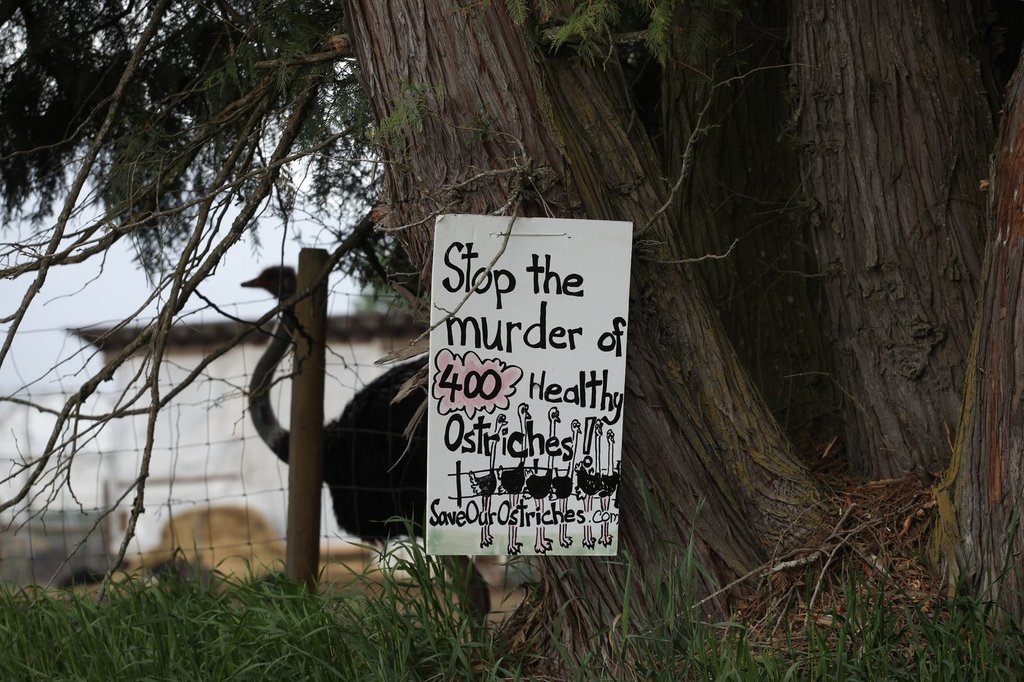
“I think there’s general sympathy for the birds but not for the farm itself due to their inability to be forthright and honest from the get-go,” Donselaar said in an interview.
A tense situation
“It is very volatile,” said another longtime resident who requested anonymity over safety fears. “One person in Edgewood has been assaulted.”
The RCMP confirmed that shortly after they arrived at the farm on Monday, police received a report of an alleged assault on one of the neighbours.
That person received treatment from RCMP medics, while a man who doesn’t live in the area was arrested.
The suspect was released from custody pending further investigation and approval of charges.
Early Wednesday, a hay bale wall set up around the flock was burned by fire.
CFIA said Friday that its policy “aims to protect both public and animal health, as well as minimize impacts on the $6.8 billion domestic poultry industry, and the Canadian economy.
“This supports Canadian families and poultry farmers whose livelihoods depend on maintaining international market access for $1.75 billion in exports,” it concluded.
— With files from Global News’ Kristen Robinson
Bird flu: Tensions build in B.C. village as court decision on ostrich cull nears
Published:
The frustration inside the Royal Canadian Legion hung as heavy as the suffocating summer heat. Dozens had come to give their side of a global controversy on whether to cull a flock of ostriches that survived a life-threatening virus.
More than two dozen people, representing a tenth of the population of the village of Edgewood, B.C., had gathered after word spread that CTV News was visiting. For several weeks, a handful of residents had emailed to voice frustration about the “unfair” coverage of Universal Ostrich Farm’s (UOF) legal battle against a culling order issued by the Canadian Food Inspection Agency after avian flu was detected in its flock last December.
The residents said their health and safety concerns have been ignored in the months since the outbreak, while media across the globe from the New York Times to the BBC had turned UOF’s ostriches into a cause-célèbre.
Yet the residents were unwilling to go on the record, citing fears of harassment and intimidation.
UOF had gained high powered support from the Trump administration, an American billionaire and closer to home - the former leaders of the Freedom Convoy such as Pat King and Tamara Lich.
Earlier in July, Lich helped organize a fundraising concert for UOF and even took to the stage in Edgewood to sing “Keep on Rockin’ in the Free World.”

Testing vs. termination
Universal Ostrich spokesperson Katie Pasitney says they’re not just trying to get about 400 birds off death row but also standing up for other farmers by challenging a government policy that is inflexible and inhumane.
While the CFIA argues the mass euthanization is the most effective way to control the outbreak and prevent the spread of a pathogenic virus that has killed birds, spread to animals and even humans.
Pasitney wants to stave off the death sentences by getting the right to test and monitor the ostriches to show they are now healthy.
As the legal challenge reached the Federal Court of Appeal in Ottawa, CTV News decided to visit Edgewood to get a better sense of the rising tensions in the village of 235 people.
One resident suggested meeting at the legion but insisted she didn’t want to be filmed.
When CTV News arrived at the blue and white shingled building on Tuesday, 26 people were waiting inside. They were beef producers and retired plumbers, paramedics, bus drivers and barbers. Some were neighbors who lived next to the ostrich farm.
The group decided they would all speak out together. Showing their strength in numbers as news cameras rolled.

Speaking out in solidarity
Lois Wood who baked cookies and squares for the group, raised her hand to speak. She’s retired, owns horses and lives alone next to UOF.
To get home, Wood has to drive down Langille road, the same rocky lane that goes by the ostrich farm and a cluster of tents and trailers that have popped up across from it. It’s a camp of strangers, gathered to protest CFIA’s cull order. Some have been in Edgewood for months.
Wood says the strangers had previously set up a checkpoint at the turnoff to the road. Other residents said the protesters asked for names and took photos of license plates.
“Edgewood is not about violence,” said Wood, who added she’s worried confrontation with protesters will lead to clashes. “If CFIA comes – they want to do everything they can to stop them.”
A few weeks ago, Wood watched as the protesters blocked access to the farm by parking their vehicles horizontally across the lane and cutting off tree branches to lay across the road when a rumour spread that inspectors were moving in.
“They’ve got nothing to do with this,” said Jim McFarlane. He and his wife Millie are beef farmers and angry that, despite being ordered to quarantine their property, UOF has allowed dozens of protesters on to their property. The couple are worried their cattle could be impacted as the legal fight drags beyond seven months.
In Canada, h5N1 has been detected in wild animals like foxes, skunks and raccoons. Pet dogs and cats have also caught the virus. In the U.S., dairy cows have been infected.
Even if their cattle are healthy, the McFarlanes say the perception of a lingering disease could impact their income.
”Our (cattle) prices could be knocked down because of the potential of avian flu in cattle, because it can happen,” said Millie.
The couple live a ten-minute drive across the village from Universal Ostrich Farm, but worry about fallout.
“It’s like living next to Chernobyl,” Millie said referring to the Ukrainian nuclear reactor explosion that released radioactive material into the air.
CFIA support
Across the room from the McFarlanes, retiree Crystal Michaud chimed in about supporting the government inspectors.
“CFIA is protecting Canadians and Canadian agriculture,” said Michaud.
“UOF is putting us on a slippery slope. They’re setting up precedents by overturning Canada’s regulations for local, national and international trade. They are putting other people at risk.”
Chicken farms in the region have been ordered to tighten their biosecurity measures to guard against the spread of H5N1 virus. Some countries such as Mexico, Japan and Taiwan have banned poultry products from B.C. because of the presence of avian flu.
On its website, CFIA states that as long “as the ostrich farm remains a confirmed infected premises, the entire British Columbia poultry sector is not able to access certain export markets.”

Ostrich research
According to court documents, UOF stopped selling ostrich meat in 2020. During the COVID-19 pandemic, it entered into an agreement with a Japanese scientist from Kyoto to research antibodies. The work involved injecting the ostriches with COVID-19 antigens to create antibodies in the birds, then extracting the proteins from the eggs.
The ostriches are kept in open air pens. There are a few wooden structures on the property and a metal corral shelter with heavy plastic sheeting that was torn and coming off the frame. The Edgewood residents are skeptical UOF facilities are conducive to scientific research.
More than a dozen people told CTV News they saw worrisome practices at UOF in the weeks before and shortly after an avian flu outbreak was declared.
They described seeing eagles and ravens picking at ostrich carcasses. They shared video of purported ostrich bones littered in the fields. And one neighbor said the farm’s owners buried dead ostriches on his property near the creek that runs across the village.
‘Hearsay and false’ claims
After the meeting, CTV visited Universal Ostrich Farm to get a response to the concerns of Edgewood residents.
A two-metre-high sign emblazoned with the words “Stop the Murder of 399 Ostriches” leans against a rusted dump truck marked the entrance of the farm. Protesters playing the role of volunteer security guards led us to the brown house on the property to interview farm spokesperson Katie Pasitney.
When confronted with the neighbours’ accounts of rotting ostrich carcasses, Pasitney said it was “hearsay and false,” and insisted the farm was well managed. “If we really believed that these animals were going to put our whole community at risk, we would have done something about it.
She said that complaint could be coming from a “neighbour who was disgruntled.’
To prevent the spread of disease, poultry producers are supposed to report dead birds. CFIA detected H5N1 at the farm last December after receiving an anonymous tip about dead ostriches. And in May, CFIA fined UOF co-owners Dave Bilinski and Karen Esperson $20,000 for failing to cooperate with anti-avian flu bio security measures and not adhering to quarantine orders.
Pasitney also dismissed concerns about harassment and intimidation. “Everybody who has come here to support this farm has been nothing but kind.” She said they’ve picked people up for rides, helped residents do yard work and supported the local store.
Pasitney said UOF’s legal challenge is about more than just saving the birds. It’s also about countering government overreach
“It’s for food security, for better ways … changing policy and fixing fractured and flawed systems and coming together.”
But other Edgewood residents like retired bus driver, Jim McKee says he wants the government to protect him from what UOF is doing.
“Government overreach is such a overused cliché. If it isn’t the government to regulate and protect – whose job is it?”
Meanwhile the CIFA says its continuing with its plan to enforce the cull order.
The Federal Court of Appeal is expected to release its decision any day now. Edgewood residents hope the matter will be resolved quickly and peacefully but are also bracing for a possible confrontation if there is a surge in protesters.
CFIA's Response to Highly Pathogenic Avian Influenza (HPAI) on British Columbia Ostrich Farm
January 27, 2025
The Canadian Food Inspection Agency (CFIA) and Canada's national poultry sectors have been responding to detections of highly pathogenic avian influenza (HPAI) in Canada since December 2021. The scale of the current worldwide HPAI outbreak is unprecedented and continues to have significant impacts on Canada's poultry industry. The CFIA acknowledges that this is a challenging situation for everyone involved, including animal owners, producers, animal health professionals, and communities across the country.
The CFIA has acted to minimize the risk of the virus spreading within Canadian flocks and to other animals. All avian influenza viruses, particularly H5 and H7 viruses, have the potential to infect mammals including humans. Our disease response has aimed to protect public and animal health, minimize impacts on the domestic poultry industry, and the Canadian economy. This supports Canadian families and poultry farmers whose livelihoods depend on maintaining international market access.
In domestic poultry, including ostriches, this is accomplished through timely depopulation of domestic birds on infected premises, implementing strong biosecurity measures, and properly disposing of carcasses from birds exposed to the disease. These disease control measures are consistent with the CFIA's mandate under the Health of Animals Act and align with World Organisation for Animal Health (WOAH) guidelines.
Depopulation can be a distressing outcome for an animal owner. When a depopulation is necessary, the CFIA provides an opportunity for all poultry farmers to develop the most appropriate plan based for their flock and facilities. CFIA veterinarians and inspectors work with poultry farmers to see that depopulation is completed humanely using internationally accepted methods. We also provide guidance to producers throughout the process of depopulation, disposal, and cleaning and disinfection, so they can resume their operations as quickly as possible. Most infected premises start the depopulation process within days of confirmed cases of HPAI.
When depopulation is completed, producers may be awarded compensation in accordance with the Health of Animals Act and under the Compensation for Destroyed Animals and Things Regulations. Compensation is based on the fair market value of the animals. For ostriches, compensation of up to $3000 per bird may be awarded when there is supporting documentation. While compensation may not offset the emotional toll of depopulation, it can provide resources to recover and reestablish operations.
The CFIA takes the responsibility to protect the health of animals and Canadians extremely seriously as we conduct these necessary disease control measures to protect public health and minimize the economic impact on Canada's poultry industry.
Judicial review upholds Canadian Food Inspection Agency order to dispose of birds located at an infected premises in Edgewood, British Columbia
May 14, 2025
Following an expedited judicial review, the Federal Court of Canada has determined that the Canadian Food Inspection Agency (CFIA) acted reasonably within the authorities provided under the Health of Animals Act when it issued an order to the owners of a highly pathogenic avian influenza (HPAI) infected premises in Edgewood, British Columbia (BC), to dispose of ostriches exposed to HPAI.
The court dismissed both applications from Universal Ostrich Farm for judicial review as it found the Agency's decisions were reasonable based on the record before the decision-maker and were made in a procedurally fair manner.
The Health of Animals Act is the primary federal legislative authority for preventing, controlling and eradicating animal diseases and is administered by the CFIA. Orders issued under Section 48 of the Health of Animals Act enable the CFIA to respond effectively to outbreaks of animal diseases in Canada and to help protect animal and human health.
All avian influenza viruses, particularly H5 and H7 viruses, have the potential to infect mammals including humans. A human case of H5N1 in BC earlier this year required critical care, and an extended hospital stay for the patient.
Allowing a domestic poultry flock known to be exposed to HPAI to remain alive allows a potential source of the virus to persist. It would increase the possibility of reassortment or mutation, particularly with birds raised in open pasture where there is ongoing exposure to wildlife. This could also increase the human health risk.
Our disease response aims to protect both public and animal health, as well as minimize impacts on the $6.8 billion domestic poultry industry, and the Canadian economy. This supports Canadian families and poultry farmers whose livelihoods depend on maintaining international market access for $1.75 billion in exports.
The CFIA has worked closely with the Province of British Columbia throughout the HPAI response to protect BC's poultry sector with effective disease controls measures, which mitigate the impact on poultry production in the province.
The CFIA will begin the humane depopulation and disposal of birds at the infected premises with veterinary oversight. Operational plans and dates will not be shared with the public in advance.
For more information
Date: 20250513
Dockets: T-294-25
T-432-25
Citation: 2025 FC 878
Ottawa, Ontario, May 13, 2025
PRESENT: The Honourable Mr. Justice Zinn
|
BETWEEN: |
|
UNIVERSAL OSTRICH FARMS INC |
|
Applicant |
|
and |
|
CANADIAN FOOD INSPECTION AGENCY |
|
Respondent |
JUDGMENT AND REASONS
TABLE OF CONTENTS
C. Avian influenza outbreaks in Canada
A. The Applicant’s ostrich operation
B. Infections, investigations, and CFIA interventions
B. Reasonableness review of policy decisions
A. The law and policy on disposal of affected or contaminated animals and things
(1) The Statutory and Regulatory Scheme
(2) The Jurisprudence on the Act’s Objective and the Decision-Maker’s Discretion
(b) International Obligations and Trade Implications
(c) Operationalization through the 2022 ERP: Trigger and Implementation
(d) Exemption Framework and Assessment Criteria
C. The law on legitimate expectation
A. Evidentiary issues: expert reports, affidavit, and Report of Inspector
(1) There is No Need to Rule on the Admissibility and Weight of the Expert Reports
(2) Dr. Cathy Furness’ Affidavit is Admissible as Factual Narrative
(3) The Respondent’s Report of the CFIA Inspector is Admissible Under the Business Record Exception
B. The Stamping-Out Policy is reasonable
C. The implementation of the Stamping-Out Policy in this case withstands judicial scrutiny
(1) The Applicant’s Two New Arguments Raised at the Hearing Are Unpersuasive
(2) The Notice to Dispose Withstands Judicial Scrutiny
(a) The Notice to Dispose was Issued in a Procedurally Fair Manner
(b) The Notice to Dispose was Unfettered
(c) The Notice to Dispose was Reasonable
(3) The Exemption Denial Withstands Judicial Scrutiny
(a) The Exemption Denial was Issued in a Procedurally Fair Manner
(b) The Exemption Denial was Reasonable
(i) The Applicant’s Argument on Dr. French’s Rapid Literature Review Fails
(ii) The Applicant’s Argument on Conflation of Exemption Criteria Fails
(iii) The Applicant’s Argument on Inadequate Engagement with Evidence Fails
(iv) The CFIA’s Reasons Properly Reflect the Impact of Its Decision on the Applicant
IX. The Applicant’s Charter, Bill of Rights, and jurisdictional arguments have been abandoned
I. Overview
[1] The
Applicant, Universal Ostrich Farms Inc., challenges two related
decisions made by the Respondent, Canadian Food Inspection Agency [the
CFIA or the Agency], under section 48 of the Health of Animals Act, SC 1990, c 21 [the Act]. The
first decision, a Notice to Dispose issued on December 31, 2024,
ordered the destruction of all ostriches on the farm after laboratory
tests confirmed infection with H5N1 highly pathogenic avian influenza
[HPAI]. The second, an Exemption
Denial, dated January 10, 2025, refused the farm’s request to spare the
flock on the basis that the ostriches formed a self-contained, unexposed
“distinct epidemiological unit”
with “rare and valuable poultry genetics,”
thus qualifying for an exemption from the Notice to Dispose under the CFIA’s Highly Pathogenic Avian Influenza 2022 Event Response Plan [the 2022 ERP].
[2] At
the heart of this proceeding lies an inevitable tension between the
CFIA’s mandate to protect public health and the Applicant’s wish to
preserve its ostriches. Parliament
has charged the CFIA with preventing the spread of designated zoonotic
and enzootic diseases and with protecting the food supply, public
health, and Canada’s reputation in global trade. To do so, the Agency complies with the internationally recognized and applied “Stamping-Out Policy”
approach recommended by the World Organisation for Animal Health [WOAH]
that requires rapid culling of affected avian populations. Conversely,
the Applicant faces the loss of decades of selective breeding work,
disruption to valuable commercial and scientific research, and
destruction of birds that might no longer pose an active, ongoing risk
of transmitting HPAI. Against this
backdrop, the Applicant contends that the CFIA has, in issuing the
Notice to Dispose and Exemption Denial, disregarded its unique
circumstances and fallen short of providing basic procedural fairness.
[3] These two applications address whether the CFIA’s decisions were reasonable and procedurally fair based on facts available to the Agency at the time. This is not an appeal. The Court is not stepping into the shoes of the Agency and making the decisions that the Court feels ought to have been made. Instead, the focus of the review is on the Agency’s reasoning and process.
[4] I dismiss both applications for judicial review. The Agency’s decisions were reasonable based on the record before the decision-maker and were made in a procedurally fair manner.
[5] Courts must respect Parliament’s choice to assign decision-making power to administrative bodies. This respect comes from the principle of separation of powers, a cornerstone of Canadian public law: Wilson v Atomic Energy of Canada Limited, 2015 FCA 17 at para 30. The separation of powers compels courts to respect the legislature’s choice to assign decision-making power to specialized administrative bodies, such as the CFIA, rather than to the judiciary: Canada (Minister of Citizenship and Immigration) v Vavilov, 2019 SCC 65 [Vavilov] at para 30.
[6] Courts must also respect the demonstrated scientific and technical expertise of administrative agencies. In administrative law, courts generally stay out of scientific debates and focus on whether the decision-makers used their expertise to make reasonable and procedurally fair decisions. When Parliament leaves technical or scientific assessments to specialized administrative bodies, it signals that those bodies, not the courts, are best positioned to make judgments on complex, expertise-driven matters. Indeed, Canadian administrative law explicitly warns that courts must not resolve scientific disputes or substitute their own views for those of specialized decision-makers authorized by Parliament to handle such issues: Vavilov at para 93. Judges are experts in law, not in public health, virology, epidemiology, or veterinary medicine. This case undeniably has a strong technical flavour. Both parties have submitted expert affidavits supported by scientific literature. The role of this Court is not to conduct afresh its own studies of that material and decide which science is correct, but to determine whether the CFIA’s decisions were reasonable and procedurally fair based on the record before it.
[7] Judicial review hinges on what was before the decision-maker. With very few exceptions, reviewing courts on judicial review must mentally travel back to the moment when the decision was made, and judge the decision with only the evidence that was before the decision-maker at that moment. Here, the dates are December 31, 2024 for the Notice to Dispose and January 10, 2025 for the Exemption Denial. A reviewing court must assess administrative decisions based exclusively on the information available to the decision-makers at the time they made those decisions: Association of Universities and Colleges of Canada v. Canadian Copyright Licensing Agency (Access Copyright), 2012 FCA 22 at para 19; Alberta (Information and Privacy Commissioner) v Alberta Teachers’ Association, 2011 SCC 61 at paras 22-26.
[8] If
courts conducted judicial review with information that did not exist at
the time of decision-making, they would be faulting decision-makers for
lacking a crystal ball. No one has the gift of foresight, so courts must avoid reviewing decisions through the lens of hindsight. Therefore, this Court cannot consider “new”
evidence, such as the current health status of the ostriches, recent
test results, or updated scientific developments that become available
only after January 10, 2025, the date of the Agency’s last decision.
[9] Concepts like “reasonableness”
and “procedural fairness”
have specific meanings in administrative law, defined and refined over years of jurisprudence. Reasonableness asks whether the CFIA’s explanation of its decisions tells a compelling story of how it reached them. Whether
the story is compelling enough depends on whether the outcome and
reasons are logically supported by the evidence on record, consistent
with applicable law, and aligned with the Agency’s past practices and
own policies. Reasonableness does not ask whether the outcome is the best or most persuasive course of action.
[10] Procedural fairness is about the decision-making process itself, not the outcome. This
assessment asks questions such as whether the Applicant received timely
notice, whether the Applicant had meaningful chance to be heard, and
whether the CFIA followed the procedures that it promised it would. In
this context, fairness is not about whether the substantive outcome
feels fair in an everyday understanding, but whether the CFIA adhered to
the required legal standards of fairness in the process it followed to
reach its decisions. Keeping these legal meanings in mind helps avoid the understandable, but legally misplaced, reaction of equating “harsh outcome”
with “unfair decision.”
[11] This Court accepts that there is a real and negative impact of the CFIA’s two decisions on the Applicant and its principals. Beyond the economic loss, the destruction of a long-established ostrich population is also a source of emotional distress, particularly given the decades of work and investment the principals have dedicated to breeding and raising their flock. I have considerable sympathy for them.
[12] Nonetheless, such personal losses must be weighed against the broader public interest in protecting public health and maintaining trade stability. Avian influenza is a virus capable of causing serious harm to both animals and humans, with significant implications for Canada’s poultry businesses and international trade status. To combat threats like this virus, Parliament has authorized the CFIA to act decisively making swift decisions with far-reaching consequences, often under conditions of scientific uncertainty. This is a challenging mandate.
II. Background
A. The parties
[13] The Applicant operates a privately owned ostrich farm and research business located approximately ten kilometres outside Edgewood, British Columbia. The 65-acre operation is primarily managed by two principals with ostrich husbandry and selective breeding experience dating back to the mid-1990s. Over the years, the Applicant has diversified its business portfolio to encompass operations in selling breeding stock, raising birds for slaughter, processing limited amounts of meat, offering agri-tourism tours, and, in recent years, focusing on extracting immunoglobulin Y from ostrich eggs for use in human-virus diagnostics.
[14] The CFIA has the statutory authority granted by the Act and the Canadian Food Inspection Agency Act, SC 1997, c 6. While commonly associated with the regulation of food safety and quality in Canada, the Agency’s broader mandate includes preventing and controlling communicable diseases in animals and plants that threaten public health, environmental integrity, or Canada’s economic interests, including international trade in livestock and animal products. In furtherance of this mandate, the CFIA administers the 2022 ERP, which is the latest formalization and operationalization of the Stamping-Out Policy. The Agency reports to the Minister of Health, except where the Act assigns powers, duties, or functions to the Minister of Agriculture and Agri-Food for matters unrelated to food safety.
B. The avian influenza virus
[15] Avian influenza, also known as bird flu, is caused by influenza A viruses. Like all viruses, avian influenza viruses cannot replicate on their own and must infect hosts to do so. Their usual hosts are wild birds. Migratory waterfowl, particularly wild ducks, serve as natural hosts, potentially returning from their overwintering grounds each year with new viral variants. These viruses can also occasionally spread to domestic birds and, more rarely and sporadically, to mammals like humans.
[16] For domestic birds, transmission of the virus can occur through direct contact with infected wild or domestic birds, as well as through indirect exposure to contaminated environments. The ability of avian influenza to persist in the environment contributes to its transmission. It can persist outside of hosts in feces, grass, and soil. It can remain viable for months or even years in fresh water at low temperatures, creating long-lasting sources of infection or re-infection. On small holding operations like the Applicant’s ostrich farm, common risk factors for transmission include direct contact between domestic and wild birds, proximity to environments such as wetlands, ponds, swamps, lakes, rivers, and grain fields, and the acquisition of birds with unknown health status.
[17] Human infection with avian influenza is rare but potentially deadly. Infection typically occurs through close contact with infected birds or contaminated environments, particularly where appropriate personal protective equipment and hygiene measures are lacking. Some strains of the virus are particularly lethal. For instance, approximately half of the more than 900 reported cases of human H5N1 infection worldwide since 1997 have resulted in death.
[18] Each strain of the avian influenza is identified by two special proteins on its surface: hemagglutinin, designated “H,”
and neuraminidase, designated “N.”
Hemagglutinin
helps the virus bind to and enter host cells, while neuraminidase
enables release and propagation of the virus from the host cells. The
combination of H and N proteins plays a large role in deciding which
specific animals the virus can infect, how easily it spreads, and how
the host immune system recognizes and reacts to it. To
date, sixteen hemagglutinin subtypes, H1-H16, and nine neuraminidase
subtypes, N1-N9, have been documented in birds, producing the familiar
binomial viral strain names such as “H5N1”
or “H7N9.”
[19] However,
knowing the H and N subtypes of an avian influenza strain alone does
not sufficiently reveal how harmful it is for birds. The avian influenza ability to cause serious disease, or its “pathogenicity,”
strongly depends on a small section of the hemagglutinin protein called the “cleavage site.”
At this site, certain host enzymes must cut the hemagglutinin to activate the virus. Depending
on the sequence of amino acids at the cleavage site, the virus may
either spread systematically throughout the host’s body and damage
multiple organs, or stay limited to the lungs, kidneys, or
gastrointestinal tract and cause less serious consequences. In
other words, the level of pathogenicity of avian influenza in birds
depends heavily on the molecular structure of its cleavage site, as
revealed by the amino acid sequence there.
[20] To find out the pathogenicity of a particular strain of avian influenza, one performs pathotyping. This
usually involves testing three things: the subtype of hemagglutinin,
the subtype of neuraminidase, and the amino acid sequence at the
cleavage site. To do this, the
laboratory technique called real-time reverse-transcription polymerase
chain reaction [RRT-PCR] is used to detect the genes for hemagglutinin
and neuraminidase and identify their subtypes, such as “H5”
and “N1.”
To
analyze the cleavage site, the part of the hemagglutinin gene
containing the cleavage site is amplified and then sequenced to see
whether it has the amino acid pattern linked to high or low
pathogenicity avian influenza [LPAI].
C. Avian influenza outbreaks in Canada
[21] Canada first confronted a major HPAI outbreak in 2004 in British Columbia. In February of that year, an LPAI H7N3 virus was detected in the Fraser Valley region. By March, the virus had mutated into an HPAI, spreading rapidly across both commercial and non-commercial premises. To contain the virus, over 14 million birds were disposed of. Two human cases were reported, both presenting with conjunctivitis and mild influenza-like symptoms. Both individuals recovered fully. The outbreak was declared over by June 2004.
[22] Several smaller HPAI events occurred between 2004 and the current outbreak. The most significant occurred in 2015, when North America faced widespread outbreaks of H5N2 and H5N8 HPAI strains. In Canada, the impact was concentrated primarily in commercial poultry flocks in Ontario.
[23] The current nationwide HPAI outbreak began in November 2021 and has affected every province except Prince Edward Island. The outbreak started with detection of clade 2.3.4.4b H5N1 in wild bird populations in Canada before spreading to domestic poultry. Since then, HPAI has been confirmed on 527 domestic premises across the country, with British Columbia reporting the highest number of cases and some premises experiencing repeated infections. The outbreak has affected operations ranging from small backyard flocks to large scale commercial farms. Canada also recorded its first domestically acquired human case in late 2024, when a British Columbia teenager became critically ill and required intensive care. The individual has since made a full recovery.
III. Facts
A. The Applicant’s ostrich operation
[24] The Applicant's property features open-air enclosures with shared facilities and proximity to wildlife. The farm is arranged with fenced and cross-fenced areas intended to separate groups of ostriches for breeding and care, while also providing a degree of biosecurity. No roofed barns segregate ostriches of different age groups. A large natural pond, routinely visited by wild ducks and other waterfowl, lies near the centre, in between two of the outdoor bird pens.
[25] The Applicant has developed what it considers a uniquely large strain of ostriches through selective breeding since the 1990s. The ostriches are allegedly selected for body size and favourable genetic traits, with surplus birds not meeting these standards being discarded or culled. Some ostriches currently on the farm trace back to early imports from Africa and remain part of the breeding stock.
[26] From approximately 2020 onward, the Applicant shifted its primary commercial focus to extracting and studying antibodies, notably immunoglobulin Y, from ostrich eggs. For the Applicant, these antibodies have lucrative commercial and research values, especially in the development of diagnostics or therapeutics relevant to human viruses, such as the COVID-19 causing virus of SARS‑CoV‑2. To advance this antibody-based venture, the Applicant has collaborated with both domestic and international partners, including scientific researchers and private sector entities. Despite this strategic shift, some level of ostrich sales, along with sales or planned sales of products derived from ostrich fat and eggshells, continued through to at least December 2024.
[27] By early December 2024, the farm reportedly housed about 450 ostriches, including older breeding stock and newly introduced birds.
B. Infections, investigations, and CFIA interventions
[28] In February 2020, the Applicant’s ostriches experienced a significant illness, reportedly resulting in roughly ten deaths. Laboratory tests confirmed bacterial infections caused by Proteus spp., Pseudomonas aeruginosa, and Escherichia coli. Although unsupported by laboratory findings, the farm’s principals speculated in hindsight that avian influenza might have contributed to the illness. Most ostriches were said to have recovered within weeks, leading the principals to suspect survivors might have developed natural immunity to future outbreaks of HPAI.
[29] In early December 2024, a new outbreak of respiratory symptoms emerged shortly after wild duck exposure. The Applicant observed respiratory or “flu-like”
symptoms among a subset of ostriches, reminiscent of the 2020 illness. According to the farm’s principals, those symptoms appeared roughly one week after “300-500 ducks … landed on the premises.”
By
late December, mortalities began increasing, particularly among newer
ostriches, prompting consultation with a local veterinarian. Approximately 25 to 30 ostriches died within a three-week period.
[30] The CFIA intervened on December 28, 2024, following an anonymous report of multiple ostrich deaths at the Applicant’s premises. The Agency promptly contacted the Applicant and imposed a verbal quarantine order on the premises, with formal documentation to follow. The next day, the Applicant requested that a CFIA veterinarian assess the flock for avian influenza. Four additional ostriches died that same day.
[31] On December 30, 2024, CFIA inspectors visited the premises, collected swab samples from two carcasses suitable for laboratory testing, noted wild-bird activity at the pond, and observed that staff and equipment were shared and moved freely among open pens. That same day, the CFIA sent the Applicant a Declaration of Infected Place pursuant to section 22 of the Act and a Requirement to Quarantine per section 91.4 of the Health of Animals Regulations, CRC, c 296. These orders imposed movement controls and established biosecurity measures aimed at containing the HPAI outbreak on the Applicant’s premises by preventing access to infected birds, carcasses, and contaminated areas by wild birds, other animals, and people.
[32] On
December 31, 2024, the Canadian Animal Health Surveillance Network
laboratory in Abbotsford, British Columbia, reported positive test
results for the H5 avian influenza subtype. On
January 3, 2025, the National Centre for Foreign Animal Disease in
Winnipeg, Manitoba, confirmed through genome sequencing that the
pathogen was a HPAI subtype, H5N1 clade 2.3.4.4b, and noted the virus’s
cleavage-site motif with amino acids “PLREKRRKR/GLF”
was “compatible with HPAI viruses that came to Canada via the Pacific’s flyway.”
[33] The CFIA issued the Notice to Dispose on December 31, 2024, immediately after receiving confirmation of a positive test result for H5 avian influenza. Just 41 minutes after obtaining the test result, the CFIA issued the Notice to Dispose as guided by the 2022 ERP and pursuant to subsection 48(3) of the Act. The CFIA set February 1, 2025, as the deadline for disposal of all affected birds and related materials.
[34] On
January 2, 2025, the CFIA Case Officer assigned to the Applicant’s case
contacted its principals to introduce herself, provide an overview of
the situation, and establish a line of communication to guide them
through the multi-step administrative process. Their
first interaction was a phone call, during which the principals first
raised their theory that the older ostriches may have developed herd
immunity because of the unreported 2020 “flu-like”
illness, and expressed interest in seeking an exemption from depopulation. The
Case Officer explained the exemption application process, emphasized
its time-sensitive and document-intensive nature, and highlighted the
need to submit a formal “Distinct Unit Request”
in a package that the Agency would provide.
[35] Later
that same day, the Case Officer sent two follow-up emails. The first
email [the Process Introduction Email] was provided three hours
following the call. This
introductory email included several important attachments: the Notice to
Dispose, the Declaration of Infected Place, the Requirement to
Quarantine, and a document titled What to Expect – Steps on How CFIA Will Work Through the Process on Your Farm. This last document explained that the entire administrative process of depopulation is “fluid”
in that while it consists of well-defined discrete steps, these may overlap in practice. It
also detailed the anticipated procedural steps, including discussions
with the Case Officer, a lengthy Premises Investigation Questionnaire
interview, biocontainment assessment, depopulation, disposal, cleaning
and disinfection, and compensation.
[36] The second email [the Exemption Process Overview Email] detailing exemption requirements was sent four hours after the call. It outlined various requirements, including official guidance on exemptions for birds with “rare and valuable genetics,”
and reiterated that the process is “document heavy.”
It provided information on how to apply for an exemption from depopulation on this basis. The
email reproduced relevant policy content regarding this category of
exemption and explained that the assessment is based on both the
submission of a completed Distinct Unit Request Package, which was attached to the email, and supporting evidence demonstrating the genetic value of the birds.
[37] Open and frequent communication between the Applicant and CFIA continued after the initial intake process. Following January 2, 2025, communications included virtual meetings, phone calls, emails, and a further on-site inspection. These interactions facilitated discussion and assessment of several key issues, including ostrich immunity, the genetic distinctiveness of the flock, the potential to identify an epidemiologically unexposed subgroup, and the farm’s biosecurity conditions.
[38] On January 3, 2025, CFIA officials held a virtual meeting with the Applicant’s principals to assist them in completing the Premises Investigation Questionnaire and to gather more information about the property. During the meeting, the son of one principal reported observing a neighbour entering areas already designated as an Infected Place. The Case Officer reminded the Applicant’s principals of the importance of managing public perception, noting that their neighbours continued to contact the Agency with concerns about mortality management. The Case Officer emphasized the situation’s urgency throughout the meeting, stressing the need for the Applicant to promptly submit evidence supporting their claimed relationship with Kyoto University and the asserted special genetic characteristics of the flock.
[39] On January 7, 2025, CFIA inspectors conducted another site visit at the Applicant’s premises, which revealed further concerns with the biosecurity conditions at the farm. Inspectors observed wild ducks following them into the quarantine zone and noted the presence of weasels in the barns. More than 50 wild ducks were seen within one of the ostrich enclosures. Although the Applicant’s principals had attempted to fence off a nearby pond, they explained that the wild ducks continued to access the ostrich feed dishes by flying in. The principals also sought guidance from the inspectors on completing the Distinct Unit Request Package. The inspectors reiterated the importance of submitting as much supporting evidence as possible to strengthen their exemption request.
[40] Between
January 4 and 9, 2025, the Applicant submitted several documents to
support its exemption application while ostrich deaths continued. The main document was the completed Distinct Unit Request Package. Other
supporting documents included letters of support, and information
detailing its business selling ostrich antibodies and other commercial
ventures as support for the Applicant’s claim that its ostriches should
be exempted for their “rare and valuable genetics”
worthy of preservation.
[41] On January 10, 2025, the CFIA issued the Exemption Denial. It concluded that the Applicant had failed to demonstrate the existence of any distinct epidemiological unit free from exposure risk. Additionally, the CFIA found that the Applicant had not submitted sufficient evidence to support its claims of genetic rarity and value qualifying the flock for an exemption.
[42] By mid-January 2025, the spread of illness had reportedly plateaued, although some ostriches remained ill or continued to die. CFIA officials continued to monitor the situation. By the end of January 2025, total ostrich mortalities tied to flu-like illness reportedly reached 69 birds. The Applicant alleges that the last death occurred on January 15, 2025, with the surviving majority appearing healthy or recovered. This reinforced its belief in the flock’s attainment of at least partial herd immunity against H5N1.
[43] Late in January 2025, the Applicant requested permission to conduct or arrange additional tests on apparently healthy ostriches to confirm whether they were shedding virus. The Applicant also sought to have recognized genetic experts examine the flock. The record indicates the CFIA did not approve further testing at that stage. It focused instead on the confirmed H5N1-positive test results and reiterated the infection risk associated with an open-air ostrich operation like that of the Applicant’s.
IV. Decisions Below
[44] This judicial review arises from the CFIA’s Notice to Dispose and its Exemption Denial. The Notice to Dispose mandates the destruction and disposal of the Applicant’s ostriches, while the Exemption Denial refuses the Applicant’s request that some or all the birds be spared. Together, these two decisions illustrate the CFIA’s position that the Applicant’s entire ostrich flock must be culled due to H5N1, with no exemption warranted. The underlying record includes not only the formal instruments themselves, but also supporting documentation such as meeting minutes, telephone call summaries, email correspondence, and internal memoranda. These materials together form the pertinent decision record before this Court.
[45] Before highlighting key aspects of the decision record, it is helpful to situate these decisions within the CFIA’s broader administrative process that implements the disposal of animals and things contemplated by subsection 48(1) of the Act. The Notice to Dispose and Exemption Denial are two steps in the multi-step process for containing and eradicating the current wave of HPAI, as set out in the 2022 ERP, which operationalizes the Stamping-Out Policy pursuant to the statutory discretion provided by subsection 48(1). The Notice initiates destruction of affected flocks based on established epidemiological criteria. The Exemption Denial serves as a secondary review that evaluates whether specific circumstances justify departing from the primary disease-control protocol.
A. Notice to Dispose
[46] On December 31, 2024, the CFIA issued the Notice to Dispose requiring destruction of all poultry on the premises. This
Agency did this through a Form 4202 Requirement to Dispose of Animals
or Things, citing statutory authority under section 48 of the Act. This Order stated that “Avian Influenza”
had been “determined or suspected”
on the premises and required “all poultry and poultry carcasses along with other material approved by CFIA disposal crew”
to be destroyed. The operative period ran from the date of the order to February 1, 2025. The Order treated ostriches as “poultry”
for disease-control purposes. At this initial stage, the CFIA did not consider whether any portion of the flock might be exempted.
[47] On
January 12, 2025, the CFIA issued an Amended Notice to Dispose,
revoking and replacing the initial order of December 31, 2024, to
correct several technical details without changing the ordered
depopulation. This amendment
corrected certain updated quarantine details, primarily the GPS
coordinates, while leaving unchanged the substantive requirement to
depopulate all ostriches and the original disposal timeline. The amended Order reaffirmed that ostriches fall under the classification of “poultry”
for HPAI control purposes and reiterated that all listed animals and items remained subject to destruction. An accompanying explanatory note confirmed that the effective date of the original Notice to Dispose remained December 31, 2024.
[48] Immediately following the issuance of the original Notice to Dispose, the CFIA communicated with the Applicant providing further details regarding movement restrictions, quarantine measures, and the CFIA’s avian influenza Stamping-Out Policy. While these additional communications did not add any new formal reasons, they clarified the administrative processes and reinforced the CFIA’s position that full flock depopulation was mandatory unless an exemption was explicitly approved. On January 3, 2025, the CFIA Compensation Unit contacted the Applicant to provide information regarding compensation for the ordered destruction of the ostriches pursuant to Compensation for Destroyed Animals and Things Regulations, SOR/2000-233 [the Compensation Regulations].
B. Exemption Denial
[49] Following
receipt of the Notice to Dispose, the Applicant sought exemption from
depopulation claiming, first, that there is a distinct epidemiological
unit within its flock that was either unexposed or at reduced risk and,
second, that the flock contained “rare and valuable poultry genetics,”
which warranted preservation from complete depopulation. On January 10, 2025, the CFIA denied both exemption requests. Three
sets of documents within the record are particularly significant in
illustrating the CFIA’s reasoning and decision-making process in
evaluating and rejecting the Applicant’s exemption request.
[50] The first set of documents consists of the Exemption Process Overview Email with the attached Distinct Unit Request Package, both dated January 2, 2025. This
Email from the Case Officer and its attachment detailed the criteria
for qualifying as a distinct epidemiological unit and listed the type of
supporting documentation required for exemption under the “rare and valuable genetics”
category. According
to the Email, examples of acceptable documentation included historical
records of genetic investment, evidence that the flock consists of
high-quality purebred birds, and proof of genomic testing for specific
traits.
[51] These
documents were sent shortly after the Case Officer’s initial intake
phone call with the Applicant’s principals, during which the principals
expressed interest in seeking an exemption. In
the Exemption Process Overview Email, the Case Officer invited the
Applicant to submit supporting documentation for the exemption request,
characterizing the application process as “document heavy.”
The Email reads:
Hello Again,
Sorry for the multiple emails!
This process is document heavy, but I'm here to help you navigate the process!
Based on the information we’ve gathered, you fall into the “birds classified as having rare and valuable genetics” category. I’ve copied CFIA’s description here:
Rare and valuable genetics in poultry refers to uncommon genetic lines of poultry that hold a high economic value. Genetic breeding of poultry involves the creation of multi-generation genetically diverse populations on which selection is practiced to create adapted animals with new combinations of specific desirable traits. It is this combination of an uncommon breed or line of poultry, which undergoes a selection process to create specific desirable traits which leads to its high economic value.
3.1 Initial screening to classify birds as having rare and valuable genetics
The genetics of the flock can be demonstrated to be distinctive from standard commercial flocks with criteria such as but not limited to the following:
● There is historical evidence of genetic investment (e.g. breeding books, use of closed flocks of breeding pure line birds for a prolonged period, a selection program from trained geneticists is implemented);
● The flock consists of high quality pure-bred birds (e.g. are recognized by breed associations, 3rd party national/international organizations or by the poultry industry as top producers/prized genetics/suppliers of genetics);
● Genomics testing for specific traits has been undertaken
Here’s what we need from you at this time to get started:
● We need documented proof that these birds are distinctive from standard commercial flocks. The highlighted section above gives good examples of the types of documents we’re looking for.
○ If you have any documentation of the agreement between you and the university – that’d be really helpful to send to us.
● I’ll also need you guys to fill out the attached document Distinct Unit Package that will need to be completed and sent back to me.
Thanks,
[bold and italic in the original]
[52] The second set of documents comprises the Applicant’s submissions supporting their exemption request. These documents, submitted to the CFIA Case Officer between January 2 and 10, 2025, included business plans highlighting research into ostrich antibodies, the potential commercialization of specific genetic lines, and assertions about the flock’s unique African genetic heritage. They also contained diagrams illustrating the farm’s physical layout, depicting fenced partitions and a large central natural pond, as well as letters from collaborators affirming the distinctiveness and commercial or research value of the flock.
[53] The third set of documents consists of the CFIA’s formal communication of the denial and reasoning. This
includes the Case Officer’s January 10, 2025, email communicating the
denial, the attached Response Letter providing formal reasons, and an
Internal Recommendation Memorandum that formalized internal
decision-making discussions. The
email acknowledged the emotional distress that the Applicant's
principals may experience and offered follow-up discussion opportunities
with CFIA officials. The attached Response Letter explained that ostriches are “poultry”
under its existing policy and the WOAH definitions, that selective
disposal of birds would conflict with Canada’s Stamping-Out obligations,
and that the evidence did not satisfy the distinct epidemiological unit
exemption threshold and the criteria for the “rare and valuable genetics”
exemption. It concluded: “This decision is final and is not subject to appeal”
[emphasis in the original].
[54] Informing the Exemption Denial was the Internal Recommendation Memorandum prepared and reviewed by the Exemption Committee. This Memorandum forms part of the Exemption Denial decision, as administrative decision-makers are entitled to adopt the reasoning of recommending bodies, such as the Exemption Committee, with the adopted reasoning being treated as that of the decision-makers: Canada (Attorney General) v Sketchley, 2005 FCA 404 at para 37−39.
[55] The Exemption Committee reviewed the Applicant’s submissions and the Agency’s internal policies and concluded there was “no evidence of a subset of birds existing as a distinct unit or at a different level of risk.”
This
finding was based on site visits and documentation confirming that the
Applicant’s ostriches roamed outdoors across multiple pens, shared feed
and staff, and frequently interacted with wild birds attracted to the
central pond. Given the open
layout of the farm, the shared equipment and staff, and the uniform risk
of H5N1 transmission, the Committee concluded it was impractical to
subdivide the flock for biosafety purposes, finding no distinct
epidemiological units that could qualify for exemption.
[56] The Committee also determined that the Applicant failed to show the genetic uniqueness or economic value of the flock. The Exemption Committee highlighted that the Applicant had “a
significant burden of proof… to demonstrate the high economic value the
flock provides to the broader Canadian poultry industry”
and the nature of the “robust processes … to actively select and breed for specific desirable traits.”
The Committee concluded that the Applicant had not met either requirement based on the evidence it had provided. Additionally,
the Committee conducted an analysis on trade implications of
non-adoption or non-implementation of the Stamping-Out Policy and wrote
about a preliminary scientific literature review indicating that
ostriches can harbour and spread sub-clinical H5N1 and potentially
facilitate further viral mutations and reassortments.
[57] Collectively, these documents articulate this rationale: ostriches, classified as poultry under Canadian avian influenza control policies, must be destroyed pursuant to the WOAH-supported Stamping-Out Policy upon confirmation of HPAI infection unless strict exemption criteria are met. Based on this rationale, the CFIA determined the Applicant’s flock was uniformly exposed to risk and concluded the Applicant failed to supply sufficient evidence to satisfy the exemption criteria.
C. Injunction
[58] The Applicant filed a motion to enjoin the CFIA from enforcing the Notice to Dispose and the Requirement to Quarantine. By Order dated January 31, 2025, this Court stayed the Notice to Dispose “until a decision is rendered in the underlying application for judicial review.”
The Requirement to Quarantine was left untouched.
V. Issues
[59] The Applicant identifies five issues in their written submissions:
-
1)The applicable standard of review;
-
2)Whether the CFIA properly exercised its discretion in issuing the Notice to Dispose;
-
3)Whether the CFIA breached procedural fairness in making the Exemption Denial;
-
4)Whether the CFIA properly applied its own exemption criteria; and
-
5)Whether the CFIA properly exercised its discretion in issuing the Exemption Denial.
[60] At the hearing, the Applicant raised two novel issues, both
bearing on the reasonableness of the CFIA’s implementation of the
Stamping-Out Policy in the Applicant’s specific circumstances. First,
whether the CFIA relied on an incorrect factual assumption about the
pathogenicity of the virus in deciding to apply the Policy. Second, whether the CFIA’s classification of the farm’s ostriches as “poultry”
was incorrect and, if so, whether that misclassification rendered its application of the Policy unreasonable.
[61] The Respondent proposes a different three-part framing of the issues:
-
1)Should portions of the five expert reports filed by the Applicant be struck;
-
2)Was the Notice reasonable and issued in a procedurally fair manner; and
-
3)Was the Exemption Refusal reasonable and made in a procedurally fair manner.
[62] Although neither party’s framing fully captures the scope and complexity of the issues in this judicial review, I find two submissions made by the Respondent’s counsel at the hearing particularly helpful in structuring the analysis. First, the Respondent correctly points out that the Applicant devotes significant attention to challenging the reasonableness of the Stamping-Out Policy itself. Hence, addressing the reasonableness of the Policy as a distinct issue yields a clearer and more logical analysis. Second, the Respondent’s conceptual distinction between the formulation and implementation of the Stamping-Out Policy strikes at the heart of this case. Treating these as distinct parts to be analyzed, each subject to different contextual factors and judicial review considerations, provides a more coherent and analytically sound framework.
[63] Accordingly, this Court frames the issues as follows:
-
Whether the CFIA’s Stamping-Out Policy, as currently operationalized through the 2022 ERP policy document, is reasonable in law?
-
Whether the CFIA’s implementation of the Stamping-Out Policy was reasonable and procedurally fair given the Applicant’s specific circumstances?
-
Whether the Notice to Dispose was made through a fair process, unfettered, and reasonable?
-
Whether the Exemption Denial was made through a fair process and reasonable?
[64] Finally, this Court also needs to address several evidentiary objections raised by both parties. These include admissibility and weight to be afforded to portions of each other’s expert reports, certain challenged parts of the affidavit of Dr. Cathy Furness submitted by the Respondent, and the challenge to the reliability of the Respondent’s Report of Inspector, authored and signed by Inspector Dykstra on January 31, 2025.
VI. Standard of Review
A. The fundamentals
[65] The parties submit that the applicable standard for review of procedural fairness is correctness. However,
based on the jurisprudence, I find a more accurate characterization to
be one that resembles the correctness standard but shifts the focus from
determining the correct procedure to assessing “whether the procedure was fair having regard to all of the circumstances”
: Canadian Pacific Railway Company v Canada (Attorney General), 2018 FCA 69 [Canadian Pacific] at para 54; Heiltsuk Horizon Maritime Services Ltd v Atlantic Towing Limited, 2021 FCA 26 at para 107. The goal of the procedural fairness review should always be investigating “the ultimate question [of] whether the applicant knew the case to meet and had a full and fair chance to respond”
: Canadian Pacific at para 56.
[66] For substantive review, I agree with the parties that the CFIA’s decisions to issue the Notice to Dispose and Exemption Denial are reviewable on the standard of reasonableness, as articulated by the Supreme Court of Canada in Vavilov.
[67] Reasonableness review is one single deferential yet robust standard: Vavilov at paras 12‑13 and 89. The
Court must give considerable deference to the decision-maker,
recognizing that this entity is empowered by Parliament and equipped
with specialized knowledge and understanding of the “purposes and practical realities of the relevant administrative regime”
and “consequences and the operational impact of the decision”
that the reviewing court may not be attentive towards: Vavilov at para 93. Judicial intervention is warranted only when the flaws or shortcomings are “sufficiently
serious… such that [the decision] cannot be said to exhibit the
requisite degree of justification, intelligibility and transparency:”
Vavilov at para 100. Absent
exceptional circumstances, reviewing courts must not interfere with the
decision maker’s factual findings and cannot reweigh and reassess
evidence considered by the decision-maker: Vavilov at para 125.
[68] However, reasonableness review is not a mere “rubber-stamping”
process: Vavilov at para 13. It
is the reviewing court’s task to assess whether the decision as a whole
is reasonable; that is, it is one that is based on an internally
coherent and rational chain of analysis and that is justified in
relation to the facts and law that constrain the decision-maker: Vavilov at para 85.
[69] A court conducting reasonableness review is not, and must not become, an “academy of science”
: Coldwater First Nation v Canada (Attorney General), 2020 FCA 34 [Coldwater First Nation] at para 119; Inverhuron & District Ratepayers Ass. v Canada (Minister of The Environment), 2001 FCA 203 [Inverhuron] at para 40. When
conducting reasonableness review of decisions involving highly
scientific and technical subject matters, courts must pay careful
attention to the decision-maker’s expertise: Vavilov at paras 92 and 93. This expertise warrants judicial deference in the assessment of facts: Vavilov at para 125; Safe Food Matters Inc. v Canada (Attorney General), 2023 FC 1471 [Safe Food Matters] at para 121; Dias v. Canada (Attorney General), 2018 FCA 126 at para 8. Similarly,
deference is also warranted in the interpretation of law, particularly
when it pertains to the decision-maker’s home statutes: Safe Food Matters at paras 8 and 111; Balogh v. Canada (Citizenship and Immigration), 2022 FC 447 at para 18. However, such expertise must be demonstrated by the decision-makers for the judiciary to afford it deference: Vavilov at para 93; Mason v Canada (Citizenship and Immigration), 2023 SCC 21 at para 70.
[70] In
addition to considering the administrative decision-maker’s
demonstrated expertise, the relevant evidentiary record, and the
applicable legal framework, reviewing courts must also pay attention to
the impact of the decision on those affected by its consequences. This
dimension of judicial scrutiny has been brought to the forefront of
reasonableness review by the Supreme Court in paragraphs 133 to 135 of Vavilov: “concerns
regarding arbitrariness will generally be more acute in cases where the
consequences of the decision for the affected party are particularly
severe or harsh, and a failure to grapple with such consequences may
well be unreasonable.”
B. Reasonableness review of policy decisions
[71] The
context of administrative decisions shapes what constitutes reasonable
decision-making, even though it does not alter the standard of review
itself. As established in Vavilov at paragraph 89, although context does “not modulate the standard or the degree of scrutiny by the reviewing court,”
it does “constrain […] what will be reasonable for an administrative decision maker to decide in a given case.”
This
distinction means that while courts must apply consistent analytical
rigour for judicial reviews of all administrative decisions, the
outcomes of a reasonableness review will necessarily vary depending on
the decision-making context, with “some decisions [being] more likely to survive reasonableness review because they are relatively unconstrained,”
while “other decisions may be less likely to survive because they are relatively more constrained”
: Entertainment Software Association v Society of Composers, Authors and Music Publishers of Canada, 2020 FCA 100 [Entertainment Software] at para 25.
[72] Policy decisions fall into the “very much unconstrained”
category and therefore are “harder to set aside”
: Entertainment Software at paras 24-28 and 31. They
typically require balancing of complex social, scientific, economic,
and public interest considerations, which are better left for the
executive branch of the government and its various administrative arms. This is particularly true for policy decisions establishing general frameworks “without reference to particular cases,”
as they are even less adjudicative and administrative in nature. Importantly, courts should not recast such decisions as administrative acts merely because certain actors may experience a sharper economic impact than others: South Shore Trading Co. Ltd. v Canada (Fisheries, Oceans and Coast Guard), 2025 FC 174 [South Shore] at paras 44–48.
[73] Historically, judicial intervention in policy decisions has been limited to specific, narrow grounds. Precedents such as Maple Lodge Farms v Government of Canada, [1982] 2 SCR 2 [Maple Lodge Farm], have
established that courts may interfere only where the policy is tainted
by bad faith, breaches an express requirement of statutory natural
justice, or relies on considerations that are “irrelevant or extraneous”
to the statute’s purpose: South Shore at para 50, citing Maple Lodge Farms at pp 7-8.
[74] The Supreme Court of Canada has now folded these traditional grounds for intervention into Vavilov’s unified reasonableness framework. In Auer v. Auer, 2024 SCC 36 [Auer], the Supreme Court established that subordinate legislation, such as regulations, is presumptively reviewed for reasonableness. The “irrelevant, extraneous or completely unrelated”
test from Katz Group Canada Inc. v Ontario (Health and Long‑Term Care), 2013 SCC 64, now
functions merely as a reminder that subordinate rules must remain
within the enabling statute’s boundaries, rather than as a separate
threshold distinct from Vavilov’s framework: Auer at paras 29–36, 41–47 and 50–65. At paragraphs 59 to 65 of Auer, the Supreme Court stressed that “the
governing statutory scheme, other applicable statutory or common law
and the principles of statutory interpretation are particularly relevant
constraints”
under reasonableness review. The
central question for reviewing courts is whether the impugned
instrument can plausibly be located within the purpose, text, and
overall architecture of the enabling statute. Weighing the substantive merits of policymaking is strictly off limits: Auer at paras 55-58.
[75] Although Auer addressed specifically decisions to make subordinate legislation, its reasoning logically extends to policymaking decisions. The
key connective tissue is the source of authority: in both contexts, the
decision-maker exercises broad, delegated discretionary power to pursue
legislative objectives. Vavilov has identified the governing statute, other relevant law, and factual context as the “legal and factual constraints”
on every administrative act: Vavilov at paras 105-135. Therefore,
whether discretion manifests through formal regulations or through
general policy directives, administrative decision-makers must always
interpret their enabling provisions purposively, act within statutory
boundaries, and demonstrate that their legislative or quasi-legislative
actions advance the statutory objectives given the available legal and
factual constraints.
[76] Consequently, the core reasonableness review considerations articulated in Auer should also apply to policymaking decisions. The analytical framework should not turn on the formal label of “regulation.”
What matters most is the nature of the decision itself. Specifically,
whether it creates generally applicable rules on statutory authority to
be applied by more frontline decision-makers in the administrative
decision-making chain. This description encompasses ministerial directives, Cabinet guidelines, and disease-control policies no less than regulations. Accordingly, the analytical framework in Auer
that includes the principles of presumption of validity, purposive
interpretation, and prohibition on merits review should also guide
courts reviewing any policymaking decision. Ultimately, the
inquiry remains whether the decision to adopt the policy instrument is
grounded in a rational, purposive interpretation of the enabling statute
and respects all relevant procedural, substantive, and contextual
limits.
[77] Deference is particularly warranted for policy decisions intended to safeguard animal and public health from high-risk disease. Case law has shown this principle consistently. In Kohl v Canada (Department of Agriculture), [1995] FCJ No. 1076 (FCA) [Kohl], the Federal Court of Appeal described a ministerial order made under section 48 of the Act as a “policy decision obviously not subject to the requirements of the rules of natural justice or procedural fairness,”
reviewable solely for abuse or misuse of power: Kohl at para 18.
[78] The teaching from Kohl is clear. Where a policy decision ordering blanket disposal of affected animals and things is made in good faith, reviewing courts should confine their reasonableness analysis to whether the destruction advances the objectives of the Act and whether there is some evidence to support the underlying suspicion. Following Vavilov, the threshold for finding sufficient support today is undoubtedly reasonableness, meaning the question is whether the suspicion is reasonably supported by the evidence and consistent with applicable legal constraints. Substituting a different view of the scientific and operational determinations underlying the policy decision would risk treading on the executive’s policy prerogative: Kohl at paras 20–22.
[79] Entertainment Software, South Shore, Kohl and Auer converge into a single guiding principle: courts serve as guardians of legality, not arbiters of the wisdom of policy. When the legislature explicitly delegates public interest decisions, such as the management of animal and public health, to administrative actors, courts must leave assessment of policy merits, especially the nuanced balancing of scientific, economic, and social factors, to decision-makers tasked by Parliament with those responsibilities. Judicial review of policy decisions should only target compliance with legal and factual constraints, and verification of whether the alleged exercise of technical expertise in formulating the policy decisions has been sufficiently demonstrated.
VII. Legal Framework
A. The law and policy on disposal of affected or contaminated animals and things
(1) The Statutory and Regulatory Scheme
[80] Under the Act, the Minister of Agriculture and Agri-Food [the Minister] holds significant powers to manage diseases in animals. These powers advance the Act’s core objectives by proactively preventing and controlling animal diseases and reducing the risk of transmission to humans, thereby protecting public health and preserving Canada’s international trade status: River Valley Poultry Farm Ltd v Canada (Attorney General), 2009 ONCA 326 [River Valley Poultry Farm] at para 68; Paradis Honey Ltd v Canada (Agriculture and Agri-Food), 2024 FC 1921 [Paradis Honey] at para 23; Jerram v Canada (Minister of Agriculture) (T.D.), [1994] 3 FC 17 [Jerram] at para 30; Kohl at paras 7-12.
[81] The Act provides multiple tools for containing disease outbreaks, including infected place declarations, quarantines, and control zones. The Minister and their delegates have authority to declare infected places under sections 22 to 23, impose quarantines per section 25, and establish primary control zones pursuant to section 27. These declarations trigger strict prohibitions against the movement of animals or related items within or out of affected areas without a licence to facilitate swift containment of potential outbreaks. Notably, Parliament has anticipated the need for broad and proactive containment measures. As such, under subsection 22(2), control orders automatically extend not only to directly affected premises but also to adjacent lands, buildings, or properties owned or occupied by the same individual.
[82] Central to this judicial review is section 48 of the Act. Subsection
48(1) empowers the Minister and their delegates to order the
destruction of animals or things in three scenarios: (a) if the animal
is infected, suspected of infection, or contaminated by a disease or
toxic substance; (b) if the animal has been in contact with or in
proximity to an infected animal or thing; or (c) if the animal itself is
a vector, causative agent, or toxic substance. Enforcement is governed by subsection 48(3), which mandates a written “Notice to Dispose”
specifying the timeline and method of destruction. Compliance is compulsory, as failure to act permits authorities to directly dispose of the animals. Subsection
48(2) offers an alternative to destruction, allowing treatment instead,
but only where the Minister is satisfied that treatment will “eliminate or prevent the spread”
of the disease or toxic substance.
[83] Parliament has clearly conferred broad discretion on the Minister and their delegates under section 48 of the Act. The
Federal Court of Appeal has confirmed that even a mere suspicion of
exposure, without confirmed contamination, is sufficient to justify
issuing a Notice to Dispose under the Act: Kohl at para 20. This broad latitude is also reflected in Parliament’s use of the permissive language “may.”
However, this discretion is limited to a functional binary of destruction and treatment. Within
this framework, the discretion focuses on two key decisions: (1)
whether to order destruction or authorize treatment; and (2) how to
carry out the chosen course of action. The statute leaves no room for a third “wait-and-see”
approach. Interpreting section 48 to allow for such an option would violate the “well established principle of statutory interpretation that the legislature does not intend to produce absurd consequences,”
which include situations where an interpretation “is incompatible with other provisions or with the object of the legislative enactment”
: Rizzo & Rizzo Shoes Ltd. (Re), [1998] 1 SCR 27 at para 27. Given the Act’s objectives of proactive disease prevention and control, a “wait-and-see”
approach, unless it can be reasonably nested under a destruction or
treatment plan, would undermine those core mandates and result in
precisely the kind of incompatible interpretation the law forbids.
[84] Moreover, discretion under the treatment option is narrowly circumscribed by scientific and operational realities. Subsection 48(2) explicitly limits treatment to situations “where the Minister considers that the treatment will be effective in eliminating or preventing”
the spread of disease. This
means that the Minister and their delegates’ discretion to authorize
treatment is therefore limited by scientific and operational realities:
they must have confidence that treatment is both scientifically viable
and practically feasible. Consequently, where the Minister and their delegates determine that treatment provided by subsection 48(2) of the Act cannot reliably eradicate or prevent the spread of a high-risk disease, the Act effectively compels the ordering of destruction contemplated by subsection 48(1).
[85] Recognizing that the CFIA’s mandate is protective rather than punitive, the Act also balances depopulation requirements with compensation to affected animal owners. Specifically, under subsection 51(1) of the Act, owners whose animals are destroyed or die after being required to be destroyed are entitled to compensation calculated based on the animal’s market value prior to destruction, less any residual value in the carcasses. Nevertheless, this market valuation is subject to regulatory caps provided by the Compensation Regulations. Specifically, pursuant to subsection 2(a) and the associated Schedule, compensation for an ostrich is limited to a maximum of $3,000 per animal. The compensation framework also extends beyond the value of the animals themselves. Subsection 51(4) of the Act permits additional compensation for disposal-related costs, which, as specified by subsection 3(1) of the Compensation Regulations, may include reasonable costs of transportation, slaughter, cleaning and disinfection, disposal services, and personal labour expended by the owner.
[86] Importantly, this compensation scheme is no-fault in nature and tied to compliance with CFIA directives. Compensation becomes payable after destruction pursuant to section 48 of the Act. In this way, the framework encourages timely cooperation with the Agency’s disease control measures while recognizing the significant economic impact borne by owners whose flocks must be sacrificed in the interest of protecting the broader public good.
(2) The Jurisprudence on the Act’s Objective and the Decision-Maker’s Discretion
[87] This
Court has long recognized that, when faced with urgent threats to
animal health, public safety, or economic interests, the Minister and
their delegates are entitled to adopt drastic measures that may
seriously and adversely impact individuals affected by the decision,
particularly in economic terms. As Justice Cullen recognized in David Hunt Farms Ltd v Canada (Minister of Agriculture), 1994 CarswellNat 1859 (FC TD) [David Hunt FC] at para 51, the authorities may legitimately pursue an “admittedly draconian approach,”
provided it is pursued in good faith and for legitimate public-interest objectives. In
such circumstances, the broader public interest in disease-control
prevails over individual property rights, especially given the statutory
compensation mechanisms available under section 51 of the Act: David Hunt FC at para 52.
[88] The jurisprudence further makes clear that the Minister’s discretion under subsection 48(1) includes the power to develop general policy directives, the implementation of which is delegated to subordinate officials: David Hunt FC at para 43, aff’d David Hunt Farms Ltd v Canada (Minister of Agriculture), 1994 CarswellNat 1876 (FCA) [David Hunt FCA] at paras 4-5, leave to appeal to the Supreme Court of Canada refused [1994] SCCA No. 353; Carpenter Fishing Corp. v. Canada, [1997] FCJ No 1811 (FCA) [Carpenter Fishing] at paras 28-29. This principle reflects the recognized distinction between two types of discretion under the Act: a broad discretion involving the formulation of general policy, and a constrained discretion exercised by officials responsible for implementing that policy.
[89] This distinction gives rise to a two-phase framework for understanding the exercise of discretion under subsection 48(1). In
the first phase, at the ministerial level, the Minister exercises broad
discretion to formulate general policies governing the control of
animal diseases. As Justice Cullen noted in paragraph 43 of David Hunt FC, “section
48(1) vests the discretion to require the disposal of animals in the
Minister, not in a person such as an inspector, or a District
Veterinarian.”
In the
second phase, at the administrative level, frontline officials implement
the policies established by the Minister, typically exercising little
to no independent discretion. This division mirrors the approach identified by the Federal Court of Appeal in Carpenter Fishing at paragraph 28, where the Court explicitly distinguished between “the imposition of a quota policy”
as “a discretionary decision in the nature of policy or legislative action”
and “the granting of a specific license”
as an administrative action.
[90] This two-phase structure aligns with established administrative law principles and ensures operational feasibility. The structure conforms with principles distinguishing between the more permissible delegation of administrative tasks and the more problematic delegation of quasi-legislative or judicial functions: The Queen v Harrison, [1977] 1 SCR 238 at p 245; Re Peralta and the Queen, [1985] OJ No 2304 at paras 63-73; The Dene Nation v The Queen, [1984] 2 FC 942 at p 947. Practically, requiring the Minister to personally make every decision concerning animal health across the country would be unworkable and inconsistent with the need for an efficient and effective animal disease response system. By allowing the Minister and their delegates to set general policy and entrust its routine implementation to officials, the two-phased statutory scheme promotes operational feasibility and consistency in a large tribunal like the Agency, which exercises discretionary powers with significant consequences for Canadians: Canada (Citizenship and Immigration) v Thamotharem, 2007 FCA 198 [Thamotharem] at para 60. As the case law recognizes, the adoption and application of general policies are both permissible and desirable, provided such policies are not applied blindly and the decision-maker remains attentive to specific circumstances: Carpenter Fishing at para 29.
[91] The distinction between policy formulation and implementation has real impacts on judicial review. First, reviewing courts must carefully differentiate between the review of general policy decisions, which are more quasi-legislative in nature, and the review of specific decisions implementing those policies, which are more administrative in nature. As the Federal Court of Appeal emphasized in Carpenter Fishing at paragraph 29, courts must not apply the standards of review appropriate to administrative decisions when assessing legislative policy-making. The Federal Court of Appeal further instructed that, where a challenge to an administrative decision indirectly attacks an underlying policy, courts should isolate the policy component and apply standards appropriate to legislative action. Consequently, courts afford greater deference to general policy decisions, while applying more rigorous scrutiny to their specific administrative application.
[92] Second,
the obligations of procedural fairness also vary depending on whether
the exercise of administrative discretion involves general policy
formulation or specific administrative implementation. Decisions
grounded in high-level policy formulation, especially at ministerial or
institutional levels, and aimed explicitly at the public interest
typically trigger minimal procedural protections for individuals, with
the generally viable route being challenges on grounds of abuse of
discretion: David Hunt FC at para 52, citing Martineau v Matsqui Disciplinary Board, [1980] 1 SCR 602 at 628-629; Kohl at paras 19-21. In contrast, decisions that are “not of a legislative nature,”
delegated to frontline officials, and directly “affect[ing] the rights, privileges, or interests of an individual,”
attract heightened procedural fairness obligations: Cardinal v. Director of Kent Institution, [1985] 2 SCR 643 [Cardinal] at para 14; Knight v Indian Head School Division No. 19, [1990] 1 SCR 653 at p. 670; Blois v. Onion Lake Cree Nation, 2020 FC 953 at para 69.
(3) The “Stamping-Out”
Policy
(a) Overview
[93] The Stamping-Out Policy is Canada’s adaptation of internationally recognized and applied principles for managing HPAI outbreaks. It prioritizes swift elimination of infected populations rather than individual testing and disposal of affected animals. Adopted during and developed following Canada’s first HPAI outbreak in British Columbia in 2004, the Policy aligns with three sequential steps of the stamping-out approach outlined by the World Organisation for Animal Health, Terrestrial Animal Health Code (Paris: WOAH, 2024) [Terrestrial Code]: killing affected animals and those suspected of exposure, disposing of carcasses, and cleansing and disinfecting establishments. Rather than prescribing detailed operational procedures, the Stamping-Out Policy sets only high-level guidance, with specific implementation protocols developed through instruments that translate the broader Policy into individual processes and actionable steps at the field level. This approach has been maintained as a directive of general applicability across different outbreak scenarios, with implementation triggered by specific conditions. Currently, the trigger is defined in the 2022 ERP as laboratory confirmation of H5-subtype HPAI detection in domestic birds within a defined epidemiological unit.
[94] Since its inception, the Stamping-Out Policy has been consistently implemented by the CFIA as its primary strategy for managing HPAI outbreaks. Previously formalized in the 2007 and 2013 Notifiable Avian Influenza Hazard-Specific Plans [the NAI HSPs] and now operationalized through the 2022 ERP, the Policy has been found by the Agency to be the most successful method for eradicating viruses, eliminating environmental contamination, halting transmission, and reducing public health risks. The 2022 ERP sets out a flexible set of guidelines informed by past decisions, and is intended to: 1) cover situations not addressed by an existing policy; 2) allow deviation from or modification of an existing policy; 3) clarify existing policy; or 4) provide a range of adaptable policy options in varying decision-making contexts. Along with other guidelines, this instrument is regularly refined and amended, particularly when sufficiently unique situations necessitate more tailored response mechanisms.
[95] The Stamping-Out Policy’s legal foundation rests in both subsection 48(1) of the Act and the long-established administrative law principle that agencies may use “soft law”
instruments to guide the exercise of their discretion without requiring an express statutory mandate: Canadian Association of Refugee Lawyers v. Canada (Immigration, Refugees and Citizenship), 2020 FCA 196 at para 45, citing Thamotharem at para 56. Scientifically
and operationally, the Policy is informed by international standards,
particularly those set by WOAH, and by scientific research and practical
considerations tailored to Canada’s agricultural, biosafety, and
economic realities. Canada’s international commitments and trade agreements also guide the design of the Stamping-Out Policy. They
also further reinforce and incentivize the consistent domestic
application of the Policy to protect its international reputation and
maintain market access.
[96] The Stamping-Out Policy operates as an automatic response protocol once triggered, with discretion reserved for exemptions. The overall process of administering the Policy is multi-stepped. In practice, the very first step of exercising discretion granted under subsection 48(1) to decide whether to destroy or to treat HPAI-infected animals has already been done at the stage when the CFIA, as a delegate of the Minister, decided to develop and adopt the Stamping-Out Policy. As a result, once a triggering laboratory result arises, the Policy functions more as an automatic response protocol rather than an occasion for fresh discretionary judgment. At that point, the roles of relevant CFIA officials are to implement the established procedures for the depopulation and destruction of animals and things, not to decide anew how to respond. As part of this process, the CFIA must define the epidemiological unit, which by default encompasses birds on the entire premises unless scientific evidence justifies a narrower designation. Once such unit is determined, all remaining steps follow according to the prescribed protocol: depopulation, disposal, and disinfection of the entire unit, along with the surveillance periods consistent with WOAH standards. Discretion remains available, however, through the exemption process, where the CFIA evaluates on a case-by-case basis whether certain birds can be exempted under one of three narrow categories.
[97] This predominantly automatic approach, with discretion reserved for case-specific exemptions, reflects the scientific and operational realities of managing HPAI outbreaks: to counteract a virus with high transmissibility, capacity for rapid spread prior to visible clinical symptoms, and potential to seriously harm Canada’s animal health, human health, and international trade interests. This unique decision-making context drives the Stamping-Out Policy’s prioritization of immediate containment and depopulation to prevent further spread. It also explains why both Parliament and the judiciary have consistently endorsed the proactive, preventive philosophy underpinning both the Act and the relevant jurisprudence such as the David Hunt cases, Kohl, Paradis Honey, and River Valley Poultry Farm.
(b) International Obligations and Trade Implications
[98] The adoption and operationalization of the Stamping-Out Policy reflects Canada’s commitment to fulfill binding international obligations, rather than mere domestic policy preference. Annex A(3)(b) of the World Trade Organization’s Agreement on the Application of Sanitary and Phytosanitary Measures has designated the WOAH as the authoritative international standard-setting body for animal health. Unsurprisingly, Canada’s major trade agreements, including Article 9.6 of the Canada-United States-Mexico Agreement and Chapter 5 of the Canada-European Union Comprehensive Economic and Trade Agreement, explicitly incorporate selected WOAH standards and condition market access to Canada’s trading partners on demonstrated compliance with specific WOAH protocols.
[99] Non-compliance with the Stamping-Out Policy can cause severe national economic consequences through extended trade restrictions in at least two ways. First, Article 10.4.3 of the Terrestrial Code establishes dramatically different waiting periods for regaining HPAI-free status: only 28 days after completing stamping-out and disinfection, versus a minimum of 12 months if stamping-out is not implemented. If the Policy is not adopted or observed, this extended trade restriction period can devastate not just individual farming operations but potentially a significant portion of Canada’s agricultural export sector.
[100] Second, proper adoption and observation of the Stamping-Out Policy are the bedrocks of Canada’s negotiated regional containment zoning agreements, which limit trade impacts to specific geographical areas during outbreaks while allowing exports to continue from unaffected regions. Dr. Suminder Sawhney, Senior Director of Animal Import and Export at CFIA, confirms that deviations from the Policy, even for smaller-scale outbreaks involving uncommon species, could invalidate entire agreements. The resulting comprehensive trade bans could impose economic costs far exceeding the immediate costs of containing individual outbreaks and harm the broader Canadian poultry industry, not just the affected premises.
(c) Operationalization through the 2022 ERP: Trigger and Implementation
[101] The 2022 ERP is the latest instrument that operationalizes the Stamping-Out Policy. Section 7.1 of the 2022 ERP sets out the triggering mechanism for implementing the Stamping-Out Policy, which varies depending on whether the case is the first occurrence, known as an index case, in a province or a subsequent detection in the same province. For an index case, the policy requires both H5 detection and pathotyping confirmation of the level of pathogenicity at the National Centre for Foreign Animal Disease in Winnipeg. For any subsequent cases within the same province, any H5 RRT-PCR positive result from a Canadian Animal Health Surveillance Network approved laboratory immediately activates the Policy without requiring pathotyping.
[102] When
triggered, the Policy applies uniformly to all domestic birds
susceptible to avian influenza, regardless of species characteristics. Section 7.3 of the 2022 ERP states: “The
classification of an IP [Infected Premises] as non-poultry does not
change the eradication actions required on the IP. These will be the
same as for an IP classified as non-commercial (small holding) poultry.”
While the 2022 ERP does distinguish between “Commercial poultry,”
“Non-commercial poultry,”
and “Non-poultry,”
these classifications of Infected Premises affect only trade reporting, zoning requirements, and surveillance protocols. They do not alter the fundamental eradication measures applied to the premises itself. As section 7.6 of the 2022 ERP confirms, “Regardless of the classification of an IP (7.3), individual IP actions include application of stamping out measures.”
Susceptibility
to avian influenza - not size, commercial value, rarity, or expected
lifespan - is the sole determining factor for whether a particular
species falls within the Policy’s scope. Consequently,
all susceptible birds - from common farm species like chickens and
turkeys to less frequently domesticated birds like emus and ostriches -
face the same depopulation protocol when H5 or H7 is detected in an
epidemiological unit.
[103] Critical to proper implementation of the Stamping-Out Policy is the determination of the “epidemiological unit,”
which the 2022 ERP defines in Section 7.2 as: “A group of animals with the same likelihood of exposure to the pathogenic agent.”
By
default, this encompasses the entire premises, unless evidence
demonstrates that smaller units maintain physical and functional
separation. In essence, this
determination of an epidemiological unit represents a scientific
assessment of exposure risk, not individual animal infection status. Once
the CFIA defines the unit, every bird within it must be destroyed,
except for three strictly defined exemption categories, and the
environment must undergo the depopulation, disposal, and disinfection
measures prescribed in the 2022 ERP Sections 7.6 through 7.8.
[104] Once triggered, the Stamping-Out Policy mandates a structured sequence of three operational phases that closely mirror those described by the Terrestrial Code. Sections 7.6 to 7.8 of the 2022 ERP outline these steps. First, depopulation requires humanely destroying all birds in the identified epidemiological unit using CFIA-approved methods. Second, disposal requires securely eliminating all carcasses and contaminated materials through biosecure methods that prevent environmental contamination. Third, premises must undergo primary cleaning and disinfection or, where infeasible, an extended 120-day fallow period at temperatures below 4°C for natural viral inactivation. These steps progress through a structured sequence: 1) completing the destruction phase permits disposal operations; 2) properly disposing of carcasses reduces airborne risk sufficiently to allow bird placement outside infected premises and begins a 14-day surveillance period in the surrounding control zone; 3) finishing the cleaning and disinfection phase triggers duty to notify WOAH of outbreak closure and initiates a 28-day surveillance period in the broader control area; and 4) either a 14-day post-cleaning vacancy period or 120-day fallow period permits lifting all restrictions and quarantine orders.
(d) Exemption Framework and Assessment Criteria
[105] The 2022 ERP permits three narrow exemptions from depopulation
required by the Stamping-Out Policy under specific scientifically
defensible circumstances: “distinct units,”
“rare and valuable genetics,”
and “pet birds.”
Conceptually
speaking, this exemption does not constitute a detachment of the birds
in question from the Policy itself, but rather excludes said birds from
the epidemiological unit to which depopulation must be applied. Pursuant to sections 7.2.1 and 7.6 as well as the Exemptions from depopulation appendix of the 2022 ERP,
these exemptions all share a common threshold requirement: the birds
must constitute a distinct epidemiological unit with no exposure to the
virus.
[106] In
addition to the basic requirement of a distinct epidemiological unit,
each of the three exemption categories also has specific qualifying
criteria. For “distinct units,”
a portion of an infected premises may qualify for exemption if it
maintains both physical and functional separation from the rest of the
premises. This requires
demonstrating separation through factors such as dedicated ventilation
systems, physical barriers, separate staff, and biosecurity protocols
preventing cross-contamination. For “rare and valuable genetics,”
poultry lines must demonstrate high economic or genetic value and maintain status as a distinct epidemiological unit. For “pet birds,”
exemptions may apply where birds are kept indoors, remain clinically
healthy, and form a distinct epidemiological unit separate from the
exposed population.
[107] A brief clarification is warranted to avoid confusion of the similarly named terms of “distinct unit”
and “distinct epidemiological unit.”
While closely related, these terms are not interchangeable, and thus have important differences in application. Unlike “distinct unit,”
which typically requires physical and infrastructural separation, “distinct epidemiological unit”
turns on demonstrated epidemiological independence. This
can be shown through strict health monitoring, assigned staff, and
rigorous biosecurity protocols that prevent exposure to the pathogen. In
practice, however, achieving this level of epidemiological independence
will often require many of the same physical and functional separations
associated with a “distinct unit.”
[108] Assessment of exemption requests follows a rigorous, evidence-based, and discretionary process. Interdisciplinary
committees like the Exemption Committee evaluate applications filled
out by applicants against twenty distinct criteria related to physical
separation, operational biosecurity, and risk management. As indicated on the self-assessment questionnaire in the Distinct Unit Request Package itself, any “NO”
answers to these criteria likely precludes exemption. Additionally, the committees also weigh international trade and public health implications before granting an exemption. Furthermore,
any exemption granted is automatically void if subsequent testing
detects infection in the exempted birds, triggering the immediate
application of the full Stamping-Out Policy to the previously exempted
birds.
[109] The
CFIA has strictly observed this distinct epidemiological unit threshold
requirement in its evaluation of exemption applications. To
date, it has granted only one exemption during the current outbreak: a
March 2022 decision on a turkey production facility [the March 2022
Exemption]. In that case, CFIA
ordered the destruction of turkeys in only two barns, while sparing
those in other barns on the same premises. This
limited exemption was justified by multiple biosafety measures
establishing demonstrated epidemiological separation: 1) each grow-out
barn maintained “distinct/separate air space in regards to ventilation”
; 2) the facility implemented “various biosecurity measures...to mitigate the risk of transmission between other flocks/barns,”
including “shower in/shower out procedures, dedicated clothing, footwear, equipment”
; and 3) “official CFIA control mechanisms… have been placed on the premise.”
Only
after establishing the existence of a distinct epidemiological unit did
the CFIA proceed to evaluate whether the facility qualified for the “rare and valuable genetics”
exemption. It concluded that the spared turkeys met this criterion, as they were “high value pedigree birds that are the genetic cornerstone for the further production of commercial turkeys.”
B. The law on fettering
[110] Fettering is a serious flaw in administrative decision-making. It unlawfully removes or abandons the discretion that legislatures intended to be exercised in relation to individual cases: Vavilov at para 108, citing Delta Air Lines Inc. v. Lukács, 2018 SCC 2 at para 18. Fettering occurs when decision-makers blindly follow soft law instruments as if they were binding law, without genuinely considering how to exercise their discretion in the specific circumstances: Thamotharem at para 62; Stemijon Investments Ltd v Canada (Attorney General), 2011 FCA 299 [Stemijon Investments] at para 22, citing Maple Lodge Farms at p 6.
[111] However, merely showing that decision-makers were “influenced significantly by… policy and its objectives”
falls short of establishing the requisite “blindness”
to constitute fettering, as influence alone does not show that decision-makers “afforded no consideration to the possibility of”
pursuing an alternative course: Publicover v. Canada (Attorney General), 2023 FC 659 at para 54; Thamotharem at para 59. Applicants
bear the burden of showing that the decision-maker treated the policy
as binding, ignoring their duty to exercise independent judgment based
on the facts of each case: Shin v. Canada (Public Safety and Emergency Preparedness), 2012 FC 1106.
[112] Once a court finds that discretion has been fettered, the decision must be set aside, as “a decision that is the product of a fettered discretion must
per se be unreasonable:”
Stemijon Investments at para 24; Barco v Canada (Public Safety and Emergency Preparedness), 2018 FC 421 at para 20; Gordon v Canada (Attorney General), 2016 FC 643 at para 28. No degree of deference can cure the flaw that flows from fettering.
[113] The prevailing view is that fettering does not engage a standard of review analysis in the usual sense. While some cases, such as Singh Bajwa v. Canada (Citizenship and Immigration), 2012 FC 864 at para 46 have suggested that correctness may apply, the now prevailing view in the Federal Courts is that the core question is simply whether the decision was, in fact, the result of fettered discretion: Desgagnés Transarctik Inc. v. Canada (Attorney General), 2014 FCA 14 at para 65; Austin v. Canada (Citizenship and Immigration), 2018 FC 1277 at para 16; Matharoo v Canada (Citizenship and Immigration), 2020 FC 664 at para21; Yanasik v Canada (Citizenship and Immigration), 2021 FC 1319 at para 25.
[114] The
Federal Courts have identified key factors to watch for within policy
instruments for distinguishing between permissible guidance and
impermissible fettering. In paragraph 64 of Thamotharem, the Federal Court of Appeal endorsed the approach from Ainsley Financial Corp. v Ontario Securities Commission, [1994] OJ No 2966 [Ainsley],
which examines: 1) the language of the instrument; 2) the practical
effect of non-compliance; and 3) the expectations of the agency and its
staff regarding implementation. A
policy that uses mandatory language, prescribes detailed procedures,
threatens sanctions for non-compliance, and is treated by staff as
binding law, is more likely to amount to fettering. The key question is whether a decision is made “solely
by reference to the mandatory prescription of a guideline, despite a
request to deviate from it in the light of the particular facts:”
Thamotharem at para 62.
[115] Two Federal Court cases applying section 48 of the Act have further clarified the distinction between permissible policy guidance and impermissible fettering in the multi-step decision-making of infected animal disposal. In David Hunt FC, Justice Cullen found that fettering cannot arise where no independent judgment remained at the implementation level. That case involved a district veterinarian tasked with destroying cattle imported from the United Kingdom. The destruction decision followed a pre-established blanket policy directing that all cattle imported before 1990 be culled. Because the Minister had already made a categorical policy decision at the national level, the field officer’s role was purely mechanical. Justice Cullen held that because no individual discretion survived at the field level, there was nothing left to fetter, a conclusion upheld on appeal: David Hunt FC at paras 33-37, aff’d David Hunt FCA at paras 3-7.
[116] In Jerram, the exercise of the same statutory power was upheld
for the opposite reason: Justice Noël found that the regional inspector
had residual discretion and genuinely exercised it. Specifically, the inspector “personally ascertained the circumstances of the subject bull,”
and then, during cross-examination, “referred to the decision… as his own”
and “confirmed his conviction that the bull had to be destroyed”
: Jerram at para 35. Justice
Noël emphasized that while the national policy strongly favoured
destruction, it did not compel that outcome in every case. Therefore,
what proved determinative was that the inspector’s suspicion was
genuinely formed and supported by evidence specific to the individual
animal in question: Jerram at paras 42-52.
[117] These animal disease-control cases yield two foundational principles for analyzing fettering in multi-step administrative processes guided by a policy instrument. First, discretion must be understood as a unified whole across the entire process. Whether discretion of the overall process is fettered cannot be judged by looking at individual decision points in isolation. It must instead be assessed holistically, considering whether, when aggregated across the process, the appropriate overall level of discretion is preserved. Second, varying levels of discretion at different stages are permissible, provided that the process preserves the proportional discretionary authority mandated by statute. This framework explains why the outcomes in the David Hunt cases and Jerram align despite differing levels of in-field discretion. In the former, discretion was concentrated at earlier, ministerial stages, leaving implementation largely mechanical. For the latter, the policy left field-level officials with some meaningful discretionary power to assess the situation before them. Neither caused fettering because the decision-makers in each case properly exercised the discretion allocated to them within the respective policy frameworks.
[118] To summarize, when reviewing fettering claims in multi-phase administrative processes, courts should make two key considerations:
-
1)Evaluate the architecture of the entire administrative process to determine whether it as a whole preserves sufficient discretion for case-specific judgment or unlawfully diminishes discretion.This is a qualitative assessment of whether the overall process maintains discretionary power proportionate to what is granted by the statute or improperly removes or abandons discretion; and
-
2)Examine the specific decision-making step under review to determine how much discretion, if any, was left to the decision-maker at that step, and whether the individual properly exercised that discretion.This is the more traditional fettering inquiry, centered on whether the decision-maker treated non-binding soft law as legally binding.
C. The law on legitimate expectation
[119] The doctrine of legitimate expectation is a core part of the procedural fairness principle. If an applicant has a legitimate expectation that a certain procedure will be followed, this procedure will be required by the duty of fairness: Baker v Canada (Minister of Citizenship and Immigration), [1999] 2 SCR 817 at para 26; Agraira v Canada (Public Safety and Emergency Preparedness), 2013 SCC 36 [Agraira] at paras 94-95.
[120] To establish a legitimate expectation, applicants must demonstrate that the relevant public authority has made clear, unambiguous, and unqualified representations about the procedure it will follow, or have consistently adhered to certain procedural practices in the past: Canada (Attorney General) v Mavi, 2011 SCC 30 [Mavi] at para 68. Moreover, the representations must be within the authority’s power to make, and applicants must have reasonably relied on the representations: Agraira at para 94.
[121] Applicants are entitled to rely on the administrative body’s established procedures and publicly available policies, even if they are in general not legally binding. A failure by the decision-maker to follow its own procedures, or a unilateral departure from established practices without notice, may constitute a breach of procedural fairness: Tafreshi v Canada (Citizenship and Immigration), 2022 FC 1089 at para 18; Kandiah v Canada (Citizenship and Immigration), 2018 FC 1096 [Kandiah] at paras 25-27.
[122] When
an administrative body changes or deviates from its procedures in a way
that affects applicants, procedural fairness may require that affected
individuals be given notice of the changes and an opportunity to adjust
or comply with the new procedures, especially if the changes or
deviations could have significant or “fatal”
consequences: Kandiah at paras 26-27; Popova v Canada (Citizenship and Immigration), 2018 FC 326 at para 11.
[123] However, the law is clear that the doctrine of legitimate expectation creates only procedural rights, not substantive ones: Agraira at para 97; Chelsea (Municipality) v Canada (Attorney General), 2024 FCA 89 at para 36. Even if an individual had “a legitimate expectation that a particular outcome will be reached, that expectation is not enforceable”
: Canada (National Revenue) v JP Morgan Asset Management (Canada) Inc, 2013 FCA 250 [JP Morgan] at para 75; Jennings-Clyde, Inc. (Vivatas, Inc.) v. Canada (Attorney General), 2024 FC 1141 [Jennings-Clyde] at para 40.
VIII. Analysis
A. Evidentiary issues: expert reports, affidavit, and Report of Inspector
(1) There is No Need to Rule on the Admissibility and Weight of the Expert Reports
[124] I do not need to rule on the admissibility or weight of the challenged portions of the parties’ expert reports, as the issues in this judicial review do not require weighing the scientific or technical insights they offer to properly conduct the reasonableness analysis. In fact, since the parties have marshalled their expert reports specifically to attack or defend the merits of the Stamping-Out Policy, examining and weighing these reports would lead to assessment of the Policy’s merits. As described in the Legal Framework section, courts at all levels have consistently held that the merits of policy decisions are strictly off limits in a reasonableness review: Entertainment Software; South Shore; Kohl; Auer.
[125] The parties, especially the Applicant, have staked much of their respective cases on competing visions of the science and practice of avian-influenza control, and each vision is carried almost entirely through expert opinion. The Applicant’s expert suite consists of three individuals drawn from outside of public service. Collectively, their reports are deployed by the Applicant attempting to show that the measures offered by the Stamping-Out Policy are neither scientifically supported nor the least-intrusive means available and, therefore, unreasonable in law.
[126] I summarize below in very broad strokes the key opinions offered in the expert reports submitted by both sides.
[127] Dr. Steven Pelech, a UBC professor and biochemist with years of training and experience in immunology and virology, supplies in his two reports the central thesis that the H5N1 detected at the Applicant’s farm behaved phenotypically like a low-pathogenic strain. He cites as evidence the low mortality of adult birds, short-lived viral shedding, and the flock’s likely attainment of immunity to the virus by mid-January. Dr. Pelech’s conclusion goes to the heart of the Applicant’s claim that CFIA’s response failed to consider the disproportionality of implementing the Stamping-Out Policy on its premises as well as the lack of consideration of monitoring and further research, and therefore is unreasonable.
[128] Dr. Byram Bridle, an immunologist at the University of Guelph with research focused on virology, also furnishes microbiology and immunology opinions. He argues that detecting an H5 gene by RRT-PCR is not, without full pathotyping, proof of a highly pathogenic virus. Faced with a novel genotype, he opines, CFIA should first have performed a fresh risk assessment and considered vaccination or natural-immunity studies.
[129] Dr. Jeff Wilson, a current director of a veterinary science and infectious disease management consulting firm and former senior epidemiologist and manager at the Public Health Agency of Canada, overlays Dr. Pelech and Dr. Birdle’s microbiology and immunology opinions with his epidemiological knowledge. Ostriches, Dr. Wilson says, live longer, range farther, and populate at far lower densities than conventional poultry, so close surveillance and targeted culling would have met international obligations with less collateral loss. Dr. Wilson further frames CFIA actions in adopting and implementing the Stamping-Out Policy as a policy failure when benchmarked against proper pandemic-response principles.
[130] The
Respondent’s scientific foundation rests on a single report by Dr.
Shannon French, a CFIA veterinary epidemiologist who completed her
doctorate research on the wildlife disease ecology of parasites and
received various post-graduate trainings on epidemiology, virology, and
poultry health management. Dr.
French traces the full-genome sequencing that identified the virus on
the Applicant’s premises as a new HPAI H5N1 lineage, reviews
international outbreak data illustrating silent but intense viral
shedding in ratites, and explains why neither vaccination nor a “burn-out”
strategy has gained WOAH endorsement for commercial poultry.
[131] Unsurprisingly, each side seeks to narrow the evidentiary footprint of the other, and asks this Court to rely on the opinion of their experts should opinions diverge. For the Respondent’s expert report, the Applicant takes issue with Dr. French’s impartiality, arguing that she joined CFIA as a doctoral student in 2020, and claiming her report strays into advocacy by endorsing the very policy under review. They also attempt to undermine the accuracy and credibility of her opinion on the characterization of the virus found on the Applicant’s premises as an HPAI by pointing to her lack of specialized qualifications and experience focused on virology or immunology. The Applicant’s counsel has not pinpointed any specific portions or paragraphs of Dr. French’s affidavit that they ask to be struck or given no weight.
[132] For its part, the Respondent launches a two-pronged counterattack. It
moves to strike 24 different portions of the Pelech, Wilson, and Bridle
reports on the grounds that: 1) none of the authors have ever worked
with ostrich production under outbreak conditions; 2) they rely on
post-decision data and speculative modelling rather than contemporaneous
evidence; and 3) their “herd-immunity”
thesis sits well outside mainstream peer-reviewed literature. The
Respondent also underlines that Drs. Pelech and Bridle have been
criticized by courts in other legal proceedings for advocacy
masquerading as expertise and have had their reports rejected. Concurrently,
the Respondent defends Dr. French’s credibility by pointing to her
systematic review of relevant peer-reviewed literature, her concessions
where data are uncertain, and the fact that her conclusions line up with
WOAH manuals and with the culling protocol upon HPAI outbreaks in
ostriches in South Africa, where the Applicant’s line of flock
reportedly originated.
[133] As previewed in the beginning of this section, I do not need to
resolve the parties’ battle over the admissibility and weight of their
expert material. The dispute they invite the Court to referee is, in substance, a contest over whose science on the virus in question is “better”
and therefore whose preferred animal and public health policy is “wiser.”
To decide a winner in this contest will cause this Court to commit two cardinal sins in reasonableness review. First, it will prompt this Court to reach beyond the legitimate scope of reasonableness review of a broad policy decision. Second,
it will effectively make this Court an academy of science and an
arbiter of truth in immunology and animal and public health.
[134] To reiterate, under Vavilov, this Court’s task on this
judicial review is to decide whether the Stamping-Out Policy, when read
considering its enabling statute, falls within a range of outcomes that
can be said to be rational, intelligible and justified. As the Federal Court of Appeal explained in Entertainment Software, decisions “very much unconstrained”
by tight statutory language or adjudicative methodology, namely policy
decisions with broad public interest implications, are correspondingly “harder to set aside”
because merits-based disagreement is not a ground for intervention. The Stamping-Out Policy under review is precisely of that character. Like the policy decisions examined in South Shore and Kohl, it is a preventative, nationwide disease-control measure adopted to proactively manage and eradicate a serious threat to animal and public health, as well as international trade. As Auer teaches us, for such decisions, the reviewing court asks whether the policy can plausibly be located within the text, purpose and architecture of the Act, not whether it represents the optimal balance of virological, economic, or public health considerations.
[135] The rivalling expert reports add fuel to precisely such an inadmissible balancing exercise. The Applicant’s evidence says the Stamping-Out Policy is economically wasteful, scientifically unnecessary, and ineffective, especially when it comes to the less studied situation of ostriches. The Respondent’s evidence says it has been effective, epidemiologically indispensable, and trade-critical. Accepting either view would require me to adjudicate the substantive merits of the policy and, as support, to resolve contested matters of viral pathogenicity, host biology, export-market tolerance of policy changes and the like, a task the case law forbids: Coldwater First Nation at 119; Inverhuron at 40.
[136] Nor is it necessary to parse the expert evidence for the limited purpose of checking whether the CFIA had some evidentiary foundation to support its suspicion of HPAI infection and implementation of the Stamping-Out Policy during this wave of HPAI outbreak, including in the Applicant’s situation specifically. The record already contains unchallenged factual materials, such as the existence of positive RRT-PCR results, whole-genome sequencing report, and information on contemporaneous HPAI outbreaks, on which the reasonableness of the suspicion and continuation of the Policy can be assessed. Whether different scientists might have drawn different risk conclusions, and which assessment this Court might prefer, is irrelevant to the reasonableness review at hand.
[137] In short, the parties’ expert reports, however scientifically accurate, provide opinions on scientific truth, the weighing of which lies with the specialized administrative bodies, which are better positioned to assess the comparative prudence, efficacy, or proportionality of animal disease-control measures of general applicability. These are questions of policy merit and have no role in the reasonableness analysis of administrative decisions. For that reason, I decline to rule on the admissibility of the expert reports and afford them no weight in my reasons.
(2) Dr. Cathy Furness’ Affidavit is Admissible as Factual Narrative
[138] I find Dr. Cathy Furness’ affidavit, tendered by the Respondent, admissible. To the extent that her affidavit refers to scientific concepts, these statements provide factual context for understanding CFIA’s regulatory decisions rather than offering scientific or technical conclusions that would require expert qualification. Additionally, I treat those statements as factual narrative explaining what the CFIA understands and considers in its decision-making, not as definitive statements of scientific truth. I therefore find no basis to exclude Dr. Furness’ affidavit or disregard portions of it as impermissible expert evidence.
[139] Dr. Furness is the Deputy Chief Veterinary Officer of the CFIA. Her affidavit offers background on the CFIA’s understanding of the current HPAI outbreak that began in November 2021, the HPAI H5N1 virus detected at the Applicant’s premises, and Canada’s international obligations to implement the Stamping-Out Policy upon detection of HPAI. It also explains how the Stamping-Out Policy facilitates a faster return to disease-free status according to relevant international treaty, protects Canada’s export markets through negotiated trade agreements, and supports coordinated global efforts to reduce public health risks from this zoonotic disease. The affidavit further details the Agency’s legal authority under the Act, the specific application of these policies to the UOF case including the denial of their exemption request, and the coordinated federal-provincial response framework between CFIA and British Columbia authorities.
[140] The Applicant’s counsel first raised their objection to the admissibility of this affidavit at the hearing. They insist that Dr. Furness’ affidavit is inadmissible because it contains statements that offer opinion on technical and scientific matters, but is never tendered as an expert report properly qualified under Rule 52.2 of the Federal Courts Rules, SOR/98-106. However, they did not identify any specific paragraphs or portions of the affidavit they sought to have struck or disregarded.
[141] The
Respondent’s counsel objected to the Applicant’s challenge, noting that
the case management judge had directed the parties identify any
admissibility objections in advance of the hearing. Respondent’s counsel argued that raising the challenge for the first time at the hearing was contrary to that direction. Respondent’s
counsel also asked for the specific parts of Dr. Furness’ affidavit
which the Applicant’s counsel had challenged, so that they could address
it in their submission. I agreed
with the Respondent at the hearing on the request for clarification and
pressed the Applicant to identify the challenged portions. In response, Applicant’s counsel stated: “it is quite obvious when you read [Dr. Furness’] report where she is offering virology or immunology opinions.”
[142] I am of the view that the Applicant’s evidentiary challenge here must fail, if not for the fact that it did not observe case management procedures, than for the fact that, contrary to what the Applicant’s counsel claims, Dr. Furness’ affidavit does not obviously contain the type of statement that veers into expert evidence on virology and immunology.
[143] Having carefully reviewed Dr. Furness’ affidavit in detail, I find this characterization inaccurate. The
statements contained therein predominantly consist of facts that one
would expect a Deputy Chief Veterinary Officer to possess through her
official position, responsibilities, and direct involvement in Canada’s
HPAI response. Jurisprudence is clear that such information does not constitute “expert
information, since it was not the kind of information that could only
be acquired and understood with special training or expertise,”
but rather information gained through knowledge, observation, and experience in the ordinary course of one’s position: R. v Millard, 2023 ONCA 426 at para 108; R. v Hamilton, 2011 ONCA 399 at para 277.
[144] For example, when Dr. Furness describes avian influenza variants being categorized into HPAI and LPAI strains or identifies which subtypes are listed in the Reportable Diseases Regulations, SOR/91-2, she is stating factual information learned from her responsibilities, not offering specialized scientific opinions that require specialized training. Similarly, when describing the current outbreak timeline, detection of specific virus subtypes, or international standards for response, Dr. Furness is stating facts directly accessible in her role. Her statements about the absence of effective treatments for HPAI in birds represent factual declarations about available options within CFIA’s policy framework, not scientific opinions on treatment efficacy. These are matters that would reasonably be known to anyone in her position without requiring special expertise beyond what is necessary for her role. It is particularly telling that, when making these statements, she cites and attaches supporting documentation as exhibits, which include fact sheets and publications from authorities such as the Public Health Agency of Canada and the World Health Organization. In other words, Dr. Furness is recounting and relaying information from these established sources, rather than communicating her opinions on scientific matters.
[145] The remaining portions of Dr. Furness’ affidavit similarly consist of factual statements, such as descriptions of relevant WOAH standards, CFIA internal processes, and federal-provincial coordination frameworks, all of which fall within the realm of factual narrative. Her account of the Stamping-Out Policy’s requirements and the consequences for disease-free status restates international standards that guide the CFIA’s work. Her descriptions of the CFIA’s emergency response framework, hazard-specific plans, and operational procedures reflect institutional knowledge directly linked to her official role. When detailing the coordinated response with British Columbia authorities, including the liaison officer structure, weekly meetings, and information-sharing protocols, Dr. Furness provides facts about administrative arrangements known to her through ordinary professional experience, not through specialized scientific training. These are precisely the kinds of statements expected from a senior public official addressing matters within her regulatory and operational mandate, not scientific opinions based on specialized training and expertise.
(3) The Respondent’s Report of the CFIA Inspector is Admissible Under the Business Record Exception
[146] The
last piece of evidentiary dispute I must address before turning to the
substance of the reasonableness analysis is whether the one-page “Inspection Report”
dated January 31, 2025, and tendered as Exhibit O to the affidavit of
Dr. Cathy Furness, may be received as evidence of what occurred during
CFIA Inspector Dykstra’s onsite visit of and the testing done at the
Applicant’s premises on December 30, 2024. I find that it is, based on the business record exception provided by section 30 of the Canada Evidence Act, RSC 1985, c C-5 [the CEA].
[147] The Inspection Report is a formal summary of the site visit of the Applicant’s premises conducted by Inspector Dykstra, with particular focus on the availability of carcasses for sampling and the applicable biosecurity measure. The Report shows that Inspector Dykstra explained that “he would like to swab up to ten mortalities,”
but the Applicant’s principal who accompanied him “stated there were only two mortalities in good enough condition to be sampled”
since “the remaining mortalities had either been scavenged on by wild animals or were in later stages of decomposition.”
The Applicant contests this account, alleging that Inspector Dykstra refused additional carcasses despite being offered more. Based on this alternative version of events, the Applicant argues that the CFIA failed to comply with section 4 of the 2022 ERP, which requires sampling of all available dead birds up to ten at maximum, and
therefore lacked a sufficient factual foundation for reasonably issuing
the Notice to Dispose.
[148] The Applicant submits that the Report of Inspector
should be struck as inadmissible hearsay that falls outside of the
business record exception, applying evaluative frameworks in Ares v Venner, [1970] SCR 608 [Ares] and Eli Lilly Canada Inc. v Teva Canada Limited, 2017 FC 88 [Eli Lilly]. The Applicant advances three main arguments in support of this position. First, the Report lacks contemporaneity, as it was signed a month after the site visit without explanation for the delay. Second,
the way the Report is tendered does not satisfy the personal knowledge
element, since Inspector Dykstra did not provide direct evidence about
the circumstances surrounding its creation. Third, the Report lacks independence, asserting that it was prepared “in contemplation of litigation,”
given that the CFIA had been notified of the Applicant’s intention to
seek judicial review of the Notice to Dispose shortly before the Report
was finalized.
[149] The
Applicant’s objections rest on a misunderstanding of the law and a
failure to read the Report of Inspector in conjunction with other
similar reports furnished by the Respondent. The legal error concerns the requirement for personal knowledge. The Applicant’s counsel specifically emphasized during the hearing that “we
have no evidence from… Dykstra… the inspector, as to how and why he
created the record a month later, the circumstances surrounding his
creation of it.”
This submission misstates what is required to satisfy the personal knowledge requirement. The
correct inquiry is whether the author of the document, in this case
Inspector Dykstra, had personal knowledge of the matters being recorded,
not whether the document must be tendered and supported by a direct
attestation from that author personally.
[150] As the Supreme Court held in Ares, the reliability of business records arises from the circumstances of their creation, not the presence of the author:
Hospital records, including nurses’ notes, made contemporaneously by someone having a personal knowledge of the matters then being recorded and under a duty to make the entry or record should be received in evidence as prima facie proof of the facts stated therein.
[151] The Supreme Court explicitly rejected the notion that the
author’s testimony is required to validate such records, pointing to the
impracticality of demanding testimony from specific individuals in
large organizations where “clerks and servants are changed from time to time, whose evidence may be difficult and often impossible to obtain”
: Ares at p 619, citing Ashdown Hardware Co. v Singer et al (1951), 3 WWR (NS) 145 (AD CA). This understanding of the personal knowledge element has not been modified by this Court in Eli Lilly, nor by the Federal Court of Appeal on appeal: Eli Lilly Canada Inc. v Teva Canada Limited, 2018 FCA 53. Accordingly,
the relevant inquiry here is whether the author of the record,
Inspector Dykstra, had firsthand knowledge of the events recorded. Whether he provided a direct attestation about the context in which the report was created is irrelevant. That function was
properly fulfilled by Dr. Furness, who has explained in her affidavit
about how the preparation of such reports are done in the ordinary
course of business at the CFIA.
[152] The business record exception exists because institutional safeguards enhance reliability. The Applicant’s insistence on requiring direct evidence from Inspector Dykstra misapprehends this underlying rationale of the exception. It is neither practical nor necessary to call every author of a record when institutional practices ensure its trustworthiness. In a national agency like the CFIA, where frontline officers like Inspector Dykstra routinely document field observations as part of their statutory duties, the absence of an affidavit from the author, who clearly had personal knowledge presented in the Report, does not undermine its reliability. This is particularly so where Dr. Furness, a senior CFIA official with institutional knowledge, has provided an affidavit situating the Report within the broader decision-making and operational context of the Agency.
[153] The Applicant’s failure to consider the Report of Inspector within the context of the record undermines its submission regarding its contemporaneity and independence. Parties do not dispute that the Report, as presented in Exhibit O, although documenting events from a site visit on December 31, 2024, was created and signed on January 31, 2025. The difference in dates is apparent. Equally apparent, however, as noted the Respondent, are the detailed, timestamped entries throughout the Report. A comparison with two other Reports of Inspector reinforces this pattern: one was again prepared and signed by Inspector Dykstra on January 20, 2025, to describe another site visit on January 7, 2025, and another by the Applicant’s Case Officer on January 23 to record all interactions with the Applicant between January 2 and 10, 2025. All three reports use the same forms and format, include detailed entries that were timestamped, and are prepared and signed weeks after the events they describe.
[154] The central concern underlying the requirements of contemporaneity and independence is the reliability of the tendered documentation: Cowichan Tribes v Canada (Attorney General), 2020 BCSC 357 paras 29-40; R. v Farhan, 2013 ONSC 7094 at para 12, citing Performing Rights Organization of Canada Ltd. v Lion d'or (1981) Ltée, [1987] FCJ No 934 at p 3. In my view, the consistent use of standardized forms, the inclusion of detailed and timestamped entries, and the common institutional practice of preparing and signing reports after the events described are strong indicators of reliability. These features, which are all present in the Report of Inspector in dispute, demonstrate contemporaneous notetaking with formal compilation into the report-format occurring later, and thus they enhance the reliability of evidence that the business records exception is intended to ensure.
[155] Moreover, there is no evidence that the Report was prepared “in contemplation of litigation,”
aside from its date. Strategically,
there would have been little reason for the Respondent to fabricate
information about the number of carcasses available, since section 7.1
of the 2022 ERP sets the key trigger for the issuance of a Notice to Dispose as the detection of “H5 Avian Influenza by RRT-PCR,”
not by the number of carcasses swabbed or number of samples collected. The Respondent gains nothing by claiming only two carcasses were available rather than more. In short, the Report of Inspector is not necessary to justify the reasonableness of issuing the Notice to Dispose. Its
evidentiary necessity lies more in describing the occurrence of carcass
decomposition and scavenging, which, along with other epidemiological
evidence, demonstrates the transmission pathways and poor biosafety
practices on the Applicant’s farm, and informs the broader risk
assessment underpinning the CFIA’s decision-making in the Applicant’s
case.
[156] On a balance of probabilities, I am satisfied that the Report of Inspector is “made in the usual and ordinary course of business”
as required by section 30 of the CEA, and is therefore admissible.
B. The Stamping-Out Policy is reasonable
[157] I agree with the Respondent that the Stamping-Out Policy is reasonable in law, for it aligns with the text, structure, and purpose of the Act. As explained in the Legal Framework section, Parliament has delegated broad power to the Minister and their delegates under section 48 to protect public health and preserve the health of humans and animals in Canada as well as Canada’s international trade status by proactively preventing and controlling animal disease outbreaks and reducing the risk of zoonotic transmission. The Stamping-Out Policy represents a legitimate policy-level exercise of this discretion, grounded in a science-informed framework that mandates swift depopulation following laboratory confirmation of H5 avian influenza. The Policy is further operationalized by measures aimed at halting viral amplification, permitting sanitization of affected premises, and facilitating the rapid restoration of disease-free status. Additionally, the CFIA complements these measures by providing operators with post-depopulation biosecurity guidance tailored to minimize future infection risks, further promoting the Act’s proactive approach to disease control.
[158] Since the Applicant does not allege any inconsistency between the Stamping-Out Policy and the text or scheme of the pertinent provisions of the Act, the central inquiry is whether the Policy remains consistent with the Act’s legislative purposes. It is important to remember that ongoing outbreaks among wild or domestic birds do not, by themselves, render the Policy incompatible with statutory objectives. The jurisprudence has made clear that the Act does not demand instantaneous or perfect eradication of specific pathogens. Rather, Parliament expects regulatory measures that can significantly mitigate disease spread, limit viral amplification, and reduce mutation and cross-species transmission risks. It is through this lens of mitigation and risk reduction, not absolute eradication, that this Court must assess the Applicant’s challenges regarding the Policy’s consistency with the Act’s purpose and, by extension, its reasonableness.
[159] Although the Applicant has not explicitly categorized its arguments under a specific heading such as “Policy Unreasonableness,”
two core claims challenging the reasonableness of the Stamping-Out
Policy can be synthesized from various parts of its submissions. In
essence, the Applicant’s position is that, first, the Policy has
demonstrably failed to achieve its legislative objectives and, second,
the scientific basis underpinning the Policy is outdated and thus cannot
advance the objectives of the Act as intended. On this basis, the Applicant contends that the Policy must be rejected as unreasonable under Vavilov, even considering the significant deference typically paid to broad policy decisions involving public interest considerations.
[160] On the flaw of empirical ineffectiveness, the Applicant submits that the Stamping-Out Policy has not achieved its stated goals and thus cannot advance the statutory mandate of the Act. The Applicant highlights the destruction of approximately 14.5 million birds since early 2022, alongside Canada’s ongoing reports of hundreds of new H5N1 detections, including repeated infections on previously cleared premises. In the Applicant’s submission, this shows the Policy has failed to meaningfully contain or eradicate HPAI and therefore no longer constitutes a measure within the defensible range of reasonableness.
[161] Concerning outdated scientific assumptions, the Applicant argues the CFIA has inappropriately adopted the Stamping-Out Policy based on the unscientific assumption that any detection of H5N1 indicates uniformly high pathogenicity and therefore requires immediate depopulation. According to the Applicant, this approach disregards emerging scientific research regarding subclinical or silent infection in ratites, the polyphyletic group that includes ostriches, and neglects the CFIA’s own data showing brief viral shedding periods among these birds. Additionally, the Applicant emphasizes that such approach completely neglects the novel genotype of the avian influenza virus detected on its farm, which its experts describe as being associated with lower adult mortality rates and quicker recovery times. Since the Stamping-Out Policy was formulated before these recent scientific developments and clinical observations, and has not been substantively revised in response, the Applicant submits that the Policy’s foundational scientific assumptions are outdated, undermining its reasonableness as a continuing mechanism to advance the statutory objectives of the Act.
[162] I cannot accept the Applicant’s positions. Both of the Applicant’s core policy-level criticisms invite this Court to engage in precisely the kind of assessment that Vavilov, Entertainment Software, South Shore, Kohl, and Auer say reviewing courts must not do: arbitrating scientific disputes, reassessing social and economic trade-offs, and pronouncing on the empirical effectiveness of broad public-interest policies. Those are tasks that are better left to the agencies like the CFIA that wield administrative and technical expertise. This Court’s role, by contrast, is confined to determining whether the CFIA’s Stamping-Out Policy fits rationally within the Act’s text, scheme, and purpose, given the legal and factual constraints that bear on the Minister and their delegates. It is not to decide whether the CFIA’s chosen balance of virology, trade protection, public-health precaution and animal-health logistics is the best or the most up-to-date, or whether the Applicant’s proposed policy changes are the better or more up-to-date ones.
[163] First, the allegation of “empirical ineffectiveness”
improperly invites the Court to substitute its own metric of success and understanding of science for those of the CFIA. Questions
about the overall success of the CFIA’s Stamping-Out Policy, its
comparative effectiveness against alternative disease-control
strategies, or how to interpret epidemiological data, lie beyond
judicial review and are not for this Court to answer. So long as the CFIA’s adoption of the Stamping-Out Policy remains linked to the Act’s objectives, this Court must refrain from
second-guessing the policy choices of the Agency to which Parliament has
assigned responsibility for managing animal health and disease control.
[164] Evaluated within this proper scope of judicial review, the record supports the conclusion that the CFIA’s application of the Stamping-Out Policy continues to advance the objectives of the Act. In his affidavit and during cross-examination, Dr. Harchaoui, Laboratory Network Director in the CFIA’s Science Branch, affirmed that the Agency tracks key performance indicators such as timeliness of detection, speed of depopulation, viral clearance, duration of movement controls, and re-listing of zones for trade purposes. These indicators, he stated, have improved consistently since 2004. He also confirmed that Canada, like most WOAH member countries, continues to regard stamping-out as the most effective approach for rapidly regaining disease-free status and lowering mutation risks. Dr. Furness similarly confirmed during cross-examination that, through application of the Policy combined with robust biosecurity measures, the CFIA limited H5N1 outbreaks during the current wave to 527 of more than 30,000 poultry premises. These points were not disputed by the Applicant’s counsel during cross-examination or at the hearing. On this record, I find no basis to conclude that the Stamping-Out Policy is incompatible with the purposes of the Act.
[165] Second, the Applicant’s contention regarding “outdated science”
similarly calls upon the Court to engage in an impermissible reassessment of the CFIA’s scientific and policy determinations. The Applicant contends that the CFIA’s continued reliance on a policy developed in 2004, with little efforts to update it to “accord with what’s actually happening,”
is unreasonable, especially when recent scientific literature undermines the effectiveness of mass culling. However, this assertion is not supported by the record. The
record, particularly as developed during cross-examination of CFIA
officials by the Applicant’s counsel, clearly demonstrates that the CFIA
has continually refined and updated the Stamping-Out Policy since its
initial formulation.
[166] For instance, the 2013 NAI HSP revisions incorporated lessons from prior outbreaks and drew upon multidisciplinary expertise, extensive literature reviews, international coordination, most notably with U.S. counterparts, and consultations with Canadian poultry industry stakeholders. These continuous updates and refinements have persisted through to the current 2022 ERP instrument, which integrates ongoing decision records, regular multidisciplinary reviews, and international expert consultations, including with the U.S. Department of Agriculture’s Animal & Plant Health Inspection Service [APHIS].
[167] Besides
refinements to specific policy guides, the CFIA has also consistently
explored alternatives to the Stamping-Out Policy itself throughout the
years, including vaccination, containment strategies such as “burn out,”
and selective culling. The 2013 NAI HSP specifically contemplated a “burning out”
option for LPAI strains in remote, non-commercial premises with inadequate resources, though this option was removed from the 2022 ERP due to the greater risks to animal health, public health and the environment caused by the spread of HPAI. In
December 2022, the CFIA conducted extensive consultations in response
to requests from poultry producers in British Columbia to apply
selective killing rather than complete stamping out. These consultations were both internal and external. The
Agency weighed the benefits and harms of selective killing,
specifically factors such as increased prevalence of HPAI, the immediate
loss of some international markets, and a potential increase in
resources required in the longer term for surveillance, and delayed
depopulation procedures. Ultimately,
the CFIA concluded that the Stamping-Out Policy remained the most
effective in controlling the spread of highly infectious HPAI to other
flocks, wild birds and mammals, including humans, while also maintaining
alignment with the internationally accepted approach to HPAI management
and control.
[168] All these extensive, iterative, and consultative review and update processes directly address the only question properly before this Court on this point: whether the CFIA has remained responsive to evolving scientific and policy developments, and nonetheless determined, on reasoned grounds and with material factors considered, that continued application of the Stamping-Out Policy properly advances the objectives of the Act. The record before me supports a resounding answer in the affirmative. Whether the Applicant’s experts might weigh scientific data differently, or prefer alternative policy approaches, is irrelevant to the reasonableness review that this Court must conduct here.
[169] In sum, the Applicant’s arguments are in substance disagreements about the scientific foundations and policy merit judgments underpinning the Stamping-Out Policy, rather than a demonstration of statutory incompatibility. Applying Vavilov and Auer, I am satisfied that the Stamping-Out Policy, as operationalized by the 2022 ERP, remains reasonable and consistent with the Act.
C. The implementation of the Stamping-Out Policy in this case withstands judicial scrutiny
(1) The Applicant’s Two New Arguments Raised at the Hearing Are Unpersuasive
[170] At
the hearing, when challenging the reasonableness of applying the
Stamping-Out Policy to the Applicant’s case, counsel for the Applicant
raised two arguments that were not included in their memorandum of fact
and law. First, they argued that the CFIA’s decisions were premised on a mistaken factual assumption. Namely, that the virus present on the farm was indeed HPAI under the definition of WOAH’s Terrestrial Code, rather than what the Code defines to be an “emerging disease.”
If
that assumption were mistaken, counsel argued, the decisions would
necessarily be unreasonable, as the issuance of the Notice to Dispose
under the Stamping-Out Policy is triggered specifically by the detection
of HPAI. Second, they contended that the CFIA misinterpreted the definition of “poultry”
in the Terrestrial Code, leading to the improper classification of the ostriches as poultry subject to the Policy. But
for that misclassification, counsel argued, the Stamping-Out Policy
would not have applied to the ostriches, and the CFIA’s subsequent
decisions dependent on that misclassification would therefore be
unreasonable.
[171] I reminded counsel of the basic principle in Federal Courts practice that “only arguments included in a party’s memorandum should be advanced in oral argument”
: Bridgen v Canada (Correctional Service), 2014 FCA 237 [Bridgen] at para 35; Sandhu v Canada (Minister of Citizenship and Immigration), [2000] FCJ No 902 (FCA) at para 4; Sibomana v Canada, 2020 FCA 57 at para 6. In
response, counsel submitted that one of the arguments could be inferred
from one sentence in the Statement of Facts section of their
memorandum, while notice of the other had been communicated to the
Respondent prior to the hearing.
[172] Neither of these two submissions comes close to meeting the bright line threshold set by the jurisprudence for arguments that may be advanced during oral submissions. If an argument is not set out in argumentative form in a party’s memorandum of fact and law, it is not properly before the Court at the hearing. I advised counsel at the hearing that I could decline to consider these arguments on that basis alone.
[173] However, I find that it is in the interests of justice to entertain the new arguments. Whether such new arguments should be considered is a discretionary decision to be guided by the balancing of the interests of justice as they affect all parties: Quan v Cusson, 2009 SCC 62 at paras 36–37; President’s Choice Bank v Canada, 2024 FCA 135 at para 47; Koch v Borgatti Estate, 2022 FCA 201 at para 67; Kaiman v. Graham, 2009 ONCA 77 at para 18.
[174] Three considerations support engaging with the new arguments. First, addressing the substance of these arguments allows for a necessary clarification of the relationship between the CFIA’s Stamping-Out Policy and the WOAH’s Terrestrial Code, and a better understanding of the precise triggering mechanism for issuing a Notice to Dispose under the 2022 ERP. This clarification not only assists in resolving the issues raised in this case, but also may provide guidance for future judicial reviews involving the CFIA’s Stamping-Out Policy. Second, the Respondent has already presented extensive counterarguments during the hearing and expressly stated that its position could succeed based solely on the existing evidentiary record. Notably, the Respondent did not object when the Applicant’s counsel devoted considerable time in oral submissions to advancing their new arguments. Third, the record before this Court provides a sufficient factual foundation for ruling on these issues without requiring further evidentiary submissions from either party. In these circumstances, and considering the significant consequences the CFIA’s decisions have had and may continue to have on the Applicant, I determine that the Applicant’s case should be adjudicated fully on the merits and not be prejudiced by its counsel’s procedural fouls.
[175] In my view, these two new arguments have little merit. The
flaw in both is the same: the Applicant’s counsel assumes that CFIA’s
Stamping-Out Policy is operationalized by adopting relevant portions of
the Terrestrial Code, leading to their conclusion that the Code’s definitional distinctions between (a) “highly pathogenic”
and “emerging”
influenza and (b) “poultry”
and “non‑poultry”
are what guide the CFIA in its implementation of the Stamping-Out Policy. This assumption is baseless. Canada’s current domestic response to the avian flu is executed through the 2022 ERP. While the Terrestrial Code
is an influential reference, it is not adopted by law or policy in its
entirety and does not directly structure the CFIA’s outbreak response.
[176] A quick review of the cross-examination transcript of Dr. Harchaoui shows that the Applicant’s counsel should have known that their assumption is baseless:
Q. Now, did WOAH itself have any input in the creation of the policy?
Let me clarify. I know that there's the terrestrial animal health and it was a general policy, but was there any actual -- were there meetings with representatives or was there kind of a sample policy or anything like that that you adopted from WOAH?
A. So the role of WOAH is not to dictate any type of policy, but they have recommendations in their terrestrial code. One element where WOAH intervened, it was in the past through what we call the PVS. It's the evaluation of the veterinary structure in any of the countries…
[emphasis added]
When reading this testimony alongside the 2022 ERP, there can be no doubt that the instrument operationalizing the Stamping-Out Policy and guiding the CFIA’s decision-making process is the 2022 ERP, not the Terrestrial Code.
[177] A review of the relevant sections in the 2022 ERP confirms that the Policy applies to the Applicant’s situation. Section 7.1
sets the trigger for confirmed case response as the confirmation that
the sample yields a RRT-PCR H5 positive result for all cases that are
not the first in that province. No further pathogenicity determination or “poultry”
classification is required. Section 7.3 explicitly states:
The classification of an [infected premises] as non‑poultry does not change the eradication actions required on the [infected premises]. These will be the same as for an [infected premises] classified as non‑commercial (small‑holding) poultry.
[emphasis added]
[178] Section 7.3 further clarifies that distinguishing poultry from
non-poultry affects only international reporting and zoning
calculations. It does not alter the core measures of depopulation, disposal, and disinfection. Accordingly, even if the ostriches were “non-poultry”
or the virus could be characterized as an “emerging disease”
pursuant to the Terrestrial Code, a confirmation of H5-positive RRT-PCR result would still unambiguously guide the CFIA to initiate the same response.
(2) The Notice to Dispose Withstands Judicial Scrutiny
(a) The Notice to Dispose was Issued in a Procedurally Fair Manner
[179] I find that the issuance of the Notice to Dispose did not breach procedural fairness. The duty of fairness the CFIA owed to the Applicant in issuing the Notice to Dispose lies on the lower end of the spectrum described in Baker. In the context of disease control, the urgency and emergency inherent to such situations justify a uniquely minimal duty of fairness that, as the Supreme Court recognized in Cardinal, may exclude prior notice or participatory rights. The CFIA’s issuance of the Notice did not violate this minimal level of duty.
[180] The
Applicant contends that the CFIA’s issuance of the Notice to Dispose
violated both the common law duty of procedural fairness and the
Agency’s own Open and Transparent Agency Policy [the Transparency
Policy]. The Applicant highlights that the Transparency Policy commits the CFIA to “open-by-design”
decision-making and timely release of information. In
its view, the inspector who issued the Notice, fell short of that
commitment by offering no explanation beyond checking statutory boxes on
the form. On this footing, the
Applicant submits that the applicable duty of fairness was moderate to
robust, requiring a more participatory process before subsection 48(1)
of the Act was invoked and the Stamping-Out Policy applied. In
particular, the Applicant argues that fairness entitled it to an
advance notice of the decision, disclosure of relevant materials, and
more extensive participatory opportunities in reviewing and contesting
the laboratory results, proposing alternative mitigation strategies such
as selective culling, vaccination, or burn-out, submitting evidence of
the flock’s natural immunity, and receiving more detailed reasons than
those provided in the standard-form Notice.
[181] The Respondent submits that, at the initial notice stage of this multi-step administrative process, the duty of procedural fairness is minimal, if it exists at all. In its view, the Notice to Dispose constitutes a mechanical implementation of a standing emergency policy, involving little to no discretionary judgment and therefore attracting a very low fairness threshold. On the Transparency Policy, the Respondent argues it is aspirational and non-binding. Even so, it maintains that real-time disclosure of evolving emergency-response data and documents during an active investigation is neither practical nor required. In the Respondent’s view, the only procedural requirement at this stage, particularly given the urgency inherent in disease-control decisions, is to issue a subsection 48(3) compliant notice that sets out the legal basis and substantive instructions for disposal without the need for prior notice or participatory opportunities. According to the Respondent, requiring advance notice or adversarial participation before issuing the Notice would frustrate the statutory purpose of enabling rapid containment of serious disease threats.
[182] Applying the factors outlined in Baker at paragraphs 23 and 27, I find that the procedural fairness does exist at this stage of the multi-step decision-making process, but it lies on the lower end of the spectrum. First, as the Respondent correctly observes, the issuance of a Notice to Dispose is a largely mechanical act guided by clear triggering criteria and procedural steps outlined in the 2022 ERP. It is further removed from a judicial model of decision-making and involves limited discretion on the part of individual inspectors. As this Court recently reaffirmed, the narrower the discretion is afforded to the decision-maker, the lower the level of procedural fairness is required: Osakwe v Canada (Public Safety and Emergency Preparedness), 2023 CanLII 111754 (FC) at para 9.
[183] Second, the Notice to Dispose does not represent a final determination of the Applicant’s legal rights or entitlements. The Stamping-Out Policy contemplates an immediate follow-up opportunity to apply for an exemption, which the CFIA promptly extended to the Applicant. The existence of this subsequent participatory opportunity within the broader process supports the conclusion that a lower level of fairness is owed at this initial stage.
[184] Third, issuing the Notice to Dispose undoubtedly carries significant adverse consequences for the Applicant. The ostrich operation appears to be the entirety, or at the very least the core, of the Applicant’s business, and the principals have devoted considerable time, financial resources, and labour into developing the flock. A full depopulation of the farm will seriously disrupt the Applicant’s business operation, producing a long-lasting, if not permanent, economic consequence. Although the Applicant may be entitled to some compensation under the Compensation Regulations, the extent and sufficiency of this relief is disputed. In all, the magnitude and irreversibility of the impact raises the level of procedural fairness owed in this case.
[185] Fourth, as discussed in the Legal Framework section, Parliament
has delegated broad discretionary power to the Minister and their
delegates under section 48 of the Act. It has prescribed only minimal procedural entitlements with the requirement to issue notices pursuant to subsection 48(3). While
I agree with the Respondent that the CFIA’s Transparency Policy is not
legally binding, I do not accept that it is irrelevant to the procedural
fairness analysis. The Supreme Court in Baker has made clear that reviewing courts should “take into account and respect the choices of procedure made by the agency,”
especially when “the agency has an expertise in determining what procedures are appropriate in the circumstances”
: Baker at para 27. However,
the Transparency Policy sets out only broad aspirational principles and
offers no concrete procedural directives applicable to the
implementation of the Stamping-Out Policy. For instance, its commitment to “open-by-design”
provides general value statements rather offering concrete procedural measures. As such, it cannot represent a deliberate procedural choice made by the CFIA in the way that the 2022 ERP and the What to Expect – Steps on How CFIA Will Work Through the Process on Your Farm document do, neither of which contemplate document disclosure or participatory elements at this stage of the administrative process. Hence, this factor also supports a lower duty of fairness.
[186] Weighing these factors cumulatively, I determine that the overall procedural fairness owed to the Applicant is minimal. In
fact, this very limited duty of fairness applicable here does not
require either prior notice or participatory rights before the issuance
of the Notice to Dispose, nor does it demand detailed substantive
reasons. As the Respondent rightly notes, the Supreme Court has established in Cardinal
at paragraphs 15 and 16 that even where a duty of fairness exists,
urgent or emergency situations may mean that the duty of fairness
involves no requirement for notice or participation before the
decision. This is precisely the scenario Parliament anticipated the
Minister and their delegates, including the CFIA, would encounter in
daily operations, and accordingly enacted sections 22 and 48 of the Act to authorize immediate action based on mere “suspicion”
of a reportable disease to achieve rapid and proactive disease mitigation and prevention. On this uniquely minimal standard, I find that the CFIA met its procedural obligations. Before issuing the Notice, Agency officials had communicated with the Applicant and conducted an on-site inspection. These
interactions informed the Applicant of the essential basis for the
Agency’s action and gave its principals an opportunity to comment on
sampling logistics and demonstrate biosafety conditions. No further advance notice, participation, or detailed reasons were legally required.
[187] The issuance of the Notice to Dispose itself also properly complied with subsection 48(3) of the Act. The Notice, delivered on December 31, 2024, cited subsection 48(1) as the legal authority, ordered the destruction of all birds within the defined epidemiological unit, outlined the procedures for carcass disposal, and set a compliance deadline of February 1, 2025.
[188] Because the CFIA had discharged the procedural obligations applicable at this initial stage of an extended decision-making process, the Applicant’s challenge to the Notice to Dispose on procedural fairness grounds cannot succeed.
(b) The Notice to Dispose was Unfettered
[189] I find that Inspector Zhang was unfettered in making the decision to issue the Notice to Dispose. As explained in the Legal Framework section, fettering is only a concern when the decision-maker wields discretion in making the decision. In my view, the 2022 ERP has structured the CFIA’s statutory discretion into a multi-step process where issuing the Notice becomes a non-discretionary action following H5-positive detection through RRT-PCR. The discretionary element is reserved exclusively for the exemption evaluation step. Since Inspector Zhang had no discretion to exercise at the Notice issuance stage, he could not have been fettered in his decision-making.
[190] The Applicant argues that section 48 of the Act expressly permits treatment as an alternative to destruction, which the CFIA has not seriously pursued. According to the Applicant, the CFIA expressly refused even to consider options such as selective depopulation, sentinel surveillance, vaccination trials or permitting naturally immune birds to remain on-site, which are approaches the Applicant’s experts characterize as feasible for low-density, long-lived ostriches. In the Applicant’s view, by slavishly mirroring non-binding WOAH guidance aimed mostly at avian species that do not resemble ostriches, Inspector Zhang, and by extension the Agency, was fettered by the Stamping-Out Policy.
[191] I am not persuaded. To begin, the Applicant’s argument again falsely equates WOAH policies with the Stamping-Out Policy. The operative instrument that implements the Policy is the 2022 ERP. If any fettering were to be found, it would need to be traced to that document. Yet, a reading of the 2022 ERP shows that the “case response trigger”
stage functions in a mechanical manner: once an accredited laboratory
confirms a positive H5 RRT-PCR result on a premises that is not the
provincial index case, the issuance of a Notice to Dispose proceeds
almost automatically.
[192] While this may, at first glance, appear to reflect the textbook definition of fettering, where a decision-maker applies a policy as legally binding without considering whether deviation is possible, such a conclusion does not withstand closer examination. The Applicant’s submission that subsection 48(1) of the Act contemplates treatment and therefore requires the inspector to weigh alternative approaches ignores how the statutory discretion has been legitimately structured by the 2022 ERP. Although subsection 48(1) does indeed vest broad discretion in the Minister and their delegates, the CFIA has operationalized that discretion by allocating it unevenly across different stages of the 2022 ERP. As recognized in Thamotharem and Ainsley, such allocation is lawful, so long as the total discretion of the entire process is not diminished. Here, the discretion is concentrated at the exemption stage, where CFIA officials evaluate case-specific facts and weigh multiple policy and scientific considerations in deciding whether to exempt an applicant from depopulation. Viewed holistically, the overall statutory discretion remains intact. It is not abolished, merely channelled. That allocation is operationally sensible given the urgency and importance of HPAI responses, and finds support in Carpenter Fishing, the David Hunt cases, and Kohl. Given that such allocation of discretion among different decision points in a multi-step administrative process is permissible in law, the lack of discretion in the issuance of the Notice to Dispose is legal. Consequently, because no discretion exists at this step, nothing can be unlawfully constrained.
[193] Accordingly, the fettering claim fails. The jurisprudence and statute permit the CFIA to channel discretion through a policy of general application. The 2022 ERP has done exactly that by allocating where that discretion is to be exercised based on the real urgency of disease-control and Inspector Zhang, having no discretion at the trigger stage, could not possibly have abdicated or fettered it.
(c) The Notice to Dispose was Reasonable
[194] I find that Inspector Zhang’s decision to issue the Notice to Dispose was reasonable. He
acted within the scope of his designated responsibilities in the
broader disease-control process: not as an independent assessor of
potential alternatives, but as an implementer of the Stamping-Out Policy
as structured through the 2022 ERP. At
the stage of issuing the Notice, his role did not require
individualized deliberation over alternative disease-management
strategies, as those policy determinations had already been made
upstream in the policymaking process. I also reject the Applicant’s “common sense”
argument that Inspector Zhang should have awaited further confirmatory testing and weighed alternative options before acting. This submission is rhetorical, unsupported by evidence, and ignores the specialized nature of disease-control decision-making. What the Applicant portrays as “common sense”
is not some self-evident truth but rather a policy preference masquerading as intuitive reasoning. This
Court cannot replace science-based, expertise-driven judgments with
counsel’s appeals to lay intuition, particularly in a domain involving
the management of potentially serious and fast-evolving animal and
public health risk.
[195] In challenging the reasonableness of the Notice to Dispose, the Applicant advances two primary arguments. The first closely mirrors its earlier submissions on fettering and takes issue with Inspector Zhang’s decision to issue the Notice without considering alternatives to the Stamping-Out Policy. Framed within the reasonableness inquiry, the Applicant characterizes this as a failure to consider relevant evidence, such as the potential benefits and efficacy of selective depopulation, quarantine and surveillance, and vaccination treatments. The Applicant argues that this omission contravenes the requirement articulated in paragraph 126 of Vavilov, which obliges administrative decision-makers to engage with relevant evidence before them.
[196] The second, closely related argument was raised during oral submissions. It concerns whether Inspector Zhang acted unreasonably by issuing the Notice to Dispose without deliberating other options and awaiting confirmatory testing from the National Centre for Foreign Animal Disease in Winnipeg. According to the Applicant’s counsel, proceeding in the absence of such deliberation and confirmation defied common sense. Faced with a novel or potentially altered pathogen, counsel argued, commonsense prudence demands that sufficient information be gathered and alterative routes be considered before issuing a consequential decision like the Notice to Dispose. Acting in the absence of such information and deliberation, counsel asserted, reflected hasty decision-making driven by a lack of common sense. This, in turn, undermined the internal coherence of Inspector Zhang’s reasoning and rendered the decision unreasonable: Vavilov at paras 102-104.
[197] I do not find either argument persuasive. Regarding the first claim that the decision-maker failed to consider all relevant evidence, I reject it for reasons similar to why I found the fettering argument unconvincing. As outlined in the Legal Framework section and discussed in the fettering analysis, Inspector Zhang’s role within the broader disease-control process was not to independently assess the situation, but to implement the Stamping-Out Policy as operationalized through the 2022 ERP. His actions were governed by a decision-making framework that has been long adopted and developed by the CFIA pursuant to its statutory authority under section 48 of the Act. As I have already found the Stamping-Out Policy reasonable in its design, which does not require case-specific deliberation at the stage of issuing a Notice to Dispose, there is nothing unreasonable in Inspector Zhang’s execution of the framework as provided.
[198] Even assuming that Inspector Zhang was required to exercise independent judgment based on the information available to him, I am not persuaded that he overlooked any relevant evidence that was before him. First, the material before Inspector Zhang did not include the alternative disease-control strategies now advanced by the Applicant. As outlined in the Overview, judicial review is confined to the record that was before the decision-maker at the time of the decision. As the Respondent correctly submits, the record before the Inspector consisted of the 2022 ERP, laboratory test results confirming that the Applicant’s ostrich herd was positive for H5 via RRT-PCR, and information obtained by the CFIA during phone communications and an on-site inspection regarding the biosecurity practices at the premises.
[199] Given
this evidentiary context, I agree with the Respondent that the
Inspector’s brief written reasons, when read together with the
surrounding record, provide a justification that meets the standard of
reasonableness. As Vavilov explains at paragraph 97, citing Komolafe v Canada (Minister of Citizenship and Immigration), 2013 FC 431 at para 11, even where formal reasons are limited or absent, reviewing courts may connect the “dots on the page”
if the record and outcome clearly suggest the underlying rationale. In
this case, those dots are especially clear and easily connectable,
given the nature of disease-control decision-making where officials are
often required to act swiftly and decisively in response to rapidly
evolving and potentially catastrophic threats.
[200] Even
if the alternative strategies proposed by the Applicant were available
to Inspector Zhang at the relevant time, I would still find no basis to
conclude that his decision to issue the Notice to Dispose was
unreasonable. My exploration of
the pertinent statutory and regulatory framework in the Legal Framework
section demonstrates that the scheme under section 48 of the Act outlines
a functional binary of destruction and treatment, and treatment refers
only to measures the Minister and their delegates deem “effective in eliminating or preventing the spread of the disease or toxic substance.”
The legislative scheme does not contemplate a third “wait-and-see”
option. Accordingly,
if the Minister’s delegates like Inspector Zhang do not consider a
proposed treatment effective, destruction is the only reasonable route
prescribed by the statute.
[201] Here, Inspector Zhang opted for destruction, indicating that he did not consider the alternative measures sufficient to prevent the spread of or eliminate the disease. That determination rests on making scientific and technical judgments, tasks Parliament has entrusted to CFIA officials like Inspector Zhang. It is not the function of this Court to doubt the scientific merits of such expert assessments, particularly in the context of infectious disease-control where decisions often must be made quickly and decisively in the face of uncertainty.
[202] Concerning the “common sense”
submission advanced by the Applicant’s counsel at the hearing, I find
it to be rhetorical in nature, unsupported by evidence, and unhelpful to
this Court’s analysis. Common sense arguments have their time and place. The
Supreme Court has repeatedly acknowledged that judicial reasoning and
fact-finding may necessarily require common sense and lived experience. For instance, as observed in paragraph 39 of R. v S. (R.D.), [1997] 3 SCR 484, “the
trier of fact is entitled simply to apply common sense and human
experience in determining whether evidence is credible and in deciding
what use, if any, to make of it in coming to its finding of fact.”
[203] However, common sense is also a concept that is too often misused both in and outside of the courtroom. Sound
commonsense reasoning must be sufficiently supported by the evidence
and appropriately responsive to the context in which the decision is
made. It cannot rest on pure
speculation or assumption, especially in decision-making contexts that
are not at all common in an ordinary person’s lived experience. Indeed, the Supreme Court has recently cautioned against making common sense “a catch-all phrase that licenses any form of reasoning, no matter how faulty,”
since it “is not always ‘common’, does not always make ‘sense’, and worst of all, may be based on falsehoods or discriminatory beliefs”
: R. v. Kruk, 2024 SCC 7 at para 99.
[204] With respect, the invocation of “common sense”
reasoning in the present case reveals a fundamental misunderstanding,
or neglect, of the complexities involved in scientific and technical
decision-making performed by the Agency. What the Applicant’s counsel characterizes as “common sense,”
the idea that Inspector Zhang, and by extension the CFIA, should have
waited for confirmatory testing before acting, is a policy preference
masquerading as self-evident truth. It presupposes that the “wait-and-see”
strategies proposed by the Applicant are inherently the more rational
or common choices when facing a rapidly spreading disease with unknown
attributes that was actively killing the Applicant’s ostriches. Even setting aside the fact that established epidemiological protocols such as the ERP 2022
often dictate precisely the opposite, I am not convinced that
reasonable individuals without specialized training in virology,
epidemiology, or public health would instinctively view a “wait-and-see”
approach as the commonsense response to such a pathogen.
[205] Moreover, as explained, common sense in decision-making only becomes truly “common”
and “sensible”
when ordinary individuals are familiar with or routinely exposed to the type of decision being made. That is not the case here. The
complex, science-driven, and high-stakes decisions involved in managing
the spread of avian influenza fall well outside the realm of commonly
shared lived experience. To be
clear, I do not suggest that the course of action proposed by the
Applicant’s counsel is inherently wrong or unworthy of consideration. I merely observe that it is not as self-evidently “common”
or “sensible”
as counsel suggest.
[206] What concerns me more is the “common sense”
reasoning proposed by counsel seems to suggest, without any support,
that there exists a universal layperson standard of rational
decision-making in disease-control that should override the need for
specialized expertise. As I have
repeatedly emphasized throughout my reasons, this Court cannot replace
the technical judgment of officials, nor accept counsel’s rhetorical
appeals to intuition, in place of the expertise exercised within a
well-established policy framework for managing potential disease
outbreaks that carry significant implications for public and animal
health across Canada. Indeed, the Supreme Court in paragraph 93 of Vavilov expressly cautioned against such an approach:
Respectful attention to a decision maker’s demonstrated expertise may reveal to a reviewing court that an outcome that might be puzzling or counterintuitive on its face nevertheless accords with the purposes and practical realities of the relevant administrative regime and represents a reasonable approach given the consequences and the operational impact of the decision. This demonstrated experience and expertise may also explain why a given issue is treated in less detail.
[207] Considering the facts and law before me, I conclude that the “common sense”
argument is rhetorical in nature and not suitably responsive to the
scientific and institutional context in which the CFIA operates. Inspector Zhang’s issuance of the Notice to Dispose does not suffer from such a defect and therefore must stand.
(3) The Exemption Denial Withstands Judicial Scrutiny
(a) The Exemption Denial was Issued in a Procedurally Fair Manner
[208] I
conclude that the CFIA has fulfilled the high level of duty of fairness
it owed to the Applicant in the exemption evaluation process. The
Applicant asserts that it held a legitimate expectation of outcome, but
in law such expectation cannot give rise to substantive rights. Even
when viewed from a procedural perspective, no legitimate expectation
could have arisen because the CFIA never made any clear, unambiguous, or
unqualified representations about procedure to the Applicant. The Applicant further did not suffer unfairness from the claimed disclosure defects, as the “significant burden of proof”
language in the final decision merely restated the consistently
communicated evidentiary threshold, and all material content from the Exemptions from depopulation appendix relevant to the Applicant’s situation had already been provided. Throughout
the eight-day evaluation process, CFIA officials engaged extensively
with the Applicant, emphasizing the specific documentation requirements
and the urgency of the process. I
am convinced that the process left the Applicant with full awareness of
the case it needed to meet and adequate opportunities to do so.
[209] The Applicant submits that a high level of fairness applied to the CFIA’s exemption evaluation process. Unlike the effectively automatic issuance of a Notice to Dispose, the exemption decision was discretionary and, importantly, expressly contemplated participatory opportunities under the 2022 ERP. The Applicant argues that the duty was further heightened considering the gravity of the Exemption Denial’s consequences: the decision has effectively sealed the fate of some 400 ostriches, threatened the livelihoods of the principals, and jeopardized ongoing antibody research projects.
[210] The Applicant contends that this high standard of fairness was breached in two main ways. First,
it argues that it had a legitimate expectation that the exemption would
either be granted or, at the very least, seriously considered in a
flexible and open-ended manner. This
expectation, according to the Applicant, was grounded in the Exemption
Process Overview Email sent by the Case Officer on January 2, 2025,
which the Applicant interpreted as indicating that its ostriches had
already been accepted into a specific procedure that led toward the “rare and valuable genetics”
exemption, and that the evaluative process was an open-ended one. The
Applicant says that such impression was further reinforced during a
meeting on the next day, when, in response to a question from one of the
principals about whether the ostriches would be culled, the Case
Officer reportedly stated that the Agency “would have told UOF at the outset of the meeting if they had made that decision.”
From the Applicant’s perspective, these interactions had established a legitimate expectation for a favourable outcome:
…in [Case Officer’s January 2, 2025] email it seemed to us that CFIA had already placed the UOF’s ostriches into the “bird classified as having rare and valuable genetics” category. We were just told to send in some documents to show what we had been doing.
The
Applicant asserts that this legitimate expectation was breached when:
1) the Agency unilaterally shifted from an open-ended process to a
narrow one requiring specific documentation, without notice; and 2) the
Agency imposed a brand new “significant burden of proof”
standard, which was only disclosed to the Applicant in the Exemption
Denial decision itself, and thus constituted an unannounced deviation
from the procedure that the Applicant expected.
[211] Second,
the Applicant argues that the CFIA’s failure to make necessary
disclosures prevented it from knowing the case it had to meet. Specifically, the Applicant takes issue with two items that were not provided: 1) the evidentiary standard of “significant burden of proof;”
and 2) the Exemptions from depopulation appendix to the 2022 ERP, which outlines and explains the exemption criteria. The
Applicant contends that, without being informed of the applicable
evidentiary threshold and exemption criteria, it did not know the case
it had to meet and was unable to properly prepare its case. As
a result, it did not gather or submit expert opinions, genetic data, or
business documentation that it otherwise would have provided to meet
the standard. The Applicant
further submits that these disclosure failures were aggravated by the
CFIA’s breach of its own Transparency Policy, which commits to the
timely provision of relevant information.
[212] The
Respondent does not dispute the level of duty owed to the Applicant,
but maintains that the process was fair, and in any event, no additional
procedural safeguards could have changed the outcome. In
its view, the Exemption Process Overview Email from the Case Officer,
when appropriately examined in context, clearly sets out the case the
Applicant needed to meet. The email described upfront that the process was “document heavy,”
explained in detail the “rare and valuable genetics”
exemption category, and included the Distinct Unit Request Package, which detailed the relevant exemption criteria and provided a self-reporting checklist for biosafety measures. The email also instructed the Applicant to submit “documented proof”
of distinct genetics and gave specific examples of acceptable evidence,
such as historical breeding records, genomic testing results, or
third-party valuations. According to the Respondent, the Applicant failed to provide any of the requested documentation and, in completing the Distinct Unit Request Package, answered “no”
to 13 of the 20 biosecurity-related self-reporting questions that would support a finding of distinct epidemiological status. As such, the Respondent argues that the refusal should not have come as a surprise and confirms that the process was fair.
[213] The Respondent also denies that any new standard was introduced. The use of the phrase “significant burden of proof”
in the written decision, it argues, simply reiterated what the term “documented proof”
had already conveyed. It
was not an unexpected or new evidentiary threshold introduced at the
last moment, especially given the repeated detailed list of sample
documents and the detailed explanation of the exemption process set out
in the Distinct Unit Request Package.
[214] The Respondent further rejects the notion that the Transparency Policy or staff communications created enforceable procedural rights. According to the Respondent, a general transparency commitment cannot give rise to binding obligations, and no applicant can reasonably expect a particular procedure or favourable decision based solely on general assurances without clear operational promises. Legitimate expectations, it argues, concern procedural fairness, not the outcome itself.
[215] Lastly, the Respondent contends that even if there had been a procedural shortcoming, such as a failure to disclose all documentation in advance, it would not have affected the result. The record shows that every ostrich in the flock had shared the same exposure risk, and under the 2022 ERP and its appendix Exemptions from depopulation, no flock in such circumstances could qualify as a distinct epidemiological unit.
[216] I agree with the Applicant that the procedural fairness owed here is high for the factors it has listed: an inherently discretionary process, the contemplation of participatory elements, and the serious impact of the decision on the Applicant. However, I reject the Applicant’s claim that the CFIA breached this heightened duty.
[217] The Applicant’s first claim of fairness breach is unpersuasive, because its position on legitimate expectation lacks legal foundation and factual support. It is trite law that legitimate expectations cannot give rise to substantive entitlements or outcomes: JP Morgan at para 75; Jennings-Clyde at para 40. If the Applicant’s counsel erred in submission and instead intended to assert a procedural legitimate expectation, I nevertheless find no basis for it. The Exemption Process Overview Email from the Case Officer does not contain any representation capable of generating a procedural expectation.
[218] To
ground a legitimate expectation, the Applicant must show that the
Agency made a clear, unambiguous, and unqualified representation as to
the procedure it would follow, or that it has consistently adopted a
particular procedural practice in similar contexts: Mavi at para 68. The
Applicant relies on the former basis and builds its arguments primarily
upon two sentences from the Exemption Process Overview Email. The first sentence reads: “Based on the information we’ve gathered, you fall into the ‘birds classified as having rare and valuable genetics’ category.”
The
Applicant asserts that this is a clear confirmation from the CFIA that
its ostriches had been locked into the procedure leading to exemption
based on “rare and valuable genetics.”
Even
when read in isolation, this statement does not rise to the level of a
clear, unambiguous, and unqualified representation about the procedure
the CFIA would follow. At best,
and even under the most generous interpretation, it is only suggesting
that, based on the information available at that time, the Applicant might be eligible for consideration under that category.
[219] When
viewed in context, there should be no reasonable doubt left about what
the Case Officer meant by this sentence, that the Applicant’s exemption
request, based on the CFIA’s understanding of the preliminary
information it has gathered, falls into the “rare and valuable genetics”
category, and to fully qualify for the exemption the Applicant needed to provide the requested information to support its case. Two contextual clues are especially illuminating. The first one comes within the Email itself:
Here’s what we need from you at this time to get started:
● We need documented proof that these birds are distinctive from standard commercial flocks. The highlighted section above gives good examples of the types of documents we’re looking for.
I find the phrases “to get started”
and “we need documented proof”
both convey that the process was at a preliminary stage and exemption
was conditional on the Applicant’s provision of specific supporting
materials. The reference of “to get started”
expressly signals that the evaluation process had not yet concluded, while the request for “documented proof”
reveals that the burden was on the Applicant to substantiate its exemption claim. Given this analysis, CFIA officials’ statement that they “would have told UOF at the outset of the meeting if they had made that decision”
also clearly indicates that the Agency was still in the process of
gathering information and had not yet reached a conclusion, rather than
that the exemption approval was forthcoming or that the process would be
open-ended. The language used in
the email or at the meeting does not support any inference that the CFIA
had already committed the Applicant’s exemption application to a
specific procedural route.
[220] The second contextual clue is found in the phone log documenting the Case Officer’s first interaction with the Applicant’s principals, some four hours before the Exemption Process Overview Email was sent. That log contains a key portion that describes how the Case Officer briefed the principals on the exemption process:
It was indicated December 31, 2024, after CFIA informed Mr. [Principal] of the positive Avian Influenza (AI) test result that Mr. [Principal] was interested in a [sic] exemption from depopulation for his ostriches. CO… briefed Mr. [Principal] on the process, that a Distinct Unit Request (DUR) would have to be submitted to CFIA to start the process. Mr. [Principal] requested his business partner… to be in the call and a three-way phone call was started to include Mrs. [Principal]… CO… further explained that the DUR process is very time sensitive and document heavy, stressed the importance of submitting everything to CFIA in time and would further explain in an email and attach the DUR template.
[emphasis added]
The underlined parts directly undermine the Applicant’s argument. First, the Case Officer explicitly explained to the Applicant’s principals that a “Distinct Unit Request… would have to be submitted to CFIA to start the process.”
This
alone dispels any notion that, at the time the Exemption Process
Overview Email was received, the process had been set on a procedural
track leading toward exemption, because that very Email was the one that
provided the Distinct Unit Request Package necessary to initiate the process. Second, the Case Officer emphasized to the principals that the exemption process would be “very time sensitive and document heavy,”
stressing the importance of “submitting everything to CFIA in time.”
This
unequivocally conveyed the provisional and conditional nature of the
exemption process, reinforcing that the responsibility to meet the
requirements rested with the Applicant. These statements cannot reasonably be interpreted as creating an expectation of the procedure sought by the Applicant.
[221] Viewed
alone or collectively, these two contextual clues put to rest any
dispute that a legitimate expectation could somehow have arisen from
this: “Based on the information we’ve gathered, you fall into the ‘birds classified as having rare and valuable genetics’ category.”
[222] The
second sentence relied on by the Applicant to assert its legitimate
expectation claim that the evaluative process was promised to be an
open-ended one: “The Exemption Email went on to state that ‘
[t]he genetics of the flock can be demonstrated to be distinctive from standard commercial flocks with criteria such as but not limited to the following…’”
[italics in the original; emphasis added by the Applicant]. However,
apart from doing underlining, the Applicant has offered no explanation,
either in written or oral submissions, on how this sentence establishes
a procedural commitment to an open-ended procedure.
[223] With respect, I am of the view that, again, when properly read in context, this sentence conveys precisely the opposite of what the Applicant suggests. The relevant excerpt from the Email reads:
The genetics of the flock can be demonstrated to be distinctive from standard commercial flocks with criteria such as but not limited to the following:
● There is historical evidence of genetic investment…;
● The flock consists of high quality pure-bred birds…;
● Genomics testing for specific traits has been undertaken
Here’s what we need from you at this time to get started:
● We need documented proof that these birds are distinctive from standard commercial flocks. The highlighted section above gives good examples of the types of documents we’re looking for.
○ If you have any documentation of the agreement between you and the university – that’d be really helpful to send to us.
[emphasis added]
The language “The highlighted section above gives good examples of the types of documents we’re looking for”
links the request for documentation directly to the previously listed criteria. This indicates that while the Applicant’s underlined “
with criteria such as but not limited”
signals that the list is not strictly exhaustive, it does not support
the Applicant’s interpretation of an open-ended process in which its
submitted documents will be sufficiently probative. Rather,
it clarifies that the CFIA was seeking materials of a comparable nature
and probative value, which are documents capable of substantiating the
distinctive genetic characteristics of the flock. Similarly, the request for “any documentation of the agreement between you and the university – that’d be really helpful to send to us”
points to the Agency’s interest in targeted, relevant information, not
an invitation for the Applicant to define the expected procedure and
submit evidence according to its wants and wishes. These communications reflect a structured procedural framework, not an undefined or open-ended process.
[224] Beyond the Email’s plain language, other contextual indicators further undermine the Applicant’s interpretation. The
exemption application required completion of a self-reporting form with
predefined criteria, and the Case Officer repeatedly requested specific
documents, including those supporting the Applicant’s alleged
collaboration with Kyoto University and evidence of the flock’s
purportedly unique genetic profile. Additionally, the What to Expect – Steps on How CFIA Will Work Through the Process on Your Farm document attached to the Process Introduction Email overwhelmingly reinforces this conclusion. Although the document acknowledges some “fluidity”
in terms of overlapping of procedural steps, it lays out clear,
defined, and sequential steps in the overarching administrative process. Taken
together, these materials show that the exemption process was tightly
structured and driven by specific criteria, not open-ended as the
Applicant suggests.
[225] The
Applicant’s second claim of fairness breach is also unconvincing,
because its submissions on disclosure defects are misguided. Regarding the alleged omission of the “significant burden of proof”
that was ultimately imposed on the Applicant and, it says, resulted in
its inability to meet the case because it had no knowledge of the case
it had to meet, I find it to be mostly a claim that plays on semantics.
While there is no doubt that the exact wording of “significant burden of proof”
only appeared for the first time in the Exemption Denial, they add no
substantive hurdle beyond what the Applicant had already been told
from January 2, 2025 and onwards.
[226] The Exemption Process Overview Email warned that an exemption request is “document heavy”
and must include documented proof that the birds are genetically
distinct. The attached Distinct Unit Request Package stated only “in some exceptional circumstances, a distinct population of birds may be recognized,”
and explained the CFIA may exercise its discretion to exempt it from depopulation. It also warned “any ‘no’ responses”
to the twenty self-reporting biosecurity questions “will likely result in a denial of the request.”
[227] The
CFIA’s subsequent communications made it even more evident that the
Applicant was or should have been aware of the high evidentiary
threshold it needed to meet. Over eight days, CFIA officials held
virtual meetings and made phone calls to discuss the situation with the
Applicant, conducted another on‑farm assessment, answered questions
about completing the package, and repeatedly urged the owners to supply “as much supporting evidence as possible.”
These interactions emphasized the need for specific kinds of
documentation and made it clear that a heavy evidentiary burden rested
on the Applicant.
[228] In
my view, both the plain language of the Exemption Process Overview
Email and the surrounding contextual communications made it sufficiently
clear that the Applicant bore a substantial onus to present persuasive
documentation aligned with the exemption criteria. The phrase “significant burden of proof,”
as used in the Exemption Denial, simply restated that existing and obvious obligation in more concise terms. While
I acknowledge that the CFIA could have provided greater clarity by
using that exact wording from the outset, I do not find the Agency’s
later use of this language introduced or imposed a new, higher
evidentiary threshold that would amount to a breach of procedural
fairness.
[229] The Applicant’s second claim of disclosure failure is similarly unconvincing, because the alleged failure neither was an actual failure nor prevented the Applicant from understanding the case it needed to meet. I find it puzzling why the Applicant insists that it was entitled to receive the full Exemptions from depopulation appendix, when all content relevant and material to its exemption request from that appendix had already been conveyed through the Exemption Process Overview Email.
[230] Two examples suffice to illustrate this point. First, the Exemption Process Overview Email reproduced in full the key part of the appendix concerning the “rare and valuable genetics”
category of exemption, which was the very category that the Applicant expressed interest in pursuing and did pursue. Second, the attached Distinct Unit Request Package clearly outlined the criteria for establishing a distinct epidemiological unit. In
fact, together, these two sources provided the entirety of the core
requirements that the Applicant needed to satisfy to obtain an
exemption: the threshold of distinct epidemiological units and the
documentary evidence necessary to support a claim under the rare
genetics category.
[231] Apart from the already addressed argument regarding the “significant burden of proof,”
the Applicant has identified no specific omission in the material disclosed to it that impaired its ability to make its case. At the hearing and in its written submissions, it failed to point to any particular section or passage from the Exemptions from depopulation appendix that was relied upon in the exemption evaluation process but was withheld from it. Instead, the Applicant simply asserts in broad terms that the entire appendix should have been disclosed. The Applicant does cite again the Transparency Policy in support of this argument. But,
as explained above, the Transparency Policy is aspirational in nature
and contains no specific procedural commitments relevant to the
administration of exemptions under the Stamping-Out Policy. It
does not entitle the Applicant to receive internal policy guidelines in
full, especially where the CFIA has already disclosed the material
operative criteria and evidentiary expectations relevant to the request
at hand.
(b) The Exemption Denial was Reasonable
[232] I find that the CFIA’s Exemption Denial was reasonable. Most of the Applicant’s arguments on Exemption Denial are more accurately understood as challenges to the reasonableness of the Stamping-Out Policy and have therefore already been addressed in my above analysis on the Policy’s reasonableness. Accordingly, I have consolidated the remaining relevant objections and distilled them into three arguments that directly concern the reasonableness of the Exemption Denial.
[233] First, the Applicant argues that the Exemption Denial was rendered when a pivotal piece of scientific input was still outstanding. This evidence was Dr. French’s rapid literature review on avian influenza in ostriches, which the Exemption Committee had itself commissioned on the morning of January 10, 2025. The Applicant notes that the Agency asked for this review because it acknowledged that the Stamping-Out Policy had primarily been developed based on experience with chickens and turkeys, not ostriches. Yet, the Exemption Denial was finalized and sent roughly five hours before Dr. French submitted her report. The Applicant contends that the Committee’s failure to wait even just one day for the results of a report it had commissioned and acknowledged as important constitutes a fatal flaw. In its view, by proceeding without this key scientific input, the Exemption Committee acted on an incomplete record and thereby reached an unreasonable decision.
[234] Second, the
Applicant submits that the Exemption Committee misconstrued its own
exemption framework by improperly welding together the two distinct
exemption pathways of “rare and valuable genetics”
and “distinct unit.”
According to the Applicant, the Agency’s internal Decision Record titled Updates to Distinct Unit Recognition Process lists these as separate, disjunctive categories for exemptions. The Exemption Denial, however, treated “distinct unit”
status as a pre‑requisite to the genetics exemption and rejected the
request on the basis that there was no physically and epidemiologically
segregated subgroup. The Applicant contends that this conflation led
the Committee to apply the policy incorrectly, making the Exemption
Denial unreasonable.
[235] Third, the Applicant contends that the Exemption Committee failed to consider relevant evidence that bears on its decision. This evidentiary neglect manifested in two major ways. First,
the Committee ignored operation-specific factors that distinguished the
Applicant’s situation from other more common poultry farms: the
ostriches’ documented natural immunity following recovery from a 2020 “flu-like”
illness; their uniquely long lifespan when compared to more common
poultry; the relative difficulty of replacing ostriches once
depopulated; the farm’s isolation from other commercial poultry
operations; a 30-year breeding program conferring exceptional research
value; and expert testimony that maintaining a naturally immune flock
posed less risk than introducing new stock. Second,
the Committee disregarded a central piece of contradictory evidence
that undermined its trade-impact justification for rejecting exemption. Namely, that the granting of the March 2022 Exemption had caused no trade disruptions, suggesting that “evidently the exemption was not as impactful as”
the Agency asserts. By
selectively ignoring this evidence that directly challenged its
reasoning, the Applicant argues, the Committee’s decision is not
justified considering the evidentiary record before them: Vavilov at para 126. For the Applicant, this neglect renders the Exemption Denial unreasonable.
[236] I will first explain, in turn, why I find each of the three arguments unpersuasive. Then, I will assess whether the CFIA’s reasons for denying the exemption appropriately reflect the gravity of its decision on the Applicant. Although the Applicant did not advance a focused argument on this specific point, it repeatedly emphasized, in written and oral submissions, that the ordered depopulation could result in the operational collapse of the farm and significant financial hardship for its principals. Cognizant of the substantial consequences of the Exemption Denial and in keeping with Vavilov’s instruction that administrative decisions must reflect the stakes of the decisions, I consider it this Court’s obligation to examine whether the CFIA gave adequate consideration to those consequences in its reasoning.
(i) The Applicant’s Argument on Dr. French’s Rapid Literature Review Fails
[237] The Applicant’s first argument is that the Exemption Denial was unreasonable because it was made without awaiting Dr. French’s scientific inputs. I find, on close review, that this outstanding piece of information was not so essential to the CFIA’s decision that proceeding without it rendered the decision unreasonable. I accept the Applicant’s submission that the Exemption Committee had not reviewed Dr. French’s report at the time the Exemption Denial was issued. However, this omission is not the fatal flaw the Applicant makes it out to be.
[238] The
record shows that the Exemption Committee properly set its central task
as assessing whether any ostriches on the Applicant’s premises met two
criteria: 1) that they formed a distinct epidemiological unit; and 2)
that they possessed “rare and valuable genetics”
warranting preservation. Those twin criteria, laid out in the Distinct Unit Request Package
and repeatedly explained to the Applicant’s principals, turn on proper
biosecurity practices, documentary pedigree and third‑party recognition
of genetic worth, rather than on a preliminary survey of avian influenza
in ostriches. Indeed, the
formal reasons for denial found both the Response Letter and the
Internal Recommendation Memorandum show that the Committee focused
primarily on the evidence directly relevant to those criteria: repeated
on-site observations of wild bird and weasel ingresses into ostrich
enclosures, the continued practice of shared feed sources, equipment,
and personnel, the Applicant’s predominantly negative responses to the
twenty-question biosecurity checklist, unrestricted human movement into
areas designated as an Infected Place, and the absence of genomic
testing or registry evidence demonstrating a unique and commercially
valuable genetic line.
[239] With this gathered information, the Exemption Committee gave serious consideration to whether a subset of the Applicant’s ostriches might be spared. However, after “significant debate,”
the Committee ultimately rejected this possibility. Their
decision was driven by two key factors: the Applicant’s poor
biosecurity conditions and practices, and the lack of sufficient
documentation to support the Applicant’s claims regarding the genetic
rarity and value of its ostriches. In
that context, Dr. French’s review—which found that ostriches are
classified as poultry under WOAH, that South Africa implements
stamping-out measures for HPAI in ostriches, and that avian influenza
can mutate spontaneously in ostriches to facilitate interspecies
transmission—would have provided no evidence to contradict, let alone
alter, the Committee’s denial of exemption.
[240] Nor was the rapid literature review a necessary piece of science
on ostriches for the Exemption Committee to make an informed decision. First,
contrary to the Applicant’s claim, its own cross-examination of Dr.
Furness confirms that the Stamping-Out Policy was not designed solely
for chickens or turkeys, but applies to “all avian species susceptible to highly pathogenic avian influenza, which includes ostriches and emus.”
This undermines the suggestion that the Agency lacked any foundational consideration of ostriches in its policy framework. Second, prior to
issuing the Exemption Denial on January 10, 2025, the Committee had
already consulted both internal experts and international counterparts,
including officials at the U.S. Department of Agriculture’s APHIS, on
HPAI management in ostriches. All confirmed that the stamping-out approach continued to apply to ostriches without modification. In
short, while Dr. French’s report undoubtedly would have provided more
extensive scientific understanding on the matter, the Committee did have
access to current scientific and policy input on the issue and was not
relying on an incomplete or outdated understanding.
[241] Even
if I were to accept the Applicant’s premise that Dr. French’s rapid
literature review was indispensable to the exemption assessment, the
CFIA’s decision would not be rendered unreasonable. If anything, it would be reinforced; that Dr.
French’s key conclusions, delivered later that evening, confirmed that
ostriches are classified as poultry, that South Africa includes
ostriches in its stamping-out approach, and that mutations of avian
influenza in ostriches are spontaneous and can increase interspecies
transmissibility. Had the Committee waited, this information could only have further supported the decision to deny the exemption. Consistent with Vavilov’s teaching that judicial review is not a “line‑by‑line treasure hunt for error,”
it would be unreasonable for this Court to fault the Agency for
not waiting for a document that would have led to the same result,
especially given the time-sensitive decision-making context within which
it operates.
[242] With
the above observations, I am satisfied that the CFIA’s decision to deny
the exemption was not unreasonable simply because it was rendered
without examining the contents of Dr. French’s rapid literature review. The Agency had done an extensive evidence-gathering process focusing on evidence going to the exemption criteria set out in the 2022 ERP, and then turned its attention to the evidence it had gathered and the Applicant had submitted. The Supreme Court instructs that decision-makers must meaningfully grapple with “key issues or central arguments raised by the parties,”
not pursue “every… line of possible analysis”
: Vavilov at para 128. Here,
the CFIA had properly focused its assessment on the core issues: the
ostriches’ exposure to the virus, the Applicant’s biosecurity conditions
and practices, as well as the documentation of genetic rarity and
value. These corresponded directly
to the two criteria at the heart of the exemption request and engaged
with the very evidence submitted by the Applicant. This demonstrates that the Agency was, in the language of Vavilov, “alert and sensitive to the matter before it.”
It was not required to delay its decision for a report that ultimately contributed no outcome-altering information. Instead,
the Committee appropriately grappled with relevant and material
evidence and submissions, striking the proper balance between
decision-making thoroughness and administrative efficiency, as Vavilov envisions.
[243] The
Applicant’s assertion that the Exemption Committee was obliged to await
Dr. French’s literature review also fundamentally misunderstands how
administrative agencies operate in time-sensitive and high-stakes
decision-making contexts. This argument incorrectly assumes that information described as “important”
and “informing the decision”
becomes indispensable to a reasonable decision-making process. Agencies
like the CFIA routinely draw on multiple sources to build as complete
an understanding as possible within limited timeframes. Dr. Furness’ acknowledgment during cross-examination that Dr. French’s rapid review was “important”
and would help inform the Exemption Denial does not make it a determinative piece of evidence. It was still one of many documents that may be “important”
in building a better understanding without being decisive to the outcome. As
the statutory authority entrusted by Parliament to handle the
high-stakes role of animal disease-control, the CFIA has the expertise
and discretion to determine when its evidentiary foundation is
sufficient to justify acting.
[244] Therefore, although it may seem counterintuitive for the Exemption Committee to request a scientific review and then proceed without waiting even a single day for its completion, this course of action aligns with the practical reality and operational urgency of disease-control. As the Supreme Court emphasized at paragraph 93 of Vavilov, an administrative decision must be evaluated against specific purpose, context, and operational demands of the administrative regime, and what may seem puzzling in isolation often becomes reasonable when properly contextualized. On January 10, 2025, the date of the Exemption Denial, the Agency was managing an active outbreak of avian influenza at the Applicant’s premises with ongoing ostrich deaths. Beyond commissioning Dr. French’s rapid literature review, the Agency had already consulted internal experts and international counterparts, who all confirmed that stamping-out measures applied to ostriches, collected extensive on-site evidence of poor biosecurity, and determined that the Applicant had failed to substantiate claims of genetic rarity or value. In this context, it was open to the CFIA to conclude that the Stamping-Out Policy needed to be implemented at the Applicant’s premises, and thus the exemption request must be denied without further waiting.
[245] I repeat—judicial review must never be conducted with the benefit of hindsight. Although the infection had later abated with many ostriches surviving, that could not have been foreseen at the time. The Stamping-Out Policy guided the Agency to depopulate the entire exposed epidemiological unit without delay. In such circumstances, the Agency was entitled, indeed compelled by its statutory mandate under the Act, to act decisively once it had gathered sufficient information to make a sound determination. In my view, this approach of soliciting information from multiple sources and proceeding when receiving adequate rather than all solicited information reflects a demonstrated expertise of properly balancing thoroughness and urgency that characterizes effective disease control. Accordingly, I conclude that the Agency acted reasonably in finalizing the Exemption Denial when it did.
(ii) The Applicant’s Argument on Conflation of Exemption Criteria Fails
[246] The Applicant’s second argument is that the Exemption Denial was unreasonable because the Exemption Committee allegedly misread “rare and valuable genetics”
and “distinct unit”
as conjunctive requirements. I find the misunderstanding instead lies with the Applicant, not with the Committee. A brief review of the record clarifies this point.
[247] I agree with the Applicant that the 2022 ERP, its Exemptions from Depopulation appendix, and the Distinct Unit Request Package, shared with it via the Exemption Process Overview Email, all list the “rare and valuable genetics”
and “distinct unit”
as separate, alternative exemption categories. However, the Exemption Committee never bolted these two categories together. Instead, the concepts the Committee paired in its reasons were “rare and valuable genetics”
and distinct epidemiological unit. The Applicant’s objection rests on a mix‑up between “distinct unit,”
which is a standalone exemption category, and “distinct epidemiological unit,”
which is a threshold criterion applicable to all exemption requests.
[248] As I explained in the Legal Framework section, the exemption regime is clear that all three available exemption categories of “distinct unit,”
“rare and valuable genetics,”
and “pet birds”
share the same initial threshold of demonstrating distinct epidemiological status. In fact, the very Decision Record the Applicant cites in support of its argument, Updates to Distinct Unit Recognition Process, explicitly confirms this common threshold:
1. Policy to be included as part of the ERP
In some exceptional circumstances, the CFIA may assess domestic birds on an [Infected Premise] to determine if they can be classified as a distinct epidemiological unit, and therefore not considered part of the susceptible population. Populations that are considered a distinct epidemiological unit may be exempt from depopulation.
There are three categories for the recognition of a distinct epidemiological unit:
● Distinct units
● Rare and valuable genetics
● Pet birds
Criteria for evaluation of each of the above categories is available in ERP Appendix - Exemptions from depopulation
[emphasis added]
[249] While the Applicant’s confusion is not entirely unexpected given the similarity between “distinct unit”
and “distinct epidemiological unit,”
any ambiguity should have been resolved by a review of the Distinct Unit Request Package provided to it. The cover page of that document clearly states: “If
a group of birds are physically and functionally separate from the rest
of an infected [epidemiological] unit, the CFIA may exercise its
discretion to consider this group of birds as a distinct unit and exempt
it from depopulation.”
[250] Both
the formal reasons set out in the Response Letter and the accompanying
Internal Recommendation Memorandum demonstrate that the Exemption
Committee applied the correct exemption criteria. The Committee first assessed whether any subgroup of the Applicant’s flock qualified as a distinct epidemiological unit. Based on substantial evidence of inadequate biosecurity at the Applicant’s facility, it reasonably concluded that none did. Since
demonstrating distinct epidemiological status is a threshold requirement
for all exemption categories, that finding alone was sufficient to
justify denying the application. The Committee’s additional analysis of
“rare and valuable genetics”
were supplementary comments, or justification in the alternative, not a sign of an analysis that conflated criteria.
[251] In any event, even if the “rare and valuable genetics”
category of exemption were to be assessed independent of the distinct
epidemiological unit threshold, the Applicant’s submissions would still
fall well short of demonstrating the required criteria. The documentation provided by the Applicant fundamentally misunderstood what constitutes “rare and valuable poultry genetics”
within the regulatory framework. Rather
than presenting evidence of genomic distinctiveness, pedigree
documentation, breed registry verification, or third-party scientific
validation of unique genetic characteristics, the Applicant submitted
materials primarily focused on commercial applications of ostrich
antibodies, business plans, and proposed research projects. These
materials spoke to potential commercial value of ostrich products
generally rather than demonstrating any genetically unique
characteristics of the specific birds in the Applicant’s flock. Moreover,
the Applicant’s submissions addressed the herd as a whole rather than
identifying particular birds with exceptional genetic traits of
significance to the broader poultry industry. The Response Letter correctly noted that “robust processes must be in place (ex. genomic testing) to actively select and breed for specific desirable traits,”
yet the Applicant provided neither evidence of such systematic genetic selection nor molecular-level proof of genetic uniqueness. Simply
put, the Applicant’s documentation has failed to establish the
fundamental premise that its birds possessed genetics that are both rare
and valuable, regardless of their epidemiological status.
[252] In short, it was the Applicant, not the Exemption Committee, that confused the exemption category of “distinct unit”
with the threshold concept of “distinct epidemiological unit.”
The Committee adhered to the exemption framework as set out in policy and applied it correctly. Therefore, the Applicant’s second unreasonableness allegation cannot succeed.
(iii) The Applicant’s Argument on Inadequate Engagement with Evidence Fails
[253] The Applicant’s third argument is that the Exemption Committee ignored operation-specific factors unique to the Applicant’s situation and neglected a key precedent exemption that allegedly contradicts the Committee’s reasoning on trade. I find that this argument is an improper invitation for this Court to reweigh evidence and a misreading of the facts and policy surrounding the precedent. While reasonableness review must be robust, reviewing courts cannot nitpick and fault a decision-maker for not cataloguing every fact and argument the Applicant considers important. That is not what Vavilov expects. Reasons in administrative decisions are required to show that the decision maker grappled with the determinative issues and stayed attuned to the relevant evidence before them, but they do not need to read like a treatise addressing every factor deemed important by the applicants: Vavilov paras 91‑93 and 125-128.
[254] I am satisfied that the content of the Response Letter and
Internal Recommendation Memorandum demonstrates that the Exemption
Committee did turn its mind to many of the operation-specific factors
the Applicant highlights. It records the on‑site inspection and the
Premises Investigation Questionnaire, noting shared personnel and
equipment, the central pond attracting hundreds of wild birds, and
outdoor pens. Those observations go directly to the claim that the
operation-specific conditions of natural immunity and efforts of
isolation rendered selective depopulation feasible and shows to this
Court the facts that the Committee deemed important in evaluating these
alternative measures. The Memorandum then addresses the correct threshold question under the 2022 ERP: could any subgroup be “separated from an infected susceptible population such that they are not considered exposed.”
The answer that “all birds on the infected premises were under the same risk of HPAI exposure”
shows that the Committee rejected the Applicant’s on-premise condition
as meeting the threshold of epidemiological separation that underpins
every exemption pathway. Moreover, the Memorandum records that “a significant policy deviation was considered (i.e. to employ selective culling … rather than stamping‑out)”
but was declined after multidisciplinary consultation because of domestic‑disease, public‑health, and trade risks. This
explicit reference confirms that alternatives such as retaining a
naturally immune flock were examined and even debated, not ignored.
[255] Vavilov cautions that a specialized agency’s demonstrated expertise may justify treating some issues in less detail, and that such an agency’s reasons will often rely on concepts and language specific to its field: Vavilov at paras 92‑93. Many of the “unique”
factors the Applicant presses, including longer lifespan,
relative difficulty of repopulation, and remoteness of the premises from
commercial poultry operations, are precisely the kind of scientific,
medical, and veterinary
risk variables the CFIA is equipped to weigh. Here, the Committee’s
heavier focus on explaining about exposure pathways, biosecurity
realities, and international obligations reflects a proper exercise of
the Agency’s expertise. As
such, its decision to focus less, or not at all, on each individual
factor deemed important by the Applicant aligns squarely with the
principles set out in Vavilov.
[256] When situated in the context of the full record, the Committee’s chosen focus is even more reasonable. Beyond what is listed by the Committee in the Internal Recommendation Memorandum regarding shared personnel and equipment, the central pond, and outdoor pens, the record also shows that the Applicant’s farm also exhibited sick ostriches being moved to treatment pens in contravention of quarantine requirements, dead ostriches dragged through pens populated with living ones without robust separation measures, and unauthorized individuals walking inside the infected zone. Seeing the many issues with the biosecurity conditions at the Applicant’s premises, I find no basis to interfere with the Exemption Committee’s approach of engaging more substantively with epidemiological and trade considerations and not providing lengthy elaboration and addressing every point that the Applicant deems more important.
[257] As to the Exemption Committee’s alleged failure to address “contradictory”
evidence that the March 2022 Exemption did not cause trade disruptions, I find this submission unpersuasive. In
my view, the suggestion that the earlier exemption contradicts the
Committee’s present reasoning on trade rests on two fundamental errors
in logic.
[258] The first error is a flawed analogy. For the March 2022 exemption to serve as a contradiction, it must be meaningfully analogous to the present case. Only then could the Applicant plausibly argue that the CFIA’s concern about trade consequences in this instance is inconsistent with and thus contradicted by its past practice. However, the factual circumstances in these two cases cannot be more different. The March 2022 Exemption was granted only after the barns of turkeys in question met the strict distinct epidemiological unit threshold: they were fully enclosed, ventilated independently, staffed separately, and never exposed to the virus. No comparable epidemiological segregation exists on the Applicant’s open‑air ostrich premises, where wild ducks, weasels, and shared staff had roamed without much hindrance. Given these substantial differences, the March 2022 Exemption simply does not meaningfully contradict the Exemption Committee’s analysis or conclusions in the present matter.
[259] The second error is a defect in causal reasoning. Specifically,
the Applicant appears to conflate the absence of negative trade
consequences in a prior case with the absence of risk in its own. This reasoning is faulty. The
fact that one exemption under materially different circumstances did
not result in adverse outcomes does not imply that a different exemption
under weaker biosecurity conditions poses no risk. The
Internal Recommendation Memorandum records the Exemption Committee’s
consultation with experts both internal and international, who confirmed
that major partners, such as the United States, have “and would continue to, apply a stamping-out approach to the detection of HPAI on ostrich farms.”
This
expert assessment directly supports the Exemption Committee’s
conclusion regarding potential international implications for this
specific case.
[260] Properly understood, the March 2022 Exemption is not contradictory evidence but rather complementary evidence that reinforces the importance of strict biosecurity conditions for any exemption consideration. True contradictory evidence would need to demonstrate either that similarly situated premises received different treatment or that international partners had explicitly indicated acceptance of exemptions for premises with compromised biosecurity. The Applicant offered neither. Instead, it has relied on a factually and epidemiologically distinct precedent that does not demand explicit engagement by the Exemption Committee. Its omission from the Committee’s reasons does not render the Exemption Denial unreasonable.
(iv) The CFIA’s Reasons Properly Reflect the Impact of Its Decision on the Applicant
[261] The law is clear that near-draconian measures may be
justified when necessary to safeguard broader public interests, even
where such measures may negatively impact private property or economic
interests: David Hunt FC at para 52. However, this principle does not license the imposition of such measures without due regard for their impact on those affected. Indeed, the central
tenet of Canadian administrative law, and the animating purpose of
judicial review, is to ensure that administrative decision-makers remain
accountable and do not exercise “absolute and untrammelled ‘discretion’:”
Roncarelli v Duplessis, [1959] SCR 121 at p 140.
[262] Since the Supreme Court’s decision in Vavilov, there has been an increased emphasis on engaging with the perspective of the individuals affected by administrative decisions. Reasons
must not only be coherent with legal interpretation and institutional
logic, but must also reflect meaningful, humane engagement with the
lived realities and consequences for those whose rights, livelihoods,
liberty, or dignity are at stake. In
practical terms, administrative decision-makers must remain responsive
to the applicants’ specific circumstances and the gravity of the
decision’s impact, and their reasons must be calibrated accordingly. This
obligation is particularly important where decisions result in harsh or
irreversible impacts, as is the case here, because it is in such
moments that the administrative decision-maker’s duty to explain “why its decision best reflects the legislature’s intention”
becomes most acute.
[263] Having reviewed the reasons provided to the Applicant, including the email communicating the denial and the attached Response Letter, I find that the CFIA’s explanation has met this standard. The reasons adequately responded to the Applicant’s circumstances, and articulated, in a transparent and clear manner, why the decision aligned with Parliament’s intent. The Agency’s communication demonstrated a humane engagement with the gravity of its decision and the impact it would have on the Applicant and its principals.
[264] The email, likely the first communication read by the Applicant, recognizes “the tremendous amount of stress”
the decision may cause, and provides mental health resources while offering opportunities for continued dialogue with “the necessary parties from the CFIA.”
This overt acknowledgment of human impact reflects precisely the responsive justification that Vavilov calls for in paragraphs 133 to 135 when a decision threatens an individual’s livelihood. I
couple this language with the extensive and continuous communications
the CFIA had maintained with the Applicant’s principals through virtual
meetings, phone calls, emails, and on-site visits throughout the entire
process. I am convinced that the
Agency did not treat the Applicant’s case as just another routine
bureaucratic exercise, but recognized the severe economic and emotional
consequences for the Applicant’s principals.
[265] On a substantive level, the Response Letter explicitly ties the Exemption Denial to the legislative purpose set out in the Act. It first explains that the Stamping-Out Policy “reflects the risks posed by HPAI infected poultry flocks to humans, domestic animals, and wildlife,”
and then states that implementation was necessary “for
Canada to mitigate the risks posed by HPAI infected poultry, maintain
its international obligations and the expectation of our trading
partners.”
This directly addresses the Act’s
core purposes of proactive disease management, protection of public
health, and preservation of Canada’s international trade status, as
recognized in the David Hunt cases, River Valley Poultry Farm, Paradis Honey, and Kohl. The
Agency’s explanation clearly indicates that the decision was made to
fulfil the statutory mandate, not as a whimsical punishment. This level of specific reasoning satisfies Vavilov’s demand that the decision-maker justify how the outcome aligns with the legislature’s purpose when the stakes are high.
[266] The
CFIA’s reasons also demonstrate substantive engagement with the
Applicant’s specific circumstances rather than merely providing generic
justifications. The Response Letter acknowledged the Applicant’s submission of a Distinct Unit Request Package and addressed the specific exemption category the Applicant had attempted to meet with the documents it had provided. The
Letter provided clear explanations why the Applicant’s premises failed
to qualify as a distinct epidemiological unit and why the claimed
genetic value did not meet the threshold for the “rare and valuable poultry genetics”
exemption.
IX. The Applicant’s Charter, Bill of Rights, and jurisdictional arguments have been abandoned
[267] The Applicant’s Notice of Application and Amended Notice of Application both raised arguments that were not pursued in its memorandum of fact and law. These included claims that the CFIA’s decisions interfered with provincial jurisdiction over health, property rights, and animal genetic development, and that the decisions violated the Applicant’s right to property under the Canadian Bill of Rights and infringed unidentified Charter rights.
[268] During the hearing, Respondent’s counsel noted these arguments were absent from the Applicant’s memorandum. When questioned on this point, Applicant’s counsel acknowledged the Charter issue was abandoned, but suggested the jurisdictional issue should still somehow work its way into the reasonableness analysis, despite admitting it was not in their memorandum.
[269] I deem all these grounds to have been abandoned by virtue of the Applicant counsel’s failure to include them in their memorandum of fact and law. Counsel cannot expect this Court to address and resolve an unsupported jurisdictional argument. For a case that is of such urgency and significance to both parties, issues and arguments should be clearly presented so they can be properly addressed and assessed on their merits. Hearings are no places for surprises, and counsel, I note, brought more than one to this hearing.
X. Conclusion
[270] For the reasons provided, these applications for judicial review are dismissed.
[271] The parties agreed that if the Respondent was successful, a lump sum award of costs in its favour of $15,000 would be appropriate. I agree with this assessment and hereby award costs to the Respondent in that amount.
[272] I apologize for the length of these Reasons. The Applicant advanced many issues and made detailed submissions over two days of hearing. Although none was successful, they were deserving of detailed consideration and assessment.
JUDGMENT IN T-294-25 and T-432-25
THIS COURT’S JUDGMENT is that these applications are dismissed, the injunction dated January 31, 2025 is vacated, and the Respondent is awarded costs of $15,000, all in.
"Russel W. Zinn"
Judge
ANNEX
Health of Animals Act, SC 1990, c 21
|
|
|
|
|
|
|
|
|
|
|
|
|
|
|
|
|
|
|
|
|
|
|
|
|
|
|
|
|
|
|
|
|
|
|
|
|
|
|
|
|
|
|
|
|
|
|
|
|
|
|
|
|
|
|
|
|
|
|
|
|
|
|
|
|
|
|
|
|
|
|
|
|
|
|
|
|
|
|
|
|
|
|
|
|
|
|
|
|
|
|
|
|
|
|
|
|
|
|
|
|
|
|
|
|
|
|
|
|
|
|
|
|
|
|
|
|
|
|
|
|
|
|
|
|
|
|
|
|
|
|
|
|
|
|
|
|
|
|
|
|
|
|
|
|
|
|
|
|
|
|
|
|
|
|
|
|
|
|
|
|
|
|
|
|
|
|
|
|
|
|
|
|
|
|
|
|
|
|
|
|
|
|
|
|
|
|
|
|
|
|
|
|
|
|
|
|
|
|
|
|
|
|
|
|
|
|
Compensation for Destroyed Animals and Things Regulations, SOR/2000-233
|
|
|
|
|
|
|
|
|
|
|
|
|
|
|
|
|
|
|
|
|
|
|
|
|
|
|
|
|
|
|
|
|
|
|
|
|
|
|
|
|
|
|
|
|
|
|
|
|
|
|
|
|
|
|
|
|
|
|
|
|
|
|
|
|
|
|
|
|
|
|
|
|
|
|
|
|
|
|
|
|
|
|
|
SCHEDULE
(Section 2)
|
|
|
|
|
|
|
|||
|
|
|||
|
|
|||
|
|
|||
|
|
|
|
|
|
|
|||
ANNEXE
(article 2)
|
|
|
|
|
|
|
|||
|
|
|||
|
|
|||
|
|
|||
|
|
|
|
|
|
|
|||
FEDERAL COURT
SOLICITORS OF RECORD
|
DOCKETS: |
T-294-25 and T-432-25
|
|
STYLE OF CAUSE: |
UNIVERSAL OSTRICH FARMS INC v CANADIAN FOOD INSPECTION AGENCY
|
|
PLACE OF HEARING: |
Vancouver, British Columbia
|
|
DATE OF HEARING: |
April 15 and 16, 2025
|
|
JUDGMENT AND REASONS: |
ZINN J.
|
|
DATED: |
MAY 13, 2025
|
APPEARANCES:
|
Michael D. Carter Lee Turner
|
For The Applicant
|
|
Aileen Jones Paul Saunders Banafsheh Sokhansanj Sophie Baton
|
For The Respondent
|
SOLICITORS OF RECORD:
|
Cleveland Doan LLP Barristers and Solicitors White Rock, British Columbia Doak Shirreff LLP Barristers and Solicitors Kelowna, British Columbia
|
For The Applicant
|
|
Attorney General of Canada Vancouver, British Columbia
|
For The Respondent
|

822 Comments