Legislative committee discovers 2018 IRAC report on P.E.I. land holdings doesn’t exist
Details provided by commission in response to subpoena issued by MLAs
 Long-sought 2018 land report doesn't exist, IRAC says in letter
Members of a legislative standing committee have learned that a long sought-after report from the Island Regulatory Appeals Commission outlining the details of a 2018 investigation into the land holdings of Buddhist groups in eastern P.E.I. was never completed.
The standing committee reviewed a letter from IRAC chair and CEO Pamela Williams during an in-camera meeting on Thursday.
The letter came in response to the committee's subpoena for a report outlining the details of an IRAC investigation into various land concerns, including in relation to the Great Wisdom Buddhist Institute (GWBI) and the Great Enlightenment Buddhist Institute Society (GEBIS) — both of which have significant land holdings in eastern P.E.I.
IRAC had until Oct. 8 to respond.
According to IRAC's letter, an investigation began in 2016 and two of the regulator's commissioners were appointed to be investigating officers on the matter. It goes on to say the investigators retained legal counsel and a consultant was hired.
In 2017, the consultant prepared an “initial” and “supplementary” report, and provided those reports to the investigating officers “on a privileged basis.”
The letter said “neither of the consultant’s reports were provided to the parties being investigated.”
In the letter, Williams wrote that there was no report prepared by the investigating officers and the commission didn’t hold a hearing on the matter.

Williams goes on to write that “there was no ‘investigative report’ dated 2018 or otherwise prepared by the Investigating Officers.”
“The long and the short of it is that there was no final report prepared by IRAC further to that investigation,” said P.E.I. Green Party Leader Matt MacFarlane, who's a member of the standing committee.
He said the committee passed a motion to release IRAC's letter to the public.
MacFarlane said he’s glad to have some answers after yearslong calls for the report to be released. But he said this latest news only creates more questions about what happened and why time and resources were spent to complete an investigation.
“There was work done, there was an investigation done. I guess the question now becomes, why was there no final report prepared given the work that was done?" MacFarlane said.
New investigation underway
Earlier this year, a legislative standing committee and the Coalition for the Protection of P.E.I. Lands called on former land minister Steven Myers to order a new investigation into the Buddhist groups' land holdings in the province.
Myers officially made that order back in February, while the standing committee continued to wait for the results of the 2018 investigation to be released.

“As we know, the issue has not gone away, we have a new investigation underway that former minister Myers had commenced back in February,” MacFarlane told CBC News.
"I think that’s where Islanders are going to want to go next. Let’s make sure that investigation actually concludes with a report and actually concludes with a report that’s going to be made public so we don’t have to go through all these jigs and reels again.”
MacFarlane said he's not aware of a timeline for when that investigation could be completed.
'There was never any context'
When the standing committee issued a subpoena for the 2018 documents last week, IRAC warned against releasing the report to the public. It said doing so could undermine its current investigation into the Buddhist groups' land holdings.
 Calls grow for a public inquiry into Chinese connections of Buddhist monks and nuns
In the letter provided to MLAs by IRAC this week, Williams reiterated this concern, writing that “disclosing any information in respect of this matter risks undermining an active investigation and could impede the ability of the Commission to carry out its mandate in an independent and impartial manner.”
“There was lots of opportunity for IRAC to maybe explain in a little more detail as to where those concerns came from,” MacFarlane said.
“We received several letters from IRAC throughout this whole process that the committee undertook where it was insinuated that there could be potential to either undermine or jeopardize the current investigation.
“There was never any context into how or why that could be.”
MacFarlane said he’s now going to go back to his Green caucus to discuss how to move forward.
MLAs reviewed IRAC's letter immediately after hearing a presentation from the Coalition for the Protection of P.E.I. Lands.
The coalition put forward a number of recommendations calling on government to increase transparency and accountability around investigations into land holdings and land protection.
ABOUT THE AUTHOR

With files from Cody MacKay
P.E.I. legislative committee subpoenas 2018 land report as IRAC urges MLAs to reconsider
Report's release could undermine current land holdings investigation, says regulator
 P.E.I. legislative committee subpoenas 2018 land report from IRAC
A long sought-after 2018 land report from the Island Regulatory Appeals Commission may soon be in the hands of politicians after a legislative standing committee issued a subpoena for the document.
The IRAC report into land holdings on Prince Edward Island, including those of Buddhist groups in eastern P.E.I., was never released by the regulatory body.
There has been some controversy about those holdings in recent years, with some groups saying the Buddist groups own more land than what's allowed under P.E.I.'s Lands Protection Act.
Some MLAs believe those rumours could be cleared up with the release of the IRAC report.

Georgetown-Pownal MLA Steven Myers has asked for the report to be released in the past. Earlier this year, he instructed IRAC to conduct a new investigation into the Buddhist group's land holdings.
"I can't really grasp how it all came about, but it stopped abruptly," Myers told CBC News: Compass host Louise Martin on Thursday of the 2018 report.
"To my knowledge I'm not sure that there's a report, and I think the government of the day may have been the ones to end it — which wasn't us, it was the previous government."
If IRAC hands over the 2018 report to the standing committee, it will go to politicians in private. The MLAs will then decide if it should be released in full to the public, or if some parts need to be redacted.
Green Party Leader Matt MacFarlane said he wants to see the full document.
"An investigation was done, apparently a report was issued. If it was done, let's just have the report. We're elected representatives," he said.
"We're elected to represent our constituents across Prince Edward Island, we need to see the report to determine if laws were broken and, if so, what we can do to fix them."

IRAC has warned against releasing the report. It said doing so could undermine its current investigation in to the Buddhist groups' land holdings — an investigation Myers ordered earlier this year in his capacity as land minister.
MacFarlane said he doesn't buy IRAC's explanation.
"Whenever you have an investigation into whether our laws have been breached, broken, violated or otherwise... and you've got public dollars being spent on that investigation, I think it does a real disservice to Islanders.... To have those results kept under wraps," he said.
 Buddhist group in Canada with ties to China at the heart of a war over religion and land in P.E.I.
 Legislative standing committees have used subpoenas in the past, most recently to force the province to release the details of its controversial contract with the National Hockey League, which saw P.E.I. branded as the "official travel destination of the NHL."
In both cases, MacFarlane said the use of a subpoena was necessary for public transparency — but that the government shouldn't need to be compelled to release information by court order.
"If that's how this government is going to operate and continue to keep secrets from Islanders, documents that should be made public, then we're going to see a lot more use of these subpoenas," he said.
MLAs rejected in-camera briefing
IRAC offered to provide the committee with a closed-door briefing on the 2018 findings, which MLAs rejected, saying they wanted to see the full report.
On top of that, MacFarlane said, committee members are not able to speak publicly about the details of an oral presentation when it's delivered in-camera.
"Our hands are tied as committee members, as MLAs, as to what we can do with what we've heard," he said.
"We're... completely muzzled to communicate anything outside that room to anyone, and I don't think that would be what Islanders want or expect."

Two of the Progressive Conservative MLAs who sit on the committee voted against the motion to subpoena the 2018 report, including newly elected Brackley-Hunter River MLA Kent Dollar.
"I'd like to give the benefit of the doubt to IRAC and what they're trying to accomplish, and I would have liked to have gone back to the in-camera briefing, " Dollar said, adding that a private meeting might have shed light on why IRAC hasn't released its findings.
"They're saying the release of the 2018 report could hinder the ongoing investigation that they're currently doing. So why don't we just let them finish, come in give us an in-camera briefing, let us know where they're at and then we'll tackle it from there?
The standing committee set the deadline for IRAC to release the report for Oct. 8.
IRAC said in a statement that it wants to enforce the Lands Protection Act in an impartial and unbiased way, citing its current investigation into land holdings.
"The commission wishes to make clear to the standing committee that complying with your request may potentially impede the commission's investigation and any enforcement that may result," the statement reads.
"The commission urges the standing committee to reconsider the issuance of a subpoena and allow the commission to carry out its mandate."
ABOUT THE AUTHOR
With files from Cody MacKay
Former CSIS, RCMP investigators call for inquiry into Buddhist monks, nuns' Chinese connections
‘I personally have not seen anything to prove that these claims are true': Buddhist monk Eli Kingston

About 250 people packed into the P.E.I Convention Centre in Charlottetown Sunday to hear questions about Buddhist monks and nuns living in the eastern part of the province — with many there calling for a public inquiry into the groups' possible connections to the Chinese government.
About 700 monks of the Great Enlightenment Buddhist Institute Society (GEBIS) and about 600 nuns from the Great Wisdom Buddhist Institute (GWBI) call the Island home.
Michel Juneau-Katsuya, a former CSIS intelligence officer, is one of the authors of the book Canada Under Siege: How P.E.I. became a forward operating base for the Chinese Communist Party. The book is co-authored by Garry Clement, who is a former national director of the RCMP's proceeds of crime program.
Juneau-Katsuya says it's time, based on their investigation, for the federal or provincial government to call a public inquiry. He also wants to see the RCMP launch an investigation.
"If you have honest MLAs, they cannot deny that there is something that has been going on for decades," Juneau-Katsuya said in an interview with CBC News.
Calls grow for a public inquiry into Chinese connections of Buddhist monks and nuns'Identify what needs to be fixed'
"The public inquiry will exactly identify what needs to be fixed," said Juneau-Katsuya. "There's a myriad of things that can be done by establishing policy, rules, regulations, how the cabinet functions, how people are vetting during the procurement process, how people coming from abroad to establish themselves here will be sort of vetted."
Four Buddhist monks sat at the back of the room, closely watching the documentary Game of Shadows — which follows Juneau-Katsuya and Clement from Ottawa to Washington and from P.E.I. to Taipei.

By times, the monks leaned forward, eyes glued to the two big screens in the front of the room, watching intently.
Eli Kingston, one of the monks in attendance, said he didn't hear anything in the documentary that he hasn't heard before — and added that anyone who suspects illegal activity should reach out to the RCMP.
'Nothing to raise any suspicion'
"I've been in the monastery for over a decade now, 12 years. I'm in charge for quite a lot of matters with the monastery, and in every meeting, every board meeting, anything like that I've been involved with, I have nothing to raise any suspicion," said Kingston, who was born and raised in P.E.I.
"No one's ever come to me and asked me to do things that are outside of my comfort zone ... I personally have not seen anything to prove that these claims are true."

Joe Donahoe, who lives in Uigg near the Buddhist nuns, was at the book and documentary launch Sunday.
Donahoe also wants a public inquiry and is urging the P.E.I. government to put a halt to all land sales to the Buddhists until that investigation is complete.
'It has to have some teeth'
"A lot of the properties, the prices are driven sky-high and I can never see any of my children returning to the Island to own property in the Town of Three Rivers for sure, because they can't afford it," Donahoe said.

Russell Compton of Belfast, who is featured in the documentary, echoed the call for a public inquiry.
"If we have an inquiry, it has to have some teeth, it really does," said Compton, the husband of Darlene Compton, who's the Progressive Conservative MLA for Belfast-Murray River.
Former Malpeque Liberal MP Wayne Easter, who joined the event Sunday by video, also wants to see an inquiry.
RCMP doesn't investigate movements, ideologies
Cpl. Gavin Moore, media relations officer for the RCMP on P.E.I., said the agency does not comment on or investigate movements or ideologies. Its investigations target the criminal activities of any individual or group that poses a threat to the safety and security of Canadians.
"The RCMP generally does not comment on potential or ongoing investigations," Moore said in a statement to CBC News on Monday.
"If an investigation leads to the laying of criminal charges, the RCMP will confirm that an investigation has been conducted, clarify the nature of the charges laid and the identity of the individuals involved, as this becomes information in the public domain."
Federal matters involved, says province
CBC News reached out the P.E.I. government to see if it is prepared to launch a public inquiry.
On Monday afternoon, a spokesperson for the province sent an email in reply.
"Many of the allegations raised fall under federal jurisdiction, and questions about those matters are best directed to the Government of Canada," it said.
"With respect to land ownership, IRAC is currently conducting an investigation related to this matter, and we will await the outcome of that process."
ABOUT THE AUTHOR

P.E.I. government orders new investigation into Buddhist land holdings in the province
Result of previous investigation from 2018 has never been released to the public
P.E.I.'s minister of housing, land and communities has ordered a new investigation to look at the land holdings of Buddhist organizations in the province. Steven Myers said he hopes this will address years of questions, speculation and innuendo. The announcement was welcome news to the municipality caught up in the middle of it all — and to the Buddhists themselves. CBC's Kerry Campbell reports.
P.E.I. Minister of Land Steven Myers has ordered the Island Regulatory and Appeals Commission to launch a new investigation looking at the land holdings of Buddhist organizations in the province.
In a media release Wednesday, the province pointed to two specific groups — the Great Wisdom Buddhist Institute (GWBI) and the Great Enlightenment Buddhist Institute Society (GEBIS) — both of which have significant land holdings in Eastern P.E.I.
Those land holdings have been the topic of speculation and controversy for years. In recent months, that's led to accusations against members of Three Rivers Council and even safety concerns for council members, who have maintained all along that issues of land ownership fall within provincial jurisdiction.
"Islanders have valid concerns about who owns land and how it is being used, especially since we are a small province with limited land," Myers was quoted as saying in the media release. "But it's important too that these discussions are based on evidence, not assumptions."
Prince Edward Island encompasses 1.4 million acres, and historically had the nickname "The Million-Acre Farm." Critics of land acquisitions from outside the province say they increase the cost of land disproportionately and will leave future Island residents unable to afford to buy land for housing and farming.
Myers said he will release the report IRAC eventually produces to the public.

Green MLA Matt MacFarlane said the investigation has been a long time coming, but he feels it's crucial that the entire process be transparent.
"I'd like to see updates as to how the investigation is going, what are the terms of reference of the investigation, will there be an opportunity for people with knowledge to come forward and share information?" he said. "The results of the investigation have to be available to the public in full, including all of the data used to formulate the report."
2018 report not made public
This is not the first time IRAC will have conducted such an investigation.
A previous investigation wrapped up in 2018, but the results have never been released to the public.
 New land ownership investigation needed, say P.E.I. MLAs
When CBC News filed a freedom of information request seeking that report, IRAC replied that it could neither confirm nor deny the report's existence. That request has been appealed and is now before the province's privacy commissioner.
Last week, the P.E.I. legislature's all-party Standing Committee on Natural Resources and Environmental Sustainability filed a request with IRAC to provide a copy of that report by Thursday, Feb 13.
The committee also agreed to ask Myers to order a new investigation.
Both motions were put forward by MacFarlane.

"I'm continuing to be concerned with respect to what we are seeing in the community down east with the lands of the monks and the community organizations affiliated with the monks," the MLA said at the time.
Based on a letter from Myers obtained by CBC News, it appears the minister's request for an IRAC investigation was made two days before the committee voted to ask him to request one.
Law limits land ownership
P.E.I.'s Lands Protection Act is a unique law that limits land ownership in the province to 1,000 acres for individuals and 3,000 acres for corporations, with exceptions for additional non-arable land or land that is leased out.
The law makes cabinet responsible for approving applications from corporations to buy land. Non-residents also require cabinet approval to purchase more than five acres of land or property that includes more than 165 feet of shoreline.
On paper, GEBIS (at 578 acres) and GWBI (663 acres) are each well below their land limits.

But the legislation also includes a stipulation that multiple corporations under the direct or indirect control of the same owner be considered as one corporation in determining how much land they can hold.
Myers referenced that section of the act in his letter directing IRAC to conduct a new investigation. It's unclear whether that provision would apply in this case — that's one of the things the minister wants IRAC to determine.
That part of the law was strengthened in 2022 after a controversial land acquisition involving a member of the New Brunswick-based Irving family, where land was acquired without receiving cabinet approval.
An IRAC investigation into that transaction was completed in 2020, but no report in that case has ever been made public either.
Last year, CBC News calculated that 20 corporations tied to the Irvings own more than 12,000 acres of P.E.I. land.
Amendments to Lands Protection Act expected
Some claim the Buddhist groups effectively control between 15,000 and 17,000 acres of land in P.E.I. Those claims have not been substantiated, and both GEBIS and GWBI have publicly refuted the allegations.
"No evidence has been presented to support the assertion that GEBIS controls 17,000 acres of land," that organization said in a statement released last week. "The overly inflated figure has caused fear and division within our community."
A statement from GWBI on Wednesday welcomed Myers' action.
We believe that it would be helpful to everyone to have a new investigation. Much of the controversy related to the Buddhist community has been based on online rumours rather than hard facts.
— Great Wisdom Buddhist Institute
"We believe that it would be helpful to everyone to have a new investigation. Much of the controversy related to the Buddhist community has been based on online rumours rather than hard facts. We're supportive of having facts out there as it would leave little space for speculation and facilitate fact-based discussions."
There was no immediate response to a request for comment from GEBIS regarding the new investigation.
Municipalities welcome move
Three Rivers Mayor Debbie Johnston welcomed news of the investigation.
"It's probably the best news I've heard in a long time," she said Wednesday.

"I'm very glad this is happening so we can put all the accusations and rumours that have been around Three Rivers concerning these two groups [to rest]. And hopefully once and for all we'll find out the truth, and this will be the end of it."
On Wednesday, the P.E.I. government also announced that amendments to the Lands Protection Act would be tabled during the spring sitting of the legislature "to enhance oversight of land holdings for non-residents."
The province also released its State of the Island report, which the King government has identified as the first step toward developing a comprehensive land use plan for P.E.I., something that has been talked about for decades.
Among other things, it notes that the province has the highest proportion of private land ownership of any province in Canada at 88 per cent, and warns: "P.E.I. has experienced a loss in agricultural lands over time, and is at risk of losing up to 50 per cent of its current agricultural land by 2050."
Late Wednesday, the Federation of Prince Edward Island Municipalities sent out a news release welcoming the news.
"The federation has long advocated for stronger land use policy on P.E.I.," president Bruce MacDougall was quoted as saying. "We support the provincial government's commitment to a land use planning framework."
ABOUT THE AUTHOR

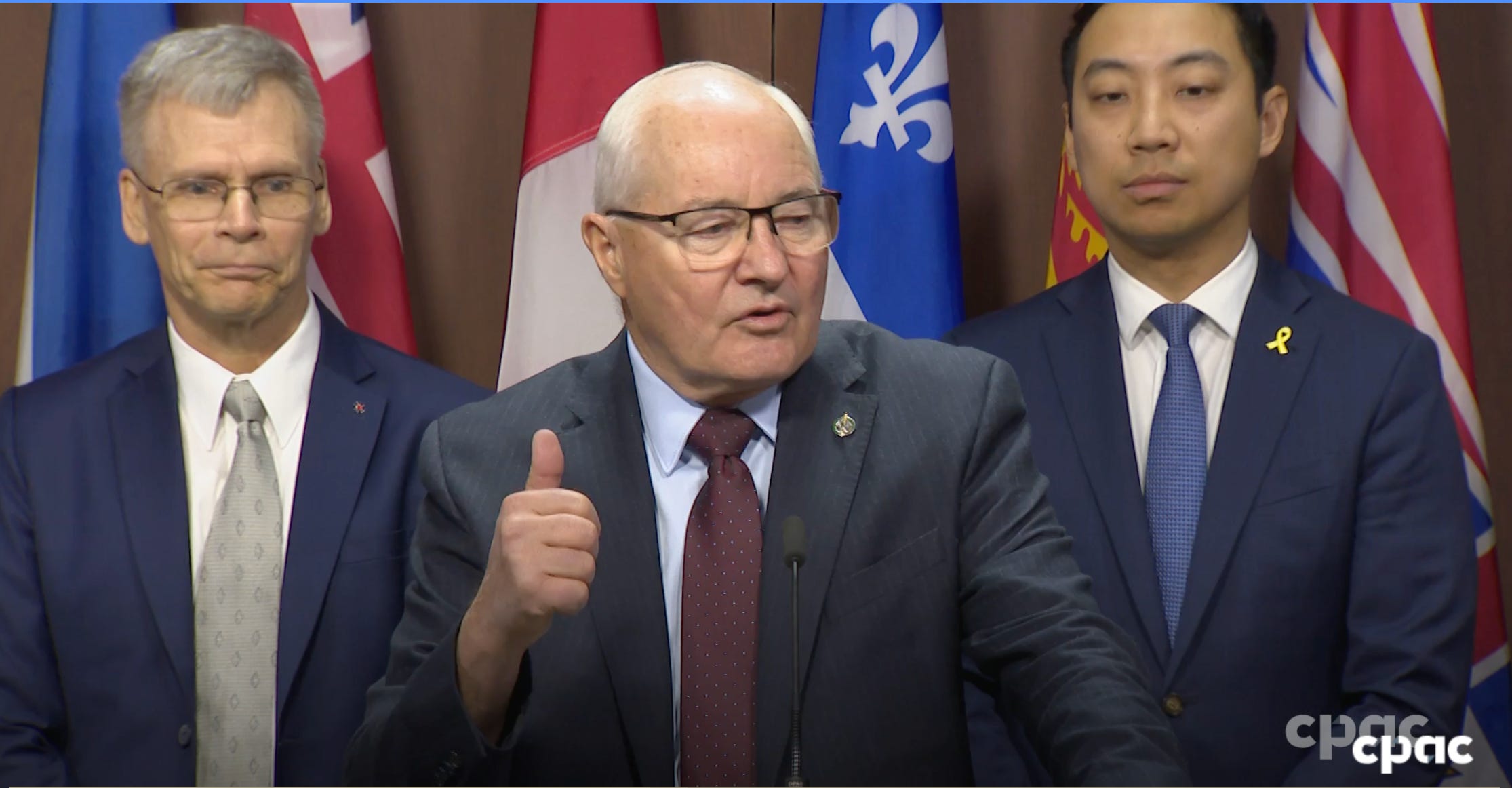
Pressure Mounts for Release of Long-Buried PEI Report on Buddhist Land Transactions, Amid Broader Calls for Federal Inquiry
https://www.youtube.com/watch?v=nkJjEr2HbZ4

2 Comments


From Wikipedia, the free encyclopedia
Kevin Vuong (born 1989)[2] is a Canadian former politician who was the member of Parliament (MP) for Spadina—Fort York from 2021 to 2025. Nominated in the 2021 federal election as a Liberal candidate, he was dropped by the party two days before the election over his failure to disclose a 2019 charge for sexual assault that was later withdrawn. Given the timing, Vuong's name controversially remained on the ballot as a Liberal, narrowly winning the riding by fewer than 1,400 votes.
Vuong sat as an independent within Parliament and faced calls to resign. He joined the Conservative Party in November 2023, and publicly indicated his wish to sit with the Conservative caucus and run under that party's banner in the 2025 federal election. However, the party declined to allow him to sit in caucus and he did not seek re-election in 2025.
Before entering politics, Vuong was a businessman who sold COVID masks and a reservist in the Royal Canadian Navy.
Price of a promise: Chinese family returns home broke after paying $40K seeking Canadian residency
Expert says Canada's immigration consultant system is 'Wild West'
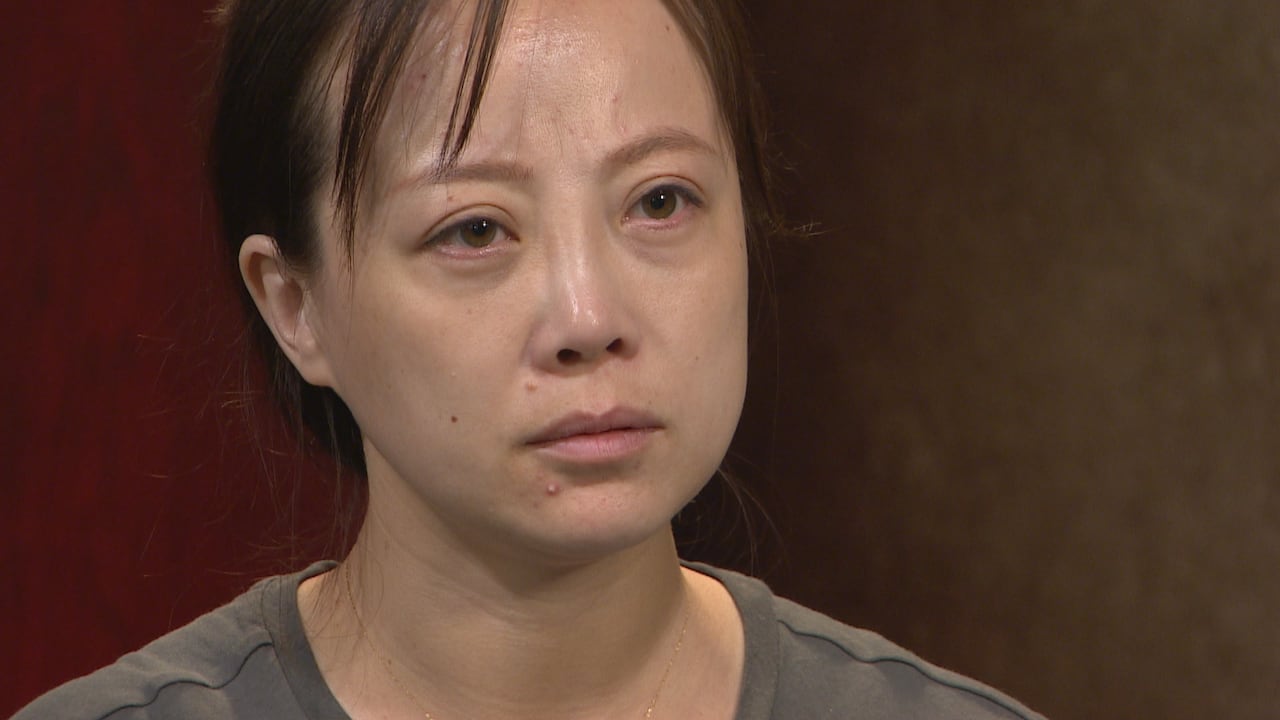
TingTing Biao remembers the moment she realized she lost everything, including tens of thousands of dollars in savings, on an immigration scheme that left her broke and traumatized.
A donated loaf of bread was all she could offer her child.
“My daughter eats one meal in the whole day,” Biao said, her voice trembling during an interview in Saskatoon this August.
Instead of a new life in Canada, Biao is now back in China warning others about what happened — a dream that turned into a nightmare.
In January, Biao and her husband arrived in Canada on tourist visas with their six-year-old daughter, intending to explore their options for moving here permanently.
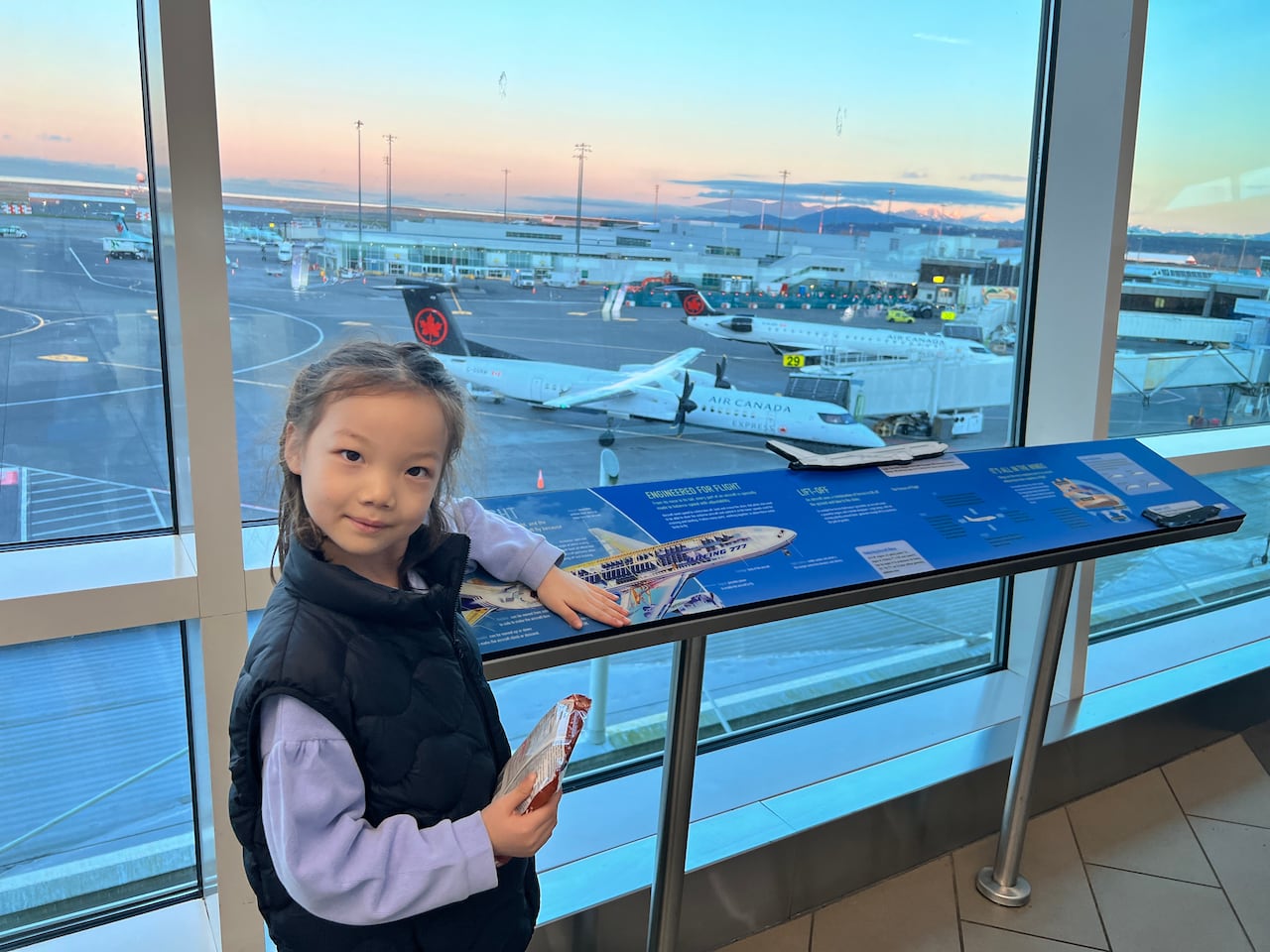
She signed a contract with Jun Su and June HR Solutions in Saskatoon. Biao said she was referred to the immigration company by a friend and believed that an agent who is also of Chinese descent would be trustworthy.
Su, gave Biao immigration advice and offered what looked like a clear path to permanent residency — for a steep price tag of up to $110,000. Biao ended up paying $40,000 before walking away.
An expert told CBC that immigrating to Canada shouldn’t cost nearly that much; it typically costs between $5,000 to $10,000 to hire an immigration consultant for a process similar to Biao’s.
Su is not a licensed immigration consultant.
The College of Immigration and Citizenship Consultants (CICC) regulates the industry by licensing agents, setting guidelines and investigating complaints. It said anyone who illegally provides Canadian immigration advice for a fee or other consideration without being licensed is an unauthorized practitioner.
Su said in a statement that her husband is a licensed agent and she gives immigration advice based on his guidance and her years of experience.
A contract for failure
CBC reviewed Biao’s contract with June HR Solutions. It laid out payments totalling $110,000 tied to several immigration steps, ultimately leading to permanent residency.
CICC said in a statement that consultants must set “fair and reasonable fees,” but it doesn’t specify how much is reasonable, nor can it track how much agents are charging.
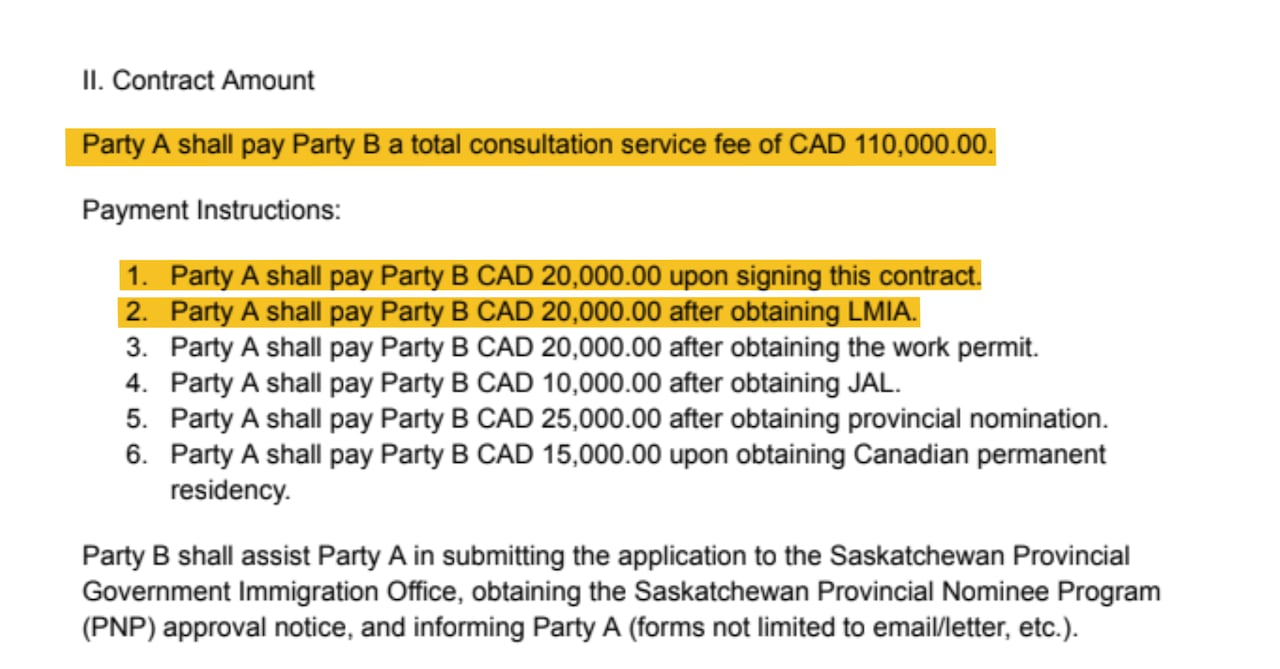
CBC reviewed Biao’s contract with June HR Solutions. It laid out payments totalling $110,000 tied to several immigration steps, ultimately leading to permanent residency. (CBC Graphics)
Biao paid the first $20,000 when she signed the contract and the next $20,000 after a successful labour market impact assessment (LMIA) — a document Canadian employers sometimes need to hire foreign workers.
Biao received a positive assessment for a kitchen helper position, but an expert told CBC that job didn’t qualify for Saskatchewan’s permanent residency pathway at the time.
Richard Kurland, an immigration lawyer with 40 years of experience said, “the plan was a plan for failure.”
“Even if you get an LMIA as a kitchen helper, it gets you nothing,” Kurland said.
An expensive detour and misleading advice
Biao’s next step was getting a work permit, which would be followed by another payment of $20,000 to Su, but Biao’s work permit application was rejected.
Immigration, Refugees and Citizenship Canada said in a rejection letter that it was not convinced Biao would leave Canada at the end of her temporary work permit, citing family ties in Canada, inconsistent details in her application and an unclear purpose of visit.
Su then suggested an even more expensive detour — invest $80,000 in a business in Yellowknife to apply for an investment visa. But that program requires more than $200,000, English fluency, business experience and a high net worth. Biao had none of those.
This is when Biao realized she was out of options and decided to walk away from the contract. With all her savings gone and no prospects of a life in Canada, she was forced to return to China.
Ghost consultant
Most of Biao’s communication was with Su, who is not a regulated immigration consultant.
CBC reviewed WeChat conversations showing Su giving instructions and immigration guidance to Biao over several months.
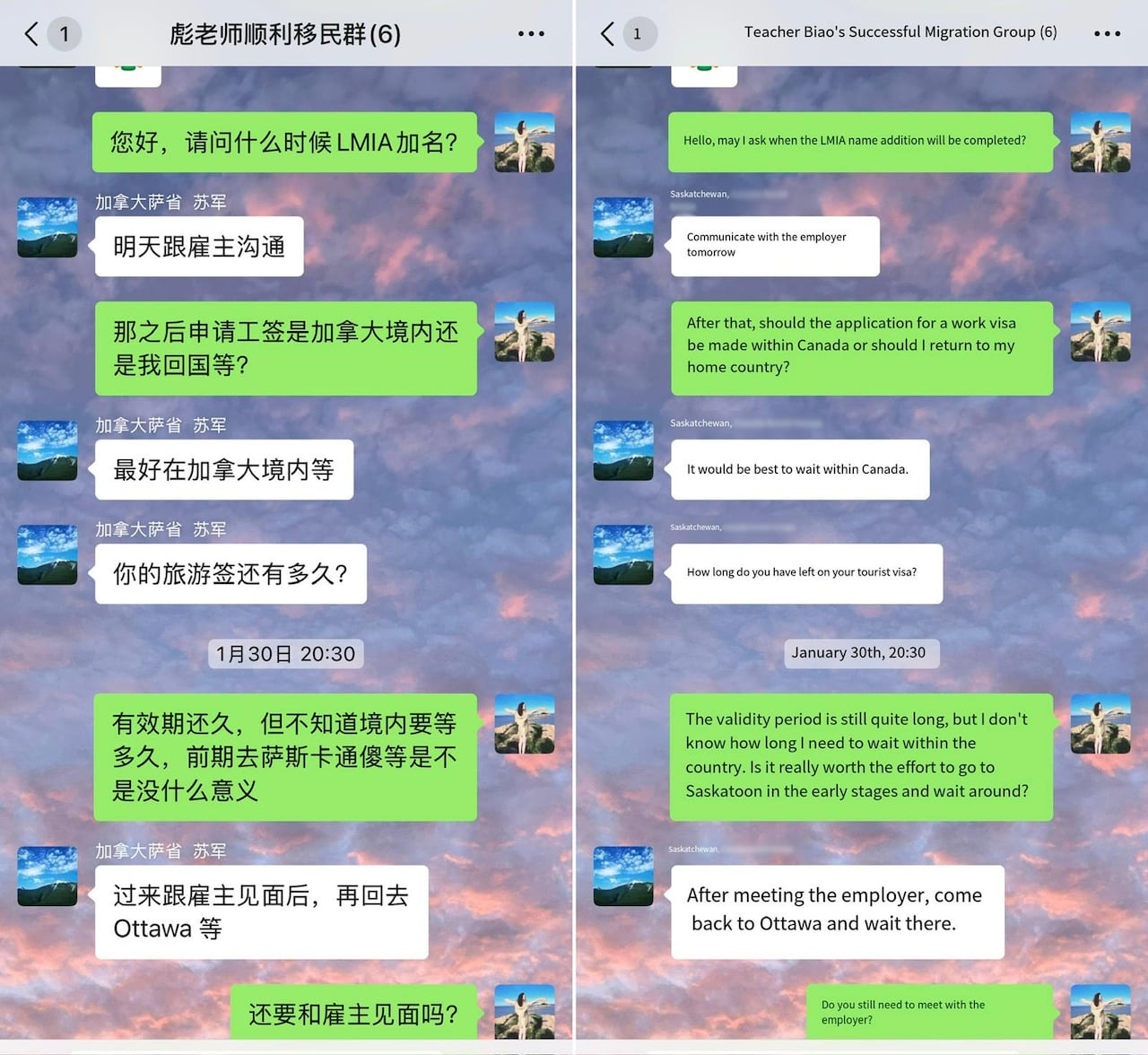
June HR Solutions Inc. does have one licensed consultant listed — Su’s husband, Zheng Tao Liu.
Su referred to Liu as “lawyer Liu” in WeChat conversations — but the Law Society of Saskatchewan confirmed that Liu is not authorized to practice law in the province.
Immigration company’s response
Su declined CBC’s request for an on-camera interview, but emailed her response to Biao’s allegations. She said she serves as an assistant to her husband, who is a licensed consultant, and that she gives advice based on his guidance and her years of experience.
“In this role, I assist in serving clients, which I believe is both my right and my responsibility.”
She also said that Liu, her husband, is a lawyer in China and that she never claimed her husband was a lawyer in Canada.
When it comes to fees, she said Canada’s free market allows her to set her own fees.
“Ms. Biao agreed to the pricing at the time of signing, so I do not believe the pricing should be a point of contention now,” she said.
Su alleged Biao and her husband have damaged her professional and personal reputation.
'Wild West'
Kurland reviewed Biao’s documents and said her experience reveals a bigger problem of a major lack of oversight in the regulation of immigration agents.
“It's an open Wild West when it comes to consultants. People can charge whatever they want,” Kurland said. “You have to protect these people. They are vulnerable. They clearly do not know how our system works and what things really cost.”
Kurland said Biao’s case is an example that shows CICC lacks the resources and authority to properly protect the public.
“What concerns me the most is the amount of money in play for a simple permanent resident application, as well as the information and advice given to these people,” Kurland said.
Solutions waiting on the shelf
Kurland said it’s clear that there are solutions to preventing issues like Biao’s.
“It's a known problem and it's going to be up to the feds to fix it if they want to,” he said.
His recommendations are:
- Parliament already passed legislation in 2019 to strengthen oversight of consultants, but it hasn’t been fully implemented. Kurland said enacting the changes would provide stronger regulation and an insurance fund to compensate victims.
- Publishing typical fee ranges for services like work permits and permanent residency applications, so newcomers know what’s reasonable.
- Giving the CICC more resources and authority, including the power to levy fines.
- Conducting random spot checks of consultants, rather than relying only on complaints.
Lingering trauma
Now back in China, Biao said the ordeal continues to haunt her family. After losing all her life savings, she’s trying to build again. She said she’s still sad and angry, and feels cheated by another person of Chinese origin.
Biao said she’s sharing her story in the hopes of warning other foreign nationals and newcomers against similar schemes.
She said that she is still haunted by nightmares from the experience.
“In the dream, I’m crying," she said.
"My husband shakes me awake … and I’m still crying. It’s true.”
ABOUT THE AUTHOR


No comments:
Post a Comment