Why U.S. investors are eyeing the Canadian oilpatch, even as oil prices dip
Shift in political rhetoric and better economics have investors taking closer look

There’s growing interest among U.S. investors in the Canadian oilpatch, a trend driven by friendlier rhetoric from the federal government and a belief that the industry north of the border will more reliably return cash to them in the years ahead.
Jeremy McCrea, a Calgary-based managing director at BMO Capital Markets, described the trend as a “rotation,” with more investment coming from the United States and a slight decline from Canada.
While lower oil prices have generally put a bit of a damper on investment, many portfolio managers still want to hold some energy stock and see more potential in the Canadian sector compared with the U.S., he said.
“You are seeing more U.S. investors saying, ‘If we have to hold energy, we'd rather hold Canadian energy here today,’” McCrea said.
U.S. funds now own about 59 per cent of Canadian oil and gas companies, up from 56 per cent at the end of last year, he said. Meanwhile, Canadian ownership of these companies has dipped from 37 per cent to 34 per cent.

CEOs in the Calgary oilpatch are seeing the trend play out in their own companies.
Grant Fagerheim, CEO of Whitecap Resources, said currently about 66 per cent of his company’s institutional holders are in the U.S., up from roughly 60 per cent at the end of last year.
“That’s quite remarkable,” he said.
Brian Schmidt, CEO of Tamarack Valley Energy, said he believes there’s still some hesitation from Canadian investors, particularly pension funds, about investing in the oil and gas sector but that U.S. investors don’t feel the same reluctance.
If he’s visiting an American city, “I can fill one or two days full of meetings," Schmidt said. “I'm not able to do that in Canada."
He estimated that U.S. ownership of his company is now about 40 per cent, up from 20 per cent prior to the COVID-19 pandemic.
A change in tone
The shift in investment started ramping up about a year ago, McCrea said, at which point the federal Conservatives were leading in the polls and promising major policy changes to boost the oil and gas sector.
While the federal Liberals were ultimately re-elected, Prime Minister Mark Carney promised in his election night speech to make Canada an energy “superpower."
 Carney says ‘more will be done’ on energy, but conversation isn't all about pipelines
“There is a bit of a change of tone that is making investors a little bit more comfortable coming into Canada," McCrea said.
Schmidt said the completion of the Trans Mountain Pipeline expansion has also ramped up interest from investors by boosting the sector’s export capacity.
Part of the uptick in interest is also driven by the relative economics of the oilpatch in Canada versus the U.S.
In the U.S., most oil production still comes from oil wells. Once wells are depleted, new ones have to be drilled. This costs money and might not be worth it to companies depending on the price of oil.
A recent survey of U.S. oil companies found that most needed a price of about $65 US per barrel to justify drilling a new well. Oil prices, meanwhile, are expected to be less than $60 US/barrel through the end of this year and average near $50 US/barrel through 2026, according to the U.S. Energy Information Administration.
Earlier this month, the CEO of one of the top oil producers in the U.S. said he expects production in his country will likely stall out if the price of oil continues to hover at its current rate.
‘Attractive’ future for oilsands
The economics of drilling new wells in the U.S. have been getting worse as the country’s top oilfield, the Texas-based Permian Basin, has become increasingly depleted. It’s now producing more water and gas and less oil, which means new wells are likely to generate diminishing returns.
In comparison, much of Canada's oil production happens in the oilsands. Oilsands projects are expensive to build upfront, but once complete, they can run at a low cost for several decades.

In recent years, oilsands companies in Canada have been less focused on building new oilsands projects and have instead opted to return more money to shareholders, which is appealing to investors on both sides of the border.
“We see these companies generating a lot of cash and returning almost all of it to the shareholders,” said David Samra, a Boston portfolio manager with Milwaukee-based investment firm Artisan Partners, which is invested in Suncor Energy.
McCrea, with BMO Capital Markets, said it’s not clear just how much bigger this trend might get, but on the whole, the future seems to look “encouraging."
As for Fagerheim, with Whitecap Resources, he said he believes investors in Europe and Asia, like their counterparts in the U.S., are increasingly eyeing the Canadian oilpatch.
“The world has taken notice as well," he said.
ABOUT THE AUTHOR

Alberto en Rosen
content deactivated
MR Cain
Reply to Alberto en Rosen
Not new news.
David Amos
content deactivated
Reply to MR Cain
As opposed to your Fake News?
John Charlton
The fact that the USA own 59% of our Oil and Gas is proof why there is next to zero tariff on those energy commodities. US owning the majority of Canadian oil and gas does not seem to be a concern for most Canadians, go figure?
MR Cain
Reply to John Charlton
This is old news. The ownership of the industry changes almost daily.
David Amos
content deactivated
Reply to John Charlton
https://www.youtube.com/watch?v=tipHN1HAHI8
David Coon and the media know I am the guy saying that since 2004
David Amos
https://www.youtube.com/watch?v=Zxuft6s-8Lk
David Coon and I knew Sheeple Get The Governments They Deserve since 1969
N.B. regulator launches review of soon-to-be-dead fuel charge
EUB not taking premier at her word carbon adjuster will be gone by year-end

The province’s energy regulator is preparing to review a fuel charge to account for the cost of federal carbon regulations — even though the premier and finance minister have promised repeatedly to scrap the levy by the end of the year.
This week the adjuster was adding as much as 8.1 cents per litre to the price of gasoline in New Brunswick and nine cents to diesel.
During the provincial election campaign Premier Susan Holt promised to end the cost of the carbon adjuster, which allows the cost of clean fuel regulation to be passed down to the pumps.
She stalled on following through, after some retailers warned the change would put them out of business, but then said in September she would continue with the promise after all and end the charge by Dec. 31.
But that change in course has not made an impression on the Energy and Utilities Board, which has begun a review into what the adjuster should cost consumers next year. At a scheduling conference Friday, the board decided hearings will go ahead on Dec. 16, 17 and 18.
Asked about the EUB holding hearings into a charge the province has promised to eliminate within weeks, Energy Minister René Legacy said the regulator is responsible for its own process.

"Our government has been clear with our intention to proclaim An Act Respecting Petroleum Products Pricing to remove the cost of carbon adjuster before the end of this year," he said in a statement.
While a bill removing the adjuster was passed this year, that legislation has yet to be proclaimed — meaning the adjuster, for now, remains in effect.
David Young, executive director of regulatory affairs for the EUB, said changes to the board’s review process would only be considered if changes to legislation are finalized.
Board chair Christopher Stewart is unable to comment on current proceedings, Young added.
Progressive Conservative MLA Kris Austin called the circumstances “a real head-scratcher” in an interview with CBC News.

He doesn’t believe the adjuster review is a good use of the board’s resources, noting the small office already has to review fuel prices on a weekly basis on top of larger rate applications.
“It doesn't make a whole lot of sense, in my world,” Austin said.
He called the review fruitless, saying if the premier ends up getting rid of the adjuster charges, "it's all for naught anyway.”
Carol Montreuil, the Canadian Fuels Association vice-president and an intervener in the EUB review, said in an interview that he doesn’t understand why the province would “short circuit” its own energy regulator.
While he ultimately believes fuel prices shouldn’t be regulated at all, Montreuil said the board does important work in evaluating those price controls.

“It's a very delicate situation, and we hope again that government will let the utility board in New Brunswick do their job — assess the real cost of this federal regulation, and let prices in New Brunswick reflect that situation,” Montreuil said in an interview.
But it's unlikely the EUB's review and findings will be complete by year-end, when Holt says the adjuster will be thrown out.
Even if that happens amid the board review, Green Party Leader David Coon believes the hearing could still be a valuable exercise.
He welcomes a closer look into whether the EUB formula, based in part on commodity prices in the U.S., best captures the actual cost of following federal regulations.
Legacy did not respond to a question about whether the province would wait for the review to finish before throwing out the adjuster.
ABOUT THE AUTHOR

Integrity commissioner clears N.B. housing minister of ethics breach
Minister David Hickey has rented an office to a Saint John outreach organization for the last several years

New Brunswick’s integrity commissioner says there is no legal violation of ethics rules in the landlord-tenant relationship of the province’s housing minister and a Saint John-based organization that does homelessness outreach.
Housing Minister David Hickey confirmed this week that Fresh Start has rented offices from him for the last several years, since before he entered provincial politics.
 No ethics breach with minister acting as landlord to anti-poverty organization
Integrity commissioner Charles Murray said he looked at the financial details of the agreement and spoke with Hickey before determining that the relationship does not violate the Members Conflict of Interest Act.
“I, looking at it as a whole, did not think that there was a conflict in the continuation of that relationship,” Murray said.
“I did caution the minister that he may need to recuse himself from discussions which will directly relate to the future finances of that particular organization.”
However, Murray said that perception of bias or conflict is still important to consider, even though that falls outside of his role as commissioner.
“There are two ways of measuring that. One would have to do with the requirements of the Act, which I feel the minister has done. The other … is in terms of the public optics. I can't advise the minister on that. That's not my place to do so.”
“But I do caution all members in these situations that what they should seek to do always is to embrace the full spirit of the Act and not merely to comply with the letter of the Act. And that they should be aware that just because the Commissioner is OK with something doesn't mean questions won't be asked in the public sphere.”

Hickey, who served on Saint John city council prior to winning a Saint John seat in the legislature last year, said he has been careful since joining cabinet to make sure that he doesn’t put himself in any situations that would put him in conflict.
“I have a really open dialogue with the integrity commissioner,” he said.
“If there is ever point where he feels that he feels that that conversation needs to be had further, then I will do whatever it takes to make sure that it never compromises the work that we do because we cannot let that stuff get in the way of the really, really important work that New Brunswickers are expecting us to do.”
Fresh Start is a Saint John based anti-poverty organization working on the frontlines of the homelessness crisis in the city.
Hickey, in his role as housing minister, does sit on a recently created ministerial taskforce on homelessness, which also includes the ministers of social development, justice and public safety, local government and mental health and addictions.
Hickey said that he hasn’t found himself in conflict while serving in that role over the past month.
“Fresh Start is a local organization offering outreach service in Saint John," he said. "So do I talk specifically about them? Rarely.
“If they ever came up. It is absolutely at the front of my mind on something. Like I said, it will never compromise the work that we are doing.”
It’s not uncommon for MLAs to be landlords or own property other than their primary residence. Murray said there are some in the current legislature who own rental properties.
All disclosures are posted publicly on the legislature’s website, although the list for MLAs elected in last year’s election has yet to be posted.
“Members have these relationships which preexist their political involvement and that those relationships don't necessarily have to be disrupted,” Murray said.
“The key part in my mind is on the other half, which is to say, is the minister, in the conduct of his duties, doing something differently now than he would do otherwise? That's to me the real issue, not necessarily the continuation of the ongoing relationship of landlord and tenant.”
When reviewing the disclosures required by each MLA and in follow up interviews, Murray says he will look to make sure lawmakers who own property aren’t using their position to charge exorbitant rates, or cut deals far below market value.
Hickey told reporters that the rent for Fresh Start has stayed the same for years at $2,000 a month, including utilities and four parking spots.
But Murray will consider factors beyond the purely financial as well, he said.
“When I see an agreement like this, one of the questions I asked myself is, is it in the public interest that this relationship be discontinued?" Murray said. "And in this particular case, I did not see that there was a compelling public interest in evicting that particular client.
“I don't think that would serve the public interest.”
ABOUT THE AUTHOR

Most N.B. universities see drop in international enrolment for 2nd year in a row
Enrolment of students from outside Canada down 11 per cent

New Brunswick universities saw an 11 per cent drop in international student enrolment in 2025 compared with the previous year.
For most of the province’s major universities, this is the second year in a row they've seen fewer students from abroad.
In Fredericton, St. Thomas University spokesperson Jeffrey Carleton said the school is feeling the impact.
“It's a serious concern for every university in the region and every university in the province,” he said.
According to a recent report from the Association of Atlantic Universities, the region as a whole saw a 36 per cent decrease in international student enrolment compared to 2024.
In a recently released report, the organization attributes the drop to a federal measure aimed at reducing the number of international students studying in Canada.

In 2024, Immigration, Refugees, and Citizenship Canada capped the number of study permit applications that could be accepted by universities. The federal government’s stated goals were to ease pressure on Canada’s housing supply, health care and other services, which it said were overwhelmed by population growth.
The report used numbers from Mount Allison University, St. Thomas, Université de Moncton and University of New Brunswick for the New Brunswick numbers.
Carleton said the changes have done significant damage to the schools' ability to recruit international students and to the “Canadian education brand."
St. Thomas and the province as a whole were seeing growth in international student numbers over the years before 2024.
“And as the federal government brought in their changes, we've had two years now of seeing those numbers decline,“ he said.
In 2024, all of the province’s major universities, St. Thomas included, saw international enrolment fall, except U de M, which kept the province's numbers of international students as a whole nearly the same as 2023.
Smaller schools hurt
This year, every university saw a decline, with most seeing between 10 and 12 per cent fewer international students than last year. Mount Allison’s numbers dropped by just over six per cent.
“So when you look at our previous trends over two years, we're down by about 30 international students and the lost revenue for that is about $1.4 million,” he said.
“For a school the size of St. Thomas, that's a significant amount of money.”
Carleton said the university is not only missing out on revenue for tuition but also for students living in residence.
The loss of students ultimately hurts growth that would benefit the university and the province as a whole, he said.
Impact on N.B.’s future, Canada’s reputation
The association said in a news release that the cap made the visa approval process more complicated for students, increased the amount of funds that students need to bank during their studies, and limited opportunities to work during and after their studies.
The organization — and other groups such as the Atlantic Chamber of Commerce and the Atlantic Canada Opportunities Agency — are pushing for a regional strategy to reverse the trend.

“We've had another year of devastating loss of international students right across the region this year in terms of our current enrolment survey,” said Peter Halpin, executive director of the Atlantic association.
“We've lost nearly 6, 500 more international students this year. That's in addition to the 3,000 that were lost last year. So that's a total of 9,500.”
New Brunswick's international student enrolment decrease is lower than the other Atlantic provinces.
In the same year, Nova Scotia saw a 37 per cent decrease. Memorial University — the only university in Newfoundland and Labrador — saw a 23 per cent drop and UPEI numbers are down 14 per cent.
The cap also has consequences for Canada’s reputation, he said.
“We're very concerned that Canada's brand internationally has been badly tarnished by these policy changes and the country is now seen as unwelcoming to international students,” Halpin said.
Mount Allison University did not provide an interview but said in a statement the it has seen a "modest decrease" in international student numbers. But the university has taken a "multifaceted approach" to recruitment that has been successful, he statement said.
U de M said in a release that its decrease in international student enrolment — by 264 — is partly due to constraints related to obtaining residence permits for international students.
Overall New Brunswick saw a one per cent increase in full-time and part-time students.
Ottawa puts $4.4M into Saint John education and employment program for youth
Nickole Theriault says program reignited her love of learning and ambition for a meaningful career

Christina Fowler talks about the kids who come to seek support from the Saint John Learning Exchange, hoods up over their heads, legs shaking and unsure of what to expect.
“They slowly begin to believe in themselves because we believe in them,” said Fowler, the Learning Exchange CEO. “One of my favourite moments is seeing that same youth, three months later, with their hood down, standing tall, confident and standing tall, ready to take on the world.”
This week at the Learning Exchange offices in Saint John, the federal government announced $4.4 million in funding for the READY program that provides wrap-around services for youth, aged 15 to 29, that need education, skills training and general support to find a good job and get a better start in life as young adults.
 Education program for Saint John youth gets huge funding boost
She was in Grade 9 at the time at St. Malachy’s High School in uptown Saint John and was being bullied and feeling a lot of pressure in the classroom.
“These challenges left me feeling really discouraged and disconnected from the idea of pursuing an education,” Theriault said.
She dropped out and didn’t return to school until she was 16 and started at the Learning Exchange, where she could do the coursework outside of the traditional classroom.
“Everyone here was so supportive and immediately invited me to start the work and do it at my own pace,” Theriault said. “I was able to get very, very high marks in my classes.”

She also started working at Stone Soup Catering, a social enterprise that hires workers from the Learning Exchange, and began thinking about the university courses she would need to take to become a veterinarian, a long-term goal she’s had for years.
READY stands for Repairing Education and Employment Achievement Debts to Youth. It was already an active program, but the federal funding is allowing it to ramp up to serve 200 youth a year.
Theriault herself was on the waitlist for the program, a common experience for many youth who end up there.
The new money will create more spots and also help them expand their skills training components and connections to companies that could employ them.
“We just had 13 young people graduate from the insulators trades training, and they're all working full-time jobs now,” Fowler said. “We're pretty proud of the trades approach, the direct employment approach.”
They also do a lot of project work so it teaches them how to be leaders and work in teams.
For people like Theriault, it also meant help finding a place to live, setting up a bank account and getting proper ID.
“[We’re providing] case management and coaching support so that they can get a job but can keep a job,” Fowler said.
The centre provides access to a variety of skills training, from the culinary arts to carpentry.

Chris Miller, a 17-year-old who was at Simonds High School before coming to the Learning Exchange, immersed himself in the culinary class and the carpentry course. He helped bake the cupcakes served at the announcement and made benches that are now part of the furniture at the Learning Exchange.
He thinks a job in the trades could be in his future.
“I've always just thought about trades, they're going to be really important in the near future,” he said. “I want that education for sure. You know, I want to be able to build my own house one day maybe and stuff like that.”
But he said it’s important to know how to bake a cupcake and “swing a hammer.”
“I think it's valuable to have those skills,” he said.
Charlton, 19, was a shy person overcoming an addiction problem when she came to the Learning Exchange and is now a confident young adult who has graduated and serves on the youth advisory council.
She works with kids at the C.E. Nick Nicolle Community Centre in the city’s north end and plans to go to university to become an educational assistant or support worker.

“It actually feels really good to be helping other people, because when I was like that, I didn't really have the help at first, and that's why I went down the wrong path,” Charlton said.
The focus of the program is on helping young people find rewarding work in a province with a 17 per cent youth unemployment rate.
But Fowler said the province is also facing a worker shortage over the next decade and will need young, eager and engaged young people like Charlton, Theriault and Miller.
Employers are "looking for the right fit, the right people,” Fowler said. “They're willing to give chances. They really need youth because that's our workforce. That's who is up and coming and we want them to be successful.”
ABOUT THE AUTHOR

Feds announce $617M for border security, officer recruitment — some in N.B.
Allocation of new officers hasn't been determined, will be based on need
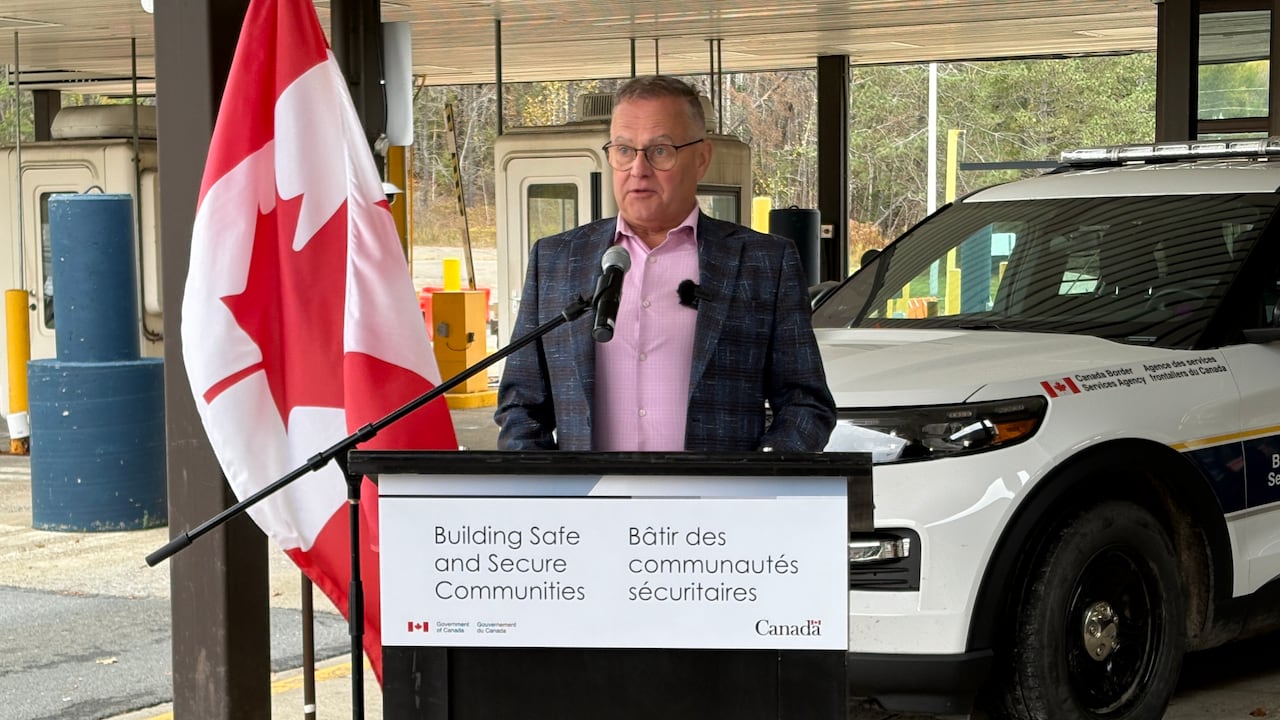
The federal government has announced a boost to border security that is set to have an impact in New Brunswick.
Wayne Long, MP for Saint John-Kennebecasis, made the announcement at the Woodstock-Houlton border on Friday.
Starting in 2025-26, the government will spend $617 million over five years on their border plan. This is a part of the upcoming budget that will be tabled on Nov. 4.
Long said the country’s safety and security begins at our borders and this funding is “of vital importance.”
“Our world is different. We have more risks. We need to protect our border. We need to strengthen our country. We need to protect our sovereignty. So this has been long overdue,” said Long, who is the secretary of state for the Canada Revenue Agency and Financial Institutions.
The funding will be used to hire 1,000 Canada Border Services Agency officers. Long said this adds to 10,000 existing border personnel.
He said the funding amount is the “largest investment in our border in Canada's history.”
 Canada to increase hiring for border jobs, do more on recruitment
It also includes new measures to improve recruitment.
The stipend paid to CBSA recruits during training will increase from $125 per week to $525 per week, an amount that hasn’t changed since 2005.
The Public Service Superannuation Act will be amended to give workers retirement options after 25 years of service, regardless of age. This also applies to parliamentary protection officers, search and rescue personnel, federal and territorial firefighters, paramedics and correctional officers.
The announcement, according to Long, is part of a broader border plan to “keep communities safe by keeping drugs, guns and criminals off our streets.”
He said, "Canada's new government is targeting drugs, cross-border crime and illegal migration to save lives and keep Canadians safe.”
Long said the plan will also address concerns from the U.S. regarding drug trafficking and fentanyl.

He said the allocation of new officers for New Brunswick hasn’t been determined, but he said the Port of Saint John will get more support.
“Obviously Port Saint John is growing exponentially. There'll be more CBSA support and services there. And I mean, they'll be allocated at the crossings in areas where they're needed.”
One border officer hopes there will be impacts at the Woodstock-Houlton border along the western edge of the province.
“We have very much a need for more employees here to help us keep our communities and Canada safe,” said Syvlie Cormier, the superintendent at the Woodstock point of entry.
"It very much helps when you have more employees. We're able to do more searches and get more firearms, illegal drugs and to keep inadmissible people outside of the country."

Cormier said traffic has been down at the land crossing over the past few months.
“They are going back up a tiny little bit now that the [Canadian] tariffs are gone, but they have been significantly lower than what we are used to.”
The number of U.S. residents entering the country by automobile is down across the board.
According to Statistics Canada, in September, there were 1.1 million trips, which is a 5.3 per cent decrease from September last year. It’s also the eighth consecutive month of year-over-year declines.
ABOUT THE AUTHOR

With files from Ian Curran

No comments:
Post a Comment