Carney says he spoke to Trump on Monday but doesn't expect tariffs to be lifted in immediate future
Clerk of the Privy Council Michael Sabia in Washington
Prime Minister Mark Carney says he spoke to U.S. President Donald Trump on Monday, but suggested it's unlikely American tariffs, which are still causing pain for certain Canadian sectors, will be lifted in the immediate future.
The conversation lined up with when Canada lifted most of its counter-tariffs on U.S. goods, a move seen as a goodwill gesture as Carney's government pushes for Trump to lift tariffs on industries including steel and aluminum.
The prime minister characterized his Monday talk with Trump as a "good conversation."
"We spoke at length on a wide range of issues, including on trade, but geopolitical, other issues, labour issues, et cetera," Carney said on his way into a meeting with his cabinet in the Greater Toronto Area.
Carney said his new clerk of the Privy Council, Michael Sabia, is in the U.S. capital to meet with American counterparts. Sabia joins a revolving door of officials, including senior cabinet members, who have travelled south to bend U.S. lawmakers' ears.
"Don't expect immediate white smoke on one of these strategic sectors. But that's the type of conversation that we're having and will continue to have as well," said Carney of Sabia's visit.
Historically, the Prime Minister's Office releases summaries, known as readouts, when the prime minister speaks with world leaders. The PMO did not issue a readout of the Monday conversation.
Earlier this year, Canada placed counter-duties on $60 billion worth of U.S. goods, but removed them this week from goods that are covered by the Canada-U.S.-Mexico Agreement (CUSMA).
Conservative Leader Pierre Poilievre called the move "yet another capitulation and climbdown by Mark Carney."
Carney meets with cabinet amid an unresolved trade war and looming budget
Public interest in Trump's tariff war subsiding a bit, pollster says
Prime Minister Mark Carney is sitting down with his cabinet to chart out the government's fall plan as he prepares to face off against Conservative Leader Pierre Poilievre for the first time in the House of Commons amid an unresolved trade war with the United States.
Carney's two days of talks in the Greater Toronto Area start Wednesday with plans to focus on helping industries hit hard by Trump's tariffs, building affordable homes, speeding up big infrastructure projects, spending more on defence and combatting crime.
David Coletto, CEO and founder of Abacus Data, said he's seeing evidence that the public's focus on U.S. President Donald Trump is starting to subside, putting pressure on Carney's government to answer how it plans to tackle other problems.
"The uncertainty that [Trump is] creating might be the norm," said Coletto. "And so now they're also looking for the government to address some other issues."
Coletto says the cost of living, health care, crime and immigration are top of mind for Canadians, along with the trade war. Poilievre, who campaigned on a promise to address the cost of living, has a news conference scheduled in the Greater Toronto Area on Wednesday focused on immigration.
Poilievre is returning to Parliament this month after securing a seat known as a Conservative stronghold in Alberta following his general election loss last spring. He's accused Carney of making generous concessions to Trump without getting anything in return — including dropping some retaliatory tariffs to try and advance trade talks.
One of Carney's MPs told CBC News that cabinet can't ignore Poilievre's ability to pivot. The Conservative leader is resilient, intelligent and his party has a lot of money to pounce on the Liberals with advertising or other techniques if it sees an opening, the MP said.
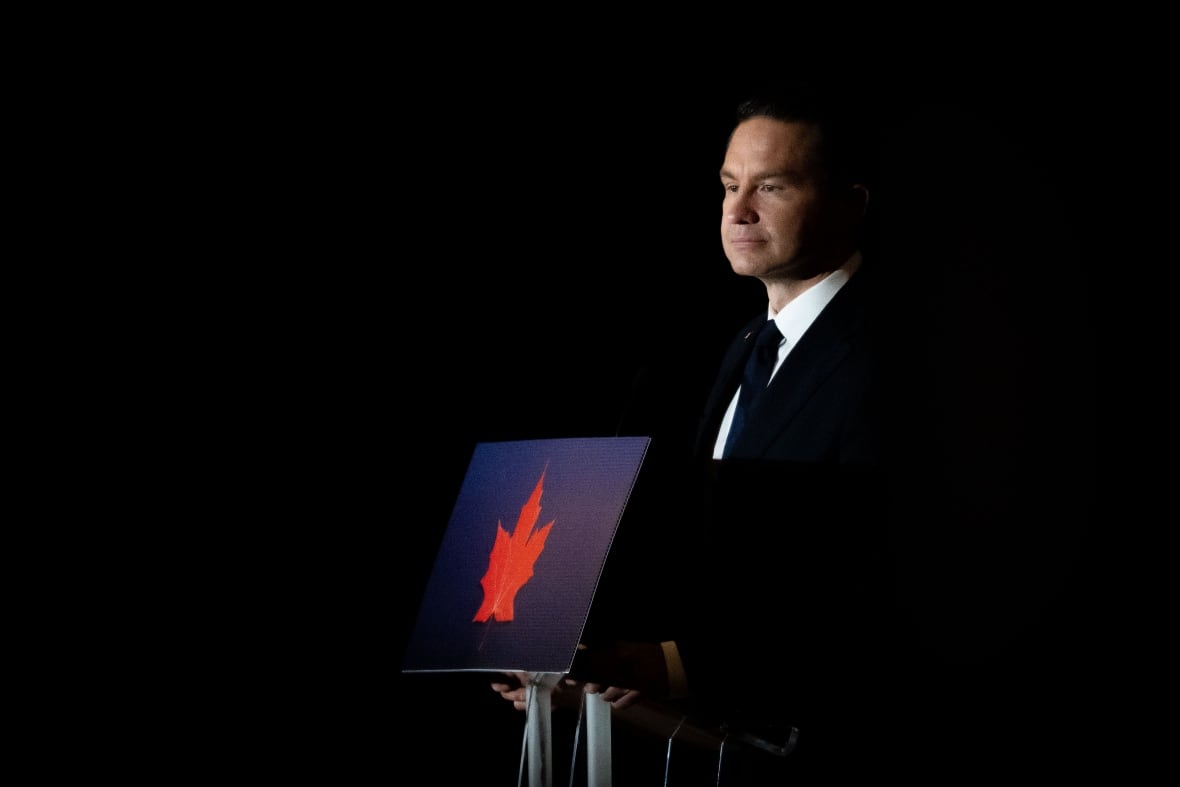 The
prime minister will face off against Conservative Leader Pierre
Poilievre for the first time in the House of Commons this fall. (Ethan Cairns/The Canadian Press)
The
prime minister will face off against Conservative Leader Pierre
Poilievre for the first time in the House of Commons this fall. (Ethan Cairns/The Canadian Press)
That MP, who spoke on the condition they not be named so they could speak freely, said they also want cabinet to talk about its communication approach so they don't fall down the same trap as during the Trudeau years. The party took a beating for its top-down messaging which the public perceived as elitist and arrogant, they said.
Another Liberal MP told CBC News that some caucus members are frustrated by how little influence they have. They said MPs are learning about decisions Carney and his office are making in the news.
That MP says the Liberals can't afford to move so far to the right that they alienate the entire base of NDP voters they gained during the last election.
Focused on speed
The Prime Minister's Office says pollster Jean-Marc Léger will be talking to cabinet about polling and the general mood of the country.
Jobs and Families Minister Patty Hajdu says cabinet will be focused on its Build Canada Strong agenda. She pointed to Dawn Farrell, former head of Trans Mountain Corp., who is in charge of a new office to fast-track Canadian infrastructure projects of national interest.
"We'll be talking about proposed projects," said Hajdu. "This is a very ambitious government and I can tell you that the prime minister is focused on the speed of delivery."
The Liberal government is also facing a call from the Centre for Israel and Jewish Affairs to confront what it calls an "alarming rise of antisemitism across our country" including increasing funding for community security and banning the glorification of terrorism.
Carney's talks with cabinet are unfolding as the Liberal government continues to work on a budget that's expected to include some serious belt-tightening. Carney promised a budget in October after his finance minister originally said they would only present a fall economic statement.
The look and feel of Carney's talks are expected to be different compared to his predecessor's time in office. The Prime Minister's Office has moved away from calling the meeting a "cabinet retreat" like it did under the Trudeau government, instead dubbing it a "cabinet planning forum."
Carney's office also said the forum is focused on working meetings and certain ministers and panellists will be assigned to speak to journalists at a microphone rather than a free flow of many ministers stopping to address reporters on camera.
ABOUT THE AUTHOR

Poilievre calls for temporary foreign worker program to be scrapped
Plan would involve keeping immigration stream for agriculture workers
Conservative Leader Pierre Poilievre wants the federal government to axe the temporary foreign worker program, saying it has flooded the market with cheap labour and made it harder for young Canadians to find work.
"The Liberals have to answer, 'Why is it that they are shutting our own youth out of jobs and replacing them with low-wage, temporary foreign workers from poor countries who are ultimately being exploited,'" Poilievre said in Mississauga on Wednesday.
The Conservatives say that while they want the temporary foreign worker (TFW) program scrapped, they will create a separate, standalone program for legitimately difficult-to-fill agricultural labour.
Canada already has a separate immigration stream for farm workers called the Seasonal Agriculture Worker Program (SWAP) that allows employers to bring in workers from Mexico and other participating Caribbean countries.
Poilievre stressed that he doesn't blame the temporary foreign workers themselves but the Liberal government and "liberal corporate elites" who he says are exploiting these workers to enrich themselves.
"Not long ago, young Canadians could gain vital skills in entry-level jobs, earn enough to pay for school and build a future," said Conservative MP Michelle Rempel Garner in a statement. "In return, employers built a skilled domestic workforce. But the Liberals broke that deal."
Poilievre said that while the Liberals promised a cap of 82,000 TFWs in 2025, the federal government has already handed out 105,000 permits.
"If they do the same number of permits for temporary foreign workers in the next six months that they did in the last, they will break the record again," Poilievre said.
Population growth slowing: Statscan
The Liberal government issued a statement saying the Conservative leader's numbers "include inaccurate or incomplete information."
Immigration Minister Lena Diab's office says that between January and June, only 33,722 TFWs entered the country, which represents about 40 per cent of the total number of TFWs expected this year.
The 105,000 permits that have been issued so far this year include permit extensions for people who are already in the country.
"Overall, 125,903 fewer new temporary workers arrived between January and June 2025 compared to January to June 2024," Diab's office said.
 A temporary foreign agriculture worker tends to grape vines at George
II Vineyards, near Beamsville, Ont., in 2023. Poilievre says he would
keep a separate stream of immigration for agriculture workers. (Evan Mitsui/CBC)
A temporary foreign agriculture worker tends to grape vines at George
II Vineyards, near Beamsville, Ont., in 2023. Poilievre says he would
keep a separate stream of immigration for agriculture workers. (Evan Mitsui/CBC)
Speaking in Toronto on Wednesday where he is meeting with his cabinet, Prime Minister Mark Carney said his government is putting policies in place so that immigration as a proportion of the population will decline from seven to five per cent a few years out.
Carney said that when he speaks to business leaders across the country, their No. 1 issue is tariffs and their second issue is how to get more foreign workers.
"That program has a role, it has to be focused in terms of its role," Carney said. "It's part of what we will be discussing — how well the temporary foreign worker program is working and how our overall immigration system is working."
In June, Statistics Canada reported that the country's population growth stalled in the first three months of the year, making it the sixth consecutive quarter of slower population growth.
Statscan said part of that decline can be attributed to decisions taken by the federal government in 2024 to "lower the levels of both temporary and permanent immigration."
The slow growth in the first quarter of the year represents the "second-slowest quarterly growth rate in Canada since comparable records began" in the first quarter of 1946.
Immigration still accounted for all of the population growth in the quarter because there were 5,628 more deaths than births in Canada.
Statistics Canada said that from Jan. 1 to April 1, the Canadian population rose by 20,107 people, the smallest increase since the third quarter of 2020 — early in the COVID-19 pandemic — when it contracted by 1,232 people.
Statscan says Canada now has a population of 41,548,787 people.
ABOUT THE AUTHOR

Labour vote splitting as Canada's political parties shift policies to attract workers' support
Interim NDP leader says party recognizes it needs to return to its roots
A year ago, then NDP leader Jagmeet Singh's Labour Day message to workers insisted that his party alone would stand shoulder-to-shoulder with working Canadians and the unions that work to protect their rights.
Six months later, Singh stood outside of an auto plant in Windsor, Ont., during the federal election, hoping to offer support and comfort to workers reeling from news of new auto tariffs from U.S. President Donald Trump.
But Singh was not greeted with warmth — most of them ignored him entirely, rushing past with their heads down as they came off shift, while some others indicated a preference for the Conservatives and Leader Pierre Poilievre.
It was an early indication that the NDP's stranglehold on union voters was loosening.
And sure enough, when the votes were counted on election night, the news for the NDP was grim. The party was shut out of Ontario completely, including across multiple union-heavy ridings in cities like Hamilton and Windsor.
It was the definitive proof that Canada's political landscape has shifted. Where labour unions and workers were once a safe vote for the NDP, the party can no longer count on their support.
 NDP will come back 'stronger' says 1 of just 7 re-elected MPs | Power & Politics
Sen. Hassan Yussuff, former president of the Canadian Labour Congress, said there are about four million unionized workers in Canada and that political parties recognize the power they wield more than ever before.
"The labour movement plays an important role in the fabric of the country, and political parties are going to have to be far more attentive around some of the issues that workers are thinking about," Yussuff said.
Changing political landscape
Yussuff said both the Liberals and Conservatives have shifted their policies toward organized labour over the last decade and many within the NDP acknowledge the party has lost touch with where it started.
Interim NDP Leader Don Davies said there is a recognition among the party that it needs to go back to its roots and reconnect with workers. He said the party was formed in 1961 with the goal of bringing the voices of workers to the federal stage.
While the NDP received several endorsements from major labour organizations, those endorsements weren't always backed by the membership, and the Conservatives won over many union voters in worker-heavy manufacturing towns.
Yussuff said unions aren't monolithic, and the historic idea the labour movement is 100 per cent NDP is "certainly not true." He said about 25 per cent of workers have always voted Conservative.
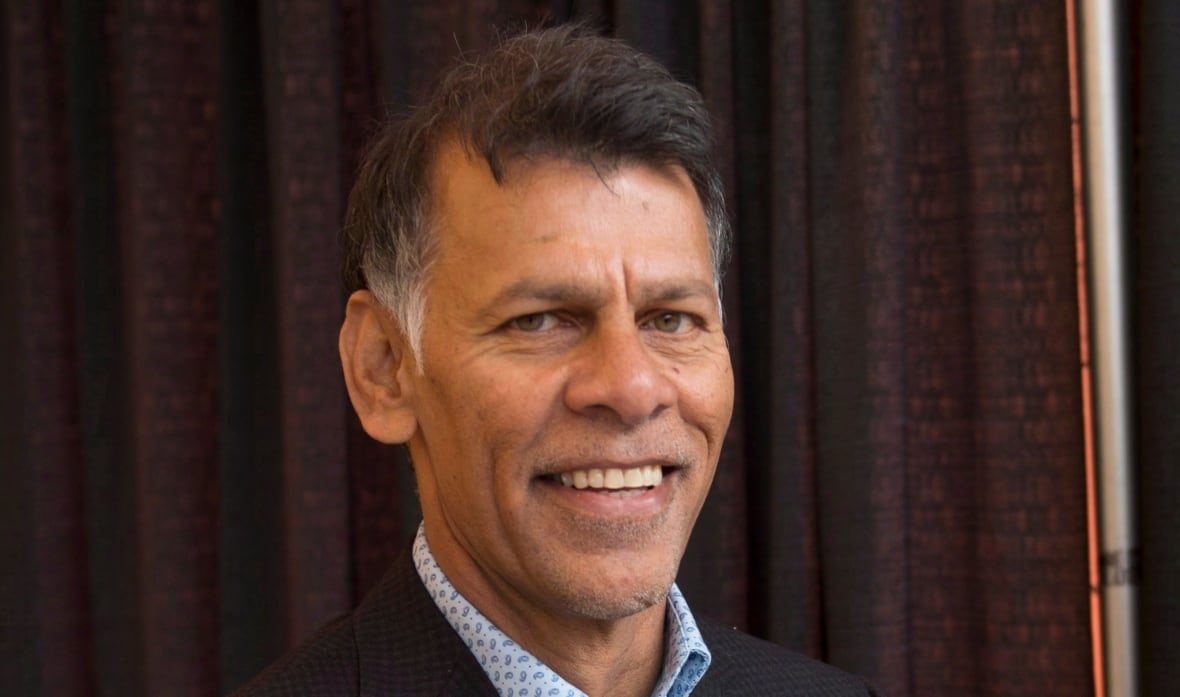 Sen.
Hassan Yussuff, former president of the Canadian Labour Congress, says
the Liberals and Conservatives have shifted policies to attract
organized labour. (Ryan Remiorz/The Canadian Press)
Sen.
Hassan Yussuff, former president of the Canadian Labour Congress, says
the Liberals and Conservatives have shifted policies to attract
organized labour. (Ryan Remiorz/The Canadian Press)
Amanda Galbraith, a Conservative strategist and partner at Oyster Group, said Ontario Premier Doug Ford offers a great example of a right-leaning politician making an appeal to working-class voters and that, federally, Erin O'Toole led the charge when he was the party's leader.
While the Conservatives have historically been known as the party of "big business," she said they needed to shake that image in order to increase their voter pool.
Galbraith said former prime minister Justin Trudeau didn't always appeal to working-class voters, and his focus on what many saw as "woke issues" dragged the Liberals far left, which "left a lot of space for the Conservatives to take aim."
Steven High, a history professor at Concordia University who recently wrote a book about Bob Rae's Ontario NDP government, said the political landscape in Canada, and elsewhere, is undergoing a "fundamental shift" with the rise of right-wing populism.
High said exit polling in recent elections in Canada, the U.S. and Germany all show that voters without higher education are shifting to the right.
Noting that the Conservatives managed to capture seats in auto-manufacturing towns and steel towns, High also said the electoral flipping of Canada's working-class would have been even more dramatic in the last election if Trump's tariff war hadn't "upended Tory plans."
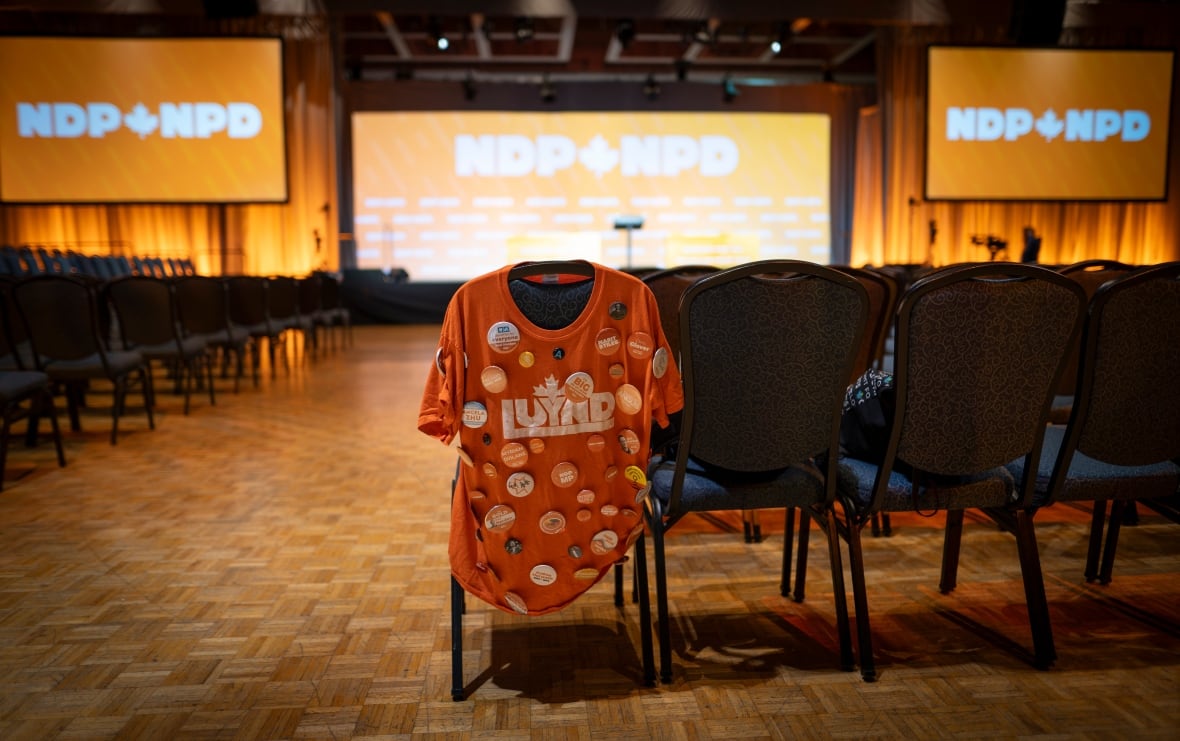 An NDP shirt with various campaign pins is shown at the NDP convention in Hamilton in 2023. (Peter Power/The Canadian Press)
High said populist parties on the right sense a "generational opportunity" and have been adjusting their message and softening anti-union rhetoric.
"The weakening of the NDP's hold on organized labour has meant that the labour movement is being courted by the other parties in a way that they had not been earlier," High said. "The degree to which this rapprochement goes beyond symbolics and influences the policies of the Conservatives and Liberals is an open question."
Charlie Angus, a longtime NDP MP who didn't run in the last election, said the election results were a "wake-up call" for the NDP and for organized labour.
Angus said the connection between organized labour and the NDP has been challenged and that party organizers are less "in tune" as they're focused on data and now rarely come from union halls.
"We were probably both taking each other for granted," Angus said, noting that the NDP was founded to give working class people political representation. "I think we strayed from that mission."
ABOUT THE AUTHOR


No comments:
Post a Comment