N.B. government says it's in talks with companies over LNG pipeline possibilities
Conversations still in early stages, minister say
As New Brunswick continues to pitch a major pipeline project to the federal government, the province now says it's also been in talks with private companies to realize its ambitious plan.
In an interview with Radio-Canada, Natural Resources Minister John Herron said the province has spoken with TC Energy, a pipeline company, and Repsol, which operates a natural gas plant in Saint John, as part of an ongoing push to bring the product to Atlantic Canada and reach what the minister has called "energy sovereignty."
Herron has previously talked up the potential for an LNG plant, or liquefied natural gas facility, coming to Saint John, from where the product could be shipped overseas to Europe.
While Herron said he'd describe the conversations as being in the "nascent stage," he said "it's quite clear that there is a demand for LNG in Europe, and Canada has natural gas to offer."
Calling it a "pan-Canadian, nation-building project," Herron said the pipeline would connect a natural gas pipeline that currently ends in Quebec City to the port of Saint John. He added that the pipeline would initially be owned by New Brunswick First Nations and the federal government, with the private sector eventually purchasing the government's share.
"But it's more than just a concept, because we're actually talking to real companies," he said.
Herron said Saint John is especially attractive for the federal government's three- to four-year timeline because it has existing LNG infrastructure and pipeline connectivity.
 Warren
Mabee, director of the Institute for Energy and Environmental Policy at
Queen's University, said Saint John has potential as a location for the
project. (Marc Godbout/Radio-Canada)
Warren
Mabee, director of the Institute for Energy and Environmental Policy at
Queen's University, said Saint John has potential as a location for the
project. (Marc Godbout/Radio-Canada)
With the war in Ukraine ongoing, Herron said Europe would prefer to buy natural gas from Canada instead of Russia, which gives the project another incentive.
The federal government has been looking into the possibility of selling natural gas to German markets.
Herron acknowledged the plan would be expensive, estimating it at a $4- to $5-billion investment, and noted the pipeline from Alberta to Ontario would need additional capacity.
The prospect has piqued the curiosity of one energy expert, however.
"With the pressure we're receiving from the U.S. and the ... desire to build more trans-Canada infrastructure, this is the time to open the conversation about what a pipeline and export terminal might look like," said Warren Mabee, director of Queens University's Institute for Energy and Environmental Policy, in an interview on CBC Radio's Shift.
He said it would be a big project that requires a buy-in from local communities and First Nations along the pipeline route.
"[Herron] talks about having First Nations ownership, which is laudable. It's a great idea, but are the First Nations at the table and are they ready to have those conversations?"
Ottawa has also looked at Churchill, Man., and Montreal as other possible sites for infrastructure upgrades, but Mabee believes Saint John is the best option.
Churchill has "really good access to Europe during the ice-free months," Mabee said, but added that there's still a long swath of the year where that port is inoperable. If the product is shipped from Montreal, he added, "you've got at least a day of travel down the Saint Lawrence, if not two, before you start to get out into the open ocean."
"Saint John has a much closer shot into the open ocean. It has closer access, essentially, to Europe than either of the other ports that we're talking about," he said.
Two years ago, Repsol dropped the idea of building an LNG plant in Saint John because it was too costly.
"My understanding is that a couple years back it was the lack of access to natural gas that made the company decide not to go ahead," Mabee said.
"There isn't a pipe that connects Saint John to the rest of Canada without going through the U.S., and that missing link, if you like, is why we haven't seen these developments in the past."
Mabee said if the province is serious, it should start getting out into the communities along a possible route to open a discussion.
"We have wonderful maps and then we go out and start talking to the people that will be impacted. That's where the pushback comes."
ABOUT THE AUTHOR

With files from Radio-Canada and Shift
The Eastern Energy Partnership: Atlantic Canada's big pitch for Carney's nation-building list
Premiers want projects to head off electricity crunch and help tie Canada together
On a gravel road by the side of the Trans-Canada Highway, New Brunswick's natural resources minister, John Herron, gazes down a long clearing cut through the forest.
He sees poetry — national poetry, that is.
Herron hopes one of New Brunswick's proposed "projects of national interest" will connect to an existing natural gas pipeline running under that clearing.
"This is a nation-building project that checks every box," Herron says.
The plan is to extend a gas line that now ends in Quebec City into New Brunswick to link with the Maritimes and Northeast Pipeline beneath the minister's feet.
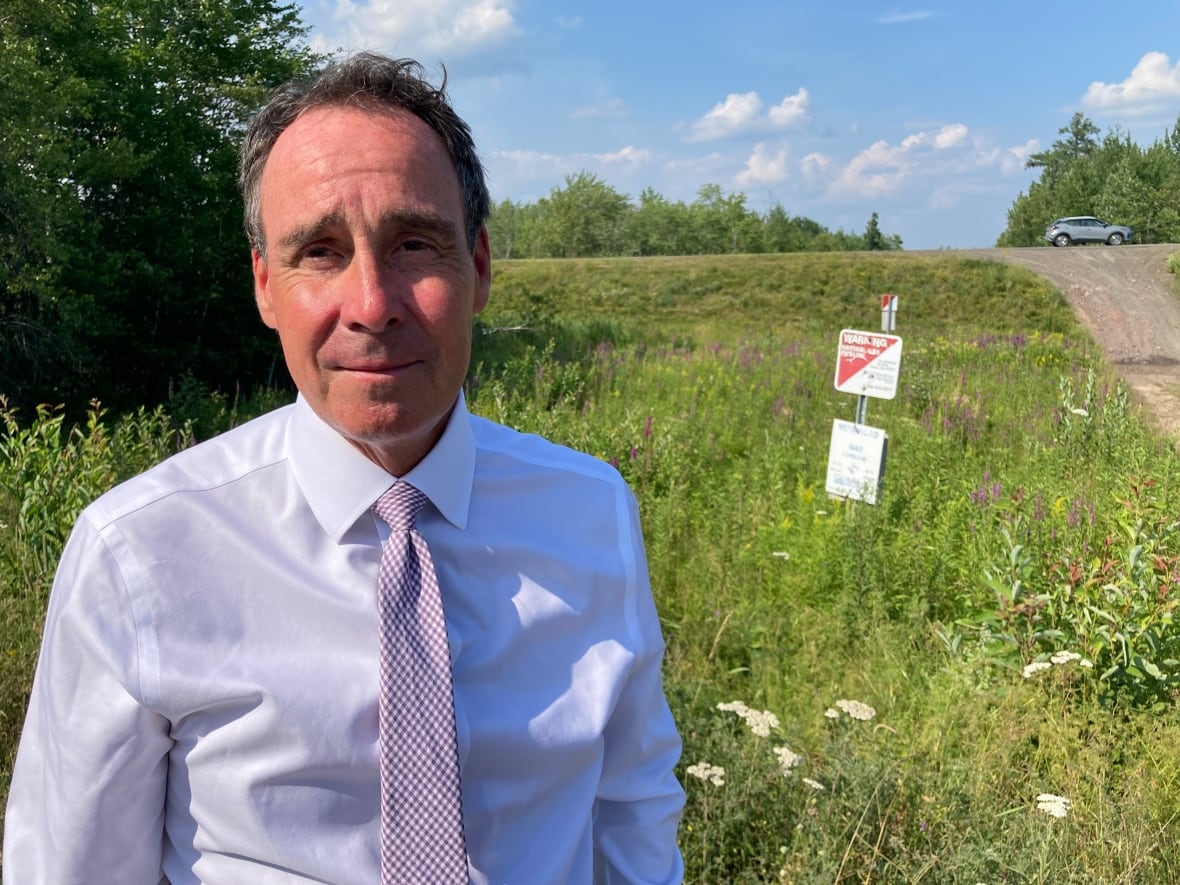 New
Brunswick's Minister of Natural Resources John Herron says his
province's nation-building proposal to extend a pipeline from Quebec
City into New Brunswick means Canada can ease its dependence on the
United States. (Jacques Poitras/CBC)
New
Brunswick's Minister of Natural Resources John Herron says his
province's nation-building proposal to extend a pipeline from Quebec
City into New Brunswick means Canada can ease its dependence on the
United States. (Jacques Poitras/CBC)
The line carries Alberta gas routed through the United States, or gas extracted in the U.S., into Atlantic Canada.
But the Quebec extension would bypass American territory completely, creating an all-Canada route.
"The poetry kind of goes like this: You have Western Canada gas going into Ontario, through the province of Quebec, [by] adding additional pipe from Quebec City into Atlantic Canada," the minister says.

"That additional pipe, aspirationally speaking, would be made of Ontario steel.… This is a made-in-Canada solution. This is energy sovereignty."
The proposal is on New Brunswick's list of projects submitted to Mark Carney's government for expedited regulatory approval under Bill C-5, which was adopted into law in June.
Carney underscored his own build-Canada agenda again on Friday, after the deadline passed for a trade agreement with the U.S. and U.S. President Donald Trump raised tariffs on many Canadian exports.
"Canadians will be our own best customer," Carney said in a statement.
The Eastern Energy Partnership
The prime minister's call for proposals has stirred interest from provincial governments across the country, not least in Atlantic Canada, where premiers see a new opportunity to boost their economies and meet a growing demand for electricity.
Many of their proposals fall under the label of the Eastern Energy Partnership, which envisions the four Atlantic provinces generating more electricity and transmitting it to each other, to Quebec and to other buyers.
They range from upgrading the subsea cable between Prince Edward Island and the New Brunswick mainland — likely one of the quicker, simpler projects — to a Nova Scotia proposal to build enough offshore wind turbines to generate a quarter of Canada's electricity needs.
Winning the "project of national interest" designation gets proponents a faster regulatory review process but doesn't guarantee federal funding.
 A lift boat, right, that serves as a work platform, assembles a wind turbine off Block Island, R.I., in 2016. (Michael Dwyer/The Associated Press)
It's also not a sure thing that Ottawa will approve the Eastern Energy Partnership projects as a whole.
"I don't want the perfect to be the enemy of the good," says Nova Scotia Liberal MP Sean Fraser, the minister responsible for the Atlantic Canada Opportunities Agency.
"I think we have an opportunity — and in fact an obligation — to move as quickly as possible on the components of the partnership that are ready," he says.
Many of the projects face obstacles.
Bill C-5 has provoked a skeptical reaction from some First Nations leaders concerned that accelerated reviews will compromise their right to be consulted.
In New Brunswick, however, some chiefs are open to making deals.
Pabineau First Nation Chief Terry Richardson supports the New Brunswick government's proposals, which include an expansion of nuclear power generation in the province.
"I'm OK with it, because we need a solution. We need a baseline source of energy and right now we don't have any," says Richardson.
 Chief
Terry Richardson of Pabineau First Nation says Atlantic Canada is often
forgotten at the national level and endorses an energy partnership made
up of provinces in the region. (Jacques Poitras/CBC)
Chief
Terry Richardson of Pabineau First Nation says Atlantic Canada is often
forgotten at the national level and endorses an energy partnership made
up of provinces in the region. (Jacques Poitras/CBC)
"I mean, renewables are great, but what do you do when the wind don't blow, the sun don't shine, and the water don't flow?"
Assembly of First Nations regional chief Joanna Bernard says many bands are keeping an open mind but will insist on equity stakes in projects.
"Back in the day, it was 'Here's some scholarships,' or 'Here's capacity building so maybe your people can work on the pipeline.' Those days are gone," Bernard said.
"We're going to own part of the company. We're going to be there on the ground, making sure environmental issues are of the highest priority. And the profits will go to the First Nations."
Wind and nuclear power
Nova Scotia Premier Tim Houston's Wind West plan to develop thousands of offshore turbines and export the electricity to other provinces could be a boon for national efforts to decarbonize its power sources, if it came to fruition at that scale.
Scott Urquhart, the Cape Breton-born CEO of a Copenhagen-based wind energy company, says the project is doable, with the wind off Nova Scotia being "pretty much best in the world."
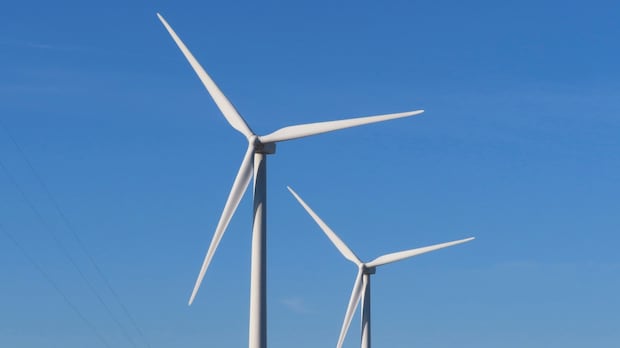 What it will take to get Nova Scotia's offshore wind project off the ground
But it may take a decade or more to get turbines turning, and at a considerably higher cost than the $5 to 10 billion the premier is forecasting, according to Halifax energy consultant Heidi Leslie.
"The estimate is really low," she says.
Wind power prices in a recent U.S. bidding process were far higher than what Ontario customers are now charged on their residential power bills, Leslie says.
At that rate, "you're losing money on every kilowatt" from Wind West, she says.
"And the further away it is from the place that's using it, the more expensive it is, because you need to build the transmission to get it there."
New Brunswick and Nova Scotia are doubling their transmission links, but "that will certainly not be enough to handle what is required," says Larry Hughes, an energy expert at Dalhousie University in Halifax.
New Brunswick's ambition to expand nuclear generation is also provoking questions.
The province's existing nuclear power plant, Point Lepreau, has been plagued with costly problems since it began operating in 1983. It is responsible for a large part of the provincial power utility's $5-billion debt.
More nuclear power — whether that is a second large reactor at Point Lepreau or small modular reactors — will only add to the financial burden, says David Coon, leader of New Brunswick's Green Party.
"It's insane," Coon says.
"We all get nuclear power bills of a size that no one is happy with because of the extremely expensive cost of owning a nuclear power plant."
Affordability top of mind
New Brunswick Premier Susan Holt says she gets it.
Holt won a big majority last year after campaigning on affordability issues, and she's already faced blowback from residents about their power bills.
She hopes neighbouring provinces will share the expense of more nuclear generation in exchange for some of the electricity that will be produced.
"When I'm trying to deliver affordability for New Brunswickers, I'm looking at who's shouldering the burden with us," she says.
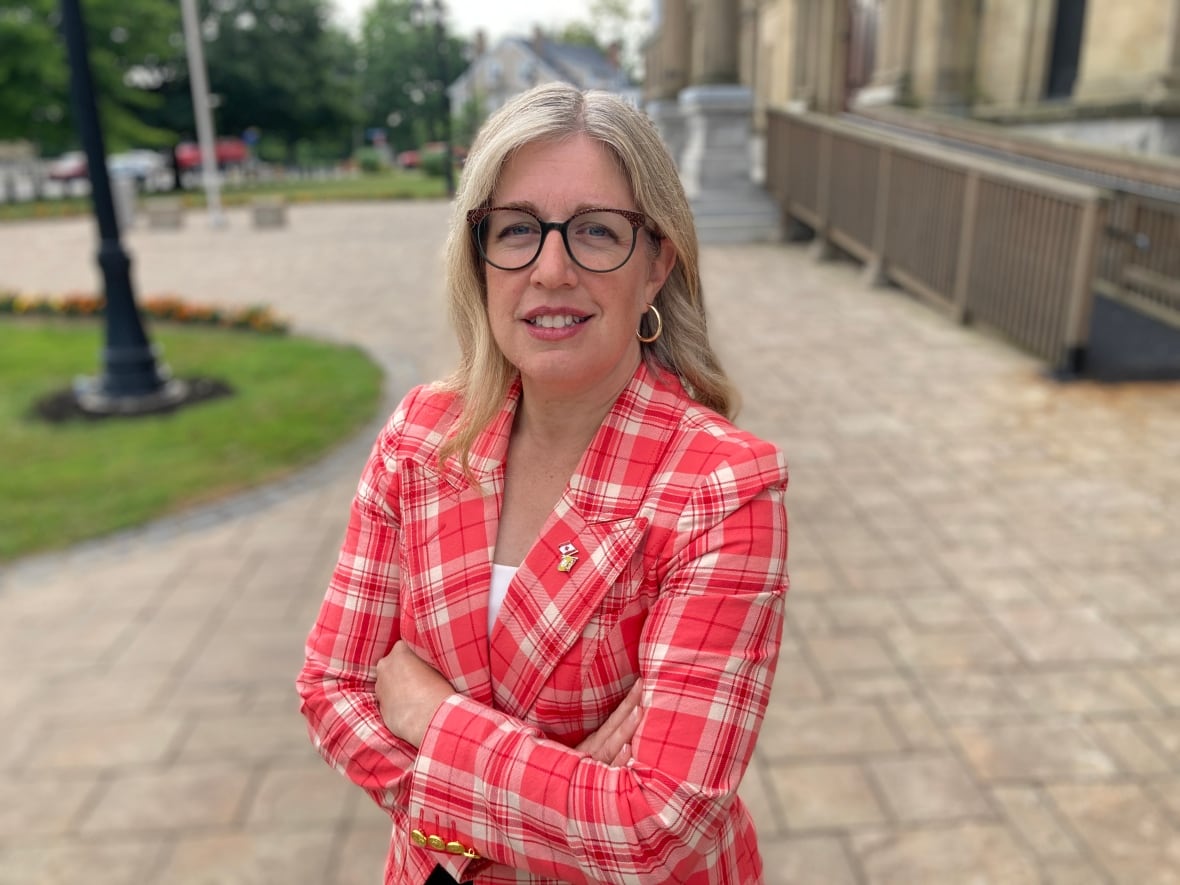 New
Brunswick Premier Susan Holt says her province has an advantage over
others when it comes to nuclear power because it already has a site
ready. (Jacques Poitras/CBC)
New
Brunswick Premier Susan Holt says her province has an advantage over
others when it comes to nuclear power because it already has a site
ready. (Jacques Poitras/CBC)
"How do we reduce the cost to New Brunswick ratepayers while still pursuing our objectives of clean power and reliable power?"
In addition to nuclear power, New Brunswick's electricity is generated by a combination of fossil fuels, hydro, and to a lesser extent, wind and biomass.
Without its emissions-free nuclear reactor, the province would need to burn four times as much coal, making it even harder to lower emissions, says Brad Coady, N.B. Power's vice-president of business development.
Meanwhile, the province's largest hydro dam, Mactaquac, needs a major upgrade that could cost up to $9 billion.
Lori Clark, the CEO of N.B. Power, says there's an onus on the federal government to help defray the costs of decarbonizing the power supply, rather than passing costs on to customers.
 The
Point Lepreau Nuclear Generating Station came online in 1983. Holt says
a second large-size nuclear power plant could address the growing
demand for electricity inside New Brunswick and beyond. (Marc Godbout/Radio-Canada)
The
Point Lepreau Nuclear Generating Station came online in 1983. Holt says
a second large-size nuclear power plant could address the growing
demand for electricity inside New Brunswick and beyond. (Marc Godbout/Radio-Canada)
"I do really believe that the federal government has a role to play in this as well. They've set the deadlines for net zero," Clark says.
Herron is also looking for federal support, invoking the possibility of a government ownership stake in the natural gas line extension.
"I think there's an opportunity to de-risk the project if the project is initially state-owned and First Nation-owned," he says.
That would speed up permitting "and it de-risks that investment for the private sector at a future date."
Fraser would not commit to that — but he didn't close the door either, citing the precedent of the federal government's 2018 takeover of the Trans Mountain pipeline expansion project in British Columbia.
"More often, the right outcome will be that we create the environment that will incentivize investment, that will allow private companies to set up to succeed and to employ people in the region," he adds.
"But we don't want to write off the possibility that certain kinds of investments may be required for particular projects to make them viable if we believe the long-term interests of Canadians will be served."
ABOUT THE AUTHOR

Electric vehicle incentives end in N.B., focus shifts to charger network
Last day to buy a vehicle eligible for government support was June 30
Jean-Marc Robichaud finally bought a fully electric vehicle in 2021.
His Hyundai Kona, the type of low-emissions car he'd wanted for over a decade, was cheaper thanks to federal and provincial electric vehicle incentives.
Robichaud received $5,000 from the federal government and another $5,000 from the province after his purchase, dropping the total for the car to $43,500.
His wife enjoyed the switch to electric so much she bought herself a Kona a year later. Once again they received $10,000 in incentives after their purchase, knocking the final price down to $51,295.
Robichaud was happy to get the incentives, despite already having his sights set on going electric.
"'Sweet, this is available,' that's how it was. More than sweet, really, it was excellent," he said.
 Jean-Marc
Robichaud bought his fully electric Hyundai Kona in 2021. A year later
his wife bought the same model. They both received federal and
provincial incentives. (Submitted by Jean-Marc Robichaud)
Jean-Marc
Robichaud bought his fully electric Hyundai Kona in 2021. A year later
his wife bought the same model. They both received federal and
provincial incentives. (Submitted by Jean-Marc Robichaud)
The incentive programs were created to help drivers make the move from gas- and diesel-powered vehicles to electric and hybrids, in a bid to lower greenhouse gas emissions.
June 30 was the last day to buy an EV and be eligible for compensation from the province. The last day New Brunswickers could apply to get the incentive was July 30.
The program issued 6,000 EV rebates and 1,300 home charger rebates over its four-year lifespan, with more still being processed.
 Electric vehicle incentive ends, N.B. turns to charger network
People receiving an incentive were also eligible for up to $750 to install a home charger.
Roughly $28 million was spent on the program since its launch in July 2021.
The federal government paused their version of the program in January when it ran out of funds, but announced in June it'll soon make a comeback.
Energy Minister René Legacy declined an interview about the future of the incentive program.
David Kelly, a spokesperson for Legacy, provided an emailed statement instead.
"With prices for electric vehicles becoming more affordable, the decision was made to wrap up New Brunswick's electric vehicle incentive and focus on adding to the province's charging infrastructure, which has been identified as a main concern by those looking to make the transition to an EV," the statement said.
 New Brunswick Energy Minister René Legacy says the province is now focused on adding to the province’s charging infrastructure. (Michael Heenan/CBC)
The province hopes a stronger charging network "will continue to fuel EV sales," but could not provide CBC News with data about the number of chargers it needs to meet demand.
As a speaker and consultant on sustainability based in New Brunswick, Carl Duivenvoorden pays close attention to incentives and hopes they'll be available for consumers again soon.
"The loss of the incentive, I think, will set back a bit our transition over to EVs, and that's too bad," he said.
Duivenvoorden feels the incentives were a way to give people "that little nudge," since a difference in sticker prices still remains between EVs and comparable gas-powered vehicles.
'Shifting its focus'
When New Brunswick announced was ending in its program, a March news release from the province said it was "shifting its focus to addressing the need for more charging infrastructure."
The release also called the program a success, saying it achieved its goal of EVs making up six per cent of new light-duty vehicle sales by this year. More than 7,400 electric vehicles have been registered in New Brunswick, according to the provincial Energy Department.
According to a Department of Natural Resources report, Canada will need about 679,000 public chargers by 2040. There are 38,696 chargers in the country now.
Duivenvoorden has taken his 2019 Chevrolet Bolt coast to coast, and said New Brunswick's charging network is very good and ranks "towards the top end of the middle of the pack."
He has found Quebec and British Columbia are the best while the prairies, southern Ontario, P.E.I and Newfoundland are good. He calls Nova Scotia and northern Ontario's networks "fairly weak."
 Carl
Duivenvoorden just returned from driving his 2019 Chevrolet Bolt to
British Columbia and back. He had first-hand experience of each
province's EV charging network and ranks New Brunswick toward the top of
the list. (Submitted by Carl Duivenvoorden )
Carl
Duivenvoorden just returned from driving his 2019 Chevrolet Bolt to
British Columbia and back. He had first-hand experience of each
province's EV charging network and ranks New Brunswick toward the top of
the list. (Submitted by Carl Duivenvoorden )
Duivenvoorden said N.B. Power's eCharge Network has evolved over the years, and its only weakness now is that some locations only have one charger. With one plug, that leaves drivers waiting or tracking down the next charger on their route.
Duivenvoorden and Robichaud both said around 90 per cent of their charging is done at home.
"You're not charging anywhere except if you go on a trip. Then all of a sudden those chargers become important. Very important," said Robichaud, who has seen public charging improve since 2021.
His trip to Quebec used to take him 12 hours and now, because of new chargers along the western border of New Brunswick, his trip is down to 10 hours.
According to Kelly, between N.B. Power and third-party stations, the province had 187 Level 2 chargers and 85 fast chargers at the start of 2023.
Today, there are 349 Level 2 chargers and 151 fast chargers.
N.B. Power's website says a Level 2 charger can fully charge an all-electric vehicle in six to 12 hours, while a fast charger takes less than an hour.
The province has budgeted $4 million to improve its charging network this fiscal year and will install 16 new chargers, including eight 320 kW fast chargers, which can charge two vehicles at the same time.
Future of N.B. network
François-Guy Haché, N.B. Power's electric mobility lead, said range anxiety is "one of the main barriers" for people considering buying EVs.
Haché said N.B. Power is focused on putting chargers along main highways to deal with that fear and allow drivers to "travel further without having big gaps in the province."
According to Haché, the province's utility company is "well positioned grid-wise" and will have to keep monitoring how EV chargers are used as more are installed.
N.B. Power is seeing the number of charging sessions "almost doubling year over year," he added.
Haché said the utility plans to build with demand as more EVs hit the road.
 University
of Toronto engineering professor Olivier Trescases, who runs the
university's electric vehicle research centre, says it's difficult to
know how many chargers are needed. (Lisa Xing/CBC)
University
of Toronto engineering professor Olivier Trescases, who runs the
university's electric vehicle research centre, says it's difficult to
know how many chargers are needed. (Lisa Xing/CBC)
Olivier Trescases, a professor at the University of Toronto and director of the university's EV Research Centre, describes the vehicle charging conundrum as a "chicken and egg problem": it's difficult, he says, to know how many chargers we actually need.
He said having Crown corporations operate chargers can help keep costs down.
For now, Trescases thinks education is important if people are going to choose electric without incentives.
"Every new technology has to stand on its own legs and we've seen that with all major technologies," he said.
"It's very, very difficult to get on to the mass adoption phase, and I think we're getting there soon."
ABOUT THE AUTHOR

Carl Duivenvoorden
Distinguished Alum 2024
Carl Duivenvoorden (Class of '83/'86)
Faculty of Agriculture Blue & Gold Alumni Awards 2024 – Carl Duivenvoorden

1 Comment

Carl Duivenvoorden was raised on a dairy farm in northern New Brunswick. He graduated from NSAC with a diploma in farming technology in 1983, followed by a degree in plant science in 1986. His diverse agricultural career, which spanned two decades and took him to over 25 countries, eventually led him towards his true calling: environmental advocacy.
In 2007, Carl took a leap of faith. He attended a training session led by former US Vice President Al Gore, then left his government job to pursue what he considered to be the most important work he could ever do: raising awareness of environmental challenges, particularly climate change. Since that time, he has dedicated himself to this cause, working as a speaker, writer and consultant. He has presented localized versions of Mr. Gore’s “An Inconvenient Truth” slideshow to over 400 audiences across the region, and wrote a column for NB newspapers for 10 years. Between his passion for the environment and the changes he’s made in his own life, Carl provides inspiration and hope for the future of our planet.
https://carlsgreenideas.wordpress.com/contact-carl/

Phone Carl Duivenvoorden at 506. 363. 8117 (in Upper Kingsclear, New Brunswick).
Contact Carl by email — info (at) changeyourcorner.com
To book An Inconvenient Truth or business presentation, please use this form.
Share this:
https://www.cbc.ca/news/canada/new-brunswick/eub-hearings-nb-power-smart-meters-1.4529640
Opting out smart meter program could cost NB Power customers
Power customers in British Columbia, Quebec have faced fees for refusing the installation of smart meters
NB Power customers who do not want a smart meter installed on their home could be facing a stiff fee for that decision, but so far the utility is not saying how much it might be.
"It will be based on the principles of cost causation, but we have not gotten into the detail of what that fee would be at this point," said NB Power Senior Vice President of Operations Lori Clark at Energy and Utilities Board hearings on Friday.
In other jurisdictions that have already adopted smart meters, customers not wanting to participate have faced hundreds of dollars in extra charges.
 Thousands of pages of evidence on a number of issues, including smart meters, have been submitted for the 12-day hearing.
In British Columbia, power customers are charged a meter reading fee of $32.40 per month if they refuse a smart meter, or $20 per month if they accept a smart meter but insist its radio transmitter be turned off. That's a cost of between $240 and $388.80 per year for customers to opt out.
In Quebec, smart meters were installed beginning in 2012. Customers who refused the devices were initially charged $98 to opt out plus a meter reading fee of $17 per month. That was eventually cut by Quebec's energy board in 2014 to a $15 refusal fee and a $5 per month meter reading surcharge.
NB Power said it may be a year or more before it settles on its own fee.
"The opt out policy will be developed and implemented as part of the roll out. It will be one of the last things we do," said Clark.
Customers need to be on board
NB Power is in front of the New Brunswick Energy and Utilities Board seeking permission to spend $122.7 million to install 350,000 smart meters province wide.
 Smart
meter opponent Roger Richard, right, leads a group worried about human
health problems caused by long term exposure to the devices. (Robert Jones/CBC NEWS)
Smart
meter opponent Roger Richard, right, leads a group worried about human
health problems caused by long term exposure to the devices. (Robert Jones/CBC NEWS)
The meters are capable of transmitting consumption data of customers back to NB Power in real time, which the utility said will allow for a number of innovations in pricing and service.
The meters require near universal adoption by customers to maximize their financial benefit — like eliminating more than $20 million a year NB Power currently spends to read meters manually. The utility has said the switch will not succeed if too many customers opt out.
"We certainly wouldn't be looking at making an investment of this size without having the customer with us," said Clark.
On Thursday, Kent County resident Daniel LeBlanc, who along with Roger Richard, is opposing the introduction of smart meters for health reasons, predicted a cool reception for the technology in many parts of the province.
Haven't tested the waters
NB Power acknowledged it has not measured public opinion on adopting smart meters but is confident it can convince customers it is a good idea for them and the utility.
"People don't understand what the smart meter is," said Clark. "We need to educate our customers first to allow them to make an informed decision so that will be part of the roll out plan."
Clark noted that smart meters, helped by stiff opting out penalties, were eventually accepted by 98 per cent of customers in British Columbia and by 97.4 per cent of customers in Quebec.
"We will check and adjust along the way if there are issues with customer uptake," said Clark.
"This is very similar to what has been done in other jurisdictions and they haven't had those challenges."
Ask yourselves why Dave Coon and his buddies did not intervene this time
http://www.nbeub.ca/opt/M/browserecord.php?-action=browse&-recid=560
Comments - Public Session - Carl Duivenvoorden 02/02/2018
From: Carl Duivenvoorden
To: NBEUB/CESPNB
Subject: Submission - Smart Meter hearings
Date: Friday, February 2, 2018 4:25:04 PM
2 February 2018
New Brunswick Energy and Utilities Board
P.O. Box 5001
15 Market Square, Suite 1400
Saint John, NB E2L 4Y9
Dear Board Members:
I’m writing to express support for the adoption and installation of smart power meters across New
Brunswick, for two main reasons: 1) to help New Brunswickers become energy-literate and learn how they can save on their energy bills; and 2) to enable and facilitate the adoption of future renewable energy and smart grid opportunities that will reinforce savings and help reduce emissions.
Energy literacy and savings
In 2009, Bob Gilligan, Vice President of Transmission and Distribution for GE Energy, famously said
“Today, most consumers live in a black hole when it comes to information about their energy consumption and costs.”
Unfortunately, I fear that remains largely true today. When it comes to power consumption, most people do not know the difference between a light bulb, a television and a baseboard heater. The reason? The only feedback we get is a power bill that arrives a month later, lumps all consumption together and focuses on dollars rather than kilowatt hours. It’s pretty difficult to take ownership of our energy reality and modify our consumption when we don’t have the tools to do so.
On the other hand, real-time or near to real-time feedback about our power consumption can be a
powerful tool for energy literacy and positive change. A number of years ago, I installed a Power Cost Monitor offered by Blueline Innovations at my home. One component strapped onto my power meter and registered our consumption in real-time. It sent this wirelessly to the other component, perched on the windowsill, which displayed it. The result? We very quickly learned our baseline power consumption, and saw how it fluctuated.
Around the same time, I got a WattsUp power meter and measured the power consumption of plug loads in my home. The result? We very quickly learned what items in our home consumed a little and what items consumed a lot. Both of the above tools improved our energy literacy, and gave us the information we needed to save.
True, smart meters don’t go quite that far – but they will offer consumers the ability to better monitor and learn more about their power consumption, thus building energy literacy. Energy literate consumers will be better equipped to understand and adapt to a changing energy reality as our world transitions from fossil fuels to renewables. Energy literate consumers will be more empowered to embrace energy efficiency and other energy and environmental solutions.
Gateway technology
To me, the far greater promise of smart meters lies in all the possibilities they enable: in linking energy demand, energy supply and energy prices; in managing grid loads; and in facilitating future technology. Power peaks are an unfortunate reality of our grid, and winter peaks tend to be the benchmark for how much total generating capacity we need. But even though a kilowatt hour of power at 8 AM in January is much more expensive to supply than a kilowatt hour at 2 PM in May, our current meter technology has no way of differentiating.
The result: consumers have zero incentive to reduce energy consumption during peak periods, and it may reasonably be expected that winter peaks will continue to rise largely independent of power prices. Higher peaks will in turn hasten the need for new generating capacity, which can be enormously expensive – and peaker plants tend to be even more expensive because sit idle much of the year. Smart meters, on the other hand, offer the possibility of better matching energy supply and demand and improving grid stability because they enable time-of-day pricing, where power rates at different times of the day or year better reflect the actual cost of supplying that power. Time-of-day pricing would give consumers a financial incentive to shift their time-insensitive power consumption out of peak periods. This would save them money, but, equally important, would fulfill a larger policy goal of deferring the need for new power generation or increased power imports.
As a NB homeowner, here’s how I believe time-of-day would impact me. I would do laundry in off-peak hours; my present washer already has a one-button process for delayed starting. I recently purchased a plug in hybrid electric vehicle, and I would charge it primarily during off peak hours; it already has a builtin system that just requires me to set it. I would make sure my hot water tank were big enough to meet a day’s needs for my family, and then have an electrician install a timer on it so it would reheat during offpeak hours. If I heated with baseboard heaters, I would install a thermal storage unit (not new technology; they’ve been in use for years in Nova Scotia and elsewhere) that would take some of my heating load out of the morning peak.
And as time went on, no doubt I would think of other ways to consume less during peak hours. Why?
Because I’d have a financial incentive. And if my utility didn’t have to worry about supplying a peak load every morning, it probably could defer new power generation projects for years – which would help keep my power rates lower too, and likely help reduce emissions.
I realize time-of-day rates have not yet been proposed for NB – but they are not even available to us as a policy option unless we install smart meters.
I know that time-of-day pricing has yielded less-than-expected results in other jurisdictions. That leads me to believe two things: 1) the price differential is probably not large enough to produce habit change; and 2) energy illiteracy is a tough barrier to overcome. Yet I am convinced price signals will yield the desired load shift over time; perhaps the greatest evidence of this lies in gasoline pricing, where a fraction of a penny difference per litre – a negligible amount for the average fill-up – will lead consumers to change where they buy gas. And perhaps we should take inspiration from Texas, where some energy suppliers offer power for free after hours and on weekends, to help lower their peaks.
Perhaps, also, we should take note of what is happening elsewhere in the world. According to NS
Power’s website, there are more than 65 million smart meters installed in the US and 11 million in
Canada, serving 70% of Canadians. The European Union aims to replace at least 80% of its power
meters with smart meters by 2020. All this would suggest we are already behind a large pack, and it’s
time for NB to get on board too.
I appreciate that it would be irresponsible to ignore financial considerations in the installation of smart meters, and I expect that this review process will be guided by due diligence. Yet I’d suggest that sometimes costs we are inclined to view as expenses might better be viewed as investments, and this might be one such instance. That’s even more critical in the face of our global climate crisis, which threatens to challenge many of our financial paradigms.
I hope these comments will be of value in your deliberations, and would welcome the opportunity for
follow up.
Yours sincerely,
Carl Duivenvoorden
Speaker - Writer - Sustainability Consultant
110 Mazerolle Settlement Road
Upper Kingsclear, NB, Canada E3E 1V5
Tel (506) 363 8117; (506) 476 9629 cell
Internet www.changeyourcorner.com
Twitter: http://tinyurl.com/FollowCarl
Most recent column:
"Life cycle assessment, the one sure measure of sustainability",
www.changeyourcorner.com/articles/153.php
Most recent Huffington Post column:
"You might want to rethink blaming China for climate change",
http://bit.ly/2hww40Z
"Maybe you can't change the whole world, but you can change your corner of it.
And when you change your corner of the world, you actually change the world."
N.B. Power turns to carbon-emitting natural gas for new electricity
Minister says gas plant could mean lower emissions overall, if it replaces Coleson Cove at peak demand times
N.B. Power is turning back to carbon-emitting fossil fuels as it scrambles to find new ways to generate electricity to meet record-breaking demands.
The utility plans to buy power generated by a new natural-gas plant to be built by a private company outside Moncton — a move at odds with the current push to achieve a net-zero-emissions power grid a decade from now.
But Energy Minister René Legacy says it will allow N.B. Power to rely less than it does now on its Coleson Cove generation station, which burns higher-emitting heavy oil during peak demand times.
"In my mind it would probably be [used] ahead of Coleson Cove, which is the heavy fuel," he said.
"So it's less emitting on that aside, short term. So we should see a reduction in carbon emissions short term."
 Energy
Minister René Legacy says that by buying power from a privately built
and run plant, N.B. Power will avoid exposing itself to the financial
risk of building its own facility. (Jacques Poitras/CBC)
Energy
Minister René Legacy says that by buying power from a privately built
and run plant, N.B. Power will avoid exposing itself to the financial
risk of building its own facility. (Jacques Poitras/CBC)
Coleson Cove can generate more than three times as much electricity as N.B. Power's only natural gas generating station, Bayside in Saint John.
But Coleson Cove produced 26 times as many greenhouse gas emissions as Bayside in 2022, according to federal data.
 N.B. Power needs more electricity. Here’s how it plans to get it
N.B. Power said no one was available for an interview on the project Thursday, but in a statement the utility said it issued a request for proposals in June, "and we are currently moving forward with due diligence with a proponent."
The likely location is an industrial area in Scoudouc outside Moncton, near the Maritimes and Northeast Pipeline that would supply it with gas, the statement said.
Officials said at a legislative committee hearing last year that during a February 2023 cold snap, N.B. Power faced an all-time peak demand for electricity that it came perilously close to not being able to meet.
Because of population growth, "it's a trend," the utility's Andy Hayward said at the time. "We're going to set peak demand records on a regular basis as we go forward."
Moe Qureshi, the director of climate research for the Conservation Council of New Brunswick, said he's worried that those soaring population numbers and heightened demand will make the proposed gas plant a regular staple of the utility's grid.
"If they don't have more clean energy projects online, they're going to be more dependent on this fossil reactor. So it might not just be a peaking facility is what I'm worried about," he said.
 Moe
Qureshi, the director of climate research for the Conservation Council
of New Brunswick, says he's concerned heightened demand will mean N.B.
Power will rely too heavily on the proposed gas plant. (New Brunswick Legislature Livestream)
Moe
Qureshi, the director of climate research for the Conservation Council
of New Brunswick, says he's concerned heightened demand will mean N.B.
Power will rely too heavily on the proposed gas plant. (New Brunswick Legislature Livestream)
But Legacy said N.B. Power will soon be adding more renewable power, such as wind energy, to its grid and those sources need a backup supply of reliable electricity for times when wind turbines can't operate.
The new plant will be convertible to non-emitting energy sources, such as hydrogen, in the future, Legacy said.
The minister said he doesn't know which company N.B. Power has signed the agreement with but was told it's a business that has built gas plants before.
He also said by buying power from a private operator, the utility is not exposing itself to the financial risk of constructing a plant itself.
N.B. Power is facing challenges to several of its generating units as it struggles to reach climate policy objectives and meet a growing demand for electricity.
Its Belledune plant must stop burning coal by 2030, its zero-emissions Mactaquac hydro dam needs a multibillion-dollar overhaul, and the future of the Point Lepreau nuclear station is unclear.
"The general takeaway is that there is no silver bullet," the utility said in its 2023 Integrated Resource Plan.
The agreement with a private operator for natural gas frees up N.B. Power financially to pursue other necessary but expensive projects, like the Mactaquac upgrade.
That project will involve taking some turbines at Mactaquac offline, another reason the new gas plant is needed, Legacy said.
ABOUT THE AUTHOR
New Brunswick Liberal leadership rivals make final pitches
Michael Murphy, Brian Gallant and Nick Duivenvoorden are running for the party's top job
New Brunswick’s Liberal Party will elect a new leader Saturday afternoon, two years after becoming the first government in the province’s history to lose after a single mandate.
Liberals will be voting for either Michael Murphy, a former health minister, Brian Gallant, a Moncton-area lawyer and Nick Duivenvoorden, a former mayor of the northern village of Belledune.
Gallant and Murphy are considered the two frontrunners in the leadership campaign.
Murphy has tried to cash in on his experience and has largely run his campaign by criticizing the party’s establishment.
The former cabinet minister quit the Shawn Graham government in January 2010 at the height of the controversy over the proposed sale of NB Power.
 Nick
Duivenvoorden, (from left) Michael Murphy and Brian Gallant are running
to be the next leader of the New Brunswick Liberals.
Nick
Duivenvoorden, (from left) Michael Murphy and Brian Gallant are running
to be the next leader of the New Brunswick Liberals.
Murphy was the first leadership contender to speak on Saturday.
He offered a long list of policy ideas during his 20-minute speech, including a vow to be tough on the environment.
"When a Texas CEO tells you not to worry, tell them this is our earth, this is our water," Murphy told the crowd.
In the end, the former cabinet minister guaranteed that he could deliver an election win in 2014.
"Today we are in the fight of our lives for our children and our seniors and our rightful place in this country. … Ladies and gentleman, Liberals across this province, I will win that election for you."
Gallant opted against having speakers introduce him on Saturday. Instead, the newcomer to New Brunswick politics used the entire 30 minutes to outline his vision for the party.
Throughout the campaign, Gallant has tried to present himself as a fresh face to Liberal members.
But the 30-year-old lawyer has faced criticism over his inexperience.
Gallant used his speech to fill in his biography to those Liberals who may not know him.
While he outlined his view of the role of government, Gallant’s speech was not as policy heavy as his chief rival’s speech.
 Interim
Liberal Leader Victor Boudreau addressed party members at the beginning
of the party's leadership convention on Saturday. (Daniel McHardie/CBC)
Interim
Liberal Leader Victor Boudreau addressed party members at the beginning
of the party's leadership convention on Saturday. (Daniel McHardie/CBC)
He closed his speech by calling everyone who voted in the Liberal leadership convention to stay active in politics after the convention, even if their candidate does not win on Saturday.
"I ask you to stay involved. To the 18,000 people who registered to vote, and the famous dog, I ask you to stay involved as well," Gallant said.
"No matter if it is with our party or outside of partisan politics. Together I am convinced that the Liberal party and all New Brunswickers can make this place better for all."
Duivenvoorden was the final candidate to speak on Saturday. While his speech was short on policy, it was infused with a healthy dose of humour.
The crowd, including delegates from all three leadership camps, laughed at Duivenvoorden's many anecdotes from his farm and the leadership campaign.
While he dismissed the insinuation that he was a "fringe candidate," the dairy farmer admitted that he was not likely going to win the party's leadership.
"I never entered the race to finish second, to finish third, to lose, nobody ever does. But I realized in this race really, really quickly that when this race started that there would be no loser," he said.
"There may be just one winner but there will be no losers today."
Tribute to Graham
Party members started the leadership convention on Friday night by paying tribute to Shawn Graham, who led the Liberals to defeat in 2010.
The three candidates running for the party's leadership have all said they would govern differently than Graham and many party members remain bitter about some of the controversial policies he pursued as premier.
Graham acknowledged during his speech that he didn't do enough to involve grassroots Liberal members in policy decisions, one of the subtexts of the party's recent renewal efforts.
 Former premier Shawn Graham spoke during a tribute dinner on Friday night. (Daniel McHardie/CBC)
The three leadership candidates have all promised to give the party members a greater role in future decisions.
When the Liberals emerge out of Moncton on Saturday afternoon, the party's new leader will not have a seat in the legislature.
None of the candidates has a seat in the legislative assembly.
The party is using a preferential ballot system, so there will be only one ballot on Saturday.
If there is not an outright winner after counting the first ballot choices, the votes cast for the last-place finisher will be re-examined and their second-choice votes will be distributed.
The Liberals have said 19,000 people have signed up to vote in the leadership contest and officials said on Saturday that roughly 13,800 have already voted.
ABOUT THE AUTHOR


Experience
-
-
-
As a speaker, writer and sustainabilty consultant, Carl specializes in helping people and organizations learn how they can save money, energy and the environment. He provides keynotes, workshops and seminars that explain complex issues in an easy-to-understand way, and he presents realistic and practical solutions. Carl coaches organizations toward sustainability and savings. His aim is to inform, educate and motivate action in all who hear him.
-
-
-
-
-
Since being personally trained by Former US Vice President Al Gore in April 2007, Carl has presented live versions of "An Inconvenient Truth" (constantly updated) to over 400 audiences comprising over 50,000 people, in English and French, across Atlantic Canada in in the US. He has also participated in Mr. Gore's '24 Hours of Reality' global webcast three times, from Greenland, New York and New Brunswick; and shared the stage with Mr. Gore at a training session in Houston in 2016.
-
-
-
-
-
As 2004-05 District Governor, Carl led District 45 (2000 members across Maine, New Hampshire, Vermont and the Maritimes) to a top-third finish among Toastmasters districts worldwide. He's presented hundreds of speeches to Toastmasters Clubs across the region, and has achieved Distinguished Toastmaster, the organization's highest designation, six times.
-
-
-
-
-
For ten years Carl wrote a biweekly column, "Green Ideas", for the New Brunswick Telegraph-Journal, the Fredericton Daily Gleaner and four New Brunswick weeklies. The column also ran periodically in the Huffington Post Canada and other newspapers in the region. Its aim was to inform, educate and provoke, plus help people better learn how they can save money, energy and the environment.
-
-
-
-
-
Carl helped develop some of Canada's most progressive and innovative programs for helping New Brunswickers make energy efficiency upgrades to their homes.
-
-
-
-
-
Helped companies in various industries develop and build their capacity to export. Provided export readiness counseling and identified market strategies and opportunities. Led trade delegations and coordinated trade events.
-
-

New Brunswick's 2023 clean-energy timeline already outdated
Deadlines changing as a result of more ‘flexibility’ in weakened federal emissions rules
The New Brunswick government is pushing back several targets from its 2023 clean-energy plan, thanks to the relaxing of federal rules.
MLAs on the legislature's climate change committee were told that Ottawa's decision to soften its requirement for net-zero-emissions electricity generation by 2035 allows the province to move more slowly on several initiatives.
Those projects, and a timeline for adopting them, were laid out in a plan released by the previous Higgs Progressive Conservative government in December 2023.
A year and a half later, the plan is being updated and adjusted.
"I think the challenge as we can all appreciate in this space is that as soon as you produce a document, things change," Jeff Hoyt, the deputy minister of energy, told MLAs.
A decision on whether to refurbish the Mactaquac Dam at a potential cost of $9 billion was supposed to be made this year but will now be made in 2026.
The goal of "significant growth" in the network of electric vehicle charging stations, initially pegged to 2029, now has 2030 as a target date.
 Province’s 2023 clean-energy plan already out of date
"Those are things that are being re-evaluated because we've been given more time and more flexibility," Hoyt said of the adjustments.
The final version of federal clean-energy regulations published in December 2024 created a range of exceptions to the goal of non-emitting electricity generation Canada-wide by 2035.
The changes cut in half the expected reductions in carbon dioxide emissions that contribute to warming temperatures.
But they give provinces "a lot more flexibility" to work toward the ultimate goal of net-zero emissions in 2050, Hoyt said.
The federal rules create exceptions for emissions from natural gas plants.
Last fall, N.B. Power announced it was looking for a proponent to build a 400-megawatt natural gas generating plant near Moncton to meet the growing demand for electricity in the southeast part of the province.
On Wednesday, Progressive Conservative MLA Ryan Cullins pointed out that the plant is nowhere to be found in the 18-month-old plan.
"It's good a example of how things change very fast," Hoyt said.
Not all of the timeline changes are due to weakened federal emissions rules.
Hoyt said small modular nuclear reactor technology has "developed slower than I think people were expecting. … The ability to draw in capital investment has been a significant challenge in that space over a number of years."
That may actually lead to cost savings, however.
The new federal flexibility on emissions from electricity generation means SMRs don't have to be ready as quickly, giving the province the opportunity to avoid first-of-their-kind units that are normally more expensive.
Two developers based in Saint John have received tens of millions of dollars in taxpayer funding to develop SMRs, but both companies have run into delays.
Hoyt said the department was closely watching the development of a General Electric SMR already approved for the Darlington nuclear plan in Ontario.
Green Party MLA Megan Mitton questioned whether the December 2023 report — or a previous report by the legislative committee — matters, given how much the timelines have changed.
"It seems like it loses its value quite a bit, if half the things in there are off-base now," she said.
ABOUT THE AUTHOR
Federal government announces more than $1B for clean energy projects in N.B.
Many projects are in collaboration with Indigenous communities and governments
The federal government has announced just over $1 billion in funding for clean electricity projects in New Brunswick.
In Dieppe on Sunday for the announcement, Minister of Environment and Climate Change Steven Guilbeault said the money would ensure that the province's power grid can keep up with increasing demand.
"All of us have a role to play in building the future we want to see — a future where we can fight climate change, grow the economy, and generate good union paying jobs," he said.
The funding will go toward numerous projects, but the largest portion by far is the $1 billion earmarked for 670-megawatts worth of Indigenous-led wind projects through the Canada Infrastructure Bank and Natural Resources Canada.
"Building a clean electricity grid is central to Canada's effort to tackle the climate change crisis," said Guilbeault.
Other projects include:
- $25 million for the Neweg Energy wind project.
- $25 million to N.B. Power for pre-development work for up to 600 megawatts in new small modular reactor capacity at the Point Lepreau Nuclear Generating Station.
- A commitment to support the conversion of the Belledune generating station from coal-fired power to biomass
- $1.6 million to further investigate the conversion through engineering and planning studies.
- $1.3 million to N.B. Power for pre-development work on the modified Atlantic Loop transmission line between N.B. and N.S.
- $500,000 to the North Shore Mi'kmaq Tribal Council to provide seven Mi'kmaw nations in New Brunswick resources and technical support and enable direct participation in clean energy opportunities.
"Whenever we introduce any kind of new energy generation, there's always fear, there's always concern," said René Legacy, New Brunswick's energy minister and deputy premier.
"So the quicker we get the dialogue going, the quicker we start producing and getting the project started, the better it is."
N.B. Power estimates these investments will help power up to 140,000 homes.
Joint agreement
Canada has committed to building a net-zero energy grid by 2050. But New Brunswick has long relied on coal and fossil fuels, threatening to derail that commitment.
Guilbeault said Sunday that another part of the announcement included an agreement between the two levels of government when it comes to new clean energy regulations.
"We've worked hard together to identify key investments that will support the phaseout of coal-fired electricity in New Brunswick by 2030 as we build a clean power grid for the future," he said.
That agreement includes some "flexibilities" when it comes to decarbonization, which will be available to all provinces, although no details were provided.
Indigenous groups taking the lead
Elder Gordon Labillois of Eel River Bar First Nation, spoke at the announcement as a representative from the Indigenous communities that will oversee some of the projects.
 MI'kmaw Elder Gordon Labillois says the partnership goes beyond simple duty to consult with Indigenous communities. (Victoria Walton/CBC)
"It's about action … reconciliation," he said. "We're finally starting to see some action that's been talked about for the longest period of time now, but it's nice to see the action with N.B. Power."
Labillois, who said his own community is at risk of being displaced by climate change, hopes that the announcements made Sunday will prevent further communities from being impacted.
"Who's to say what's gonna happen in 100 years, 200 years or 500 years?" he said. "But I think it's important to do something today."
ABOUT THE AUTHOR


No comments:
Post a Comment