Tantramar council turns down call to oppose proposed natural gas power plant
Defeated motion called for lobbying premier, asking NB Power to go with clean energy

In a tight vote Tuesday evening, Tantramar councillors rejected a call to officially oppose a proposed natural gas power plant in a rural part of the southeastern New Brunswick municipality.
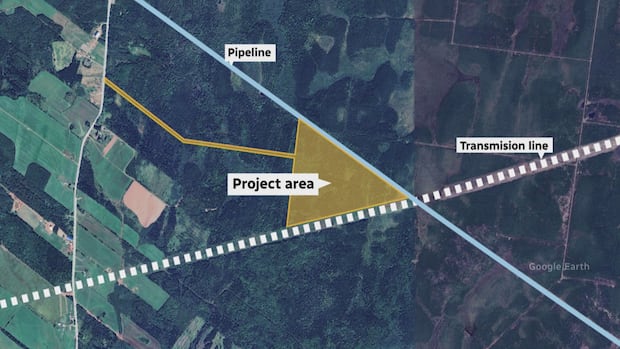
N.B. Power first announced in July that its Renewables Integration and Grid Stability (RIGS) project would be built near Centre Village, a rural area outside of Midgic. Since then, local residents and environmental groups have been vocal in their opposition.
On Tuesday, Coun. Michael Tower followed through on a request from the local Stop the Tantramar Gas Plant group with a motion asking council to write to Premier Susan Holt and call for the project to be cancelled. The motion also asked that N.B. Power instead prioritize wind and solar energy generation, supported by battery energy storage systems.
Midgic resident Juliette Bulmer said she was "absolutely disappointed" with the decision, questioning concerns expressed by Mayor Andrew Black and some councillors that weighing in on the project would be outside their mandate.
Bulmer said the Stop the Tantramar Gas Plant group will now wait to hear Holt's response to letters delivered in person last week.
Outside municipal mandate?
Black told council that despite his personal concerns, taking a stance on the project was outside the scope of a municipal council.
"Municipalities need to stay in their lane," he said. "This motion is urging the immediate cancellation of the project — a power that local governments do not have the authority to dictate."

Deputy Mayor Matt Estabrooks, who was elected in Tantramar's Ward 4, which includes Centre Village, shared Black's concerns over council's role.
"We, as elected officials, cannot assume the role of activists," he said. "I hope that this council fully understands the implications of taking a public stance and writing letters against this project."
Some councillors disagreed.
It is part of our mandate to protect our citizens.
— Coun. Michael Tower
"As an elected official, I do have the right to speak my mind on behalf of the people, and represent them and how they feel about this project," said Coun. Bruce Phinney.
Tower told council he heard a similar "stay in your lane" argument when he wanted his fellow municipal councillors at the former Town of Sackville to speak out on the threatened reduction of services at the Sackville Memorial Hospital.

Sackville's council eventually took an active role in the health-care issue, providing funding and appointing a council member to liaise with a local community group. The town went on to become part of the amalgamated Municipality of Tantramar in 2023.
Potential merits and downsides discussed
The debate over Tower's motion on the natural gas plant also included discussion over the merits of the proposed project, and its potential impact on the region.
Tower said he had concerns about how wells in the area would be affected by the significant water requirements of a power plant, and about the emergency response capabilities of local authorities in case of fires or other accidents at the plant.
He also cited issues with trust over the information shared by N.B. Power and ProEnergy, the American company selected to build the plant.
I don't like to think that I am a NIMBY kind of person. I don't think this should be in anyone's backyard. But I am elected to look after this backyard, and I do not want this here.
— Coun. Allison Butcher
The latter concern was shared by several councillors, including Allison Butcher.
She said there has been "misinformation" about the support of Indigenous communities for the project and over the labelling of the project as green, despite the role of fossil fuels as the source of power.
Butcher said that after speaking to many residents, she not heard from anyone in support of the project.
"I don't like to think that I am a NIMBY kind of person," said Butcher, referring to the acronym for "not in my backyard."
"I don't think this should be in anyone's backyard. But I am elected to look after this backyard, and I do not want this here."

He said the N.B. Power project is "a necessity" for the province, adding: "It is going to happen somewhere.... If we close the door on it here, then the benefits will fall to another community."
Estabrooks said despite those benefits, his support would require that all environmental concerns at the federal and provincial levels are met.
"We need to let that process happen," he said.
What's next? Waiting on provincial decision
But exactly what that process consists of is still up in the air.
A number of community and environmental groups, along with Tantramar's mayor and area MLA Megan Mitton, have called for the province to level up its environmental impact assessment for the project.
There's confusion as to whether the province has ruled out a comprehensive review, something normally used for "large-scale projects like mines, refineries, nuclear power, etc.," according to Environment and Climate Change Department spokesperson Vicky Lutes.
Black told council on Monday and again on Tuesday night that the province had refused his request for a comprehensive environmental impact assessment. However, in an emailed statement Wednesday, Lutes said a decision on a comprehensive review has yet to be made, and will come after the department's review process is finished.
On Sept. 19, the Impact Assessment Agency of Canada ruled that no further assessment would be required at the federal level, after collecting 272 submissions online, mostly expressing opposition to the project.
Meanwhile, ProEnergy says it has received regulatory approvals to move forward with further site investigation work in Centre Village.
Chris Evans, the company's vice-president of marketing, said by email that water assessment and site geotechnical work is needed "so that we can answer community questions about water supply."
Evans also said the company will build a road to allow the well driller and geotechnical experts access to the site.
Corrections
- A previous version of this story incorrectly said Deputy Mayor Matt Estabrooks was elected in Tantramar's Ward 5, rather than Ward 4.Sep 25, 2025 10:20 AM ADT
ABOUT THE AUTHOR

New Brunswick's energy regulator promises decision 'soon' on generating station review
Facility would be built by a private company but used by N.B. Power, lawyer tells EUB

The lawyer for New Brunswick's three municipal utilities is urging N.B. Power regulators to take a broad view of its powers and undertake a full review of a proposed natural gas generating station to be built in Tantramar, N.B., near the Nova Scotia border.
"It would be a very large hole in the regulatory scheme if generating facilities that N.B. Power refers to as critical are not being reviewed," said Ryan Burgoyne during closing arguments in front of the New Brunswick Energy and Utilities Board.
Provincial legislation requires the board to hold hearings into any N.B. Power capital project that will exceed $50 million in expenditures.
However, the utility is asking for a ruling that exempts the proposed new generating station, which will cost several hundred million dollars to construct, from that provision.

In a special arrangement with N.B. Power, the private company ProEnergy will build, own and operate the generating station, with the utility obliged to pay for the station's entire output for 25 years.
That arrangement should place the facility outside of the EUB's legal review powers, according to N.B. Power and ProEnergy.
The EUB is now sorting through arguments for and against that position.
"We're here to try to determine what a particular section in a particular piece of legislation allows us to do," EUB chairperson Christopher Stewart said during the hearing.

Burgoyne, who represents Saint John Energy, Edmundston Energy and the Perth Andover Electric Light Commission, said even though N.B. Power is not directly building or owning the new station, it is causing it to be built for its own use.
That, he said, gives the EUB authority to review whether it is a financially responsible project.
"I do not know how N.B. Power can credibly argue that this is not a capital project of N.B. Power. They can repeat that they do not own the project but that is not the test [for a review]," said Burgoyne.
 Proposed gas plant might not be held to same review standards as N.B. Power
 Also calling for a full review of the merits of the generating station were the New Brunswick Conservation Council and public intervener Alain Chiasson.
However, lawyers for both N.B. Power and ProEnergy argued New Brunswick legislation specific states that only capital projects of N.B. Power are subject to an EUB review.
"I don't see this in any way being a capital project of N.B. Power," said Len Hoyt, a lawyer acting for ProEnergy.
Stewart said the board recognized the importance of the issue and promised a decision "as soon as possible."
ABOUT THE AUTHOR

N.B. Power argues Tantramar gas plant should be exempt from EUB review
Utility asks EUB to rule private development is outside of its oversight powers

In what has become largely a battle of accounting concepts, N.B. Power formally made its application Wednesday for a ruling that the planned construction of a natural gas generating station in Tantramar should be exempt from review by the New Brunswick Energy and Utilities Board (EUB).
The board is required by provincial legislation to hold hearings into any N.B. Power capital project that will exceed $50 million in expenditures, but the utility is asking for a ruling that the new generating station, scheduled for operation by 2028, not be covered by that provision.
Acknowledging N.B. Power will be the new facility's sole customer, the utility's vice president of finance Justin Urquhart nevertheless told the board the generating station will not be a "capital asset" of N.B. Power's because of a partnership with the private sector builder and operator ProEnergy.
Instead, the plant will be a "right of use asset" on N.B. Power's books that offers reduced risk to the utility and its customers, Urquhart said. N.B. Power also believes that frees the project from full EUB scrutiny.
"Unlike a traditional asset that N.B. Power would own, we would not take the construction risk," Urquhart said of the advantage of a third party owning the generator.
Urqhuart also said any long-term issues with the gas plant will be ProEnergy's problem, not N.B. Power's as has been the case with other generating stations like the Mactaquac Dam and Point Lepreau nuclear generating station.
"If a facility is no longer operating, of which N.B. Power has experienced in the assets it does own, in this situation that risk is with the proponent," Urquhart told the board.
N.B. Power says the 400 megawatt plant is required to meet a surging demand for electricity and to help manage a growing amount of wind energy on the provincial system that comes with large swings in output.
However, several groups are arguing the new plant is not independent enough from N.B. Power to escape full scrutiny.
Under questioning by public intervener Alain Chiasson, Urquhart acknowledged accounting rules will require N.B. Power to recognize $95 million in capital costs on its books as a result of the project related to new transmission infrastructure and upgrades that it requires.
That amount includes $70 million in transmission assets being built by ProEnergy for the generating station, that it then would transfer to N.B. Power's ownership. ProEnergy is to be paid for the transmission asset by the utility over time.

Chiasson said that one component of the development alone meets the requirement for a full EUB review of the project.
"My point is the threshold is not an issue in this case. We are way past the $50 million, aren't we," Chiasson asked Urquhart.
"The right-of-use asset that will be on the books will be in excess of $50 million." acknowledged Urquhart.
Also pushing for a full review of the generating station by the EUB are New Brunswick's three municipal utilities and a number of individuals and environmental groups.
Final arguments by parties are scheduled in front of the EUB on Friday morning.
ABOUT THE AUTHOR
Opponents of new gas plant accuse N.B. Power of trying to evade regulatory scrutiny
N.B. Power hopes the new generating plant will be up and running in 2028

Advocates are raising concerns that N.B. Power is looking to shortcut the regulatory process and avoid public scrutiny of its proposed 400-megawatt gas plant.
"It's an attempt to evade the regulatory process and that's unacceptable," said Green Leader David Coon.
N.B. Power is required to get approval from the Energy and Utilities Board for capital projects costing more than $50 million, but are arguing that a $70-million transmission facility required for a new natural gas generating facility in the province's southeast should be excepted from that scrutiny. Normally, that would trigger a review of the entire project.
Coon said it's clear the utility doesn't believe the independent EUB would see the economic argument for it.
"It says to me they don't have much faith in the Energy and Utilities Board deciding that these expenditures would be in the economic interests of New Brunswickers given the alternatives," he said.
"The alternatives are there. I mean, places from the city of Saint John to the state of Vermont are using large battery storage systems on the scale of hundreds of megawatts in the case of Vermont to provide peak power."
N.B. Power's application makes the case that the structure of the deal to build and operate the plant and necessary infrastructure doesn't count as a traditional capital investment.
The new plant will be owned and operated by ProEnergy, which will sell the power generated back to N.B. Power. Because the plant is being built by and will be wholly owned by ProEnergy, the project doesn't require hearings and board approval.
 Opponents of new gas plant say N.B. Power is trying to evade public scrutiny
However, the project also includes a $70-million switchyard that ProEnergy has agreed to build. By law, only N.B. Power can own transmission assets in the province, so once completed, it will be sold to the utility for a dollar.
N.B. Power argues that since they aren't building it, the transfer shouldn't count as a capital project and should therefore be shielded from board review and the public hearings that come with it — even though it will show up as a $70-million asset in its capital structure, with the depreciation and liabilities that come with it.
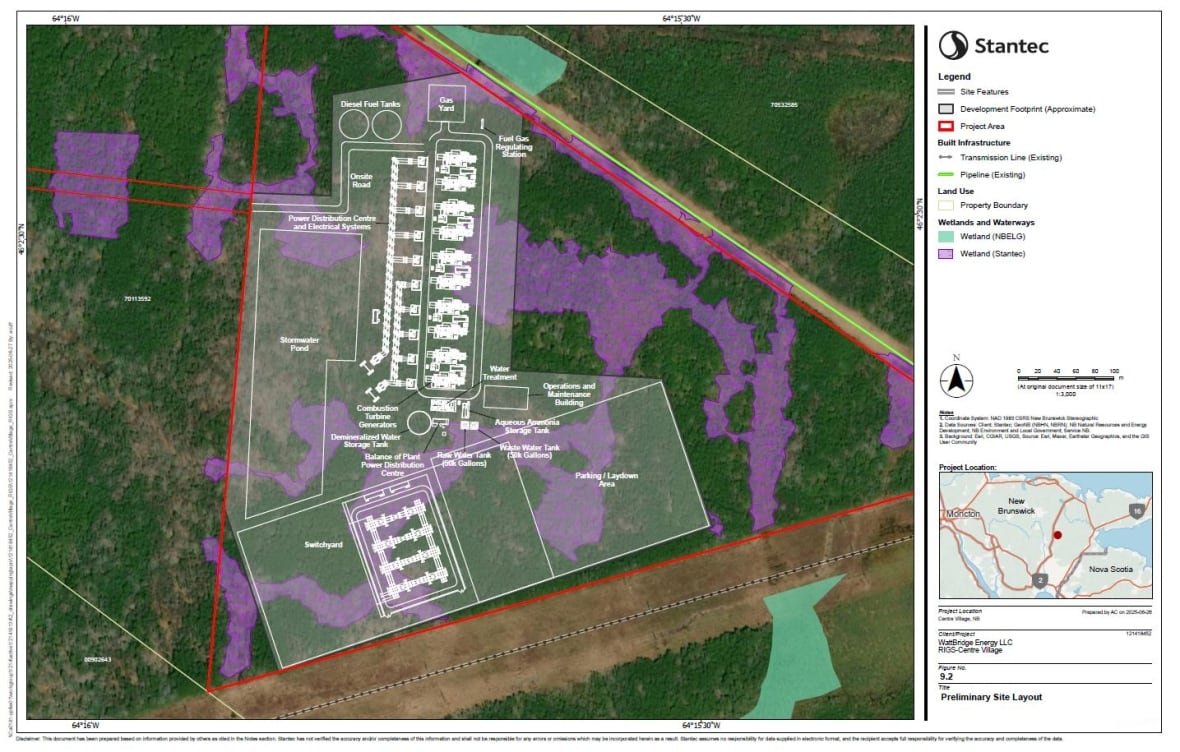
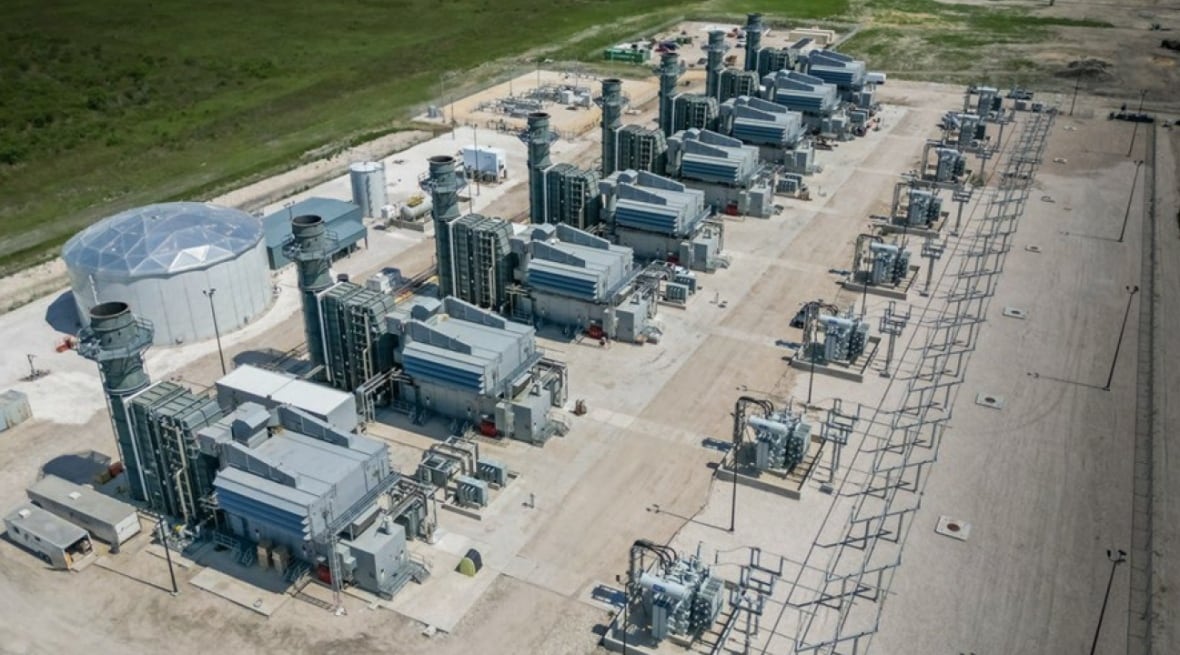
The preliminary site layout shows where the plant's 10 turbines will be located on Route 940 in Tantramar. (ProEnergy)
A spokesperson for N.B. Power said in a statement that the application is intended to get the EUB's opinion on how to treat these types of agreements.
"This structure differs from N.B. Power building and operating a long-term asset, where we would assume all operational risks, ultimately borne by the ratepayer. This is a new type of agreement for NB Power, and we felt it was important to seek the NBEUB's opinion," Elizabeth Fraser said in an email.
Fraser added that while a full EUB review would take longer, they believe the plant could still be ready by 2028.
N.B. Power said previously that the plant is necessary to address the growing population and demand for energy in the province and to provide a backup to intermittent renewable power. The utility is also looking to add hundreds of megawatts of wind energy to its generation mix in coming years and says the plant will be a crucial part of ensuring it has the energy it needs when demand dictates.
According to environmental assessment filings, work to prepare the site is intended to start as early as next year, with the plant coming online in 2028. ProEnergy's lead for the project previously told CBC that it's expected the project could result in a 250,000-tonne reduction in N.B. Power's greenhouse gas emissions as the plant would displace more polluting sources of power.
Reduction claims need to be tested
Moe Qureshi, the director of climate change research and policy at the Conservation Council of New Brunswick, said those claims need to be tested in the EUB's public hearing process to determine if the plant, or the deal, is in the best interest of New Brunswickers.
"The EUB is the way to review that information to check if this is really the best choice for New Brunswick and, without that oversight, I think we're going to get into more problems rather than less," he said.
"What if this costs us more down the road than what we think now? And I think if the ratepayers have to pay for this, they have a right to see what's going on."
The EUB filing also provides more details about how ProEnergy will be paid for the facility. N.B. Power will pay for the fuel used to power the plant and purchase the power generated. But they will also make monthly "capacity payments" based on how much power the utility purchased versus what the facility could produce.
Fraser said payments will be based on a "'pay for performance' model, meaning we are only subject to payments when the facility meets a high level of availability."
N.B. Power's EUB filing states they expect the capacity payments will eclipse $50 million over the 25-year lifespan of the agreement.
A pre-hearing conference is scheduled for Aug. 12, with hearing dates set for the beginning of September.
ABOUT THE AUTHOR

From: David Amos <david.raymond.amos333@gmail.com>
Date: Fri, Sep 5, 2025 at 1:52 PM
Subject: Fwd: Review of the New Brunswick Energy and Utilities Board's Rules of Procedure / Révision des règles de procédures de la Commission de l'énergie et des services publics du Nouveau-Brunswick
To: <Karen.petitpas@doaktown.ca>, <krista.lambert@doaktown.ca>, <carl.price@doaktown.ca>, <mayor.artodonnell@doaktown.ca>
Cc: <office@mrvrc.ca>, <kevinrussellpcnb@gmail.com>, <mike.dawson@parl.gc.ca>, Susan.Holt <Susan.Holt@gnb.ca>, David.Coon <David.Coon@gnb.ca>, <JOHN.HERRON@gnb.ca>, Glen.Savoie <Glen.Savoie@gnb.ca>, <hannahfultonjohnston@gmail.com>, <RDA11.2025Campaign@greenpartynb.ca>, chuck.chiasson <chuck.chiasson@gnb.ca>, Jacques.Poitras <Jacques.Poitras@cbc.ca>, Robert. Jones <Robert.Jones@cbc.ca>
From: Melissa Curran <Melissa.Curran@nbeub.ca>
Date: Fri, Aug 22, 2025 at 10:08 AM
Subject: Review of the New Brunswick Energy and Utilities Board's Rules of Procedure / Révision des règles de procédures de la Commission de l'énergie et des services publics du Nouveau-Brunswick
To: NBEUB/CESPNB <general@nbeub.ca>
Cc: Melissa Curran <Melissa.Curran@nbeub.ca>
Please see attached a letter from the New Brunswick Energy and Utilities Board in relation to the above-noted subject.
Veuillez voir ci-joint une lettre de la Commission de l’énergie et des services publics du Nouveau-Brunswick concernant le sujet susmentionné.
Melissa Curran
Chief Clerk / Greffière en chef
(506) 658-2504 (General/Général)
(506) 643-7334 (Direct/Directe)
Confidentiality Notice
This message and any files transmitted with it are confidential and intended solely for the use of the individual or entity to whom they are addressed. It must not be forwarded unless permission has been received from the sender. Disclosure to anyone other than the intended recipient does not constitute a waiver of privilege. If you have received this message inadvertently, please notify the sender, delete the message and then delete your response. Thank you.
Avis de confidentialité
Ce message ainsi que tout fichier qui pourrait l’accompagner sont confidentiels et destinés uniquement à l'usage de la personne ou de l'entité à laquelle ils sont adressés. Il ne doit pas être réacheminé sans la permission de l'expéditeur. La divulgation à toute personne autre que le destinataire prévu ne constitue pas une renonciation au privilège. Si vous avez reçu ce message par inadvertance, veuillez en informer l'expéditeur, supprimer le message, puis votre réponse. Merci.
From: David Amos <david.raymond.amos333@gmail.
Date: Wed, May 31, 2023 at 3:34 PM
Subject: Fwd: Virtual Public Forum - Matter 529 - NB Power Rate Design Application / Forum Public Virtuel - Instance 529 - Énergie NB Demande d'établissement des tarifs
To: <office@rogersvillenb.ca>, <krista.lambert@doaktown.ca>, <Robert.white@arcadianb.ca>, <Melanie.savoie@richibucto.org
Cc: motomaniac333 <motomaniac333@gmail.com>, <Eric.gagnon@grandsault.ca>
---------- Forwarded message ----------
From: Angèle McCaie <gm@rogersvillenb.ca>
Date: Wed, 31 May 2023 10:52:18 -0700
Subject: Hors du bureau / Out of Office Re: Fwd: Virtual Public Forum
- Matter 529 - NB Power Rate Design Application / Forum Public Virtuel
- Instance 529 - Énergie NB Demande d'établissement des tarifs
To: david.raymond.amos333@gmail.
Angèle McCaie n’est plus une employée de la municipalité de
Nouvelle-Arcadie. Pour la réception, vous pouvez appeler le (506)
775-2080 ou envoyer un courriel à office@rogersvillenb.ca
***
Angèle McCaie no longer works for the municipality of
Nouvelle-Arcadie. For the reception, you can call (506) 775-2080 or
send an email to office@rogersvillenb.ca
Merci beaucoup/ Thank you!
--
** Notez bien que le 21 avril 2023 sera ma dernière journée comme
directrice municipale de Nouvelle-Arcadie.
** Please note that April 21st 2023 will be my last day as General
Manager for Nouvelle-Arcadie.
Angèle McCaie (elle / she / her)
Directrice Générale
Nouvelle-Arcadie
10989 rue Principale
Rogersville, NB
E4Y 2L6
Tél: (506) 775-2080
Cell: (506) 625-2887
Télécopieur: (506) 775-2090
---------- Forwarded message ----------
From: "karen.petitpas@doaktown.ca" <Karen.petitpas@doaktown.ca>
Date: Wed, 31 May 2023 19:52:05 +0200
Subject: Out of Office
To: david.raymond.amos333@gmail.
I will be out of the office on Medical Leave for a few months. I will
be periodically checking my email, to keep updated.
If this is of an urgent matter , please email the Acting Assistant
Clerk Krista Lambert at krista.lambert@doaktown.ca or call
(506)365-7970 ext: 103.
If your matter has to do with water, sewer or transportation, please
contact our Public Works Supervisor, Shawn Brown at 506-365-0138.
Thank You!
Karen Petitpas
CAO/Clerk
---------- Forwarded message ----------
From: David Amos <david.raymond.amos333@gmail.
Date: Wed, 31 May 2023 14:52:04 -0300
Subject: Fwd: Virtual Public Forum - Matter 529 - NB Power Rate Design
Application / Forum Public Virtuel - Instance 529 - Énergie NB Demande
d'établissement des tarifs
To: joey@gssc-cesb.ca, Karen.petitpas@doaktown.ca,
comptabilite@saint-leonard.ca, Stephanie.thorne@nbse.ca,
scoulombe@saintquentin.ca, bettyann@
rogervil@nbnet.nb.ca, Jamie.degrace@airbathurst.com,
direction@neguac.com, Kathryn.clark@nackawic.com,
carole.tremblay@kedgwick.ca, dave.brown@lameque.ca
Cc: motomaniac333 <motomaniac333@gmail.com>
---------- Forwarded message ----------
From: David Amos <david.raymond.amos333@gmail.
Date: Wed, 31 May 2023 14:11:32 -0300
Subject: Fwd: Virtual Public Forum - Matter 529 - NB Power Rate Design
Application / Forum Public Virtuel - Instance 529 - Énergie NB Demande
d'établissement des tarifs
To: cemmerson@quispamsis.ca
Stephen P. Wilbur
Called to the bar: 1983 (NB)
Wilbur & Trueman
706B Coverdale Rd.
Riverview, New Brunswick E1B 3L1
Phone: 506-387-7715
---------- Forwarded message ----------
From: "Bowen, Natalie" <nbowen@quispamsis.ca>
Date: Wed, 31 May 2023 16:26:22 +0000
Subject: Automatic reply: Virtual Public Forum - Matter 529 - NB Power
Rate Design Application / Forum Public Virtuel - Instance 529 -
Énergie NB Demande d'établissement des tarifs
To: David Amos <david.raymond.amos333@gmail.
Please forward any inquiries to cemmerson@quispamsis.ca
---------- Forwarded message ----------
From: Mail Delivery Subsystem <mailer-daemon@googlemail.com>
Date: Wed, 31 May 2023 09:26:14 -0700 (PDT)
Subject: Delivery Status Notification (Failure)
To: david.raymond.amos333@gmail.
** Message blocked **
Your message to mctdev@nb.aibn.com has been blocked. See technical
details below for more information.
The response from the remote server was:
554 Access Denied
From: David Amos <david.raymond.amos333@gmail.
Date: Wed, May 31, 2023 at 3:38 PM
Subject: Fwd: Virtual Public Forum - Matter 529 - NB Power Rate Design Application / Forum Public Virtuel - Instance 529 - Énergie NB Demande d'établissement des tarifs
To: <STHOMSON@5-rivers.ca>
---------- Forwarded message ----------
From: Shane Thomson <shane@villageofrexton.com>
Date: Wed, 31 May 2023 18:34:59 GMT
Subject: Attention! Change of email address
To: David Amos <david.raymond.amos333@gmail.
I M P O R T A N T
As a result of Local Governance Reform, as of January 1st, 2023, we
are officially the new entity of Five Rivers. During this transition
period, we would ask that you PLEASE DIRECT ALL FUTURE EMAILS TO
STHOMSON@5-RIVERS.CA and remove the email (shane@villageofrexton.com
and sthomson@nb.aibn.com) from your system. Emails under the former
address will be monitored until February 28, beyond this date, will no
longer be accepted.
Please advise if further information is necessary.
We apologize for any inconveniences and appreciate your understanding.
- - - - - - - - - - - - - - - -
À la suite de la réforme de la gouvernance locale, à partir du 1er
janvier 2023, nous sommes officiellement connus en tant que l’entité
de Five Rivers. En cette période de transition, nous vous demandons
D’ADDRESSER TOUS VOS FUTURS COURRIELS À STHOMSON@5-RIVERS.CA et
d’enlever ce courriel (shane@villageofrexton.com et
sthomson@nb.aibn.com) de votre système. Les courriels sous l’ancienne
adresse seront surveillés jusqu’au 28 février, au-delà de cette date,
ils ne seront plus acceptés.
Veuillez nous informer si des informations supplémentaires sont requises.
Nous nous excusons pour tout inconvénient et apprécions votre compréhension.
Shane Thomson, CAO
[image]
Notice: This email is confidential. If you are not the intended
recipient, please notify the sender by return email and delete this
message from your mailbox without reading or copying it or any
attachments.
Any correspondence with employees, agents, or elected officials of
Five Rivers may be subject to disclosure under the provisions of the
Right to Information and Protection of Privacy Act of the Province of
New Brunswick.
---------- Forwarded message ----------
From: David Amos <david.raymond.amos333@gmail.
Date: Wed, 31 May 2023 13:26:13 -0300
Subject: Fwd: Virtual Public Forum - Matter 529 - NB Power Rate Design
Application / Forum Public Virtuel - Instance 529 - Énergie NB Demande
d'établissement des tarifs
To: vnorton <vnorton@nbnet.nb.ca>, jborne@dorchester.ca,
fallon@town.woodstock.nb.ca, earsenault@mcadamnb.com,
Tara.Olesen@sussex.ca, Claudette.maclean@snbsc.ca,
denise.guitard@shediac.ca, dianneayles@salisburynb.ca,
cspear@townofstandrews.ca, ashleyburchell@rothesay.ca,
scott.sparks@vonm.ca, michelle.dickinson@
mctdev@nb.aibn.com, caroline@memramcook.com, Paul.lang@csrk.ca,
admin.kvfd@nb.aibn.com, info@townofhampton.ca,
clerk@villageofgrandmanan.com
Cc: motomaniac333 <motomaniac333@gmail.com>, "blaine.higgs"
<blaine.higgs@gnb.ca>, "Holland, Mike (LEG)" <mike.holland@gnb.ca>,
info@rsc8.ca, nbowen@quispamsis.ca
https://mac-ccm.com/board-of-
Municipal Advisory Corporation Inc
Brenda Knight, Secretary
628 Route 715
Jemseg, NB
E4C 3P2
506-471-2653
https://mac-ccm.com/directory/
---------- Forwarded message ----------
From: Melissa Curran <Melissa.Curran@nbeub.ca>
Date: Wed, 31 May 2023 13:57:44 +0000
Subject: Virtual Public Forum - Matter 529 - NB Power Rate Design
Application / Forum Public Virtuel - Instance 529 - Énergie NB Demande
d'établissement des tarifs
To: "ceo@fermenbfarm.ca" <ceo@fermenbfarm.ca>,
"louis-philippe.gauthier@cfib.
"frederic.gionet@cfib.ca" <frederic.gionet@cfib.ca>,
"Ron.marcolin@cme-mec.ca" <Ron.marcolin@cme-mec.ca>,
"David.Raymond.Amos333@gmail.
"david.sollows@gnb.ca" <david.sollows@gnb.ca>,
"hanrahan.dion@jdirving.com" <hanrahan.dion@jdirving.com>,
"nrubin@stewartmckelvey.com" <nrubin@stewartmckelvey.com>,
"coneil@stewartmckelvey.com" <coneil@stewartmckelvey.com>,
"lmclements@stewartmckelvey.
"pbowman@bowmaneconomics.ca" <pbowman@bowmaneconomics.ca>,
"brudderham@stewartmckelvey.
"JohnFurey@fureylegal.com" <JohnFurey@fureylegal.com>,
"jpetrie@nbpower.com" <jpetrie@nbpower.com>,
"NBPRegulatory@nbpower.com" <NBPRegulatory@nbpower.com>,
"lgordon@nbpower.com" <lgordon@nbpower.com>, "SWaycott@nbpower.com"
<SWaycott@nbpower.com>, "George.Porter@nbpower.com"
<George.Porter@nbpower.com>, "kevgibson@nbpower.com"
<kevgibson@nbpower.com>, Veronique Otis <Veronique.Otis@nbeub.ca>,
"Young, Dave" <Dave.Young@nbeub.ca>, "Aherrington@lawsoncreamer.com
<Aherrington@lawsoncreamer.com
<Kathleen.Mitchell@nbeub.ca>, NBEUB/CESPNB <General@nbeub.ca>,
"Colwell, Susan" <Susan.Colwell@nbeub.ca>,
"bhavumaki@synapse-energy.com" <bhavumaki@synapse-energy.com>
"mwhited@synapse-energy.com" <mwhited@synapse-energy.com>,
"prhodes@synapse-energy.com" <prhodes@synapse-energy.com>,
"alawton@synapse-energy.com" <alawton@synapse-energy.com>,
"jwilson@resourceinsight.com" <jwilson@resourceinsight.com>,
"pchernick@resourceinsight.com
Melissa Curran <Melissa.Curran@nbeub.ca>, "alain.chiasson2@gnb.ca"
<alain.chiasson2@gnb.ca>, "rdk@indecon.com" <rdk@indecon.com>,
"tammy.grieve@mcinnescooper.
"paul.black@twinriverspaper.
"Hoyt, Len" <len.hoyt@mcinnescooper.com>,
"tyler.rajeski@
<tyler.rajeski@
"darcy.ouellette@
<darcy.ouellette@
<dan.murphy@umnb.ca>, "jeff.garrett@sjenergy.com"
<jeff.garrett@sjenergy.com>, "shelley.wood@sjenergy.com"
<shelley.wood@sjenergy.com>, "dan.dionne@perth-andover.com"
<dan.dionne@perth-andover.com>
<pierreroy@edmundston.ca>, "ryan.mitchell@sjenergy.com"
<ryan.mitchell@sjenergy.com>, "sstoll@stollprofcorp.com"
<sstoll@stollprofcorp.com>, "pzarnett@bdrenergy.com"
<pzarnett@bdrenergy.com>
Good morning,
Please note below the information for the Virtual Public Forum related
to Matter 529 - NB Power Rate Design Application
The Virtual Public Forum will take place via Zoom videoconference on
June 1st, 2023, from 2 p.m. until 4 p.m.
It should also be noted that registered interveners are permitted to
observe the public forum but may not make a presentation. The public
forums are intended for those who have not registered as interveners
to make submissions about the application.
Zoom Videoconference information:
Virtual Public Forum - Matter 529 - NB Power Rate Design Application /
Forum Public Virtuel - Instance 529 - Énergie NB Demande
d'établissement des tarifs
Join Zoom Meeting via telephone:
855-703-8985 Canada Toll-free
Or
Join Zoom Meeting via web:
https://us06web.zoom.us/j/
Meeting ID: 873 3880 6224
Passcode: xxxxxxxxxxxx
Bonjour,
Veuillez noter ci-dessous l'information pour le forum public virtuel
relative à l'instance 529 - Énergie NB - Demande d'établissement des
tarifs
La session du forum public virtuel va se dérouler sur la plateforme
Zoom par vidéoconférence le 1er juin 2023, de 14 h à 16 h.
Il est aussi à noter que les intervenants inscrits sont autorisés à
observer le forum public, mais ne peuvent pas faire une présentation.
Les forums publics sont destinés à ceux qui ne se sont pas inscrits en
tant qu'intervenants pour faire des observations sur la demande.
Information sur la plateforme Zoom par vidéoconférence :
Forum Public Virtuel - Instance 529 - Énergie NB Demande
d'établissement des tarifs / Virtual Public Forum - Matter 529 - NB
Power Rate Design Application
Rejoignez la réunion Zoom par téléphone :
855-703-8985 Canada sans frais
Ou
Rejoignez la réunion Zoom via le Web :
https://us06web.zoom.us/j/
ID de réunion: 873 3880 6224
Code secret: xxxxxxxxxxx
Regards / Cordialement,
Melissa Curran
Deputy Chief Clerk / Greffière en chef adjointe
(506) 658-2504 (General/Général)
(506) 643-7334 (Direct/Directe)
[Text Description automatically generated]
Confidentiality Notice
This message and any files transmitted with it are confidential and
intended solely for the use of the individual or entity to whom they
are addressed. It must not be forwarded unless permission has been
received from the sender. Disclosure to anyone other than the intended
recipient does not constitute a waiver of privilege. If you have
received this message inadvertently, please notify the sender, delete
the message and then delete your response. Thank you.
Avis de confidentialité
Ce message ainsi que tout fichier qui pourrait l'accompagner sont
confidentiels et destinés uniquement à l'usage de la personne ou de
l'entité à laquelle ils sont adressés. Il ne doit pas être réacheminé
sans la permission de l'expéditeur. La divulgation à toute personne
autre que le destinataire prévu ne constitue pas une renonciation au
privilège. Si vous avez reçu ce message par inadvertance, veuillez en
informer l'expéditeur, supprimer le message, puis votre réponse.
Merci.
From: David Amos <david.raymond.amos333@gmail.com>
Date: Tue, Mar 19, 2024 at 8:13 AM
Subject: Re: RE Matter 552 - NB Power 2024-2025 Its obvious Holland's minions in NB Power are pulling a fast one within the EUB before Higgy has a writ dopped an Mikey is out a job
To: blaine.higgs <blaine.higgs@gnb.ca>, Holland, Mike (LEG) <mike.holland@gnb.ca>, Mitton, Megan (LEG) <megan.mitton@gnb.ca>, David.Coon <David.Coon@gnb.ca>, <keith.chiasson@gnb.ca>, <jacques.j.leblanc@gnb.ca>, <jean-claude.d'amours@gnb.ca>, <robert.mckee@gnb.ca>, <robert.gauvin@gnb.ca>, <Mark.Blakely@rcmp-grc.gc.ca>, martin.gaudet <martin.gaudet@fredericton.ca>, premier <premier@gnb.ca>, <dominic.cardy@gnb.ca>, Arseneau, Kevin (LEG) <kevin.a.arseneau@gnb.ca>, Ross.Wetmore <Ross.Wetmore@gnb.ca>, John.Williamson <John.Williamson@parl.gc.ca>, rob.moore <rob.moore@parl.gc.ca>, Bill.Oliver <Bill.Oliver@gnb.ca>, Trevor.Holder <Trevor.Holder@gnb.ca>, jeff.carr <jeff.carr@gnb.ca>, Daniel.J.Allain <Daniel.J.Allain@gnb.ca>, <Dorothy.Shephard@gnb.ca>, andrea.anderson-mason <andrea.anderson-mason@gnb.ca>, <susan.holt@gnb.ca>, <LTgov@gnb.ca>, bruce.fitch <bruce.fitch@gnb.ca>, Benoit.Bourque <Benoit.Bourque@gnb.ca>, Rene.Legacy <Rene.Legacy@gnb.ca>, guy.arseneault <guy.arseneault@gnb.ca>, chuck.chiasson <chuck.chiasson@gnb.ca>, Robert. Jones <Robert.Jones@cbc.ca>, rrichard <rrichard@nb.aibn.com>
Cc: louis-philippe.gauthier@cfib.ca <louis-philippe.gauthier@cfib.ca>, frederic.gionet@cfib.ca <frederic.gionet@cfib.ca>, <david@ibew37.com>, david.sollows@gnb.ca <david.sollows@gnb.ca>, <mike.legere@adityabirla.com>, <Ron.marcolin@cme-mec.ca>, <executivedirector@forestnb.com>, Brandy.Gellner@libertyutilities.com <Brandy.Gellner@libertyutilities.com>, JohnFurey@fureylegal.com <JohnFurey@fureylegal.com>, Murray, Leanne <LMurray@nbpower.com>, Petrie, Jamie <JPetrie@nbpower.com>, Murphy, Darren <DaMurphy@nbpower.com>, Porter, George <George.Porter@nbpower.com>, <pmckay@nbpower.com>, <lgordon@nbpower.com>, <kevgibson@nbpower.com>, NBP Regulatory <NBPRegulatory@nbpower.com>, NBEUB/CESPNB <General@nbeub.ca>, Young, Dave <Dave.Young@nbeub.ca>, Aherrington@lawsoncreamer.com <Aherrington@lawsoncreamer.com>, Dickie, Michael <Michael.Dickie@nbeub.ca>, Mitchell, Kathleen <Kathleen.Mitchell@nbeub.ca>, Veronique Otis <Veronique.Otis@nbeub.ca>, Susan Colwell <Susan.Colwell@nbeub.ca>, Melissa Curran <Melissa.Curran@nbeub.ca>, Hoyt, Len <len.hoyt@mcinnescooper.com>, jeff.garrett@sjenergy.com <jeff.garrett@sjenergy.com>, shelley.wood@sjenergy.com <shelley.wood@sjenergy.com>, dan.dionne@perth-andover.com <dan.dionne@perth-andover.com>, pierreroy@edmundston.ca <pierreroy@edmundston.ca>, <ryan.mitchell@sjenergy.com>, <pzarnett@bdrenergy.com>, rburgoyne@coxandpalmer.com <rburgoyne@coxandpalmer.com>, <hwafaei@stikeman.com>, gzacher@stikeman.com <gzacher@stikeman.com>, <hanrahan.dion@jdirving.com>, alain.chiasson2@gnb.ca <alain.chiasson2@gnb.ca>, <randy@sjhdc.ca>, <dustin@emrydia.com>, <rdk@indecon.com>, <shelley@nbcpd.org>
Friday 15 March 2024
EUB approves 9.8% interim rate increase for N.B. Power's residential customers
EUB approves 9.8% interim rate increase for N.B. Power's residential customers
Utility says increase on April 1 necessary because of debt, 'unexpected events'

N.B. Power residential customers will be seeing a 9.8 per cent interim rate increase on April 1, the public utility announced Friday afternoon.
"We will be communicating with all customers before the new rates take effect this spring to help them understand any changes to their bills," the utility said on X.
The average increase for all rate classes on April 1 is 9.25 per cent, while residential customers will increase by 9.8 per cent.
Approval of N.B. Power's request for the increase was delivered orally by the Energy and Utilities Board, whose lawyer had questioned the need for the rate increase at a hearing in early March.
"We understand that raising rates is not something anyone wants, particularly when customers are already facing the rising cost of basic necessities," N.B. Power CEO Lori Clark said in an email statement to CBC News on Friday afternoon.
She went on to say the increase is necessary to provide customers with reliable power "during this time of unprecedented challenges and volatility."
 N.B.
Power CEO Lori Clark acknowledged increases rates are 'not what anyone
wants,' but this one is necessary at a time of "unprecedented
challenges." (Jacques Poitras/CBC)
N.B.
Power CEO Lori Clark acknowledged increases rates are 'not what anyone
wants,' but this one is necessary at a time of "unprecedented
challenges." (Jacques Poitras/CBC)
N.B. Power applied for the increase 10 weeks past the deadline, which the EUB blamed on the province. N.B. Power's original rate increase proposal was 12 per cent, but at the last minute the province moved back a debt reduction target for N.B. Power from 2027 to 2029.
This allowed N.B. Power to reduce the increase it was asking for, but made the utility miss the deadline to file.
At the time the EUB estimated the process would delay the new rate from going into effect until July 1, which is why N.B. Power is implementing an "interim" rate increase for now.
Clark acknowledged missing the deadline to file a rate increase request with the EUB, but she said moving back the timeline for paying off debt — to 2029 — allowed the lower 9.8 per cent increase.
"We made the decision to apply for interim rates for April 1st to avoid a revenue shortfall which would eventually be passed on to the customer as we are a cost-of-service utility," Clark said.
Lepreau breakdown a factor
The increased rates are to tackle debt and address what N.B. Power calls unexpected events in recent years, including a breakdown of the Point Lepreau nuclear generating station in winter 2022.
"The requested increases are necessary to allow N.B. Power to fulfil its core responsibility, and to make modest improvements in its financial health," N.B. Power wrote in its application for the rate hike.
N.B. Power spokesperson Dominique Couture said there is an additional EUB hearing next week about an unrelated four per cent variance cost increase to power bills as well.
Couture said in an email that the next step for N.B. Power is to review the decision and adjust rate schedules and policies manual for EUB approval. After approval, new rates will take effect, likely on April 1.
"We respect the ruling of the EUB and their commitment to ensuring New Brunswickers pay a fair rate for their electricity," Couture said.
Final decision expected July 1
Due to the late filing, a final EUB decision is not expected until July 1, Couture said.
"Today's decision allows us to implement the new rate until a final decision is made by the independent regulator. If the EUB decides on a lower rate in its final decision, we will adjust bills accordingly," Couture said.
A spokesperson from the New Brunswick government acknowledged a request for comment Friday afternoon, but did not provide a statement by the end of the day.
Green Party Leader David Coon said the increase for New Brunswickers would be hard "for those who are living cheque to cheque or not even keeping their head above water, any extra costs are going to be problematic, no question about it."
Coon also called it "wholly inappropriate" for the EUB to approve an interim rate hike before full hearings to hear why the hike is needed.
"I'm quite shocked that the Energy and Utilities Board would grant this rate increase without reviewing the evidence to justify the increase," Coon said.
New Brunswick's Liberal energy critic did not respond to a request for comment by Friday evening.
Corrections
- A previous version of this story said the interim rate hike would increase by 9.5%, but was later clarified by N.B. Power to be a 9.8% increase for residential customers and an average of 9.25% increase for all rate classes.Mar 15, 2024 6:25 PM AT
ABOUT THE AUTHOR

Journalist
Sam Farley is a Fredericton-based reporter at CBC New Brunswick. Originally from Boston, he is a journalism graduate of the University of King's College in Halifax. He can be reached at sam.farley@cbc.ca

MOTION FOR INTERIM RATE RELIEF
WRITTEN ARGUMENT OF NEW BRUNSWICK POWER CORPORATION
57. Finally, as noted by the Board in its Oral Decision of October 30,
2023, the Public Intervener raised no concerns with NB Power’s request
to vary the filing date of the Application. If the Public Intervener
wished to allege that the delay in filing was “self inflicted” by NB
Power, it was incumbent on the Public Intervener to raise the issue at
that time.
The Response of the Public Intervener – Deleterious Impact
58. The Response of the Public Intervener also suggests that NB Power
has not demonstrated that it will suffer deleterious impact arising
from the delay in implementation of rates. The Public Intervener
relies on the opinion of Mr. Madsen, as set out in his affidavit dated
February 7, 2024.
59. Mr. Madsen’s description of the “form and function” of the
variance accounts (at para. 10) is somewhat confusing. He states that
the variance accounts operate as an “offset” to any difference between
actual and forecast monthly values in “revenues” for the in-province
energy supply cost, as well as the in-province and out-of- province
electricity revenue and margins from sales of energy, capacity and
renewable energy credits.
60. In substance, Mr. Madsen suggests that, based on his
interpretation of the variance accounts, the net impacts associated
with the delay in implementation of rates will be largely recoverable
through either the Electricity Sales and Margin Variance Account or
the Energy Supply Cost Variance Account.
61. NB Power submits that Mr. Madsen’s conclusion fails to consider
the manner in which the Board will approve the monthly forecasts on
which the relevant variances are calculated. Despite having correctly
identified that forecast values in the calculation of the relevant
variances are those values reflected in the revenue requirements
approved by the Board, Mr. Madsen fails to consider how those values
will be determined by the Board through the hearing process, and
whether and how they will differ from actual values
62. A simple hypothetical example, in which no interim rate order is
granted, will demonstrate that there will be no variance between
actual and forecast revenues associated solely with the rate increase
approved by the Board.
63. The hypothetical example assumes that the Board renders a decision
(whether partial or final) in late June, in which NB Power is directed
to make certain non-material adjustments to its revenue requirements
and file a Proof of Revenue, and resulting rates are implemented on
July 1, 2024. Assuming no interim rate order, the actual revenues of
NB Power for the months of April to June will not include any revenue
associated with the proposed (or approved) rate increase. An estimate
of that foregone revenue is identified in Exhibit “B” to the Affidavit
of Darren Murphy dated January 29, 2024, in the row entitled “Total
Revenue Impact”.
64. The existence of a variance related to these revenues is thus
determined by whether the Board approves a monthly revenue forecast
which includes the revenues associated with the rate increase (for the
three-month period), or approves a monthly forecast which excludes
them. If the monthly revenue forecast approved by the Board includes
revenues associated with the rate increase for the three-month period,
NB Power agrees that the actual revenues would be less than the
forecast revenues, which would result in that negative margin variance
being included in the Electricity Sales and Margin Variance Account.
65. However, NB Power submits that it would be unreasonable for the
Board to approve a monthly forecast for the months of April through
June which includes revenues associated with the approved rate
increase, in circumstances in which the Board is already aware that
those revenues will not be collected. NB Power submits that such an
approach would materially overstate the forecast revenue for the
three-month period, in a deliberate fashion. This approach would also
be contrary to the Board’s stated intention that forecasts should be
as accurate as possible for the purpose of minimizing the balances in
the variance accounts. (See Board Decision dated June 7, 2023, Matter
541, paras. 47-53).
66. Accordingly, as the revenues (for the three-month period)
associated with either the proposed rate increase, or the rate
increase ultimately approved by the Board, will not be included in
either the actual or the forecast values, no variance will exist with
respect to them, and thus those revenues will not be included in the
variance accounts.
67. Finally, NB Power submits that the same logic applies to the
LIREPP Purchases adjustment shown in Exhibit “B” to the Affidavit of
Darren Murphy dated January 29, 2024.
IV. RELIEF REQUESTED
68. Accordingly, NB Power requests that the Board approve an Interim Order:
a. Approving the schedule of rates for the 2024/25 fiscal year as set
out in Exhibit NBP 02.07, which reflects differential rates and an
average 9.25 per cent increase to all customer classes, effective from
April 1, 2024 until further Order of the Board;
b. Directing NB Power to make billing adjustments for customers in the
event that final rates approved by the Board are different than rates
approved in the Interim Order, and further directing NB Power to keep
appropriate records to permit such adjustments; and c.Following the
Board’s determination of the issue of granting an interim rateOrder,
an Order approving a monthly revenue forecast consistent with
theBoard’s determination, until further order of the Board.
Respectfully submitted this 14th day of February, 2024
_____________________
John G. Furey
Counsel for the Applicant
John G. Furey Professional Corporation
265 Berkley Drive
New Maryland, NB E3C 1B9
Telephone: (506) 444-1328
Email: JohnFurey@fureylegal.com
On 2/8/24, David Amos <david.raymond.amos333@gmail.com> wrote:
> New Brunswick Power Corporation
> APPLICATION FOR INTERIM RATES
> NOTICE
> New Brunswick Power Corporation has filed a Notice of Motion with the
> New Brunswick Energy and Utilities Board seeking an interim order as
> follows:
> 1. Approving the schedule of rates for the 2024/25 fiscal year as set
> out in Exhibit NBP 02.07 in Matter 552 which reflects differential
> rates and an average 9.25 per cent increase to all customer classes,
> effective from April 1, 2024 until further Order of the Board;
> 2. Directing NB Power to make billing adjustments for customers in the
> event that final rates approved by the Board are different than rates
> approved in the Interim Order, and further directing NB Power to keep
> appropriate records to permit such adjustments;
> 3. Directions respecting the hearing of this Motion; and
> 4. Such further Orders and Directions as the Board may deem appropriate.
> NB Power’s Notice of Motion and the supporting affidavit may be viewed
> on the Board’s website at www.nbeub.ca under Matter No. 552.
> As per Rule 4.3 of the Rules of Procedure, any party to this matter
> who wishes to respond to the Motion must file and serve on all other
> parties, a written response outlining the party’s position and the
> grounds for same along with a specific indication of any evidence upon
> which the party seeks to present or rely no later than Thursday,
> February 8th at 4:00 p.m. (Atlantic Time).
> NB Power is to file with the Board, and serve on all other parties,
> its written argument in support of its motion, including copies of any
> authorities upon which it intends to rely no later than Thursday,
> February 15th at 4:00 p.m. (Atlantic Time).
> Parties who have filed a written response to the Motion are to file
> their written argument outlining their position in response to the
> Motion, including copies of any authorities upon which they intend to
> rely no later than Thursday, February 22nd at 4:00 p.m. (Atlantic
> Time).
> The Board will hold an in-person hearing on the Motion for Interim
> Rates on Friday, March 1, 2024, beginning at 9:30 a.m. (Atlantic
> Time). The location will be confirmed by the Board shortly.
> New Brunswick Energy and Utilities Board
> P.O. Box 5001
> Suite 1400, 15 Market Square
> Saint John, NB E2L 4Y9
> Telephone: (506) 658-2504
> Toll Free 1-866-766-2782
> Fax: (506) 643-7300
> E-Mail: general@nbeub.
>
> ---------- Original message ----------
> From: David Amos <david.raymond.amos333@gmail.com>
> Date: Tue, 31 Oct 2023 13:41:38 -0300
> Subject: Fwd: Zoom videoconference Matter 552 - NB Power 2024-2025
> This is what I was talking about before you shut me down
> To: "blaine.higgs" <blaine.higgs@gnb.ca>, "Holland, Mike (LEG)"
> <mike.holland@gnb.ca>, "Mitton, Megan (LEG)" <megan.mitton@gnb.ca>,
> "David.Coon" <David.Coon@gnb.ca>, keith.chiasson@gnb.ca,
> jacques.j.leblanc@gnb.ca, jean-claude.d'amours@gnb.ca,
> robert.mckee@gnb.ca, robert.gauvin@gnb.ca,
> Mark.Blakely@rcmp-grc.gc.ca, "martin.gaudet"
> <martin.gaudet@fredericton.ca>, premier <premier@gnb.ca>,
> dominic.cardy@gnb.ca, "Arseneau, Kevin (LEG)"
> <kevin.a.arseneau@gnb.ca>, "Ross.Wetmore" <Ross.Wetmore@gnb.ca>,
> "John.Williamson" <John.Williamson@parl.gc.ca>, "rob.moore"
> <rob.moore@parl.gc.ca>, "Bill.Oliver" <Bill.Oliver@gnb.ca>,
> "Trevor.Holder" <Trevor.Holder@gnb.ca>, "jeff.carr"
> <jeff.carr@gnb.ca>, "Daniel.J.Allain" <Daniel.J.Allain@gnb.ca>,
> Dorothy.Shephard@gnb.ca, "andrea.anderson-mason"
> <andrea.anderson-mason@gnb.ca>, susan.holt@gnb.ca, LTgov@gnb.ca,
> "bruce.fitch" <bruce.fitch@gnb.ca>, "Benoit.Bourque"
> <Benoit.Bourque@gnb.ca>, "Rene.Legacy" <Rene.Legacy@gnb.ca>,
> "guy.arseneault" <guy.arseneault@gnb.ca>, "chuck.chiasson"
> <chuck.chiasson@gnb.ca>
> Cc: motomaniac333 <motomaniac333@gmail.com>, "Robert. Jones"
> <Robert.Jones@cbc.ca>
>
> NEW BRUNSWICK ENERGY and UTILITIES BOARD
> COMMISSION DE L’ENERGIE ET DES SERVICES PUBLICS N.-B.
>
> Matter 552
> IN THE MATTER OF a stay of the Board's Decision of July 16, 2019, in
> accordance with sections 32 and 41 of the Energy and Utilities Board
> Act, SNB 2006, c.E-9.18 ("Matter 552")
>
> AND IN THE MATTER OF the New Brunswick Power Corporation ("NB Power")
> General Rate Application Under Subsection 103(1) of the Electricity
> Act, SNB 2013 c.7
>
>
> Held via Zoom, on October 30, 2023.
>
> Henneberry Reporting Service
> NEW BRUNSWICK ENERGY and UTILITIES BOARD
> COMMISSION DE L’ENERGIE ET DES SERVICES PUBLICS N.-B.
>
> Matter 552
> IN THE MATTER OF a stay of the Board's Decision of July 16, 2019, in
> accordance with sections 32 and 41 of the Energy and Utilities Board
> Act, SNB 2006, c.E-9.18 ("Matter 552")
> AND IN THE MATTER OF the New Brunswick Power Corporation ("NB Power")
> General Rate Application Under Subsection 103(1) of the Electricity
> Act, SNB 2013 c.7
>
>
> Held via Zoom, on October 30, 2023.
>
> Members of the Board:
> Ms. Stephanie Wilson – Vice-Chairperson
> Mr. Christopher Stewart – Presiding Member
> Ms. Heather Black - Member
> Counsel to Board Staff - Ms. Abigail Herrington
> ...........................................................
> MR. STEWART: It looks like we have everybody joining us now. So
> good morning, this is the hearing of an application by NB Power to
> vary certain standing directions contained in the Board’s decisions in
> Matter 430 and 4’ -– excuse me, 541 relating to the deadline for NB
> Power to file a general rate application and the use of and filing of
> certain PROMOD forecasts as part of that application.
> My name is Christopher Stewart. I am joined this morning by
> Vice-Chair Stephanie Wilson and Member Heather Black.
> So I guess we will start with appearances for NB Power?
> MR. FUREY: Good morning, Mr. Chair, John Furey for New Brunswick
> Power Corporation.
> MR. STEWART: Good morning, Mr. Furey. And based on the faces that
> I see before me, for J.D. Irving, Limited?
> MR. ZACHER: Good morning, Mr. Chair. Glenn Zacher appearing on
> behalf of J.D. Irving, Limited.
> MR. STEWART: Good morning, Mr. Zacher. And for Utilities Municipal?
> MR. BURGOYNE: Good morning, everyone. Ryan Burgoyne, appearing on
> behalf of the Utilities Municipal.
> MR. STEWART: Good morning, Mr. Burgoyne. And the Public Intervener?
> MR. CHIASSON: Good morning, Mr. Chair. Alain Chiasson for the
> Public Intervener.
> MR. STEWART: Good morning. And finally, the New Brunswick Energy &
> Utilities Board?
> MS. HERRINGTON: Good morning, Mr. Chair. Abigail Herrington.
> MR. STEWART: Good morning, Ms. Herrington. Counsel, just before we
> start, just a bit of sort of housekeeping. I just wanted to mention
> sort of to counsel for the record that the Board has styled the
> pending rate application as Matter 52’ –- or 552, excuse me, and in
> theory, we are also –- we are sort of viewing these as sort of like
> preliminary motions are part of that matter. So, Mr. Furey, if and
> when the application is filed, you can –- you can proceed under this
> particular matter number, as can all of the rest of the parties.
> I guess the first order of business, Mr. Furey, we have received the
> affidavit that you filed from Darren Murphy, sworn Octobe 25, 2023 and
> I presume you would like that admitted in to evidence and marked as an
> exhibit?
> MR. FUREY: Yes. Thank you, Mr. Chair.
> MR. STEWART: And I am just going to poll counsel to see if there is
> any objection to that. Mr. Zacher, do you have any objection to the
> Board receiving Mr. Murphy’s affidavit?
> MR. ZACHER: No, no objection.
> MR. STEWART: Mr. Burgoyne?
> MR. BURGOYNE: No objection.
> MR. STEWART: Mr. Chiasson?
> MR. CHIASSON: No objection, Mr. Chair.
> MR. STEWART: And Ms. Herrington?
> MS. HERRINGTON: No objection, Mr. Chair.
> MR. STEWART: All right. So with that, the affidavit of Darren
> Murphy complete with the attached exhibits will be admitted into
> evidence and marked as exhibit NB Power 1.01 in this matter.***
> MR. FUREY: Thank you, Mr. Chair.
> MR. STEWART: You are welcome, Mr. Furey. So, counsel, I think how
> we will do this today -- and if anyone has any objection, by all means
> please do -- is we will hear submissions from the parties on NB
> Power’s motion, frankly, akin to how we would in a more fulsome
> hearing. We will hear from the applicant first, and then we will --
> to the extent that other counsel have submissions they wish to make,
> we will do that and then we will reverse the order for counsel to give
> you an opportunity solely to make any sort of rebuttal comments on
> anything that has been raised specifically by counsel who spoke after
> you.
> So with that, Mr. Furey, are you ready to proceed with your submissions?
> MR. FUREY: Yes, I am, Mr. Chair.
> MR. STEWART: All right. So please do.
> MR. FUREY: Thank you, Mr. Chair. So no surprise to the Board that
> there are three requests in the application. The principal request is
> that the Board vary its decision in Matter 430 and extend the time -–
> MR. STEWART: Excuse me, Mr. -– excuse me, Mr. Furey, I am sorry to
> interrupt you, but -- and we can hear you okay, but there is a bit of
> an echo there. I don’t know if somebody has --
> MR. FUREY: I am getting it too.
> MR. STEWART: Yeah. There, it just seemed to have gone away.
> MR. FUREY: Has it gone away?
> MR. STEWART: It has gone away now.
> MR. FUREY: Okay. There. Okay.
> MR. STEWART: Perfect. Please proceed.
> MR. FUREY: Thank you for pointing it out. It was very distracting to
> me as well.
> MR. STEWART: It was. Thank you.
> MR. FUREY: So the principal request is that thew Board vary its
> decision in Matter 430 by extending the time for filing this general
> rate application to December 15th of 2023.
> The two related requests are if that request is granted, that the
> Board grant additional relief by one, permitting NB Power to base that
> filing on the more up to date Q2 PROMOD forecast rather than the Q1
> PROMOD forecast that was directed by the Board to be utilized in its
> decision in Matter 541 and in particular in paragraph 57.
> And further, again, dependent on the initial -– or relief on the
> initial request that the Board permit the filing of the Q3 PROMOD
> forecast that the decision in Matter 541 contemplates as being on
> January 21st, that that filing take place instead on February 29th of
> 2024.
> The framework within which the Board considers requests of this nature
> for variances of previous Board orders, and in particular where we are
> talking about extension of time, the framework is relatively clear.
> Section 43 of the Energy and Utilities Board Act, while it has been
> updated in 2023, it now reads, the Board may reconsider any order made
> by it and review, rescind or vary the order if it considers it
> advisable to do so.
> I don’t think that represents a substantive change from the way it
> read previously. It simply -- it used to say the Board may review,
> rescind or vary any order previously made by it. So there is some
> different wording, but I don’t think substantively the test has
> changed.
> Rule 8.1.1 of the Board’s Rules of Procedure sets out the grounds or
> the basis upon which an applicant is required to make an application
> of this nature, and NB Power is relying on subparagraph (b)(2) with
> respect to changed circumstances or new facts that have arisen since
> the previous decisions were made. And I will get into that in a
> little more detail.
> And Rule 1.2.5 of the Board’s Rules of Procedure allows the Board to
> abridge or extend any time previously set by it.
> Just a little bit of history in terms of what has transpired. As the
> Board is aware, on September 27th, New Brunswick Power received a
> directive from executive council under section 69 of the Electricity
> Act. There are two parts to the directive. The first part extends
> the equity target date or the date by which NB Power is directed to
> make plans to achieve the 20 percent equity in its capital structure
> from March 31st 2027 to March 31st 2029.
> And secondly, NB Power is directed to include in its budget capital
> expenditures and rate forecasts to include that directive in those
> plans and documents for the three fiscal years commending with the
> 24/25 fiscal year.
> The directive was provided to the Board virtually immediately the
> next day on September 28th and the Board issued an order on September
> 29th granting an extension to October 31st but requiring this
> application if NB Power was unable to file its general rate
> application by that date. And I would point out that as directed, the
> application was served on the Public Intervener and all parties to
> Matter 541.
> The -- NB Power’s submissions this morning really revolve around two
> assertions. One, the directive in our submission is clearly a new
> fact and a change in circumstance that justifies a variance of the
> Board’s order. The –- the way that rates are set by the Board in the
> Province of New Brunswick contemplates a multi-year view, the
> three-year-plan is mandated by the Act and an extension of the equity
> target date by two years is a relevant factor that changes the nature
> of the application.
> And secondly, NB Power’s response to the directive and its request
> to extend time are reasonable.
> And I am going to go to Mr. Murphy’s affidavit. I am not going to –-
> the Board has –- interveners have had an opportunity to see it. I am
> not going to spend a lot of time on it, but I would submit that Mr.
> Murphy’s affidavit demonstrates three things. One, it demonstrates
> that NB Power acted immediately upon receiving the directive. It was
> provided to the Board the next day. NB Power’s own Board held a
> meeting the same day that it received the directive and Mr. Murphy was
> able to provide direction to what is referred to in his affidavit as
> the subgroup, part of the working group with respect to the
> preparation of the general rate application, on September 27th, the
> day that the directive was received.
> The second thing that the affidavit demonstrates is that the work
> required as a result of the directive is significant. And I will go
> to Mr. Murphy’s affidavit at paragraph 14 that appears on page 5 of
> the PDF. And this is where Mr. Murphy says this is the –- this is the
> focus of the work at the current time, and there is five items. The
> first is the development of a proposed revenue requirement. Should I
> wait, Mr. Chair? Would the clerk be able to bring that up?
>
>
> ETC ETC ETC
>
>
>
> ---------- Original message ----------
> From: David Amos <david.raymond.amos333@gmail.com>
> Date: Mon, 30 Oct 2023 10:32:54 -0300
> Subject: Re: Zoom videoconference Matter 552 - NB Power 2024-2025
> General Rate Application - Application for Variance
> To: Melissa Curran <Melissa.Curran@nbeub.ca>
> Cc: NBP Regulatory <NBPRegulatory@nbpower.com>,
> "louis-philippe.gauthier@cfib.ca" <louis-philippe.gauthier@cfib. ca>,
> "frederic.gionet@cfib.ca" <frederic.gionet@cfib.ca>,
> "david.sollows@gnb.ca" <david.sollows@gnb.ca>, "Daly, Gerard"
> <daly@nbnet.nb.ca>, "hanrahan.dion@jdirving.com"
> <hanrahan.dion@jdirving.com>, "Brandy.Gellner@libertyutilities.com"
> <Brandy.Gellner@libertyutilities.com>,
> "dave.lavigne@libertyutilities.com"
> <dave.lavigne@libertyutilities.com>,
> "Gilles.volpe@libertyutilities.com"
> <Gilles.volpe@libertyutilities.com>, "JohnFurey@fureylegal.com"
> <JohnFurey@fureylegal.com>, "Murray, Leanne" <LMurray@nbpower.com>,
> "Petrie, Jamie" <JPetrie@nbpower.com>, "Murphy, Darren"
> <DaMurphy@nbpower.com>, "Porter, George" <George.Porter@nbpower.com>,
> "Gibson, Kevin" <KevGibson@nbpower.com>, "Gordon, Laura"
> <LGordon@nbpower.com>, NBEUB/CESPNB <General@nbeub.ca>, "Young, Dave"
> <Dave.Young@nbeub.ca>, "Aherrington@lawsoncreamer.com"
> <Aherrington@lawsoncreamer.com>, "Dickie, Michael"
> <Michael.Dickie@nbeub.ca>, "Mitchell, Kathleen"
> <Kathleen.Mitchell@nbeub.ca>, Veronique Otis
> <Veronique.Otis@nbeub.ca>, Susan Colwell <Susan.Colwell@nbeub.ca>,
> "tyler.rajeski@twinriverspaper.com"
> <tyler.rajeski@twinriverspaper.com>,
> "darcy.ouellette@twinriverspaper.com"
> <darcy.ouellette@twinriverspaper.com>, "Hoyt, Len"
> <len.hoyt@mcinnescooper.com>, "paul.black@twinriverspaper.com"
> <paul.black@twinriverspaper.com>, "tammy.grieve@mcinnescooper. com"
> <tammy.grieve@mcinnescooper.com>, "jeff.garrett@sjenergy.com"
> <jeff.garrett@sjenergy.com>, "shelley.wood@sjenergy.com"
> <shelley.wood@sjenergy.com>, "dan.dionne@perth-andover.com"
> <dan.dionne@perth-andover.com>, "pierreroy@edmundston.ca"
> <pierreroy@edmundston.ca>, "rburgoyne@coxandpalmer.com"
> <rburgoyne@coxandpalmer.com>, "gzacher@stikeman.com"
> <gzacher@stikeman.com>, "alain.chiasson2@gnb.ca"
> <alain.chiasson2@gnb.ca>
>
> Why was I not permitted to speak?
>
> On 10/26/23, Melissa Curran <Melissa.Curran@nbeub.ca> wrote:
>> The Board acknowledges receipt of NB Power’s application dated October
>> 25th,
>> 2023, and the affidavit of Darren Murphy sworn October 25th, 2023, as
>> attached.
>>
>> The Board advises that it will hear NB Power’s application on Monday,
>> October 30th, at 10:00 a.m. by Zoom videoconference.
>>
>> Please see below the Zoom link information:
>>
>> Zoom link:
>> https://us06web.zoom.us/j/86526832735?pwd= MtRl6qbOTAw54eOPKWO3FjWm50IPpL .1
>>
>> Meeting ID: 865 2683 2735
>> Passcode: 765150
>>
>>
>> La Commission accuse réception de la demande d’Énergie NB datée du 25
>> octobre 2023 et de l’affidavit de Darren Murphy fait sous serment le 25
>> octobre 2023, ci-joint.
>>
>> La Commission avise qu’il entendra la demande d’Énergie NB le lundi 30
>> octobre à 10 h 00 par vidéoconférence Zoom.
>>
>> Veuillez voir ci-dessous les informations sur le lien Zoom :
>>
>> Lien Zoom :
>> https://us06web.zoom.us/j/86526832735?pwd= MtRl6qbOTAw54eOPKWO3FjWm50IPpL .1
>>
>> ID réunion : 865 2683 2735
>> Mot de passe : 765150
>>
>>
>>
>> Melissa Curran
>> Deputy Chief Clerk / Greffière en chef adjointe
>> (506) 658-2504 (General/Général)
>> (506) 643-7334 (Direct/Directe)
>> [Text Description automatically generated]
>> Confidentiality Notice
>> This message and any files transmitted with it are confidential and
>> intended
>> solely for the use of the individual or entity to whom they are
>> addressed.
>> It must not be forwarded unless permission has been received from the
>> sender. Disclosure to anyone other than the intended recipient does not
>> constitute a waiver of privilege. If you have received this message
>> inadvertently, please notify the sender, delete the message and then
>> delete
>> your response. Thank you.
>> Avis de confidentialité
>> Ce message ainsi que tout fichier qui pourrait l’accompagner sont
>> confidentiels et destinés uniquement à l'usage de la personne ou de
>> l'entité
>> à laquelle ils sont adressés. Il ne doit pas être réacheminé sans la
>> permission de l'expéditeur. La divulgation à toute personne autre que le
>> destinataire prévu ne constitue pas une renonciation au privilège. Si
>> vous
>> avez reçu ce message par inadvertance, veuillez en informer l'expéditeur,
>> supprimer le message, puis votre réponse. Merci.
>>
>>
>> From: NBP Regulatory <NBPRegulatory@nbpower.com>
>> Sent: Wednesday, October 25, 2023 4:02 PM
>> To: louis-philippe.gauthier@cfib.ca; frederic.gionet@cfib.ca;
>> David.Raymond.Amos333@gmail.com; david.sollows@gnb.ca; Daly, Gerard
>> <daly@nbnet.nb.ca>; hanrahan.dion@jdirving.com;
>> Brandy.Gellner@libertyutilities.com; dave.lavigne@libertyutilities. com;
>> Gilles.volpe@libertyutilities.com; JohnFurey@fureylegal.com; Murray,
>> Leanne
>> <LMurray@nbpower.com>; Petrie, Jamie <JPetrie@nbpower.com>; Murphy,
>> Darren
>> <DaMurphy@nbpower.com>; Porter, George <George.Porter@nbpower.com>;
>> Gibson,
>> Kevin <KevGibson@nbpower.com>; Gordon, Laura <LGordon@nbpower.com>; NBP
>> Regulatory <NBPRegulatory@nbpower.com>; NBEUB/CESPNB <General@nbeub.ca>;
>> Young, Dave <Dave.Young@nbeub.ca>; Aherrington@lawsoncreamer.com; Dickie,
>> Michael <Michael.Dickie@nbeub.ca>; Mitchell, Kathleen
>> <Kathleen.Mitchell@nbeub.ca>; Veronique Otis <Veronique.Otis@nbeub.ca>;
>> Susan Colwell <Susan.Colwell@nbeub.ca>; Melissa Curran
>> <Melissa.Curran@nbeub.ca>; tyler.rajeski@twinriverspaper.com;
>> darcy.ouellette@twinriverspaper.com; Hoyt, Len
>> <len.hoyt@mcinnescooper.com>;
>> paul.black@twinriverspaper.com; tammy.grieve@mcinnescooper.com ;
>> jeff.garrett@sjenergy.com; shelley.wood@sjenergy.com;
>> dan.dionne@perth-andover.com; pierreroy@edmundston.ca;
>> rburgoyne@coxandpalmer.com; gzacher@stikeman.com; alain.chiasson2@gnb.ca
>> Subject: Matter 552 - NB Power 2024-2025 General Rate Application -
>> Application for Variance
>>
>> Dear Ms. Mitchell:
>>
>> In relation to the Board’s Order of September 29, 2023, in Matter 552 -
>> NB
>> Power 2024-2025 General Rate Application, NB Power respectfully submits
>> the
>> following documents pertaining to the filing deadline:
>>
>>
>> * Application for Variance
>> * Affidavit of Darren Murphy
>>
>>
>> Kind regards,
>>
>> Laura Gordon
>>
>>
>> [cid:image002.png@01DA0803.601D2DA0]
>>
>> Corporate Regulatory Affairs
>>
>> T: 506.458.4959
>> C: 506.429.8556
>> nbpower.com | energienb.com
>>
>>
>>
>>
>>
>>
>>
>>
>> ________________________________
>> This e-mail communication (including any or all attachments) is intended
>> only for the use of the person or entity to which it is addressed and may
>> contain confidential and/or privileged material. If you are not the
>> intended
>> recipient of this e-mail, any use, review, retransmission, distribution,
>> dissemination, copying, printing, or other use of, or taking of any
>> action
>> in reliance upon this e-mail, is strictly prohibited. If you have
>> received
>> this e-mail in error, please contact the sender and delete the original
>> and
>> any copy of this e-mail and any printout thereof, immediately. Your
>> co-operation is appreciated.
>> Le présent courriel (y compris toute pièce jointe) s'adresse uniquement à
>> son destinataire, qu'il soit une personne ou un organisme, et pourrait
>> comporter des renseignements privilégiés ou confidentiels. Si vous n'êtes
>> pas le destinataire du courriel, il est interdit d'utiliser, de revoir,
>> de
>> retransmettre, de distribuer, de disséminer, de copier ou d'imprimer ce
>> courriel, d'agir en vous y fiant ou de vous en servir de toute autre
>> façon.
>> Si vous avez reçu le présent courriel par erreur, prière de communiquer
>> avec
>> l'expéditeur et d'éliminer l'original du courriel, ainsi que toute copie
>> électronique ou imprimée de celui-ci, immédiatement. Nous sommes
>> reconnaissants de votre collaboration.
>>
>
>
>
>
>
> Page 18
> VICE-CHAIRPERSON: That is all I had for questions. Thank you.
> MR. STEWART: Ms. Black, do you have any questions for any of the
> counsel?
> MS. BLACK: No questions. Thank you, Mr. Chair.
> MR. STEWART: All right. Well, counsel, I don't have any particular
> additional questions to make -- or to pose, excuse me. I thank
> everyone for -- for coming this morning.
> I think what the Board will do is we are going to take a brief
> recess and then we will come back. Obviously, time is of the essence
> with respect to this matter. So we are going to take a brief recess
> and then we will come back and then we will make a determination as to
> where we go from here with this hearing. So we will stand adjourned
> for ten minutes.
> MR. FUREY: Thank you, Mr. Chair.
>
>
> (Short recess)
>
>
> MR. STEWART: Counsel, before we begin, when I was taking
> appearances earlier on my screen, I didn’t notice that Mr. Amos had
> joined the hearing, you know, after that. I understand that Mr. Amos
> has now indicated that he would like to make a submission on the
> application. Certainly the Board is happy to hear whatever
> submissions Mr. Amos would like to make.
> So, Mr. Amos, as you there, can you hear me? I would say you seem
> to be on mute, Mr. Amos. Mr. Amos, can you hear me now?
> MR. AMOS: Can you hear me now?
> MR. STEWART: I can hear you now, Mr. Amos. If you have some
> submissions to make with respect to the application please do.
> Sorry, Mr. Amos, if you are speaking we cannot hear you. So if
> you have submissions to make please -- please make them now. Mr.
> Amos, I am going to ask you one more time. I can see that you are
> connected. I don’t -- it doesn’t look like you are mute. Certainly
> we want to give you an opportunity to speak or address this matter
> should you wish to do so, so if you can hear me and if you would like
> to make a submission please do so.
> All right. Well Mr. Amos -- I am not sure -- we did hear him
> briefly. I am not sure what the issue is. So, counsel, what we have
> determined is that we will adjourn until noon and then we will resume
> at that time. If the Board is in a position to give a decision at
> that time, we will do so. And perhaps we will give Mr. Amos one more
> opportunity to -- to address the Board should he -- should he wish or
> be able to do so at that time in case there is some sort of technical
> glitch. And then if the Board is in a position to issue a decision,
> we will do so. And if not, we will advise further at that time.
> Anything further we need to do between now and noon, Mr. Furey?
> MR. FUREY: Not from my perspective, Mr. Chair. Thank you.
> MR. STEWART: All right. Ms. Herrington, is there anything else we
> need to do until we adjourn till noon?
> MS. HERRINGTON: Not that I can think of, Mr. Chair.
> MR. STEWART: All right. Well thank you, everyone. So we will
> stand adjourned till noon. I am advised by the clerk that the same
> Zoom link should work. And so if you just hit click again and join
> the meeting then we will resume at that time. All right. And with
> that, we will stand adjourned. Thank you.
>
> (Recess)
>
>
>
>
> ---------- Original message ----------
> From: David Amos <david.raymond.amos333@gmail.com>
> Date: Mon, 30 Oct 2023 10:55:58 -0300
> Subject: Re: Zoom videoconference Matter 552 - NB Power 2024-2025 This
> is what I was talking about before you shut me down
> To: Melissa Curran <Melissa.Curran@nbeub.ca>, crystal.critch@gnb.ca
> Cc: NBP Regulatory <NBPRegulatory@nbpower.com>,
> "louis-philippe.gauthier@cfib.ca" <louis-philippe.gauthier@cfib. ca>,
> "frederic.gionet@cfib.ca" <frederic.gionet@cfib.ca>,
> "david.sollows@gnb.ca" <david.sollows@gnb.ca>, "Daly, Gerard"
> <daly@nbnet.nb.ca>, "hanrahan.dion@jdirving.com"
> <hanrahan.dion@jdirving.com>, "Brandy.Gellner@libertyutilities.com"
> <Brandy.Gellner@libertyutilities.com>,
> "dave.lavigne@libertyutilities.com"
> <dave.lavigne@libertyutilities.com>,
> "Gilles.volpe@libertyutilities.com"
> <Gilles.volpe@libertyutilities.com>, "JohnFurey@fureylegal.com"
> <JohnFurey@fureylegal.com>, "Murray, Leanne" <LMurray@nbpower.com>,
> "Petrie, Jamie" <JPetrie@nbpower.com>, "Murphy, Darren"
> <DaMurphy@nbpower.com>, "Porter, George" <George.Porter@nbpower.com>,
> "Gibson, Kevin" <KevGibson@nbpower.com>, "Gordon, Laura"
> <LGordon@nbpower.com>, NBEUB/CESPNB <General@nbeub.ca>, "Young, Dave"
> <Dave.Young@nbeub.ca>, "Aherrington@lawsoncreamer.com"
> <Aherrington@lawsoncreamer.com>, "Dickie, Michael"
> <Michael.Dickie@nbeub.ca>, "Mitchell, Kathleen"
> <Kathleen.Mitchell@nbeub.ca>, Veronique Otis
> <Veronique.Otis@nbeub.ca>, Susan Colwell <Susan.Colwell@nbeub.ca>,
> "tyler.rajeski@twinriverspaper.com"
> <tyler.rajeski@twinriverspaper.com>,
> "darcy.ouellette@twinriverspaper.com"
> <darcy.ouellette@twinriverspaper.com>, "Hoyt, Len"
> <len.hoyt@mcinnescooper.com>, "paul.black@twinriverspaper.com"
> <paul.black@twinriverspaper.com>, "tammy.grieve@mcinnescooper. com"
> <tammy.grieve@mcinnescooper.com>, "jeff.garrett@sjenergy.com"
> <jeff.garrett@sjenergy.com>, "shelley.wood@sjenergy.com"
> <shelley.wood@sjenergy.com>, "dan.dionne@perth-andover.com"
> <dan.dionne@perth-andover.com>, "pierreroy@edmundston.ca"
> <pierreroy@edmundston.ca>, "rburgoyne@coxandpalmer.com"
> <rburgoyne@coxandpalmer.com>, "gzacher@stikeman.com"
> <gzacher@stikeman.com>, "alain.chiasson2@gnb.ca"
> <alain.chiasson2@gnb.ca>
>
> ---------- Original message ----------
> From: David Amos <david.raymond.amos333@gmail.com>
> Date: Wed, 5 Jul 2023 14:51:55 -0300
> Subject: Re: Court of Appeal File No. 68-23-CA - Judicial Review of
> Board Decision in Matter 541
> To: John Furey <JohnFurey@fureylegal.com>, "Holland, Mike (LEG)"
> <mike.holland@gnb.ca>, "blaine.higgs" <blaine.higgs@gnb.ca>,
> "kris.austin" <kris.austin@gnb.ca>, "Mike.Comeau"
> <Mike.Comeau@gnb.ca>, "martin.gaudet" <martin.gaudet@fredericton.ca>,
> "Mark.Blakely" <Mark.Blakely@rcmp-grc.gc.ca>, crystal.critch@gnb.ca
> Cc: "Mitchell, Kathleen" <Kathleen.Mitchell@nbeub.ca>,
> "Aherrington@lawsoncreamer.com" <Aherrington@lawsoncreamer.com >,
> Melissa Curran <Melissa.Curran@nbeub.ca>, "Young, Dave"
> <Dave.Young@nbeub.ca>, "Michael.Dickie@nbeub.ca"
> <Michael.Dickie@nbeub.ca>, Veronique Otis <Veronique.Otis@nbeub.ca>,
> "Colwell, Susan" <Susan.Colwell@nbeub.ca>, "Chiasson, Alain (OAG/CPG)"
> <Alain.Chiasson2@gnb.ca>, "Hoyt, Len" <len.hoyt@mcinnescooper.com>,
> "Glenn Zacher (gzacher@stikeman.com)" <GZacher@stikeman.com>,
> "rburgoyne@coxandpalmer.com" <rburgoyne@coxandpalmer.com>,
> "louis-philippe.gauthier@cfib.ca" <louis-philippe.gauthier@cfib. ca>,
> "frederic.gionet@cfib.ca" <frederic.gionet@cfib.ca>,
> "daly@nbnet.nb.ca" <daly@nbnet.nb.ca>, "david.sollows@gnb.ca"
> <david.sollows@gnb.ca>, "Brandy.Gellner@libertyutilities.com"
> <Brandy.Gellner@libertyutilities.com>,
> "Gilles.volpe@libertyutilities.com"
> <Gilles.volpe@libertyutilities.com>,
> "dave.lavigne@libertyutilities.com"
> <dave.lavigne@libertyutilities.com>, "Waycott, Stephen"
> <SWaycott@nbpower.com>, "Gordon, Laura" <LGordon@nbpower.com>
>
> Court of Appeal File No.: 68-23-CA
>
> IN THE COURT OF APPEAL OF NEW BRUNSWICK
>
> UNDER SECTION 52(1) OF THE ENERGY AND UTILITIES BOARD ACT, SNB 2006,
> c. E-9.18, AND RULE 69 OF THE RULES OF COURT, NB REG 82-73
>
> BETWEEN:
> NEW BRUNSWICK POWER CORPORATION,
>
> APPLICANT,
> - and –
>
> NEW BRUNSWICK ENERGY AND UTILITIES BOARD,
>
> RESPONDENT.
>
> TO: NEW BRUNSWICK COURT OF APPEAL
> AND TO: New Brunswick Power Corporation, Applicant
>
> ACKNOWLEDGEMENT OF RECEIPT
> I hereby acknowledge that on the day of July, 2023, I received
> the following documents:
> a) Notice of Application dated July 4, 2023, issued by the Court of
> Appeal on July 5, 2023;
>
> b) Affidavit of Darren Murphy dated July 4, 2023, with Exhibits “A”
> through “I” attached; and
>
> c) Correspondence from the Deputy Registrar of the Court of Appeal
> dated July 5, 2023.
>
> I am a Registered Party who is named at the top of the notice of
> application why would I be required to seek status?
>
>
> Veritas Vincit
> David Raymond Amos
>
>
>
>
> On 7/5/23, John Furey <JohnFurey@fureylegal.com> wrote:
>> Dear Ms. Mitchell, Counsel and Registered Parties,
>>
>> Please find attached the following documentation:
>>
>>
>> 1. Court Stamped copy of a Notice of Application dated July 4, 2023
>> (issued by the Registrar of the Court of Appeal on July 5, 2023);
>> 2. Court Stamped copy of the Affidavit of Darren Murphy dated July 4,
>> 2023;
>> 3. Copy of correspondence dated July 5, 2023 from the Deputy Registrar
>> of
>> the Court of Appeal confirming the hearing date of October 19, 2023 and
>> the
>> dates for filing of further documentation; and
>> 4. An Acknowledgement of Receipt (in both Word and pdf format).
>>
>> I am providing this documentation to the Board, Board staff, counsel for
>> those parties who had retained counsel, and those parties who have not
>> previously retained counsel. I recognise that counsel for J.D. Irving
>> Ltd.
>> And Utilities Municipal have changed since the hearing of this matter,
>> and
>> will reach out to those counsel directly.
>>
>> May I ask that each registered party execute and return to me the
>> Acknowledgement of Receipt that has been enclosed. The form has been
>> adapted to permit execution by counsel, an authorized representative, or
>> the
>> party themselves where they are individuals who have intervened without
>> counsel.
>>
>> NB Power has not automatically added Registered Interveners in Matter 541
>> as
>> parties to this Application. The practice in these matters is not to do
>> so,
>> and to require such interested persons to apply to the Court of Appeal
>> for
>> status as an intervener in this proceeding. NB Power will not object to
>> any
>> such motion for status which is brought to the Court.
>>
>> If you have any questions, please do not hesitate to reach out to me.
>>
>> Regards,
>>
>> John
>>
>> John G. Furey
>> Barrister & Solicitor
>> John G. Furey Professional Corporation
>> 265 Berkley Drive
>> New Maryland, NB
>> E3C 1B9
>> Email: JohnFurey@fureylegal.com<mailto:JohnFurey@fureylegal. com>
>> Phone: 506-444-1328
>> Fax: 506-300-2076
>>
>>
>
>
> On 10/30/23, David Amos <david.raymond.amos333@gmail.com> wrote:
>> Why was I not permitted to speak?
>>
>> On 10/26/23, Melissa Curran <Melissa.Curran@nbeub.ca> wrote:
>>> The Board acknowledges receipt of NB Power’s application dated October
>>> 25th,
>>> 2023, and the affidavit of Darren Murphy sworn October 25th, 2023, as
>>> attached.
>>>
>>> The Board advises that it will hear NB Power’s application on Monday,
>>> October 30th, at 10:00 a.m. by Zoom videoconference.
>>>
>>> Please see below the Zoom link information:
>>>
>>> Zoom link:
>>> https://us06web.zoom.us/j/86526832735?pwd= MtRl6qbOTAw54eOPKWO3FjWm50IPpL .1
>>>
>>> Meeting ID: 865 2683 2735
>>> Passcode: 765150
>>>
>>>
>
>
> MR. STEWART: Good afternoon, everyone. I see some people are still
> -- it looks like they are connecting so if you just bear with us for a
> moment until they are connected. All right. I guess it is now good
> afternoon, everyone. This is the continuation of the hearing of an
> application by NB Power for certain variances to the Board’s
> directives issued in Matters 430 and 541.
> Mr. Amos, I see you are able to join us again this afternoon. Do you
> wish to make any comments or submissions with respect to this
> application? And if you do, please make them now.
> MR. AMOS: Yes, can you hear me?
> MR. STEWART: I can hear you, Mr. Amos.
> MR. AMOS: Thanks for having me back in. What happened there? I
> was talking and everything shut down. Did you hear anything that I
> said the last time?
> MR. STEWART: Not a word, unfortunately, no, we didn’t hear anything
> you said. So please make whatever submissions you would like to make
> now.
> MR. AMOS: Yeah, I was in the middle of talking and everything went
> away. So I sent you a couple of emails in the meantime, and then I
> got notice that you were starting again at noon. So we are back.
> What I said out of the gate is I understand the nature of the hearing
> today because of the -– the executive orders recently, and I
> understand NB Power needs extra time to make an application and I do
> not disagree with that, okay.
> What I have a problem with is in July, NB Power sent me notice
> that they were taking your Board to court, are you aware of this?
> MR. STEWART: Mr. Amos, we are not going to discuss those matters.
> The only hearing -- the only thing that we are going to discuss in
> this hearing this afternoon is the application --
> MR. AMOS: Well how can you -- how can you have another rate hearing
> -- how can you have another rate hearing when you are being sued about
> the last one?
> MR. STEWART: Mr. Amos, do you have any comments on the application
> by NB Power in this Matter? I believe you have said that you --
> MR. AMOS: Yes --
> MR. STEWART: -- do not disagree with the request.
> MR. AMOS: -- I think -- yes, I have a comment.
> MR. STEWART: Please make your comment.
> MR. AMOS: I think the matter in court should be resolved before you
> go into another one.
> MR. STEWART: Thank you, Mr. Amos. Do you have anything else you
> would like to say with respect to the --
> MR. AMOS: Would you like to meet me in federal court?
> MR. STEWART: -- relief sought -- excuse me. Let me finish, Mr.
> Amos. Do you have anything else to say --
> MR. AMOS: NB Power is a Crown Corporation --
> MR. STEWART: Mr. Amos, I am going to ask you --
> MR. AMOS: -- would you like to meet me in federal court?
> MR. STEWART: Mr. Amos, would you please let me -- please wait until
> I finish speaking, and then you can say. Do you have anything else
> you wish to comment on with respect to the relief or the application
> that NB Power has brought before the Board today? Limit your comments
> to that. Anything else you would like to say?
> MR. AMOS: Or call Mr. Higgs. Have yourself a good day.
> MR. STEWART: Thank you. All right. Mr. Furey, strictly speaking,
> I am not sure what you -- but I would give you an opportunity such as
> it is to respond, if you wish, to anything that Mr. Amos had to say in
> his submissions?
> MR. FUREY: I have no further submissions. Thank you, Mr. Chair.
>
From: David Amos <david.raymond.amos333@gmail.
Date: Thu, Feb 8, 2024 at 11:43 AM
Subject: RE Matter 552 - NB Power 2024-2025 Its obvious Holland's minions in NB Power are pulling a fast one within the EUB before Higgy has a writ dopped an Mikey is out a job
To: blaine.higgs <blaine.higgs@gnb.ca>, Holland, Mike (LEG) <mike.holland@gnb.ca>, Mitton, Megan (LEG) <megan.mitton@gnb.ca>, David.Coon <David.Coon@gnb.ca>, <keith.chiasson@gnb.ca>, <jacques.j.leblanc@gnb.ca>, <jean-claude.d'amours@gnb.ca>, <robert.mckee@gnb.ca>, <robert.gauvin@gnb.ca>, <Mark.Blakely@rcmp-grc.gc.ca>, martin.gaudet <martin.gaudet@fredericton.ca>
Cc: louis-philippe.gauthier@cfib.
New Brunswick Power Corporation
APPLICATION FOR INTERIM RATES
NOTICE
New Brunswick Power Corporation has filed a Notice of Motion with the
New Brunswick Energy and Utilities Board seeking an interim order as
follows:
1. Approving the schedule of rates for the 2024/25 fiscal year as set
out in Exhibit NBP 02.07 in Matter 552 which reflects differential
rates and an average 9.25 per cent increase to all customer classes,
effective from April 1, 2024 until further Order of the Board;
2. Directing NB Power to make billing adjustments for customers in the
event that final rates approved by the Board are different than rates
approved in the Interim Order, and further directing NB Power to keep
appropriate records to permit such adjustments;
3. Directions respecting the hearing of this Motion; and
4. Such further Orders and Directions as the Board may deem appropriate.
NB Power’s Notice of Motion and the supporting affidavit may be viewed
on the Board’s website at www.nbeub.ca under Matter No. 552.
As per Rule 4.3 of the Rules of Procedure, any party to this matter
who wishes to respond to the Motion must file and serve on all other
parties, a written response outlining the party’s position and the
grounds for same along with a specific indication of any evidence upon
which the party seeks to present or rely no later than Thursday,
February 8th at 4:00 p.m. (Atlantic Time).
NB Power is to file with the Board, and serve on all other parties,
its written argument in support of its motion, including copies of any
authorities upon which it intends to rely no later than Thursday,
February 15th at 4:00 p.m. (Atlantic Time).
Parties who have filed a written response to the Motion are to file
their written argument outlining their position in response to the
Motion, including copies of any authorities upon which they intend to
rely no later than Thursday, February 22nd at 4:00 p.m. (Atlantic
Time).
The Board will hold an in-person hearing on the Motion for Interim
Rates on Friday, March 1, 2024, beginning at 9:30 a.m. (Atlantic
Time). The location will be confirmed by the Board shortly.
New Brunswick Energy and Utilities Board
P.O. Box 5001
Suite 1400, 15 Market Square
Saint John, NB E2L 4Y9
Telephone: (506) 658-2504
Toll Free 1-866-766-2782
Fax: (506) 643-7300
E-Mail: general@nbeub.
---------- Original message ----------
From: David Amos <david.raymond.amos333@gmail.
Date: Tue, 31 Oct 2023 13:41:38 -0300
Subject: Fwd: Zoom videoconference Matter 552 - NB Power 2024-2025
This is what I was talking about before you shut me down
To: "blaine.higgs" <blaine.higgs@gnb.ca>, "Holland, Mike (LEG)"
<mike.holland@gnb.ca>, "Mitton, Megan (LEG)" <megan.mitton@gnb.ca>,
"David.Coon" <David.Coon@gnb.ca>, keith.chiasson@gnb.ca,
jacques.j.leblanc@gnb.ca, jean-claude.d'amours@gnb.ca,
robert.mckee@gnb.ca, robert.gauvin@gnb.ca,
Mark.Blakely@rcmp-grc.gc.ca, "martin.gaudet"
<martin.gaudet@fredericton.ca>
dominic.cardy@gnb.ca, "Arseneau, Kevin (LEG)"
<kevin.a.arseneau@gnb.ca>, "Ross.Wetmore" <Ross.Wetmore@gnb.ca>,
"John.Williamson" <John.Williamson@parl.gc.ca>, "rob.moore"
<rob.moore@parl.gc.ca>, "Bill.Oliver" <Bill.Oliver@gnb.ca>,
"Trevor.Holder" <Trevor.Holder@gnb.ca>, "jeff.carr"
<jeff.carr@gnb.ca>, "Daniel.J.Allain" <Daniel.J.Allain@gnb.ca>,
Dorothy.Shephard@gnb.ca, "andrea.anderson-mason"
<andrea.anderson-mason@gnb.ca>
"bruce.fitch" <bruce.fitch@gnb.ca>, "Benoit.Bourque"
<Benoit.Bourque@gnb.ca>, "Rene.Legacy" <Rene.Legacy@gnb.ca>,
"guy.arseneault" <guy.arseneault@gnb.ca>, "chuck.chiasson"
<chuck.chiasson@gnb.ca>
Cc: motomaniac333 <motomaniac333@gmail.com>, "Robert. Jones"
<Robert.Jones@cbc.ca>
NEW BRUNSWICK ENERGY and UTILITIES BOARD
COMMISSION DE L’ENERGIE ET DES SERVICES PUBLICS N.-B.
Matter 552
IN THE MATTER OF a stay of the Board's Decision of July 16, 2019, in
accordance with sections 32 and 41 of the Energy and Utilities Board
Act, SNB 2006, c.E-9.18 ("Matter 552")
AND IN THE MATTER OF the New Brunswick Power Corporation ("NB Power")
General Rate Application Under Subsection 103(1) of the Electricity
Act, SNB 2013 c.7
Held via Zoom, on October 30, 2023.
Henneberry Reporting Service
NEW BRUNSWICK ENERGY and UTILITIES BOARD
COMMISSION DE L’ENERGIE ET DES SERVICES PUBLICS N.-B.
Matter 552
IN THE MATTER OF a stay of the Board's Decision of July 16, 2019, in
accordance with sections 32 and 41 of the Energy and Utilities Board
Act, SNB 2006, c.E-9.18 ("Matter 552")
AND IN THE MATTER OF the New Brunswick Power Corporation ("NB Power")
General Rate Application Under Subsection 103(1) of the Electricity
Act, SNB 2013 c.7
Held via Zoom, on October 30, 2023.
Members of the Board:
Ms. Stephanie Wilson – Vice-Chairperson
Mr. Christopher Stewart – Presiding Member
Ms. Heather Black - Member
Counsel to Board Staff - Ms. Abigail Herrington
..............................
MR. STEWART: It looks like we have everybody joining us now. So
good morning, this is the hearing of an application by NB Power to
vary certain standing directions contained in the Board’s decisions in
Matter 430 and 4’ -– excuse me, 541 relating to the deadline for NB
Power to file a general rate application and the use of and filing of
certain PROMOD forecasts as part of that application.
My name is Christopher Stewart. I am joined this morning by
Vice-Chair Stephanie Wilson and Member Heather Black.
So I guess we will start with appearances for NB Power?
MR. FUREY: Good morning, Mr. Chair, John Furey for New Brunswick
Power Corporation.
MR. STEWART: Good morning, Mr. Furey. And based on the faces that
I see before me, for J.D. Irving, Limited?
MR. ZACHER: Good morning, Mr. Chair. Glenn Zacher appearing on
behalf of J.D. Irving, Limited.
MR. STEWART: Good morning, Mr. Zacher. And for Utilities Municipal?
MR. BURGOYNE: Good morning, everyone. Ryan Burgoyne, appearing on
behalf of the Utilities Municipal.
MR. STEWART: Good morning, Mr. Burgoyne. And the Public Intervener?
MR. CHIASSON: Good morning, Mr. Chair. Alain Chiasson for the
Public Intervener.
MR. STEWART: Good morning. And finally, the New Brunswick Energy &
Utilities Board?
MS. HERRINGTON: Good morning, Mr. Chair. Abigail Herrington.
MR. STEWART: Good morning, Ms. Herrington. Counsel, just before we
start, just a bit of sort of housekeeping. I just wanted to mention
sort of to counsel for the record that the Board has styled the
pending rate application as Matter 52’ –- or 552, excuse me, and in
theory, we are also –- we are sort of viewing these as sort of like
preliminary motions are part of that matter. So, Mr. Furey, if and
when the application is filed, you can –- you can proceed under this
particular matter number, as can all of the rest of the parties.
I guess the first order of business, Mr. Furey, we have received the
affidavit that you filed from Darren Murphy, sworn Octobe 25, 2023 and
I presume you would like that admitted in to evidence and marked as an
exhibit?
MR. FUREY: Yes. Thank you, Mr. Chair.
MR. STEWART: And I am just going to poll counsel to see if there is
any objection to that. Mr. Zacher, do you have any objection to the
Board receiving Mr. Murphy’s affidavit?
MR. ZACHER: No, no objection.
MR. STEWART: Mr. Burgoyne?
MR. BURGOYNE: No objection.
MR. STEWART: Mr. Chiasson?
MR. CHIASSON: No objection, Mr. Chair.
MR. STEWART: And Ms. Herrington?
MS. HERRINGTON: No objection, Mr. Chair.
MR. STEWART: All right. So with that, the affidavit of Darren
Murphy complete with the attached exhibits will be admitted into
evidence and marked as exhibit NB Power 1.01 in this matter.***
MR. FUREY: Thank you, Mr. Chair.
MR. STEWART: You are welcome, Mr. Furey. So, counsel, I think how
we will do this today -- and if anyone has any objection, by all means
please do -- is we will hear submissions from the parties on NB
Power’s motion, frankly, akin to how we would in a more fulsome
hearing. We will hear from the applicant first, and then we will --
to the extent that other counsel have submissions they wish to make,
we will do that and then we will reverse the order for counsel to give
you an opportunity solely to make any sort of rebuttal comments on
anything that has been raised specifically by counsel who spoke after
you.
So with that, Mr. Furey, are you ready to proceed with your submissions?
MR. FUREY: Yes, I am, Mr. Chair.
MR. STEWART: All right. So please do.
MR. FUREY: Thank you, Mr. Chair. So no surprise to the Board that
there are three requests in the application. The principal request is
that the Board vary its decision in Matter 430 and extend the time -–
MR. STEWART: Excuse me, Mr. -– excuse me, Mr. Furey, I am sorry to
interrupt you, but -- and we can hear you okay, but there is a bit of
an echo there. I don’t know if somebody has --
MR. FUREY: I am getting it too.
MR. STEWART: Yeah. There, it just seemed to have gone away.
MR. FUREY: Has it gone away?
MR. STEWART: It has gone away now.
MR. FUREY: Okay. There. Okay.
MR. STEWART: Perfect. Please proceed.
MR. FUREY: Thank you for pointing it out. It was very distracting to
me as well.
MR. STEWART: It was. Thank you.
MR. FUREY: So the principal request is that thew Board vary its
decision in Matter 430 by extending the time for filing this general
rate application to December 15th of 2023.
The two related requests are if that request is granted, that the
Board grant additional relief by one, permitting NB Power to base that
filing on the more up to date Q2 PROMOD forecast rather than the Q1
PROMOD forecast that was directed by the Board to be utilized in its
decision in Matter 541 and in particular in paragraph 57.
And further, again, dependent on the initial -– or relief on the
initial request that the Board permit the filing of the Q3 PROMOD
forecast that the decision in Matter 541 contemplates as being on
January 21st, that that filing take place instead on February 29th of
2024.
The framework within which the Board considers requests of this nature
for variances of previous Board orders, and in particular where we are
talking about extension of time, the framework is relatively clear.
Section 43 of the Energy and Utilities Board Act, while it has been
updated in 2023, it now reads, the Board may reconsider any order made
by it and review, rescind or vary the order if it considers it
advisable to do so.
I don’t think that represents a substantive change from the way it
read previously. It simply -- it used to say the Board may review,
rescind or vary any order previously made by it. So there is some
different wording, but I don’t think substantively the test has
changed.
Rule 8.1.1 of the Board’s Rules of Procedure sets out the grounds or
the basis upon which an applicant is required to make an application
of this nature, and NB Power is relying on subparagraph (b)(2) with
respect to changed circumstances or new facts that have arisen since
the previous decisions were made. And I will get into that in a
little more detail.
And Rule 1.2.5 of the Board’s Rules of Procedure allows the Board to
abridge or extend any time previously set by it.
Just a little bit of history in terms of what has transpired. As the
Board is aware, on September 27th, New Brunswick Power received a
directive from executive council under section 69 of the Electricity
Act. There are two parts to the directive. The first part extends
the equity target date or the date by which NB Power is directed to
make plans to achieve the 20 percent equity in its capital structure
from March 31st 2027 to March 31st 2029.
And secondly, NB Power is directed to include in its budget capital
expenditures and rate forecasts to include that directive in those
plans and documents for the three fiscal years commending with the
24/25 fiscal year.
The directive was provided to the Board virtually immediately the
next day on September 28th and the Board issued an order on September
29th granting an extension to October 31st but requiring this
application if NB Power was unable to file its general rate
application by that date. And I would point out that as directed, the
application was served on the Public Intervener and all parties to
Matter 541.
The -- NB Power’s submissions this morning really revolve around two
assertions. One, the directive in our submission is clearly a new
fact and a change in circumstance that justifies a variance of the
Board’s order. The –- the way that rates are set by the Board in the
Province of New Brunswick contemplates a multi-year view, the
three-year-plan is mandated by the Act and an extension of the equity
target date by two years is a relevant factor that changes the nature
of the application.
And secondly, NB Power’s response to the directive and its request
to extend time are reasonable.
And I am going to go to Mr. Murphy’s affidavit. I am not going to –-
the Board has –- interveners have had an opportunity to see it. I am
not going to spend a lot of time on it, but I would submit that Mr.
Murphy’s affidavit demonstrates three things. One, it demonstrates
that NB Power acted immediately upon receiving the directive. It was
provided to the Board the next day. NB Power’s own Board held a
meeting the same day that it received the directive and Mr. Murphy was
able to provide direction to what is referred to in his affidavit as
the subgroup, part of the working group with respect to the
preparation of the general rate application, on September 27th, the
day that the directive was received.
The second thing that the affidavit demonstrates is that the work
required as a result of the directive is significant. And I will go
to Mr. Murphy’s affidavit at paragraph 14 that appears on page 5 of
the PDF. And this is where Mr. Murphy says this is the –- this is the
focus of the work at the current time, and there is five items. The
first is the development of a proposed revenue requirement. Should I
wait, Mr. Chair? Would the clerk be able to bring that up?
ETC ETC ETC
---------- Original message ----------
From: David Amos <david.raymond.amos333@gmail.
Date: Mon, 30 Oct 2023 10:32:54 -0300
Subject: Re: Zoom videoconference Matter 552 - NB Power 2024-2025
General Rate Application - Application for Variance
To: Melissa Curran <Melissa.Curran@nbeub.ca>
Cc: NBP Regulatory <NBPRegulatory@nbpower.com>,
"louis-philippe.gauthier@cfib.
"frederic.gionet@cfib.ca" <frederic.gionet@cfib.ca>,
"david.sollows@gnb.ca" <david.sollows@gnb.ca>, "Daly, Gerard"
<daly@nbnet.nb.ca>, "hanrahan.dion@jdirving.com"
<hanrahan.dion@jdirving.com>, "Brandy.Gellner@
<Brandy.Gellner@
"dave.lavigne@
<dave.lavigne@
"Gilles.volpe@
<Gilles.volpe@
<JohnFurey@fureylegal.com>, "Murray, Leanne" <LMurray@nbpower.com>,
"Petrie, Jamie" <JPetrie@nbpower.com>, "Murphy, Darren"
<DaMurphy@nbpower.com>, "Porter, George" <George.Porter@nbpower.com>,
"Gibson, Kevin" <KevGibson@nbpower.com>, "Gordon, Laura"
<LGordon@nbpower.com>, NBEUB/CESPNB <General@nbeub.ca>, "Young, Dave"
<Dave.Young@nbeub.ca>, "Aherrington@lawsoncreamer.com
<Aherrington@lawsoncreamer.com
<Michael.Dickie@nbeub.ca>, "Mitchell, Kathleen"
<Kathleen.Mitchell@nbeub.ca>, Veronique Otis
<Veronique.Otis@nbeub.ca>, Susan Colwell <Susan.Colwell@nbeub.ca>,
"tyler.rajeski@
<tyler.rajeski@
"darcy.ouellette@
<darcy.ouellette@
<len.hoyt@mcinnescooper.com>, "paul.black@twinriverspaper.
<paul.black@twinriverspaper.
<tammy.grieve@mcinnescooper.
<jeff.garrett@sjenergy.com>, "shelley.wood@sjenergy.com"
<shelley.wood@sjenergy.com>, "dan.dionne@perth-andover.com"
<dan.dionne@perth-andover.com>
<pierreroy@edmundston.ca>, "rburgoyne@coxandpalmer.com"
<rburgoyne@coxandpalmer.com>, "gzacher@stikeman.com"
<gzacher@stikeman.com>, "alain.chiasson2@gnb.ca"
<alain.chiasson2@gnb.ca>
Why was I not permitted to speak?
On 10/26/23, Melissa Curran <Melissa.Curran@nbeub.ca> wrote:
> The Board acknowledges receipt of NB Power’s application dated October 25th,
> 2023, and the affidavit of Darren Murphy sworn October 25th, 2023, as
> attached.
>
> The Board advises that it will hear NB Power’s application on Monday,
> October 30th, at 10:00 a.m. by Zoom videoconference.
>
> Please see below the Zoom link information:
>
> Zoom link:
> https://us06web.zoom.us/j/
>
> Meeting ID: 865 2683 2735
> Passcode: 765150
>
>
> La Commission accuse réception de la demande d’Énergie NB datée du 25
> octobre 2023 et de l’affidavit de Darren Murphy fait sous serment le 25
> octobre 2023, ci-joint.
>
> La Commission avise qu’il entendra la demande d’Énergie NB le lundi 30
> octobre à 10 h 00 par vidéoconférence Zoom.
>
> Veuillez voir ci-dessous les informations sur le lien Zoom :
>
> Lien Zoom :
> https://us06web.zoom.us/j/
>
> ID réunion : 865 2683 2735
> Mot de passe : 765150
>
>
>
> Melissa Curran
> Deputy Chief Clerk / Greffière en chef adjointe
> (506) 658-2504 (General/Général)
> (506) 643-7334 (Direct/Directe)
> [Text Description automatically generated]
> Confidentiality Notice
> This message and any files transmitted with it are confidential and intended
> solely for the use of the individual or entity to whom they are addressed.
> It must not be forwarded unless permission has been received from the
> sender. Disclosure to anyone other than the intended recipient does not
> constitute a waiver of privilege. If you have received this message
> inadvertently, please notify the sender, delete the message and then delete
> your response. Thank you.
> Avis de confidentialité
> Ce message ainsi que tout fichier qui pourrait l’accompagner sont
> confidentiels et destinés uniquement à l'usage de la personne ou de l'entité
> à laquelle ils sont adressés. Il ne doit pas être réacheminé sans la
> permission de l'expéditeur. La divulgation à toute personne autre que le
> destinataire prévu ne constitue pas une renonciation au privilège. Si vous
> avez reçu ce message par inadvertance, veuillez en informer l'expéditeur,
> supprimer le message, puis votre réponse. Merci.
>
>
> From: NBP Regulatory <NBPRegulatory@nbpower.com>
> Sent: Wednesday, October 25, 2023 4:02 PM
> To: louis-philippe.gauthier@cfib.
> David.Raymond.Amos333@gmail.
> <daly@nbnet.nb.ca>; hanrahan.dion@jdirving.com;
> Brandy.Gellner@
> Gilles.volpe@libertyutilities.
> <LMurray@nbpower.com>; Petrie, Jamie <JPetrie@nbpower.com>; Murphy, Darren
> <DaMurphy@nbpower.com>; Porter, George <George.Porter@nbpower.com>; Gibson,
> Kevin <KevGibson@nbpower.com>; Gordon, Laura <LGordon@nbpower.com>; NBP
> Regulatory <NBPRegulatory@nbpower.com>; NBEUB/CESPNB <General@nbeub.ca>;
> Young, Dave <Dave.Young@nbeub.ca>; Aherrington@lawsoncreamer.com; Dickie,
> Michael <Michael.Dickie@nbeub.ca>; Mitchell, Kathleen
> <Kathleen.Mitchell@nbeub.ca>; Veronique Otis <Veronique.Otis@nbeub.ca>;
> Susan Colwell <Susan.Colwell@nbeub.ca>; Melissa Curran
> <Melissa.Curran@nbeub.ca>; tyler.rajeski@twinriverspaper.
> darcy.ouellette@
> paul.black@twinriverspaper.com
> jeff.garrett@sjenergy.com; shelley.wood@sjenergy.com;
> dan.dionne@perth-andover.com; pierreroy@edmundston.ca;
> rburgoyne@coxandpalmer.com; gzacher@stikeman.com; alain.chiasson2@gnb.ca
> Subject: Matter 552 - NB Power 2024-2025 General Rate Application -
> Application for Variance
>
> Dear Ms. Mitchell:
>
> In relation to the Board’s Order of September 29, 2023, in Matter 552 - NB
> Power 2024-2025 General Rate Application, NB Power respectfully submits the
> following documents pertaining to the filing deadline:
>
>
> * Application for Variance
> * Affidavit of Darren Murphy
>
>
> Kind regards,
>
> Laura Gordon
>
>
> [cid:image002.png@01DA0803.
>
> Corporate Regulatory Affairs
>
> T: 506.458.4959
> C: 506.429.8556
> nbpower.com | energienb.com
>
>
>
>
>
>
>
>
> ______________________________
> This e-mail communication (including any or all attachments) is intended
> only for the use of the person or entity to which it is addressed and may
> contain confidential and/or privileged material. If you are not the intended
> recipient of this e-mail, any use, review, retransmission, distribution,
> dissemination, copying, printing, or other use of, or taking of any action
> in reliance upon this e-mail, is strictly prohibited. If you have received
> this e-mail in error, please contact the sender and delete the original and
> any copy of this e-mail and any printout thereof, immediately. Your
> co-operation is appreciated.
> Le présent courriel (y compris toute pièce jointe) s'adresse uniquement à
> son destinataire, qu'il soit une personne ou un organisme, et pourrait
> comporter des renseignements privilégiés ou confidentiels. Si vous n'êtes
> pas le destinataire du courriel, il est interdit d'utiliser, de revoir, de
> retransmettre, de distribuer, de disséminer, de copier ou d'imprimer ce
> courriel, d'agir en vous y fiant ou de vous en servir de toute autre façon.
> Si vous avez reçu le présent courriel par erreur, prière de communiquer avec
> l'expéditeur et d'éliminer l'original du courriel, ainsi que toute copie
> électronique ou imprimée de celui-ci, immédiatement. Nous sommes
> reconnaissants de votre collaboration.
>
Page 18
VICE-CHAIRPERSON: That is all I had for questions. Thank you.
MR. STEWART: Ms. Black, do you have any questions for any of the counsel?
MS. BLACK: No questions. Thank you, Mr. Chair.
MR. STEWART: All right. Well, counsel, I don't have any particular
additional questions to make -- or to pose, excuse me. I thank
everyone for -- for coming this morning.
I think what the Board will do is we are going to take a brief
recess and then we will come back. Obviously, time is of the essence
with respect to this matter. So we are going to take a brief recess
and then we will come back and then we will make a determination as to
where we go from here with this hearing. So we will stand adjourned
for ten minutes.
MR. FUREY: Thank you, Mr. Chair.
(Short recess)
MR. STEWART: Counsel, before we begin, when I was taking
appearances earlier on my screen, I didn’t notice that Mr. Amos had
joined the hearing, you know, after that. I understand that Mr. Amos
has now indicated that he would like to make a submission on the
application. Certainly the Board is happy to hear whatever
submissions Mr. Amos would like to make.
So, Mr. Amos, as you there, can you hear me? I would say you seem
to be on mute, Mr. Amos. Mr. Amos, can you hear me now?
MR. AMOS: Can you hear me now?
MR. STEWART: I can hear you now, Mr. Amos. If you have some
submissions to make with respect to the application please do.
Sorry, Mr. Amos, if you are speaking we cannot hear you. So if
you have submissions to make please -- please make them now. Mr.
Amos, I am going to ask you one more time. I can see that you are
connected. I don’t -- it doesn’t look like you are mute. Certainly
we want to give you an opportunity to speak or address this matter
should you wish to do so, so if you can hear me and if you would like
to make a submission please do so.
All right. Well Mr. Amos -- I am not sure -- we did hear him
briefly. I am not sure what the issue is. So, counsel, what we have
determined is that we will adjourn until noon and then we will resume
at that time. If the Board is in a position to give a decision at
that time, we will do so. And perhaps we will give Mr. Amos one more
opportunity to -- to address the Board should he -- should he wish or
be able to do so at that time in case there is some sort of technical
glitch. And then if the Board is in a position to issue a decision,
we will do so. And if not, we will advise further at that time.
Anything further we need to do between now and noon, Mr. Furey?
MR. FUREY: Not from my perspective, Mr. Chair. Thank you.
MR. STEWART: All right. Ms. Herrington, is there anything else we
need to do until we adjourn till noon?
MS. HERRINGTON: Not that I can think of, Mr. Chair.
MR. STEWART: All right. Well thank you, everyone. So we will
stand adjourned till noon. I am advised by the clerk that the same
Zoom link should work. And so if you just hit click again and join
the meeting then we will resume at that time. All right. And with
that, we will stand adjourned. Thank you.
(Recess)
---------- Original message ----------
From: David Amos <david.raymond.amos333@gmail.
Date: Mon, 30 Oct 2023 10:55:58 -0300
Subject: Re: Zoom videoconference Matter 552 - NB Power 2024-2025 This
is what I was talking about before you shut me down
To: Melissa Curran <Melissa.Curran@nbeub.ca>, crystal.critch@gnb.ca
Cc: NBP Regulatory <NBPRegulatory@nbpower.com>,
"louis-philippe.gauthier@cfib.
"frederic.gionet@cfib.ca" <frederic.gionet@cfib.ca>,
"david.sollows@gnb.ca" <david.sollows@gnb.ca>, "Daly, Gerard"
<daly@nbnet.nb.ca>, "hanrahan.dion@jdirving.com"
<hanrahan.dion@jdirving.com>, "Brandy.Gellner@
<Brandy.Gellner@
"dave.lavigne@
<dave.lavigne@
"Gilles.volpe@
<Gilles.volpe@
<JohnFurey@fureylegal.com>, "Murray, Leanne" <LMurray@nbpower.com>,
"Petrie, Jamie" <JPetrie@nbpower.com>, "Murphy, Darren"
<DaMurphy@nbpower.com>, "Porter, George" <George.Porter@nbpower.com>,
"Gibson, Kevin" <KevGibson@nbpower.com>, "Gordon, Laura"
<LGordon@nbpower.com>, NBEUB/CESPNB <General@nbeub.ca>, "Young, Dave"
<Dave.Young@nbeub.ca>, "Aherrington@lawsoncreamer.com
<Aherrington@lawsoncreamer.com
<Michael.Dickie@nbeub.ca>, "Mitchell, Kathleen"
<Kathleen.Mitchell@nbeub.ca>, Veronique Otis
<Veronique.Otis@nbeub.ca>, Susan Colwell <Susan.Colwell@nbeub.ca>,
"tyler.rajeski@
<tyler.rajeski@
"darcy.ouellette@
<darcy.ouellette@
<len.hoyt@mcinnescooper.com>, "paul.black@twinriverspaper.
<paul.black@twinriverspaper.
<tammy.grieve@mcinnescooper.
<jeff.garrett@sjenergy.com>, "shelley.wood@sjenergy.com"
<shelley.wood@sjenergy.com>, "dan.dionne@perth-andover.com"
<dan.dionne@perth-andover.com>
<pierreroy@edmundston.ca>, "rburgoyne@coxandpalmer.com"
<rburgoyne@coxandpalmer.com>, "gzacher@stikeman.com"
<gzacher@stikeman.com>, "alain.chiasson2@gnb.ca"
<alain.chiasson2@gnb.ca>
---------- Original message ----------
From: David Amos <david.raymond.amos333@gmail.
Date: Wed, 5 Jul 2023 14:51:55 -0300
Subject: Re: Court of Appeal File No. 68-23-CA - Judicial Review of
Board Decision in Matter 541
To: John Furey <JohnFurey@fureylegal.com>, "Holland, Mike (LEG)"
<mike.holland@gnb.ca>, "blaine.higgs" <blaine.higgs@gnb.ca>,
"kris.austin" <kris.austin@gnb.ca>, "Mike.Comeau"
<Mike.Comeau@gnb.ca>, "martin.gaudet" <martin.gaudet@fredericton.ca>
"Mark.Blakely" <Mark.Blakely@rcmp-grc.gc.ca>, crystal.critch@gnb.ca
Cc: "Mitchell, Kathleen" <Kathleen.Mitchell@nbeub.ca>,
"Aherrington@lawsoncreamer.com
Melissa Curran <Melissa.Curran@nbeub.ca>, "Young, Dave"
<Dave.Young@nbeub.ca>, "Michael.Dickie@nbeub.ca"
<Michael.Dickie@nbeub.ca>, Veronique Otis <Veronique.Otis@nbeub.ca>,
"Colwell, Susan" <Susan.Colwell@nbeub.ca>, "Chiasson, Alain (OAG/CPG)"
<Alain.Chiasson2@gnb.ca>, "Hoyt, Len" <len.hoyt@mcinnescooper.com>,
"Glenn Zacher (gzacher@stikeman.com)" <GZacher@stikeman.com>,
"rburgoyne@coxandpalmer.com" <rburgoyne@coxandpalmer.com>,
"louis-philippe.gauthier@cfib.
"frederic.gionet@cfib.ca" <frederic.gionet@cfib.ca>,
"daly@nbnet.nb.ca" <daly@nbnet.nb.ca>, "david.sollows@gnb.ca"
<david.sollows@gnb.ca>, "Brandy.Gellner@
<Brandy.Gellner@
"Gilles.volpe@
<Gilles.volpe@
"dave.lavigne@
<dave.lavigne@
<SWaycott@nbpower.com>, "Gordon, Laura" <LGordon@nbpower.com>
Court of Appeal File No.: 68-23-CA
IN THE COURT OF APPEAL OF NEW BRUNSWICK
UNDER SECTION 52(1) OF THE ENERGY AND UTILITIES BOARD ACT, SNB 2006,
c. E-9.18, AND RULE 69 OF THE RULES OF COURT, NB REG 82-73
BETWEEN:
NEW BRUNSWICK POWER CORPORATION,
APPLICANT,
- and –
NEW BRUNSWICK ENERGY AND UTILITIES BOARD,
RESPONDENT.
TO: NEW BRUNSWICK COURT OF APPEAL
AND TO: New Brunswick Power Corporation, Applicant
ACKNOWLEDGEMENT OF RECEIPT
I hereby acknowledge that on the day of July, 2023, I received
the following documents:
a) Notice of Application dated July 4, 2023, issued by the Court of
Appeal on July 5, 2023;
b) Affidavit of Darren Murphy dated July 4, 2023, with Exhibits “A”
through “I” attached; and
c) Correspondence from the Deputy Registrar of the Court of Appeal
dated July 5, 2023.
I am a Registered Party who is named at the top of the notice of
application why would I be required to seek status?
Veritas Vincit
David Raymond Amos
On 7/5/23, John Furey <JohnFurey@fureylegal.com> wrote:
> Dear Ms. Mitchell, Counsel and Registered Parties,
>
> Please find attached the following documentation:
>
>
> 1. Court Stamped copy of a Notice of Application dated July 4, 2023
> (issued by the Registrar of the Court of Appeal on July 5, 2023);
> 2. Court Stamped copy of the Affidavit of Darren Murphy dated July 4,
> 2023;
> 3. Copy of correspondence dated July 5, 2023 from the Deputy Registrar of
> the Court of Appeal confirming the hearing date of October 19, 2023 and the
> dates for filing of further documentation; and
> 4. An Acknowledgement of Receipt (in both Word and pdf format).
>
> I am providing this documentation to the Board, Board staff, counsel for
> those parties who had retained counsel, and those parties who have not
> previously retained counsel. I recognise that counsel for J.D. Irving Ltd.
> And Utilities Municipal have changed since the hearing of this matter, and
> will reach out to those counsel directly.
>
> May I ask that each registered party execute and return to me the
> Acknowledgement of Receipt that has been enclosed. The form has been
> adapted to permit execution by counsel, an authorized representative, or the
> party themselves where they are individuals who have intervened without
> counsel.
>
> NB Power has not automatically added Registered Interveners in Matter 541 as
> parties to this Application. The practice in these matters is not to do so,
> and to require such interested persons to apply to the Court of Appeal for
> status as an intervener in this proceeding. NB Power will not object to any
> such motion for status which is brought to the Court.
>
> If you have any questions, please do not hesitate to reach out to me.
>
> Regards,
>
> John
>
> John G. Furey
> Barrister & Solicitor
> John G. Furey Professional Corporation
> 265 Berkley Drive
> New Maryland, NB
> E3C 1B9
> Email: JohnFurey@fureylegal.com<
> Phone: 506-444-1328
> Fax: 506-300-2076
>
>
On 10/30/23, David Amos <david.raymond.amos333@gmail.
> Why was I not permitted to speak?
>
> On 10/26/23, Melissa Curran <Melissa.Curran@nbeub.ca> wrote:
>> The Board acknowledges receipt of NB Power’s application dated October
>> 25th,
>> 2023, and the affidavit of Darren Murphy sworn October 25th, 2023, as
>> attached.
>>
>> The Board advises that it will hear NB Power’s application on Monday,
>> October 30th, at 10:00 a.m. by Zoom videoconference.
>>
>> Please see below the Zoom link information:
>>
>> Zoom link:
>> https://us06web.zoom.us/j/
>>
>> Meeting ID: 865 2683 2735
>> Passcode: 765150
>>
>>
MR. STEWART: Good afternoon, everyone. I see some people are still
-- it looks like they are connecting so if you just bear with us for a
moment until they are connected. All right. I guess it is now good
afternoon, everyone. This is the continuation of the hearing of an
application by NB Power for certain variances to the Board’s
directives issued in Matters 430 and 541.
Mr. Amos, I see you are able to join us again this afternoon. Do you
wish to make any comments or submissions with respect to this
application? And if you do, please make them now.
MR. AMOS: Yes, can you hear me?
MR. STEWART: I can hear you, Mr. Amos.
MR. AMOS: Thanks for having me back in. What happened there? I
was talking and everything shut down. Did you hear anything that I
said the last time?
MR. STEWART: Not a word, unfortunately, no, we didn’t hear anything
you said. So please make whatever submissions you would like to make
now.
MR. AMOS: Yeah, I was in the middle of talking and everything went
away. So I sent you a couple of emails in the meantime, and then I
got notice that you were starting again at noon. So we are back.
What I said out of the gate is I understand the nature of the hearing
today because of the -– the executive orders recently, and I
understand NB Power needs extra time to make an application and I do
not disagree with that, okay.
What I have a problem with is in July, NB Power sent me notice
that they were taking your Board to court, are you aware of this?
MR. STEWART: Mr. Amos, we are not going to discuss those matters.
The only hearing -- the only thing that we are going to discuss in
this hearing this afternoon is the application --
MR. AMOS: Well how can you -- how can you have another rate hearing
-- how can you have another rate hearing when you are being sued about
the last one?
MR. STEWART: Mr. Amos, do you have any comments on the application
by NB Power in this Matter? I believe you have said that you --
MR. AMOS: Yes --
MR. STEWART: -- do not disagree with the request.
MR. AMOS: -- I think -- yes, I have a comment.
MR. STEWART: Please make your comment.
MR. AMOS: I think the matter in court should be resolved before you
go into another one.
MR. STEWART: Thank you, Mr. Amos. Do you have anything else you
would like to say with respect to the --
MR. AMOS: Would you like to meet me in federal court?
MR. STEWART: -- relief sought -- excuse me. Let me finish, Mr.
Amos. Do you have anything else to say --
MR. AMOS: NB Power is a Crown Corporation --
MR. STEWART: Mr. Amos, I am going to ask you --
MR. AMOS: -- would you like to meet me in federal court?
MR. STEWART: Mr. Amos, would you please let me -- please wait until
I finish speaking, and then you can say. Do you have anything else
you wish to comment on with respect to the relief or the application
that NB Power has brought before the Board today? Limit your comments
to that. Anything else you would like to say?
MR. AMOS: Or call Mr. Higgs. Have yourself a good day.
MR. STEWART: Thank you. All right. Mr. Furey, strictly speaking,
I am not sure what you -- but I would give you an opportunity such as
it is to respond, if you wish, to anything that Mr. Amos had to say in
his submissions?
MR. FUREY: I have no further submissions. Thank you, Mr. Chair.

Phinney stopped by CHMA to talk about his campaign and PC party promises so far this election season:
“I finally got recognized as a candidate later than everybody else,” says Phinney. “It’s one of the stumbling blocks I had to deal with, and I’m dealing with it the best way I can.”
Phinney says that his door-to-door canvassing will be limited to some stops in Cape Tormentine and in his downtown Sackville ward where he was elected to Tantramar municipal council in 2022. “I’m not going to get around to everybody,” he says, “there’s no way realistically, but I will continue to run into people, ask for their vote.”
When it comes to his party’s platform, Phinney says he trusts that leader Blaine Higgs has a plan. “He’s done certain things on certain issues, but there’s more to be done,” says Phinney. “And that’s exactly why he needs another four years in order to continue on the work that he’s already put in place.”
“To me, he’s got the right way of thinking at the present time,” says Phinney. “Opening up the purse strings and just spending isn’t going to solve the problem,” says Phinney.
The key promise from the PC party this campaign has been a 2% cut in HST, which will cost nearly $1.6 billion over four years, the single most expensive action promised by any party in the campaign, according to Transparency in Elections reporting. Phinney likes the idea of moving the HST from 15% to 13%. “We have to do something. There’s no doubt,” he says. “And I feel that if the [Progressive] Conservative Party is promising that I’m assuming that they’ve probably got a way of doing it.”
As a local candidate, Phinney touts his personal qualities over his positions on issues, which he says will come after he’s elected and has had time to speak to constituents and do research. If elected as MLA for Tantramar, Phinney says he will then be able to “find out what’s going on and see exactly what we can do to resolve” the key problems plaguing the province, like health care staffing and increasing poverty and affordability issues.
Phinney says he’s against running deficits because he doesn’t want to create more debt that could become problematic in the future, a position that’s informed by his own experience with bankruptcy. He touts his honesty, willingness to speak up, and attitude towards collaboration between parties as his strengths as a public official.
“I want to be part of the team, but I also still have my own way of thinking,” says Phinney. Phinney prides himself on sometimes being called a “thorn in the side” of Tantramar council, and indeed he has been sanctioned twice by his colleagues under a Code of Conduct bylaw, and has also taken the municipality to court over its refusal to release a consultant’s report about the working atmosphere in the Sackville Fire Department.
“I’ll certainly turn around and speak up and speak out in Fredericton,” says Phinney.
Hear Bruce Phinney’s interview as it aired on Tantramar Report:

Last Monday, September 8th, at the Tantramar council meeting, local residents Juliette Bulmer and Kristen LeBlanc, who both live in Ward 4 in Midgic and are members of the Stop the Tantramar Gas Plant Group, made a presentation which they characterized as a ‘call to action’ to stop a proposed 500 megawatt gas/diesel plant NB Power wants to build in Centre Village.
Juliette Bulmer was the first to speak and shared information about potential threats by the planned plant to the environment, the local economy, the health of residents of Centre Village, and their way of life.
“Imagine if you will the next 25 years from 2025 to 2050. Seven million liters of water being drawn from the ground daily, an amount equal to 2.8 Olympic sized swimming pools, 10 spinning noisy turbines, three million gallons of diesel fuel stored and used on site,” said Bulmer.
She went on to suggest there would be accumulated climate change against national goals, air pollution causing asthma, increased respiratory illness, and lung disease (especially in the vulnerable populations), and water contamination. Then went on to speak of the unique and vulnerable nature of the region.
“The Chignecto Isthmus and Tantramar natural and cultural heritage are central to its identity,” said Bulmer.
“It has many national and international designations, including being identified by Parks Canada as one of 23 priority ecological corridor areas across the country.”
“We strongly oppose this project. We want transparency. And we want our voices to be heard, indigenous and community voices. We want real indigenous engagement. Letters have been written to MP Dominic Leblanc, Premier Susan Holt, NB Power, New Brunswick and the Nova Scotia government officials and so, so many others.”
Kristen Leblanc added that her group has started a federal petition that she says will be endorsed by Federal Green Party leader, Elizabeth May. “Unfortunately we have not heard from our local MPs and surrounding MPs, so we had to go across Canada to be supported by Green.
Leblanc said, “A lot of us, specifically in Ward 4 four, who have a lot of concern about this, have already began writing the provincial government, the federal government.”
She urged council members to do the same.
“We need you guys to draft and form letters. Send them where it matters. Send them to Susan Holt, send them to Dominic Leblanc. Send them to fellow MPs.”
She added, “Make sure that there is urgent transparency and proper indigenous consultation.”
Councillor Tower was the first to respond.
“You make a good point. I personally, fully support your idea. I think we should be doing something going forward” He said.
“It does baffle me that in this day and age of climate change and forest fires like we’ve had across Canada, and United States too, that we’re gonna put jet engines into a forest and say it’s safe to be there.”
Councillors Bruce Finney and Debbie Wiggins Cole voiced their support for the presenters. “Yes, we do need energy, but we have to do it the right way. So thank you for your presentation,” said Wiggins-Colwell.
Councillor Josh Goguen also spoke in support of the opposition to the gas plant.
“At first when I first heard about this, I’m like, yes, you know, this is extra income to our municipality and it’ll bring in tax dollars,” he said.
“But then the more and more I’m reading about it, it just does not make sense.”
He listed off poor roads in the area, and the amount of water that would be used at the plant as his reasons for opposing the project.
“I totally support you guys and I’ll sign whatever needs to get signed,” said Goguen.
Councillor Estabrooks of Ward 4 chose not to make any comments on the matter.
A Special Motion by Councillor Tower at the end of the meeting will allow this issue to go to the September 23rd special council meeting to be put on the town agenda.
Saturday, 6 September 2025
https://www.cbc.ca/news/canada/new-brunswick/eub-hearings-nb-power-smart-meters-1.4529640
Opting out smart meter program could cost NB Power customers
Power customers in British Columbia, Quebec have faced fees for refusing the installation of smart meters
NB Power customers who do not want a smart meter installed on their home could be facing a stiff fee for that decision, but so far the utility is not saying how much it might be.
"It will be based on the principles of cost causation, but we have not gotten into the detail of what that fee would be at this point," said NB Power Senior Vice President of Operations Lori Clark at Energy and Utilities Board hearings on Friday.
In other jurisdictions that have already adopted smart meters, customers not wanting to participate have faced hundreds of dollars in extra charges.
 Thousands of pages of evidence on a number of issues, including smart meters, have been submitted for the 12-day hearing.
In British Columbia, power customers are charged a meter reading fee of $32.40 per month if they refuse a smart meter, or $20 per month if they accept a smart meter but insist its radio transmitter be turned off. That's a cost of between $240 and $388.80 per year for customers to opt out.
In Quebec, smart meters were installed beginning in 2012. Customers who refused the devices were initially charged $98 to opt out plus a meter reading fee of $17 per month. That was eventually cut by Quebec's energy board in 2014 to a $15 refusal fee and a $5 per month meter reading surcharge.
NB Power said it may be a year or more before it settles on its own fee.
"The opt out policy will be developed and implemented as part of the roll out. It will be one of the last things we do," said Clark.
Customers need to be on board
NB Power is in front of the New Brunswick Energy and Utilities Board seeking permission to spend $122.7 million to install 350,000 smart meters province wide.
 Smart
meter opponent Roger Richard, right, leads a group worried about human
health problems caused by long term exposure to the devices. (Robert Jones/CBC NEWS)
Smart
meter opponent Roger Richard, right, leads a group worried about human
health problems caused by long term exposure to the devices. (Robert Jones/CBC NEWS)
The meters are capable of transmitting consumption data of customers back to NB Power in real time, which the utility said will allow for a number of innovations in pricing and service.
The meters require near universal adoption by customers to maximize their financial benefit — like eliminating more than $20 million a year NB Power currently spends to read meters manually. The utility has said the switch will not succeed if too many customers opt out.
"We certainly wouldn't be looking at making an investment of this size without having the customer with us," said Clark.
On Thursday, Kent County resident Daniel LeBlanc, who along with Roger Richard, is opposing the introduction of smart meters for health reasons, predicted a cool reception for the technology in many parts of the province.
Haven't tested the waters
NB Power acknowledged it has not measured public opinion on adopting smart meters but is confident it can convince customers it is a good idea for them and the utility.
"People don't understand what the smart meter is," said Clark. "We need to educate our customers first to allow them to make an informed decision so that will be part of the roll out plan."
Clark noted that smart meters, helped by stiff opting out penalties, were eventually accepted by 98 per cent of customers in British Columbia and by 97.4 per cent of customers in Quebec.
"We will check and adjust along the way if there are issues with customer uptake," said Clark.
"This is very similar to what has been done in other jurisdictions and they haven't had those challenges."
Ask yourselves why Dave Coon and his buddies did not intervene this time
http://www.nbeub.ca/opt/M/browserecord.php?-action=browse&-recid=560
Comments - Public Session - Carl Duivenvoorden 02/02/2018
From: Carl Duivenvoorden
To: NBEUB/CESPNB
Subject: Submission - Smart Meter hearings
Date: Friday, February 2, 2018 4:25:04 PM
2 February 2018
New Brunswick Energy and Utilities Board
P.O. Box 5001
15 Market Square, Suite 1400
Saint John, NB E2L 4Y9
Dear Board Members:
I’m writing to express support for the adoption and installation of smart power meters across New
Brunswick, for two main reasons: 1) to help New Brunswickers become energy-literate and learn how they can save on their energy bills; and 2) to enable and facilitate the adoption of future renewable energy and smart grid opportunities that will reinforce savings and help reduce emissions.
Energy literacy and savings
In 2009, Bob Gilligan, Vice President of Transmission and Distribution for GE Energy, famously said
“Today, most consumers live in a black hole when it comes to information about their energy consumption and costs.”
Unfortunately, I fear that remains largely true today. When it comes to power consumption, most people do not know the difference between a light bulb, a television and a baseboard heater. The reason? The only feedback we get is a power bill that arrives a month later, lumps all consumption together and focuses on dollars rather than kilowatt hours. It’s pretty difficult to take ownership of our energy reality and modify our consumption when we don’t have the tools to do so.
On the other hand, real-time or near to real-time feedback about our power consumption can be a
powerful tool for energy literacy and positive change. A number of years ago, I installed a Power Cost Monitor offered by Blueline Innovations at my home. One component strapped onto my power meter and registered our consumption in real-time. It sent this wirelessly to the other component, perched on the windowsill, which displayed it. The result? We very quickly learned our baseline power consumption, and saw how it fluctuated.
Around the same time, I got a WattsUp power meter and measured the power consumption of plug loads in my home. The result? We very quickly learned what items in our home consumed a little and what items consumed a lot. Both of the above tools improved our energy literacy, and gave us the information we needed to save.
True, smart meters don’t go quite that far – but they will offer consumers the ability to better monitor and learn more about their power consumption, thus building energy literacy. Energy literate consumers will be better equipped to understand and adapt to a changing energy reality as our world transitions from fossil fuels to renewables. Energy literate consumers will be more empowered to embrace energy efficiency and other energy and environmental solutions.
Gateway technology
To me, the far greater promise of smart meters lies in all the possibilities they enable: in linking energy demand, energy supply and energy prices; in managing grid loads; and in facilitating future technology. Power peaks are an unfortunate reality of our grid, and winter peaks tend to be the benchmark for how much total generating capacity we need. But even though a kilowatt hour of power at 8 AM in January is much more expensive to supply than a kilowatt hour at 2 PM in May, our current meter technology has no way of differentiating.
The result: consumers have zero incentive to reduce energy consumption during peak periods, and it may reasonably be expected that winter peaks will continue to rise largely independent of power prices. Higher peaks will in turn hasten the need for new generating capacity, which can be enormously expensive – and peaker plants tend to be even more expensive because sit idle much of the year. Smart meters, on the other hand, offer the possibility of better matching energy supply and demand and improving grid stability because they enable time-of-day pricing, where power rates at different times of the day or year better reflect the actual cost of supplying that power. Time-of-day pricing would give consumers a financial incentive to shift their time-insensitive power consumption out of peak periods. This would save them money, but, equally important, would fulfill a larger policy goal of deferring the need for new power generation or increased power imports.
As a NB homeowner, here’s how I believe time-of-day would impact me. I would do laundry in off-peak hours; my present washer already has a one-button process for delayed starting. I recently purchased a plug in hybrid electric vehicle, and I would charge it primarily during off peak hours; it already has a builtin system that just requires me to set it. I would make sure my hot water tank were big enough to meet a day’s needs for my family, and then have an electrician install a timer on it so it would reheat during offpeak hours. If I heated with baseboard heaters, I would install a thermal storage unit (not new technology; they’ve been in use for years in Nova Scotia and elsewhere) that would take some of my heating load out of the morning peak.
And as time went on, no doubt I would think of other ways to consume less during peak hours. Why?
Because I’d have a financial incentive. And if my utility didn’t have to worry about supplying a peak load every morning, it probably could defer new power generation projects for years – which would help keep my power rates lower too, and likely help reduce emissions.
I realize time-of-day rates have not yet been proposed for NB – but they are not even available to us as a policy option unless we install smart meters.
I know that time-of-day pricing has yielded less-than-expected results in other jurisdictions. That leads me to believe two things: 1) the price differential is probably not large enough to produce habit change; and 2) energy illiteracy is a tough barrier to overcome. Yet I am convinced price signals will yield the desired load shift over time; perhaps the greatest evidence of this lies in gasoline pricing, where a fraction of a penny difference per litre – a negligible amount for the average fill-up – will lead consumers to change where they buy gas. And perhaps we should take inspiration from Texas, where some energy suppliers offer power for free after hours and on weekends, to help lower their peaks.
Perhaps, also, we should take note of what is happening elsewhere in the world. According to NS
Power’s website, there are more than 65 million smart meters installed in the US and 11 million in
Canada, serving 70% of Canadians. The European Union aims to replace at least 80% of its power
meters with smart meters by 2020. All this would suggest we are already behind a large pack, and it’s
time for NB to get on board too.
I appreciate that it would be irresponsible to ignore financial considerations in the installation of smart meters, and I expect that this review process will be guided by due diligence. Yet I’d suggest that sometimes costs we are inclined to view as expenses might better be viewed as investments, and this might be one such instance. That’s even more critical in the face of our global climate crisis, which threatens to challenge many of our financial paradigms.
I hope these comments will be of value in your deliberations, and would welcome the opportunity for
follow up.
Yours sincerely,
Carl Duivenvoorden
Speaker - Writer - Sustainability Consultant
110 Mazerolle Settlement Road
Upper Kingsclear, NB, Canada E3E 1V5
Tel (506) 363 8117; (506) 476 9629 cell
Internet www.changeyourcorner.com
Twitter: http://tinyurl.com/FollowCarl
Most recent column:
"Life cycle assessment, the one sure measure of sustainability",
www.changeyourcorner.com/articles/153.php
Most recent Huffington Post column:
"You might want to rethink blaming China for climate change",
http://bit.ly/2hww40Z
"Maybe you can't change the whole world, but you can change your corner of it.
And when you change your corner of the world, you actually change the world."
Mayor & Council
Serving the needs of residents, visitors and businesses since 1762

Andrew Black, Mayor (He/Him)
Andrew Black was born in Amherst, Nova Scotia. His family moved to Alberta in the 70’s and made their way back east to Sackville in 1985. After graduating from Mount Allison University in 1997, Andrew lived in the United States and Toronto with his now wife Kathy. They moved back to Sackville 16 years ago to start a family and are proud parents to three children (Phaedra, Roman and Margot). Mayor Black co-owned and operated local businesses Mr. Movie and Black Bowser Comics, worked as the Retail Manager for Jean Coutu Pharmacy, oversaw logistics work for Blugenics Innovations and is currently employed as a Supply Chain Analyst for Gordon Food Services. Mayor Black is also the President of UMNB, sits on the board for FCM, and is the Atlantic board representative for Climate Caucus Canada. In his spare time, he enjoys gardening, hiking, cooking, and running. Mayor Black is the first Mayor for the new entity of Tantramar and previously served as councillor and deputy mayor for the Town of Sackville.

Allison Butcher (She/Her) Ward 3
Allison Butcher was born and raised in Sackville. As a young adult, she moved away and lived in Ottawa. She returned to Sackville in 1998 and married her husband Andy (who she has known since elementary school!). They are proud parents to two daughters (Norah and Erika). Councillor Butcher is an Early Childhood Educator and received her diploma from the Nova Scotia Teacher’s College. She is currently employed as the Director of Sackville Playschool Inc., a designated early learning centre in Sackville. In her spare time, she enjoys reading and spending time near the ocean in Cape Spear where her family owns property. Councillor Butcher is a member of the first Council for the new entity of Tantramar and previously served as a councillor for the Town of Sackville.

Josh Goguen (He/Him) Ward 3
Josh Goguen was born in Cocagne, New Brunswick and moved to Sackville in 2006 when he met his wife Sara Goguen. Together they have a son named Ben. Councillor Goguen currently works at Moneris where he’s been employed since 2007 in the Technology Operations Centre department. In this role, he monitors various systems in the company to ensure they’re working as expected. He holds a diploma from Oulton’s College in Network Administration and graduated from Mathieu-Martin high school. In his free time, Councillor Goguen volunteers with the 1st Tantramar Scouts Group leading two groups of Cubs (ages 8-11) and Scouts (ages 12-14). He also enjoys watching hockey, building things, and camping. Councillor Goguen is a member of the first Council for the new entity of Tantramar.

Matt Estabrooks, Deputy Mayor (He/Him) Ward 4
Matt Estabrooks is a lifelong Tantramar resident. He and his wife Chrissy are proud parents to three children (Alexa, Sophia, and Matthew Blair). Councillor Estabrooks is a Red Seal Carpenter and a Red Seal Motorcycle Mechanic; he also holds a Certificate in Adult Education from the University of New Brunswick. His employment history includes working as a Carpentry Instructor with NBCC Moncton and he is currently employed as the Senior Manager of Building Maintenance, Heating Plant Operations and Fleet at Mount Allison University. Councillor Estabrooks has always been very active as a volunteer in the community, participating with Breakfast Clubs of Canada, Sackville Minor Hockey, Sackville Minor Baseball and with the Sackville Golf Club. Hobbies include staying active by coaching and refereeing hockey in the winter as well as coaching and playing baseball and golf in the summer. Councillor Estabrooks is a member of the first Council for the new entity of Tantramar and previously served as a councillor for the Town of Sackville.

Barry Hicks (He/Him) Ward 2
Barry Hicks is a life-long resident of Tantramar. He was born and raised in British Settlement, where he has lived for all of his 65 years. He has deep roots here, as well as a genuine passion for not only protecting our heritage, but also helping to carve a sustainable future for Tantramar. Barry is married to Rhonda and together they have four children, six grandchildren, and a sassy little chihuahua named Ellie. In 2017, Barry retired from the Town of Sackville where he worked for 40 plus years in the Public Works Department. He was a heavy equipment operator for 20 years and then joined the management team as the Superintendent of Public Works for the remainder of his career. In his free time, Barry enjoys riding his motorcycle, driving his side-by-side, and hunting. When not enjoying these activities he can be found at their cottage in Slacks Cove or at their hunting camp, depending on the time of year. Councillor Hicks is a member of the first Council for the new entity of Tantramar.

Greg Martin (He/Him) Ward 5
Greg Martin was born and raised in Aulac, New Brunswick on Green Hill Road. He met his wife Denise 51 years ago at the Enterprise Foundry in Sackville and is the proud dad of Kim Martin. As a young man, he joined the Canadian Forces, serving three years in the Canadian Army and 22 years in the Militia. He has served as past president of the Port Elgin Rotary club, lay leader of the Anglican Parish of Westmorland, was a former member of Point Du Bute LSD, and is the current Chairperson of Dorchester Penitentiary Citizens Advisory Committee. Greg and Denise have fostered children in their home for over 40 years. In his spare time, he enjoys camping, playing darts, and watching the Montreal Canadians play hockey. Councillor Martin is a member of the first Council for the new entity of Tantramar.

Bruce Phinney Ward 3
Bruce I. Phinney was born in Sackville, New Brunswick. As a child in a military family, he lived in Nova Scotia and Germany for 3 years before landing back in New Brunswick in 1962 in Oromocto, where he spent most of his younger life growing up with his two younger sisters. Councillor Phinney then returned to Sackville in 1977, where he started his lifelong career (42.5 years) with Mount Allison University in Facilities Management. Councillor Phinney has a Marketing Diploma from NBCC and he is currently on his 4th year at Mount Allison University, working towards his Commerce Degree. For the past 7 years he has been an active member of the Middle Sackville Baptist Church. He sat on Sackville’s Town Council since first being elected in 2004. Councillor Phinney’s pastimes include road tripping around the Maritimes, watching Sidney Crosby play hockey, and talking to people. Councillor Phinney is a member of the first Council for the new entity of Tantramar and previously served as a councillor for the Town of Sackville.

Michael Tower (He/Him) Ward 3
Mike Tower is a lifelong resident of Sackville. He is a proud father to two children and grandfather to four young grandchildren. Councillor Tower recently retired from NB Liquor, where he worked for 47 years as Manager for the local store. In his spare time, he and his wife Lynn enjoy visiting with family and friends, taking road trips and daily walks with their young lovable dog Rory. Mike also enjoys friendly rounds of golf, puttering around the yard, and sitting out on the back deck with a single malt and cigar. Councillor Tower is a member of the first Council for the new entity of Tantramar and previously served as a councillor for the Town of Sackville

Debbie Wiggins-Colwell (She/Her) Ward 1
d.wiggins-colwell@TantramarNB.com
Debbie Wiggins-Colwell was born in Sackville, NB and moved to Dorchester, NB in 1972 where she raised a family of three. Debbie owned and operated two businesses in Dorchester between 1972 to 2018, up until her retirement in 2018. In the early 1980’s, Debbie was a pioneer in autism awareness and served on several boards advocating for persons living with autism. Debbie completed a Tour of Duty in Afghanistan in 2009 in her role as a combat barber. In 2019, Debbie was the recipient of the Molly Kool Award recognizing her outstanding contributions to the community, volunteerism for the Village of Dorchester and her role as co-founder of the Greater Dorchester Moving Forward Cooperative. Councillor Wiggins-Colwell is an outdoor enthusiast and can often be found enjoying the many trails in Southeastern, NB. She is passionate about gardening, outdoor winter/summer camping, snowshoeing, and spending time with family and friends. Councillor Wiggins-Colwell is a member of the first Council for the new entity of Tantramar and previously served as Mayor (and the first female Mayor) for the Village of Dorchester.
If you would like to speak with the Mayor or a Municipal Councillor, you can contact Municipal Office at (506) 364-4930. Municipal Office is located at 31C Main Street, 2nd Floor and is open to the public from Mon-Fri, 8:30 am to 4:30 pm.

Tantramar mayor cites differences between his letter to Rogers & the one council voted not to send to Premier Holt, NB Power & PROENERGY

Mayor Andrew Black addressing council on the proposed Rogers cell tower
Tantramar Mayor Andrew Black says there are two significant differences between his letter asking Rogers Communications to find an alternate site for its proposed cellphone tower and the letter Councillor Michael Tower wanted council to send to Premier Holt and various officials calling for immediate cancellation of the proposed gas/diesel plant on the Chignecto Isthmus.
In a narrow 5-4 vote Tuesday, council rejected Tower’s motion to send such a letter.
Black writes in an e-mail to Warktimes that the Rogers tower comes within the jurisdiction of the Town of Tantramar because it falls under the Antenna System Siting Protocol established by the Southeast Regional Service Commission in 2018.
The Siting Protocol says companies should avoid placing towers within urban residential zones, on ecologically significant natural lands or on sites of natural or cultural prominence.
Black’s letter to Rogers last February expresses concern about “the potential negative impacts this tower would have on the health of our residents, their property values and their overall quality of life.”
It also points out that the antenna location at 14 Crescent Street would be next to the Lorne Street flood control pond.
“The motion from Councillor Tower is asking for a cancellation of a project, outright,” Black writes in his e-mail, while his letter to Rogers asked the company to consider an alternate location within Tantramar.
During Tuesday’s council debate, Black argued that taking a position on the gas/diesel plant falls outside the scope of council’s roles and responsibilities.
Cell tower may still be coming

Percy Best
Sackville resident Percy Best, who owns the land at 14 Crescent Street, says in an e-mail, he’s hoping Rogers “will do something next spring, but we will just have to wait and see.”
He says surveyors set orange corner markers on the property two weeks ago to comply with the planning department’s requirement that Rogers use a much bigger piece of land than the original contract called for.
“It has been around five years for Rogers trying to find a place and they have had a signed contract with me for about two years…
“It has been a loooong haul,” Best adds.
He and his partner Sharon Hicks sent an open e-mail today to members of council about the proposed gas/diesel plant. It asks council to write to NB Power demanding answers “for the multitude of concerns which have been raised by local citizens.”
To read their e-mail, click here.
REQUEST FOR LETTER FROM TANTRAMAR COUNCIL TO NB POWER …
We have closely followed the news surrounding the proposed gas/diesel-fired generating plant
being planned for Center Village. What first appeared to be a positive move for our region quickly
became something more sinister, with potential damage to our environment, water supply, air
quality, and wildlife habitat, as well as noise and light pollution, and much more.
Once such damage is done, no amount of ‘extra tax dollars’, collected by our municipality, could
ever compensate for such permanent negative outcomes.
Rather than the proposed letter which was rejected at the recent Council meeting, which called for
“the immediate cancellation” of the planned project, we feel that a letter should instead be sent to
NB Power, and copied to ProEnergy, demanding immediate answers for the multitude of concerns
which have been raised by local citizens, with a requested reply timeline of 2 weeks. The letter
needs to include a concise comprehensive list of all the concerns, which should be compiled in
conjunction with those individuals and groups who have already come forward.
The whole of Tantramar needs to have clear information as to how NB Power and ProEnergy will
properly address each and every concern. We all need to know how the numerous potential
negative outcomes will be dealt with, in the form of firm written commitments from the
proponents.
Opponents of NB Power gas plant project shocked & disheartened by council vote

A grim-faced Juliette Bulmer talks to reporters after last night’s meeting
Opponents of the big, gas/diesel generating plant that NB Power wants built on the Chignecto Isthmus seemed shocked Tuesday night after Tantramar Town Council voted against calling for the immediate cancellation of the project.
Midgic resident Juliette Bulmer told reporters that there seemed to be good support for the town opposing the project as Councillors Michael Tower, Bruce Phinney, Allison Butcher and Josh Goguen spoke out against it.
“And then all of a sudden it took a wrong turn,” she said, “and unfortunately, the majority ruled to support Mayor Black.”
During the meeting, Black moved a motion to delay the vote until the next regular council meeting on October 14th and when his motion was defeated, he argued that opposing the project was outside council’s jurisdiction.
“I hate to say it, but that’s not right,” Bulmer said, “because a lot of this will affect the health of community members.”
She referred to Councillor Tower’s statement during the meeting that when he wanted council to speak out against the threatened closure of Sackville’s hospital, he was told that was outside its mandate.
“If health isn’t part of the mandate of this municipality, then there’s a problem,” Tower said.
Bulmer agrees.
“What the hell is going to happen when this plant releases its toxic pollution, contaminates the water, emits greenhouse gases way above anything that should be and is acceptable?” she asked.
“What about the health of the community then?”
Councillor Martin explains his vote
Greg Martin, the only councillor who did not speak during the meeting, told reporters afterwards that he was following his mother’s advice to learn by listening to others.
He also explained why he voted against Councillor Tower’s motion to send a letter to Premier Holt with copies to other officials urging the immediate cancellation of the gas plant project.
“The reason why I voted against sending the letter is because I don’t know enough about the project,” he said.
He added that he wasn’t able to attend any meetings which would have included the two open houses that the American company PROENERGY held in Sackville during August.
“I don’t want to make a long statement,” Martin said, “about something that I don’t really know a whole lot about.”
Coalition to protect Chignecto Isthmus

AWI Executive Director Barry Rothfuss talking to CBC reporter Erica Butler after last night’s council meeting
Barry Rothfuss, executive director of the Atlantic Wildlife Institute, said council’s lack of support for protecting the sensitive environment on the Isthmus is disheartening.
“We found out today that they’ve got the permits to start drilling wells to do the water testing which is the beginning of damaging the ecosystem,” he said, adding that he’s also heard that PROENERGY will start building a new access road next week into the 50-acre gas plant site.
“At the same time, we’ve got a premier telling us publicly that she’s concerned and taking our concerns to heart and telling us there’s a lot of questions that need to be answered,” Rothfuss said.
“She’s doing nothing to slow down the process and making it so that the questions that she potentially claims she’s asking are going to be answered after the fact and the damage will already be done.”
Rothfuss is co-ordinating a coalition of more than 15 groups to defend the Chignecto Isthmus.
He says the combined knowledge in the coalition will be used to inform decision makers at every level including the municipal one.
“Let’s bring it to them, bring it wholeheartedly to them with the voices of the people that have that expertise,” he says.
To read today’s news release announcing formation of the coalition, click here.
For coverage of the strategy meeting that led to its formation, click here.
To read a transcript of the town council debate, click here.
For CBC coverage, click here.
4 Responses to Opponents of NB Power gas plant project shocked & disheartened by council vote
Tantramar council defeats motion to oppose 500 MW gas/diesel plant near Centre Village

Councillor Michael Tower
In a narrow 5-4 vote Tuesday, Tantramar Town Council decided against urging the immediate cancellation of the proposed, 500 MW gas/diesel generating plant near Centre Village on the Chignecto Isthmus.
The decision came after Councillor Michael Tower moved a motion, seconded by Councillor Bruce Phinney, calling on the town to send letters to Premier Holt with copies to other officials:
I move that Council send formal letters to Premier Susan Holt with copies to Minister Gilles Lepage and Minister René Legacy, MP Dominic LeBlanc, CEO of NB Power Lori Clark and NB Power’s Board of Directors and CEO of PROENERGY Jeff Canon, urging the immediate cancellation of the proposed Centre Village Renewable Integration and Grid Security Project.
The letter shall further request that NB Power prioritize the use of wind and solar energy generation, supported by the proven battery energy storage system, BESS.
Furthermore, council requests that Premier Susan Holt meet with council to discuss the project in person.
Lengthy debate
Members of council spent just over 48 minutes debating Tower’s motion as well as one from Mayor Andrew Black seeking — on procedural grounds — to delay a vote until the next regular council meeting on October 14th.
Black’s motion was defeated in a 5-4 vote clearing the way for the main debate on Tower’s urging the immediate cancellation of the proposed gas/diesel generating plant.
Here is a summary of some of the main arguments:
Councillor Tower said he spoke to many residents in town who were overwhelmingly opposed to the project, with only one person expressing support. He added that at their open houses, PROENERGY, the company that would build and operate the plant, did not have convincing answers when he raised the possibility of using battery energy storage systems instead of fossil fuels to back up renewable sources such as solar and wind.
Tower also expressed concerns that wells in Tantramar would be depleted and polluted by the gas plant potentially destroying the livelihoods of people in Midgic and he suggested that a fossil-fuel burning plant did not fit with the area’s United Nations designation as a Ramsar City wetland site.
Lack of Indigenous support

Councillor Allison Butcher. Note: Council cameras were not working, so this and the following photos in this report are from previous council meetings
Councillor Allison Butcher expressed concern that the proponents of the project had said there was Indigenous support for it when it turned out later that wasn’t true. She also said the project was being put forward as green energy when it’s about burning greenhouse gas emitting fossil fuels.
Butcher also pointed to NB Power’s decision to award the contract to an American company in a political climate in which Canada is trying to be more self-sufficient.
“Nothing about it feels right for our community and I don’t like to think that I am a NIMBY kind of person, not in my backyard. I don’t think this should be in anyone’s backyard but I am elected to look after this backyard and I do not want this here,” Butcher said.
Councillor Bruce Phinney said it really stuck in his craw that the proponents had claimed Indigenous support. He also objected to the contract with an American company and accused NB Power of not being honest while making costly mistakes and then raising power rates.
Councillor Josh Goguen said the vast majority of people he had spoken to were against the project and he questioned why solar power could not provide needed energy.
Experts should decide

Councillor Matt Estabrooks
Deputy Mayor Matt Estabrooks argued strongly against opposing the gas/diesel plant. He said no one on council had the expertise to pass judgment on the project and suggested it should be left to the federal and provincial experts to determine whether it would meet all the necessary environmental requirements.
Estabrooks also argued that council should wait until it had the chance to hear directly from PROENERGY about the use of natural gas turbines as “a proven environmentally conscious companion” to back up renewable energy sources.
“As councillors that is our job to listen, to understand and then make the best long and short-term decision based on the facts for the betterment of all residents. We are elected officials, we are not activists, we are not environmental experts. We must not be swayed by populist or perceived populist interest,” Estabrooks said, adding that the gas plant project would contribute between $350 and $400 million to the local community over the next 25 years.
In a brief statement, Councillor Barry Hicks said he agreed with Estabrooks and that council should wait for the results of the provincial environmental impact assessment (EIA).
Councillor Debbie Wiggins-Colwell agreed that council should wait for the results of the EIA and also speak to the premier and the minister of the environment.
No local jurisdiction
Mayor Andrew Black
Mayor Black argued that taking a stand on the power project exceeded council’s jurisdiction.
“This motion is urging the immediate cancellation of the project, a power that local governments do not have the authority to dictate,” he said.
“The motion also requests that NB Power prioritizes the use of wind and solar energy supported by the proven battery energy storage system. Local governments cannot dictate how a business, any business, handles their affairs. We do not have the power or authority to do this.”
While Black said he celebrated the work of local groups in bringing their concerns directly to Premier Holt, he added:
“The activism to stop this project or to advance it lies in the hands of our provincially and federally elected officials, not with local governments, without the power and authority to act.”
When the mayor called the vote on Councillor Tower’s motion, the majority voted against it:
Nays: Andrew Black, Matt Estabrooks, Debbie Wiggins-Colwell, Barry Hicks, Greg Martin.
Yeas: Michael Tower, Bruce Phinney, Allison Butcher, Josh Goguen.
Note: This is a preliminary report. My next one will include reaction from those opposing the proposed gas/diesel plant as well as a full transcript of the council debate.
12 Responses to Tantramar council defeats motion to oppose 500 MW gas/diesel plant near Centre Village
-
No one was suggesting Council dictate anything to anyone, neither a business nor a government. The Mayor is wrong to use that word. The motion was to request and urge, to show the will of a community that will certainly be affected in negative as well as positive ways. Your community has been misled by members of your Council to submit to an illegal contract under United Nations and Canadian law, which does not have Indigenous nor local support, nor adequate consultation. There has been misreprepresentation, which you are agreeing to let go unchallenged and in fact, rewarded. You do not have time to wait before you begin a meaningful registration of your constituents and surrounding First Nations’ objections. People who object are are your friends, neighbours and partners. This is a step backwards in reconciliation.
-
Logan Atkinson says:
Agree. The Mayor is wrong. Council is free to make representations on any subject to anyone. Acting on Councillor Tower’s motion would not constitute an extra-jurisdictional act. It would simply mean advocating for the right and the good. We are dumbfounded by the lack of leadership.
-
-
As much as those of us who are opposed to the plant – for whatever reason – won’t like this result, Mayor Black does have a point. In the end, the local government as a group doesn’t have jurisdiction to tell NB Power (and American PROENERGY) no on this.
It sucks, yes, but the work is in the hands of the public, not town.
That said, I can’t imagine that – as individuals – the councillors aren’t allowed to express their objections (or support) of the idea.
There is also the “we can vote” for next election too for those who don’t follow what people believe are their positions.
-
The Council has jurisdiction to advocate for what is right and good. The Mayor is wrong. Council is perfectly free to urge whatever action they want or need, from both senior levels of government. This is not a question of jurisdiction. It’s a question of leadership and support for constituents.
-
And yet by the 5-4 vote, it seems the council feels it doesn’t have jurisdiction.
So, if they don’t, then I can see the precaution of the decision.
That doesn’t negate that the council can, as individuals, have their say.
And despite saying I can understand how the council voted, I *personally* don’t like it either. I’d much rather see them stand up against this project for most of the reasons given (ie it’s an American company, the spreading of misinformation about the Indigenous support). I’d much rather see the town deal with NB Power when they’re ready to respect the people of Tantramar, rather than think that they can do whatever they wish without the regard of residents.
But that’s personal opinion.
And if in fact council DOES have Jurisdiction here, then this is yet another example of Council not giving a damn about the region they are supposed to govern and is another tick in the box to their being voted out next election.
-
-
-
The first issue to be determined before statements and decisions are made is that being ” What are the legal/true/official geophonic boundaries of the Chignecto Isthmus?
The second issue is to make clear to the residents of the Tantramar Region what government departments(s) have jurisdiction over location of the NB Power Project and/or the Chignecto Isthmus?
Creditable discussions and decisions cannot take place until the correct information is not made available so people have their facts straight.
Over the past 35 years in and around the Tantramar Region there have been a number of medium and large projects completed for the benefit of the area and province. Every project have had protesters who have made ill informed statements.
Recently the Confederation Bridge celebrated it’s 25th anniversary and according to statements has been paid for and the crossing fees have been reduced. Where are those who demonstrated, made ill informed statements and predicted bad consequences would take place around the area of the bridge and the Northumberland Strait.
The same type situation took place prior to and after the Windmill project took place on the Tantramar Marshes. There was the prediction made that the flocks of birds would greatly affected when the windmills were activated. As of yet there have been no reports on the negative affects of wildlife. Some people say “cars kill more birds than windmills, (unstimulated).
The two projects mentioned are just a short list of those who make uninformed negative statements about an issue then become hard to find once the project has been completed and a benefit to the local area. The easiest job to obtain is that of an uninformed clique.
Everyone has the right to be concerned about any issue, protect our area and the right to question the process, but should express their questions based on the factual verifiable information and not something created in the local rumor mill.
The Tantramar Region is a great place to live lets make it better using the facts.
-
“Everyone has the right to be concerned about any issue, protect our area and the right to question the process, but should express their questions based on the factual verifiable information and not something created in the local rumor mill.”
Like that this is an American Company pushing into Canada during an era when America “needs nothing from Canada” and the relationship between the US and Canada is at a low point thanks to certain types of people who are in control of the US?
Like how both NB Power and PROENERGY have ‘misrepresented’ the claim that the Indigenous people support the project?
Like how there are questions to the Environmental evaluation of the project site?
Those are facts, Macx, not “Rumour”. And they’re substantial enough to put this entire project on pause until there are answers.
There are some out there who don’t mind being hoodwinked and told untruths, but there are some of us who don’t exactly like being led to false beliefs.
-
-
Percy Best says:
It has been only 9 years or so since our Mayor and Councillors of our Town of Sackville wrote a very heavy handed letter to Ottawa to condemn and demand that the proposed Energy East Pipeline Project be killed. That fossil fuel export pipeline project would not have been within 200 km of here.
It seems really strange, and a total flip, that our current Mayor now says that this RIGS gas/diesel fuel proposed project, that is totally within our Municipality of Tantramar, is being labeled as ‘not in our jurisdiction’.
-
But only recently our mayor had no problems with his public statement against a local telephone tower https://warktimes.com/2025/02/25/mayor-black-calls-on-rogers-to-reconsider-location-for-cell-tower-near-homes-downtown-pond/
-
Douglas W Key says:
Are funds being made available to track impacts on water quality related to both natural and toxic compounds as well as to monitor well capacities within the community?
Our industries, both commercial and agricultural, are major tax revenue sources and need to be protected! D. Key -
Meredith Fisher says:
Pick one:
A. Tantramar should have an irreversibly degraded environment.
or
B. Tantramar should have a clean and safe environment.Thank you to Tantramar Councillors Butcher, Goguen, Phinney and Tower for choosing to pick B.
-
The present Council for the Tantramar Region should be addressing the numerous environmental issues already occurring/present within its present jurisdiction.
-


Town engineer cautions Sackville residents about water use, but says there’s enough for flushing the pipes in October

Town Engineer Jon Eppell
Tantramar’s town engineer says Sackville residents who are on the municipal water system should be cautious about how much they use as the current drought continues.
At the same time, Jon Eppell says he’s confident there’s enough water to conduct water-main flushing beginning on October 6th.
“If we could defer this for a year or two we would do so, but it is necessary to do it,” he said during Monday’s Tantramar council meeting.
“If we don’t flush the pipes, we get build-up on the inside of the pipe and sometimes that can break free and then discolour water at undetermined times and cause water quality concerns,” Eppell added.
“The data that we have from Sackville water well number three is that the water levels and the recovery time for that well have remained consistent since the beginning of July,” he told council.
“So we’re confident that we have the water in the aquifer in order to proceed with the unidirectional flushing despite the dry weather that we’ve had.”

Water well #3 is housed in this fibreglass hut. One of two big surface reservoirs is visible on the left. Sackville relies on the three wells, but has the reservoirs as back-up
During the public question period, Eppell explained that well number three has water-level sensors that have been in place for some time, while sensors were installed only recently in wells one and two and aren’t active yet.
“So, I don’t have levels for those two, but I do have it for well three and because I had good historical data for well three, I was able to rely on that information.”
Eppell also reported that workers have cleaned out one of two big lagoons in a fenced-in area near the water treatment plant.
At least once every day, water is blasted through huge filters inside the plant to clear them of manganese, iron and other particles.
The water is then discharged into one of the lagoons where the solids settle to the bottom.
“Every once in a while, we have to go and empty those out,” he explained.
“That material gets put up to the side and is allowed to dry and settle and then eventually, we take it and dispose of it offsite.”

Dry, fenced-in lagoon with dark solids piled around it [click photo to enlarge it]
Province rejects Tantramar mayor’s call for comprehensive environmental assessment of proposed NB Power gas plant

Mayor Andrew Black
Tantramar Mayor Andrew Black says the provincial environment minister has rejected his request for a comprehensive environmental impact assessment (EIA) of the proposed 500 MW gas/diesel generating plant on the Chignecto Isthmus.
During today’s town council meeting, Black said he had received a letter from Gilles LePage saying the province would conduct a less detailed, “deterministic” EIA instead.
He added the minister’s letter explained that a comprehensive EIA is used only for specific projects.
“The way that the regulation is written out is that the comprehensive EIA is only used for, you know, 0.01% of projects that would then trigger it,” Black explained during the public question period.
“And where they felt that this project didn’t fall in line with one of those projects that would trigger that, that it would be a deterministic EIA which is what is happening,” the mayor added.
He reported that Premier Holt had assured him during a phone call on August 19th that the proposed gas plant would go through proper provincial assessments.
Black said that Fort Folly Chief Rebecca Knockwood had forwarded a news release from Mi’gmag Chiefs opposing the gas plant project.
He also reported that e-mails he was receiving from Tantramar constituents and environmental groups were overwhelmingly opposed to the project citing a variety of concerns.
“So you know, water levels and gas emissions and light pollution and noise pollution and those kinds of concerns,” he said.
Strong environmental focus at Sackville Fall Fair with activists saying ‘no’ to big gas plant on the Isthmus

The three Red Rebels marched in the Fall Fair Parade while a fourth campaigner distributed cards calling for a a halt to investments in fossil fuels [click photo to enlarge]
Cards distributed on behalf of the black-gloved Red Rebel Troupe said their costumes symbolized the colour of blood as well as the connections we all share.
“Solving the climate crisis is essential to the future of all life on Earth,” the cards read. “We know the solution — stop investing in fossil fuels — invest in renewable energy.”
Proposed gas plant
Environmental activism was part of similar Canada-wide actions Saturday, but here there was a local focus on the big, gas/diesel generating plant that NB Power wants built on the Chignecto Isthmus within the Town of Tantramar.

Meredith Fisher at the Seniors Climate booth
“We shouldn’t even be thinking about doing a project like this here or anywhere,” said Meredith Fisher at the Seniors Climate booth on Dufferin Street.
“We don’t need any more of these fossil-fuel-burning projects that emit greenhouse gases,” she added. “It’s outdated technology.”
Fisher encouraged visitors to fill out postcards with their own personal messages for Prime Minister Carney and Premier Holt and also handed out a poster that pointed to alternatives to the high costs of using gas-fired turbines to generate electricity.

Tantramar MLA Megan Mitton in the parade


Other parade participants
Aside from the traditional fire and police vehicles, the Fall Fair
parade also featured farm tractors, the Shriners Mini Kar Unit, heavy
equipment, a fleet of 18 all-terrain vehicles and a lone advocate for a
free Palestine and an end to the genocide in Gaza.


Facebook photo: Tantramar ATV Club

Green energy storage

Caroline Doucet at the Maritimes Against Climate Change booth
Caroline Doucet, who was staffing the Maritimes Against Climate Change booth on Dufferin Street, said her group was trying to inform people about the alternatives to the 500 MW gas/diesel plant.
“We’re also giving information on what some other places have done like Summerside, PEI in terms of green solar energy and battery storage,” she added.
A poster on her table advertised a “Community Climate Strike” that begins outside the Mount Allison University library at 12:30 p.m. on Friday, September 26th.
Seven generations

Climate activist Quinn MacAskill
As the Fall Fair parade was ending, environmental activist Quinn MacAskill said she had an idea to share about the proposed gas plant based on traditional Indigenous wisdom.
“It’s the element of equity for future generations,” she explained, “because the decisions that we make now will have an impact on people who currently don’t have a voice.”
She added that she was referring to people who haven’t been born yet.
“As a young person, I think it’s very important that we think seven generations ahead,” she said.
“It’s the same thing for animals and ecosystems and biodiversity. There are a lot of stakeholders who don’t have a voice, but we still need to be considering them.”
Federal agency OK’s gas/diesel plant on the Isthmus; MLA calls for comprehensive provincial review

Tantramar MLA Megan Mitton addressing a meeting last month at the Midgic Baptist Church
Tantramar MLA Megan Mitton says she’s not surprised that the Impact Assessment Agency of Canada (IAAC) has decided no further federal review is needed for the proposed 500 MW gas/diesel generating plant on the Chignecto Isthmus.
“The decision is not unexpected,” Mitton said today in a telephone interview, “but it certainly wasn’t what I was hoping for.”
She added that it’s now more important than ever that the province launch its own comprehensive environmental impact assessment (EIA).
“I really don’t get the sense that they want to do a comprehensive EIA,” Mitton said, referring to a letter she received from Environment Minister Gilles LePage in which he noted that “comprehensive reviews are generally required for large scale projects like mines, refineries, nuclear power, etc.”
“However, I strongly believe that they should do a comprehensive review that would include the potential impact on human health,” she added.
IAAC decision
In its decision released today, the Impact Assessment Agency indicated it was satisfied by the American company PROENERGY’s responses to concerns raised by Indigenous groups, members of the public and a wide-range of environmental organizations.
The company, that would build and operate the big generating plant, promised “to continue its engagement with Indigenous communities and organizations and provide responses to their questions and concerns.”
It also promised to incorporate a Mi’gmaq Rights Impact Assessment into the project and address concerns about potential effects on moose, black ash and bald eagles — species that the Impact Agency identified as culturally significant species for Mi’kmaq.
PROENERGY provided the following response to concerns about the potential effects on migratory birds:

Left-hand column outlines concerns noted by the IAAC with the right column listing PROENERGY’s responses
Barry Rothfuss, executive director of the Atlantic Wildlife Institute, says it’s disappointing that the Impact Assessment Agency ignored many of the concerns raised in 270 public comments that included detailed ones from organizations such as Birds Canada, the Conservation Council of New Brunswick, the Canadian Parks and Wilderness Society and the Canadian Association of Physicians for the Environment.
Rothfuss himself filed a formal complaint with the Impact Assessment Agency over PROENERGY’s erroneous claim that the Mi’kmaq were co-owners of the project.
He says the IAAC responded that they have referred his complaint to their legal division.
“Even if it’s already been approved and moved on, they’re still accountable under the law for making false claims within their proposal,” he adds.
“So, that may catch up with them later on.”
Megan Mitton says she’s also concerned about the misrepresentation of Indigenous support for the project.
“I think that’s extremely problematic and is yet another reason that the premier should help pull the plug on this gas plant,” she says.
Premier Holt says there are many unanswered questions about proposed NB Power gas plant on the Isthmus

L-R: Phyllis Wheaton & Juliette Bulmer presenting letters to Premier Holt today at the Pump House Brewery in Shediac
Premier Susan Holt says her government is asking many questions about the proposed gas/diesel generating plant that NB Power wants built on the Chignecto Isthmus.
“There’s tonnes of questions on this project,” Holt said today after talking with Phyllis Wheaton and Juliette Bulmer of the Stop the Tantramar Gas Plant group at the Pump House Brewery in Shediac.
“I mean, there are the historical questions we’ve been asking about the whole tender process and the competitiveness of it,” she said referring to NB Power’s decision to award the contract to build and operate the gas/diesel generating plant to the American company PROENERGY.
She said her government also has questions about the technology being used and possible alternatives as well as the timing requirements based on federal rules.
“We’re at the beginning of asking a long list of questions about this,” she added.
Lack of Indigenous support
During a CBC question and answer session last month, Holt said she was encouraged that the project “will be co-owned by a group of different First Nations,” but in Shediac today, she suggested she did not know at the time that there was no Indigenous investment.
Mi’maq Chiefs have since declared the project cannot go ahead without an Indigenous-led, rights impact assessment.
“I didn’t say I look forward to a project that has Indigenous investment,” the premier said, referring to her CBC comments.
“I say we think Indigenous investment is a good thing. That’s something I look for in a lot of different projects.”

Juliette Bulmer & Susan Holt with the letters presented to the premier
The three letters that Bulmer and Wheaton presented to Holt included two from Kathy Berry and a personal, handwritten one from Wheaton.
Bulmer said the premier accepted the letters and seemed open to a meeting with the group opposed to the gas/diesel plant suggesting that they get in touch with one of her executive assistants to set it up.
“My feeling is more positive than negative,” Bulmer said. “She seemed willing to talk to us.”
Audience member blows the whistle on NB Power
By: John Chilibeck, Local Journalism Initiative Reporter
Source: The Daily Gleaner
September 13, 2025

Transmission tower. Photo: Wikipedia
Sitting at the back of an auditorium, Randy Dickinson blasted a whistle, shocking the audience below him.
The long-time advocate for people with disabilities had just finished reading aloud handwritten notes on all the problems facing NB Power, the public utility that’s under review by an independent panel appointed by the Holt Liberal government.
“I’m blowing the whistle on NB Power. It’s time for a change! Thank you!” said Dickinson, who was wearing a black baseball cap with the phrase “Elbows Up!” and a red maple leaf.
His preamble up to that moment had lasted five minutes.
Like many of the people who spoke over the one-hour, question-and-answer public consultation session, Dickinson had plenty of concerns.
NB Power over the last two years has raised electricity rates close to 20 per cent. Last December, when the full impact of those rates had just come into effect, a cold snap sent bills soaring, leading to a special independent inquiry on the sudden jump.
And while relatively speaking, New Brunswickers have lower rates compared to elsewhere, the population is also poorer and uses far more electricity, making bills unaffordable.
The utility is saddled with close to $6 billion in debt and aging, legacy generating systems that need major upgrades that will require billions more in spending.
On top of this, people are demanding action to remove greenhouse gases from the grid to help combat climate change, all while electrical demand is steadily growing.
For these reasons, and many more, the Holt government appointed an independent panel of three executives to review NB Power and make recommendations on how it should change, with a report due in March.
On late Friday morning and early afternoon, they appeared at the Hugh John Flemming Forestry Centre in Fredericton, following previous public engagement sessions in Moncton, Saint John and Saint Andrews. At each location, between 40 and 50 people showed up, organizers said.
“A lot of seniors and people with disabilities and others are on low and fixed incomes, and when the rates go up for NB Power, it creates hardship and makes them have to make difficult choices with their limited spending opportunities,” Dickinson told the panel.
“Electricity is an essential service. NB Power does not have the confidence of their customers at the moment. It seems to me they have too many highly paid managers and public relations staff and people working for more rate increases, and maybe not enough people on customer service and preventative maintenance.”
There was applause when he finished.
Duncan Hawthorne, the Scottish utility and energy expert on the review panel who has worked in the United Kingdom, the United States and Canada, including 16 years as president and CEO of Bruce Power in Ontario, told Dickinson he liked his hat.
He said Dickinson had raised good points, namely, to ask why NB Power’s core business has performed badly, and chronically so.
The utility has not shown it can execute large projects without significant overspending, Hawthorne noted, something that would have to be addressed.
“Everything you’ve raised is fair game,” Hawthorne said. “Although you’ve given specific examples, we’ve heard them everywhere we’ve gone.”
People who raised their hands to speak into the microphone were calm, polite and asked informed questions, much to the delight of the panel.
One man who said he worked in affordable housing asked why NB Power used a variance account recovery to boost bills.
The panel, which has talked to both officials at NB Power and the New Brunswick Energy and Utilities Board, which acts as a regulator for the utility’s monopoly power, said it was an unusual model being used in New Brunswick that should be further reviewed.
Another audience member asked why New Brunswick does not pursue the de-regulated model from Texas to get more affordable electricity rates.
Panel member Michael Bernstein, a seasoned senior executive with extensive experience in the Canadian power, infrastructure and utilities sector, warned him that Texas also had huge blackouts in February 2021 following three icy winter storms, a crisis that left 4.5 million without power for several days and is blamed for the deaths of some 700 people.
Again and again, the panel advised the audience not to draw too many comparisons from other parts of the world, arguing that New Brunswick had a unique electrical system and set of challenges.
The audience seemed split between several people who backed putting more renewable energy on the grid, through wind, solar and backup batteries, and those who warned such energy systems were too expensive and would drive prices through the roof.
Margo Sheppard, a Fredericton city councillor and environmentalist, said the climate crisis risked destroying the planet and couldn’t be ignored. She asked why NB Power was so resistant to the idea of allowing microgrids and letting people create their own energy.
Tom Mueller, a retired teacher and columnist for Brunswick News, warned that following Germany and Spain on renewables could lead to sky-high prices (Germans pay four times as much for electricity as New Brunswickers do) and blackouts (Spain and Portugal suffered a major one in April).
Another focus was the new gas plant NB Power wants to build in Tantramar in southeast New Brunswick, as a backup facility for wind and solar generation.
When panel member Anne Bertrand, a former director on NB Power’s board and New Brunswick’s first access to information and privacy commissioner, suggested natural gas was a good transition fuel to reduce greenhouse gases, several audience members gasped.
Another shouted, “no, it’s not!”
Without passing judgment on whether the gas/diesel plant was a good idea, Bernstein said it was smart for NB Power to farm the job out to a private company with expertise in building such facilities, given how much trouble NB Power has had building its own generators.
Hawthorne was adamant that NB Power had to be more accountable, and while he said it was fine to have “a wringable neck at the top,” he said it was important for the entire organization to be accountable, from top to bottom.
A specialist in nuclear plants, Hawthorne added that building a second or third reactor in New Brunswick, as Mueller had suggested, was not in the cards.
“There’s no way we should build another nuclear plant when we can’t run the one we’ve got,” he said, a reference to the troubled Point Lepreau Nuclear Generating Station near Saint John, which has had a series of breakdowns in recent years despite a giant refurbishment project over a decade ago that went more than $1 billion overbudget.
The panel also plans on holding a virtual meeting for the public and in-person sessions for northern New Brunswick. The dates have yet to be announced.
This story by Local Journalism Initiative Reporter John Chilibeck appeared in The Daily Gleaner in Fredericton on September 13, 2025.
For CBC coverage, click here.
Protesters march in Sackville against proposed, 500 MW gas plant near Centre Village

Tantramar MLA Megan Mitton at the mic with march organizers Juliette Bulmer (L) and Terry Jones
About 130 people attended a rally and march in Sackville Saturday to protest against NB Power’s plans for a 500 MW gas/diesel generating plant on the environmentally sensitive Chignecto Isthmus.
“I can’t tell you how proud I am of how our community has responded to this terrible threat to the Chignecto Isthmus and to our community,” Tantramar MLA Megan Mitton told the protesters gathered in Bill Johnstone Park.
“I’m also hopeful,” she added. “I really think we can win this.”

The Hamilton sisters, Gabby and Alex. Photo: Facebook
March organizer Terry Jones said the NB Power project is very personal for her because her property is right beside the 50 acres of wilderness where the gas plant would be built.
“The plant is literally in my backyard,” she told the crowd. “It is also very distressing that we’re going to destroy a pristine area where there’s all kinds of wildlife and flora and fauna.”
Jones noted that if the project goes ahead, the 10 jet-engine generators at the plant would be built by the American company PROENERGY which would funnel money out of the country when it should be staying in New Brunswick.
“It should be used for green energy and not for continuing to burn fossil fuels and the greenhouse gases that are destroying the ocean,” she said, adding that operating the plant for at least 25 years would deplete and pollute the local water supply in the Centre Village-Midgic area.
Jones appealed to the crowd to gather support from friends and neighbours across Canada.
“The more support we get, the louder we are, maybe we can send this plant out of our woods.”

One group of marchers went to town hall and are seen here returning to join the other group which marched along Main and then down Bridge St
As the march began, one group set off along Main Street and then down Bridge, while another marched to town hall, then returned to join the first group before marching on to Landsdowne where the Mt. A. Mounties were playing against the Acadia Axemen. (The Axemen ended up defeating the Mounties 20-11.)
Some of the marchers then returned to Bill Johnstone Park where Kyle Sauvé and his partner Leanne Robertson, who had travelled from Memramcook with their four-year-old daughter, told Warktimes why they are strongly opposed to the proposed power plant.

Leanne Robertson & Kyle Sauvé
“This affects all of us, right?” said Leanne Robertson.
“We might be separated by 20-30-40 kilometres, but this is still my backyard,” she added.
“Everybody in New Brunswick should be concerned about this,” she said.
“We come together in solidarity to speak the truth about the climate’s warming. Things are getting worse and we need to come up with better strategies than a new, slightly greenwashed fossil fuel plant,” Robertson added, referring to NB Power’s contention that the new plant would stabilize the grid allowing the utility to add more renewables such as solar and wind.
E-mail to deputy mayor
Kyle Sauvé said he sent a strongly worded e-mail to Tantramar Deputy Mayor Matt Estabrooks who represents Ward 4 where the gas plant would be built.
He said he lambasted Estabrooks for refusing to speak when residents made a presentation to town council calling for council support in opposing the project.
“People there showed up, they cared,” Sauvé said, adding that other councillors expressed their opposition to the proposed plant.
“And so they called upon him to speak and he clearly chose not to,” he said.
He added that he would have been satisfied if Estabrooks had said he was still weighing the pros and cons and had not decided yet, but he said a member of council is obligated to tell the people he represents where he stands.
Estabrooks’s response
In his e-mail response, obtained by Warktimes, the deputy mayor defended his decision not to speak.
“Remaining impartial and not responding to the presentation with remarks or questions was a conscious decision on my part, and not one that indicates I am either in favour of or opposed to this proposed project,” Estabrooks wrote.
“I have stated many times that the environmental concerns must be properly addressed by the governing Federal and Provincial bodies before this project is allowed to proceed,” he added.
Councillors Michael Tower, Bruce Phinney, Josh Goguen and Debbie Wiggins-Colwell did voice their opinions, but in his e-mail response, Estabrooks said they were not following “proper procedure.”
“If a Councillor has questions for clarification about what was presented, then that would be considered proper exchange,” Estabrooks wrote.
“Given that some Councillors made the decision to comment on their personal opinions regarding this project demonstrated publicly that they have turned their backs on a portion of their constituents who wish for this project to happen,” he added.
To read the deputy mayor’s full e-mail response, click here.

Kamaya Lindquist carried this sign during Saturday’s rally & march. Photo: Facebook
Opponents of NB Power gas/diesel plant hold strategy meeting at Atlantic Wildlife Institute

Barry Rothfuss and Pam Novak hosted the strategy session at the Atlantic Wildlife Learning Centre
About 25 environmental activists, health experts, heritage advocates and Midgic-area residents held a two-hour strategy session Thursday night to discuss ways of stopping NB Power from building a 500 MW gas/diesel generating plant on the Chignecto Isthmus.
“We all have a common interest here,” said Barry Rothfuss, executive director of the Atlantic Wildlife Institute which hosted the gathering at its learning centre about 4.5 kilometres from the proposed plant.
“We’ve all worked hard to protect the Chignecto Isthmus,” he added, “and now we need to come together to speak with one voice against a project that is being done covertly and underhandedly.”
Rothfuss was referring to the sudden announcement of the gas/diesel plant on July 14th in the middle of summer as well as the claim from NB Power and the American company PROENERGY that the plant had the support of Indigenous investors.
“They misrepresented this project to federal and provincial regulators and to the public,” said Logan Atkinson of the group Seniors for Climate – Tantramar who attended the meeting via Zoom.
“How can we trust anything they say?” he asked, adding that opponents of the project need to recruit Indigenous support as part of a broad coalition.
The Elsipogtog First Nation and its Indigenous rights-defending organization Kopit Lodge have filed a comment with federal regulators saying they were not consulted about the project.
The Chiefs of the nine Migmaq First Nations in New Brunswick have also said the gas plant project cannot go ahead until there has been a thorough Indigenous-led rights impact assessment.
Anti-shale gas campaign

Sign on display in Midgic Baptist Church on August 11th during community meeting about the proposed gas plant. The plant would use fracked gas piped from Alberta through the U.S.
Meredith Fisher of the Anti-Shale Gas Alliance referred to the successes of the campaign against fracking.
“It was the first time in this province that Francophone, Anglophone and Indigenous people worked together,” she said.
“We were able to throw out a government,” she added, referring to the defeat of Premier David Alward’s Conservatives in 2014 and the imposition of a moratorium on new fracking projects by the Liberals.
“Fracking created a coalition with 44 communities against it,” said poet and anti-shale gas activist Marilyn Lerch. “We got a lot of experience putting a coalition together,” she added, “and we can get New Brunswick to back you and beat this thing.”
Pressure people with power
Doug Bliss, chair of the Town of Tantramar’s Climate Change Advisory Committee warned about the pitfalls of relying on government-led environmental impact assessments.
“Environmental assessments will never stop a project,” he said, adding that’s something he learned during decades of working for the federal government in wildlife management and conservation policy.
Bliss recommended e-mailing people with the power to stop it including the premier and the three cabinet ministers who have responsibilities related to it.
“E-mail the CEO of NB Power and also the board of directors,” he said.
MLA Megan Mitton, who attended the meeting from Fredericton via Zoom, said Green Party leader David Coon would be asking Premier Holt about the proposed gas/diesel plant when he meets with her on Monday.
Support for local organizers

Local organizers who live near the proposed plant. L-R: Juliette Bulmer, Kristen LeBlanc &Terry Jones
After the meeting, the three local organizers who would live near the plant said they were encouraged by the support they were getting from all the experts in the room.
“I think the meeting went really well,” said Juliette Bulmer.
“It was great to have the input of all the different groups who participated. They’re so experienced in these causes and how to get things done,” she added.
“You know for us, it’s a matter of the health of people and the environment. It’s like our basic existence.”
So far, Bulmer, Kristen LeBlanc and Terry Jones have organized a community meeting at the Midgic Baptist Church, established the Stop the Tantramar Gas Plant! Facebook page which now has 670 members and are circulating a petition that federal Green leader Elizabeth May has agreed to present in Parliament. They’re planning a protest outside the legislature in Fredericton on October 21st when the fall session begins.
They’re also organizing MARCH FOR OUR FUTURE — PROTECT THE ISTHMUS at 1 p.m. on Saturday September 13th in Sackville’s Bill Johnstone Memorial Park.
Tantramar Council urged to write letters opposing NB Power gas/diesel plant on the Isthmus

Leaders of Stop the Tantramar Gas Plant. L-R: Juliette Bulmer, Terry Jones, Kristen LeBlanc
Members of the Stop the Tantramar Gas Plant group asked town council Monday to join their constituents in writing letters opposing the big gas/diesel generating plant that NB Power wants to have built near Centre Village on the Chignecto Isthmus.
“What we are asking from the Town of Tantramar specifically is to oppose the gas plant proposal,” Midgic resident Kristen LeBlanc told council.
She asked that council write letters to federal and provincial decision makers.
“Send them to Susan Holt, send them to Dominic LeBlanc, send them to fellow MPs,” she said, “so they’re eventually heard by the Liberal Party.”
LeBlanc said her group has been gathering signatures on a petition that Green Party leader Elizabeth May has agreed to present in Parliament, but unfortunately there’s been no response to their letters so far from Beauséjour MP Dominic LeBlanc or his federal colleagues.
She made her request after Midgic resident Juliette Bulmer showed a series of slides describing the effects of a 500 MW fossil-fuel plant in such an ecologically sensitive place.

Bulmer said up to seven million litres of water could be drawn from the underground aquifers every day — enough to fill two Olympic-sized swimming pools — with three million gallons of diesel fuel stored and used on the 500 acre site.
“There will be threats to our economy, our health and our way of life,” she added.
“Air pollution causing asthma, increased respiratory illness and lung disease especially in vulnerable populations,” she said before mentioning falling property and business values.
“A peaceful natural community replaced with toxic industry.”
Council reaction

Councillor Michael Tower
“It does baffle me that in this day and age of climate change and forest fires, like we’ve had across Canada and the United States too, that we’re going to put jet engines into a forest and say it’s safe to be there,” Councillor Michael Tower said as about 25 spectators applauded.
“I do love the idea that we write to Dominic LeBlanc and I think we should also be writing to [Prime Minister] Mark Carney,” Tower added.
He referred to “false information” that NB Power and the American company PROENERGY were spreading, an apparent reference to their claim that Mi’kmaq chiefs had agreed to invest in the project as equity partners.
(The Chiefs issued a news release last month saying they had not agreed to invest and wanted a thorough, Indigenous-led rights impact assessment before they would consider consenting to a project on land that is subject to their claims for Aboriginal title.)
Councillors Bruce Phinney and Debbie Wiggins-Colwell also expressed support for a council letter-writing campaign.
“When I first heard about this, I’m like, yes, you know, this is extra income to our municipality and it will bring in tax dollars,” Councillor Josh Goguen said.
“But then, the more and more I’m reading about it, it just does not make sense,” he added, pointing to the “horrible” conditions of the roads around Midgic.
“This is definitely not needed in our area and I totally support you guys and I’ll sign whatever needs to get signed.”
Estabrooks keeps quiet

Deputy Mayor Matt Estabrooks
As Mayor Black called for last questions or comments, an audience member called out to ask for support from Deputy Mayor Matt Estabrooks who represents the municipal ward that includes Midgic, Centre Village and the property that would house the gas plant.
“He can speak if he wishes to, but that’s up to him,” Black said. “I’m not going to make somebody say something.”
Estabrooks stayed silent. After the meeting, he told Warktimes he did not wish to comment and he walked away when Juliette Bulmer approached him.
In e-mail exchanges obtained by Warktimes, Estabrooks wrote in reply to questions from area residents that the gas plant project is making its way through provincial and federal environmental impact assessments.
“I am confident in these processes,” he wrote. “They are the Experts.”
In another e-mail, Estabrooks wrote:
“I will share that I have received lots of feedback from residents regarding this project, the resounding majority being in support of it…that said, any support offered has been unanimously contingent on receiving a stamp of approval from the Provincial and Federal environmental assessment processes.”
Tower promises to act
Councillor Michael Tower said he wanted to move a motion asking council to write letters opposing the gas plant project, but he agreed to wait until council’s budget meeting on September 23rd after Mayor Black suggested it would give staff time to review the matter.
EUB promises decision as quickly as possible on NB Power gas/diesel plant on Chignecto Isthmus

EUB Chair Christopher Stewart
The Chair of New Brunswick’s Energy & Utilities Board (EUB) has promised to make a decision “as quickly as we possibly can” on NB Power’s application to avoid the regulator’s financial scrutiny of the proposed 500 MW gas/diesel generating plant on the Chignecto Isthmus.
Christopher Stewart made that commitment at the close of a two-day EUB hearing in Saint John.
He noted that the legal issues are significant and any EUB decision may set a precedent.
“So, the Board will consider the matter carefully,” he said.
Power purchase agreement

NB Power lawyer John Furey
During the hearings, which concluded on Friday, NB Power’s lawyer John Furey argued that the EUB has no jurisdiction over plans for the generating plant that would cost hundreds of millions to build and operate.
New Brunswick’s Electricity Act states that the EUB must approve any NB Power capital project over $50 million, but Furey said the law doesn’t apply because the American company PROENERGY will be taking on the financial risks of building and operating the plant.
Therefore, he argued, the plant will be PROENERGY’s capital project, not NB Power’s.
Under the proposed 25-year contract, PROENERGY would not be allowed to sell the electricity the plant produces to anyone other than the power utility.
NB Power calls the contract a “tolling agreement” and Furey said it would be similar to a power purchase agreement that the utility routinely enters into with firms that own and operate wind turbines.
Municipal utilities urge EUB review

Ryan Burgoyne, lawyer representing smaller municipal utilities
The lawyer representing New Brunswick’s three smaller municipal utilities in Saint John, Edmundston and Perth Andover, urged the EUB to subject the proposed gas/diesel plant to a full financial review.
Ryan Burgoyne referred to a July 14th news release in which NB Power President and CEO Lori Clark is quoted as saying the proposed gas/diesel plant is required to address “the pressing need to enhance our grid’s reliability and security to meet the unprecedented growth in energy demand.”
“It would be a very large hole in the regulatory scheme if generation facilities that NB Power refers to as critical and addressing a pressing need are not being reviewed,” Burgoyne told the EUB.
“If they are not reviewed prior to construction, there would be no oversight for ensuring that the generation facilities meet the goal stated by NB Power and in the Electricity Act to have a reliable and safe supply of electricity as well as the most efficient supply,” he said.
“Once they are built, there is no turning back,” he added.
Customers will pay

Moe Qureshi of the Conservation Council of New Brunswick
“From a ratepayer’s perspective, it makes no difference what label NB Power chooses,” Moe Qureshi of the New Brunswick Conservation Council told the Board.
“Whether one calls it a tolling agreement, a power purchase agreement, or a capital project, the economic reality is the same,” he said.
He added that NB Power would be required to make monthly payments to the operators of the gas/diesel plant for 25-years with a possible eight year extension whether it needs the electricity it produces or not.
“The present value of those payments alone exceeds $50 million, and the total nominal commitment is several times higher,” he said.
Qureshi argued that under its contract with the American company, NB Power would take ownership of a new $70 million switchyard that would connect the plant to the grid and would also be required to supply gas and diesel fuel to operate the plant.
“In addition, NB Power has already purchased and assembled hundreds of acres of land to host the facility,” he said, adding that NB Power customers would have to pay for everything.
Qureshi urged the EUB to assert its jurisdiction and subject the proposed project to what he called “a full prudence review.”
Public intervener pushes for review

Alain Chiasson, Public Intervener
In his closing arguments, New Brunswick’s Public Intervener for the Energy Sector repeated his argument that the gas/diesel plant qualifies as an NB Power capital project and therefore, needs EUB approval under section 107 of the provincial Electricity Act.
“The project costs exceed the $50 million threshold in the Act,” Alain Chiasson said.
He added that the $70 million switchyard that will be added to NB Power’s books as a capital asset exceeded that threshold alone.
Chiasson referred to an affidavit submitted to the EUB by accounting expert Dustin Madsen who acknowledged that the law’s definition of “capital project” is ambiguous, but said the average NB Power customer would expect a full financial review of a project this big.
“The fact is that from a technical accounting perspective, Mr. Madsen’s evidence is clear that a capital asset and a capital project are the same thing,” the Public Intervener argued as he again urged the EUB to hold public hearings as part of a full financial review.
To read a transcript of the hearings, click here.

Demonstators campaign Wednesday against Chignecto Isthmus fossil fuel plant outside EUB hearing in Saint John. Photo: Juliette Bulmer
EUB holds 1st day of hearings on NB Power’s proposed gas/diesel plant on the Isthmus

Justin Urquhart, NB Power VP of Finance
New Brunswick’s Energy & Utilities Board (EUB) held more than five hours of hearings today on NB Power’s application to avoid the regulator’s financial scrutiny of its controversial proposal for a 500 MW gas/diesel generating plant on the Chignecto Isthmus.
Justin Urquhart, NB Power’s Vice President of Finance testified the plant should not be considered a capital project because it would be built and owned by the American company PROENERGY under a 25-year power-purchase, leasing agreement.
The provincial Electricity Act requires EUB approval of any NB Power capital project over $50 million, but the law does not clearly define what a capital project is.
Urquhart was asked why NB Power described its deal with PROENERGY as a partnership in a news release it issued on July 14th.
“NB Power is not a formal partner that one might expect in a conventional business relationship of being an ownership interest in the joint venture or anything else,” he replied.
“I think partnership in this context was being pulled more from the NB Power new strategic plan Energizing our Future which talks about doing business differently and finding ways for broader partnerships,” he said.
Earlier, NB Power’s lawyer John Furey succeeded in persuading the three-member EUB panel to strike from the record parts of an affidavit filed by accounting expert Dustin Madsen who had been hired by the province’s energy watchdog known as the Public Intervener for the Energy Sector.
Although the panel agreed to certify Madsen as an accounting expert, it ruled he was not qualified to comment on provisions of the Electricity Act that require EUB scrutiny of capital projects.
The ruling means, for example, that the board will disregard part of Madsen’s affidavit that says the EUB should interpret the term “capital project” based on its grammatical or ordinary meaning and that it should consider accounting guidance and legal precedents from other Canadian jurisdictions.
Meantime, NB Power has hired accounting expert Tarah Schulz who filed her own affidavit and also testified today that under international financial reporting standards (IFRS), leasing agreements are fundamentally different from assets or investments that a business entity owns and controls.
Public Intervener
Alain Chiasson, Public Intervener
In a written brief filed with the EUB, Alain Chiasson, the Public Intervener argues that the gas/diesel generating plant should be considered a capital project, one that brings with it considerable financial risks that could affect power rates.
During today’s EUB hearing, he pointed to a $70 million electricity switching facility that would connect the new generating plant to the grid.
PROENERGY would build the switchyard, then sell it for $1 to NB Power because under the electricity act, only NB Power can build and operate new transmission facilities in the province.
“We respectfully submit that the Switchback Assets alone represent a capital project with a total projected capital cost of $50 million or more which fulfills the requirements of section 107(1) of the Electricity Act,” Chiasson’s brief states, adding that therefore, under the law, it must be approved by the EUB.
The board will reconvene at 9:30 Friday morning to hear oral arguments from various parties including NB Power, the Public Intervener for the Energy Sector and Moe Qureshi of the Conservation Council of New Brunswick.
To read the heavily redacted “tolling agreement” between NB Power and its PROENERGY partner, click here.
To read a transcript of the hearings, click here.
Summer communications student suggests local transit services for young people & the elderly

Mya Artibello presenting her youth engagement report to Tantramar Council. Photo: Town of Tantramar
A student working with Tantramar this summer on how to get young people involved in the community is suggesting the town needs an affordable transit system similar to the one in Antigonish, Nova Scotia.
“In a rural community like Tantramar, transportation is a major barrier to youth engagement,” Mya Artibello told town council at its meeting last Monday.
“Many youth without vehicles miss events, jobs or recreation simply because they cannot get there. As a Mount Allison student myself, I see peers skip activity due to the weather or lack of transportation,” she said as she delivered her report based on four months of research that included talking with six other municipalities across Canada.
Artibello suggested a pilot transit program, such as a shuttle bus on days when there are major events, or a system with regular stops at Tantramar Regional High School and in busy neighbourhoods.
“Before you call me crazy,” she said, “I wanted to share an example of a successful small town public transit which is in Antigonish, a town about the same size as Sackville and is also a university town.”

Artibello showed this slide of an Antigonish Community Transit bus. To learn more about the services offered to residents of Antigonish, town & county, click on the photo
Artibello explained that Antigonish Community Transit (ACTS) began with a single small bus that charged two dollars for a ride anywhere in town.
She said ACTS has since added more buses that also serve the needs of its large population of elderly people with regular stops where there are assisted-living homes and seniors residences.
“Being born and raised in Antigonish, I take pride in a community that is easily accessible and is able to support everyone’s needs,” she added.
A note on its website says that the transit system is supported by the Nova Scotia government, the municipalities of the Town and County of Antigonish, local businesses and community members. As a non-profit society, it is governed by a volunteer board of directors.
Local transportation services
“Community transit, the Antigonish model, is pretty interesting,” Mayor Andrew Black said after Artibello concluded her presentation.
He added that it’s something he and Deputy Mayor Matt Estabrooks could discuss with the Southeast Regional Service Commission which has a mandate for transportation.
The mayor also mentioned Urban/Rural Rides, which uses volunteer drivers with their own cars to offer transportation services to low-income families and the elderly primarily for medical appointments and food bank visits.
“In fact, Urban/Rural Rides is looking at having a bus just like that, a minibus for each of the 12 communities within the southeast region to help support an overall transportation network,” Black said.
He suggested that maybe they could consider rates that would be affordable for students.
To read Mya Artibello’s full report including her many other ideas for involving young people aged 14-25 in the community, click here.
What to do about Dorchester’s unsafe intersection?

Dorchester intersection where 3 roads meet: Woodlawn (L), Cape Rd. (R) & Main St. (Hwy 106) looking east over the blind hill to Sackville. [click to enlarge]
“I don’t have an answer for you today,” Town Engineer Jon Eppell said after telling council about the results of a radar survey his department conducted in May and June on traffic volumes and speed.
“This is probably not the ideal intersection given the geometry, the angle of the intersection of roads, the grades and that there are S curves approaching it as well,” Eppell said.

Town Engineer Jon Eppell
“There are in the order of 1,200 vehicles on weekdays and 1,000 on weekends, which would classify this as a low-volume intersection,” he added.
Eppell said that 85% of the vehicles travelled between 52 and 55 kmh close to the posted 50 kmh speed limit and that an average of only 10 vehicles on weekdays and nine on weekends exceeded 65 kmh which is less than 1% of the traffic volume.
“On that basis, we don’t believe that changes to the traffic control in the area of the intersection are warranted,” he told council.
Council suggestions
Eppell then responded to the following suggestions from members of council who all agreed that in spite of the figures, the intersection can be a dangerous one, especially for pedestrians trying to cross it.
Deputy Mayor Matt Estabrooks wondered if lowering the speed limit from 50 to 40 kmh would help along with radar signs showing drivers their actual speed combined with increased police enforcement.
Eppell said that in his former career as a traffic consultant, he learned if drivers are ignoring the posted speed limit, they’re just as likely to ignore a lower one. He added that his survey did not show a clear pattern of when speeding occurred, so it would hard to tell police when they should patrol, but he acknowledged that some RCMP presence would help.
While Eppell agreed that flashing speed signs do tend to reduce speed, the effect wears off over time “and then you have the other people who see it as a challenge to see how big a number they can get up there.”
Councillor Debbie Wiggins-Colwell suggested installing a crosswalk with Councillor Michael Tower adding that when pedestrians press the walk button, there could be lights flashing on the other side of the Main Street blind hill to warn drivers someone is crossing.

Councillor Allison Butcher
“There’s likely not enough pedestrian traffic in the community to warrant that crosswalk,” Eppell replied, adding that if a crosswalk isn’t being used frequently, drivers will become “habituated to it not being used” and will ignore it.
Councillor Allison Butcher noted that Main Street (Hwy 106) is a provincial road and she wondered if the town could suggest that the Department of Transportation install a roundabout there.
“I love roundabouts. They really are a safety improvement,” Eppell said, adding, however, that it would be hard to find enough space for one at that location.
Councillor Bruce Phinney said that speed limits had been lowered in the past on some Sackville streets and he wondered if there had been any followup studies on how effective that was.
“I visit Dorchester quite a bit now, now that we’re amalgamated and I know it’s very unsafe to try to go across there,” he said. “You’re got to have your head on a 360 [degree] swivel…it’s unsafe and we need to find a way to deal with it.”
Pedestrian survey

Councillor Debbie Wiggins-Colwell crossing Dorchester’s wide village square intersection
During Monday’s council meeting and later during an interview on Friday at the intersection in Dorchester, Councillor Debbie Wiggins-Colwell said she would push for a pedestrian survey to supplement the one already conducted on traffic volumes and speed.
She added that in her 55 years living near the intersection, she’s heard squealing brakes and seen near misses with pedestrians.
“You’ve got parents walking with their children who don’t walk fast trying to cross the intersection to get to the library. You’ve got seniors who walk with canes and people with knee replacements and the kids at the day care who are often crossing here,” she said.
“I’m not an engineer, but I would like them to make something that could come with flashing lights to have a safe crossing,” she added.
“That’s one option, but I’m sure the engineers and public works could come up with a solution that would make it safe for us.”

Dorchester resident David Hargreaves & his dog Cosby
As she was talking, David Hargreaves crossed Main Street from Woodlawn to Cape Road with his dog Cosby.
“I’m legally blind, so I have a hard time with this intersection,” he said, adding that sometimes the cars coming up the hill are going quite fast.
“He (Cosby) is actually pretty good. He stops usually at the intersection, and then I can hear if there’s a car coming,” he says.
“If they’re travelling over the speed limit and if you’re in the middle of the road, there’s not much chance you’re going to get out of the way,” he says, adding that although he has never actually been hit, he has had close calls.
“Years ago, I used to work for the village and they had a crosswalk here and it was painted and there was a sign up and I used to walk the children across here, and it slowed the traffic down both ways,” he adds.
“So maybe they need to do something like that, put a sign up or maybe a crosswalk for the pedestrians,” Hargreaves says.
“Hard to know where to put it, but a crosswalk might work.”
To read Town Engineer Jon Eppell’s report to council on his traffic survey, click here.
Elsipogtog comment contradicts assertions Indigenous First Nations & groups were consulted on Chignecto gas plant
 Elsipogtog
First Nation and the Indigenous rights-defending organization called
Kopit Lodge have filed a comment with federal regulators noting that
they and the broader Mi’kmaq community were not consulted about the
proposed gas/diesel generating plant on the Chignecto Isthmus.
Elsipogtog
First Nation and the Indigenous rights-defending organization called
Kopit Lodge have filed a comment with federal regulators noting that
they and the broader Mi’kmaq community were not consulted about the
proposed gas/diesel generating plant on the Chignecto Isthmus.
“This [lack of consultation] must be remedied as part of the ongoing Impact Assessment process as a requirement of the Crown’s duty to consult and the need for meaningful reconciliation efforts,” their seven-page submission states.
It was filed with the Impact Assessment Agency of Canada on August 19th and appears on the regulator’s website.
The comment contradicts assertions in documents filed by the U.S. company PROENERGY with the federal Assessment Agency that NB Power undertook “engagement” with Indigenous First Nations and other groups between July 2024 and May 2025:

The project description, filed by PROENERGY, also asserts that as an partner in the project, the North Shore Mi’kmaq Tribal Council “was supportive of the site selection approach and identified Centre Village as the preferred location, having fewer environmental impacts from a rights-holder perspective.”
It has since been revealed that the Chiefs of the Tribal Council did not sign onto the project as an equity partner and have yet to decide whether to invest in it.
Elsipogtog First Nation, which is not a member of the Tribal Council, says in its submission to the Impact Assessment Agency that the gas/diesel plant lies within its “Sacred Traditional Territory, where our people have lived, hunted, fished and gathered since time immemorial.”
It goes on to point out that the Mi’kmaq have never surrendered, ceded or sold Aboriginal title to any of their lands and therefore hold the right “to make decisions over, care for, and generate economic benefits from our title lands.”
Environmental concerns
The Elsipogtog comment notes that the project would use high-emitting fossil fuels.
“These pose significant threats to air quality, local waterways, wildlife habitats, and traditional food and medicine sources,” it says, adding that the project increases the risk of fuel spills and flaring along with the long-term degradation of land.
“The project involves long-term contracts with a U.S.-based energy company during a period of rising cross-border economic tension and trade disputes. This is viewed as tone-deaf and irresponsible, especially for a Crown Corporation.”
The comment says that if the project has any merit, its economic benefits should flow to Canadians and First Nations and that Elsipogtog and Kopit Lodge must be involved in consultation that is financed by both the Crown and the proponent.
To read the full comment, click here.
Tantramar council hears about big housing development near Salem Elementary
 Sackville
developer Artie Kenny has begun clearing 9.6 acres of land near the
Salem Elementary School to build an urban subdivision with 92-dwelling
units off Queens Road.
Sackville
developer Artie Kenny has begun clearing 9.6 acres of land near the
Salem Elementary School to build an urban subdivision with 92-dwelling
units off Queens Road.
The Bayview Estates subdivision would contain a series of townhouse-style buildings each ranging from three to six units as well as three, two-storey buildings with multiple units in each.
Town planner Lori Bickford told Tantramar Council on Monday that the property is already zoned to permit high-density development.
She said that the subdivision, built by Salem Properties Inc., would include two new streets. Sheppard Lane would run directly off Queens Road, while Basinview Drive would run parallel to it.

Bickford slide shows about 15 residential lots with two new streets
Bickford told council that the Southeast Planning Review and Adjustment Committee is recommending that council approve the street layout and street names.
“I did want to make note that it is the developer’s responsibility to construct the public roads as well as water, sanitary sewer, storm systems, curbing and sidewalks,” she said.
To read her written report to council, click here.
“I’m excited to see this land get developed,” said Councillor Josh Goguen. “It’s a huge parcel of land within town and I’m glad to see it will bring an additional 92-dwelling units, which is awesome.”

Councillor Michael Tower
“I also agree this is awesome,” said Councillor Michael Tower. “More development, more housing. There’s nothing wrong with it indeed,” he added.
“I don’t know if I’m allowed to ask this or not, but who is Salem Properties Incorporated and where are they out of?” Councillor Bruce Phinney asked.
“It’s a company that’s owned,” Bickford replied. “I don’t know who all the partners are that are within it, so I don’t want to start to say names and then find out that I’ve left somebody out, but they are the registered property owners and I do believe that it is a local mailing address.”
Deputy Mayor Matt Estabrooks said he was pleased to see the proposal.
“Always exciting when you see a new subdivision especially in that area right beside our elementary school. It makes perfect sense to me,” he added, noting that he looked forward to council’s review of the project so that any questions he might have about public safety and engineering could be answered.
Mayor Black said that council would deal with any motions relating to the project at its next meeting on September 8th.
Public hearing
Earlier during Monday’s meeting, council held a seemingly unrelated public hearing on a application to change the town’s zoning bylaw to allow townhouse development on smaller parcels of land.
Former CHMA journalist Erica Butler reported in June that developer Artie Kenny had asked for that change.
No members of the public spoke at Monday’s hearing.
Energy activist ‘bewildered’ by NB Power’s plan for gas plant on Chignecto Isthmus

Tom McLean
A member of the Core Group with the Coalition for Responsible Energy Development in New Brunswick (CRED-NB) says he reacts with disbelief when he hears officials from NB Power and the US company PROENERGY say that a big gas/diesel generating plant on the Chignecto Isthmus is the best way of safeguarding energy security as more renewable sources are added to the electrical grid.
“It’s bewildering to say the least as to why they’re making these statements,” Tom McLean said in an interview Friday with Warktimes.
“Unfortunately, I react with disbelief, and because they’re hiding all their numbers, I also react with mistrust,” he added.
McLean was referring to comments at a public meeting in Sackville last week where Mat Gorman of NB Power and Landon Tessmer of PROENERGY argued against alternatives to the gas/diesel plant saying that in an emergency where half the grid goes down, battery energy storage systems could supply power for only four hours when it may be needed for four days.
“First off, they’re saying power for four days,” McLean says. “I bet you we’re going to have lots of wind during those four days. So, OK, let’s use that wind. And we’re probably going to have some sun too, so let’s use that sun.”
He adds that while it’s true that a fully charged 400 MW battery could supply power for four hours if the full 400 MW were needed, that time would increase to 16 hours if only 100 MW were required.
“The other thing about the gas fired plants is that they’re not a silver bullet because they fail too,” he said referring to catastrophic gas plant failures in Texas in February 2021 and more recently in Alberta in January, 2024.
Grid stability

Overhead view of Tehachapi Energy Storage Project, Tehachapi, California. Photo: Wikipedia
McLean also took issue with claims from Gorman and Tessmer that battery storage systems aren’t capable of providing stability and voltage control the way gas turbines can.
He referred to a newly-published article headlined: “Australia’s most powerful battery is now officially operating as the grid’s biggest shock absorber.”
“Batteries all over the world are providing grid stability,” McLean says and probably the most famous one is the Hornsdale Power Reserve in Australia.
GHG emissions
McLean disputes NB Power’s claim that a gas and diesel fired generating plant would actually reduce greenhouse gas emissions by providing the grid stability needed to integrate more renewables such as wind and solar to replace coal and oil.
“You can use battery storage and other forms of storage to add wind and solar to the grid,” he says.
“The other thing about gas-fired power plants, of course, is they encourage the distribution of gas and gas is mostly methane, which is a very high-impact greenhouse gas. Over 20 years, it’s about 80 times more powerful than carbon dioxide in terms of climate change,” he adds.
McLean says leaks and venting in the distribution system push gas into the atmosphere before it actually gets to the plant.
“That’s not included in their calculations,” he says.
Affordable electricity
McLean cites NB Power’s own figures from its 2023 Integrated Resource Plan showing that a dual-fuel combustion turbine is much more expensive than other alternatives.
“It’s $418 per megawatt hour from a gas-fired combustion turbine which is what they’re planning to install,” he says.
“From wind, it’s $47, from sun it’s $80, so what would you rather buy? he asks.
NB Power’s table shows that the cost of power from a four-hour lithium-ion battery is $193 per megawatt hour and $195 for a 12-hour one.
But McLean notes that battery storage costs have fallen by more than 50% since 2022.

This graph appears on page 53 of NB Power’s Integrated Resource Plan, 2023
Managing demand
McLean says NB Power should be promoting ways of reducing the demand for electricity during peak periods.
He says it could follow Ontario’s example by providing its customers with incentives to install energy-saving devices to shift hot water tank heating or EV car battery charging, for example, to times when demand for electricity is low and also, by making power rates cheaper during off-peak periods.
He says hot water heaters alone use huge amounts of power, so shifting their demand for power for even short times during peak periods could reduce the need for more generating capacity.
“Using NB Power’s figures, if you add up all the hot water heaters and their demand across the province, that comes to one gigawatt,” McLean says.
“So to give you an idea of how big one gigawatt is, the whole provincial grid during the summertime runs between one and two gigawatts,” he adds.
“My main motivation here is to take action on climate change and when NB Power is saying that the best way to go is by installing a gas-fired power plant, I’m somewhat bewildered,” he concludes.
To read Tom McLean’s submission to the Impact Assessment Agency of Canada on the proposed PROENERGY gas plant, click here.
To read CRED-NB’s submission, click here.
Challenges to NB Power’s plan to avoid EUB hearings on proposed gas plant
Transmission tower. Photo: Wikipedia
New Brunswick’s energy watchdog is opposing NB Power’s attempt to avoid a public hearing on its controversial proposal for a 500 MW gas/diesel generating plant on the Chignecto Isthmus.
Alain Chiasson, who is head of the Office of Public Intervener for the Energy Sector, hired an expert from Calgary to file an affidavit with New Brunswick’s Energy and Utilities Board (EUB) calling for a full public hearing.
Dustin Madsen, a Calgary accountant who has been certified by the EUB as an energy expert in the past, states in his August 7th affidavit that NB Power should not be able to escape public scrutiny.
Madsen was responding to arguments from NB Power that since the U.S. company, PROENERGY is building and operating the plant, it should not be considered an NB Power capital project subject to review and approval by the EUB.
Section 107(1) of New Brunswick’s Electricity Act requires EUB approval of NB Power capital projects worth $50 million or more, but the utility argues that since it’s not building the plant, but will be buying the power under a 25-year lease agreement, it should not be considered a capital project.
In his affidavit, Madsen concedes that the law’s definition of “capital project” is ambiguous, but argues that the average New Brunswick power customer would expect EUB scrutiny.
“Take for example a situation where NB Power constructs a generation facility at a cost of $500 million,” Madsen states, adding such a project would clearly require EUB scrutiny and approval.
“If NB power leases for the construction of that facility and is in turn required to pay $700 million over the life of that lease for the same facility, then I would expect NB Power’s customers to expect that both transactions regardless of their form receive the same degree of scrutiny from the Board,” he writes.
Conservation council agrees

Moe Qureshi. Photo: CCNB
In a written statement filed with the EUB on August 11th, Moe Qureshi, of the Conservation Council of New Brunswick (CCNB), also argues the gas/diesel plant project should not escape EUB scrutiny.
“The arrangement binds ratepayers to hundreds of millions of dollars in payments over its term, with exposure to volatile fuel prices,” Qureshi writes.
“If accepted, NB Power’s interpretation would set a dangerous precedent, enabling the utility to avoid…oversight for future large-scale generation commitments by outsourcing asset ownership while retaining the financial burdens,” he adds.
During a telephone interview, Qureshi said he’s shocked that NB Power is claiming the EUB has no jurisdiction.
“The EUB is supposed to be protecting the public and should be looking out for our best interests,” he says.
“This is a project that’s going to be built in New Brunswick, The emissions are going to be in New Brunswick. The financial costs and burden are going to be on New Brunswick ratepayers. So, it certainly does need to be reviewed by the EUB,” he concludes.
Meantime, the EUB has scheduled oral arguments on September 3rd or 5th in Saint John on NB Power’s application to avoid a public hearing on the proposed gas plant.
To read NB Power’s affidavit claiming the EUB has no jurisdiction over the gas/diesel plant , click here.
To read Dustin Madsen’s affidavit on behalf of the Office of the Public Intervener for the Energy Sector, click here.
To read the Conservation Council’s submission to the EUB, click here.
Mi’gmaq chiefs say big gas plant can’t proceed without Indigenous-led impact assessment
 The
chiefs of the nine Mi’gmaq First Nations in New Brunswick say the
proposed 500 MW gas plant on the Chignecto Isthmus can’t go ahead until
it undergoes a rigorous, Mi’gmaq-led, rights impact assessment.
The
chiefs of the nine Mi’gmaq First Nations in New Brunswick say the
proposed 500 MW gas plant on the Chignecto Isthmus can’t go ahead until
it undergoes a rigorous, Mi’gmaq-led, rights impact assessment.
In a news release, the chiefs of Mi’gmawe’l Tplu’taqnn Inc. say that consent for the project can only be granted if “Mi’gmaq concerns are meaningfully addressed and impacts on rights are avoided, minimized, and accommodated.”
Mi’gmawe’l Tplu’taqnn Inc. (MTI) is the non-profit organization that represents Mi’gmaq communities in the province.
The chiefs say they acknowledge that New Brunswick has growing energy needs and they recognize the importance of integrating more renewable power on the grid. But they add that “critical issues” need to be dealt with before the PROENERGY gas/diesel plant can proceed.
“The proposed development is located in an area of cultural significance to the Mi’gmaq, where activities and land use extend well beyond community boundaries,” the news release notes.
“There are potential implications for Mi’gmaq harvesting, access to ancestral areas, and the health of local ecosystems. Concerns have also been raised about possible impacts to water quality, wetlands, and species that hold both ecological and cultural importance.”
‘Thorough’ review
The release adds that a “thorough, Migmaq-led review” will require the U.S. company “to address deficiencies, to complete all the necessary studies, and work with MTI to avoid, mitigate, and accommodate impacts to Mi’gmaq rights, culture and the environment.”
The chiefs also say that they haven’t made any decision on whether to invest in the project.
Slides displayed at two PROENERGY open houses last week claimed that the North Shore Mi’kmaq Tribal Council supported the project as a minority equity partner and that the gas plant would be co-owned by the Tribal Council and PROENERGY.
The company also makes those claims in a document it filed with the federal Impact Assessment Agency of Canada.
Land claims
Last summer, eight of the chiefs in the Mi’gmawe’l Tplu’taqnn organization went to court seeking a declaration of Aboriginal title to more than half of the land in New Brunswick including the 550 acres that PROENERGY would need for its gas plant.
In 2016, Elsipogtog First Nation filed its own claim for Aboriginal title to all of southeastern New Brunswick.
To read the chiefs’ news release, click here.
Mitton says community won’t accept proposed gas plant on Chignecto Isthmus

Tantramar MLA Megan Mitton
Tantramar MLA Megan Mitton says the proposed 500 MW gas/diesel generating plant on the Chignecto Isthmus is being pushed through in haste, without proper consultation.
“It’s pretty hard to stomach this being called transparent when it was really sprung on us in the middle of summer and trying to be rushed through in summer when we can’t have recording, we can’t have journalists record what’s happening in this room,” she said during a public question and answer session attended by about 200 people Wednesday at the Tantramar Civic Centre in Sackville.
The American company, PROENERGY, which hosted the Q&A, would not allow audio recording devices or cameras to be used during the meeting. Warktimes snapped the above photo of Mitton after it ended and during an angry exchange with a security guard was escorted out of the building.
Mitton was the final speaker of the 19 who asked questions of officials from PROENERGY, NB Power, Stantec consulting and the provincial department of environment and local government. The questions and answers led to exchanges that were at times heated and angry while at others, highly technical.
“We’re not going to let you go in and build this,” someone shouted from the audience as Mitton objected to the use of fracked gas in a massive power plant located in a highly sensitive eco-system.
“It’s not happening. You are not building this. We will be out there every day,” the audience member added.
“My community won’t accept this,” Mitton said, “and I’m proud of everyone in the room for showing up, being educated, researching this and asking great questions.
“This is our community and this is our utility. N.B. power shouldn’t be signing contracts with U.S companies,” she said to cheers and applause.
Mat Gorman of NB Power said the fracked gas comes from Alberta through a pipeline that runs through the States.
“It’s all fracked,” Mitton said. “We shouldn’t be burning more fracked gas.”
‘Why here?’

Topaz Generating Station near Houston, Texas is similar to the one that PROENERGY wants to build near Centre Village. Photo: PROENERGY
Allison Manthorne, a director at Birds Canada, pointed out that the Chignecto Isthmus is one of 23 conservation priority sites in Canada where numerous environmental organizations are working to preserve wildlife habitat and a wide variety of flora and fauna.
“Given the international importance of this area for wildlife and biodiversity, why here?” she asked to loud applause.
Mat Gorman of NB Power replied that the utility looked at nine locations for the gas plant, but finally settled on two: the Scoudouc Industrial Park and the Isthmus.
“We needed natural gas availability and we needed transmission line infrastructure,” he said, referring to the fact that the Maritimes and Northeast gas pipeline and a major transmission line both cross at the site near Centre Village.
He added that environmental consultants from Stantec assessed both sites and judged that the one in Scoudouc was more vulnerable when considering the effects on fish and fish habitats, wetlands and migratory birds.
He said the Scoudouc site also has potential archeological significance.
“Both sites are viable,” Gorman said, “but to meet the needs of our system integration by 2028, we would not have been able to develop the Scoudouc property in time, which led us to Centre Village.”1
Hydro & battery backup
Mat Gorman also rejected suggestions that NB Power could buy more electricity from Quebec instead of building a big gas plant.
He said that when bad weather hits, Quebec is often affected too and as demand for electricity increases, there can be supply shortages, a situation that developed during a record cold snap in February 2023.
“Internal security always comes first,” Gorman said. “You need to have local source generation to meet your peak demands for that one bad day at a maximum capacity and you can’t rely on your injects.”

Landon Tessmer. Photo: PROENERGY
He also argued that, at the moment, Quebec does not have as much excess hydro power as people think.
Landon Tessmer of PROENERGY said storage batteries won’t work as an alternative either, especially when there’s a climate emergency that knocks out half the grid.
“Let’s call it a severe winter storm and you’re out for four days in a row,” he said.
“You need a power plant that can provide power for four days straight. A battery can provide power for four hours, not four days straight.”
Animals & forests
The emotional and technical aspects of the public Q&A came into sharp contrast after eight-year-old Marlee Hicks asked: “How many animals will be killed or moved as you build your plant?”
Dale Conroy of the consulting firm Stantec said the effects on birds, fish, other wildlife and rare plants are being studied as part of the current environmental assessment.
“And from that, we’re going to put in mitigation that will hopefully, if the project gets approved, be put in place to reduce any impacts to those types of animals that are in the area that we found,” he added.
“What does mitigation mean?” Marlee Hicks asked.
“So mitigation is basically a term we use for, I guess, best management practices that are put in place to help reduce the effects of something,” Conroy answered.
“So, for instance, if we wanted to cut down a tree or a forest…
“Why would we cut down a forest?” Hicks asked as the audience broke into laughter and applause.
“We cut down forests every day,” Conroy replied.
“But typically, on a project like this, we would put in mitigation that says you can’t cut down a forest when it’s breeding bird season because you don’t want to harm the breeding birds or the eggs that are in the nest. So you wait until they’re done breeding before you cut down the tree.”
“That’s not how it goes,” an obviously unconvinced Hicks concluded.
PROENERGY unable to back claims it has active Indigenous partners in 500 MW Centre Village gas plant

PROENERGY slide on display during two public information sessions this week in Sackville claiming that Indigenous investors already hold an ownership stake in the proposed gas plant project
PROENERGY, the U.S. company hired to build and operate a gas/diesel generating plant on the Chignecto Isthmus, was unable to back up its claims that the project has Indigenous support during a public question and answer session Wednesday night at the Tantramar Civic Centre.
After Sackville resident Shelley Chase questioned why an Indigenous representative was not at the front of the room to answer questions, Tristan Jackson came forward to discuss his involvement in the proposed RIGS Energy Atlantic gas plant.

Tristan Jackson, Facebook photo. Cameras and audio recorders were banned from last night’s meeting
Jackson is chief executive officer of Nikutik Limited Partnership, a newly created Indigenous Sovereign Wealth Fund that works with industry on clean energy projects to create economic independence for the seven First Nations that are members of the North Shore Mi’kmaq Tribal Council.
The Amlamgog (Fort Folly) First Nation is one of those members.
Jackson revealed that the seven chiefs who govern the council have not yet agreed to invest in the project.
He said Nikutik has secured an option for 2.5% of the equity and a further option to acquire 33% at a later time, but he stressed those options have not been exercised in spite of the U.S. company’s claim that the gas plant “will be owned by PROENERGY and the North Shore Mi’kmaq Tribal Council.”
“I can’t speak for the First Nations,” Jackson said, adding that the option to invest does not mean that they endorse it.
“My job is to secure them opportunities,” he added.
Earlier in the day, he told Warktimes that he does not know what the seven chiefs will decide.
“They may invest in the project and then again, they may not,” he said.
‘Deceptive & misleading’
Later during last night’s question and answer session, someone from the audience said he had been speaking with local MP Dominic LeBlanc’s executive assistant who said he had the impression that the gas plant project had Indigenous support.
“Now, we hear that they haven’t decided whether to be stakeholders or shareholders,” the audience member said.
“It seems deceptive and misleading to say that they are.”

John MacIsaac, President PROENERGY Canada. Photo from Nalcor Energy via CBC & Halifax Examiner
John MacIsaac, president of PROENERGY Canada, replied that the company aims to be transparent suggesting that identifying the First Nations as “equity partners” was simpler than saying there is an options agreement.
He also blamed the media for misinterpreting the ownership situation.
“We’re potentially partners moving forward,” MacIsaac explained.
Tantramar MLA Megan Mitton also questioned why both PROENERGY and NB Power were claiming that the Tribal Council was a minority equity partner.
She added she had just learned that Elsipogtog Chief Arren Sock had written to NB Power to oppose the project.
“We will see what other First Nations decide,” she said.
Note: Warktimes has been unable to reach Fort Folly Chief Rebecca Knockwood. And, an assistant who answered the phone at Elsipogtog First Nation said Chief Arren Sock would not be available until September.
On August 12th Angie Pitre, a member of the Elsipogtog First Nation, submitted this comment opposing the project to the federal Impact Assessment Agency.
This is the first of two reports on the public Q&A session hosted by PROENERGY Canada.
Tantramar mayor calls for comprehensive EIA of proposed 500 MW gas plant on the Chignecto Isthmus

Tantramar Mayor Andrew Black
Tantramar Mayor Andrew Black has joined MLA Megan Mitton in calling for a comprehensive environmental impact assessment (EIA) of the proposed 500 MW gas and diesel generating plant near Centre Village on the Chignecto Isthmus.
During an interview with Warktimes on Tuesday, Black said he asked for the comprehensive EIA in an e-mail he sent this week to Premier Holt and the ministers responsible for the environment and local government.
“I said, I seriously recommend that you consider Megan Mitton’s request to have a comprehensive EIA on this project from day one,” Black said.
“The only response I’ve heard so far is that I’ll be receiving a response,” he added.
To read the mayor’s e-mail, click here.
Black included a spreadsheet in his e-mail summarizing every comment the town has received so far on the project.
It shows that the most frequently mentioned issue was about reports that the generating plant could use up to 7,000 cubic metres of water per day: “where is the water coming from/going to?!?!?”, the mayor’s spreadsheet quotes people as asking.
Other frequent comments included concerns about the ecological sensitivity of the Isthmus; its status as a critical wildlife corridor; the need to protect its biodiversity of flora and fauna and “environmental concerns as the project is disguised as a ‘green’ project while truly being a fossil fuel burning plant.”
The spreadsheet shows that people who e-mailed the town also expressed concerns about limited public debate and consultation on the project, the “flawed and grossly inadequate EIA” and the hiring of an American company to do the work — “and what if they walk away?”
Town’s role
Five e-mails called on local elected officials to speak out against the project, but Mayor Black says that at this stage, that’s not the town’s role.
“At this point, it’s not for the municipality to take a side,” Black told Warktimes.
“Our responsibility is to make sure that the environmental impact assessment is done properly, that there is involvement both with transparency to the public and to the municipality, and if there’s anything that’s flagged that comes from it, that we fight for that,” he said.
The mayor said he’s glad to see such an outpouring of comments on the proposed project.
“I’m really pleased to see this level of engagement from the community, which doesn’t surprise me considering where we live, but I am very pleased to see that.”
Open house Q&A
Black made his comments at the Sackville Music Barn where he was attending a public open house on the project hosted by PROENERGY, the company that has been hired to build and operate the plant.
The open house featured displays with participants given the chance to question officials during one-on-one conversations.
Things seemed to be going smoothly until the power went out after 5 p.m. and at 6, about 40 people showed up to demand a change in format that would allow the whole group to participate in a question and answer session with officials.
After a few heated exchanges, Mayor Black and MLA Mitton succeeded in persuading John MacIsaac, president of PROENERGY Canada, to include a two-hour question and answer session during today’s open house at the Tantramar Veterans Memorial Civic Centre.
The open house begins at 4 p.m. The Q&A session will run from 6 p.m. to 8 p.m.
Midgic meeting discusses how to stop proposed 500 MW gas plant on Chignecto Isthmus

Terry Jones (L) and Juliette Bulmer along with Kristen Nicole LeBlanc organized Monday’s meeting
About 80 people gathered in the basement of the Midgic Baptist Church Monday night to discuss ways of stopping NB Power from building a massive natural gas generating plant near Centre Village on the ecologically sensitive Chignecto Isthmus.
“Ultimately, the biggest impact that we’re going to find is going to come to our wetlands, our water and our wells,” said meeting organizer Terry Jones whose 178 acre family property is only 1.4 kilometres from the proposed 500 MW gas plant.
“And this water damage is going to travel all the way to the Tantramar River, to Sackville, to the aquifers down there. So to think that it’s just a Centre Village project, that’s just the tip of the iceberg,” she added.
“What we need to do is look at slowing this project down for sure so that we have time,” Jones said, “because if everything passes through, they’re going to start in the fall drilling test wells, and in January, first quarter of next year, building and starting the infrastructure.”
“It’s not that we’re anti-progress or anti-development. Not at all,” meeting organizer and Midgic resident Juliette Bulmer told the meeting.
“It’s just such a sensitive area right here. It’s one of the few corridors where we have the migratory birds, the moose project and all kinds of things,” she added.
“A lot of you have been living on the land for a long time. You’ve got generations of families and you know what it’s been like living here,” Bulmer said as someone in the audience called out, “The water is so good here.”
“The water is so good here,” Bulmer repeated.
“We have a right to have clean water, clean air and to enjoy our property,” Jones said adding there’s potential for safe, eco-friendly tourism in the area.
“But, we’re looking at building a concrete pad up there and sticking in generating stations.”
No ‘confidence’ in province
Tantramar MLA Megan Mitton
Tantramar MLA Megan Mitton reported on the provincial environment minister’s response to her letter calling for a comprehensive environmental impact assessment (EIA) that would require extensive public consultations.
She said Gilles LePage wrote back to say he would not decide on whether to order a comprehensive EIA until initial reviews had been completed and he added: “It should be noted that Comprehensive reviews are generally required for large scale projects like mines, refineries, nuclear power, etc.”
“So, I don’t have confidence in the provincial government,” Mitton said.
She offered to use her constituency office to co-ordinate e-mail and telephone lists as a tool for organizing and sharing information. She said she will also present petitions against the project in the legislature, but warned it won’t meet until October and it’s easy for the government to ignore petitions.
Diesel dangers

Pam Novak and Barry Rothfuss of the Atlantic Wildlife Institute
Barry Rothfuss, executive director of the Atlantic Wildlife Institute (AWI), which would be 4.5 kilometres from the generating plant, spoke about his expertise in dealing with the environmental effects of projects like this.
AWI is the only organization in Atlantic Canada that is certified to deal with risks and threats to ecologically sensitive flora and fauna and the only one certified to suggest ways of mitigating damage when it occurs.
“I’ve been in a lot of facilities like this,” he said. “Just to access these facilities, you need special training. You need understanding of the environments you’re walking into.”
He added that the big, 10-generator plant will be using diesel fuel as a backup to natural gas and that would require a diesel storage capacity of three million gallons.
Rothfuss said if significant leaks occurred, local organizations would not have the capacity to deal with them.
“These types of facilities are notorious for leaks and things going wrong and human error,” he added.
In addition to AWI, speakers for the Canadian Parks and Wilderness Society and EOS Eco-Energy expressed their environmental concerns about the proposed gas and diesel plant.
Renewable alternatives

Leslie Chandler
Activist Leslie Chandler told the meeting there are alternatives to fossil fuels such as gas and diesel.
“There’s something called BESS which is battery energy storage systems. The cost of those systems has dropped 50% since 2022,” she said.
“And building one of those is cheaper than a gas plant,” she added referring to a report from the Clean Energy States Alliance in Maine.
Chandler noted that PROENERGY, the American company contracted to build and operate the gas plant, is holding open houses from 4 to 8 p.m. on Tuesday, August 12th at the Sackville Music Barn and on Wednesday, August 13th at the Tantramar Veterans Memorial Civic Centre.
She urged people to carry one message to company representatives.
“Say our community is not having this and we are going renewable. Yeah, we’re just not buying it, we’re not having it, it’s not happening here and we’re going renewable,” she concluded.

Meeting participants on one side of the church basement. A total of about 80 people attended the meeting
Commentary: Key questions need answers before Centre Village natural gas plant is built
Note to readers: The following commentary raises questions about the 500 MW natural gas generating plant that NB Power is proposing for the ecologically sensitive Chignecto Isthmus near Centre Village in the Town of Tantramar. NB Power announced last month that it had awarded a contract to the American company PROENERGY to build and operate the plant for at least 25 years on a 550 acre site that NB Power bought nearly a year ago. The project would consist of 10 natural gas generators that would use low-sulphur diesel fuel as a backup.
By Bradley Walters, PhD, Professor of Geography & Environment, Mount Allison University

Mount Allison Professor Bradley Walters. Photo: Mount Allison University
I have real concerns about the potential for significant local impacts from the proposed Centre Village gas power plant project on wildlife, water and air quality, but will restrict my comments here to the issue of wider energy policy and greenhouse gas emissions. These are subjects I’ve been discussing with my students for many years at Mount Allison University.
The way this project is being framed seems appealing. The proponents are presenting it as a means to transition away from dirtier fossil fuels like coal and heavy oil while enabling the expansion of intermittent renewables such as wind and solar. The idea is that there needs to be a way of providing baseload power when the wind isn’t blowing or the sun isn’t shining. Baseload power is the minimum amount of electricity that needs to be supplied to the electrical grid at any given time.
If we indeed had to choose between fossil fuel power options, natural gas is probably the better one for this purpose. However, I’m highly skeptical that we’re limited in our choices and that fossil fuels are the answer.
‘Clean’ power sources
New Brunswick already has access to large amounts of ‘clean’, so-called, ‘baseload’ power in the form of Point Lepreau nuclear, Mactaquac hydro, and hydro imports from Quebec. In particular, Hydro Québec (HQ) is a possible source of massive, additional ‘clean’, baseload power given our province already imports electricity from it and HQ exports even more south of the border (New England, New York State) and to Ontario.
Is there a reason that increased electricity imports from HQ are not on the table as a viable alternative to both reducing existing fossil emissions from NB sources and backstopping intermittent renewables?
Such a scenario seems all the more relevant given the heightened talk of a so-called ‘Atlantic Loop’ that would integrate electricity production and transmission across the Atlantic Provinces and possibly Quebec. And then, there are the proposals now being seriously considered for massive development of offshore wind in Nova Scotia.
In short, the days of thinking provincially about electricity supply and demand rather than regionally and nationally/internationally are coming to an end. Is the proposed Centre Village project being effectively evaluated in light of these regional trends and related planning?
Battery storage
If backstopping NB’s intermittent renewables (existing and planned) from existing baseload sources is genuinely not an option (although I doubt that is the case), then I wonder whether alternatives like battery storage paired with specific intermittent, renewable power sources has been considered as an alternative.
Large-scale battery storage costs have declined rapidly in recent years, so much so that these are increasingly being chosen as the default option by power developers in the United States, Europe and elsewhere. Granted, the up-front costs of building such storage units are sizeable, but the up-front costs of battery storage need to be weighed against their reduced carbon emissions, lower local environmental effects, and gains in long-term energy and financial security.
For example, natural gas prices are currently low by historical standards, but aren’t likely to stay that way. When gas prices inevitably rise, will the economics of natural gas-fired power still look appealing compared to the alternatives?
It’s also worth noting that massive investments in Canadian battery manufacturing are currently underway, mostly in Ontario. This should lead to continued declines in battery costs and also offer New Brunswick a Canadian rather than an American-made solution to the need for baseload power. In the decision to go with gas-fired power, were such considerations even evaluated and if not, why not?
Finally, it appears that the proposed Centre Village generators will burn fracked gas from the U.S. While it’s important to appreciate that natural gas offers a far more efficient way to generate power on-site compared to conventional coal or oil, whole life-cycle assessments of fracked natural gas that take into account the energy consumed by extraction processes, climate impacts of methane leakages, etc., suggest it may not offer much net gain in terms of overall greenhouse gas emissions.
In short, local efficiencies and effects are only part of the picture and there are many key questions that need to be answered before this natural gas plant goes ahead.
Bradley Walters, PhD, Professor of Geography & Environment, Mount Allison University, Sackille, NB
Note: See below for details of public meeting on Monday, August 11th.

New pump should lessen risk of Sackville water shortage says town engineer

Crane lowers new low-lift pump through a specially designed hatch in the roof of the Sackville water treatment plant. Photo: Town of Tantramar
Tantramar Town Engineer Jon Eppell says a new $55,000 pump was successfully installed last week at the Sackville water treatment plant in the Ogden loop area off Walker Road.
The pump was lowered into the plant through a specially designed hatch on the building’s metal roof.
“The pump is now operational. It is producing much higher flows,” Eppell said in an e-mail to Warktimes.

Inside view of pump descending through hatch (L) with the new pump attached to its base inside the water plant. Photo: Town of Tantramar [click to enlarge]
He said the pumps were installed around 1997 and did not appear to have been refurbished or serviced since then.
Last Thursday, a crane removed the old pump before lowering the new one into the plant.

Old pump after its removal. Photo: Town of Tantramar
The old pump will now be refurbished replacing the second of the three pumps, which will then be refurbished until Sackville is left with one new pump and three refurbished ones, an operation that will cost just over $100,000.
During a step-by-step, media tour of the water plant last week, Eppell explained how it works.
He said that water from three deep wells gets pumped into a big tank underneath the treatment plant.

Town Engineer Jon Eppell explains that water gets pumped through two large blue-painted filters to remove iron, manganese and other particles. Filter #1 is at the upper left. Photo: Warktimes
The three pumps, that are being replaced or refurbished, lift the water from the raw-water tank and pump it through two big, blue-painted filters that contain anthracite or charcoal-like material and sand.
“The water then gets deposited into a large tank that’s underneath the building and actually extends beyond the building,” Eppell said, “and we add chlorine, we add some pH adjustment, erosion protection and then by gravity, it goes to town.”
He says fluoride is not added to Sackville’s water.

Chlorine room (L) for water disinfection and caustic soda tank to adjust acidity/alkalinity. Polyphosphate is also added to prevent deterioration of the pipes in the water distribution system. Photo: Warktimes [click to enlarge]
“It’s better on your skin for showering, bathing, things like that,” he said. “I’ll tell you that once it went in, the complaints from the town went way down.”
The Sackville plant treats about 2,500 cubic metres of water per day, enough to fill an Olympic-sized swimming pool.
Since 1998, Veolia has operated Moncton’s much-larger water treatment plant with a capacity of 45,000 cubic metres per day.
Moncton’s water comes from a surface reservoir, but Sackville now relies on three, deep wells with its two surface reservoirs as backup.
“The advantage of using wells is that there’s some natural filtering that happens, and you’re less susceptible to surface runoff and feces from animals and air pollution and that sort of thing,” Eppell says.

One of three pump houses (L) with a look inside it. Last summer, council allocated about $113,000 to replace two of the three pump houses that dated from the early 1980s. Photo: Warktimes [click to enlarge]
“What happens there is this silver air blower pushes air up through the media, the sand and all that, it breaks it up, lifts it up,” he says, “and then these larger pumps come on, they come up underneath and push the water out.”
He explained the backwash water is discharged to two, fenced-in lagoons that act as settling ponds which get cleaned out periodically.

One of two, fenced-in lagoons that act as settling ponds for minerals filtered out of the treated water. Photo: Warktimes
Sackville’s water treatment plant also houses a small lab where water samples are regularly tested to ensure that water quality meets Canadian drinking water guidelines.
Nicholson says Veolia staff are at the water treatment plant at least twice a week, but monitor it through a remote automatic messaging system that notifies operators if things go wrong.
“It’s a constant alarms system, so anything goes out of whack, drifts a certain way, they get notified,” he says.
“It’s really monitored 24-7.”
For CHMA reporter Erica Butler’s coverage of the water plant tour, click here.
Tantramar MLA Megan Mitton responds to Premier Holt’s comments on natural gas plant

Tantramar MLA Megan Mitton: Facebook photo
Tantramar MLA Megan Mitton is vowing to continue pushing for a comprehensive environmental impact assessment (EIA) of NB Power’s proposed natural gas and diesel generating plant on the Chignecto Isthmus near Centre Village.
She was responding to Susan Holt’s comments Friday during CBC Radio’s morning show when the premier stopped short of committing the province to a comprehensive review of the project that would include government experts and an independent review panel.
Instead Holt suggested any assessment would be conducted by New Brunswick Power.
“I’m not sure if Premier Holt is familiar with the EIA process,” Mitton said during a telephone interview with Warktimes.
“It’s not NB Power that would be carrying it out,” she added noting that the American contractor, PROENERGY will be holding open houses on the project.
“A comprehensive review is much more in-depth and it requires extensive public participation as well as consultations with First Nations and much more study,” Mitton said.
She added that provincial Environment Minister Gilles LePage has not responded to her July 23rd letter requesting a comprehensive provincial EIA.
“And, I’m going to take his silence as a rejection of my request at this point.”
Uncertain project costs
During the CBC morning show, Holt acknowledged that the province is currently trying to support Canadian businesses rather than procuring U.S. goods and services, but said NB Power put the gas plant project out for tender before her government was elected and the American company was the only bidder that met the requirements.

Premier Susan Holt
“So, there wasn’t a Canadian option,” the premier said.
But Mitton says she’s skeptical.
“It’s unconscionable to be signing a contract with an American company during an economic trade war and moving forward without it being clear even how much this is going to cost New Brunswickers,” she said.
“I don’t think this is best option, and it’s locking us in for 25 years using fracked gas from the U.S,” she added, noting that NB Power is claiming that the province’s Energy & Utilities Board (EUB) does not have jurisdiction to oversee the costs of the project which it refers to as Renewables Integration Grid Security (RIGS).
Battery backup
Barb Clayton, who is chair of the group EOS Eco-Energy, e-mailed a question to the CBC that Premier Holt answered during Friday’s morning show.
“Why not focus on developing an energy storage facility using the battery technology already in use in places like the EU (European Union), which now generates almost three-quarters of its energy using renewables rather than relying on dated and polluting gas and diesel?” Clayton asked.
Holt replied that renewable sources such as wind and solar are intermittent and need to be backed up.
“The natural gas plant is the best and easiest way to allow us to adopt a lot more renewable energy quickly and be able to handle its load on the grid,” the premier said.
She suggested that batteries, such as ones used to back up a solar project in Shediac, generate power for only one or two hours and so wouldn’t be suitable for longer backups.
But Mitton points to larger batteries that are now being used in Ontario and Nova Scotia.
“Ontario has just procured a 390-megawatt one,” she said.

Barb Clayton, Chair EOS Eco-Energy, presenting to town council in February
“There are other options and so I just don’t buy what they’re selling,” she said, adding that New Brunswick needs energy that’s “not going to make us sick with air pollution, using up people’s well water, emitting light pollution and that’s not going to harm the environment in an ecologically sensitive area.”
Barb Clayton herself says she wasn’t satisfied with Holt’s answer either.
“The idea with renewables is that you have to use multiple sources, wind and solar and hydro,” she told Warktimes during a telephone interview.
“And besides, fossil fuels, including natural gas, are not a good investment,” Clayton said referring to Prime Minister Mark Carney’s book Value(s) which argues for massive investments in renewable energy including storage batteries while redirecting capital investments away from carbon-intensive sectors.
“It seems like some people in the European Union have figured it out because they’re getting a substantial amount of their energy needs from renewables,” Clayton says.
“So how are they doing it? Let’s find out what the rest of the world is doing.”
To read a transcript of Premier Holt’s comments, click here.
Note: Two public open houses have been scheduled on the project:
-
- Tuesday, August 12th from 4 p.m. to 8 p.m. at the Sackville Music Barn, 18 Station Rd.
- Wednesday, August 13th from 4 p.m. to 8 p.m. at the Tantramar Veterans Memorial Civic Centre, 182 Main St., Sackville.
To comment on the project and to read existing online comments made to the federal Impact Assessment Agency of Canada, click here.
For more information, click here.
‘Sears Sanctuary’ threatened by NB Power’s proposed 500 MW gas plant

Veteran journalist Wallie Sears during a protest in 2020 against government cuts to Sackville’s hospital. Wallie Sears died last year
The late Wallie Sears’s daughter Paula says her father would be dismayed by NB Power’s proposal to build a big, natural gas generating plant 1.5 kilometres from land his family donated as a sanctuary for native wildlife and plants.
“He would shake his head and say, ‘What will be left for the future?'” Paula Sears wrote in a message in response to questions from Warktimes.
The Sears family donated the 160-acre property to the Atlantic Wildlife Institute (AWI) in 2018. Wallie Sears, who covered local news and sports for more than 60 years, spent part of his childhood on the property which had been in his family since 1875.
“It is extremely disappointing to consider what will happen to the wildlife and the flora and fauna in this area, should this project go ahead,” Paula Sears added.
“I thought about what my father would say. He always dreamed of that area being developed and young families starting to call it their home again,” Sears writes.
“In his mind, however, I doubt very much that this was the development he would envision.”
She also wrote that she fully supports recent comments made by AWI directors Barry Rothfuss and Pam Novak opposing the Centre Village natural gas development on the grounds that it would have devastating effects on the extremely sensitive ecosystem of the Chignecto Isthmus.
‘Absolutely shocking’

Pam Novak points to NB Power transmission lines that run just beyond the boundary of the Sears Sanctuary on the right. [click to enlarge photo]
They pointed out that their main, 120-acre location would be only 4.5 kilometres from the big gas plant and directly downstream from it.
“It’s absolutely shocking to us that this is happening this close to us,” Novak said, “in this region that is such an environmentally sensitive part of the province.”
Meantime, the federal impact assessment agency is inviting comments on the project until August 13th.
So far, online comments have been overwhelmingly opposed including these ones:
Howling Creek Farm online comment
For previous Warktimes coverage, click here.
To read the latest CBC coverage, click here.
For tributes to Wallie Sears, click here.
Mayor, MLA, environmental expert question plan for big Tantramar gas plant

Brotman Generating Station in Rosharon, Texas, has similar components and layout to the proposed project that a U.S. company is proposing to build on 50 acres in Tantramar. Image from Environmental Impact Assessment document
Tantramar Mayor Andrew Black says it’s “incredibly unacceptable” that the town was not informed or consulted before NB Power announced construction of a 500 megawatt, natural gas generating plant in Centre Village near Midgic.
“I can honestly say that neither myself and council through governance, nor the CAO and staff through operations, received any indication of this project before we all heard about it on the news,” Black writes in an e-mail to Warktimes.
“Yet again the municipality, as has happened often over the last couple of years, was not informed or communicated with about this project, its impact, and the public input which is a huge issue as seen through the obvious divisiveness of opinion of the residents of Tantramar,” he adds.
“Just like when the province decided to close a culvert wash-out on the way to Dorchester, closing the Wheaton covered Bridge, reducing the weight tonnage of the Peck’s Point Bridge, and the tearing down of the old Aulac tourism information centre, here we are again being surprised at a project that stands to have considerable impact on this community in many ways.”
Mayor Black was referring to the announcement that NB Power had awarded a contract to PROENERGY, an American company that would operate the facility under a 25-year power-purchase agreement.
As CHMA journalist Erica Butler reported, NB Power announced the project last Monday, the same day that the comment period opened for its federal environmental impact assessment process. The comment period closes August 1.
As part of the EIA process, the Impact Assessment Agency of Canada is hosting online (Zoom) information sessions on Monday, July 21 and Tuesday, July 22 for members of the public to learn more about the project.
Mitton criticizes use of shale gas

Tantramar MLA Megan Mitton
In a post on her Facebook page, Tantramar MLA Megan Mitton says she has serious concerns about holding the comment period in the middle of summer when many people are away on vacation.
And in a separate post, she questions building a plant that would be powered by shale gas from the U.S.
“This will cost taxpayers, increase emissions, threaten sensitive wetlands, and disrupt major wildlife corridors between provinces.” she writes.
“NB Power calls this project a ‘renewable energy integration project.’ But let’s be clear: hydraulic fracking gas is neither renewable nor clean. Methane, which escapes at every stage, from extraction to transport, is more than 80 times more powerful than CO2 in the short term,” Mitton adds.
“This project will lock us into expensive fossil fuels for 25 years as neighboring provinces switch to 100% renewable energy over the next decade. All this while our province is under a heatwave alert and faces growing climate risks.”
Atlantic Wildlife Institute at risk

Barry Rothfuss, executive director, Atlantic Wildlife Institute
In a letter to PROENERGY posted on Facebook, Barry Rothfuss, executive director of the Atlantic Wildlife Institute, writes that the environmental impact assessment documents do not mention that the natural gas generating plant would be located on the ecologically sensitive Chignecto Isthmus, an indication that it is not a serious, well thought-out plan.
During an interview today at the Institute, Rothfuss pointed out that his organization is the only one in Atlantic Canada that is certified to deal with risks and threats to ecologically sensitive flora and fauna and the only one certified to suggest ways of mitigating damage when it occurs.
And even though the Institute would be only 4.5 kilometres from the gas plant, he says no one called to consult him about the threats it would pose to an area that has been recognized regionally, nationally and internationally as a critical wildlife corridor between New Brunswick and Nova Scotia.
“It tells me that they had no concept of what they’re actually building here in relationship to its impact on the environment,” he says.
Gas pipeline damage
He recalls that when a gas pipeline was built in the area in the late 1990s, the environmental damage that occurred over several years was devastating.
“It’s just got worse and worse to the point of where we had a large lake in front of our property that’s now shrunken down to a very narrow marsh with a channel that runs through the middle of it, which was due to siltation caused by development,” he says,
“And that siltation has built up to the point where it’s choked off the entire wetlands.”
He also recalls how he was called in to assess the deaths in 2013 of 7,500 songbirds that flew into a burning gas flare at the Canaport LNG facility in Saint John.
He says the proposed gas plant in Tantramar would probably have to use flaring systems too to relieve the buildup of pressure within storage tanks.
“We have huge migratory bird populations that fly in and out of here that could have very similar consequences as to what we saw in the LNG incident and it just takes one day with one instance where they’re flaring at the wrong time,” he says.
“Birds fly by light, stars and moon, and when you throw their senses off, they are attracted to these things.”
Threats to water

AWI photo
Rothfuss also worries about the potential for spills of toxic materials that can affect surface and ground water on the Isthmus and notes that the EIA documents show that the proposed gas plant would require 7,000 cubic metres of water every day when an average household uses 10 to 15 cubic metres per month.
“From our own perspective…I have a 120-acre site here, and we’re directly downstream from a facility that’s going to be basically pulling most of the groundwater out of the ground here,” Rothfuss says,
“It’s going to affect our wells, the quality of our wells. Then on top of that, the sound pollution that comes out of these facilities is going to be a major issue,” he adds.
“Then you’ve got a higher degree of traffic going up and down an area, which we’re trying to keep open for movement of wildlife, so you’re going to have impact issues. You’re going to have all sorts of problems that didn’t exist in the past that are going to be there, but it’s also going to directly affect our ability to stay here and do the type of work that we do,” he says.
He adds that the main reason he came to the area was that it was conducive for treating injured animals before releasing them back into the wild.
Rothfuss worries that his Atlantic Wildlife Institute will be pushed out of the area.
So, you know, we’ve put 30 years into building this program, and now we’re being threatened by a project that essentially will undermine and remove all of the positive work that we’ve done, not only through the province, but also here locally in the Isthmus itself.”
To read Barry Rothfuss’s letter, click here.
To view the Environmental Impact Assessment document, click here.
For Erica Butler’s story based on her interview with the president of PROENERGY, Canada, click here.
To read a recent Canadian Geographic article on the Chignecto Isthmus, click here.
Sandpiper Shep will get plaque & maybe a new coat of paint

Councillor Debbie Wiggins-Colwell with Shep
Tantramar Councillor Debbie Wiggins-Colwell says she’s pleased to hear that a non-profit group will be working with the town and its citizens to design a plaque for Shep, the giant shorebird sculpture in Dorchester’s Village Square.
“I’m so excited about that happening,” Wiggins-Colwell said in an interview today with Warktimes.
“It’s very important for our community and for the awareness of the semi-palmated sandpiper.”
She was referring to news that the Fundy Biosphere Region, a non-profit group that promotes conservation and tourism, is working with town staff to design the plaque.
In an e-mail to Warktimes, Naomi Meed, Fundy Biosphere’s strategic engagement manager added that her group will also solicit feedback from the community about the plaque’s design and content on Saturday, August 9th during this year’s Sandpiper Festival in Dorchester.
Among other things, the plaque is likely to say that the Fundy Biosphere Region paid for the $9,300 statue and that it was created by Robin Hanson, the artist who operates a workshop, art gallery and historical theme park in French Lake, near Oromocto.
Hanson had been approached by then Dorchester Mayor Debbie Wiggins-Colwell to create a fibreglass replacement for the original wooden Shep in time for the 2023 Sandpiper Festival celebrating the return of the shorebirds to the Bay of Fundy in August.
But when the newly amalgamated municipal council and staff seemed uninterested in restoring the Shep statue, Wiggins-Colwell had it installed herself leading to code of conduct complaints against her and a $19,000 investigation that concluded, among other things, that she did not follow proper municipal procurement policies.
(During her successful campaign for a Tantramar Council seat, Wiggins-Colwell had promised to have Shep returned to the $15,000 concrete platform, stairs and railings that the Village of Dorchester had already built for it.)
Shep ‘touch-up’ needed
 Meantime, artist Robin Hanson says he’d be happy to come to Dorchester to touch Shep up free of charge.
He explained that ultra-violet sunlight can damage outdoor sculptures like Shep.
After viewing some photos that Warktimes sent to him, Hanson e-mailed to say he noticed some yellowing and a brownish tinge.
“Some sandpipers are very white on the underside,” he writes. “If we lightly sanded the smooth surfaces and sprayed with white paint, it will look much brighter.”
Hanson added that a “little face-lift” for statues like Shep is needed every couple of years.
He said he can’t tell from the photos if the fibreglass Shep needs another coat of clear epoxy.
“Just say the word and I will come and assess,” he writes.
Tourism & science
Councillor Wiggins-Colwell says the Shep statue draws tourists from all over the world who come to the Dorchester area every August to observe the return of the migrating shorebirds to the Bay of Fundy.
“Last year, we had over 200 scientists and shorebird watchers from about 20 countries who had their photo taken with Shep,” Wiggins-Colwell said. “So it just lets you know how important this is to have Shep here.”
Meantime, she and her husband have created four smaller Shep statues that welcome people to Dorchester.
“We have something very unique in our little community, so we do have to celebrate it,” she says.

Tantramar Council hears QAnon, anti-COVID message during 2-minute presentation

Sackville resident Sara Rideout reads her statement expressing QAnon claims
Sackville resident Sara Rideout followed procedural rules when she registered in advance for a two-minute presentation to Tantramar Town Council last week.
After Mayor Black called her name, Rideout began by quoting the Bible, Luke chapter 8, verse 17:
“For nothing is secret that will not be revealed, nor anything hidden that will not be known and come to light.”
She then referred to what she sees as hidden truths that the outbreak of COVID-19 brought to light over the last five years.
“What we called a pandemic was not truly about a virus,” she said. “Instead it revealed the deep control woven through every system: education, healthcare, politics, business and finance at every level from local to global.”
In a reference to theories advanced by adherents of the group QAnon, Rideout mentioned an ongoing secret military campaign against the “deep state” that some believe U.S. President Donald Trump is now leading.
“Behind the scenes, there has been a covert military operation working for decades to cleanse the earth of darkness and deception that has held humanity captive and in slavery through the systems of control,” she said, adding that central to what she called “the Q-Plan” is the protection of children who are abused and tortured by liberal elites.
“This truth is about protecting God’s beautiful children from horrific evils, human trafficking, adrenochrome, organ harvesting, money laundering, and all forms of darkness.”
Vaccine safety
In an interview outside the council chamber, Rideout rejected the argument that COVID-19 was a worldwide public health emergency.
“When in your lifetime were people forced to wear masks and to take injections?” she asked.
“The time that I was in the military, not once did we ever close borders for a worldwide flu,” she added, referring to her 12 years as a supply technician in the Canadian armed forces.
When reminded of quarantines in the 1940s and 50s for infectious diseases such as polio, scarlet fever and whooping cough before the development of vaccines to protect against them, Rideout asked:
“Have you done any research on what’s in any of the vaccines?”
She then referred to heavy metals, chemical substances and fetal cells:
“Aluminum, barium, also formaldehyde, polysorbate 80, which allows heavy metals to cross the blood-brain barrier,” she said.
“There’s lots of ways to find information about what I’m saying,” she added. “People worldwide know exactly what I’m telling you right now.”
From McGill University: Should We worry about metals in vaccines?
From Government of Canada: COVID-19: Vaccine safety and side effects.
From the American Academy of Pediatrics: Fact Checked: Vaccines Do Not Contain Fetal Cells.
From the Canadian Paediatric Society: Vaccine Myths and Facts.
To read a transcript of Sara Rideout’s presentation to council, click here.
‘Warts and all,’ the need for community-based journalism

L-R: Paul MacNeill, Jo-Ann Roberts, Marcel Parker-Gallant, Darrell Cole
Paul MacNeill, publisher of PEI’s Eastern Graphic, says he’s optimistic about the future of local print journalism in spite of newspaper closures everywhere including in Sackville where the Tribune-Post ceased publication after the outbreak of the COVID-19 pandemic in March 2020.
“Our print is still very strong, our advertising is still very strong, and that’s because we’re relevant and have boots on the ground,” MacNeill told a journalism symposium at Mount Allison University last month.
He mentioned his father Jim, who started the weekly paper in 1963 after emigrating to Canada from Scotland.
“He used to say a good community paper covers its community warts and all,” MacNeill said. “You’re tough when you need to be tough, but you support when you need to support and you’re always there.”
In 1998, Jim MacNeill died of a heart attack on the ferry ride back to PEI after delivering the convocation address to the graduating students at the University of King’s College in Halifax.
“Don’t let the bastards grind you down,” he told them explaining that the bastards he was referring to are people who hold power. (After Jim MacNeill had been convicted of impaired driving in 1990, he ran the story on the Eastern Graphic’s front page in keeping with his “warts and all” philosophy of holding power to account.)
“Autonomy, accountability, trust, personality,” Paul MacNeill told the symposium. “Those are the keys to local decision-making,” he said referring to his standards for local journalism at the Eastern Graphic and several other papers he publishes on PEI.
He cited research findings that show while local journalism remains the most trusted news source in Canada, 30% of Canadians pay no attention to mainstream news, instead relying on social media platforms like TikTok and YouTube.
 Local journalism & social media
Jo-Ann Roberts, who spent decades as a CBC journalist before moving into advocacy and Green Party politics, said people’s reliance on social media makes media literacy education more important than ever.
“I love the idea of citizen journalism, but they should not replace trained journalists. Journalists who make curated decisions, who look for sources, who check whether they got it right,” she said.
“We need to start educating people about what media literacy is. And it’s going to become more important.”
Shrinking newsrooms, vanishing papers
Darrell Cole, who spent 30 years covering local news in Amherst and vicinity, said that journalists who work for small-town papers get to do everything.
“Besides general reporting, we covered politics, courts, sports, even IODE and Rotary meetings. I even wrote obituaries,” he said. “When I joined the industry, the paper was the heartbeat of the community.”
But when the Transcontinental Media chain bought the Amherst Daily News, the weekly Citizen-Record and the weekly Sackville Tribune-Post in 2002, Cole said things started falling apart.
“From 50 to 60 people working in Amherst and Sackville, the papers quickly went down to 20 to 25,” he said.
Eventually a staff of only four was producing the daily and weekly papers in Amherst until, in 2013, Transcontinental turned the 120-year-old Amherst Daily News into a weekly that published only on Fridays.
In 2017, after the Halifax-based Saltwire chain bought the papers, the Amherst staff went down to two and the weekly Citizen-Record was closed. About a year later, the Amherst paper became what’s known in the industry as a “shopper” full of fluffy features and distributed free with advertising flyers.
“The bread and butter of the small papers years ago was the small mom and pop businesses that advertised,” Cole said. “Those businesses disappeared when the Walmarts and the Superstores came in and the Walmarts and Superstores don’t advertise in local papers.”
Cole joined the Municipality of Cumberland in 2022 to work as a communications officer, but said he misses the news business every day.
 Listening to the community

Marcel Parker-Gallant brought a broadcaster’s perspective to the discussion. As assistant general manager of the French-language community station Radio Beauséjour, he said it’s vital to cover local issues that engage listeners who call the phone-in shows.
“Every time a host would go on air and sometimes picked subjects that weren’t related to local, no one was calling in,” he said.
“Why isn’t anybody calling in? It’s because you’re not talking about how certain things are touching their lives.”
Parker-Gallant said people go on Facebook and expose their lives because they want recognition, so it’s important for local media to cover their communities and give recognition to the people they include in their stories.
‘Print’s not dying’
Throughout the panel discussion, Paul MacNeill insisted that printed newspapers are here to stay.
“Print’s not dying,” he said. “But the print product has to be relevant and it can’t simply be a copy of what’s been on the CBC news the night before or they’ve seen it somewhere else,” he said.
” So we’re going through a transition. I think what may be dying is corporate media, not the independent media who print.”
This is the second in a series on the Local News Matters journalism symposium held on June 14th in the Mt. A. library. For earlier coverage, click here.
Town engineer says ‘no swimming,’ ‘no dogs’ signs to be posted at Sackville’s water reservoirs

One of two large reservoirs that serves as an emergency back-up for Sackville’s water supply. A hiking trail runs beside the reservoir on the left
Tantramar Town Engineer Jon Eppell says the town is planning to post signs within the next year to keep dogs and people out of the big, open-air reservoirs that serve as an emergency back-up for Sackville’s water supply.
The reservoirs are accessible to hikers, dog-walkers, snowshoers and cross-country skiers who use the network of Ogden Loop trails off Walker Road.
“It’s unusual to have trails so close to a water supply,” Eppell told Warktimes Tuesday night.
He acknowledged that Sackville gets its water from three deep wells, but says the reservoirs should be protected in case they’re needed as back-up.
His comments came after town council approved spending more than $100,000 to replace and refurbish three low-lift pumps inside Sackville’s water treatment plant.
“These are pumps that pump from the raw water tank that’s underneath the building, through the filters and into the clear well where it’s chlorinated and then goes into Sackville,” Eppell told council.

Sackville’s water treatment plant
Last September, council approved spending just over $55,000 to buy one new pump for the treatment plant after Eppell said the pumps, which date from 1997, have never been refurbished even though it’s standard practice to rebuild them every 7 to 12 years.
“We believe that they are operating at about 40% of their rated capacity and that has been affecting our ability to produce water,” he said at Tuesday night’s council meeting.
He added that the new pump should arrive soon and will be hoisted by crane through an existing roof hatch.
The pump that it replaces will be rebuilt and will in turn replace a second pump that will also be rebuilt to replace the third while it is refurbished.
The total bill will come to $100,705 plus HST.
To read Eppell’s two-page background report to council, click here.
For previous coverage, click here.

Sackville pump house over well #1 is located near the treatment plant which can be seen in the distance on the right. It is one of three deep wells that pump water into the raw water reservoir underneath the plant
Last summer, Tantramar council approved spending about $113,000 to replace two wooden pump houses that dated from the early 1980s.
That included $55,000 for a new pump for well #1 as well as additional well-drilling; $35,000 for electrical work and $22,000 for additional technical work on both wells #1 and #2.
Eppell said at the time that the pump house over well #3, which opened in 2015, is made of fibreglass and is in good shape.
Sackville’s water system includes the highly-visible tower located just off Hesler Drive that cost $4 million and was officially opened in November 2010. It has a 550,000 gallon capacity.
To read previous coverage about work on the wells, click here.
Streetlights likely coming to former LSDs, but it’s not clear who will pay for them
Deputy Mayor Matt Estabrooks
At its meeting next Tuesday, Tantramar Town Council is expected to approve spending about $11,225 this year and $10,850 every year after for streetlights at 27 intersections in the former local service districts (LSDs) that were amalgamated with Sackville and Dorchester in 2023.
The mayor and several councillors spoke in favour of having the streetlights installed during their Committee of the Whole meeting last week even though no money has been set aside in this year’s budget.
“I do realize it’s unbudgeted,” said Deputy Mayor Matt Estabrooks who represents Ward 4 encompassing rural areas north of Sackville.
“But you know, representing the people from the former LSDs, this is an important one, so my hat and my interest is in having it happen as quickly as possible.”
Streetlights would be installed at several intersections in Estabrooks’s ward including at Pond Shore and Upper Aboujagane Roads as well as several on Rte. 940 at White Birch, Cookville, Midgic Station and Goose Lake Roads.
Estabrooks suggested the money could come from this year’s $50,000 council initiatives budget.
‘No reason to hold back’
Councillor Michael Tower, who represents Ward 3 that includes most of the former town of Sackville, agreed the streetlights should be installed this year.
“There’s no reason to hold back,” he said. “The LSDs do deserve something and for us to step forward now to give some improvements is what we should do.”
Treasurer Michael Beal agreed the money could come from the council initiatives budget, but warned installing streetlights could mean higher taxes in the former LSDs.
Beal estimated taxes would rise by about one cent for each $100 of assessment.

Ward 2 Councillor Barry Hicks
Councillor Barry Hicks, who represents Ward 2 that includes Westcock, British Settlement, Wood Point and Rockport, said the streetlights should be installed this year.
But he strongly disagreed with raising local taxes to pay for them since former LSD residents have already had their tax rates raised by 10 cents with further five cent increases scheduled in each of the next few years.
“We’ve already risen 10 cents and spent nothing in the LSDs yet,” Hicks complained.
Deputy Mayor Estabrooks agreed saying installing streetlights now is important.
“I also think we need another way to fund this,” he added.
Council voted unanimously to send the streetlights issue to its next regular meeting where installing them this fall is likely to be approved.
Treasurer Michael Beal said if council does goes ahead, the initial money would come from the total Tantramar budget, but decisions would have to be made about who will pay for them during the 2026 budget deliberations.
List of proposed streetlight locations
 For previous coverage of LSD tax rates, click here.
Mounties tout body cams, but expert warns of high costs & uncertain benefits

Acting Sgt. Andy Paynter shows town council his new body-worn camera
RCMP Acting Sergeant Andy Paynter told Tantramar councillors on Monday that for the past two weeks, they may have noticed that most members of the Sackville detachment now have a small plastic case attached to the front of their vests.
“We’re being issued our body-worn cameras,” he said indicating that officers are being trained on how to use them.
The Sackville detachment is among the latest in New Brunswick and across Canada to receive the body-worn cameras that can record both audio and video when officers are responding to calls for service.
The camera rollout began last fall when the RCMP’s New Brunswick division issued a news release calling body-worn cameras “an independent, unbiased, and objective way to capture interactions between the community and police officers, with the goal of increasing trust between police and the communities we serve.”
The news release quoted communications officer Hans Ouellette as saying that the RCMP welcomes body-worn cameras:
“We live and work in a fast-paced, modernized environment, and the addition of this investigative tool is another positive step forward in showing our commitment to accountability and transparency.”
Front-line RCMP officers are supposed to turn on their cameras before they arrive at a service call or when they engage with members of the public.
Flashing red lights on the camera signal that it is recording.
RCMP background info

Material from RCMP background document: https://rcmp.ca/en/body-worn-cameras
Expert questions claims

Brandon University Sociology Professor Christopher Schneider. Photo submitted
Brandon University Sociology Professor Christopher Schneider, who is co-author of a forthcoming book on the police use of body-worn cameras (BWCs), says scientific studies have produced mixed results on whether the devices reduce police use of force or the number of civilian complaints against police.
“In some circumstances, with the presence of body-worn cameras, police force goes down, as do civilian complaints, which of course is what we all like to see,” Schneider told Warktimes during a telephone interview on Wednesday.
“In other circumstances, however, there’s been evidence that has shown police use of force has increased and in many circumstances, there is no statistical or discernible difference between officers with body-worn cameras and those without,” he said.
“All of this suggests that the scientific research literature on the efficacy of body-worn cameras is mixed and inconclusive.”
As a result, Schneider says, police administrators, politicians and advocacy groups who favour BWCs, use the terms “transparency” and “accountability” to suggest that police misconduct or brutality will be exposed by the cameras and offending officers held to account for their bad behaviour.
“When we talk about accountability and transparency, it is the police that control the footage. They determine when the cameras are turned on and turned off,” he notes.
“All of which raises some serious questions about accountability and transparency when the very organization that the public is supposed to be holding to account controls the very thing that is supposed to be holding it to account.”
Schneider adds that under federal privacy legislation, BWC footage is rarely made public in Canada.
“Therefore, there is essentially no transparency in Canada around body-worn camera footage, which is really interesting I think because police know this.”
Schneider referred to an internal audit of BWCs by the Toronto Police Service in 2023.
“The Toronto police found that their own officers in use-of-force incidents did not turn on the cameras intentionally, intentionally obscured the lens of the camera and intentionally blocked the audio.”
He said officers who are found to have done these things should be fired immediately, but rarely are.
“Instead, it’s a disciplinary issue. Maybe they get docked a day’s pay, maybe a reprimand, but there’s no real disciplinary mechanisms around such behaviour and there should be.”
Concerns about costs

An example of a modern body camera designed for police use. Source Wikipedia
Schneider says the cameras, priced from about $800 to $1,500, are relatively expensive, but the main costs are the data storage and management provided by Axon, the U.S. company that is gaining a near monopoly on the use of BWCs by police forces around the world.
“In large jurisdictions, large municipalities, this can cost upwards of millions of dollars a year just to house the data on secure, cloud storage,” he says, adding that Axon is building a digital media eco-system that bundles its cameras with data storage on its proprietary evidence.com service.
“The RCMP, the Vancouver Police Department, Edmonton Police, Toronto Police, and so on, they’ve all bought in to this media ecosystem that Axon has provided,” he says.
But he wonders what would happen if Axon raises its prices and the RCMP, for example, decides it’s too expensive and wants to pull out.
“Now they have all these Axon cameras and the proprietary evidence.com cloud storage service that has all their data and all their evidence, but it’s proprietary, right?
“Axon has it and it does not transfer to a new service, like Motorola, because Motorola body-worn cameras are not going to speak to the Axon media ecosystem.”
Schneider predicts police forces will get trapped into staying with an expensive, monopolistic system.
“When police are using taxpayer money to pay for their body-worn camera provider, I think the public should be consulted. The police should go back to the public, have a public forum and say, these are all the rates we’ve been provided with. What do you guys think?
“We should be consulted because we’re paying for it.”
For earlier CBC coverage, click here.
For additional information from and about Professor Schneider, click here and here.
Local news matters, but ‘these are desperate times’ says journalism researcher

Professor April Lindgren has conducted extensive research on local newsmedia
A retired Toronto Metropolitan University (TMU) professor says local journalism matters because it builds a shared sense of community and provides citizens with the information they need to participate in local decision-making.
“Covering municipal council, for instance, means that people will find out what’s going on, that there’s a discussion about building a four-lane highway at the end of your street before the decision gets made at local council and it creates an opportunity for you to have a say in that,” April Lindgren told an audience of about 75 journalists, politicians, academics and members of the public Saturday during a local news symposium at Mount Allison University.
Lindgren is the principal investigator for the Local News Research Project at TMU’s school of journalism.
“Since 2008, we’ve tracked 566 local news outlets that have closed in 372 locations,” she said.
“Sadly, over the same period, while there have been new local news outlets launched, only about half as many have launched in half as many places. So the net result, when we look more closely at the data, is that at least 239 communities have experienced net losses,” she added.
“Community newspapers have accounted for three-quarters of the closings to date.”
[Locally, the Sackville Tribune-Post stopped publishing in 2020 and was officially closed in 2021.]
Effects on smaller, poorer places
Lindgren said that communities with fewer than 10,000 people have been affected most, especially in poorer places where average incomes are lower than the average for Canada as a whole.
“You know, these are desperate times,” she said as fewer community papers, broadcast stations and online outfits scramble to cover local news, including municipal councils, and in many places there’s no coverage at all.
“I think there have been certain local politicians who thought, ‘Oh great, no more pesky reporters to bug us’ as local news organizations cut back on coverage or just plain closed,” Lindgren said.
“But I spoke to a bunch of Ontario municipal politicians a year or so ago, and what I’m hearing now is, ‘Oh my God, there’s no more pesky reporters bugging us, and we don’t know how to get our message out, because everybody’s mad at us now, because everything comes as a surprise to [our residents], because they didn’t know we were talking about this, and now we made the decision, and now they’re showing up at council and yelling at us.'”
Municipal support for local media
Lindgren pointed to the town of High Level in northern Alberta where the local council bought subscriptions to the Echo-Pioneer for every house in the community in return for a page in the paper for municipal announcements.
“Now, of course, there are problems with that because if you write a story that that council doesn’t like, they can in one-fell-swoop eradicate your subscription base,” she said.
“But that’s another example, I think of the desperation that’s filtering into municipal politics.”
Theresa Blackburn, publisher and editor of the River Valley Sun in northwestern New Brunswick said the six municipalities her newspaper covers each contribute $450 a year, money that covers a full month of the paper’s printing costs.
[Tantramar council contributes $2,500 a year to help support Erica Butler’s community news on CHMA and in return, the campus/community station broadcasts municipal announcements.]
Lindgren stressed however, that local news outlets need to earn such financial support.
“You have to produce content that really matters to your community and be engaged with that community in a way that is meaningful and visible and consistent,” she said.
This is the first in a two-part series. Next, ideas from participants at the Mt. A. symposium on how local media might survive (and thrive) in these times of financial crisis.
ATV clubs seeking greater access to Tantramar streets and roads

Vance Johnson of QUAD NB
QUAD NB, the association that represents 59 ATV clubs in the province, is seeking the town’s support for all-terrain vehicle access to three residential streets in Sackville so that club members could ride legally to the parking lot at The Painted Pony Bar & Grill on Bridge Street.
During a presentation to Tantramar Council on Tuesday, Vance Johnson trail co-ordinator with QUAD NB, proposed that ATVs be allowed to operate for 200 metres on Squire Street, 100 metres on Princess and 500 metres on Weldon.
Riders would gain access to those streets from the existing ATV trail that runs beside the TransCanada highway.
Noting that ATV riders can already ride legally on Mallard Drive and Wright Street in the highway commercial zone, Johnson drew a distinction between those who come to Sackville for gatherings and events and those who come as tourists.
“They just want to stay, gas up, get their food, fill their belly and away they go,” he said referring to traditional riders who stop at the fast food restaurants, gas stations, liquor and grocery stores on Wright and Mallard.
“The tourists are on their own agenda,” he said. “So. bring them into the downtown. They want to go shopping.”

Councillor Josh Goguen
When Councillor Josh Goguen expressed concerns about ATV traffic volumes and noise on Squire, Princess and Weldon, Johnson replied that ATVs are required to have mufflers that do not typically violate municipal noise bylaws.
“We’re not opening any floodgates here by any means,” he said of the traffic volumes. “You won’t see them, large groups, huge groups, like at an event, for instance. They won’t be coming here by the hundreds.”
Johnson said ATV clubs prefer to avoid residential areas, adding that his proposal is only a draft and there may be better alternatives.
He noted that in May, the provincial department of transportation and infrastructure (DTI) had rejected an earlier proposal to allow ATVs to travel to the downtown core via Main and Bridge Streets because traffic volumes are already high on those roads.
Johnson presented council with two maps showing that QUAD NB is also requesting access to roads on the outskirts of Sackville including 500 metres on Station Road, 6.4 kilometres on Mount View and 600 metres on Walker Road as well as greater access to Dorchester via Lower Walker Road, Woodlawn, Lower Fairfield and Cherry Burton.
To view those maps, click here.
Mayor Andrew Black
Mayor Andrew Black suggested that ATV access to Mallard Drive and Wright Street hasn’t caused problems for residents there.
“I haven’t personally heard of anybody who lives in that area being concerned or voicing concern over noise levels or even the amount of ATVs,” he said.
“So we do have a bylaw in the books already that seems to be working very well.”
On behalf of QUAD NB, Johnson asked council for a general letter of support, so that his organization can move forward with applications to provincial officials in public safety, DTI and the department of natural resources.
He also emphasized that his current proposals for access to town roads and streets are only preliminary.
“So we would be working with council or somebody within the municipality to come up with that final draft,” he said before submitting it for provincial approval.
Differing local views on the ‘Roaring Lion’ thief’s two-year prison sentence

The famous “Roaring Lion” photo of Winston Churchill was taken by Yousuf Karsh in 1941. Photo: Wikipedia
Prominent Tantramar photographer Thaddeus Holownia says he was astounded when he heard that the man who stole the “Roaring Lion” photo of Winston Churchill had been sentenced to two years in prison.
“It just seemed really, really severe for what actually happened, what the crime was,” Holownia said today during a telephone interview.
He added that the prominence and iconic status of the photo should not have had any bearing on the sentencing.
“It’s an important image, it’s iconic on some level or another to some people while for others, it’s just a picture of Winston Churchill,” he said.
“I don’t know how important that should have been in sentencing this poor gentleman.”
Holownia pointed out that the thief, Jeffrey Wood, had been trying to raise money to help his brother who suffered from a mental disorder.
He had no previous criminal record, pleaded guilty and expressed remorse.
Theft went unnoticed
In his judgment, Ontario Justice Robert Wadden wrote that Wood stole the photo from Ottawa’s Chateau Laurier hotel sometime in January 2022 replacing it with a cheap copy that carried a forged signature of the well-known Canadian photographer Yousuf Karsh who had donated it to the hotel for permanent public display.
“As this was during the pandemic,” the judge wrote, “there was less activity than usual in the hotel. The theft went unnoticed for months.”
Wood sold the original photo through Sotheby’s auction house in London which estimated its sale price at approximately $26,000 CDN, but because it was damaged in transit, the famous photo went to an Italian lawyer in Genoa for just under $10,000 with Wood receiving about $4,500.
(The Italian collector, Nicola Cassinelli, voluntarily gave the photo back to the Chateau Laurier where it is now on display.)
Karsh snatches Churchill’s cigar
Justice Wadden reported that Karsh snapped the photo in 1941 just after Churchill had spoken to Canada’s Parliament about British determination to defeat Nazi Germany and its Axis allies during the Second World War.
“Karsh’s portrait session with Churchill was scheduled to last only two minutes,” Justice Wadden wrote, adding:
As Karsh was preparing, Churchill was smoking a cigar, which Karsh asked him to put down so the smoke did not interfere with the picture. Churchill refused, so just before taking the photograph, Karsh moved forward and snatched the cigar from Churchill’s mouth. The resulting belligerent scowl came to epitomize the fierce glare of the leader of a nation fearlessly confronting its enemy.

In 2016, the Bank of England used the Karsh photo of Churchill on its new five pound, plastic note. Image: Bank of England
Meantime, retired Mount Allison Fine Arts Professor Virgil Hammock says he feels that the two-year sentence is just about right because it will deter others from stealing and selling art.
At the same time, he says it was “sort of a victimless crime” not at all on the scale of what the Nazis did in their systematic plunder of European art treasures.
Hammock studied photography after enlisting in the U.S. Army and ended up taking photos in Korea in the late 1950s.
After that, he started in the photography program at the San Francisco Art Institute before switching to the study of painting.
“I’ve got quite a few books on Karsh,” he says.
“I admire his work. He’s a real master photographer, especially a master of using light.”
—–
To read the full Ontario Court of Justice ruling including the judge’s reasoning for the two-year prison sentence, click here.
For more about Thaddeus Holownia, click here.
To read Virgil Hammock’s extensive writings about Beauty & Art, click here.
NOTE: Although Churchill was a British hero during the Second World War, he was also an unapologetic racist who defended the many atrocities his country committed when it ruled over hundreds of millions in the world’s largest Empire.

Tantramar Councillor Bruce Phinney poses with the “Roaring Lion” while attending the Federation of Canadian Municipalities conference earlier this month in Ottawa
Tantramar Council OKs new code of conduct with tougher penalties

Councillor Bruce Phinney speaks against new code of conduct
Tantramar Town Council has adopted a new Code of Conduct bylaw that would allow for the suspension of any member of council for up to 90 days without pay.
Councillor Bruce Phinney, who has been sanctioned three times under previous codes of conduct, was the only member to speak and vote against the new bylaw on third and final reading. (Councillor Barry Hicks also voted against the new bylaw on second reading.)
Phinney referred to critical comments from Mount Allison Politics Professor Geoff Martin who told Warktimes in February that the new code could violate Charter of Rights guarantees of free speech and freedom of association.
Phinney also said he had spoken to two human resources experts who suggested members of council should not be allowed to sit in judgment on each other.
“In some cases the council may say, ‘I don’t like that councillor and I don’t like what they’re doing, so we’re going to find a way to put them in their place,” Phinney added.
Mayor Andrew Black suggested the town’s lawyers did not see any conflict with the Charter of Rights and that members of council are always free to express differences of opinion.
“That’s why we’re here. That’s what we should be doing,” he added.
If everybody just believed the same thing, then we would just be rubber stamping everything all the time,” Black continued.

Mayor Andrew Black
“But what’s not okay is if it gets potentially disrespectful or whatever, puts the municipality at a potential and serious risk,” the mayor said referring to the possibility of costly lawsuits that could arise if members of council made irresponsible or disparaging comments about each other, town staff or members of the public.
Councillor Debbie Wiggins-Colwell was absent from Tuesday’s meeting, but spoke against the 90-day suspension at previous meetings on the grounds that it could deprive her ward of representation on council.
Wiggins-Colwell herself was found guilty of violating a previous code of conduct when she took personal charge of restoring Dorchester’s giant shorebird statue in time for the 2023 Sandpiper Festival and the return of the migrating birds to the Bay of Fundy in August.
In 2022, Councillor Phinney lost two months pay and his prescription drug coverage for that period after he suggested Sackville’s hiring practices were unfair because “family members are being hired.”
He was also sanctioned for saying Mount Allison students from outside the area should vote where they came from instead of casting their ballots here.
To read my coverage, click here.
The more water you use in Sackville, the cheaper it gets

A Mount Allison University politics professor says the leaflet included in the latest quarterly Sackville water and sewer bills makes it difficult to compare the rate increases that small residential users are facing with those for larger consumers such as apartment building owners and commercial operators.
In an e-mail to Warktimes, Mario Levesque says that if the
town had included the percentage increases in brackets under the dollar
figures for residential users, people would see that the percentage
increases for smaller water users are roughly double those for the
bigger consumers.
 “Even if the town did not intend to mislead customers, the end result is still very misleading,” Levesque writes.
Tantramar Treasurer Michael Beal says the town chose to report the residential figures in dollar amounts so that those users could see at a glance what their minimum quarterly charge will be if they use 30-cubic metres or less every three months.
(30-cubic metres would fill a backyard pool that is five metres or 16.4 feet long, three metres or 9.8 feet wide and two metres or 6.5 feet deep.)
Beal confirmed that the percentage increases Levesque calculated for residential users are correct and that as water use increases over the minimum amount, the percentage increases drop.
“The person who uses more will pay a lower percentage, but will pay more dollar wise year-over-year,” Beal explains in an e-mail that also included the following water and sewer use chart for 30, 60 and 100 cubic metre users:

click to enlarge
Beal points out, that as the chart shows, water and sewer operations charges (as measured by meters) rise with increasing consumption, but water and sewer treatment charges are billed at the flat rate of $45.00 each in every quarter this year.
The total annual bill this year for residential consumers who use 30 cubic metres or less is $615.60; for 60 cubic metre users, it’s $871.20 and for 100 cubic metre users, it’s $1,212.
“The more you use, the less you pay per cubic metre,” Levesque says. “No incentive to conserve there.”
Beal also provided charts showing that customers who use 150 cubic metres or less per quarter are paying $3,078 this year for a 3-inch pipe and meter service and $4,356 for a 4-inch one.
Customers who use 300 cubic metres or less per quarter pay $6,156 this year for a 3-inch service and $8,712 for a 4-inch one.
For my report on how and why Sackville began gradually increasing its water and sewer rates starting in 2017, click here.
Moncton Fire Chief says ‘misunderstandings’ are blocking emergency aid pact with Tantramar

Moncton Fire Chief Conrad Landry. Photo submitted
Moncton Fire Chief Conrad Landry says he’s hoping a meeting between his city’s insurance company and the one that serves Tantramar will resolve what he sees as misunderstandings that have so far blocked an agreement on emergency mutual aid during major disasters among all 18 municipalities in southeastern New Brunswick.
“Their insurance company is going to talk to our insurance expert in the city to clarify any misunderstanding,” Landry said yesterday during a telephone interview.
He was referring to Tantramar’s concern that it would be required to cover the cost if, for example, one of Moncton’s fire trucks were damaged in an accident while responding to an emergency call in Sackville.
During Monday’s Tantramar council meeting, Mayor Andrew Black said the town needed to limit its own risk when other fire departments respond to our request for aid.
“If something were to happen to an $860,000 fire truck that would be on us,” Black said. “It would be an awful lot of money.”
But Moncton’s fire chief says that would not be the case under the Emergency Mutual Aid Agreement that 17 municipalities have signed so far, all except Tantramar.
“The agreement specifically says that we need to send the vehicle with a driver, with an operator, because Tantramar may not know how to operate one of Moncton’s vehicles,” Landry says.
“So whenever there’s a vehicle that’s sent out…it’s sent out with a driver, our driver and our insurance. It’s our insurance that’s going to cover that driver and it’s going to cover that vehicle.”
Landry acknowledged that if other pieces of equipment are damaged, the municipality requesting emergency aid would be required to cover that cost, but not any costs for injured personnel or damaged vehicles.
Tantramar Treasurer Michael Beal says that when municipal staff sent the Emergency Mutual Aid Agreement to the town’s insurance company and its lawyer, both expressed concern about the potential for liability costs and that’s why staff is recommending against signing the agreement.
“There is always the possibility for Council to sign it the way it is,” Beal said in an e-mail to Warktimes. “That is one of the options in the report to Council, but is not staff’s recommendation.”
Meantime, Fire Chief Landry says it has taken two years to get the agreement in place, which he sees as a logical extension of the mutual aid agreements among Moncton, Dieppe and Riverview.
He says that with the potential for more hurricanes and other catastrophic events linked to climate change, it’s important for the cities, towns and rural communities in the region to have an agreement in place that clarifies who is responsible for what when they help each other.
“So if you look in the future, we would have potentially 18 municipalities that would have a mutual aid agreement to share resources and a very similar plan so that when we help each other, we’re all talking the same language,” he says.
“So I think it’s huge that we have some written guidelines in case there’s disaster or in case there’s a large emergency that our neighbours can help each other,” he adds.
To read, Tantramar Fire Chief Craig Bowser’s presentation to council on Monday and the proposed Emergency Mutual Aid Agreement, click here.
Premier says ‘no’ to sharing provincial sales tax with local governments

Susan Holt, Wikipedia photo
Premier Susan Holt says her government will not be sharing sales tax revenues with municipalities as recommended in a report commissioned by the Union of Municipalities of New Brunswick (UMNB).
During an interview last week in Sackville, Holt referred to an earlier announcement that local governments will receive $138 million in provincial funding next year, an increase of $63 million, but still well below the $200-$225 million per year the UMNB says is needed.
The province says it plans to increase funding in each of the next five years until 2030, but even then the funding will reach only about $188 million.
“We’re trying to balance both living within our means and giving municipalities the tools they need to live within their means,” Holt said when asked what the province is aiming to do.
“We have increased funding for municipalities that’s going to grow year-over-year-over- year until we get pretty close to that target that Craig Brett set,” Holt added.
She was referring to the report the UMNB commissioned from Mount Allison Economics Professor Craig Brett.
It recommended that the province transfer one point of provincial sales tax revenue (about $225 million per year) to municipalities, but Holt said “no” when asked if her government would do that.
In his report, Brett points to a steady reduction in provincial grants over the last 25 years forcing municipalities to rely more heavily on residential property taxes which account for nearly 85% of municipal revenues. (Tantramar relies on property taxes for just over 93% of its revenues.)

Mt. A. Economics Prof Craig Brett. Photo: UMNB
The Brett report says municipalities also need the sales tax revenue to pay for improvements to local infrastructure such as roads, storm sewers, sidewalks and buildings.
The UMNB and the Association of Francophone Municipalities say increasing provincial funding levels is a good first step, but much more is needed to close a gap in funding for municipal infrastructure estimated at $2.5 billion.
In a joint news release, the UMNB and AFMNB warn that phasing the funding increases in over five years risks worsening the infrastructure deficit.
The release quotes UMNB President Brittany Merrifield: “Delaying essential infrastructure investments only increases future costs and undermines the quality of services provided to citizens. We need to act quickly to prevent further deterioration.”
The province plans to introduce legislation this spring outlining more details about the new municipal funding model.
For earlier coverage, click here.
Beauséjour candidates asked if they’d push for arrest of Israeli prime minister for war crimes

U.S. President Donald Trump with Israeli Prime Minister Benjamin Netanyahu at the Israel Museum in Jerusalem in 2017. Wikipedia photo credit: U.S. Embassy, Tel Aviv
Beauséjour Liberal candidate Dominic LeBlanc refused to say Tuesday whether he would push for the arrest of Benjamin Netanyahu if the Israeli prime minister visits Canada.
“Look, I’m not going to answer a hypothetical question in terms of the International Criminal Court’s role,” LeBlanc said when pressed by NDP candidate Alex Gagné to say whether he would push to enforce the arrest warrant the ICC issued last November against Netanyahu for possible war crimes and crimes against humanity in connection with Israel’s war on Gaza.

Liberal candidate Dominic LeBlanc
“What I’m saying is that Canada has consistently supported the International Criminal Court, and we have consistently spoken out about the humanitarian crisis that has gripped the world and has taken place in Gaza, and that’s my answer to your question,” LeBlanc said to Gagné.
Both were responding to my initial question asking whether, if elected, they would push for enforcement of the arrest warrant since Canada is a member state of the ICC.
Neither the United States nor Hungary enforced the warrant when Netanyahu visited and according to Amnesty International, leaders from other ICC member states such as France, Germany, Italy and Poland have suggested they would not arrest the Israeli prime minister either if he travels to their countries.
“I’m glad you highlighted Canada’s founding role in the International Criminal Court,” LeBlanc replied in response to my question.
“I’m very proud of that. We’ve always been supporters of the International Criminal Court,” he said, adding that Canada is one of the most generous donors to the ICC.
“And I think it behooves all of us to respect the process that the International Criminal Court would undertake in this regard,” LeBlanc said.

People’s Party candidate Eddie Cornell
People’s Party candidate Eddie Cornell said that while the situation in Gaza is tragic, “it would not be fair for me to say that we would arrest this person.”
He added that an arrest would not be the answer.
“You know, there needs to be discussions, and all the evidence needs to be examined and people need to get to the table,” Cornell added.
“The world is in great turmoil over this, and discussion needs to be had, and we’re willing to listen and find out what can be done to make this situation not happen again,” he said.
During last night’s French-language leaders’ debate in Montreal, NDP leader Jagmeet Singh challenged Liberal leader Mark Carney on the war in Gaza.
Mr. Carney, why don’t you call it what it is? It’s a genocide,
Singh said, adding that both Israelis and Palestinians deserve peace and security.
Carney responded that he would never use that word to “politicize” the situation in Gaza.
During the debate, the journalist who was acting as moderator mentioned the release yesterday of a report from Doctors Without Borders calling Gaza a “mass grave” for Palestinians and those trying to help them.
To listen to the local all-candidates’ forum, click here. The forum will be broadcast at 1 p.m. on Sunday on CFTA, 107.9 FM.
False claims & misinformation abound at Beauséjour all-candidates forum

The candidates who attended last night’s forum pose for a photo. L-R, Alex Gagne (NDP), Dominic LeBlanc (Liberal), Donna Allen (Libertarian), Eddie Cornell (People’s Party). The Conservative and Green Party candidates in the riding declined the invitation to attend
About 150 people who attended an all-candidates forum in Middle Sackville on Tuesday heard some polarizing disinformation along with a wide range of citizens’ questions about the environment, local housing, and poverty.
Donna Allen, the Libertarian Party candidate for the New Brunswick riding of Beauséjour, walked out of the forum after moderator Carol Cooke questioned her facts.
Allen was answering the first question of the evening about the potential recessionary effects in Beauséjour of U.S. President Donald Trump’s tariffs on Canadian exports.
She noted that Canada should “fix the problem first” before talking to President Trump.
“It’s not a tariff problem. It’s a drug problem. We keep letting drugs like fentanyl into the United States,” Allen said, adding that fentanyl is the number one killer of 18-to-35-year olds.
Cooke interrupted to say that the cross-border flow of fentanyl is not a problem.
“We’re going to fact check as much as we can,” she added, “but fentanyl…has not been a problem.”
“I’ll shut the microphone down right now,” Allen replied saying she was being censored.
“Oh, it wasn’t censorship, it was just fact checking,” the moderator said, apparently referring to figures published by the federal government that show fentanyl seizures by the U.S. Customs and Border Patrol at the Canada-U.S. border represent less than 0.1% of U.S. fentanyl seizures between 2022 and 2024.
After Cooke invited another candidate to comment on the tariffs issue, Allen got up and left the room.
People’s Party candidate Eddie Cornell chided members of the audience.
“I see some people laughing out there,” he said. “I think it’s disgraceful. We’re trying to answer your questions in a respectful manner.”
Climate change misinformation

About 150 people attended the forum in the gym at Middle Sackville’s Baptist church. Photo: Erica Butler
Later, when answering the second question of the night, about whether his party would promise not to invest in large fossil fuel projects such as pipelines, Cornell said the People’s Party would accelerate fossil fuel production in Canada.
“That’s key,” he said. “Canada is already basically carbon neutral,” a statement that flies in the face of the facts, but does align with his party’s false claim there is no scientific consensus that greenhouse gas emissions cause climate change.
“The policy debate about global warming is not grounded on science anymore. It has been hijacked by proponents of big government who are using crude propaganda techniques to impose their views,” the People’s Party says on its website.
Cornell also claimed when he answered a question about immigration that Canada follows an “open border policy” letting “everyone in, unvetted.”
He said that immigrants “don’t bring anything to the table” because “they’re not vetted for skills,” adding: “These people are earning thousands of dollars every month, living in hotels while our people are starving, our own citizens.”
To read common myths about immigration including ones expressed by Cornell, click here and here.
Taxing churches: Facebook misinformation

Facebook post claiming Dominic LeBlanc wants to tax churchs. It urges people to vote for his Conservative opponent
Sackville resident Merlin Estabrooks caused a stir when he accused Liberal candidate Dominic LeBlanc of wanting to tax churches.
“When you were finance minister, you’re doing away with the charitable donations that people give for churches,” he claimed.
“A lot of our churches are dying because they haven’t got the finances,” Estabrooks said, adding that if the Conservatives hadn’t blocked it, people wouldn’t be able to claim charitable, church donations on their taxes.
“Mr. Estabrooks, the very premise of your question is false,” LeBlanc answered.
“You’re going with a social media posting that I read that is full of misinformation and, if not, disinformation, that endorses a Conservative candidate who didn’t have the guts to show up at the Middle Sackville Baptist Church tonight to answer questions.” he said.
“You have been misled. When I was finance minister, I had nothing to do with the idea of removing charitable donations for religious organizations. That is completely false. It’s not true. We haven’t done that. We’re not going to do that. We support those charitable donations, and will continue to do so.”
Background
As is often the case, the Facebook misinformation is based on a kernel of truth — a recommendation from the House of Commons Committee on Finance that heard 828 submissions from 74 groups and individuals in its public consultations for the 2025 federal budget. (Dominic LeBlanc did not serve on this committee as claimed in the misleading Facebook post.)
The Finance Committee accepted the recommendation of one of those groups, the B.C. Humanist Association. It recommended amending the Income Tax Act to create a statutory definition of a charity that would remove the privileged status of “advancement of religion” as a charitable purpose.
The Association pointed out that “advancement of religion” is a relic of English charity law dating back to 1601 and that New Zealand, Australia, England and Wales have modernized their legislation.
Their brief states:
Doing so would eliminate the presumed public benefit of belief. Any organization that is presently registered as advancing religion would simply need to identify how their activities benefit broader Canadian society. That is, what benefit do they provide to those who do not necessarily agree with their orthodoxy or do not attend their services. A church that runs a soup kitchen or homeless shelter relieves poverty, so long as they do not discriminate in the provision of these services. This approach has the added benefit of removing the requirement that bureaucrats arbitrate what constitutes a religion when an organization applies for charitable status.
To read the Association’s brief, click here.
Meantime, Trump-style misinformation seems to have spread to Canada and was on full display for all to see and hear at Tuesday’s all-candidates’ forum in Beauséjour.
This is the first of a two-part series on the Beauséjour all-candidates forum.
Listen to a recording of the forum at CHMA.com. It will also be broadcast on CFTA 107.9 FM at 1 p.m. on Sunday, April 20.
NB premier announces plans to eliminate waiting list for family doctors in Tantramar area by April 2026

Premier Susan Holt announces plans to eliminate waitlist for family doctors in the Tantramar area by April 2026 as Maily Lockhard of Horizon Health looks on
Premier Susan Holt has announced plans to add another 1,000 patients this year to the list of 1,650 already being treated at the new primary care clinic next to the Sackville Memorial Hospital.
Holt made the announcement today during a speech to about 40 people gathered inside the new collaborative care clinic.
She added that her government and the Horizon Health Network plan to add the remaining 850 patients on the waiting list for primary care to the clinic’s roster by April 2026.
“We think this is monumental in helping us address the number one goal that our government set and that is to make sure that every New Brunswicker has access to primary care in their community close to home,” Holt said to a round of applause.
“So, we’re looking forward to moving the needle on access to health care, to getting that wait list in this area down to zero.”
Holt also thanked the local people, including members of the Rural Health Action Group who have been pushing for access to primary care since 2023 when two local doctors announced they were closing their practices in Sackville leaving thousands without access to primary care.
A third local doctor also moved his practice to Cocagne, a 45-minute drive from Sackville.
Margaret Melanson, president and CEO of the Horizon Health Network said the health care team at the clinic has grown significantly since it opened in September 2023.
“Today it serves 1,650 patients who have access to a physician, two nurse practitioners, two registered nurses, a licensed practical nurse, three administrative staff to support and a range of allied health professional including a dietitian, a pharmacist, a social worker and a respiratory therapist.”

Janet Hammock descibes her experiences at the new clinic
Retired Mount Allison music professor Janet Hammock spoke about how she and her partner Marilyn Lerch felt when their family doctor closed her practice in Sackville.
“It certainly never occurred to me, never, that I would suddenly, in my 80s, and with my wife also in her late 80s, that we would suddenly find ourselves without a family doctor,” Hammock said, adding that although it took some time for them to be added to the new clinic’s roster, she’s delighted with the service she’s now getting.
“First of all, I don’t have to wait long for an appointment,” she said. “When I arrive at the clinic now, someone comes out to this waiting room to get me and graciously ushers me into the consultation room.”
Hammock added she feels welcome at the clinic and that the staff work together to provide care including a doctor’s referral to a specialist, as well as scheduling blood tests at the Sackville hospital and arranging an appointment with the dietitian.
“When I leave, I’m handed a paper copy of a prescription, which has already been called into my pharmacy,” she said. “So this Tantramar primary health care centre may be small, but it’s become already a smoothly running, collaborative, team-based care model.”

Tantramar MLA Megan Mitton talking with Premier Holt after today’s announcement
Tantramar MLA Megan Mitton, who attended today’s announcement, said she’s glad there are plans to clear the primary care waitlist in this area by April of next year.
At the same time, however, she expressed concern that Horizon has no immediate plans to increase the hours in the Sackville hospital’s emergency room which is only open from 8 a.m. to 4 p.m. seven days a week.
Horizon CEO Margaret Melanson did say the ultimate goal is to restore 24-hour service, but the health network isn’t ready to do that yet.
“Certainly having better access to primary care will take some pressure off of the emergency rooms,” Mitton said, “but we need our emergency room to be open and ready when someone has an emergency.”
She added that people feel mental stress when they can’t count on the ER being there when they need it.
“We do need a concerted effort to recruit [ER staff] and make sure that we have the expertise here to run our ER 24-7,” Mitton said.
To read the government news release on today’s announcement, click here.
Poilievre’s anti-journalism stance worries Canadian author

Jo-Ann Roberts campaigning for Green candidate Megan Mitton in 2018
Veteran journalist Jo-Ann Roberts says she’s upset by Conservative leader Pierre Poilievre’s attempts to undermine the legitimacy of professional journalism both before and during the federal election campaign.
“It really breaks my heart, to be honest, because I think it is very much a campaign to discredit one of the elements of education,” Roberts said after signing copies of her new book Storm the Ballot Box earlier this month at Tidewater Books in Sackville.
“When you attack mainstream media, media that have a code of conduct and a code of ethics, you lose something the public’s not terribly aware of. You lose that credibility factor.”
Roberts was referring to Poilievre’s claim that mainstream media are biased and unreliable, especially those that get funding from government sources, including the CBC and media outlets that receive local journalism initiative (LJI) grants to hire local reporters.
During a stop in Niagara-on-the Lake last August, for example, the Conservative leader told a journalist for The Lake Report, that the Liberal government of then-Prime Minister Justin Trudeau was trying to use the LJI grants to turn news media into outlets for Liberal propaganda.
“It’s terrible…how local journalism has done under nine years of Trudeau,” the newspaper quotes Poilievre as saying. “He’s tried to take it over and basically wants everyone to work for the government so that he can have regurgitated propaganda paid for by taxpayers,” he added.
On August 15th, The Lake Report published a blistering editorial accusing Poilievre of pandering to supporters by misleading them and telling lies.
The paper, which receives LJI money, ridiculed Poilievre’s suggestion of Liberal bias as “insulting” and “out of touch with reality” adding: “Does he think that if he keeps the program running, news outlets are going to magically turn Conservative because we are so grateful?”
Defending or defunding CBC
Roberts writes in her book that in 2014, she left her job as host of CBC Radio’s afternoon show in Victoria, B.C. to fight Conservative Prime Minister Stephen Harper’s long-term plan to eliminate the public broadcaster after he had cut the CBC budget by $115 million over three years.
She ran unsuccessfully for the Green Party in Victoria in the 2015 federal election.
Now, to her dismay, Pierre Poilievre is promising to “defund” the English-language CBC if he becomes the next Conservative prime minister.

Pierre Poilievre wins applause for his promise to defund CBC during his campaign to win the leadership of the Conservative Party in 2022. Photo: Pierre Poilievre YouTube channel
“I’m going to do it,” Poilievre told a Toronto Sun columnist in December, and when asked how quick that would be, he replied, “Very quick, very quick,” then continued:
“I’m going to defund the CBC. That’s my commitment. My commitment has been the same since I first said it at my very first leadership rally in Regina. I said, ‘We will defund the CBC to save a billion dollars.’ That was my commitment then, it’s my commitment now.”
Roberts says a national public broadcaster is essential to democracy and that cutting it would be a devastating blow at a time when mainstream media are laying off professional journalists while misinformation and half-baked opinions spread across social media.
“If we lose our independent journalists in this country, we will have lost something that will hurt our democracy and will hurt our way of life,” she says.
“We’re watching it south of the border now. We’re watching it in other authoritarian governments.”
Conservatives break with tradition
For the first time in modern history, the Conservative leader is not allowing reporters to accompany him on party buses and planes as he campaigns across the country.
And, at daily news conferences, his aides select which of four reporters can ask one question each with no follow-up questions allowed.
Local Conservative candidates are not taking part in all-candidates’ events including broadcast roundtables or forums such as the one scheduled for tomorrow night, April 15th, at the Church by the Lake in Middle Sackville.

Political insider’s book explains why money matters so much in politics

Jo-Ann Roberts during book signing at Tidewater Books in Sackville
Jo-Ann Roberts says she thought she had a good understanding of politics and democracy after 40-years as a journalist, many of them working for the CBC.
But after she became a political candidate for the Green Party in the 2015 federal election, she realized there were many things she didn’t know including why money matters so much in determining how much influence various political parties have in our parliamentary system.1
“I’d say the most significant thing I didn’t know about was the financing that goes on with parties in terms of rebates,” she said during an interview last week at Tidewater Books in Sackville where she signed copies of her new book Storm the Ballot Box: An Insider’s Guide to a Voting Revolution.
“For example, if a party in Canada gets 2% of the vote, they get a 50% rebate on everything they spend in an election. And if a candidate gets 10% of the vote, they get 60% back.”
Roberts explained the rebate money not only helps parties and candidates pay their campaign expenses, it also allows them to continue working and raising issues between elections.
That public money, she says, is crucial for smaller parties like the NDP and the Greens.
Per-vote subsidy
Roberts mourns the fact that after he won a majority government in the 2011 federal election, Conservative Prime Minister Stephen Harper eliminated the per-vote subsidy that the Liberal Chrétien government had introduced in 2003 along with measures to limit campaign contributions from wealthy donors, big corporations and unions.
“Chrétien wanted to reduce the political influence of the rich and powerful and to recognize that, despite our first-past-the-post election system, every vote had some value,” Roberts writes in her book.2
The subsidy paid to qualifying federal political parties was $1.75 per vote, per year, for every vote they had received in the previous election.
She writes that it’s something candidates from smaller parties can point to when voters ask why they should vote for someone who isn’t likely to win.
“I can say from experience that when a candidate knocks on a door and tells someone that, if they vote for them, their vote will help fund the party’s work — even if they are not elected — it makes a difference,” she adds.
Life-line for parties

Illustration from Wikimedia Commons
Money that is generated by political support is a life-line for parties, Roberts writes.
“And if we care about our democracy,” she says during our interview, “we should be very careful that we don’t let politicians kick out some of the legs of the stool.
“And that’s what Stephen Harper did,” she adds. “He wanted to bankrupt smaller parties. He wanted us to be in a two-party system very much like we see in the U.S.”
Now, aside from the rebates based on vote percentages, parties rely on individual donors who have enough disposable income to make a contribution that will earn them a tax deduction later.
Roberts argues that makes political parties more responsive to people with money.
“The per-vote subsidy was a much more democratic way of financing political parties,” she writes.
She urges voters to push federal governments to bring it back.3
“This is the single, most significant change we can make to election financing and the simplest way, barring proportional representation, to make every vote matter and let the public know their vote has value,” she concludes.
This is the first of three reports based on Roberts’s ideas for electoral reform.
Tantramar Council rejects housing co-op’s request for support

Freshwinds Co-chair Sabine Dietz addressing town council
In a 7-1 vote, Tantramar Town Council decided on Tuesday not to support the Freshwinds Eco-Village Co-operative which is hoping to build 63 affordable housing units on its 21-acre property on Fairfield Road near the Sackville Golf Course.
Council rejected a request from Freshwinds Co-chair Sabine Dietz that the town apply for $2.4 million in federal and provincial funding to pay for the water and sewer upgrades on municipal land that would be needed to make the Freshwinds project work.
The money would come from the Canada Housing Infrastructure Fund (CHIF) with the federal and provincial governments paying more than 80% of the cost. The town’s share would be about $400,000.
“Essentially, what happened tonight is an expression of ‘No, we’re not supporting Freshwinds,'” a surprised and disappointed Dietz told CHMA reporter Erica Butler after last night’s council meeting.
She said that without the town’s support, Freshwinds would not be able to get money from New Brunswick’s Regional Development Corporation to build water and sewer connections on its own land.
“We will not get access to that funding,” Dietz said. “If the municipality doesn’t do the other part, we will not get access and we cannot add $2.4 million at this stage to our project.”
Earlier, during a five-minute presentation, Dietz said Freshwinds is aiming to make up to half of its units affordable for low-income tenants.
She also reminded council that Sackville developer John Lafford has publicly supported the Freshwinds project because, she said, for-profit developers like him cannot build enough affordable, low-income housing.
CAO concerns

Tantramar CAO Jennifer Borne
Later, during the council meeting, Tantramar’s Chief Administrative Officer Jennifer Borne expressed concern that applying for infrastructure funding for the Freshwinds project could jeopardize a later application for money to upgrade Sackville’s two main sewage lagoons.
Although Borne conceded that Tantramar is facing a housing crisis, she also worried that municipal involvement in the Freshwinds project could set a precedent.
“At least one other non-profit has the same ask to partner on a funding application,” Borne wrote in her report to council. “There could be other multiple asks to partner on funding applications.”
Mayor Andrew Black, Deputy Mayor Matt Estabrooks, Councillors Allison Butcher and Josh Goguen suggested that funding for the sewage lagoons should come first, while Councillor Barry Hicks said the town should apply for CHIF money to provide much-needed water and sewer services to places like Frosty Hollow and Mountview.
Only Councillor Michael Tower spoke in favour of supporting Freshwinds and he cast the only vote against denying the Freshwinds request for an application to the CHIF program.
He said CHIF was set up to help municipalities support non-profit housing and that it would be a year-and-a-half before Tantramar applies for sewage lagoon funding possibly under a different program.
“I think it’s time that we have to show some leadership and say, ‘Let’s help out, let’s find a partnership and try to work forward to make some things happen and get this housing crisis under control,'” Tower concluded.
Scobie paintings show beloved Mel’s Tea Room gone, but far from forgotten

Mary Scobie at the opening of her art show on Friday which runs until May 2nd (click to enlarge)
Artist Mary Scobie says she has fond memories of Mel’s Tea Room because she grew up in Sackville.
“I remember going in there as a teenager and buying magazines,” she said during the opening of her art show at Fog Forest Gallery on Friday.
“When I was at Mt. A., I’d go to Mel’s to have a milkshake or food or visit with friends,” she added.
“So, yeah, I just have such fond memories of Mel’s. It’s one of the reasons I really wanted to do this show.”
Scobie graduated from the music program at Mt. A. in 1984, then studied at the Nova Scotia College of Art and Design before working as a designer and illustrator for music and arts organizations in Victoria, B.C.
She says she took many photos of Mel’s and other heritage buildings in Sackville during visits to her parents.
“So, I had a lot to choose from and I just picked the different angles that appealed to me,” she adds.
She also worked from old black and white photos that are part of the collection in the Mount Allison University archives.
Most of the 18 oil paintings in her show are of Mel’s although there are also depictions of other gathering places such as Cranewood on Main and Blooms on York Street.
Scobie says she was surprised to learn that 14 of the 18 paintings in her show had already sold.
“Oh yes, it was a lovely surprise,” she says. “Mel’s is a unique place, you know.”
Mary is the daughter of Charles Scobie, a retired Mt. A. professor and longtime heritage conservation advocate who chaired the now-defunct Sackville Heritage Board from 2005 to 2012. He is also the author of four books on local history including People of the Tantramar with layout and design by Mary Scobie.
Sackville repealed its heritage bylaw in 2018 and dissolved its heritage board so, when John Ernst and Tyler Gay bought Mel’s in 2022 for $250,000, they were free to alter the building in any way they liked without having to apply for a permit.
Historic Mel’s

Photo: Tantramar Heritage Trust
Mel’s Tea Room originally opened in Sackville in 1919. Owner Melbourne Goodwin moved it to 17 Bridge Street in 1945 where he installed distinctive green neon signs, 21 sets of Maritime-made booths with comfortable seats and a long soda fountain with 12 stools.
Over more than seven decades, Mel’s served as a diner, coffee shop, magazine stand, bus depot, convenience store and gathering place for students, townsfolk and tourists.
It’s now home to Oh Chicken! a Korean fried chicken restaurant operated by Paul Sungchul An, owner of Song’s Chopsticks across the street.
No mention of heritage in new strategic plan
Longtime heritage advocate Meredith Fisher was helping to serve refreshments during Friday’s art show which runs until May 2nd.
“It makes me happy, but it also makes me sad,” she said as she looked around a room filled with people admiring Scobie’s paintings.
“This is a lovely statement of what our town has been in the past and what it is very close to losing in its future,” Fisher added.
“We don’t have heritage preservation, no protection at all and haven’t since 2018 and there doesn’t seem to be anything in the strategic plan for 2025 and on into the future. Not one word about heritage. Not one word about history.”
Fisher was referring to the draft, three-year strategic plan that Tantramar council will be asked to adopt at its next regular meeting on Tuesday.
She noted that she had organized a presentation to council in September on behalf of about 35-people asking for council to make heritage preservation a priority in its new strategic plan and that during public consultations many citizens called on the town to place heritage at the top of its list.
“So there it is, gone, erased, out of sight, out of mind, I guess. We need to get some heritage protection for sure, or else we’re going to look like Dieppe. I’m sorry to say that. But I think it’s very true.
“We’re already well on our way to looking like Dieppe.”

Meredith Fisher at Mary Scobie’s art show
With local journalism in crisis, advocates mourn loss of U.S. media scholar Robert McChesney

The late media scholar Robert McChesney. Photo: University of Illinois
The death of the American media scholar Robert McChesney on March 25th is a significant loss for anyone worried about the future of democracy and journalism.
The 72-year-old McChesney, who had been diagnosed with a brain tumour more than a year earlier, wrote or edited 27 books examining media, democracy and journalism. He was also co-founder of Free Press, an advocacy group working for a free and open Internet as well as more democratic and diverse media.
As part of its recent tribute to him, the American news program Democracy Now played excerpts from a 2013 interview in which McChesney argued that instead of being an open forum for ideas and debate, the Internet has been captured by powerful, corporate monopolies.
“I think most people are oblivious to what’s taken place,” McChesney said, adding that as long as they can visit their favourite web sites and express their opinions on social media platforms, people think everything’s fine.
“But it doesn’t really work that way,” he said. “What’s been taking place — and I think it’s really crystallized in the last five years — is that on a number of different fronts, extraordinarily large, monopolistic corporations have emerged.”
He mentioned the huge telecommunications companies that charge steep prices for Internet access and the online platforms such as Google, Facebook, Apple and Amazon that generate trillions in revenues for themselves as they dominate the Web, buy up smaller rivals and build their world-wide empires.
“These firms have changed the nature of the Internet dramatically,” McChesney said before referring to The Death and Life of American Journalism, the 2010 book he co-authored with John Nichols.
“And what they’re able to do is collect information on us that’s absolutely unbelievable — we have no privacy anymore — and use that information to sell us to advertisers,” he said.
“And then, I think most strikingly, what I get at in the book is that they work closely with the government and the national security state and the military. They really walk hand-in-hand collecting this information, monitoring people, in ways that, by all democratic theory, are inimical to a free society.”
Local journalism in crisis
McChesney noted that the big Internet players have attracted the advertisers which used to fatten the profits of traditional newspapers, but that are now being driven out of business.

CCPA report cover
(A recent report from the Canadian Centre for Policy Alternatives points out that since 2008, Canada has lost 11% of its print media outlets or roughly 25 of them per year since 2014. Here in Tantramar, the Sackville Tribune-Post closed in 2020.)
McChesney and Nichols’s book begins with a quote from then-U.S. President Barack Obama:
“I am concerned that if the direction of news is all blogosphere, all opinions, with no serious fact-checking, no serious attempts to put stories in context, that what you will end up getting is people shouting at each other across the void, but not a lot of mutual understanding.”
One possible solution suggested by both McChesney and the CCPA report would be to strengthen public broadcasters such as the CBC and revise their mandates to include an emphasis on providing local news.
In Britain, for example, the BBC has been working with more than 200 local media organizations representing more than 1,100 print, online and broadcast outlets to provide coverage of municipal councils and other local bodies and events.
The BBC’s Local News Partnerships, launched in 2017, employs up to 165 local reporters.
But anything like it won’t happen here if the Conservatives win the April 28 election and carry out their threat to shut the CBC down.
“A world without journalism is not a world without political information. Instead it is a world where what passes for news is largely spin and self-interested propaganda,” McChesney and Nichols wrote in their book.
“It is an environment that spawns cynicism, ignorance, demoralization and apathy. The only “winners” are those that benefit from a quiescent and malleable people who will ‘be governed’ rather than govern themselves.”
Note: A local symposium will be held in Sackville on June 14th to discuss how to foster local journalism in the Maritimes. For more details, click here.

NB premier stands by decision to slash Green Party caucus budget

Premier Susan Holt answering question on cut to Green Party caucus budget at her news conference last week
Liberal Premier Susan Holt says she has no intention of overriding the work of a legislative committee that decided to slash the Green Party caucus budget by $154,000 and give that money instead to her party’s caucus.
“The decisions on how the opposition and the government members’ offices are funded is a decision of the Legislative Administrative Committee,” Holt explained last week, adding the committee members agreed to a funding formula that they felt “was most equitable and fair across all 49 representatives in the New Brunswick legislature.”
She was responding to a question at her weekly news conference about the potential loss of effective opposition voices in the legislature.
The Greens have been forced to lay off two of their four caucus staff members because of the budget cut.
“There’s clearly an attempt by the Liberals to try to undermine the work that we do in the legislature,” Tantramar Green MLA Megan Mitton said today in a telephone interview.
“It’s frustrating because some of the work that we need to do is to read and research bills,” she added, “so that we are effective in dealing with them at committee.”
Mitton said that she and Green leader David Coon will continue to put in even more hours to do that work.
“I refuse to let them slow us down despite their best efforts,” she added.
She also pointed out that the new budget allocations have nothing to do with the Greens’ loss of one seat in the election last fall because the party’s caucus budget had already been reduced to reflect that loss.
“They’ve taken this further,” she says. “This is clearly an attack on the Greens.”
Cuts to Green statements

MLA Megan Mitton reading a statement in the legislature in 2020
Mitton says that yesterday she was writing a statement to read in the legislature when she learned that the rules had been changed and the time for Green statements had been cut in half, from two per day to one, with that lost time allocated to the Progressive Conservatives.
“What that means is, they’ve taken 40% of our caucus budget and they gave it to themselves, and then they took 50% of our member statements and gave them to the PCs,” she says, adding that those brief, one-minute member statements are important for calling attention to issues that matter.
She says the statement she wasn’t allowed to read yesterday was a follow-up to questions she had asked about how many people apply for social assistance and how many actually receive it.
“I finally got the number and I was shocked,” she says. “More than half of people who call and apply for assistance are screened out as ineligible. It’s like 11,000 people who call and ask for help and don’t get it. And so, I was going to draw attention to how the system isn’t working.”
She says the figures also showed that about 42% of those who apply for disability benefits get rejected.
“I was going to draw attention to how the government is failing thousands of people who are struggling the most.”
Two party system
Mitton says she has made statements every day she was in the legislature since 2018 when she was first elected — statements ranging from expressing concerns about cuts to road maintenance budgets, the rough shape of many roads such as Rte. 955, lack of access to primary health care, the need to reform laws for victims of sexual abuse, inadequate responses to the climate crisis and the urgency of protecting the Chignecto Isthmus from rising seas and violent storms.
“I speak for thousands of people,” she says, “and I was extremely upset yesterday when I learned that the government is trying to silence us.”
She says the all-party committee that decided on the caucus budget cut meets behind closed doors and discussions there are not made public, but she feels the Liberal majority and their PC colleagues were motivated by politics.
“I do think this is an effort to reinforce the two-party system that benefited both the Conservatives and the Liberals, because they basically just passed power back and forth, 100% of the power, you know, every four or eight years.
“And they were quite happy to do it that way,” she says.
Tantramar council hears detailed ideas for developing key economic sectors by 2035

David Campbell, president of Jupia Consultants speaking to town council on Monday
A newly released report recommends that Tantramar focus on developing key sectors such as tourism, the arts, agriculture and health care over the next 10 years to promote a thriving and prosperous economy.
“It’s really just meant as a sort of starting document to get you thinking about the future from a population growth and economic opportunity perspective,” consultant David Campbell told Tantramar Town Council on Monday as he presented highlights from a 35-page report commissioned by the Southeast Regional Service Commission.
The report called “Tantramar A Look Forward to 2035” says the municipality will need to attract more workers to replace just over a quarter of its workforce that is now 55 or older.
Campbell presented a slide showing that compared to Canada as a whole, Tantramar has a disproportionately older population.

The report notes that Tantramar’s population grew by an estimated 11% between 2013 and 2023 to a total of about 9,600, but that more housing will be needed to attract additional workers.
It says the Tantramar workforce is mobile with many workers who live here going out of town to work, with many who live elsewhere, coming in to work here.

The report lists the top employers in Tantramar as: Mount Allison University (925 workers), Dorchester Penitentiary (645 workers), health care and social assistance (560), professional services (300), finance and insurance (300), construction (290), accommodation and food services (280) and retail trade (280).
 The report recommends developing key sectors over the next 10 years and presents ideas for how to do it:
Tourism
The tourism industry is important to the Tantramar economy and supports multiple industries including arts, entertainment and recreation; accommodations and food services; and retail trade. The community hosts many festivals and events that draw in people from across the Maritimes and beyond. There are many tourism activities to explore and many attractions. In the years ahead, there could be potential to attract more investment to boost Tantramar’s dominance in the tourism industry.
The tourism industry took a hit during the COVID-19 pandemic, but there are many reasons why the future could hold additional potential for Tantramar. The aging population across North America is expected to give tourism spending a boost over the next 20-30 years. Further, international tourists were a fast-growing segment of traffic pre-pandemic. It is expected to continue rebounding in the coming years. The university is a magnet not only for students but for tourists as well.
Opportunity: • Attract more tourism investment to the municipality leveraging the municipality’s existing assets including the beaches and ocean-based tourism. • Continue to expand the season for tourism. Bringing in more tourists in the shoulder seasons would result in more year-round jobs and boost the economy for more than just a few months each year. • Continue to develop events and activities that draw tourists from other parts of New Brunswick, Canada and beyond. Live Bait Theatre and the Mount Allison Performing Arts provide excellent entertainment. • Work with the farming sector to develop agritourism opportunities.

Arts and culture
One of the industries that could hold potential in the future is the arts and culture sector. Tantramar has a vibrant arts and culture scene including art exhibitions, theatrical performances, recitals, concerts, film, festivals, and more. Anchoring the arts and culture sector is Mount Allison University with its many arts and cultural assets. The Owens Art Gallery is the oldest art gallery in Canada. The Brunton Auditorium hosts more than 80 concerts, recitals and guest speakers each year. The 1,500 seat Convocation Hall can accommodate large performances. Adjusted for population size, the municipality is home to more than twice as many companies operating in the arts, entertainment and recreation sector compared to the rest of southeastern New Brunswick. There are four performing arts companies, theatres, heritage institutions, museums and other arts and cultural assets. Tantramar is an ideal location for creators offering beautiful landscapes, water views and other inspiration.
Opportunity: • Attract more independent artists to the municipality. • Continue to work with the university to expand the arts and culture sector.

Health care
The Municipality of Tantramar is home to the Sackville Memorial Hospital, an acute care community hospital that serves the population of Sackville, Dorchester, Port Elgin and surrounding areas, including the large student population of Mount Allison University. Health care ranks as the third most important industry in the municipality in terms of employment and revenue (behind education and the penitentiary). However, there could be health care services that are currently offered in the Greater Moncton region but there is enough demand for them to be offered in Tantramar. For example, according to Lightcast, per capita revenue in the ‘ambulatory health care services sector’ was 40 percent lower than the average across southeastern New Brunswick in 2022. Adjusted for population size there are only half as many doctors’ offices and 24 percent fewer dentist offices.
Opportunity: • Determine gaps in health care services by surveying residents or other methods. Develop a business case to attract more health care service providers to fill any gaps.
Farming
 According to Lightcast,
revenue from the farming sector in Tantramar (including the former
parish) exceeded $22 million in 2022. This makes farming one of the most
important private sector industries in the municipality. The number of
farms in the area is shown in Table 6. In addition to the 37 farms,
there are five food manufacturing companies in the municipality
including two bakeries, a frozen food manufacturer, a snack food
manufacturer and one brewery.
According to Lightcast,
revenue from the farming sector in Tantramar (including the former
parish) exceeded $22 million in 2022. This makes farming one of the most
important private sector industries in the municipality. The number of
farms in the area is shown in Table 6. In addition to the 37 farms,
there are five food manufacturing companies in the municipality
including two bakeries, a frozen food manufacturer, a snack food
manufacturer and one brewery.
Opportunity: There is an opportunity to encourage more farming in and around the municipality. This would require attracting young farmers to the area and providing them support. There could be more opportunities for small scale value-added food production. Agri-tourism could be developed further in conjunction with the growth in farming. A report prepared for the Southeast Regional Service Commission suggested that agri-tourism revenue could double in the coming years if there was a focused effort.
Personal & professional services
Residents of Tantramar commute into Greater Moncton or Amherst to access a wide variety of services. Based in the number of businesses per 1,000 population, Tantramar could be under-serviced in areas such as legal services, engineering services and financial services. There are 25 percent fewer limited service eating places. There are considerably fewer retail stores (e.g. furniture, building supplies, specialty foods, etc.). This is not necessarily a bad thing. In fact, one of the benefits to being a municipality located adjacent to a larger urban centre is that residents can access a much broader mix of services compared to more remote municipalities. However, if there is enough demand in the municipality for specific stores and services, residents may wish to shop local rather than commute into the urban centre.
Opportunity: Develop a detailed market threshold analysis to determine if there is a business case for specific stores and services to be located in a central part of Tantramar.
To read the full report, click here.
Note: The report is one of 13 that the Southeast Regional Service Commission asked Jupia Consulting to compile for municipalities in southeastern New Brunswick. To read an overview report on the whole region, click here.
Mt. A. audience hears how Canada’s ‘settler-colonialism’ explains its support for Israel’s slaughter of Palestinians

Professor Veldon Coburn
Indigenous scholar Veldon Coburn introduced a panel discussion on the similarities between Canada and Israel on Friday with a blunt observation:
“Nobody’s slaughtering my people anymore,” he said. “They’ve taken everything.”
Coburn, whose mother is a status Indian and whose father’s side descended from white settlers, is Anishinaabe, a citizen of the Algonquins of Pikwàkanagàn whose reserve at Golden Lake, Ontario is a mere 6.9 square kilometres.
“That’s what was left for us out of about 145,000 square kilometres,” he told an audience of about 30 in the Windsor Grand Room at Mount Allison University.
He noted that while Indigenous dispossession is all-but complete in Canada, Israel is currently inflicting extreme violence on Indigenous Palestinians in the occupied territories of Gaza, the West Bank and East Jerusalem because it is determined to take their land.
Coburn, who is a professor of Indigenous studies at the University of Ottawa, said that although mainstream media do not show it, the “horrors and atrocities” committed by Israel in Gaza during the past week would turn anyone’s stomach.
“More Palestinian children were killed this past week. It’s incomprehensible and it’s difficult to avoid words like butchered, massacred, slaughtered,” he said as he introduced Jeremy Wildeman and Muhannad Ayyash, co-editors of the 2023 book Canada as a Settler Colony on the Question of Palestine.
Canada’s settler-colonial history
The book argues that in spite of many Canadians’ belief that their country champions democracy, human rights and peace around the world, Canada’s steadfast support for Israel’s dispossession of Palestinians is rooted in its own history as a settler colony whose white European settlers violently displaced Indigenous peoples from their ancestral lands.
“Settler colonialism is, first and foremost, defined by the elimination of Indigenous peoples from the land and their replacement with settlers from elsewhere,” the book’s introduction says.

Professor Muhannad Ayyash
“You can make sense of Canada’s position on Palestine on the very basis of its settler-colonial nature, not just its foundation, but its continuing existing structure today,” said Muhannad Ayyash who was born and raised in Silwan, Al-Quds (Jerusalem) before emigrating to Canada where he is professor of sociology at Mount Royal University in Calgary.
“Canada is completely uninterested in decolonizing this settler colony,” Ayyash said. “It is uninterested in decolonizing Palestine. It is completely uninterested in decolonizing the world imperial order in which Canada plays a supporting role to U.S. imperialism.”
He added that neither Canada nor Israel will ever accept the sovereignty of their Indigenous peoples.
In Canada’s case, he said, it’s safe to talk about truth and reconciliation because its Indigenous inhabitants have been dispossessed of their lands and their sovereign powers.
In Israel’s case, there is continuing fierce political, military and judicial resistance to Palestinian sovereignty.
“They’ve never said Palestinians can have self-determination,” Ayyash said.
“They’ve never officially finalized their borders. Why do you think that is? Because, like, we’re not done. We’re going to take the whole thing.”
Canadian hypocrisy
Jeremy Wildeman, who is a Fellow at the Human Rights Research and Education Centre at the University of Ottawa and who was raised in Treaty 6, in central Saskatchewan, suggested that Canada’s failure to stand up for human rights in Palestine and parts of the world where Canadian mining companies operate, may now be coming back to haunt us as the U.S. threatens to annex the country as its 51st state.
“Anybody who thought we can just ignore human rights and justice because it’s not going to affect us…[and who said] ‘Look, we’re such loyal allies to the United States. We’re such good subcontractors in the American empire’…and now the United States is saying, ‘Actually, you know what? You’re part of us, right?'” Wildeman said, adding that Canadians now feel a strong sense of injustice when Americans talk about tearing up our free trade treaties.
“This is the world we’re entering now,” he said, pointing to one in which Donald Trump threatens to expel Palestinians and turn Gaza into ocean-front beach resorts or take over resource-rich Greenland.
Media biases

Jeremy Wildeman
Both Ayyash and Wildeman agreed with Veldon Coburn that the Canadian media do not tell the truth about what Israel is doing to Palestinians in Gaza and the West Bank.
They referred to a chapter in their book by Rachad Antonius, an Egyptian-born adjunct professor of sociology at the Université du Québec à Montréal.
That chapter analyzes Radio-Canada coverage of Israel’s seven week war on Gaza in July-August 2014.
Among his conclusions, Antonius finds that the coverage from the French-language CBC was framed as a symmetrical contest between equals even though Israel was using one of the world’s most powerful militaries to attack a tiny, densely-populated territory that has primitive defences with no air power at all.
“Israel is in a position of self-defence, and Hamas is to blame,” he writes about media portrayals. He adds that Israeli justifications are given prominence while Palestinian perspectives are ignored or downplayed and that coverage explains military violence as a response to earlier military violence, not as a response to Israel’s occupation and its ongoing naval, air and ground blockade of Gaza.
And while “Palestinian suffering is amply represented,” coverage again follows the Israeli narrative of blaming Hamas for it.
Finally, Antonius argues that Radio-Canada coverage reflects Canada’s official position on Israel/Palestine and that any change “would put the CBC and its journalists on a collision course with its funders, the Canadian government, and with the Canadian political elite.”
During the panel discussion, Muhannad Ayyash said it is not bad journalism that is to blame for biased coverage. It is a structural bias arising from the mindset of settler colonialism.
“Canadian mainstream media, like American mainstream media, UK, any Western European onwards, they know that they’re not telling the truth on Palestine. Let me just be very clear about that. They’re not stupid. They know they’re not telling the truth,” Ayyash said pointing out that hundreds of Canadian journalists, including those working for CBC, have complained publicly about the lack of honesty and objectivity in reporting on Palestine/Israel.
“If you really don’t want to know what’s going on in the Middle East, watch the CBC or the BBC,” Wildeman said as the audience laughed.
To read a detailed report on the CBC journalists complaining about biased Middle East coverage that was featured in The Review of Journalism at Toronto’s Metropolitan University, click here.
For a transcript and analysis of a recent CBC Radio story on coverage of Israel’s war on Gaza, click here.
To order a copy of Canada as a Settler Colony on the Question of Palestine from Tidewater Books, click here.
Sackville open house hears strong opposition to proposed Rogers cell tower

Screen shows agent Michelle Klein, (upper right) Chris McDonald of Rogers., (lower left), a blank square representing Ben Van Reekum of Scott Telecom (lower right) and audience members (upper left)
About 25 people attended a meeting on Tuesday where residents expressed strong opposition to a proposed 65-metre (213 foot) Rogers cell phone tower at 14 Crescent Street in Sackville overlooking one of the town’s new water retention ponds and the walking trails around it.
“While the other providers such as Bell and Eastlink have more infrastructure in the area, Rogers currently has fewer towers, which results in many areas with weak or no service,” said Michelle Klein of Scott Telecom Services, the company that is acting as an agent for Rogers Communications Inc.
“This is especially important for critical services like EMS (emergency medical services), police, fire, rural broadband and everyday communication like voice, data and streaming,” Klein added in her online presentation from Calgary that was projected on a screen at the Civic Centre.
“I’m wondering why this tower has to be at 14 Crescent Street and not somewhere away from where people live,” asked Sackville resident Meredith Fisher referring to nearby homes on Beal Heights.
“It’s right in the centre of our town,” she said. “It’s going to be a contentious issue.”
Klein replied that her company selected the site because it’s zoned industrial and has ready access to electric power.
Her colleague Ben Van Reekum said the company has been working on the site’s technical specifications for several years after finding that there wasn’t room for a tower in the vicinity of Mount Allison University.
“There are many considerations: zoning, space…power, access, etc. and this location fit all of those as well as having a willing landlord,” he added.
Rogers is leasing the site from Sackville resident Percy Best who also attended Tuesday’s meeting.

The cell tower is across from the Armtec pipe plant, beside the CN rail line and overlooking the newly constructed Lorne St. water retention pond. Source: Rogers Communications
Kathleen Trites, a dental hygienist who works on Allison Avenue, said she puts lead aprons on her patients to protect them from tiny amounts of radiation when they get X-rays.
“What are people going to do, walk around with lead aprons all the time?” she asked referring to studies on the health effects linked to radio frequency (RF) radiation from cell towers.
Trites warned that children at the nearby Marshview Middle School would be at risk of thyroid cancer.
“Canada has very strict regulations for RF energy including Health Canada’s Safety Code 6“, Klein told the meeting.
“Safety Code 6 is based on scientific research and it aligns with international standards,” she added. “Health Canada ensures that RF levels from towers remain well below safe limits for human and wildlife exposure.”
However, Klein’s assurances did not seem to convince other residents who spoke.

Jean Cameron speaking to Michele Klein as audience members listen. Photo: Erica Butler
Retired physician Jean Cameron expressed a number of concerns pointing out that the area is subject to flooding worsened by rising sea levels and potential dyke breaches as well as hurricane-force winds from the Bay of Fundy as ocean temperatures rise due to climate change.
She also said that a cell tower that tall could affect migrating birds and wondered why Rogers would not consider locating it on the Tantramar Marsh where CBC shortwave towers once stood or on the nearby site of the Enterprise Foundry less than a kilometre away.
“This is a difficult decision I know for you folks to make, but it’s also very important to us as residents,” said former Sackville mayor Pat Estabrooks who also expressed concern about potential health effects.
“I live on Beal Heights, so that tower will be directly behind our home,” she added.
“It’s not the right place to put it…[and] I just want to tell you you’re making a wrong decision.”
When asked about next steps, Klein explained that after public consultations are complete, she will write a report for the Southeast Regional Service Commission’s municipal planning department known as Plan 360.
“It will include every comment that we’ve received, not from the open house tonight, but it will include every comment that has been e-mailed in and my response to the comment,” she said.
“After that, it will be up to Plan 360 to issue a letter of concurrence or non-concurrence. And, at that point, we review the file and if we have our letter of concurrence, then we move forward with building a tower.”
For previous coverage, click here.
Tantramar council gives preliminary approval to contentious code of conduct

Councillor Debbie Wiggins Colwell voiced concerns about 90-day suspensions
In a narrow 5-4 vote, Tantramar council gave preliminary approval (first reading) Tuesday to a revised code of conduct bylaw that would give members the power to suspend one of their colleagues for up to 90-days without pay.
“Remember this is first reading,” Mayor Andrew Black told council. “You still have another two readings, so there’s still opportunity for conversation.”
Black made the comment during a 19-minute debate in which the four councillors who voted against approving the revised bylaw, expressed concerns about the 90-day suspension as well as a provision that says members of council must “avoid forming ‘alliances’ with other councillors for the purpose of controlling council meetings, agendas or outcomes.”
“I definitely have no objections to the code of conduct. We do need the code of conduct,” said Councillor Debbie Wiggins-Colwell, adding however, that a 90-day suspension is a “heavy-handed” penalty.
She argued it would mean that wards with only one councillor such as Dorchester, Point de Bute and Westcock could lose their representation on council for up to three months.
“I represent everyone within our municipality,” countered Ward 3 Councillor Allison Butcher emphasizing that she does not only represent residents in the former town of Sackville where she was elected.
“We all represent everyone and someone who lives in Point de Bute can contact me if they have a problem,” she said.

Councillor Josh Goguen
Meantime, Councillor Josh Goguen took aim at the prohibition on forming alliances with other members.
“If I’m putting forward a motion and I go talk to the councillors and I say, ‘I want your support’ that could be considered as an alliance,” he said, adding the provision is open to differing interpretations.
Councillor Michael Tower said that while he agreed with the 90-day suspension without pay for “rogue” councillors, he too was concerned about the provision against forming alliances because it could discourage members of council from enlisting support from their colleagues.
“I really think alliances or conversations are consensus building,” he said.
Councillor Barry Hicks suggested that the town consult experts on municipal politics such as Mount Allison Professor Geoff Martin on what needs to be in a code of conduct bylaw.
(Martin, who served for six years as a municipal councillor in Sackville, told Warktimes recently that the draft of the revised code of conduct bylaw would violate Charter rights to free speech and free association.)
In the end, Mayor Black, Deputy Mayor Greg Martin and Councillors Butcher, Tower and Matt Estabrooks voted in favour of first reading while Councillors Bruce Phinney, Wiggins Colwell, Hicks and Goguen voted against.
Other Canadian provinces
Only three other provinces in Canada have regulations allowing for suspension of municipal council members for violating council codes of conduct:
- Newfoundland and Labrador: up to 3-month suspension
2. Prince Edward Island: suspension of the council member for a maximum of 6 months
3. Quebec: up to 90-day suspension
Three provinces have policies that explicitly prohibit such suspensions:
1. Ontario: penalties must not prevent council members from carrying out their duties
2. Saskatchewan: Statement from provincial minister of government relations (2023): Council members are ultimately accountable to the people who elect them. Voters make the decision on whether or not to re-elect a council member if they choose to run again for office. Removing a council member from that position before an election interferes with the democratic will of voters who put them there. Therefore, any action that effectively results in the removal from office would be undemocratic.
3. Alberta: Council may not impose any sanction that prevents a councillor from fulfilling the legislative duties of a councillor. Further, a councillor may not be disqualified and removed from office for a breach of the Code.
Note: As the debate over Tantramar’s revised council code of conduct continues, the municipality of Strait Shores has suspended a newly elected councillor indefinitely.
For the latest coverage from CHMA reporter Erica Butler, click here.
For CBC coverage, click here.
Recent Comments
Wayne Feindel on Opponents of NB Power gas plan… W G Macx MacNichol on Tantramar council defeats moti… Meredith Fisher on Tantramar council defeats moti… Elaine MacDonald on Opponents of NB Power gas plan… Wayne Feindel on Opponents of NB Power gas plan… Bruno on Opponents of NB Power gas plan… Douglas W Key on Tantramar council defeats moti… Harold Jarche on Tantramar council defeats moti… Percy Best on Tantramar council defeats moti… Elaine MacDonald on Tantramar council defeats moti… Elaine MacDonald on Tantramar council defeats moti… W G Macx MacNichol on Tantramar council defeats moti… Logan Atkinson on Tantramar council defeats moti… Logan Atkinson on Tantramar council defeats moti… Elaine MacDonald on Tantramar council defeats moti…


https://deborahcarr.ca/were-the-problem/
We’re the Problem
(Saltscapes Magazine, Oct/Nov 2020; International Regional Magazine Awards, Silver award winner, Nature & Environmental category)
When wildlife brushes up against human activity, it usually ends poorly for the animal. This dedicated duo of wildlife rehabilitators works to rewrite that ending (part 1 of a 2-part series)
The phone call from Canaport LNG came in at 10AM on September 14, 2013. Flocks of birds had flown into a gas flare the night before, the caller said. Can you help?
Barry Rothfuss, Executive Director of Atlantic Wildlife Institute (AWI), a wildlife rehabilitation facility in Cookville, NB, hung up the phone and kicked into high gear, initiating protocols he’d developed over decades of emergency response. By 2PM, he and a team of well-trained responders had arrived at the Saint John, NB facility overlooking the Bay of Fundy.
The scene was horrific. Thousands of dead and dying songbirds covered an area the size of two football fields. Some were flopping about unable to fly; others still tumbled from the sky. A feeding frenzy of gulls plucked up the helpless fallen. Traumatized workers were unsure what to do.
“In an event like this, your mind focuses on the task at hand,” recalls Barry. “You don’t have time to reflect on emotions, or the animals suffering. Your job is to remediate and respond as best you can.”
He quickly established a triage process for the victims. Some were charred beyond recognition, some singed, others appeared stunned, but unharmed. Volunteers transported the dead to the New Brunswick Museum for documenting and preserving; the living to Barry’s wife, Pam Novak, at the AWI facility several hours away.
“They were dying in my hands,” she says. Any birds surviving the transport had to be euthanized due to the severity of their injuries. Not a single bird survived. Necropsies showed most died instantly from contact with the flame, gas in their lungs or impact from the fall.
“This was one of the worst large scale disasters we’ve seen,” says Pam. “Not something I want to see again. It was a perfect storm – large flare, low cloud, key migration route. Everyone felt bad. The workers were breaking down in tears. No one fathomed this could happen.”
They documented the deaths of over 7,500 birds—warblers, ovenbirds, chickadees, nuthatches, vireos, American Redstarts—but Barry estimates the true loss to be well over 10,000. This is the heartbreaking part of their work.

Barry Rothfuss and Pam Novak tend to an injured osprey. (copyright © Amanda Beers)
AWI is the only facility in Atlantic Canada licensed for emergency response to large scale wildlife disaster. “If we’d not been able to respond, government response would have taken days and by that time, the birds would have been gone,” says Barry.
Their records proved invaluable for the ensuing lawsuit, during which Canaport LNG, jointly owned by Repsol and Irving Oil, pled guilty to charges under the Migratory Birds Convention Act and the Species at Risk Act. The company was fined $750,000.
“The main good thing to come of it was that it started communications between us, industry and government to ensure this doesn’t happen again,” says Barry. “Regulations now require that industry monitor migration routes and timing of activities. At least we’ve made changes.”
And that is his main goal.
Barry began his career as an architectural engineer in New York State. But, after becoming politically involved with evaluating a waste energy plant in his community, he realized how the operation impacted and displaced small avian and reptile species.
“Monitoring the indigenous wildlife population was a good indicator of how burning garbage for energy would also affect the human population,” he says. “These individual animals were telling us a story about what was going on in the environment. They tell us what’s going wrong.”
At the time, his findings led to tougher legislation on emissions and disposal of toxic waste. But it also led him to found a wildlife rehabilitation and emergency response organization.
Meanwhile, Pam was also becoming acutely aware of the impacts humans were having on wildlife habitats. Working as an architectural designer and space planner in New York, she noticed how urban sprawl and road building occurred with a total disregard of nature’s functions.
“I wondered why we didn’t take wildlife into consideration during the planning stages,” she said. Her concerns led her to volunteer with Barry’s organization. The match was meant to be.
Together, Pam and Barry threw their energies into the work, learning as they went. They sometimes witnessed up to 2,000 oil and toxic spills a year in the New York Harbour area. It soon became evident they were simply applying band-aids to a chronic illness.
“We wanted to become more proactive,” says Pam. “We had two young children at the time, and wanted an opportunity for them to grow up in open areas.”
In 1995, they moved to Canada and purchased a 120-acre property with fields, mixed forest, ponds, and wetlands outside of Sackville, NB.
“We built it all–the farm and the programs–from the ground up,” says Pam. AWI now has 25 rehabilitation buildings on site: baby barn units, nurseries, critical care areas, a watch tower, flight aviary, and large learning centre for public workshops, and training sessions. A recent land donation more than doubled their acreage.
They’ve provided internships for university students, trained more than 200 licensed first responders, and established a network of veterinary partners who handle the surgical and medical care and offer emergency drop-off points for animals. Having a competent community network is critical to educating the public in the proper way to interact (or not) with wildlife.
AWI receives up to 5000 wildlife referrals a year: mammals, reptiles, amphibians, and birds suffering injuries, lead poisoning, displacement from habitats, or intentional damage. Many of these come via provincial natural resource wardens, yet with the exception of student employment grants, they receive no funding from government. They rely on income from programs, individual and corporate donations, and fundraising events. It’s a struggle.
About 65 per cent of their annual calls come during spring and early summer ‘baby season.’ As snow melts, animals emerging from hibernation seek a safe place to raise their young, sometimes a shed that was closed up for the winter. Conflicts occur when humans discover an animal or bird nesting in or under an outbuilding. They may trap, evict or kill the mother, not realizing they’ve just orphaned her young.
“When people disrupt wild populations in breeding season, we call this unintentional interference,” says Pam. To avoid this outcome, she suggests leaving the animals alone, or find a way to work around them, until the young have left the nest, then animal-proof the building.
The influx means that Barry and Pam often start their day at first light and work past midnight caring for tiny, vulnerable patients requiring constant feeding and monitoring. This year, the pandemic quarantine made this even more challenging, as they managed without volunteer help.

A Great Horned owl with an injured wing, one of the patients at Atlantic Wildlife Institute, Cookville, NB (copyright © Atlantic Wildlife Institute)
This spring, AWI housed 19 raptors—barred and great horned owls, eagles, kestrels, broad-winged and red-tailed hawks—in various stages of rehab due injury, or poor body condition. In winter, raptors often hunt close to roads, leading to collision with vehicles. Pam notes that people could greatly reduce the number of impacts if they slowed down and become more observant of animal movement while driving.
One resident, a great horned owl, is recovering from soft tissue damage to a wing after becoming entangled in wire. If he was part of a mating pair, his absence would also stress the female as she’d be incubating eggs and dependent upon him supplying food.
His story highlights the importance of cleaning up broken glass, bottles, plastics, wiring, fencing and other debris on our properties. The same things that could endanger a child, can also inflict harm on the species that share our environment.
In February, a bobcat wrapped in a snare was brought to the Douglas Animal Hospital near Fredericton. The wire had almost cut him in half, slicing through multiple layers of skin and tissue to his backbone. And yet he lived.
Deborah Carr
I’m a storyteller, author, speaker and writing coach. I’m also a nature lover and photographer, an activist and community organizer. A daughter, wife, grandmother, step-mom, dog-lover, hiker, kayaker, gardener, traveler, listener, and friend. And so much more than even this.
I’m also a seeker of truth, gatherer of stories, purveyor of words in a world that is changing far too fast.
We’re all beautifully multi-dimensional, aren’t we?
You’ll find me on the fringe of moose, bear and coyote country, along the south-eastern New Brunswick shores of the magical Bay of Fundy, not far from Moncton, NB. A land where gentle, worn-down mountains slope to emerald marshes. It’s a pretty phenomenal place to find yourself. (In more ways than one.)
I write about people and their relationship to place…their history and habits, fascinations and pursuits. I also write about environment, conservation and culture…all inherent to Atlantic Canada. Words have been my living for over twenty years now.
You should also know that I dance in the rain, play in the snow, wade in the water and slide in the mud. I revel in the seasons and all their gifts.
You may be thinking that a professional bio is more apropos, but it’s all part of my story, isn’t it?
I believe…
I believe in the power of stories and the finely-crafted sentence.
I believe writers and other artists are the history-keepers of our world.
I believe good writing is a combination of intuition and skill, of creativity and craftsmanship, of free flow and boundaries. When done right, it exudes strength and energy, clarity and authenticity. And character. Mustn’t forget character.
I believe we are co-creating the future world as we travel the present. So I tread gently, listen deeply, speak honestly. I do my best to plant kindness and respect, and to cause no harm.

A little inside baseball: The Mayor is hoping to run as a Liberal MLA in the near future. He’ll never do anything against the provincial government because he wants to run. No backbone. Absolute self interest. He represents US, not himself and his ambitions.
There are no repesentatives in the new system . They speak with one voice or not at all. No one is in an advocacy position. It’s fake. A little research will show many failures of the CARVER model. The fine print in the new act is quite clear that the province decides the good of the whole province. I call it the indefinite good. I say march on corporate Tantramar and insist any councillor (acting as a corporate director) who takes your money without standing up for their ward needs to resign.
““The reason why I voted against sending the letter is because I don’t know enough about the project,” he said.
He added that he wasn’t able to attend either of the two open houses that the American company PROENERGY held in Sackville during August.
“I don’t want to make a long statement,” Martin said, “about something that I don’t really know a whole lot about.””
I find it seriously hard to believe that Counsillor Martin “knows nothing” about this subject. Considering how front page – as it were – it has been since July, for him to be so uninformed means he’s either been vacant over the entire summer, hasn’t seen the local news nor talked to anyone, or he hasn’t bothered TO look into a subject that is obviously important locally.
Either excuse does not give a good impression. Considering the area of Tantramar he represents – which is smack dab in the Isthmus – one would think he would know something by now about it. At LEAST the research is there online to look at both sides of the issue.
And if truly ignorant of the topic, instead a vote of ‘no’ against the proposal, an abstain from voting should have been the choice.
At this point, it truly seems that a good chunk of the council doesn’t seem to give any consideration to the people who live in this town and their thoughts/impressions of this topic.
Elane everyone can stop bickering and squabbling. Now that you know [OWNER] not citizen and the Elected officials know also that their positions are geographic places only.
Actual quote from Carver. Directors/Councillors once elected and enlightened if they were to accept petitioners from the folks, “would be knowedge listening to ignorance.” We can’t have that. Where is the outrage about corportism taking over deliberative boards.