Conservative Jonathan Rowe wins Terra Nova-The Peninsulas following recount
Jonathan Rowe defeated Liberal Anthony Germain by 12 votes
 Conservative
Party candidate Jonathan Rowe, second from left, defeated Liberal
Anthony Germain by 12 votes following a marathon judicial recount. (Terry Roberts/CBC)
Conservative
Party candidate Jonathan Rowe, second from left, defeated Liberal
Anthony Germain by 12 votes following a marathon judicial recount. (Terry Roberts/CBC)Conservative candidate Jonathan Rowe has defeated Liberal Anthony Germain by 12 votes in the Newfoundland district of Terra Nova-The Peninsulas following a judicial recount.
Rowe initially lost the seat on election night to Germain by 12 votes — 19.605 to 19,593, according to Elections Canada.
The margin of victory following the recount is the exact number of votes Germain initially won by.
The recount started in Marystown on May 12, nearly two weeks ago.
Rowe's victory gives the Conservatives their third seat in Newfoundland and Labrador. He'll leave his career as an engineer to head for Parliament Hill.
A judicial recount is automatically triggered if the number of votes separating the winner and a runner-up is less than 0.1 per cent of the total votes. More than 41,000 votes were cast in the newly redrawn riding on election night, with Germain — a former CBC journalist turned teacher — initially winning by 19,704 votes to 19,692.
The recount, overseen by Supreme Court Justice Garrett Handrigan, was expected to take between two and three days, but an unprecedented 1,041 ballots needed to be reviewed before the recount could be completed.
 The candidates and residents of Terra Nova-The Peninsulas are still waiting to know who won the federal election
Some of those disputed ballots might have included those rejected on election night. In all, 579 were rejected in the initial count. A rejected ballot can be accepted during the recount process if the recount teams — which include representatives for each candidate — unanimously agree that the ballot should be reclassified.
Elections Canada had reported 819 ballots were rejected as part of the final results.
The recount was also delayed on Wednesday after public buildings in Marystown were forced to close due to a scheduled water shutoff in the town. A spokesperson for Elections Canada said Wednesday that ballots were stored securely during the delay.
Download our free CBC News app to sign up for push alerts for CBC Newfoundland and Labrador. Sign up for our daily headlines newsletter here. Click here to visit our landing page.
Corrections
- A previous version of this story stated Liberal candidate Anthony Germain had won the seat. In fact, Conservative candidate Jonathan Rowe defeated Germain following the judicial recount.May 23, 2025 3:40 PM ADT
With files from Heather Gillis
Jonathon Rowe

Overview
- Political Affiliation:
- Conservative
- Constituency:
- Terra Nova—The Peninsulas
- Province / Territory:
- Newfoundland and Labrador
- Preferred Language:
- English
Contact Details
Hill Office
House of Commons *
Ottawa, Ontario,
Canada
K1A 0A6
* Mail may be sent postage-free to any member of Parliament.
Constituency Offices
Main office - Clarenville
B-76 Manitoba drive
Clarenville, Newfoundland and Labrador
A5A 1K6
Telephone:
Grand Bank
3 Church street
Grand Bank, Newfoundland and Labrador
A0E 1W0
Telephone:
Centreville
367 JW Pickersgill Boulevard
Centreville, Newfoundland and Labrador
A0G 4P0

Intro


Recount confirms narrow Liberal victory in Milton East-Halton Hills South
Race narrowed to 21 votes from 29 in judicial recount
A judicial recount in the southern Ontario riding of Milton East-Halton Hills South confirmed Friday that Liberal Kristina Tesser Derksen won the seat.
Tesser Derksen posted on social media shortly after midnight that the official recount had confirmed her victory.
"It is a profound honour to be elected as your MP," she wrote on X.
Elections Canada ordered the recount last week after the vote validation process showed Tesser Derksen won the riding over Conservative Parm Gill by a slim margin.
The recount narrowed the margin from 29 votes to 21.
A judicial recount is ordered automatically when the top two candidates are separated by less than 0.1 per cent of the valid votes cast.
Gill was declared the victor on election night but the riding flipped to Liberals after the results were validated by Elections Canada. The validation process requires the returning officer in every riding to check the cumulative addition of votes from all the polls, and happens in the days after the initial count takes place on election night. It does not recount the ballots.
A judicial recount does count the ballots again, including reviewing rejected ballots, and takes place in the presence of a judge from a Superior Court in the relevant province or territory.
The current standings have the Liberals two seats shy of a majority government, with 170 MPs. The Conservatives have 143 seats, the Bloc Québécois 22, the NDP seven and the Green Party one.
There are still two judicial recounts outstanding, and the results in the riding of Nunavut have yet to be validated because a blizzard has prevented a ballot box from getting to the returning office in Iqaluit.
A judicial recount in the Newfoundland and Labrador riding of Terra Nova-The Peninsulas is still in progress. Before the recount, Liberal Anthony Germain led Conservative Jonathan Rowe by 12 votes.
Elections Canada said Thursday the recount will continue through the weekend if necessary.
A recount in the Ontario riding Windsor-Tecumseh-Lakeshore is scheduled to begin on May 20. The current result shows Conservative Kathy Borrelli edging out incumbent Liberal Irek Kusmierczyk by 77 votes.
The House of Commons is set to resume on May 26.
Corrections
- An earlier version of this story said this decision leaves the Liberals with 169 seats, in fact it leaves them at 170 seats. This story has been updated.May 16, 2025 12:36 PM ADT
ABOUT THE AUTHOR

Bloc Québécois contesting recount in Terrebonne, after 5 more ballot issues declared in riding
Liberals won the riding by 1 vote
The Bloc Québécois is challenging the result in the federal riding of Terrebonne, where the party lost by one vote, as Elections Canada revealed issues with five more mail-in ballots.
Bloc Québécois Leader Yves-François Blanchet announced the party's intentions at a news conference at the House of Commons foyer on Thursday morning, alongside Nathalie Sinclair-Desgagné — the party's candidate in the riding — and Bloc MP Christine Normandin.
"Since Elections Canada cannot by themselves ask for the election to be repeated, we have to bring this situation in front of a judge, in a court, in order to do the election all over again," Blanchet said.
He noted that it's important for the case to be addressed quickly in the event that an MP whose election is being contested may affect votes in Parliament.
A spokesperson for Elections Canada said in an email on Thursday that five ballots were received at the local office late "even though the return envelope contained an error in the postal code."
"There is no information as to whether the delay was due to the incorrect postal code," the spokesperson said.
The spokesperson, who did not sign the email, noted that to date, Elections Canada is aware of only one case where an envelope containing a marked ballot was returned to a voter because of an incorrect address.
The announcement comes a day after Elections Canada declared that the result of a recount in Terrebonne is final, despite a misprint that led to one special ballot being returned to sender.
Elections Canada spokesperson Matthew McKenna said in an email on Wednesday that the agency does not explicitly provide for the appeal of a judicial recount.
"Elections Canada is unaware of any appeals brought to a court following a recount," McKenna said, noting that a mechanism exists to contest election results.
Elections Canada investigated after Terrebonne resident Emmanuelle Bossé came forward with an envelope that contained a vote for the Bloc Québécois which had been returned to sender.
Results on election night indicated that Liberal MP Tatiana Auguste won the riding by 35 votes. After a standard validation process, the seat flipped temporarily to Sinclair-Desgagné by 44 votes. A judicial recount then found the Liberals had won, but only by a single vote.
The independent agency said that this is the only case they know of in the recent election of an envelope containing a marked ballot being returned to a voter because of an incorrect address.
Sinclair-Desgagné said the vote issues in the riding go beyond the results of a single party.
"It's a matter of trust in our democratic institutions," she said. "It is important in our case to follow through with these steps so that citizens of Terrebonne have a legitimate MP to represent them."
With files from Louis Blouin, Vanessa Lee, Isaac Olson, Sarah Sears and the Canadian Press
Elections Canada says Terrebonne, Que., result is final despite mailing error
Challenge still possible, but no application has been filed
Elections Canada says the result of a recount in the federal riding of Terrebonne is final, despite a misprint that led to one special ballot being returned to sender.
Elections Canada says there was an error on the envelope used to mail a special ballot from Terrebonne, a Quebec riding the Liberals won by a single vote after a recount.
Preliminary results indicated that the Liberals had won the riding, but the seat flipped temporarily to the Bloc Québécois after the results were validated.
After a recount that gave the seat back to the Liberals, however, CBC News reported that a Bloc voter saw her mail-in ballot returned to her.
The agency says an analysis confirmed that part of the return address on the envelope destined for a local Elections Canada office — the last three characters of the postal code — was incorrect.
Despite the error and questions about the possibility of another recount or a byelection, Elections Canada spokesperson Matthew McKenna said "the result of the recount is final."
"The Canada Elections Act does not explicitly provide for the appeal of a judicial recount and Elections Canada is unaware of any appeals brought to a court following a recount," said McKenna.
Elections Canada said that this is the only case they know of in the recent election of an envelope containing a marked ballot being returned to a voter because of an incorrect address.
McKenna said the returned vote was never part of the recount.
"Any vote that doesn't get to us on time to wherever it's meant to go, whether it's the local office or to our accounting facility in Ottawa, the law basically dictates that it can't be counted," he said.
"So even if it's something that happens as a result of an error on our part, there's really no mechanism for that to be counted."
McKenna said the only thing that could lead to a change in the result is someone officially contesting it.
"Anyone can make an application to a judge to say that they want the results of the election to be reviewed," he said. "There's a possibility that that happens... as far as I'm aware, nobody's put forward such an application yet."
ABOUT THE AUTHOR
Intro

Posts


 we need more blue on this island


Bloc candidate who lost by 1 vote considering 'all options' after report of ballot problem
1 voter says her mail-in ballot for the Bloc was sent back to her
The Bloc Québécois candidate for the Montreal-area riding of Terrebonne says she's evaluating her options after a judicial recount that saw her lose by a single vote.
"Following a judicial recount that caused a vote reversal as spectacular as unexpected, I owe it to myself to evaluate all the options before us," Nathalie Sinclair-Desgagné wrote on Facebook on Monday.
"I'll keep you updated on the next steps."
Sinclair-Desgagné's statement comes as Elections Canada investigates a possible error involving an uncounted mail-in ballot from a Bloc voter in the Terrebonne riding.
Voter Emmanuelle Bossé told Radio-Canada that she mailed in her ballot in early April using an addressed envelope provided by Elections Canada, but it was returned to her as undeliverable.
Elections Canada says it appears that part of the postal code printed on the envelope was wrong and that it's working to gather more facts about what happened.
Liberal Tatiana Auguste was declared the winner over Sinclair-Desgagné, the incumbent, by a one-vote margin after a judicial recount, in an election that returned the Liberals to power with a minority government on April 28.
Both parties declined to comment, and Sinclair-Desgagné's statement did not specifically mention the uncounted ballot.
Auguste was initially projected to win the riding by 35 votes after the election, but Sinclair-Desgagné, who was first elected in 2021, moved ahead by 44 votes following the required post-election validation process.
The win was returned to Auguste on Saturday following the judicial recount, with Auguste receiving 23,352 votes and Sinclair-Desgagné 23,351.
Liberals fall just shy of majority
The final result brought the Liberals to 170 seats in the House of Commons, two shy of the 172 needed for a majority government. The Bloc seat count fell to 22. Other judicial recounts are ongoing.
Julie Simmons, an associate professor of political science at the University of Guelph, described the one-vote margin as "exceptionally unusual." While the judicial recount represents the official final vote tally, she said there is still a process by which candidates or voters can apply to contest the election in court.
During a contested election proceeding, a judge can rule on the eligibility of candidates "or whether there were any other irregularities, fraud, or corrupt or illegal practices that affected the result of the election," according to Elections Canada's website.
While she's not a legal expert, Simmons said there could be a "compelling" argument to be made for a contestation in this case because the vote was so close. A successful challenge would result in a byelection, she said.
 1 vote flipped Quebec’s Terrebonne riding Liberal. But the story may not be over yet
Heidi Tworek, the director of the centre for the study of democratic institutions at the University of British Columbia, said the "twists and turns" in Terrebonne show there are processes in place to ensure the vote result is as accurate and transparent as possible.
"I think the key is A, this is extremely uncommon, and B, despite it being extremely uncommon there are lots of mechanisms to ensure the vote is free and fair," she said in a phone interview.
While "all systems and all people" can occasionally make mistakes, "the question is whether those are admitted, rectified and you have processes in place to try and prevent them as much as you possibly can, and try to learn from them so the next time you prevent any of those kind of mistakes form happening," she said.
Richard Lacas, a resident of Terrebonne who voted in the election, said a byelection should be held to clarify the vote results. "I think all of us in the riding will be left with a doubt if ever it isn't redone," he said in a phone interview. "We will have a doubt on whether there were others."
Lacas, a staunch sovereignist, voted Liberal for the first time in April because he believed the party was best-placed to stand up to the United States during the ongoing trade war. If a byelection were held, he said he'd go back to voting Bloc, as he has in previous elections, because a Liberal victory wouldn't be enough to secure a majority.
"I wanted the Liberal Party to get in, and it's what happened. So after that I'd come back to my old love and return to the Bloc," he said.
Liberals won Terrebonne, Que., riding by 1 vote — but this woman's Bloc ballot wasn't counted
Bloc Québécois voter's mail-in ballot was returned to sender after the election
1 vote flipped Quebec’s Terrebonne riding Liberal. But the story may not be over yetElections Canada says it is investigating after a voter in a Quebec riding came forward with an envelope that had been returned to sender.
Inside was a vote for the Bloc Québécois in the Terrebonne riding, where, as it stands, incoming Liberal MP Tatiana Auguste was declared the winner by one vote after several recounts.
Elections Canada said the return address printed on this elector's return envelope was incorrect — specifically, part of the postal code.
"We are still working to gather all the facts. We will be able to get back to you as soon as we have more information," the agency said in a statement to CBC News.
The voter, however, remains irked by the situation. Terrebonne resident Emmanuelle Bossé said she sent in her vote on time for the April 28 federal election.
"I wasn't the one who got Elections Canada's address wrong on the envelope," she told Radio-Canada. "Elections Canada glued this label on the envelope. I had nothing to fill. I just had to put my vote in there."
She says she mailed her vote in on April 5 and it was returned to her on May 2.
Auguste's one-vote victory was highly unusual, making international headlines and attracting significant attention on social media, as she appeared to flip a riding long held by the Bloc.
 Elections Canada says the return address printed on this elector’s return envelope was wrong. (Radio-Canada)
On election night, Terrebonne initially went to Auguste by 35 votes. But after a standard validation process, the result flipped to the incumbent Bloc Québécois MP Nathalie Sinclair-Desgagné, by 44 votes.
This triggered an automatic judicial recount.
A few days later, the results of the recount showed that Auguste had won by a single vote.
"I think it's a first in recent history," said political commentator Frédéric Bérard.
To recap: on election day, voters go to polling stations and cast their ballots. Once the polls close, Elections Canada workers hand count the ballots and report the results to a returning officer. The results are then posted online.
Next comes the validation process.
This is when Elections Canada double-checks and verifies the numbers reported on election night, looking for errors or discrepancies before making the result official.
A win by less than 0.1 per cent of the overall vote automatically triggers a recount.
"That will be overseen by a judge, and the candidates, their lawyers, some scrutineers and electoral officials will all be present," said Holly Ann Garnett, a political science professor at Queen's University.
"They're going to go through all the ballots, recount them and make sure the tally from election night holds."
During the recount, the judge can rule on whether to keep or reject ballots that were disputed because they were considered spoiled or unclear.
"They'll go through all of the ballots again so everyone has a second look," Garnett said.
Courts could force byelection, expert says
But Ara Karaboghossian, professor of political science at Vanier College, says there's a chance this saga isn't over. He said the election could be contested through Elections Canada's contested elections process. He said irregularities can be the basis for contesting a decision
"It says that if there is any type of irregularity that has an effect on the result, then the person can actually contest," said Karaboghossian. "The elector can contest. A candidate can contest. It's open to anybody."
The case will hinge on what an irregularity is, but it seems to Karaboghossian that a misprint on a self-addressed, stamped envelope could fall into that category.
"For me, that consists of an irregularity," said Karaboghossian. "But the second step is to determine whether that irregularity affected the result."
An irregularity that doesn't affect the outcome would be discarded. However, in this case, one vote would have made a difference in Terrebonne. Bossé would still need to take Elections Canada to court, and then it will be a legal decision, he explained.
"This is the interesting part," Karaboghossian said. "We're in uncharted waters."
If the court does decide Bossé's Bloc vote should be counted, "we should have a byelection," he said. "That would be the logic that would apply, but again, this is where the uncharted waters come in."
ABOUT THE AUTHOR

Written by Isaac Olson, with files from Radio-Canada and CBC's Gloria Henriquez
Official recounts are underway in close ridings. Here's how they work
Recounts are overseen by a judge with candidates and legal representatives present
One vote turned out to be the difference-maker in the Montreal-area riding of Terrebonne.
The riding underwent a lengthy process where the seat flipped between the Liberals and Bloc Québécois before the official recount results were announced over the weekend.
On election night, the unofficial results showed that Liberal Tatiana Auguste had unseated Bloc incumbent Nathalie Sinclair-Desgagné. The riding was later declared for Sinclair-Desgagné but then an official recount before a judge showed that Auguste had won by a single vote.
While the back and forth may seem confusing, Laura Stephenson, chair of the political science department at Western University, says it shows a "deliberate and careful" accountability process at work.
"It's detailed, it's rigorous, it's careful. All of those things should tell you how seriously our rules and Elections Canada are taking the outcome of our elections," she said.
Three other recounts are taking place. A recount in Terra Nova-The Peninsulas in Newfoundland and Labrador began Monday, another in Ontario's Milton East-Halton Hills South will start Tuesday. Windsor-Tecumseh-Lakeshore's recount will start on May 20.
Here is how the judicial recount process works.
Unofficial results and validation
Election workers count every ballot by hand in front of witnesses — typically representatives of the competing candidates. They then report those numbers to Elections Canada's headquarters, which are the unofficial results that voters see on election night.
In the days following, returning officers — Elections Canada employees who are responsible for an electoral district — go through a validation process to ensure that the numbers reported on election night are accurate. That validation process is different from an official recount.
"When you're talking about hundreds of or thousands of polling locations and lots of results coming in, errors can happen. Whether it's something gets misheard on the phone or somebody accidentally types in the wrong number on the keyboard," Matthew McKenna, a spokesperson for Elections Canada, told CBC News before election day.
"The returning officer for each riding goes through the statements of the vote from every poll and makes sure that that's checked against the records so that we can adjust for any little errors or mistakes."
Unlike official recounts, the validation process happens in every riding. When results are extremely tight after the validation process, recounts are triggered.
Recounts can be done upon request
A judicial recount will automatically be triggered if the number of votes separating the winner and a runner-up is less than 0.1 per cent of the total votes cast.
This was the case in Terrebonne, Terra Nova-The Peninsulas and Milton East-Halton Hills South.
In some cases, a recount can also be requested if someone believes that the ballot count was improperly carried out. Typically such requests are made by candidates, but any voter can ask for one. A person who requests a recount must do so in writing, provide their reasoning for the request and make a $250 deposit.
In Windsor-Tecumseh-Lakeshore, the Liberal candidate requested the recount. In making the request, Irek Kusmierczyk cited more than a dozen affidavits from scrutineers for his campaign who had witnessed ballots that they say were valid be rejected. A judge granted Kusmierczyk's request for a recount last week.
How the recount process works
All recounts are overseen by a judge, and a select few are allowed to take part in the proceedings. They include the returning officer, the candidates, the recount teams — each consisting of a handler, a recorder and one representative appointed by each candidate — legal counsel for each candidate, legal counsel for the chief electoral officer and two representatives per candidate who are not members of the recount team.
Holly Ann Garnett, a professor of political science at the Royal Military College of Canada, says the recount process can be quite rigorous.
"Essentially they're going to go through all of the ballots and recount and make sure that the tally that they had on election night is the same as it is when they go through that recount," she said.
 Here’s how the automatic recount will work for Terra Nova-The Peninsulas
The recount teams can also review ballots that may have been rejected on election night and then decide if they should be counted.
A rejected ballot can be accepted during the recount process if the recount teams — which include representatives for each candidate — unanimously agree that the ballot should be reclassified.
But if there is a dispute among the recount team on whether a ballot should count or not, it will then be up to the judge to decide. The judge can hear arguments from both sides before making a decision.
Once the ballots are reviewed, the results are then announced.
Are recounts common?
Judicial recounts happen almost every election.
Two recounts occurred in 2021. A recount in Trois-Rivières confirmed that the Bloc candidate had won while another recount in Châteauguay-Lacolle flipped the seat to the Liberals after the Bloc candidate had initially been declared the winner.
Two other recounts were requested by candidates in 2021 but later dropped.
In 2019, three recounts were requested, but later withdrawn. Five were held in 2015 — an additional recount was requested and later dropped.
Why recounts matter
Stephenson says that while it can be lengthy — some recounts may take days — the process is meant to ensure that the will of voters is reflected in the results.
"We're following [the] process and process is slow and deliberate and careful. And so I have a lot more faith in the electoral process because of that," she said.
Even though recounts have happened — and even flipped seats — in the past, Stephenson says more attention is being placed on this election for a few reasons.
After the Terrebonne recount, the Liberals now have 170 seats — just two shy of a majority. Even if the Liberals are declared the winners in the remaining three recounts — which include two seats currently held by the Liberals and one by the Conservatives — they would still fall short of a majority.
 Elections
Canada employees count ballots by hand. When the results are extremely
close, they are subject to an automatic recount. (Olivier Hyland/CBC)
Elections
Canada employees count ballots by hand. When the results are extremely
close, they are subject to an automatic recount. (Olivier Hyland/CBC)
Still, Stephenson said even having a party on the cusp of a majority is going to shine more of a spotlight on judicial recounts.
"[A recount] isn't something that typically is going to make such a difference," she said.
That the campaign shaped into a two-horse race is also a factor in the attention given to the close ridings, Stephenson said.
"We saw two very clear front-runners take the majority of the support. So, it's almost like every little bit matters," she said.
ABOUT THE AUTHOR

With files from Sharon Yonan-Renold


Quebec riding of Terrebonne flips to Liberals after recount shows candidate won by single vote
Liberals now have 170 seats in House of Commons, two shy of a majority government
After a judicial recount, the Quebec riding of Terrebonne has flipped to the Liberals, who have beaten the Bloc Québécois by one vote. The result means the Liberals have 170 seats in the House of Commons — just two shy of a majority government.
On Wednesday, Chief Electoral Officer of Canada Stéphane Perrault announced the judicial recount after results showed incumbent Bloc Québécois MP Nathalie Sinclair-Desgagné beat Liberal challenger Tatiana Auguste by 44 votes.
Now, Elections Canada's website shows Auguste received 23,352 votes. Sinclair-Desgagné received 23,351 votes.
According to Canada's election rules, a recount is automatically triggered when a candidate wins by less than 0.1 per cent of the overall vote in that riding, which applied to Terrebonne. In certain circumstances, candidates can also request a recount.
The recount was conducted by Superior Court of Quebec Justice Danielle Turcotte.
Terrebonne had originally been called for the Liberals the day after the votes were cast. But the riding flipped to the Bloc during the validation process — which is different from a recount. Validation is a procedure in which Elections Canada double-checks and verifies the numbers reported on election night.
 A
judicial recount has found incumbent Bloc Québécois MP Nathalie
Sinclair-Desgagné has lost the riding of Terrebonne to the Liberals by a
single vote. (Sean Kilpatrick/The Canadian Press)
A
judicial recount has found incumbent Bloc Québécois MP Nathalie
Sinclair-Desgagné has lost the riding of Terrebonne to the Liberals by a
single vote. (Sean Kilpatrick/The Canadian Press)
Results in three other ridings are currently being recounted.
Elections Canada announced Friday that a recount will take place in Milton East-Halton Hills South, where the Liberal candidate edged the Conservative by 29 votes. That riding was initially declared for the Conservatives, but flipped to the Liberals after the validation process.
A recount is also taking place in the Newfoundland and Labrador riding of Terra Nova-The Peninsulas, where the Liberal candidate won by 12 votes.
On Friday, a judge ordered a recount in another Ontario riding — Windsor-Tecumseh-Lakeshore, where the Conservative candidate won by 77 votes.
The Liberal candidate had requested that recount, citing more than a dozen affidavits from scrutineers for his campaign who had witnessed ballots be rejected that they say were valid.
The Liberals are now just two seats short of the 172 required of a majority government. But even if the recounts all turn out Liberal victories, the party will still be one short.
The recounts in Terra Nova-The Peninsulas and Milton East-Halton Hills South will begin next week. Windsor-Tecumseh-Lakeshore's recount will start on May 20.
ABOUT THE AUTHOR

With files from Darren Major, David Cochrane
Ballot recounts taking place in 4 tightly contested federal ridings
Recounts triggered when candidate wins by less than 0.1 per cent of the vote
Ballots will be recounted in four ridings due to the results from last week's election being extremely close between the top candidates.
According to Canada's election rules, a recount is automatically triggered when a candidate wins by less than 0.1 per cent of the overall vote in that riding. In certain circumstances, candidates can also request a recount.
Three of the four ridings were close enough to trigger an automatic recount, while a request was granted in another.
All recounts are overseen by a judge, and a select few are allowed to witness the proceedings. They include the returning officer, the candidates, the recount teams — each consisting of a handler, a recorder and one representative appointed by each candidate — legal counsel for each candidate, legal counsel for the chief electoral officer and two representatives per candidate who are not members of the recount team.
Elections Canada announced earlier this week that the Quebec riding of Terrebonne — where the Bloc Québécois candidate beat the Liberal by 44 votes — would automatically undergo a recount.
Terrebonne had originally been called for the Liberals the day after the votes were cast. But the riding flipped to the Bloc during the validation process — which is different from a recount. Validation is a procedure in which Elections Canada double-checks and verifies the numbers reported on election night.
Elections Canada announced Friday that a recount will also take place in Milton East-Halton Hills South, where the Liberal candidate edged the Conservative by 29 votes.
Here’s how the automatic recount will work for Terra Nova-The PeninsulasThe riding was initially declared for the Conservatives, but like Terrebonne the riding was flipped after the validation process.
A recount is also taking place in the N.L. riding of Terra Nova-The Peninsulas, where the Liberal candidate won by 12 votes.
On Friday, a judge ordered a recount in another Ontario riding — Windsor-Tecumseh-Lakeshore, where the Conservative won by 77 votes.
The Liberal candidate had requested that recount, citing more than a dozen affidavits from scrutineers for his campaign who had witnessed ballots be rejected that they say were valid.
The Liberals fell just three seats short of the 172 required of a majority government. Even if the recounts all turn out Liberal victories, the party will still be one short.
The recounts in Terra Nova-The Peninsulas and Milton East-Halton Hills South will begin next week. Windsor-Tecumseh-Lakeshore's recount will start on May 20.
The recount in Terrebonne began Thursday. CBC News has asked Elections Canada for clarification whether that recount is ongoing.
ABOUT THE AUTHOR
Conservative fundraising email suggests Liberals trying to 'tip the scales' in recounts
Canada Elections Act sets out when recounts happen and how they can proceed
A Conservative Party fundraising email alleges the Liberals are trying to "tip the scales" in riding recounts, language political watchers say is concerning as some Canadians say they don't trust the results of last week's election.
The email, sent to the Conservatives' mailing list on Wednesday, solicits donations to "help us hold the line" as recounts play out.
"The Liberals are working to flip just enough seats to edge closer to a majority. We can't let that happen," reads the email.
"If we don't act fast, we risk losing the gains we made on election night."
It concludes by saying "the Liberals are fighting hard to tip the scales."
Under Canadian law, recounts are automatically triggered when the difference in the number of votes received by the top-finishing candidates is 0.1 per cent or less of the total number votes cast. A candidate can also request a judicial recount under certain circumstances.
Elections Canada is the independent agency responsible for overseeing the federal election and recounts, following the rules set out in the Canada Elections Act.
The Conservative Party did not respond to a CBC News request to explain how they think the Liberals are tipping the scales.
Chris Tenove, assistant director of the Centre for the Study of Democratic Institutions, said there are legitimate reasons for parties to help scrutinize results, especially in tight races, to make sure the counting is done correctly.
"On the other hand, some of the language around the Liberals trying to tip the scales was concerning," he said.
"In general that kind of ad that's suggesting there's an emergency that people need to respond to right now to get funding to political parties is troubling."
Tenove and other researchers at the University of British Columbia spent the election monitoring online spaces for narratives sowing distrust around the electoral process — from rumours people were able to vote multiple times to pencil marks being erased.
 Fact check: Does using a pencil allow ballot tampering?
"There is a lot that is bubbling online and offline, but we can see it online, of these stories about our elections being unfair or rigged," he said.
Worry about election distrust surging on this side of the border comes in the aftermath of the 2020 U.S. presidential election, which gave rise to the "Stop the Steal" movement. That movement is based on the debunked conspiracy that former president Joe Biden's win was rigged. It fuelled the deadly Jan. 6, 2021, attack on Capitol Hill and continues to erode trust in democratic institutions.
"We're not at that place in Canada. But that's very concerning and we don't want to go that way," said Tenove.
He said hot-button issues are increasingly being used by political parties for fundraising.
"Really trying to make it us vs. them … that's a fundraising technique that is effective certainly for the party short term," he said.
"But I think in general it's got real long-term costs. It just leverages and exacerbates political polarization in order for the parties to make money."
Poll suggests 13% of Canadians don't trust results
A recent poll from Leger suggests the majority of Canadians' trust last week's results, but not by an overwhelming amount.
The poll suggests just under two-thirds of Canadians fully trust the results.
"I wouldn't suggest that I'm over the moon," said Andrew Enns, Leger's executive vice-president for Central Canada, of that response. "It's a bit disconcerting."
According to the poll, 13 per cent of Canadians don't trust them "at all."
Liberals were the most likely to trust the results, while 25 per cent of Conservatives said they don't trust the results at all.
 Conservative Leader Pierre Poilievre said during his concession speech
that the result of the vote must be respected. (Adrian Wyld/The Canadian
Press)
Conservative Leader Pierre Poilievre said during his concession speech
that the result of the vote must be respected. (Adrian Wyld/The Canadian
Press)
"That partisan gap is problematic in my view," said Enns. "I'm sure from maybe a fundraising perspective they sense some opportunity."
Enns said the language in the email is "disappointing" and a "slippery slope" but he was happy to see Conservative Leader Pierre Poilievre come out and accept Prime Minister Mark Carney's win in an election night concession speech.
He said all parties have a role in addressing declining trust in elections.
"It's important that they try to not waver or flirt with this sort of thing," he said.
The Leger poll sampled more than 1,500 Canadian adults from April 29 to May 1. The poll was conducted online and can't be assigned a margin of error.
A spokesperson for the Liberal Party said the Conservatives are trying to "sow doubt in the electoral process for a quick fundraising opportunity."
"As always, it's important that every vote is counted, and the Liberal campaign has full confidence in the avenues provided for in the Canada Elections Act for close results," said Jenna Ghassabeh.
Judicial review requested in Windsor riding
So far, two seats have flipped during the validation period — which is different from a recount.
In the wee hours Tuesday, it looked like the Liberals had taken the riding of Terrebonne, just north of Montreal. But during validation the Bloc Québécois candidate pulled ahead by 44 votes.
The unofficial results in the Ontario riding of Milton East-Halton Hills South showed a Conservative win, but after double-checking the numbers, Elections Canada reported the Liberal candidate won.
That brings the Liberals to 169 seats — three shy of a majority — and the Conservatives to 143.
The final tally in both ridings is so close it will trigger an official recount.
 A Windsor-Essex riding’s election result is being challenged. How would a judicial recount work?
A candidate can also request a judicial recount if they believe there was an issue counting the votes. In those cases, the applicant must give notice to Elections Canada, file an affidavit before a judge arguing the formal vote count was carried out improperly and pay a $250 deposit with the court.
The failed Liberal candidate for the riding Windsor-Tecumseh-Lakeshore requested a recount after losing by 77 votes in last week's federal election. The candidate, Irek Kusmierczyk, alleges ballots were wrongfully rejected.
Elections Canada spokesperson Matthew McKenna said — by law — only select people can be in the room for a recount besides the judge.
They include the returning officer, the candidates, the recount teams — each consisting of a handler, a recorder and one representative appointed by each candidate — legal counsel for each candidate, legal counsel for the chief electoral officer and two representatives per candidate who are not members of the recount team.
Canada's elections, which still run on paper ballots, are often praised for being safe from tampering.
That being said, errors do happen.
On Wednesday, Elections Canada reported that more than 800 special ballots cast by electors in 74 districts were mistakenly kept at the office of a returning officer in B.C.
The federal agency said an initial analysis shows that the outcomes in those districts were not affected by the mislaid ballots.
The agency said its initial analysis showed that the problem was caused by "human error" and "a failure to comply with the written procedures."
Chief Electoral Officer Stéphane Perrault said he's asked for a complete review.
ABOUT THE AUTHOR

With files from Raffy boudjikanian and the Canadian Press
The man who unseated Poilievre: N.B.-raised Bruce Fanjoy had support from Maritimers
Bruce Fanjoy, who grew up in Saint John and Fredericton, has a political family history
When federal Conservative Leader Pierre Poilievre lost his long-held seat last week in the Ottawa-area riding of Carleton, the man who unseated him gained national attention.
Liberal Bruce Fanjoy, who beat Poilievre in an area the Conservative had represented since 2004, says he's feeling great as he transitions into the role.
He said he is "enormously grateful" to everyone who supported his campaign during the federal election, and that includes more than just those in his riding.
Fanjoy, who grew up in New Brunswick and earned two university degrees in Halifax, said he had support from fellow Maritimers during the campaign.
"One of the remarkable things in this campaign was how people from all over that I had grown up with reached out to me, including people from Saint John and Fredericton," he told Information Morning Saint John on Tuesday.
"It's amazing how people were following the campaign and with a name like Fanjoy, people remember … if they met you before."
Fanjoy said his parents met in Saint John and moved to Millidgeville in the north of the city when he was a young boy. He attended elementary school there but when his father took a position with the provincial government, his family moved to Fredericton and then from there to Halifax.
 Conservative
Leader Pierre Poilievre lost in the riding of Carleton, an area he's
represented in the House of Commons since 2004. He wants to get back
into Parliament by running in an Alberta riding. (Amber Bracken/CBC)
Conservative
Leader Pierre Poilievre lost in the riding of Carleton, an area he's
represented in the House of Commons since 2004. He wants to get back
into Parliament by running in an Alberta riding. (Amber Bracken/CBC)
Fanjoy lives in the village of Manotick, where he built a carbon-neutral house. He worked in business and marketing before becoming a full-time parent, according to his campaign materials, and the recent election was his first foray into politics.
But Fanjoy's father, Emery Fanjoy, was secretary to the Council of Maritime Premiers, and his uncle, Harold Fanjoy, was MLA for Kings Centre and a provincial cabinet minister.
Although his father and uncle have died, Fanjoy said, "I did feel that they were watching actively, and had they been here, they would have just been tickled pink with what was happening," he said.
"Our family was one that, you know, you grew up with politics and public service around the dinner table.
"It was, you know, some of that training, which I didn't realize would eventually lead me to this point."
 The Carleton riding had 91 candidates registered to run, including Fanjoy and Poilievre. (Justin Tang/The Canadian Press)
The Carleton riding was the target of a ballot protest for electoral reform, with a whopping 91 candidates registered to run.
And by the time the huge ballots were counted, Fanjoy had garnered about 51 per cent of the vote to Poilievre's 45 per cent.
With Poilievre unseated, Damien Kurek, the MP-elect in the Alberta riding of Battle River-Crowfoot, announced he'll step aside so Poilievre can run in the there, a seat considered one of the safest Conservative seats in the country.
Poilievre has already visited the riding, though he'll have to wait at least 30 days or more for Kurek to legally resign his seat.
It was Poilievre who motivated Fanjoy to take the step into Canadian politics.
"It was never in my plans, but I realized that we were facing an historic election, and in Carleton, we had a unique opportunity," he said.
"I felt a responsibility to mount a strong challenge against [Poilievre].
"We were very present here, travelled all over the riding lots of times, meeting with people, and I think that we just managed to take advantage of a door that he opened for us."
ABOUT THE AUTHOR

With files from Information Morning Saint John
Conservative Damien Kurek says he'll step aside for Poilievre — but by law he has to wait
MPs can't resign their seat until 30 days after election result is officially published
Conservative Leader Pierre Poilievre has already taken a trip out to the Alberta riding he hopes to represent, after losing the Ottawa-area seat he held for more than two decades in last week's general election.
On Friday, Battle River-Crowfoot MP Damien Kurek announced he'll step aside so Poilievre can run in the riding, considered one of the safest Conservative seats in the country.
But Poilievre will have to wait at least 30 days for that to happen, and likely more.
According to the Office of the Speaker of the House of Commons, Members of Parliament can't resign their seat until 30 days after their election result is published in the Canada Gazette, the federal government's official publication.
After the 2019 and 2021 federal elections, it took about a month before the chief electoral officer's validated results were published in gazette. CBC News has asked Elections Canada when it expects to publish results this time around.
The Parliament of Canada Act sets out when a member can and can't resign. Olivier Duhaime, spokesperson for the Speaker's office, said the 30-day window is enshrined in the Canada Elections Act and "linked to the contestation period of an election."
"After this period, a member may submit their resignation unless their election is being contested," he said in a statement to CBC News.
Once Kurek is in the clear to resign, it's the Speaker who informs the chief electoral officer that a seat is vacant.
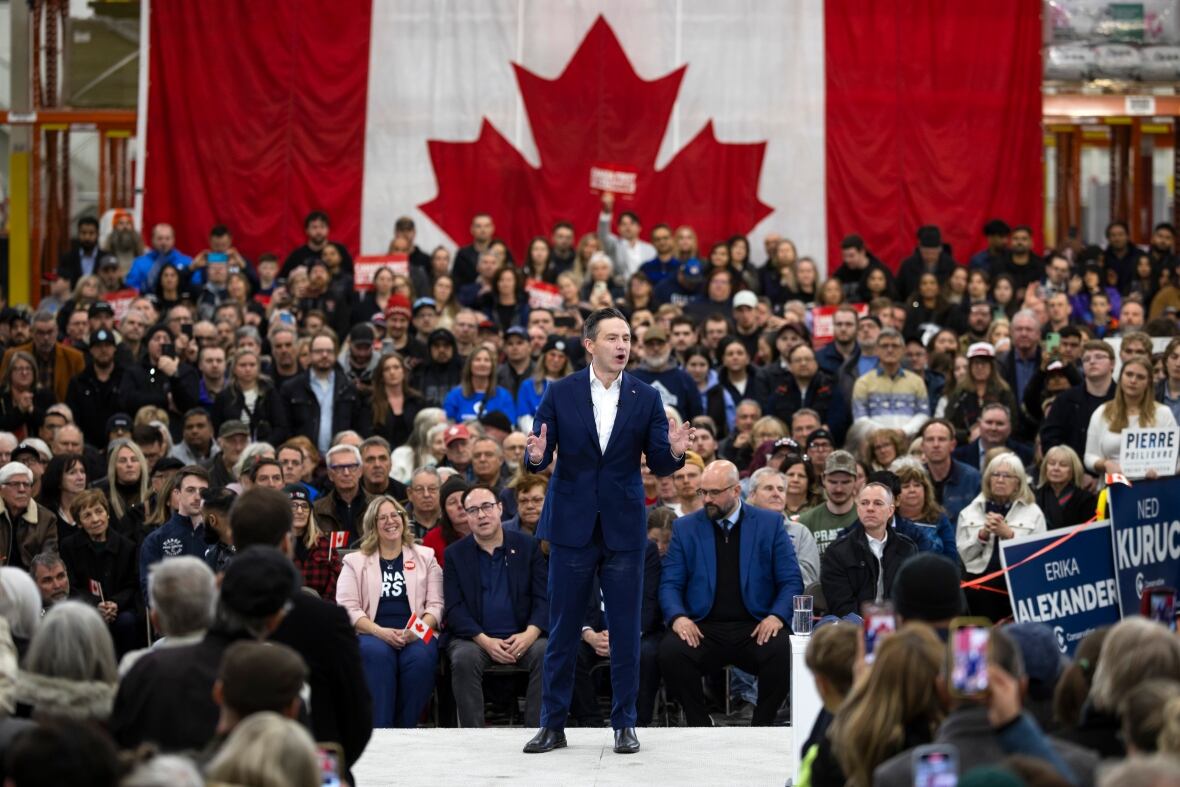 Conservative Leader Pierre Poilievre will run for a seat in Alberta,
but that won't happen for at least a month. (Nick Iwanyshyn/The Canadian
Press)
Conservative Leader Pierre Poilievre will run for a seat in Alberta,
but that won't happen for at least a month. (Nick Iwanyshyn/The Canadian
Press)
The Governor General, on the advice of the prime minister and cabinet, then sets the date for the byelection. A byelection can be called between 11 and 180 days after an MP resigns.
Prime Minister Mark Carney said Friday he won't go the long route.
"I will ensure that it happens as soon as possible. No games, nothing," he told reporters at a news conference.
That could mean Poilievre will be back to leading the Opposition and facing off against the prime minister at some point during the fall sitting.
Kurek first won the seat of Battle River-Crowfoot in 2019 and was re-elected last week with almost 82 per cent of the vote.
In his statement Friday, Kurek said he plans to run in Battle River-Crowfoot again in the next general election
"An unstoppable movement has grown under [Poilievre's] leadership, and I know we need Pierre fighting in the House of Commons to hold the Liberal minority government to account," he said.
Poilievre lost his seat of Carleton to Liberal candidate Bruce Fanjoy by more than 4,000 votes, leaving the Conservatives without its leader in the House of Commons.
Poilievre, originally from Calgary, called Kurek's move "selfless."
Other MPs who stepped aside were rewarded
The Conservative leader posted photos from the riding on Monday, where he met with Kurek's family and team.
In an accompanying video, Poilievre addressed Monday's results for the the first time since his concession speech, acknowledging "it didn't go how we wanted."
"But when you get knocked down, you get up and get going," he said to the camera.
There's some precedent of MPs stepping aside for their party leaders.
After winning the 1983 Progressive Conservative leadership, Brian Mulroney was on the hunt for a seat. Nova Scotia MP Elmer MacKay, father of former Conservative cabinet minister Peter MacKay, resigned his Central Nova seat and Mulroney was able to lead the Opposition.
 Conservatives, NDP work on their paths forward before Parliament’s return | Power & Politics
Mulroney ran in his home riding of Manicouagan in the 1984 general election, which his party won in a landslide. MacKay was re-elected in Central Nova that same year and served in Mulroney's cabinet.
In 1990, New Brunswick MP Fernand Robichaud ceded his riding of Beauséjour so Liberal Party Leader Jean Chrétien could run in a byelection. Chrétien had represented the Saint-Maurice area of Quebec under former prime minister Pierre Elliott Trudeau, but had resigned before making his successful leadership push.
When the 1993 general election rolled around, Chrétien ran in St-Maurice, which includes his hometown of Shawinigan, and Robichaud successfully re-offered in Beauséjour.
Robichaud went on to serve in Chrétien's cabinet and was later appointed to the Senate.
ABOUT THE AUTHOR
Liberals' Kusmierczyk pushes for recount in 'razor-thin' loss to Conservatives
The court will review the recount application later this week
Fewer than 250 votes – that was Conservative candidate Kathy Borrelli's initial margin of victory over the Liberals' Irek Kusmierczyk, who has served as the MP for Windsor—Tecumseh—Lakeshore for more than five years.
Now, Kusmierczyk is pushing for a recount in the border city riding after Borrelli's lead dropped to just 77 votes once the federal election results were validated.
"We know that this election was razor-thin," Kusmierczyk said outside the Ontario Superior Court of Justice in Windsor on Monday.
"We believe strongly that we owe the residents to do everything possible to make sure that every vote that was cast was valid and that every valid vote is counted."
On Monday morning, Kusmierczyk's team filed an application for a judicial recount, which the court accepted and will review later this week, he said.
A representative for Borrelli said they won't be commenting before the court makes its decision.
"Certainly it's reasonable for Mr. Kusmierczyk to make the case that, given how close it is, that he would like to make sure that every vote was properly accounted for," said Lydia Miljan, a political science professor at the University of Windsor.
Windsor—Tecumseh—Lakeshore is one of several ridings across the country where the results were so tight that recounts are likely or have been automatically triggered.
The recounts, depending on their results, could shift the makeup of the next Parliament as the Liberals sit at 169 seats – just three short of a majority government.
WATCH: How the automatic recount will work for Terra Nova-The Peninsulas
 Here’s how the recount in Terra Nova - The Peninsulas will work
"Depending on how all these recounts go, it could increase the Carney government to maybe even a majority, or it could reduce them back down to 165," said Miljan, who also serves as a senior fellow at the Fraser Institute. "We just don't know, given the closeness of a lot of these races."
Already, seats have flipped in close races after Elections Canada validated the April 28 election results. That process does not include recounting ballots.
Kusmierczyk was only seven votes shy of an automatic recount, which would have been triggered had the difference between the vote totals for the two candidates been less than one one-thousandth of the overall number of valid votes cast in the riding.
Just over 70,000 people voted in the riding, meaning the difference would have needed to be 70 or fewer votes.
Kusmierczyk says he believes he has strong evidence to support a recount, which will need to be approved by a judge. The validated Elections Canada results show 536 votes were rejected in the riding.
"We feel strongly that many of those votes were wrongly rejected," Kusmierczyk said.
The Elections Canada validation process narrowed the vote margin to 77 votes from 233.
Miljan says it's not unusual for mistakes to happen "either in numbers being transposed or how they're reported" that are then corrected in the validation process.
But she said Kusmierczyk likely has a good shot at securing a recount.
"I don't think it would be a difficult case for him to make," she said. "And he can certainly say given the verification, there were so many votes that were not allocated for whatever reason — that's probably a good enough case."
Kusmierczyk said there will be a court hearing Friday where he'll be able to make his case before the judge.
From that point, a recount would be done relatively quickly. "Residents want to see a timely conclusion to this process," he said. "We're talking a matter of days, not weeks."
Elections Canada says on its website that the law stipulates that a recount "must commence within four days after the judge receives the application for a recount."
"The goal of the recount is to provide a timely and final determination as to the elected member of the House of Commons," the website says. "This may be important in determining the makeup of the government. For this reason, timelines in the Act are very tight."
Either way, Kusmierczyk said he will "absolutely and unequivocally" accept the result of the recount if one takes place.
He also said he would "absolutely" work with Borrelli if she remains the winner "to make sure that the community is supported."
ABOUT THE AUTHOR

With files from Pratyush Dayal
Liberal minority back up to 169 after Elections Canada validates close Ontario race
Revised result close enough to be subject to automatic recount
Elections Canada's validation process has revealed a second closely contested riding's winner has changed after Monday's preliminary result — this time from the Conservatives to the Liberals.
The unofficial results posted on election night showed that Conservative Parm Gill had won the redrawn riding of Milton East-Halton Hills South by 298 votes.
But after double-checking the numbers, Elections Canada now reports that Liberal Kristina Tesser Derksen won by 29 votes.
 Unofficial
results on election night reported that Conservative candidate Parm
Gill had won the riding of Milton East-Halton Hills South. The Elections
Canada validation process has now declared the riding for the Liberals. (Evan Mitsui/CBC)
Unofficial
results on election night reported that Conservative candidate Parm
Gill had won the riding of Milton East-Halton Hills South. The Elections
Canada validation process has now declared the riding for the Liberals. (Evan Mitsui/CBC)
This latest riding flip brings the Liberals back to 169 seats — three seats shy of a majority — while the Conservatives drop to 143.
The Liberals lost a riding on Thursday after a similar validation process in the Montreal-area riding of Terrebonne revealed that the Bloc Québécois had won.
Validation is not a recount
The validation process — which is different from an official recount — is a way for Elections Canada to verify the unofficial results that are reported on election night. Each local returning officer goes through the results reported by each polling station to weed out any potential errors.
"When you're talking about hundreds of or thousands of polling locations and lots of results coming in, errors can happen. Whether it's something gets misheard on the phone or somebody accidentally types in the wrong number on the keyboard," Matthew McKenna, a spokesperson for Elections Canada, told CBC News before election day.
"The returning officer for each riding goes through the statements of the vote from every poll and makes sure that that's checked against the records so that we can adjust for any little errors or mistakes."
Even after the validation process, both Milton East-Halton Hills South and Terrebonne's final tally are so close that it will trigger an official recount. Such a recount is overseen by a judge and is automatically triggered if a candidate wins by less than 0.1 per cent of the overall vote.
Official recounts have flipped ridings in the past. In 2021, the Bloc candidate was declared the winner of the then-named riding of Châteauguay-Lacolle. But an official recount two weeks later gave the victory to the Liberals.
An official recount will also be triggered in the N.L. riding of Terra Nova-The Peninsulas, where the Liberal candidate edged out the Conservative by 12 votes.
ABOUT THE AUTHOR
Liberals lose closely contested seat to Bloc Québécois after vote validation
44-vote margin small enough to trigger official recount
The Liberals have dropped one seat after Elections Canada's validation process determined they lost a tightly contested Quebec riding.
Terrebonne, just north of Montreal, was one of the last ridings to be called on Tuesday afternoon. The final vote count had the Liberals flip the seat from the Bloc Québécois by 35 votes.
But Elections Canada is now reporting that, after double-checking the numbers during its validation process, the Bloc in fact held the riding by a margin of 44 votes.
The flip pulls the Liberals — who fell just a few seats short of a majority government — down to 168 seats and the Bloc jumps to 23 seats.
Nathalie Sinclair-Desgagné, the Bloc incumbent for the riding, wrote in a Facebook post that she's cautiously optimistic but will be waiting for a judicial recount.
"Thank you for your continued support and let's pay attention to what follows. I hope to have the honour of representing Terrebonne once again," she wrote in French.
Validation is not a recount
The validation process — which is different from an official recount — is a way for Elections Canada to verify the unofficial results that are reported on election night. Each local returning officer goes through the results reported by each polling station to weed out any potential errors.
"When you're talking about hundreds of or thousands of polling locations and lots of results coming in, errors can happen. Whether it's something gets misheard on the phone or somebody accidentally types in the wrong number on the keyboard," Matthew McKenna, a spokesperson for Elections Canada, told CBC News before election day.
"The returning officer for each riding goes through the statements of the vote from every poll and makes sure that that's checked against the records so that we can adjust for any little errors or mistakes."
Even after the validation process, the race was so close that it will trigger an official recount. Such a recount is overseen by a judge and is automatically triggered if a candidate wins by less than 0.1 per cent of the overall vote.
Official recounts have flipped ridings in the past. In 2021, the Bloc candidate was declared the winner of the then-named riding of Châteauguay-Lacolle. But an official recount two weeks later gave the victory to the Liberals.
An official recount will also be triggered in the N.L. riding of Terra Nova-The Peninsulas, where the Liberal candidate edged out the Conservative by 12 votes.
ABOUT THE AUTHOR
With files from Raffy Boudjikanian
Sole Green MP Elizabeth May looks to play pivotal role in minority Parliament
Green Party leader says results would've been different if Canadians didn't feel weight of strategic voting
Even though Elizabeth May is the only Green member of Parliament left standing after the federal election, the party leader says she wants to play a key role in the new minority Parliament.
With the Liberals just a few seats shy of a majority, May said she's open to negotiating and possibly even striking a deal with Prime Minister Mark Carney in exchange for her support.
But that's only if Carney's government is willing to advance her priorities.
"I would never have done the kind of deal that Jagmeet Singh did with Justin Trudeau, which ignored fair voting and ignored climate," May told CBC News.
Above all, May said her main goal is getting electoral reform — something that she believes is possible to achieve as a caucus of one.
May said she wants Carney to commit to dismantling the first-past-the-post voting system — a promise that his predecessor made in the 2015 federal election then famously broke.
 Is the Green Party still relevant? | Power & Politics
If people didn't feel obliged to vote strategically, May said she believes many Canadians would have picked different candidates.
"First-past-the-post drives people to fear-based voting … and rewards mindless hyper-partisanship," May said.
May's former co-leader, Jonathan Pedneault, cited the need for the change in his resignation statement.
"[The] election results were deeply disappointing and highlight more than ever the need for electoral reform," he wrote.
 Green
Party co-leaders Elizabeth May and Jonathan Pedneault attend their
election campaign launch in Montreal on March 23, 2025. Pedneault
resigned as co-leader after failing to win a seat this election. (Evan Buhler/Reuters)
Green
Party co-leaders Elizabeth May and Jonathan Pedneault attend their
election campaign launch in Montreal on March 23, 2025. Pedneault
resigned as co-leader after failing to win a seat this election. (Evan Buhler/Reuters)
The Greens were hoping to make gains. Instead, they lost an incumbent and Pedneault failed to win a Montreal riding for a second time.
In total, the Greens received 244,952 votes across the country, representing 1.2 per cent of the vote share — the lowest for the party in 25 years.
It's a significant decline from the momentum the party enjoyed in the 2010s, which peaked in 2019 when they received 1.19 million votes and sent three MPs to Parliament Hill.
Along with strategic voting, May also blames a last-minute decision by the Leaders' Debates Commission to disqualify Pedneault from the debates.
The commission said the Greens no longer met its participation requirements, a decision the party is now fighting in Federal Court.
Ending party status requirement also a priority
Mike Morrice, May's former caucus colleague who was defeated by the Conservatives in the Ontario riding of Kitchener Centre, said he wants May to keeping pushing for electoral reform.
Morrice introduced a motion in the last session of Parliament asking for the establishment of a non-partisan citizens' assembly to make recommendations on changes to the voting system. The motion was defeated, but several MPs from the Liberals and Conservatives broke party ranks to support it.
"We can do better and that should start [with] hearing from experts on the best path forward," he said.
May also said she wants to end the 12 MP requirement for recognized party status — a designation the NDP just lost.
 FULL SPEECH | May celebrates projected win in her Vancouver Island riding
Parties without the designation don't get opposition days, guaranteed participation in parliamentary committee, access to parliamentary funding for staff, the right to respond to statements by ministers or input on the appointment of officers of Parliament.
May said she plans to work with the new Speaker of the House of Commons on the issue, unless she decides to run for the job herself — something she said she hasn't ruled out, but would be difficult to consider with her party's position.
Used to being underestimated
Although disappointing, the results for the Greens are not as bad as pollsters predicted.
Some analysts said the Greens could've been wiped off the electoral map entirely, and even some of May's staunchest supporters weren't sure she could pull off a fifth straight win in her riding of Saanich-Gulf Islands.
In the end, those results weren't even close. May kept her Vancouver Island seat, which she's held since 2011, with 39.1 per cent of the vote share.
When the results started to pour in, May jumped to her feet and started dancing with her husband at her election night headquarters: a picturesque winery in her riding.

At the age of 70, May says she has plans to keep running as long as she can. She said she believes she proved pundits wrong because of her dedication to her constituents.
May travels back to her riding every weekend when the House is sitting to attend community events. During the pandemic, she said she helped bring Canadians back home who were stuck abroad, including backpackers in Peru, by personally booking and paying for their flights. She said all but one person has paid her back.
May insists the party is more than her and said she will take direction from the party's membership and federal council on its future.
"We obviously need to rebuild, and we need to fundraise and we need to make sure we keep moving forward," May said.
"But we are legitimately one of the few parties in opposition that retained the seat of the leader, which is not nothing."
ABOUT THE AUTHOR

Elections Canada apologizes to Nunavik voters left out of vote
Elections Canada to review circumstances around the situation and publish findings
Elections Canada has apologized to voters in Nunavik who were unable to cast a vote in Monday's federal election.
CBC News has heard from residents in several Nunavik communities who reported issues at polling stations, including some that closed early or didn't open at all.
Earlier this week, Elections Canada said bad weather affected flights for workers, and they struggled with local recruitment.
"I deeply regret that some electors in Nunavik were not able to cast their vote. To them, I apologize," said chief electoral officer Stéphane Perrault in a written statement on Wednesday.
According to Makivvik president Pita Aatami, nine of Nunavik's 14 villages did not have local polling staff, so Elections Canada had to fly people in from elsewhere. That led to polls in many of those villages closing early.
"It showed us how Inuit were made to feel like their right to vote was taken away from them … the issue has to be resolved before the next election," he said in Inuktitut.
Perrault's statement says that over the past three years, Elections Canada has made it a priority to remove barriers to voting services for Indigenous electors.
"Nevertheless, the shortcomings of our services in Nunavik during the general election underscore the importance of the work that remains," he said.
"Elections Canada will review the circumstances that led to this situation, as well as the measures taken during this election to improve voting services to Indigenous electors. We will publish the findings."
 A
sign indicating that the polling station in the Nunavik community of
Salluit had to close at 2:30 p.m. local time on election day due to
'unforeseen circumstances.' (Submitted by Mary Papigatuk)
A
sign indicating that the polling station in the Nunavik community of
Salluit had to close at 2:30 p.m. local time on election day due to
'unforeseen circumstances.' (Submitted by Mary Papigatuk)
Fair and equal access for all Indigenous communities
Mandy Gull-Masty, the new MP for Abitibi–Baie-James–Nunavik–Eeyou, said she was fielding calls from people in Nunavik throughout election day. She said she's gathered those complaints and submitted them to the compliance officer.
Now that she's elected, Gull-Masty said she would work toward introducing a bill to Parliament to address some of the shortcomings that might come from the Elections Canada report.
Two issues stand out to her already: the engagement with locals to help at polling stations, and the lack of communication in Indigenous languages.
"People need to come to the community sooner. There needs to be more engagement with the local municipal offices. There are a lot of corporate secretaries that have experience in running an election," she said.
"The use of language would remove so many barriers for so many people. Having access to information in their own written language, not just Nunavik but also [elsewhere] like Eeyou Istchee. We have a lot of people fluent in Cree and do not speak English and French."
 Mandy
Gull-Masty won the riding of Abitibi–Baie-James–Nunavik–Eeyou. It's the
first time in roughly 20 years the seat has been held by a Liberal. ( CBC/Olivia Stefanovich)
Mandy
Gull-Masty won the riding of Abitibi–Baie-James–Nunavik–Eeyou. It's the
first time in roughly 20 years the seat has been held by a Liberal. ( CBC/Olivia Stefanovich)
Some voters CBC News spoke to also said there were no advance polls in their communities, and they were not aware of any recruitment drive for getting locals on board.
Mail-in issues
The voting issues weren't just limited to polling stations.
Some Nunavik residents, like high school teacher Taylor Adams, didn't receive their special ballots by mail despite having applied weeks prior to the deadline.
"All of our mail comes from Montreal … I think the earliest we can get mail from Montreal is generally about three weeks," the Puvirnituq resident said.
"I just thought that maybe with the election they would have some kind of an express postage system, if it said 'Elections Canada' on the ballot."
Once an elector's application for a special ballot is approved, they're unable to vote another way, such as in-person at advance polls, according to Elections Canada.
For those who did get their special ballots, Adams also wonders whether they would have even made it back to Elections Canada in time for the count.
"People already have a fearfulness of the systems that are in place and this really doesn't help," Adams said.
Forty-six per cent of registered electors in Abitibi–Baie-James–Nunavik–Eeyou voted in the 2025 federal election. That is roughly in line with the turnout in 2021, and below the 2025 national rate of 68 per cent.
ABOUT THE AUTHOR

With files from Alec Gordon and Emma Tranter
These big-name MPs won't be returning to Parliament after Monday's vote
Poilievre, Singh are most notable losses, but other familiar faces won't be back
Two of the major party leaders were unable to retain their seats on Monday, with both the Conservatives' Pierre Poilievre and NDP's Jagmeet Singh falling to Liberal challengers.
Singh placed a distant third in Burnaby Central. But Poilievre's result was a shocking upset, losing the Ottawa-area riding of Carleton after holding it for two decades.
But beyond those two leaders, a number of other notable incumbents also lost their seats. Here's a breakdown of some of the bigger names who won't be returning to the House of Commons.
Niki Ashton
 Niki
Ashton said she and her team hoped to visit 90 per cent of all
communities in the Churchill-Keewatinook Aski riding during the election
campaign. (Sanuda Ranawake/CBC)
Niki
Ashton said she and her team hoped to visit 90 per cent of all
communities in the Churchill-Keewatinook Aski riding during the election
campaign. (Sanuda Ranawake/CBC)
Beyond Singh, Niki Ashton is one of the more notable NDP candidates to lose her seat.
Ashton had been an MP since 2008 when she won the Manitoba riding of Churchill-Keewatinook Aski for the NDP.
She ran for the party's leadership in 2017, finishing third in the contest that Singh ultimately won.
Rebecca Chartrand, who identifies as Anishinaabe, Inninew, Dakota and Métis from Pine Creek First Nation, ousted Ashton after 17 years as an MP.
Peter Julian
 Peter Julian served as the NDP's House leader before the election was called. (Sean Kilpatrick/The Canadian Press)
Peter Julian is a loss that will potentially fuel the leadership vacuum in the NDP after Singh's resignation.
As the NDP's House leader, Julian could have been an easy choice as the party's interim leader, assuming he had no aspirations for the permanent gig.
Julian had been the MP for New Westminster-Burnaby for two decades, first winning the seat in 2004.
Liberal Jake Sawatzky unseated Julian in the redrawn riding of New Westminster-Burnaby-Maillardville.
Kamal Khera
 Prime Minister Mark Carney tapped Kamal Khera to be his health minister
before the election. (Sean Kilpatrick/The Canadian Press)
Prime Minister Mark Carney tapped Kamal Khera to be his health minister
before the election. (Sean Kilpatrick/The Canadian Press)
The Liberals were able to pick up a good number of seats in Quebec, but lost some ground in Ontario — especially in the 905 region surrounding Toronto.
Kamal Khera had held the riding for Brampton West since 2015, but lost to Conservative candidate Amarjeet Gill.
A nurse by training, Khera had been a cabinet minister under both Mark Carney and Justin Trudeau. Before earning her first cabinet post in 2021, Khera was a parliamentary secretary.
Ya'ara Saks
 Ya'ara
Saks had been minister of mental health and addictions under former
prime minister Justin Trudeau. (Spencer Colby/Canadian Press)
Ya'ara
Saks had been minister of mental health and addictions under former
prime minister Justin Trudeau. (Spencer Colby/Canadian Press)
Ya'ara Saks is another former cabinet minister from the region to fall to a Conservative.
Saks won her seat in a 2020 byelection and was sworn in as minister of mental health and addictions during a cabinet shuffle in 2023. But Carney did not include her in his cabinet when he won the leadership.
Roman Baber, who was kicked out of the Ontario Progressive Conservative caucus and later ran for the federal leadership, won the York Centre riding over Saks.
Chad Collins
 Chad Collins was first elected MP for Hamilton East-Stoney Creek in 2021. (Dan Taekema/CBC)
While Chad Collins had only been an MP since 2021 and largely served as a backbencher, his loss in Hamilton East-Stoney Creek stands out for different reasons.
Since 2004, the riding has largely been a three-way race, but has either gone to the Liberals or NDP. That changed Monday, with Conservative Ned Kuruc topping Collins by just under 1,500 votes. The NDP placed a distant third.
The riding would have been a seat the Liberals needed to hold to get into majority territory.
Collins was one of the Liberal backbenchers publicly calling for Trudeau to step down before the former prime minister decided to leave — but voters appear to have not rewarded Collins for speaking out.
Stephen Ellis
 Stephen Ellis was the Conservative health critic in the last Parliament. (Adrian Wyld/Canadian Press)
Overall the Conservatives had a good election, increasing both their share of seats and the popular vote. But the party's losses extend beyond their leader.
Even though Stephen Ellis lost his seat after only one term, the family doctor was considered a star candidate for the Conservatives in the 2021 pandemic election.
Ellis won back the Nova Scotia riding of Cumberland-Colchester from the Liberals, who held the seat since 2015. He served as Poilievre's health critic in the last Parliament.
Liberal Alana Hirtle defeated Ellis by nearly 1,300 votes.
Tracy Gray
 Conservative MP for Kelowna-Lake Country Tracy Gray lost her riding by about 200 votes. (Adrian Wyld/The Canadian Press)
Dozens of seats were still too close to call when Elections Canada halted the count at 4:30 a.m. ET Tuesday. That included Kelowna, B.C.
The CBC Decision Desk called the race for Liberal Stephen Fuhr on Tuesday afternoon. He beat Conservative incumbent Tracy Gray by 1,077 votes.
Gray was another member of Poilievre's front bench, serving as the employment critic.
A former city councillor, Gray won the seat from Fuhr in 2018.
Michelle Ferreri
 Michelle Ferreri was an outspoken MP during question period. (Adrian Wyld/The Canadian Press)
Conservative Michelle Ferreri also won't be returning to the House, having lost her seat in Peterborough, Ont.
Ferreri's riding — formerly Peterborough-Kawartha — has flipped back and forth between Liberals and Conservatives over the past few decades.
Ferreri won the riding from former Liberal cabinet minister Maryam Monsef in 2021. As Conservative critic for families and social development, she was an extremely vocal member of the Opposition — and occasionally made outlandish claims.
Emma Harrison, a farmer and small business owner, won the seat for the Liberals.
Alain Therrien
 Bloc
Québécois Leader Yves-François Blanchet embraces candidate Alain
Therrien. The leader said Therrien's loss was particularly hard to
swallow. (Adrian Wyld/The Canadian Press)
Bloc
Québécois Leader Yves-François Blanchet embraces candidate Alain
Therrien. The leader said Therrien's loss was particularly hard to
swallow. (Adrian Wyld/The Canadian Press)
Alain Therrien losing in La Prairie-Atateken was just one of about a dozen seats the Bloc Québécois dropped this election.
But Therrien was a notable member of the Bloc caucus, serving as the party's House leader. When leader Yves-François Blanchet was absent from question period, it was usually Therrien grilling the government.
Speaking to reporters Tuesday morning, Blanchet himself singled out Therrien's loss as especially difficult.
"You can't have a greater warrior than Alain. All the other candidates, all the other friends I've lost … Alain had a special closeness," he said in French.
The former Quebec MNA lost his seat to Liberal Jacques Ramsay, a family physician from Montreal's South Shore.
Diane Lebouthillier
 Former cabinet minister Diane Lebouthillier lost her Quebec seat. (Adrian Wyld/The Canadian Press)
While the Liberals were largely able to pick up seats from the Bloc, the sovereignist party was able to take a seat away from a key Liberal player.
Former cabinet minister Diane Lebouthillier lost her seat in the easternmost Quebec riding of Gaspésie-Les Îles-de-la-Madeleine-Listuguj.
Lebouthillier had been a member of Trudeau's front bench since the Liberals won their first election under the former leader in 2015 — though Carney didn't include her in his cabinet.
Bloc Québécois candidate Alexis Deschênes had previously run provincially but had more luck in this federal race. He likely benefited from a redrawn riding and a campaign visit from Blanchet.
Brian Masse
 Brian Masse defeated after 2 decades in office
The Conservatives were able to outperform the polls in Ontario in part by earning blue-collar votes in the southwest region of the province.
A prime example: Brian Masse lost his seat after representing Windsor-West since 2002.
Masse held several critic portfolios for the NDP, including Canada-U.S. border relations — one of the key issues this election. His Windsor riding is also on the front lines of the U.S. trade war.
Harb Gill, a retired police officer, pushed a message of change in his successful bid to unseat Masse.
Lindsay Mathyssen
 Lindsay Mathyssen responds to election loss in London-Fanshawe
Lindsay Mathyssen dropping her London-Fanshawe seat is another example of the Conservatives picking up seats from the NDP in southwestern Ontario.
Mathyssen had represented the riding since 2019. Before that, her mother, Irene Mathyssen, held the same seat from 2006.
Kurt Holman will be the first Conservative to represent the riding in more than two decades.
Mike Morrice
 Green Party MP Mike Morrice's loss brings the Green seat count down to one. (Spencer Colby/The Canadian Press)
With the loss of Mike Morrice, the Green Party caucus has been cut in half.
While co-Leader Elizabeth May held her B.C. seat, Morrice came a close second to Conservative Kelly DeRidder in Ontario's Kitchener Centre.
Morrice won the riding in 2021, though the Liberal candidate in that election had dropped out of the race.
This time around, Morrice appears to have split the vote with the new Liberal candidate Brian Adeba.
ABOUT THE AUTHOR
6 key takeaways from Monday's historic vote
Election shaped up as 2-way race between Liberals and Conservatives, with diminished NDP, Bloc support
Canada's 45th general election has significantly shaken up the composition of the House of Commons.
The historic vote saw the emergence of a two-horse race between the Liberals and Conservatives, the collapse of NDP support and some rather significant incumbent losses.
Here are six takeaways from Monday's election.
Tight races push final result to Tuesday afternoon
Liberal Leader Mark Carney will form a minority government, CBC News now projects. But tight races in a number of ridings made that too difficult to determine on election night.
Elections Canada halted its count at about 4:30 a.m. ET Tuesday before picking up the count later in the day. As the last results trickled in Tuesday afternoon, the CBC Decision Desk projected a minority just before 4 p.m. — almost a full day after the first polls began to close.
The Liberals appear set to win 169 seats — just short of the 172 needed for a majority.

NDP collapse and the 2-horse race
When the dust settles, the main story of the 2025 election will likely be the two-horse race that developed between the Liberals and Conservatives.
A large part of the race developing into a showdown between the two parties had to do with the collapse of NDP support, and to a lesser extent a downturn in the Bloc's fortunes.
Shortly after midnight in B.C., Jagmeet Singh said he would be stepping down with the NDP set to lose official party status in the House and Singh himself set to lose his own seat.
 Singh gets emotional as he announces he will step down as NDP leader
The Liberals and Conservatives were both able to feast on the lack of NDP and Bloc support.
The Conservatives picked up a number of traditionally orange seats, especially in blue-collar ridings like Ontario's Windsor West and Manitoba's Elmwood-Transcona.
The Liberals, on the other hand, picked up NDP seats in B.C. ridings. But the collapse of the NDP was also on full display in ridings where the Liberals held their seats. In Halifax, for example, the NDP have won or placed second in the riding since 2004, but trailed in third after Monday's election.
The Liberals also ate up seats from the Bloc, including in the South Shore area of Montreal. Those pickups helped offset losses elsewhere, specifically in Ontario.
2 leaders without seats?
Both Conservative Leader Pierre Poilievre and NDP Leader Jagmeet Singh were projected to lose their seats. CBC News projected Poilievre would lose to Liberal Bruce Fanjoy in his longtime rural Ottawa seat of Carleton, an electoral district Poilievre represented since 2004. The Conservative leader had been trailing in the vote count all night.
Meanwhile, Singh was projected to lose his B.C Burnaby Central riding to Liberal Wade Chang, finishing in third place.
While Singh resigned, Poilievre signalled his intention to stay on.
"It will be an honour to continue to fight for you and be a champion for your cause as we go forward," he said.
The decision to stay or go for both leaders likely came down to seat count. The NDP lost official party status in the House, while Poilievre's party increased its tally by nearly two dozen seats — boosting the Conservative popular vote share at the same time.
Conservatives outperform in Ontario
Although they didn't win government, the Conservatives outperformed most polls, especially in vote-rich Ontario.
Heading into Monday's election, Conservatives were averaging 41 per cent support in Canada's biggest province, according to CBC's Poll Tracker. But the party appears to have garnered closer to 45 per cent of the vote in Ontario.
In terms of seat count, the party was able to wrestle away a number of ridings from both the NDP and Liberals.
Poilievre's party was able to break through in the 905 region surrounding Toronto — in Richmond Hill, Vaughan, Brampton and York — while also snagging NDP seats in Windsor and London.
Federal, provincial conservative tensions
Speaking of Ontario, Conservative tensions with their provincial counterparts were on full display before election night.
Kory Teneyke — of the country's top Conservative strategists who just helped Ontario Premier Doug Ford win a sizable majority government — had publicly criticized the federal Conservative campaign, accusing the party of not adequately addressing the U.S. trade war.
Ford himself backed his campaign manager up when speaking to reporters earlier this month.
"Sometimes the truth hurts," Ford said of Teneyke's criticisms.
Once the polls started rolling in on Monday night, showing a better-than-expected result for the Conservatives — especially in Ontario — one Conservative candidate went off on Ford.
 Jamil Jivani slams Doug Ford during fiery interview
"I think Doug Ford is a problem for Ontario and for Canada," Jamil Jivani told CBC News after winning the Ontario riding of Bowmanville-Oshawa North.
"This guy's a political genius because he beat [Ontario Liberal Leader] Bonnie Crombie and [former Ontario Liberal leader] Steven Del Duca? And now we got to sit around and get advice from him?" Jivani asked rhetorically.
"He has taken the provincial conservatives and turned it into something hollow."
Jivani called Ford an "opportunist" and said the people around him are "goons." His remarks, when played at the Conservative party HQ in Ottawa, prompted cheers.
Beyond tensions with Ford, the federal Conservative campaign also had tensions with Nova Scotia Premier Tim Houston, who was notably absent from Poilievre's rally in Trenton, N.S., last week.
Where do we go from here?
In six of the last eight elections, voters have elected a minority government. That includes Monday's election.
This election has shifted the makeup of the House, but some dynamics might remain consistent.
The NDP — which was able to squeeze policy commitments out of former prime minister Justin Trudeau — has a diminished role. But even without official party status, the few seats they do have provide them some leverage with a Liberal government that is just shy of a majority.
The Bloc, although returning to Ottawa with a reduced caucus, will also still have leverage and could push its priorities. Leader Yves-François Blanchet has said he's willing to work with the Liberals.
But after months of gridlock in Parliament leading up to Trudeau's resignation, Canadians could rightfully question how a House heavily divided between Liberals and Conservatives will move forward.
In a potentially hopeful sign, both Carney and Poilievre indicated in the early Tuesday hours that they're both focused on the U.S. tariff threat.
Poilievre said that he'd work with other parties in "getting a trade deal that puts these tariffs behind us while protecting the sovereignty of Canada and the Canadian people."
Despite winning government, Carney acknowledged the "millions of our fellow citizens preferred a different outcome.… Let's put an end to the division and anger of the past. We are all Canadian and my government will work for and with everyone."
ABOUT THE AUTHOR
Carney and Trump speak, agree to meet in person following Liberal minority win
PM will need to work with opposition to push through agenda
Prime Minister Mark Carney spoke to U.S. President Donald Trump a day after securing the Liberals a return to power and following a campaign very much based on reproaching the president's trade war and his 51s state ambitions.
According to a readout of the call from the Prime Minister's Office, Trump congratulated Carney.
"The leaders agreed on the importance of Canada and the United States working together — as independent, sovereign nations — for their mutual betterment," the readout said.
"To that end, the leaders agreed to meet in person in the near future."
A statement from the U.S. State Department sent to CBC News on Tuesday afternoon also extended congratulations to Carney.
"We look forward to working with Prime Minister Carney's government, particularly on key issues such as trade fairness, combating illegal immigration, halting the flow of fentanyl and other dangerous drugs and countering the Chinese Communist Party influence in our hemisphere," read the statement from spokeswoman Tammy Bruce.
However, in a statement to The Canadian Press earlier in the day, White House spokesperson Anna Kelly said the election "does not affect President Trump's plan to make Canada America's cherished 51st state."
Trump's return to the White House and former prime minister Justin Trudeau's exit from Canadian politics played a role in delivering Carney a minority win.
 Canada's election: Why no model could predict the outcome
After winning re-election south of the border, Trump threatened to impose massive tariffs on all Canadian goods, claiming he needed to take action because of fentanyl spilling across the border. U.S. figures show the percentage of fentanyl seized at the northern border is fraction of the deadly opioid seized at the U.S. southern border.
Trump coupled his tariff threats with repeated calls for Canada to become a U.S. state, and referred to Trudeau as "governor."
So far this year, Trump has triggered chaos in the markets, bringing in steep duties on goods from Canada and around the world, then walking them at least partially back.
He has since moved ahead with tariffs against Canada's auto sector, steel and aluminum — but some of those are also in flux.
All of that reshaped the ballot box question leading into Canada's 45th election. The Liberals are projected to take 169 seats, shy of the 172 needed for a majority.
While a Liberal win was clear on election night, it took until Tuesday to be certain what kind of government Carney would lead.
Recounts in tight races
Carney, a central banker who ascended to the office of prime minister after an incredible sequence of events, will need to collaborate with opposition members, most likely the Bloc Québécois or NDP, to pass legislation and stave off another election in the near future.
While there will be at least two automatic recounts, results suggest for now the Conservatives secured 144 seats, the Bloc were reduced to 22 and the NDP collapsed to just seven. Elizabeth May is back to being the sole Green Party MP.
The results are likely not as strong as Carney, who had been asking Canadians for a "strong mandate," wanted.
Still, a minority government would have felt miraculous a few months ago when the Liberals under Trudeau faced annihilation.
When Canadians gathered over the December holidays, Pierre Poilievre's Conservatives had a 21-point lead over the Liberals in opinion polls as Canadians became increasingly concerned about affordability and frustrated with the Liberals.
 Poilievre projected to lose his longtime Ottawa-area seat
Then came Trudeau's resignation and Trump's annexation taunts.
By Easter and Passover, Carney's Liberals held a small lead in the polls, which he was able to translate into the most seats.
While the race against the Conservatives shaped up to be closer than many polls predicted, Carney pulled off one of the most stunning reversals of political fortunes in Canadian history.
"Not a lot of sleep," said Carney as he headed into his office Tuesday morning. He remains prime minister but now gets to call himself an elected leader, after securing a seat in the House of Commons and winning the most seats.
Poilievre, Singh both lose seats
This projection means Carney will not only need to figure how to lead his party in the House of Commons, something he's never done before, but also how to manage a minority situation.
That's on top of an already ambitious agenda he laid out to voters, including what could be unpleasant negotiations with the president around a new economic and security deal.
And he's promised to reduce interprovincial trade barriers by Canada Day as part of his plan to lessen the country's dependence on the U.S.
Carney also spoke to French President Emmanuel Macron on Tuesday. According to the readout of that conversation, the two men discussed their "ongoing work to deepen defence and commercial ties between their nations" and agreed to remain in close contact.
When the House of Commons is recalled, there will be two prominent faces missing. Poilievre failed to win his Ottawa-area riding and NDP Leader Jagmeet Singh also lost his seat.
Singh announced last night he will step down, but Poilievre indicated he wants to stay on.
ABOUT THE AUTHOR
with files from the Canadian Press
'I lost my legal right to vote': Booths closed early — or didn't open at all — in some Nunavik villages
Elections Canada cites weather and difficulty recruiting local teams as the source of the challenges
Elia Lauzon doesn't trust the government, or the electoral system. Still, she turned up Monday to the polling station in Puvirnituq, Que., to have her say.
"I do know it's the smallest right that I have offered to me and fought for me by other Indigenous activists over the course of decades," Lauzon said.
Lauzon, who's normally based in Kuujjuaq, was motivated to vote when she saw an Indigenous candidate, a Cree woman, running in her riding of Abitibi–Baie-James–Nunavik–Eeyou. The riding has been held by the Bloc Québécois for two terms now.
But when Lauzon turned up to the polls, she was told it was closing around 2:30 p.m. — seven hours before it was supposed to, as listed under the Canada Elections Act for districts in the Eastern time zone.
"I was looking forward to that ability, but now you know what, I'm just mad," she said.
 "Low
voter turn out in Indigenous nations is always going to be reflective
of a federal system that does not respect or even recognize Indigenous
peoples as people," Kuujjuaq's Elia Lauzon says. (Submitted by Elia Lauzon)
"Low
voter turn out in Indigenous nations is always going to be reflective
of a federal system that does not respect or even recognize Indigenous
peoples as people," Kuujjuaq's Elia Lauzon says. (Submitted by Elia Lauzon)
Aside from Puvirnituq, CBC has heard from residents in four other Nunavik villages who say voting booths closed early in their communities.
In a statement, Elections Canada said weather issues were affecting flights for workers.
"The returning officer attempted to implement several different strategies to provide voting services to communities," it said in a statement.
"In several cases, it was not possible to recruit local teams. In other cases, harsh weather conditions have prevented access to communities."
Elections Canada did not confirm how many villages were affected, or whether polling booths did close down.
'It's just a terrible mess'
In Salluit, recreation co-ordinator Mary Papigatuk said residents only had an hour and 15 minutes to vote before workers packed up and left at 2:30 p.m.
She was at the village office the whole time, and saw less than 70 people vote during that short window. (In the 2021 federal census, Salluit's population was around 1,600.)
For her, this is another example of Inuit being used by politicians and government officials who claim they're engaging with Indigenous people.
A sign indicating that the Salluit polling station had to close at 2:30
p.m. local time due to "unforeseen circumstances." (Submitted by Mary
Papigatuk)
"We as Inuit, we've had non-Inuit using us for show, but then when it's actually time for us to be involved, we're not involved," she said.
In Ivujivik, Mayor Adamie Kalingo said Elections Canada staff didn't even set up a station in his community before they left.
He was expecting them over the weekend, but he started to worry when they still hadn't arrived by mid-morning.
They eventually did around midday, but after a toilet stop, they took off again.
"We don't have any official ballot papers or information on how to go about this particular election," he said.
"I've been getting calls from teachers and social workers and local people wanting to vote but I have no choice but to tell them we don't know what's happening, and it's just a terrible mess."
 "Politics
are taboo in Nunavik, especially for children. So maybe if we had a
translator for these campaigns or if they're broadcasted around Nunavik
in Inuktitut, that we'd have more children or more adults who would want
to be more involved," Salluit's Mary Papigatuk said. (Submitted by Mary Papigatuk)
"Politics
are taboo in Nunavik, especially for children. So maybe if we had a
translator for these campaigns or if they're broadcasted around Nunavik
in Inuktitut, that we'd have more children or more adults who would want
to be more involved," Salluit's Mary Papigatuk said. (Submitted by Mary Papigatuk)
Leaving Inuit out — again
Papigatuk is also frustrated that Elections Canada employed nobody local to help with the voting stations — which is something she says she witnessed in the past.
The lack of information in Inuktitut from all political parties also pains her.
"There's never really been anyone to translate these campaigns for our elders, or the children, who only know Inuktitut, or people who have a hard time understanding what's going on."
Voter turnout in Indigenous communities has historically been an issue.
In the 2021 federal election, out of over 38,000 registered electors in Indigenous communities in Quebec, less than 9,000 cast a vote, according to Elections Canada.
That 23 per cent voter turnout rate lagged behind the average national rate for electors in Indigenous communities, which sat at 44 per cent.
-
In this huge Quebec riding, Indigenous voters have lots of power — and specific concerns
-
Voter turnout in Eeyou Istchee is traditionally low. Some hope this election will be different
Kuujjuaq's Elia Lauzon recognizes the logistical challenges of voting in the North, but she said she doesn't believe that is acceptable in 2025.
"If you're not going to send people to my region, make it possible for me to vote online," she said.
 Kayla
Meeko poses with her three-year-old daughter. "Today my right to vote
was really putting my life, my daughter's life, all of the people that I
live with ... into someone's hands to make decisions for us," Meeko
said. (Submitted by Kayla Meeko)
Kayla
Meeko poses with her three-year-old daughter. "Today my right to vote
was really putting my life, my daughter's life, all of the people that I
live with ... into someone's hands to make decisions for us," Meeko
said. (Submitted by Kayla Meeko)
Kayla Meeko, the president of the board of directors at Quaqtaq's daycare, was working out when they would let staff leave so they had their legally-entitled three hours to vote.
When word spread that the voting station was closing at 2.30 p.m., she and others rushed to the polling booth, but she was too late.
"I could hear their airplane starting in the background," she said. "Today, I lost my legal right to vote.
"As an Inuk woman, having the right to vote is very, very important. Not that long ago, women were not allowed to vote, and as an Indigenous person of Canada, how our prime minister treats us depends very much on our votes."
ABOUT THE AUTHOR
With files from Félix Lebel and Rachel Watts
Carney vows to govern for all Canadians after winning election upended by Trump
Poilievre says he'll stay on as Opposition leader, Singh will step down
Mark Carney achieved what seemed like an impossible feat just a few months ago, leading the Liberals to another victory after an election that was shaped by U.S. President Donald Trump's trade war and threats of annexation.
The CBC Decision Desk is projecting a fourth Liberal term — a rarity in Canadian politics — but it's too close to tell whether it will be majority or minority government.
Carney, a central banker who only jumped into Canadian politics in January, successfully reversed his party's fortunes after polling earlier this year suggested defeat was all but guaranteed. But the race against the Conservatives is shaping up to be closer than many polls predicted.
The Liberal share of the vote hovers just above 43 per cent and, as of 8 a.m. ET, are leading or projected elected in about 168 seats, short of the 172 needed to form a majority government.
 Prime
Minister Mark Carney and his wife Diana Fox Carney took the stage after
it became clear the Liberals would once again form government. (Frank Gunn/The Canadain Press)
Prime
Minister Mark Carney and his wife Diana Fox Carney took the stage after
it became clear the Liberals would once again form government. (Frank Gunn/The Canadain Press)
The Conservative vote share stands at about 41 per cent, which is an extremely strong showing for the party but did not translate into the most seats
While some ridings are too close to call still, results suggest Bloc Québécois and NDP support faltered. If the results hold, New Democrats will lose both party status and its leader's seat in one night.
A minority government would be short of the "strong mandate" Carney campaigned for and would mean his party will need the support of one of the opposition parties to pass legislation and stave off an another election in the near future.
Still, a minority government would have felt miraculous at the end of last year. Canadians had soured on former prime minister Justin Trudeau and polls suggested Conservative Leader Pierre Poilievre would snap up the majority government he'd long been waiting for.
Then came Trudeau's early January resignation, U.S. President Donald Trump's trade war and persistent barbs about making Canada the 51st state — flipping the political script.
With Trump announcing, pausing, then re-announcing devastating tariffs on Canadian goods, the campaign largely became a race about who is best to steer Canada through global uncertainty.
Carney focused campaign on Trump
Carney tried to define himself as a steady, mature outsider who is best to deal with the unpredictable president and map out a new economic and security relationship. Heading into the campaign, Carney did not have a seat in the House of Commons. That changed Monday as CBC News projects he's won the Ottawa riding of Nepean.
While criss-crossing the country, the freshly minted leader pointed to his time as the governor of the Bank of Canada during the 2008 global financial crisis and head of the Bank of England during the Brexit years as evidence that Canadians should trust him to steer the country's economy through turbulent times.
 FULL SPEECH | Carney delivers message of unity as Liberals projected to win 4th term
Speaking from the election headquarters in downtown Ottawa, Carney opened his speech saying he has lots to be humble about.
"Humility underscores the importance of governing as a team in cabinet and in caucus and working constructively with all parties across Parliament," he said.
He then spoke to those who didn't vote for him, saying he intends to govern for all Canadians "no matter where you live, no matter what language you speak, no matter how you voted.
"Millions of our fellow citizens preferred a different outcome," he said from a hockey arena.
"Let's put an end to the division and anger of the past. We are all Canadian and my government will work for and with everyone."
Carney then congratulated his political rivals for "all the work they did and their service to Canada, now and in the future."
While the political dust still has to settle on the overall results, Carney already has his eye on one of the next major hurdles: negotiating with the president.
"When I sit down with President Trump, it will be to discuss the future economy and security relationship between two sovereign nations," he said.
"It will be our full knowledge that we have many, many other options to build prosperity for all Canadians."
 Carney dances to Down With Webster after election win
During his victory speech he reiterated his promise to make the Canadian economy less dependent on the U.S. and to reduce barriers to interprovincial trade by Canada Day.
He ended the night dancing in a red hoodie with supporters to the band Down With Webster, a staple of his campaign rallies.
Poilievre projected to lose seat
The mood at the Conservative headquarters, just blocks away from where Liberals gathered, was understandably more subdued.
"Change did not get over the finish line tonight," Poilievre told the crowd just after 1 a.m. ET.
He congratulated Carney, and said the Conservatives will "do our job to hold the government to account."
 FULL SPEECH | Poilievre says he intends to stay on as Conservative leader
Poilievre, who has lead the Conservatives since 2022 and has very much shaped the party, added that they will learn lessons from this election for "an even better result" next time.
But CBC News projected he would lose his own seat to Liberal challenger Bruce Fanjoy in the Ottawa Carleton riding Poilievre has held since 2004.
However, Poilievre said he intends to stay on as leader.
"It will be an honour to continue to fight for you," he said.
 A
supporter of Conservative Party of Canada’s leader Pierre Poilievre
gestures to early election results at his election night headquarters in
Ottawa, Ontario, Canada April 28, 2025. (Shannon VanRaes/Reuters)
A
supporter of Conservative Party of Canada’s leader Pierre Poilievre
gestures to early election results at his election night headquarters in
Ottawa, Ontario, Canada April 28, 2025. (Shannon VanRaes/Reuters)
During the race, Poilievre faced criticism that he was too slow to pivot from the ballot box questions he wanted to campaign on — the carbon tax, affordability and Trudeau's unpopularity — to Trump's trade war and revived Canadian patriotism.
He defended his approach, arguing Canadians share his concerns about the housing crisis and illegal drugs.
Singh resigns as leader of a decimated party
The night was devastating for the NDP, with results suggesting a near-total collapse. New Democrats are leading or projected elected in just seven ridings, short of the 12 needed for official party status.
Singh gets emotional as he announces he will step down as NDP leaderJagmeet Singh, fronting his third campaign as leader, acknowledged defeat in his concession speech where he also announced he'll step down.
"Obviously I know this night is a disappointing night for New Democrats," he said, repeatedly tearing up after failing to win his seat of Burnaby Central.
"We had really good candidates that lost tonight. I know how hard you worked. I spent time with you. You're amazing. I am so sorry you are not going to be able to represent your communities."
Singh was projected to lose his B.C. Burnaby Central riding to Liberal Wade Chang, finishing in third place.
At the tailend of the campaign he stood by his decision to not trigger a federal election sooner, even after ripping up the supply-and-confidence agreement he had signed with the Trudeau Liberals.
"I could not stomach the idea of Pierre Poilievre and the Conservatives forming a majority government," Singh said.
"I knew that it was going to be bad because of their cuts, because of the division, because of the things they wanted."
Singh had been quick to point out his deal with Trudeau pushed the Liberals to bring in pharmacare and a dental care programs, policies that New Democrats sought for years.
Bloc loses ground in Quebec
Bloc Québécois Leader Yves-François Blanchet, who is projected to be re-elected in Beloeil-Chambly, has also been working to hold the balance of power in the House. The separatist party only runs candidates in Quebec and its mandate has long been to act as a voice for Quebecers in Ottawa.
Even though the party is projected to lose a chunk of its seats, it could play an important role if the Liberals preside over a minority government.
 Bloc Québécois Leader Yves-François Blanchet is projected to keep his seat, though his party lost ground. (Christopher Katsarov/The Canadian Press)
In his address to supporters, Blanchet underscored that Canada would have to answer to Quebec and ensure its interests are respected.
"You have overcome a challenge that would have literally overwhelmed people of lesser character than yours," Blanchet told the crowd in French.
"This will once again be an example of what distinguishes Quebec and what makes it a great nation that is unique and whose voice will be heard around the world."
 How CBC News makes projections on election night
The night was also disappointing to the Greens, which saw Kitchener Centre incumbent Mike Morrice lose. Co-Leader Elizabeth May will hold onto her Saanich-Gulf Islands riding, CBC News projects. The other co-leader, Jonathan Pedneault, was hoping to win a seat but is currently in fifth place in the Montreal riding of Outremont.
ABOUT THE AUTHOR
A consequential election ends with a stark choice and an uncertain future
Liberals, Conservatives both say Canada is facing its biggest decision in decades
John Duffy, the late political strategist and author, began Fights of Our Lives, his lively and encyclopedic account of the federal campaigns that shaped this country, with a simple premise — one always worth returning to at moments like this.
"Elections matter," he wrote.
Writing in 2002, Duffy was pushing back against what he saw as the lazy cynicism of "academics, journalists and political dissenters of various stripes" who had "worked very hard for many years to convince voters in democracies that elections are inconsequential or, even worse, rigged, so that this or that social group maintains dominance no matter what happens at the polls."
Duffy's view was that elections — fundamentally human endeavours — are precarious and dynamic, and the choices that leaders and voters make are consequential.
If anything, the last decade of global politics has made it much harder to be complacent. With the future of Western democracy newly uncertain, the climate crisis bearing down and polarization on the rise, it can now feel like elections almost matter too much.
In Canada, even before this spring, the notion that any given election was possibly the "most important" to have ever occurred was in some danger of becoming a cliché. But it is at least much harder to dispute this time.
"We are facing the most significant crisis of our lifetimes," Liberal Leader Mark Carney said at Rideau Hall last month, moments after asking the Governor General to trigger this election.
Two weeks later, former prime minister Stephen Harper appeared at a rally in Edmonton with Pierre Poilievre and thanked Conservative supporters for being a "positive part of the most important decision that this country is going to make in decades."
 Poilievre rallies his base as Liberals gain traction in the West
Not to be outdone, former Reform Party leader Preston Manning emerged mid-campaign to warn that, above and beyond everything else, the unity of the country hung in the balance — and that a Liberal victory would drive Western provinces to secede.
Carney has stated repeatedly that this is the "most consequential election of our lifetime." That is perhaps a judgment that can only truly be made in hindsight, once the exact consequences are known. But given the choices and the circumstances, it certainly seems possible that the 45th general election will come to deserve that title.
- This Sunday, Cross Country Checkup is asking: What compelled you to switch your vote this election? Which issue hits closest to home? Fill out this form and you could appear on the show or have your comment read on air.
Stewart Prest, a political scientist at the University of British Columbia, wrote this week that Canada's domestic challenges are "multiple and significant." But from watching the leaders' debates last week, Prest said it was clear that "Canadian voters, journalists, debate moderators and politicians alike are all still coming to terms with the depth of change in the world around them."
That is almost certainly true.
But this campaign was probably only ever going to be about Canadians starting to wrap their minds around the challenges in front of them — and, crucially, choosing who will lead the country's initial response.
Unlike the "free trade election" of 1988 — the last time Canada's relationship to the United States was so central to a federal election — this one is perhaps less easily reduced to a yes-or-no question on a specific, tangible thing. While it may come to be remembered as the "Donald Trump election," this vote concerns a stack of questions about how and what Canada should be at the start of this new epoch.
 At Issue | Party leaders unveil their platforms — finally
2 very different candidates for prime minister
It has been noted that, on some matters, the difference between the two leading parties has shrunk over the course of the last two months.
Carney has abandoned the federal government's carbon tax, nixed planned changes to capital gains taxes and opened the door to approving new pipelines to transport oil and gas. The Liberals and Conservatives agree on the need to impose retaliatory tariffs on American products in response to President Donald Trump's tariffs on Canadian products.
The two parties are proposing broadly similar increases in defence spending. They are both promising income tax cuts. They would both hope to use federal spending power to persuade municipalities to eliminate regulatory barriers to housing construction.
But the Liberal and Conservative leaders still offer Canadians a stark choice of personalities, priorities and biographies.
Poilievre starts from the premise that the biggest problem facing this country is the broad set of policies implemented by Justin Trudeau's government over the last nine years — and that he is the person to lead great change. Carney starts from the premise that the biggest problem facing this country is Trump and the agenda and politics that he represents — and that he is the person best suited to lead the country through this precarious moment.
Poilievre, an experienced and combative parliamentarian, is a populist conservative who has promised to fight "woke ideology" and who jokes that "income tax is the fine you pay for the crime of working hard." Until recently, he seemed to be riding the wave of frustration that has toppled incumbent governments across the Western world.
Carney, a former central banker but a novice politician, is a technocratic progressive who is comfortable with the word "catalyze" and who believes the government needs to "step up" and act amid the uncertainty of the present crisis. His presence has reset the political playing field, but he is still leading a party that has been in power for more than nine years.
 Carney makes final push in vote-rich Ontario
On the crisis of climate change, the two parties are possibly as far apart as they have ever been, with the Conservatives no longer committed to a target to reduce greenhouse gas emissions.
With governments still struggling to contain the opioid crisis, the Conservatives would move away from the harm reduction policies the Liberals have opened the doors to, ending safer supply programs and putting new limits on supervised consumption sites.
The Liberals believe a new public agency should be charged with building new affordable housing; the Conservatives believe the Liberals will only succeed in wasting more money on bureaucracy. Poilievre says he would use the notwithstanding clause to overrule judges on sentencing decisions; the Liberals argue that would set a dangerous precedent.
Both parties have promised to reduce the cost of government operations, but the Liberals would be willing to run slightly higher deficits for the next four years.
The Conservatives have stopped short of fully embracing Liberal-designed social programs like child care, dental care and pharmacare, saying only that they would honour "existing" agreements and coverage (only three provinces and one territory have signed pharmacare agreements with the federal government).
The two parties fundamentally disagree about the future of the CBC.
Both leaders broadly speak about the value of economic sovereignty, but seem to view the challenge of Donald Trump differently.
Poilievre has framed the Trump challenge as a tariff fight that should end with a renegotiated trade deal (and perhaps even expanded trade with the United States). Carney frames the Trump challenge in terms of a changed relationship and a changed world which will require Canada to act differently, forge new alliances with "like-minded countries" and renegotiate its terms with the United States.
Some of the difference in framing might be explained by each leader's political interests. But their different frames also speak to real choices this country will have to make in the weeks, months and years ahead about its relationship with the United States.
 Record 7.3M Canadians voted in advance polling. What it all means | Hanomansing Tonight
The heavy burden of victory
In an interview with National Public Radio this week, Steven Levitsky, a professor of government at Harvard, opined that Americans were "no longer living in a democratic regime."
That statement might contain two warnings for Canadians — one about the immediate future of the behemoth to our south, and another about how little can be taken for granted when it comes to the health of any democracy.
After five weeks of official campaigning, and four months of remarkable change, the Canadian electorate has clustered around two options.
Drawn by the populist message, the conservative ideals or their unhappiness with the state of things after nine years of a Liberal prime minister, something like 38 per cent of voters seem pledged to Poilievre's Conservatives — nearly as large a share of voters as Stephen Harper's Conservatives received when they formed a majority government in 2011.
Driven by concerns about Trump, opposition to Poilievre or their preference for progressive values, a little more than 40 per cent of voters are inclined to unite behind Mark Carney's Liberals — slightly more than Trudeau's Liberals received when they formed a majority government in 2015.
If the polls match the result on Monday night, it would be the first time since 1957 that two parties have each received 38 per cent or more in a federal election. In that case, two-fifths of those who voted will wake up disappointed Tuesday morning. The winners will have to contend with that.
Whoever is prime minister after Monday will inherit all the challenges that were present before Trump returned to the White House — from the cost of housing to the climate crisis to the opioid crisis to the various forces that threaten democracy in the 21st century — and they'll have to lead this country through a moment of incredible stress and uncertainty.
They'll have to contend with a president taking unprecedented actions. The global economy may tip into a recession. The prime minister will have to make a dozen major decisions that we can currently only guess at.
This moment in Canadian history has been cause for reflection and patriotism. It has inspired a competitive election and may drive a higher-than-usual rush to the polls. One way or another, the result will be consequential.
But the winner will carry a heavy burden.
ABOUT THE AUTHOR


No comments:
Post a Comment