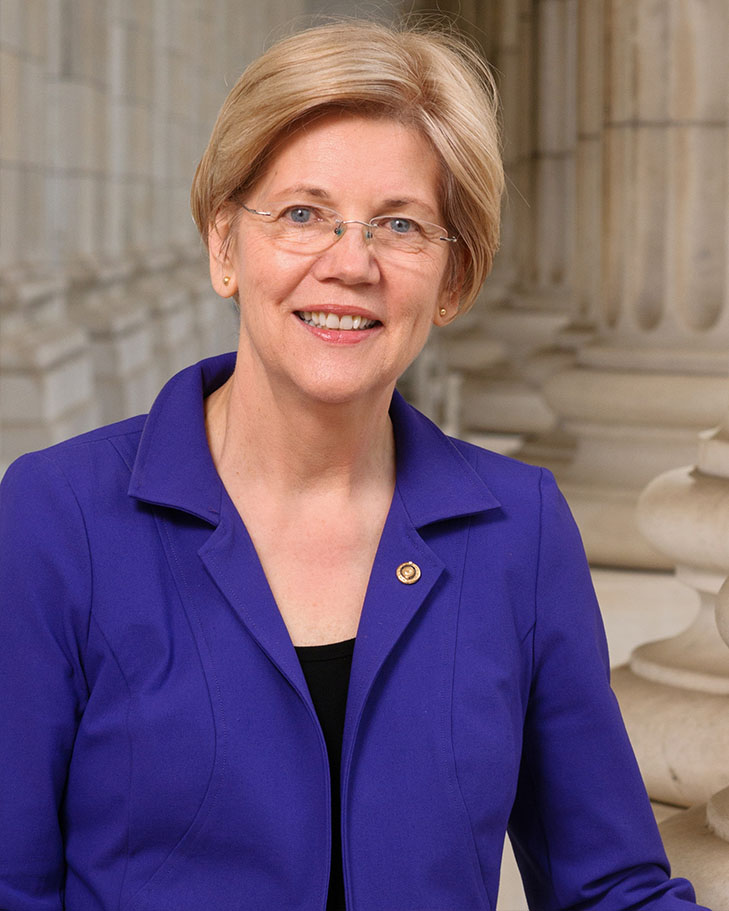
Elizabeth Warren, a fearless consumer advocate who has made her life's work the fight for middle class families, was re-elected to the United States Senate for a second term on November 6, 2018, by the people of Massachusetts.
Elizabeth is one of the nation's leading progressive voices, fighting for big structural change that would transform our economy and rebuild the middle class
Office Locations


311 Hart Senate Office Building
Washington, DC 20510
Phone: (202) 224-4543
The U.S. Senate Committee on Banking, Housing, and Urban Affairs is one of twenty Senate committees tasked with conducting Senate business related to specialized areas of legislative interest. Although the Senate has a longstanding history of writing and passing legislation focusing on our nation's banks, the Senate Banking Committee was not formally established until 1913, with Senator Robert Owen of Oklahoma, sponsor of the landmark Federal Reserve Act, as its first Chairman; since then, the Committee has undergone various transformations and reorganizations. Now known as the Committee on Banking, Housing, and Urban Affairs to underscore the diversity of issues under its purview, the Committee plays an integral role in managing legislation that affects the lives of many Americans. These areas of jurisdiction include, but are not limited to: banking, insurance, financial markets, securities, housing, urban development and mass transit, international trade and finance, and economic policy (an official list of these legislative and policy issues can be found in the Jurisdiction section of our website). Further information about how Senate Committees generally operate can be found here.
The Committee is led by Chairman Tim Scott (R-SC) and Ranking Member Elizabeth Warren (D-MA). The Committee is currently made up of 24 Senators; 13 Republicans, and 11 Democrats.
Thank you for visiting the U.S. Senate Committee on Banking, Housing & Urban Affairs website. If any of your questions were not answered by our website, please contact us by phone, fax, or mail.
U.S. Senate Committee on Banking, Housing, and Urban Affairs
534 Dirksen Senate Office Building
Washington, D.C. 20510
BRUTAL: Elizabeth Warren Reads Off '100 Reports Of Corruption' From Trump's First 100 Days In Office

BREAKING NEWS: Trump Hosts Canada's Carney In Oval Office, Takes Multiple Questions From Reporters
CBC News: The National | Trump reignites 51st state threat


Trump reiterates 51st state threat as Carney prepares for critical White House meeting
President says he’ll 'always talk about' Canadian statehood during NBC interview
U.S. President Donald Trump is doubling down on threats to make Canada the 51st state and says he'll "always talk about that" as Prime Minister Mark Carney prepares for a crucial White House meeting and insists Canadian sovereignty is not up for discussion.
"You don't even realize what a beautiful country it would be. It would be great," Trump told host Kristen Welker during an interview on NBC's Meet The Press which aired Sunday.
"I'll always talk about that. You know why? We subsidize Canada to the tune of $200 billion a year," Trump added, reiterating his false claim over the U.S. trade deficit with Canada.
When asked if he'd consider using military force to annex Canada, Trump said he thinks "we're not gonna ever get to that point" but "something could happen with Greenland" — the autonomous Danish territory which he's also mentioned absorbing.
The U.S. president's renewed threats come as Carney prepares to meet him on Tuesday for a comprehensive set of discussions on tariffs and the broader Canada-U.S. relationship.
 Carney to meet Trump at White House on Tuesday
On Friday, at his first press conference since becoming prime minister, Carney said he's going to the White House "with the expectation of constructive — difficult, but constructive discussions."
But Carney has long maintained he would only speak with Trump once the U.S. president shows respect for Canada. The prime minister was pressed by reporters on this issue during his press conference.
"It's always important to distinguish want from reality," Carney said in response, adding that Canadians have clearly stated that Canada will never join the U.S.
"There'll be zigs and zags, ups and downs, but as I said in my remarks I will fight for the best deal for Canada and only accept the best deal for Canada."
Trump told Welker that he congratulated Carney for his election win. The U.S. president also noted Carney's minority government will "make things a little bit difficult for him to run. But he nevertheless had a victory and he's a nice man, I'd think."
Carney-Trump meeting 'a good start'
Everett Eissenstat, who served as deputy director of Trump's National Economic Council during his first term, says the upcoming meeting is "certainly a good start" but "it's unlikely that the relationship will be sorted out within a single meeting."
Eissenstat's advice to Carney is pragmatism over emotions. He said in an interview on Rosemary Barton Live there's "an opportunity to open the aperture beyond just the traditional trade discussion that I think could be very, very fruitful."
 What to expect when Carney goes to Washington?
"The president wants to achieve a different type of relationship," Eissenstat told host Rosemary Barton on Sunday. "It's obvious to me in hearing some of the comments from the now- prime minister that he does as well."
There are a lot of tariffs on the table, Eissenstat said. The U.S. has imposed 25 per cent tariffs on Canadian steel and aluminum, non-U.S. content of Canadian-made passenger vehicles and goods that aren't compliant with the Canada-U.S.-Mexico Agreement (CUSMA).
There's also 10 per cent tariffs on energy products in CUSMA and potash products not covered by CUSMA. Canada has retaliated with tariffs on more than $60-billion worth of U.S. goods and on vehicles imported from the U.S. that are not CUSMA-compliant.
Eissenstat said getting rid of those tariffs could be contingent on Canada addressing other irritants Trump has raised, like defence spending.
And then there's the 51st state threats. "I don't conceivably see any scenario where that could actually happen, but I do understand how disturbing it is and how emotive that language can be," Eissenstat said.
Anand 'enthusiastic' about Carney's meeting
Innovation Minister and Oakville East MP-elect Anita Anand told Barton that she's "very enthusiastic" about Carney's upcoming meeting. She added Carney can now fulfil his election mandate to ensure "Canada's economic sovereignty is protected."
"My hope and our hope is that this will be the continuation of a productive conversation and a productive relationship between our two countries," Anand said, adding that the White House meeting is the start, not the end of Canada's dialogue with the United States over shared issues.
 Minister
of Innovation, Science and Industry Anita Anand arrives for a cabinet
committee on Canada-U.S. relations and national security on Parliament
Hill in Ottawa on Friday, April 11, 2025. (Sean Kilpatrick/The Canadian Press)
Minister
of Innovation, Science and Industry Anita Anand arrives for a cabinet
committee on Canada-U.S. relations and national security on Parliament
Hill in Ottawa on Friday, April 11, 2025. (Sean Kilpatrick/The Canadian Press)
As Canada irons out its relationship with the United States, Carney will need to contend with a minority government that requires cooperation from other parties.
Anand said she hopes there will be more collaboration at the House of Commons and pointed to Canada's COVID-19 response as a sign federal parties can work together to address critical issues.
"There is room for us after this election to come and to say 'let's work together in the best interests of our great country,'" Anand said.
ABOUT THE AUTHOR

With files from Jenna Benchetrit, Sarah Ramsaran and Sarina Mohan
Trump’s meeting with Carney to unfold against a backdrop of renewed 51st-state rhetoric
 U.S.
President Donald Trump boards Air Force One prior to departure from
Palm Beach International Airport in West Palm Beach, Fla., on May 4.SAUL LOEB/AFP/Getty Images
U.S.
President Donald Trump boards Air Force One prior to departure from
Palm Beach International Airport in West Palm Beach, Fla., on May 4.SAUL LOEB/AFP/Getty ImagesU.S. President Donald Trump says it’s “highly unlikely” he would resort to military force to annex Canada but is adamant that the border separating it from the United States is “an artificial line” that prevents the two territories from forming a “beautiful country.”
Speaking to NBC just days before his first in-person meeting with Prime Minister Mark Carney, Mr. Trump declined to flatly rule out a military invasion of Canada, instead saying that it’s not a course of action he envisions taking but that as a “real estate guy at heart,” he feels the two countries should be joined.
The President’s comments ensure that his persistent talk of making Canada the “51st state” will loom over his planned May 6 meeting with the Prime Minister. The sit-down comes at a nadir in bilateral relations after Mr. Trump made Canada and Mexico the opening salvo of his global trade war and after he declined in January to rule out using “economic force” to achieve annexation.
When Mr. Carney, fresh from his election victory, visits Mr. Trump at the White House Tuesday, he will be seeking a grand bargain to end Mr. Trump’s tariffs and assuage Washington’s concerns about Ottawa’s security and defence spending.
As the Prime Minister announced back in March, he and Mr. Trump agreed that after the election the two countries’ leaders would commence negotiations on a “comprehensive economic and security” deal.
But Mr. Carney, who rode Canadian anger over Mr. Trump’s threats to electoral success, faces a perilous task in rejecting the annexation talk without jeopardizing more than US$1.2-trillion in annual trade.
In his remarks to NBC‘s Meet the Press, which aired Sunday, Mr. Trump tried to make the case that Canada has no leverage when it comes to trade talks. “We don’t need their cars, we don’t need their lumber, we don’t need their energy. We don’t need anything,“ he said. “They need us. We don’t need them.”
“They think we are going to protect them, and really, we are. But the truth is, they don’t carry their full share, and it’s unfair to the United States and our taxpayers.”
He described the Canada-U.S. border as “an artificial line that was drawn with a ruler many years ago.”
Asked whether he would send the U.S. military to take a sovereign territory, Mr. Trump said it “certainly could happen with respect to Greenland.” On Canada, he said, “I think we’re not going to ever get to that point,” adding later that “it’s highly unlikely. I don’t see it with Canada.”
The U.S. President has so far outlined few concrete demands of Canada, meaning much of Tuesday will be spent trying to determine what he wants specifically, whether Ottawa can accommodate any of it and if any sort of deal is even possible.
It has left Mr. Carney himself playing down expectations for the May 6 meeting. “Do not expect white smoke,” he said Friday, referring to the signal at the Vatican that a new pope has been elected.
Brian Clow, who previously served as deputy chief of staff to Justin Trudeau, and played a senior role in Canada-U.S. relations for more than nine years in the Prime Minister’s Office, said Tuesday’s meeting is an opportunity for these leaders to begin a relationship and take the measure of each other.
He expects the Canadian delegation will enter the White House with the outlines of a proposal for co-operation but that this could only ultimately succeed if the U.S. tariffs were removed from Canadian products.
“The measure of success for this meeting is to set the foundation for further talks that will hopefully lead to quick removal of tariffs,” Mr. Clow said. “But I really don’t expect removal of tariffs on Tuesday, and I don’t think anyone should expect that. It’s going to take some time.”
Statehood for Canada is off the table. Mr. Carney has flatly ruled out annexation and declared that Canada’s old relationship “of steadily increasing integration with the United States” is over in the age of Mr. Trump.
“The questions now are how our nations will co-operate in the future and where we in Canada will move on,” he said Friday, meaning where the two countries will diverge.
So what kind of deal on trade and defence spending can be struck to end the conflict? Or more pointedly, what does Mr. Trump hope to achieve in talks with Canada?
“It’s a question that that we, and I think a lot of people, have struggled with,” Mr. Clow said of his time in the Trudeau government. “And it’ll be something the Prime Minister and his team are surely already trying to scope out, and which these talks and further engagements after will hopefully illuminate.”
The U.S. President has been clear about wanting to bring back manufacturing to the United States, and he has said tariffs are designed to force companies to relocate factories inside American borders.
Roland Paris, an international affairs expert at the University of Ottawa and former adviser to Mr. Trudeau, said that while Mr. Trump has tried to make nice with Mr. Carney so far, he has not dropped his 51st-state messaging.
“It’s still not clear what the United States is putting on the table with regards to Canada, what their demands will be. We’ve only had a smattering of grievances as opposed to an opening offer,” he said.
One possible move for Canada would be to try to quickly open negotiations over a renewal of the U.S.-Mexico-Canada Agreement (USMCA) to funnel Mr. Trump’s complaints about Canada into a more controlled setting.
“Having a negotiating table would provide a structure to Trump’s free-form style, a way of channelling the discussion if Trump wakes up one day deciding to criticize some other element of Canadian policy,” Prof. Paris said.
The mounting toll that Mr. Trump’s global trade war will take on the U.S. economy will also work to Canada’s advantage by cranking up the pressure on the White House to reverse course, analysts say.
Much of Mr. Carney’s strategy involves pressing the Trump administration to back down: Canada is one of the few countries to impose retaliatory tariffs on the U.S. and is also working with trade-aligned American politicians and businesses to fight back against Mr. Trump’s protectionism.
“Time is on our side. With every week that goes by, the inflationary impact of Trump’s tariffs will become clearer to people. He’s aware of this mounting concern and that’s only going to grow,” Prof. Paris said.
Even if Canada tries to mollify Mr. Trump, it is unclear that such an approach can actually work.
Canada’s efforts to meet Mr. Trump’s concerns on fentanyl failed to resolve this matter. Only five months ago, Mr. Trudeau, the prime minister at the time, flew to the United States to find a solution. After returning, he pledged $1.3-billion more in spending over six years on helicopters, drones, surveillance gear and border-security employees to address Mr. Trump’s concerns about fentanyl and illegal immigrants entering the United States from Canada.
Despite the fact that statistics show a very small fraction of illegal fentanyl is seized at the U.S.-Canada border, Ottawa also appointed a “fentanyl czar” to oversee a crackdown on illegal production and distribution of the opioid.
None of this stopped Mr. Trump from imposing 25-per-cent tariffs on all Canadian goods − and 10 per cent on energy, critical minerals and potash − before exempting most imports from Canada from this levy.
“We put a whole bunch of extra resources and money into it, and it turned out to not to satisfy the Americans,” Mr. Clow said.
Mr. Trump’s beefs with Canada − and he has listed many − are in some cases based on questionable information.
He alleges that the United States is subsidizing Canada by about US$200-billion per year. For months, he’s suggested that this is connected to the trade imbalance between Canada and the United States where U.S. customers buy more goods from Canada than vice versa. For merchandise alone, the U.S. trade deficit with Canada has averaged a little more than $100-billion annually for the past three years. Its deficit is smaller when services are taken into account.
Mr. Clow said he suspects the balance of Mr. Trump’s $200-billion grievance figure includes a notional estimate of how much the United States spends on protecting Canada. “They are attributing some level of defence spending to that number and calling it a subsidy of Canada.”
The current U.S. levies on Canada that remain in effect include 25-per-cent tariffs on Canadian steel and aluminum, as well as a 25-per-cent tariff on Canadian-made vehicles, which applies only to the non-U.S. content in those cars and light trucks. There is also a 25-per-cent tariff – which drops to 10 per cent on critical minerals, energy and potash – for goods that don’t comply with USMCA rules of origin.
Canada responded with a series of countertariffs on tens of billions of dollars of U.S. imports.
One area where Mr. Carney can demonstrate progress is military spending.
He promised during the election campaign to speed up the timeline for Canada to reach NATO’s target of military spending equivalent to 2 per cent of GDP. This will cost Canada about $20-billion more per year and Mr. Carney is preparing plans to reach this threshold by 2030 instead of 2032, as Mr. Trudeau had promised.
In a recent open letter to Mr. Carney, Business Council of Canada president Goldy Hyder cautioned against seeking a bilateral trade deal with the United States instead of a trilateral agreement including Mexico.
“In our view, a bilateral arrangement could create unnecessary risk and undermine Canada’s mutually beneficial trilateral economic partnership with the United States and Mexico,” Mr. Hyder said.
He said Ottawa’s priority should be expediting the scheduled 2026 renewal of the USMCA and starting negotiations on updating it. Mr. Hyder said business leaders in all three countries believe this route is the “only way to restore the certainty, stability and predictability required to regain the investor confidence that underpins our continental economy.”
Laura Dawson, who heads a business group pushing for more integration across the Canada-U.S. border, said that despite Mr. Trump’s rhetoric, there are areas in which Mr. Carney may be able to establish common ground: the U.S.’s need for critical minerals and concern for Arctic security, for instance.
“It doesn’t make sense for Canada to just go on an appeasement campaign and say ‘whatever you need, we’ve got it,‘ but it does make sense for Canada to figure out where its own interests lie and where those intersect with the United States,” said Ms. Dawson, executive director of the Future Borders Coalition.
“Engagement with the United States is not the same as capitulating.”
https://www.theglobeandmail.com/authors/adrian-morrow/
amorrow@globeandmail.com
adrianmorrow (at) protonmail
Deja Vu Anyone???
https://the1a.org/guests/adrian-morrow/
Who’s afraid of a trade war? And who should be?
https://www.theglobeandmail.com/authors/steven-chase/
schase@globeandmail.com
Steven Chase, The Globe and Mail
National Correspondent, Globe and Mail newspaper, Canada

Location: Ottawa bureau

Twitter handle: @stevenchase

Work email: schase at globeandmail dot com

Confidential contact information:

Signal: schase at globeandmail dot com

Confide: schase at globeandmail dot com

Even more secure email: ProtonMail: stevenchase at protonmail dot com
Mike Blanchfield
Mike Blanchfield is the Director of Energy and Global Affairs for the Public Policy Forum. Mike is an award-winning author and journalist who spent decades covering international affairs, politics, defence, security, trade and development for major Canadian news outlets.
He has been based on Parliament Hill since 1998 but his reporting has taken him around the world, to the front lines of the wars in Afghanistan and Iraq, and to conflict and disaster zones in Africa and Asia. He extensively covered the renegotiation of the North American Free Trade Agreement during the Trump administration and the creation of the Canada-European Union Comprehensive Economic and Trade Agreement. He has had numerous reporting assignments in Washington, D.C. from the contentious 2000 U.S. Presidential election that took him to several states, to anchoring the then Southam News newspaper chain’s coverage of the 9/11 attacks, to the Oval Office in 2019 to witness some memorable moments between Justin Trudeau and Donald Trump. He has travelled the world with four Canadian prime ministers, covering official visits and almost every permutation of multilateral summitry. He is the co-author (with Fen Osler Hampson) of the award-winning The Two Michaels: Innocent Canadian Captives and High Stakes Espionage in the US-China Cyber War and is the author of Swingback: Getting Along in the World with Harper and Trudeau.
He won the 2013 R. James Travers Foreign Corresponding Fellowship. He has also taught reporting techniques at Carleton University’s School of Journalism and Communication, where he received a Master of Journalism.

No comments:
Post a Comment