Date: Wed, Jun 25, 2025 at 8:09 PM
Subject: Finally, a real debate about Alberta’s future
To: David Amos <David.Raymond.Amos333@gmail.com>
|
|||||||||||||||||||||||
|
|||||||||||||||||||||||
|


|
This email was sent to David.Raymond.Amos333@gmail. To stop receiving emails, click here. |

Less than 1 year into job, David Knight Legg steps down as CEO of Invest Alberta
The former advisor to Jason Kenney will prioritize family, according to the corporation
The CEO of the government's new investment attraction crown corporation, Invest Alberta, is stepping down after less than a year on the job.
David Knight Legg is instead shifting into a part-time advisor role with the corporation.
"A decision that was not easy to come by, Dr. Knight Legg needs to prioritize time with his family who he has not seen due to COVID-19 travel restrictions for over 18 months," reads the notice from board chair Scott Hutcheson.
Knight Legg's family lives in Singapore.
The management of Invest Alberta will expand to include two new vice presidents, Lynette Tremblay and Greg Baker.
Baker will also serve as interim CEO until a new permanent leader is identified following a national search set to begin next week.
"I'm incredibly proud of the success and agility of the [Invest Alberta] team to adapt to the unique environment we've been working in. Their efforts in just a few months have already made a positive impact on our province's economy and recovery," Knight Legg said in a release.
Knight Legg, a former international banker, was the top advisor to Premier Jason Kenney prior to being offered the CEO position in September.
Invest Alberta is less than a year old, established in July to attract investment to the province's different sectors like energy, technology and agriculture.
In 2019, Knight Legg was criticized by the opposition NDP for billing $45,000 in travel expenses over six months while working as Kenney's principal advisor. The government defended the expenses as reasonable costs for the trips.
Alberta Separatism Debate: David Knight Legg vs. Keith Wilson at Rebel News LIVE! Red Deer 2025
 Rebel News
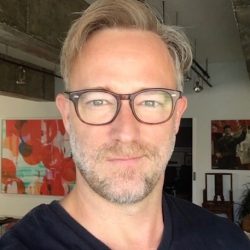
David Knight Legg
https://www.readtheorchard.org/p/in-red-deer-the-canada-strong-andIn Red Deer, the Canada Strong and Free Network prepares for culture war
Premier Danielle Smith may have snubbed fellow keynote speaker Christopher Rufo, but her remarks hammered on many themes that would likely resonate with the far-right agitator.
"The most amusing portion of the conference was hearing former federal Leader of Opposition Stockwell Day rant and rave about “cultural Marxism” on the conference’s final panel, which was ostensibly about Alberta’s efforts to create an “energy-secure future.”
I doubt Day, who once sat on the board of the Centre for Israel and Jewish Affairs (CIJA), despite not being Jewish, is aware of the antisemitic origins of the phrase cultural Marxism, nor do I suspect CIJA cares an iota about their associate’s fondness for this dog whistle, given their mutual, full-throated support for anything and everything Israel does—the reason he ever sat on the board to begin with.
Every question asked by moderator David Knight-Legg, Jason Kenney’s former chief of staff when he was premier, was an opportunity for Day to pivot towards what has quite clearly become an obsession for him.
I shuffled into the conference hall a tad late, just as Day was complaining about a “culturally Marxist dogma, related to oil and gas, to prosperity and the human condition” that seeks to shut down all energy production that isn’t cow dung.
In response to a question on how the energy industry can give Canada a bigger voice on the international stage, Day went to bat for nuclear energy, which makes up 55% of Ontario’s electricity grid and 40% of New Brunswick’s, but isn’t a source of electricity in any other province.
“More people are killed and injured installing solar panels than have ever been injured in any way with nuclear installations,” he said, as if the greatest danger posed by nuclear power plants is their construction.
“And by the way, I'm not promoting nuclear. I'm just talking about how we are afraid to talk about it.”
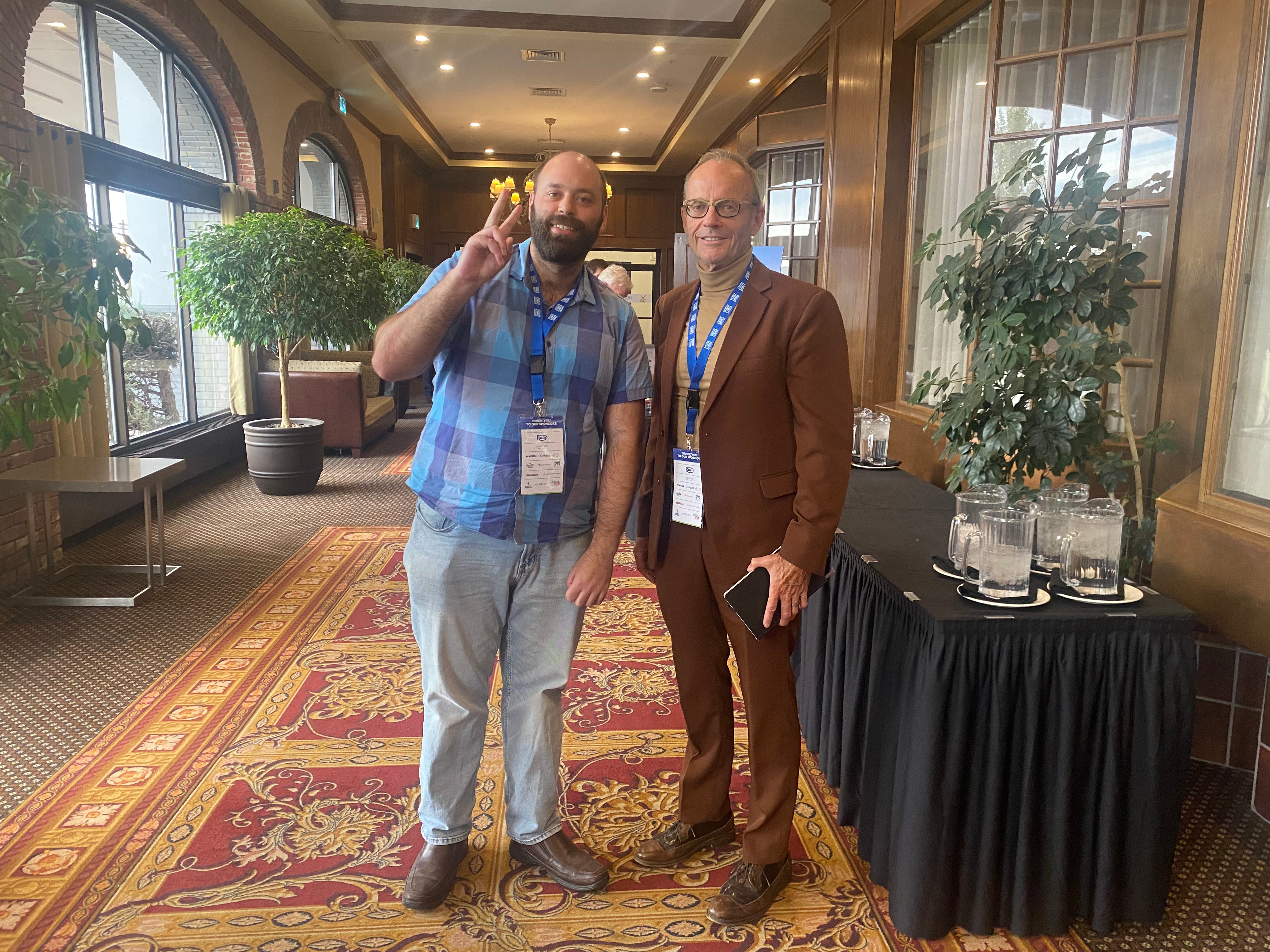
Why are we, whomever that may be, afraid to talk about it? Well, according to Day, that has something to do with university students feeling the need “to modify their papers to align with what the Marxist professor wants.”
“We're not going to change that, but we can through alternate institutions,” he said, adding that the Marxist infiltration of society begins before university.
For this reason, suggested that conservatives establish an alternative to the Alberta Teachers’ Association, which he claimed is “the only certifier of teachers” in Alberta.
Just one problem—the ATA doesn’t certify teachers. That’s what Alberta Education does.
Day closed his contribution to the panel, which need I remind you was about Alberta’s contribution to energy security, by providing an anecdote about how his granddaughter didn’t want him to kill a bee that had invaded his living room, because many bee species are going extinct.
“I'm telling you our upcoming generation is seized by a mindset that is culturally Marxist, uninformed or wrong, informed on these issues,” said Day.
The transformation of Stockwell Day from presiding over key
Cabinet portfolios in Stephen Harper’s government to someone whose
brain is so cooked by the internet that he sees preventing bees from
going extinct as a Marxist plot tells you everything about the
trajectory of Canadian conservatism.
https://www.counterpunch.org/author/jeremy-appel/
Jeremy Appel
Canada’s Nazi Problem
January 26, 2025Wave of Suppression Targets Palestinian-Canadian Workers
November 13, 2023Israeli Rabbi Describes Settler Rampages Across West Bank
November 3, 2023Meet the Hamas Massacre Survivors Opposing Israeli Brutality in Gaza
October 20, 2023Pro-Palestine Groups Want Calgary to Drop Green Line Contractor
October 14, 2022CounterPunch
Editorial
Mailing Address
G7 fortress summit keeps protesters—and reality—at a safe distance
My dispatch from the designated demonstration zones at the Kananaskis G7.
Kananaskis served as a fortress from June 15 to 17, sheltering world leaders from popular discontent over climate catastrophe, the genocide in Gaza, Indigenous rights, the exploitation of migrant workers and other issues that are a direct result of their failed policies.
In the weeks leading up to the G7 summit, the RCMP announced four “designated demonstration zones,” or DDZs, outside the Kananaskis district limits, which police naturally portrayed as a means of protecting the “safety of the protestors and general public.”
There were three dystopian DDZs in Calgary—outside city hall, near the Stampede grounds and a special viewing area outside the Calgary International Airport—and one in Banff—the Fenlands Banff Recreation Centre just outside the town limits.
"Creating these locations ensures minimal disruption to critical infrastructure such as roads or highways,” RCMP chief superintendent David Hall said, as if disrupting business as usual wasn’t precisely the point of mass protest.
Calgary, by the way, is 86 km from Kananaskis and Banff is 46 km away from the summit site.
By contrast, the last time the G7 was held in Canada, the Council of Canadians was irked that the designated democracy zone was 2 km from the Fairmont Le Manoir Richelieu in Charlevoix, Quebec.
The Mounties promised that each DDZ, save for the one at the Calgary airport, “will be equipped with infrastructure to broadcast demonstrators' messages to G7 Leaders and delegations in Kananaskis.”
Beyond a sign outside Calgary city hall to that effect and the surveillance drones buzzing overhead, I saw no indication that there was any livestream from the DDZs to the summit.
And besides, even if there was some sort of live feed for the world leaders, would any of them bother listening?
The entire purpose of hosting the G7 in Kananaskis is so that the most powerful people in the world don’t have to listen to the plebs, as was the case the last time it was held there in 2002.
Prior to the summit’s Sunday kickoff, there were two pieces of counter-programming that attempted to set the tone for the weekend.
The first was an art installation that activist groups Calgary Climate Hub, Indigenous Climate Action and Common Horizon set up at the Confluence (formerly known as Fort Calgary), which consisted of lettering on grass reading: G7 Pick a Path: Pipelines [or] Climate Action.
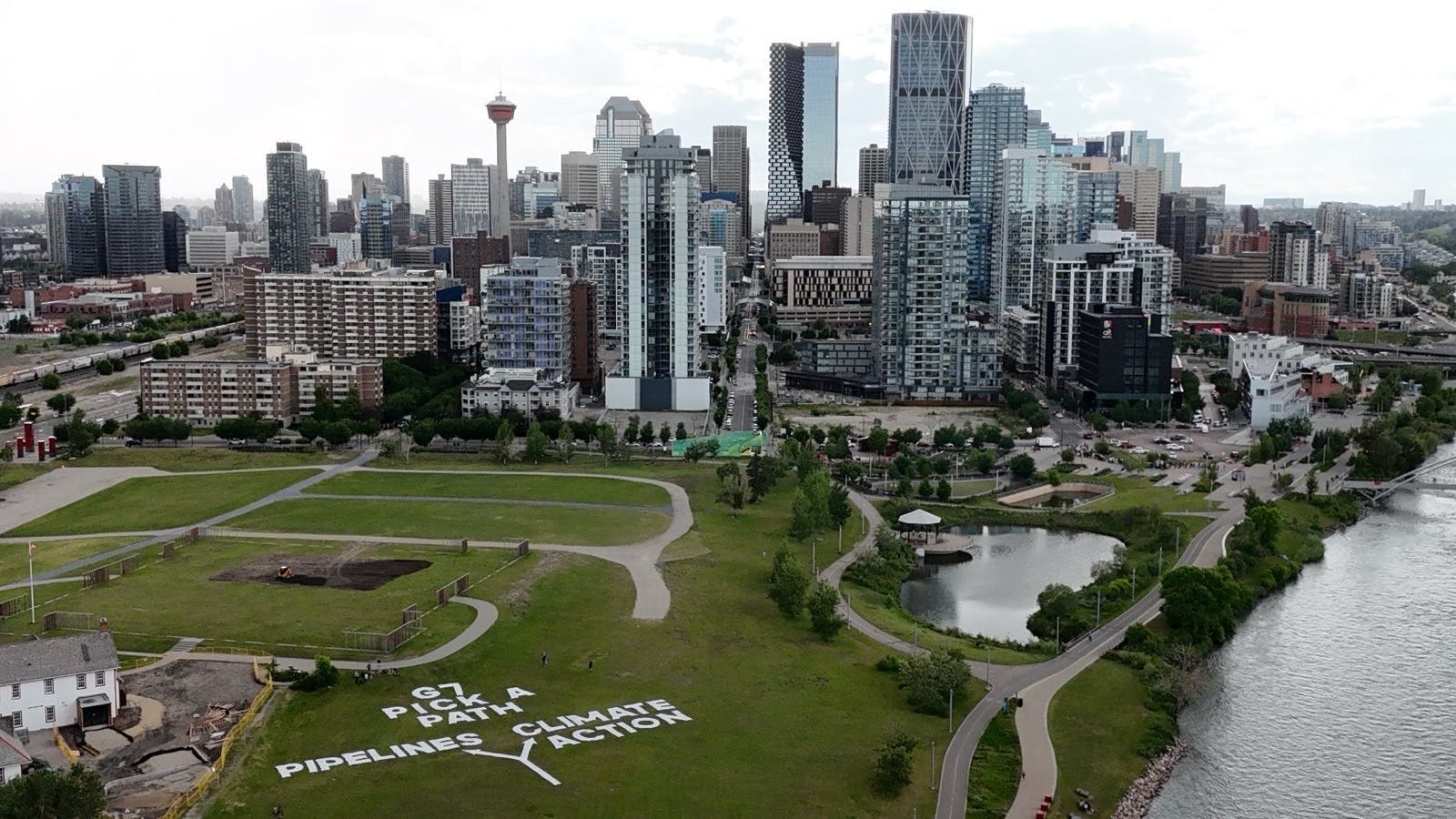
This was based on a similar installation installed in Ottawa after Carney was re-elected, which told the prime minister to pick the path.
Prime Minister Mark Carney, who has already introduced legislation that will make it quicker and easier to build fossil fuel infrastructure, appears to have made his choice. But even if Carney cannot be swayed, it’s worth reminding the broader public that there is an alternative.
On the same day, the International League of Peoples’ Struggle (ILPS) held a “people’s forum” to offer more alternatives to the priorities of the leaders about to gather in Kananaskis.
A key question that was raised at the forum, which was a theme throughout the weekend’s protest, was how to draw together a cohesive movement from the various issues being protested and sustain it after the G7 circus leaves town.
"The G7, it's happening for a few days, but it's going to wrap up and leave," Yasmeen Khan of the ILPS told CBC News.
"But the issues are still going to be there. So how do we, in Calgary and in Alberta particularly, build a people's movement?"
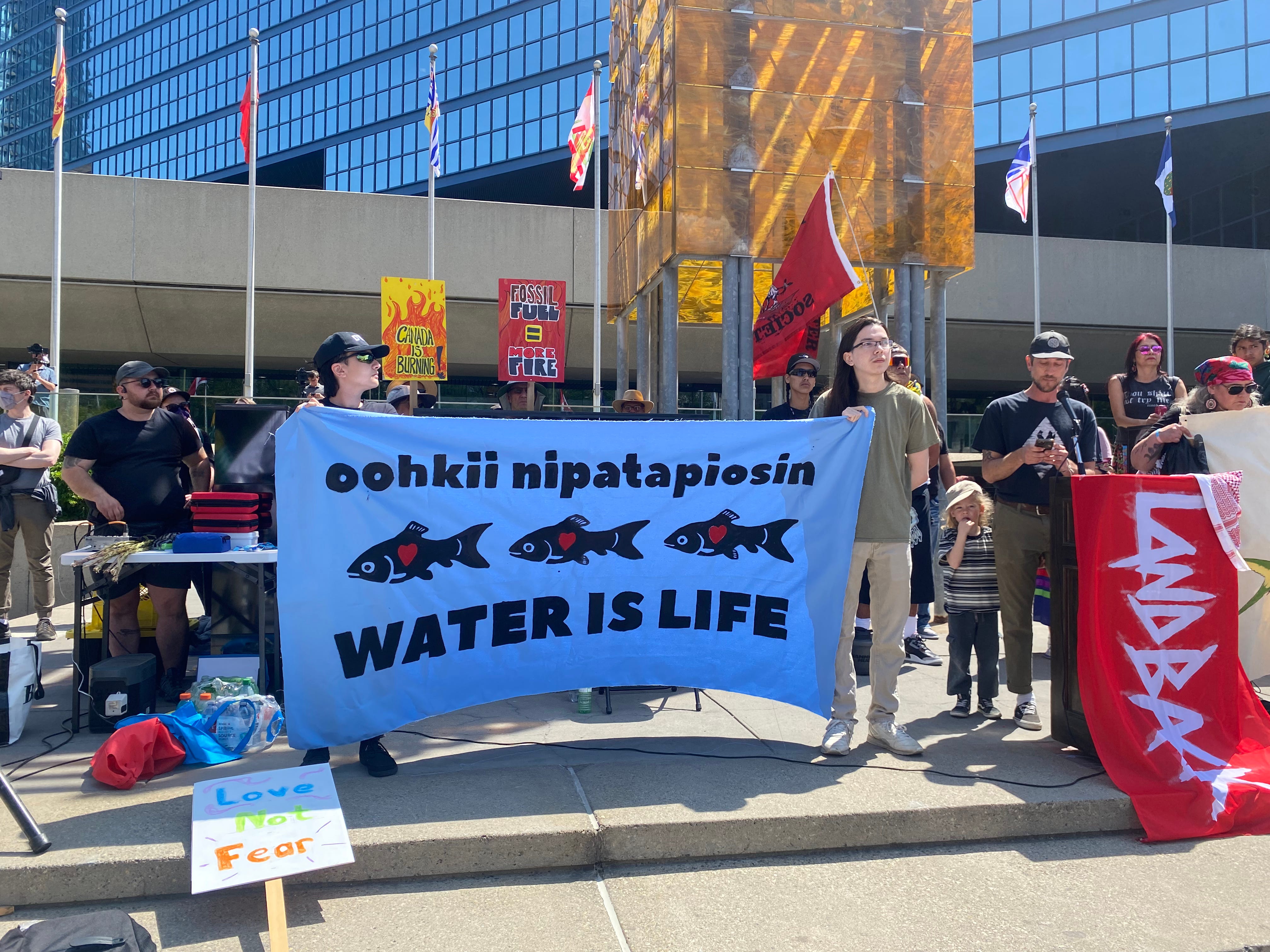
I arrived at city hall a bit early on Sunday for a noon protest in support Indigenous water rights, dubbed Hands Off Our Water, followed by a march against Western imperialism and the Gaza genocide organized by the ILPS.
I caught the tail-end of two concurrent protests. The first, occurring on the north side of the plaza was in support of Kashmir, which faces triple occupation by India, Pakistan and China. The other, on the plaza’s south side, drew attention to Ethiopia’s mass murder and forced displacement of the Amhara people.
There were people in keffiyehs gathering, Trots hawking newspapers and an eclectic array of signs—Canada Is Burning; Wind! Solar! No Coal; Israel Murdered 15 Medics in Cold Blood; Stop the Genocide in the Congo; and LandBack.
Rick Bell of the Calgary Sun, who spent a portion of the afternoon asking people in keffiyehs to disavow Hamas, said there were Maoists in attendance, but colour me skeptical of his ability to distinguish a Maoist from a Trot.
I would estimate that between the rally and march, there was somewhere in the realm of 1,000 people in attendance, which Bell noted was substantially smaller than Calgary protests when the G8 was held in Kananaskis in 2002.
What the Dinger didn’t note was that the protests 23 years ago occurred at the height of the anti-globalization movement, with demonstrators flying in from all over the world in an age before the deleterious climate impact of flight was as well known.
In this case, the only major contingent from outside Calgary was some protestors who bussed and carpooled down from Edmonton.
While the protest was centred on Indigenous water rights, the lineup included people from the climate, migrant rights, Palestinian liberation and Amhara justice movements.
The first speaker was Josie Auger, a Keepers of the Water board member from Bigstone Cree Nation in Treaty 8.
The Bigstone community of Lake Chipewyan had to evacuate in late May due to wildfires, which are becoming an increasingly frequent occurrence due to the climate crisis.
The G7 is an opportunity to remind world leaders that water scarcity is a global issue, said Auger.
“Our spirituality is connected to the sun, to the earth, to the water, and to the air we breathe, and so we remember these things, and we remember that we never gave up our rights to the water,” she added.
Calgary Climate Hub executive director Jared Blustein emphasized the conspicuous absence from the G7 agenda of climate change, income inequality and Indigenous self-determination “in any meaningful form.”
“This is even more troubling within our current social and economic context,” Blustein added.
“For too many years now, our lives, our families and our world have been increasingly economized. Today, a hyper form of capitalism threatens our collective future for the wealth and power of a few, often supported by the policies and actions of the varied nations meeting today in Kananaskis.”
Isa Carlin of Migrante Alberta aptly tied together the plight of Filipino migrant workers, the ecological crisis and imperialism.
The land in the Philippines is fertile, rich and plentiful, but it is owned by the political dynasty landlord families who serve the interests of foreign imperialists, including Canada, including the G7 governments.
These families exploit the land and transform our beautiful homeland into haciendas, or plantations, where we grow crops for export while farm workers and peasant farmers can barely afford rice.
Solving the problem of land ownership and land stewardship in our homeland is our greatest contribution, and it is our internationalist duty, so that we end the system of forced migration, which brings us to Turtle Island in a spirit of international solidarity.
Blackfoot activist Nicole Johnson said to great applause that she’s “tired of the First Nations being put on the back burner.”
“No more,” said Johnson.
Referencing a video (shot by yours truly) of Premier Danielle Smith asking protestors in Fort Macleod for “courtesy” as she excused her government’s plans to mine the eastern slopes of the Rocky Mountains for coal, Johnson praised the demonstrators.
“Courtesy is not what she got. Despite the lies that were put out there, the people spoke, and I was so happy the people were loud and clear,” said Johnson.
Blackfoot Elder Charlotte Yellowhorn McLeod emphasized the universal nature of the struggle for Indigenous water rights, “because when we stand up for our water, it isn't just to drink water for Indigenous people, it's for you.”
“I’m really gratified to see all nations [are] here,” she added. “The only voice we're going to have is when we support each other.”
She explicitly connected the horrific images coming out of Gaza to the history of Indigenous Peoples in Canada.
“The Israelis are shooting at people, families and children, and it's a shameful thing. It hurts my heart to see that in the news,” Yellowhorn McLeod said. “And you know what? That happened to our Indigenous people in this country. We are still under genocide.”
And then we marched, with a heavy emphasis on the dire situation in Palestine.
The cops boasted to the Canadian Press in May that hosting the G7 is “the largest domestic security operation" conceivable, and they certainly acted like it.
There were hundreds of Calgary Police Service (CPS) officers decked out in riot—err, tactical—gear along the perimeter of the march route, which began north along Macleod Trail before turning west on 6th Avenue S.E.
At that intersection, somebody pelted protestors with eggs from a rooftop.
The cops, who were snapping photos of protestors throughout the march, didn’t seem too interested in finding out who did that.
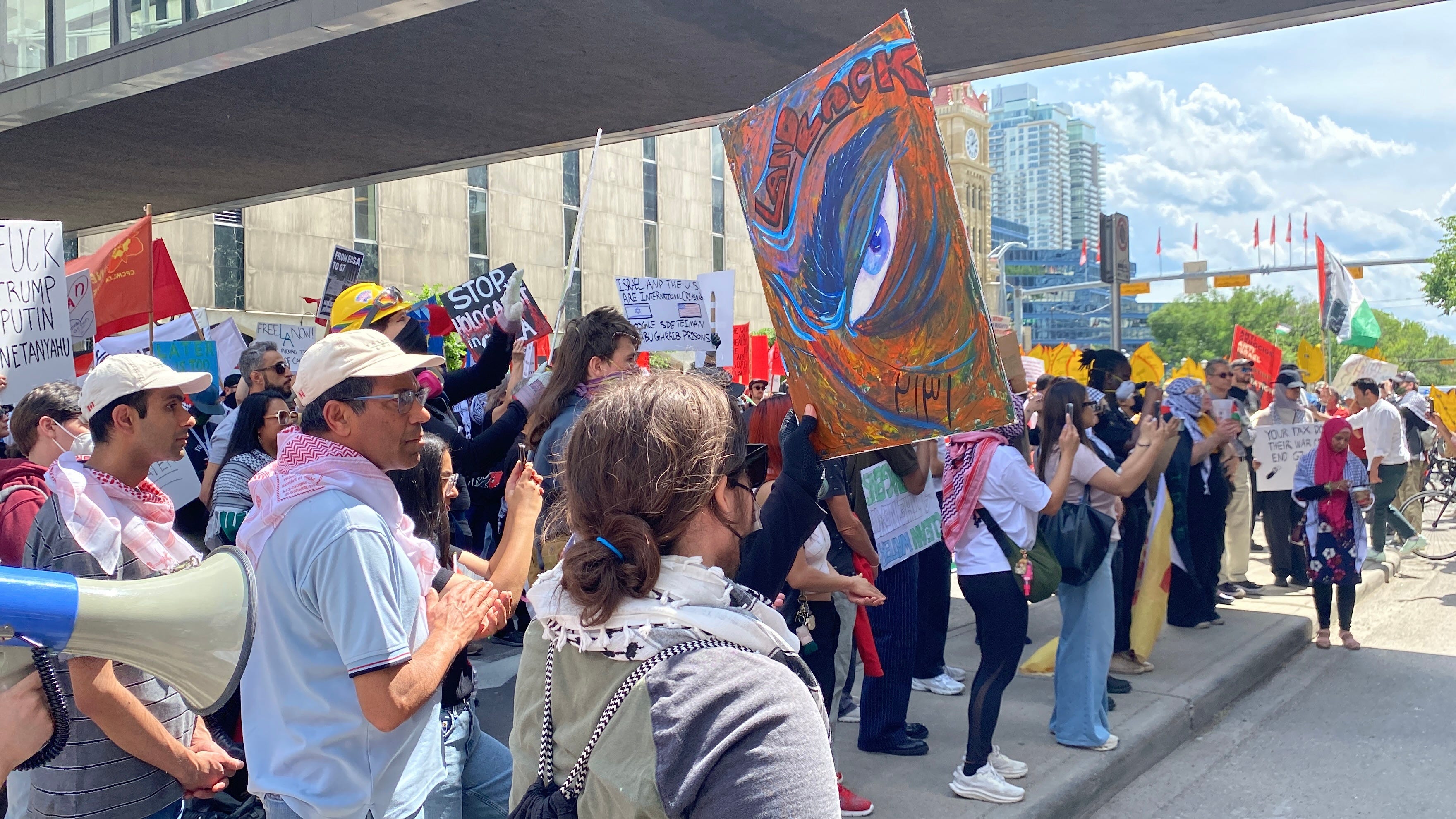
The chants at the march would be familiar to anyone who’s attended a Palestine solidarity protest over the past two years—free free Palestine; from the river to the sea, Palestine will be free; CPS, KKK, IOF, they’re all the same; Carney, Carney, you can’t hide, we charge you with genocide.
The original plan was to march along Stephen Avenue, but police blocked the protestors from accessing the pedestrian street, forcing them back along to city hall.
Once we returned to city hall, one of the march leaders announced on their megaphone that the cops had stopped blocking Stephen Avenue, and so we marched back.
As we made our way along Stephen, I spotted a couple Israeli and American flags visible in the distance.
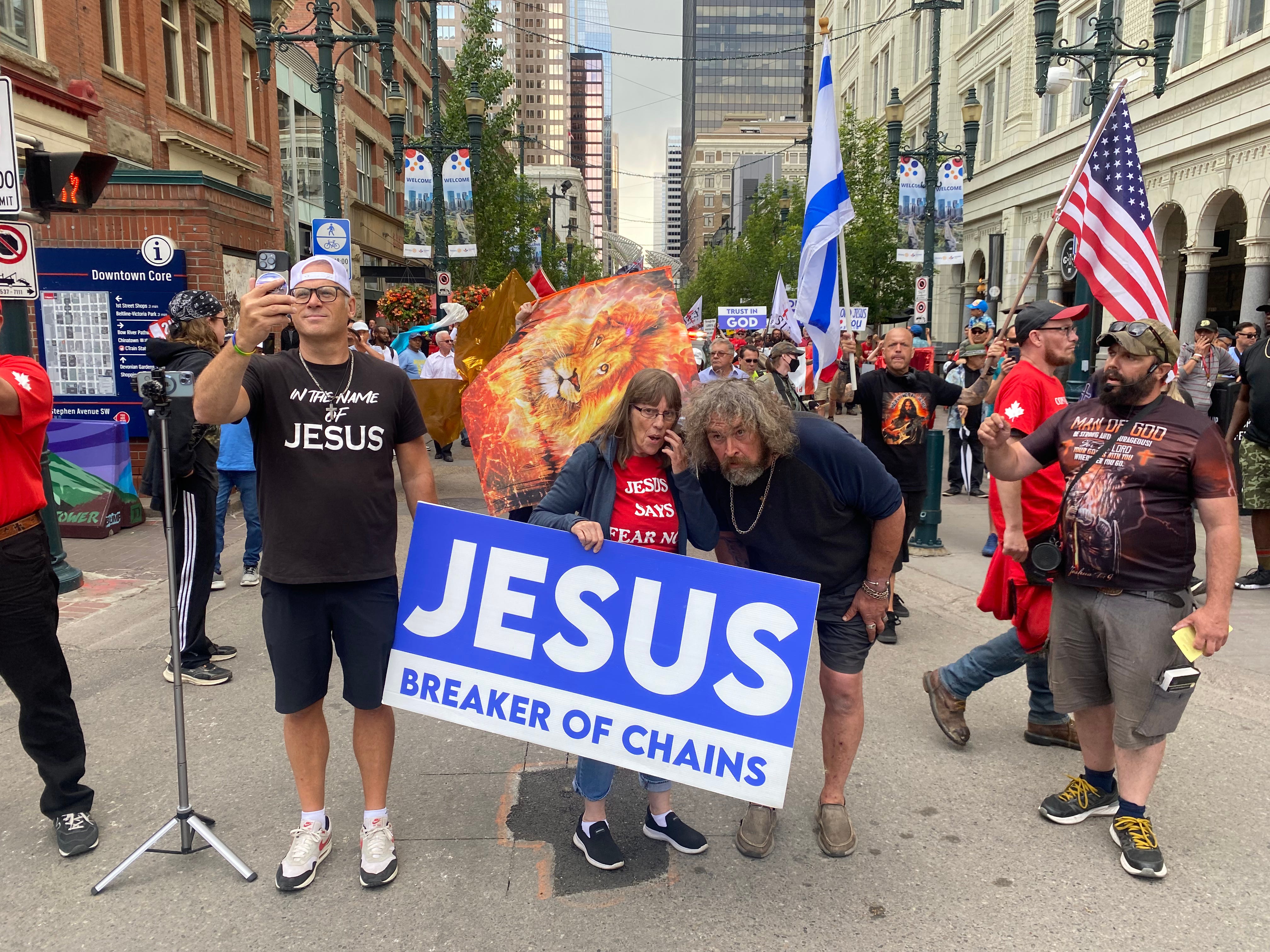
I thought it might have been some organized counter-protest of the sort that Palestine solidarity demonstrations in Calgary have regularly encountered over the past two years.
Taking off my keffiyeh and stuffing it in my back pocket to check out the other protest, I realized it was just a bunch of Jesus freaks. I spotted notorious local hate preacher and convicted criminal Artur Pawlawski near the front of their march.
One protestor was shouting Jesus! repeatedly at the top of their lungs, and another person wearing a portable voice amplifier said in response to our chants: “Only Jesus can free Palestine.”
As the two groups approached each other, the cops got between us, pushing the far larger anti-G7 march back while shouting move in unison to allow the relatively small band of Jesus freaks to turn at the intersection.
There was, to my knowledge, no arrests or violence, but the sheer size of the police presence added to the dystopian vibe of the DDZ.
The next day, I hitched a ride to Banff with Dr. Joe Vipond of Calgary Climate Hub, who was giving a speech at a climate rally in the closest DDZ to the summit.
That event was much smaller than the one in Calgary the day before, attracting dozens rather than hundreds of attendees.
As was the case with the previous day’s event, the Banff protest wasn’t confined strictly to the topic at hand, with supporters of Ukraine and Palestine speaking alongside Indigenous and climate activists.
Event organizer Scott Diehl astutely threaded the needle between war and climate catastrophe in an interview before the event, noting that we’re living in an age of “polycrisis.”
“Let's remember every time that a bullet is fired and every time that a bomb is dropped, it adds to the greenhouse gas emissions. Not only is it a terrible human tragedy, but it's a terrible planetary tragedy,” said Diehl.
When we arrived at the parking lot of the Fenlands Banff Recreation Centre, there were Falun Gong protestors already gathered outside the building.
It’s hard to imagine why the ultraconservative anti-Communist cult, which adheres to the obscure spiritual practice of Falun Dafa, would be protesting the G7. China wasn’t invited to the summit and the Falun Gong-owned propaganda rag, the Epoch Times, loves Donald Trump and fossil fuels.
A well-intentioned organizer, certainly unaware of Falun Gong’s backstory, permitted a couple of the cult members to speak near the end of the event, with one proceeding to blame the riots in Los Angeles on Chinese subversion in front of a confused audience.
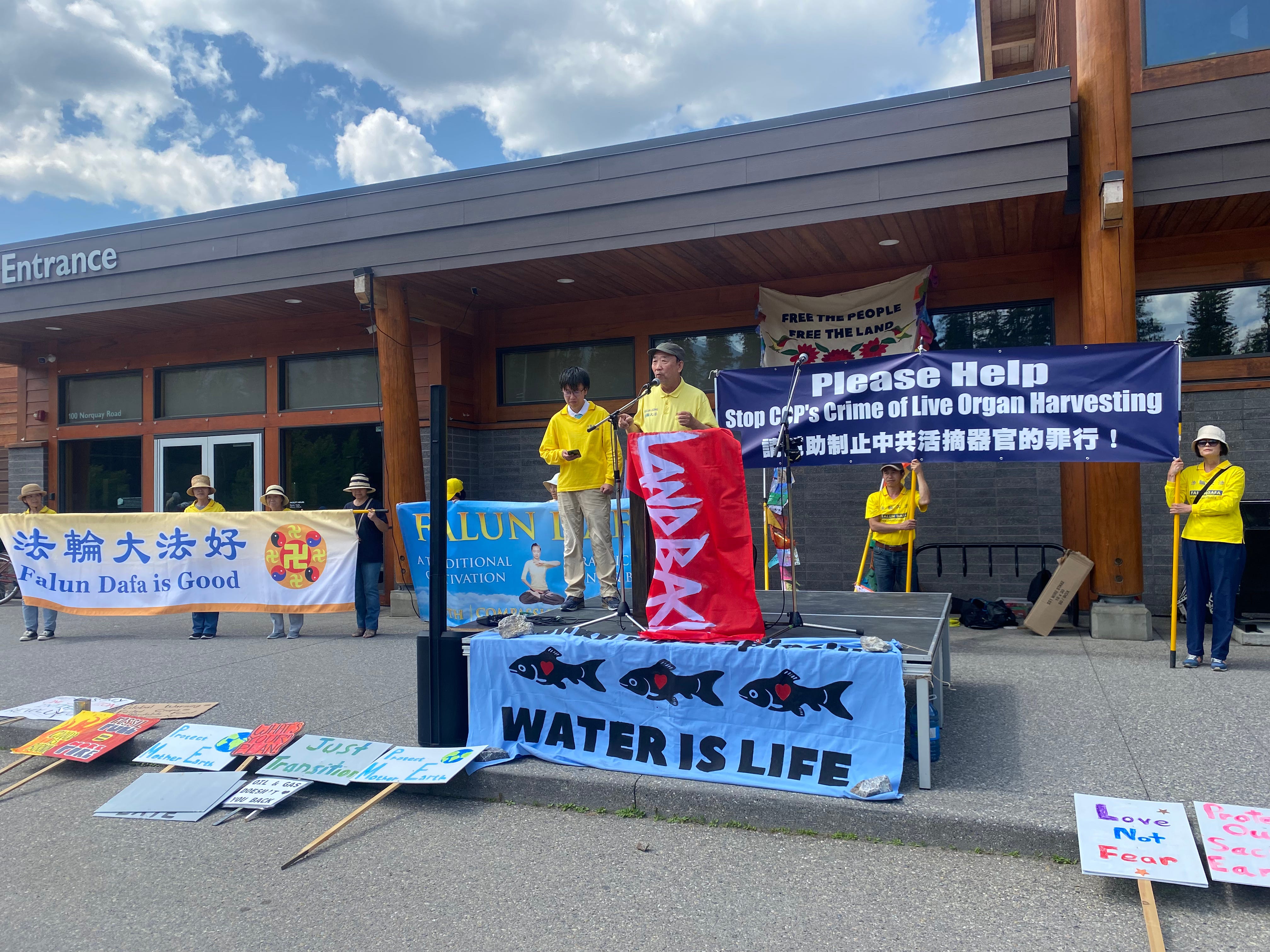
The imagery of a Falun Gong member raving about the evils of international Communism behind a LandBack banner was quite the sight to beholden.
I originally found the presence of Ukrainian protestors at an anti-G7 event somewhat confounding.
Ukrainian president Volodymyr Zelenskyy was invited to the summit; Russian president Vladimir Putin was not. But at the same time, Trump has indicated a shift away from U.S. support for Ukraine, and suggested he wants to reconstitute the G8 by bringing Russia back into the fold, which Ukrainians likely aren’t too thrilled about.
While there are superficial similarities between the situations in Ukraine and Palestine—namely, Russia’s occupation of parts of Ukraine and Israel’s occupation of all of historic Palestine—the way Ukraine has received billions of dollars in military aid from G7 countries has far more in common with Israel.
This point was illustrated when a person wrapped in an Israeli flag showed up alongside people draped in Ukrainian flags.
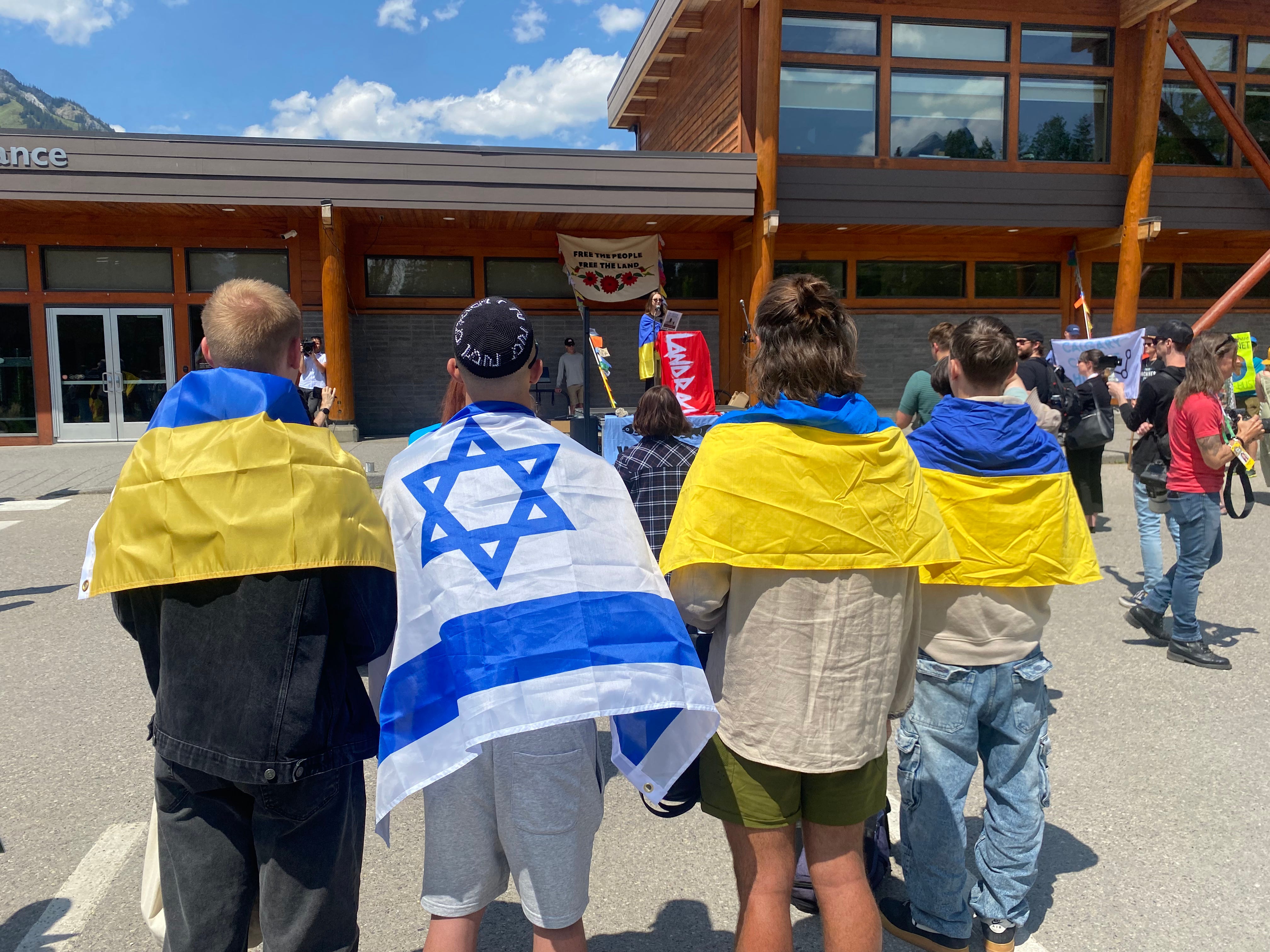
The pro-Israel attendee packed up his flag and left pretty early into the event, likely frightened by the presence of a small but mighty group of local Banff Palestine solidarity activists.
A Ukrainian-Canadian named Olga was the event’s first speaker, who framed Russia’s invasion of Ukraine as an “ecocide.”
Noting that the protest was occurring in a national park, she pointed to Russia’s devastation of the Askania-Nova nature reserve located north of Crimea, and likened Russia’s abduction of Russian-speaking Ukrainian children to Canada’s forced assimilation of Indigenous children.
Regardless of what you think of the origins of the war in Ukraine, and to what extent NATO expansionism provoked the Russian invasion, it’s undeniable that Ukrainian people are suffering greatly.
Speaking on behalf of ILPS, Shivanga Misra began by noting the “lip service” G7 leaders have played towards climate action before contrasting their words with the harsh reality:
As we stand here a few kilometers away from us, the leaders of the richest countries in the world are meeting in one of the most expensive resorts, surrounded by the Canadian Armed Forces and the RCMP, underwritten by hundreds of millions of dollars of public money.
Do you think that they've spent all this money, deployed their militarized police in order to help them fight climate change? No. There is no fighting climate change without Indigenous national liberation.
It is an imperialist colonial system that degrades and exploits the environment and those militarized police we have been seeing this whole weekend, those that are keeping the G7 leading politicians sheltered from the people, they are the same armed police who are forcing Indigenous land defenders off their lands, terrorizing and arresting people in order to make sure that the pipelines get built.
At the outset of his remarks, Dr. Vipond emphasized that he has “no illusions” that any of the G7 leaders are “listening to me or even care what I have to say.”
Vipond said he naively believed that
as the increasingly evident signs of climate collapse surrounded us, as the forests burned and the rivers rose and the climate dismounted, we would, as a prescient species focused on self-preservation, start to have more aggressive climate action, rather than capitulating to the heat, but we are being aggressively manipulated through propaganda and outmaneuvered.
Striking a more hopeful tone, he noted that “there are hundreds of billionaires, but there are billions of us.”
“If we want to be in the rooms, be at the negotiations, we need to rethink what we are doing. The marches and speeches are good, don't get me wrong, but we need more, louder marches and speeches,” said Vipond.
“We also need to do more organizing, more planning, more networking, more community and more love. So we're going to disperse today and go our various ways, but we need to gather together again soon and figure this out.”
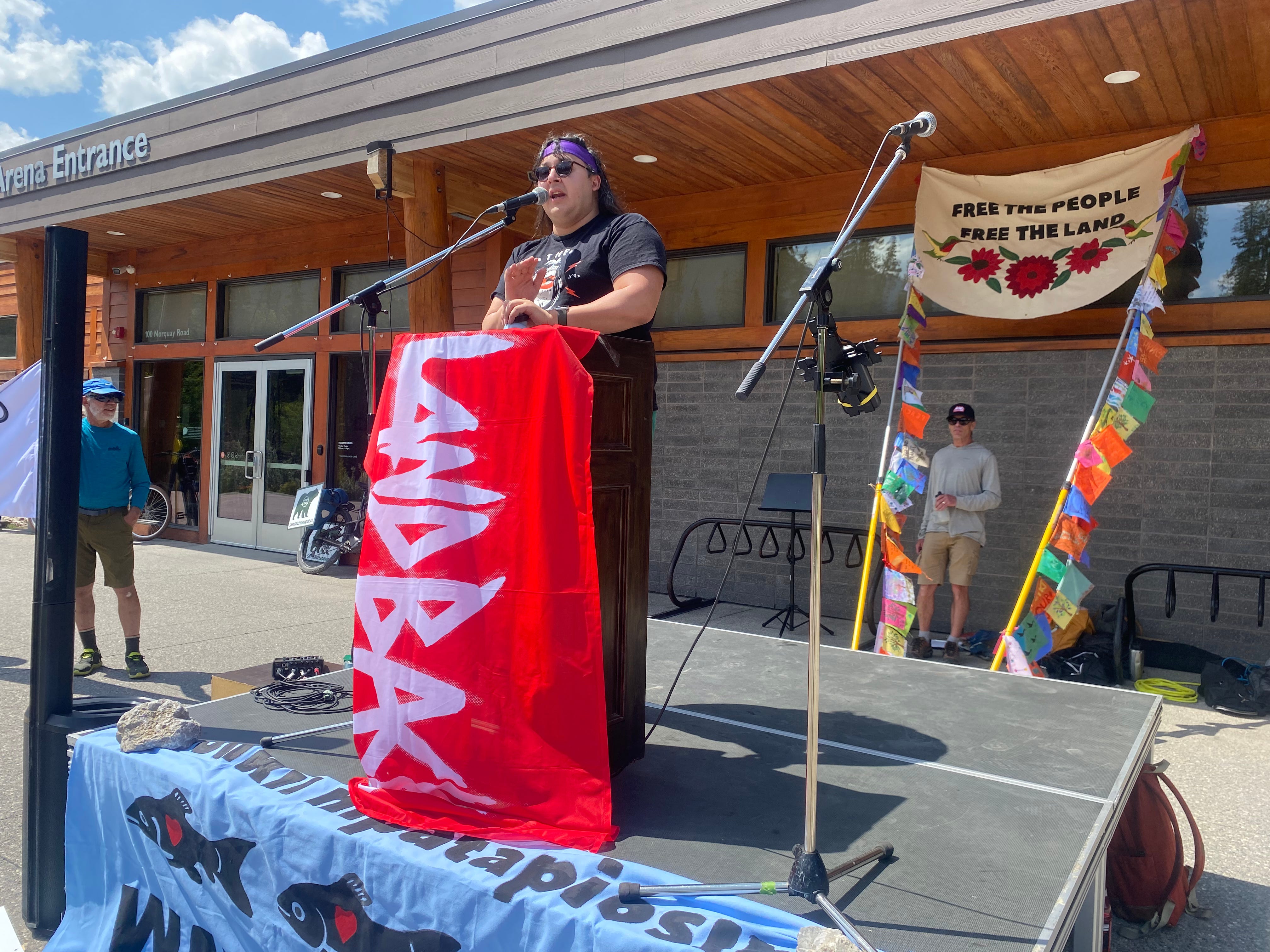
Nigel Robinson, Keepers of the Water’s community engagement coordinator, spoke of a need to combat the “active devolution of our species” by “coming together and sharing ideas and figuring out how we can do things a little bit better.”
Robinson, who’s from Cold Lake First Nations in northeastern Alberta, said that colonial powers wanted to “disempower indigenous people, take our land take our culture,” because “they knew that our culture contained a lot of power, and our culture was not based off of greed and genocide.”
Robinson, with whom I spoke at a Watershed Sentinel-hosted webinar about the carbon capture, utilization and storage scam, slammed Carney for promoting this “greenwashing false solution.”
“There is more than enough extraction. The oil and gas industries do not need to be expanded,” he added, criticizing the release of tailings sludge into the Athabasca River and the province’s efforts to mine the eastern slopes for coal.
Humanity must “evolve a lot faster if we're going to stick around,” said Robinson.
“Because the planet is going to be okay. I can assure you of that. But human beings, and not just human beings, the animals that also live in the environments that we live in, they will all die out. We owe animals, we owe plants, we owe them a future too.”
https://www.readtheorchard.org/p/in-red-deer-the-canada-strong-and
In Red Deer, the Canada Strong and Free Network prepares for culture war
Premier Danielle Smith may have snubbed fellow keynote speaker Christopher Rufo, but her remarks hammered on many themes that would likely resonate with the far-right agitator.
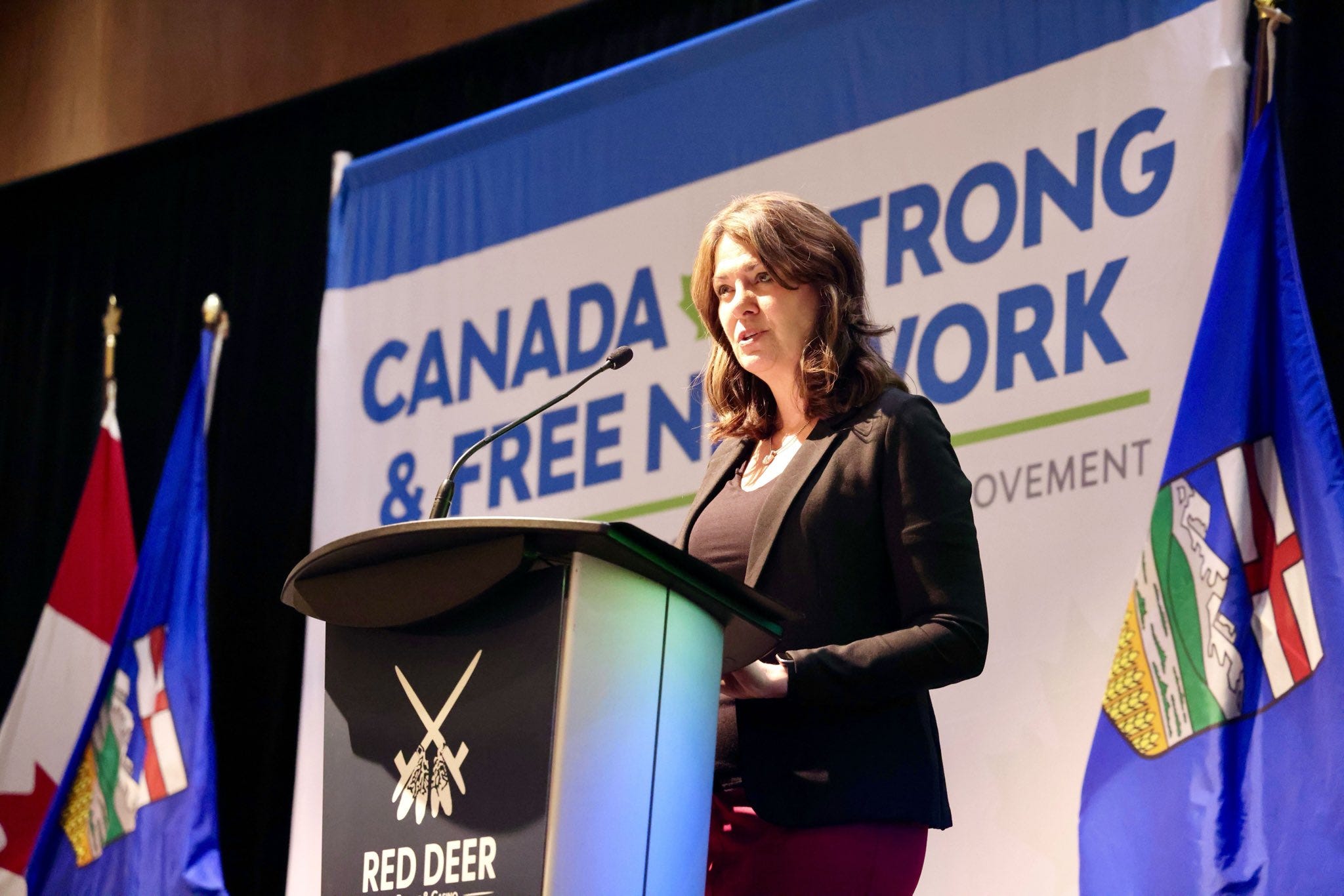
Given her apparent obsession with American culture war discourse, Smith would certainly be familiar with Rufo’s work. Florida governor Ron DeSantis, whom Smith has repeatedly cited as a political inspiration, is a close collaborator with Rufo.
In January 2023, DeSantis appointed Rufo to the Board of Trustees at Sarasota’s New College of Florida, with Rufo promising a “top-down restructuring,” which he likened to Elon Musk’s takeover of Twitter, in an interview with the New York Times.
A month later, Rufo was front and centre at the launch of DeSantis’s campaign to “abolish” diversity, equity and inclusion programs at public universities.
Not only did Smith ignore Rufo’s presence at the Sept. 21 event, but she didn’t even stick around for his remarks.
That might have been a product of the controversy surrounding Rufo’s appearance.
Multiple sponsors, including big names like RBC, SunLife and the Canadian Bankers Association, pulled out of the event after journalists Rachel Gilmore of Check My Ads and John Woodside of Canada’s National Observer publicized Rufo’s appearance, alongside his track record of virulent anti-2SLGBTQ+ sentiment.

 Tiktok failed to load.
Enable 3rd party cookies or use another browser
Major sponsors, such as Meta, which has quite the track record of amplifying far-right narratives globally, Coca Cola and DoorDash remained on the bill.
I suspect Premier Smith didn’t need the added headache of a clip of her praising Rufo circulating as she enters a legislative session in which she’s determined to pass legislation that would make Rufo and DeSantis proud.
The premier’s keynote was introduced by Erika Barootes, Smith’s former director of issues management who has since been hired by MaKami College, a for-profit former massage therapy school that Smith’s government quietly added to the province’s list of Independent Academic Institutions (IAIs) last year.
Other IAIs, including Concordia University of Edmonton and Burman University in Lacombe, are privately operated but publicly funded—essentially post-secondary charter schools. MaKami, however, hasn’t received public funding, at least not yet.
Barootes was originally hired as MaKami’s director of external relations, but since May has been the department head of the college’s new Applied Politics and Public Affairs program.
The college was advertising this new program at a table in the conference room, handing out free MaKami College-branded fidget spinners, sunglasses and coupons for a free massage.
In addition to working for MaKami College, Barootes has joined a long line of elected Alberta senators who aren’t actual senators, because that’s not how the Canadian Senate works.
Smith opened her speech bemoaning the fact that Prime Minister Justin Trudeau didn’t appoint Barootes to the Senate, and then slammed those who were appointed through the official process—MacEwan University academic Kristopher Wells and corporate lawyer Daryl Fridhandler.
Without naming them, Smith referred to Wells as a “radical, extreme LGBT activist” and Fridhandler as a “radical, extreme fundraiser for the Liberals.”
The bulk of Smith’s remarks focused on her plans for the upcoming legislative session that she knew would be a hit with the Strong and Free crowd.
Smith vowed to “ensure that children are protected” by introducing a suite of policies that will harm trans children by denying them access to puberty blockers and hormone treatment and requiring parental notification if kids decide to begin a “social transition” by changing their name at school.
She promised to invoke the Alberta Sovereignty within a United Canada Act for the federal Liberals’ forthcoming emissions caps on oil and gas, fertilizer and methane, just as she did earlier this year for the feds’ Clean Electricity Regulations.
Smith gave the conference’s dozens of attendees a sneak preview of her proposed amendments to Alberta’s Bill of Rights, promising to great applause that she “will make it illegal for the government to discriminate against any individual for refusing medical treatments, including vaccines.”
A minute later, Smith spoke of her forthcoming “compassionate intervention act,” which will allow the state to force people who use drugs into medical treatment for 90 to 128 days, without hint of irony.
On Sept. 24, Smith unveiled her full proposed amendments to the Bill of Rights, which notably occurred on her personal YouTube channel and not the Government of Alberta page.
In addition to banning discrimination against people who refuse medical treatment (except for those pesky addicts), Smith plans to enshrine property and gun rights.
The province’s Bill of Rights has as much legal force as the Sovereignty Act—which is to say, none.
The comfort some speakers felt to make lewd, incendiary remarks in front of a like-minded audience was notable.
Longtime conservative activist Andy Crooks, sporting a flashy bowtie, opened up a panel he moderated on constitutional issues by noting that his wife recently moved to Victoria, B.C.
“As I like to say, if I want marital sex, I have to go to the west coast,” Crooks said, likening being back in Alberta to a “refreshing shower.”
He then proceeded to read a mock land acknowledgement, which took care to note “the great men and women of all races and origins who have built up and developed this part of the country.”
Crooks, alongside two of the panel’s participants—Calgary School academics Barry Cooper and Ted Morton—signed the infamous 2001 “firewall letter.”
Published in the National Post as an open letter to then-premier Ralph Klein, it advocated a series of policies that would sound familiar to anyone who follows Alberta politics today, including a provincial police force, pension plan and tax collection agency, as well as more health-care privatization.
In more recent years, Cooper co-wrote the “Free Alberta Strategy,” part of which includes the Alberta Sovereignty Act, alongside a revival of firewall letter policies.
Cooper was quite open about the sovereignty act being inherently unconstitutional, because it’s designed “precisely to change the constitution,” which he portrayed as a colonial relic.
“Law exists downstream from politics,” he said, paraphrasing the late American right-wing blogger Andrew Breitbart’s remarks on culture.
Cooper predicted that implementing the Free Alberta Strategy in whole will cause “tax revolt, insurrection [and] constitutional crisis.”
“Exactly,” he said gleefully, adding that Albertans will understand “that the province is getting serious—no more nice, polite, futile begging for changes.”
Josh DeHaas of the Canadian Constitution Foundation, whom Crooks introduced as the panel’s “token millennial,” provided a more cautious voice on the panel.
Given the Supreme Court of Canada’s ruling last year that elements of the federal Impact Assessment Act unconstitutionally invade on provincial jurisdiction, he sees an opportunity for Alberta to challenge the “really radical” Clean Electricity Regulations.
At the same time, he suggested a constitutional challenge to Canada’s equalization formula, in which a portion of federal income taxes are redistributed to lower-income provinces to ensure every province is capable of offering the roughly same level of services, would be fruitless.
“For Alberta, since you're such a low tax jurisdiction, I just don't think that's going to work out very well,” said DeHaas.
Morton, a two-time failed PC leadership candidate and former cabinet minister, emphasized the need for judicial reform to implement a right-wing agenda. It’s unfair that the federal government gets to appoint not only provincial court judges, but even Supreme Court judges, he complained.
“The judiciary has a very Laurentian, centralist, woke, DEI agenda, because it's appointed by the political party in Canada that wants that perspective, that lens, when the court does its work,” he said, referring to the Liberals.

According to Morton, the requirement that judges be “functionally
bilingual” is another manifestation of this radical leftist agenda.
“Bilingualism is not just about language, it's about ideology,” he said.
During the panel’s Q&A portion, DeHaas and Morton both sang the praises of the Federalist Society for its growing influence over the past 42 years in securing right-wing judicial appointments in the U.S.
“When they started off, they were marginal,” said Morton. “People hardly knew who they were. There were some law professors involved, some activist politicians. By the time Trump was elected in 2016, the Federalist Society had a very extensive, well-developed network.”
He cited the Runnymede Society, which was founded by the Canadian Constitution Foundation in 2016, as an effort to establish a Canadian equivalent of the Federalist Society. Just give them time, Morton implied.
I did some straight reporting on Rufo’s keynote speech for Canada’s National Observer, so I’ll use this space to editorialize briefly.
Rufo opened his remarks by expressing pride in his wife being pregnant with their fourth child and first girl, presenting himself as an all-American family man.
Two days before the event, documentarian Lauren Windsor revealed on Twitter that she found Rufo’s email address in the 2015 Ashley Madison data leak.
Texas Observer investigative reporter Steven Monacelli independently verified Windsor’s reporting, questioning why someone else would sign Rufo up for an extramarital affair dating website years before he was a public figure.
Rufo responded by falsely accusing Windsor of having an Onlyfans account and threatening to sue her, linking to a searchable database of the leak that doesn’t include his email.
But, as Monacelli pointed out, the website doesn’t include anybody’s emails, because it’s fake. For his part, Monacelli received a block.
I thought Rufo might bring up what he’s characterized as a “smear campaign” from a “left-wing operative” as an example of his political opponents’ perfidy.
He didn’t, which is unsurprising in retrospect, given how it would distract from the focus of his talk.
Rufo’s speech centred on how to build a successful political campaign by carefully cultivating a set of facts designed to elicit an emotional response that spurs people to action.
He was received enthusiastically by the audience as he boasted of his efforts to ban critical race theory, DEI and gender affirming health care across the U.S., as well as his role in forcing former Harvard president Claudine Gay’s resignation over plagiarism accusations.
Rufo was especially proud of his role in drafting President Donald Trump’s executive order banning critical race theory, or what the order characterized as “offensive and anti-American race and sex stereotyping and scapegoating.”
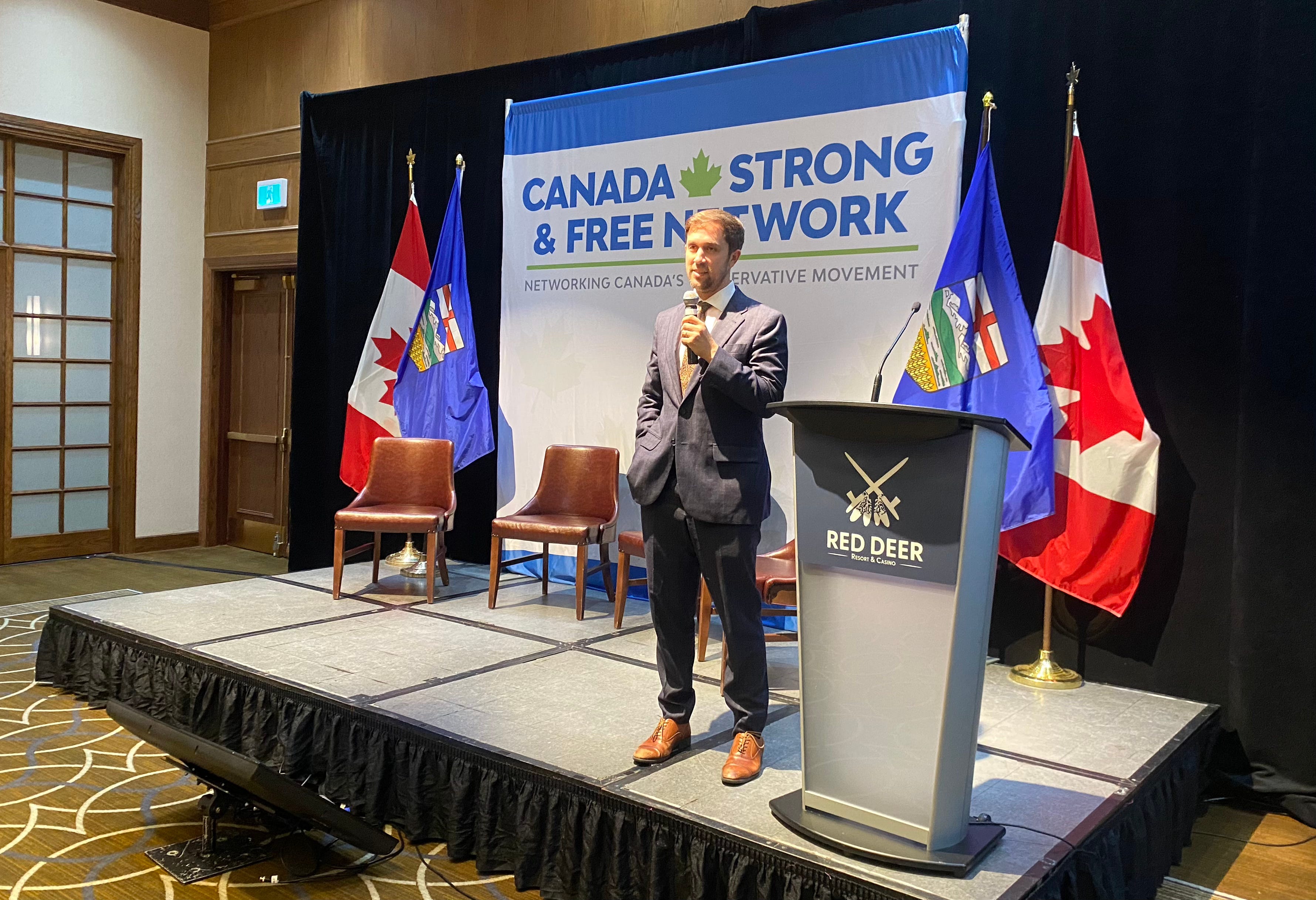
Rufo, who is a senior fellow at the conservative Manhattan Institute, was critical of how think tanks are often excessively focused on facts, data and statistics, which he called the “raw material” of political campaigns.
In order to get results, one needs to trigger some sort of emotional response, which allows you to dominate the traditional news cycle, go viral on social media and, most importantly, influence people “to skip cooking dinner for their family to go do something for two hours.”
“Outrage is fundamental,” he said. “If you don't have outrage, you're not winning in politics. This is just a fundamental kind of effect that has to be cultivated and directed.”
Rufo, like the premier, has a gift for spinning a convincing yarn of bullshit peppered with some kernels of truth.
If you ignore the policies he’s advocating, his advice for political campaigning is sound.
It is important to not just spout off a list of facts, although Rufo’s definition of facts is quite lax, but to create an emotional connection with your audience that inspires them to do something about it.
When it comes to the substance of policy, however, Rufo doesn’t have the slightest clue as to what he’s talking about, as Nathan Robinson of Current Affairs aptly demonstrated in a July 2023 sit-down with Rufo.
At the conference, Rufo spoke of how “the left has control over all of the organs of knowledge production, with a few exceptions,” citing supposed leftist dominance of the media, academia, K-12 education and the bureaucracy.
It’s a bit rich for someone who’s been profiled in the New Yorker, Politico and the Washington Post, been invited to write an op-ed for the New York Times, and appeared on Fox News—America’s most watched news network by a longshot—dozens of times to claim that his political opponents are in control of the media.
Rufo collapses the tepid neoliberal incrementalism that tends to dominate these institutions with radical leftism, presenting himself, Gov. DeSantis, Trump, Jordan Peterson, Tucker Carlson, or whomever, as courageously standing in the way of a total Marxist takeover of society.
By rejecting the notion that systemic racism or trans people exist at all, and pushing for these subjects to be removed from public conversation, Rufo obscures key differences between reformist and radical solutions to these issues, grouping anyone who so much as acknowledges their existence as a radical attempting to subvert Western civilization from within.
The most amusing portion of the conference was hearing former federal Leader of Opposition Stockwell Day rant and rave about “cultural Marxism” on the conference’s final panel, which was ostensibly about Alberta’s efforts to create an “energy-secure future.”
I doubt Day, who once sat on the board of the Centre for Israel and Jewish Affairs (CIJA), despite not being Jewish, is aware of the antisemitic origins of the phrase cultural Marxism, nor do I suspect CIJA cares an iota about their associate’s fondness for this dog whistle, given their mutual, full-throated support for anything and everything Israel does—the reason he ever sat on the board to begin with.
Every question asked by moderator David Knight-Legg, Jason Kenney’s former chief of staff when he was premier, was an opportunity for Day to pivot towards what has quite clearly become an obsession for him.
I shuffled into the conference hall a tad late, just as Day was complaining about a “culturally Marxist dogma, related to oil and gas, to prosperity and the human condition” that seeks to shut down all energy production that isn’t cow dung.
In response to a question on how the energy industry can give Canada a bigger voice on the international stage, Day went to bat for nuclear energy, which makes up 55% of Ontario’s electricity grid and 40% of New Brunswick’s, but isn’t a source of electricity in any other province.
“More people are killed and injured installing solar panels than have ever been injured in any way with nuclear installations,” he said, as if the greatest danger posed by nuclear power plants is their construction.
“And by the way, I'm not promoting nuclear. I'm just talking about how we are afraid to talk about it.”
Why are we, whomever that may be, afraid to talk about it? Well, according to Day, that has something to do with university students feeling the need “to modify their papers to align with what the Marxist professor wants.”
“We're not going to change that, but we can through alternate institutions,” he said, adding that the Marxist infiltration of society begins before university.
For this reason, suggested that conservatives establish an alternative to the Alberta Teachers’ Association, which he claimed is “the only certifier of teachers” in Alberta.
Just one problem—the ATA doesn’t certify teachers. That’s what Alberta Education does.
Day closed his contribution to the panel, which need I remind you was about Alberta’s contribution to energy security, by providing an anecdote about how his granddaughter didn’t want him to kill a bee that had invaded his living room, because many bee species are going extinct.
“I'm telling you our upcoming generation is seized by a mindset that is culturally Marxist, uninformed or wrong, informed on these issues,” said Day.
The transformation of Stockwell Day from presiding over key Cabinet portfolios in Stephen Harper’s government to someone whose brain is so cooked by the internet that he sees preventing bees from going extinct as a Marxist plot tells you everything about the trajectory of Canadian conservatism.

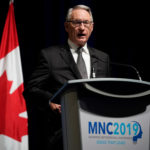


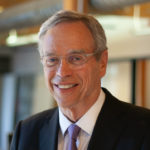


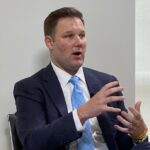



David Knight Legg
Strategic Advisor
Government, Energy & Financial Services Firms
David is currently an advisor to governments, energy, and financial services firms. He was the CEO for Invest Alberta and the Principal Advisor to the Premier of Alberta. Prior to that David was the Group Head of Strategy for Commonwealth Bank of Australia. David has a master’s in Law from Oxford and Ph.D at Yale.
The Business Transitions Forum is produced by Cube Business Media Inc., a team of entrepreneurs with over 40 years of experience producing industry-leading conferences that have drawn tens of thousands of attendees. We are dedicated to building CONNECTIONS, CONTENT and COMMUNITIES for diverse stakeholders through our events.
BTF is your opportunity to efficiently gather information and hear from a variety of people who have experienced the transition process first-hand. This is your chance to benefit from the accumulated knowledge, wealth of expertise and hindsight relating to successes and failures in business transitions.
The Business Transitions Forum
℅ Cube Business Media Inc.
#410 – 221 West Esplanade
North Vancouver, B.C. V7M 3J3
From: Rebel News <info@rebelnews.com>
Date: Wed, Jun 25, 2025 at 12:26 PM
Subject: REBEL BUZZ | After Israel-Iran war: Will the people rise up?
To: David Amos <David.Raymond.Amos333@gmail.com>
|
|||||||||||||||||||||||||||||||||||||||
|
|||||||||||||||||||||||||||||||||||||||
|
|||||||||||||||||||||||||||||||||||||||
|
|||||||||||||||||||||||||||||||||||||||
|
|||||||||||||||||||||||||||||||||||||||
|
|||||||||||||||||||||||||||||||||||||||
|
|||||||||||||||||||||||||||||||||||||||
|
|||||||||||||||||||||||||||||||||||||||
|
|||||||||||||||||||||||||||||||||||||||
|


 TV-Style Shows: The Ezra Levant Show, The Gunn
Show, The Yemini Report & more
TV-Style Shows: The Ezra Levant Show, The Gunn
Show, The Yemini Report & more Members-Only Events: Virtual town halls,
behind-the-scenes access, and VIP perks at live events
Members-Only Events: Virtual town halls,
behind-the-scenes access, and VIP perks at live events Ad-Free Browsing: No popups, no distractions —
just fearless journalism
Ad-Free Browsing: No popups, no distractions —
just fearless journalism In-Depth Documentaries: On topics the mainstream
media won’t touch
In-Depth Documentaries: On topics the mainstream
media won’t touch Subscriber Comments: Join the conversation on
every story
Subscriber Comments: Join the conversation on
every story Just $8/month: Less than a fancy coffee — and a
lot more impactful
Just $8/month: Less than a fancy coffee — and a
lot more impactful


|
This email was sent to David.Raymond.Amos333@gmail. To stop receiving emails, click here. |


No comments:
Post a Comment