With rules in place, N.B. PC leadership race kicks off — unofficially
Eligibility rules will force interim leader Glen Savoie to decide by Canada Day whether he wants to run
The leadership race for New Brunswick's Progressive Conservative party is unofficially underway — with one potential candidate being forced to make a decision before Canada Day.
Rules for the race adopted last week include a proviso that anyone holding the position of interim leader on July 1 of this year is ineligible to run for the permanent position.
That means Saint John East MLA Glen Savoie would have to relinquish the interim job soon if he wants to have the option of running.
Savoie says he's been too focused on scrutinizing the Holt Liberal government in the legislature to give it much thought, and he won't make up his mind until after MLAs adjourn the session for the summer on June 6.
"I'll look at that at that time, but it takes discipline to say, 'I'm not dealing with this right now because I have an important task in front of me,'" he said.
"And I have been disciplined. I've put 100 per cent of my energy into holding this government to account."
Traditionally, MLAs who become interim leaders of their parties don't become candidates for the leadership, though there's often no rule prohibiting them from running.
PCs will choose their new leader Oct. 17, 2026, with the official kickoff for the campaign set for October of this year.
Several party members are already thinking about it.
 Former
MLA Réjean Savoie with Kris Austin on Saturday. Austin, a former leader
of the People’s Alliance who moved to the PCs and became a cabinet
minister in 2022, is considering running for the PC leadership. (Marie-Ève Lamarche/Radio-Canada)
Former
MLA Réjean Savoie with Kris Austin on Saturday. Austin, a former leader
of the People’s Alliance who moved to the PCs and became a cabinet
minister in 2022, is considering running for the PC leadership. (Marie-Ève Lamarche/Radio-Canada)
Fredericton-Grand Lake MLA Kris Austin, a former leader of the People's Alliance who moved to the PCs and became a cabinet minister in 2022, is one of them.
"I am still considering the possibility of a run for leader," Austin said in an email.
"I will take the summer to gauge support and have discussions with my wife, family and supporters before making a final decision."
Former cabinet minister Daniel Allain, who was shuffled out of cabinet in June 2023 after being part of a caucus revolt against then-premier Blaine Higgs, has been open about his interest in the job.
"I'm seriously thinking about it," he said.
"It's a family decision. It's a decision based on what the members think. … There's lots of time to decide."
 New rules mark unofficial start of N.B. PC party leadership race
To quality as a candidate, a party member has to amass $35,000 in donations to the party earmarked as support for their bid.
He or she also has to collect 500 endorsements from party members, with at least 20 each from seven out of nine regions of the province as defined by the party's constitution.
A ranked-ballot system will allow party members to vote in advance by mail rather than at the main convention venue or a satellite polling location, the system the party used in its last leadership content in 2016.
That led to a long day marred by delays in the three rounds of voting, with large numbers of party members giving up and drifting away as the process stretched from the noon hour into the late evening.
'Leading and dividing New Brunswick': New book explores Blaine Higgs's legacy
Former premier's rocky relationship with some groups a lesson for others, Gabriel Arsenault says
Blaine Higgs "broke an all-time record" for low levels of support in New Brunswick's francophone ridings in both 2020 and 2024, says Gabriel Arsenault, a Université de Moncton political science professor.
Though it may have worked in the short term — Higgs was re-elected premier in 2020 — "in the long term that's not a winnable strategy," said Arsenault, editor of a new book of scholarship on Higgs's legacy.
Higgs led the Progressive Conservatives to defeat and lost his own seat in October 2024, when Susan Holt and the Liberals won a majority in the legislature.
Arsenault is the editor of The Higgs Years: Leading and Dividing New Brunswick, a collection of 15 essays by academics across Canada who looked back at Higgs's time as premier and his leadership.
Arsenault said that the book can also shed light on the most recent federal election because many of the things that led to Higgs downfall were paralleled federally.
 Gabriel Arsenault's new book looks into the story of Blaine Higgs's premiership. (Michele Brideau/Radio-Canada)
The book is not only important to New Brunswickers but also to people across the country, Arsenault said, since "New Brunswick is in many ways a microcosm of Canada."
New Brunswick is in many ways a microcosm of Canada.
- Gabriel Arsenault
In the most recent federal election, the Conservative Party would also have won "if it weren't for Quebec," according to Arsenault, because "Quebecers massively voted for the Liberal Party and that really cost him the election."
When he was first elected premier, in 2019, Higgs's main promise was to balance the books, Arsenault said:
"He was very motivated about that issue and he arguably won the election in 2018 because of that issue."
On this front, Higgs was successful every year, even during the pandemic.

"It was the only jurisdiction in Canada to do so and, even abroad, I would be hard-pressed to find another jurisdiction who managed to do a surplus during the COVID years."
One of Higgs's biggest problems, Arsenault said, was that he tried to appease both sides of a coin but actually remained highly divisive.
To manage the province's response to the pandemic, Higgs put together a committee that included the leaders of all parties in the legislature, including those with political views quite different from his own.
At the time, Higgs's approval rating "was around 90 per cent," Arsenault said, "which is absolutely phenomenal in a democracy.",
This flipped entirely in his second term, when Higgs began to face opposition from his own caucus, and eight of his cabinet ministers stepped down.
Arsenault also said that the financial surplus during COVID was not completely due to policy decisions because huge numbers of people were immigrating to New Brunswick from urban centres at the time.
 When
the cross-party committee was created as part of New Brunswick's
response to the pandemic, it included, from left, Higgs, former People's
Alliance leader Kris Austin, former Liberal leader Kevin Vickers, and
David Coon, who is still Green Party leader. (Jacques Poitras/ CBC)
When
the cross-party committee was created as part of New Brunswick's
response to the pandemic, it included, from left, Higgs, former People's
Alliance leader Kris Austin, former Liberal leader Kevin Vickers, and
David Coon, who is still Green Party leader. (Jacques Poitras/ CBC)
"Housing is cheaper in New Brunswick and a lot of people from Ontario moved to New Brunswick, bringing with them their income, their money," Arsenault said.
But even if he could claim progress with the province's finances and economy, Higgs was divisive in many ways, said Arsenault, pointing to a French-English divide, the government's relationship with Indigenous peoples, and Policy 713, the province's gender-identity policy for schools.
This divisiveness was one of Higgs's biggest problems, and it even caused instability within his own party. Higgs underestimated the number of party members who "are 'small c' conservatives," and "think they have a responsibility to defend minorities."
Arsenault said the book is a balanced look at Higgs's legacy. He also said that to form a majority government, the Progressive Conservative Party usually needs to be more moderate or centrist than the Higgs government was.
ABOUT THE AUTHOR

I wrote two novels, then a traumatic brain injury forced me to learn to write all over again
My recovery is the hardest fight I’ve ever had
I sat looking out at a crowd gathered for my book launch in Fredericton on March 30, emotional because of the journey it took to get there.
In September 2022, at the age of 26, I suffered a life-threatening brain injury during a boxing training session.
I was in a coma for five weeks.
During my recovery, which is still ongoing, there were times I was not sure I would ever walk, feed myself or write again.
On that day, sitting in front of patients and staff at the Stan Cassidy Centre for Rehabilitation, where I lived for two months after my injury, I spoke about my entire life being restructured for recovery, about my family being told that I might never be able to be home alone again, about engaging in daily therapy sessions to relearn basic life skills.
Going back there, I had to face the memory of all of those hard weeks and months of recovery. But I was also face-to face with people who had suffered injuries just like mine. I had once been where they were and could reach them in a different way than their care team.
 At the age of 27, Luke Beirne had to learn how to walk again
I had come so close to losing the ability to write and was now sitting in one of the places which helped me redevelop that skill, among many others. I was looking directly at members of the care team who had worked so hard to help me.
The speech language pathologist who worked with me, day after day, retraining my reading and writing skills was right there. So was the physiotherapist who had helped me learn to walk again.
The idea that I would ever be able to write another novel seemed impossible in those days.
The injury
I wasn't in a fight when the injury happened, just a sparring session to prepare for one. I don't remember the session at all. It was wiped from my memory entirely.
I don't remember setting it up, speaking with the coaches, any of the planning, or the trip from Saint John to the club in Moncton.
 Luke Beirne drawing and listening to music in the early stages of his recovery. (Luke Beirne/CBC)
Afterwards, I spent five weeks in a medically induced coma at the Moncton Hospital. While I was in that coma, my family stayed at my bedside.
I was initially fed through a tube in my throat and had to re-learn basic life skills at the rehabilitation centre, including how to swallow and walk, from a wonderful team of therapists.
Physiotherapists helped me build up the muscle and then retrain myself to walk at the rehabilitation centre, using special equipment and support.
For a long time after my injury, my vision was severely affected. I had a kind of double vision, where I also saw things slightly out of place.
No 'time off'
During this early recovery period, every minute of my days were scheduled, moving from one therapy session to another. I had no time off.
Even when not actively taking part in a therapy session, I was constantly working — just living became work.
I don't remember much from the early stages of my recovery because there was a long period when I could not retain memory.
I began writing almost immediately, working away in notebooks that my partner Charlotte would hand me. When I look back at these notebooks, the writing is crooked and meanders between the lines.
 A note from early in the recovery. (Luke Beirne/CBC)
My memory of this time is almost non-existent. It was so bad that Charlotte would leave for work in the morning and I would forget that she lived in the centre with me almost as soon as she stepped out the door.
She would come back after work to see me sitting there with wide eyes, looking lost.
Throughout my recovery, Charlotte has been incredible. The strength that she carried me with, particularly in the early days, stuns me.
After my release, I lived in Fredericton because I needed to remain an outpatient at "the Stan." Charlotte and I stayed across the street from her grandparents in an empty house owned by a friend of theirs.
 Luke Beirne at his book launch at the Stan Cassidy Centre for Rehabilitation. (Luke Beirne/CBC)
During this time, my family put a huge amount of effort and attention into my recovery. My mom Eilish Cleary was a doctor and believed deeply in the health benefits of engaging with nature.
After recovering to a certain point, I would go out to her house in Penniac and spend time in the woods behind it, walking with her through hills of roots and pine. She believed that navigating this kind of terrain was beneficial to retraining my mind and body.
My mom passed away in March 2024, but I was lucky enough to spend a lot of time with her between my accident and her passing and know that it brought her peace to see how well I had recovered.
 Luke Beirne and his mother during a walk in the park after his injury. (Luke Beirne/CBC)
My dad and brothers lived in Ireland at the time but travelled to Canada for long periods. My sister spent a lot of time visiting me and celebrated my release from the Stan Cassidy Centre by bringing a cake and balloons.
I also spent a huge amount of time with Charlotte's grandparents, who drove me to appointments or played board games with me. As a result, I grew very close to them and they now feel like another set of grandparents.
After I returned to Saint John, I was still not ready to be alone, so I spent my days with a wonderful home-care worker, who went above and beyond with the amount of kindness and compassion she showed me. She would go to the gym with me, help clean the apartment, and walk me to and from appointments.
What was most beneficial, however, was just having somebody there for social interaction during the day. Keeping my mind active was key to a strong recovery.
I credit writing as a key part of my recovery. I worked with my dad, also a published author, to relearn to write from the early days of my recovery. We would do regular video calls, working on retraining writing techniques and story structure elements.
 Luke Beirne in front of the Stan Cassidy Centre following the book launch. (Luke Beirne/CBC)
After working on small projects, I stepped back into one that I had been working on before my injury. What began as a short story expanded to become my recently published third novel Saints Rest. This kept my mind active and stimulated.
Though the process of working on the book was extremely difficult for a number of reasons, maintaining focus and retaining memory of earlier parts of the book as I got further in, I believe that it played a crucial role in getting me where I am today.
I am always grateful for how fortunate I have been with my recovery.
So I write this as a message of hope for others who've experienced a traumatic brain injury: life will be hard but there is light ahead.
ABOUT THE AUTHOR
Uptown Saint John's new bookstore café aims for 'cosy, homey vibe,' owners say
Non-profit venture, the Write Cup, will feature East Coast writers, host local writing groups
 Amanda Evans and Shannon Dykens standing in front of the entrance of the Write Cup Bookstore Cafe. (Luke Beirne/CBC)
A new bookstore and coffee shop set to open in Market Square hopes to create a space for people to write and to connect writers and readers.
Amanda Evans and Shannon Dykens plan to open the Write Cup, which will be a non-profit venture, in February. It's an extension of their company, Partridge Island Publishing, which has released a number of story anthologies based in the Port City.
Right now, they are painting, assembling shelves, installing furniture, and setting up the venue for its opening day.
"We're going for a cosy, homey vibe, where you feel like you're coming into your own living room," Dykens said.
"Yes, there'll be lots and lots and lots of bookshelves. But we also have comfortable furniture, nice little seating areas. We will have a big harvest table where we will be having our writing meetings."
They say that the credit for opening the business should be given to the community that they have built and the friends that they've developed.
"What makes this unique is the fact that we have found a family, an ever growing family, that everybody wants to come in, they want to be part of this," Evans said. Their coffee will be from the Fredericton-based Whitney Coffee Company and Have Fun Coffee from Dartmouth.
The plan is to be a hub for readers and have the largest collection of works by Atlantic Canadians in the area.
They will also have knitting groups and board games, and are very open to listening to suggestions from customers.
"Having a bookstore and a café … for us to be solely focused on Atlantic Canada, the authors that come out of this region, to have the books available and to have the café truly integrated in the bookstore, that is truly unique," Dykens said.
 Amanda Evans and Shannon Dykens in front of the Write Cup Bookstore and Cafe in Market Square (Submitted by Amanda Evans)
The shop will have all kinds of writing-related features for those who want to spend time working on their craft.
"We have a gumball machine that we're filling with prompts, so you can get a prompt of the day," Dykens said. A prompt, or writing prompt, is a common tool used to inspire stories by providing a specific cue or focus to an author.
"Shannon and I are brilliant, probably the two smartest people in the entire world," Evans joked, "but we can't think of all the ideas, so we do want the community involved. We want you to be comfortable. We want you to feel like you're at home."
They also plan to help forge connections.
"Even if we can't publish a book, we will help you," she said. "We'll give you a list of publishers that are accepting in your genre," she said.
"How can we help is something that we say quite a lot. 'How can we help? Do you need editors? Do you need art? What do you need?' Tell us how we can help because we just want to help."
Birth of a small press
For Evans and Dykens, this new enterprise is part of a larger plan they hatched after they met at a local writing group called Write Now in 2019 and "clicked immediately," said Dykens.
When the group decided to write a collection of stories set in Saint John, the two quickly decided to go into business together and publish it themselves. After making this decision, they founded Partridge Island Publishing.
This past summer, the pair ran a store at Area 506 Container Village on Saint John's waterfront, and Dykens said a permanent space was the next logical step.
"It was always our goal to have a bookstore in five years and we accomplished that in just under four years, she said. "We turn six in May. So we've met our goals so far."
 The interior through the window of the Write Cup. (Submitted by Amanda Evans)
Because of the connections they have developed through Partridge Island Publishing, several local writing groups, including Write Now, Saint John Writes, and Saint John Voices, plan to hold weekly or biweekly meetings at the Write Cup when it opens. They say the community support that they have built is enabling the transition.
"Everything we get from the Partridge Island side, even from the Write Cup side, gets reinvested," Evans said.
After paying off the expenses of opening the café, the proceeds will fund writer's workshops, organizing events, buying supplies, and hosting various programs.
They said the cost of opening the café was funded by a combination of earnings, grants, and donations.
A backroom of the Write Cup will serve as the new office for Partridge Island Publishing. Through the front window, customers can look out at the Saint John Free Public Library, which will continue to host larger readings and special events when the 40-seat café doesn't have the space.
Both Evans and Dykens will be transitioning to work on the café full time, allowing them to turn their passion into a career.
Though they are thrilled about it, the opening day is coming very quickly.
"It's really, it's really hitting us now that whole, 'man, we're really doing this.' Like, there's no turning back now," said Dykens.
ABOUT THE AUTHOR
STU Alum Luke Beirne Publishes Debut Novel
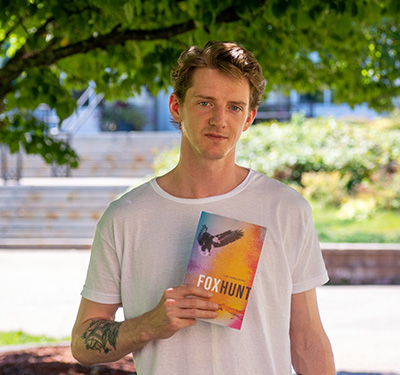
STU alumnus Luke Francis Beirne, BA ‘18, has published his first novel, Foxhunt.
The novel tells the story of a Canadian writer who travels to London to start a literary magazine at the start of the Cold War.
After graduating from STU, Beirne completed a masters in cultural studies and critical theory at McMaster University.
“I researched literary propaganda of the Cold War at STU and McMaster. This research became the frame for the novel,” Beirne said.
Despite the Cold-War setting, Beirne said he doesn’t consider his novel a thriller.
“It’s slower paced and the spy story primarily plays out peripherally. I like to think that the writing itself drives the book.”
Beirne said the writing and rewriting process was hard work, but a lot of fun. He said seeing his first book published so early on was an incredible experience.
“Everything has to line up just right for a book to make it out of the gate and, fortunately, things lined up for me sooner rather than later.”
Learning at STU
At STU, Beirne majored in English Language and Literature and minored in History. He said he came to STU with a love of reading, but only really learned “how' to read” when he got to STU.
“I learned about the way that literature 'works' and about how active the reading process really is. This has been very important for my development as a writer so far.”
Beirne said many of his professors at STU had a profound impact on his development as a reader and writer, including Professor John Muise from the department of English Language and Literature.
"His unashamedly human approach to literature and academia taught me so much," he said.
Beirne also recommends students interested in writing take courses from a wide range of disciplines.
“When looking at literature from different angles, it becomes clear that so many of the ‘rules’ in creative writing are simply a matter of convention,” he said.
“When you read different kinds of writing, from different times and places, you realize that these value judgements have not always been consistent and are not apolitical. It's important to know that you can choose to emphasize different things and produce an equally valuable work.”
Beirne currently lives in Saint John, and is in the process of writing another novel.
https://policyoptions.irpp.org/authors/gabriel-arsenault/

Gabriel Arsenault
Gabriel Arsenault is an assistant professor of political science at the École des hautes études publiques at the Université de Moncton. His research focuses on Canada’s social economy and policy.
Articles by this author

https://www.umoncton.ca/prof/umcm-gabriel_arsenault
Gabriel Arsenault
18, avenue Antonine-Maillet
The Institute is an autonomous entity; however, it has a special relationship with the Université de Moncton. Its presence on the Moncton campus fosters research with faculty members and contributes to training young researchers. Members of the research team of the Institute regularly teach courses at the Université de Moncton, which enriches the courses curriculum.
The Institute also maintains relationships with multiple partners from various institutions in Atlantic Canada and nationwide.
History
The Institute was founded in 1983 by Donald J. Savoie as the Canadian Institute for Research on Regional Development (CIRRD). Under the leadership of Professor Savoie, CIRRD has earned an enviable reputation nationally and internationally. The CIRRD hosted leading researchers and published a large number of theoretical and applied works on a range of issues related to the economic development of regions and elsewhere.
In 2005, the Institute adopted the name Canadian Institute for Research on Public Policy and Public Administration, which emphasized the central role of quality of governance, public policy and public administration in the welfare and economic development of our communities. The Institute stressed the importance of not only providing research but also assisting in the development of public policies based on a rigorous and objective analysis of major public policy issues.
In 2015, the Institute adopted its new name in honour of its founder.
Board of directors
Jacques Paul Couturier, Ph. D. (President)
Monique Collette
Corporate Director
Gabriel Cormier
Université de Moncton
Madeleine Dubé
Denise Frenette
Fisheries and Oceans Canada
The Clément-Cormier Research Chair
Team

Donald J. Savoie
He has won numerous prizes and awards and received many honours, including: promoted Companion of the Order of Canada (2022), he received the Order of Moncton (2021), he was the inaugural recipient of the Royal Society of Canada’s Yvan Allaire Medal for outstanding contribution in governance (2018), the 2015-2016 Donner Prize, the 2015 Killam Prize in Social Sciences, the Order of New Brunswick (2011) and was elected Fellow of the Royal Society of Canada (1992). He has been awarded honorary doctorates by eight Canadian universities and a Doctor of Letters from Oxford University (2000). He was also elected Senior Fulbright Scholar at Harvard and Duke universities (2001-02) and Visiting Fellow, All Souls College, Oxford (2006).
Professor Savoie has published numerous books on public policy, public administration and federalism. His best-known books include Democracy in Canada: The Disintegration of Our Institutions; Breaking the Bargain: Public Servants, Ministers and Parliament; Governing from the Centre: The Concentration of Power in Canadian Politics; The Politics of Public Spending in Canada; and What Is Government Good At? A Canadian Answer. He has also contributed chapters to books published in Canada and abroad. His articles have appeared in all the significant journals in political science, public policy and public administration and his books have been reviewed in leading national and international peer reviewed journals and in leading newspapers in Canada, the U.K., India and the United States.
He has served as an advisor to a number of federal, provincial and territorial government departments and agencies, the private sector, independent associations, OECD, the World Bank and the United Nations. In addition, he served as a member of the Independent Advisory Board for Senate Appointments (2016-17 and 2022- ). At the request of the Canadian prime minister, he undertook in 198687 a review of federal government regional development efforts in Atlantic Canada and prepared a report that led to the establishment of the Atlantic Canada Opportunities Agency.
Professor Savoie holds a D. Phil. (Political Economy), Oxford, 1979, a M.A. (Political Science), University of New Brunswick, 1972 and a B.Sc. Comm. (Economics), Université de Moncton, 1968.
View the curriculum vitae »

Céline Basque
Researchers

Gabriel Arsenault, Associate Researcher

Richard Saillant, Researcher in Residence
Richard Saillant is a Moncton-based economist and public policy consultant. He holds a B.A. with double major in economics and political science, a M.A. in economics from the Université de Montréal and an M.B.A. from McGill University. Richard has spent nearly twenty years in government and academia, including as Director General at Industry Canada, as former vice-president of the Université de Moncton and as Director of the Donald J. Savoie Institute. He is the author of a number of publications including A Tale of Two Countries: How the Great Demographic Imbalance is Pulling Canada Apart. Richard was also a columnist for l’Acadie Nouvelle and for the Brunswick News dailies from 2020 to 2023.
Michel Cormier, Visiting Researcher

Michel Cormier began his broadcasting career at Radio-Canada in Moncton. He has been a parliamentary correspondent for Radio-Canada and CBC in Ottawa, Quebec National Assembly bureau chief and foreign correspondent in Moscow, Paris and Beijing. From 2011 to 2012, he was director of Radio-Canada Acadie in Moncton.
He authored five books, including biographies of Richard Hatfield and Louis Robichaud; the latter won the Prix France-Acadie. His La Russie des Illusions was a finalist for the Governor General Award.
Michel Cormier sits on the boards of Reporters Without Boarders and Journalists for Human Rights. He has received his bachelor’s degree in journalism from Carleton University and a master’s degree in political science from Laval University. He has lectured on journalism ethics at Université de Montréal.
A Cocagne (New Brunswick) native, he spends his summers at Cap-de-Cocagne.
Michel Cormier, Visiting Researcher
Michel Cormier began his broadcasting career at Radio-Canada in Moncton. He has been a parliamentary correspondent for Radio-Canada and CBC in Ottawa, Quebec National Assembly bureau chief and foreign correspondent in Moscow, Paris and Beijing. From 2011 to 2012, he was director of Radio-Canada Acadie in Moncton.


The Commission
Commissioner
Commissioner
The role of Debates Commissioner is being held by the highest-ranking staff member of the Secretariat of the Commission who is authorized, in accordance with OIC 2024-0598, to exercise the powers and perform the duties and functions of the Debates Commissioner in case there is a vacancy in that office.
Secretariat
Michel Cormier
Executive Director

Michel Cormier has served as the executive director of the Leaders' Debates Commission since 2019. His mandate is to deliver leaders' debates in federal general elections that are accessible and informative and oversee the work of the Commission. As executive director of news and current affairs at Société Radio-Canada from 2012 to 2018, he was responsible for the public broadcaster's election coverage and organization of leaders' debates, both at the federal and provincial levels. Before holding management roles, he was a national political reporter in Ottawa and Quebec City and foreign correspondent from 2000 to 2011. He sits on the boards of Reporters Without Borders and Journalists for Human Rights, has lectured on journalism ethics at Université de Montréal and is the author of five books and a finalist for the Governor-General's literary awards.
Advisory Board
Dr. Chad Gaffield
Distinguished Professor, University of Ottawa, former President of the Royal Society of Canada
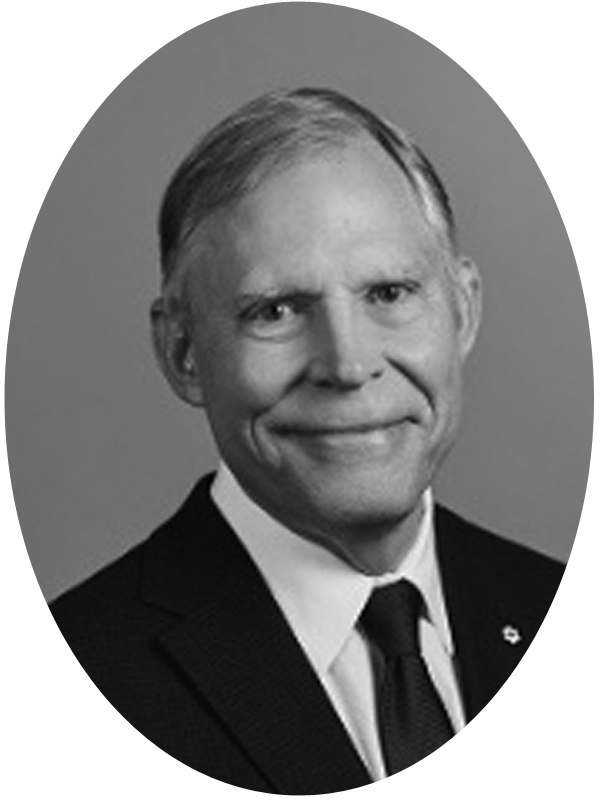
Dr. Chad Gaffield is Distinguished University Professor and Professor of History Emeritus at the University of Ottawa. He holds the University Research Chair in Digital Scholarship (2019-2024) and is the CEO of the U15 Canada, an association of 15 leading research universities across Canada. From 2017-2019, he was the President of the Royal Society of Canada and was appointed an Officer of the Order of Canada in 2017. An expert on the sociocultural history of 19th- and 20th-century Canada, Mr. Gaffield has been at the forefront of efforts to develop digital technologies that expand, deepen, and facilitate research, teaching and public engagement. He received his BA (Hons) and MA from McGill University and his PhD from the University of Toronto.
Deborah Grey
Former Reform MP, first female Leader of the Opposition
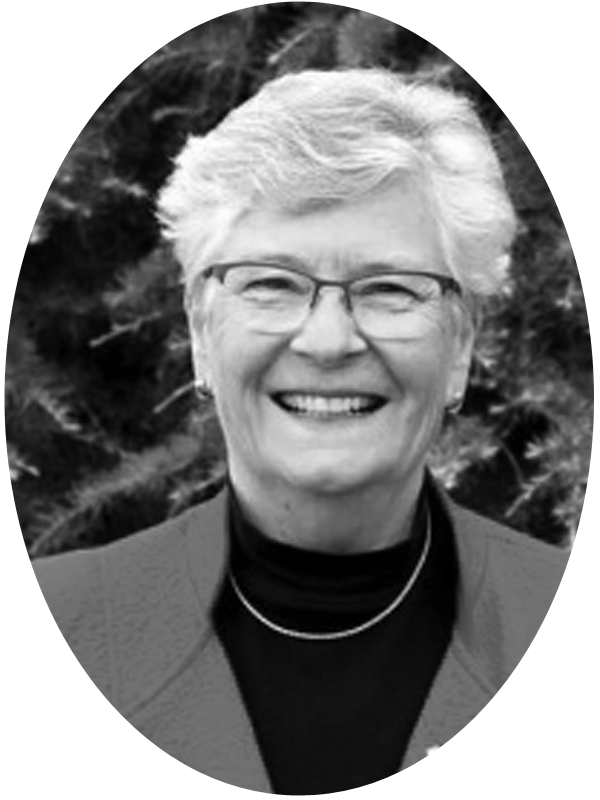
Deborah Grey grew up in Vancouver, BC and moved to Alberta where she was a high school English teacher before her election to the House of Commons as the Reform Party's first Member of Parliament in 1989. She served in Ottawa for over 15 years with the Reform Party/Canadian Alliance/Conservative Party of Canada. In 2000, she was Canada's first-ever female Leader of the Opposition. Ms. Grey left public office in 2004, after winning four straight elections. In December 2007, she was appointed an Officer of the Order of Canada for Public Service. She has received the Queen Elizabeth II 50th and 60th Jubilee Medals, the Alberta Centennial Medal and an Honorary Doctorate of Laws from Trinity Western University. She travels across Canada as a professional speaker, addressing groups on leadership, balancing work and play, and relationship building and is also involved with many charity events.

Deborah Grey PC OC LLD
MP (Ret'd)
Contact Deb Grey
To contact Deb Grey please email her at: debgrey@gmail.com
Jean La Rose
President & CEO, Dadan Sivunivut Inc. and Former Chief Executive Officer, Aboriginal Peoples Television Network (APTN)

Jean La Rose is a First Nations citizen from the Abenaki First Nation of Odanak in Québec. He grew up in Ottawa where he studied Journalism at Algonquin College and obtained his Bachelor of Arts in Social Communication at the Université St. Paul. He has worked for a variety of federal government departments such as Secretary of State (now Canadian Heritage), Treasury Board, Health Canada, External Affairs (now Global Affairs) and a few others. He joined the Assembly of First Nations in 1994 and served three National Chiefs (Ovide Mercredi, Phil Fontaine and Matthew Coon Come) until 2002. He was the Chief Executive Officer of APTN, the first national Indigenous broadcaster in the world, with programming by, for and about Indigenous Peoples from 2002 to 2019. He is now the President & CEO of Dadan Sivunivut, the parent company of Nagamo Music Publishing, AnimikiSee Digital Productions, AnimikiSee Distribution, First Peoples Radio, Red Music Rising and All Nations Network. He serves on a variety of boards, such as Indspire, 'Namgis Business Development Corporation, La Cité Collégiale in Ottawa and others. His focus is on developing opportunities for Indigenous Peoples in Canada that will allow the communities to achieve the full economic potential they have been denied since colonization.
Megan Leslie
President and Chief Executive Officer, World Wildlife Fund Canada, former Deputy Leader of the Official Opposition (NDP)
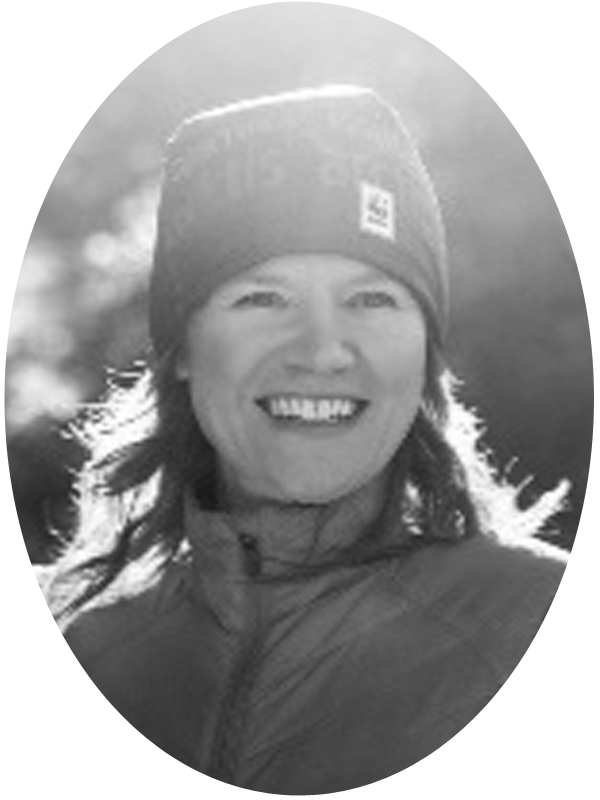
Megan Leslie is President & CEO of World Wildlife Fund-Canada. Since taking on this role, Megan has led WWF-Canada's bold 10-year plan Regenerate Canada, to expand habitats, reduce carbon in the atmosphere, lower industrial impacts and, as a result, reverse wildlife loss and fight climate change. She is also passionate about engaging Canadians to take action for nature. Before assuming the role of President & CEO, Megan was WWF-Canada's Vice-President, Oceans. Prior to that, she was a Member of Parliament representing Halifax for two terms during which she was deputy leader of the Official Opposition, environment critic and vice-chair of the government committee on environment and sustainable development. As a Parliamentarian Megan introduced a motion to ban plastic microbeads which led to a ban on the Canadian manufacture, sale and importation of these products. She also expedited the creation of Sable Island National Park Reserve. Megan is the proud recipient of an Honourary Degree from Mount Saint Vincent University in Halifax, is a Senior Policy Fellow at the Munk School of Global Affairs and Public Policy at the University of Toronto, and an ArcticNet board member.
The Honourable John P. Manley
Former Deputy Prime Minister of
Canada, Liberal Cabinet Minister and former President and Chief
Executive Officer of Business Council of Canada
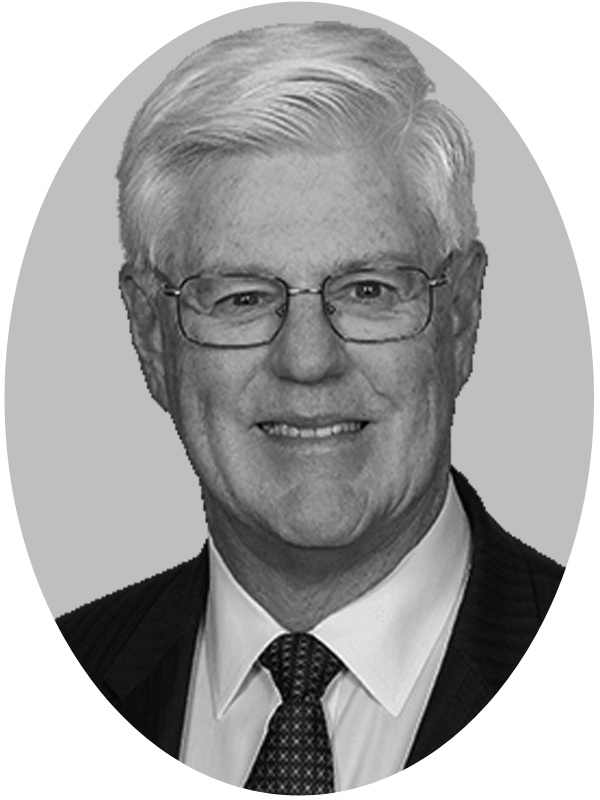
The Honourable John P. Manley is a former Deputy Prime Minister of Canada. He was first elected to Parliament in 1988 and re-elected three times. From 1993 to 2003 he was a Minister in the governments of Jean Chrétien, serving in the portfolios of Industry, Foreign Affairs and Finance, in addition to being Deputy Prime Minister. Following the terrorist attacks of September 11, 2001, he was named Chair of a Cabinet Committee on Public Security and Anti-terrorism. After a 16-year career in politics, he returned to the private sector in 2004. Since leaving government, Mr. Manley has continued to be active in public policy, as a media commentator, speaker, and adviser to governments of differing political stripes. He is currently Chair of Jefferies Securities and a Fellow of the CD Howe Institute, the Royal Canadian Geographic Society, and the Institute of Corporate Directors. In the private sector, he served as President and CEO of the Business Council of Canada (from 2010 to 2018) and joined Bennett Jones LLP as Senior Business Adviser in September 2019. Mr. Manley is an Officer of the Order of Canada and recipient of many awards and honours, including honorary doctorates from six Canadian Universities. He graduated from Carleton University and the University of Ottawa and served as law clerk to the Chief Justice of Canada.
Louise Otis
President of the Administrative
Tribunal of the Organization for Economic Co-operation and Development
(OECD) and President of the Administrative Tribunal of the Organization
Treaty of Atlantic North (NATO)

Louise Otis is an active judge, arbitrator, and mediator in administrative and commercial matters. She is Adjunct Professor at McGill University, Faculty of Law and a distinguished fellow of the International Academy of Mediators. She is President of the Administrative Tribunal of the Organization for Economic Co-operation and Development (OECD) and President of the Administrative Tribunal of the Organization Treaty of Atlantic North (NATO). She is also a deputy judge of the Administrative Tribunal of the European Organisation for the Exploitation of Meteorological Satellites (EUMETSAT) and member of Internal Justice Council of the United Nations (UN). From 2010-2022, she was President of the Appeals tribunal of the International Organization of the Francophonie (IOF). She regularly participates in international governance and justice reform missions. At the international level, she has been involved in the reform of justice systems in different countries and international organizations.
Abdullah Snobar
Executive Director, DMZ and Chief Executive Officer of DMZ Ventures & Zone Startups

Abdullah Snobar is the Executive Director of the DMZ and the CEO of DMZ Ventures. Headquartered in Toronto, Canada, the DMZ helps start-up founders build, validate, and scale into world-class companies. Under Abdullah's leadership, the incubator has expanded its global impact by establishing partnerships and satellite locations across North America, Latin America, Africa, and Asia. To date, DMZ has helped 820+ startups raise $2,58 billion in capital. Abdullah serves on the Board of Directors for the Rideau Hall Foundation, The Power Plant Contemporary Art Gallery and is a member of the Forbes Tech Council. He was a former Board Director for the Business Bank of Canada (BDC) and the Ontario Trillium Foundation. He has previously held roles with the Canadian Armed Forces, Fairmont Hotels, and Marriott Hotels & Resorts. Abdullah holds an ICD.D designation from the Institute of Corporate Directors, and MBA and BComm degrees from Toronto Metropolitan University.
Date modified: May 12, 2025
Contact Us
The Commission is an independent and impartial public body created by Order in Council P.C. 2018-1322 ("OIC") on October 29, 2018 and amended by Order in Council P.C. 2020-0871 ("OIC") on November 5 2020.
Its core mandate is twofold. First, to organize two leaders' debates during each federal general election – one in each official language. Second, to prepare a report to Parliament, following the debates, outlining findings, lessons learned, and recommendations.
Contact us at: info@debates-debats.ca
Date modified: March 31, 2023

No comments:
Post a Comment