So social media has broken even Elon Musk. I’m forced to ask: U OK hun?

In his spat with Trump, the man who literally owns X has been hoist by his own platform. Guys, no one is safe!Fri 13 Jun 2025 12.31 BST
Did you see Elon Musk apologise for some tweets this week? (Please don’t be naff and call them “X posts”.) Like me, you will be so embarrassed for Earth’s primo edgelord that he feels pressed into doing something so excruciatingly conventional. This is worse than when Kate Moss was scapegoated into rehab.
Imagine owning the world’s premier shitposting platform – in fact, having spent $44bn (£32bn) on it, specifically so that your magic mirror would tell you each day that you were the fairest shitposter of all – and then shuffling sheepishly on to your own pixels to mumble something about having gone “too far” with your hurty words. Buck up, sadsack – honestly.
We’ll come in a minute to how this hilariously preposterous spectacle should surely mark the absurdist endpoint of humankind’s intensely brief, intensely passionate, and intensely destructive relationship with social media. But first, a recap. Elon’s apology, of course, related to last week’s spectacular online beef that he’d started with US president Donald Trump over the latter’s OBBB. (Sounds like a specialist Pornhub search term; actually stands for One Big Beautiful Bill.) Amusingly, the two men were not able to directly confront each other, each feeling that they could only engage on their own platforms – X in Musk’s case, Truth Social in Trump’s. Going forward, we surely need some proxy platforms these two superpowers can fight on, like the proxy war countries of the cold war. Maybe Threads and Bluesky could play the role of Vietnam and Nicaragua?
After all, I’m sure these two will do battle – covert or otherwise – once more. The path to war had been set the second they became buddies, despite the Maga crowd’s comic refusal to see the inevitable. It was only a few months ago that Fox News bobblehead Sean Hannity did a fawning joint chat with the pair, telling them and his viewers: “I feel like I’m interviewing two brothers here.” Yep. Caned and unstAbel. (Completely unrelated, but in 2019, polling found that 13% of Americans still believe that men are “better suited emotionally for politics than most women”. Could the poll be rerun in light of new information?) And it was only a few months earlier that Musk was explaining to a rally crowd: “I’m not just Maga, I’m dark gothic Maga.” Mm-hm.
Anyway, in this battle, Elon ended up getting resoundingly beaten by the final boss of posting. As we know from the fact that Musk turned up to his first day at Twitter carrying a sink and honking “let that sink in”, this is a guy who just loves a crashingly literal joke. So it’s a shame the president was too busy playing golf to turn up at Elon’s Texas babymother compound with some latex buttocks, an elated wink to camera, and the words: “I handed him his ass!” Maybe next time.
This week was all about the apology, which should be a defining moment in man’s – and woman’s – understanding of precisely the pitfalls of being extremely online. It’s extraordinary to think that social media didn’t meaningfully exist 20 years ago, but has – in that very short span – now hurtled toward the spectacle of the world’s richest man functioning as a warning about what can happen to anyone if they spend way too much time on it. The man who literally owns X has been hoist by his own platform. Guys, no one is safe! How much more wake-up do we want our calls to be?
For a long while back there, it was fashionable to refer to the particular disorder engendered by excessive Twitter use as brainworms. Elon Musk is surely riddled with them. Intriguingly, despite essentially running the free world from the platform during his first term in office, Trump himself has remained weirdly resistant to the brainworms. If anything, his particular arrangement reminds one of that old Private Eye headline when Rupert Murdoch had some prostate bother a few decades ago: “Cancer has Murdoch”. And so with Trump and the brainworms. Brainworms have Trump. Maybe Trump IS the brainworms?
Sadly for Musk, he didn’t have the same mysteriously resistant gene. He loved Twitter so much he bought the company – for a price that was the sort of joke someone might make on Twitter – and it actually seemed to get him what he wanted for a time: a president who was buddies with him, a more-than-fair wind for all his government contracts, and every one of his posts liked by bazillions of followers who absolutely weren’t mostly bots. It might have lost money in and of itself, but seemed like a super-successful and lucrative political project when considered in the round, given his other business interests.
But this is what spending too much time on social media does to you! It makes you feel like you’re being productive, and important, and “not complicit” in whatever you’ve just farted out a couple of hundred characters on. But – and spoiler alert for anyone still unaware of the import of watching Musk deliver his equivalent of the Notes app apology meme – this is all an illusion. Spending lots of time and energy on social media platforms simply means you work for the guys who own them. For free.
Whether this week’s cautionary tale starring one of those very guys will shake humanity out of its potentially fatal attention spiral is, regrettably, doubtful in the extreme. But after watching Musk act like someone tearfully trying to de-cancel themself, no one can say the message of the spectacle was anything less than sledgehammer: delete your account, sir.
-
Marina Hyde is a Guardian columnist


Joanna Coles is joined again by Anthony Scaramucci, the infamously short-lived Trump first term White House communications director and longtime Trump confidant-turned-critic. The Mooch brings a blisteringly informed look into what happens to those, like Elon Musk, who get too close to Donald Trump—and why Musk is the latest casualty. Scaramucci explains why Ro Khanna is the only Democrat with the foresight to try and win Musk back, how Potomac fever has infected Silicon Valley, and why Trump's orbit inevitably burns anyone drawn into it. He reveals how Trump really fired him and why Howard Lutnick may be the next domino to fall. Plus, Scaramucci argues that a Musk-backed centrist third party won't be able to win the presidency—it could break the political duopoly for good.
Ep 6: The Single Point of Failure for Young Men Today I Anthony Scaramucci and Scott Galloway
 Anthony Scaramucci


I Went to Harvard Law with Anthony Scaramucci. Here’s What He Was Like.
Like the president he serves, Anthony Scaramucci, the flamboyant new White House communications director, likes to reference his Ivy League credentials. In a recent interview with CNN’s Jake Tapper, Scaramucci was asked whether he would have attended a meeting with a Russian lawyer who promised to supply dirt on Hillary Clinton. While Donald Trump Jr. took the meeting, Scaramucci bragged that as a Harvard Law School graduate, he probably wouldn’t have gone himself. When asked about whether Trump could pardon himself, Scaramucci offered that he wasn’t sure, but he did get an A- in constitutional law from Harvard Law professor Larry Tribe.
What was the young Anthony Scaramucci like at Harvard Law School? And what might those early years tell us about President Trump’s new favorite aide, whose brash New York style is rightly earning Scaramucci the moniker, “mini-me”?
Scaramucci was in my first year section at Harvard Law School more than 30 years ago, and even then, he was known as a big personality. He was an exuberant figure who proposed to his girlfriend on a Times Square billboard. He made a brief appearance in a book I wrote called Broken Contract: A Memoir of Harvard Law School. In the volume, I used the real names of professors—who were well known—but gave the young, non-famous students pseudonyms. Anthony Scaramucci’s was Joe Sisorelli.
Scaramucci was a well-liked and high profile figure in the class of 1989. The son of working-class parents from Long Island, neither of whom were college graduates, Scaramucci enjoyed challenging Harvard’s pretensions.
In the second year, we had a tax professor who intimidated a lot of people, but not Scaramucci. When the professor asked him a tough question, Scaramucci said, “Well, I’d be glad to answer. But first, could you tell me where you got that great haircut?” The class burst into laughter and people swarmed Scaramucci afterward to congratulate him for taking the professor down a peg.
I don’t remember whether Scaramucci had already embraced right wing politics back at Harvard, but if he had, he was nevertheless a popular presence. He was a showman then, is a showman now, and he may just succeed in advancing Trump’s agenda.
In retrospect, though, there was another side to the gregarious and wise-cracking Scaramucci that was more unsettling. Many of us had come to law school hoping to be the next Thurgood Marshall advancing civil rights or Ralph Nader promoting consumer protection. Two-thirds of us entered law school saying we wanted careers in public interest law, but most of us instead became corporate lawyers. Referencing the then-popular TV show, “LA Law,” I wrote: “A number of students come wanting to be Atticus Finch and leave as Arnie Becker.” If most of us sold out, we nevertheless agonized over the decision of what type of law to practice.
Scaramucci, however, skipped law altogether and went straight to investment banking at Goldman Sachs. He would later go on to found a group of global hedge funds known as SkyBridge Capital.
Looking back at our class of 1989 yearbook, I was struck by something Scaramucci’s parents wrote in a section of the volume where family members could wish their loved ones congratulations.
The note read: “To Anthony with love, pride and congratulations. ‘To the victor go the spoils.’ Mr. and Mrs. Alexander Scaramucci.”
On one level, this sentiment was understandable. The son of a construction worker had risen to graduate from Harvard Law School, an enormous accomplishment. But the parental advice was not a lofty “give back to your community,” or “to whom much is given, much is expected” or “promote justice in the legal profession.” It suggested that having advanced in America’s meritocratic race, it was time to cash in.
Like the president whom Scaramucci would go on to serve, getting rich was the goal, and winning was everything. In some ways, Scaramucci is a funnier and smarter version of his boss. And if Scaramucci’s early days are any indication, his charm may well be effective in carrying out their shared conception of success—uninspiring and shallow as that vision may be.


Richard D. Kahlenberg, a professorial lecturer at George Washington University, was an expert witness in Students for Fair Admissions v. Harvard. He is writing a book about the future of affirmative action for PublicAffairs Books.
https://www.richardkahlenberg.org/
ABOUT RICHARD KAHLENBERG

Richard D. Kahlenberg is an education and housing policy researcher, writer, consultant, and speaker.
He is also Director of Housing Policy and Director of the American Identity Project at the Progressive Policy Institute. In addition, he is a professorial lecturer at George Washington University's Trachtenberg School of Public Policy and Public Administration. He was recently featured in a front-page New York Times profile on his policy work as a "liberal maverick."
The author or editor of 19 books, Kahlenberg has been recognized primarily for his expertise in three policy areas:
-
Affirmative action in higher education He has been called “arguably the nation’s chief proponent of class-based affirmative action in higher education admissions.”
-
Diversity in K-12 schools He has been labeled “the intellectual father of the economic integration movement” in K–12 schooling.
-
Zoning barriers to housing opportunities His work on how housing policies inhibit educational opportunities made him one of Washingtonian magazine’s top 25 most influential people shaping education policy.
Kahlenberg’s articles have been published in the New York Times, the Washington Post, the Wall Street Journal, the Atlantic, the New Republic, and elsewhere. He has appeared on ABC, CBS, CNN, FOX, MSNBC, PBS, and NPR.
His books include: Class Matters: The Fight to Get Beyond Race Preferences, Reduce Inequality, and Build Real Diversity at America's Colleges (PublicAffairs Books, 2025); Excluded: How Snob Zoning, NIMBYism, and Class Bias Build the Walls We Don't See (PublicAffairs Books, 2023); A Smarter Charter: Finding What Works for Charter Schools and Public Education (with Halley Potter) (Teachers College Press, 2014), Why Labor Organizing Should Be a Civil Right: Rebuilding a Middle-Class Democracy by Enhancing Worker Voice (with Moshe Marvit) (Century Foundation Press, 2012); Tough Liberal: Albert Shanker and the Battles Over Schools, Unions, Race and Democracy (Columbia University Press, 2007); All Together Now: Creating Middle Class Schools through Public School Choice (Brookings Institution Press, 2001); The Remedy: Class, Race, and Affirmative Action (Basic Books, 1996); and Broken Contract: A Memoir of Harvard Law School (Hill & Wang/Farrar, Straus & Giroux, 1992).
The Remedy was named one of the best books of the year by the Washington Post, Tough Liberal was named one of the best books written on labor unions by the Wall Street Journal; and Excluded won the Goddard Riverside Book Prize for Social Justice.
Kahlenberg has been a nonresident scholar at Georgetown University's McCourt School of Public Policy, a Senior Fellow at The Century Foundation, a Fellow at the Center for National Policy, a visiting associate professor of constitutional law at George Washington University, and a legislative assistant to Senator Charles S. Robb (D-VA).
His work has been supported by leading foundations including Broad, Jack Kent Cooke, Ford, Gates, Hewlett, Lumina, Nellie Mae, Spencer, Walton, and W.T. Grant.
He serves on the advisory boards of the Pell Institute and the Albert Shanker Institute. He is a graduate of Harvard College and Harvard Law School.
https://www.richardkahlenberg.org/_files/ugd/88f4ca_d4dbeafd9d2f46f9a4d66ac47ff2c5de.pdf
Richard D. Kahlenberg
Director of Housing Policy and the American Identity Project
Richard D. Kahlenberg is the Director of Housing Policy at the Progressive Policy Institute, and the Director of the American Identity Project, where he is working on to strengthen American identity through public education. The author or editor of eighteen books, he has expertise in education, civil rights, and equal opportunity. Kahlenberg has been called “the intellectual father of the economic integration movement” in K–12 schooling and “arguably the nation’s chief proponent of class-based affirmative action in higher education admissions.” He is also an authority on teachers’ unions, charter schools, community colleges, housing segregation, and labor organizing.
Kahlenberg’s articles have been published in the New York Times, the Washington Post, the Wall Street Journal, The New Republic, and elsewhere. He has appeared on ABC, CBS, CNN, FOX, C-SPAN, MSNBC, and NPR.
Previously, Kahlenberg was a nonresident scholar at the Georgetown University McCourt School of Public Policy, a senior fellow at The Century Foundation, a fellow at the Center for National Policy, a visiting associate professor of constitutional law at George Washington University, and a legislative assistant to Senator Charles S. Robb (D-VA). He also serves on the advisory board of the Pell Institute, and the Albert Shanker Institute, and as a professorial lecturer at George Washington University’s Trachtenberg School of Public Policy and Public Administration. In addition, he is the winner of the William A. Kaplin Award for Excellence in Higher Education Law and Policy Scholarship. Reflecting on Kahlenberg’s work on higher education, William G. Bowen and Michael S. McPherson wrote that he “deserves more credit than anyone else for arguing vigorously and relentlessly for stronger efforts to address disparities by socioeconomic status.” He graduated from Harvard College and Harvard Law School and was a Rotary scholar at the University of Nairobi School of Journalism.
“Trump has pulled off something I thought I’d never see, which is he made Harvard look sympathetic,” said Richard D. Kahlenberg, a Harvard critic who supports the idea of giving admissions preferences to students with lower family incomes. […]
Mr. Kahlenberg said his “big fear” was that Harvard might scale back on social mobility efforts and seek to admit more students whose families could pay full freight, nearly $87,000 a year for undergraduates, including room and board.
Read more in The New York Times.
What Happens if ‘Harvard Is Not Harvard’?
If President Trump makes good on all his threats, Harvard may lose much of its influence and prestige. It could also become even harder to afford.


As President Trump and his team dialed up the pressure on Harvard University last month, threatening to bar its international students, the school issued what was at once a warning and a plea.
Europeans chomp popcorn while Elon Musk and Donald Trump rage-quit their bromance
Welcome to Declassified, a weekly humor column.
 The two billionaires are throwing tantrums on social media
platforms that they each own. | Pool photo by Francis Chung/EFE via EPA
The two billionaires are throwing tantrums on social media
platforms that they each own. | Pool photo by Francis Chung/EFE via EPA
Once upon a time in Mar-a-Lago, Elon Musk and Donald Trump were political soulmates — a bromance forged in tweets, Tesla stocks, and errant Truths. But alas, the relationship has frayed. And to Europeans, the slap-fight plays like a particularly chaotic Eurovision act: loud, overproduced, and somehow involving a rocket.
Last week, the U.S. president and his billionaire ex-first buddy have been backpedaling on their relationship with the elegance of a self-driving Cybertruck in a school zone.
Can you do better? Email us at gpoloni@politico.eu or get in touch on X @POLITICOEurope.
Last week we gave you this photo:

Thanks for all the entries. Here’s the best one from our mailbag — there’s no prize except the gift of laughter, which I think we can all agree is far preferable to cash or booze.
“You don’t know this, but I want to lose my election.”
by Roman Boyer
Musk admits he went ‘too far’ attacking Trump
Regrets, the tech billionaire has a few.
 “I regret some of my posts about President @realDonaldTrump last
week,” Musk wrote on his social media platform X. | Francis
Chung/EPA-EFE
“I regret some of my posts about President @realDonaldTrump last
week,” Musk wrote on his social media platform X. | Francis
Chung/EPA-EFE
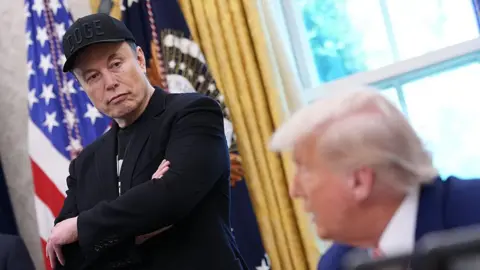
Elon Musk says he regrets some posts about Donald Trump
 Getty Images
Billionaire Elon Musk has said he regrets some of the posts he made about US President Donald Trump during their war of words on social media.
"They went too far," he wrote on his social media platform X.
The two were embroiled in a public fallout after the Tesla owner stepped back from his White House role and called Trump's tax bill a "disgusting abomination".
His post comes after Trump said he was open to the possibility of reconciliation in an interview with the New York Post on Wednesday. The president said he was a "little disappointed" about the fallout, but there were "no hard feelings".
Musk urged Americans to call their representatives in Washington to "kill the bill" as he believed it would "cause a recession in the second half of the year".
The tech entrepreneur claimed, without evidence, that Trump appears in unreleased government files linked to the late sex offender Jeffrey Epstein. The White House rubbished those claims.
In response, Trump said Musk had "lost his mind" and threatened to cancel his government contracts, which have an estimated value of $38bn (£28bn). A significant chunk of that goes to Musk's space technology company SpaceX.
"I think it's a very bad thing, because he's very disrespectful. You could not disrespect the office of the president," Trump said in an interview with NBC on Saturday.
Musk appeared to have deleted many of his posts over the weekend, including one calling for Trump's impeachment.
Musk was the largest donor for Trump's 2024 presidential campaign and had been considered the president's right-hand man.
Former Trump aide Steve Bannon called for Musk, who was born in South Africa, to be deported.
US Vice-President JD Vance told reporters on Wednesday that while Trump was frustrated with Musk, the president does not want a long-term feud with the Tesla CEO.
Vance also said he had spoken to both Trump and Musk about the billionaire donor remaining supportive of the administration.
Most Republicans have called for the two men to reconcile, while Democrats have watched on as the feud unfolded.
Their fallout came shortly after Musk left the task force he headed called Department of Government Efficiency (Doge), which he had promised would make trillions of dollars of federal spending cuts, 129 days into the job. So far, those cuts appear to have been smaller. After his departure, many of the Doge staff he hired have stayed on at a variety of federal agencies.

No comments:
Post a Comment