We want land returned, Wolastoqey say as they fight to keep forestry parcels in claim
Indigenous rights lawyer says N.B. case will likely go to Supreme Court of Canada
The Wolastoqey Nation's title claim over more than half of New Brunswick has been the subject of two days of arguments about whether land privately owned by forestry companies should be excluded from the litigation.
The Wolastoqey say exclusion would amount to putting the property interests of private industry over the constitutional rights of the First Nation.
The matter is before the New Brunswick Court of Appeal this week after a judgment last year that removed the industrial defendants from the lawsuit — including J.D. Irving, H.J. Crabbe and Acadian Timber.
The three timber firms are appealing the lower court's judgment. JDI has argued the title claim puts its privately owned land at risk, including more than 600,000 hectares. JDI says that land should be removed from the claim if the company cannot be in court to defend its interests.
Renée Pelletier, lawyer for the Wolastoqey, says just because the companies were removed from the lawsuit doesn't mean their land can't be touched.
"If the effect is that once the Crown gives the land away it can never be returned to the First Nation, there's an injustice there," Pelletier said Thursday in an interview outside the courthouse in Fredericton. "Because these are rights that are supposed to be constitutionally protected."
Pelletier said the claim is very clear. It seeks the return of the land owned by the industrial defendants — mainly the forestry companies.
Pelletier said the claim was structured to ask the court, after a declaration of title, to decide which lands should be returned.
 The
Wolastoqey title claim covers more than five million hectares the
chiefs identify as Wolastoqey traditional lands, including land now
owned by forestry companies and other industrial interests. (Submitted by Wolastoqey Nation of New Brunswick)
The
Wolastoqey title claim covers more than five million hectares the
chiefs identify as Wolastoqey traditional lands, including land now
owned by forestry companies and other industrial interests. (Submitted by Wolastoqey Nation of New Brunswick)
Last year's lower court decision by Justice Kathryn Gregory suggests a two-step process that would put negotiations about land return and other remedies, between the Crown and the Wolostaqey.
"Maybe that means we don't get all the land back," Pelletier said. "It's unclear what that means. There would be a negotiation between the Wolastoqey and the Crown to figure out what is the proper remedy."
The Court of Appeal heard from additional parties Thursday, including Elsipoqtoq First Nation, which has filed its own title claim, and the eight Mi'kmaw communities that have also, together, filed their own title claim.
The court also heard representation from EMS Enterprises.
Landowner fears impact of title declaration
Lawyer Megan Mara Mallory said EMS is a business owned by Daryl Branscombe, who owns commercial buildings inside the part of the claim that's identified as schedule A, which maps the area of claim that does not include the forestry parcels.
Mallory said the Wolastoqey are seeking declaration of title to the area known as schedule A, but not asking for the return of that land. But a declaration of title, she said, would vest immediate rights with the Wolastoqey and directly impact her client, who makes his livelihood from his land.
She said it is not possible for title rights to co-exist with property rights. She said they are competing interests.
The court adjourned Thursday afternoon.
With Bill C-5 passed, Carney to meet Indigenous leaders over major projects | Power & Politics
 CBC News
 Prime Minister Mark Carney says legislation passed by the House of Commons that gives cabinet powers to fast-track major national projects will be followed by full-day summits with Indigenous leadership in July to increase consultation and co-operation. The Power & Politics panel of party insiders discusses Carney's comments and possible political challenges ahead.
House of Commons passes Liberals’ major projects legislation | Power Play for Friday, June 20, 2025
 CTV News
 Conservative members of Parliament voted with the minority Liberal government to pass its marquee major projects legislation Friday evening, setting it up to become law before Canada Day.

Andrew Scheer, the leader of the Official Opposition and the Conservative parliamentary leader, speaks with reporters following the passage through the House of Commons of C-5, the government’s internal trade, labour mobility, and major projects bill. The bill passed with support from the Conservatives.
Canadian economy act passes in House of Commons | CTV National News at 5:30 for June 20 2025
CTV News128 Comments


Bill C-5 expected to pass in the House of Commons on Friday, but questions over consultations loom
CTV News Ford apologizes to First Nations chiefs after suggesting they “keep coming hat in hand” to him


Government fast-tracking major projects bill amid constitutional concerns | Power & Politics
CBC News First Nations threaten ‘long hot summer’ if Ottawa passes national project legislation | APTN News
 APTN News
 N.S. government settles lawsuit with former senior lawyer
Alex Cameron abruptly retired in 2017, announced intention to sue province
A long-running legal battle that pitted a former senior Nova Scotia government lawyer against the premier and the attorney general is over.
But no one is saying exactly how or when the matter was resolved.
Alex M. Cameron conducted civil litigation for the province until April 2017, when he abruptly retired and served notice he intended to sue the province, then premier Stephen McNeil and his attorney general, Diana Whalen.
Cameron accused them of defamation, abuse of public office, constructive dismissal and violation of his constitutional rights.
At issue were legal arguments that Cameron advanced on behalf of the province in a case involving the Sipekne'katik First Nation. Sipekne'katik had launched an appeal in Nova Scotia Supreme Court of a decision by the provincial Environment Department to allow the underground storage of natural gas in Alton, N.S.
In his brief, Cameron argued the province did not have a duty to consult Sipekne'katik on its Alton gas decision. Or if it did, he argued the province had already met that duty.
 The Sipekne'katik flag flies at an Alton Gas protest site in 2017. (Robert Short/CBC)
When news of Cameron's arguments broke, it touched off a political furor, with McNeil, Whalen and others claiming Cameron had acted on his own and gone far beyond the government's position.
The politicians also claimed they had no prior knowledge of what Cameron intended to do in this case.
Those public comments led to Cameron's lawsuit, which dragged through the courts for years, even reaching the Supreme Court of Canada.
One of the outstanding issues was whether Cameron could use internal government communications to bolster his case. The province tried to claim those communications were covered by privilege, but that argument was rejected by the courts.
Under questioning by reporters Thursday, Premier Tim Houston said he believed the legal dispute had been settled, but he offered no details. A spokesperson for the provincial Justice Department confirmed a settlement, but would not comment further.
Efforts by CBC News to reach Cameron or his lawyer for comment were unsuccessful.
Both McNeil and Whalen are retired from politics. The company behind the proposal to store natural gas underground at Alton has abandoned the project.
Stephen McNeil to apologize to Mi'kmaq for 'unconquered' people law brief
'That brief didn't reflect who I am, doesn't reflect the belief of my government,' says premier
A group of Mi'kmaq chiefs will get an apology from Nova Scotia's premier Thursday for a government legal brief that implied members of a First Nation band are a conquered people.
"I will extend my apologies," Stephen McNeil said Wednesday ahead of a scheduled meeting Thursday at the Nova Scotia Archives.
"That brief didn't reflect who I am, doesn't reflect the belief of my government, and I certainly will express that to them."
McNeil had already distanced himself last week from the brief, after accusations the government had set back relations with First Nations people.
The brief said the Crown's obligation to consult extended only to "unconquered people," and that a band's submission to the Crown in 1760 negated its claim of sovereignty and negated government's constitutional duty to consult.
The Indian Brook band argued the province had a duty to consult it on Alton Gas's plan to store natural gas in salt caverns near the Shubenacadie River. The brief was presented as part of the government's case in an appeal of its approval of the Alton plan.
Treaties to be put on display
McNeil has said he believes the brief went too far and that the government's intent in court was to show that it had consulted on the project.
During Thursday's meeting, the provincial archives will put the original documents associated with the early peace and friendship treaties between the Mi'kmaq and the Crown on display to be photographed and videotaped.
McNeil said that was the plan all along, although the symbolism will stand out even more given the controversy.
"To have this kind of thing happen, which is unnecessary ... gets in the way of actually continuing to make the progress that we've made with communities across the province," he said.
The Assembly of Nova Scotia Mi'kmaq Chiefs, which will be represented at Thursday's meeting, did not return a call seeking comment.
McNeil, who said he didn't see the brief before it was presented in court, said he is frustrated at how things turned out and he will convey that to the chiefs.
"The Supreme Court [of Canada] has settled this. We have a duty to consult and they have rights associated with their treaties," he said.
No decision about us, without us, say forestry companies
Timber companies ask to have their land excluded from Wolastoqey title claim
Three New Brunswick timber companies are seeking to have their forestry lands excluded from the Wolastoqey Nation's Indigenous title claim that's working its way through the courts.
J.D. Irving, H.J. Crabbe and Sons, and Acadian Timber say the land they harvest and privately own should be excluded from the claim because a lower court last year removed them as defendants in the lawsuit, filed by the First Nation.
Lawyer Paul Steep, counsel for JDI, said his client has the right to respond in a case that puts the company's land at risk.
So either JDI is restored as a defendant with standing, he said, or JDI land is no longer targeted by the claim.
In one affidavit, JDI claims to own 652,689 hectares included in the statement of claim.
 Paul
Steed, lawyer for J.D. Irving Ltd., says land owned by the company is
put at risk by the Wolastoqey title claim, yet JDI does not have
standing in the lawsuit to defend its interests. (CBC News)
Paul
Steed, lawyer for J.D. Irving Ltd., says land owned by the company is
put at risk by the Wolastoqey title claim, yet JDI does not have
standing in the lawsuit to defend its interests. (CBC News)
The Wolastoqey launched the lawsuit in the early 2020s, asserting title to more than half of New Brunswick, saying they never surrendered their traditional territory.
Last November, Justice Kathryn Gregory ruled that landowners can't be directly sued for the return of land.
She placed the issue squarely between the Wolastoqey and the Crown and dismissed the "industrial defendants."
The companies appealed.
In the New Brunswick Court of Appeal on Wednesday, lawyer Alex Cameron said he took issue with the characterization of "industrial defendants' on behalf of his client, Donald Crabbe, the owner of a sawmill in Florenceville-Bristol.
 Homeowners have 'nothing to fear' from Wolastoqey title claim, says Madawaska chief
Cameron said the mill employs 50 people, and those much needed jobs depend on the woodlots that were fairly purchased by Crabbe.
He said his client has been "startled and a little upset" to be pulled into "financially disastrous," years-long litigation.
Repeatedly, questions were raised about what kind of remedies might ensue if title is declared — whether it might include financial compensation to the Wolastoqey, land expropriation, or the power to determine how land is used.
 Indigenous
rights lawyer Renée Pelletier says a declaration of title claim could
lead to another step in reconciliation, which would include discussions
on what to do with the land. (CBC News)
Indigenous
rights lawyer Renée Pelletier says a declaration of title claim could
lead to another step in reconciliation, which would include discussions
on what to do with the land. (CBC News)
At last year's hearing, Gregory did say, "the Crown may be directed or ordered to use its expropriation powers" to return land to the Wolastoqey.
On Wednesday, lawyer Renée Pelletier said the Wolastoqey Nation has no intention of disturbing land owned by parties not named in the lawsuit. They're not coming for the farmer, she said.
She also said the Wolastoqey did not have the luxury of containing their claim to tracts of unused Crown land because there isn't much left in New Brunswick.
A choice was made to include the top six land-owning companies in New Brunswick that were using undeveloped land for economic gain, taking the resources and making a profit, Pelletier said.
Justice Ernest Drapeau asked Pelletier if the concept of aboriginal title might have enough flexibility to deal with each case in a fair manner.
He said in his world, peace and reconciliation is not somebody coming to your door, saying 'I'm moving in.'"
Pelletier said a declaration of title could be followed by another step in the spirit of reconciliation that could include discussions about what to do with land, including options that do not involve possession.
But, she said, a decision should not be made now to exclude the forestry land from the claim because that would give preference to the timber companies over the Wolastoqey.
Pelletier paused her arguments at 4 o'clock and was expected to resume Thursday.
Meanwhile, New Brunswick Justice Minister Robert McKee confirmed this week that the Holt government believes the best forum for resolving title questions is the negotiating table rather than the courtroom.
"We have instructed our lawyers to work with the lawyers for First Nations to that end, and they're on it," said the emailed statement provided by McKee.
The appeal is being heard by Drapeau, Justice Kathleen Quigg and Justice Bradley Green.
ABOUT THE AUTHOR

Government of Canada invests in the New Brunswick Aboriginal Forestry Initiative under the Aboriginal Skills and Employment Partnership program
News Release
Natives have role in forestry: Green
The province says it will continue to make room in the forest industry for First Nations people following a Supreme Court ruling that Mi'kmaq and Maliseet do not have treaty rights to commercial logging.
Logging agreements between the government and each of the province's 15 First Nations have been in place for several years, said Aboriginal Affairs Minister Brad Green. Those agreements give the native communities a 5.3 per cent share of the annual cut of wood on Crown land, and will remain in place, he said.
"Those were initially entered into by the provincial government not on a rights basis, but on a policy basis," said Green.
"It was good public policy to try and create opportunities for the First Nations communities to take an active role in the forestry sector in this province. It's good in terms of economic development within the communities. It's good in terms of job creation and skills upgrading within the communities."
The Supreme Court ruled Wednesday that native loggers hadn't proved they hold aboriginal title to Crown land, and that they hadn't proved their ancestors used trees in their trading practices with European settlers.
First Nation leaders were disappointed by the court's decision, but many of them said it's not the last word on the issue.
"This is a setback, and we're used to setbacks," said Tim Paul, a native logger from the St. Mary's First Nation in Fredericton.
- FROM JULY 20, 2005: Supreme Court ruling disappoints chiefs
New Brunswick Liberal MLA T.J. Burke agrees that the fight for commercial logging rights is not over.
"It's never the end in New Brunswick for First Nations and government," said Burke, who is a Maliseet and a lawyer.
"There's always going to be a debate over who belongs in the woods and who belongs on the water."
There are about 20 native logging cases still before the province's courts. Green said the Supreme Court decision has helped answer important legal questions that will be used in those cases, but he admitted there could be other court battles ahead.
"Other questions of aboriginal title could make their way through the court system," said Green, "but the issue of whether or not there is a treaty right to commercial logging…that's been settled and been settled very clearly by the court."
About the Community of Creative Citizens
We are a think tank based in New Brunswick, Canada. We represent the rich tapestry of our province’s society, encompassing individuals from various political leanings, linguistic communities, and philosophical and religious perspectives. Amongst our experts, you’ll find business owners, dedicated employees, engineers, healthcare leaders, former civil service officials, teachers, lawyers, parents, and grandparents. We are a microcosm of our beloved province, a place we hold dear.
Our love for New Brunswick is rooted in a deep appreciation for its culture, community, and history. We are inspired by the resiliency, determination, and vision of its people, past and present. Our collective goal is to ensure that this province continues to thrive for generations to come.
As citizens who share a common concern for our home, we have come together, transcending party lines and personal preferences, to address pressing issues facing our province. Yet, we firmly believe in the untapped potential of our province.
We endorse the idea of an empowered electorate—one that possesses the knowledge and information necessary to hold candidates and elected officials accountable. We believe that an informed electorate is a cornerstone of a thriving democracy.
Are New Brunswickers at risk of losing their private property?
Over the past three months, several articles have addressed the issue of aboriginal title to privately held land in New Brunswick. By way of background, Wolastogey and Mi’kmaqFirst Nations filed legal actions seeking Aboriginal title over 4.1 million hectares of land, including both crown and privately owned land in New Brunswick. They also assert ownership […]
Daryl Branscombe wins intervenor status at New Brunswick’s Court of Appeal
New Brunswick has just revisited the parable of Hans Brinker—the plucky Dutch boy in wooden shoes who, by thrusting a finger into a leaking dike, held back a flood and saved his town. This time, it was Daryl Branscombe, a private citizen in sensible footwear, who came to the rescue. After Susan Holt’s Liberals withdrew […]
It’s time to push for self-sufficiency
The tariffs on Canadian imports imposed by Donald Trump and the United States have been enacted. These measures mark the beginning of a trade conflict with an uncertain resolution timeline. The Canadian economy, including New Brunswick, is expected to be significantly impacted. Approximately 2.5 million Canadian jobs may be affected, with nearly 40,000 of those […]
Private citizen joins case on title claim
A retired businessman who says the Holt Liberal government has abandoned private citizens in a landmark case to decide Aboriginal title has convinced New Brunswick’s highest court to let him take part in the proceedings. Daryl Branscombe, who owns EMS Enterprises Inc., a real estate holding company, petitioned the New Brunswick Court of Appeal when […]
Opinion: It’s time for N.B. to get fracking
NB Power’s financial woes should tip the scales in favour of shale gas Author of the article: Tom Mueller First Published in Brunswick News: https://tj.news/new-brunswick/opinion-its-time-for-n-b-to-get-fracking NB Power is finally under independent scrutiny, thanks to a flood of complaints about December’s eye-popping electricity bills — some reportedly soaring by hundreds of dollars. But don’t expect relief. […]
You can make a donation in various ways.
- Cheque payable to:
Community of Creative Citizens
P. O. Box 804, Station A
Fredericton, N. B. E3B 5B4 - Credit card by calling our office 1-506-451-1357
- Electronic Transfer
We thank you in advance of your generosity.
https://www.cbc.ca/news/canada/new-brunswick/hospice-developer-facility-ceo-fired-1.3476021
Developer Daryl Branscombe axed as Fredericton hospice director
Branscombe confirmed to CBC News he was removed by the board
The man who was the driving force behind establishing Fredericton's first residential hospice has been ousted as executive director and CEO just weeks before its opening.
Property developer Daryl Branscombe led a successful capital campaign to raise more than $2 million to refurbish Rosary Hall into a 10-bed facility for the dying.
The hospice also includes an adult day program to provide relief to people caring for their loved ones at home.
The community helped raise the money to pay for the $4.5 million to the project, including a $500,000 gift from Rosemary McCain-McMillin.
It's scheduled to open in mid-April.
Branscombe confirmed to CBC News Friday he's no longer involved after being removed by the board.
His job as CEO and executive director has been posted without explanation for the sudden vacancy.
Members of the hospice executive were not available for comment.
The hospice project was a personal one for Branscombe who lost his own children to a rare auto-immune disease and they died less than two years apart.
Branscombe, Daryl Kadey
Doctor of Letters (D.Litt.)
Orator: Davies, Gwendolyn
Citation:
CONVOCATION, 20 OCTOBER 2016
DARYL KADEY BRANSCOMBE
to be Doctor of Letters
In Shakespeare's play King John, he notes that "Strong reasons make strong actions". In many respects, this literary observation sums up much that underlies Daryl Branscombe's success as a business visionary, property developer, socially-conscious public volunteer, and community leader.
Born and raised in Chipman, New Brunswick, Daryl Branscombe graduated from Chipman Regional High School, the New Brunswick Institute of Technology in Moncton, and the University of New Brunswick (where he earned a Bachelor's degree in Teaching). Having taught in Chipman, Saint John and Summerside, PEI, he turned in the mid 1970s to a career in business. Beginning with co-owning and managing a hardware store in Summerside, PEI, he had moved to Fredericton by the late 1970s where he variously became leasing manager for Ross Ventures; founding director of the Fredericton Downtown Development Corporation; the developer of a brokerage division of Greenarm Commercial Realty Inc.; and eventually, through his own company, Dad's Enterprises N.B., the owner and developer of commercial and residential property throughout the province. The first president of the Business New Brunswick Association, his effective influence can be traced in the evolution of Carleton Place in downtown Fredericton, in the visionary planning of the Knowledge Park as an information technology cluster in Fredericton, and in the development of the TD Centre in Saint John.
A major turning point in the life of Daryl Branscombe came with the heartbreaking death of his sons from a rare autoimmune disease while they were still in their early twenties. In Walking With a Limp, the autobiographical book dedicated to his sons and published after their deaths, Daryl Branscombe explores the impact of such a tragedy on one's life, at the same time developing a message of healing and social outreach to others in grief that has proven inspirational to a wide range of readers. This moving "coming to terms with loss" has included Branscombe's establishing two memorial scholarships at UNB, one the Michael Christian Branscombe Memorial Scholarship for Fredericton campus students in the Faculty of Science majoring in Biology (especially favouring students whose career plans have the potential to ease human suffering), and the other the Anthony Watson Branscombe Memorial Scholarship for students on the Fredericton campus who have completed at least first year in the Bachelor of Arts programme and have indicated interest in a major or honours in English, particularly in creative writing. An annual Branscombe Golf Tournament, now in its 15th year, adds to the endowment of the scholarships and helps to perpetuate the memory of the two Branscombe boys.
Daryl Branscombe's personal experience of death and loss--as well as his history as a successful community volunteer, developer, and businessman--inevitably drew him into roles as President of Fredericton Hospice Inc. and as Chair of the Fredericton Hospice Fundraising Campaign. Noting in a news release on the Hospice Fredericton initiative that by 2036 twenty-five per cent of the local New Brunswick population will be senior citizens, Branscombe articulated at the beginning of the hospice campaign Fredericton's need "to have infrastructure in place to deliver the most effective, most compassionate care that we can for both patients and their families." Overseeing successful funding approaches to government, business, and the private sector while chairing the Hospice Palliative Care capital campaign, Branscombe (and his committee) raised millions of dollars to convert the former Rosary Hall in downtown Fredericton into a peaceful palliative-care site for end-of-life patients surrounded by caring friends and families.
throughout his career, Daryl Branscombe has consistently demonstrated qualities of both dynamic corporate leadership and compassionate caring for his fellow citizens. It is with pleasure that the University of New Brunswick now bestows upon him an Honorary Doctor of Letters, honoris causa.
Insignissime praeses...
Citations may be reproduced for research purposes only. Publication in whole or in part requires written permission from the author.
It's The Economy, Stupid
David Campbell – A blog about economic development in Atlantic Canada
Daryl Branscombe and New Brunswick’s Travelling Wilburys
Daryl Branscombe started a group a couple of years ago called the Coalition of Concerned Citizens. It is made up mostly of wizened New Brunswickers who formerly held senior roles in government, community and industry.
I admire what they are trying to do. Collectively they probably have more than a thousand years’ experience.
I have said in the past and continue to believe that older New Brunswickers are key to any future economic renaissance. If they don’t want immigration – it will slam the door on any attempts to grow the population. If they don’t want new natural resources development – it won’t happen. If they want an increasing share of public spending to be directed towards health care at the expense of investments in education, etc. there is a strong likelihood this will happen. If they are okay with governments running up huge deficits building up the burden on future generations, this is likely to continue. It’s not a criticism per se, just that we live in a democracy and if the largest voting block holds certain views – views that are more aligned with their age and stage in life – that is likely what will be reflected back in political outcomes.
At the risk of sounding a little condescending, I would like to challenge older New Brunswickers a bit. I think I can get away with it at least a bit because I have fewer years ahead of me than behind. In 2021, I am entering the 28th year of my post-MBA graduation career. I work with young folks on a weekly basis that are the age of my eldest daughter. In other words, I’m no spring chicken myself.
As I told Daryl recently, the economic prosperity and quality of life of the average New Brusnwickers made significant gains over the period of his and his peer’s careers. The life expectancy of the average New Brunswicker rose from the early 70s in the 1960s and 1970s to 82+ years today. The per capita GDP and income gap narrowed significantly. Between the 1950s and 2016 the per capita household income gap shrunk by two thirds. Structural unemployment has collapsed (i.e. non-seasonal unemployment) in the past 30-40 years. The share of the population below the poverty line is lower. The quality of public infrastructure has massively improved – hospitals, roads, airports, etc. We have more kms of four-lane highway than any other province adjusted for population size.

But after a lost decade of economic growth, a domestic population and workforce in outright decline and an entrepreneurial class where over 40% are pushing retirement, we risk giving back a lot of the gains made over the past 50 years or so.
This was my message to Daryl and the Travelling Wilburys (I realize the TWs have become a metaphor for older musicians getting together late in life – they were actually in their 40s and 50s at the time) was we should all be focused on ensuring those gains don’t fritter away over the next 20-30 years.

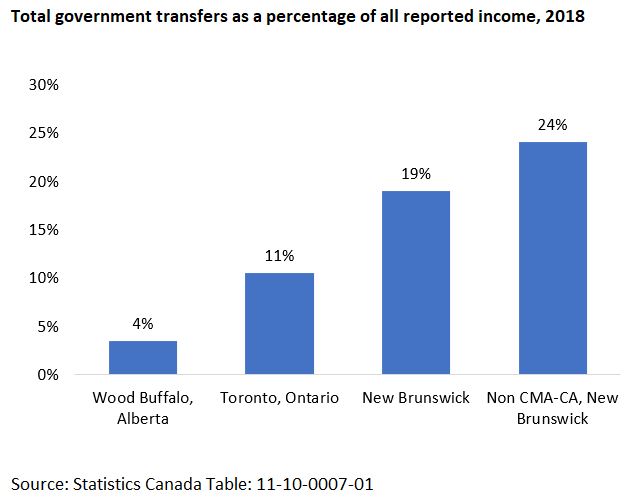
Now others – namely Richard Saillant and Herb Emery – remind me that much of the ‘gains’ over the past 50 years are due to the expansion of federal transfer payments – Equalization and payments to individuals – Employment Insurance (which provided $900 million to NBers in 2018). That is true. Look at the following chart. In rural New Brunswick, almost one out of every four dollars in total personal income reported on tax forms was from the government* compared to only 4% in Fort McMurray/Wood Buffalo.
To put this another way, for every dollar of employment income earned in rural New Brunswick in 2018, there was 39 cents of government transfer income.
But it’s not the whole story. A number of new export-focused industries emerged. Private sector investment expanded through much of the 1960s-early 2000s.
Plus, even if that is true -all the more reason to get the Golden Girls and Boys together with the dewy-eyed dragon slayers to come up with a growth plan for the future.
Someone’s gotta do if. If the retirees want to retrench and play shuffleboard and golf and if the young ‘uns just shrug and move to Toronto, who’s left to work on this place in this time?
*Includes all government transfers to individuals – EI, CPP, OAS, workers’ comp, social assistance, etc.
Private citizen allowed to contest big Aboriginal title claim
A retired businessman in New
Brunswick who says the Holt Liberal government has abandoned private
citizens in a landmark case to decide Aboriginal title has convinced the
province's highest court to let him take part in the proceedings.
Daryl Branscombe, who owns EMS Enterprises Inc., a real estate holding company, petitioned the New Brunswick Court of Appeal when he read in the newspaper that the Liberal government had decided not to pursue a defence on behalf of private owners whose properties are within the title claim filed by the Wolastoqey Nation of New Brunswick.
"There didn't seem to be anybody else taking this on," Branscombe told Brunswick News in an interview. "Normally, it would be the Crown, or the province, but it chose to do negotiation rather than litigation. And I just felt this was too important to negotiate because the public wouldn't even know what's being negotiated."
The claim area is for more than half of the province's territory on its western side, encompassing more than 40,000 square kilometres, about the same size as the country of Switzerland. Tens of thousands of people hold private property there.
The former Higgs Progressive Conservative mounted a robust defence, stating title to private property owners was at risk. But the Wolastoqey Nation has consistently argued private property owners - excluding large ones they call industrial defendants, mostly big timber and pulp and paper companies - are "strangers to the claim," and have no reason to worry about losing their homes or businesses.
Liberal Leader Susan Holt promised last year during the election campaign she would try to take the case out of the courts, arguing it was a waste of taxpayers' money, and would instead try to come to terms with the Wolastoqey Nation in New Brunswick.
The nation is made up of six Indigenous communities along the St. John River - also called the Wolastoq in their language - and its tributaries. The leaders of these 6,000 or so people say they never ceded their land to European colonizers.
"The claim that the Wolastoqey Nation has made is extreme," Branscombe said. "It seems to me, if you're laying a claim to 4.1 million hectares of land, you must prove that you owned it. And the burden of proof should be on the plaintiff, the Wolastoqey Nation. I started asking myself, who's looking after the private citizens? There didn't seem to be anybody.
"I figured somebody had to do it."
The three-judge panel, made up of justices Ernest Drapeau, Kathleen Quigg and Brad Green, granted him intervenor status at a hearing late last month.
The court clerk's office confirmed to Brunswick News the judges made an oral decision granting the status.
After hearing arguments, the judges also permitted Elsipogtog First Nation to participate as an intervener, along with the other eight Mi'kmaq nations in New Brunswick represented by the nonprofit organization MTI, or Mi'gmawe'l Tplu'taqnn Inc.
The Mi'kmaq, who live in communities along the province's eastern coast, have filed two separate Aboriginal title claims for more than half of New Brunswick, some of it overlapping with the Wolastoqey claim.
The legal team representing the Wolastoqey Nation argued against Branscombe being allowed to take part as an intervener.
"We are of the view, and as the chiefs have always maintained, that the Wolastoqey's claim doesn't impact people who are not named," Renée Pelletier, a partner at OKT law firm, told Brunswick News. "But we appreciate that the court was trying to balance interests and wanted to hear different perspectives. This is an important issue."
She said she was pleased the judges put restrictions in place, limiting the interveners to a written brief of 20 pages or less, which has to be submitted within about a month's time, well ahead of the next hearing on June 17.
"The concern is, how is Mr. Branscombe different than any private property owner? If they all get let into the case, this truly becomes unwieldy," Pelletier said. "I certainly don't think that allowing Mr. Branscombe in will mean everyone else will be allowed in. EMS pointed out in its submission that no other private party was seeking intervener status, and I think that helped its cause."
The Wolastoqey Nation did not object to the Mi'kmaq interveners.
Pelletier pointed out that three industrial defendants that operate on freehold land in the title claim area - J.D. Irving, Limited; Acadian Timber; and H.J. Crabbe and Sons - are the parties that had successfully convinced the Court of Appeal in the first place that their motions should be heard, challenging a lower-court ruling.
The arguments of those industrial defendants in June could also affect the Mi'kmaq title claims, she said.
"We see that as something those communities should have a chance to be heard on," Pelletier said.
Brunswick News tried to reach MTI and Arren Sock, the chief of Elsipogtog, on Friday but didn't hear back before deadline.
The Canadian Press. All rights reserved
Renée Pelletier is a Partner at OKT. Her practice focuses on Aboriginal and Treaty Rights litigation and negotiation. Renée is currently lead counsel on two Aboriginal title claims: Saugeen Ojibway Nation’s Aboriginal title claim to their water territory and the Wolastoqey Nation’s Aboriginal title claim to their territory in New Brunswick. She has also developed significant experience in claims and legal matters involving the Peace and Friendship Treaties. Additionally, Renée regularly advises and represents her Indigenous clients on consultation matters, regulatory and environmental matters.
Renée is especially passionate about assisting her Indigenous clients in achieving greater self-determination. She also strives to incorporate the legal traditions of her Indigenous clients into the work she does on their behalf.
Renée has served as a member of the Independent Federal Environmental Assessment Expert Review Panel. The Panel engaged Canadians and Indigenous peoples and provided recommendations to the Government of Canada on reforms to federal environmental assessment processes. She contributes to the advancement and recognition of Indigenous rights through her published work and was cited by the Supreme Court of Canada in the high-profile case R. v. Ipeelee, 2012 SCC 13. Renée is a frequent guest lecturer in Aboriginal and Environmental Law and is a sessional lecturer at the University of New Brunswick, teaching an upper year course on land claims and self-government. Renée also serves as co-chair of Osgoode Professional Development’s Certificate Program in the Fundamentals of Indigenous Peoples and Canadian Law.Renée grew up in Fall River, Nova Scotia and is a member of the New Brunswick and Ontario Bars. She is French Acadian, her first language is French, and she is fluently bilingual in both French and English. Renée is listed as a “most frequently recommended” lawyer in the Lexpert Directory and is ranked in Lexpert, Best Lawyers in Canada and Chambers Canada as one of the top lawyers in the area of “Aboriginal Law.” In 2024, Renée was the recipient of Osgoode Hall Law School’s Alumni Gold Key Award for a Career of Distinction.
Member #: 1989-1002
Call to the Bar Date: Feb 20, 1989
| Primary Address |
|---|
| Alex M. Cameron - Barrister & Solicitor 2015 Black River Road Meadowville, NS B0K 1R0 Phone #: 1-902-301-2517 Fax: Email: alex.cameron@backmeadows.ca |
Authors
Keywords
Power Without Law, Supreme Court of Canada, Marshall, Mi'kmaq, treaty, Nova Scotia, fisheries
Abstract
Alex Cameron's book, Power WithoutLaw, is a scathing critique ofthe Supreme Court of Canada's 1999 decisions in R. v. Marshall upholding Donald Marshall Jr.'s Mi'kmaq treaty claim. Cameron's book has attracted a lot of attention because of the author's position as Crown counsel for the government of Nova Scotia. Cameron was not involved as a lawyer in the Marshallcase itself. As a fisheries prosecution, Marshallwas a matter of federal jurisdiction pursuant to s. 91(12) of the Constitution Act, 1867, and Nova Scotia chose not to intervene. However, Cameron did become involved in a subsequent case dealing with the same series of treaties but different accused, R. v. Stephen Marshall; . v.Bernard, 4 which involved logging and was thus a matter of provincial jurisdiction. Cameron, who had been a staff lawyer in the civil litigation section of the Nova Scotia Department of Justice, was appointed as a Crown attorney (co-counsel) in the Public Prosecution Service (PPS) for the purposes of the appeals in the Stephen Marshallcase. It was that involvement that brought Cameron to the view that the Supreme Court of Canada had wrongly decided the 1999 Marshallcase, (8) and ultimately to write the book.
Recommended Citation
Dianne Pothier, "Alex M. Cameron, Power Without Law. The Supreme Court of Canada, .the Marshall Decisions, and the Failure of Judicial Activism" (2010) 33:1 Dal LJ 189.
Province: Alex Cameron was a rogue employee who ignored orders to give up his “conquered peoples” argument

The province of Nova Scotia has filed with the court its statement of defence of Alex Cameron’s constructive dismissal lawsuit.
Cameron was the provincial lawyer who argued in court briefs and in oral arguments before the court that the province had no legal obligation to consult with the Sipekne’katik First Nation about the Alton Gas project on the Shubenacadie River. In one brief, Cameron referred to the Mi’kmaq as “conquered people.”
After the contents of Cameron’s arguments became public, Premier Stephen McNeil and then-Justice Minister Diane Whalen stated they disagreed with the argument. Cameron was removed from the file, and then resigned.
Cameron filed a “constructive dismissal” lawsuit against the province, claiming that his job was made untenable and that McNeil and Whalen had defamed him.
The government attempted to thwart Cameron’s lawsuit by claiming that solicitor-client privilege prevented Cameron from discussing the Alton Gas case, even before the court. But the court ruled that the government had effectively waived its privilege when McNeil and Whalen publicly criticized Cameron. The province appealed that ruling, but the Supreme Court of Canada* upheld it, allowing Cameron’s lawsuit to continue.
That brings us to the province’s statement of defence in constructive dismissal matter. In the statement, which was recently filed with the court, the province paints Cameron as a rogue employee, claims he filed briefs with the court without first running them by government officials, and he then disobeyed instructions to abandon his argument that the province had no duty to consult the Sipekne’katik First Nation by making that argument before the court anyway.
Cameron’s legal briefs
The province is represented by William McDowell, a partner at the Lenczner Slaght law firm in Toronto.
McDowell notes that Cameron had a long-time interest in the issue of Canadian governments’ treaty obligations to First Nations. Cameron even wrote a book about it in 2009: Power Without Law: The Supreme Court of Canada, the Marshall Decisions, and the Failure of Judicial Activism. In the book, “Cameron criticized the Supreme Court of Canada’s approach to treaty interpretation and to the Honour of the Crown in respect to the Mi’kmaq of Nova Scotia,” writes McDowell in the province’s statement of defence.
“Cameron advanced these personal criticisms as counsel on behalf of Nova Scotia in the Alton Gas Appeal without instructions and to the detriment of his client,” the statement continues.
Cameron was assigned to the Alton Gas file in the spring of 2016, and on June 8, 2016, he had a phone call with Julie Towers and Justin Huston of the province’s Office of Aboriginal Affairs (OAA). According to the statement, in that conversation Cameron said he was going to raise issues with the court about the validity of treaties with the Mi’kmaq; Towers and Huston replied that that wasn’t necessary, as the province’s argument was that it recognized the duty to consult the Sipekne’katik, but that it had in fact done a proper consultation.
The following week, however, Cameron filed a brief that made the exact opposite claim, as McDowell tells it:
a) the duty to consult Sipekne’katik was not engaged, or was engaged at a low level, because Sipekne’katik did not possess treaty rights of the kind described in the Marshall No. 1 decision; and,
b) Marshall No. 1 was wrongly decided by the Supreme Court of Canada.
Arguing before a provincial court that the Supreme Court of Canada decided wrongly, well, takes chutzpah.
More than that, McDowell claims in the province’s statement of defence that Cameron did not send a draft of the brief to the Department of Environment, the OAA, the Department of Justice, or any other department, and he had been given no instructions to pursue that line of argument, which again, contradicted the province’s claim that it recognized the duty to consult the Sipekne’katik, but that it had in fact done a proper consultation.
The next day, Justin Huston at OAA received the already-filed brief and called a meeting of provincial officials. That meeting was held on June 25. Present were Huston and Towers from the OAA; the acting deputy minister of Justice, Tillay Pillay; and Cameron. According to McDowell, Cameron was told once again that it was the province’s view that there was a duty to consult the Sipekne’katik, but that it had in fact done a proper consultation.
But four days later, Cameron filed another brief with the court, which argued:
a) the Honour of the Crown is engaged by the assertion of Crown Sovereignty over sovereign “unconquered peoples” only; and,
b) evidence of a “submission” by Sipekne’katik to the Crown in 1760 negated any subsequent constitutional duty of consultation owed to Sipekne’katik.
Again, according to the statement of defence, Cameron did not run the brief by any provincial officials before he submitted it to the court.
Premier Stephen McNeil was asked about Cameron’s brief and the “conquered people” argument on the floor of the legislature on November 9, and was blindsided by it, as the premier had no knowledge of the brief. McNeil said, in part:
“… we believe the duty to consult — the obligation — was fulfilled. We take it very seriously that the First Nations of this province — the Mi’kmaq, the people whose land we are on — are part of the process as we go through any development in Nova Scotia.”
“Back door conversations” with Bernie Miller
The court hearing was scheduled for Monday, November 14. According to the province’s statement of defence, over the weekend before the hearing there was a flurry of activity.
First, on Friday evening, Cameron contacted Bernie Miller, perhaps the most connected bureaucrat in Nova Scotia. Miller and Cameron had a personal relationship that predates their employment with the province; at this time Miller was a Senior Executive Advisor in the Executive Council Office, but he had no active involvement in the Alton Gas issue.
According to the statement, Cameron sent Miller an email saying that the Alton Gas project “ha(d) met with native opposition” and there had “been some howls about it from certain quarters in the media, and it may be that some in government would like the point [that no duty to consult might be engaged] dropped.” Cameron went on to say that if the province abandoned his argument in court, “[t]hat could potentially be to the province’s long term disadvantage.”
On Saturday, there was a conference call with Karen Hudson, the deputy minister of Justice; Julie Towers and Justin Huston from the Office of Aboriginal Affairs; Frances Martin, the deputy minister at the Department of Environment; Tillay Pillay, who by this time was the executive director of Legal Services; Peter McLaughlin, the director of communications in the Department of Justice; and Cameron.
As portrayed in the document, Cameron was told that his concern about treaty rights was besides the point, but Cameron resisted “pulling back” the argument, and insisted that objecting to a constitutional duty to consult the Mi’kmaq was essential.
To that, Huston told Cameron that “we do not need to get into Treaty rights or title” because “[t]here is an Aboriginal right to fish in the river in any event, so a duty to consult arises.
Cameron, says the statement filed by McDowell, was to respond “with words to the effect of ‘I’m not even acknowledging that.’”
After the call, Cameron emailed Miller again, complaining that the others on the call didn’t understand his point.
On Sunday, there were emails back and forth all day, culminating with what an email from Karen Hudson, the deputy minister of the Department of Justice, directly to Cameron, with what the statement of defence calls “explicit instructions.” Hudson’s email read in part:
The province’s position is: There was consultation and it was extensive and thus sufficient; The province will not advance a position that there is no duty to consult … The above deals with substance and as always, tone is also important … I appreciate that this is contrary to what you advocated for on the call.
After he received Hudson’s email, at 7:43pm on Sunday evening, Cameron again emailed Miller, forwarding Hudson’s email and apparently attempting to go over her head. That email read in part:
[F]or my piece of mind could you confirm the email below — which you were copied on — is correct?
The statement of defence doesn’t quote Miller’s response, but Cameron later, at 10:16pm, emailed Hudson:
Bernie tells me that your instructions this evening are not accurate. I am in court on this at 9:30 tomorrow morning so it would be good to have your instructions before then.
Hudson wrote back:
Bernie will advise you.
Bernie and I did connect later tonight for tomorrow (I did reach as you suggested this aft and advised in my earlier email that Bernie or D Langley would advise if I misstated). He will advise you of any changes as soon as he can …
The statement claims that the next day, the morning of the hearing, Miller met with Premier Stephen McNeil; McNeil “stated that the Province recognized a duty to consult, and that the only thing that should be argued in court was that the Province recognized the duty to consult and had met that duty through extensive consultation.”
As an aside, email documentation of the premier’s conversation with Miller might have helped the province’s case in this instance, but McNeil has stated he uses phone calls in order to work around Freedom of Information laws that would allow reporters and others to obtain email communication. So we’re left with the word of Miller and McNeil.
In any event, the statement goes on to say that Miller emailed Cameron at 8:20am with the following instructions:
1. Consultation has occurred and the Crown met the appropriate standard;
2. Nova Scotia recognizes a responsibility to consult and does so and has consulted in this case. In addition to the policy adopted in NS for consultation, a constitutional duty arises when triggered by section 35 of the Constitution Act;
3. Notwithstanding the main argument, the Brief [that is, the “conquered people” brief Cameron had already submitted to the court] raises legal points regarding the nature and existence of the duty in the specific evidentiary basis of the case for the [province]. If the court considers it necessary to assess this aspect, the position raised in the brief may be advanced, although it should be emphasized at all times that the Crown, as a matter of policy consulted fully and submits it met the duty to consult. (emphasis added)
McDowell comments in the statement:
The third point in Mr. Cameron’s instruction was prompted by what Mr. Miller understood to be Mr. Cameron’s concern — the risk of resiling from the positions taken in the brief and the the possibility of an adverse finding being made against the Province in relation to Aboriginal rights. It was included as a result of Mr. Cameron’s urgent, back door conversations with Mr. Miller on the weekend before the argument. It was not discussed with the Premier, with any official, or with anyone else who had been involved.
Thus, on the morning of the first day of the hearing on November 14, 2016, Mr. Cameron’s instructions (following his own importuning of Mr. Miller into the process) were to advance, as his primary position, that the Province of Nova Scotia had a duty to consult and the the Provincial Crown had met the appropriate standard of consultation. Any further argument about the duty to consult in “this case” was relegated to a passive role only, and was to be advanced only “if the court consider[ed] it necessary,” and while emphasizing that the Province “met the duty to consult.”
The court hearing
As McDowell tells it in the statement of defence, when Cameron showed up in court for the oral argument, after some preliminary discussion, his first words were “I’m going to start talking about treaties.”
The statement of defence recounts Cameron’s argument to the court over four pages. It involved a single letter from a British military officer named Col. Frye who related that two “Indian Chiefs” had submitted to British authority, and therefore “according to that document these individuals, on behalf of their bands, were to come and make submissions for themselves and tribes to His Britannic Majesty.”
Wrote McDowell in the statement of defence:
Mr. Cameron had no instructions to make the submissions that he advanced at the hearing of the Alton Gas Appeal.
On the contrary, Mr. Cameron sought to circumvent the clear instructions from Deputy Minister Hudson by engaging Mr. Miller, who was not briefed on the arguments and who would not typically not provide instructions in the circumstances, in an effort to obtain his desired instructions.
…
Mr. Cameron then not only inverted the sequence and priority of the argument he had been instructed to make, be he also never made the argument he was instructed to make. Quite apart from instructions, Mr. Cameron advanced an argument that was wrong at law, that was not the position of the government of Nova Scotia, and that never should have been made.
Mr. Cameron’s submissions represented his personal views, were taken directly from his book, were never condoned by his client, and were advanced to serve his personal agenda and not the interests of his clients.
The statement of defence goes on to dismiss Cameron’s claims that McNeil and Whalen had defamed him.
The court has not ruled on the truth and the legal arguments of either Cameron’s wrongful dismissal argument or the province’s statement of defence have not been adjudicated.
* as originally published, this article misidentified the court.
Tim Bousquet is the editor and publisher of the Halifax Examiner. Twitter @Tim_Bousquet Mastodon More by Tim Bousquet

Meet National Chief Cindy Woodhouse Nepinak
National Chief Woodhouse Nepinak holds a Bachelor of Arts degree from the University of Winnipeg and has completed Harvard Business School’s Tribal Leaders program.
In 2021, she was elected as the Regional Chief for the AFN Manitoba Region. During her tenure, she was the lead negotiator for the First Nations Child and Family Services and Jordan’s Principle class action lawsuit, which resulted in over $40 billion compensation for First Nations children and families.
Throughout her career, National Chief Woodhouse Nepinak has accumulated a wealth of experience lobbying the Senate, House of Commons, Cabinet Ministers, and the Prime Minister’s Office to fulfill mandates from Chiefs. She continues to advocate for First Nations priorities, as directed by the First Nations-in-Assembly collaboratively with First Nations leadership, to protect collective rights–Treaty, inherent rights, title and jurisdiction, the right to self-determination, and all human rights.
Throughout her career, National Chief Woodhouse Nepinak has accumulated a wealth of experience lobbying the Senate, House of Commons, Cabinet Ministers, and the Prime Minister’s Office to fulfill mandates from Chiefs.
A mother to three children, she is passionate about leaving a better future for all First Nations children and the next seven generations, envisioning a future where all First Nations Peoples live in balance as our ancestors envisioned for us since time immemorial.
Reach out with your questions, feedback or media inquiries.
Please reach out to contact Assembly of First Nations using the postal address, phone/fax numbers or email form. Media inquiries, feedback and questions are welcome.
Assembly of First Nations
50 O’Connor Street, Suite 200
Ottawa, Ontario K1P 6L2
Tel: +1 (613) 241-6789
Toll-free: +1 (866) 869-6789
Fax: +1 (613) 241-5808
Reaction to the passing of Carney government's contentious Bill C-5 | APTN News
‘The honour of the Crown is not being upheld’: Indigenous leaders tell prime minister to start again with Bill C-5
 The prime minister’s approach is breaching
constitutional obligations, treaty rights, and UNDRIP. Photo: APTN.
The prime minister’s approach is breaching
constitutional obligations, treaty rights, and UNDRIP. Photo: APTN.
Liberals and Conservatives passed a rare closure motion meaning that debate on Prime Minister Mark Carney’s controversial One Canadian Economy Act, or Bill C-5, will conclude by Friday despite serious concerns about Indigenous rights, climate protections and democratic process.
The rush forced Assembly of First Nations (AFN) National Chief Cindy Woodhouse Nepinak, Inuit Tapiriit Kanatami President Natan Obed and President David Chartrand of the Manitoba Métis Federation to appear before the Senate Committee of the Whole just days after the legislation was introduced in the House of Commons.
With fires raging across northern territories forcing Indigenous communities to evacuate, Woodhouse Nepinak reminded the Senate that many chiefs have been unable to respond while Parliament insists on “ramming something through in seven to 14 days”
“ The world of 34 First Nations are literally burning up because of human-induced climate change,” she said. “There is no respite for affected First Nations to provide input or to consult with the Crown on this bill unless they can work the magic of protecting lives, getting on your witness list, to prepare and deliver a submission to you.”
Woodhouse Nepinak noted she was forced to address the Senate committee without a resolution from chiefs, a departure from AFN protocol because there was no time to pass one.
“ The honour of the Crown is not being upheld,” she told senators. “Deep consultation involves a two-way exchange of information sharing accompanied by substantive dialogue. It is more than merely inviting First Nations rights holders to speak for five minutes or to make written submissions.”
“We ask this in a kind, good way. Rights holders from coast to coast to coast want to come to talk to you. Give them that respect.“
All three leaders agreed the Carney government has mishandled the bill, which was only shared with “Indigenous partners” on June 6—ten days before the final debate.
They called the Crown’s approach a breach of its constitutional obligations, treaty rights and the United Nations Declaration on the Rights of Indigenous Peoples (UNDRIP).
“It has been Canada’s weakness that it pats itself on the back for being a great champion of Indigenous Peoples and upholder of the rule of law and the respect for Indigenous Peoples’ rights at the same time acting very differently through its legislation and through its practice,” said Obed.
Obed urged Canada to rewrite the bill to include language that has been negotiated with Indigenous Peoples and pointed specifically to Article 19 of UNDRIP which requires states to obtain “free, prior and informed consent” (FPIC) before passing legislation that affects Indigenous peoples.
He also reminded senators the government had recently committed to FPIC in its recent throne speech, yet that language is not in the bill.
Obed added the bill should have a non-derogation clause to protect Constitutional rights and emphasized the need to incorporate recommendations from the National Inquiry into Missing and Murdered Indigenous Women and Girls—specifically, section 13, which addresses protections against gender-based violence linked to resource extraction projects.
He said words in the bill that allegedly protect Indigenous rights are “thrown around in the bill as if they don’t have meaning. But they do have deep meaning.”
Chartrand expressed support for economic development but echoed concerns about inclusion.
He said Métis are ready to support national interest projects— but only if the implementation of Bill C-5 recognizes Métis treaties and prioritizes their full inclusion.
“ We have land and shovel-ready projects and we’re prepared to invest part of our future land claim settlement into these projects,” said Chartrand.
“We’ll support this legislation and we’re ready to walk side by side with Canada as well as the provinces and territories.”
But Chartrand also stressed the need for clarity around the proposed Indigenous advisory body, which was mentioned in a government press release but not included in the text of the legislation.
He questioned its intended role, authority, and whether it would have any real decision-making power.
“ It doesn’t take rocket science for them to put a proper consultation process written in a form we can understand and private sector, the government, everybody understands. That should be easily done… that could be done overnight,” he said, adding the federal government is asking for too much trust, in leaving gaps in the legislation instead of including hard-won rights-based language.
Carney is currently in Alberta hosting the G7 summit.
Several times during their presentations, Indigenous leaders were interrupted and made to wait, because of issues with sound and translation. Disruptions lasted more than a half hour.
The One Canadian Economy Act will allow the federal Cabinet to select certain projects it considers of national interest.
The minister in charge will be able to bypass key federal laws—including the Canadian Environmental Protection Act, the Indian Act, and the Impact Assessment Act without parliamentary oversight.
Legal experts have dubbed sections 21 to 23 of the bill “Henry VIII clauses,” a term for provisions that enable governments to change laws by regulation—without returning to Parliament.
The name is a pointed allusion to the infamous monarch who ruled by decree.
“We need more time, we need to meet as chiefs-in-assembly. We ask for that support from this place,” pleaded Woodhouse Neepinak.
Author(s)
First Nations threaten ‘long hot summer’ if Ottawa passes national project legislation
“If you pass this Bill C-5 it will be a long hot summer,” said Alvin Fiddler, grand chief of the Nishnawbe Aski Nation, an organization that represents 49 First Nations in northern Ontario. “We will not sit idly by and watch any government whether it’s Ontario or Canada to come to our territory and take whatever or whatever they want because it is ours.”
Fiddler is also in a fight with the Ontario government over the province’s own legislation that gives it sweeping power to override environmental and municipal laws if it deems a project to be important.
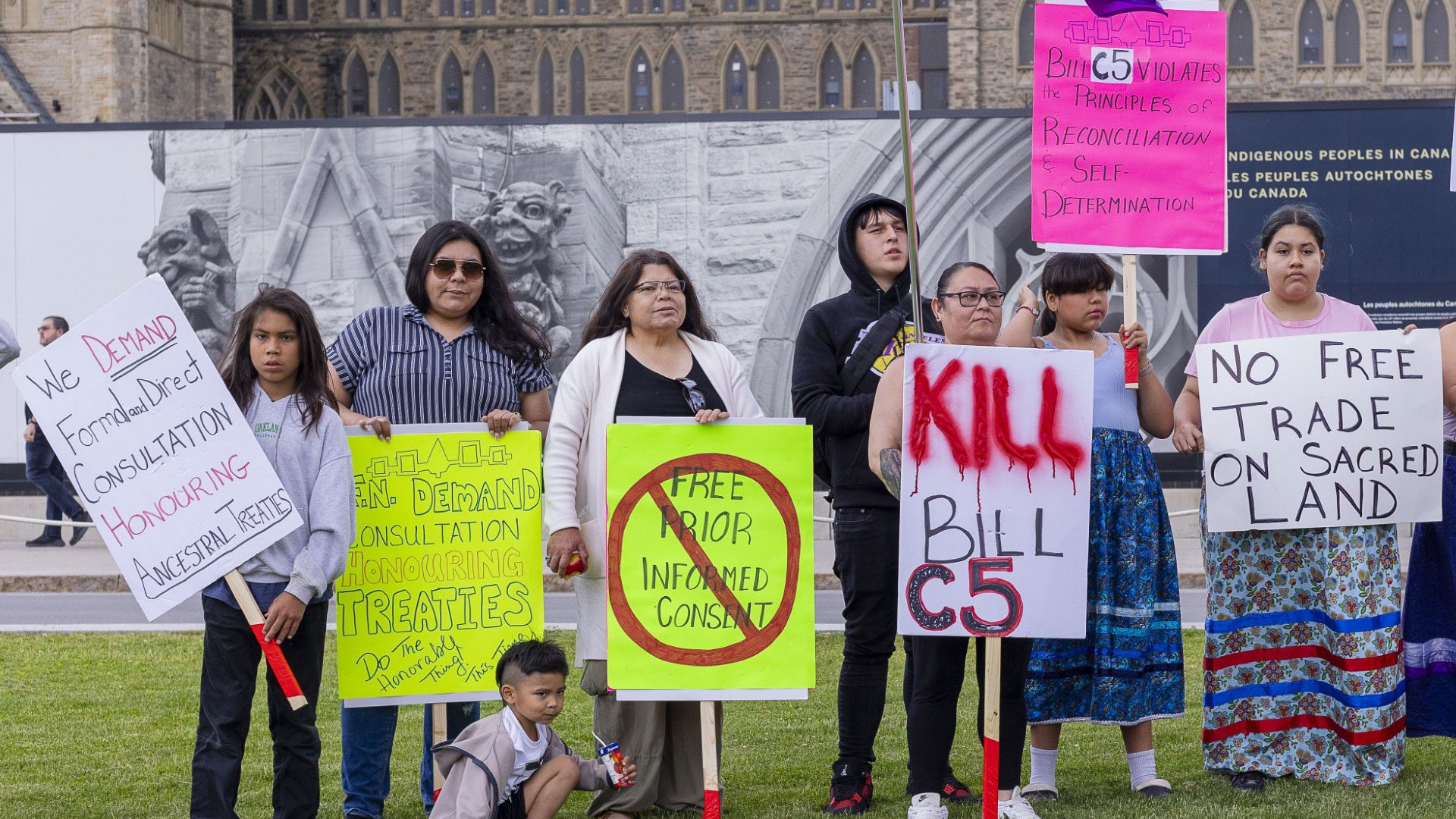
On Parliament Hill, about 350 people brought signs and ceremonial drums to help make their point.
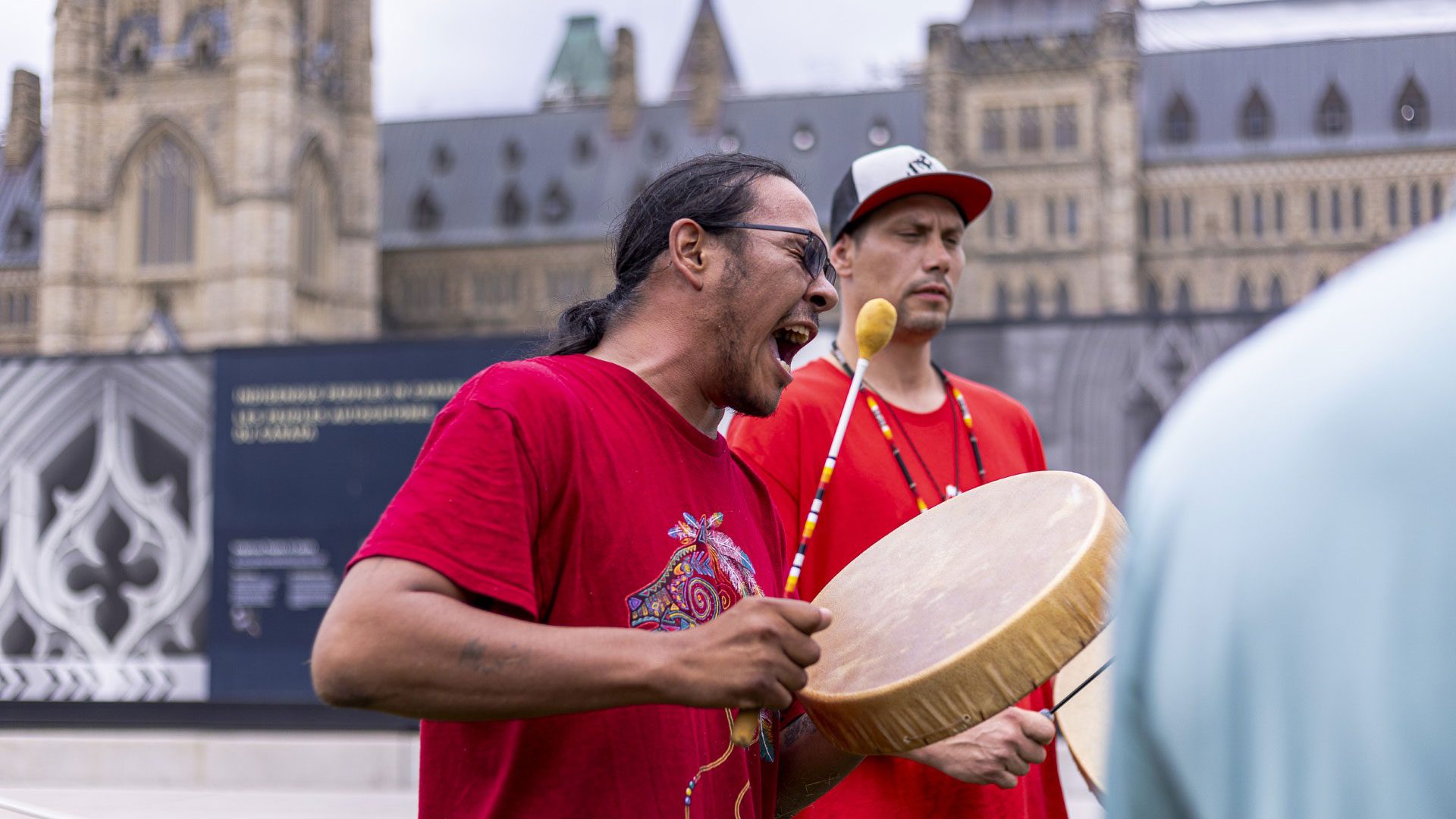 About
350 people came from various locations to take part in the protest on
Parliament Hill on Tuesday. Photo: Charlie Woolf/APTN.
About
350 people came from various locations to take part in the protest on
Parliament Hill on Tuesday. Photo: Charlie Woolf/APTN.
Bill C-5 is currently being fast-tracked through Parliament. There has been little consultation with First Nations.
According to the government, it sent an outline to about 60 “Indigenous partners” to review the gist of the legislation a week or so before it was tabled in the House of Commons.
If passed, the minister in charge of approving projects would be able to override 13 different federal laws currently on the books including the Indian Act, Species at Risk and Environmental Protection Act to get a project underway.
The prime minister said an Indigenous Advisory Council would be formed to help guide the process – but there’s no mention of it in the legislation.
“It’s important to protect our land in and our waters because that’s one of the crucial parts of our culture is to protect our lands and the water,” said Jessica George, 19, who made the six hour drive from Oneida First Nation.
Ontario NDP MPP Sol Mamakwa said First Nations need to be part of the discussion when decisions effect Treaty rights, land rights and people who live on the land.
He said communities will rise up against both Ontario and Canada’s proposed bill.
“I think you will see different direct actions from different areas and one of the things is some peaceful demonstrations, but I think if there’s no pull back of the Bill 5 or repealing of the bill or killing the bills I think things will just elevate slowly throughout the summer,” said Mamakwa.
Ramon Katakwapit is from Attawapiskat First Nation, a Cree community in Treaty 9 in northern Ontario. That’s the treaty area where the Ring of Fire is located. Rich in minerals vital to the green economy, it’s an area that Ontario Premier Doug Ford said is at the top of his list to get a “special economic zone” designation.
Even First Nations that have signed road construction agreements with the Ford government said they are against the province’s law.
Katakwapit said the Nishnawbe Aski Nation Youth Council is starting a movement across the country for young people to make change.
“We will not be the same as Idle No More, KI Six, 1492 Landback,” he said about previous protests, “This will be different and real change will be made because we’re only building on top of what our predecessors have built for us but we’re going to the moon this time and I believe in this generation.”
Read the federal government’s proposed legislation: Bill C-5
Read Ontario’s economic renewal law: Bill 5
Prime Minister Mark Carney, who is currently in Alberta hosting the G7 summit, said Parliament would sit until the Bill 5 was passed.

Author(s)
First Nations need to ‘draw a firm line in the sand’ to get Ottawa to drop Bill C-5, says Wilson-Raybould
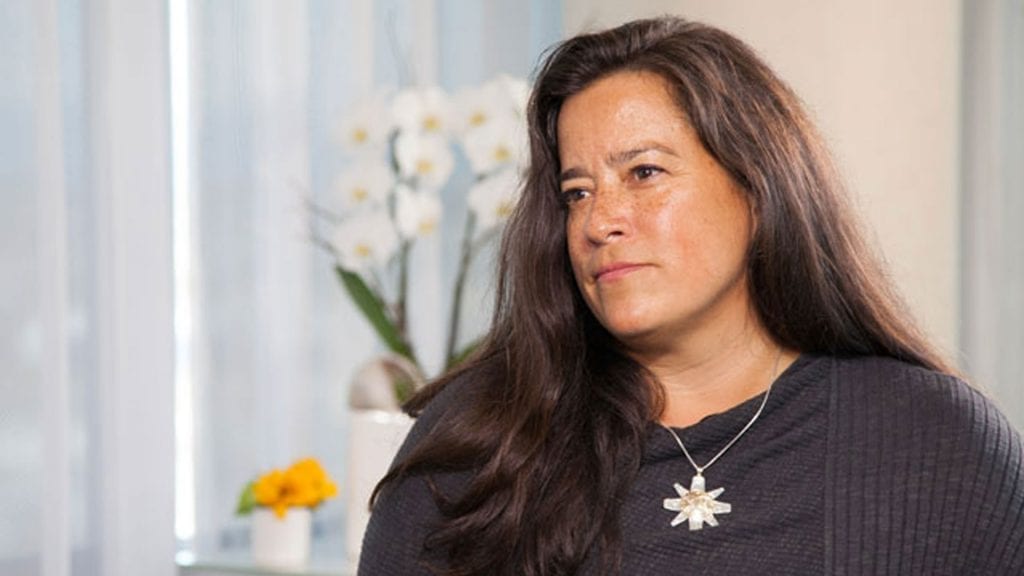 Jody Wilson-Raybould, seen here in this file photo
from 2019, says First Nations need to push back against Bill C-5. Photo:
APTN
Jody Wilson-Raybould, seen here in this file photo
from 2019, says First Nations need to push back against Bill C-5. Photo:
APTN Jody Wilson-Raybould says that Indigenous peoples across the country need to come together and “draw a firm line in the sand” to kill Bill C-5.
The former federal justice minister and attorney general of Canada who served under Justin Trudeau, was one of a number of speakers during a virtual forum on Tuesday hosted by the Assembly of First Nations (AFN) about a section of Bill C-5 called the Building Canada Act.
According to a recording of the meeting, Wilson-Raybould said Bill C-5 was developed “behind closed doors” and the government will “make decisions and build projects on its own terms, at its own pace and based on rules that it choses to make up as they go along.”
The AFN said leaders have “significant concerns” about Bill C-5.
The proposed law gives unprecedented powers to the federal cabinet to sidestep more than a dozen Canadian laws including the Indian Act, Fisheries Act, Migratory Birds Convention Act and Canadian Environment Protection Act in an effort to fast-track projects of “national interest.”
The law aims to cut down on the decision making process from five years to two. The bill will also allow Ottawa to make its decisions behind closed doors and without debate in Parliament or the public.
“The broad powers contained in the proposed legislation may impact opportunities for First Nations participation in regulatory processes and could be utilized to shorten project timelines or exempt projects from certain procedural or substantive requirements,” said an AFN report prepared for the chiefs.
Wilson-Raybould said First Nations are “not fooled by the fancy rhetoric that we’re hearing from government ministers” about free, prior and informed consent.
“It’s just performative,” she said.
Wilson-Raybould said First Nations need to continue to remind government that they cannot build a new economy without First Nations.
She said First Nations need to be relentless in their opposition to Bill C-5.
“We need to be clear that this new economy is not going to be built on the backs of our people in our communities and it’s not going to be built on the lands that we have protected for generations,” said Wilson-Raybould.
Reflecting on her time in office, Wilson-Raybould said the government still doesn’t “get it.”
“They do not understand Indigenous issues or how to work well with our people,” she said.
Chief Tony Alexis of the Alexis Nakota Sioux Nation in Treaty 6 Territory, said Bill C-5 is more than just another piece of legislation.
“It’s a direct threat to our treaty relationship. It hands over the power to federal ministers to push through major projects without our consent, without full consultation and without us at the table,” Alexis said.
“This bill turns us from Treaty partners into bystanders, or worse, obstacles to remove and that’s unacceptable.”
Alexis also called on First Nations to be clear and firm in its rejection of Bill C-5, in its current form.
Calls for prime minister to sit down with First Nations
Former AFN national chief Ovide Mercredi said during the forum it would be hard for any First Nations person to be a cheerleader for this legislation.
“Not much has changed really in how they perceive us as a people. I know a little about law and a little bit about parliament, not much, but I also know that they can do whatever they want. That they will pass this legislation and they will do it quickly,” said Mercredi while wondering what options First Nations have.
“All we have is resistance? What more can we do, besides fighting and roadblocks or whatever we’ve done in the past? Do we still use the courts with limited success? How do we protect our people? How do we make sure that we get prosperity and economic security? How do we make sure we get our autonomy guaranteed? That’s the question for us.”
Mercredi said there will be some communities who want these projects and will see it as an economic opportunity but feels its difficult to discuss such benefits when we don’t know what the projects are.
The former national chief said all the leaders in every region need to drop what they’re doing and make this a priority and decide for themselves where they stand with major projects.
“Maybe we are a major project, maybe our needs are a major project,” said Mercredi who called on Prime Minister Mark Carney to sit down with First Nations.
Historic Shift
Mark Podlasly, the CEO of the First Nations Major Projects Coalition (FNMPC), a group of over 180 First Nations across Canada, working to advance Indigenous participation in major resource development projects, agreed the legislation is being rushed.
“We’re also very strong on the opinion that First Nations must share the benefits. If we host the projects, there has to be real environmental and economic value to our people. That includes equity, it could also include revenue sharing, loan guarantees, Indigenous procurement, on the economic side,” said Podlasly adding, “there is still a need to still negotiate the other impacts to our rights and title that will come from the projects.”
Read More:
First Nations threaten ‘long hot summer’ if Ottawa passes national project legislation
Podlasly said this could be a “historic shift in how Indigenous people are included in the development of our economy going forward but only if the Crown choses partnership over speed.”
Podlasly said First Nations can expect projects to be proposed in all areas of energy, mining, electric transmission lines, and railways.
The FNMPC is currently involved in 19 projects across the country, including natural gas pipelines, passenger rail, electrical transmission and a lithium project.
Podlasly said there are more coming.
The total capital cost of the projects the FNMPC is supporting right now is worth $45-billion dollars
Author(s)


No comments:
Post a Comment