Liberals' throne speech adopted without a recorded vote
Considered a confidence vote, the throne speech was adopted Wednesday evening
The Liberal government avoided its first confidence vote Wednesday evening as MPs adopted the throne speech.
When debating legislation in the House, the Speaker will ask if MPs request a "recorded division," or a standing vote. If no MP asks for one, the motion is deemed adopted.
No MP asked for recorded division on the throne speech when the time to vote came, meaning it was passed without MPs standing to vote.
"The House of Commons has adopted our new government's speech from the throne, setting the stage for a strong and focused agenda," Government House leader Steven MacKinnon said in a social media post on Wednesday.
The adoption came despite Interim NDP Leader Don Davies saying his party would be voting against the throne speech earlier Wednesday.
If the throne speech had proceeded to a standing vote, the Liberals would have needed another opposition party to survive the confidence vote.
 NDP leader says party will vote against throne speech
Davies told reporters on Parliament Hill that the throne speech doesn't emphasize some key priorities that the NDP want included, such as health care and employment benefits.
"It's a clear message that this throne speech is not a worker-centred throne speech and it does not deliver the priorities that we heard from millions of Canadians across this country," Davies said.
"We can't support a speech that so badly misses the mark in terms of the economic and social policies people need in this country."
 NDP Interim Leader Don Davies said Wednesday that the throne speech was
missing key priorities. (Sean Kilpatrick/The Canadian Press)
NDP Interim Leader Don Davies said Wednesday that the throne speech was
missing key priorities. (Sean Kilpatrick/The Canadian Press)
The NDP was reduced to seven seats in April's election. But with the Liberals just a few seats short of a majority, the party still has some sway in this Parliament.
The Conservatives have said they would back the Liberals in certain circumstances. But neither the Conservatives nor the Bloc Québécois said they would back the throne speech ahead of the time to vote.
Liberals lost vote to amend speech
The adoption of the throne speech came just days after the Liberals lost a vote to amend the speech.
Opposition MPs outvoted the Liberals 166 to 164 on Monday night to include the amendment which calls on the government to table an economic update before Parliament breaks for the summer.
 Carney 'ignoring' will of the House on spring economic update: Melissa Lantsman | Power & Politics
The amendment was put forward by the Conservatives and included language inserted by the Bloc and NDP. All three opposition parties voted to support it.
The NDP, which had a supply-and-confidence agreement with the previous Liberal government, has said it will not enter a formal arrangement to support Prime Minister Mark Carney's government.
ABOUT THE AUTHOR

With files from The Canadian Press
Carney 'ignoring' will of the House on spring economic update: Melissa Lantsman | Power & Politics
Jun 3, 2025Throne speech motion rewrite should remind Liberals of the perils of minority government
A timely deep dive into parliamentary procedure.
Published June 4th, 2025 at 10:01am

 Leader
of the Government in the House of Commons Steven MacKinnon arrives to a
cabinet meeting on Parliament Hill in Ottawa on Tuesday, June 3, 2025.
THE CANADIAN PRESS/Sean Kilpatrick
Leader
of the Government in the House of Commons Steven MacKinnon arrives to a
cabinet meeting on Parliament Hill in Ottawa on Tuesday, June 3, 2025.
THE CANADIAN PRESS/Sean Kilpatrick
For a moment or so on Monday night, it looked like newly installed House of Commons Speaker Francis Scarpaleggia might have to kick off his second week on the job by breaking a tie.
When the time expired for MPs to vote on a Conservative-initiated motion to expand the proposed response to the Speech from the Throne delivered by King Charles III last week to “urge” the government to “present to Parliament an economic update or budget this spring, before the House adjourns for the summer,” the tally stood at 164 to 164.
In accordance with the standard protocols for verifying remote votes, Scarpaleggia invited any MP who may have had trouble doing so to raise their virtual hand to correct the record.
Newly elected Conservative MP Matt Strauss was the first to take him up on the offer, but his putative yea was disallowed when it was pointed out that he wasn’t wearing a jacket — which, as per longstanding chamber conventions, is still required even when voting by video.
Two of his Conservative caucus colleagues, however, managed to get in under the wire, bringing the final total to 166-164, sparing Scarpaleggia from having to cast the deciding vote and setting the stage for the House of Commons to sign off on the opposition rewrite tonight.
Speaking with reporters the following day, Government Whip Mark Gerretsen dismissed the suggestion that somehow, his side had been caught short by the vote.
“We knew the outcome of what that vote was going to be,” he explained: Out of the 169 Liberals elected, “one’s the speaker,” while four more were paired with opposition members. “We had 100 per cent efficiency in terms of our vote turnout yesterday. Every single person that was supposed to vote yesterday voted.”
In a social media post a few hours earlier, he went even further, suggesting that, while they “didn’t go into that vote thinking we would win it,” but almost accidentally did due to opposition sloppiness.”
Even so, it’s hard to fathom why the Liberals wouldn’t have at least tried to find a way to engineer a less awkward conclusion to the first make-or-break test of what may be Prime Minister Mark Carney’s first, but is technically their party’s third go-round in minority government.
The clock actually started ticking down last week, when Liberal MPs voted alongside their opposition colleagues to adopt a Bloc Québécois amendment, which extended the call for a spring budget to recognize the need to respect Quebec and provincial jurisdiction.
At that point, it was obvious to anyone paying attention — which presumably includes the government’s lead House wranglers — that the Conservative amendment would have the support of all opposition members — a point that was made even more clear on Monday, when the New Democrats successfully expanded the Bloc addition to include Indigenous peoples, a change that, once again, was adopted unanimously.
And yet, during the two-day window when the Conservative motion was open for further amendment, at no point does the government seem to have attempted to edit the motion to remove the reference to a spring budget, which could have been done with a strategically crafted subamendment — and the support of just half a dozen opposition members — right up until Monday’s vote.
Alternatively, after crunching the numbers and examining their options, the Liberals could have made the call to make the support for the Conservative amendment unanimous as well, which would at least have avoided a clear defeat on the floor of the House of Commons.
In any case, the revised motion before the House tonight may not constitute an explicit challenge to their party’s claim to hold the confidence of the House — nor, indeed, is it even binding on the government.
It is, however, still very much a question of confidence, which means the 164 Liberal MPs who voted nay on Monday night will now have to add their voices to the chorus of yeas — that, or risk bringing down the government on a spot.
What’s more, although the government isn’t obliged to heed the advice to present a hastily-assembled budget before the precinct powers down for the summer, the motion, as adopted, will reflect the will of the House of Commons, which is something that even majority governments dismiss at their peril, while doing so as a minority is downright foolhardy.
Supporters of the current government will undoubtedly point out — accurately, to be fair — that even as this real-time cross-aisle drama was playing out on the floor of the House of Commons, the prime minister was wrapping up a high-stakes huddle with provincial and territorial premiers that Ontario Ford Doug Ford summed up as the “best meeting we’ve had in years.”
Still, Carney’s pledge to bring in legislation to make Canada an economic and energy “superpower” is contingent on his minority government coming out on the winning side of multiple votes needed to get it to the finish line — as, indeed, will the approval of the main estimates, which has to happen before the supply cycle wraps up on June 23, as well as the promised income tax cuts, removal of the GST on new homes and other measures included in the Making Life More Affordable for Canadians Act, which was previewed in a ways and means motion during the opening week of the sitting, but has yet to make it onto the order paper.
That will require the support of at least some of the MPs who sided with the Conservatives on the need for a spring budget, and may be distinctly less willing to back the government in the upcoming confidence votes without some assurance that the Liberal will take their views — and demands — seriously.
There are also four opposition-designated supply days in the queue between now and the summer recess, any of which could, at least in theory, include a motion of non-confidence, although at the moment, no one seems to be expecting a serious bid to trigger a snap election until next spring at the earliest.
For his part, Government House Leader Steven MacKinnon struck a pragmatic tone when asked about the vote before heading into a cabinet meeting on Tuesday.
“When Parliament speaks, it speaks in different tones, in different voices,” he noted. “Some are advisory. Lots of points are registered in the House of Commons. Budgets, Throne Speeches, that’s another matter. We’ll see how the votes line up.”
Liberals survive confidence vote, as throne speech motion passes through House
The amended Liberal motion responding to the throne speech was carried on division, meaning the votes of individual MPs were not tallied, but the parties collectively agreed that it would be passed.
Published June 4th, 2025 at 7:29pm

 Prime
Minister Mark Carney makes his way through the foyer of the House of
Commons on Parliament Hill in Ottawa on Wednesday, June 4, 2025. THE
CANADIAN PRESS/Sean Kilpatrick
Prime
Minister Mark Carney makes his way through the foyer of the House of
Commons on Parliament Hill in Ottawa on Wednesday, June 4, 2025. THE
CANADIAN PRESS/Sean Kilpatrick
Prime Minister Mark Carney’s government has prevailed in its first confidence vote, as MPs agreed to support the throne speech reply during a vote in the House of Commons on Wednesday evening.
The Liberal motion had been amended by the Conservatives to include a provision calling on the government to table an economic update or budget before the summer, despite Liberal MPs voting against the amendment. The text also included a Bloc Québécois sub-amendment that referenced respect for provincial jurisdictions and institutions, and was further tweaked by an NDP motion that included Indigenous peoples, both of which passed.
The amended Liberal motion responding to the throne speech was carried on division, meaning the votes of individual MPs were not tallied, but the parties collectively agreed that it would be passed.
Liberal MP Kevin Lamoureux then moved for the Speaker to deliver the response to both King Charles III, who delivered the throne speech during a royal visit to the nation’s capital last week, as well as Governor General Mary Simon, which passed unanimously.
There had been some uncertainty regarding how the vote would unfold after the NDP announced it would not support the throne speech earlier on Wednesday. The New Democrats had previously been the Liberal government’s most reliable parliamentary partner during Justin Trudeau’s administration, as the two parties had a supply-and-confidence agreement from 2022 to 2024.
READ MORE: NDP to vote against Liberal throne speech
With the Liberals only winning a minority government in this spring’s federal election, the throne speech response could only pass with the support of an opposition party. Neither the Conservatives nor Bloc had revealed how they would vote prior to Wednesday evening.
The throne speech is traditionally considered a confidence vote, meaning, if it had been defeated, it could have triggered a snap election.
However, the drama was cut short after Chief Government Whip Mark Gerretsen called for the motion to be carried on division, and there were no objections.
The next confidence vote is expected to be on the main estimates, which were tabled last week and outline annual government expenditures. Similarly, the estimates are automatically considered a matter of confidence, and Conservative Leader Pierre Poilievre has already announced his party will vote against the government.
The estimates will be examined for four sitting days by a committee of the whole, which will be formed on Thursday, with a vote expected later this month.
BREAKING!!! Liberal Government COULD FALL TODAY! - NDP To Vote AGAINST THRONE SPEECH


Throne Speech PASSED - Why That's NOT Such a Bad Thing For Conservatives

126 Comments

Mark Carney Faces NON-CONFIDENCE VOTE | HES DONE!! | June 04 , 2025
Streamed live on Jun 4, 2025230 Comments
Mark Carney Faces Upcoming NON-CONFIDENCE VOTE Question Period | June 05 , 2025
Streamed live on Jun 5, 2025
Conservative MPs GO OFF On Carney's Ministers In Parliament! | Question Period | June 5
 Canadian Capital Clips
 The Canadian 45th Parliament is now in its second week, and things are starting to get spicy! Mark Carney has proposed a $486 billion dollar spending plan with no budget, while signing fake "executive orders" as PM, which Canada does not have

Interim NDP leader on 'reasserting' the party in Parliament

NDP Pull Biggest VOTE FAKE-OUT in History—Liberals SCOLD Fraser in Embarrassing SHUTDOWN
 The Elev8 Podcast
 1,250 Comments
Bloc supply management bill represents 1% of economy, expert says
Bill C-202 prohibits the Canadian government from altering dairy, egg, or poultry quotas through international trade treaties.


Facebook / Yves-François Blanchet (left)
On Thursday, the House of Commons unanimously approved a Bloc Québécois bill safeguarding dairy quotas in future trade negotiations, despite an equivalent bill being weakened by the Senate last year.
“We will never give up,” said Bloc MP Yves Perron. “We are now counting on swift passage in the Senate so the bill can come into effect as quickly as possible.”
Prime Minister Mark Carney backed the bill, amid the ongoing trade disputes with U.S. President Donald Trump. “Supply management will never, never be on the negotiation table,” he told the Commons last month. “Supply management will be protected.”
Bill C-202, An Act To Amend The Department Of Foreign Affairs Act, prohibits the Canadian government from altering dairy, egg, or poultry quotas through international trade treaties, according to Blacklock’s. It is identical to an earlier Bill C-282.
Supply-managed sectors, representing just one percent of the economy, receive disproportionate benefits from the bill, which could harm the majority of farmers and set concerning trade precedents, as stated by the Canadian Agri-Food Trade Alliance.
Daniel Schwanen, senior vice-president at the C.D. Howe Institute, called the quota sector “a very important but nevertheless small portion of the Canadian economy.” He clarified that most farm and food sectors favor free trade, arguing that the bill has global repercussions.
Trade negotiators and farmers cautioned that protectionism would damage other parts of Canada's economy as CUSMA nears its 2026 review. Bill C-282, if approved, would have exempted 37 trade agreements from certain provisions.
“The bill ties our hands unnecessarily,” said Schwanen. “Supply management will not go away. Much as sometimes I wish it would, it hasn’t gone away in recent major trade negotiations and it doesn’t need to be protected in this costly fashion.”
When C-282 did not become law by October 29, 2024, the Bloc began talks to trigger an election, but these discussions stalled. Conservative amendments made the bill untenable for Québec separatists, who advocated protectionism.
“I disagree with it in principle,” Senator Peter Harder, sponsor of the amendment, said at the time. “It is not about supply management but rather about trade policy.”
Another Senator decried the lack of study on C-282. “It’s really incumbent upon us to do a thorough study of this bill,” Senator Mary Coyle earlier told the foreign affairs committee.

Alex Dhaliwal
Journalist and Writer
Alex Dhaliwal is a Political Science graduate from the University of Calgary. He has actively written on relevant Canadian issues with several prominent interviews under his belt.

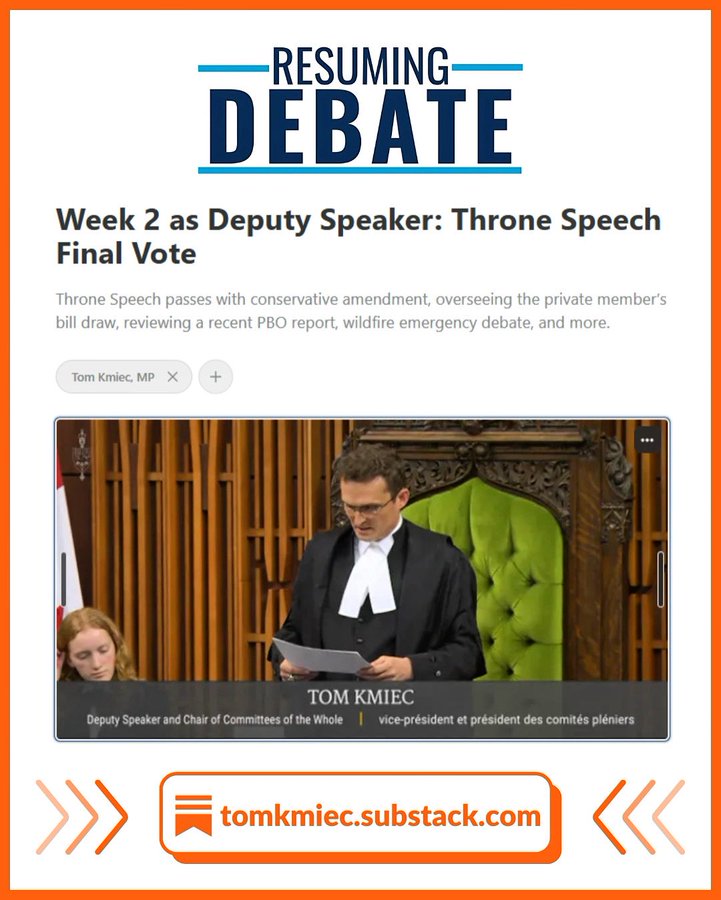


Week 2 as Deputy Speaker: Throne Speech Final Vote
Throne Speech passes with conservative amendment, overseeing the private member’s bill draw, reviewing a recent PBO report, wildfire emergency debate, and more.
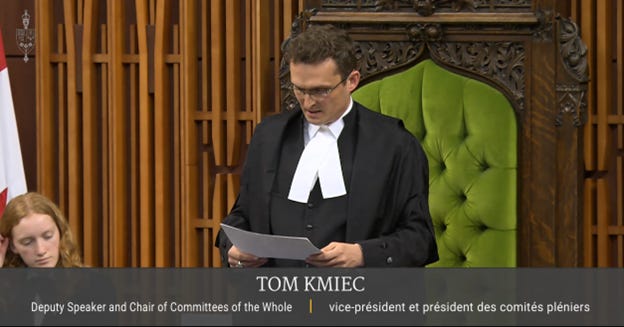
This week, I presided over my first vote in the House of Commons as Deputy Speaker. The occasion was the adoption of the Address in Reply to the Speech from the Throne, more commonly known just as the Throne Speech, with a conservative opposition amendment urging the federal government to put forward a budget.
The Throne Speech outlines government's priorities and legislative agenda for the parliamentary session. It is required at the opening of every new parliament and after every return from prorogation. The full text of the speech is available here.
Following the speech, only the House of Commons where all MPs sit debates and votes on the Address in Reply, which is a formal response expressing the overall MPs agreement or disagreement with the outlined agenda. At the end of the 6th day of debate, once all amendments are done being voted on, then the final vote is taken. Formally, that moment is called putting the question and a decision is being by the majority on whether to continue. This is always done by what’s called a voice vote which means it is not reported MP by MP but the general sense is taken of whether there is agreement to continue or not. The rules state that any MP from any recognized party can stand to request a recorded vote which then is formally taken after all MPs are called to appear in their seats. The final vote on the Throne speech is considered a confidence matter which means that if the government loses the vote it is expected to resign and a very high chance of the Governor General immediately calling a federal election.
In this instance, the throne speech was adopted "on division," meaning that while the majority agreed, some MPs signaled their disagreement without requiring a recorded vote. This is a common approach. It is often employed when the outcome is known, allowing the House of Commons to continue its business when the vote outcome is known.
Presiding over this vote was a profound reminder of the responsibilities entrusted to the Speaker. It underscored the importance of impartiality, procedural knowledge, and respect for the democratic process. As Deputy Speaker, I am committed to upholding the traditions and rules that ensure our parliamentary system functions with integrity and fairness.
What is the story with the speaker/deputy speaker and voting on bills etc? If you are filling the role as speaker does the regular speaker vote, and vice versa, or is it more complicated?
Good question. The Speaker nearly never votes for the duration of the Parliament. He is obliged to vote only to break a tie. I can vote when not in the Chair filling in for the Speaker. That can be tricky sometimes if a switch of chair occupants happens right before a vote as I have to avoid voting in the robes and especially with the tabs.
https://tomkmiec.substack.com/p/no-to-the-emergencies-act
No to the Emergencies Act
Plus Liberals vote down Conservative motion to lift federal COVID restrictions, lethal aid is sent to Ukraine, and more
No to the Emergencies Act
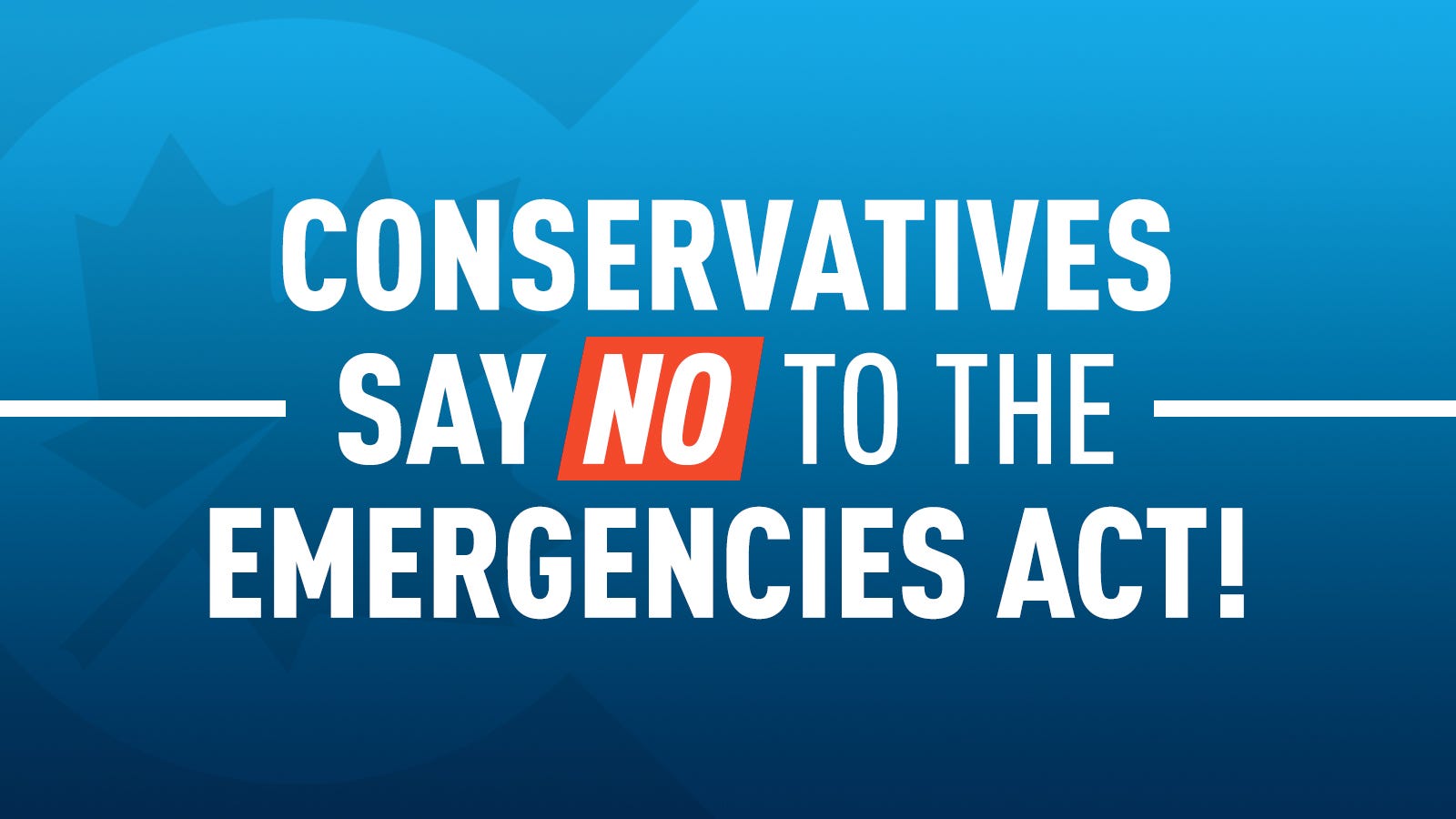
On February 14, Prime Minister Justin Trudeau along with senior cabinet ministers announced that the government would invoke the Emergencies Act to clamp down on the protests in Ottawa and blockades at the international borders. I believe the federal government has not provided sufficient justification for the use of these emergency powers and that view is shared by many legal experts including the Canadian Civil Liberties Association and the Canadian Constitution Foundation. The vote on Monday will be the most important one I take so far during the three Parliaments I have served in. I, along with my conservative colleagues, disagree with the use of the Act and I will lay out my thoughts for voting against the emergency motion that confirms the federal government these powers and extends the state of emergency they called per the Act.
In 1988, Parliament passed the Emergencies Act to add parliamentary supervision and make changes to the act’s prior version, the War Measures Act, as its use was criticised for not upholding charter liberties adequately during the FLQ crisis in Montreal. The final version approved by Parliament defined a national emergency as “an urgent and critical situation of a temporary nature” that either “seriously endangers the lives, health and safety of Canadians,” or “seriously threatens the ability of the Government of Canada to preserve the sovereignty, security and territorial integrity of Canada.” It must also be a situation that cannot “effectively be dealt with” by the provinces and territories. Under the act, a federal government can declare one of four types of emergencies: a public welfare emergency, a public order emergency, an international emergency, and war itself. In this case, the Liberals have called a public order emergency.
Once a federal government has issued an emergency declaration, they have 7 days to table in Parliament a motion outlining the declaration of emergency and the reasons for calling an emergency. The motion will be provided to all MPs and will kick off an immediate debate on the merits and wisdom of the decision taking precedence over any other business we were conducting beforehand. On Monday, at conclusion of debate, Parliament will vote on the motion. Should the majority of Parliament vote against the federal government’s motion, the motion is defeated and all emergency powers are immediately revoked. If passed, the federal government is granted the specific powers laid out in the emergency motion for a period of 30 days. A government may choose to end the emergency declaration before the 30-day point, but to extend the emergency powers, the government would have to pass an additional motion in Parliament. Debate was to continue today but due to security concerns on Parliament Hill, the Speaker of the House of Commons ordered the closure of the parliamentary precinct. We remain set to continue debate Saturday and Sunday starting at 7am until midnight.
There are several issues with the Liberal government’s use of the Emergencies Act. The first issue is with the Prime Minister himself, who made no effort to de-escalate the situation. In 2020, he spoke before Parliament and said “it is our job to choose respect and communication. We must not embark upon a path where we refuse to listen, or we give in to hostilities”. Yet before the protestor convoy had even left British Columbia, he had denigrated it as a “fringe minority” holding “unacceptable views”. He increased the stakes and raised the rhetoric at a time when a statesman should have been looking for ways to calm things down. Leaders are supposed to listen even to those people they profoundly disagree with. Hurling invectives and insults serves only to divide, wedge and stigmatize a particular group. The Prime Minister then proceeded to retreat to his cottage, as one dissenting senior Liberal noted, and disappeared for several days. The crisis is not about the protests in downtown Ottawa but about his lack of leadership.
Another issue was the justification offered for its use by Finance Minister Chrystia Freeland, which was to end the blockade of truckers at the Ambassador Bridge between Detroit and Windsor, a major trade route between Canada and the United States and the blockade of which cost an estimated $350 million a day. Further border blockades were present at the Coutts border in Alberta and Emerson, Manitoba. I was clear from the beginning of the Coutts blockade; protesting on the streets of Ottawa peacefully at our nation's capital is the right of every citizen but nobody has a right to blockade critical infrastructure like border crossings.
While the Liberal government claims the border blockades were cleared thanks to the use of the Emergencies Act, this is untrue. Before the Prime Minister made his announcement on the Monday, the blockade on the Ambassador Bridge had already ended, as the Ontario Superior Court granted an injunction barring protestors from blocking traffic at the bridge and police had begun making arrests in the days prior. By the end of February 13th that border crossing had been cleared. On the Coutts border a day later, the protestors had begun leaving voluntarily after negotiations with the RCMP. On Wednesday, in Manitoba, the RCMP reached an agreement for the blockaders to depart and the border would be reopened. The only group that remains is in downtown Ottawa, which is under municipal control, unlike the federally regulated borders. It begs the question: was the Emergencies Act truly needed or was it all for show?
This was the first use of the Act since Pierre Trudeau had invoked the War Measures Act to suppress the Front de Libération du Québec (FLQ), an extremist movement declared a terrorist organisation. This was a group that had carried out over 200 bombings, injuring hundreds, and kidnapped and murdered provincial cabinet minister Pierre Laporte. Since 1988, five prime ministers faced issues of national concern and yet did not use the Act. Past governments have avoided using the Emergencies Act during major crises, including on 9/11 when our airspace was shutdown and many flights were forced to land in Canada, during the entirety of the COVID-19 health pandemic, the Oka crisis in 1990 or the stand-offs at Caledonia. Other than during World War I, World War II, and the 1970 FLQ crisis, emergency powers have never been sought by a federal government. In fact, the Quebec government specifically requested for emergency help during the 1970 FLQ crisis. Today, 7 out of 10 Premiers have publicly said they do not accept the use of emergency powers with notably Ontario welcoming its use.
Using the Emergencies Act sets a dangerous precedent because of how low a threshold the federal government has actually set in practice. The Government of Canada should not have the power to freeze the bank accounts of hardworking Canadians simply on the suspicion of supporting causes of which the government doesn’t approve. This government power already exists but it is constrained by forcing governments to seek judicial approval. This takes more time and a judge must hear the reasons and evidence for it. In government briefings I am aware of, civil servants claimed this took too long. Accountability and having to prove cause before a judge cannot be set aside because it takes "too long". This is a slippery slope, and not how the federal government should operate in a free and democratic society.
Finally, a matter of deep concern for me is how the Prime Minister and the key cabinet ministers involved continue to contradict themselves on the extent of the emergency powers can be used, and for how long. On the first morning of the parliamentary debate, the Prime Minister explicitly claimed the emergency powers would apply across Canada. For days prior and during interviews, cabinet ministers have confidently claimed it would be limited to the situation in downtown Ottawa and to specific geographic regions across Canada. These contradictions do not increase confidence. The next concern is that Liberal MPs and parliamentary secretaries have repeatedly said the emergency powers are necessary in case protestors and blockaders return. This is not how the emergency powers are to be used. The Emergencies Act was never to be invoked as a precautionary measure but as a last resort when events and a situation have led to a breakdown in public order. To claim the preemptive use and therefore quick use of extraordinary powers normalizes emergency powers.
I want to assure residents of Calgary Shepard that I will be voting against the motion. The federal government has not met the standards of the law to invoke its extraordinary powers. Police forces across Canada were succeeding at clearing the border crossings and findings ways to talk protestors into returning to their communities. It is a drastic overreach of federal power and Conservatives will be voting against the Liberal’s decision to invoke the Emergencies Act.
Conservative motion on lifting pandemic restrictions voted down by the Liberals and NDP
On Monday, the Conservatives proposed a motion in Parliament calling upon the Liberal government to present a plan to lift all federal COVID-19 restrictions. Unfortunately, the Liberal government, with the support of the NDP, voted down the motion by a vote of 151-185. The plan would have provided hope for Canadians wishing to return to a pre-pandemic life and aligned Canada with many of the provinces and international friends and allies who have rolled back their pandemic restrictions. Dr. Theresa Tam and many provincial chief medical officials have already called for the re-examination of public health measures and to learn to live with the virus. The Liberal government’s refusal to present a plan is simply more bad policymaking and does not match the decisions taken by provinces such as Alberta, Ontario, and Quebec, who have all offered a date for the lifting of restrictions. Conservatives will continue holding the Liberal government to account on this issue.
https://www.ourcommons.ca/members/en/votes/44/1/24
Vote No. 24
44th Parliament, 1st SessionSitting No. 30 - Monday, February 14, 2022
Sponsor of this Motion

Subject
Motion Text
See the published vote in the Journals of Monday, February 14, 2022
Summary
Vote details
| Member of Parliament | Political Affiliation | Member Voted | Paired Two members from opposite sides of the House can agree to neutralize their votes by abstaining from voting on a given day, allowing them to be absent from the House. |
|---|---|---|---|
| Ziad Aboultaif (Edmonton Manning) |
Conservative | Yea |
|
| Scott Aitchison (Parry Sound—Muskoka) |
Conservative | Yea |
|
| Dan Albas (Central Okanagan—Similkameen—Nicola) |
Conservative | Yea |
|
| John Aldag (Cloverdale—Langley City) |
Liberal | Nay |
|
| Omar Alghabra (Mississauga Centre) |
Liberal | Nay |
|
| Shafqat Ali (Brampton Centre) |
Liberal | Nay |
|
| Dean Allison (Niagara West) |
Conservative | Yea |
|
| Anita Anand (Oakville) |
Liberal | Nay |
|
| Gary Anandasangaree (Scarborough—Rouge Park) |
Liberal | Nay |
|
| Charlie Angus (Timmins—James Bay) |
NDP | Nay |
|
| Mel Arnold (North Okanagan—Shuswap) |
Conservative | Yea |
|
| René Arseneault (Madawaska—Restigouche) |
Liberal | Nay |
|
| Chandra Arya (Nepean) |
Liberal | Nay |
|
| Niki Ashton (Churchill—Keewatinook Aski) |
NDP | Nay |
|
| Jenica Atwin (Fredericton) |
Liberal | Nay |
|
| Taylor Bachrach (Skeena—Bulkley Valley) |
NDP | Nay |
|
| Vance Badawey (Niagara Centre) |
Liberal | Nay |
|
| Parm Bains (Steveston—Richmond East) |
Liberal | Nay |
|
| Yvan Baker (Etobicoke Centre) |
Liberal | Nay |
|
| Tony Baldinelli (Niagara Falls) |
Conservative | Yea |
|
| John Barlow (Foothills) |
Conservative | Yea |
|
| Michael Barrett (Leeds—Grenville—Thousand Islands and Rideau Lakes) |
Conservative | Yea |
|
| Lisa Marie Barron (Nanaimo—Ladysmith) |
NDP | Nay |
|
| Xavier Barsalou-Duval (Pierre-Boucher—Les Patriotes—Verchères) |
Bloc Québécois | Yea |
|
| Jaime Battiste (Sydney—Victoria) |
Liberal | Nay |
|
| Mario Beaulieu (La Pointe-de-l'Île) |
Bloc Québécois | Yea |
|
| Terry Beech (Burnaby North—Seymour) |
Liberal | Nay |
|
| Rachel Bendayan (Outremont) |
Liberal | Nay |
|
| Carolyn Bennett (Toronto—St. Paul's) |
Liberal | Nay |
|
| Bob Benzen (Calgary Heritage) |
Conservative | Yea |
|
| Candice Bergen (Portage—Lisgar) |
Conservative | Yea |
|
| Stéphane Bergeron (Montarville) |
Bloc Québécois | Yea |
|
| Luc Berthold (Mégantic—L'Érable) |
Conservative | Yea |
|
| Sylvie Bérubé (Abitibi—Baie-James—Nunavik—Eeyou) |
Bloc Québécois | Yea |
|
| James Bezan (Selkirk—Interlake—Eastman) |
Conservative | Yea |
|
| Marie-Claude Bibeau (Compton—Stanstead) |
Liberal | Nay |
|
| Chris Bittle (St. Catharines) |
Liberal | Nay |
|
| Daniel Blaikie (Elmwood—Transcona) |
NDP | Nay |
|
| Bill Blair (Scarborough Southwest) |
Liberal | Nay |
|
| Maxime Blanchette-Joncas (Rimouski-Neigette—Témiscouata—Les Basques) |
Bloc Québécois | Yea |
|
| Rachel Blaney (North Island—Powell River) |
NDP | Nay |
|
| Kelly Block (Carlton Trail—Eagle Creek) |
Conservative | Yea |
|
| Kody Blois (Kings—Hants) |
Liberal | Nay |
|
| Randy Boissonnault (Edmonton Centre) |
Liberal | Nay |
|
| Alexandre Boulerice (Rosemont—La Petite-Patrie) |
NDP | Nay |
|
| Valerie Bradford (Kitchener South—Hespeler) |
Liberal | Nay |
|
| Richard Bragdon (Tobique—Mactaquac) |
Conservative | Yea |
|
| John Brassard (Barrie—Innisfil) |
Conservative | Yea |
|
| Élisabeth Brière (Sherbrooke) |
Liberal | Nay |
|
| Larry Brock (Brantford—Brant) |
Conservative | Yea |
|
| Alexis Brunelle-Duceppe (Lac-Saint-Jean) |
Bloc Québécois | Yea |
|
| Blaine Calkins (Red Deer—Lacombe) |
Conservative | Yea |
|
| Richard Cannings (South Okanagan—West Kootenay) |
NDP | Nay |
|
| Frank Caputo (Kamloops—Thompson—Cariboo) |
Conservative | Yea |
|
| Jim Carr (Winnipeg South Centre) |
Liberal | Nay |
|
| Colin Carrie (Oshawa) |
Conservative | Yea |
|
| Sean Casey (Charlottetown) |
Liberal | Nay |
|
| Louise Chabot (Thérèse-De Blainville) |
Bloc Québécois | Yea |
|
| Bardish Chagger (Waterloo) |
Liberal | Nay |
|
| George Chahal (Calgary Skyview) |
Liberal | Nay |
|
| Adam Chambers (Simcoe North) |
Conservative | Yea |
|
| François-Philippe Champagne (Saint-Maurice—Champlain) |
Liberal | Nay |
|
| Martin Champoux (Drummond) |
Bloc Québécois | Yea |
|
| Sophie Chatel (Pontiac) |
Liberal | Nay |
|
| Shaun Chen (Scarborough North) |
Liberal | Nay |
|
| Paul Chiang (Markham—Unionville) |
Liberal | Nay |
|
| Michael Chong (Wellington—Halton Hills) |
Conservative | Yea |
|
| Chad Collins (Hamilton East—Stoney Creek) |
Liberal | Nay |
|
| Laurel Collins (Victoria) |
NDP | Nay |
|
| Michael Cooper (St. Albert—Edmonton) |
Conservative | Yea |
|
| Serge Cormier (Acadie—Bathurst) |
Liberal | Nay |
|
| Michael Coteau (Don Valley East) |
Liberal | Nay |
|
| Chris d'Entremont (West Nova) |
Conservative | Yea |
|
| Julie Dabrusin (Toronto—Danforth) |
Liberal | Nay |
|
| Marc Dalton (Pitt Meadows—Maple Ridge) |
Conservative | Yea |
|
| Pam Damoff (Oakville North—Burlington) |
Liberal | Nay |
|
| Raquel Dancho (Kildonan—St. Paul) |
Conservative | Yea |
|
| Scot Davidson (York—Simcoe) |
Conservative | Yea |
|
| Don Davies (Vancouver Kingsway) |
NDP | Nay |
|
| Claude DeBellefeuille (Salaberry—Suroît) |
Bloc Québécois | Yea |
|
| Gérard Deltell (Louis-Saint-Laurent) |
Conservative | Yea |
|
| Caroline Desbiens (Beauport—Côte-de-Beaupré—Île d'Orléans—Charlevoix) |
Bloc Québécois | Yea |
|
| Luc Desilets (Rivière-des-Mille-Îles) |
Bloc Québécois | Yea |
|
| Blake Desjarlais (Edmonton Griesbach) |
NDP | Nay |
|
| Sukh Dhaliwal (Surrey—Newton) |
Liberal | Nay |
|
| Anju Dhillon (Dorval—Lachine—LaSalle) |
Liberal | Nay |
|
| Lena Metlege Diab (Halifax West) |
Liberal | Nay |
|
| Todd Doherty (Cariboo—Prince George) |
Conservative | Yea |
|
| Han Dong (Don Valley North) |
Liberal | Nay |
|
| Terry Dowdall (Simcoe—Grey) |
Conservative | Yea |
|
| Earl Dreeshen (Red Deer—Mountain View) |
Conservative | Yea |
|
| Francis Drouin (Glengarry—Prescott—Russell) |
Liberal | Nay |
|
| Emmanuel Dubourg (Bourassa) |
Liberal | Nay |
|
| Jean-Yves Duclos (Québec) |
Liberal | Nay |
|
| Terry Duguid (Winnipeg South) |
Liberal | Nay |
|
| Eric Duncan (Stormont—Dundas—South Glengarry) |
Conservative | Yea |
|
| Kirsty Duncan (Etobicoke North) |
Liberal | Nay |
|
| Julie Dzerowicz (Davenport) |
Liberal | Nay |
|
| Ali Ehsassi (Willowdale) |
Liberal | Nay |
|
| Fayçal El-Khoury (Laval—Les Îles) |
Liberal | Nay |
|
| Stephen Ellis (Cumberland—Colchester) |
Conservative | Yea |
|
| Dave Epp (Chatham-Kent—Leamington) |
Conservative | Yea |
|
| Nathaniel Erskine-Smith (Beaches—East York) |
Liberal | Nay |
|
| Rosemarie Falk (Battlefords—Lloydminster) |
Conservative | Yea |
|
| Ted Falk (Provencher) |
Conservative | Yea |
|
| Ed Fast (Abbotsford) |
Conservative | Yea |
|
| Greg Fergus (Hull—Aylmer) |
Liberal | Nay |
|
| Michelle Ferreri (Peterborough—Kawartha) |
Conservative | Yea |
|
| Andy Fillmore (Halifax) |
Liberal | Nay |
|
| Kerry-Lynne Findlay (South Surrey—White Rock) |
Conservative | Yea |
|
| Darren Fisher (Dartmouth—Cole Harbour) |
Liberal | Nay |
|
| Peter Fonseca (Mississauga East—Cooksville) |
Liberal | Nay |
|
| Mona Fortier (Ottawa—Vanier) |
Liberal | Nay |
|
| Rhéal Fortin (Rivière-du-Nord) |
Bloc Québécois | Yea |
|
| Peter Fragiskatos (London North Centre) |
Liberal | Nay |
|
| Sean Fraser (Central Nova) |
Liberal | Nay |
|
| Chrystia Freeland (University—Rosedale) |
Liberal | Nay |
|
| Hedy Fry (Vancouver Centre) |
Liberal | Nay |
|
| Iqwinder Gaheer (Mississauga—Malton) |
Liberal | Nay |
|
| Cheryl Gallant (Renfrew—Nipissing—Pembroke) |
Conservative | Yea |
|
| Marc Garneau (Notre-Dame-de-Grâce—Westmount) |
Liberal | Nay |
|
| Jean-Denis Garon (Mirabel) |
Bloc Québécois | Yea |
|
| Randall Garrison (Esquimalt—Saanich—Sooke) |
NDP | Nay |
|
| Marie-Hélène Gaudreau (Laurentides—Labelle) |
Bloc Québécois | Yea |
|
| Leah Gazan (Winnipeg Centre) |
NDP | Nay |
|
| Bernard Généreux (Montmagny—L'Islet—Kamouraska—Rivière-du-Loup) |
Conservative | Yea |
|
| Garnett Genuis (Sherwood Park—Fort Saskatchewan) |
Conservative | Yea |
|
| Mark Gerretsen (Kingston and the Islands) |
Liberal | Nay |
|
| Marilène Gill (Manicouagan) |
Bloc Québécois | Yea |
|
| Marilyn Gladu (Sarnia—Lambton) |
Conservative | Yea |
|
| Joël Godin (Portneuf—Jacques-Cartier) |
Conservative | Yea |
|
| Laila Goodridge (Fort McMurray—Cold Lake) |
Conservative | Yea |
|
| Karina Gould (Burlington) |
Liberal | Nay |
|
| Jacques Gourde (Lévis—Lotbinière) |
Conservative | Yea |
|
| Tracy Gray (Kelowna—Lake Country) |
Conservative | Yea |
|
| Matthew Green (Hamilton Centre) |
NDP | Nay |
|
| Steven Guilbeault (Laurier—Sainte-Marie) |
Liberal | Nay |
|
| Patty Hajdu (Thunder Bay—Superior North) |
Liberal | Nay |
|
| Jasraj Singh Hallan (Calgary Forest Lawn) |
Conservative | Yea |
|
| Brendan Hanley (Yukon) |
Liberal | Nay |
|
| Ken Hardie (Fleetwood—Port Kells) |
Liberal | Nay |
|
| Lisa Hepfner (Hamilton Mountain) |
Liberal | Nay |
|
| Randy Hoback (Prince Albert) |
Conservative | Yea |
|
| Mark Holland (Ajax) |
Liberal | Nay |
|
| Anthony Housefather (Mount Royal) |
Liberal | Nay |
|
| Carol Hughes (Algoma—Manitoulin—Kapuskasing) |
NDP | Nay |
|
| Ahmed Hussen (York South—Weston) |
Liberal | Nay |
|
| Gudie Hutchings (Long Range Mountains) |
Liberal | Nay |
|
| Angelo Iacono (Alfred-Pellan) |
Liberal | Nay |
|
| Lori Idlout (Nunavut) |
NDP | Nay |
|
| Marci Ien (Toronto Centre) |
Liberal | Nay |
|
| Helena Jaczek (Markham—Stouffville) |
Liberal | Nay |
|
| Matt Jeneroux (Edmonton Riverbend) |
Conservative | Yea |
|
| Gord Johns (Courtenay—Alberni) |
NDP | Nay |
|
| Mélanie Joly (Ahuntsic-Cartierville) |
Liberal | Nay |
|
| Yvonne Jones (Labrador) |
Liberal | Nay |
|
| Majid Jowhari (Richmond Hill) |
Liberal | Nay |
|
| Peter Julian (New Westminster—Burnaby) |
NDP | Nay |
|
| Arielle Kayabaga (London West) |
Liberal | Nay |
|
| Mike Kelloway (Cape Breton—Canso) |
Liberal | Nay |
|
| Pat Kelly (Calgary Rocky Ridge) |
Conservative | Yea |
|
| Iqra Khalid (Mississauga—Erin Mills) |
Liberal | Nay |
|
| Kamal Khera (Brampton West) |
Liberal | Nay |
|
| Robert Kitchen (Souris—Moose Mountain) |
Conservative | Yea |
|
| Tom Kmiec (Calgary Shepard) |
Conservative | Yea |
|
| Annie Koutrakis (Vimy) |
Liberal | Nay |
|
| Michael Kram (Regina—Wascana) |
Conservative | Yea |
|
| Shelby Kramp-Neuman (Hastings—Lennox and Addington) |
Conservative | Yea |
|
| Damien Kurek (Battle River—Crowfoot) |
Conservative | Yea |
|
| Stephanie Kusie (Calgary Midnapore) |
Conservative | Yea |
|
| Irek Kusmierczyk (Windsor—Tecumseh) |
Liberal | Nay |
|
| Jenny Kwan (Vancouver East) |
NDP | Nay |
|
| Mike Lake (Edmonton—Wetaskiwin) |
Conservative | Yea |
|
| Marie-France Lalonde (Orléans) |
Liberal | Nay |
|
| Emmanuella Lambropoulos (Saint-Laurent) |
Liberal | Nay |
|
| David Lametti (LaSalle—Émard—Verdun) |
Liberal | Nay |
|
| Kevin Lamoureux (Winnipeg North) |
Liberal | Nay |
|
| Melissa Lantsman (Thornhill) |
Conservative | Yea |
|
| Viviane Lapointe (Sudbury) |
Liberal | Nay |
|
| Andréanne Larouche (Shefford) |
Bloc Québécois | Yea |
|
| Patricia Lattanzio (Saint-Léonard—Saint-Michel) |
Liberal | Nay |
|
| Stéphane Lauzon (Argenteuil—La Petite-Nation) |
Liberal | Nay |
|
| Philip Lawrence (Northumberland—Peterborough South) |
Conservative | Yea |
|
| Dominic LeBlanc (Beauséjour) |
Liberal | Nay |
|
| Diane Lebouthillier (Gaspésie—Les Îles-de-la-Madeleine) |
Liberal | Nay |
|
| Richard Lehoux (Beauce) |
Conservative | Yea |
|
| Sébastien Lemire (Abitibi—Témiscamingue) |
Bloc Québécois | Yea |
|
| Chris Lewis (Essex) |
Conservative | Yea |
|
| Leslyn Lewis (Haldimand—Norfolk) |
Conservative | Yea |
|
| Ron Liepert (Calgary Signal Hill) |
Conservative | Yea |
|
| Joël Lightbound (Louis-Hébert) |
Liberal | Yea |
|
| Dane Lloyd (Sturgeon River—Parkland) |
Conservative | Yea |
|
| Ben Lobb (Huron—Bruce) |
Conservative | Yea |
|
| Wayne Long (Saint John—Rothesay) |
Liberal | Nay |
|
| Lloyd Longfield (Guelph) |
Liberal | Nay |
|
| Tim Louis (Kitchener—Conestoga) |
Liberal | Nay |
|
| Lawrence MacAulay (Cardigan) |
Liberal | Nay |
|
| Heath MacDonald (Malpeque) |
Liberal | Nay |
|
| Alistair MacGregor (Cowichan—Malahat—Langford) |
NDP | Nay |
|
| Dave MacKenzie (Oxford) |
Conservative | Yea |
|
| Steven MacKinnon (Gatineau) |
Liberal | Nay |
|
| Larry Maguire (Brandon—Souris) |
Conservative | Yea |
|
| James Maloney (Etobicoke—Lakeshore) |
Liberal | Nay |
|
| Richard Martel (Chicoutimi—Le Fjord) |
Conservative | Yea |
|
| Soraya Martinez Ferrada (Hochelaga) |
Liberal | Nay |
|
| Brian Masse (Windsor West) |
NDP | Nay |
|
| Lindsay Mathyssen (London—Fanshawe) |
NDP | Nay |
|
| Bryan May (Cambridge) |
Liberal | Nay |
|
| Elizabeth May (Saanich—Gulf Islands) |
Green Party | Nay |
|
| Dan Mazier (Dauphin—Swan River—Neepawa) |
Conservative | Yea |
|
| Kelly McCauley (Edmonton West) |
Conservative | Yea |
|
| Ken McDonald (Avalon) |
Liberal | Nay |
|
| David McGuinty (Ottawa South) |
Liberal | Nay |
|
| John McKay (Scarborough—Guildwood) |
Liberal | Nay |
|
| Ron McKinnon (Coquitlam—Port Coquitlam) |
Liberal | Nay |
|
| Greg McLean (Calgary Centre) |
Conservative | Yea |
|
| Michael McLeod (Northwest Territories) |
Liberal | Nay |
|
| Heather McPherson (Edmonton Strathcona) |
NDP | Nay |
|
| Eric Melillo (Kenora) |
Conservative | Yea |
|
| Alexandra Mendès (Brossard—Saint-Lambert) |
Liberal | Nay |
|
| Marco Mendicino (Eglinton—Lawrence) |
Liberal | Nay |
|
| Wilson Miao (Richmond Centre) |
Liberal | Nay |
|
| Kristina Michaud (Avignon—La Mitis—Matane—Matapédia) |
Bloc Québécois | Yea |
|
| Marc Miller (Ville-Marie—Le Sud-Ouest—Île-des-Soeurs) |
Liberal | Nay |
|
| Rob Moore (Fundy Royal) |
Conservative | Yea |
|
| Marty Morantz (Charleswood—St. James—Assiniboia—Headingley) |
Conservative | Yea |
|
| Mike Morrice (Kitchener Centre) |
Green Party | Nay |
|
| Rob Morrison (Kootenay—Columbia) |
Conservative | Yea |
|
| Robert Morrissey (Egmont) |
Liberal | Nay |
|
| Glen Motz (Medicine Hat—Cardston—Warner) |
Conservative | Yea |
|
| Joyce Murray (Vancouver Quadra) |
Liberal | Nay |
|
| Dan Muys (Flamborough—Glanbrook) |
Conservative | Yea |
|
| Yasir Naqvi (Ottawa Centre) |
Liberal | Nay |
|
| John Nater (Perth—Wellington) |
Conservative | Yea |
|
| Mary Ng (Markham—Thornhill) |
Liberal | Nay |
|
| Taleeb Noormohamed (Vancouver Granville) |
Liberal | Nay |
|
| Christine Normandin (Saint-Jean) |
Bloc Québécois | Yea |
|
| Jennifer O'Connell (Pickering—Uxbridge) |
Liberal | Nay |
|
| Seamus O'Regan (St. John's South—Mount Pearl) |
Liberal | Nay |
|
| Erin O'Toole (Durham) |
Conservative | Yea |
|
| Robert Oliphant (Don Valley West) |
Liberal | Nay |
|
| Jeremy Patzer (Cypress Hills—Grasslands) |
Conservative | Yea |
|
| Pierre Paul-Hus (Charlesbourg—Haute-Saint-Charles) |
Conservative | Yea |
|
| Monique Pauzé (Repentigny) |
Bloc Québécois | Yea |
|
| Rick Perkins (South Shore—St. Margarets) |
Conservative | Yea |
|
| Yves Perron (Berthier—Maskinongé) |
Bloc Québécois | Yea |
|
| Ginette Petitpas Taylor (Moncton—Riverview—Dieppe) |
Liberal | Nay |
|
| Louis Plamondon (Bécancour—Nicolet—Saurel) |
Bloc Québécois | Yea |
|
| Pierre Poilievre (Carleton) |
Conservative | Yea |
|
| Marcus Powlowski (Thunder Bay—Rainy River) |
Liberal | Nay |
|
| Carla Qualtrough (Delta) |
Liberal | Nay |
|
| Alain Rayes (Richmond—Arthabaska) |
Conservative | Yea |
|
| Brad Redekopp (Saskatoon West) |
Conservative | Yea |
|
| Scott Reid (Lanark—Frontenac—Kingston) |
Conservative | Yea |
|
| Michelle Rempel Garner (Calgary Nose Hill) |
Conservative | Yea |
|
| Blake Richards (Banff—Airdrie) |
Conservative | Yea |
|
| Anna Roberts (King—Vaughan) |
Conservative | Yea |
|
| Yves Robillard (Marc-Aurèle-Fortin) |
Liberal | Nay |
|
| Pablo Rodriguez (Honoré-Mercier) |
Liberal | Nay |
|
| Churence Rogers (Bonavista—Burin—Trinity) |
Liberal | Nay |
|
| Sherry Romanado (Longueuil—Charles-LeMoyne) |
Liberal | Nay |
|
| Lianne Rood (Lambton—Kent—Middlesex) |
Conservative | Yea |
|
| Alex Ruff (Bruce—Grey—Owen Sound) |
Conservative | Yea |
|
| Ruby Sahota (Brampton North) |
Liberal | Nay |
|
| Harjit S. Sajjan (Vancouver South) |
Liberal | Nay |
|
| Ya'ara Saks (York Centre) |
Liberal | Nay |
|
| Darrell Samson (Sackville—Preston—Chezzetcook) |
Liberal | Nay |
|
| Randeep Sarai (Surrey Centre) |
Liberal | Nay |
|
| Simon-Pierre Savard-Tremblay (Saint-Hyacinthe—Bagot) |
Bloc Québécois | Yea |
|
| Francis Scarpaleggia (Lac-Saint-Louis) |
Liberal | Nay |
|
| Andrew Scheer (Regina—Qu'Appelle) |
Conservative | Yea |
|
| Peter Schiefke (Vaudreuil—Soulanges) |
Liberal | Nay |
|
| Jamie Schmale (Haliburton—Kawartha Lakes—Brock) |
Conservative | Yea |
|
| Kyle Seeback (Dufferin—Caledon) |
Conservative | Yea |
|
| Marc Serré (Nickel Belt) |
Liberal | Nay |
|
| Judy A. Sgro (Humber River—Black Creek) |
Liberal | Nay |
|
| Brenda Shanahan (Châteauguay—Lacolle) |
Liberal | Nay |
|
| Terry Sheehan (Sault Ste. Marie) |
Liberal | Nay |
|
| Martin Shields (Bow River) |
Conservative | Yea |
|
| Doug Shipley (Barrie—Springwater—Oro-Medonte) |
Conservative | Yea |
|
| Maninder Sidhu (Brampton East) |
Liberal | Nay |
|
| Sonia Sidhu (Brampton South) |
Liberal | Nay |
|
| Mario Simard (Jonquière) |
Bloc Québécois | Yea |
|
| Nathalie Sinclair-Desgagné (Terrebonne) |
Bloc Québécois | Yea |
|
| Jagmeet Singh (Burnaby South) |
NDP | Nay |
|
| Clifford Small (Coast of Bays—Central—Notre Dame) |
Conservative | Yea |
|
| Francesco Sorbara (Vaughan—Woodbridge) |
Liberal | Nay |
|
| Gerald Soroka (Yellowhead) |
Conservative | Yea |
|
| Sven Spengemann (Mississauga—Lakeshore) |
Liberal | Nay |
|
| Pascale St-Onge (Brome—Missisquoi) |
Liberal | Nay |
|
| Gabriel Ste-Marie (Joliette) |
Bloc Québécois | Yea |
|
| Warren Steinley (Regina—Lewvan) |
Conservative | Yea |
|
| Jake Stewart (Miramichi—Grand Lake) |
Conservative | Yea |
|
| Mark Strahl (Chilliwack—Hope) |
Conservative | Yea |
|
| Shannon Stubbs (Lakeland) |
Conservative | Yea |
|
| Jenna Sudds (Kanata—Carleton) |
Liberal | Nay |
|
| Filomena Tassi (Hamilton West—Ancaster—Dundas) |
Liberal | Nay |
|
| Leah Taylor Roy (Aurora—Oak Ridges—Richmond Hill) |
Liberal | Nay |
|
| Luc Thériault (Montcalm) |
Bloc Québécois | Yea |
|
| Alain Therrien (La Prairie) |
Bloc Québécois | Yea |
|
| Rachael Thomas (Lethbridge) |
Conservative | Yea |
|
| Joanne Thompson (St. John's East) |
Liberal | Nay |
|
| Corey Tochor (Saskatoon—University) |
Conservative | Yea |
|
| Fraser Tolmie (Moose Jaw—Lake Centre—Lanigan) |
Conservative | Yea |
|
| Justin Trudeau (Papineau) |
Liberal | Nay |
|
| Denis Trudel (Longueuil—Saint-Hubert) |
Bloc Québécois | Yea |
|
| Ryan Turnbull (Whitby) |
Liberal | Nay |
|
| Tim Uppal (Edmonton Mill Woods) |
Conservative | Yea |
|
| Rechie Valdez (Mississauga—Streetsville) |
Liberal | Nay |
|
| Tony Van Bynen (Newmarket—Aurora) |
Liberal | Nay |
|
| Adam van Koeverden (Milton) |
Liberal | Nay |
|
| Tako Van Popta (Langley—Aldergrove) |
Conservative | Yea |
|
| Dan Vandal (Saint Boniface—Saint Vital) |
Liberal | Nay |
|
| Anita Vandenbeld (Ottawa West—Nepean) |
Liberal | Nay |
|
| Karen Vecchio (Elgin—Middlesex—London) |
Conservative | Yea |
|
| Gary Vidal (Desnethé—Missinippi—Churchill River) |
Conservative | Yea |
|
| Dominique Vien (Bellechasse—Les Etchemins—Lévis) |
Conservative | Yea |
|
| Arnold Viersen (Peace River—Westlock) |
Conservative | Yea |
|
| Julie Vignola (Beauport—Limoilou) |
Bloc Québécois | Yea |
|
| René Villemure (Trois-Rivières) |
Bloc Québécois | Yea |
|
| Arif Virani (Parkdale—High Park) |
Liberal | Nay |
|
| Brad Vis (Mission—Matsqui—Fraser Canyon) |
Conservative | Yea |
|
| Kevin Vuong (Spadina—Fort York) |
Independent | Nay |
|
| Cathay Wagantall (Yorkton—Melville) |
Conservative | Yea |
|
| Chris Warkentin (Grande Prairie—Mackenzie) |
Conservative | Yea |
|
| Kevin Waugh (Saskatoon—Grasswood) |
Conservative | Yea |
|
| Len Webber (Calgary Confederation) |
Conservative | Yea |
|
| Patrick Weiler (West Vancouver—Sunshine Coast—Sea to Sky Country) |
Liberal | Nay |
|
| Jonathan Wilkinson (North Vancouver) |
Liberal | Nay |
|
| Ryan Williams (Bay of Quinte) |
Conservative | Yea |
|
| John Williamson (New Brunswick Southwest) |
Conservative | Yea |
|
| Jean Yip (Scarborough—Agincourt) |
Liberal | Nay |
|
| Salma Zahid (Scarborough Centre) |
Liberal | Nay |
|
| Bonita Zarrillo (Port Moody—Coquitlam) |
NDP | Nay |
|
| Bob Zimmer (Prince George—Peace River—Northern Rockies) |
Conservative | Yea |
|
| Sameer Zuberi (Pierrefonds—Dollard) |
Liberal | Nay |
The Speaker and Other Presiding Officers
The Speaker and other presiding officers oversee the sittings and proceedings of the House of Commons, maintaining order and decorum in the chamber. Visit the website of the Speaker of the House of Commons for biographical information about the current Speaker and other presiding officers.



Date: Thu, May 29, 2025 at 5:01 PM
Subject: Automatic reply: RE How do you feel about King Charles’s visit to Ottawa?
To: David Amos <david.raymond.amos333@gmail.com>
Tom Kmiec, MP
Calgary Shepard
Date: Thu, May 29, 2025 at 5:00 PM
Subject: Fwd: RE How do you feel about King Charles’s visit to Ottawa?
To: <Tom.Kmiec@parl.gc.ca>, <mwilson@goodmans.ca>
From: Kmiec, Tom - M.P. <Tom.Kmiec@parl.gc.ca>
Date: Sun, Feb 20, 2022 at 8:15 PM
Subject: Automatic reply: RE Trudeau Invoking the Emergency Act and Freeland defending her liberal democracy byway of her bankster buddies
To: David Amos <david.raymond.amos333@gmail.
Thank you for taking the time to contact my office.
Due to the increasing use of auto-generated form letters used by advocacy and special interest groups, which send me up to a thousand emails a day, I am no longer responding to form emails. I will still read every email personally.
Individually written emails and letters from constituents will always get a response from me by email, phone call, or other digital response. Please ensure that your name, address and postal code are included in your email so I can respond to you promptly. Due to the large volume of correspondence I receive daily, replies are prioritized by urgency. I will do my very best to give you a response within a few weeks.
Thank you again for the email.
In your service,
Tom Kmiec, MP
Calgary Shepard
From: Poilievre, Pierre - M.P. <pierre.poilievre@parl.gc.ca>
Date: Wed, Mar 2, 2022 at 2:18 AM
Subject: I am 100% against the use of the Emergencies Act
To: David Amos <david.raymond.amos333@gmail.
Sincerely,
Pierre Poilievre P.C., M.P. Carleton
Shadow Minister of Finance
SK
Poilievre replaces top lawyer at Conservative Party
Michael Wilson, an ally of the new leader, replaces Arthur Hamilton
 Conservative
Leader Pierre Poilievre has replaced the party's legal counsel with a
pick of his own, as he continues to shake up the party. (Adrian Wyld/The Canadian Press)
Conservative
Leader Pierre Poilievre has replaced the party's legal counsel with a
pick of his own, as he continues to shake up the party. (Adrian Wyld/The Canadian Press)Pierre Poilievre has replaced the Conservative Party's top lawyer with his own pick, CBC News has learned, as he continues to shake up the party's upper echelons.
The party's legal counsel, Arthur Hamilton, has been replaced with Michael Wilson, a Poilievre ally and partner at the law firm Goodmans, according to sources. The sources were not authorized to speak publicly about the change.
It's the latest in a series of appointments by Poilievre that include an overhaul of the party's powerful fundraising arm and a reported change to a high-ranking leadership role.
Wilson, a partner in the dispute resolution group at Goodmans, helped out with Poilievre's leadership campaign. A Politico profile of the campaign names him as an Ontario field organizer. He previously worked as chief of staff to Ontario's attorney general.
His predecessor, Hamilton, a partner at Dentons, has a long history of representing the party, including during high-profile incidents during the Stephen Harper era, such as the 2011 robocalls affair.
 Former cabinet minister Tony Clement has been appointed to the board of the Conservative Fund. (Adrian Wyld/Canadian Press)
The switch follows other recent behind-the-scenes changes. One of Poilievre's first moves upon becoming Conservative leader was to replace the head of the powerful Conservative Fund.
James Dodds, appointed to the party's fundraising arm by former leader Erin O'Toole, was replaced with lawyer Robert Staley, another Poilievre ally who has been with the party since the Harper period.
Former MP and cabinet minister Tony Clement was also appointed to the Fund's board.
Less than a week after winning the leadership, the Toronto Star reported Mike Crase, executive director of Ontario's Progressive Conservatives, would become executive director of the federal party.
A spokesperson for Poilievre's office said he would not comment on staffing matters.
ABOUT THE AUTHOR

Senior reporter
Catherine Cullen is host of CBC Radio's The House and a senior reporter on Parliament Hill.
From: David Amos <david.raymond.amos333@gmail.
Date: Thu, May 29, 2025 at 2:48 PM
Subject: Fwd: Sean Casey said he thinks there's an opportunity for a positive reset Yea Right
To: <alexis.deschenes@parl.gc.ca>, Rheal.Fortin <rheal.fortin@parl.gc.ca>, <patrick.bonin@parl.gc.ca>, Luc.Theriault <Luc.Theriault@parl.gc.ca>, Gabriel.Ste-Marie <Gabriel.Ste-Marie@parl.gc.ca>
Cc: <sebastien.corhino@gmail.com>, <Alexis.Brunelle-Duceppe@parl.
Nine years after retiring from active politics, former Bloc Québécois leader Gilles Duceppe looks back on highlights of his career and offers his thoughts on current issues such as immigration and populism. He also talks optimistically about the future of the party he led for nearly 15 years.
Retirement and brief return to politics
Duceppe has worked as a political analyst since his departure from parliament. In 2014, he denounced comments made by newly elected Bloc leader Mario Beaulieu in which he seemingly dismissed the Bloc under Duceppe as having followed a gradualist strategy for achieving sovereignty which Beaulieu characterised as defeatist and for invoking the phrase "nous vaincrons" (we will vanquish), which was a slogan employed by the paramilitary Front de libération du Québec.[25]
After two years of further decline in the polls and internal divisions, it was announced June 10, 2015 that Duceppe would be returning to lead the Bloc into the campaign while his successor, Mario Beaulieu would relinquish the leadership but remain party president.[26][27] The party executive agreed on June 9, 2015, to split the positions of president and party leader in order to facilitate Duceppe's return. The changes were ratified by the party's general council[28] on July 1.[29][30]
On August 1, 2015, it was reported that Duceppe had decided to contest his former riding of Laurier-Sainte-Marie in the upcoming federal election and that he would announce this in a press conference shortly after the election was called, which occurred on August 2.[31] However, while leading his party to a win of 10 seats in the October 19, 2015 election, up from two, Duceppe was personally defeated in his riding and announced his resignation as leader several days later.[32]
Duceppe's son Alexis Brunelle-Duceppe was elected to parliament in the 2019 federal election.[33] In 2024, he commented on Trudeau saying Liberals "don't have another choice" for leader before the 45th Canadian federal election.[34]
From: David Amos <david.raymond.amos333@gmail.
Date: Mon, May 26, 2025 at 11:00 AM
Subject: Fwd: Sean Casey said he thinks there's an opportunity for a positive reset Yea Right
To: <aaron.gunn@parl.gc.ca>, <Mark.Strahl@parl.gc.ca>, Jeremy.Patzer <Jeremy.Patzer@parl.gc.ca>, <Brad.Redekopp@parl.gc.ca>, Warren.Steinley <Warren.Steinley@parl.gc.ca>, Corey.Tochor <Corey.Tochor@parl.gc.ca>, fraser.tolmie <fraser.tolmie@parl.gc.ca>, kevin.waugh <kevin.waugh@parl.gc.ca>, <steven.bonk@parl.gc.ca>, <buckley.belanger@parl.gc.ca>, <randy.hoback@parl.gc.ca>, Michael.Kram <Michael.Kram@parl.gc.ca>, <Chris.dEntremont@parl.gc.ca>, don.davies <don.davies@parl.gc.ca>, Gord.Johns <gord.johns@parl.gc.ca>, Jenny.Kwan <jenny.kwan@parl.gc.ca>, lori.idlout <lori.idlout@parl.gc.ca>, Alexandre.Boulerice <Alexandre.Boulerice@parl.gc.
Cc: Speaker.President <Speaker.President@parl.gc.ca>
Sean Casey keeps his name in the hat for Speaker of the House of Commons
Liberal MP from P.E.I. also let his name go forward for the prestigious role in 2023
 'I've
seen the gradual decline in the level of civility, decorum, respect for
the institution, respect for the Speaker's office. I think that I can
play a role in making that better,' says Sean Casey, MP for
Charlottetown. (Jane Robertson/CBC)
'I've
seen the gradual decline in the level of civility, decorum, respect for
the institution, respect for the Speaker's office. I think that I can
play a role in making that better,' says Sean Casey, MP for
Charlottetown. (Jane Robertson/CBC)Charlottetown MP Sean Casey says he's letting his name go forward to be considered for the role of Speaker in the House of Commons.
With a third of MPs having been newly elected in the April 28 general election, the five-term Liberal MP said there's a unique opportunity for a reset in terms of how members treat one another in the House.
"I've seen the gradual decline in the level of civility, decorum, respect for the institution, respect for the Speaker's office. I think that I can play a role in making that better," Casey told CBC News on Friday.
"Running for Speaker is a chance for me to use my experience in a way that will make a contribution to the country. And the fact that I was passed over for cabinet is one of the reasons that I am in the race," he said.
The Speaker will be elected by the MPs on Monday as Parliament's first order of business. Tradition holds that all members other than party leaders and cabinet ministers are considered to be running unless they take their name out of contention by 6 p.m. ET on the business day before the vote.
Casey was also contending for the position in 2023 after former Liberal MP Anthony Rota stepped down from the position. But MPs at that time elected Liberal Greg Fergus, who is expected to be in the running again.
The Speaker's position comes with a salary top-up of nearly $100,000, an official residence in a nearby part of Quebec, and an apartment and office within Parliament's Centre Block building.
There has never been a Speaker of the House of Commons from P.E.I.
ABOUT THE AUTHOR

Gwyneth Egan is a digital writer at CBC Prince Edward Island. She is a graduate of Carleton University's master of journalism program and previously interned with White Coat, Black Art. You can reach her at gwyneth.egan1@cbc.ca
With files from Wayne Thibodeau
From: Blanchet, Yves-François - Député <Yves-Francois.Blanchet@parl.
Date: Mon, May 26, 2025 at 10:30 AM
Subject: Réponse automatique : Sean Casey said he thinks there's an opportunity for a positive reset Yea Right
To: David Amos <david.raymond.amos333@gmail.
(Ceci est une réponse automatique)
(English follows)
Bonjour,
Nous avons bien reçu votre courriel et nous vous remercions d'avoir écrit à M. Yves-François Blanchet, député de Beloeil-Chambly et chef du Bloc Québécois.
Comme nous avons un volume important de courriels, il nous est impossible de répondre à tous individuellement. Soyez assuré(e) que votre courriel recevra toute l'attention nécessaire.
Nous ne répondons pas à la correspondance contenant un langage offensant.
L'équipe du député Yves-François Blanchet
Chef du Bloc Québécois
Thank you for your email. We will read it as soon as we can.
We do not respond to correspondence that contains offensive language.
From: Fergus, Greg - Député/MP <Greg.Fergus@parl.gc.ca>
Date: Mon, May 26, 2025 at 10:30 AM
Subject: Automatic reply: Sean Casey said he thinks there's an opportunity for a positive reset Yea Right
To: David Amos <david.raymond.amos333@gmail.
Nous vous prions de bien vouloir noter que si votre correspondance est à l'attention du Président de la Chambre des communes, il est recommandé de la diriger vers le Bureau de la présidence à l'adresse électronique suivante : Speaker.President@parl.gc.ca.
Kindly be advised that should your correspondence be directed towards the Speaker of the House of Commons, it is recommended to address it to the Speaker's Office using the following electronic address: Speaker.President@parl.gc.ca.
[English follows]
Bonjour,
Nous vous remercions d'avoir communiqué avec le bureau de l'honorable Greg Fergus, Député de Hull-Aylmer.
Nous apprécions que vous ayez pris le temps de nous écrire. Ce message confirme que notre bureau a reçu votre courriel et qu'il sera examiné sous peu.
Toute la correspondance est lue, mais en raison du volume élevé de courriels reçus, il se peut que les campagnes de lettres types et la correspondance provenant de l'extérieur de Hull-Aylmer ne reçoivent pas de réponse directe.
La priorité est accordée aux commettants de Hull-Aylmer. Veillez donc à indiquer votre nom complet et votre adresse personnelle, y compris votre code postal et votre numéro de téléphone, dans tous vos courriels.
Cordialement,
Bureau de l’honorable Greg Fergus, Député de Hull-Aylmer
Good day,
Thank you for contacting the office of the Honourable Greg Fergus, Member of Parliament for Hull-Aylmer.
We appreciate you taking the time to write to us. This message is to acknowledge that our office has received your email and it will be reviewed shortly.
All correspondence is read, however, due to the high volume of emails received, form letter campaigns and correspondence from outside Hull-Aylmer may not receive a direct response.
Priority is given to constituents of Hull-Aylmer. Please be sure to include your full name, and home address, including postal code and phone number, on all emails.
Kind Regards,
Office of the Honourable Greg Fergus, M.P. for Hull-Aylmer
From: Oliphant, Rob - M.P. <Rob.Oliphant@parl.gc.ca>
Date: Mon, May 26, 2025 at 10:30 AM
Subject: Automatic reply: Sean Casey said he thinks there's an opportunity for a positive reset Yea Right
To: David Amos <david.raymond.amos333@gmail.
Thank you for emailing the office of Robert Oliphant, Member of Parliament for Don Valley West.
All correspondence is read, however due to the high volume of emails received, form letter campaigns and correspondence from outside Don Valley West may not receive a direct response. Priority is given to constituents of Don Valley West, so please be sure to include your full name, home address, including postal code and phone number, on all emails.
Regards,
Office of Rob Oliphant, MP
Don Valley West
From: David Amos <david.raymond.amos333@gmail.
Date: Mon, May 26, 2025 at 10:30 AM
Subject: Sean Casey said he thinks there's an opportunity for a positive reset Yea Right
To: Sean.Casey <Sean.Casey@parl.gc.ca>, Greg.Fergus <Greg.Fergus@parl.gc.ca>, Alexandre.Boulerice <Alexandre.Boulerice@parl.gc.
Cc: pm <pm@pm.gc.ca>, Marco.Mendicino <Marco.Mendicino@parl.gc.ca>, <francois-philippe.champagne@
Several MPs make pitches to colleagues to become next Speaker of the House of Commons

OTTAWA — Among the tour groups converging on Parliament Hill under umbrellas this week, new and newly re-elected members of Parliament are getting acquainted with their offices and colleagues ahead of the opening of the House of Commons next week.
The first order of business for MPs is the selection of a new House Speaker on Monday morning, and at least six returning members are asking their colleagues to support their bid to take the chair.
That includes former Speaker Greg Fergus, a Liberal MP, who faced accusations of partisanship from the Conservatives and Bloc Québécois in the last Parliament that led to calls for his resignation.
Fergus was elected to the position in late 2023 after Anthony Rota was forced to resign due to a scandal that made international headlines.
Rota had invited a Second World War veteran to the House of Commons during a visit by Ukrainian President Volodymyr Zelenskyy without realizing the man fought for a Nazi division.
In a letter sent to MPs on May 16, Fergus acknowledged the challenge posed by those circumstances.
"To be frank, it was a difficult time for anyone in that role," he wrote.
"Partisanship was high; patience and traditional collaborative efforts were low. It was in this context that I learned the ropes of the job, often getting it right, and learning every time when I didn't."
Former deputy Speaker Chris d'Entremont and fellow Conservative MP Tom Kmiec have also sent letters to MPs asking for their support.
D'Entremont highlighted his experience during key debates, saying he made more procedural decisions than any other deputy Speaker in the past.
"The House of Commons needs an experienced Speaker now more than ever — someone who has proven their dedication to this institution, who understands the demands of the role, and who can ensure our work proceeds with respect, order and fairness," he wrote.
He said Canadians expect "co-operation, civility, and results" from Parliament — a theme echoed by many of his colleagues.
The fall sitting of the last Parliament was particularly dysfunctional. The Conservatives used a privilege motion to stall debate for 48 of the 56 days, grinding nearly all government business to a halt. Opposition parties repeatedly threatened to topple the minority government and forced three non-confidence votes.
Fergus struggled to maintain order during question period, where members were frequently reprimanded for using unparliamentary language and heckling.
Kmiec pledged to enforce the ban on unparliamentary language.
"Speakers have repeatedly tried to enforce decorum by interrupting the debate or questions and chastising MPs for bringing disorder to the House. This has not worked," he wrote.
"Decorum has not improved. It has brought the Speaker into sharp conflict with MPs instead of their role as facilitator."
P.E.I. Liberal MP Sean Casey said he thinks there's an opportunity for a positive reset.
"Decorum, civility, and respect for Parliament and the office of the Speaker have dramatically declined over the last decade at an accelerating pace. Only members can restore it, and it is for the Speaker to set the tone early, vigorously and consistently," Casey wrote.
He added that a "collegial approach, cajoling repeat offenders, has proven ineffective" and pledged "the consistent application of progressive discipline."
Liberal MP Rob Oliphant, who was first elected in 2008, said he is considering running, and wrote to colleagues that he would "very much welcome your thoughts."
"Westminster tradition is clear: no one should really want this job!" he wrote. "It is with both a significant amount of humility, as well as confidence, that I imagine myself in the Speaker's chair."
Sherry Romanado, another Liberal MP, said as deputy government House leader she has navigated "complex parliamentary dynamics with fairness and a steady hand."
"I will work tirelessly to uphold the integrity of the House, to maintain order, and to cultivate a proper environment for constructive debate — a space where members can engage in the important business of the nation with civility and purpose," she wrote.
Green Party Leader Elizabeth May said she's still mulling whether to run for a job she considers to be a "life's dream."
"I have a conflicted sense of duties: the idea of the duty to the Parliament, could I be a really good Speaker, and would it make a difference to Parliament?" she said in an interview.
"Or, does my duty lie with all the people across the country who want at least one Green voice in Parliament? And I would be immediately silencing myself as that one Green voice if I were to become Speaker."
What she is sure of is that she wants reform in the role, which she said has "played second fiddle to backroom party whips" who decide which members ask questions in question period.
"It's a monumental job, and to do it well is challenging," she said.
"We can't have our Parliament be as dysfunctional as it was right before Christmas ever again."
The final list of people running for Speaker will be released on Sunday evening.
Members are considered to be in the running unless they ask to have their name withdrawn before 6 p.m. EDT on Sunday. It's not uncommon for members to forget to withdraw their names.
When Parliament opens on Monday morning, the candidates will each have five minutes to address the House before MPs vote in a preferential secret ballot.
It's possible that not all 343 members will be able to vote, however, because of the short time frame between the April 28 election and the May 26 return to Parliament.
Elected members can only be sworn in once the results from their ridings are officially reported and the writs returned by Elections Canada, and that process can take time. There have also been recounts in a number of close ridings.
Officials who gave a briefing to reporters this week said they had completed about half the swearing-in ceremonies, with more scheduled through the weekend. It has happened in the past, officials said, that a small number of members were not sworn in by the time Parliament resumed.
This report by The Canadian Press was first published May 23, 2025.
Sarah Ritchie, The Canadian Press

2,209 Comments